Lionsgate Studios: The Movie That Made the Quarter
I. One Hit, One Very Different Company
In the middle of July 2026, a movie about Michael Jackson did something no biopic had ever done. Antoine Fuqua's Michael, with Jackson's nephew Jaafar Jackson making his acting debut in the title role, crossed $1 billion at the worldwide box office, about $372 million of it from North America and the rest from abroad.1 It had opened to $97 million at home and $217 million around the world, a record for a musical biopic, and it kept going long after the critics had moved on.1 For Lionsgate, a studio that had spent a quarter of a century trying to prove that an independent could play in the same weight class as the majors, it was the first billion-dollar film in its history.12
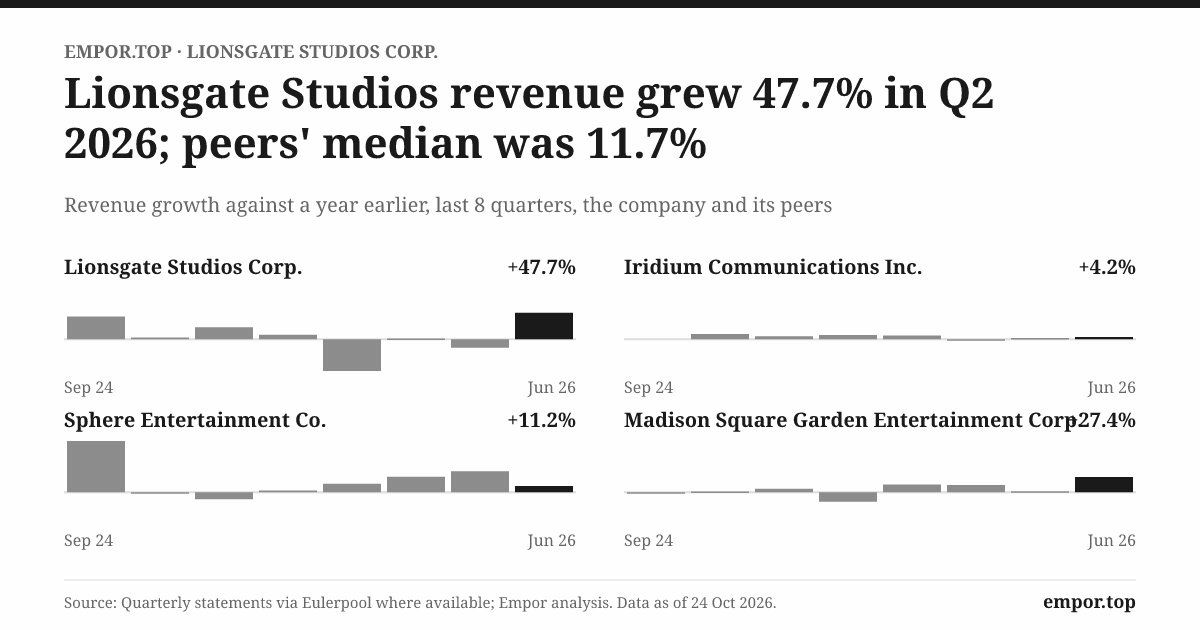
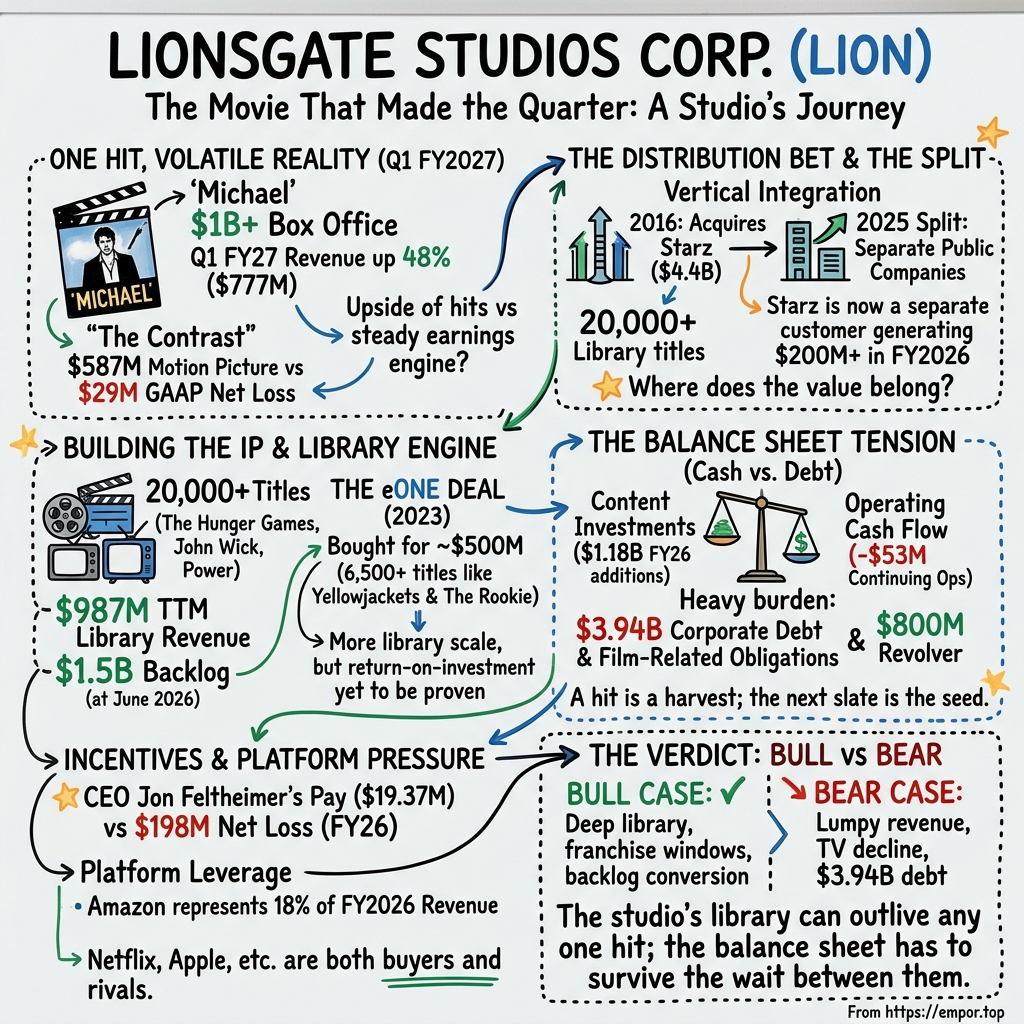
Three weeks later the hit arrived in the accounts. On August 6, Lionsgate Studios reported revenue of about $777 million for the quarter that ended in June, up 48% on a year earlier.3 Almost all of the jump came from one place. The Motion Picture segment's revenue more than doubled to about $587 million, and its segment profit went from roughly $2 million to $105 million, the best first quarter that division had ever recorded.3 Chief financial officer James Barge told analysts plainly that Michael drove the result.4
And yet, on the line that ordinary shareholders tend to look at first, the company still lost money. The net loss from continuing operations attributable to shareholders was about $29 million, or ten cents a share.3 The biggest hit in the studio's history produced a quarter of record film profit, positive operating income and a GAAP loss, all at once.
That contradiction is the place to start, because it is the whole company in miniature. A film studio's income statement is built around a peculiar rhythm. Money goes out for years before a movie opens, through development, production, marketing and the salaries of the people who decide what to make. Then a title is released and the accounting starts charging its cost against revenue in proportion to how much the film is expected to earn over its life. Add interest on a large debt load, overhead and the fees paid to the stars and producers who share in a hit, and a spectacular quarter at the box office can still leave the bottom line in the red. The question for an investor is whether that pattern reveals a durable business with strong assets and heavy financing, or a volatile one that lives and dies by release dates.
There are four threads to pull. The first is whether the value of Lionsgate's library and franchises can outlast the swings in its release schedule, so that the company earns from old titles while it waits for new ones. The second is whether the cash thrown off by hits actually pays down debt after the next slate of films and shows has been funded, or whether it simply rolls into the next round of production. The third is whether the studio can grow without leaning too heavily on a handful of platform buyers, Amazon and the newly independent Starz above all. The fourth is whether the people running Lionsgate are paid in a way that matches what shareholders actually experience.
A word on boundaries before going further, because the company's history makes them slippery. Lionsgate Studios Corp. is the studio business, a British Columbia corporation listed on the New York Stock Exchange under the ticker LION since the separation from Starz in May 2025.5 Starz Entertainment, the premium cable and streaming network Lionsgate bought nearly a decade ago, now trades on its own.6 Before that split, the studio's predecessor reported as part of a larger group, so long-run financial histories mix the old Lions Gate Entertainment, the studio that was carved out in 2024, and today's company. Some of the decade-long figures that circulate about Lionsgate describe a business that no longer exists in that form. They are context, not a clean record of the standalone studio.
The quarter also hid a second story inside the first. While films soared, the Television Production segment's revenue fell from about $289 million to $189 million and its segment profit from $26 million to $10 million, which management attributed to the timing of episode deliveries.3 Television is the slower, steadier half of the house: networks and streamers commission series, Lionsgate makes them, and revenue is recognized when episodes are delivered. The company has promised that scripted deliveries will double in the fiscal year ending March 2027.3 Whether that promise holds will say more about the studio's earning power than any single box-office weekend.
So here is the investor's version of the opening scene. Michael demonstrated what owning a film and all of its downstream rights can do in a good year. It did not demonstrate that Lionsgate has a steady earnings engine, because one exceptional release cannot do that. To understand why a studio with a billion-dollar movie still reports a loss, the story has to go back to the moment the old Lionsgate decided it needed to own the pipe as well as the water.
 Subscribe on LinkedIn
II. The Studio That Bought Its Distribution Channel
Jon Feltheimer had spent his career on both sides of the screen before he ever ran Lionsgate. He was president of TriStar Television in the early 1990s, then ran Columbia TriStar Television and the wider Columbia TriStar Television Group while serving as an executive vice president of Sony Pictures Entertainment until 1999; before that he had worked at New World Entertainment.7 In March 2000 he became chief executive of Lions Gate Entertainment, a young distributor with Canadian roots, a scrappy reputation and very little in the way of a library.7 He has held the top job, at the old company and now at the studio, for more than a quarter of a century. Alongside him for most of that run was Michael Burns, the vice chairman, the deal-maker of the partnership and the man who still fields the questions about mergers on earnings calls. Together they built Lionsgate the way an outsider has to build a studio in Hollywood: by buying what the majors would not sell cheaply and by betting on franchises that the majors had overlooked.
The decisive early moves were acquisitions. In January 2012 Lionsgate bought Summit Entertainment, the home of The Twilight Saga, for $412.5 million in cash and stock, paid mostly with cash already sitting on Summit's balance sheet.8 Twilight had grossed more than $2.5 billion worldwide, and the deal put it under the same roof as a book adaptation Lionsgate was about to release on March 23 of that year: The Hunger Games.8 Feltheimer and Burns described the transaction as part of a long-term strategy of "building a diversified worldwide media company," and the merged library came to about 13,000 titles.8 With two young-adult franchises and an action series that would become John Wick, Lionsgate had finally become a studio that could be compared with the majors on the release calendar, if not on corporate scale.
But a library is only as valuable as the prices buyers pay to show it, and by the middle of the 2010s Feltheimer and Burns could see the buyers changing. Netflix was turning from a customer into a rival producer. Cable bundles were starting to leak subscribers. The old model, in which an independent studio made a film and then sold its pay-television window to an HBO or a Showtime or a Starz, looked exposed to a world in which the platform owners might decide they no longer needed outside suppliers. The chess move Lionsgate chose was to buy one of the platforms.
In December 2016 Lionsgate closed its acquisition of Starz for about $4.4 billion in cash and stock.9 The premium network had nearly 25 million U.S. subscribers at the time, and the combined company pitched itself as a vertically integrated global content business: a major independent television producer, a premium pay network, a film studio and a combined library of more than 16,000 titles.9 Feltheimer and Burns said they were "more excited than ever at the value created by the combination."9 The logic was easy to state. Lionsgate would no longer have to rent shelf space for its movies and shows. It would own a shelf, collect monthly fees from subscribers, and use its own content to keep them.
The logic was harder to execute. Owning Starz meant owning a business with very different economics: a subscriber base to defend, carriage negotiations with cable distributors, marketing spend aimed at churn rather than opening weekends, and a direct-to-consumer streaming push that required investment just as the giants were spending tens of billions on the same idea. It also meant financing a much larger company. Feltheimer's studio, which had long operated with a mix of production loans and corporate debt, now carried acquisition debt for a cable network whose core market was shrinking. The integrated group became harder to value, because investors who liked a content library did not necessarily want a sub-scale streaming service attached to it, and vice versa.
The subscriber numbers tell the direction of travel. Starz entered the group with nearly 25 million premium subscribers in the U.S.; by December 2024, shortly before it left, it had about 20 million across the U.S. and Canada.6 Those are group-level figures about a business the listed studio no longer owns, and they say nothing directly about the studio's economics today. What they do show is that vertical integration did not settle the question of where value belonged. The pipe was not getting fuller.
So the group began to take itself apart. The first step, in May 2024, was to carve the studio into a separately traded company through a merger with a special-purpose acquisition company, after which the parent still owned the large majority of it, about 87.8% immediately before the final split.5 The second step came on May 6, 2025, when the separation completed: Starz Entertainment became a standalone company trading on Nasdaq under STRZ, and Lionsgate Studios began trading on the NYSE as LION, with its old two-class share structure collapsed into a single class of common stock.56 More than 99% of both classes of shareholders voted for it.6
What did the studio gain? Focus, first. Lionsgate now describes itself as a "standalone, pure play content company," a seller to every platform rather than a supplier with a captive in-house buyer.10 Management has made a virtue of this, arguing on its February 2026 call that not owning a proprietary streamer gives it flexibility in licensing.11 What did it lose? The certainty of a sister company that had to buy its output, and the subscription revenue that came with it. Starz's monthly fees no longer show up in the studio's income statement.
The relationship did not end, however. It became a contract. In the fiscal year to March 2026, Lionsgate recorded about $200 million of licensing revenue from Starz, and it received about $305 million from Starz under its licensing agreements during the year.5 Some of those agreements are long-dated: library licenses running through at least 2028 and a pay-one television and streaming arrangement, the first premium window after a film's release, running through at least 2036.5 Before the separation, sales from the studio to Starz were eliminated in consolidation as internal transfers; now they count as revenue from an outside customer.5 That accounting change is one reason the studio's reported consolidated revenue looked roughly flat in fiscal 2026 even as its two segments shrank, a quirk worth remembering when the numbers come up later.
The Starz chapter, then, is best read as a lesson the old group paid for rather than a current asset of the listed studio. It gave Lionsgate a premium outlet for its films, and it gives the studio a long-term customer today. It also left behind a balance sheet shaped by acquisitions and a habit of thinking about the library as the company's crown jewel. That library is where the next part of the story lives.
III. When the Library Became a Production Business
Walk into the Lionsgate catalogue and it feels less like a film studio than a warehouse district. There are more than 20,000 film and television titles in the company's library.5 There are the franchises everyone knows—The Hunger Games, John Wick, Saw and Twilight—and the television worlds built around Power and The Rookie. There are also thousands of titles that most viewers would never connect with the studio at all, from Dirty Dancing to prestige pictures picked up through acquisitions. Management counts more than 40 active franchise properties across film, television, games and live experiences.11
To understand what that warehouse is worth, start with the product. Lionsgate develops and produces films and series, distributes some titles itself, and licenses the rights to others by territory, by platform and by window.5 The economic unit is a title, a license, a theatrical release or a delivered episode, not a subscriber seat.5 Some contracts include box-office participation or royalties tied to sales or usage, and the company also earns commissions and producer fees through its talent-management business, 3 Arts Entertainment.5
Follow a film through its life and the logic becomes clear. A movie opens in theaters, where the studio shares ticket revenue with exhibitors and spends heavily on prints and advertising. A few weeks later it moves to premium video-on-demand, then to digital purchase and rental, and then to physical home entertainment. After that comes the pay-one window, often a premium network such as Starz, followed by streaming and free television licenses that can be resold over and over, region by region, for decades.5 Each window is a separate sale of the same asset. If the first window is the harvest, the later ones are the orchard that keeps bearing fruit.
That is why theatrical revenue is a surprisingly small part of the Motion Picture segment. In the fiscal year to March 2026, theatrical revenue was just 10.9% of the segment's revenue; home entertainment was 44.1%, international 28.3% and television licensing 14.0%.5 The glamour is at the multiplex; the money is in the long tail. Television production works differently. A network or streamer commissions a season, Lionsgate produces it, and revenue arrives as episodes are delivered. In the fiscal 2026 mix, nearly half of the Television Production segment's revenue came from domestic television, with a quarter from international sales.5 Episodic production is closer to contract manufacturing with an ownership kicker: the buyer pays for delivery, and Lionsgate often keeps rights it can sell later in other territories or windows.
Two numbers suggest the warehouse is busy. On the August 2026 call, Barge reported trailing twelve-month library revenue of $987 million and a backlog of $1.5 billion, up 21% from a year earlier.4 The backlog is the value of contracted licenses that have not yet been recognized as revenue because the titles have not yet become available to the buyer; at March 2026, the company's broader remaining performance obligations were $1.8 billion, including $1.3 billion of backlog.5 Management has said that about 90% of the March backlog should convert within 24 months.2 Jim Packer, who runs worldwide television and digital distribution, added a striking piece of evidence on the May call: in fiscal 2026 Lionsgate sold 17 library series to the six largest streamers, against four in fiscal 2022, and ten of those 17 reached the top ten on their platforms.2
That is the bull case for the library in a paragraph: old shows and films are being bought by the biggest platforms, at a rising rate, and they perform when they get there. Now the test. The same library revenue figure that topped $1 billion in each of the three quarters through March 2026, and reached $1.05 billion in December 2025, slipped to $987 million in June, which management described as roughly flat year over year.2114 An analyst from StoneX, Matthew Harrigan, used the August call to press on exactly this, asking whether hit films can lift library revenue and whether an expected roll-off of library contracts over three years can be offset; Feltheimer answered that technology has historically benefited strong library content, and Packer suggested new formats might create buyer demand.4 Those are reasonable answers. They are not data.
The company is also trying to sell the same titles through more doors. On the February call, management said television series made up about a third of library revenue, and that free ad-supported streaming channels and ad-supported video-on-demand, the FAST and AVOD services that run old shows with commercials, were about 6% of library revenue, with an ambition to lift that to 10% to 15%.11 Digital sale and rental added about another tenth.11 Each new channel is another buyer for an old asset, which is exactly how a library is supposed to work. But the ambition itself is a reminder that the traditional licensing buyers alone were not pushing library revenue higher fast enough.
What would prove a moat? A business with real pricing power over its library would show it in renewal rates, in price realized per title as contracts roll over, or in returns on individual titles across their lifetimes. Lionsgate does not publish any of these. It does not disclose a recurring-revenue percentage or a common minimum-commitment profile across its licenses.5 The one minimum-guarantee figure it does report, mostly from foreign distribution of films, was about $175 million in fiscal 2026, a modest slice of revenue.5 So the honest verdict is narrower than the brochure version. The library and its franchises are real commercial assets, licensed across windows and years, and recent sales to the largest streamers show genuine demand. The filings do not show that scale gives Lionsgate pricing power, because the company does not publish the evidence that would show it.
There is one more mechanism hidden in this section, and it is the one that matters most to the cash story. A library does not sit still. Titles age, and their licensing value fades unless they are refreshed by new entries in the same franchise or new hits that drive viewers back to the old ones. Lionsgate keeps the warehouse stocked by spending heavily on new content; in fiscal 2026, additions to film and television investments were $1.184 billion, broadly in line with the year before.5 That spending is what turns a library into a production business, and it raises the question that will follow this story to the end: can the library's cash yield fund the next slate and pay down debt at the same time? The company's answer to that question, in late 2023, was to buy more library.
IV. The eOne Deal: More Library for Less Than Hasbro Paid
On August 3, 2023, two companies issued press releases about the same deal, and they read like the two sides of a divorce settlement. Hasbro, the toy company behind Monopoly, Transformers and Peppa Pig, announced that it was selling the film and television business of Entertainment One. Lionsgate announced that it was buying it.1213
The backstory made the price remarkable. Less than four years earlier, on December 30, 2019, Hasbro had completed its acquisition of the whole of eOne, a Canadian entertainment company, in an all-cash deal valued at about £2.9 billion, roughly $3.8 billion for the shares, plus about £0.6 billion of eOne debt that it planned to redeem or repay.14 Hasbro's chief executive at the time, Brian Goldner, said the deal accelerated its "blueprint strategy" and spoke of "substantial synergies and a great cultural fit."14 The vision was a toy company that owned the stories behind its toys, with eOne's preschool brands, its film and television studio and its music business inside the same tent.14
By 2023 the vision had changed. Hasbro's new chief executive, Chris Cocks, wanted to focus on the company's own brands and move to what he called an asset-light model for future live-action entertainment, relying on licensing and co-productions rather than owning a studio.13 So Hasbro kept the parts of eOne that served its toys: its animation efforts, including Peppa Pig, Transformers: EarthSpark and My Little Pony, and a development team overseeing more than 30 projects built on Hasbro brands.13 It put the rest up for sale and planned to use the proceeds to retire at least $400 million of floating-rate debt.13
Lionsgate's price for what Hasbro was selling was about $500 million, made up of $375 million in cash, subject to adjustments, plus the assumption of production financing loans.12 For that, it got a library of about 6,500 film and television titles, active productions including The Rookie on ABC, The Rookie: Feds and Yellowjackets on Showtime, the unscripted business behind Naked & Afraid on Discovery, and film rights to titles such as 1917, Green Book, Atomic Blonde and The Woman King, with television library titles including Grey's Anatomy and Criminal Minds.1213 Lionsgate also secured film development rights to Monopoly.12 Feltheimer said the acquisition would be "immediately and highly accretive."12 The deal closed on December 27, 2023, and Lionsgate funded the cash portion with about $375 million of revolver borrowings.15
Here is where the headline comparison gets seductive, and where it needs care. On paper, Hasbro paid around $4 billion for eOne's shares, and Lionsgate bought the film and television business for around an eighth of that. The temptation is to say that Lionsgate picked up a bargain from a forced seller. But the perimeters are different. Hasbro's 2019 purchase included the preschool brands it kept, which were arguably the main prize, and a music business that did not come with the Lionsgate purchase.1412 The price gap is a warning about how quickly entertainment assets can be repriced when their owner's strategy changes. It is not an apples-to-apples multiple, and it does not by itself prove that Lionsgate got the better side of the trade.
What did eOne actually contribute? In its first full year under Lionsgate ownership, the fiscal year to March 2025, eOne generated about $592 million of revenue for the studio business, of which about $468 million came through Television Production and about $123 million through Motion Picture.15 That is meaningful scale for a purchase price of around half a billion dollars. eOne brought procedural network television, prestige cable and a stable of unscripted formats, a mix that should, in theory, make the television business less dependent on a few big scripted bets.
Then the next year happened. In fiscal 2026, Television Production revenue fell from about $1.61 billion to $1.04 billion, a decline of roughly 35%, which the company attributed mainly to a significantly lower number of episodic deliveries.105 Taken together, the studio's two segments generated about $2.66 billion of revenue before eliminations, down about 17% from $3.2 billion.5 Whatever the mix of causes, the added eOne business did not prevent the television segment from shrinking sharply. The acquired series are still there; The Rookie was renewed for a ninth season and ABC picked up a spinoff, The Rookie: North.2 But the segment they joined got smaller.
There is also a financing tail. Part of eOne's library sits behind a dedicated eOne IP credit facility secured mainly by titles acquired in the deal, which stood at about $371 million at March 2026.515 In other words, the library Lionsgate bought for a modest cash price is also collateral for a meaningful slice of the company's corporate debt. That is efficient financing; it is also a reminder that the acquired titles have to earn enough to service the borrowing secured against them.
The eOne deal also overlapped with the studio's own route to the public market, which is easy to confuse. In December 2023, the same month eOne closed, the old Lionsgate agreed to combine its studio with Screaming Eagle Acquisition Corp., a special-purpose acquisition company; that business combination closed on May 13, 2024, and the studio began trading on Nasdaq as LION.16 Investors in a private placement, or PIPE, subscribed for roughly 28 million shares at prices around $9.63 to $10.17 each, and the combination brought gross proceeds to the studio predecessor.16 The S-1 that followed in mid-2024 was not a primary initial public offering. It registered the resale of shares by existing holders, and the company stated plainly that it would receive none of the proceeds; one supplement covered about 4.2 million shares.1617 The proceeds that mattered came from the business combination itself, not from the resale prospectus.
So where does the eOne acquisition stand nearly three years on? The strategic fit is clear: more library, more production capacity, more buyers. The return is not yet demonstrated. A full return-on-invested-capital case would set the cash generated by the acquired titles and productions against the purchase price, the assumed production loans and the debt secured against the library, net of the amortization of acquired content and any impairments. The company does not report eOne's results separately in a way that allows that calculation today. What an investor can watch is narrower: acquired-content amortization, Television Production segment profit, any impairments on acquired titles, and whether the eOne facility is paid down from the titles' own cash. Until those numbers move the right way, eOne remains a sensible-looking purchase that has yet to prove it was a profitable one. And the studio that made it soon found itself standing alone, with the debt in plain view.
V. The Split Put the Studio on Its Own Balance Sheet
When LION began trading on the New York Stock Exchange in May 2025, the separation was sold as a clarifying event. Investors would no longer have to value a film studio and a cable network bundled together; they could buy the content business alone. In that sense it worked. For the first time, an investor could look at one set of accounts and see exactly which assets, which operations and which obligations belonged to the studio.
What they saw was a business that runs on borrowed money in three different ways. At March 2026, Lionsgate had about $1.98 billion of corporate debt and about $1.96 billion of film-related obligations, a combined $3.94 billion, plus about $301 million of operating lease obligations reported separately.5 Those are very different kinds of debt, and the difference is the key to reading the company.
Corporate debt is the long-dated money that funds the company as a whole. At March 2026 it consisted of about $390 million of 6% senior notes due April 2030, the roughly $371 million eOne IP facility due July 2029, a larger $1.19 billion facility secured on Lionsgate's own intellectual property due September 2029, and a small facility at 3 Arts due May 2029.5 On top of that sits a new $800 million revolving credit facility maturing in May 2030, arranged as part of the separation.5 No single corporate maturity looms in the next couple of years, which is a genuine strength.
Film-related obligations are a different animal. They are production loans and facilities secured on tax credits and contracted backlog, borrowed to make specific films and shows and repaid as those titles are delivered and paid for.5 Think of them as a builder's construction loan: the money goes out to make the house, and it comes back when the house is sold. At March 2026, about $1.29 billion of these obligations were classified as current, due within a year, because they turn over with the production calendar.5 The company estimated about $1.46 billion of principal and interest payments due over the following twelve months across its debt and film obligations.5 That is not a sign of distress on its own, since most of it should be repaid from the titles it financed. It is a sign of how much depends on those titles being delivered and collected on time.
The capital history behind this balance sheet is worth keeping straight. The 2024 resale prospectus brought the company no money at all.16 The SPAC combination did bring gross proceeds, including the private placement, and part of that money was used at the predecessor level to address debt.16 The separation itself raised nothing; it divided the existing group and its obligations. And the share count has crept up: about 290 million shares were outstanding at March 2026 and about 297.5 million by July, with a 2025 incentive plan of up to 58 million shares standing behind future awards.57 The company has disclosed no buyback program.5 Shareholders' equity on the balance sheet is negative, which is why conventional debt-to-equity ratios are meaningless here.5
Management's preferred lens is net debt divided by trailing adjusted OIBDA, its own version of operating profit before depreciation and amortization, in which the amortization of film and television content is still treated as a cost.10 On that measure the trajectory has been striking. Leverage stood at 7.4 times at December 2025, about 6.1 times at March 2026 and 4.3 times at June 2026, when Barge put net debt at about $1.5 billion and told analysts the company had reached its mid-four-times target early.1124 He guided to leverage in the low-to-mid four times through the fiscal year, cautioned that a possible put option at 3 Arts could add about half a turn, and set a target of 3 to 3.5 times in fiscal 2028 and below three times after that.4
Now reconcile that with the balance sheet. At June 2026, corporate debt was about $1.9 billion and cash about $426 million, which yields roughly the $1.5 billion of net debt management cited.3 Film-related obligations, at about $2.04 billion, sit outside that calculation entirely.3 That is a defensible choice, because production loans are self-liquidating against specific titles, and most studios present them separately. But it means the 4.3 times is a measure of corporate leverage only. And over the same quarter in which corporate net debt fell by about $121 million, film-related obligations rose from about $1.95 billion to about $2.04 billion.4103 Some of the debt reduction on one side of the balance sheet was matched by more production borrowing on the other, as the company geared up to double its scripted output. That is not a contradiction of management's claim. It is a reason to track both numbers together.
Michael Burns, the vice chairman, also had to field the question every independent studio eventually faces. Asked about press reports of buyer interest, he said "we haven't engaged in any substantive conversations," while noting it sees "real strategic optionality."4 Feltheimer had said in May that any strategic conversations "would probably involve some deleveraging, but they will for sure be driven by the strategy not the delevering."2 Those comments sit beside a governance change: the shareholder rights plan, a poison pill that had protected the newly separated company from unsolicited bids, expired in May 2026, which management said would not change the business materially.2
The separation, then, clarified ownership without changing the underlying need. The studio's financial strength depends on recurring cash generation across a full slate, not on the corporate structure. It has valuable content, and it has to keep funding the next slate while paying down the last one. That is the hinge on which every quarter now turns.
VI. The Hit Factory Meets the Delivery Calendar
Picture the competitive field Lionsgate plays on. On one side are the integrated giants: Disney, Comcast's Universal, Warner Bros. Discovery, Sony Pictures and Paramount, each with a studio, a vast library and, in most cases, a streaming service of its own. On the other is Netflix, the largest streamer, which makes its own shows and films at enormous scale and still buys from outside studios. Amazon, Apple, Hulu, HBO Max and Peacock sit in between, each both a customer and a competitor. Every one of them fights for the same scarce inputs: writers, directors, stars, intellectual property, audience attention and platform budgets.
Lionsgate's position in that field is unusual. It is far smaller than the integrated rivals, with only about 916 full-time employees worldwide in May 2026.5 It has no streaming service of its own since Starz left. Published market-share comparisons are not like-for-like measures of studio economics, because a box-office share captures only the first window. Still, they give a sense of reach: Feltheimer said that Michael and The Housemaid helped Lionsgate reach more than 10% of the domestic box office in the first half of calendar 2026.4 For an independent, that is a very good half-year. It is also a half-year built on two titles.
That is the war-game logic of an independent studio. It wins when it picks the right titles, budgets them carefully, shares risk with partners and sells the downstream windows to whichever platform pays most. On Michael, for example, Universal handled international distribution.2 The economics come from title selection, production budgets, talent costs, marketing, theatrical performance, licensing terms, window timing and eventual library reuse. Adam Fogelson, who chairs the Motion Picture Group, described the right yardstick on the August call: a film's profitability is measured over roughly a ten-year cycle, front-loaded in the early years.4 It is a useful reminder that the record quarter captured only the first chapter of Michael's economics.
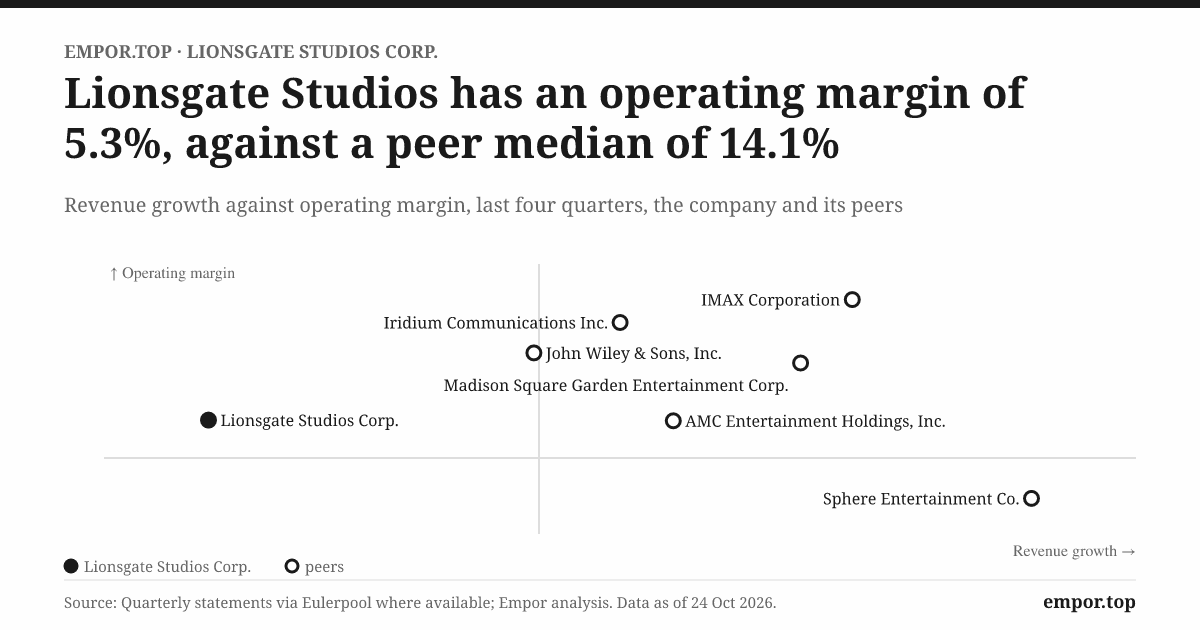
So treat "the studio" as two businesses, because the numbers insist on it. In fiscal 2026, Motion Picture revenue edged up to about $1.62 billion from $1.60 billion, but its segment profit fell from about $304 million to $279 million.10 Television Production revenue dropped from about $1.61 billion to $1.04 billion, and its segment profit slipped from about $137 million to $125 million.10 Reported consolidated revenue was about $2.63 billion.5 Film supplied more of both revenue and profit, and television, despite its steep revenue fall, held its profit better than its revenue, which suggests that the lost deliveries were lower-margin work or that cost cuts helped. The film segment's profit decline came in a year when the company spent about $100 million on U.S. marketing for three wide releases in the December quarter alone.11 One of those releases, The Housemaid, became the kind of surprise that independents live for: it carried the March quarter, when Motion Picture segment profit rose 39%, and management now treats it as a new franchise with a sequel in development.1011 That is how the hit factory is supposed to work: spend heavily up front, find out which bets pay, and turn the winners into series.
The timing problem is sharpest in television. Television revenue depends on episodes delivered, and episodes are delivered on the buyer's schedule, not the studio's. In May, Kevin Beggs, who chairs the Lionsgate Television Group, reported that 12 of 13 scripted series had been renewed, and management guided that episodic deliveries would nearly double in fiscal 2027, with about 90% of renewed-series episodes landing between July 2026 and March 2027.2 In August, Beggs said the company was "on the cusp of going perfect 13 for 13" in scripted renewals across 12 different buyers.4 The doubling was first promised in February and repeated in May and August.1123 Consistent messaging is a good sign. It is not delivery. The first quarter, with television revenue down by a third, was the quarter the company had already said would be light.23 The proof will be in the three quarters that follow.
Then there is bargaining power. Amazon and its subsidiaries accounted for about 18% of Lionsgate's revenue in fiscal 2026, up from 16% the year before and 14% two years before.5 No other single customer exceeded 10%, and the company has no long-term agreements with home-entertainment retailers.5 A rising share from one buyer can mean two things at once: that the buyer values the studio's content, and that the studio depends more on the buyer's terms. Netflix's August deal for Power, licensing the first four Power series internationally and the original series worldwide for three years, shows the other side of the coin: Lionsgate can play buyers against each other, including selling a Starz-associated franchise to a Starz competitor.4 Management's own framing of industry consolidation was candid; Feltheimer said that "uncertainty is the worst thing for our business," while arguing that a better-financed streamer formed from a Paramount and Warner Bros. Discovery combination could be a good customer.4 Fewer, larger buyers might pay more per title. They might also pay less, because a studio has fewer places to go.
This is the place to test the library moat once, with the evidence at hand. Twenty thousand titles, repeat licensing across windows and a track record of selling series to the largest streamers support breadth and bargaining options. A moat in the strict sense would require proof that customers cannot easily source similar content elsewhere or shift their spending, and that Lionsgate can raise prices as a result. The company publishes no retention rates, no price realization on renewals and no title-level returns that would demonstrate it. Meanwhile its largest customer's share is rising and its trailing library revenue has flattened. The fair conclusion is that the library is a real competitive asset that gives the studio options, but the evidence supports "valuable inventory" more than "pricing power."
Artificial intelligence belongs in this conversation at its economic weight, no more. The 2026 annual report flags low-cost, AI-enabled content as a possible substitute that could pressure demand for professionally produced film and television.5 Management frames AI as an efficiency opportunity. Lionsgate appointed a chief AI officer, Kathleen Grace, reporting to Burns, and has an existing partnership with the AI video company Runway.11 Feltheimer said in August that about 95% of employees use AI tools and that AI can "reduce cost, enhance revenue, and accelerate the production process," though no savings figures were given.4 The investment question is which effect wins. If AI lowers the cost of making a show by a meaningful fraction, an owner of franchises and a disciplined producer could earn wider margins. If it floods platforms with cheap, good-enough content, the price a streamer pays for a licensed library title could fall. Today neither effect shows up in the numbers.
The verdict on this section is a qualified one. Motion Picture supplied more revenue and profit in fiscal 2026, and the June quarter confirmed the film upside dramatically. Television's revenue collapse was tied to fewer deliveries, and its rebound is promised and partly contracted, but not yet delivered. Neither engine has yet shown consistency. And even when both engines run, the cash they generate arrives on a different timetable from the profits.
VII. The Cash That Arrives Late—and the Debt That Does Not
Here is a puzzle that looks simple and is not. Over the fourteen fiscal years from 2013 through 2026, the reported entity that is now Lionsgate Studios recorded cumulative net losses of about $210 million, yet generated about $383 million of cash from operations and about $266 million of free cash flow after capital spending.5 It paid no dividends over that span, and its cash and short-term investments rose by only about $13 million between the end of fiscal 2012 and the end of fiscal 2026.5 Cash flow beat profit, which sounds healthy. But those totals cross the old group, the carved-out studio and the separated company, and they average across very different businesses. They cannot establish what the standalone studio generates.
The fiscal 2026 annual report is the cleaner starting point, and it shows the content cycle in motion. During the year, Lionsgate charged about $1.02 billion of film and television amortization against its earnings.5 Amortization is the accounting cost of content already made, spread across the period in which it earns revenue, and it is not a cash payment in the year it is booked. At the same time, the company spent about $1.18 billion on additions to film and television content, which is real cash going out to make the next slate.5 That relationship is the heart of the business. In a stable year, a studio's cash spending on new content should look roughly like its amortization of old content, the way a farm's spending on seed should resemble the value of last year's harvest. In fiscal 2026 Lionsgate spent more on new content than it expensed on old, which is what a company does when it is rebuilding a slate. It also explains why accounting earnings, even after the add-back of non-cash costs, did not turn into much cash.
Working capital added its own swings. Receivables provided about $29 million of cash as collections ran ahead of new billings, payables and accruals used about $73 million, and participations and residuals, the sums owed to talent and guilds, provided about $47 million.5 There were also about $78 million of non-cash share-based compensation and $17 million of content and other impairments.5 Put it together and operating cash flow from continuing operations was negative $53 million for the year; discontinued operations, the Starz stub before the May 2025 separation, contributed about $78 million, leaving total operating cash flow at about $25 million.5 The continuing business, in other words, consumed cash in fiscal 2026.
Now look at the company's own measure, adjusted free cash flow, because how it is built changes how it should be read. Lionsgate starts with operating cash flow from continuing operations, subtracts capital expenditures, and then adds net borrowings or repayments of production loans and production tax-credit facilities.10 The logic is that production spending sits in operating cash flow while the loans that fund it sit in financing, so matching them gives a truer picture of a slate's economics. In fiscal 2026 the adjustments cut both ways: repaying about $126 million of production loans, offset by about $85 million of new tax-credit borrowing, turned negative $53 million of operating cash into negative $107 million of adjusted free cash flow.10 A year earlier, the same arithmetic ran the other way. Operating cash from continuing operations was negative $102 million, but about $184 million of net new production borrowing helped produce positive adjusted free cash flow of about $84 million.10 In one year the measure was flattered by new borrowing; in the next it was penalized by repayment. Neither year shows the business generating free cash on its own over a full cycle.
The first quarter of fiscal 2027 looked much better. Operating cash flow from continuing operations was about $54 million, and adjusted free cash flow was about $129 million, compared with outflows a year earlier.3 But in the same quarter, film-related obligations rose by roughly $87 million, so some of the improvement in adjusted free cash flow reflects production borrowing that will have to be repaid when the new episodes and films are delivered.103
Receivables deserve a careful look rather than an assumption about who pays late. At March 2026, net accounts receivable were about $785 million, up from about $586 million a year earlier, and tax-credit receivables, money owed by governments under film and television production incentives, were about $640 million.5 The company's allowance for bad debts is small: it rose from about $5.6 million to $6.3 million after a $2.4 million provision and $1.7 million of write-offs.5 Lionsgate says it reviews aging, customer condition and collection history, but it does not publish an aging schedule or name overdue balances.5 Its customers are mostly large platforms and distributors, so credit risk looks low. The bigger point is timing. A receivable that rises by about $200 million in a year is cash earned in the accounts but not yet in the bank.
There is a second wrinkle. Lionsgate sells some of its receivables to third parties, accounted for as transfers without recourse, and classifies the proceeds as operating cash flow.5 Selling receivables is common in the industry and is a legitimate way to manage liquidity, much as a homeowner might take a lump sum today in exchange for future rent. But it pulls future collections into the current period. An investor who wants to know whether operating cash flow is recurring should pair it with receivable sales, tax-credit collections and the change in production borrowing before calling it the business's natural cash generation. The company does not lead with that combined view; a careful reader has to build it.
Treasury and currency matter at the edges of this bridge. Cash was about $342 million at March 2026, with about $78 million more in restricted cash, rising to about $426 million by June.53 Productions shot in Europe, Canada and elsewhere generate costs and tax credits in local currencies, so Lionsgate uses forward contracts to hedge them. At March 2026 it held forwards equivalent to about $231 million in euros, $30 million in Hungarian forint and $30 million in Canadian dollars, with smaller sums in other currencies, all maturing within 21 months.5 The company says these are for hedging, not trading.5 Hungary's appearance is a clue to where films get made: production follows tax incentives around the world, and the currency risk follows the production.
So, does accounting cash conversion turn into free cash after content investment, receivable financing and debt service? Not yet on a sustained basis. Content amortization explains part of the gap between earnings and cash, but financing the next slate and the timing of working capital matter just as much. The forward test is concrete: sustained reduction in net debt, counting both corporate debt and film obligations, from operating cash after content investment, without leaning on receivable sales or incremental production borrowing. If that happens through a full slate cycle, the library thesis gets its proof. Until it does, the people setting pay at Lionsgate are rewarding a different number.
VIII. Jon Feltheimer's Pay Meets the Loss Column
In the fiscal year that ended in March 2026, Jon Feltheimer, now 74, received total compensation of about $19.37 million, according to the company's proxy statement.7 That included about $10.68 million of stock awards and a $6.5 million bonus.7 In the same year, Lionsgate reported a net loss attributable to shareholders of about $198 million.5 The juxtaposition writes its own headline. The more useful exercise is to understand how the pay was set and what it rewards.
Lionsgate's bonuses are tied principally to adjusted OIBDA. In fiscal 2026, adjusted OIBDA came in at about $261 million, against a plan of $270 million.710 The compensation committee funded the bonus pool at 87% of target, below plan, reflecting the miss.7 That is a real sign that the committee responds to the measure it chose. Feltheimer's pay was about $9.8 million in fiscal 2025 and about $18.2 million in fiscal 2024, so it has swung with outcomes.7
The problem is the measure. Adjusted OIBDA excludes content impairments, restructuring, share-based compensation and, crucially, interest. It is a reasonable gauge of operating performance in a content business. But shareholders absorb what it leaves out: interest on almost $4 billion of corporate and film debt, impairments, and the dilution from stock awards. The company reported net losses in fiscal 2024 and fiscal 2025 as well, and the loss in fiscal 2026 was about $198 million.57 An incentive system can reward management for a rising operating measure while per-share results remain negative. That does not mean the system is wrong. It means alignment is a live question rather than a settled strength.
Ownership and governance shape how that question is likely to be answered. In the July 2026 proxy, Mark Rachesky's MHR Fund Management held about 12.7% of the company and Liberty 77, the Liberty Global-related holder, about 12.6%, followed by BlackRock at 6.8%, Jericho Capital at 6.3% and FMR at 5.0%.7 Rachesky, a physician-turned-investor who has sat on Lionsgate's board since 2009, is chair.7 Liberty Global's chief executive, Michael Fries, sits on the board as Liberty's designee.7 MHR and Liberty retain specified rights to nominate directors, along with voting, pre-emptive and registration rights, and a standstill agreement was signed in January 2026.7 Feltheimer is the only non-independent director on the eleven-member slate; the other ten are identified as independent.7 The board was refreshed in early 2026 when former U.S. Treasury Secretary Steven Mnuchin joined.11
The September 15, 2026 annual meeting gave shareholders a chance to respond. Say-on-pay passed with about 83% support.18 That is a pass, but not an overwhelming one; roughly one in six votes cast went against the pay package. Michael Fries received the highest withhold vote among directors, at about 19%.18 Neither number is a revolt. Both suggest that a minority of shareholders are uneasy about pay and about the influence of the large holders with special rights.
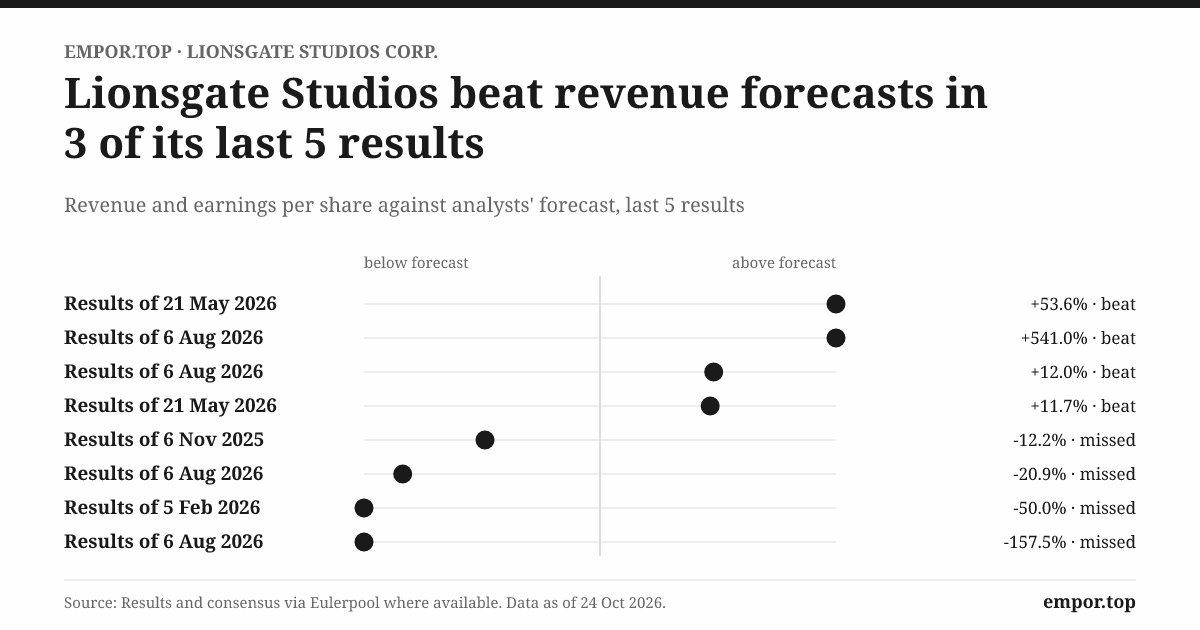
Credibility is better judged by behavior than by votes, and Lionsgate's recent calls give a fair test. In February 2026, Barge promised that leverage would fall to the mid-four times range by the middle of fiscal 2027 and to about three to three-and-a-half times in fiscal 2028, and that scripted deliveries would double.11 In May, management reported that leverage had already dropped from 7.4 times to about 6.1 times, repeated the doubling, and declined to give numeric guidance, with Barge saying "we are not going to put a range on that."2 In August, leverage was 4.3 times, ahead of the promise, and Barge said the company remained "highly confident" in its fiscal 2027 outlook.4 On leverage, management has done what it said, and early. On deliveries, the claim has been consistent but the proof is still ahead. On profitability of Michael, the size of a sequel budget, AI savings and possible deals, management avoided quantified answers when analysts asked.4 Analyst questioning on the August call was largely constructive rather than adversarial.4 The pattern is a team that hits the targets it sets on corporate leverage while keeping the numbers that would let outsiders judge returns on titles out of view.
Two governance items deserve tracking rather than conclusions. James Barge, chief financial officer since May 2025, had his employment agreement amended on July 20, 2026, with a stated term ending October 31, 2026, a base salary of $1.25 million and a target bonus of 240% of salary.7 A contract end date a week from now is worth watching for news of renewal or succession. And the auditor's evidence is reassuring as far as it goes: Ernst & Young gave an unqualified opinion on the fiscal 2026 financial statements and on internal controls, and its report identified no material weakness.5 One legal item also needs placing correctly. A noteholder lawsuit filed in 2024 over an Old Lionsgate note exchange relates to the former parent and the Starz transaction, and the company does not expect ordinary-course proceedings to have a material adverse effect.5 It is not a new operating liability of the studio.
The verdict is mixed rather than damning. The committee cut the bonus pool when the plan was missed, and management has met its own leverage targets. But the gap between the operating measure that sets pay and the GAAP losses shareholders experience leaves alignment unproven. With incentives, ownership and promises on the table, it is time to put the whole case together.
IX. Analysis & Bear vs. Bull Case
Lay the pieces on the table side by side. On one side sit a library of more than 20,000 titles, a billion-dollar hit, $1.5 billion of contracted backlog and an enterprise value of about $7.2 billion.54 On the other sit recurring GAAP losses, rising dependence on Amazon, close to $4 billion in corporate debt and film obligations, and a content slate that has to be refinanced every year. The market's verdict sits between them, and it is worth understanding how the market is reading the company before arguing about it.
Start with the industry's structure, using Michael Porter's five forces. Buyer power is high and probably rising. Platform buyers have leverage, and Amazon's share of Lionsgate's revenue has risen over two years.5 Consolidation among streamers could make the remaining buyers bigger still. Rivalry is intense: Lionsgate competes for talent, rights and attention with the integrated majors and the streaming giants, all of which are larger. The threat of substitutes is broad, from games and social video to, potentially, low-cost AI-generated content, a risk the company itself flags.5 Supplier power is meaningful, because writers, directors, stars and production partners are essential, and hits such as Michael involve profit participations that share the upside. The threat of new entrants is modest in premium scripted production, where scale, relationships and financing matter, but the same buyers who license Lionsgate's content also make their own. Overall, the structure favors the buyers and the stars over the studio in the middle, which is why the independent's edge has to come from somewhere specific.
Hamilton Helmer's seven powers frame where it might come from. Cornered resource is the strongest candidate: owned franchises such as The Hunger Games, John Wick and Power, and now Michael with its planned sequel, are assets no competitor can replicate.4 The weakness is that franchises are perishable and must be refreshed with new hits. Scale economies are limited; Lionsgate is small next to its rivals, and its library breadth gives it options rather than unit-cost advantages. Counter-positioning is plausible: as a seller to everyone without its own streamer, it can license to rivals that would never buy from each other, as the Netflix Power deal showed.4 Switching costs and network effects are largely absent, because buyers can choose other content. Brand matters for franchises, not for the Lionsgate name. Process power, a repeatable way of picking and budgeting hits, is what management implicitly claims; the record of one billion-dollar film and a string of mid-sized hits is suggestive, not proof. The honest summary is that Lionsgate has a cornered resource that must be renewed and a counter-position that depends on buyers continuing to want neutral suppliers.
The bull case, made as strongly as the evidence allows, runs like this. Franchise hits and a broad library create multiple licensing windows that compound over years. The $1.5 billion backlog is contracted revenue waiting to be recognized, and the promised doubling of scripted deliveries, backed by renewals across a dozen buyers, can restore television output.42 Corporate leverage has fallen sharply, and a sequel to Michael and a new Hunger Games film in November 2026 give the slate visible momentum.114 If those films perform and television delivers, the company could reach management's three-to-three-and-a-half-times leverage target in fiscal 2028 and look like a self-funding library business.
The bear case is equally concrete. Revenue is lumpy: the studio's segment revenue fell about 17% in fiscal 2026 before rebounding on one film.5 Television deliveries fell sharply, and the rebound has not yet been shown. Amazon's share has risen, while trailing library revenue has slipped back below $1 billion. The roughly $3.94 billion in corporate debt and film-related obligations leaves limited room for a prolonged weak slate, and the company's own adjusted free cash flow has depended on the direction of production borrowing.510 A couple of expensive misses in fiscal 2028 would expose how much of the deleveraging came from one hit.
A skeptical investor would also stress-test capital allocation, and the record is mixed. eOne added substantial production and library scale at a far lower headline price than Hasbro paid for the broader business, but its return has not been demonstrated, and the segment it joined shrank. The 2016 Starz purchase, the old group's largest bet, ended in a separation that implicitly conceded that integration had not created the hoped-for value; Starz is no longer a current studio asset. An activist would ask for title-level or franchise-level return disclosure, a debt bridge that includes film obligations, and pay metrics tied to per-share results or free cash after production financing.
Valuation needs similar discipline about denominators. At October 24, 2026, Lionsgate had a market value of about $3.7 billion and an enterprise value of about $7.2 billion, a figure that, when set against the balance sheet, captures film-related obligations as well as corporate debt.5 The often-quoted price-to-earnings ratio of 65 times is stale: it refers to the twelve months to September 2023, and trailing twelve-month earnings per share today are negative, at about minus 42 cents.35 The two enterprise multiples tell opposite stories. At about 6 times EBITDA, the stock looks cheap, but that EBITDA adds back the amortization of film and television content, which is the studio's main cost of goods; a studio that must keep spending around $1.2 billion a year on new content is not entitled to ignore it. At about 47 times operating profit, which does count content amortization, it looks expensive. Price to sales is about 1.3 times, and the free-cash-flow yield is about 2.6%. Read together, the market appears to be paying for the library and franchises, and for a recovery in earnings and cash that has not yet arrived, rather than for current profits. Peer multiples are hard to compare directly, because the integrated majors bundle studios with parks, networks or streaming.
Three measures will tell an investor more than any other. The first is television episodes delivered against the plan to double scripted deliveries, which stands at a promise with a light first quarter behind it. The second is cash from continuing operations after content investment, set beside receivable sales and the change in production borrowing; it was negative $53 million in fiscal 2026 and positive $54 million in the June quarter.53 The third is net debt and leverage on a consistent definition, ideally with film obligations shown alongside corporate debt; corporate leverage was 4.3 times in June while film obligations rose.43 The November 2026 results call should test all three, along with backlog conversion and management's answers on leverage.
X. Business & Investing Lessons
The first lesson starts with Starz's long contracts, which produced about $200 million in fiscal 2026.5 They are an annuity only as long as someone keeps licensing the library; the investor's job is to watch the renewals, not admire the shelf.
The second lesson sits in the gap between Michael's box office and the $1.18 billion Lionsgate spent on new content in the year before it opened.5 Every hit is preceded by years of spending and followed by a sequel budget; Fogelson said a second Michael film could go into production between late 2027 and the first half of 2028.4 A studio that treats a hit as profit to be distributed will find that it has eaten its seed corn. A hit is a harvest; the next slate is the seed, and the cash that matters is what remains after the seed is bought.
The third lesson comes from Hasbro's change of heart: it paid billions for eOne and sold the film and television business to Lionsgate for about half a billion.1412 The headline price tempts an investor to declare a bargain, but the return remains unproven. Scale can be bought cheaply and still take years to prove; the price you pay sets the hurdle, but only the cash the assets throw off clears it.
The fourth lesson comes from cash conversion: the continuing business consumed cash in fiscal 2026, and adjusted free cash flow swung with production borrowing.510 Lionsgate also sells receivables and books the proceeds as operating cash.5 Cash conversion in a creative business is a cycle, not a slogan; one good quarter cannot settle it.
The fifth lesson is about the separation: Lionsgate now sells to Starz under contract.95 The economics did not disappear; they moved from an internal transfer to an outside customer. Separate the businesses, then follow the contracts, because in entertainment the value often lives in who has the right to show what, for how long and at what price.
XI. Epilogue
On the evening of Thursday, November 5, 2026, Lionsgate will report its results for the quarter that ended in September and take questions from analysts at 5 p.m. Eastern.19 It will be the first report since the summer in which Michael lifted the film business to its best first quarter ever, and since management repeated that scripted deliveries would double this fiscal year.3
As the report approaches, Lionsgate still has a billion-dollar film earning in later windows, alongside the backlog, leverage and customer concentration already in view.45 It also has a new Hunger Games film due in November and a crowded slate behind it, from a Rambo film to The Resurrection of the Christ and reboots of Blair Witch and Magic.112 A great deal is about to be tested.
The first thing to watch is television. If scripted deliveries rise as promised and Television Production segment profit follows, the studio will have shown that its slower engine can recover, not just be forecast to recover. If deliveries slip again, the doubling becomes the latest in a line of timing explanations, and the bear case on lumpy revenue gains weight.
The second is how the backlog turns into revenue and cash. A backlog that converts without a comparable rise in production borrowing would suggest the library and new titles are funding themselves. A backlog that grows while film obligations grow alongside it would suggest the studio is pre-selling content it is still borrowing to make.
The third is net debt measured honestly: reduction after content investment, excluding receivable sales. Management's leverage figure has moved quickly in the right direction. The next few quarters will show whether it keeps moving once the Michael cash has been collected and the bigger television slate has to be financed.
The fourth is the shape of the customer list. Amazon's share and the Starz relationship will be disclosed again in the next annual report. If Amazon's share keeps rising, Lionsgate's independence becomes a narrower thing. If the studio's sales spread across more buyers, as the Power deal with Netflix hints, its counter-position as a neutral supplier gains substance.
The last is pay and per-share results. At the next proxy and annual meeting, shareholders will be able to compare compensation and guidance with GAAP earnings and per-share outcomes again. The board will also need to resolve the chief financial officer's contract, which ends on October 31.7
None of these moments will settle the question alone. Several quarters of evidence will be needed to show that the standalone studio can deleverage through a full slate cycle, including a year without a once-in-a-generation hit. The library is proven inventory. A durable cash engine is still to be demonstrated.
XII. Outro
Go back to a darkened theater in the spring of 2026, the lights dropping and a familiar silhouette rising on screen. Michael filled those seats around the world and carried Lionsgate across the billion-dollar line for the first time.1 Then the lights came up, and the film began its second life: digital rental, home entertainment, a premium window, streaming licenses country by country for a decade or more. That long, quiet tail is where Lionsgate's library earns its keep, the part of the business that produced nearly $1 billion of revenue over the past year.4 The other part is quieter still. In the last full fiscal year, the continuing business still used about $53 million of cash from operations, because the money from yesterday's hits was already being spent on tomorrow's.5
That is the bet Lionsgate makes every year, and it makes it with borrowed money. It owns stories that can travel across screens and across decades. Its test is whether those stories leave enough cash behind to finance the next one. The studio's library can outlive any one hit; the balance sheet has to survive the wait between them.
References
-
'Michael' movie crosses $1 billion, becoming first biopic to reach historic box office milestone — theGrio, 2026-07-13 ↩↩↩↩
-
Lionsgate (LION) Q4 2026 Earnings Call Transcript — The Motley Fool, 2026-05-21 ↩↩↩↩↩↩↩↩↩↩↩↩↩↩↩
-
Lionsgate Reports Results for First Quarter Fiscal 2027 — Lionsgate, 2026-08-06 ↩↩↩↩↩↩↩↩↩↩↩↩↩↩↩↩↩
-
Lionsgate Studios Q1 FY2027 Earnings Call Transcript — Stock Analysis, 2026-08-06 ↩↩↩↩↩↩↩↩↩↩↩↩↩↩↩↩↩↩↩↩↩↩↩↩↩↩
-
Lionsgate Studios Corp. Annual Report on Form 10-K for the fiscal year ended March 31, 2026 — SEC, 2026-05-27 ↩↩↩↩↩↩↩↩↩↩↩↩↩↩↩↩↩↩↩↩↩↩↩↩↩↩↩↩↩↩↩↩↩↩↩↩↩↩↩↩↩↩↩↩↩↩↩↩↩↩↩↩↩↩↩↩↩↩↩↩↩↩↩↩↩↩↩
-
Lionsgate and Starz Are Officially Now Two Separate Companies — Variety, 2025-05-08 ↩↩↩↩
-
2026 Definitive Proxy Statement — Lionsgate Studios Corp., SEC, 2026-07-28 ↩↩↩↩↩↩↩↩↩↩↩↩↩↩↩↩
-
Lionsgate Acquires Summit for $412.5 Million — Home Media Magazine, 2012-01-13 ↩↩↩
-
Lionsgate Completes Acquisition of Starz — SEC, 2016-12-08 ↩↩↩↩
-
Lionsgate Reports Results for Fourth Quarter Fiscal 2026 — Lionsgate, 2026-05-21 ↩↩↩↩↩↩↩↩↩↩↩↩↩↩
-
Lionsgate (LION) Q3 2026 Earnings Call Transcript — The Motley Fool, 2026-02-05 ↩↩↩↩↩↩↩↩↩↩↩↩↩↩
-
Lionsgate and Hasbro Announce eOne Acquisition — SEC, 2023-08-03 ↩↩↩↩↩↩↩
-
Hasbro Announces Sale of eOne Film and TV Business to Lionsgate — SEC, 2023-08-03 ↩↩↩↩↩
-
Hasbro Completes Acquisition of Entertainment One — SEC, 2019-12-30 ↩↩↩↩↩
-
Annual Report on Form 10-K for the fiscal year ended March 31, 2025 — SEC, 2025 ↩↩↩
-
Form S-1 Resale Prospectus — Lionsgate Studios Corp., SEC, 2024 ↩↩↩↩↩
-
Prospectus Supplement No. 2 to Form S-1 Resale Prospectus — Lionsgate Studios Corp., SEC, 2024-08-14 ↩
-
2026 Annual General and Special Meeting Voting Results — Lionsgate Studios Corp., SEC, 2026-09-16 ↩↩
-
Lionsgate to Release Second Quarter Earnings for Fiscal 2027 on Thursday, November 5 — PR Newswire via Finviz, 2026-10-14 ↩
 LinkedIn
 WhatsApp
 Reddit
 Hacker News
 Email
 Kindle
 RSS Feed
 Spotify
 Apple Podcasts
 Amazon Music
 Audible
 YouTube