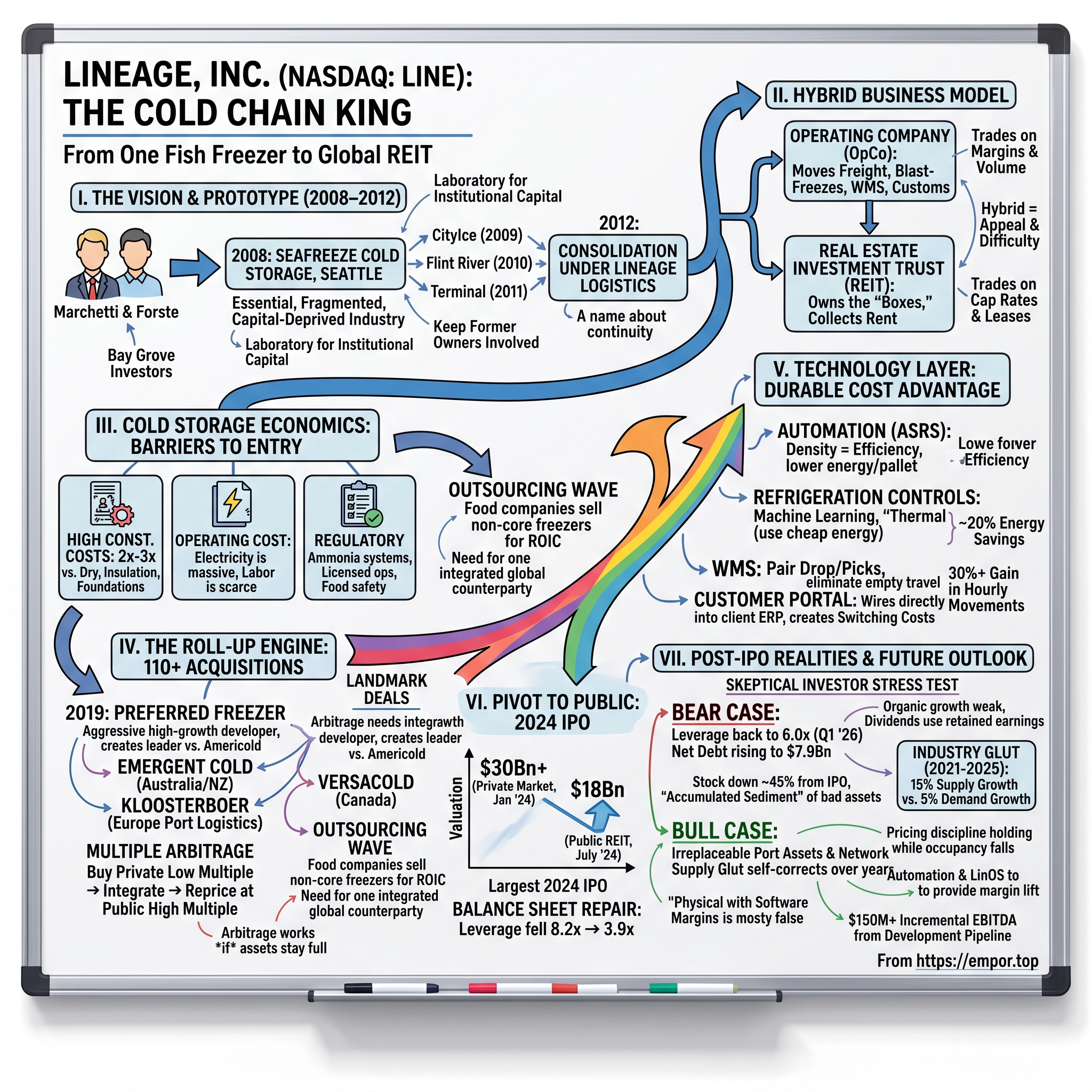
Lineage, Inc. (NASDAQ: LINE): The Story of the Cold Chain King
I. Introduction & Episode Roadmap
There is a particular kind of building that almost nobody notices and almost everybody depends on. It has no windows. It sits at the edge of a port, or beside an interstate interchange, or behind a poultry plant in rural Georgia. Its walls are eighteen inches of insulated panel. Its floor is heated — not to warm the people inside, but to stop the ground beneath from freezing solid and heaving the concrete slab upward like a geological accident. Inside, the air is held between minus ten and minus twenty degrees Fahrenheit, and men and women in insulated bib overalls drive forklifts through aisles where exposed skin goes numb in minutes.
Roughly a third of everything Americans eat that requires refrigeration has passed through a building like this. And a startling share of those buildings, worldwide, are owned by one company.
The story of how that happened is not a story about food. It is a story about capital. In late 2007, two young men who had met early in their careers at Morgan Stanley formed an investment firm called Bay Grove.1 Kevin Marchetti and Adam Forste were not logistics people. They were not refrigeration engineers. They were investors looking for something specific: an industry that was genuinely essential, structurally boring, wildly fragmented, and — critically — mispriced by the people who owned it. In December 2008, at what turned out to be almost the precise low point of the global financial crisis, they bought a single fish-freezing warehouse in Seattle called Seafreeze Cold Storage from the Japanese food group 東洋水産 Toyo Suisan Kaisha.1
Sixteen years later, on July 25, 2024, the entity that grew out of that one warehouse rang the opening bell at Nasdaq. Lineage, Inc. priced 57 million shares at $78 each and raised $4.44 billion — the largest initial public offering anywhere in the world that year, and the largest since Arm's listing the previous September.2 Underwriters exercised their option in full days later, pushing gross proceeds to roughly $5.1 billion.3 At the time of listing, Lineage operated a network that its own registration statement described as spanning hundreds of facilities across North America, Europe and Asia-Pacific, with roughly three billion cubic feet of temperature-controlled capacity — a footprint assembled through well over a hundred acquisitions.4
That is the triumphant version. Here is the other one.
As of mid-2026, Lineage's equity is worth roughly half what it was on the day it went public. Market capitalization has fallen from a little over $18 billion at listing to around $10 billion, a decline of more than 45%.5 The stock touched an all-time low of $31.33 in March 2026, against an all-time high of $89.85 recorded six days after the IPO.5 Leverage, which the IPO proceeds were supposed to cure, has climbed back to 6.0 times net debt to adjusted EBITDA against a stated target range of 5.0 to 5.5 times.6 Same-store net operating income declined in the most recent quarter, occupancy sits in the mid-seventies, and management has told investors that the industry added roughly 15% more refrigerated warehouse supply between 2021 and 2025 while demand for the categories it serves grew about 5% — leaving something like 10% excess capacity sloshing around the market.6
So this is not a hagiography. It is a case study in one of the most consequential questions in modern investing: what happens when a private-equity roll-up, built and financed under one set of rules, has to live under another?
The business model itself is genuinely unusual. Lineage is legally a real estate investment trust — it owns the boxes, and it collects rent on the pallets inside them. But it is also an operating company that moves freight, blast-freezes product, clears customs, and runs warehouse management software. That hybrid identity is the source of both its appeal and its analytical difficulty. Pure industrial REITs like Prologis trade on cap rates and lease rollovers. Pure logistics operators trade on margins and volume. Lineage asks investors to underwrite both at once.
Here is the road we will travel. First, the physics and economics of cold storage — why a frozen warehouse is not simply a cold version of a dry one, and why that difference creates the barriers to entry the whole thesis rests on. Then the founding: Bay Grove, Seafreeze, and the deliberately unglamorous prototype phase from 2008 to 2012. Then the roll-up engine itself, including the landmark deals — Preferred Freezer, Emergent Cold, Kloosterboer, VersaCold — and the multiple arbitrage that made the arithmetic work. Then the technology layer, which is where the story gets genuinely interesting and where the company's claim to a durable cost advantage lives or dies. Then the pivot to public markets, the deleveraging that didn't stick, and the structural trap of being a capital-hungry business that must pay out most of its taxable income. Then the segments, the duopoly with Americold, the people running the place, and finally a hard-nosed stress test of what has to be true for this to work — and what would break it.
Start with the building. Everything else follows from the building.
 Subscribe on LinkedIn
II. The Physics and Economics of Cold Storage
Pour a concrete slab on ordinary soil, chill the air above it to minus twenty degrees Fahrenheit, and leave it there for a year. The ground underneath will freeze. Water in the soil will expand as it turns to ice, and the floor of your warehouse will begin to lift — unevenly, silently, catastrophically. Racking goes out of plumb. Forklifts stop tracking straight. Eventually the slab cracks.
The solution, in every serious cold-storage facility on earth, is a heated subfloor: a grid of glycol lines or electrical elements running beneath the freezer, actively warming the earth so that it never freezes while the room above it stays deep-frozen. It is a beautiful little emblem of the whole industry. To make something very cold, you must simultaneously spend energy keeping something else warm, forever, or the building destroys itself.
This is the first thing to understand about cold storage: it is not warehousing with a chiller bolted on. It is a different asset class. The walls are structural insulated panels rather than tilt-up concrete. The vapor barriers must be continuous, because a single leak lets humid outside air migrate inward, condense, and form ice inside the wall cavity. Doors are air-locked. Docks are refrigerated. The refrigeration plant itself — typically ammonia-based, because ammonia is a far more efficient refrigerant than the synthetic alternatives and carries no global-warming potential — is essentially an industrial chemical facility requiring licensed operators, process safety management, and regulatory compliance that a dry warehouse never contemplates.7
The construction cost differential is the number that matters. Building a temperature-controlled facility runs materially more per square foot than building a dry distribution center — the industry rule of thumb has long been two to three times, driven by the insulation envelope, the deep and often piled foundations, the refrigeration machinery, and the electrical service required to run it. Then there is the operating side. Electricity is one of the largest single line items in a cold warehouse's cost structure, in a way it simply is not for a dry facility where the lights are the main load. And labor is scarce and expensive, because a meaningful fraction of the population will not, at any wage, spend eight hours a day in a room colder than a Minnesota January.
Every one of those characteristics is a barrier. Together they explain why the competitive set in cold storage is measured in dozens of serious players rather than the thousands that populate dry logistics. Capital intensity screens out the undercapitalized. Regulatory complexity screens out the casual. And the labor problem screens out anyone who cannot recruit, train and retain a workforce willing to do genuinely uncomfortable work.
But barriers alone do not make a business. What made cold storage investable at scale was a demand-side shift that had been building for two decades before Bay Grove noticed it.
Through most of the twentieth century, food companies owned their own freezers. If you were Tyson or Nestlé or Kraft, the cold warehouse next to the plant was simply part of the plant — a cost center, depreciated, staffed, and rarely thought about. Beginning in the 1990s and accelerating through the 2000s, that logic inverted. Capital became precious, return-on-invested-capital became the metric boards cared about, and a freezer full of chicken started to look like a spectacularly poor use of a food company's balance sheet. Better to sell the building, sign a storage agreement, and redeploy the capital into brands, marketing, and product development where the returns were higher and the multiples richer.
That outsourcing wave created demand for third-party cold storage. It also created something more valuable: demand for integrated third-party cold storage. A multinational food company that has just exited the warehouse business does not want to manage forty separate vendor relationships across twelve countries. It wants one counterparty with one contract, one system, one point of accountability.
And here was the problem, circa 2008. No such counterparty existed. The industry was a patchwork of hundreds of regional operators — often second- or third-generation family businesses, each running two or five or fifteen buildings in a single metro or a single state, each with its own warehouse management system, its own pricing conventions, its own idea of what a pallet position was worth. They were, in aggregate, enormously valuable and, individually, structurally incapable of serving a global customer.
That gap between what customers increasingly wanted and what the fragmented supply base could deliver is the entire commercial premise of Lineage. Someone was going to consolidate this industry. The only questions were who, how fast, and with whose money.
For an investor looking back from 2026, the important nuance is that these barriers cut both ways. High construction costs deter entry — until capital gets cheap and developers decide cold storage is the new hot asset class, which is precisely what happened in 2021 and 2022, and precisely why Lineage found itself in 2025 telling shareholders the industry had roughly 10% too much capacity.6 Barriers to entry are not the same as barriers to overbuilding. That distinction, glossed over during the growth years, became the central issue of the post-IPO era.
In late 2008, though, nobody was overbuilding anything. Credit markets were frozen in a rather different sense, and two men in San Francisco were about to buy their first fish freezer.
III. Bay Grove Capital & The Seafreeze Prototype (2008–2012)
Picture the timing. Lehman Brothers had collapsed in September 2008. By December, the commercial real estate financing market had effectively ceased to function, private equity deal volume had fallen off a cliff, and the phrase "dry powder" had acquired a slightly desperate quality. This was the month Kevin Marchetti and Adam Forste chose to close their first acquisition.
The two had met early in their careers at Morgan Stanley and formed Bay Grove in late 2007 with an explicitly unfashionable ambition: not to buy a company, improve it, and sell it in five years, but to build something they could compound over a long duration.1 That framing matters more than it sounds. Traditional private equity is a fund business with a clock. Bay Grove structured itself as a principal investment firm that could hold — which is why, sixteen years later, its principals were still the controlling shareholders rather than long-since-exited sponsors. Dave Brandes joined them in 2011.8
They screened for industries that were essential, resilient, and under-appreciated, and landed on cold storage — infrastructure that the global food supply chain could not function without, growing steadily, and largely invisible to institutional capital.1
Seafreeze Cold Storage was the test case: a single warehouse in Seattle, purchased from Toyo Suisan Kaisha, serving the Pacific Northwest seafood trade.1 It was not a trophy. It was a laboratory.
What Bay Grove learned in that laboratory shaped everything that followed. The central insight was about capital deprivation. These regional operators were not badly run in any moral sense — many were superbly run, with deep customer relationships and decades of operating knowledge. But they were structurally starved. A family-owned three-building operator generating a few million dollars of EBITDA cannot fund a modern warehouse management system. It cannot afford a data science team to optimize refrigeration schedules. It certainly cannot write a nine-figure check for automated storage and retrieval equipment. Every dollar of free cash flow went to maintenance capex, family distributions, and debt service, in roughly that order.
The corollary was that the same physical asset, placed inside a platform with access to institutional capital and a shared technology stack, was worth meaningfully more — not because the building changed, but because the building could suddenly be operated with tools its previous owner could never justify buying.
That is the thesis. Whether it was ever fully realized is the question we will return to repeatedly.
The follow-on acquisitions came quickly and stayed deliberately small: CityIce in Seattle in 2009, Flint River Services in Georgia in 2010, Terminal Freezers across the Pacific Northwest in 2011. Each added density in a specific geography. Each was small enough that a mistake would be survivable. And each taught the team something about integration — which systems could be standardized, which customer relationships would tolerate a change in ownership, and which local operating quirks turned out to be load-bearing rather than legacy cruft.
One structural choice from this era deserves attention because it recurs throughout the roll-up. Bay Grove made a practice of keeping former owners involved as strategic advisors and, in many cases, as equity holders in the combined platform.1 This is not sentimentality. In a fragmented industry where deal flow is proprietary and relationships are everything, a satisfied seller is the single best marketing channel available. The founder of a family cold-storage business who rolled equity into Lineage and watched it appreciate became, functionally, a business development representative to every other family cold-storage business in his region. That flywheel — buy well, treat sellers decently, get the next call first — is the least technological and possibly most durable advantage the company ever built.
By 2012, the collection of regional brands had reached the point where operating them separately made no sense. Bay Grove consolidated them under a single name: Lineage Logistics. The choice of word is telling. Not "Cold Chain Partners," not "Freezerco" — lineage, a word about inheritance and continuity, chosen by a firm that had just spent four years buying multi-generational family businesses.
At that moment Lineage was a regional operator with a good idea and a modest balance sheet. What turned it into something else was the decision, over the following decade, to stop being patient.
IV. The Roll-Up Engine: 110+ Acquisitions & The Premium Arbitrage
Roll-ups have a bad reputation, and they have earned it. The graveyard of American finance is stocked with companies that acquired their way to scale, discovered that scale without integration is just a larger version of chaos, and collapsed under debt raised against synergies that never materialized. Funeral homes. Veterinary clinics. Auto dealerships. Dry cleaners. The pattern repeats with grim reliability.
So the interesting question about Lineage is not "did they buy a lot of companies." They did — well over a hundred transactions across roughly fifteen years.4 The interesting question is what, mechanically, made this roll-up different, and whether that difference was durable or merely well-timed.
Start with the arithmetic, because the arithmetic is the point.
A roll-up creates value in three distinct ways, and they are frequently confused with each other. The first is operational synergy: two companies combined cost less to run than two companies separate. The second is strategic value: the combined entity can do something for customers that neither could do alone. The third is multiple arbitrage: you buy small private assets at a low multiple of earnings, and the market values the aggregated entity at a higher multiple, so value appears out of nowhere purely from the act of assembly.
Bay Grove pursued all three, but the third one is what financed the first two. Regional private cold-storage operators changed hands at multiples that, while never uniformly disclosed, were substantially below what public infrastructure REITs commanded. Buy at a private multiple, integrate, and reprice at a public multiple, and the spread is free money — provided the integration is real and provided the public market's willingness to pay premium multiples persists. Both of those provisos would eventually be tested.
The deals that mattered most came in a concentrated burst.
Preferred Freezer Services, 2019. Announced on February 25 and closed on May 7, this was the transaction that changed the company's category.9 Preferred Freezer was not a sleepy family operator — it was the industry's most aggressive high-growth developer, run by John Galiher, with a portfolio of modern, well-located facilities and a genuine claim to being the best builder in the business. Reported at more than $1 billion, the combination created an entity with more than 200 facilities and 1.3 billion cubic feet across three continents, vaulting Lineage past Americold, which at the time held roughly 900 million cubic feet.10
Read that deal correctly and it tells you something about how Bay Grove thought. They did not buy the cheapest available assets. They bought the competitor most likely to become a peer — the one company whose development pipeline could have compounded into a genuine rival over the following decade. Eliminating a future competitor is a form of value creation that never shows up in a synergy schedule but frequently justifies a price that looks aggressive on a spreadsheet.
Emergent Cold, announced in late 2019 and completed in 2020. This was the geographic pivot. Emergent brought Australia, New Zealand and Vietnam into the network, along with port-adjacent infrastructure that mattered disproportionately.11 Cold storage is a location business in the most literal sense: a freezer three miles from a container terminal is a fundamentally different asset from an identical freezer thirty miles inland, because product coming off a ship must be moved into refrigeration immediately. Port-proximate cold storage is close to unreproducible — the land is scarce, entitled, and already spoken for.
Kloosterboer, 2021. The Dutch group gave Lineage a commanding position in Western European port logistics, particularly in the Netherlands, and with it the seafood and produce flows moving through Rotterdam and the North Sea ports.
VersaCold Logistics Services, 2022. Announced on April 13 and closed on August 3, the acquisition from TorQuest Partners brought 24 temperature-controlled facilities and 114 million cubic feet across nine Canadian provinces.1213 Canada was the last major North American gap.
Four transactions in roughly three years took Lineage from a large North American operator to a genuinely intercontinental network. The strategic logic was coherent: a multinational food producer shipping salmon from Chile to Rotterdam to Chicago wants one counterparty across that entire path, and only a company with assets on every leg can offer it.
Now the harder question. Did they overpay?
The honest answer is that nobody outside the company can compute it precisely, because purchase multiples on individual transactions were largely not disclosed. What can be said is this. Cold-storage assets were historically valued in the range that industrial real estate commanded — a range consistent with a stable, slow-growth, capital-intensive property type. The prices Bay Grove paid, by broad market reckoning, sat above that historical band. The defense was always that the multiple paid was not the multiple owned: fold a regional operator into a network with centralized procurement, shared refrigeration optimization, coordinated transportation, and eliminated duplicate corporate overhead, and the effective entry multiple falls post-integration.
That defense is theoretically sound and empirically unverifiable from the outside. And it has a specific vulnerability: it works beautifully when the acquired assets stay full. Synergy math assumes the denominator holds. When industry occupancy falls — as it did across 2024 and 2025 — the EBITDA you paid a multiple of shrinks, and the effective entry multiple rises again in the direction you came from.
There is a second, subtler cost to serial acquisition that the growth narrative tends to bury. Every acquisition brings not just buildings but bad buildings — the two facilities in the portfolio that are functionally obsolete, in the wrong location, or serving a customer who left three years ago. In a rising market these are invisible, absorbed by the growth of everything around them. In a flat market they surface as the assets you have to idle. Lineage idled ten facilities during 2025 and signalled a handful more in 2026 as part of active supply management.14 That is not an anomaly of the cycle; it is partly the accumulated sediment of a hundred-plus transactions finally being sorted.
For investors, the takeaway from the roll-up era is dual. The strategic assembly was real and is not reproducible — no one is going to re-acquire two hundred regional cold-storage companies, because they no longer exist as independent entities. But the financial case for the roll-up rested on a multiple arbitrage that only pays out if the public market agrees to pay the premium multiple. Since July 2024, the public market has been actively renegotiating that assumption.
What was supposed to justify the premium was not the boxes. It was what Lineage put inside them.
V. The Technology Layer: ASRS, ATLAS, and Thermal Flywheeling
Walk into a conventional cold warehouse and the dominant impression is of space wasted on purpose. Aisles wide enough for a forklift to turn. Ceilings high, but racking that stops well short of them because a human operator cannot reliably place a pallet at eighty feet. Lights on. Doors opening and closing. And in every one of those design compromises, energy leaking out.
Walk into a fully automated high-bay facility and the impression is of a building that has stopped pretending to be for people. The racking runs to the roof. The aisles are the width of a pallet plus tolerance. Cranes travel vertically and horizontally on rails, retrieving pallets under software control. The lights are mostly off, because machines do not need to see. And the volume of air being refrigerated per pallet stored has collapsed, because the wasted space is gone.
This is the physical foundation of Lineage's technology argument, and it is worth being precise about the mechanism. An automated storage and retrieval system — ASRS — does three things simultaneously. It roughly doubles the number of pallets you can store in a given building envelope. It reduces the labor hours required per pallet moved. And, less obviously but perhaps most importantly, it slashes energy consumption per pallet, because refrigeration cost scales with the volume of air you have to keep cold, not with the number of pallets in it. Density is efficiency.
Lineage went into its IPO with a substantial base of automated and semi-automated facilities — a mix of fully automated buildings and semi-automated ones, together representing a meaningfully higher automation penetration than the industry norm.4 It has continued building. In the Dallas market, the company broke ground on a new automated facility as part of a development program that has become the primary use of growth capital in the post-IPO era.15
The economics of these projects are the single most important operating variable in the company today. In the first quarter of 2026, Lineage invested $130 million across 22 facilities either under construction or in the ramp-up phase, and told investors it had deployed $1.2 billion cumulatively into the development pipeline with an expectation of more than $150 million of incremental EBITDA once those projects stabilize.6 Take that at face value and it implies an unlevered yield on cost comfortably above where the company's cost of capital sat at the time — which, if delivered, is the cleanest path to growing into the balance sheet rather than issuing equity to fix it.
"If delivered" is doing significant work in that sentence. Automated warehouse projects are notorious for commissioning delays. The steel goes up on schedule; the software that coordinates a hundred cranes, conveyors and sortation points does not. A six-month commissioning slip on a large automated facility converts a strong development yield into a mediocre one, and the industry is littered with automation projects that ran long. This is not a hypothetical risk drawn from a risk-factors page; it is the base rate.
Then there is the energy story, which is the most genuinely differentiated thing in the company.
Here is the concept in plain terms. A warehouse full of frozen food is, physically speaking, an enormous battery — not an electrical one, a thermal one. A million pounds of frozen chicken at minus twenty degrees holds an enormous amount of "cold." If you chill it a few degrees further than necessary during hours when electricity is cheap, and then let the refrigeration compressors idle during hours when electricity is expensive, the product temperature drifts slowly upward but stays comfortably within its safe range. You have effectively bought electricity at off-peak prices and consumed it at peak. The industry calls this thermal flywheeling, and the metaphor is apt: you spin the mass up when power is cheap and coast on its momentum when power is dear.
The reason nobody did this well for decades is that doing it safely requires knowing, with confidence, how fast a specific room in a specific building loaded with specific product will warm up — and that depends on outside temperature, humidity, how often the doors open, how full the room is, what the product is, and the idiosyncrasies of the refrigeration plant. Get it wrong and you have a food safety incident and a very unhappy customer. It is a control problem, and control problems are exactly what modern machine learning is good at.
Lineage built an in-house data science capability to model thermal profiles and refrigeration schedules, work recognized by the U.S. Department of Energy's Better Plants program.[^16] It then developed a modern refrigeration controls platform in partnership with CrossnoKaye, whose Atlas software combines physics-based models with machine learning and predictive analytics to automate facility control — supporting cloud-based controls, thermal flywheeling, intelligent load scheduling and energy optimization.[^17] The documented results were striking: a deployment at the Riverside-3 facility delivered roughly 20% energy savings, and a subsequent deployment at Oxnard, California produced a far larger reduction.[^17]
The strategic significance is straightforward. Energy is a top-tier variable cost in this industry. A structural 15-20% reduction in energy cost per pallet, applied across a network of hundreds of buildings, is a permanent margin advantage over any operator who cannot afford to build the same capability — which is to say, most of them. It is also self-reinforcing in a mild way: the models get better with more data from more buildings across more climates.
Alongside refrigeration control sits the warehouse operating layer. LinOS is Lineage's proprietary operating system for the warehouse floor, and it is the technology story management has pushed hardest since the IPO. The pitch is specific rather than vague: in pilot locations, LinOS coordinated inbound and outbound pallet movements so that a forklift dropping a pallet off could immediately pick another one up on the return leg — pairing those trips more than 40% of the time and eliminating empty travel.16 Reported pilot results included a better-than-30% gain in hourly movements and labor savings around 5% per pallet moved.16 Lineage has stated it invested roughly $250 million in LinOS with another $200 million committed through 2030, forecasting a return on invested capital of 24% and roughly $110 million of incremental EBITDA from rollout across approximately half its warehouses.16 As of the first quarter of 2026, the system was live at 11 facilities with a target of at least 20 during the year.6
Be appropriately skeptical of that framing. Pilot results are selected results — a company deploys new software first at the facilities where it will work best. Eleven sites out of a network of hundreds is early. And a projected 24% ROIC on internal software is a management estimate, not an audited outcome. The honest read is that the direction of travel is credible and the mechanism is real, but the quantum is unproven, and investors should watch the deployment count and the actual expense line rather than the projection.
The third piece is customer-facing. Lineage Link is the portal through which customers see and manage their inventory across the network, integrating with their own enterprise systems. The strategic function is lock-in. Once a food company's ERP is wired into a logistics provider's systems, and its planners have built their weekly rhythm around a particular interface, moving to a competitor stops being a procurement decision and becomes an IT project with supply-chain risk attached. That is genuine switching cost — though it is worth noting it is the kind of switching cost that raises the price of leaving without preventing it, and it does very little to protect against a competitor that undercuts on rate in a single local market.
Which brings us to the moment when all of this — the assets, the algorithms, the accumulated debt — had to be presented to public investors.
VI. The Pivot to Public: The 2024 IPO and Capital Structure Evolution
In January 2024, the Financial Times reported that Lineage was targeting a valuation of more than $30 billion in a Wall Street listing.17 By the time the deal actually priced six months later, the number was $18 billion.2 The gap between those two figures is the most instructive thing about the entire transaction.
The company filed publicly in late June 2024.18 The roadshow marketed a range of $70 to $82 per share.[^21] Demand was strong enough that the deal was upsized — Lineage had planned to sell 47 million shares and ended up selling just under 57 million — and it priced at $78, near the top of the range, raising $4.44 billion and making it the largest IPO globally in 2024.2 Shares began trading on Nasdaq on July 25 and closed the first day up more than 3%.3 The greenshoe was exercised in full within days, bringing gross proceeds to approximately $5.1 billion.3
By every conventional measure of IPO execution, that was a success — an upsized deal priced at the high end in a market that had been closed to large listings for two years. And yet the valuation was roughly 40% below what had been floated at the start of the year.
Why? Because the buyer changed. Private markets in 2021 and 2022 valued infrastructure-adjacent real assets on a cost of capital that no longer existed by 2024. Public REIT investors in mid-2024 were pricing off Treasury yields that had risen several hundred basis points, and they applied a discount rate to Lineage's cash flows that private owners simply had not. The step-down from $30 billion to $18 billion was not a referendum on the business. It was a repricing of duration.
The proceeds went almost entirely to the balance sheet, and here the numbers tell a genuinely dramatic story. Prior to listing, Lineage carried the capital structure of a private roll-up that had financed a hundred acquisitions largely with debt — leverage that peaked around 8.2 times net debt to adjusted EBITDA in 2023.4 That is a level at which a company has no strategic freedom whatsoever; every decision is a financing decision. The IPO proceeds took leverage down to roughly 3.9 times almost overnight.4
For about two quarters, Lineage looked like a deleveraged infrastructure compounder. Then the arithmetic began running the other way.
By the first quarter of 2026, quarter-end net debt stood at $7.9 billion and reported net leverage had climbed back to 6.0 times, against a management target range of 5.0 to 5.5 times.6 The company also reports an adjusted figure — net debt to transaction-adjusted EBITDA of 5.3 times — which normalizes for acquisitions and dispositions during the period and for development capital that has been spent but not yet started generating income.6 That adjusted measure is analytically defensible: capital sunk into a facility under construction genuinely does depress the ratio without reflecting economic reality. It is also, inevitably, the more flattering number, and investors should note that the company chose to introduce it during a period when the headline number was moving in the wrong direction. Both readings are legitimate; only one of them is the one lenders and rating agencies anchor on.
How did leverage travel from 3.9 to 6.0 in roughly eighteen months without a transformational acquisition? Three forces, all mundane. EBITDA declined modestly — full-year 2025 adjusted EBITDA fell 2.3% to $1,298 million on essentially flat revenue of $5,355 million.19 Development capital continued flowing out at a substantial rate. And dividends had to be paid regardless.
That last point deserves its own paragraph, because it is the structural feature that makes Lineage's situation different from an ordinary levered industrial company.
To maintain REIT status and the tax advantage that comes with it, a company must distribute at least 90% of its taxable income to shareholders. In exchange, it avoids corporate-level tax on distributed income. For a mature, stabilized property portfolio with modest capital needs, this is an excellent bargain. For a business that wants to spend a billion dollars building automated warehouses, it is a straitjacket. Retained earnings — the cheapest capital in existence, requiring no negotiation with any lender or dilution of any shareholder — are largely unavailable. Every dollar of growth capital must be raised externally, from debt markets or equity markets, on whatever terms those markets happen to be offering.
This is the REIT capital trap, and it converts capital allocation from a skill into a timing problem. When the equity trades well, issuing shares to fund development is accretive and the model hums. When the equity trades at half its IPO price, issuing shares is punitive dilution, and the only remaining levers are more debt (already stretched), asset sales, or joint ventures that bring in outside capital at the asset level.
Unsurprisingly, that is exactly where management landed. On the first-quarter 2026 call, executives described a strategic portfolio review and pointed to a disconnect between private and public valuations for storage assets, saying all options — major asset sales, joint ventures, and acquisitions — were under consideration to enhance financial flexibility without dilution.6 Read plainly, that is a company saying: the public market is valuing our buildings below what private buyers would pay, so rather than issue cheap equity, we would rather sell or partner on assets at private-market prices.
That is a rational response. It is also an admission that the multiple arbitrage which powered the roll-up has, for now, run in reverse.
VII. The Core Business: Segment Breakdown & Market Structure
Strip away the technology narrative and the M&A history, and Lineage is two businesses stapled together — one that behaves like real estate, and one that behaves like freight.
The first is Global Warehousing. This is the bedrock: hundreds of temperature-controlled facilities, millions of pallet positions, and revenue that comes from storage rent plus the handling fees charged when product moves in and out. In the first quarter of 2026, this segment generated $364 million of net operating income, up 1.1% year over year.6 It is by a wide margin the larger and more important of the two, contributing the overwhelming majority of consolidated NOI, and it carries the economic characteristics investors associate with infrastructure — long customer relationships, contractual rate escalators, and revenue tied to a physical asset that cannot be replicated quickly.
The second is Global Integrated Solutions, or GIS. This is everything that happens around the box: transportation management, less-than-truckload consolidation programs, customs brokerage, blast freezing, packaging and repacking. In the same quarter it produced $57 million of NOI, flat year over year, with margin improving 190 basis points to 18.3% following the divestiture of a lower-margin transportation business.6
That divestiture is a useful window into management's thinking. Asset-light transportation brokerage generates revenue with almost no capital, which flatters growth optics but earns thin margins and carries no moat. Selling it improved segment margin and simplified the story. It also, notably, ran counter to the roll-up instinct of accumulating adjacent services — a small but real data point that the post-IPO management team is willing to shrink the perimeter.
The strategic relationship between the two segments is the part that is easy to miss. GIS is small in earnings and large in stickiness. Consider what LTL consolidation actually does. A mid-sized food producer generates, say, eight pallets a week destined for a Walmart distribution center. Eight pallets is not a truckload; shipping it alone means paying for air. But if Lineage has thirty such customers in one building, all shipping to the same retail hub, it can aggregate their volumes into full truckloads and pass a meaningful share of the savings back — the company has historically pitched transport savings in the high-teens percentage range to shippers who participate.
Now consider what happens when that customer contemplates moving to a competitor. It is not just relocating pallets. It is exiting a consolidation program whose economics depend on the other customers in the building — customers the competitor does not have. The savings evaporate on departure. This is a genuine, if modest, network effect operating at the level of the individual facility, and it is far more defensible than the generic "integrated solutions" language companies use to describe service bundles.
So GIS should be understood not as a margin business but as a retention mechanism that funnels volume into the high-margin warehousing segment. Judging it on its own 18% margin misses the point.
Now the competitive map. North American cold storage is effectively a duopoly at the top. Lineage is the larger player by a wide margin — roughly three billion cubic feet of capacity and a footprint that spans North America, Europe and Asia-Pacific.4 Americold Realty Trust, listed on the NYSE under COLD, is the number two with roughly a third of Lineage's capacity and a portfolio weighted toward North America.20 Together they control a majority of the organized North American market, with the balance spread across regional operators and the remaining private family businesses.
But "duopoly" flatters the pricing environment, and 2025 proved it.
Cold storage competes locally. A customer in Atlanta does not care that Lineage has a facility in Rotterdam; it cares what the freezer eleven miles away charges per pallet per month. National share is a poor predictor of local pricing power, and when a regional developer puts up a new automated facility in a specific metro, the incumbent in that metro feels it regardless of what happens nationally. This is precisely what unfolded across the market: U.S. public refrigerated warehouse supply rose roughly 15% on a square-foot basis between 2021 and 2025, while consumer demand in the categories served grew about 5% — leaving something on the order of 10% excess capacity in the system.6
Lineage's response has been to segment its own portfolio by exposure rather than pretend the problem is uniform. Management has categorized the U.S. book into three buckets: low-supply markets accounting for 64% of U.S. NOI, early-cycle supply additions from 2022-2023 at 21%, and late-cycle additions from 2024-2025 at 15% — with roughly that last slice facing genuine near-term competitive pressure.6 Framed that way, 85% of U.S. NOI sits in markets management describes as stable or early-cycle.
That is a more useful disclosure than most companies provide during a downcycle, and it deserves credit as such. It is also, unavoidably, a self-assessment. The proof will be in whether same-store NOI in the "stable" 85% actually holds while the troubled 15% works through.
Meanwhile the physical portfolio has been shrinking at the margin. Average physical occupancy across 2025 ran around 75%, down roughly 300 basis points from 2021 levels — a decline management has argued is modest given the supply backdrop.14 Ten facilities were idled in 2025 with more flagged for 2026.14 In the first quarter of 2026, physical occupancy fell 290 basis points sequentially to 76.4%, with economic occupancy — which reflects committed space rather than space physically filled — at 82%.6
The gap between those two figures is worth pausing on. Economic occupancy exceeding physical occupancy means customers are paying for space they are not currently using, typically under minimum-commitment contracts. That is a genuine cushion, and it is one reason cold storage revenue is more stable than throughput volumes suggest. But it is a cushion, not a floor: commitments come up for renewal, and a customer who has spent a year paying for empty racking will negotiate hard when it does.
Myth vs. Reality
Three consensus beliefs about this industry deserve correction, because each one was widely repeated during the IPO period and each one has been partly falsified since.
Myth: cold storage is recession-proof because people always eat. Reality: people always eat, but they do not always eat the same things in the same quantities through the same channels, and warehouses are paid on pallets stored and pallets moved rather than on calories consumed. When food companies deliberately run leaner inventories, warehouse occupancy falls even though consumption is unchanged. That is exactly what happened, and it is why full-year 2025 revenue was flat at $5,355 million while adjusted EBITDA fell 2.3%.19 Demand for the product is inelastic. Demand for the storage is not.
Myth: high barriers to entry mean supply is disciplined. Reality: barriers restrain entry when capital is expensive and evaporate when it is cheap. The 2021-2022 vintage of development was funded by investors who had decided cold storage was an attractive alternative asset class, and they built into a market that did not need the space. Fifteen percent supply growth against five percent demand growth is not the signature of a protected industry.6
Myth: automation is a pure margin story. Reality: automation is a capital-allocation decision with a multi-year payback and real commissioning risk, and it improves the economics of the building it is installed in without doing anything for the hundreds of buildings that still run on forklifts. It is a slow, compounding advantage, not a step change.
Behind these operating decisions sits a management team that has itself been changing.
VIII. Management, Governance, and Capital Allocation Credibility
There is an unusual structure at the top of Lineage, and any investor evaluating the company has to form a view on it.
Kevin Marchetti and Adam Forste, the Bay Grove founders, serve as Co-Executive Chairmen of the board. They are not passive legacy shareholders who cashed out at the IPO and drifted into emeritus roles. Bay Grove-managed vehicles held approximately 70% of shares outstanding as of the first quarter of 2026 — a level of concentration that makes Lineage, functionally, a controlled company operating with a public listing attached.6
The bull reading is that this is precisely the alignment public markets always claim to want. The founders own the overwhelming majority of the equity; they have suffered the full 45%-plus decline in market value alongside every other shareholder; and they built this business over eighteen years with an explicit long-duration compounding philosophy rather than a five-year exit clock.1 Management noted on the first-quarter call that Bay Grove faces no pressure to sell and consists predominantly of long-term holders.6
The bear reading is that 70% concentration means minority shareholders have essentially no ability to influence outcomes, that the public float is thin relative to the market capitalization, and that any eventual distribution or sale of that stake constitutes a structural overhang on the shares regardless of how patient the holders claim to be. Both readings are true simultaneously. Which one dominates depends entirely on whether you trust the controlling holders' capital allocation — which is an empirical question, not a philosophical one.
Then there is the operator. Greg Lehmkuhl has served as President and CEO since 2015 — hired at the moment Bay Grove recognized that a portfolio of acquired warehouses needed to become an actual company. His background is freight rather than finance: more than a decade at Con-way, the trucking and logistics group, including senior roles in its freight and contract logistics businesses. That pedigree shows in what he has emphasized. The professionalization of the operating model, the standardization of processes across acquired sites, and the push into warehouse technology are all recognizably the priorities of someone who came up in transportation operations rather than real estate.
Lehmkuhl's communication style, judged across recent earnings calls, is notably concrete. On the first-quarter 2026 call he opened by saying the business was stabilizing while the company managed through industry headwinds — a formulation that neither denied the problem nor overpromised the recovery.6 He gave analysts specific figures on the supply-demand imbalance rather than deflecting to macro generalities, quantified the container volume decline at 17% year over year and attributed it explicitly to tariff and trade uncertainty, and stated that customer inventory destocking was "largely in the rearview mirror" based on direct customer dialogue.6
That last claim is the kind of statement worth logging and checking. Destocking calls have a poor track record across the consumer supply chain since 2023; multiple companies declared it finished and then found more of it. If throughput volumes continue declining through the back half of 2026, that specific assertion becomes a credibility issue.
The finance seat changed hands recently. On October 20, 2025, Lineage announced that Robb LeMasters would become Chief Financial Officer effective November 10, succeeding Rob Crisci, who had announced his intention to retire and stayed on in an advisory capacity through the transition.21 LeMasters arrived from BWX Technologies, where he served as CFO of a capital-intensive nuclear and specialty manufacturing business, and before that spent his career on the investment side — Managing Director at the activist-oriented Blue Harbour Group, with earlier roles at Theleme Partners, The Children's Investment Fund and Highbridge Capital Management.21
That résumé is a signal. Hiring a former activist investor as CFO, at the moment your leverage is above target and your stock trades at half its IPO price, is a deliberate choice. People who spent years pressuring management teams about capital allocation, portfolio complexity and underperforming assets tend to arrive with a specific playbook: identify the assets that do not earn their cost of capital, sell or restructure them, and simplify. The strategic portfolio review announced shortly after his arrival is consistent with exactly that.6
There is also a related-party structure worth flagging. Post-IPO, Lineage entered into a transition services arrangement with Bay Grove covering support for capital deployment and acquisition sourcing.4 The commercial logic is defensible — Bay Grove's proprietary deal network in a fragmented industry is a genuine asset, and severing it abruptly would have destroyed value. But it is, structurally, a payment from a public company to its controlling shareholder for services, and that is the category of arrangement that governance-focused investors scrutinize. It deserves monitoring rather than alarm.
Now the credibility question, assessed on behavior rather than rhetoric.
The positive evidence: management has not moved the goalposts. Guidance for 2026 — adjusted EBITDA of $1.25 to $1.30 billion and AFFO per share of $2.75 to $3.00 — was initiated with the full-year 2025 results in February 2026 and maintained unchanged at the first quarter, with management expressing increased confidence in reaching the midpoint rather than quietly resetting the range.196 Same-store NOI guidance of negative 4% to negative 1% was likewise held.6 Setting a guidance range that explicitly contemplates NOI declining, and then not revising it, is a low bar in absolute terms but a higher one than many management teams clear during a downcycle. Notably, the company has also disclosed the uncomfortable data — the supply glut, the idled facilities, the occupancy decline — rather than burying it.
The negative evidence: leverage went from 3.9 times to 6.0 times in under two years following an IPO whose central promise was deleveraging.46 Some of that is cyclical EBITDA pressure the company did not control. Some of it is development spending the company chose. An investor is entitled to ask why the growth capex pace was not moderated sooner given the visible supply overbuild — and to note that the company has now, belatedly, said it will prioritize debt-neutral organic development and slow capital-heavy M&A. Discipline announced after leverage rises is worth less than discipline exercised before.
The cost-reduction program is the concrete test of the new regime. Management has targeted more than $50 million of annualized administrative and indirect cost reductions, with roughly half to be realized in 2026 and the remainder in 2027.6 That is a specific, checkable number with a specific timeline, and it should be tracked against actual reported expense.
One further honesty note from the same call: management attributed about one-third of the quarter's outperformance to expense timing deferrals rather than underlying improvement.6 Volunteering that a beat was partly a timing artifact is not what a promotional management team does. It is a small thing, but credibility is built out of small things.
With the people and the numbers on the table, it is worth formalizing what kind of business this actually is.
IX. Hamilton Helmer's 7 Powers & Porter's 5 Forces Analysis
Frameworks are useful precisely when a business is hard to categorize, and Lineage is hard to categorize. So let us run it through two of them honestly — including the boxes where the company scores poorly.
The 7 Powers
Scale Economies — strong, and the clearest power in the portfolio. Corporate overhead, a centralized national sales organization, insurance and energy procurement, and the software development cost of LinOS and refrigeration controls are all fixed costs spread across roughly three billion cubic feet.4 A regional operator with fifteen buildings cannot amortize a $250 million software investment.16 The efficiency of the thermal optimization models also improves with data volume across more buildings and climates. This power is real and measurable.
But note its limit. Scale economies are national and corporate; competition is local and physical. Lineage's overhead advantage does not stop a new automated facility in Atlanta from taking a customer at a lower rate. The 2024-2025 experience demonstrated exactly this: scale did not prevent occupancy erosion in overbuilt markets.
Switching Costs — moderate to strong, but frequently overstated. ERP integration through Lineage Link and participation in consolidation programs raise the cost of leaving.4 Moving frozen inventory between facilities is physically difficult, risks temperature excursions, and requires re-qualification of food safety protocols. All true. And yet occupancy fell from roughly 78% to roughly 75% across the cycle, which means customers did leave, or shrank, or renegotiated.14 Switching costs are a tax on departure, not a wall.
Network Effects — genuine but narrow. The LTL consolidation dynamic described earlier is a real facility-level network effect: more customers in one building means better truckload economics for all of them. It does not operate at the network level, though. Adding a warehouse in Vietnam does not improve the economics of a customer in Ohio.
Cornered Resource — moderate, and more physical than relational. The genuinely irreplaceable assets are the port-adjacent sites. Land next to a container terminal in Rotterdam, Los Angeles, Sydney or Auckland is finite, entitled, and mostly already owned. That is a cornered resource in the strict sense — a competitor cannot buy it at any price because it is not for sale. Bay Grove's deal-sourcing network was a cornered resource during the roll-up era; with the industry now consolidated, its remaining value is lower than it was.
Process Power — plausible, unproven at scale. Thermal flywheeling and the CrossnoKaye-built controls platform represent accumulated operating knowledge that would take a competitor years to replicate, with documented energy savings in specific facilities.[^17] The reason this rates "plausible" rather than "strong" is deployment breadth: LinOS was live at 11 facilities entering 2026 out of a network in the hundreds.6 Process power that exists in pilots is a hypothesis. Process power that exists across the network is a moat. Lineage is somewhere in between.
Counter-Positioning — essentially absent. Lineage did not invent a business model that incumbents could not copy. It bought the incumbents. That is a capital strategy, not a counter-position, and Americold could and did pursue similar consolidation.20
Branding — weak, appropriately. Cold storage is a business-to-business service purchased by professional procurement teams on location, rate, reliability and food safety record. Nobody pays a premium for the logo on the building.
Porter's Five Forces
Threat of New Entrants — low for a network, moderate for a building. This is the distinction the market got wrong in 2022. Nobody can replicate Lineage's global network; the assets no longer exist to be assembled. But a well-capitalized developer absolutely can build one modern automated facility in an attractive metro and compete hard for local volume. The 15% supply increase from 2021 to 2025 is the evidence.6 Entry barriers at the network level are formidable. At the facility level they are merely expensive.
Bargaining Power of Buyers — moderate to high, and rising. Customers are large, sophisticated food companies with professional procurement functions. In a market with 10% excess capacity, they have alternatives and they know it. Lineage secured 70% of its planned rate increases in the first quarter of 2026 and maintained conviction in net full-year price increases of 1-2%, but acknowledged that mix effects produced negative revenue per pallet on a blended basis.6 Rent, storage and blast revenue per physical pallet did rise 2.2% year over year — a fourth consecutive quarterly increase, and the single most encouraging operating datapoint in the quarter.6 Holding price while occupancy falls is the correct trade-off; whether it can be sustained through a second year of surplus capacity is untested.
Bargaining Power of Suppliers — moderate, and concentrated in one place. The critical supplier is the electric utility, and utilities are regulated monopolies with which one does not negotiate. This is exactly why the energy optimization work matters strategically rather than merely environmentally: thermal flywheeling is the only meaningful lever a cold-storage operator has against a supplier it cannot bargain with, because it shifts when power is consumed even when it cannot change what is paid per kilowatt-hour at a given hour.[^17] Automation equipment vendors and construction contractors are the other supplier group, and they hold moderate leverage during automation booms.
Threat of Substitutes — low. The substitute is insourcing — a food company building its own freezer. The twenty-year trend has run decisively the other way for good capital-allocation reasons, and nothing about the current environment reverses it. A more interesting long-horizon substitute risk is supply chain redesign: shorter chains, more local production, or ambient-stable food technology reducing the frozen volume that needs storing. These are slow-moving and speculative rather than near-term.
Competitive Rivalry — moderate nationally, sharp locally. The top of the market is a rational duopoly where both players understand the value of price discipline.20 But rivalry is fought metro by metro, and in a metro with new supply it is not rational at all — a developer with an empty building and a construction loan will price to fill it. That is the environment Lineage has been navigating, and it is why national market share has been a poor guide to realized pricing.
The frameworks converge on a consistent conclusion. Lineage's competitive position is genuinely strong at the network and corporate level, where scale, port real estate and technology investment create advantages competitors cannot match. It is considerably weaker at the level where revenue is actually won and lost — the individual building in the individual market — and the last two years have made that asymmetry impossible to ignore.
Which sets up the argument that matters.
X. The Skeptical Investor Stress Test: Bear vs. Bull Cases
Every investment case is a bet on which of two coherent stories turns out to be right. Both of Lineage's are coherent. That is what makes it interesting.
The Risk Radar
Before the cases, the specific mechanisms that could do damage.
Refinancing and cost of capital. Total debt stood at $6.3 billion at the end of the first quarter of 2026, with a weighted average effective interest rate of 4.1% and roughly 3.2 years of remaining term.6 That average rate is a legacy of a lower-rate era and it will not survive contact with maturity. Near-term maturities of $600 million in 2026 were characterized as very manageable against total liquidity of about $1.6 billion — roughly $66 million of cash and $1.5 billion of revolver capacity.6 The immediate cliff is not the problem. The problem is the cumulative repricing as the entire stack rolls over the next several years. The company has already felt a version of this: AFFO fell 9.3% year over year in the first quarter to $201 million, or $0.78 per share, primarily because interest rate hedges expired.6 That is a preview, not an aberration.
Execution risk in automation. Twenty-two facilities under construction or ramping, $1.2 billion deployed, and more than $150 million of incremental EBITDA expected on stabilization.6 Every one of those projects carries commissioning risk, and the returns are back-loaded — you spend the capital years before the yield arrives. A cluster of delays would extend the period during which capital is invested but not earning, which is precisely the dynamic that pushes reported leverage higher.
Volume volatility. Throughput declined 3.3% year over year in the first quarter of 2026, with container volumes down 17% on trade and tariff disruption.6 Beyond trade policy, the food supply chain carries its own idiosyncratic shocks: avian influenza culling poultry flocks, drought compressing harvests, livestock disease. These are genuinely unforecastable and they flow directly into warehouse throughput.
Concentration and cyclicality of the customer base. Lineage's fortunes are tied to the volume decisions of a relatively small number of very large food producers. When those companies decide to run leaner inventories — as they collectively did following the pandemic overstocking cycle — the effect on a warehouse operator is immediate and severe. Management believes that adjustment is complete.6 The evidence is a quarter or two of stabilization, which is suggestive, not conclusive.
The Bear Case
A skeptical investor would frame it roughly like this.
Lineage is a debt-financed roll-up that went public because private markets would no longer fund its leverage on acceptable terms, and the public market has spent two years correcting the price. The evidence is in the tape: down more than 45% from the IPO, an all-time low in March 2026, and a valuation now well below the $30 billion once floated.517
The deleveraging that justified the offering did not hold. Eighteen months after taking leverage to 3.9 times, it was back to 6.0 times.46 The REIT structure means retained earnings cannot fix it, the equity is too cheap to issue without punishing dilution, and so the only available paths are selling assets — which shrinks the earnings base — or joint venturing, which shares the upside with outside capital.
Organic growth is weak on the company's own guidance: same-store NOI expected between negative 4% and negative 1% for 2026.6 Strip out acquisitions and currency, and the underlying business is not growing. Much of the historical "growth" was acquisition arithmetic and inflation-linked rate escalators, not volume expansion. With M&A slowed by balance sheet constraints, that engine is off.
An activist would press further on three points. First, portfolio quality: a hundred-plus acquisitions inevitably produced a tail of assets that do not earn their cost of capital, and ten idled facilities in 2025 suggests the sorting has only begun.14 Second, governance: 70% ownership by the controlling sponsor with founders as Co-Executive Chairmen and a services arrangement flowing to that sponsor is a structure with limited minority-shareholder recourse.64 Third, disclosure: the introduction of an adjusted leverage metric that reads 70 basis points better than the reported one, during a period when reported leverage was deteriorating, is exactly the kind of presentational choice that invites scrutiny.6
The bear conclusion: an over-levered, slow-growing, capital-hungry property company carrying development risk while paying out most of its taxable income, in an industry with roughly 10% surplus capacity.
The Bull Case
The believer's version starts from a different premise: that the current difficulties are cyclical and the assets are not.
Lineage owns irreplaceable infrastructure. The port-adjacent real estate cannot be recreated. The global network cannot be reassembled, because the regional operators that were once available have been consolidated. And the customer base — global food producers who have permanently exited the business of owning freezers — is not going to reverse a twenty-year outsourcing decision.
The supply glut is self-correcting on a known timetable. Development that began in the cheap-capital era of 2021-2022 has largely delivered; new starts have collapsed because nobody finances a cold-storage development at current rates against current market rents. Demand grows with population and food consumption. A market with 10% excess capacity and roughly 2-3% annual demand growth absorbs the surplus in a few years without anyone doing anything clever.
Meanwhile the operating evidence is already turning. Same-store NOI declined only 0.9% in the first quarter of 2026, a marked improvement on prior trends.6 Adjusted EBITDA grew 3.3% to $314 million, ahead of internal expectations.6 Revenue per pallet rose for a fourth consecutive quarter.6 Full-year 2025 AFFO grew 22.7% to $865 million even as adjusted EBITDA declined — a reminder that lower interest expense post-IPO flows straight to distributable cash flow.19 These are the signatures of a business finding its floor.
The technology is a real and widening cost advantage. Documented energy savings of roughly 20% at Riverside-3 and substantially more at Oxnard represent permanent structural cost reduction that competitors without a data science organization cannot replicate.[^17] The LinOS rollout, targeting $110 million of incremental EBITDA at a projected 24% return on the investment, is being funded and deployed now.16 And the development pipeline's expected $150 million-plus of incremental EBITDA on stabilization is roughly 12% of current adjusted EBITDA arriving without any acquisition at all.619
The bull conclusion: the lowest-cost operator of essential, irreplaceable infrastructure, trading at half its listing price because of a cyclical capacity overhang that resolves itself, with organic development and cost programs providing the deleveraging path.
Adjudicating
The two cases are not actually in conflict about the facts. They disagree about the duration of the downcycle and the quality of the marginal asset.
If the supply overhang clears within two to three years and the development pipeline stabilizes on schedule, EBITDA grows, leverage falls mechanically toward the 5.0-5.5 target, and the assets prove worth roughly what private markets say they are. If the overhang persists, occupancy stays in the mid-seventies, pricing power erodes further, and a company at 6.0 times leverage with a mandatory distribution requirement is forced into asset sales at unattractive prices — the classic mechanism by which levered real estate companies destroy equity value slowly.
The honest assessment is that neither outcome is knowable today, and that the observable evidence is genuinely mixed. Pricing is holding while occupancy is not. Costs are being cut while capital is still being spent. Management has been candid about the problems while also introducing a friendlier way to measure the biggest one.
What that means practically is that this is a situation to be judged on evidence arriving quarter by quarter, not on narrative.
XI. Playbook: Business & Investing Lessons
Strip away the specifics and Lineage offers three lessons that generalize well beyond frozen warehouses.
The roll-up arbitrage only pays if the integration is real — and even then, only if the multiple holds. Bay Grove executed the assembly phase about as well as it can be done: proprietary sourcing, sellers kept close, small early deals before large ones, and genuine investment in a common technology stack rather than a holding-company structure that merely aggregated P&Ls. That is the difference between Lineage and the failed roll-ups of the 1990s, and it is not a small difference.
But note what it did not protect against. The multiple arbitrage depended on public markets paying a premium for the assembled entity, and public markets are under no obligation to do so. When the discount rate moved, roughly $12 billion of anticipated valuation evaporated between January and July 2024 without a single operational thing changing.172 The lesson for anyone underwriting a roll-up: separate the value created by integration from the value created by repricing, because only the first one is yours.
"Physical asset with software margins" is a seductive and mostly false promise. Every asset-heavy business in the 2020s discovered that adding software to the pitch deck raised the multiple. Lineage's technology is more substantive than most — the energy optimization is real, the automation economics are real, the operating system is being deployed and measured.[^17]16 And it still has not changed the fundamental nature of the business, which is building insulated boxes on concrete slabs, filling them with other people's food, and hoping the local market does not get overbuilt.
The software makes Lineage a better cold-storage company. It does not make it a software company. Investors should size the technology's contribution the way management actually frames it — tens of millions of dollars of operating expense savings against a $1.3 billion EBITDA base — rather than as a transformation of the business model.1619 The genuine premium in this business comes from layering services on top of the physical asset and from owning locations nobody else can own, not from algorithmic margin expansion.
Cost of capital is a strategy, not a line item. This is the deepest lesson, and it is the one Lineage is currently living. The company was built in an environment where capital was cheap, abundant, and patient. Its capital structure, its acquisition pace, and its development pipeline were all calibrated to that environment. When the environment changed, none of the operating decisions became wrong — but the financing assumptions underneath them did, and that was enough to halve the equity value.
The REIT structure compounds this. A company that must distribute most of its taxable income has surrendered the option to self-fund, which means it is permanently dependent on market conditions it does not control. In good markets this is a feature — cheap external capital plus tax efficiency is a powerful combination. In bad markets it is a constraint that turns capital allocation from strategy into triage. Anyone evaluating a capital-intensive REIT should ask, before anything else: what happens to this company's growth plan if the equity trades down 50%? For Lineage the answer, visible in real time, is a strategic portfolio review and a shift to debt-neutral organic development.6
The corollary lesson for management teams is about sequencing. Deleveraging is easy to announce and hard to sustain when growth capital keeps flowing out the door. The gap between 3.9 times and 6.0 times was not caused by any single bad decision; it was caused by the accumulation of reasonable individual decisions made against an assumption about EBITDA growth that did not materialize.46
XII. Epilogue & Outro
Eighteen years is a long time in one industry. Marchetti and Forste bought a fish freezer in Seattle in the same December that the S&P 500 was losing a third of its value, and they built from it the largest temperature-controlled warehouse network on earth — hundreds of buildings, three continents, and a position in the global food supply chain that no competitor can replicate at any price.14 They then took it public in the largest offering of 2024 and watched roughly half the market value disappear over the following two years.25
Both of those things are true, and the temptation is to pick one as the "real" story. The more useful framing is that they are the same story observed at different points in the capital cycle. Lineage was built by people who were exceptionally good at buying assets when capital was cheap and sellers were fragmented. It is now being run by people who have to be good at something different: extracting returns from assets already owned, in a market with too much capacity, under a corporate structure that limits their financing options.
The transition from the first skill to the second is not automatic. Plenty of companies never make it.
There are three things worth watching, and only three.
Constant-currency same-store NOI growth. This is the purest available measure of whether the underlying business is healthy, because it strips out acquisitions, dispositions, and the currency swings that a network spanning three continents inevitably generates. Guidance for 2026 sits at negative 4% to negative 1%.6 Every roll-up eventually has to answer the question of whether the assets it bought grow on their own, and this is the number that answers it. Watch for the trajectory through the year — whether the first quarter's negative 0.9% was a genuine inflection or a favorable comparison.6
Net debt to adjusted EBITDA. Everything about Lineage's strategic freedom runs through this ratio. At 6.0 times against a 5.0-5.5 target, the company is constrained.6 The path down runs through EBITDA growth, asset sales, or joint ventures — and the mix matters, because deleveraging by shrinking is a different outcome than deleveraging by growing. Track the reported figure rather than the adjusted one, and track how the improvement is achieved.
Stabilized development yields on automated facilities. This is the one that determines whether the bull case has an engine. If the $1.2 billion deployed genuinely produces more than $150 million of incremental EBITDA on stabilization, the company grows into its balance sheet without issuing a share.6 If those projects deliver late or below expectation, the entire self-funded deleveraging thesis fails, and Lineage is left choosing between dilution and divestment. There is no third path.
Beyond the numbers, the open strategic questions are about geography and structure. Asia-Pacific remains the least developed and fastest-growing part of the network — the joint venture with Vietnam's SK Logistics, announced in 2023, was an early template for expanding through partnership rather than balance sheet.22 Partnership structures of that kind may prove to be the model for growth in a period when the company cannot easily fund acquisitions outright. And the strategic portfolio review will eventually produce decisions: which assets get sold, which get joint-ventured, and at what prices relative to the depressed public valuation management has complained about.6
Robb LeMasters inherited a balance sheet that needs fixing and a background that suggests he knows how such things get fixed.21 Greg Lehmkuhl has run this business through its entire scaling phase and now has to prove he can run it through a contraction.6 And Bay Grove, holding roughly 70% of the equity, has every incentive to be patient — and every ability to be, having built the whole thing on the premise that duration is an advantage rather than a constraint.61
The freezers keep running. The food keeps moving. Whether the equity above them compounds is a question about capital, not about cold.
References
-
Lineage raises $4.44 bln in biggest IPO of 2024 — Reuters, 2024-07-24 ↩↩↩↩↩
-
Lineage closes up more than 3% in market's largest IPO of 2024 — CNBC, 2024-07-25 ↩↩↩
-
Lineage, Inc. filings including Form S-11 IPO registration statement — SEC EDGAR, CIK 0001997782 ↩↩↩↩↩↩↩↩↩↩↩↩↩↩
-
Lineage (LINE) Q1 2026 Earnings Call Transcript — The Motley Fool, 2026-05-06 ↩↩↩↩↩↩↩↩↩↩↩↩↩↩↩↩↩↩↩↩↩↩↩↩↩↩↩↩↩↩↩↩↩↩↩↩↩↩↩↩↩↩↩↩↩↩↩↩↩↩↩
-
Cold-Storage Operator Lineage Logistics 'Committed to Natural Refrigerants' — R744.com ↩
-
Lineage Logistics Closes Acquisition of Preferred Freezer Services — Lineage, 2019-05-07 ↩
-
Lineage Logistics to acquire Preferred Freezer to be largest cold storage company — Supply Chain Dive, 2019-02-25 ↩
-
Lineage Logistics to Acquire Emergent Cold — REIT.com, 2019-11-20 ↩
-
Lineage Logistics Closes Acquisition of VersaCold Logistics Services — Business Wire, 2022-08-03 ↩
-
Lineage Logistics Broadens North American Network with Acquisition of VersaCold Logistics Services from TorQuest Partners — Business Wire, 2022-04-13 ↩
-
Lineage Q4 2025 slides: occupancy improves amid capacity glut — Investing.com, 2026-02-25 ↩↩↩↩↩
-
Lineage Breaks Ground on New Automated Facility in Dallas Market — Lineage ↩
-
Lineage eyes $110M lift from warehouse tech rollout — FreightWaves ↩↩↩↩↩↩↩
-
Lineage Logistics targets valuation of over $30bn in Wall Street IPO — Financial Times, 2024-01-16 ↩↩↩
-
Cold-Storage Giant Lineage Logistics Files for US IPO — Bloomberg, 2024-06-26 ↩
-
Lineage, Inc. Reports Full-Year 2025 Financial Results and Initiates 2026 Guidance — Lineage IR, 2026-02-25 ↩↩↩↩↩↩
-
Lineage Announces New Chief Financial Officer — Lineage, 2025-10-20 ↩↩↩
-
Lineage announces joint venture with Vietnam's SK Logistics, expanding its network in Southeast Asia — Lineage, 2023 ↩
 LinkedIn
 WhatsApp
 Reddit
 Hacker News
 Email
Email Kindle
 RSS Feed
 Spotify
 Apple Podcasts
 Amazon Music
 Audible
 YouTube