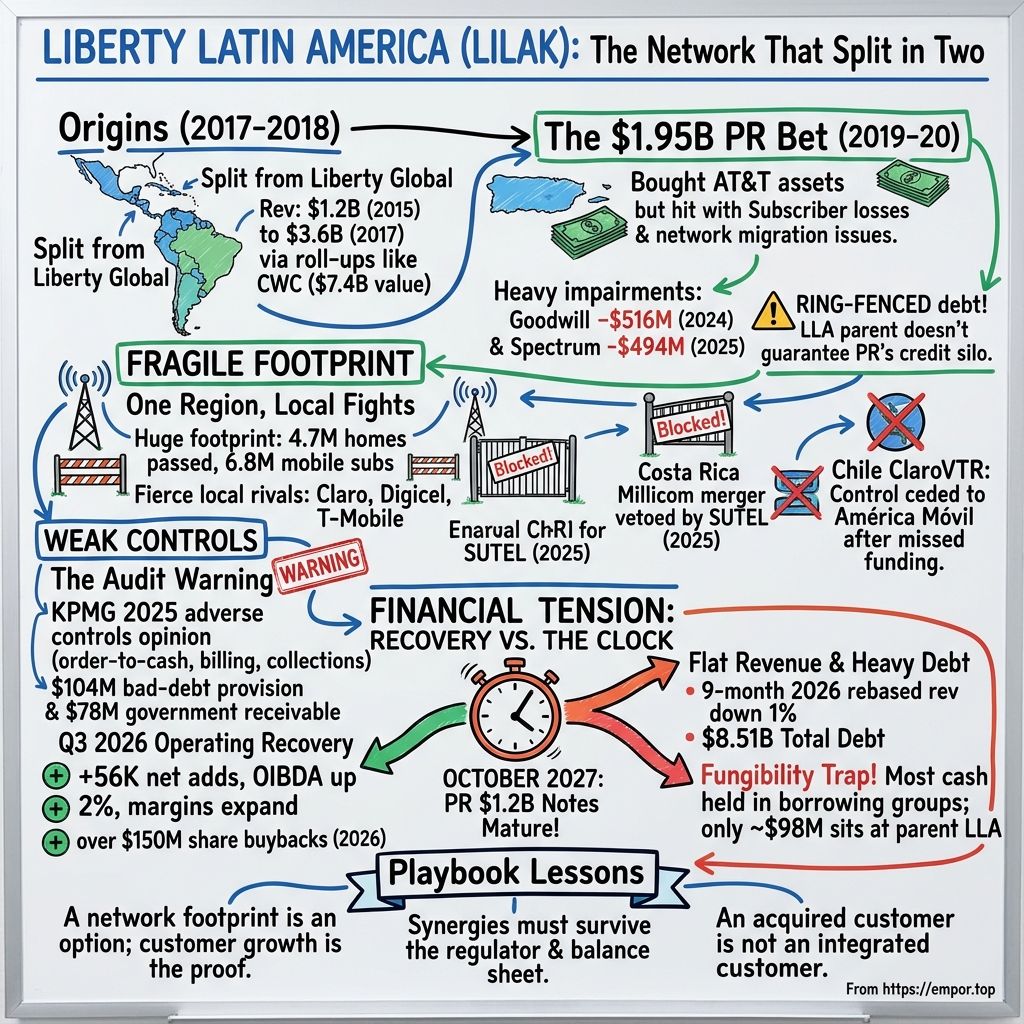
Liberty Latin America: The Network That Split in Two
I. The Bill Comes Due in Puerto Rico
In the first week of November 2026, Balan Nair had a good-news story to tell, and he told it with the ease of a man who has run the same company for almost nine years. Liberty Latin America had just added 56,000 postpaid mobile and broadband customers in a single quarter.1 Its Adjusted OIBDA margin, the industry's preferred measure of operating profit before depreciation, had widened by 160 basis points from a year earlier.1 And the company had spent more than $150 million that year buying back its own shares, close to a tenth of the common stock that had been outstanding at the end of 2025.1 On the investor call, the tone was that of a turnaround that had found its footing: price increases sticking, costs coming out, mobile customers arriving in Panama and Costa Rica.2
The same week, in a different set of documents, a different story was being told about the same company. The Form 10-Q filed alongside those results described a lawsuit brought in January 2026 by creditors of Liberty Puerto Rico, the group's largest single operation by debt, who alleged that collateral had been moved out of their reach into an unrestricted part of the group.3 Three months earlier, Fitch Ratings had cut Liberty Communications of Puerto Rico to CC, a rating that sits just above default, and had written in plain language that a default or a distressed exchange appeared probable.4 The reason was arithmetic. Puerto Rico has $1.2 billion of secured notes that mature in October 2027, and Fitch could not see how that bill gets paid on existing terms, especially after Liberty Latin America said it would not fund the Puerto Rico silo's liquidity needs.4
Hold those two scenes side by side and the shape of this episode appears. One company is reporting subscriber growth and buying back stock. A large piece of that same company is negotiating, in effect, with its lenders over whether it can pay them in full. Both things are true at once, and the reason both can be true is the most important structural fact about Liberty Latin America.
Four questions run through the story that follows. The first is whether revenue can grow again, or whether the current recovery is mostly the product of cutting costs and raising prices on customers who stay. The second is whether Puerto Rico's operations can recover fast enough to matter before its debt comes due. The third is whether investors can rely on the company's reported revenue and receivables while its auditor says the controls over that very process are materially weak. And the fourth is whether a company carrying more than $8.5 billion of debt should be returning cash to shareholders at all.1
Before answering any of them, it helps to be precise about what the listed company is. Liberty Latin America Ltd., usually shortened to LLA, is a holding company incorporated in Bermuda and listed on Nasdaq under three share classes, of which LILAK, the Class C stock, is the most widely traded.5 It is not a subsidiary of Liberty Global, despite the shared name, shared history and several shared directors.5 Its consolidated accounts pull in the full revenue and costs of subsidiaries it controls, even where local partners own a slice; their share shows up lower down the income statement as noncontrolling interests.5 When this story talks about LLA's revenue, it means that consolidated figure, which is larger than the economic interest LLA's own shareholders hold.
The second precision matters even more. LLA's debt is not one pile. It is organized into separate borrowing groups, or credit silos, each with its own lenders, covenants and collateral. The largest is Cable & Wireless, which owns most of the Caribbean and Panamanian businesses. Then there is Liberty Puerto Rico, and there is Liberty Costa Rica.1 Fitch notes that there are no cross-guarantees or cross-defaults between Puerto Rico and LLA's other silos.4 So when Fitch calls a Puerto Rico default probable, it is not rating the whole group, and a default there would not automatically cascade into the Caribbean bonds. That is a protection. It is also a constraint, because the same walls that keep Puerto Rico's problems in also keep the rest of the group's cash out.
So the listener should carry two balance sheets through this story. One belongs to the listed group, which reports a consolidated net leverage of about 4.5 times its Adjusted OIBDA.1 The other belongs to Puerto Rico, which Fitch expects to carry net leverage of roughly eight times through 2027.4 The operating recovery Nair celebrated is real enough to measure. Whether it can arrive in the right silo, at the right speed, before October 2027 is the question that hangs over everything else. To understand how a regional cable company ended up with a $1.2 billion deadline on one island, the story has to go back to the moment it became a public company in the first place.
 Subscribe on LinkedIn
II. A Regional Cable Map Becomes a Public Company
On December 29, 2017, Liberty Global completed a piece of corporate surgery that John Malone's companies have performed many times before. It took the businesses it had been tracking under a separate stock, the LiLAC Group, and split them off into a new, independent company. Holders of LiLAC tracking shares received shares of Liberty Latin America, and on January 2, 2018, the new company began trading on Nasdaq on its own.6 Tracking stocks are a peculiar invention: they let investors bet on one division's performance while the assets remain legally inside the parent. The split-off ended that ambiguity. From that day forward, the Latin American and Caribbean businesses had their own board, their own balance sheet and their own share price.
What did LiLAC shareholders actually receive? On paper, a company that had tripled in size in two years. Revenue had climbed from about $1.2 billion in 2015 to about $3.6 billion in 2017.6 A newcomer looking only at that line might have concluded that this was a fast-growing regional champion. It was not, or at least not in that way. Almost all of the jump came from acquisitions: a smaller deal for Choice Cable TV in Puerto Rico in 2015 and, far more important, Liberty Global's purchase of Cable & Wireless Communications in 2016.6 The new company was a roll-up wearing the clothes of a growth story.
That CWC deal is the hinge of the whole origin. Cable & Wireless was an old British name with an imperial-era footprint of telephone and cable operations across the English-speaking Caribbean, plus Panama and a web of undersea cables. In 2015 it had itself absorbed Columbus Communications, a Caribbean cable and subsea operator. In November 2015, Liberty Global announced its offer for CWC at an enterprise value of roughly $7.4 billion, which it presented as about 10.7 times CWC's adjusted EBITDA once the expected synergies from the Columbus combination were counted.7 In other words, the headline multiple already gave CWC credit for cost savings that had not yet fully materialized. That is a common way for a buyer to make a price look reasonable, and it is worth remembering because synergies reappear many times in this story, sometimes delivered, sometimes not.
The boundary here is important. CWC was bought by Liberty Global, a company above the entity that is listed today. LLA's current shareholders did not pay for that deal with LLA's capital, and LLA's current management did not negotiate it. What LLA inherited was a platform: the mobile licenses, the cable plants, the subsea fiber, the brands like Flow and Más Móvil, and the debt that came with them.6 It is evidence about how this footprint was assembled, not evidence about how well today's listed company allocates capital.
The 2017 Form S-1 that accompanied the split-off reads accordingly.8 It is not an initial public offering prospectus in the ordinary sense. No new money was raised from the public to build anything. It was a registration document that allowed an existing set of assets to begin trading separately, with risk factors that already flagged the themes this story returns to: small and volatile markets, hurricanes, currency exposure, heavy leverage and the overlapping interests of directors who also served Liberty Global.8 The document even had to contend with a fresh disaster, because Hurricanes Irma and Maria had torn through Puerto Rico and parts of the Caribbean in September 2017, months before the shares began trading, damaging networks and knocking out service for customers who could not be billed while their homes had no power.6
It also mattered who stood behind the new company. John Malone, the cable entrepreneur who built Tele-Communications Inc. into America's largest cable operator and then assembled the web of Liberty companies, had made a career of a particular formula: buy networks with subscription revenue, finance them with as much debt as the cash flows can bear, minimize taxable profit through depreciation and interest, and use the cash to buy more networks or shares. Through his high-vote Class B shares, Malone held about a quarter of LLA's voting power by the end of 2019.9 The new company was born into that philosophy. Leverage was not an accident of its structure; it was the design. The design works beautifully when subscription revenue is stable and growing, and far less well when it is not, which is the condition that the rest of this story keeps testing.
The first years of independence showed what the inherited machine could do without another giant deal. Revenue was about $3.7 billion in 2018 and about $3.9 billion in 2019.9 That is growth, but modest growth, the kind that comes from rebuilding after storms, nudging up prices and adding customers at the margin. LLA's shareholders also absorbed large losses in those years, about $345 million in 2018 and about $80 million in 2019, as depreciation, interest and storm effects weighed on the income statement.9
Here, then, is the verdict on the origin. The listing created a genuinely distinct regional operator with real infrastructure in markets where few companies can afford to build. But its scale was assembled through a roll-up under a different corporate parent, at prices that assumed synergies, and the business it became did not have an organic growth engine of the kind its 2015-to-2017 revenue chart implied. The question that hung over the newly independent company was whether this inherited footprint could grow by itself. Its management answered, within two years, with the largest acquisition the listed company has ever made.
III. The $1.95 Billion Bet on Puerto Rico
In October 2019, LLA agreed to buy AT&T's wireless and wireline operations in Puerto Rico and the U.S. Virgin Islands. The deal was priced at an enterprise value of $1.95 billion on a cash-free, debt-free basis, and it brought more than one million wireless subscribers.10 Then the world changed. By the time the transaction closed on October 31, 2020, the pandemic had upended markets and daily life, and the U.S. Department of Justice had extracted a condition: before LLA could take AT&T's island business, it had to divest certain fiber assets and the customer accounts served by them, so that Puerto Rico's business connectivity market would retain a competitor.11 The deal closed, but the buyer got a slightly smaller wireline business than it had first agreed to buy.
To understand why Nair wanted this asset so badly, think about what LLA was before the deal. In most of its markets it was a cable operator or an incumbent phone company in a small economy whose currency could move against the U.S. dollar, which is the currency its debt is mostly denominated in. Puerto Rico is different. It is a U.S. territory that uses the dollar. A business there earns in the same currency it borrows in. LLA already owned Liberty Cablevision of Puerto Rico, a strong cable franchise; what it lacked on the island was a mobile network. AT&T's operation filled that gap at a stroke, turning LLA into a provider that could sell home broadband, video and mobile together to the same household. The strategic case had three parts, and all of them were coherent: more dollar revenue, a mobile business alongside an existing fixed one, and a bigger, more defensible position in an important market.10
Was the price too high? This is where a careful listener should slow down, because the obvious comparison is a trap. The 10.7-times multiple that Liberty Global put on CWC was disclosed for that earlier deal, under a different buyer and with synergies baked in.7 The AT&T announcement gave an enterprise value and a subscriber count, but not a directly comparable EBITDA multiple for the business being sold.10 Without that, saying LLA overpaid from the headline number alone would be guesswork dressed up as analysis. The honest way to judge the deal is by what happened afterward, which is a far harsher test and a more informative one.
What the integration actually delivered
The thesis of a mobile acquisition rests on a promise that sounds simple and is fiendishly hard: take the acquired customers, move them onto your own network and systems, bundle them with your fixed services, and keep them. For several years after closing, LLA ran the acquired mobile customers on AT&T's systems under transition arrangements. Then came the migration, the moment when customer accounts, billing records and network traffic were moved to LLA's own platforms. It went badly. The company later disclosed that billing and collection problems followed the mobile network and systems migration, leading to elevated bad-debt charges in 2024.5 Customers who receive wrong bills, or no bills, or who find their service disrupted, are customers who leave. Puerto Rico lost subscribers after the migration, and its network faced challenges as rival operators competed for the same households.54
The financial scar tissue followed. In 2024, LLA recorded a goodwill impairment of $516 million for Liberty Puerto Rico.5 Goodwill is the accounting name for the premium a buyer pays above the identifiable value of what it acquires; writing it down is management's formal admission that the business is now worth less than the price implied. A year later came a second charge, a $494 million impairment of Puerto Rico spectrum, the licensed radio frequencies that a mobile network depends on.5 And over three years, Puerto Rico's revenue shrank from about $1.36 billion in 2023 to about $1.13 billion in 2025, a decline of roughly a sixth.5
Two impairments totalling about a billion dollars in two years would tempt any storyteller into calling the deal a disaster. The evidence supports something narrower but still damaging. Impairments reflect lost value relative to the carrying amount on the balance sheet. They do not, on their own, prove that the 2019 price was excessive, because they also capture what happened afterward: a botched migration, intensified competition and higher interest rates that reduce the present value of future cash flows. What the record does show is that the integration thesis, the bit of the plan management controlled most directly, failed in its most important test. An acquired customer counts for something only once that customer has been successfully moved onto the buyer's own network, and the move is where Puerto Rico broke.
The DOJ condition sharpens the picture. By requiring the divestiture of fiber and business accounts, the regulator narrowed the wireline footprint LLA could fold into its existing cable operation.11 What LLA kept was, above all, a mobile business with more than a million subscribers and the spectrum to serve them.10 The measures that would show whether the acquisition earned its cost are straightforward: whether postpaid mobile subscribers stabilized and grew, whether bad debt fell back to normal, and whether Puerto Rico's revenue stopped shrinking. As of late 2026, management could point to the first stirrings of recovery. Puerto Rico's Adjusted OIBDA for the first nine months of the year was about $287 million, up from about $264 million a year earlier, and Fitch itself acknowledged cost reductions, higher average revenue per user and normalizing postpaid losses.14 But a recovering operating profit off a depressed base is not the same as an acquisition that has paid back.
The walls around the island
The Puerto Rico silo's ring-fenced structure kept its problems from spreading to the group.4 LLA's stated refusal to fund Puerto Rico's liquidity needs was part of that boundary, and Fitch cited it in its downgrade.4
That protection has a price. Puerto Rico's creditors, by suing over a transfer of collateral to an unrestricted part of the group, are contesting precisely where those walls stand.3 For LLA's shareholders, the structure limits the downside of a Puerto Rico restructuring but also limits the parent's ability to shape the outcome by writing a cheque. Fitch's outlook leaves little chance that an operating recovery alone will make the October 2027 notes refinanceable on existing terms.4
The Puerto Rico bet, then, bought a strategically important dollar business and ran into the hardest part of telecom mergers: moving customers without losing them. The listed company has absorbed the write-downs, and its walls may limit the damage. The deeper lesson is about the rest of the map, because if a market as attractive as Puerto Rico could slip this badly, the strength of LLA's position in its smaller markets deserves a much closer look.
IV. One Region, Many Local Fights
Picture two customers on the same evening, in two countries LLA serves. In Panama City, a family's home broadband and television bundle comes up for renewal, and the family decides that switching to another provider is more trouble than the few dollars a rival might save them. In Kingston, Jamaica, a young professional looks at a mobile offer from a competing network and wonders whether LLA's Flow brand is still the better deal. These are not scenes from one regional market. They are separate contests, fought with different brands, against different rivals, under different regulators and in different currencies. LLA's business is the sum of dozens of such contests.
The scale of the footprint is genuine. At the end of 2025, LLA's fixed networks passed about 4.7 million homes, meaning that the cable or fiber ran past those front doors and could be connected.12 Over those networks it served about 1.75 million broadband subscribers, about 901,000 video subscribers and about 1.19 million fixed-line telephone subscribers. Its mobile networks served about 6.79 million subscribers.12 Those are large numbers for markets as small as Barbados or the Cayman Islands, and very respectable ones for Panama, Costa Rica or Puerto Rico. Nobody builds a fiber network across a Caribbean island cheaply, and nobody lays subsea cable on a whim.
How the money comes in
The business earns in three broad ways. The largest is consumer subscriptions: households paying a monthly bill for broadband, television, fixed phone service and mobile plans. Here the revenue equation is simple to write and hard to manage. It is the number of subscribers multiplied by the average revenue each pays per month, which the industry calls ARPU. Everything else moves one of those two variables. Price increases lift ARPU, but can push customers away. Bundles, which sell broadband and mobile together, can raise the total bill while making customers less likely to leave. Promotions win customers but dilute ARPU. Churn, the share of customers who cancel each month, is the leak in the bucket.5
The second engine is business services: connectivity and managed services for companies and governments, from a hotel's internet link to a ministry's data network. The third is wholesale capacity, sold to other carriers over LLA's subsea and terrestrial fiber, often under long contracts and sometimes paid up front, with revenue recognized over the life of the agreement.5 Around those engines sit less predictable revenue streams: handset sales, network-building projects for governments and enterprises, and roaming and interconnection fees.5 Those can make a quarter look better or worse without saying much about the underlying business. LLA does not disclose what share of total revenue is recurring, or the length and minimum commitments of its contracts across the customer base.5
The economics are lumpier still across segments. In 2025, the three reported segments inside the Cable & Wireless silo, Liberty Caribbean, C&W Panama and Liberty Networks, generated about $2.6 billion of revenue together and about $1.23 billion of Adjusted OIBDA, before eliminations between them.15 That silo is the group's profit core, keeping close to half of each revenue dollar as Adjusted OIBDA on that basis. Liberty Puerto Rico and Liberty Costa Rica are reported separately and have their own debt.1 The silo total is a financing perimeter, not a customer-facing business, and it should not be read as one market or one competitive position.
Who LLA is fighting
Name the rivals market by market and the idea of a single regional moat starts to fade. In Puerto Rico, LLA fights Claro, the island brand of Mexico's América Móvil, and T-Mobile, the U.S. mobile giant.12 Across much of the English-speaking Caribbean, its principal rival is Digicel, the mobile operator that built its business by attacking Cable & Wireless's old incumbency two decades ago.12 In Trinidad and Tobago, the state-linked incumbent TSTT is a competitor.12 In Costa Rica, LLA competes with kolbi, the brand of the state-owned Instituto Costarricense de Electricidad, along with Claro and Millicom's Tigo.12 These are not weak opponents. América Móvil and T-Mobile have far larger balance sheets than LLA's. Digicel has spent years fighting for the same mobile customers. State-owned incumbents can have political cover and patient owners. LLA does not publish comparable market shares across these markets, so the strength of its position must be inferred from subscriber trends rather than read off a share table.12
So what protects LLA? Start with what plausibly does. A fixed network that passes millions of homes is costly to replicate, especially in small markets where a second or third network may never earn its cost of capital. Where LLA owns the cable or fiber and also offers mobile service, it can sell a household a bundle that a mobile-only rival cannot match. Its subsea network gives it wholesale relationships and route diversity that would take years to build. And its broadband and mobile subscriber counts prove that real customers pay real money for the service.12
Now ask what the evidence does not show. LLA discloses no top-customer revenue concentration figure, so the business is presumably diversified across many households, but that diversification also means it has no locked-in anchor customers.5 It does not provide a long churn series that would show whether customers are becoming more loyal. And the record contains strong counterevidence to the idea that switching costs reliably protect pricing: Puerto Rico's subscriber losses after the migration show that when the service falters, customers walk, network or no network.54 Switching broadband providers is inconvenient; switching mobile providers in a market with number portability is often a matter of minutes. Local scale is a credible advantage. A durable, region-wide moat is not established by the evidence.
That distinction has an economic consequence worth spelling out. Consolidated revenue was close to flat from 2023 to 2025, slipping from about $4.51 billion to about $4.44 billion, even as margins later improved.5 When revenue stalls and margins rise, two things can be happening. Either the company's customer proposition is strengthening, allowing it to charge more without losing customers, or it is pulling cost levers and taking price from customers who have not yet left. The first is a moat. The second is a recovery mechanism. LLA's recent results contain elements of both, and telling them apart is the work of the sections ahead.
One more feature of these markets shapes everything: weather. Many of LLA's networks sit squarely in the Atlantic hurricane belt, where a single storm can tear down aerial cable, flood equipment rooms and leave customers unable to pay for a service they cannot use. That is why LLA buys weather derivatives that pay out after severe storms, and why rebuilding after a hurricane is a recurring capital cost rather than a one-off.5 Any analysis of the moat in these markets has to account for the fact that the moat itself periodically gets washed out and must be rebuilt at the owner's expense. It is a cost that mainland cable operators rarely face at the same frequency, and it is part of why returns on these networks have been harder to earn than their local scale suggests.
The same caution applies to the company's newer experiments. LLA has announced partnerships with Starlink, the satellite broadband provider, and launches of direct-to-cell service, which lets ordinary mobile phones connect to satellites where towers do not reach.12 For islands battered by hurricanes, the logic of satellite backup coverage is obvious. But these are experiments at the edge of the core network, not material new businesses. Satellite connectivity could also become a competitor to fixed broadband in remote areas. Their relevance will depend on whether customers adopt them, what LLA earns from them, and whether they extend coverage without undermining the economics of the networks LLA owns.
If local scale is the asset and local execution is the variable, the natural strategic move is to get bigger in each market by combining with a rival. LLA tried exactly that. The results show where consolidation runs into its limits.
V. The Synergy Deals That Did Not Become a New Growth Engine
In August 2024, LLA and Millicom announced that they would combine their Costa Rican operations in an all-stock transaction.13 On paper, it was the cleanest kind of telecom merger: two operators in the same country, overlapping networks, a market where fiber buildout was expensive and where a stronger combined company could, the parties argued, accelerate that investment. The combined business was described as having about $255 million of Adjusted OIBDA, more than 440,000 broadband subscribers and about $533 million of net debt at the end of 2023.13 LLA and its local minority partner would have held about 86% of the merged company, Millicom about 14%.13 It looked like the playbook that LLA's investors had been waiting for: in-market consolidation, where cost savings are concrete because two networks and two head offices become one.
Then the regulator spoke. Costa Rica's telecommunications regulator, SUTEL, reviewed the proposed concentration and issued a final decision not to approve it.14 The parties appealed. The appeal did not produce approval, and in November 2025 LLA and Millicom issued an update on the transaction confirming that the deal would not proceed in the form announced.15 There was no later approval to rescue the synergy case. The cost savings that would have come from combining two networks remained on the drawing board.
It would be easy to treat this as bad luck. It is better understood as part of the industry structure. In a small market, there are only a handful of networks. Every merger that reduces their number reduces consumer choice, and regulators know that the cost savings promised to investors are partly a transfer from customers in the form of weaker price competition. The very feature that makes in-market consolidation attractive to operators, fewer rivals and more pricing discipline, is the feature that makes it hard to approve. Costa Rica's veto is not proof that every future deal will fail, but it is a concrete limit on the thesis that LLA can manufacture value by merging its way to scale in each market.
Chile: the joint venture LLA stopped funding
The Chilean episode teaches a different and more uncomfortable lesson. In 2022, LLA combined its Chilean cable operator, VTR, with América Móvil's Claro Chile in a 50:50 joint venture.16 VTR had been under heavy competitive pressure in a fiber-rich market, and the combination was designed to give both owners a stronger platform. Joint ventures of this kind come with funding obligations: when the venture needs capital, each partner is expected to contribute in proportion to its stake.
When those matching funding commitments came due, LLA chose not to fund its share. In June 2024, América Móvil announced that it would consolidate ClaroVTR, taking control of the venture.16 From one angle, this was disciplined. LLA declined to throw good money into a challenged market, reducing its exposure to a business that had absorbed capital and attention. From another angle, it was a quiet retreat. LLA gave up control of the Chilean business it had brought to the deal, and with it a large part of its participation in whatever upside the venture eventually earns.
Put the investment history in one frame and a pattern emerges. The Puerto Rico acquisition led to impairments. The Chile combination ended with LLA ceding control after declining to fund. The Costa Rica merger was blocked by the regulator. Each episode has its own explanation, and none, alone, condemns management. But together they temper the idea, so central to the logic of a regional platform, that scale automatically converts into shareholder returns. Scale is an input. The conversion is where things have gone wrong.
That leaves the company with the hardest kind of growth to fake. If acquisitions and mergers cannot be relied on, the best evidence of a working strategy must come from within: sustained growth in subscribers, in ARPU and in segment revenue, quarter after quarter. Announced synergies are a forecast. Customer growth is a fact. And by 2026, management was asking investors to judge it on precisely those facts.
VI. The Recovery Is Showing Up in Margins Before Revenue
The third-quarter 2026 call opened the way recovery calls usually do, with the good numbers first. Management highlighted the 56,000 postpaid mobile and broadband net additions, growth in Adjusted OIBDA of about 3% on a rebased basis, and that 160-basis-point margin expansion.12 Then, almost in passing, came the other figure: rebased revenue was down from a year earlier.1 "Rebased" is the company's way of adjusting for currency moves and acquisitions or disposals so that one period can be compared fairly with another. It is the closest thing LLA reports to organic growth, and in the third quarter of 2026 organic growth was still negative.
The nine-month figures tell the same story with less noise. Reported revenue for the first nine months of 2026 was about $3.30 billion, a hair above the roughly $3.28 billion of the same period in 2025, but down about 1% on a rebased basis.1 Adjusted OIBDA rose to about $1.30 billion from about $1.26 billion, up about 2% rebased.1 Put simply, for every $100 of revenue, LLA now keeps about $39 as operating profit before depreciation, compared with about $38 a year earlier. The extra dollar did not come from more customers paying more in aggregate. It came from spending less to serve them and from charging some of them more.
To understand the operating agenda behind these numbers, it helps to know the man running it. Balan Nair has been chief executive since the 2017 split-off.17 Before that he spent roughly a decade as Liberty Global's chief technology officer, the executive responsible for the networks and the technology platforms of one of the world's largest cable groups, after an earlier career in senior technology roles at Qwest Communications in the United States.17 That background shows in his style. He talks about networks the way an engineer does, in terms of capacity, migration and cost per bit, and his turnaround playbook leans heavily on operations: cut costs, rationalize systems, invest selectively in fiber and mobile, and raise prices where the product supports it. It is a technologist's turnaround, and its strengths and limits both trace back to that orientation. Network efficiency is something an engineer can command. Customer loyalty in a price-sensitive Caribbean mobile market is not.
The 2026 agenda had five recognizable parts. Targeted price increases were meant to lift ARPU without triggering a wave of cancellations. Mobile subscriber additions, especially in postpaid plans where customers sign contracts and pay monthly, were meant to show that the networks could win share. Cost efficiency, including restructuring and headcount reductions, aimed to widen margins regardless of revenue. Jamaica's broadband business needed to recover, and Panama and Costa Rica were expected to carry more of the growth.218 On the third-quarter call, management pointed to better subscriber momentum in Panama and Costa Rica as evidence that the plan was working.2
What the analysts asked
Prepared remarks tell you what management wants to emphasize. Analyst questions tell you what investors doubt. On the third-quarter call, the questions circled four areas.2 Analysts wanted to know which businesses were actually producing the net additions, because 56,000 customers spread across many markets can conceal stagnation in the largest ones. They asked how much of the improvement in cash flow came from working-capital timing, meaning the speed at which bills were paid and collected, rather than from a structurally better business. They pressed on government and business-to-business project collections, which can shift revenue and cash between quarters. And they asked how much cash Puerto Rico continued to consume. Management's answers pointed to the higher-margin product mix, project timing in the B2B business, and seasonal improvements expected in the fourth quarter.2 Those are plausible explanations. They are also the explanations that, if repeated for too many quarters, become a pattern rather than a reason.
The segment detail reinforces the need for caution. Over the first nine months of 2026, Liberty Puerto Rico's Adjusted OIBDA grew about 9% on a rebased basis, Liberty Costa Rica's about 2%, while Liberty Networks, the subsea and wholesale business, declined about 4%.1 A consolidated margin hides that dispersion. Puerto Rico's improvement is welcome but starts from a badly damaged base, and it is happening inside a silo whose debt has already been rated close to default.4 Liberty Networks' decline matters because wholesale capacity was once pitched as one of the group's more distinctive assets. And the fixed and B2B lines, which management acknowledged were under pressure from project timing and the shift toward higher-margin products, remain counterweights to the mobile momentum.2
There is also a credibility test that runs across calls. Through the first quarter, second quarter and third quarter of 2026, management described improving momentum.1918 The reported numbers do show improvement in subscriber additions and segment OIBDA. They do not yet show rebased revenue growth across the group. That is not evidence of broken promises; it is evidence that the promised turn has arrived first in margins and only partly in the top line. The fourth quarter, for which management has flagged seasonal improvement, is the next check on whether the language and the numbers converge.2
The leadership bench is also shifting under the plan. In October 2026, LLA announced that Rocio Lorenzo, who had run Panama, one of the markets carrying the growth narrative, was leaving; Guillermo Ponce took over on an interim basis.20 One departure does not change a strategy, but it removes a key operator from the market management most often cites as proof that the plan works.
Three measures will decide whether this becomes growth. The first is rebased revenue by segment, because a recovery that cannot grow revenue has a ceiling set by how much cost is left to cut. Its latest reading is a decline of about 1% over nine months.1 The second is broadband and postpaid mobile net additions, the clearest sign that customers are choosing LLA rather than being retained by inertia; the latest reading is 56,000 in the third quarter.1 The third is the Adjusted OIBDA margin, which has been rising, by 160 basis points year on year in the quarter.1 For the investment case, all three need to improve together. Margin alone is the sound of a company getting leaner. Margin plus subscribers plus revenue is the sound of a company getting stronger.
The verdict is clear enough to state. The cost and pricing program is producing a real margin recovery, and subscriber momentum in Panama and Costa Rica is encouraging. Revenue has not yet confirmed a broad-based return to growth. Which leads to the question that actually determines what shareholders receive: how much of the cash this improving business generates is theirs to keep.
VII. Cash Flow Is Real; It Is Not All Available to Shareholders
Open LLA's 2025 cash-flow statement and the first impression is paradoxical. The company reported a net loss attributable to its shareholders of about $611 million.5 Yet the same year, cash from operations was about $806 million.5 A company losing hundreds of millions of dollars on its income statement was, at the same time, producing hundreds of millions in cash. Which number is the truth?
Both, and the gap between them is the most important lesson in telecom accounting. Over 2023 through 2025, LLA's consolidated net losses totalled about $1.3 billion, while cash from operations totalled about $2.46 billion.5 The difference is chiefly noncash. A telecom operator buys network equipment, then depreciates it over years, recording a charge against profit long after the cash has gone out of the door. LLA's depreciation and amortization came to about $2.9 billion over those three years.5 Impairments, such as the Puerto Rico goodwill and spectrum write-downs, add further charges that involve no cash at all. Think of it like a homeowner who bought a house years ago: the house loses value every year on paper, but the mortgage payment, not the depreciation, determines what is in the bank account this month.
That analogy points to the real issue, though. The homeowner still has to replace the roof. Cash from operations is cash before the company reinvests in its network, and a cable-and-mobile operator cannot stop reinvesting. LLA's cash capital expenditure fell from about $585 million in 2023 to about $500 million in 2025.5 The accrual-basis figure for property and equipment additions, which captures equipment acquired even if not yet paid for, was higher, about $640 million in 2025.5 The gap between the two is partly timing and partly vendor financing: equipment arriving now, bills paid later. Capital intensity is falling, which helps cash flow, but it is falling partly because management is spending more carefully and capitalizing more labor, and any sustained underinvestment in networks eventually shows up in customer experience.5
The operating cash figure also contains some flattering items. Working capital moved in both directions over three years, with receivables releasing cash and payables consuming it.5 LLA sold some receivables for cash, about $48 million in 2025, which accelerates collection but is not a recurring source of new money.5 And it received weather-derivative proceeds, about $81 million in 2025 and $44 million in 2024, from contracts that pay out when hurricanes hit.5 Those payments are real cash, and buying hurricane protection is sensible for a business whose networks sit in the storm belt. But insurance proceeds compensate for damage; they are not a dividend from the business.
Then there is debt service. Interest expense was about $656 million in 2025.5 That single line consumed most of what was left of operating cash after capital spending. Put the pieces together with rough arithmetic: about $806 million of operating cash, minus about $500 million of cash capex, leaves about $300 million before any principal repayments, minority distributions, preferred dividends or buybacks, and operating cash is already net of cash interest. That cushion is real, but it is not large relative to $8.5 billion of debt.
Cash that cannot travel
The second complication is geography. At the end of September 2026, LLA reported about $579 million of cash and restricted cash.1 Only about $98 million of that sat at LLA itself and its corporate subsidiaries; the rest was held inside the borrowing groups.1 That matters because cash inside a borrowing group is subject to that group's covenants and restrictions. Cash in the Cable & Wireless silo cannot be freely sent to Puerto Rico, and cash in Puerto Rico cannot be freely sent up to fund buybacks. The group's liquidity is not a single pool. It is a set of tanks connected by pipes with valves, and creditors control many of the valves.
Now the debt itself. At September 30, 2026, LLA had about $8.51 billion of debt and finance lease obligations.1 The Cable & Wireless silo carried about $4.94 billion, Puerto Rico about $3.06 billion and Costa Rica about $504 million.1 The company measured its net leverage at 4.5 times Adjusted OIBDA and gross leverage at 4.8 times, with a weighted-average debt tenor of about 3.7 years and about $860 million of unused borrowing capacity under its facilities.1 A 4.5-times leverage ratio is high but not unusual for cable operators, which have historically borrowed heavily against the stability of subscription revenue. The question is whether LLA's subscription revenue has that stability. And Puerto Rico's piece is a distinct refinancing problem. Its $1.2 billion of notes due in October 2027 belong to the Puerto Rico silo, not the parent.41 For the rest of the group, the 2025 annual report said LLA expected to refinance or extend its later maturities, but gave no assurance that it could do so.5
Currency adds a final layer. LLA reports in dollars, and its debt is largely dollar-denominated, but many of its operations earn in local currencies: the Jamaican dollar, the Costa Rican colón, the Trinidad and Tobago dollar.5 When those currencies weaken, LLA's dollar revenues shrink and its debt burden rises in relative terms. The company recorded foreign-currency transaction losses of about $43 million in 2025.5 It hedges some predictable cash flows with forward contracts and uses cross-currency and interest-rate swaps; after derivatives, about 88% of its debt was fixed or capped at the end of 2025.5 But it generally does not hedge translation risk, the effect of converting a foreign subsidiary's results into dollars.5 Puerto Rico's dollar earnings were part of what made the AT&T deal attractive. The irony is that the dollar-earning silo is now the one with the acute debt problem.
The verdict is that LLA's cash flow is genuine but encumbered. Depreciation and noncash charges explain most of the gap between reported losses and operating cash, so the losses overstate the cash damage. But capex, interest, silo restrictions, receivable sales, weather payments and minority interests all have to be accounted for before any of it can be called distributable. And there is another reason to look carefully at the cash: the receivables that generate it are processed through controls that LLA's auditor does not consider effective.
VIII. The Auditor's Opinion Is Unqualified; Its Controls Opinion Is Not
KPMG's report on LLA's 2025 accounts contains two opinions that pull in opposite directions. The first, on the financial statements, is unqualified: the auditor concluded that the statements presented LLA's financial position and results fairly in accordance with U.S. accounting rules.5 The second, on the effectiveness of internal control over financial reporting, is adverse.5 KPMG found material weaknesses, including in the order-to-cash process—the chain of controls running from taking a customer's order to billing it, recording revenue and collecting cash—and in controls over revenue, trade receivables and deferred revenue.5 The auditor also flagged revenue recognition as a critical audit matter, meaning an area that required especially challenging judgment.5
How can both opinions be true? A material weakness means there is a reasonable possibility that a material misstatement would not be prevented or caught in time by the company's own controls. It is a judgment about the process, not a finding that the numbers are wrong. When controls are weak, the auditor compensates by doing more testing, and if that testing satisfies it, it can still sign a clean opinion on the statements. The analogy is a restaurant whose kitchen fails a hygiene inspection but whose plates, on the day of inspection, all happened to be clean. You can eat the meal. You should keep an eye on the kitchen.
The kitchen has a history. LLA disclosed that billing and collection problems during the Puerto Rico migration led to unusual bad-debt charges in 2024, including adjustments involving two large customers it did not name.5 Then, in 2025, the company identified and corrected immaterial errors in its 2024 results, which reduced Puerto Rico's 2024 revenue by about $10 million and its Adjusted OIBDA by about $29 million.17 Each of these items is small relative to a $4.4 billion revenue base. Together, they describe a billing machine that went wrong at exactly the place where the group's largest acquisition was being integrated.
Where the receivables sit
The balance sheet shows why this deserves attention. At the end of 2025, LLA had about $654 million of net trade receivables and about $124 million of current contract assets, which represent revenue recognized for work performed but not yet billed.5 During 2025, it recorded about $104 million of bad-debt provisions, an amount equal to roughly a sixth of year-end net receivables, and wrote off about $90 million net of recoveries.5 The company's normal policy is to write off balances after 365 days, but it makes an exception for certain government receivables.5
One government stands out. At the end of 2025, a single government owed LLA about $78 million, down from about $118 million a year earlier.5 The direction is encouraging; the government had paid down about a third of what it owed. But LLA does not name the government, and it does not publish a detailed ageing schedule showing how long the balance has been outstanding.5 For a company whose investors are being told that cash generation supports buybacks, a large government receivable exempted from the ordinary write-off rule is worth tracking closely. Governments rarely vanish, but they can pay slowly, renegotiate or dispute invoices, and a slow-paying sovereign can turn reported revenue into delayed cash.
The questions for the coming year are concrete. Will LLA complete its remediation of the order-to-cash weaknesses, and will KPMG's next assessment confirm that the controls are effective? Will bad-debt provisions fall back toward a normal level as billing systems settle? Will the government balance continue to shrink? Each is a measurable event. Until they arrive, revenue quality and collections remain live monitoring issues rather than settled facts.
There is one governance footnote worth adding for scale, without overstating it. LLA has related-party dealings stemming from its overlapping relationships with Liberty Global, and an independent committee reviews conflicts.5 In the parent company's standalone accounts, related-party charges and other items came to about $34 million in 2025; separately, the borrowing groups reported affiliate fees and allocations over the first nine months of 2026 of about $65 million at Cable & Wireless and about $30 million at Puerto Rico.51 These are different measures from different perimeters, and they should not be added together or confused with consolidated revenue. LLA does not provide a group-wide pricing benchmark for them. They are small relative to the business but large enough to matter to creditors of a silo like Puerto Rico, where every dollar of allocated cost is a dollar not available for debt service.
So the statements can be relied on in the sense that an independent auditor tested them and found them fairly presented. The process that generates them is still being repaired. That leaves the investor facing the ultimate question with an incomplete toolkit: what is this company worth, and what does its current price ask a buyer to believe?
IX. Analysis & Bear vs. Bull Case
On November 20, 2026, LILAK closed at $9.16.21 At that price, the market valued LLA's equity at about $1.7 billion, against consolidated debt and finance leases of more than $8.5 billion.211 That ratio is the first thing any investor should absorb. Roughly five dollars of debt sit beneath every dollar of market equity. In a business like this, small changes in the value of the operating company produce large changes in the value of the shares, in both directions. The equity is, in effect, a leveraged option on the recovery.
The income statement offers little help in pricing it. Revenue in 2025 was about $4.44 billion, almost exactly where it had been in 2024.5 The net loss attributable to shareholders was about $611 million, distorted by the $494 million spectrum impairment.5 With negative earnings, a price-to-earnings ratio is meaningless. The more useful lens is enterprise value, the combined value of equity and net debt, compared with operating profit before depreciation. Rough arithmetic illustrates the point without pretending to precision: equity of about $1.7 billion plus about $8.5 billion of debt and finance leases, less about $0.6 billion of cash, implies an enterprise value near $9.6 billion before adding noncontrolling interests and the new preferred shares.211 Against an Adjusted OIBDA run rate implied by the first nine months of 2026, about $1.3 billion over three quarters, that is roughly five and a half times operating profit.1 Cable and mobile operators with growing revenue have historically commanded higher multiples. But comparing LLA with its own history or with peers requires consistent treatment of silo debt, leases, minority interests and impairment-distorted earnings, and a multiple that looks low may simply reflect the fact that a large slice of the enterprise value belongs, in practice, to Puerto Rico's creditors.
The case for and against
The bull case is specific and has evidence behind it. Mobile and broadband net additions, 56,000 in the third quarter, suggest that the networks can win customers again.1 Targeted price increases and lower costs have expanded OIBDA even while revenue stayed flat, and if revenue merely stops shrinking, the cost base that management has already cut would let more of each additional dollar fall to operating profit.1 Local fixed networks and bundled services provide a platform in markets where LLA has decades-old customer relationships and where building a rival network is uneconomic. Puerto Rico's operating profit is rising, which is the precondition for any constructive deal with its creditors.1 And the ring-fenced structure means that, in the worst case, a Puerto Rico restructuring might cost the group its equity in that silo without dragging down the Caribbean and Costa Rican businesses.4 If all that holds, a buyer today owns a leaner regional operator at a modest multiple, with a large debt-laden subsidiary that is either fixed or ceded.
The bear case is equally specific. Sustained rebased revenue growth has not returned; nine-month rebased revenue was still down about 1%.1 The Puerto Rico acquisition's integration failures and roughly a billion dollars of impairments weaken the case that management allocates capital well.5 The Costa Rica consolidation was blocked, and Chilean control was ceded after LLA did not match funding.1416 The auditor's adverse controls opinion leaves revenue and receivables under a cloud.5 Leverage at 4.5 times is high for a business that is not growing revenue.1 And the market is being asked to value the group while Puerto Rico's creditors litigate over collateral, with an outcome that could include a distressed exchange in which LLA's equity in that silo is diluted or lost.34
The buyback decision deserves its own stress test, because it is the clearest expression of how management weighs those two cases. LLA repurchased more than $150 million of common stock in 2026.1 If the operating recovery continues and the market eventually prices it, buying shares at around five and a half times operating profit could prove a good use of cash. But a skeptical investor would ask what that cash could otherwise have done. It could have reduced debt in the Cable & Wireless silo, lowering interest costs and risk. It could have funded more fiber. It could have strengthened liquidity before a period in which lenders, watching Puerto Rico, may price all LLA paper less generously. And it must sit alongside other claims: distributions to minority partners in the businesses LLA does not wholly own, and the 9% cumulative dividend on the Series A preference shares LLA distributed in June 2026.1 A 9% cumulative dividend is an expensive form of capital; if it is not paid, it accumulates. Repurchasing common stock while issuing a security that carries a 9% coupon is a bet that the common is worth more than the market says. That bet may be right. It is a bet nonetheless.
Who decides
Management behavior matters as much as biography here. Nair's reported total compensation was about $16.9 million in 2025, down from about $18.5 million in 2024, mostly in equity and incentive awards, during years in which shareholders absorbed net losses of about $611 million and $689 million.17 At the June 2026 annual meeting, the new incentive plan passed with about 33.3 million votes in favor and about 17.5 million against.22 That is roughly a third of votes cast in opposition, meaningful dissent in a share structure where much of the voting power sits with insiders. Directors also drew withheld votes, about 9.5 million for Executive Chairman Michael Fries, who is also Liberty Global's chief executive, and about 12.5 million for director Alfonso de Angoitia Noriega.22 None of this amounts to an activist campaign. It is a visible signal that a portion of outside holders is uncomfortable with pay and governance at a company whose shares have not rewarded them.
The voting math explains why dissent rarely turns into change. John Malone, the cable pioneer behind the Liberty family of companies, is LLA's largest voting holder. His August 2026 Schedule 13D reported about 31% of voting power, up from the 27.2% recorded in the 2026 proxy, and listed purchases of about 512,000 Class A shares between June and August 2026.2317 Part of that rise reflects buybacks shrinking the share count rather than his purchases alone.23 Class B shares carry ten votes each, and Class C shares, including LILAK, generally carry none.5 Malone is not described as a controlling shareholder, but his influence is substantial, and many investors read his buying alongside the company's buybacks as a vote of confidence from the most experienced cable investor in the room. That reading is an inference, not a disclosure, and it should be weighed while remembering that Malone's long career includes both spectacular successes and leveraged bets that took years to pay off.
An activist would push on three points. Why carry the governance overlap with Liberty Global, including an executive chairman who runs another company? Why buy back stock rather than reduce debt in a business whose largest silo is approaching a distressed maturity? And why should pay remain this high while the integration of the company's biggest acquisition produced impairments and an adverse controls opinion?
The moat, tested once
Porter's five forces make the structure concrete. The threat of new entrants is moderate to low in fixed networks, because building cable or fiber across small markets is costly, and spectrum is scarce and licensed; this is LLA's strongest structural protection. Rivalry is high, because in nearly every market LLA faces at least one well-funded competitor, from América Móvil's Claro and T-Mobile in Puerto Rico to Digicel in the Caribbean and state-owned kolbi in Costa Rica.12 Buyer power is significant despite fragmented customers: households are price-sensitive, mobile switching is easy, and Puerto Rico's subscriber losses show customers' willingness to leave when service falters.5 Governments, as large buyers of business services, add bargaining power and payment risk, as the $78 million government receivable illustrates.5 Supplier power is moderate, since LLA buys network equipment, handsets and programming from global vendors, and it does not disclose supplier concentration.5 The threat of substitutes is rising at the edges, with satellite broadband and over-the-top video eroding traditional services. Add regulation, which is not one of Porter's five but dominates this industry, and the picture is complete: the Costa Rica veto showed that regulators will cap the consolidation that could otherwise ease rivalry.14
Hamilton Helmer's seven powers sharpen the verdict. The evidence supports a form of scale economies in each local market, where the fixed costs of a network are spread over more subscribers, and a partial cornered resource in spectrum licenses and subsea routes. It does not support strong switching costs: churn history and Puerto Rico's losses argue against them.5 There are no meaningful network effects in the social-media sense, since a customer's value from LLA's network does not rise much as other customers join. Brand power exists locally, with names like Flow and Liberty, but there is no evidence that it supports a sustained price premium. Counter-positioning, process power and the rest are not in evidence. The conclusion is that LLA has local scale with real but limited power, not a regional moat. That narrows the bull case rather than rejecting it: the shares can work if local execution drives subscribers and revenue, but the business does not have structural protection that would forgive poor execution.
No valuation verdict follows from the spot quote alone. What the price appears to assume is that the operating recovery is real but fragile, that Puerto Rico's equity may be worth little, and that leverage will constrain shareholder returns for years. Whether that assumption is too harsh or too generous depends on the lessons this company's history has already taught.
X. Playbook: Business & Investing Lessons
Set two pictures side by side. In November 2015, Liberty Global presented its offer for Cable & Wireless as the creation of a regional platform, with synergies already factored into the price.7 By November 2026, the resulting company was adding customers but had faced setbacks in Costa Rica, Chile and Puerto Rico.114164 It served about 6.8 million mobile subscribers and about 1.75 million broadband subscribers, yet revenue stayed close to $4.5 billion a year from 2023 to 2025.125 The map grew; the business did not.
The first lesson is that a network footprint is an option, and customer growth is the proof. Homes passed measure reach, not demand. The footprint becomes valuable only when net additions and ARPU rise together and stay up. Founders building infrastructure businesses often confuse capacity with demand; investors often pay for the capacity. LLA's history suggests paying only for the demand.
The second lesson is that synergies have to survive the regulator and the balance sheet. The Costa Rica merger and Chilean venture show that synergies depend on regulators, partners and available capital.1416 In small markets with few competitors, the very concentration that makes synergies large makes approval unlikely. Investors should discount announced synergies by the probability that they are blocked or abandoned, and LLA's record suggests that probability is not small.
The third lesson is that cash flow is a beginning, not a payout. Capex, interest, silo restrictions and minority claims stand between operating cash and shareholders. A dollar in the Cable & Wireless silo is not a dollar in the parent's pocket, and hurricane-insurance proceeds are not recurring earnings. In leveraged, multi-silo companies, the question is never how much cash the group generates. It is how much cash can travel, and to whom.
The fourth lesson belongs to this company more than any other: an acquired customer is not an integrated customer. LLA's Puerto Rico acquisition and migration showed that customers can be lost in transit and billing systems can fail.105 Every acquirer of subscriber businesses should study the gap between the closing press release and the first post-migration quarter.
The central discipline is to measure announced strategy by realized revenue, OIBDA, cash and customer outcomes. LLA's strategies were plausible. The record shows which ones turned into numbers, and that record, not the story, is where investors should look.
XI. Epilogue
Tonight, LLA stands between two clocks. One is the reporting calendar. Early in 2027, on the rhythm of past years, the company is expected to publish its fourth-quarter and full-year 2026 results, covering the quarter for which management has promised seasonal improvement.2 The other is the debt calendar. In October 2027, $1.2 billion of Puerto Rico's secured notes come due.4 The gap between those two dates is roughly eight months, and the story will be decided within it.
The first thing to watch is whether the three operating measures move together. If rebased revenue turns positive by segment, while broadband and postpaid net additions continue and the Adjusted OIBDA margin keeps widening, the recovery becomes growth, and the bull case gains the evidence it has lacked. If margins keep widening while revenue keeps slipping, the recovery is running on cost cuts and price increases, which have limits. Liberty Networks' decline and the pressure in fixed and B2B lines will show whether the weaker businesses stabilize or drag.12
The second is the integrity of the numbers. KPMG's next assessment of internal controls will reveal whether order-to-cash remediation succeeded.5 Bad-debt provisions, write-offs and the remaining balance on the government receivable will show whether billing and collections have normalized.5 A clean controls opinion would remove a cloud; another adverse one would keep revenue quality on the list of open questions.
The third is Puerto Rico. The creditor litigation over the collateral transfer is pending.3 Between now and October 2027, Puerto Rico will need a refinancing, an exchange or an agreement with its creditors. A non-distressed solution would validate the operating recovery Fitch acknowledged.4 A distressed exchange, which Fitch considers probable, would likely impose losses on creditors and could reduce or eliminate LLA's equity interest in the silo, though the ring-fence would, in principle, keep the rest of the group intact.4 Each outcome would also send a signal to LLA's other lenders about how the company treats its creditors, which will matter when the Cable & Wireless silo next refinances.
The fourth is capital return. Full-year 2026 cash flow after capex, debt service, minority distributions and the 9% preferred dividend will show how much room really existed for the buybacks.1 If the company keeps repurchasing shares while Puerto Rico negotiates with its creditors, investors will learn how management ranks those claims.
The tension remains unresolved. An operating recovery that is measurable, a capital-return program that assumes the recovery will last, and a Puerto Rico debt problem that recovery alone cannot fix are all moving at once. Which clock runs out first is the question LLA cannot answer yet.
XII. Outro
Go back to the two documents that framed this story. One celebrated subscriber growth.1 The other described the lawsuit and Puerto Rico's $1.2 billion October 2027 maturity, after the parent said it would not fund the business.34
That is what Liberty Latin America is: not one network but many, spread across islands and coastlines, each with its own customers, rivals and regulators, and each with its own lenders guarding its own cash. The map is larger than the money that can move across it. Whether LLA's shareholders benefit from the recovery depends less on how far the network reaches than on how much of what it earns can reach them.
References
-
Liberty Latin America Q3 2026 Earnings Release — SEC, 2026-11-04 ↩↩↩↩↩↩↩↩↩↩↩↩↩↩↩↩↩↩↩↩↩↩↩↩↩↩↩↩↩↩↩↩↩↩↩↩↩↩
-
Liberty Latin America Q3 2026 Earnings Call Transcript — Equibles, 2026-11-05 ↩↩↩↩↩↩↩↩↩↩
-
Puerto Rico Financing Transaction Litigation Disclosure, Q3 2026 Form 10-Q — SEC, 2026-11-04 ↩↩↩↩↩
-
Fitch Downgrades Liberty Communications of Puerto Rico to ‘CC’ — Fitch Ratings, 2026-08-20 ↩↩↩↩↩↩↩↩↩↩↩↩↩↩↩↩↩↩↩
-
Liberty Latin America 2025 Form 10-K — SEC, 2026-02-18 ↩↩↩↩↩↩↩↩↩↩↩↩↩↩↩↩↩↩↩↩↩↩↩↩↩↩↩↩↩↩↩↩↩↩↩↩↩↩↩↩↩↩↩↩↩↩↩↩↩↩↩↩↩↩↩↩↩↩
-
Liberty Latin America 2017 Form 10-K — SEC, 2018-02-27 ↩↩↩↩↩
-
Liberty Global Offer for Cable & Wireless Communications — SEC, 2015-11-16 ↩↩↩
-
Liberty Latin America Form S-1 for Liberty Global Split-Off — SEC, 2017-11-16 ↩↩
-
AT&T Puerto Rico and U.S. Virgin Islands Acquisition Completion — SEC, 2020-10-31 ↩↩↩↩↩
-
Justice Department Requires Divestiture in Order for Liberty Latin America to Acquire AT&T’s Puerto Rico and U.S. Virgin Islands Operations — U.S. Department of Justice, 2020-10-23 ↩↩
-
Liberty Latin America Q4 and FY2025 Investor Call Presentation — Liberty Latin America, 2026-02-19 ↩↩↩↩↩↩↩↩↩↩↩
-
Liberty Latin America and Millicom Agree to Combine Operations in Costa Rica — Liberty Latin America, 2024-08-01 ↩↩↩
-
SUTEL Public Record of Costa Rica Concentration Proceedings — SUTEL ↩↩↩↩↩
-
Liberty Latin America and Millicom Update on Costa Rica Transaction — SEC, 2025-11-13 ↩
-
América Móvil to Consolidate ClaroVTR — SEC, 2024-06-24 ↩↩↩↩↩
-
Liberty Latin America 2026 Proxy Statement — SEC, 2026-04-29 ↩↩↩↩↩
-
Liberty Latin America Q3 2026 Investor Call Presentation — Liberty Latin America, 2026-11-05 ↩↩
-
Liberty Latin America Quarterly Results and Investor Call Materials, including Q2 2026 — Liberty Latin America, 2026-08-05 ↩
-
Liberty Latin America Announces Executive Team Changes — Liberty Latin America, 2026-10-14 ↩
-
Liberty Latin America Investor Relations — Liberty Latin America ↩↩↩
-
Liberty Latin America 2026 Annual Meeting Results — SEC, 2026-06-29 ↩↩
 LinkedIn
 WhatsApp
 Reddit
 Hacker News
 Email
 Kindle
 RSS Feed
 Spotify
 Apple Podcasts
 Amazon Music
 Audible
 YouTube