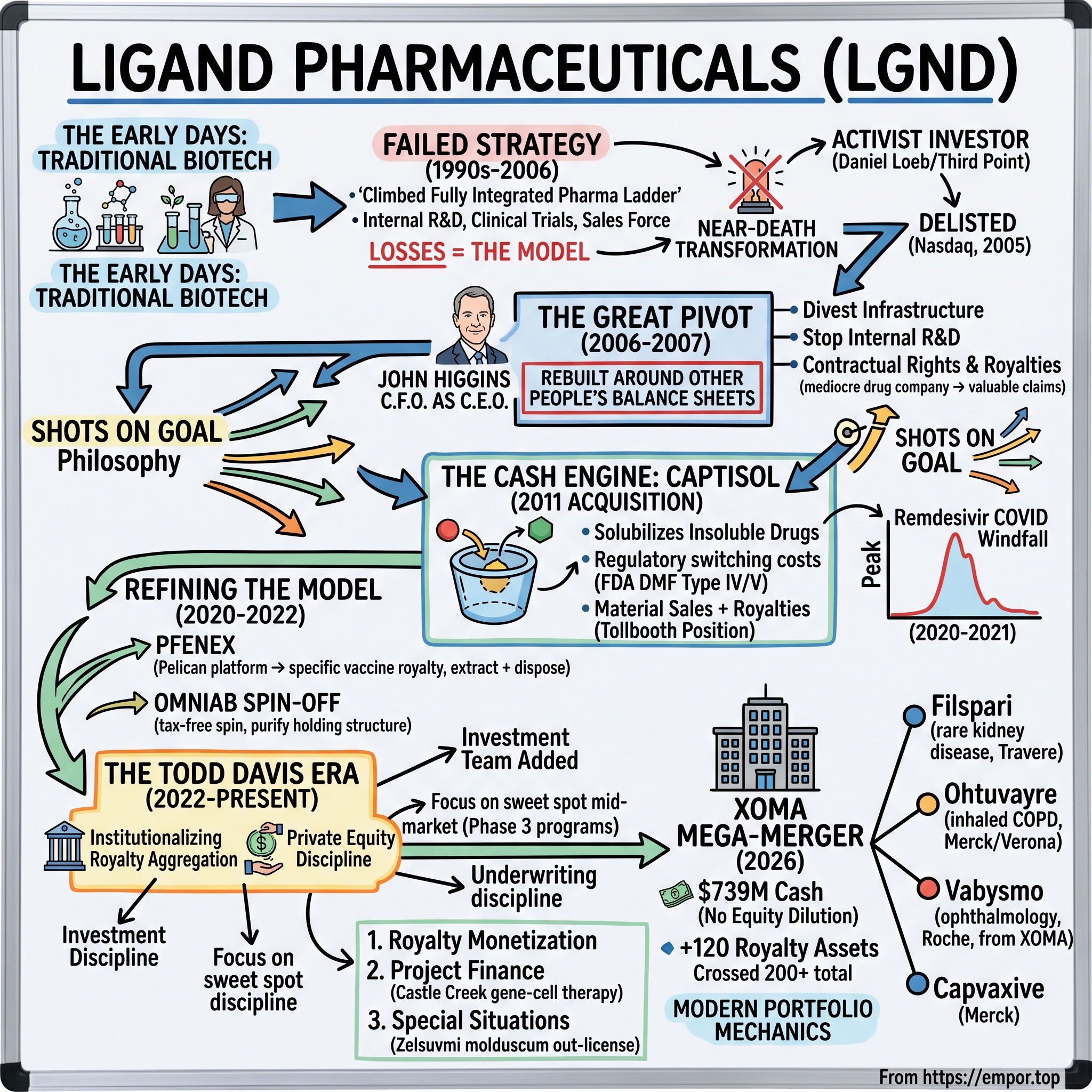
Ligand Pharmaceuticals: The Wall Street Mechanics of the Biotech Tollbooth
I. Introduction & Episode Roadmap
There is a particular kind of company that most investors never learn to see properly, because it hides inside an industry whose economics it has deliberately rejected.
Walk into the headquarters of a typical mid-cap biotech and you will find laboratories, freezer farms, regulatory affairs departments, a clinical operations team tracking patient enrollment across forty sites, and a chief medical officer whose entire career hinges on a single readout eighteen months away. Walk into Ligand Pharmaceuticals and you will find something closer to a specialist credit fund. As of December 31, 2025, the company employed 47 full-time people.1 Those 47 people sat on top of a portfolio that, after the July 2026 close of its largest transaction ever, spans more than 200 biopharmaceutical royalty assets.2
That ratio — roughly four royalty-bearing programs per employee — is the entire story compressed into a single number. Ligand does not run clinical trials. It does not employ sales representatives. It does not build manufacturing plants. It writes checks, negotiates contracts, and then waits for a percentage of somebody else's revenue to arrive. In 2025, royalties produced $161.0 million of income against total revenues of $268.1 million, and royalty receipts — actual cash through the door — reached $176.9 million.31 Full-year core adjusted earnings came in at $8.13 per diluted share, up 42% year over year.3
The obvious question, and the one this story exists to answer, is whether that arrangement is a genuine structural advantage or an accounting artifact dressed in the language of compounding.
Because here is the uncomfortable truth about royalty aggregation: it is not a technology, it is not a patent, and it is not a brand. It is a financing structure. Anyone with capital can buy a royalty. Royalty Pharma has been doing it at a vastly larger scale for decades. Blackstone has a life-sciences arm doing the same thing. Private credit funds have discovered the asset class. If Ligand's edge is simply "we buy cash flows," then it has no edge at all — it has a cost of capital, and cost of capital is a commodity.
So what, precisely, is Ligand selling?
The answer that management gives, and that the last four years of results partially support, is that Ligand operates in a segment of the market where capital is genuinely scarce: mid-market, late-stage, often privately held biotech assets that need $25 million to $200 million and cannot get it cheaply anywhere else. On the first-quarter 2026 earnings call, CEO Todd Davis described the sweet spot as Phase 3 programs costing "$30 million to $80 million" in total, where "there's a high demand for capital and there's relatively few solutions in terms of structured finance or royalty financing."4 That is a claim about market structure, not about science. It is testable. And it is the claim we will be testing throughout.
The five threads of this story. First, the near-death transformation — how a 1990s drug-discovery company with world-class science and a terminal cost structure nearly destroyed itself, and how a young former CFO named John Higgins rebuilt it around other people's balance sheets. Second, the engine: Captisol, an unglamorous chemical excipient that became one of the most durable toll positions in pharmaceutical manufacturing. Third, the COVID super-cycle, when Gilead's remdesivir turned a niche formulation ingredient into a nine-figure revenue line, and the corporate housecleaning that followed. Fourth, the Todd Davis era, in which a healthcare private-equity veteran replaced the "shots on goal" philosophy with something closer to underwriting discipline. And fifth, the mechanics of the moat — whether Ligand's advantages survive contact with Hamilton Helmer's 7 Powers and Michael Porter's five forces, or whether they dissolve into "we got the timing right on four good drugs."
One more framing note before we begin. Ligand's headline earnings figure is a non-GAAP construct, and the gap between the two accounting worlds is not cosmetic. In the first quarter of 2026, the company reported a GAAP diluted loss of $0.67 per share and an adjusted profit of $1.63 per share — a swing driven mostly by fair-value marks on equity holdings.4 In full-year 2025, GAAP net income was $124.5 million while core adjusted net income was $165.1 million.3 Neither number is wrong. But an investor who reads only one of them is not reading this company.
To understand why Ligand became what it is, you have to go back to what it was — and to the fact that it was, for roughly two decades, a spectacularly unsuccessful drug company.
 Subscribe on LinkedIn
II. The Biotech Crucible: Founding & The Nuclear Receptor Era (1987–2006)
In September 1987, in the biotech corridor stretching north from San Diego toward the Salk Institute, a venture capitalist named Brook Byers of Kleiner Perkins Caufield & Byers incorporated a company called Progenx.5 The initial concept was monoclonal antibodies for cancer detection. Howard Birndorf, one of the era's serial biotech founders, took the chief executive's chair.
Then the science pivoted, and the pivot is what gave the company its name and its identity for the next twenty years.
The Salk Institute, a few miles up the road, was home to research on intracellular receptors — the molecular switches inside cells that hormones dock into to turn genes on and off. Think of a cell as a factory with thousands of machines, and the nucleus as the control room where the instructions live. Hormones like estrogen, testosterone, cortisone, and vitamin A derivatives don't operate the machines directly. They bind to receptor proteins, and the receptor-hormone pair travels into the control room and flips genetic switches. A molecule that binds to a receptor is called a ligand. In December 1989, the company licensed the Salk receptor technology and renamed itself accordingly.5
This was, at the time, close to the frontier of molecular biology. If you could design small molecules that bound to specific nuclear receptors and flipped specific genetic switches, you could in theory treat cancer, metabolic disease, inflammation, and hormonal disorders with a precision that the pharmacology of the 1980s could not approach. The intellectual proposition was genuinely first-rate, and the pharmaceutical industry agreed with its wallet. David Robinson replaced Birndorf as CEO in 1991, and over the following decade Ligand signed research collaborations with Pfizer, Glaxo Wellcome — which put $10 million of equity in during 1992 — Abbott Laboratories, Wyeth-Ayerst, and SmithKline Beecham. An October 1997 arrangement with Eli Lilly was valued at up to $200 million; Elan Corporation invested $20 million in October 1998.5
The company went public in December 1992, selling 3.75 million Class A shares for more than $38 million.5
The playbook that consumed the company
What followed is the canonical biotech tragedy of the 1990s, and it is worth telling precisely, because everything Ligand became later is a reaction to it.
The prevailing strategy of the era held that a discovery company should become a fully integrated pharmaceutical company. Discover the molecule, develop it, get it approved, and — critically — hire your own sales force to sell it, because that is where the margin lives. Every step of that ladder consumed capital, and the equity market supplied it in exchange for dilution.
Ligand climbed the ladder. It bought Glycomed in 1995 for roughly $57 million and Seragen in May 1998 for about $35 million.5 And it did, eventually, produce approved medicines. In a single week in 1999, the FDA cleared both Panretin gel and Ontak; Targretin followed later that year, with analysts projecting $100 million to $300 million in eventual annual sales.5
Three approved oncology and dermatology products. A world-class receptor platform. Partnerships with half of Big Pharma.
And it still did not work.
The financial record tells the story: revenues of $5.5 million against a $14 million loss in 1992, growing to $16.1 million of revenue against a $19.5 million loss in 1993, with profitability remaining out of reach through the end of the decade.5 The losses were not a bug in the model; they were the model. Every dollar of product revenue arrived only after several dollars of clinical and commercial spending, and the specialty sales force required to sell Targretin to dermatologists and oncologists cost roughly the same whether it sold $50 million or $300 million of product.
This is the structural flaw that defines small-cap drug commercialization, and it is worth stating plainly because Ligand's later strategy is a direct inversion of it. A branded pharmaceutical sales infrastructure is a fixed cost with a step function attached. You cannot buy 30% of a sales force. Below a certain revenue threshold, the infrastructure eats the product. Above it, the economics are magnificent. Most small companies never cross the threshold, and Ligand did not.
The unraveling
By the mid-2000s the accumulated strain broke through into the accounting. Ligand's revenue recognition for product shipped into the wholesale distribution channel came under scrutiny, and the company was forced into a restatement of prior financial reports. The consequence was severe and public: delisting from Nasdaq in 2005, delayed filings, shareholder litigation, and a collapse in the equity.6
Into that vacuum came activist capital. Third Point, the hedge fund run by Daniel Loeb, accumulated a major stake and pushed hard for a wholesale reconstruction of the business.6 Henry Blissenbach took over as chairman and interim CEO in August 2006.7 The company began selling assets — the oncology products, the AVINZA pain franchise — and shedding the infrastructure that had been built to support them.
The restructuring, when it came, was not a trim. It was an amputation. Ligand cut roughly three of every four remaining employees, taking headcount from 352 to 85, dismissed senior executives including the CFO, and shuttered its UK operation.6
What survived that amputation is the interesting part. The intellectual property survived. The research collaborations survived. The contractual rights to receive milestone payments and royalties on molecules that partners were still developing — those survived, and they cost almost nothing to maintain.
Ligand had spent nineteen years proving it was a mediocre drug company. It had also, entirely by accident, accumulated a portfolio of claims on other people's future revenue. The question in early 2007 was whether anyone would recognize that the second thing was worth more than the first.
III. The Near-Death Crisis & The Great Pivot: John Higgins and the Royalty Transformation (2006–2011)
On January 16, 2007, Ligand's board named John L. Higgins chief executive officer.7
He was 36 years old. His prior job had been chief financial officer of Connetics, a specialty dermatology company — a finance seat, not a laboratory seat. He had never run a drug discovery organization, had never shepherded a compound through a Phase 3 trial, and had never launched a product. In the biotech orthodoxy of the time, this was a category error. Chief executives of drug companies were supposed to be physicians or PhDs, or at minimum former commercial leaders. Ligand hired an accountant.
That, in retrospect, was the entire point. Ligand's problem was never scientific. Its receptor chemistry had produced approved medicines and had attracted partnerships from Pfizer, Lilly, and Glaxo. Its problem was that it had built a cost structure appropriate to a company with $2 billion of revenue and attached it to a company with $30 million. What it needed was not a better scientist. It needed someone willing to look at the profit-and-loss statement and destroy most of what he saw.
The surgical shift
Higgins's reconstruction had a simple logic that took years to fully express. Ligand would stop doing drug development and start owning economics in drug development.
That meant divesting the commercial infrastructure, closing internal development programs, and cutting overhead to a level where the company could survive on partner-derived income alone. It meant accepting, permanently, that Ligand would never capture the full economics of a blockbuster — that it would earn 2% to 10% of net sales where a fully integrated developer might earn 40% operating margins on 100% of them.
In exchange, Ligand transferred essentially all of the risk. The partner funds the Phase 3 trial. The partner takes the regulatory review risk. The partner hires the sales force, negotiates with payers, absorbs the pricing pressure, defends the patents, and books the manufacturing cost. Ligand's downside on any given program is capped at what it already spent, which in many legacy cases was zero incremental dollars. Its upside is a perpetual percentage.
Management branded this "shots on goal." The framing was deliberately probabilistic: no single program mattered, and the company would hold enough of them that the portfolio's expected value dominated any individual outcome. It is a venture capital philosophy applied to contractual claims rather than equity.
It is also, viewed skeptically, a philosophy that can excuse a great deal of undisciplined activity. If no single asset matters, then no single asset needs to be underwritten rigorously. That tension — breadth as diversification versus breadth as an alibi — would follow Ligand for the next fifteen years and become the central charge in the short-seller attacks of 2019.
Buying pipelines out of the wreckage
The 2008–2009 financial crisis was, for a company with cash and a mandate to acquire royalty rights, extraordinarily convenient. Small biotechs with promising partnered programs and eighteen months of runway had no access to equity markets. Their royalty interests — contractual rights to future payments from large-cap partners — were worth something to a patient buyer and nothing to a company that needed payroll met in ninety days.
Ligand bought Pharmacopeia in 2008 and Metabasis in 2009, in both cases acquiring portfolios of partnered programs and residual royalty rights at prices reflecting distress rather than expected value. Metabasis, in particular, carried a hepatitis C compound that would eventually pass through several hands.
None of these deals were individually transformative. What they established was a template and a discipline: identify contractual claims on future pharmaceutical cash flows, buy them from sellers whose need for immediate liquidity exceeds their patience, and hold them at almost no carrying cost because Ligand's overhead had been cut to the bone.
The template needed one more thing to become a business rather than a collection of lottery tickets: a source of recurring cash flow that arrived every quarter regardless of whether any particular molecule succeeded.
In January 2011, Higgins found it in a company outside Kansas City that made a chemical nobody outside pharmaceutical formulation had ever heard of.
IV. Building the Cash Engine: The CyDex Acquisition & Captisol's Golden Monopoly (2011–2019)
Lenexa, Kansas, is not where biotech legends are typically set. But the deal Ligand signed there in January 2011 has a reasonable claim to being one of the most value-accretive acquisitions in the history of mid-cap pharmaceuticals.
CyDex Pharmaceuticals was a small, cash-flow-positive business built around a single chemical platform. Ligand agreed to pay $31.2 million at closing plus $4.3 million on the one-year anniversary — roughly $35.5 million in aggregate, before milestone consideration.89 Ligand did not even fund it primarily from its own balance sheet: $11.2 million came from internal cash and $20 million from a 42-month secured term loan arranged with Oxford Finance.9
CyDex generated $16.3 million of revenue in 2010 from four marketed drugs, material sales, and license and milestone payments.9 Ligand was paying roughly two times revenue for a profitable specialty chemical business.
What Captisol actually does
The technology deserves a plain-English explanation, because the economics follow directly from the chemistry.
An enormous fraction of promising drug molecules fail for a boring reason: they will not dissolve in water. A compound can bind its target beautifully in a test tube and still be undeliverable, because you cannot inject a suspension of insoluble crystals into a patient's bloodstream, and a pill that will not dissolve will not be absorbed. Formulation chemists spend careers on this problem.
Captisol is a chemically modified cyclodextrin. Cyclodextrins are ring-shaped sugar molecules — picture a doughnut, or better, a tiny bucket. The outside of the bucket is water-loving; the inside is greasy. Drop a stubborn, oily drug molecule into solution with these buckets and the drug tucks itself inside the greasy cavity while the water-friendly exterior keeps the whole assembly dissolved. The drug is not chemically altered. It is chaperoned. When the complex reaches the bloodstream, it dissociates and releases the active molecule.
The commercial consequence is that Captisol rescues drugs that would otherwise be undevelopable, particularly injectables.
Why the tollbooth holds
Now consider what happens once a pharmaceutical company builds Captisol into an approved product.
An FDA new drug application is not a description of a molecule. It is a description of a specific manufactured product — every excipient, every concentration, every step of the process, all supported by stability data and clinical evidence generated using that exact formulation. Swapping out a solubilizing agent after approval is not a purchasing decision. It is a regulatory event that requires new stability studies, potentially new bioequivalence work, and agency review, on a molecule that is already generating revenue and where any interruption of supply is commercially catastrophic.
No product manager alive volunteers for that project to save a few points of cost on an excipient.
Ligand reinforced the position with regulatory infrastructure that a would-be competitor would need years to replicate. The company maintains both Type IV and Type V Drug Master Files with the FDA, containing the manufacturing and safety data that licensees reference in their own filings.1 A DMF is, in effect, a pre-cleared regulatory dossier: the partner's filing points at Ligand's file rather than reconstructing the evidence. That reference relationship is itself a switching cost — the second supplier would not merely need an equivalent molecule, but an equivalent regulatory history.
By the end of 2025, Captisol had enabled 17 FDA-approved products.1
The economics run on two tracks simultaneously, which is the elegant part. Ligand sells the physical material — a recurring, contracted product revenue stream with the working-capital profile of a specialty chemical business. And on many programs, it also earns a royalty on the finished drug's net sales. The same relationship monetizes twice.
The anchor asset
The proof case arrived in July 2012, when Onyx Pharmaceuticals received FDA accelerated approval for Kyprolis (carfilzomib) in multiple myeloma — a Captisol-enabled injectable.10 Amgen acquired Onyx the following year at $125 per share, and Kyprolis became a franchise product inside one of the largest biotechnology companies in the world. Ligand collected Captisol material revenue and royalties from a drug it had neither discovered nor developed nor sold.
Through the 2010s the same pattern repeated across a widening set of partners, and Ligand layered additional licensing arrangements on top through a steady cadence of small acquisitions. By the end of the decade the company was describing a portfolio of more than 100 partnered programs.
Then, in March 2019, Higgins demonstrated that the royalty book could be monetized in the other direction. Ligand sold its Promacta intellectual property rights and the associated royalty stream on Novartis's worldwide net sales — a legacy asset from the old receptor-chemistry era — to Royalty Pharma for $827 million in cash.11
That single transaction is worth pausing on, because it reframes everything that came before. Ligand had spent the better part of two decades failing to build a profitable drug company. One contractual royalty claim, generated almost incidentally by that failed effort and sold to a larger aggregator, produced more cash than the company's entire commercial operation had ever earned. The market for royalty streams was deep, liquid, and willing to pay a premium for duration and credit quality.
Ligand now had a proven cash engine, a proven exit market, and — after the Promacta sale — a fortress balance sheet.
What it did not have was a plan for what to do when the world changed. Eleven months later, it did.
V. The COVID Windfall, Pfenex, and Unlocking OmniAb (2020–2022)
In the early months of 2020, as hospitals worldwide filled with patients suffering from a disease with no approved treatment, Gilead Sciences accelerated development of an antiviral compound called remdesivir.
Remdesivir has a solubility problem. It is administered intravenously, and to get it into solution and keep it stable, Gilead's formulation used Captisol.
For Ligand, the consequence was a revenue shock of a magnitude the company had never experienced. Captisol material sales reached $110.0 million in 2020 and $164.3 million in 2021, with total 2021 revenues of $277.1 million — a record.12 A specialty excipient business acquired for $35 million had, in a single pandemic year, generated more revenue than its purchase price roughly five times over.
The proper analytical reading of this event is more complicated than "Ligand got lucky," though luck was clearly involved. What the pandemic demonstrated was the option value embedded in an ingredient that sits inside hundreds of formulation programs. Ligand had no idea which molecule would need Captisol at scale. It simply held a position that paid off whenever any Captisol-enabled drug went vertical. That is a genuine feature of the business model, not an accident.
But it is also the kind of windfall that corrupts capital allocation, and the record here is mixed.
Management's forecasting record under pressure
In September 2020, with remdesivir demand surging, Ligand publicly forecast 2021 Captisol material sales of $200 million.13 Actual 2021 Captisol sales came in at $164.3 million — roughly 18% below the forecast.12 By the fourth quarter of 2021, Captisol revenue was already declining year over year on lower remdesivir-related demand.12
This matters as evidence about behavior, not as a scandal. Management extrapolated a pandemic demand curve, published a number, and missed it. That is a data point on forecasting discipline that belongs in the file alongside the more recent record, which — as we will see — has been considerably better.
Deploying the windfall: Pfenex
The more consequential question was what to do with the cash. Ligand's answer, announced in August 2020, was to acquire Pfenex Inc. for $12.00 per share in cash — approximately $438 million of equity value on a fully diluted basis, plus a contingent value right of $2.00 per share tied to future milestones. The transaction closed on October 1, 2020.1415
Pfenex owned the Pelican Expression Technology platform, an engineered Pseudomonas fluorescens system for manufacturing complex therapeutic proteins. If Captisol solves the problem of getting a small molecule into solution, Pelican solves an adjacent problem: producing certain proteins efficiently at scale when conventional bacterial or mammalian systems struggle.
The strategically important asset inside Pfenex was not the platform itself but a specific royalty. Merck used a Pelican-produced CRM197 carrier protein in its pneumococcal conjugate vaccine program, and Ligand acquired a low-single-digit royalty on net sales of that franchise.15 Those vaccines — Vaxneuvance and, later, Capvaxive — would become durable contributors to the royalty base years after the platform that generated them had been sold off.
Which is exactly what happened. In September 2023, Ligand spun the Pelican subsidiary out, merging it with Primordial Genetics to form Primrose Bio.16 Ligand kept the royalty and disposed of the operating business.
That sequence is the clearest available illustration of what the company actually optimizes for. It is not interested in owning platforms. It is interested in owning the contractual claims platforms generate, and it will pay several hundred million dollars for an operating business in order to extract a royalty and then dispose of the rest.
Purifying the model: the OmniAb separation
The same logic drove the largest corporate restructuring of the Higgins era.
OmniAb was Ligand's antibody discovery platform — transgenic animals engineered to produce human antibodies, licensed to pharmaceutical partners who paid access fees and downstream milestones and royalties. Scientifically it was well regarded and commercially it was growing. It was also, structurally, the wrong business to sit inside a royalty aggregator: it required continuous research spending, a substantial scientific staff, and capital equipment, all of which diluted the margin profile and obscured the underlying royalty economics.
Ligand separated it. OmniAb completed its tax-free spin-off and concurrent business combination with Avista Public Acquisition Corp. II on November 1, 2022, beginning trading on Nasdaq under the ticker OABI the following day, with Ligand's longtime operating executive Matt Foehr taking the chief executive role at the new company.17
Ligand shareholders received shares directly. What remained at Ligand was, for the first time in the company's thirty-five-year history, close to a pure financial holding structure: contractual royalty rights, the Captisol franchise, and very little else.
John Higgins had arrived in 2007 to salvage a delisted, litigated, cash-burning drug company. He left it as a debt-light, cash-rich collector of pharmaceutical cash flows. Five weeks after the OmniAb separation closed, he announced his retirement.
VI. The Todd Davis Playbook: Institutionalizing Royalty Aggregation (2022–2026)
On December 5, 2022, Ligand named board member Todd C. Davis as chief executive officer, with Matt Korenberg appointed president and chief operating officer.18
The choice signaled a change in kind, not degree. Higgins was a corporate finance executive who had learned the royalty business by rebuilding a broken drug company around it. Davis had spent his career in the royalty business as a principal. He was a co-founder of HealthCare Royalty Partners, one of the firms that professionalized pharmaceutical royalty investing, with a background spanning structured debt, equity, and synthetic royalty transactions across three decades of healthcare investing.
The distinction matters because it changed the unit of analysis. Under "shots on goal," the relevant question about a new program was: could this work? Under a private-equity-trained underwriter, the question becomes: at what price does this clear our return threshold, and what does the downside look like if the clinical assumption is wrong?
The 2022–2023 reset
Davis has been unusually explicit about what he did on arrival, and the numbers he cites are checkable.
On the first-quarter 2026 call, he described the shift into "a pure royalty aggregation model and away from the development of infrastructure-heavy technology platforms," noting that across 2022 and 2023 Ligand divested two platform businesses and reduced headcount from nearly 200 employees to approximately 40 — taking operating expenses "from the $90 million range down to about the $40 million range."4
Then he rebuilt in one direction only. Ligand added an investment team; by mid-2026 the deal organization numbered 18 people — more than a third of total headcount devoted to origination, diligence, and portfolio management.4 For a company whose entire product is capital deployment, that allocation is the strategy made visible.
The financial arc since is genuinely striking. Core revenue grew from $108 million in 2022 to $240 million in 2025, and adjusted earnings per share from $2.44 to $8.13 over the same span.3 Ligand went from seven commercial royalty assets to fifteen and closed 18 transactions in three years.4
For context on how far the trough went: full-year 2023 total revenues were a fraction of the pandemic peak, with fourth-quarter 2023 revenue of $28.1 million including royalties of $22.5 million, and initial 2024 guidance called for total revenue of just $130 million to $142 million.19 The company then delivered $167.1 million in 2024 and $268.1 million in 2025.3 Post-COVID normalization was severe, and the recovery was driven by assets that did not exist in the portfolio in 2021.
Three ways to buy a royalty
Davis has organized origination around three distinct tactics, and the distinction is analytically useful because each carries different risk.
Royalty monetizations are the classic trade: a company or institution holds an existing license with a royalty attached and sells it for present cash. Risk is essentially commercial and credit — will the underlying product sell?
Project finance is riskier and, according to management, less competitively contested. Ligand funds a specific clinical program in exchange for a royalty on the eventual product. Here the company is taking clinical development risk, which is precisely the risk the entire strategy was built to avoid. Two 2025 examples show up directly in the accounting: Ligand led a $75 million royalty financing in Castle Creek Biosciences supporting the Phase 3 study of its gene-modified cell therapy for dystrophic epidermolysis bullosa, and funded a royalty financing with Orchestra BioMed's cardiology programs.203 It also entered a $100 million royalty financing agreement with Agenus.21
Special situations are the most operationally involved — cases where, as Davis put it, Ligand engages "operationally and rescue[s] good assets trapped in challenging situations."4 The signature example is Zelsuvmi, a treatment for molluscum contagiosum that Ligand shepherded out of a bankrupt partner through FDA approval, then placed into a newly constructed public company, Pelthos Therapeutics, via a merger with Channel Therapeutics — retaining a 13% royalty and a substantial equity position.322 The out-license generated approximately $25 million of income in 2025.3
The special-situations line is where a skeptic should focus. It is high-return when it works, but it is also the tactic that most resembles operating a biotech — the exact activity Ligand's structure claims to have outsourced. The Pelthos equity stake now moves Ligand's GAAP earnings around through fair-value marks each quarter, which is how a company with $52 million of quarterly revenue reported a GAAP loss in the first quarter of 2026.4
The people running it
Todd Davis is, in his public appearances, notably unromantic about the science and precise about structure. Asked on the first-quarter call whether the XOMA transaction signaled a shift toward buying portfolios rather than individual assets, he did not oversell: "the majority of our pipeline are single or double assets," he said, calling XOMA "fairly unique" and noting "there are not many like this in the market that we know of."4 That is a CEO declining an easy narrative extension.
Octavio "Tavo" Espinoza, the chief financial officer, handles the parts of the story that determine whether any of it converts to shareholder value: overhead discipline, tax structure, and cash conversion. His disclosure on the XOMA tax attributes was a good example of appropriate hedging — he told analysts the acquired net operating losses would be limited under Section 382-type restrictions but that the Section 174 R&D tax credits would transfer fully and be usable immediately, and explicitly declined to quantify the total until financial diligence was complete.4 Declining to give a number you cannot yet stand behind is, on the evidence of many management teams, rarer than it should be.
Lauren Hay, vice president of portfolio strategy and investments, runs a function created in 2025 that reveals something important about how the model has evolved. Ligand no longer treats its portfolio as passive. The "systematic portfolio management" process tracks partner progress, increases dialogue frequency, and hunts for assets that have stalled and can be repartnered or refinanced.22
The clearest proof point is lasofoxifene — a selective estrogen receptor modulator originally discovered in 1991 through a Ligand–Pfizer research collaboration, still sitting in the portfolio thirty-four years later. Its developer, Sermonix, ran into financial trouble midway through a Phase 3 trial in ER-positive, HER2-negative metastatic breast cancer. Rather than write it off, Ligand worked with Sermonix's investors to assign the license to LeonaBio (formerly Athira Pharma), which completed a $90 million PIPE led by Perceptive, Commodore, and TCGX with potential additional financing of $146 million. Ligand participated in the PIPE and retains a tiered 6% to 10% royalty on worldwide net sales, with pivotal data expected in mid-2027.22
That is a thirty-four-year-old asset resurrected by financial engineering rather than science. It is also, notably, the kind of value that never appears in a discounted cash flow model built off current royalties.
What is actually driving the numbers
Behind the strategy language, four or five products are doing most of the work — a concentration that sits uneasily beside the "200+ assets" framing.
Filspari (sparsentan), partnered with Travere Therapeutics for IgA nephropathy, is now the largest royalty in the portfolio. U.S. net sales reached $322 million in 2025, with fourth-quarter sales of $103 million growing 108% year over year; including sales booked by Travere's European partner CSL Vifor, global sales were approximately $355 million, on which Ligand recorded $32 million of royalties at a 9% rate.322 In April 2026 the FDA granted full approval in focal segmental glomerulosclerosis — a second rare kidney disease with no previously approved therapy — across primary, secondary, and genetic forms.4[^23] Travere has guided to a roughly $3 billion peak opportunity across both indications, which management calculates would translate to approximately $270 million of annual royalty to Ligand.4
Ohtuvayre (ensifentrine) is the first novel inhaled mechanism approved for COPD maintenance treatment in more than twenty years; Ligand earns a low-single-digit royalty plus milestones, including $5.8 million on FDA approval and $13.8 million on commercial launch.23 U.S. net sales reached $506 million in its first full calendar year, 2025.3 The asset changed hands in October 2025 when Merck completed its approximately $10 billion acquisition of Verona Pharma — an event that transferred the commercialization of Ligand's royalty-bearing product from a small-cap specialist to one of the largest pharmaceutical companies in the world.24 China's 国家药品监督管理局 NMPA accepted an NDA for review in January 2026.3
Capvaxive, Merck's pneumococcal vaccine descended from the Pfenex transaction, recorded $279 million of net sales in the fourth quarter of 2025 and $755 million for the year.3 Qarziba, a neuroblastoma therapy marketed by Recordati in 35 ex-U.S. markets, generated €159 million of 2025 net sales, up 12%; Ligand acquired the royalty by purchasing Austria's APEIRON Biologics outright for $100 million in cash in July 2024, with up to $28 million of additional contingent consideration.325
The pattern across these four is consistent and worth naming: Ligand's growth has come from acquiring or financing assets shortly before or shortly after commercial inflection, in therapeutic areas — rare kidney disease, COPD, pediatric oncology, vaccines — where the partner is a capable commercial organization. That is a specific, repeatable underwriting posture, not a diversified index of biotech.
It is also a posture with an obvious limitation. Ligand controls none of it. If Travere's field force underperforms, or Merck deprioritizes a respiratory asset inside a portfolio containing Keytruda, Ligand has no lever to pull beyond a phone call.
By early 2026, with cash and investments approaching $780 million and $200 million of undrawn revolver capacity, the company had roughly $1 billion of deployable capital and a stated deployment pace of $150 million to $250 million per year.4 That is more capital than the strategy could absorb at its historical rate.
So Ligand bought the only other company doing the same thing.
VII. The $739M XOMA Mega-Merger & Modern Portfolio Mechanics
XOMA Royalty Corporation had a history that rhymed with Ligand's almost uncomfortably.
Founded in the biotech industry's first generation, XOMA spent close to four decades attempting to develop and commercialize its own antibody therapeutics without ever achieving durable commercial success. In 2017, it abandoned the attempt and pivoted to royalty aggregation — the same conclusion Ligand had reached a decade earlier, arrived at by the same route. Over the following years XOMA deployed more than $200 million of capital across 17 royalty transactions and nine acquisitions, assembling a portfolio of over 120 partnered programs.26 Its first meaningful royalty cash arrived in 2022 from Vabysmo, Roche's ophthalmology blockbuster for wet age-related macular degeneration and diabetic macular edema.26
Leadership passed from Jim Neal, who retired in January 2023, to Owen Hughes, who served as executive chairman and interim CEO before being named chief executive in January 2024.26
The two companies knew each other well. According to Michael Vigilante, Ligand's deal lead on the transaction, the firms had a long-standing relationship; the parties "engaged fully in December" 2025, Ligand spent considerable time diligencing the portfolio, and the discussions "continued into 2026, where we reached alignment on terms and structure in April."4
The terms
On April 27, 2026, Ligand announced it would acquire XOMA Royalty for $39.00 per share in cash — approximately $739 million of total equity value, representing about a 14% premium to XOMA's 30-trading-day volume-weighted average price as of April 24.27 The transaction closed on July 14, 2026.2
Two structural features deserve attention.
First, the financing. Ligand funded the purchase from cash on hand and borrowings under its existing credit facility.27 No equity was issued. For a company whose entire investment case rests on compounding per-share cash flow, refusing to dilute for the largest acquisition in its history is the most meaningful signal in the transaction.
Second, the contingent value right. XOMA shareholders received one non-transferable CVR per share, entitling them to 75% of any net proceeds from XOMA's pending litigation against Janssen Biotech relating to the commercialization of TREMFYA.27 The litigation assets remain in a post-reorganization XOMA LLC. Ligand retains the other 25% and — critically — has no obligation to fund the litigation.4
This is a genuinely clever piece of deal architecture. Litigation outcomes are close to un-underwritable; a buyer forced to price them will either overpay or walk. By carving the claim out into a CVR, Ligand paid for the assets it could diligence and handed the sellers most of the upside on the asset it could not. Espinoza's framing on the call — "there is no P&L impact associated with the case, only potential upside" — is accurate as far as it goes, though investors should note that a CVR structure also means Ligand captured only a quarter of an outcome it now partly controls the timeline of.
What came in the door
The acquired portfolio added more than 120 assets: seven commercial products, 14 late-stage development programs, and over 100 earlier-stage assets.2 The named commercial additions are Vabysmo (Roche), Ojemda (tovorafenib, Servier), and Miplyffa (arimoclomol, Zevra Therapeutics).2 Late-stage additions include Takeda's 武田薬品工業 mezagitamab and several externalized Takeda assets — osavampator, volixibat, and OHB-607.2 Volixibat, in development by Mirum Pharmaceuticals for primary sclerosing cholangitis, reported positive Phase 2b data in May 2026 with an NDA submission planned for the second half of the year.4
Ligand's total portfolio crossed 200 royalty assets, and its Phase 2 and Phase 3 holdings roughly doubled.227
Did Ligand overpay?
This is the question that matters, and the honest answer is that it depends almost entirely on assets that are not yet generating revenue.
Work the disclosed arithmetic. Ligand guided to approximately $0.50 per share of adjusted EPS accretion in 2026, reflecting a partial-year contribution, and approximately $1.50 per share in 2027 on a full-year basis.24 With roughly 21 million diluted shares outstanding — implied by fourth-quarter 2025 GAAP net income of $44.8 million at $2.12 per diluted share3 — $1.50 per share equates to something on the order of $32 million of incremental adjusted net income in the first full year.
Against a $739 million purchase price, that is an initial earnings yield in the neighborhood of 4%. On a static basis, that is not obviously a bargain. It is roughly what a long-dated investment-grade bond yielded in 2026, for an asset carrying commercial, clinical, and patent risk.
The case for the deal therefore rests on four things that the static number omits. The tax attributes — particularly Section 174 R&D credits usable immediately — reduce the effective cash cost.4 The synergies are close to total: Davis described them as "approaching 100%," because Ligand's existing 47-person infrastructure absorbs a passive contractual portfolio at essentially no incremental cost.4 The commercial assets grow, and some of the royalty rights extend past 2040.4 And the 14 late-stage programs plus 100-plus earlier-stage assets are effectively unpriced options.
An investor's view of this deal is therefore a view about whether Ligand's diligence on 120 assets in roughly four months was rigorous enough to price the tail correctly. Ligand's disclosed underwriting bar is a 12% to 15%-plus unlevered return; whether XOMA clears it will not be knowable from external data for several years. That is an uncomfortable but accurate statement of the epistemic position.
What is knowable is the operating logic, and it is sound. A royalty aggregator's cost structure is almost entirely fixed. Doubling the portfolio without doubling overhead is the single most reliable value-creating move available to the model — and it is the move that only works if you have already built the infrastructure to absorb it. Davis's claim that Ligand spent two years "scaling the business and our portfolio management system in anticipation of absorbing new assets" is at least consistent with the timeline.4
With the transaction closed, it is worth stepping back to examine how the combined business actually makes money — and whether the resulting position is defensible.
VIII. Business Breakdown, Financial Engine, & Economic Moats
Ligand reports as a single operating segment, but its revenue arrives in three economically distinct forms, and confusing them is the most common analytical error made about this company.1
Royalties are the core. In 2025 they contributed $161.0 million of the $268.1 million total, and 2026 guidance — raised after the XOMA close — calls for $225 million to $250 million within total revenue of $270 million to $310 million.328 These are contractual percentages of partner net sales with essentially no associated cost of goods. Every incremental dollar drops to operating income before tax.
Captisol material sales contributed $40.2 million in 2025, with 2026 guidance of $35 million to $40 million.3 This is a physical product business with real manufacturing economics and lumpy ordering patterns. Espinoza has been candid that the line "tends to be inconsistent" quarter to quarter because of order timing from large customers, while noting Ligand has order visibility into early 2027.4 The strategic significance of Captisol has inverted: once the majority of revenue during the pandemic, it is now roughly 15% and functions primarily as a stable base and a relationship-origination channel rather than a growth driver.
Contract revenue — milestones and license fees — was $66.9 million in 2025, inflated by the roughly $25 million Zelsuvmi out-license, against 2026 guidance of $10 million to $20 million.3 This line is genuinely unpredictable; Espinoza noted more than 18 distinct milestone opportunities across the portfolio, of which only some will trigger in any given year.4
The accounting judgment investors must understand
Here is the item that deserves more scrutiny than it typically receives.
When Ligand funds a development-stage royalty — the project finance tactic — accounting rules can require the payment to be expensed immediately as research and development rather than capitalized as an asset. In 2025, full-year R&D expense was $81.2 million, of which approximately $62 million related to the accounting treatment of the Castle Creek and Orchestra BioMed investments, including a $44.3 million one-time charge for Castle Creek and $17.8 million for Orchestra.3
Those charges are then excluded from core adjusted earnings.
Both treatments are defensible in isolation. GAAP forces the expense because the future benefit is not sufficiently probable; management excludes it because it is a capital deployment, not an operating cost. But the combined effect is that Ligand's headline adjusted EPS — the number that anchors guidance, and the number in the $8.50 to $9.50 range for 2026 — reflects the royalties these investments eventually produce while excluding what was paid for them.
This is not an accusation of impropriety. It is a statement that adjusted EPS, on its own, systematically flatters a business model whose primary cost is capital deployment. The corrective is to track cash: operating cash flow against capital deployed, over multi-year windows. Management guides to approximately $300 million of combined operating cash flow with $150 million to $250 million of annual deployment.4 That spread — cash generated versus cash reinvested — is the honest measure of whether the machine self-funds.
Similarly, GAAP earnings are distorted in the opposite direction by fair-value marks on equity holdings in Pelthos, Viking Therapeutics, and other positions, which produced $41.6 million of non-operating expense in the first quarter of 2026 alone.4 Neither statement, read alone, describes the business.
Hamilton Helmer's 7 Powers, applied honestly
Counter-Positioning is the strongest of Ligand's claims. Ligand offers biotechs non-dilutive capital in exchange for a royalty, and its own cost structure carries no clinical spending. A traditional biotech cannot adopt this posture without liquidating the R&D organization that constitutes its identity and its equity story. That is a textbook counter-position: the incumbent's response is blocked not by capability but by self-cannibalization.
The limit is that Ligand's real competitors are not biotechs. They are other capital allocators — Royalty Pharma, HealthCare Royalty, Blackstone Life Sciences, and an expanding set of private credit funds — and none of them face that constraint. Counter-positioning protects Ligand from the sellers, not from the buyers.
Cornered Resource applies narrowly but genuinely to Captisol: patent protection plus the FDA drug master files plus a manufacturing and quality track record embedded in 17 approved products.1 It does not extend to the royalty business, where deal-sourcing relationships are valuable but replicable.
Switching Costs are real and, in the Captisol case, close to absolute for the life of an approved product. In the royalty business, switching costs do not exist in the usual sense — but something better does. A royalty contract is a legal obligation running with the asset, surviving changes of ownership. When Merck bought Verona Pharma, Ligand's economics on Ohtuvayre transferred intact.24 Ligand's claim does not depend on the counterparty's goodwill or on renewal.
Scale Economies are the power the XOMA transaction was designed to purchase. With 47 employees supporting 200-plus assets, the marginal cost of the two hundred and first is close to zero.12 This is the most credible durable advantage in the business — provided management resists the temptation to grow overhead alongside the portfolio. G&A rose from $78.7 million in 2024 to $92.4 million in 2025 as the business development function scaled.3 That is defensible investment in origination capacity, but it is the line item where discipline will be visible or absent.
Process Power, Network Economies, and Branding — the remaining three powers — are largely absent. Management would argue that a reputation as a reliable, fast, founder-friendly counterparty constitutes brand in a market where sellers choose their financier. There is some truth to this in a small, relationship-driven market. It is not a moat you would underwrite.
Porter's five forces
Buyer power is moderate and asymmetric in an unusual way. Ligand's "buyers" — its licensees and partners — hold enormous power over outcomes, since they control pricing, promotion, and geographic strategy. But they hold almost no power over terms, because executed royalty agreements are not renegotiated. Ligand is exposed to partner competence, not partner bargaining.
Supplier power, in this model, means the power of asset sellers, and it is rising. Davis himself noted the royalty funding market has doubled over five years and that biotech CFOs no longer require education about how royalty financing fits a capital structure.22 A more sophisticated, better-informed seller base means less mispricing. That is a headwind management has acknowledged rather than denied — a point in its favor for candor, and a point against the durability of returns.
Threat of substitutes is low at the product level. Reformulating an approved drug to remove Captisol requires regulatory work no commercial team will authorize. At the capital level, substitutes are abundant: equity, venture debt, structured royalties, regional licensing deals. Ligand competes on speed, structure, and willingness to take clinical risk — not on price.
Rivalry is the crux. In the $500 million-plus mega-deal tier, competition for blockbuster royalties is intense and Royalty Pharma's scale and cost of capital are decisive. In the $25 million to $200 million tier, Ligand's contention is that the deals are too small to interest the giants and too complex for generalist credit funds. The evidence is suggestive rather than conclusive: 18 transactions in three years, a pipeline management describes as containing more deals than the team can execute, and — most tellingly — the fact that when Ligand wanted to add scale, the most attractive available target was a competitor it could buy at a 14% premium.427 A fiercely contested market does not usually let consolidation happen that cheaply.
The strategic position, then, is genuinely defensible in a narrow band and genuinely vulnerable outside it. Which brings us to what a serious skeptic would do with it.
IX. Bear vs. Bull Case, Skeptical Stress Test, & Key KPIs
On the morning of January 16, 2019, Andrew Left's Citron Research published a report on Ligand Pharmaceuticals. The stock fell 17.65% that day to $108.51, having already declined 52% over the preceding six months.29
The report's central charge was not that any specific asset was worthless. It was structural: that Ligand was "a company designed for the 'lazy investor'," that its accounting was deliberately "opaque and complex," and that the aggregation of many small, individually unanalyzable claims created an appearance of diversification that concealed a dependence on a handful of speculative outcomes. Left noted that half of Ligand's projected major revenue milestones depended on a single partner, Viking Therapeutics, and questioned why the company was repurchasing its own stock rather than investing in Viking if the pipeline were genuine. He set a $35 price target.29
Citron was wrong on price — LGND traded around $300 per share in July 2026, against a 52-week range of roughly $130 to $327.30 But the analytical critique was more durable than the price call, and any honest assessment of Ligand today has to answer it.
Myth versus reality
Myth: Ligand is diversified across 200-plus assets, so no single failure matters.
Reality: the asset count is 200-plus; the revenue concentration is not. By management's own account, Filspari is the single largest royalty in the portfolio, and 2026 royalty growth was expected to be driven primarily by Filspari, Ohtuvayre, Capvaxive, and Zelsuvmi.3 Twelve products are described as the major royalty revenue drivers.1 The remaining ~190 assets are options, not income. Options have value — but a portfolio of 200 assets where four drive the growth rate is not a diversified portfolio in the sense that word implies.
Myth: Ligand takes no clinical risk.
Reality: it takes less clinical risk than a developer, but the project-finance tactic explicitly involves funding Phase 3 programs before approval. The $62 million of 2025 R&D charges tied to Castle Creek and Orchestra are the accounting footprint of exactly that risk.3 If those programs fail, the money is gone.
Myth: royalty aggregation is a capital-light business.
Reality: it is labor-light and asset-light, but it is capital-intensive in the most literal sense — the business consists of deploying capital. Ligand plans $150 million to $250 million of deployment annually against roughly $300 million of combined operating cash flow.4 More than half of operating cash flow is required simply to keep the machine running at its stated pace. That is closer to a specialty finance company than to a software business, and it should be valued with that in mind.
The activist stress test
A skeptical investor sitting across from Todd Davis in 2026 would press on five things.
Portfolio opacity. With more than 200 assets and disclosure concentrated on twelve, the external investor cannot independently value the tail. Ligand's response is that it discloses risk-adjusted assumptions — Espinoza cited a specific $4 million 2026 contribution assumption for Filspari in FSGS disclosed at the December 2025 Investor Day, which is unusually granular.22 That is a genuine mark in management's favor. But granular disclosure on a handful of assets does not solve the tail problem.
Non-GAAP dependence. Discussed above. The exclusion of expensed royalty investments from adjusted EPS is the single most important accounting judgment in the filings, and it deserves standing scrutiny rather than one-time acknowledgment.
Balance sheet and cost of capital. Ligand ended 2025 with $733.5 million of cash and short-term investments against $446.2 million of convertible senior notes due 2030, then spent $739 million on XOMA using cash and revolver borrowings.327 The company that entered 2026 with a fortress balance sheet exited the third quarter with materially less flexibility. If royalty asset prices become more attractive during a biotech downturn — precisely when Ligand would most want to deploy — the dry powder is thinner than it was.
The special-situations drift. Rescuing Zelsuvmi from bankruptcy, constructing Pelthos, participating in the LeonaBio PIPE, and taking equity stakes in partners are all activities that move Ligand back toward operating risk and equity volatility. Each is individually justifiable. Cumulatively, they blur the pure-royalty thesis that justified the OmniAb separation in the first place. An activist would ask why a company that spun out platforms to purify its margin profile is accumulating equity positions that swing GAAP earnings by tens of millions a quarter.
Capital allocation after promising discipline. Management has consistently described a disciplined, threshold-driven approach. It then executed the largest acquisition in company history, roughly quadrupling its typical deal size, on a diligence timeline of about four months. Davis's answer — that the parties had a long-standing relationship and engaged fully in December 2025 — is reasonable.4 But "we knew them well" is a weaker underwriting statement than "we modeled every asset," and the burden of proof sits with management.
Management credibility, measured by behavior
The record over the past three years is, on balance, good — with caveats.
Ligand exceeded its original 2025 adjusted EPS guidance by approximately 30%.3 It beat its initial 2024 revenue guidance of $130 million to $142 million by delivering $167.1 million.193 It raised 2026 guidance in connection with the XOMA announcement and then reaffirmed the raised figures at the first quarter.28 It disclosed a risk-adjusted assumption for a pending approval, then explained transparently when the FDA extended the review timeline that the delay was offset by de-risking on approval.224
Management also declines easy narratives. Asked whether the earlier-stage XOMA portfolio would reduce the need for external deals, Davis said Ligand does not need additional deals to sustain over 20% growth for five years but will continue transacting anyway.4 Asked about deal sizing, he described the intention to move toward "slightly larger deals and more deals" rather than claiming the strategy was unchanged.22
Against this: the 2020 Captisol forecast miss under prior leadership, the persistent gap between GAAP and adjusted results, and a five-year outlook — 23% compound annual growth in royalty receipts through 2030, core revenue above $430 million, adjusted EPS above $13.50 — that is unusually specific for a business dependent on partner execution and clinical outcomes.[^32]22 Specific long-range targets are a credibility instrument in both directions. They will be checkable.
The bear case
Concentration masquerading as diversification. If Filspari's FSGS launch disappoints, or if competitive entrants in IgA nephropathy erode share faster than expected, a meaningful share of the growth algorithm goes with it.
Partner execution risk with no remedy. Ohtuvayre now sits inside Merck, where a respiratory launch competes for attention against a portfolio of far larger franchises. Ligand has no vote.
Patent expiry and the reinvestment treadmill. Every royalty is a wasting asset with a defined life. Ligand must deploy capital continuously simply to hold revenue flat, which means returns depend on the price of future royalties, not the quality of past ones. In a market management concedes has doubled in five years, price competition is the natural direction.22
Cost of capital and the credit cycle. The model works when Ligand's capital is scarcer than its counterparties'. A sustained rise in financing costs, or a re-opening of the biotech equity window that gives founders cheaper alternatives, compresses returns on both sides.
Drug pricing policy. Every royalty is a percentage of a price set in a political environment. U.S. pricing reform, international reference pricing, and payer consolidation all flow directly through to a royalty holder with no ability to offset through cost reduction.
The bull case
Structural operating leverage that has been demonstrated, not promised. Taking operating expenses from roughly $90 million to roughly $40 million while growing royalty revenue from $50 million-ish to $161 million is the kind of before-and-after that is hard to argue with.43
Self-funding compounding. At roughly $300 million of expected combined operating cash flow against $150 million to $250 million of deployment, Ligand can grow its asset base without issuing equity — the single most important condition for per-share compounding.4
Genuine mid-market position. Post-XOMA, the most obvious competitor in the $25 million to $200 million tranche has been absorbed. Whether this constitutes a "monopoly" is management's framing, not a fact; private credit can enter the segment. But the near-term competitive intensity in Ligand's chosen niche is lower than it was in April 2026.
Unpriced optionality. Palvella's QTORIN rapamycin illustrates the shape of the tail. Its Phase 3 SELVA trial in microcystic lymphatic malformations produced a 2.13-point improvement on the primary investigator-assessed scale against a guided "decisive win" threshold of 1.0, in a disease with no approved therapy; Palvella projects $1 billion to $3 billion of U.S. peak sales across its two lead indications, which management calculates could yield $100 million to $300 million of annual royalty.422 Those are management-supplied peak estimates, not forecasts — but the clinical result is a matter of record, and Ligand paid for the option years before it printed.
The three KPIs that matter
Everything above collapses into three things worth tracking. Not calculating — tracking, quarter by quarter.
1. Royalty receipts growth, excluding one-time items. Ligand reports royalty receipts alongside GAAP royalty income — $176.9 million versus $161.0 million in 2025.1 Receipts are the cleanest available measure of the portfolio's underlying cash economics. Strip out one-time license fees like the Zelsuvmi transaction and milestone lumps, and the residual growth rate answers the only question that matters: are the drugs Ligand owns pieces of actually selling more? Management's 23% five-year receipts CAGR target is the benchmark to measure against.[^32]
2. Capital deployed per year, and what it bought. Ligand deployed approximately $130 million across six investments in 2025 against a stated $150 million to $250 million annual target.[^32]4 Watch both the quantum and the composition: deployment consistently below target suggests either discipline or an inability to source; deployment above target with declining implied returns suggests the opposite. Management's stated bar is unlevered returns in the 12% to 15%-plus range. Deals disclosed with structures that imply less should raise questions.
3. Cash operating expense as a share of royalty receipts. This is the scale-economies thesis reduced to a single ratio. Ligand's entire structural claim is that the portfolio can double while the cost base does not. G&A of $92.4 million against royalty receipts of $176.9 million in 2025 is the starting point.31 If the XOMA assets arrive and this ratio compresses meaningfully in 2027, the operating leverage is real. If it holds flat or expands, the "approaching 100% synergies" claim was rhetoric.
X. Strategic Playbook & Durable Investing Lessons
Strip away the pharmaceutical specifics, and Ligand's forty-year history contains three lessons that generalize well beyond biotech.
Lesson 1: Capital allocation beats operational scope. Ligand's science was never the problem. Its receptor chemistry produced approved medicines and attracted partnerships from the largest pharmaceutical companies in the world. What destroyed shareholder value was the assumption that a discovery organization should also become a developer, a manufacturer, and a sales organization — climbing a ladder where each rung required capital the company could only raise by diluting the people already on it. The value creation came from recognizing that Ligand was playing a game it could not win and constructing a different game around the assets it already owned. Knowing when to stop competing is a rarer executive skill than knowing how to compete.
Lesson 2: Unbundle the value chain, then own the highest-return link. Pharmaceutical value creation has three distinct activities with three distinct return profiles: discovery, which universities, institutes, and small biotechs do well; development funding, which requires patient capital and portfolio diversification; and commercialization, which requires enormous fixed distribution infrastructure. The integrated model bundles all three inside one balance sheet, forcing every participant to accept the blended return. Unbundling lets each activity be performed by whoever has the structural advantage in it. Ligand's insight was that the middle link — financing development in exchange for a permanent percentage — could be performed by 47 people with a spreadsheet and a legal department.
The corollary is the caution. Because that link requires no proprietary technology, its returns are protected only by underwriting skill and by market segments too small or too complex to attract larger capital. Both protections erode with success. The more visible Ligand's returns become, the more competitors arrive to compete them away — which is why the deployment pace and implied return on new deals matter more to the long-term case than any individual product's launch trajectory.
Lesson 3: Own the small, mission-critical, hard-to-replace component. Captisol is not a drug. It is a sugar-derived molecular chaperone that costs a rounding error relative to the medicine it enables. That is precisely why it is defensible. Regulated supply chains create permanent positions for components that are cheap enough that nobody bothers to replace them and critical enough that nobody dares. The lesson generalizes to any industry where a certification, an approval, or a qualification freezes a supplier relationship in place. Look for the component whose replacement cost is measured in years of regulatory work rather than dollars of purchase price.
Where things stand
As of July 2026, Ligand Pharmaceuticals is a roughly $6 billion market-capitalization holder of contractual claims on pharmaceutical revenue, run by 47 people, with a newly doubled portfolio and a materially reduced cash cushion.3012 Its recent operating record is strong: royalty revenue up 48% in 2025 and 56% in the first quarter of 2026, adjusted earnings roughly tripled since 2022, guidance beaten in consecutive years.3284
The forward case is more contingent than that record implies. It requires four commercial products to keep launching well in markets Ligand does not control; it requires the XOMA portfolio's late-stage tail to convert at something like historical industry probabilities; it requires management to hold overhead flat while the asset count grows; and it requires new royalties to be purchased at prices that still clear a double-digit unlevered return in a financing market that management itself says has doubled in five years.
What makes Ligand analytically interesting is not that it has solved biotech's capital problem. It is that it has positioned itself as the counterparty to that problem — profiting from an industry structurally short of non-dilutive capital, without taking the risk that makes the capital scarce. That position is durable exactly as long as the scarcity is. The company's own disclosures point at the thing most likely to erode it: a royalty financing market that has doubled in size and become mainstream in the CFO's toolkit.
For a long-term investor, then, the question is not whether the tollbooth works. The evidence says it does. The question is how many other people are now building tollbooths on the same road — and whether Ligand's forty-year education in what happens when the economics turn against you will prove to be its most valuable asset.
References
-
Ligand Pharmaceuticals Inc. Form 10-K for Fiscal Year Ended December 31, 2025 — SEC EDGAR, 2026-02 ↩↩↩↩↩↩↩↩↩↩↩
-
Ligand Completes Acquisition of XOMA Royalty, Creating a Portfolio of More than 200 Biopharmaceutical Royalty Assets — Ligand Pharmaceuticals Inc., 2026-07-14 ↩↩↩↩↩↩↩↩↩
-
Ligand Reports Fourth Quarter and Full Year 2025 Financial Results — GlobeNewswire, 2026-02-26 ↩↩↩↩↩↩↩↩↩↩↩↩↩↩↩↩↩↩↩↩↩↩↩↩↩↩↩
-
Ligand Pharmaceuticals First Quarter 2026 Earnings Conference Call — Ligand Pharmaceuticals Investor Relations, 2026-05-07 ↩↩↩↩↩↩↩↩↩↩↩↩↩↩↩↩↩↩↩↩↩↩↩↩↩↩↩↩↩↩↩↩↩↩
-
History of Ligand Pharmaceuticals Incorporated — FundingUniverse / International Directory of Company Histories ↩↩↩↩↩↩↩
-
Ligand slashes staff in restructuring effort — Fierce Biotech ↩↩↩
-
Ligand Pharmaceuticals Inc. Form 8-K, Exhibit 99.1 — SEC EDGAR, 2007-01 ↩↩
-
Ligand Acquires CyDex Pharmaceuticals — Ligand Pharmaceuticals Inc., 2011-01-26 ↩
-
Ligand to Pay $35.5M for CyDex Pharmaceuticals — Genetic Engineering & Biotechnology News, 2011 ↩↩↩
-
Ligand Licensee Onyx Pharmaceuticals Receives FDA Accelerated Approval of Kyprolis (carfilzomib) for Injection — Ligand Pharmaceuticals Inc., 2012-07-20 ↩
-
Ligand Sells Promacta Assets and Royalty for $827 Million — Ligand Pharmaceuticals Inc., 2019-03-05 ↩
-
Ligand Reports Fourth Quarter and Full Year 2021 Financial Results — BioSpace, 2022 ↩↩↩
-
Ligand Announces its Captisol Business is Positioned for Major Growth and Forecasts 2021 Captisol Material Sales of $200 Million — Business Wire, 2020-09-23 ↩
-
Ligand Completes Acquisition of Pfenex Inc. — Ligand Pharmaceuticals Inc., 2020-10-01 ↩↩
-
Ligand Spins Out and Merges Pelican Subsidiary with Primordial Genetics to Form Primrose Bio — Business Wire, 2023-09-18 ↩
-
OmniAb Announces Completion of Spin-Off and Business Combination — Business Wire, 2022-11-01 ↩
-
Ligand Pharmaceuticals Names Director Todd C. Davis as CEO — Nasdaq, 2022-12-05 ↩
-
Ligand Reports Fourth Quarter and Full Year 2023 Financial Results — Ligand Pharmaceuticals Inc., 2024-02-27 ↩↩
-
Ligand Leads $75 Million Royalty Financing in Castle Creek Biosciences — Ligand Pharmaceuticals Inc., 2025 ↩
-
Ligand and Agenus Enter Into $100 Million Royalty Financing Agreement — Ligand Pharmaceuticals Inc., 2024 ↩
-
Ligand Pharmaceuticals Fourth Quarter and Full Year 2025 Earnings Conference Call — Ligand Pharmaceuticals Investor Relations, 2026-02-26 ↩↩↩↩↩↩↩↩↩↩↩
-
Ligand Partner Verona Pharma Announces FDA Approval of Ohtuvayre (ensifentrine), First Inhaled Novel Mechanism for Maintenance Treatment of COPD in More Than 20 Years — Ligand Pharmaceuticals Inc., 2024-06-26 ↩
-
Merck Completes Acquisition of Verona Pharma — Merck & Co., Inc., 2025-10-07 ↩↩
-
Ligand to Acquire APEIRON Biologics AG for $100 Million — Ligand Pharmaceuticals Inc., 2024 ↩
-
XOMA: The royalty aggregator that thinks like a biotech — XOMA Royalty Corporation ↩↩↩
-
Ligand to Acquire XOMA Royalty, Further Accelerating Profit Growth and Strengthening Ligand's Position as a Leading Biopharma Royalty Aggregator — XOMA Royalty Corporation, 2026-04-27 ↩↩↩↩↩↩
-
Ligand Reports First Quarter 2026 Financial Results — GlobeNewswire, 2026-05-07 ↩↩↩
-
Ligand Pharmaceuticals Hit By Bearish Citron Report — Benzinga, 2019-01-16 ↩↩
-
Ligand Pharmaceuticals Incorporated Stock Overview — Reuters, 2026 ↩↩
 LinkedIn
 WhatsApp
 Reddit
 Hacker News
 Email
Email Kindle
 RSS Feed
 Spotify
 Apple Podcasts
 Amazon Music
 Audible
 YouTube