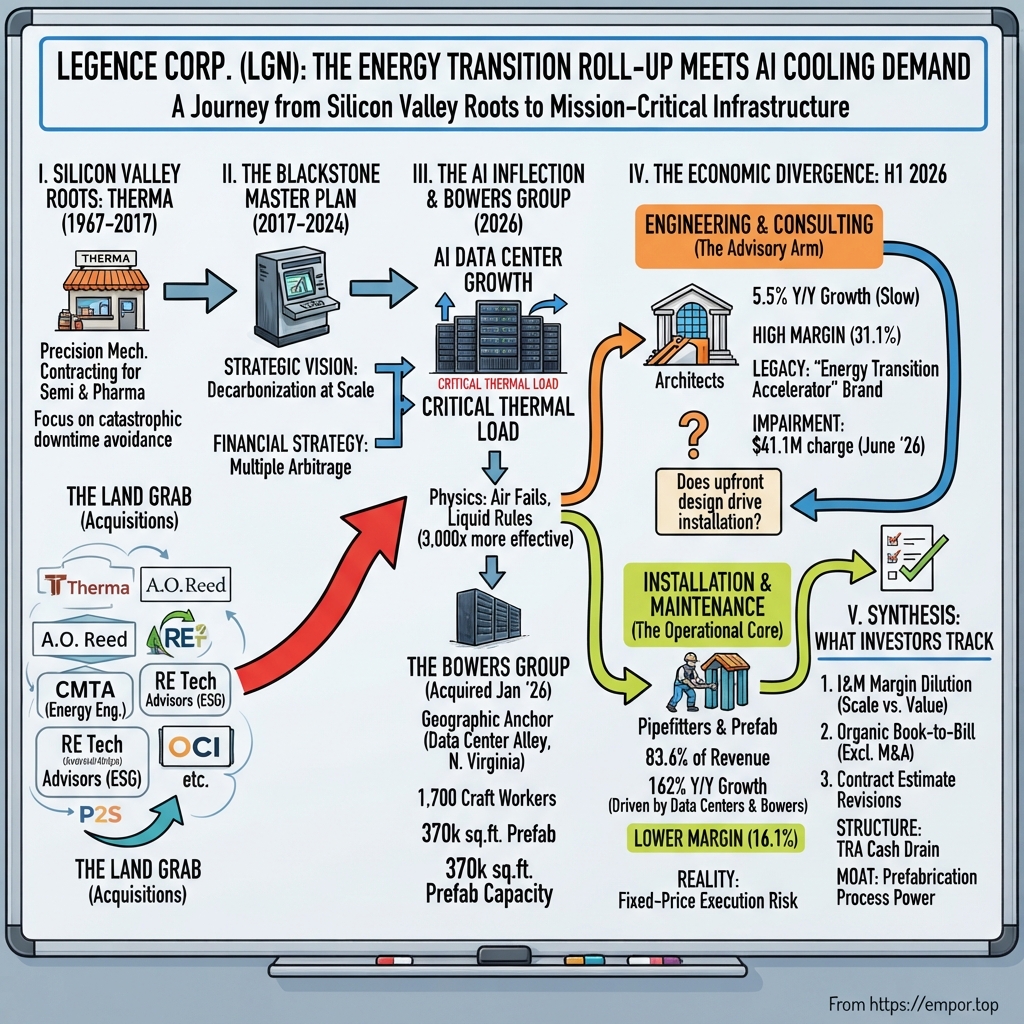
Legence Corp. (NASDAQ: LGN): The Energy Transition Roll-Up Meets the AI Cooling Reality
I. Prologue: The $28 IPO, The Blackstone Machine, and The High-Priced Promise of "Decarbonization at Scale"
On the morning of September 12, 2025, Legence Corp. arrived at the Nasdaq MarketSite with a narrative tailored for the moment, pricing its initial public offering at $28.00 per share — the midpoint of its marketed range. The offering raised roughly $728 million in gross proceeds and listed the company on the Nasdaq Global Select Market under the ticker LGN.12
In its prospectus and roadshow presentations, Legence framed itself as an "energy transition accelerator," helping commercial and institutional property owners decarbonize, electrify, and re-engineer physical facilities.2 The pitch rested on a straightforward macro thesis: buildings generate a substantial share of global carbon emissions, creating long-term demand for net-zero campus designs, heat pump conversions, comprehensive energy audits, and boiler replacements. That market, management argued, belonged to Legence.
While the thesis was compelling, it was an incomplete description of how the company actually generated its revenue.
Beneath the branding sits an older, more labor-intensive operational core: a roll-up of mechanical, electrical, and plumbing subcontractors — pipefitters, sheet metal fabricators, controls technicians, and cleanroom specialists — assembled over roughly five years by Blackstone's energy transition platform from regional trade contracting firms.[^6] These operating units bid competitive contracts, manage craft labor, negotiate change orders, and depend fundamentally on jobsite productivity in demanding field conditions.
Moreover, the primary growth engine driving Legence's performance as of mid-2026 is neither rooftop solar installations nor sustainability reporting software. Instead, it is one of the most capital-intensive construction sectors in the global economy: high-density, liquid-cooled artificial intelligence data centers, alongside mission-critical life sciences and semiconductor cleanrooms. By the close of its second fiscal quarter of 2026, Legence reported a total backlog of roughly $5.67 billion and quarterly revenue of about $1.26 billion, propelled by installation activity expanding at rates rarely seen in traditional construction cycles.34
The central analytical tension lies in the divide between how the business was packaged for public markets and how its field operations function — a disparity exposed under the scrutiny of quarterly disclosures.
Three structural dynamics define the company's trajectory. The first is private equity financial engineering: Blackstone acquired a San Jose mechanical contractor founded in the 1960s, bolted more than fifteen trade shops and consultancies onto the platform, rebranded the combined entity, and brought it public at a valuation multiple typically reserved for asset-light advisory firms rather than specialty contractors.[^6]5 The second is an internal economic divergence: Legence operates two fundamentally different businesses — a high-margin engineering and consulting practice and a much larger, lower-margin installation and maintenance operation — with revenue shifting toward the lower-margin contracting side far faster than management initially projected.4
The third dynamic is an analytical reality check for shareholders: the environmental consulting thesis that justified the premium IPO multiple suffered a $41.1 million impairment charge in the quarter ended June 2026, concentrated entirely within the Engineering & Consulting segment.4 At the same time, the traditional mechanical contracting business has generated record top-line revenue. This divergence raises a critical question for investors: whether Legence is an integrated platform with durable pricing power, or a specialty contractor benefiting from an unprecedented buildout in computing infrastructure while carrying fixed-price execution risk across a $5.67 billion backlog.
Evaluating that risk requires examining where the enterprise began — not in a private equity investment memorandum, but inside a sheet metal shop in Northern California's Santa Clara Valley.
 Subscribe on LinkedIn
II. Silicon Valley Roots: The Therma Lineage (1967–2017)
In 1967, the orchards around San Jose were still being cleared for low-slung industrial parks whose purpose few local residents yet understood. Fairchild Semiconductor had already spun out the engineers who would co-found Intel. The Santa Clara Valley was taking shape, and the facilities going up required mechanical infrastructure that was unglamorous yet technically exacting: clean air, purified water, process piping that would not contaminate sensitive manufacturing runs, and environmental controls precise enough to keep silicon wafers from warping.
That was the year Joe and Nicky Guglielmo founded Therma Corporation in San Jose.2 Like most mechanical contractors of the era, the business started with standard regional trade work — plumbing, ductwork, and commercial HVAC. Over the ensuing decades, however, Therma took a different path from competitors that chased high-volume commercial projects: it focused on the most technically demanding mechanical work emerging in its local market.
Learning to build for rooms where failure is not an option
The semiconductor industry required capabilities far beyond conventional commercial contracting. Fabs depended on high-purity process piping, orbital-welded and passivated to standards where even a microscopic particle could compromise an entire production run. Cleanrooms required specialized HVAC systems capable of filtering particulate counts down to invisible thresholds, alongside custom sheet metal fabricated to tolerances standard trade contractors rarely encountered.
Therma built out that technical expertise and later extended it into early biopharmaceutical facilities, where regulatory oversight and cleanroom validation requirements were equally stringent.2 Through acquisitions that Blackstone later combined into Legence, the organization also absorbed contracting businesses with roots extending well beyond Northern California — including A.O. Reed & Co., a Southern California mechanical contractor founded in 1914.2
The operational lesson from that period became central to Legence's eventual pitch: the way a trade contractor escapes commoditization is by working in buildings where downtime is catastrophically expensive. While a commercial developer building a standard warehouse will routinely award work to the lowest bidder, a semiconductor manufacturer, hospital network, or pharmaceutical company operates under a different calculation. For those facility owners, the cost of a delayed opening or an undetected leak dwarfs any savings achieved on contractor bids. Therma's regional advantage rested on direct relationships with clients who could not afford to take execution risks.
The dilemma that defines the industry
That specialization stood out because mechanical, electrical, and plumbing contracting remains one of the most punishing corners of the construction economy.
The broader sector is fragmented among tens of thousands of small, family-owned operators bound to local metropolitan labor markets. It is intensely cyclical, lagging non-residential construction spending and amplifying broader economic downturns. It is also structurally subordinate: specialty subcontractors work beneath general contractors who dictate site access, sequencing, and payment schedules. Contractors must absorb fixed-price bid risk, committing to contract figures eighteen months or more before labor availability, material prices, and jobsite conditions are fully known. Furthermore, in unionized markets like Northern California where Therma operated, wage rates are determined through collective bargaining agreements that individual contractors have little ability to change.
Those structural constraints historically keep operating margins tight. Yet those same headwinds also made the sector an attractive target for private equity: a fragmented, cash-generative trade base offered the classic raw material for a programmatic roll-up.
Gemspring, 2017: the first outside owner
In 2017, the middle-market private equity firm Gemspring Capital acquired Therma.2 Gemspring's initial thesis followed standard roll-up mechanics rather than an energy transition pivot: use a respected West Coast mechanical contractor with mission-critical end-market exposure as a consolidation platform, buy smaller regional peers, centralize back-office operations, and sell the enlarged business to a larger financial buyer.
That regional roll-up unfolded largely as designed. But the sponsor that acquired the platform next envisioned a far more ambitious narrative for what this collection of regional trade shops could represent to public markets.
III. The Blackstone Master Plan: Rebranding the Roll-Up into "Legence" (2017–2024)
In late 2020, amid pandemic lockdowns and widespread uncertainty across commercial real estate, Blackstone Energy Partners completed the acquisition of Therma Holdings.[^6] The timing appeared counterintuitive, but it aligned directly with the macro thesis Blackstone was underwriting.
Blackstone's energy transition team was not setting out simply to own a regional specialty contractor. It was positioning the firm for what it viewed as a multi-decade cycle of mandated capital expenditure. The thesis held that buildings account for a substantial share of global greenhouse gas emissions; institutional real estate owners face escalating pressure to decarbonize from regulators, lenders, tenants, and limited partners; and few property owners possess the technical engineering staff to execute retrofits internally. Under that view, substantial value would accrue to whoever served as the contractor of record for retrofitting the built environment.
The multiple arbitrage, stated honestly
That strategic vision was paired with a fundamental financial maneuver: valuation multiple arbitrage.
Specialty trade contractors have historically traded at modest public valuations—typically high single digits to low double digits as a multiple of EBITDA—reflecting the cyclicality, thin margins, and fixed-price execution risks inherent in subcontracting. Energy services platforms, sustainability consultancies, and climate-technology providers, by contrast, commanded substantially higher multiples during the 2021–2022 market cycle.
Acquiring trade contracting businesses at lower entry multiples and persuading public equity markets to price the consolidated entity as a high-margin sustainability platform offered significant upside, independent of operational changes in field execution. While multiple arbitrage is a standard private equity playbook, for public investors evaluating Legence, the "energy transition accelerator" framing represented a deliberate effort at category redefinition designed to achieve an equity re-rating.
In June 2022, Blackstone formalized that shift: Therma Holdings was rebranded as Legence and presented to the market as an energy transition accelerator.5 It was a new corporate identity and an elevated valuation narrative, built on the work of the same regional trade craftspeople.
The land grab
Between 2021 and 2024, the platform pursued an aggressive acquisition campaign, assembling a portfolio that reflected the dual nature of its strategy.
The high-visibility advisory assets arrived first. CMTA, acquired in 2021, served as the centerpiece of the engineering practice—a nationally recognized designer of net-zero-energy facilities with established capabilities in geo-exchange systems, high-performance education and healthcare design, and energy performance contracting.6 CMTA provided Legence with something physical contracting capacity alone could not: direct access to facility owners during the early design phase, before capital was committed to construction.
RE Tech Advisors, also acquired in 2021, pushed further into strategic consulting, providing sustainability and ESG advisory services to institutional real estate portfolios to help property owners develop and report against decarbonization roadmaps.2
Then came the operational scale: a continuous series of regional mechanical, electrical, plumbing, and engineering acquisitions between 2021 and 2024, including P2S Inc., OCI Associates, Gilbert Mechanical, SC Engineers, Blackhawk Specialty Solutions, and AMA Consulting Engineers.2 In total, Blackstone folded more than fifteen businesses into the platform, expanding both field trade capacity and technical design capability.
What the company paid, and what it borrowed to pay it
While Legence did not disclose a deal-by-deal purchase price schedule or individual acquisition multiples, the timing of the roll-up heavily influenced the platform's capital structure.
Legence assembled these assets during an expensive valuation window for sustainability-linked businesses—a period characterized by near-zero interest rates, abundant private equity dry powder, and peak institutional demand for ESG assets. Trade contracting capacity commanded full valuations in that market, while pure consulting and advisory practices traded at even steeper premiums.
Moreover, the expansion was financed substantially through leverage. By the time Legence prepared for its initial public offering, the company carried roughly $1.6 billion in funded debt, making balance-sheet deleveraging—rather than funding operational growth—a primary objective of the listing.2 An offering designed primarily to pay down sponsor-era leverage carries a distinct financial profile, effectively shifting the capital costs of building the private roll-up onto public equity holders.
That leverage left investors facing a central question: could the advisory assets acquired at the height of the market deliver the durable margins and client stickiness needed to support the platform's valuation? Disclosures would soon provide an answer. First, however, evaluating that performance requires examining how Legence actually generates its revenue—and why its two operating divisions run on fundamentally different economics.
IV. The Anatomy of the Engine: Segment Realities, Economics, and the Margin Squeeze
Picture two rooms.
In the first, a dozen engineers sit in front of modeling software, running energy simulations on a data center that does not yet exist, debating chilled-water supply temperatures and evaluating whether a client's projected rack densities are realistic. Their inventory is technical judgment; their capital requirement is limited to computers and payroll. When they win work, they generate roughly thirty cents of gross margin on every dollar of revenue.
In the second room—a 200,000-square-foot fabrication facility—crews weld pipe spools, assemble cooling skids onto structural steel frames, and hoist multi-trade racks onto flatbeds headed for a jobsite. This operation consumes raw materials: structural steel, copper, chillers, air handlers, switchgear, and tens of thousands of craft labor hours. When it wins, it captures roughly sixteen cents of gross margin on the dollar.
Those two settings represent Legence's two reportable business segments, and the economic interplay between them forms the central question for the company's valuation.
Installation & Maintenance: the mass of the company
The Installation & Maintenance segment represents the physical bulk of the enterprise. In the second quarter of fiscal 2026, the segment generated approximately $1.055 billion in revenue—accounting for 83.6% of the company's total—and expanded roughly 162% year over year, delivering an adjusted gross margin of 16.1%.34
A 162% top-line growth rate within mechanical trade contracting requires decomposition rather than uncritical acceptance. A substantial portion of that expansion came via acquisition: the Bowers Group transaction, which closed at the beginning of the fiscal year, added significant volume that did not exist in the prior-year period.[^5] The remainder reflected organic volume, which management attributed primarily to accelerated data center construction.37
Operationally, the segment handles complex physical trade execution: custom industrial fabrication, chilled-water piping infrastructure, direct-to-chip liquid cooling installations, coolant distribution units, central utility air handling, electrical distribution, and integrated building automation, followed by ongoing preventive maintenance. The work is labor-intensive, managed directly on jobsites, and governed by rigid project delivery schedules.
Engineering & Consulting: the small, high-margin half
By contrast, the Engineering & Consulting practice generated approximately $207 million during the same quarter—representing 16.4% of total revenue—growing 5.5% year over year with an adjusted gross margin of 31.1%.34
The operational asymmetry is striking. While the advisory practice generates nearly twice the gross margin percentage of the contracting business, it represents roughly one-fifth of total volume and is expanding at a fraction of the pace. This smaller segment carries the "energy transition accelerator" brand identity—housing facilities design, mechanical engineering, net-zero consulting, energy audits, and regulatory compliance advisory—yet by mid-2026, its revenue growth had slowed to near-stagnant rates in inflation-adjusted terms.
The margin dilution paradox
Combining these two business lines produces an inescapable mathematical headwind. Legence's consolidated adjusted gross margin declined to roughly 18.5% in the quarter ended June 2026, retreating from the low-twenties range the company historically recorded.34
The decline was not triggered by acute operational distress or a specific project failure. Rather, the blended margin compressed because the company is expanding rapidly in its lower-margin trade contracting business while growth in its high-margin advisory practice has flattened. Every incremental dollar of mechanical contracting work in data centers dilutes the corporate gross margin rate, even when that work is executed profitably on an absolute dollar basis.
This dynamic presents a two-sided analytical challenge for investors. On one side, margin dilution stemming from volume growth is not inherently destructive: absolute gross profit dollars have increased substantially, and an operator that doubles revenue at a 16% gross margin creates meaningful cash flow. On the other side, the underlying shift pulls the corporate financial profile steadily away from the premium valuation multiple management sought at the IPO, steering it back toward the lower multiples public markets historically assign to specialty trade subcontractors. Maintaining a premium valuation as an advisory platform becomes difficult when heavy mechanical construction accounts for nearly 84% of revenue and is accelerating its share of the total.
Management has acknowledged this shift while maintaining that the two business lines are commercially interdependent.
The funnel argument, and what would prove it
The strategic thesis put forward by leadership is built around an integrated project funnel: securing early-stage engineering and design mandates creates an inside track to win downstream mechanical and electrical contracting work, frequently on a negotiated or sole-source basis rather than through competitive open bidding.7 By engineering the cooling architecture, the contractor understands system tolerances, operating parameters, and constructability challenges better than outside trade peers pricing off standard bid documents. For project developers facing tight delivery deadlines, maintaining vendor continuity reduces scheduling risk.
If validated, that structure provides genuine competitive insulation, suggesting the advisory arm should be evaluated not merely as a standalone consulting firm, but as a profitable customer-acquisition funnel generating a 31% gross margin on its own work.
Yet the strength of that funnel remains unverified by public filings. Legence does not disclose attach rates indicating what percentage of engineering contracts convert into field installation awards, nor does it quantify how much contracting revenue originated in internal design mandates. Without those disclosures, the integration thesis relies on corporate narrative and operational intuition. For market participants assessing the stock, two leading indicators matter: whether management begins reporting audited design-to-installation conversion metrics, and whether engineering revenue reaccelerates to signal future contracting demand. Subdued engineering growth alongside surging installation revenue remains consistent with an alternative scenario: that the contracting arm is winning data center volume based on labor capacity, regional footprint, and pricing, while operating largely independent of the design practice.
The contract structure sitting underneath all of it
Underpinning these segment economics is a fundamental contractual reality: fixed-price contracts account for the dominant share of Legence's backlog.24 Under percentage-of-completion accounting rules, revenue and gross profit are recognized progressively as jobsite costs are incurred relative to total estimated project expenses. As a result, reported quarterly profitability rests heavily on management's periodic estimates of the remaining labor and materials required to complete every job.
This accounting treatment is standard practice across the commercial construction and specialty contracting sector. However, it also means reported margins represent an estimate-dependent output, where revisions to project completion costs serve as the primary mechanism for unexpected quarterly adjustments.
That operational and contractual exposure became all the more consequential following a major transaction that decisively shifted the company's center of gravity.
V. The AI Data Center Inflection & The Bowers Group Mega-Bet
To understand why Legence's revenue mix inverted so quickly, you have to understand a physics problem.
When air stops working
For roughly three decades, data centers were cooled by moving cold air across servers. A conventional enterprise rack drew something in the range of 8 to 15 kilowatts — enough heat that you needed serious air handling, raised floors, and hot-aisle containment, but a problem that air could solve.
Then came dense AI training clusters. A rack packed with modern accelerators can draw 40 kilowatts, 80 kilowatts, north of 120 kilowatts in the highest-density configurations.9 The heat does not scale gently; it scales catastrophically.
The intuition that matters for non-engineers: air is a terrible carrier of heat. Water is roughly three thousand times more effective per unit volume. Below a certain power density you can get away with blowing cold air around a room. Above it, you physically cannot move enough air fast enough to keep silicon below its thermal limits — not because the equipment is inadequate, but because the thermodynamics forbid it. You would need hurricane-grade airflow.
So the industry has been forced into liquid. Coolant distribution units that act as heat exchangers between facility water and server-side loops. Cold plates bolted directly to processor packages. Manifolds, hoses, and quick-disconnects at rack level. And behind all of it, vastly larger central utility plants — chillers, pumps, cooling towers, and miles of large-diameter hydronic piping.
That piping is not a technology product. It is mechanical contracting. Which is how a physics constraint in machine learning became a revenue event for companies that employ pipefitters.9
Buying the ground in Data Center Alley
Legence's response was the largest acquisition in its history. On January 2, 2026, the company completed its acquisition of The Bowers Group for approximately $475 million — structured as roughly $325 million in cash, $100 million in Legence stock, and $50 million deferred.[^5]
Bowers, based in Beltsville, Maryland, brought approximately 1,700 craft workers and more than 370,000 square feet of offsite prefabrication capacity.[^5] The stock component matters as a signal: paying partly in equity aligns the seller with post-close performance and conserves cash on a balance sheet that was already carrying significant leverage.
But the real logic was geographic. Northern Virginia — Loudoun and Prince William counties, the corridor universally known as Data Center Alley — is the densest concentration of data center capacity on earth. Legence's historical strength was the West Coast. Its brand-new growth market was three thousand miles away, in a labor market where it had no craft workforce, no union relationships, no local track record, and no fabrication footprint.
You cannot fix that organically at the speed the demand cycle is moving. Craft labor in a hot construction market is not hireable in bulk; it is controlled by local union halls and existing contractor relationships. Buying Bowers was buying the one thing that cannot be built quickly: an assembled, trained, locally credentialed workforce standing next to the customer.
The early evidence is that it worked commercially. The acquisition coincided with backlog expanding to roughly $5.67 billion and drove the step-change in I&M scale.34 Management raised full-year guidance alongside second-quarter results.3
A note of discipline, though: eight months is not an integration track record. The question that will not be answerable until fiscal 2027 or later is whether Bowers' margins hold under Legence ownership, whether the two fabrication organizations actually share standards and capacity, and whether the acquired management team stays. Integration failure in contracting roll-ups rarely shows up as a headline — it shows up quietly, as estimate revisions on jobs.
War-gaming the competition
Legence did not discover the data center opportunity. It arrived at a party already in progress.
Comfort Systems USA (NYSE: FIX) is the benchmark, and it is a demanding one. At roughly $7 billion-plus of revenue with strong margins in its technology-facing work, Comfort Systems built its reputation on exactly the modular prefabrication playbook Legence is now pursuing, and has been compounding on it for years while earning a premium valuation among mechanical contractors.8 On its own earnings calls, Comfort Systems management has described the data center and advanced-manufacturing demand environment in consistent terms — strong, long-dated, and constrained more by labor capacity than by customer appetite.8 That corroboration matters: two independent operators describing the same demand conditions is better evidence than either one alone.
EMCOR Group (NYSE: EME) is the scale player — a diversified construction and facilities services company with revenue north of $14 billion, unmatched bonding capacity, and national geographic breadth.[^14] EMCOR can absorb a project failure that would be material to Legence. What EMCOR lacks is Legence's concentrated positioning as a design-led decarbonization specialist, which cuts both ways depending on whether that positioning proves to be a real advantage or a marketing layer.
Limbach Holdings (NASDAQ: LMB) is the instructive small-cap case: a company that deliberately walked away from competitively bid general-contractor work to focus on owner-direct relationships and recurring facility services, accepting lower revenue in exchange for better margins and less risk. It is the clearest demonstration that in this industry, who you contract with matters more to returns than how much you contract.
Legence sits between these poles: smaller than the giants, more concentrated than EMCOR, more construction-heavy than Limbach, and attempting to claim Comfort Systems' prefabrication advantage without Comfort Systems' decades of accumulated operating history.
Why the factory is the actual moat candidate
Which brings us to the most defensible part of the Legence story.
A traditional jobsite is a terrible manufacturing environment. Work happens outdoors or in partially enclosed structures, at height, in weather, with multiple trades competing for the same physical space, on a schedule dictated by whoever finished before you. Productivity is poor and highly variable.
Offsite prefabrication inverts this. Cooling skids, pump assemblies, and multi-trade overhead racks get built on a factory floor — level ground, controlled conditions, fixed workstations, repeatable processes, quality inspection at each station — then shipped to site and set in place. The commonly cited industry range for field labor hour reduction from serious prefabrication is roughly 30–40%, with additional benefits in schedule compression and rework reduction.
The competitive consequence is what makes it strategically interesting. A 370,000-square-foot prefabrication facility is a capital asset that a regional union contractor with twenty million dollars of revenue cannot build, cannot finance, and cannot fill. Prefabrication converts a labor-arbitrage business into a capital-intensity business — and capital intensity, in a fragmented industry, is exclusionary. It is the closest thing Legence has to a structural barrier.
The honest caveat: Comfort Systems has been executing this for far longer, at greater scale, and it is available to any competitor willing to spend the money and endure the learning curve. Prefabrication is a real advantage. It is not a proprietary one.
Which brings us to the harder exercise — testing the company's claims against its own record.
VI. Historical Falsification Layer: Testing the Moats, Capital Allocation, and Contract Traps
Every investment thesis is a collection of underlying claims. The essential analytical task is not to restate those claims, but to identify the evidence in a company's own operating history that tests them—determining whether each thesis survives intact, holds in a narrower form, or fails.
Legence has a brief public operating record of barely a year. Yet that initial record already contains a clean, disconfirming event.
Test 1: The decarbonization advisory moat — falsified as stated, revised downward
The claim: Legence's sustainability advisory and net-zero engineering capability constitutes a sticky, high-margin, relatively counter-cyclical economic moat—the defining asset that distinguishes the business from a commoditized mechanical subcontractor and justifies a premium valuation multiple.
The disconfirming evidence: In the quarter ended June 30, 2026, Legence recorded a $41.1 million impairment charge—comprising approximately $21.6 million of goodwill write-offs and $19.5 million of long-lived asset impairments—concentrated entirely within the Engineering & Consulting segment.4
An accounting impairment carries an unambiguous operational meaning: the future cash flows management expects from an acquired asset base have fallen materially below the carrying value recorded on the balance sheet. Under auditor oversight, leadership formally conceded that its original acquisition assumptions were overly optimistic. Crucially, that impairment landed in the exact segment designed to anchor the company's strategic narrative.
The mechanism: Two distinct pressures converged. First, the commercial office sector never reclaimed its pre-pandemic occupancy levels, permanently altering leasing dynamics, constraining capital for discretionary building retrofits, and dampening demand among distressed property owners for multi-year decarbonization roadmaps. Second, corporate appetite for discretionary ESG reporting and stand-alone sustainability consulting softened considerably from its 2021 peak, pinched by tighter corporate budgets and heightened political scrutiny around ESG mandates. The demand profile for pure advisory practices proved both highly discretionary and sharply cyclical.
Engineering & Consulting's modest 5.5% year-over-year revenue expansion in the second quarter of 2026 offered clear operating confirmation of that cooling demand environment.34
Verdict: The claim as originally presented does not survive public market scrutiny. Advisory services do not represent a recurring, software-like, counter-cyclical moat; their stand-alone economics proved vulnerable to commercial real estate retrenchment and shifting corporate priorities. The defensible surviving thesis is far narrower: early design engagement provides a commercially valuable pipeline position that captures attractive gross margins on its own billings, functioning as an upstream project feeder rather than an unassailable competitive fortress. Even that revised formulation remains unproven until management discloses verified design-to-construction conversion rates.
What would confirm or further falsify it: A sustained reacceleration of organic growth within Engineering & Consulting into double digits would validate the narrower feeder thesis. Conversely, a second impairment charge within the division or outright negative organic growth would signal that the advisory assets are struggling to clear even their reduced carrying value, raising fundamental questions about their long-term role in the portfolio.
Test 2: Capital allocation and M&A discipline — narrowed, with a clear split
The claim: Management operates as a disciplined programmatic acquirer across a fragmented industry, systematically compounding capital at attractive rates of return.
The disconfirming evidence: The advisory impairment directly demonstrates historical overpayment. Goodwill is not written down when an acquired business tracks management's underwriting model. The write-down provided empirical evidence that Legence paid valuations for consulting and sustainability firms during the 2021–2022 market peak that subsequent cash flows failed to justify.4
The counterweight: The Bowers Group acquisition, based on early operational disclosures, achieved its core objectives. It secured the geographic footprint, craft workforce, and offsite prefabrication capacity the company required in the mid-Atlantic, coinciding with a step-change in segment scale and an expanding backlog approaching $5.7 billion.3[^5]
Weighing it: These two outcomes are not contradictory; they reveal a distinct operational boundary. Legence has executed effectively when buying businesses grounded in its traditional core competencies—trade capacity, licensed craft labor, and physical fabrication facilities whose worth can be vetted through direct field due diligence. It stumbled when acquiring businesses anchored to broader market sentiment, where valuations depended on sustained client enthusiasm for corporate sustainability consulting.
That split suggests a clear framework for evaluating future capital deployment: investors can view subsequent mechanical, electrical, and prefabrication transactions with measured confidence, while treating any future advisory, software, or platform acquisition with heightened skepticism until leadership establishes a disciplined track record in those verticals. Calling management an elite capital allocator remains premature given its brief public history and uneven private record. Yet dismissing the team's transactional capability would overlook the commercial timeliness and execution of the Bowers integration.
A critical structural nuance accompanies this record: the private roll-up was heavily debt-financed, and a substantial portion of the IPO proceeds went toward repaying that leverage rather than funding organic operational growth.2 Expanding through debt and subsequently issuing public equity to repair the capital structure transfers the financing burden of private roll-up activity onto public market investors. While transparently disclosed and standard in sponsor-backed listings, that dynamic remains central to assessing long-term capital discipline.
Test 3: The fixed-price contract trap — intact, unproven, and the largest unmeasured risk
The claim: Legence's integrated engineering capabilities and offsite prefabrication infrastructure shield the business from the severe project-level write-downs that periodically derail specialty trade subcontractors.
The evidence available: Genuinely limited—which constitutes the primary analytical takeaway. Legence has reported as an independent public entity for only one year, during an intense data center construction upcycle. The platform has not yet navigated a major cyclical contraction, an acute labor cost spike, or a protracted project dispute under public scrutiny.
The structural vulnerability: Fixed-price contracts account for the dominant share of Legence's $5.67 billion backlog.24 With the Installation & Maintenance segment operating at an adjusted gross margin of roughly 16%, the financial buffer on individual projects is thin. Several variables can erode that margin on a single hyperscale project: unexpected engineering revisions requiring field rework; extended equipment lead times on specialized chillers, switchgear, or substations; craft wage inflation emerging from local collective bargaining negotiations; or sudden schedule compressions driven by customer hardware deployments. Under percentage-of-completion accounting, any anticipated project-level loss must be recognized immediately in full rather than amortized across remaining project milestones.
That contractual exposure is magnified by the current technological transition. Much of the liquid-cooling infrastructure deployed today involves relatively new engineering methodologies delivered at unprecedented scale, on aggressive timelines, for clients whose technical specifications change alongside silicon architectures. Fast-tracked execution on novel designs has historically represented the precise environment in which trade contracting cost estimates face downward revisions.
Verdict: The thesis is not disproven, but it remains entirely unverified. The absence of material project write-downs across four quarters of boom-period disclosures demonstrates steady execution in a favorable climate, rather than structural immunity to fixed-price subcontracting risk.
The falsification KPI: The critical metric lies in the contract estimate disclosures in each quarterly report (Form 10-Q). Analysts should monitor revisions in estimated contract costs alongside the relative movement between contract assets—representing unbilled work in progress—and contract liabilities. When contract assets expand significantly faster than recognized revenue, it frequently indicates that a contractor is performing field work ahead of formal change-order approvals or billing authorizations. Such adjustments typically surface in contract estimate footnotes well before they compress headline gross margins.
Corporate disclosures provide the quantitative framework for evaluating these risks. The executives charged with managing them represent the next critical layer of analysis.
VII. Management, Governance, and The Sponsor Overhang
There is a recognizable executive archetype assembled for a specific corporate transition: moving a private-equity-owned industrial platform onto the public markets. Legence's leadership fits that template precisely, and the appointments reveal what the board viewed as its central operational and structural challenges.
Jeff Sprau: the operator
Chief Executive Officer Jeff Sprau joined Therma in 2021, arriving from senior roles inside large industrial organizations that operate upstream and adjacent to mechanical contracting, including Trane Technologies, Johnson Controls, and BrandSafway.2 An industrial engineer by training, his background centers on HVAC equipment manufacturing and industrial services rather than specialty trade subcontracting.
That operational heritage carries distinct analytical implications. An executive with deep tenure at Trane and Johnson Controls understands the equipment side of the value chain—equipment lead times, original equipment manufacturer behavior, and the pricing dynamics of chillers and building controls—from the manufacturer's vantage point. Furthermore, coming from enterprises organized around standardized production and repeatable workflows aligns naturally with the offsite prefabrication strategy Legence has prioritized. A traditional specialty contractor might not have leaned as aggressively into the factory model.
The critical unknown is common to many first-time public company chief executives: Sprau remains untested as a long-term public market capital allocator. Scaling an operating platform for a financial sponsor with a defined investment horizon and an aligned board is fundamentally different from deploying capital on behalf of permanent public equity holders across a full economic cycle. With only a year of public disclosures on record, that track record is still being established.
Stephen Butz: the balance sheet specialist
Chief Financial Officer Stephen Butz brings a background that highlights where the board anticipated financial complexity. He previously served as CFO at offshore drilling contractors, including Noble Corporation and Hercules Offshore—an industry that navigated severe balance-sheet stress and debt restructurings over the past two decades.2
A finance chief whose background includes complex credit negotiations, corporate restructurings, and volatile capital-markets environments was not recruited merely to manage day-to-day working capital. He was brought in because Legence entered its public listing carrying roughly $1.6 billion in funded debt, an active acquisition pipeline, and a layered holding-company structure.2 The appointment itself signaled how management and its sponsor prioritized balance-sheet management during the transition.
Compensation and alignment
Executive compensation incentives are weighted heavily toward adjusted EBITDA and revenue milestones, complemented by significant equity awards subject to multi-year vesting schedules.2
That architecture warrants close analytical attention. Adjusted EBITDA is a metric that programmatic acquirers can expand through dealmaking alone: it rewards top-line scale accumulation while inherently excluding the depreciation, amortization, and periodic impairment charges that result from paying full prices for acquired assets. When an executive team is compensated primarily on adjusted EBITDA targets within a fragmented industry containing abundant buyout candidates, the incentive structure does not naturally enforce price discipline. While such metric design is common among private-equity-backed roll-ups, it introduces an inherent bias toward transactional expansion. For long-term shareholders, monitoring whether the board eventually incorporates return-on-invested-capital hurdles will be critical to evaluating ongoing alignment.
The Up-C structure and the Tax Receivable Agreement
The company's governance architecture introduces another layer of structural complexity.
Legence Corp. is organized as an "Up-C" corporation, where the publicly traded entity serves as a holding company whose primary operating asset is an equity interest in the underlying partnership, Legence Holdings LLC.2 This structure is commonly deployed in sponsor-backed offerings to preserve pass-through tax treatment for pre-IPO owners while providing a liquid public currency.
Tied directly to this arrangement is a Tax Receivable Agreement. Under the TRA, Legence is contractually required to distribute to its pre-IPO owners—with Blackstone as the primary beneficiary—85% of the cash savings in federal, state, and local income taxes that the corporation realizes from the tax basis step-up generated by the reorganization and subsequent unit exchanges.2
In practical terms, as Legence generates tax savings from the stepped-up basis, 85 cents of every dollar saved flows out of the corporate treasury directly to pre-IPO owners, leaving 15 cents to benefit the publicly traded enterprise. Public shareholders absorb the operational and project risks of the contracting business, but retain only a minor fraction of the associated cash tax benefits.
While the Up-C structure and TRA are standard mechanisms in private equity listings and were fully disclosed in the company's prospectus, they carry tangible valuation consequences. The agreement creates a multi-year, contractually mandated cash drain positioned directly between reported corporate earnings and distributable free cash flow. Any valuation model that evaluates Legence solely on conventional cash flow metrics without deducting future TRA obligations risks overstating the economic value accruing to public equity. Furthermore, it widens the gap between reported net income and cash available for reinvestment in an operating business that already requires substantial working capital to fund construction receivables and contract assets.
The sponsor overhang
Blackstone retained majority voting control following the initial public offering.2 In April 2026, selling stockholders completed a secondary offering of 11 million shares, initiating the sponsor's public equity monetization.[^9]
Such secondary sales follow the standard monetization path for sponsor-backed public entities. A controlling financial sponsor typically exits its position over several years through successive secondary blocks, each releasing incremental supply into public float. For public market participants, this dynamic creates three distinct considerations: recurring overhang and trading volatility around offering windows; the structural requirement for the market to absorb a substantial transfer of shares; and a governance backdrop where the strategic priorities of an exiting majority holder and those of permanent equity investors may periodically diverge.
These dynamics do not reflect project-level execution or commercial demand, but they directly shape shareholder returns and governance throughout the post-IPO transition.
VIII. Strategic Synthesis: 7 Powers & Porter's 5 Forces
Stripping away corporate branding and the broader construction cycle brings forward a fundamental structural question: what, if anything, prevents a well-capitalized competitor from duplicating Legence's business model?
Hamilton Helmer's 7 Powers, applied honestly
Process Power — the strongest candidate. More than 370,000 square feet of offsite prefabrication capacity from Bowers alone, combined with legacy Therma fabrication facilities, represents an accumulated operational capability rather than an easily replicated asset.[^5] Standardizing the assembly of liquid cooling skids and multi-trade utility racks inside a controlled factory environment is difficult to copy quickly—not because the physical tools are proprietary, but because institutional process knowledge across fabrication sequencing, millimeter tolerances, quality assurance protocols, and jobsite logistics is accumulated through years of operational trial and refinement. Process power rates as strong, though with the significant caveat that established competitors such as Comfort Systems possess far more of it.
Switching Costs — moderate to high, but narrowly located. Inside an operational hospital, an active semiconductor fab, or an energized data hall, the incumbent mechanical contractor holds a formidable position. Having installed the hydronic piping and configured the building automation systems, the contractor understands the facility's idiosyncrasies—down to which isolation valves reliably seat. Replacing that contractor for ongoing maintenance introduces operational downtime risks that few facility managers will accept simply to trim marginal labor costs. This operational lock-in is genuine, representing the direct legacy of Therma's historical strategy. Yet switching costs apply almost exclusively to recurring maintenance and service contracts rather than major project awards: a hyperscale developer soliciting bids for its next data hall faces no meaningful lock-in.
Scale Economies — moderate. National purchasing scale on HVAC and industrial cooling equipment provides modest leverage with original equipment manufacturers. More importantly, bonding capacity acts as a gating mechanism: securing a mechanical contract exceeding $100 million for a hyperscale facility requires substantial surety backing that the vast majority of regional trade contractors cannot obtain. That threshold eliminates most regional competitors, though it does not differentiate Legence from larger industry peers such as EMCOR Group or Comfort Systems, both of which command greater financial scale and bonding capacity.[^14]
Cornered Resource — weak. This represents the thinnest pillar of the structural thesis. Legence's specialized engineering talent, particularly within its CMTA subsidiary, is capable and difficult to recruit.6 Yet that talent remains mobile and employable across the broader engineering sector. Meanwhile, the craft trade workforce executing physical installations—pipefitters, sheet metal fabricators, and electricians—belongs to local union halls rather than Legence. Any competing contractor with an active project award can dispatch calls to the identical union hall. In a constrained labor environment, skilled labor availability functions as an industry-wide headwind rather than a proprietary corporate asset.
Network Effects — absent. No structural mechanism exists through which completing a mechanical installation for one client enhances Legence's service value or operating efficiency for another.
Branding — weak. The Legence corporate brand dates only to 2022.5 In specialty contracting, client loyalty attaches to long-standing regional operating identities and, even more directly, to individual project executives and jobsite superintendents. A facilities director in Maryland contracts with Bowers; a semiconductor plant manager in Northern California trusts Therma. The holding company's umbrella identity carries negligible independent pricing power, explaining why management continues to operate under acquired regional trade names.
Counter-Positioning — not applicable. Legence does not deploy a disruptive business model that incumbent contractors are structurally disincentivized or unable to adopt. It operates the traditional specialty contracting model, distinguished primarily by institutional scale.
In sum, Helmer's framework reveals a distinct profile: Legence possesses one defensible structural advantage in manufacturing process power, a narrow switching-cost moat confined to facility service and maintenance, and table-stakes scale in bonding capacity. It commands neither cornered resources, network effects, nor brand pricing power. While that represents a durable foundation for a commercial contractor, it does not describe an asset-light platform that warrants a technology-adjacent valuation multiple.
Porter's Five Forces
Supplier power: high. The critical path for complex cooling projects runs through a concentrated cohort of major original equipment manufacturers, including Vertiv, Trane, Carrier, and Johnson Controls. Procurement lead times on specialized chillers, switchgear, and transformers have stretched significantly throughout the current infrastructure buildout, extending well beyond a year in several equipment categories.9 When essential cooling machinery carries fifty-week lead times from a handful of qualified vendors, a contractor holds negligible procurement leverage and absorbs substantial scheduling risk. Crucially, supplier delays serve as a direct transmission mechanism for fixed-price project exposure: late equipment deliveries idle field crews, cause labor inefficiencies, and trigger contract cost revisions.
Buyer power: high. Customer concentration across artificial intelligence infrastructure remains pronounced. A small group of hyperscale technology giants and major colocation providers drives the bulk of market demand. These clients are sophisticated, well-capitalized institutional buyers: they maintain internal engineering teams, cross-benchmark regional installation pricing, reallocate capital budgets across geographic corridors, and systematically shift execution risk to subcontractors through rigid contractual terms. Facing a concentrated and technically adept customer base creates a persistent structural barrier to sustained gross margin expansion.
Competitive rivalry: high. Legence faces direct competition from established national peers, including Comfort Systems and EMCOR, alongside a broad bench of entrenched regional contractors for every marquee mission-critical project award.8[^14] While intense rivalry is temporarily masked by an environment where hyperscale construction demand outstrips industry-wide labor supply, that balance reflects a cyclical peak rather than a permanent structural shelter. When capital expenditure moderates, competitive price pressure will inevitably resurface.
Threat of substitutes: low. Substitution dynamics represent the most unambiguous structural tailwind in Legence's favor. Software solutions cannot circumvent thermodynamics: high-density computing clusters generate massive thermal loads that must be physically extracted, and removing heat at those densities requires liquid cooling, hydronic piping, and skilled craft labor to install the physical systems.9 Plausible substitution risks are largely secondary: a fundamental shift in chip architectures toward lower thermal footprints, or hyperscalers deciding to bring mechanical construction capabilities in-house. While neither scenario appears imminent, direct vertical integration by massive recurring buyers remains an essential long-term trend to track.
Barriers to entry: high. The capital outlays required to construct industrial prefabrication facilities, coupled with bonding requirements, rigorous security credentialing for mission-critical facilities, and access to localized union labor, make de novo entry virtually impossible. Meaningful competitive entry occurs through acquisition rather than organic expansion—a reality that protects established operators while simultaneously driving up acquisition multiples for high-performing regional trade platforms.
Synthesizing these forces underscores Legence's strategic reality: the company operates in a sector characterized by high structural entry barriers and negligible substitution threats, yet remains squeezed between highly concentrated, powerful customers and dominant equipment suppliers. That combination typically yields respectable, though cyclical, returns on invested capital—with financial performance dictated far more by day-to-day project execution and macroeconomic timing than by platform pricing power.
That structural reality sets up the decisive question for investors: how does a skeptic evaluate the gap between the platform's narrative and its operational execution?
IX. The Skeptical Investor Stress Test: Bull vs. Bear
What an activist would say
The critique from a skeptical institutional short-seller takes shape around five direct assertions:
The business is a specialty contractor in energy-transition packaging. If public equity markets ultimately value Legence on the same multiples assigned to conventional specialty trade contractors rather than as an asset-light climate-advisory platform, the resulting multiple compression would be severe. In that scenario, steady operational execution on job sites cannot offset the valuation re-rating. The gap between those two valuation regimes forms the entire foundation of the bull case.
The company's own balance sheet confirms the diagnosis. The $41.1 million impairment in Engineering & Consulting was management's formal concession that the high-margin advisory practice was acquired at an excessive valuation.4 Capital allocation discipline would dictate halting further advisory acquisitions and assessing whether the remaining consulting assets should be divested to owners willing to pay higher multiples outside a construction-heavy operating structure.
The Tax Receivable Agreement represents a structural drain on distributable cash. Diverting 85% of realized tax savings out of the corporate treasury to pre-IPO owners removes cash that would otherwise accrue to public equity holders.2 Transparent governance calls for clarifying, capping, or exploring a negotiated buyout of that contractual cash outflow.
Holding company overhead requires rationalization. Managing a federation of more than fifteen regional operating brands introduces redundant administrative costs. Management has yet to provide public disclosures demonstrating that this corporate layer pays for itself through shared procurement scale.
Leverage should not fund cyclical growth. Rather than compounding acquisition risk during a cyclical peak in construction spending, capital discipline would prioritize organic free cash flow generation, debt paydown, and direct capital returns to shareholders.
None of those arguments is insurmountable, but each identifies an unhedged operational exposure.
The current risk radar
The hyperscaler capex air pocket. This represents the central structural risk facing the business. Legence's accelerated top-line growth is a direct derivative of capital expenditure decisions made by a concentrated cohort of hyperscale technology firms. If growth in artificial intelligence infrastructure spending decelerates from peak rates to historical norms—even without a sharp contraction—the expansion rate in Installation & Maintenance would compress rapidly. Under that scenario, Legence would carry expanded prefabrication overhead, an enlarged craft payroll, and a backlog that converts without replacing itself. Specialty contracting platforms do not retrench easily: capital-intensive fabrication facilities and salaried project managers cannot be shed at the speed revenue contracts.
Fixed-price contract exposure. Fixed-price agreements continue to govern the dominant share of Legence's backlog. With segment gross margins hovering near 16%, a small percentage error in jobsite labor estimates or supply-chain deliveries on a multibillion-dollar project can quickly eliminate operating profits, turning cyclical momentum into contract write-downs.
Working capital intensity and cash conversion. Rapid top-line expansion in construction absorbs substantial cash balances. As project volume surges, unbilled work in progress, customer retainage, and trade receivables expand in tandem. Funding organic growth above 60% requires significant liquidity even when projects are profitable under percentage-of-completion accounting—and cash obligations under the Tax Receivable Agreement compound that cash drain.
Sponsor equity supply. Blackstone's controlling position will continue to be monetized over time through successive secondary offerings, creating recurring technical supply overhang for public equity markets.[^9]
Labor market constraints. Skilled union craft availability remains the binding operational ceiling for the mechanical contracting industry. Wage increases negotiated through local collective bargaining agreements represent the most immediate threat to field margins, and those labor rates sit entirely outside management's unilateral control.
The bull case
The investment thesis supporting Legence rests on three distinct pillars:
First, the cooling retrofit cycle may be in its early innings. Upgrading computing facilities to direct-to-chip liquid cooling is not merely a feature of greenfield construction; it represents a mandatory retrofit across a vast existing footprint of enterprise and colocation data center halls. If that dynamic sustains, the construction demand runway extends over years rather than quarters—a trajectory corroborated by commentary from peer contractors and equipment manufacturers rather than Legence's marketing alone.89
Second, contracted backlog offers forward operational visibility. A $5.67 billion backlog set against full-year revenue guidance of roughly $4.7 billion to $4.8 billion provides more than a full year of forward work already under contract.34 While backlog remains subject to customer scheduling adjustments, scope revisions, or cost inflation, it provides a degree of visibility rare among cyclical industrial companies.
Third, an integrated design-to-installation pipeline creates genuine differentiation. Securing a 31% gross margin on upfront engineering while positioning the firm to convert those relationships into negotiated, sole-source installation work would offer a genuine operational advantage over trade contractors that compete only for open-bid plans.47 That conversion advantage remains unquantified in public disclosures, but its commercial logic is sound if validated by sustained reporting.
The bear case
The negative thesis tracks an equally clear trajectory:
Consolidated gross margins continue their mathematical drift toward the 16% mechanical contracting baseline as revenue mix tilts further toward field trade execution. As that shift deepens, public markets increasingly price Legence alongside commoditized specialty trade peers, dismissing the platform narrative.
Further write-downs in the Engineering & Consulting division confirm that advisory demand has permanently softened, documenting that capital deployed during the pre-IPO acquisition campaign destroyed shareholder value.
Working capital absorption, debt service requirements, and mandatory Tax Receivable Agreement payments leave public shareholders with substantially less cash flow than headline adjusted EBITDA figures suggest—revealing the classic gap between a roll-up's reported earnings and its actual distributable cash.
Ultimately, Legence is being evaluated at what may prove to be the cyclical zenith of data center construction spending, leaving little room for execution error when industry capital expenditures normalize.
The three KPIs that matter
Evaluating Legence's operational progress requires tracking three specific disclosures:
1. Installation & Maintenance adjusted gross margin. This metric reflects the operational health of roughly 84% of corporate revenue. The segment generated an adjusted gross margin of approximately 16.1% in the quarter ended June 30, 2026.34 Maintaining margins in the 16% to 16.5% range alongside rapid top-line growth demonstrates that Legence is scaling field labor without losing bidding and scheduling discipline. Conversely, a sustained decline below 15% would provide the earliest evidence of jobsite execution pressure.
2. Organic book-to-bill ratios and backlog duration. Backlog acquired through M&A represents a balance-sheet transaction; backlog generated through organic contract awards reflects baseline customer demand. Investors should watch whether new awards outpace quarterly revenue burn in the absence of dealmaking. An organic book-to-bill ratio sliding below 1.0 would serve as the primary early warning of an air pocket in hyperscale data center commitments.
3. Revisions in estimated contract costs within quarterly SEC filings. Disclosed in the footnotes of Form 10-Q reports, revisions to contract estimates are the primary indicator of fixed-price stress. Cumulative upward revisions in estimated project costs reveal labor overruns and scheduling friction long before those losses show up in headline financial results.
These three metrics separate operational performance from promotional framing. Everything else is secondary narrative.
X. Epilogue & Playbook: What Investors and Founders Can Learn
Lesson 1: Packaging moves multiples; physics moves economics
Blackstone's repositioning of a mechanical contracting platform as an energy transition accelerator was an effective marketing maneuver, contributing to a public listing at a valuation multiple traditional trade contractors rarely achieve.[^6]5 Yet packaging does not alter jobsite economics: four years after the rebrand, the segment carrying the sustainability identity suffered an impairment charge, while the legacy trade contracting operation generated the bulk of corporate revenue and growth.4
The transferable lesson for investors is straightforward: when a company's narrative category diverges from its revenue mix, the revenue mix reveals the underlying business. Operational segment disclosures provide far more analytical clarity than corporate strategy decks.
Lesson 2: Bits need watts, and watts become heat
Every computing era has encountered a physical bottleneck that digital narratives tend to overlook. Mainframes required dedicated power and climate-controlled rooms; the cloud required fiber routes, land, and electrical substations. Advanced artificial intelligence workloads consume electricity at a scale that is reshaping utility planning across continents—and that energy must be evacuated as heat through liquid, hydronic piping, and specialized infrastructure installed by licensed craft labor.9
The economics of a technology expansion rarely stay confined to software and semiconductor designers. Value disperses into the physical supply chain, allowing firms positioned at binding physical constraints to capture substantial economic rents. The structural question for market participants is identifying where those bottlenecks emerge and which operators control the capacity to clear them.
The analytical corollary is equally vital: economic rents earned at a cyclical bottleneck are themselves cyclical. They command premium value while capacity constraints bind, but compress once industrial supply catches up with demand.
Lesson 3: Moving work indoors changes the business you are in
The most durable operational insight in the Legence story is also the least publicized. Structurally, a traditional construction contractor coordinates variable craft labor under uncontrolled jobsite conditions, whereas a manufacturing enterprise manages repeatable workflows in a controlled factory environment. The manufacturing model historically commands superior operational predictability and higher returns on capital.
Offsite prefabrication provides the bridge through which a specialty trade contractor shifts toward a manufacturing model—while raising capital intensity to a level that excludes smaller regional competitors lacking comparable fabrication facilities.[^5] Comfort Systems has demonstrated the commercial viability of that playbook over multiple operating cycles.8 Legence, through Bowers and its legacy fabrication shops, is attempting to duplicate that model at accelerated speed.
Whether that transition delivers durable structural power is the central question future filings will resolve. Through late 2026, the record depicts an enterprise executing effectively amid an extraordinary infrastructure buildout, but also one burdened by governance mechanisms that divert meaningful cash from public shareholders, carrying an impairment in its core advisory acquisition, and managing a $5.67 billion backlog of fixed-price commitments that have yet to face an economic downturn.
That assessment is neither an uncritical bull case nor a dismissive short thesis. It reflects the disclosed operational evidence—and underscores why verifiable execution metrics deserve far more weight than corporate narrative.
References
-
Blackstone-Backed Decarbonization Firm Legence Raises $728M in Nasdaq IPO — Bloomberg News, 2025-09-12 ↩
-
Legence Corp. Form S-1 Registration Statement (IPO Prospectus) — U.S. Securities and Exchange Commission, 2025-08-15 ↩↩↩↩↩↩↩↩↩↩↩↩↩↩↩↩↩↩↩↩
-
Legence Reports Second Quarter 2026 Financial Results and Raises Full Year Guidance — Legence Corp. Press Release, 2026-08-13 ↩↩↩↩↩↩↩↩↩↩↩
-
Legence Corp. Form 10-Q for the Quarterly Period Ended June 30, 2026 (Impairment and Segment Disclosures) — U.S. Securities and Exchange Commission, 2026-08-14 ↩↩↩↩↩↩↩↩↩↩↩↩↩↩↩↩↩
-
Therma Holdings Rebrands as Legence, Creating the First Energy Transition Accelerator — Business Wire, 2022-06-08 ↩↩↩↩
-
CMTA Joins Legence Platform to Expand Net-Zero Engineering Capabilities — CMTA Engineering News, 2021-07-15 ↩↩
-
Legence Q2 2026 Earnings Conference Call Transcript & Prepared Remarks — Seeking Alpha, 2026-08-13 ↩↩↩
-
Comfort Systems USA (FIX) Q2 2026 Earnings Call Transcript (Peer Data Center Benchmarking) — Seeking Alpha, 2026-07-25 ↩↩↩↩↩
-
How High-Density AI Computing is Driving the Liquid Cooling Boom in Data Center Alley — Data Center Frontier, 2025-11-18 ↩↩↩↩↩↩
 LinkedIn
 WhatsApp
 Reddit
 Hacker News
 Email
Email Kindle
 RSS Feed
 Spotify
 Apple Podcasts
 Amazon Music
 Audible
 YouTube