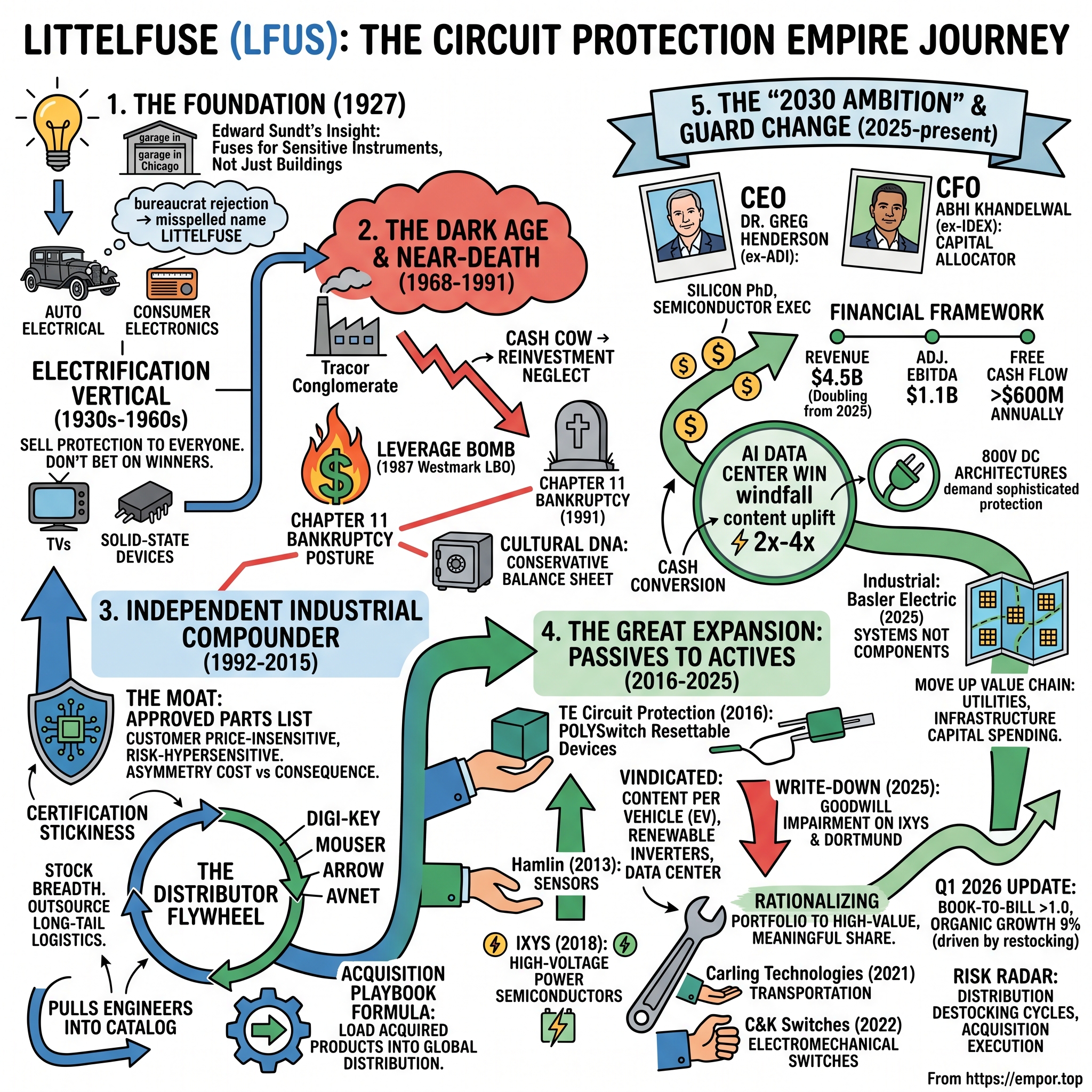
Littelfuse: The Story of the World's Circuit Protection Empire
I. Introduction & Episode Roadmap
There is a particular kind of failure that engineers dread more than any other. It is not the slow degradation of a battery or the gradual drift of a sensor. It is the instant, violent, unrecoverable failure — the moment when current that was supposed to flow at fifteen amps suddenly flows at four hundred, when copper traces on a circuit board vaporize, when a lithium cell goes into thermal runaway, when a server rack in a data center full of graphics processors worth more than the building becomes an open flame.
The entire modern electrified world runs on the assumption that this does not happen. And the reason it mostly does not happen is a category of components so unglamorous that almost no one outside the industry can name a single manufacturer of them: fuses, transient voltage suppression diodes, resettable polymer devices, thyristors, relays, and protection semiconductors. Sacrificial parts. Components whose entire job description is to die so that something expensive can live.
The largest and most globally diversified maker of these components is Littelfuse, Inc., traded on NASDAQ under the ticker LFUS. As of mid-July 2026, the market valued the company at roughly $10.7 billion, with the stock trading around $422 — well off its 52-week high of about $500, but nearly double its 52-week low of $226, a range that tells you a great deal about how violently the market has repriced this business over the past year.1
The thesis is deceptively simple. Littelfuse sells components that typically represent a fraction of one percent of the bill of materials in the systems they protect, but whose failure can destroy one hundred percent of the system — and sometimes the room it sits in. That asymmetry between cost and consequence is the foundation of everything that follows: the pricing power, the design-in stickiness, the distribution economics, the acquisition playbook.
But a thesis is not a proof. And the more interesting question — the one worth three hours of your attention — is how a company founded in a Chicago workshop in 1927, harvested for cash by a defense conglomerate for two decades, and spat out of a Chapter 11 reorganization in 1991 as an orphaned public company, turned into a $2.4 billion revenue industrial compounder that in 2025 generated $366 million of free cash flow.2
The company is also, right now, in the middle of its most consequential transition in a generation. In February 2025, Dave Heinzmann — who joined Littelfuse as an engineer in 1985 and spent four decades inside it — handed the CEO role to Dr. Greg Henderson, a semiconductor executive who spent his career at Analog Devices, Hittite Microwave, TriQuint, and IBM.3 Four months later, the CFO seat went to Abhi Khandelwal, most recently finance chief at IDEX Corporation, one of the most respected serial acquirers in American industrials.4
Neither man came up through fuses. That is the point, and it is also the risk.
In May 2026, this new team stood in front of investors in New York and laid out a "2030 Ambition": $4.5 billion of revenue and $1.1 billion of adjusted EBITDA by the end of the decade, roughly doubling both from 2025 levels.5 Roughly half of that is supposed to come from organic growth, half from acquisitions. It is an aggressive target from executives who have been in their seats for barely a year.
This is the story of how Littelfuse got here, whether the moat is as durable as the narrative claims, and what would have to be true — and what would have to break — for the 2030 number to be anything other than a slide in a deck.
 Subscribe on LinkedIn
II. Edward Sundt's Garage & The Invention of the Fuse (1927–1968)
Picture a laboratory in Chicago in the mid-1920s. The equipment is precision diagnostic gear — expensive, hand-built, temperamental. The power coming out of the wall is not. The American electrical grid of that era was a patchwork of utilities with wildly inconsistent voltage, and a surge that would barely register today could destroy an instrument that cost more than a year of a technician's wages.
Edward V. Sundt had seen this problem from both sides. He had worked at General Electric and at Stewart-Warner, and in that work he kept encountering the same maddening pattern: delicate diagnostic equipment failing not because it was badly built, but because the electricity feeding it was uncontrolled.6 The fuses available at the time were designed for building wiring — heavy, slow, sized to protect against fires in walls rather than damage to sensitive instruments. By the time a standard fuse noticed a problem, the instrument was already dead.
Sundt's insight was one of scale and speed. What if you made a fuse small enough and fast enough to protect an instrument rather than a building? In 1927 he founded Littelfuse Laboratories in Chicago and built exactly that: a miniature, fast-acting protective fuse designed to blow before the equipment downstream could be damaged.6
It is worth pausing on why this was a genuinely good business from day one, because the economics have barely changed in a century. The fuse is cheap. The thing it protects is not. The customer's decision is therefore never really about price — it is about whether they trust the part. That trust, once earned, is extraordinarily durable, because the cost of testing a cheaper alternative is measured not in dollars saved but in the expected value of catastrophe avoided. Very few purchasing managers have ever been promoted for saving eight cents on a fuse.
The name that came from a rejection
The company's name is the product of a bureaucratic setback. Sundt wanted to trademark "Little Fuse," which described the product with perfect literalness. That was precisely the problem — the description was too generic to register as a mark. His workaround was to deliberately misspell it, swapping the final letters to produce "Littelfuse."6
It is a small story, but it captures something about the company that persists: a preference for the practical solution over the elegant one, and an almost complete indifference to how anything sounds. Littelfuse has spent ninety-nine years being an aesthetically unremarkable name attached to an aesthetically unremarkable product, and has never once shown any interest in fixing that.
Riding the electrification of everything, version 1.0
What made the next four decades work was not invention but timing. Sundt had built a company whose product was demanded in direct proportion to the number of electrical circuits in the world — and the number of electrical circuits in the world was about to go vertical.
The 1930s brought automotive electrical systems into the mainstream: ignition, lighting, instrumentation, and eventually radios. Every one of those circuits needed overcurrent protection, and automotive fuses had to be small, cheap, vibration-tolerant, and reliable across brutal temperature ranges. That is a harder engineering problem than it sounds, and it created the first real technical moat — the metallurgy and manufacturing tolerances required to make a fuse that blows at exactly the right current, every time, after ten years of engine bay heat cycling.
The 1940s and 1950s brought televisions into tens of millions of living rooms, each with a high-voltage circuit that could kill someone if it went wrong. The 1960s brought the first wave of solid-state consumer electronics.
Littelfuse incorporated formally in 1938, moving from workshop to structured industrial manufacturer. It went public in 1962, and in 1963 moved its headquarters from Chicago to Des Plaines, Illinois — the northwest suburb it still calls home.6 Sundt himself retired in 1965, handing the company to Thomas Blake.6
The pattern established in this era is the one that still defines Littelfuse's business model: the company does not bet on which specific device, vehicle, or appliance wins. It sells protection to everyone building anything electrical. That is a structurally attractive position — it converts a company from a participant in technology races into a taxer of them.
It is also, as the next chapter shows, a position that can be extremely valuable to someone who wants to own it for reasons that have nothing to do with fuses.
III. The Tracor Dark Age & The Near-Death Spin-Off (1968–1991)
By the late 1960s, American corporate strategy had been captured by a single, seductive, and largely wrong idea: that a sufficiently skilled management team could run anything. The conglomerate era was in full flower. Companies with strong cash generation in boring industries were prized not for what they made but for what they could fund.
Littelfuse was a textbook target. Steady demand. Modest capital intensity. Reliable cash conversion. A product nobody thought about but everybody bought.
In 1968, Tracor — a defense and aerospace electronics firm — acquired the company.6 Thomas Blake stayed on as president, but Littelfuse now operated as a wholly owned subsidiary of a parent whose real business was government contracts.6
What follows is one of the most instructive corporate arcs in the entire Littelfuse story, and it is instructive precisely because so little happened.
What it means to be a cash cow
For roughly two decades, Littelfuse's role inside Tracor was to generate cash that could be deployed elsewhere. This is not inherently destructive — plenty of good businesses have funded their parents. But it has a predictable set of consequences over a long enough horizon.
Capital investment gets allocated to the parent's strategic priorities rather than the subsidiary's competitive position. R&D budgets get set by what can be spared rather than what the market requires. Management talent gets promoted out of the subsidiary rather than developed within it. And most corrosively, the subsidiary's leaders learn to optimize for the annual cash remittance rather than for the ten-year franchise.
The precise degree to which Littelfuse's competitive position eroded during the Tracor years is not something the public record quantifies in detail. But the structural incentives are unambiguous, and the company's behavior after independence — near-obsessive attention to reinvestment, product breadth, and global manufacturing footprint — reads very much like an organization overcorrecting for a period of neglect.
The leverage bomb
Then it got worse. In 1987, Westmark Systems acquired Tracor and its Littelfuse subsidiary in a leveraged buyout.6 This is the moment the story turns genuinely dangerous, because an LBO does something specific to a cash-generative subsidiary: it converts the subsidiary's cash flow from discretionary funding into contractually mandatory debt service.
For a few years the arithmetic held. Then it did not. The late 1980s brought a combination of defense program delays and a debt structure with no margin for error. Tracor's defense-related businesses deteriorated, the interest burden did not, and by the start of 1991 the senior lenders and other creditors had agreed in principle to restructure the entire group through bankruptcy.
On February 15, 1991, Tracor and its affiliates — including the entity then known as Old Littelfuse — filed voluntary petitions for reorganization under Chapter 11.7
Read that again. The company that makes the components preventing electrical catastrophe was itself dragged into bankruptcy court by a parent's financial catastrophe. There is no version of that outcome that was Littelfuse's operational fault. The fuse business had not stopped working. The capital structure wrapped around it had.
Emerging alone
The reorganization is what freed the company. In November 1991, Littelfuse reincorporated as an independent, publicly traded entity, listed on NASDAQ, with Howard Witt as president and chief executive officer.6 The equity emerged trading at levels that reflected exactly what the market thought of a small-cap industrial supplier spat out of a bankruptcy proceeding.
This is where the cultural DNA of modern Littelfuse was formed, and it is the single most important thing to understand about how the company has behaved for the thirty-five years since.
An organization that has watched its parent destroyed by leverage does not forget the mechanism. Littelfuse has, across three decades and more than a dozen acquisitions, maintained a conservative balance sheet posture, prioritized cash conversion over reported earnings growth, and consistently declined the kind of transformational, balance-sheet-betting deal that periodically tempts industrial companies of its size. As of the first quarter of 2026, net leverage sat at approximately 1.0x — a level that, for a company simultaneously promising to spend billions on acquisitions by 2030, is remarkably unlevered.8
Investors should hold that fact carefully, because it is the strongest single piece of evidence for management discipline in the entire story — and it is also the constraint most likely to be tested by the 2030 plan.
The immediate task in 1992, though, was more basic: figure out how a small, newly independent fuse company could build a business durable enough that it would never again be somebody else's collateral.
IV. The Industrial Compounder Playbook: Passives & Distribution Moat (1992–2015)
Walk into the engineering department of any company that designs circuit boards, and you will find a peculiar artifact of the industry: the approved parts list. It is a database of every component an engineer is permitted to place on a board without escalating for review. Getting onto that list is difficult. Getting removed from it is nearly impossible, because removal requires someone to actively decide that changing a working, certified, field-proven design is worth the effort.
Understanding that document is understanding Littelfuse's entire business model.
The economics of protecting something expensive
Start with the unit economics, because they are unusual. A standard surface-mount fuse might cost a fraction of a dollar. The engine control unit it protects might cost hundreds. The industrial drive it sits inside might cost tens of thousands. The data center power shelf it guards might be feeding accelerators worth six figures.
What this creates is a customer who is, functionally, price-insensitive on the component and hypersensitive on the risk. If a supplier raises the price of a fuse by fifteen percent, the impact on the finished product's cost is essentially unmeasurable. If that same supplier's fuse fails to open during a fault, the impact is a warranty campaign, a safety recall, or a fire.
That asymmetry is the origin of pricing power here, and it is worth being precise about what kind of pricing power it is. It is not the pricing power of a monopolist who can extract whatever they want. It is the pricing power of a supplier whose price is simply not the variable the customer is optimizing. Those are different things, and the second is more durable, because it does not invite the same regulatory or procurement backlash.
Why switching costs are the real moat
The deeper protection is in the design-in. When an engineer specifies a Littelfuse part into a circuit board, that part becomes embedded in a design that has been simulated, prototyped, tested, and — critically — certified.
That last word carries enormous weight. Electrical products sold into most developed markets require safety certification from bodies such as UL in North America, CSA in Canada, and VDE in Europe. Those certifications are granted to specific designs with specific components. Swapping the protection device is not a purchasing decision; it is an engineering change order that triggers requalification, re-testing, and often re-certification — a process that consumes engineering hours and calendar time, both of which are far more expensive than the component.
Meanwhile, the product itself may stay in production for ten to twenty years. An automotive platform, an industrial drive, a piece of medical equipment — these have lifecycles that dwarf consumer electronics. So a design win in 2015 can still be generating revenue in 2033.
This is the mechanism that turns a commodity-looking product into an annuity. And it is genuinely verifiable rather than a management talking point: it explains why Littelfuse's revenue does not collapse when a cheaper competitor appears, and why the company's declines are cyclical and inventory-driven rather than share-driven.
The honest caveat is that switching costs protect the installed base, not the next design. Every new program is a fresh competition, and the moat only compounds if Littelfuse keeps winning those. That is a real ongoing requirement, not a permanent state.
The distributor flywheel
Here is the operational problem that nearly every component maker faces: your customers number in the hundreds of thousands, most of them buy in tiny quantities, and the cost of serving them directly would exceed the revenue.
Littelfuse's answer was to lean hard into the high-service distribution channel — the catalog distributors like DigiKey, Mouser Electronics, Arrow Electronics, and Avnet who stock enormous breadth, ship in single-unit quantities, and serve as the default procurement path for engineers everywhere.
The economics of this arrangement are elegant in both directions. Littelfuse outsources the long tail of sales, credit, inventory holding, and logistics to partners who are structurally better at it. In exchange, the distributors get a category with high margins, small physical footprint, enormous SKU count, and a role as an anchor product that pulls engineers into the catalog in the first place. A designer searching for a fuse ends up buying twenty other things in the same order.
There is a second, subtler benefit. Because distributors hold inventory, they act as a shock absorber between end demand and Littelfuse's factories — smoothing production planning and reducing the working capital Littelfuse itself must carry.
And there is a second, subtler cost, which the company learned painfully in the 2023–2025 period: that same buffer amplifies the cycle. When distributors decide their inventory is too high, they do not reduce orders proportionally to end demand. They stop ordering almost entirely until the excess clears. Littelfuse's reported revenue in a destocking cycle can therefore fall far more than actual consumption of its products — and then rebound far more when restocking begins. Anyone reading LFUS quarterly results as a clean signal of underlying demand will be repeatedly misled in both directions.
Learning to buy things
Somewhere in this period, Littelfuse figured out what its most valuable asset actually was. It was not any particular fuse. It was the pipe — the global distribution relationships, the design-in presence, the certification infrastructure, the sales coverage across dozens of countries.
Once you understand that, the acquisition logic becomes obvious. If you own a pipe that can push components to the entire world, then buying a small company with a good product and mediocre distribution is close to arbitrage. You keep the product, you keep the engineering, and you push the volume through a channel the target could never have built.
The 2013 acquisition of Hamlin, Inc. from Key Safety Systems for $145 million is the template.9 Hamlin, founded in 1949, made sensors — reed switches, position sensors, magnetic sensing — with roughly $76 million of 2012 revenue, sold primarily into automotive.9 Littelfuse got an adjacent product category, a technology base in sensing rather than pure protection, and a set of automotive relationships it could cross-sell into.
The integration playbook that emerged is consistent enough to describe as a formula: eliminate duplicative corporate and administrative overhead, migrate manufacturing toward the company's low-cost hubs in Mexico, China, and the Philippines, and immediately load the acquired products into the global distribution network.
The reason this compounds rather than merely adds is that each acquisition makes the pipe more valuable, which makes the next acquisition more accretive. The reason it is not risk-free is that the formula works best on products that resemble what Littelfuse already sells. Push far enough afield — into complex semiconductors, into systems rather than components — and the synergy math gets considerably softer.
Which is exactly what the company was about to do.
V. The Great Expansion: Passives to Actives & High-Voltage (2016–2025)
There is a moment in the life of every successful component company when the ground shifts underneath the product. For Littelfuse, that moment arrived with electrification — and it arrived with a problem.
A traditional fuse is a beautifully dumb device. It is a piece of metal engineered to melt. It has no intelligence, no control, no ability to do anything other than fail in a predictable way. For a hundred years, that was enough.
But an electric vehicle's battery pack does not just need something that melts. It needs devices that switch, convert, regulate, and manage hundreds of volts and hundreds of amps, continuously, for the life of the vehicle. A solar inverter does not need a fuse; it needs power semiconductors that convert DC to AC thousands of times per second. A modern data center power architecture does not just need protection; it needs active power conversion.
Littelfuse could either become a supplier of active power components, or it could watch its content per system shrink as the value migrated to silicon.
2016: Cornering the passive board
The first move was consolidation rather than expansion. On March 25, 2016, Littelfuse completed the acquisition of TE Connectivity's circuit protection business for $350 million in cash.10 The prize was the PolySwitch family of polymer-based resettable devices, along with the 2Pro and PolyZen product lines, and operations spanning Menlo Park, California; Tsukuba, Japan; and Shanghai and Kunshan in China.10
Resettable devices are worth explaining, because they are conceptually different from a fuse. A polymer positive-temperature-coefficient device does not melt. Under fault current it heats up, and as it heats, its resistance rises dramatically — choking off the current. When the fault clears and the device cools, it returns to a conducting state. It is less a sacrificial valve than a self-resetting circuit breaker the size of a grain of rice, and it is ubiquitous in battery packs, USB ports, and mobile devices, where you cannot ask a consumer to replace a component.
Buying this business gave Littelfuse ownership of the industry-standard resettable technology alongside its existing fuse and TVS diode portfolios — meaning that for board-level protection, an engineer could get essentially every approach from a single vendor. That is a real structural advantage in a world where design engineers value vendor consolidation.
2018: The bet on silicon
Then came the deal that actually changed the company. On January 17, 2018, Littelfuse completed its acquisition of IXYS Corporation for approximately $750 million.11 IXYS was a pioneer in medium- to high-voltage power semiconductors — MOSFETs, IGBTs, thyristors, rectifiers — sold into industrial, communications, consumer, and medical markets.11
For a company whose entire identity was passive components, this was a genuine strategic discontinuity. And Wall Street was not uniformly enthusiastic. The concerns were legitimate and worth stating plainly: semiconductor businesses carry heavier capital intensity, sharper cycles, faster technology obsolescence, and thinner defensive characteristics than passive components. Littelfuse was paying a full multiple to acquire volatility it had spent twenty-five years avoiding.
The strategic argument in favor was equally legitimate. As power systems electrify, the protection function and the power conversion function increasingly sit on the same board, get specified by the same engineer, and are sold to the same customer. Owning both means selling a system rather than a part — and system-level content per vehicle or per inverter is measured in dollars rather than cents.
For several years the deal looked vindicated. IXYS silicon gave Littelfuse credible positions in EV powertrains and renewable energy inverters, and the company extracted meaningful cost synergies from consolidating overhead and manufacturing.
And then, in the fourth quarter of 2025, Littelfuse took a $301 million non-cash goodwill impairment charge against the IXYS and Dortmund acquisitions, with CFO Abhi Khandelwal attributing it to "weaker sales and profitability than original expectations amid persistent soft market conditions."12 The charge landed in the semiconductor product business within the Electronics segment.12 It drove full-year 2025 GAAP diluted EPS to a loss of $2.89 and GAAP operating margin to 1.6%, against adjusted diluted EPS of $10.68 and an adjusted EBITDA margin of 20.9%.2
This deserves an honest reading rather than a dismissive one. A goodwill impairment is a non-cash accounting event, and it does not change the cash the business generates. But it is also an explicit management admission, filed with auditors and regulators, that the price paid exceeded the value realized. Eight years after the deal, the company wrote down forty percent of the purchase price. Whatever else the IXYS acquisition accomplished strategically — and it accomplished real things — it did not clear the return hurdle Littelfuse underwrote in 2018.
The gap between a GAAP loss and $10.68 of adjusted EPS is also exactly the kind of item a skeptical investor should sit with. Adjusted numbers are the right basis for understanding ongoing cash economics. But a company that repeatedly adds back impairments on acquisitions is, over time, telling you something about acquisition quality that the adjusted number is designed to suppress.
Notably, on the Q4 2025 call, CEO Greg Henderson did not defend the semiconductor portfolio as-is. He described an active effort to narrow it: "We're focused here on areas where we have high value, meaningful share, and differentiated solutions… we're undergoing an effort to rationalize the portfolio."12 That is a more candid posture than the industry norm, and it is worth crediting.
Building out transportation and industrial
Alongside the silicon bet, Littelfuse kept executing the bolt-on playbook in adjacent electromechanical categories.
On November 30, 2021, it completed the acquisition of Carling Technologies for approximately $315.5 million, subject to working capital adjustment.13 Carling, founded in 1920, held strong positions in switching and circuit protection for commercial vehicle, marine, and datacom/telecom infrastructure markets.13 The logic was to deepen the Transportation segment beyond passenger vehicles into commercial trucks and marine — markets with lower volumes but higher content and less brutal pricing pressure from automotive Tier 1 buyers.
On July 19, 2022, Littelfuse closed the acquisition of C&K Switches for $540 million in cash.14 C&K, founded in 1928, designed and manufactured high-performance electromechanical switches and interconnect solutions across industrial, transportation, aerospace, and datacom markets.14 Switches sit right next to protection devices on a board, are specified by the same engineers, and carry the same design-in stickiness. This was the playbook executed on precisely the kind of product where the playbook works best.
2025: Basler and the pivot to grid
The most recent and most strategically revealing acquisition came in late 2025. Littelfuse announced on October 28, 2025 that it would acquire Basler Electric Company, and closed the transaction on December 11, 2025 for approximately $350 million in cash.15
Basler is not a component company. Founded in 1942 and headquartered in Highland, Illinois, it is a third-generation family-owned manufacturer of electrical control and protection systems — generator excitation systems, protective relays, and power system controls — with roughly 700 employees, more than 1,600 global customers, and manufacturing in Illinois, Texas, and Mexico.15 For 2025, Basler was expected to generate approximately $125 million of revenue at a high-teens adjusted EBITDA margin.15 After expected tax benefits of roughly $30 million, the net transaction value was approximately $320 million.15
Do the arithmetic on those disclosed figures and the implied multiple lands somewhere in the low-to-mid teens on EBITDA — in the same range Littelfuse has historically paid for bolt-ons, and materially below what it paid for IXYS.
But the more important observation is what Basler represents. This is Littelfuse buying systems rather than components, sold to utilities and power producers rather than to distributors and OEMs, in a market driven by infrastructure capital spending rather than unit volumes. It is the clearest signal yet that management intends to move up the value chain — which brings higher revenue per customer and better secular growth, but also longer sales cycles, project-based revenue recognition, and integration challenges that a fuse acquisition never presented.
On the Q4 2025 call, analysts pressed specifically on Basler cultural integration and received answers management deferred to the May investor day.12 That deferral was reasonable at seven weeks post-close. It is less reasonable as a permanent posture, and it is one of the things worth watching.
The results, at least initially, were striking. In the first quarter of 2026, the Industrial segment's sales jumped 45% year over year, with 39 percentage points of that coming from Basler and 5% organic.8 Whether that reflects durable integration or simply the mechanical arithmetic of adding an acquired revenue base is something the next several quarters will answer.
Which is the natural place to turn to the people now responsible for answering it.
VI. The 2025 Executive Guard Change: Greg Henderson & Abhi Khandelwal
On January 13, 2025, Littelfuse announced that David Heinzmann would retire as chief executive officer after forty years with the company.3 Forty years. He had joined in 1985 as an engineer, worked his way through operations and product management, become CEO in 2017, and steered the company through the IXYS integration, the pandemic supply chain crisis, and the brutal destocking cycle that followed.
His successor was named in the same release, and the choice said everything about where the board thought the company was going.
The silicon PhD
Dr. Greg Henderson took over as president and CEO effective February 10, 2025.3 He was 56 at the time of appointment, and — critically — he was not a stranger. He had joined the Littelfuse board in May 2023, giving him roughly twenty months of governance-level exposure to the business before taking operational control.3 That is meaningfully better than a cold external hire, and it partially answers the obvious question about a semiconductor executive running a fuse company.
His resume reads like a map of the RF and analog semiconductor industry. From 2017 to 2024 he served as Senior Vice President of Analog Devices' Automotive & Energy, Communications, and Aerospace Group — running exactly the end markets Littelfuse now says are its growth engines.3 Before ADI, he held leadership roles at Hittite Microwave, Harris Corporation, Tyco Electronics, TriQuint Semiconductor, and IBM.3 He holds a bachelor's degree in electrical engineering from Texas Tech University and a Ph.D. in electrical engineering from Georgia Tech.3
Chairman Gordon Hunter framed the choice around Henderson's "wealth of experience across our industry, end markets and technologies" and "extensive technical skills and management experience."3
Read the appointment as a strategic statement and it is unambiguous. Littelfuse did not hire an operator to squeeze the existing business. It hired a semiconductor executive from the company that arguably best exemplifies high-margin, design-win-driven analog silicon — a business model built on thousands of long-lived products sold at high gross margins into applications where the customer cares about performance rather than price.
That is not a coincidence. It is a template.
The bull reading is that Henderson knows how to build a franchise where technical differentiation, not manufacturing cost, drives margin — and that this is precisely the skill Littelfuse needs to move from selling fuses to selling power systems.
The bear reading is worth stating with equal clarity. Analog Devices is a $40-billion-revenue-class semiconductor company with a fundamentally different cost structure, customer base, and channel than a diversified industrial component maker. Littelfuse's business is not primarily a design-win-driven silicon business; it is a catalog and distribution business with a design-win layer on top. An executive whose instincts were formed in one model running a company built on the other is a real integration risk at the strategic level, not just the personnel level.
The evidence so far leans positive but is early. Henderson's transition was orderly — Heinzmann remained on the board through April 2025 and served as an advisor through August 10, 2025, providing genuine continuity rather than a clean break.3 The previously scheduled February 2025 investor day was postponed, which was the correct call: a new CEO presenting a five-year plan in his first month would have been theater.3 The plan eventually arrived fifteen months later, after Henderson had time to actually form a view.
The capital allocator
The second half of the leadership change came in May 2025. Littelfuse announced that Abhi Khandelwal would become Executive Vice President and Chief Financial Officer, effective June 18, 2025, succeeding Meenal Sethna.4
Khandelwal arrived from IDEX Corporation, where he was Executive Vice President and CFO.4 Before IDEX, he was CFO of Multi-Color Corporation, a global packaging and label solutions provider, and Senior Vice President and CFO of CIRCOR International.4 He holds a Bachelor of Science in Business with a finance concentration from Indiana University and an MBA from Northwestern.4
The IDEX pedigree is the part that matters. IDEX is one of the more respected practitioners of decentralized industrial operating models and programmatic bolt-on acquisition — a company that has spent decades buying small, high-margin niche businesses, leaving their commercial organizations largely intact, and compounding capital through disciplined deployment rather than transformational bets.
Hiring an IDEX CFO immediately after a semiconductor CEO tells you the board designed a specific pairing: technical strategy plus acquisition discipline. If the 2030 plan is genuinely half organic and half M&A, then the CFO's job description is essentially "run the acquisition engine without repeating IXYS."
Khandelwal's early public behavior has been more precise than promotional. On the Q4 2025 call he framed price-cost management in explicitly neutral terms — "our goal is to be price cost neutral… there'll be timing… throughout the year depending on how the commodity pricing moves" — which is the language of someone managing expectations rather than selling a story.12 He was also direct about the impairment rather than burying it in adjustments.12
The alignment question
Littelfuse is overwhelmingly institutionally owned, which means insider equity ownership is small in absolute terms and management alignment depends heavily on the incentive plan rather than on personal stakes.
That places unusual weight on the compensation design. Based on the company's disclosed executive compensation framework, the annual incentive structure has been anchored on adjusted EBITDA margin and adjusted free cash flow conversion, with new business bookings as an operating measure, and long-term equity carrying a relative total shareholder return modifier that adjusts payouts based on performance against a peer group.
The structural read is reasonable. Weighting margin and cash conversion rather than revenue growth is the right emphasis for a company about to spend heavily on acquisitions — because revenue targets are trivially achievable through M&A, while margin and cash conversion targets are not. A relative TSR modifier is a genuine accountability mechanism in a cyclical business, since it strips out the sector-wide moves that neither help nor hurt shareholders on a relative basis.
The structural concern is the mirror image. A management team that is compensated on margin and bookings, holds relatively little stock personally, and has publicly committed to doubling the company by 2030 has a coherent set of incentives to be aggressive with the balance sheet. That is not an accusation — it is simply the shape of the incentive, and it is why the pace and pricing of acquisitions over the next three years is the single most informative thing an investor can watch.
To assess whether they can actually execute, we need to look at what they inherited.
VII. Segment Economics & The Power of Distribution
The cleanest way to understand Littelfuse is to stop thinking about it as one company and start thinking about it as three businesses with genuinely different customers, cycles, and economics — bound together by a shared manufacturing base and a shared channel.
Full year 2025 gives the baseline. Total net sales were $2,386 million, up 9% year over year with 6% organic growth.2
Electronics: the engine
Electronics generated $1,346 million of 2025 sales, up 13.4%, at a 16.4% operating margin (up 210 basis points) and a 22.9% adjusted EBITDA margin (up 190 basis points).2 At roughly 56% of revenue and the highest margin in the portfolio, this is the business that determines whether Littelfuse is a good company or an average one.
It houses the historical core — miniature fuses, TVS diodes, the PolySwitch resettable family — alongside the IXYS power semiconductor portfolio and C&K switches. Its customers reach it primarily through the catalog distribution channel, which is why it has the best margins: distribution pricing is set by service and availability rather than by annual OEM negotiation.
The first quarter of 2026 showed what a recovery looks like in this segment. Electronics sales grew 18% with 15% organic growth, and — this is the number worth noting — passive products surged 22% organically while semiconductor protection products expanded 8%.8 Segment margin improved 300 basis points to 25.1%.8
The analytical point is that the recovery was led by the old, boring, high-margin passive business rather than by the acquired silicon. That is simultaneously reassuring about the core franchise and a little awkward for a narrative built on the pivot to active power.
Transportation: volume without pricing
Transportation generated $676 million of 2025 sales, up just 0.6%, at a 12.5% operating margin — though that margin improved a striking 380 basis points, and adjusted EBITDA margin reached 17.7%, up 370 basis points.2
Flat revenue with sharply expanded margin is an interesting combination. It suggests the improvement came from mix, cost reduction, and portfolio pruning rather than from demand. In Q1 2026, Transportation sales rose 5% with only 1% organic growth, with passenger vehicle content growing high single digits while commercial volumes faced headwinds from an exited marine business.8 Margins nonetheless expanded 200 basis points to 19.1%.8
The structural reality of this segment is that it sells to automotive Tier 1 suppliers and OEMs — among the most sophisticated, most cost-focused, highest-leverage buyers in global manufacturing. Annual price-down expectations are a fact of life. What Littelfuse gets in exchange is enormous volume, extremely long program lifecycles, and content growth as vehicles electrify: a high-voltage EV architecture requires substantially more protection content than an internal combustion vehicle.
That content story is real but it is not free. It is precisely the market where Chinese and other Asian competitors are most aggressive, and where a customer's willingness to requalify a part is highest because the volumes justify the engineering effort.
Industrial: the new growth story
Industrial generated $364 million of 2025 sales, up 9.9%, at a 16.2% operating margin (up 340 basis points) and a 19.5% adjusted EBITDA margin.2 At roughly 15% of revenue, it is the smallest segment — and the one management has designated as the growth vehicle.
This is heavy industrial fuses, protection relays, and now Basler's control and excitation systems. Its demand driver is not consumer electronics cycles or vehicle build rates but capital spending on electrical infrastructure: substation upgrades, renewable interconnection, backup generation, and data center power distribution.
The Q1 2026 print showed the acquisition arithmetic in action — 45% total growth, 39 points from Basler, 5% organic, driven by grid infrastructure and data center demand and partially offset by soft residential HVAC, with margins improving 340 basis points to 21.9%.8
The honest framing is that Industrial's headline growth is currently an acquisition story with a decent organic layer underneath. The 5% organic figure is respectable, not spectacular. Management's 2030 plan calls for this segment to grow at double-digit organic rates.5 That is a meaningful acceleration from what the segment is currently delivering, and it is one of the least-supported assumptions in the entire plan.
The cash conversion machine
The financial characteristic that ties all three segments together — and the one that justifies the "compounder" label more than any growth statistic — is cash generation.
For full year 2025, cash flow from operations was $434 million and free cash flow was $366 million on $2,386 million of revenue.2 That is roughly 15% of revenue converted to free cash, from a manufacturing business with global factories. In the fourth quarter alone, operating cash flow was $139 million and free cash flow $120 million.2 In the first quarter of 2026, free cash flow climbed 55% to $66 million.8
Three structural features drive this. First, capital intensity is genuinely modest: management's 2030 framework targets capital expenditure at just 3–4% of sales.5 Second, the distribution model shifts a meaningful portion of finished goods inventory carrying onto partners. Third, the products themselves are small, high-value-density items — a warehouse of fuses represents far more revenue per square foot than a warehouse of most industrial products.
What this means practically is that Littelfuse can fund a serious acquisition program from internally generated cash plus modest leverage, without repeatedly returning to equity markets. At a 1.0x net leverage ratio and $366 million of annual free cash flow, the company has substantial deployable capacity.82 The question is not whether it has the money. The question is what it buys with it.
VIII. The "2030 Ambition" & The AI Data Center Windfall
On May 14, 2026, Greg Henderson stood in front of investors in New York for the first investor day of his tenure — the one that had been postponed sixteen months earlier when he took the job.5 The presentation had to answer a question that had been hanging over the company since his appointment: what, specifically, does a semiconductor executive intend to do with a fuse company?
The answer was a set of numbers.
The math of doubling
By 2030, Littelfuse targets $4.5 billion of revenue, up from $2.39 billion in 2025 — an 8–10% annual growth rate.5 Adjusted EBITDA is targeted at $1.1 billion against $498.6 million in 2025, implying an adjusted EBITDA margin of 24–26% versus 20.9% in 2025.5 Free cash flow is targeted above $600 million annually, up from $366.1 million.5
The composition matters more than the headline. Management framed 7–9% annual organic revenue CAGR from the core business, plus 6–8% annual CAGR from acquisitions.5 Note that these ranges sum to more than the 8–10% total growth target — which suggests either conservatism in the total or an expectation of portfolio pruning alongside the buying. The company has already demonstrated willingness to prune, having exited the marine business.8
Underneath the growth targets sits a market sizing claim: serviceable addressable market expanding from roughly $22 billion in 2025 to roughly $30 billion by 2030.5 That implies Littelfuse holds roughly 11% share today and needs to reach roughly 15% by 2030 — a share gain of about four points in five years, in a market with real competitors.
Segment-level assumptions were: Electronics at high-single-digit organic growth, Transportation at mid-single digits, and Industrial at double digits.5
Capital deployment priorities were laid out in order: organic investment at 3–4% capex to sales, strategic acquisitions targeted at double-digit return on invested capital, and consistent dividends plus opportunistic buybacks.5
That "double-digit ROIC" acquisition hurdle is the most important sentence in the entire plan, and it should be read against the IXYS write-down. A company that just impaired $301 million of goodwill from its largest-ever acquisition is now publicly committing to a specific return threshold on future deals.12 That is either genuine institutional learning or a promise that will be quietly redefined. There is no way to know yet. There is a way to check: watch whether disclosed acquisition multiples stay in the low teens, and whether the company reports return-on-capital metrics on acquired businesses rather than only revenue contribution.
The AI data center opportunity, explained properly
The most-discussed pillar of the plan deserves a careful technical explanation, because the mechanism is genuinely interesting and widely misunderstood.
A traditional server rack has been powered at 12 volts for decades. Power comes into the data center at high voltage, gets stepped down repeatedly, and arrives at the motherboard as 12V DC, where it is converted again to the roughly 1V the processors actually consume.
That architecture worked when a rack drew a few kilowatts. It breaks completely at the power densities AI accelerators demand. Here is why, in plain terms: power equals voltage times current. If you need to deliver 100 kilowatts to a rack at 12 volts, you need to push roughly 8,000 amps of current. The copper required to carry 8,000 amps without melting is enormous — thick busbars, massive connectors — and the resistive losses (which scale with the square of current) turn a meaningful fraction of your electricity into waste heat before it ever reaches a chip.
The industry's answer is to raise the voltage. Move from 12V to 48V and you cut current by a factor of four and resistive losses by a factor of sixteen. Move to 800V DC architectures — which the highest-density AI deployments are now adopting — and the improvement is dramatic.
But raising voltage does something else: it makes faults far more dangerous. A short circuit at 12 volts is a problem. A short circuit at 800 volts is an arc flash — a phenomenon with enough energy to vaporize metal. Higher voltage architectures require fundamentally more sophisticated, more expensive protection, and considerably more of it.
That is the entire content story, and it is a genuinely good one. Littelfuse quantified it at the investor day: the data center market growing at greater than 15% CAGR from 2025 to 2030, with a 2x–4x content uplift opportunity as architectures move to high voltage, and Littelfuse's own data center revenue targeted to grow at a 25–30%+ CAGR through 2030.5 High- and medium-voltage protection products already represent roughly one-fifth of the company's business.5
There is product-level evidence rather than just assertion. On the Q1 2026 call, management disclosed a design win for an 800-volt data center power system deployment, alongside a U.S. grid infrastructure excitation systems contract where shipments begin in 2027.8 Henderson also stated on the Q4 2025 call that data center design wins "more than doubled in 2025."12
What the order book says
The most useful leading indicator management has disclosed is the bookings trend. On the Q1 2026 call, the company reported book-to-bill "well above 1.0, while bookings were again up more than 20%."8
Book-to-bill above 1.0 means orders are arriving faster than shipments go out — the backlog is building. The word "again" is doing real work in that sentence: it signals this is not a single quarter's anomaly.
The results have followed. Q1 2026 net sales were $657 million, up 19% year over year, with 9% organic growth, 6 points from Basler, and 3 points from foreign exchange.8 Adjusted EBITDA margin expanded 180 basis points to 22.9%; adjusted diluted EPS rose 51% to $3.31.8 Guidance for Q2 2026 was set at $690–$710 million of sales, representing roughly 14% growth with 8% organic, and adjusted EPS of $3.65–$3.85.8
A 22.9% adjusted EBITDA margin in Q1 2026 against a 24–26% target for 2030 means roughly half the margin journey has already happened — which is either evidence that the target is achievable or evidence that it was set conservatively enough to be safe.
The falsification test
A plan is only useful to an investor if you can specify what would prove it wrong. Here is what would.
If data center and grid demand is genuinely driving a structural content increase, then organic growth in Electronics and Industrial should stay in high single digits or better after the current restocking cycle completes — probably by late 2027. If organic growth reverts to low single digits once channel inventories normalize, then what looked like a secular story was a cyclical one dressed up in AI language.
If the acquisition discipline is real, disclosed multiples should stay in the low teens and the company should not need to reach for a transformational deal to hit $4.5 billion. Roughly $2.1 billion of revenue must be added over five years; at a 6–8% inorganic CAGR that is achievable through bolt-ons, but only if the pipeline of appropriately-priced targets actually exists. If Littelfuse announces a deal above $1 billion at a mid-to-high-teens multiple, the discipline thesis is materially weakened.
And if the margin story is real, the 24–26% target should be approached through mix and operating leverage rather than through an ever-growing list of adjustments.
IX. Playbook: Business & Investing Lessons
Strip away the specifics and Littelfuse offers four transferable lessons about how durable industrial businesses actually get built. They are worth stating cleanly, because they generalize far beyond circuit protection.
Lesson 1: Own the asymmetry, not the category
The most valuable position in any supply chain is the component that is trivially cheap and catastrophically important. If your product is under one percent of the bill of materials but its failure destroys the whole system, you have escaped price competition without needing a monopoly.
The generalization is that the customer's decision framework matters more than the customer's bargaining power. Automotive Tier 1 suppliers are formidable negotiators, but even they do not spend their leverage on protection components, because the savings are immaterial and the downside is a recall.
The limit of this lesson is important: it works only where failure is visible, attributable, and expensive. In applications where a component's failure is cheap or invisible, the asymmetry collapses and price competition returns immediately. This is precisely why Littelfuse's margins are strongest in high-reliability industrial and electronics applications and weakest in high-volume, low-consequence ones.
Lesson 2: Distribution is harder to copy than product
Any competent manufacturer with a metallurgy lab can produce a fuse that meets a spec. What they cannot easily produce is thirty years of stocking relationships with DigiKey, Mouser, Arrow, and Avnet; presence on approved parts lists at thousands of engineering organizations; certification files with UL, CSA, and VDE across tens of thousands of SKUs; and the logistical infrastructure to ship a single part to an engineer in Stuttgart tomorrow.
That accumulated infrastructure is the real asset, and it explains why Littelfuse's acquisition strategy has worked. The company is not buying products. It is buying products to put in a pipe it already owns.
The nuance investors should hold is that distribution moats are strong against new entrants and weak against incumbents with equivalent channel access. Littelfuse's competition is not a startup; it is Eaton's Bussmann business, Mersen, Bourns, and the Asian manufacturers who have spent two decades building exactly this kind of channel presence in their home markets.
Lesson 3: Programmatic beats transformational — but only with discipline
The bolt-on model has a specific mathematical advantage: it fails cheaply. Buy a $150 million business at 12x EBITDA, integrate it badly, and you have destroyed a manageable amount of value. Buy a $3 billion business at 18x, integrate it badly, and you have destroyed the company.
Littelfuse's history is a natural experiment in this. Hamlin, Carling, and C&K were all classic bolt-ons in adjacent categories at reasonable prices, and none of them created a crisis. IXYS was the largest, the most strategically ambitious, and the furthest from the core — and it is the one that produced a $301 million write-down.12
The lesson is not that big deals are always wrong. It is that deal risk scales with the distance from the core, not just with the size of the check. IXYS was risky because Littelfuse was buying a business model it did not have institutional expertise in, not merely because it was expensive.
Basler is a smaller check but sits at a similar strategic distance — systems rather than components, utilities rather than distributors. That is the deal to watch.
Lesson 4: Sell to the transition, not to the winner
Perhaps the most useful lesson for public market investors is structural. Nobody knows which EV manufacturer will dominate in 2035, which AI chip architecture will win, or which grid storage chemistry will scale. Predicting those outcomes correctly is extremely difficult and extremely valuable.
Not having to predict them is also valuable, and considerably easier.
Littelfuse's position is that electrification in aggregate increases the number and voltage of circuits requiring protection, regardless of which specific companies build them. Whether a data center runs NVIDIA or AMD silicon, its 800V power architecture needs protection. Whether an EV is built in Michigan or Shenzhen, its battery pack needs high-voltage fusing.
The honest caveat — and it is a real one — is that this positioning insulates against company risk, not against technology risk or cycle risk. If power architectures evolve in a direction that integrates protection into the silicon itself, or if the electrification build-out slows, the index-fund quality of the business provides no shelter at all.
X. Analysis: Risk Radar, Bull vs. Bear Case
Now the war-gaming. What does this business look like to someone actively trying to break the thesis?
The competitive structure
Run the industry through Porter's framework and the picture is better than average but not fortress-like.
Rivalry is moderate. The circuit protection market is fragmented across Littelfuse, Eaton's Bussmann division, Mersen, Bourns, Vishay, and a long tail of regional manufacturers, with no participant able to dictate industry pricing. Competition happens design by design rather than through broad price wars, which keeps rivalry from becoming destructive — but it also means share gains are slow and grinding.
Buyer power varies dramatically by segment, and this is the single most useful thing to understand about the business. In Electronics, where the channel is catalog distribution and the end buyer is an engineer choosing from a catalog, buyer power is genuinely weak — which is why that segment carries the highest margins. In Transportation, where the buyer is an automotive Tier 1 with annual price-down expectations and enormous volume leverage, buyer power is strong, which is exactly why Transportation's margins have historically trailed. The margin gap between the two segments is not a mystery; it is a direct readout of channel structure.
Supplier power is a genuine and underappreciated exposure. Fuses are made of copper, silver, zinc, and specialty alloys, and semiconductors require wafers and packaging materials. Khandelwal's stated goal of being "price cost neutral" acknowledges this directly, and his caveat about timing — "there'll be timing… throughout the year depending on how the commodity pricing moves" — is a candid admission that the company absorbs commodity moves before it can pass them through.12
Threat of substitutes is low for the core function but not zero. Electronic protection circuits and solid-state breakers can substitute for fuses in some applications, and — more interestingly — a competitor could integrate protection functions into the power semiconductor itself. As Littelfuse moves into power silicon, it is arguably positioning to be on the right side of that transition rather than the wrong one, but this is a genuine long-horizon technology risk.
Threat of new entrants is low at the high end and meaningful at the low end. Nobody is going to build a new global circuit protection franchise from scratch. But low-cost Asian manufacturers can and do compete effectively on standard, high-volume, low-differentiation parts.
Where the powers actually are
Applying Hamilton Helmer's 7 Powers, three apply with real force and the rest are weak.
Switching costs are the strongest power in the portfolio, for the design-in and certification reasons already described. This is genuinely durable and genuinely verifiable.
Scale economies apply to the distribution and certification infrastructure more than to manufacturing. Maintaining certification files, distributor relationships, and global logistics across tens of thousands of SKUs has enormous fixed costs that amortize across a large revenue base. A smaller competitor simply cannot afford the same breadth.
Process power exists in the metallurgy and manufacturing tolerances — the accumulated know-how of making a component that behaves identically across millions of units and decades of thermal cycling. It is real but it is the most easily overstated of the three, because process advantages in mature manufacturing erode over time as competitors accumulate their own experience.
What Littelfuse notably does not have: branding power (no engineer pays a premium for the name in any emotional sense), network economies, cornered resources, or counter-positioning. This is a business with a solid moat, not a spectacular one.
The risk radar
Distribution destocking is the most consistently underestimated risk in this story. The 2023–2025 downturn demonstrated how violently the channel buffer amplifies the cycle. Investors looking at Q1 2026's 19% growth should be clear-eyed that a meaningful portion of that reflects restocking, not consumption — and restocking, by definition, ends.8
Acquisition execution is now the central risk, and it has been elevated from theoretical to demonstrated by the IXYS write-down. The company is committing to add roughly $2 billion of revenue through acquisition by 2030 while simultaneously moving into systems businesses that are structurally harder to integrate.512
The adjusted-versus-GAAP gap deserves standalone attention. Full year 2025 produced a GAAP diluted loss of $2.89 per share against adjusted diluted EPS of $10.68, and GAAP operating margin of 1.6% against an adjusted EBITDA margin of 20.9%.2 The bulk of that gap was the goodwill impairment, which is legitimately non-cash and non-recurring in character. But an investor evaluating a company whose growth plan depends on acquisitions should track how frequently acquisition-related items appear in the adjustment column over time. One impairment is an event. A pattern is a business model.
EV and automotive cyclicality remains a real exposure. Transportation grew 0.6% in 2025 and 1% organically in Q1 2026.28 The high-voltage content story is genuine, but it is being delivered into a global automotive market with uneven EV adoption and considerable production volatility.
Geopolitical and supply chain concentration is inherent to the manufacturing footprint. Littelfuse manufactures across Mexico, China, the Philippines, and elsewhere, which is efficient but exposes the company to tariff regimes, trade restrictions, and regional disruption. Management's price-cost-neutral framing on the Q4 call addressed commodity inputs specifically, but tariff policy is a separate and less controllable variable.12
Segment-level demand pockets can offset the good news. Even in the strong Q1 2026 Industrial print, soft residential HVAC partially offset grid and data center strength.8 The portfolio's diversification cuts both ways: it dampens downside and dilutes upside.
The activist stress test
What would a skeptical investor with a real position push on?
First, portfolio complexity. Littelfuse now spans passive protection, power semiconductors, electromechanical switches, sensors, and utility control systems, across three reporting segments and dozens of end markets. Management is already rationalizing the semiconductor portfolio and has exited marine.128 An activist would ask whether that pruning is aggressive enough, and whether the semiconductor business — which just produced a $301 million write-down — belongs in the company at all, or would be worth more to a dedicated power semiconductor buyer.12
Second, capital allocation credibility. The company impaired forty percent of its largest acquisition's purchase price and then, months later, announced a plan to roughly double the company with acquisitions supplying half the growth.125 The natural challenge is: what specifically changed in the diligence and underwriting process? The "double-digit ROIC" hurdle is an answer, but it is an assertion until deals are measured against it.
Third, disclosure. The most useful thing Littelfuse could publish — and does not — is return on invested capital by acquisition cohort. Revenue contribution from Basler is disclosed; whether Basler is earning its cost of capital will not be visible for years.
Fourth, the balance sheet. At 1.0x net leverage, the company is arguably under-levered for a business with this cash conversion profile.8 An activist could reasonably argue for more aggressive buybacks, particularly given a stock that traded between $226 and $500 over the past year.1 Management's answer is that the capacity is reserved for M&A — which is only the right answer if the M&A is good.
The bull case
The bull case rests on four legs, and they are not equally strong.
The strongest is the demonstrated operating leverage. Q1 2026 adjusted EBITDA margin of 22.9%, up 180 basis points, on 9% organic growth, shows that incremental volume drops through at attractive rates.8 Segment margins improved across all three businesses simultaneously, which is difficult to attribute to mix alone.8
The second is the order book. Book-to-bill well above 1.0 with bookings up more than 20% is a hard operating metric, not a narrative.8
The third is the content story, supported by an actual 800V design win and a doubling of data center design wins in 2025 rather than by market-size slides alone.812
The fourth, and weakest, is the leadership pairing. An ex-ADI CEO and an ex-IDEX CFO is an elegant thesis about capability, but fifteen months is not a track record.
The bear case
The bear case is equally coherent.
Start with the cycle. This business has poor forward visibility — typically only a quarter or two of meaningful order book — and its reported results are systematically distorted by channel inventory behavior. The current strength is occurring during a restocking phase following a severe destocking phase. Some portion of 19% growth is arithmetic, not demand.8
Add the commoditization pressure at the low end, which requires continuous R&D investment simply to maintain position — a treadmill that consumes cash without necessarily expanding the moat.
Add the execution risk. The 2030 plan requires simultaneously accelerating organic growth above recent trend, expanding margins by roughly four points, and deploying over a billion dollars into acquisitions at attractive returns — from a management team that has been in place for roughly a year and inherited a fresh write-down from the last big deal.512
And add valuation sensitivity. At roughly $10.7 billion of market capitalization against $2.4 billion of 2025 revenue and $10.68 of adjusted EPS, the stock embeds meaningful expectations for the recovery and the plan to work.12 The 52-week range of $226 to $500 is not the trading pattern of a stable compounder; it is the trading pattern of a cyclical business whose narrative has been repriced hard in both directions.1
The three KPIs that matter
Strip away everything else and three metrics tell you whether the story is working.
Book-to-bill ratio. This is the earliest available signal of whether demand is genuine. Above 1.0 means backlog is building; below 1.0 means the cycle has turned. In a business with one to two quarters of visibility, this is the closest thing to a leading indicator that exists, and management discloses it on earnings calls.
Organic growth by segment, excluding acquisition contribution. The single most important discipline for an investor here is to strip out acquired revenue. Headline growth of 19% means very little when 6 points came from Basler and 3 from currency.8 The 9% organic figure is the number that tests the secular thesis — and specifically, whether Industrial's organic growth accelerates toward the double digits management has promised for 2030.5
Adjusted EBITDA margin. The path from 20.9% in 2025 toward the 24–26% target for 2030 is the cleanest test of whether operating leverage and mix shift are real.25 Margin is much harder to manufacture through acquisition than revenue is, which makes it the more honest metric.
XI. Epilogue & Outro
There is a particular satisfaction in businesses that nobody talks about. The electrical infrastructure of the modern world — the grid substations, the vehicle powertrains, the server halls consuming the output of entire power plants — is monitored, regulated, and protected by components that cost less than a cup of coffee and are named after a trademark rejection from ninety-nine years ago.
Littelfuse's story is not one of genius or reinvention. It is a story about position. Edward Sundt found a spot in the electrical supply chain that would grow with electrification itself, and every generation since has mostly just declined to leave that spot. The Tracor years nearly cost the company its independence. The 1991 bankruptcy taught it a lesson about leverage it has never unlearned. The distribution model turned a commodity into an annuity. The acquisition engine turned an annuity into a compounder.
The current chapter is genuinely open. A semiconductor executive and an industrial CFO have committed publicly to doubling a company they inherited a year ago, in end markets — AI data centers, grid modernization, aerospace and defense — where the demand is real but the durability is unproven and the competition is intensifying. They have a stronger balance sheet than almost any peer, a demonstrated ability to expand margins, and an order book pointing up. They also have a fresh $301 million reminder that acquisitions do not always work, sitting in the same fiscal year as the plan they are asking investors to believe.
What makes Littelfuse worth understanding is not that the answer is obvious. It is that the question is unusually well-defined. Either the electrification of everything drives structural content growth in protection and power components, and a disciplined acquirer with a global channel captures a disproportionate share of it — or the last two years were a restocking cycle wearing an AI costume, and 2030 is a slide.
The evidence for distinguishing between those two outcomes arrives quarterly. It is in the bookings, in the organic growth, and in the multiples paid for the next deal.
References
-
Littelfuse Reports Fourth Quarter and Full Year 2025 Results — Littelfuse, Inc., 2026-01-28 ↩↩↩↩↩↩↩↩↩↩↩↩↩
-
Littelfuse Announces CEO Retirement and Leadership Transition — Littelfuse, Inc., 2025-01-13 ↩↩↩↩↩↩↩↩↩↩
-
Littelfuse Names Abhi Khandelwal Chief Financial Officer — Business Wire, 2025-05-27 ↩↩↩↩↩
-
Littelfuse sets 2030 revenue, EBITDA and FCF goals (Form 8-K, 2026 Investor Day) — StockTitan, 2026-05-14 ↩↩↩↩↩↩↩↩↩↩↩↩↩↩↩↩↩↩
-
Littelfuse, Inc. Form 10-K for fiscal year 1996 — U.S. Securities and Exchange Commission, 1997 ↩
-
Littelfuse (LFUS) Q1 2026 Earnings Call Transcript — The Motley Fool, 2026-05-06 ↩↩↩↩↩↩↩↩↩↩↩↩↩↩↩↩↩↩↩↩↩↩↩↩↩↩
-
Littelfuse Completes Hamlin Acquisition — Littelfuse, Inc., 2013-05-31 ↩↩
-
Littelfuse Completes Acquisition of TE Connectivity Circuit Protection Business — Littelfuse, Inc., 2016-03-25 ↩↩
-
Littelfuse Completes Acquisition of IXYS Corporation — Littelfuse, Inc., 2018-01-17 ↩↩
-
Littelfuse (LFUS) Q4 2025 Earnings Call Transcript — The Globe and Mail, 2026-01-28 ↩↩↩↩↩↩↩↩↩↩↩↩↩↩↩↩↩
-
Littelfuse to Acquire Carling Technologies — Littelfuse, Inc., 2021-10-20 ↩↩
-
Littelfuse to Acquire C&K Switches — Business Wire, 2022-04-08 ↩↩
-
Littelfuse to Acquire Basler Electric, Enhancing High-Growth Industrial Market Positioning — Littelfuse, Inc., 2025-10-28 ↩↩↩↩
 LinkedIn
 WhatsApp
 Reddit
 Hacker News
 Email
Email Kindle
 RSS Feed
 Spotify
 Apple Podcasts
 Amazon Music
 Audible
 YouTube