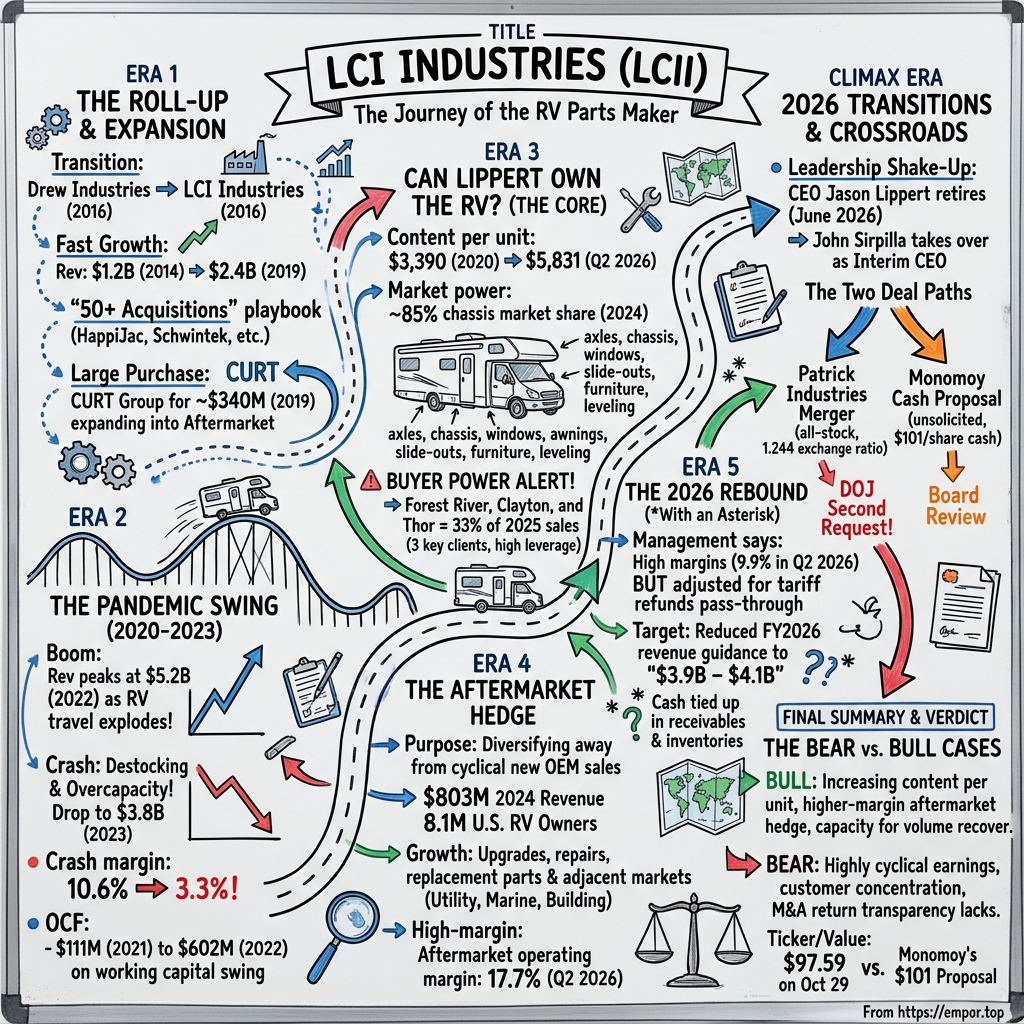
LCI Industries: The RV Parts Maker at the Center of a $101 Question
The $101 offer changes the story
On October 28, 2026, LCI Industries' shareholders were holding a thick document in one hand and a surprise in the other. The document was the joint proxy statement and prospectus, mailed nine days earlier, asking them to vote on November 18 to fold their company into its Elkhart, Indiana neighbour, Patrick Industries, in an all-stock deal.1 The surprise came that morning, when LCI confirmed that it had received an unsolicited, non-binding proposal from the private-equity firm Monomoy Capital Partners to buy every share for $101 in cash.2 The board said it still recommended the Patrick transaction, that it was evaluating the Monomoy approach with its advisers, and that shareholders should take no action for now.2
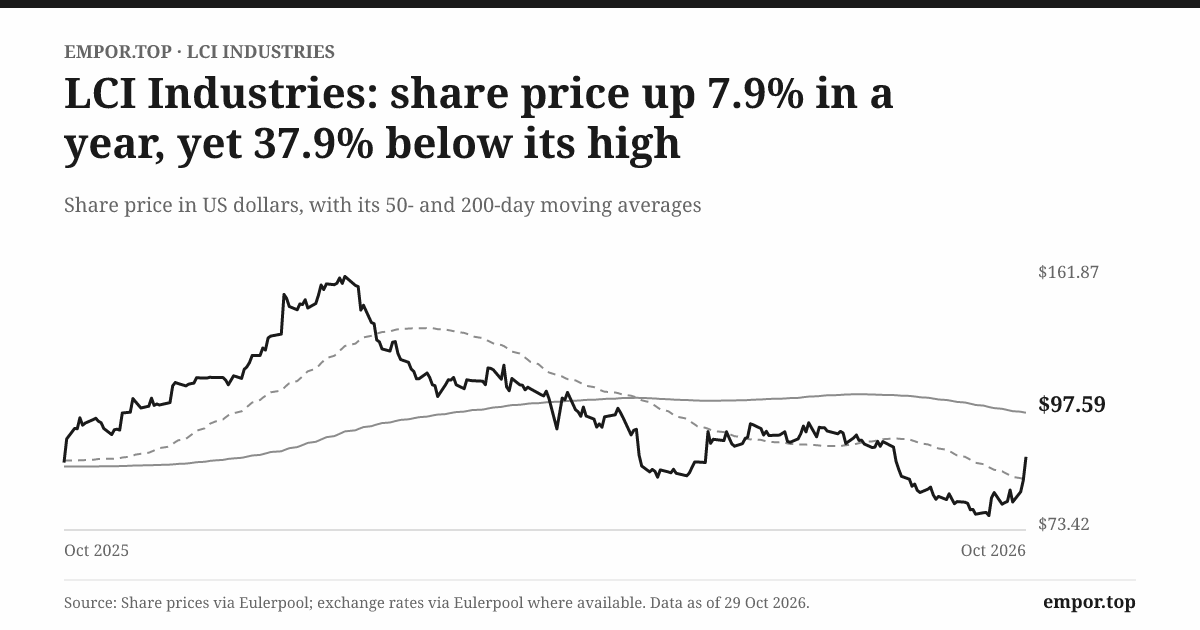
The arithmetic of the two offers explains why the second one stung. Under the merger agreement, each LCI share converts into 1.244 Patrick shares, a fixed ratio that does not move when Patrick's stock price does.1 On June 29, the day before the deal was announced, that ratio valued an LCI share at about $116, a premium of roughly 16% to where LCI was trading.1 By October 16, Patrick's stock had fallen from about $93 to about $68, and the same 1.244 shares were worth less than $85.1 Monomoy's $101 in cash, in other words, arrived at a moment when the stock deal was worth meaningfully less than the cash bid. On October 29, LCI's stock closed at $97.59, close enough to $101 to suggest the market took the cash proposal seriously, and far enough below it to show the market doubted it would close as offered.2
So what exactly is being fought over? Walk through a new travel trailer at a dealer lot anywhere in America and much of what you touch could have come from one company: the steel chassis underneath, the axles and suspension, the slide-out mechanism that pushes the living room wall outward, the windows, the awning, the sofa, the leveling jacks, and increasingly, the appliances.3 LCI sells those parts to the manufacturers who assemble recreational vehicles, and to builders of boats, buses, trailers and manufactured homes. It also sells replacement and upgrade parts to the people who already own those vehicles. In 2025 that added up to about $4.1 billion of sales from more than 100 factories across North America and Europe.3
A note on names, because it matters throughout this story. LCI Industries is the Delaware holding company that trades on the New York Stock Exchange under the ticker LCII. The business itself, the factories, the engineers and the customer relationships, sits inside its wholly owned subsidiary Lippert Components and that company's own subsidiaries.3 When this story says "Lippert", it means the operating business; when it says "LCI", it means the listed company that shareholders own. The financial figures belong to LCI and its consolidated subsidiaries, with no parent company or sponsor above them.
The tension at the centre of the company is easy to state and hard to resolve. Over two decades LCI broadened itself from a narrow supplier of RV chassis and windows into a portfolio of engineered components sold across many end markets. Yet its earnings still rise and fall with the number of RVs built in northern Indiana, and a small group of very large manufacturers buy a large share of what it makes. Two customer groups alone, Berkshire Hathaway's Forest River and Clayton Homes on one side and Thor Industries on the other, took a third of LCI's 2025 sales.3
Layered on top of that tension is a corporate drama. In June, the chief executive and the board chair both left on the same day. Four weeks later the company agreed to merge with its closest listed rival. On October 9 the Antitrust Division of the U.S. Department of Justice issued a Second Request, a formal demand for more documents and data that extends the regulators' review and pushes back any closing.1 And now a cash buyer has stepped in.
Neither transaction, though, settles what LCI's business is actually worth through a full RV cycle. A merger ratio measures two stocks against each other on a particular day. A non-binding cash proposal measures what one buyer is willing to say before doing its full homework. The better question is the one underneath both: how much durable earning power sits inside this company once the cycle is stripped out?
That question breaks into four smaller ones, and this story follows each in turn. Can Lippert's growing share of the parts inside each RV outlast the swings in RV production? Did two decades of acquisitions create lasting value, or just more revenue? Is the recent recovery in profit and cash real, or flattered by tariffs, prices and working-capital timing? And does the board's chosen path actually reward the people who own the company? To answer them, the story has to start where the modern company began, with a name change.
 Subscribe on LinkedIn
From Drew Industries to Lippert's roll-up
For most of its public life the company was called Drew Industries, a name that told investors almost nothing about what it made. By the end of 2016 that had become a problem of identity. Drew operated through Lippert Components, and Lippert, the brand known on RV factory floors across Indiana, had, in the company's own words, "grown considerably over the past decade."4 So on December 16, 2016, the board approved a new corporate name, LCI Industries, effective December 30, chosen "to better align the investment community with the strength of the LCI brand."4 On January 3, 2017, the shares began trading under a new ticker, LCII.4
The rename was a small piece of paperwork with a large meaning. At the time, the company ran 48 manufacturing and distribution facilities in the United States, Canada and Italy, supplying chassis, axles, slide-outs, windows, awnings, furniture, leveling systems and electronics to RV manufacturers, along with buses, trailers, pontoon boats and manufactured housing.4 The parent was formally conceding that the subsidiary was the story. Revenue had already climbed from about $1.2 billion in 2014 to about $1.7 billion in 2016,5 and by 2019 it had reached about $2.4 billion, roughly double the 2014 level.6
How does a component supplier double in five years in an industry that grows far more slowly? Part of the answer is that the RV industry itself boomed in the second half of the 2010s. The larger part is a playbook that Lippert ran over and over. Find a niche product line, often a small family company or a single clever patent. Buy it. Then push that product through the relationships Lippert already had with the big RV manufacturers, using its purchasing scale to cut material costs and its factories to build the product more cheaply. Call it the bolt-on machine: every new product rides the same sales relationships, so the cost of selling one more item to an existing customer is low.
The company's favourite examples show what the machine could do at its best. Lippert bought HappiJac, a maker of bed lifts, in 2006, when it had about $15 million of revenue; by 2019, the company said, that line was generating about $32 million.7 In 2010 it bought Schwintek, essentially a patent for a slide-out mechanism, with about $5 million of starting revenue; by 2019 that product family was producing about $52 million, a roughly tenfold increase.7 By early 2021 LCI said it had completed more than 50 acquisitions over 20 years, and that most of the recent ones lay outside its original market of North American RV manufacturers.7 By late 2024 its investor materials put the count at more than 75.6
Those numbers deserve a healthy squint. They are examples the company chose to show investors, not an audited scorecard of every deal. Nobody outside the company knows how many acquired lines stalled, how much of HappiJac's or Schwintek's growth came from price inflation or from content Lippert would have sold anyway, or what the company paid for each. LCI does not publish acquisition-level returns. The honest reading is that the playbook demonstrably worked for some products, and that the full portfolio has never been opened for inspection.
The biggest single move in this era came at the very end of 2019. On December 19, Lippert completed the purchase of CURT Group, a Wisconsin maker of towing hitches and truck accessories sold under brands such as CURT, Aries, Luverne, Retrac and UWS, for about $340 million.8 It paid with cash, revolver borrowings and a new $300 million term loan.8 CURT was a different kind of asset. It sold mostly to retail and installer channels rather than RV factories, and its products went onto pickup trucks and SUVs as much as onto campers. LCI told investors CURT had grown sales from about $210 million in 2014 to about $268 million in 2019, with about $35 million of EBITDA in 2019.7
Those two figures allow one rare valuation check. A $340 million price against $35 million of earnings before interest, tax, depreciation and amortisation implies LCI paid a little under ten times CURT's trailing EBITDA. For a business growing sales about 5% a year, that was a full price but not an outlandish one for industrial distribution assets. It also changed the company's balance sheet. Total debt, which had sat around $50 million in 2017, climbed to about $630 million by the end of 2019, and the company itself attributed the jump to funding acquisitions.6
Now step back to the growth record itself. Across the decade from 2015 to 2025, revenue compounded at about 11% a year, an impressive rate for a parts supplier in a mature consumer market.53 Over the five years from 2020 to 2025 the rate slows to about 8% a year. Over the three years from 2022 to 2025 revenue actually shrank, by about 7.5% a year.3 The long arc is real expansion. The recent arc is a company still digging out from a cyclical peak.
The uncomfortable question is how much of the long arc was bought. LCI does not split its decade of revenue growth into organic and acquired pieces, but it does disclose the recent slices. In 2025, for example, sales rose by about $381 million, and acquisitions completed in 2024 and 2025 contributed about $124.5 million of that increase, roughly a third.3 LCI attributed the rest to tariff-related price increases, a richer mix of high-content fifth-wheel trailers, market-share gains and a 3% rise in industry shipments.3 That pattern, part prices, part acquisitions, part genuine share, is a reasonable guide to the decade as a whole.
So the long-run story supports a verdict, but a bounded one. Lippert built a real machine for buying niche products and selling them through its existing customer relationships, and some of those products grew dramatically. Acquisitions are part of the growth engine, not a footnote to it, and the company has never shown what that engine earned on the capital it consumed. The real stress test of the whole model was still ahead, and it would come from the very customers who had made the model possible, when they first could not build RVs fast enough, and then stopped building them almost altogether.
When the RV boom became a balance-sheet problem
In the spring of 2020, the RV factories along the Indiana Toll Road went quiet. Manufacturers shut plants in response to COVID-19, and motorhome shipments that year fell sharply because of those closures.9 Then something strange happened. Americans who could not fly, could not cruise and did not want to sit in a hotel lobby discovered the travel trailer. LCI later described record RV retail demand driven partly by consumers seeking "alternative vacation options that avoid large gatherings and allow for social distancing."9
The numbers on dealer lots tell the story better than any adjective. In 2020, Americans and Canadians bought about 456,000 towable RVs at retail, while manufacturers shipped only about 380,000 to dealers; roughly 76,000 units simply vanished from dealer inventory.9 In 2021 the factories roared back, shipping about 531,000 towables, a 40% jump, while retail sales grew about 10% to roughly 500,000.9 For the first time in two years, dealers were restocking, and they kept buying into 2022.
For Lippert this was both a gift and a strain. Revenue rose from about $2.8 billion in 2020 to about $5.2 billion in 2022.6 Some of that was volume. A great deal was price. Steel and aluminium costs surged, and LCI's contracts with many customers index prices to commodities, so as metal prices rose, so did the invoices.3 Content per towable RV, the company's measure of how many dollars of Lippert product go into each trailer, hit a record of about $6,090 for 2022, up 45% in a single year.10 Management celebrated "record content growth."10
What the celebration obscured was how much cash the boom swallowed. To keep up with customers, LCI loaded its warehouses with steel, aluminium and components in short supply. Inventory more than doubled in a single year, from about $490 million at the end of 2020 to about $1.1 billion at the end of 2021, and total debt rose from about $740 million to about $1.3 billion.6 Operating cash flow turned negative, at about minus $111 million, in a year when the company reported about $287 million of net profit.9 The boom, in accounting terms, had been financed by the balance sheet.
Then the cycle turned, and it turned at the dealer lot first. By late 2022 retail demand had cooled, interest rates were rising, and dealers who had overstocked wanted to shed inventory before they ordered more. Manufacturers responded the only way they can: they stopped building. On the February 2023 earnings call, Jason Lippert described January and December as "right-sizing months for the industry," with manufacturers taking most of both months off so dealers could rebalance.10 LCI's sales to North American RV manufacturers in the fourth quarter of 2022 fell about 42% from the year before.10
At this point management made a forecast worth remembering. On that same call, the company estimated that full-year 2023 RV shipments would land between 330,000 and 350,000 units, assuming the industry looked more like the second half of 2019 from the second quarter onward.10 Lippert added that for a down year, it was "a pretty damn good number."10 The industry actually shipped about 313,000 units in 2023, below the bottom of that range.11
And the impact on LCI was brutal. Revenue fell to about $3.8 billion in 2023. Operating profit dropped from about $553 million to about $123 million, and operating margin from 10.6% to 3.3%.6 Sales to North American RV manufacturers fell 47% for the year, to about $1.5 billion.11 Return on equity collapsed from about 28% to under 5%.6 The dividend, which LCI kept paying, consumed about 166% of the year's net income.6
Why did profit fall so much further than sales? The answer is operating leverage. A component factory carries rent, supervisors, machines and engineering staff whether it runs two shifts or one. When volume drops by half in the RV business, revenue falls immediately, but most of those fixed costs remain, so each lost dollar of sales takes a much larger share of profit with it. Commodity-indexed pricing made the fall steeper in the other direction too. As steel prices eased, LCI's contractual prices came down, so content per towable unit shrank 17% to about $5,058 in the fourth quarter of 2023; management attributed the drop largely to "index pricing pass-throughs versus elimination of Lippert content."11
That last detail matters more than it looks. It means the record $6,090 content figure of 2022 was partly a metal-price number, not proof of a structural leap in how much Lippert sold into each RV. Content rose with inflation and fell with deflation.
There was one bright consequence of the bust. As production slowed, the inventory LCI had stockpiled turned back into cash. Operating cash flow swung to about $603 million in 202210 and about $527 million in 2023, and the company used the money to pay down debt.3 Free cash flow in 2023 was about $465 million, more than seven times net profit that year.6 Working capital works like an accordion: it absorbs cash when the business expands and releases it when the business contracts. LCI's cash flow is therefore, perversely, often strongest in the worst years for earnings.
Diversification softened the blow, and the evidence for that is specific. In the fourth quarter of 2023, while sales to North American RV manufacturers fell 11%, the rest of the business outside RV and marine OEMs grew 8%.11 Aftermarket sales for the year slipped just 1%, to about $814 million, and international sales rose 4%.11 Without those businesses the trough would have been deeper.
But softened is not the same as prevented. The 2022 to 2023 swing is the cleanest historical test of any claim that LCI has become structurally less cyclical, and the result is clear: when RV production fell by roughly a third, LCI's operating profit fell by almost four-fifths. The boom showed that Lippert could scale production quickly and capture a surge. The bust showed that much of the peak earning power belonged to the cycle, not to the company. The question that follows is whether anything about Lippert's position on the factory floor can change that arithmetic.
Can Lippert sell more of every RV?
Picture a towable RV moving down a production line in Elkhart County. At the first station, workers drop the floor onto a steel chassis, very likely a Lippert chassis riding on Lippert axles. Further down the line come the slide-out mechanisms, the windows and entry doors, the furniture and mattresses, the awning, the leveling jacks and, more and more often, the air conditioner and other appliances.3 The manufacturer, a Thor brand or a Forest River brand or one of their smaller rivals, designs the floor plan, assembles the box, puts its badge on the back and sells it to a dealer. Lippert's business is to supply as many of the parts inside that box as it can, and then to keep supplying parts to the owner for years after it leaves the dealer.
The economics hinge on a simple idea. If Lippert cannot control how many RVs get built, it can try to control how many of its dollars go into each one. That is what content per unit measures: LCI's sales to RV manufacturers divided by the number of RVs the industry built. A towable trailer carried about $3,430 of Lippert content in the twelve months to September 2020.7 Through 2024 it carried a little over $5,000.6 By the twelve months to June 2026 it carried about $5,831, up 11% in a year, despite fewer high-content fifth-wheel trailers in the mix.1213
That looks like a climb. It is not quite one. Remember the record of about $6,090 in 2022 and the 17% drop that followed as commodity-indexed prices fell.11 Content per unit rises when Lippert wins a new product slot, but it also rises when steel prices go up, when the mix shifts toward larger trailers, and when the company buys a business that already sells into RVs. LCI itself defines the measure as one affected by selling prices, market share, acquisitions and mix.3 It is a useful thermometer, not a clean measure of market share. Even today's record-feeling $5,831 sits below the 2022 peak.
Where does the measure point when the noise is stripped out? Management's best evidence is specific product wins. On the August 2026 call, interim chief executive John Sirpilla said Lippert had won about $140 million of annualized new business in the 2027 model-year changeover, the moment each summer when manufacturers redesign their lines and choose suppliers for the coming year.13 The company said its five most important recent innovations generate about $270 million of normalized annual revenue.13 Back in 2024, LCI estimated that it held about 60% of the addressable market for its existing products in North American RV manufacturing, and said it was gaining share in its top five RV categories: appliances, awnings, chassis, furniture and windows.6
Those are management's estimates, not independent measurements. No industry body publishes market shares for RV axles or slide-out mechanisms, and LCI does not disclose how many bids it lost, which customers it lost them to, or how much it had to cut prices to win. The evidence for an advantage is breadth and installed position. The evidence on retention and pricing power is thin.
The competitive landscape helps explain why. The closest listed peer is Patrick Industries, also based in Elkhart, a component supplier founded in 1959 that serves manufacturers and aftermarket customers in RV, marine, powersports and housing markets through more than 85 brands.1 In 2025 Patrick reported about $3.95 billion of sales and about $276 million of operating income; LCI reported about $4.1 billion of sales and about $280 million of operating profit.13 In other words, the two biggest broad-line suppliers to the RV industry are almost exactly the same size and earn almost exactly the same profit. They overlap less than their scale suggests: Patrick's board described the two portfolios as largely "complementary non-competing products across end markets," though the Justice Department's Second Request shows that regulators want to test that claim.1 Beyond Patrick, competition is fragmented, product by product. LCI's own risk factors describe its markets as "characterized by low barriers to entry" with "numerous existing and potential competitors," and say competitive pressure has at times cut its margins and its share.3
Put that sentence next to another one from the same annual report. In its business description, LCI says its value proposition "fosters customer loyalty, creates high switching costs, and deters competitor entry."3 Both cannot be fully true at once. A supplier with genuinely high switching costs would not need to warn shareholders about low barriers to entry. The likelier truth sits between them: switching is costly for a manufacturer in the middle of a model year, once a chassis or slide-out is engineered into a floor plan, but much cheaper at the annual model changeover, when every slot can be rebid.
Now look at who sits across the table. Berkshire Hathaway's subsidiaries Forest River and Clayton Homes bought 18% of LCI's 2025 sales; Thor Industries bought another 15%.3 Those two groups, which together build most of North America's towable RVs, account for a third of everything LCI sells. No other customer exceeded 10%.3 When a customer that large redesigns its line each summer, it can split its business between suppliers, demand price concessions, or build components itself.
That last threat is not hypothetical. When Patrick's board weighed the LCI merger in April 2026, it discussed "the risk of vertical integration (i.e. 'self-supply') initiatives by certain significant customers."1 The same month, the chief executive of a "strategic industry participant and customer of both Patrick and LCI," identified in the proxy only as Party B, called Patrick's chief executive to express reservations about the combination, and floated the idea of a different transaction instead.1 The customers, in other words, were watching their two largest suppliers try to become one, and at least one of them pushed back.
What would a framework purist say about all this? Hamilton Helmer's 7 Powers asks what lets a company earn more than its cost of capital for a long time. For Lippert, scale economies are plausible: buying steel and aluminium for more than 100 plants, spreading engineering across many product lines, and running dedicated logistics into manufacturer plants should give it lower unit costs than a single-product rival. A milder form of counter-positioning is also plausible, because a one-product competitor cannot offer a manufacturer a bundled chassis, axle, slide-out and window package from one engineering team. Switching costs exist within a model year but are not shown to survive the annual rebid, and the filings demonstrate no cornered resource, such as an exclusive patent estate or supply contract, that a rival cannot replicate. Brand is real in the aftermarket, much weaker with factory buyers who care mostly about price, quality and on-time delivery.
The historical record adds one more test. If Lippert held a strong pricing moat, its margins should have held up when volume collapsed. Instead, the business that sells to manufacturers stayed on very thin margins long after the 2023 trough: in the fourth quarter of 2024, more than a year into the slump, operating margin on OEM sales was just 0.3%.14 Pricing power that disappears every time the industry slows is not much of a moat; it is a cyclical tailwind.
So the claim survives, but in a smaller form. Lippert holds a position worth defending: unusual breadth, deep engineering integration with manufacturers, and a demonstrated ability to win new slots at model changeovers. It has not shown that the position translates into protected pricing or guaranteed share, and its two largest customers have both the scale and the motive to keep it honest. Investors who want to watch whether the position strengthens have one number to follow above all others: towable content per unit, at about $5,831 and rising, read alongside OEM segment margins so that price inflation is not mistaken for share gains. If the factory is where Lippert's position gets tested every summer, the place where the company has tried to escape that test is the market that begins after the RV leaves the dealer.
The aftermarket is the hedge LCI is still building
Somewhere in Texas this autumn, a retiree who bought a used fifth-wheel three years ago is standing in a service bay looking at a torn awning. The manufacturer that built the trailer has cut production schedules, its dealers are not reordering, and the RV factories of northern Indiana are running short weeks. None of that matters to the awning. It is worn, it needs replacing, and the replacement very likely carries the same brand as the original.
This is the logic of LCI's aftermarket business, and it is a good one. Every RV that leaves a factory with Lippert parts becomes, years later, a customer for Lippert replacement parts, upgrades and service. In early 2026 the company said that more than $15 billion of its content had gone into RVs over the past decade, and that about 1.5 million of those RVs were expected to enter repair cycles over the next few years.15 U.S. RV ownership, the company noted, reached an estimated 8.1 million households in 2025.3 Many of those owners buy upgrades and non-critical replacement parts outside the spring and summer selling season, which gives the aftermarket a counter-seasonal rhythm.3
Two details in those claims deserve a footnote-level caution. In February 2026, the same embedded-content figure was presented as "more than $20 billion."14 By May it had become "more than $15 billion," the figure management repeated in August.1513 The direction of the thesis did not change, but the headline number shrank by a quarter in three months without explanation. And the 8.1 million households figure, which the 2025 annual report calls a record, sits awkwardly beside the "over 11 million households" for 2020 that the company cited from the same industry source in its 2021 annual report.93 Survey methods evidently changed. Neither point breaks the thesis; both are reasons to anchor on LCI's own sales rather than on industry statistics.
And LCI's own sales tell a genuine growth story. The aftermarket segment had about $64 million of sales in 2014.5 In 2025 it had about $932 million, roughly 23% of the company.3 The single largest step came with the CURT purchase, and CURT still provides about half of aftermarket sales.3 Ranch Hand, a Shiner, Texas maker of custom bumpers, grill guards and steps for pickups bought in April 2021 for about $57 million in cash, added another automotive leg.9 Much of the aftermarket, then, was built by acquisition rather than grown from the installed base of RVs, which matters when deciding what kind of hedge it really is. Half of it rides on pickup-truck owners buying hitches and bumpers, a market that moves with the automotive economy rather than with RV production.
The numbers for 2025 show why that distinction matters. Aftermarket sales grew about 6% for the year, yet operating profit in the segment fell from about $111 million to about $96 million, and margin from 12.6% to 10.3%.3 Management blamed about $23 million of tariff and freight costs, a shift toward lower-margin products, and investment in capacity, distribution and logistics technology.3 In the fourth quarter of 2025, aftermarket margin fell to 4.3%.14 Meanwhile CURT sold about 907,000 hitches in 2025, down from about 1.06 million in 2024 and about 1.2 million in each of 2020 and 2021.39 The higher-margin hedge, in other words, had its own bad year while the OEM side was recovering.
Then came 2026, and the picture flipped. In the second quarter, aftermarket sales rose 10% to about $294 million, and segment operating profit jumped to about $52 million, a reported margin of 17.7%.12 That headline flatters the business, though, because the reported quarter included a net benefit from tariff refunds. On the call, management put the adjusted aftermarket margin at about 14%, up modestly from a year earlier.13 Chief financial officer Lillian Etzkorn attributed part of the growth to share gains after a competitor's bankruptcy, and when Raymond James's analyst asked whether the aftermarket could keep growing at high-single to low-double digits, she said she expected growth at recent levels and called the segment "a bright spot."13 Sirpilla pointed to a new Texas facility expected to double Ranch Hand's capacity.13
The adjacent markets deserve proportionate space too, because they are the other half of LCI's diversification. Sales to manufacturers of buses, utility and cargo trailers, boats, manufactured homes and other non-RV products reached about $1.2 billion in 2025, 39% of OEM segment sales.3 In the second quarter of 2026, a striking thing happened: sales to these adjacent manufacturers, about $339 million, roughly equalled sales to RV manufacturers, about $336 million, for the first time, because RV OEM sales collapsed by a third while adjacent sales edged up.12 International and export sales, mostly European RV, marine and rail, were about 9% of 2025 sales.3 No single one of these markets dominates the story, and none is large enough to rescue a bad RV year on its own. Together, they have now become as big as the RV OEM business in a weak quarter.
Is LCI investing enough to keep these hedges growing? Research and development spending fell to about $15 million in 2025 from about $21 million in 2024, about a third of one percent of sales, while capital expenditure rose to about $53 million.3 Management guided 2026 capital spending to $55 million to $65 million.12 Those are modest numbers for a company that talks constantly about innovation; much of its product pipeline, historically, has come through the acquisition door rather than the laboratory. Sirpilla said engineering time is split roughly half and half between cost reduction and customer-facing innovation.13
And the deepest question about the aftermarket remains open. Does Lippert's service network, its call centres and its brand on the original part actually translate into a customer who comes back to Lippert rather than buying a cheaper generic replacement online? The company says it handles more than two million annual interactions with dealers and RV consumers, and that it doubled its mobile technician workforce in 2025.14 It does not publish repeat-purchase rates, aftermarket share by product, or how often an owner chooses a Lippert replacement over a rival's.
So the verdict on the hedge is clear and bounded. The aftermarket is a real, larger and usually higher-margin business, with an installed-base logic that should strengthen as pandemic-era RVs age. But it is still less than a third the size of the OEM business, about half of it rides on the automotive towing market, its margin fell sharply as recently as 2025, and acquisitions built much of it. It is a hedge under construction, not proof that the cycle has been neutralized. Which raises the question of how well the acquisition engine that built it has actually used shareholders' money.
The acquisition engine meets its return test
Imagine the inside of LCI's corporate development function over the past two decades as a conveyor belt that never stopped. Bed lifts in 2006. A slide-out patent in 2010. CURT in 2019. Ranch Hand and a European supplier, Schaudt, in 2021.9 Four more businesses in 2025, including Freedman Seating, for an aggregate $112.7 million in cash.3 Each deal had a logic. The question an investor has to ask is not whether each made sense on the day, but whether the whole conveyor belt earned more than it cost.
Start with what can be measured. The 2025 acquisitions brought businesses with about $194 million of trailing annual sales for about $113 million, a little under 0.6 times revenue.3 For low-margin industrial manufacturers that is not obviously expensive, but LCI does not disclose the earnings of what it bought, so the multiple of profit is unknown. Ranch Hand cost about $57 million plus up to $3 million of contingent consideration, with about $25 million of the price allocated to customer relationships.9 No consistent deal-by-deal record of EBITDA or return on invested capital exists in LCI's public filings, so any claim that it routinely bought cheaply, or routinely overpaid, would be a guess.
The return the market can see is the company's overall return on capital, and that tells a sobering story. In the years before the debt-funded acquisition wave, return on invested capital ran between roughly 15% and 25%. From 2019 it fell into a range of roughly 10% to 15% in decent years, and to about 4% in 2023. In 2025, a recovery year, it was about 8.7%.3 Some of that decline reflects the cycle and some reflects the fact that acquisitions add goodwill and intangible assets to the capital base, which mechanically dilutes returns even when the acquired businesses perform. But the direction is clear. The roll-up made LCI bigger and more diverse; it did not make each dollar of capital work harder.
The repeatability test is mixed. On the positive side, LCI has a genuine process: it has done dozens of deals, integrates them into a common purchasing and enterprise software system, and has shown that some products can grow several-fold once they run through Lippert's channels.73 On the other side, the company acknowledges the integration burden, warning in its own risk factors that putting acquired businesses onto its enterprise systems can cause disruptions and delays.3 It has also exited businesses: in the fourth quarter of 2025, it booked about $3.9 million of restructuring costs to close its glass operations in Ireland.14 In early 2026, management said it was evaluating divestitures of select lower-margin businesses.15 That is healthy pruning, but it is also evidence that not every acquired line earned its keep.
Where did the money come from? Across the twelve years from 2014 to 2025, LCI generated about $2.1 billion of free cash flow and paid about $889 million of it out as dividends, about 42%.3 The rest, plus a good deal of borrowing, went into acquisitions, buybacks and debt reduction. The dividend itself tells the cycle's story: in a typical year it consumed a bit under half of earnings, but exceeded earnings in 2023 and consumed about 61% in 2025.63 Shareholders were paid steadily through the trough, which is a commitment worth noting and a reason the balance sheet matters so much.
The financing grew more sophisticated in 2025. In March, LCI issued $460 million of convertible notes due 2030 and used about $370 million of the proceeds to buy back most of its convertible notes due 2026, recording a $6.2 million loss on the early repayment.3 It paid $67.6 million for a call-spread hedge and sold warrants covering about 3.9 million shares at a strike price of about $183, a structure that protects existing holders from dilution unless the stock rises above that level.3 The same year, the company bought back about $128.6 million of its own shares.3
A skeptical activist would ask a pointed question about that sequence. LCI borrowed through a convertible bond and repurchased stock in the same year, at prices well above where the stock trades today, and then, a year later, agreed to sell itself in an all-stock deal at a modest premium. Buybacks are only as good as the price paid, and the 2025 repurchases now look expensive relative to both the October stock price and the $101 cash proposal. Management's answer, implicitly, is that the shares were cheap relative to its own long-range plan, which projected rising revenue and earnings through 2030.1 That plan is about to meet the evidence.
The debt picture is reasonable, provided leases and borrowings are kept apart. At the end of 2025 LCI had about $945 million of debt, made up mainly of the new convertible notes, about $92 million of the old notes and a term loan of about $397 million maturing in 2032, plus about $290 million of operating lease obligations reported separately.3 After the company paid off the remaining $92 million of 2026 notes at maturity, long-term debt stood at about $853 million at June 30, 2026.12 Net debt was about $636 million, or about 1.5 times adjusted EBITDA, against 1.8 times at the start of the year and in line with the company's long-standing target of 1.5 times.1311 LCI also reported that Moody's had upgraded its long-term rating to A2 in February and that S&P had affirmed A- with a positive outlook in April, both company summaries of rating actions rather than the agencies' full reasoning.16
So the verdict on the acquisition engine lands where the evidence allows. LCI is a capable, repeat acquirer that built a broader company and a meaningful aftermarket, and it financed the program without ever losing control of its balance sheet. But the long decline in return on capital, the absence of deal-level returns, and the occasional closure or divestiture all argue against calling it a proven, disciplined buyer at any price. The program created a bigger company. Whether it created a more valuable one per share is precisely the question the 2026 recovery was supposed to answer.
The 2026 recovery comes with an asterisk
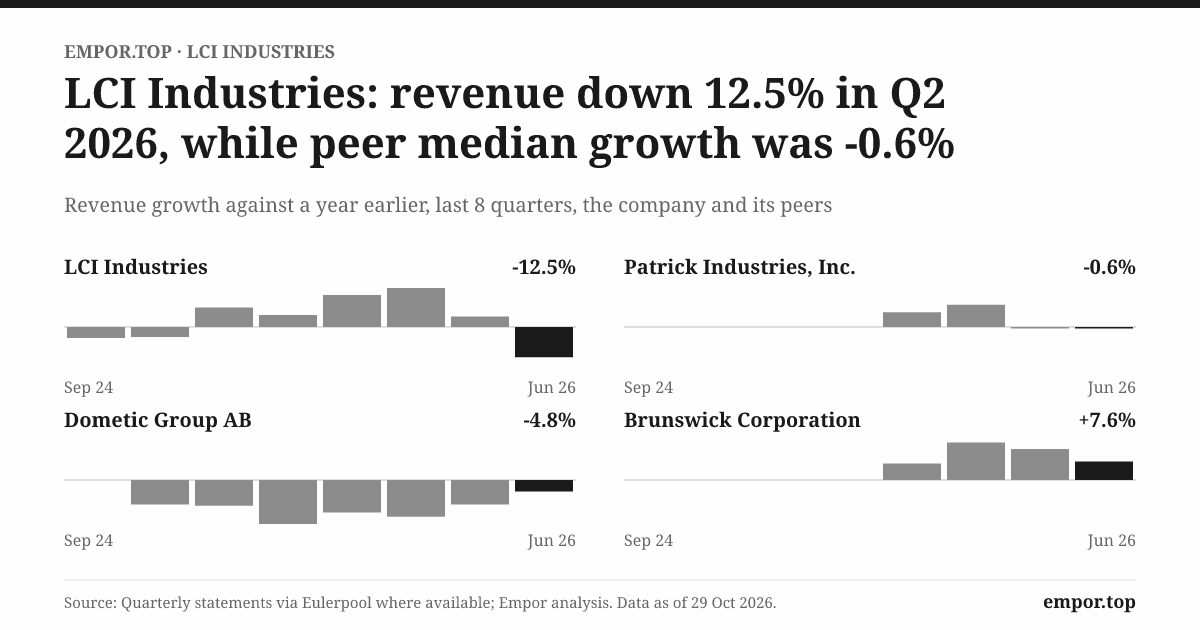
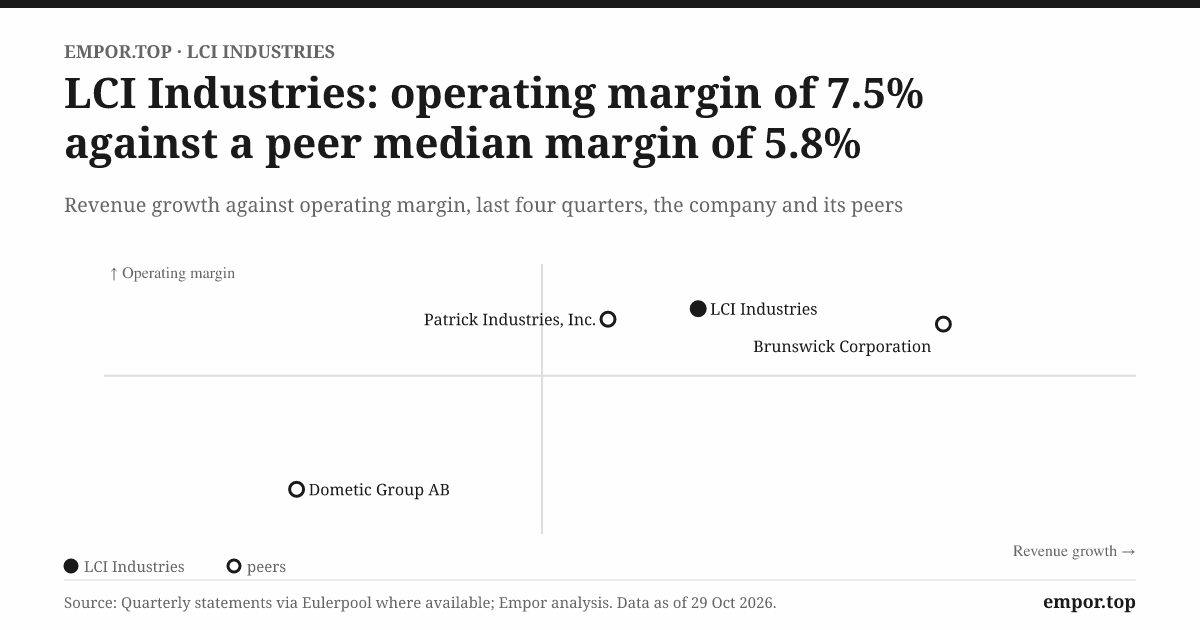
On the morning of August 5, 2026, John Sirpilla opened his first earnings call as interim chief executive with a number that looked bad and a story that sounded good. Net sales for the second quarter had fallen 12.5%, to about $969 million.12 Operating profit, though, had risen to about $96 million, and operating margin had widened from 7.9% to 9.9%.12 "Our 2026 performance has been driven first and foremost by our self-help initiatives," he said.12 Profit up, sales down: the kind of quarter that makes a skeptic reach for the footnotes.
The footnotes start with tariffs. During 2025, LCI paid tariffs imposed under the International Emergency Economic Powers Act on imported materials and components, and passed much of that cost on to customers through price increases. When refunds of those tariffs became available, LCI recognised them and committed to passing nearly $90 million back to its customers.13 The pass-through was recorded as a reduction of net sales, about $88.8 million in the quarter.12 Strip it out, and adjusted sales were about $1.06 billion, down roughly 4% to 4.5% from a year earlier rather than 12.5%.12 Sirpilla described the refunds as having "minimal impact on our P&L."13 Minimal is not zero: after the pass-through, the refunds still added a net benefit of about $16 million to EBITDA in the quarter.12
So the first lesson of the quarter is that the reported sales decline overstates the weakness and the reported margin overstates the strength. On management's adjusted figures, operating profit was about $99 million, up 8%, and operating margin was 9.3%, up 1.1 percentage points.13 That is still a real improvement. Etzkorn attributed about 1.6 percentage points of year-over-year margin gain to self-help, which Sirpilla described as overhead reduction, facility consolidation, quality gains and re-shored procurement.13 The company had closed five facilities in 2025 and planned eight to ten more consolidations in the second half of 2026.13
What was happening underneath was a sharper slump in the core market than the headline suggested. Industry wholesale shipments of towable RVs fell about 20% in the quarter, and LCI's sales to RV manufacturers fell about a third.1312 Total OEM segment sales dropped 20%.12 The business held its profit by charging more per unit, cutting cost and leaning on the aftermarket and adjacent markets, not by selling more parts into more RVs.
Pricing deserves its own sentence, because it explains much of the 2025 recovery too. In 2025, price increases added about $80.9 million to profit, but tariff and freight costs took away about $75.8 million, so pricing largely offset cost inflation rather than creating new margin.3 On the August call, management noted that aluminium costs were up about 80% year over year and steel about 20%, and Etzkorn insisted that LCI's pricing follows index-based input costs rather than "pricing for the sake of pricing."13 That is the right answer for a supplier to give its customers. It also means the margin gains that come from price are, by design, temporary: when metal prices fall, the indexed prices fall too, as they did in 2023.
Now set the guidance path beside the outcomes, because this is where management credibility gets tested. In February 2026, the company told investors to expect 335,000 to 350,000 RV wholesale shipments, revenue of $4.2 billion to $4.3 billion, an operating margin of 7.5% to 8% and adjusted earnings per share of $8.25 to $9.25.14 In May it cut the shipment forecast to 315,000 to 330,000 but held revenue at $4.2 billion to $4.3 billion.15 In August it cut shipments again, to 280,000 to 300,000, lowered the revenue outlook to $3.9 billion to $4.1 billion, held the margin range and set adjusted earnings per share at $8.25 to $8.75.1213 Three times in six months, the industry forecast moved down.
There is an older echo here: management's 2023 shipment forecast also proved optimistic.1011 RV forecasting is genuinely hard, and LCI is hardly the only company to misjudge the cycle. But the pattern says something specific: management's volume forecasts have tended to start optimistic and drift down. The margin guidance has held up better than the volume guidance, which is evidence that the cost actions are real, and also a warning that holding margin on a smaller sales base requires more cost cutting each time volume disappoints.
There is a sharper echo too. In March 2026, LCI management presented the board with a long-range plan that projected 2026 revenue of about $4.37 billion, rising to about $5.6 billion by 2030, with adjusted EBITDA growing from about $493 million to about $755 million.1 Those projections underpinned the bankers' valuation work on the Patrick merger. Within five months, the company's own revenue outlook for 2026 sat roughly $300 million to $500 million below the plan's first year. A forecast that misses its first year by that much deserves caution in its fifth.
Then there is cash. In 2025, net income rose about $45 million, yet operating cash flow fell to about $330 million from about $370 million, mainly because inventory grew by about $35 million after shrinking by about $46 million the year before.3 In the first half of 2026, rising receivables consumed about $140.6 million of operating cash; receivables stood at about $383 million at June 30, against about $243 million at the end of 2025, and the allowance for doubtful accounts rose from about $6.8 million to about $11.6 million.17 LCI attributed the receivables build to seasonally higher sales, and the filings disclose no customer default.17 But tariff refunds owed to customers and a rising bad-debt allowance in a softening market are exactly the conditions under which receivables deserve close watching.
The cushion against all of this is substantial. At June 30, LCI had about $216.5 million of cash and about $595.2 million of undrawn revolver capacity, for roughly $812 million of liquidity.12 Its revolving credit facility carries a net-debt-to-EBITDA covenant, which the company reported it satisfied.16 And on the call, management said dealer inventories stood at a lean 18 to 20 weeks, with retail expected to run slightly ahead of wholesale, which is the setup that eventually forces restocking.13
So the verdict on the recovery has an asterisk, and the asterisk is honest rather than damning. The margin improvement is real and owes a good deal to genuine cost work. But some of the reported gain came from tariff refunds, much of the pricing simply offset cost inflation, the volume outlook kept falling, and cash is again being absorbed by working capital. Three indicators will show whether the recovery is structural: towable content per unit, organic growth and adjusted margin in the aftermarket, and operating cash flow after working-capital changes. All three would have to hold as RV shipments soften, under a leadership team that was itself only weeks old.
A leadership change collides with two deal paths
On June 3, 2026, LCI filed a short document that rearranged the top of the company in a single afternoon. Jason Lippert, the chief executive whose family name is on the operating company, retired as chief executive and resigned from the board, effective that day.18 The same day, board chair Tracy Graham resigned from the board and all its committees.18 Both departures, the filing stressed, did "not result from any disagreement with the Company."18 The board named director John Sirpilla interim chief executive and fellow director Virginia Henkels chair.18
To understand why that day mattered, rewind ten months. In mid-August 2025, the chief executive of another company, identified in the merger proxy only as Party A, approached Graham with an all-stock merger at the market price, with no premium for LCI's shareholders.1 The board hired the investment bank Perella Weinberg Partners and the law firm Kirkland & Ellis, and in September, at the board's direction, Lippert contacted a Patrick director to ask whether Patrick would consider a combination.1 Party A eventually confirmed it could not offer a satisfactory premium, and talks ended in November 2025.1
The Patrick talks moved slowly through the winter and then hit two snags. The first was governance. Patrick's board insisted from February 2026 that its own chief executive, Andy Nemeth, would run the combined company, and in March Lippert told his board that Patrick did not expect him to be chief executive of the combined group, before leaving the meeting so the remaining directors could talk in private.1 The second was price. In April, market rumours about a possible deal leaked, and Patrick's stock fell further than LCI's.1 Patrick wanted to set the exchange ratio using unaffected prices from April 13; LCI wanted its holders to own more than the 45% Patrick proposed.1 On May 3, Patrick's board voted to terminate discussions, and the two companies announced the end of talks before the market opened on May 4.1
What happened next is the part of the story that shareholders should read twice. During May and early June, the proxy says, LCI's board discussed "leadership of the LCI board and management," and deferred further talks with Patrick until it had finished reviewing potential leadership changes, "in light of the potential impact of any such changes on a potential transaction with Patrick."1 On June 3 came the departures. On June 6, Sirpilla told the board that management supported pursuing Patrick; on June 10, Henkels and Sirpilla met Nemeth in Chicago.1 Patrick's opening position this time was tougher than before: it would pick the combined company's chair, hold six of eleven board seats, and start the exchange-ratio talks from those pre-leak April prices.1 Henkels told Nemeth that such governance rights would be disproportionate without additional value, potentially a premium.1
The compromise came within a fortnight. On June 23 Patrick proposed that LCI holders own about 48% of the combined company, and on June 24 LCI's board accepted that split.1 The merger agreement was signed on June 30 at a ratio of 1.244 Patrick shares per LCI share.1 Nemeth will be chief executive, Patrick director Todd Cleveland will be chair, and Sirpilla will be vice chair.1 The companies said they expect about $150 million of annual net cost synergies within three years, mainly from procurement, facility and logistics consolidation and overhead.1 Either side may owe the other a $94.2 million termination fee in certain circumstances, including a change in recommendation or a competing takeover proposal.1 One more detail from the chronology now looks prescient: on June 15, Party A's chief executive told Sirpilla he might be interested in acquiring LCI outright, though no proposal followed.1
A reasonable reader can draw two different conclusions from this sequence. One is that the board did its job: it rejected a no-premium offer, walked away when Patrick would not meet its price, refreshed leadership, and returned to win a 16% premium and a vice-chair seat. The other is that the board replaced its chief executive and chair in the middle of merger talks with a counterparty that had made clear it did not want the incumbent to run the combined company, and then signed a deal paid entirely in a stock that subsequently fell by more than a quarter. The filings support both readings. What they do not show is that the board tested the market for a cash buyer before signing; the proxy describes inbound approaches about non-control transactions and conversations with "certain other parties," but no formal auction.1 Monomoy's arrival is the market's answer to that gap.
The man at the centre of the next decisions has an unusual background for an industrial chief executive. Sirpilla, 59, began his career as an independent RV dealer; when Camping World bought his business, he joined its senior executive team, later serving as president and chief business development officer of Camping World and Good Sam.18 He has sat on LCI's board since 2019 and ran its compensation committee until June.18 On the August call he described himself as coming to the role "as a builder, not just a caretaker."13 A former dealer knows exactly how dealers decide when to restock, which is the single most important variable in LCI's near-term demand. He is also, by title and by contract, temporary.
His pay reflects that. Sirpilla receives a $1.1 million salary, a target bonus of 140% of salary and a one-time grant of restricted stock worth $1.8 million, which vests fully on a change in control.18 As of the March 2026 proxy he owned 8,533 shares, well under 1% of the company.19 Lippert, by contrast, held about 1.4%, and receives $100,000 a month for advisory services through June 2027; his 2024 performance shares remain eligible to vest, while those granted in 2025 and 2026 do not.1918 His reported pay was about $8.6 million in 2023 and $10.1 million in 2025, a period in which net income went from about $64 million to about $188 million, and the company said 88% of his target direct compensation was at risk or variable.19 Pay that stayed flat while earnings nearly tripled from a trough is not obviously excessive. Whether it rewarded long-term value creation is harder to say, because the proxy's at-risk percentages show how pay was structured, not what shareholders earned over the period.
The governance record otherwise shows little sign of revolt. At the May 2026 annual meeting, shareholders approved executive pay with about 20.7 million votes for and about 330,000 against.20 Director Linda Myers drew the most opposition, with about 805,000 votes against.20 Two of Jason Lippert's brothers work at the company, as chief marketing officer and in care-centre operations, and were paid about $489,000 and $182,000 respectively; the board's governance committee reviews such related-person arrangements.19 Those amounts are immaterial to the company's finances, but family employment is a reasonable thing to monitor at a company named after the family.
Now the board faces the hard part. Shareholders vote on the Patrick merger on November 18.1 The Justice Department's Second Request, issued October 9, means the companies must produce extensive documents and data before the waiting period can end, which costs time and money and can substantially delay closing.1 LCI received three demand letters alleging deficiencies or omissions in the preliminary proxy, though no merger lawsuit was pending as of October 19.1 On the August call, when Jefferies's analyst asked about regulatory risk, Etzkorn declined to comment.13 Monomoy's proposal has no disclosed financing details.2
The credibility test, then, is immediate and concrete. Sirpilla brings relevant industry experience and a sensible operating agenda, but his interim status and the board's simultaneous transaction decisions mean the people judging the Monomoy approach are the same people who chose Patrick. If they reject a higher cash price for a lower stock value, they will need to explain why Patrick shares will be worth more than $101 per LCI share by the time the deal closes. If they engage with Monomoy, they will need to explain why they signed with Patrick at all. Either way, the board's choice will be judged against the one thing nobody can transact on, which is the value of the business itself.
Analysis & Bear vs. Bull Case
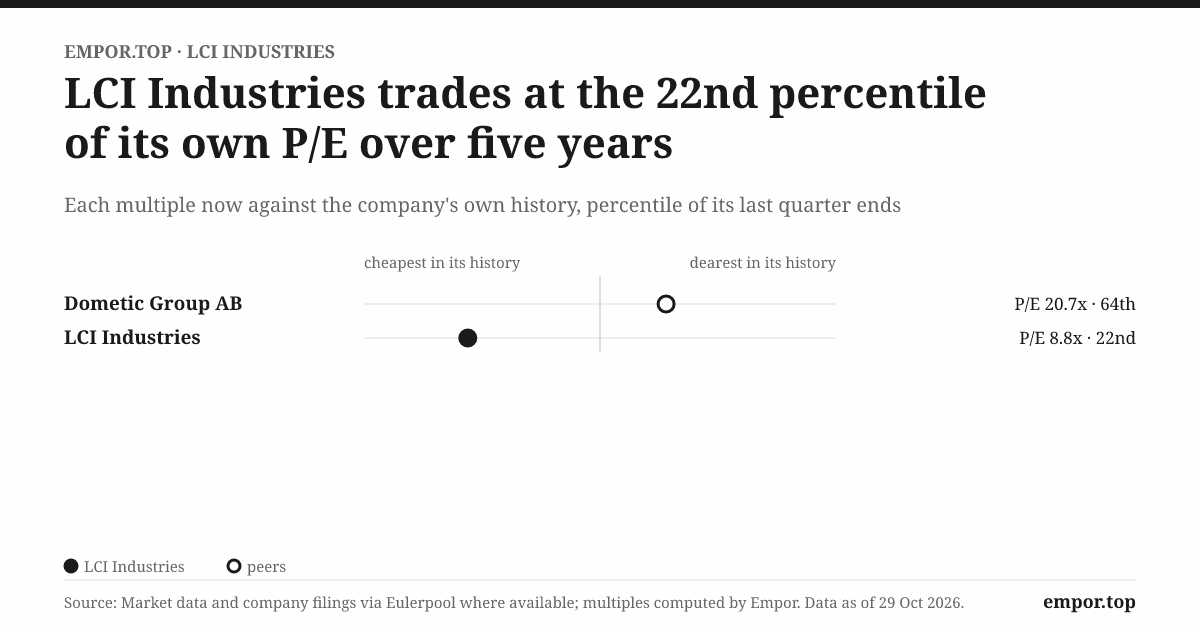
At $97.59 on October 29, LCI's shares sit roughly 38% below their 52-week high of about $157 and a little under the $101 Monomoy has proposed. The company's market value is about $2.4 billion, and including debt, its enterprise value is a little over $3 billion.23 On 2025 diluted earnings of $7.57 per share, the stock trades at about 13 times earnings; on management's 2026 adjusted guidance of $8.25 to $8.75, at a little over 11 times.312 Its own five-year median price-to-earnings multiple is close to 15. Enterprise value is about 7.7 times 2025 EBITDA. The quarterly dividend of $1.15 a share gives a yield of about 4.7%.13
Against peers, LCI looks cheap but not uniquely so. A third-party peer table in October showed Patrick at about 14.7 times earnings, Thor at about 20 times and Winnebago at about 16 times, with a peer median around 15.5 times; that table used different dates and earnings definitions, so it is context rather than a precise comparison.21 The bankers advising LCI's board used a cleaner lens. Perella Weinberg found a median of about 9.7 times 2026 EBITDA for RV and outdoor-enthusiast peers, applied 7 to 9 times to LCI's own forecast, and arrived at an implied value of roughly $107 to $147 per share.1 Patrick's adviser J.P. Morgan, running a discounted cash-flow model on LCI management's long-range plan, produced roughly $179 to $229 per share.1
Those bank numbers deserve the hardest squint in the whole story. The discounted cash-flow range rests on the same management plan that assumed about $4.37 billion of 2026 revenue, a figure the company's current outlook already undershoots. The multiple-based range assumes LCI earns its forecast EBITDA. Rerun either with the revised 2026 outlook and the numbers come down. They show what LCI could be worth if its plan comes true; they do not show what it is worth.
So what is the market assuming at around $98? A useful check is normalized earnings. Over the twelve years from 2014 through 2025, LCI's operating margin averaged a little over 8%, with a peak of 12% in 2016, 10.6% in 2022 and a trough of 3.3% in 2023.563 On a revenue base of roughly $4 billion, an 8% margin implies about $320 million of operating profit, close to the roughly $300 million LCI earned over the last twelve months. In other words, today's earnings are not a depressed trough waiting to rebound, nor a peak about to collapse. They are close to average. A low-teens multiple on average earnings is the market saying, roughly, that it expects this company to earn its historical average and not much more.
The bull case is that the average is about to move up. It rests on rising content, recent product wins, aftermarket growth, adjacent-market resilience and cost actions that lifted margins as volume fell.1213 Management has a stated objective of double-digit operating margins, and its second-quarter results showed progress toward that goal.1412 Add a recovering RV cycle on top of a leaner cost base, and the bulls see earnings well above today's guidance within a few years, plus $150 million of synergies if the Patrick deal closes.
The bear case is that the average is the ceiling. The evidence is stronger in the long record: profit fell almost four-fifths when production fell by about a third in 2023; the 2026 volume forecast has been cut three times; aftermarket margins fell sharply in 2025 before recovering; two customer groups buy a third of the output; and a meaningful part of the 2025 to 2026 margin gain came from price increases that offset metal and tariff costs and from tariff refunds.31213 Even Etzkorn acknowledged in May that reaching double-digit margins would require "some industry recoveries."15
The five forces sharpen the bear's point. Buyer power is high: dominant OEM groups can multi-source, rebid at each model changeover and threaten self-supply, and at least one large customer voiced reservations about the Patrick merger.1 Supplier power is moderate to high, because steel and aluminium are commodities whose prices LCI cannot control, and tariffs have made them volatile; the company passes most increases through, but with a lag.13 The threat of new entrants is real product by product, in LCI's own description of low barriers to entry.3 Substitutes come less from rival products than from vertical integration by the customers themselves. Rivalry is fragmented in most categories, with Patrick the only broad-line peer of equal scale. That last point cuts both ways for the merger: combining the two largest broad-line suppliers would ease rivalry and could improve bargaining power with OEMs, which is precisely why the Justice Department is asking questions, and precisely why a customer might push back.
Lippert's moat, tested against the factory floor, holds in its narrower form: scale and breadth are real advantages, while switching costs, pricing power and retention remain unproven. Diversification is real but partial. The OEM segment was still 77% of 2025 sales, and RV manufacturers alone 61% of that segment.3 The aftermarket, larger and growing, is still roughly a quarter of the business and half automotive. Until the aftermarket grows through a soft RV year without margin erosion, the diversification thesis remains a work in progress.
An activist looking at this company would ask four questions. Why did the board sign an all-stock merger without a disclosed cash market check, then see a cash bid emerge at a price above the deal's value? Why did the company buy back $128.6 million of stock in 2025 at higher prices and then agree to sell at a lower one? What exactly did two decades of acquisitions earn, given return on invested capital in the high single digits? And why should holders trust five-year projections that missed their first year so quickly? None of these questions proves wrongdoing. Each is a fair challenge to the claim that the board's chosen path maximizes value.
For investors trying to tell the bull and bear apart over the next year, three numbers matter more than the rest. Track towable content alongside OEM margins, aftermarket growth alongside adjusted margin, and operating cash flow after working capital.121317 If all three hold through a soft production year, the bull case gains real evidence. If any of them breaks, the bear case was right that the low multiple was a fair price for a cyclical business.
The transaction choice is a live catalyst, not proof of intrinsic value. The Patrick merger still needs shareholder votes and antitrust clearance; the Monomoy proposal is non-binding. The market price, sitting just below $101, suggests investors see the cash bid as a floor of sorts. But a floor set by a non-binding letter is only as solid as the buyer's willingness to sign.
Playbook: Business & Investing Lessons
LCI's story is the story of a product that lives two lives. It is sold once into a new RV at a factory in Indiana, and sold again, years later, as a replacement part to an owner in a service bay. The first sale depends entirely on whether the factory is running. The second depends on whether the owner remembers whose part it was. Over a decade, that dual life produced revenue growth of about 11% a year; over the latest three years, revenue shrank about 7.5% a year.53 Both numbers are the same company. The lessons belong to that tension.
The first lesson: a component bundle can raise your share of each vehicle; it cannot make the vehicle cycle disappear. Lippert spent twenty years putting more of itself into every trailer, until a towable carried almost $6,100 of its content at the 2022 peak.10 Then the factories took two months off, content fell with metal prices, and operating profit fell almost four-fifths in a year.116 For founders, the lesson is that winning a larger share of the customer's product is a real achievement and a different achievement from controlling the customer's volume. For investors, it is a reminder to value content gains in units of share, not units of price.
The second: diversification earns its name only when it changes the downturn. LCI has diversified for decades, and in the 2023 bust its non-RV businesses grew while RV sales halved.11 Yet profit still collapsed, because the diversified businesses were too small to carry the fixed costs of the RV plants. In 2025, the aftermarket, the supposed hedge, saw its margin drop by more than two percentage points while the OEM side recovered.3 A hedge proves itself not in a good year's segment report but in a bad year's income statement. LCI's next soft year will show whether the hedge has finally grown large enough.
The third: an acquisition is a thesis only after the returns arrive. Schwintek's tenfold growth and CURT's arrival as half of the aftermarket are genuine successes.73 But return on invested capital fell from roughly 15% to 25% before the acquisition wave to under 9% in 2025, and the company has never published what its deals earned.3 The test is never whether a deal can be explained on the day it is announced. It is whether, ten years later, each dollar spent earns more than it did before. Serial acquirers that do not publish that answer are asking for trust they have not formally earned.
The fourth: cash conversion is a behaviour, not an annual average. Over twelve years LCI turned about $1.9 billion of net profit into about $2.9 billion of operating cash, a reassuring ratio.3 But the path ran through minus $111 million in the boom year of 2021 and more than $600 million in the bust year that followed, and in 2026 receivables have again absorbed cash as the cycle shifts.91017 A company whose cash comes in when its profits go out has a built-in shock absorber, but also a built-in trap: the best cash years arrive when management is least able to invest them, and the worst arrive just when growth is accelerating.
And a last lesson, the one the current moment teaches: a fixed exchange ratio is a bet on two stocks, not one. LCI's board negotiated hard for 48% of the combined company, and won a 16% premium on the day of signing.1 Within four months, a fall in Patrick's shares erased that premium and more, and a cash bidder appeared at a price the stock deal could no longer match.12 In an all-stock merger, the seller's shareholders are buying the acquirer as much as they are selling their own company.
Epilogue
Tonight, LCI Industries stands at three crossroads at once. Its shareholders are three weeks from a vote on the Patrick merger, scheduled for November 18.1 Its board is weighing Monomoy's $101 cash proposal, with Perella Weinberg and Kirkland & Ellis advising.2 And the Justice Department's antitrust lawyers are combing through the two companies' documents under the Second Request issued on October 9.1 Behind all of it, the business keeps running: the latest guidance calls for $3.9 billion to $4.1 billion of revenue in 2026, an operating margin of 7.5% to 8%, and adjusted earnings of $8.25 to $8.75 per share.12
The first decision belongs to the board. If it engages with Monomoy and a binding offer emerges, the Patrick agreement's termination fee of $94.2 million becomes part of the price, and LCI's shareholders would exchange the uncertain value of Patrick stock for certain cash.1 If the board rejects the approach, it will have to persuade holders that a combined company run by Patrick's chief executive will be worth more than $101 per LCI share, a case built largely on $150 million of synergies that have yet to be realised.1 If Monomoy walks away, the stock may lose the floor it seems to provide.
The second decision belongs to the regulators. A Second Request does not mean a deal will be blocked, but it does mean a longer review, more cost and more uncertainty for employees and customers. The Justice Department will be asking the question this story has asked from the other side: how much do the two largest broad-line RV suppliers actually compete, and how much bargaining power would a combined company hold over the manufacturers who buy from both? A customer that already voiced reservations to Patrick's chief executive in April may well be telling regulators the same thing.1
The third decision belongs to the business itself, and it arrives with each quarterly report. The next results will show whether margins held in the seasonally weaker second half, whether the aftermarket kept growing near 10%, whether content per towable unit kept rising while RV production fell, and whether the cash tied up in receivables during the first half came back. They will also show whether the revenue outlook, cut once already this summer, needs to be cut again. In August, Sirpilla said the industry's late-September open house would guide dealer restocking for the first half of 2027, so the next report should carry the first read on that spring.13
And somewhere in the background, LCI still has no permanent chief executive. If the Patrick deal closes, that question is answered: Nemeth runs the combined company and Sirpilla becomes vice chair.1 If it does not, the board will need to name a permanent leader, and quickly.
Each of those outcomes maps onto the four questions this story began with. Content gains through a soft year would answer the first in the bulls' favour. Disclosure, at last, of what acquisitions earned, or a buyer's due diligence that implicitly prices them, would answer the second. Margins that hold without tariff refunds and with cash coming back from receivables would answer the third. And the board's choice between Patrick's shares and Monomoy's cash will answer the fourth, at least for the shareholders who live with the result. The tension that remains is the oldest one in this company's history: a business that keeps getting better at selling into every RV, still waiting for the RV factories to tell it how many there will be.
Outro
Go back to that trailer on the production line in Elkhart County. Much of it still says Lippert, and more of it does each year. Somewhere down the road, when a part wears out, the replacement may say Lippert too.
What makes LCI distinctive is that both truths ride in the same vehicle: it has widened its bundle of parts, but its earnings still move with RV production.36 Patrick, Monomoy or LCI's own shareholders will soon decide who owns that combination. None of them can decide how many trailers roll off the line next year. The question that outlasts any deal is the one that has followed Lippert all along: can a wider bundle of parts be turned into steadier cash before the next downturn arrives?
References
-
Patrick Industries and LCI Industries Joint Proxy Statement/Prospectus — SEC, 2026-10-19 ↩↩↩↩↩↩↩↩↩↩↩↩↩↩↩↩↩↩↩↩↩↩↩↩↩↩↩↩↩↩↩↩↩↩↩↩↩↩↩↩↩↩↩↩
-
LCI Industries confirms receipt of Monomoy proposal, Form 8-K — StockTitan copy of SEC filing, 2026-10-28 ↩↩↩↩↩↩↩
-
LCI Industries 2025 Form 10-K — SEC, 2026-02-26 ↩↩↩↩↩↩↩↩↩↩↩↩↩↩↩↩↩↩↩↩↩↩↩↩↩↩↩↩↩↩↩↩↩↩↩↩↩↩↩↩↩↩↩↩↩↩↩↩↩↩↩↩↩
-
Drew Industries announces name change to LCI Industries, Form 8-K Exhibit 99.1 — SEC, 2016-12-19 ↩↩↩↩
-
LCI Industries Investor Presentation — LCI Industries, 2024-11-18 ↩↩↩↩↩↩↩↩↩↩↩↩↩↩↩
-
LCI Industries completes acquisition of CURT Group, Form 8-K Exhibit 99.1 — SEC, 2019-12-19 ↩↩
-
LCI Industries Q4 2022 Earnings Call Transcript — SEC, 2023-02-14 ↩↩↩↩↩↩↩↩↩↩
-
LCI Industries Q4 2023 Earnings Call Transcript — SEC, 2024-02-13 ↩↩↩↩↩↩↩↩↩↩
-
LCI Industries Q2 2026 Earnings Release — SEC, 2026-08-05 ↩↩↩↩↩↩↩↩↩↩↩↩↩↩↩↩↩↩↩↩↩
-
LCI Industries Q2 2026 Earnings Call Transcript — SEC, 2026-08-05 ↩↩↩↩↩↩↩↩↩↩↩↩↩↩↩↩↩↩↩↩↩↩↩↩↩↩
-
LCI Industries Q4 2025 Earnings Call Transcript — SEC, 2026-02-20 ↩↩↩↩↩↩↩
-
LCI Industries Q1 2026 Earnings Call Transcript — SEC, 2026-05-05 ↩↩↩↩↩
-
LCI Industries Q1 2026 Form 10-Q — Fortune document copy, 2026-04-21 ↩↩
-
LCI Industries leadership transition, Form 8-K — SEC, 2026-06-03 ↩↩↩↩↩↩↩↩
-
LCI Industries 2026 Proxy Statement — LCI Industries, 2026-03-27 ↩↩↩↩
-
LCI Industries 2026 Annual Meeting Voting Results, Form 8-K — SEC, 2026-05-12 ↩↩
 LinkedIn
 WhatsApp
 Reddit
 Hacker News
 Email
 Kindle
 RSS Feed
 Spotify
 Apple Podcasts
 Amazon Music
 Audible
 YouTube