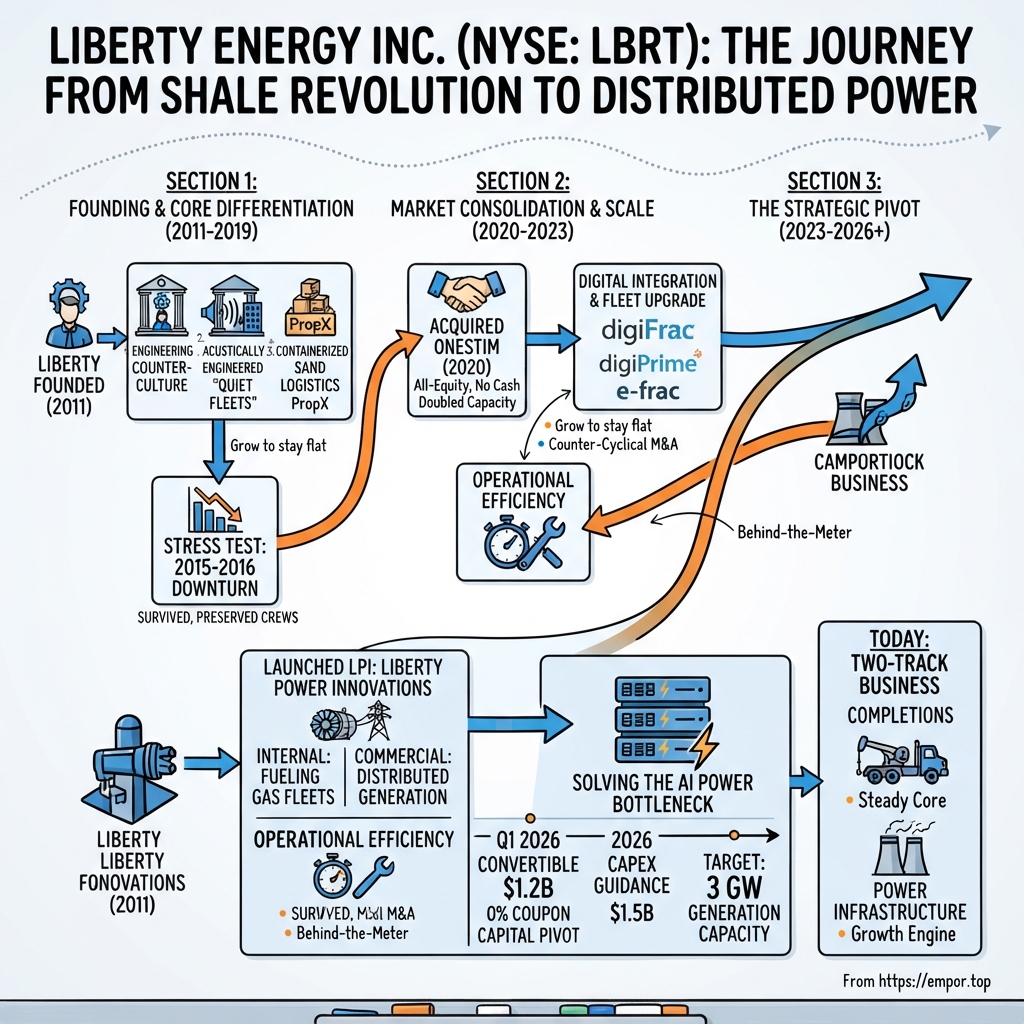
Liberty Energy Inc. (NYSE: LBRT): The Engine of the Shale Revolution
I. Introduction & The $4 Billion Pressure Cooker
On a caliche pad somewhere west of Midland, at three in the morning, one of the loudest industrial operations in North America unfolds in near-total darkness. Twenty-odd pumping units sit in two facing rows, connected by steel manifolds to a wellhead the size of a kitchen appliance. Through that wellhead, more than one hundred barrels a minute of water, sand, and chemical friction reducers are forced two miles down and two miles horizontally, under pressures high enough to shatter tight subterranean rock. Inside a blue-lit control cabin the size of a shipping container, an engineer in her late twenties watches a pressure curve on a bank of monitors, waiting for the precise signature that confirms the rock has fractured.
That operational hour is the product Liberty Energy sells. The company does not produce crude oil or natural gas. It sells hydraulic horsepower, sand logistics, and fleet runtime—converting diesel, natural gas, and proppant into fractured rock, billed stage by stage and measured by minutes of non-productive time avoided.
The initial question is how an independent operator founded in Denver in 2011 by a physicist-turned-fracture-mapper emerged as one of the two dominant pressure pumpers in North America, competing against legacy oilfield service providers—Halliburton, Schlumberger, and Baker Hughes—that possessed century-long operating histories and balance sheets an order of magnitude larger. The more pressing question for investors in 2026 is what kind of business Liberty is becoming.
By September 2026, Liberty no longer fits the early bull thesis of an unconstrained hydraulic fracturing compounder. Its core operations have contracted: full-year 2025 revenue came in at $4.0 billion, down 7% from 2024's $4.3 billion, while Adjusted EBITDA fell 31% to $634 million from $922 million.12 Net income dropped from $316 million to $148 million.12 That margin compression reflects the cyclical realities of a mature, consolidating North American completions market.
In the middle of that downcycle, management executed a sharp capital pivot. The company raised roughly $1.2 billion of zero-coupon convertible debt inside eight weeks—pricing $700 million due 2031 on February 4, 2026, and $475 million due 2032 on March 25, 2026—while raising its 2026 capital spending guidance to about $1.5 billion, compared to $571 million spent across all of 2025.3415 That capital is not funding new frac fleets; it is being deployed into natural-gas-fired power plants designed to supply AI data centers.5
This shift highlights a fundamental tension in oilfield services. For a decade, the prevailing consensus on North American pressure pumping was that the business chronically destroyed capital: fragmented, overbuilt during every upswing, and stripped of durable pricing power during downturns. Liberty's operating thesis was that technical efficiency could overcome industry structure—that running equipment harder, reducing mechanical failures, and controlling sand logistics could generate sustainable returns in a commodity sector. For several years, execution supported that view. The OneStim transaction, in which Liberty acquired Schlumberger's entire North American fracturing business at the bottom of the 2020 collapse for equity and no cash, stands as one of the better-timed asset trades in modern energy services.[^6][^7]
Yet management has acknowledged the structural limits of that domestic market. Presenting at the EnerCom Denver conference on August 18, 2026, CEO Ron Gusek pointed out that North America operates with roughly 200 frac crews and 600 drilling rigs today, compared to about 450 crews and 1,800 rigs when Liberty launched in 2011—observing that the business must "grow to stay flat."6 That assessment reframes the company's trajectory: the move into distributed power is not a speculative sideline layered onto an expanding pressure pumping operation, but a strategic redeployment away from a plateauing domestic core.
Historical performance illustrates the underlying volatility of the service model. At EnerCom in August 2026, management put up its own long-run scorecard: cash returns on invested capital averaging about 23% across fifteen years, with annual results ranging from roughly negative 2% in the worst downturns to the mid-forties in the best years.6 While a 23% multi-year average outpaces broader industrial averages and substantially outperforms bankrupt peers, the wide dispersion demonstrates that even a disciplined operator remains tied to energy cycles.
Against that backdrop, two major transitions collide. The first is in executive leadership: founder, evangelist and public face Chris Wright left in February 2025 to become U.S. Secretary of Energy, handing the company to Gusek, with co-founder Michael Stock remaining CFO.[^9]7 The second is the transformation of the operating model itself. This analysis traces how Liberty arrived at this juncture—from the physics of reservoir stimulation and the company's founding, through the shale downturns and the scale acquired via OneStim, to the power-generation pivot that now commands its balance sheet—testing whether the operational advantages management claims can endure across an entirely new asset class.
 Subscribe on LinkedIn
II. The Physics of Fracking: From George Mitchell to Pinnacle Technologies
Understanding that trajectory begins with the subsurface geology, because the physical nature of the rock dictated the operating model that followed.
In caricature, conventional oil production is a drainage problem: puncturing the impermeable seal over a porous reservoir allows hydrocarbons to migrate to the wellbore because the formation is permeable enough to let them flow. Shale is fundamentally different. It is a source rock—the geologic kitchen where hydrocarbons were generated under heat and pressure—with permeability measured in nanodarcies. By comparison, if conventional sandstone behaves like a sponge, shale resembles cured concrete with oil trapped in microscopic pores. Drilling a standard vertical well into such a formation yields virtually nothing.
Two technologies changed the commercial equation, and neither worked without the other. Horizontal drilling allowed operators to steer the drill bit ninety degrees and navigate laterally for miles through target formations only a hundred feet thick, maximizing contact with the reservoir. Multi-stage hydraulic fracturing then opened that contact surface, isolating the horizontal wellbore into dozens of segments and pumping each at high pressure until the rock failed in tension. Sand pumped alongside fluid propped those fractures open, preventing them from snapping shut once surface pressure was released.
George Mitchell served as the foundational figure in that shift: Mitchell Energy spent nearly two decades testing completion designs in the Barnett Shale outside Fort Worth before pairing slickwater fluids with inexpensive sand to unlock commercial natural gas. Yet the popular narrative obscures a central limitation of that early boom: through the 1990s and into the 2000s, completions were carried out largely blind. Crews pumped high volumes of fluid and proppant downhole, inferring reservoir behavior only from surface pressure gauges and subsequent production decline. Operators could not actually see the fracture geometry they were creating.
That diagnostic gap created an opening for Chris Wright. After studying mechanical engineering at MIT and pursuing graduate work in electrical engineering at UC Berkeley—with early research exploring solar and fusion energy—Wright shifted into subsurface geomechanics. In 1992, he founded Pinnacle Technologies to map downhole fractures. Pinnacle commercialized surface and downhole tiltmeter arrays, which measured the minute earth deformations caused by fractures opening thousands of feet underground, as well as microseismic monitoring, which triangulated the faint acoustic emissions produced as rock sheared under hydraulic pressure into three-dimensional maps.
The diagnostic advance proved consequential. For the first time, operators could compare completion models against subsurface reality, identifying whether fractures were propagating out of zone into water-bearing strata, falling short of planned lengths, or interfering with adjacent stages. Completion design began shifting from empirical folklore toward quantifiable engineering. Pinnacle mapped tens of thousands of treatments before Wright sold the company to Carbo Ceramics in 2006 for roughly $130 million—a profitable exit, but one that monetized only the diagnostic layer rather than field execution.
The economic asymmetry between diagnosis and execution shaped Wright's subsequent venture. Fracture mapping operated like a specialized consultancy: highly technical, generating modest revenue per job, and typically retained once per basin or play to calibrate reservoir models. Pressure pumping, by contrast, was a high-volume industrial service: capital-intensive, generating substantial revenue per well, and contracted continuously across multi-year drilling campaigns. Wright had developed the diagnostic microscope, but the cash flow resided on the assembly line.
In directing Pinnacle, Wright had also gathered fourteen years of cross-sectional performance data tracking how completion designs from every major service provider functioned across thousands of wells. For an entrepreneur preparing to enter a capital-heavy sector, that visibility offered a systematic record of which operating habits destroyed capital and which generated durable field efficiency.
That operational perspective formed the foundation of Liberty. Having observed competitor operations from the inside, Wright concluded that traditional pressure pumpers were managed much like low-margin freight haulers: purchasing iron, deferring maintenance, maximizing spot equipment utilization, and treating crews as interchangeable labor. Non-productive time—hours of a multi-hundred-thousand-dollar-per-day operation lost to blown fluid ends, failed transmissions, or depleted sand silos—was accepted as a routine cost of doing business. Fleets burned massive volumes of diesel, and the resulting noise increasingly complicated local permitting as drilling moved closer to populated communities.
Liberty's founding premise was an organizational and operational challenge to that standard: that a completion contractor staffed by engineers, run with factory-level instrumentation, integrated into its own sand supply chain, and governed by predictive maintenance could achieve superior returns on capital despite providing an undifferentiated commodity service.
It was a compelling framework for capturing relative operational advantages. Yet as the subsequent fifteen years of volatile oilfield cycles would demonstrate, disciplined execution could widen margins against weaker peers, but it could not liberate the business from the broader commodity cycle.
III. Founding Liberty Oilfield Services: The Engineering Counter-Culture
Denver in 2011 was an atypical location to launch a completions business. The center of gravity for North American oilfield services was Houston and Oklahoma City; Denver was a market where petroleum geologists and Front Range environmentalists crossed paths in the same coffee shops. That geographic backdrop proved meaningful. Backed by private equity sponsor Riverstone Holdings, Chris Wright launched Liberty Oilfield Services alongside a small founding team that included chief financial officer Michael Stock.
From inception, Liberty’s operating model inverted traditional oilfield conventions. Rather than maintaining a rigid hierarchy that left field hands in the dark, the company pushed granular operational metrics—pump hours, stage counts, downtime causes, and cost per stage—directly to equipment operators, linking field compensation to those figures. Wright paired that data transparency with an overt corporate ethos, arguing that expanding energy access was an essential moral good for human flourishing. In an industry plagued by chronic labor churn, that mission-driven framing served a pragmatic commercial purpose: it attracted and retained personnel, curbing training overhead and reducing operational errors.
In pressure pumping, the economic penalty for operational failure is severe. Holding an idle multi-well pad can cost an exploration and production customer hundreds of thousands of dollars a day. Most mistakes occur during night operations, in harsh weather, under intense operational pressure. A crew member in their first few months rarely identifies the subtle acoustic shift in a power end before a pump fails; a technician with three years on the job does. Practices that retained experienced hands on location—pay transparency, internal advancement, and real-time performance feedback—directly reduced unplanned downtime, creating a clear link between crew stability and fleet-level EBITDA.
The company's initial proving ground was the Denver-Julesburg Basin, specifically the Wattenberg field north of Denver, where horizontal drilling encroached directly onto residential subdivisions. Operators faced a restrictive permitting environment shaped by suburban neighborhoods sensitive to drilling noise. Liberty approached the issue through acoustic engineering rather than political lobbying, designing custom sound-dampening perimeter walls, enclosing pump engines, and configuring equipment layouts to minimize noise propagation. The resulting "Quiet Fleet" complied with strict municipal decibel ordinances, allowing operators to complete wells at residential setbacks where standard hydraulic fracturing fleets could not legally run.
That engineering delivered a genuine structural advantage: when local regulatory standards disqualify competing equipment, a service provider does not have to compete solely on price. Yet it was also an inherently localized moat. It applied to a specific basin, an idiosyncratic regulatory framework, and a cohort of Front Range operators that later consolidated. The enduring takeaway for Liberty was broader: pricing power in oilfield services emerges at the customer’s binding operational or regulatory constraint. While noise mitigation provided little edge in the remote expanses of the Permian Basin—where acoustic footprints rarely matter—the underlying discipline of engineering around customer bottlenecks translated directly. In West Texas, the binding constraint was not sound, but fuel and sand logistics.
The second foundational innovation addressed materials handling. Measured by physical volume, modern completions are bulk materials handling and logistics operations with high-pressure pumps attached. A single multi-well pad can require tens of millions of pounds of proppant, translating into hundreds of highway truckloads that must be scheduled, staged, and unloaded without the blender ever running empty. Under the legacy model, sand arrived in pneumatic trailers and was blown into vertical silos—a noisy process that generated clouds of respirable crystalline silica, congested pad entrances with truck queues, and halted pumping whenever deliveries stalled.
Liberty addressed that vulnerability by adopting containerized proppant delivery through PropX, transporting sand in sealed modular boxes that were crane-lifted off trailers and gravity-fed into blenders. By treating proppant handling as an integrated manufacturing supply chain rather than a commoditized trucking expense, Liberty established on-site buffer inventory. Decoupling delivery schedules from instantaneous wellsite consumption reduced silica dust exposure, cut truck traffic, and virtually eliminated non-productive time caused by waiting on sand.
That operational architecture faced its first severe stress test in late 2014. When Saudi Arabia and OPEC declined to cut production and instead defended market share, crude plunged from more than $105 a barrel to the mid-$20s by early 2016. Pressure pumpers, situated at the most vulnerable end of the oilfield supply chain, absorbed catastrophic margin collapse. Service providers went bankrupt in waves, equipment auctioned at near-scrap valuations, and surviving competitors cannibalized cold-stacked fleets for spare parts.
Liberty navigated the downturn through financial conservatism and operational consistency. Having avoided heavy debt loads during the 2012–2014 expansion, the company entered the crash without impending debt maturities forcing fire sales or restructuring. That liquidity buffer allowed Liberty to preserve its core operating crews and capture market share: cash-strapped operators cutting activity to bare minimums concentrated their remaining completions with the contractor that generated the least non-productive time. Low leverage did not insulate the company from lower pricing, but it provided the liquidity runway to operate proactively while competitors were forced into triage—a dynamic that would repeat at greater scale four years later.
The 2015–2016 bust also revealed an enduring structural flaw in the North American pressure pumping sector. Downturns rarely destroyed physical capacity; they merely rearranged balance sheets. Idle fleets were stacked, acquired out of bankruptcy by private equity sponsors at a nominal cost basis, and returned to service at the first signs of market recovery, quickly eroding any pricing power that tightening supply created. Financial restructurings extinguished equity and subordinated debt, but left the iron in place. That historical pattern remains central to assessing management’s argument in 2026 that the equipment market has achieved structural discipline: whether sidelined pumping capacity has been permanently retired and cannibalized, or simply parked until pricing improves.
IV. The Public Debut & Surviving the Capital Destruction Machine
By late 2017, the oilfield recovery was sufficiently underway for the equity market to reopen. Liberty listed on the New York Stock Exchange under the ticker LBRT in January 2018, pricing shares at $17 and raising approximately $218 million.8
The pitch to public investors centered on operational discipline: top-tier pumping efficiency, top-decile returns on capital, and leading safety metrics, framed as the product of an engineering-led operating system rather than proprietary patents. At the time of the roadshow, prevailing market conditions supported that thesis.
The timing also reflected management's capital strategy. Liberty went public roughly a year into the recovery at a mid-cycle valuation, raising a modest sum relative to peak market capacity. Rather than seeking a maximized liquidity exit at the top of an upcycle, the listing established a publicly traded equity currency for future transactions and opened access to capital markets ahead of inevitable downturns—a strategic reserve that would prove critical by 2020.
That initial thesis faced disruption less than a year later, driven not by operational missteps within Liberty, but by a structural shift in customer behavior.
Through 2018, the exploration and production sector underwent a fundamental realignment. After a decade of rewarding debt-funded volume growth, public equity markets abruptly demanded capital discipline, free cash flow generation, and living strictly within cash flow. For oilfield service providers, the fallout was swift and mechanical. Upstream operators front-loaded drilling and completion activity into the first half of the year, exhausted their capital budgets by October, and halted well completions for the remainder of the fourth quarter. This recurring pattern of year-end "budget exhaustion" destabilized service pricing. Frac spread counts dropped sharply through 2019, and spot pricing across the Permian Basin and the Mid-Continent collapsed as equipment suppliers competed for a shrinking calendar of active days.
This downturn provided the first real-world test of Liberty's economic moat against disclosed financial results.
At its initial public offering, management had argued that operational superiority and culture would insulate the company from commoditized price cuts. The historical record challenged that assumption. Across late 2018 and 2019, Liberty maintained fleet utilization well above industry averages, as customers favored its crews. Yet price per stage dropped regardless. Per-fleet profitability compressed from levels that had comfortably supported reinvestment down toward levels that barely covered maintenance capital expenditures—a margin squeeze that occurred despite consistent, high-uptime field execution.
The resulting dynamic clarified the precise boundaries of Liberty's competitive edge: the advantage operated along the volume axis, not the price axis. Liberty's operational reputation determined which fleets remained active when customers idled equipment. That utilization advantage held tangible economic value, because idle pressure-pumping fleets generate zero revenue while continuing to incur depreciation and carrying costs. However, operational efficiency did not dictate at what price those active fleets worked. When overall basin utilization falls to levels where competitors bid down to marginal cash costs simply to cover fixed overhead, market pricing collapses indiscriminately.
That distinction has persisted across subsequent cycles. Liberty functions as a market-share consolidator and a last-to-idle operator, but it has never demonstrated durable pricing power independent of broader industry utilization.
This relationship carries a critical implication for financial modeling. Because realized pricing is dictated by the marginal bidder in each basin rather than an individual contractor's cost structure, Liberty's earnings remain far more sensitive to industry-wide fleet utilization than to internal efficiency gains. A five-percentage-point swing in macro utilization easily overwhelms a year of hard-won operational improvements. Per-fleet profitability, rather than headline revenue or fleet count, serves as the primary gauge of underlying financial health—explaining how a company posting record operational runtimes could simultaneously absorb sharply lower earnings, as occurred during the 2025 downcycle.
If an operator cannot control market pricing, the strategic challenge becomes controlling the cost of capital equipment. In 2020, management found its answer: acquire tier-one assets at distressed valuations, just as the cheapest equipment in the history of shale went on sale.
V. The Masterstroke: Swallowing Schlumberger's OneStim at Negative Oil
On April 20, 2020, the West Texas Intermediate crude futures contract for May delivery settled at negative $37.63 per barrel, as commercial storage evaporated and global mobility ground to a halt. For a brief window, oil producers paid counterparties to haul physical barrels away.
The North American completions market halted in tandem. Across the United States, the active frac spread count plummeted from roughly 300 to approximately 45, leaving the vast majority of the industry's pumping horsepower idle. BJ Services, an oilfield service company whose operational roots traced back to 1872, filed for Chapter 11 bankruptcy and liquidated. Liberty absorbed the shock directly: full-year 2020 revenue dropped to $966 million from $2.0 billion in 2019, tipping the company into a net loss.9
The downturn catalyzed an exit by legacy service giant Schlumberger (SLB). SLB had spent much of the preceding decade expanding into North American onshore pressure pumping—most notably through its 2016 combination with Cameron International—on the thesis that integrating surface equipment and wellsite services would command premium pricing. That strategy faltered. North American hydraulic fracturing generated structurally lower returns than SLB’s international and offshore business lines, diluting consolidated margins and corporate valuation multiples. Under Chief Executive Officer Olivier Le Peuch, SLB had begun pivoting toward a capital-light, returns-oriented model. The pandemic-era demand collapse accelerated that withdrawal.
On September 1, 2020, Liberty announced an agreement to acquire OneStim, SLB's onshore hydraulic fracturing business in the United States and Canada, encompassing pressure pumping, pumpdown perforating, and associated sand logistics infrastructure. In exchange, Liberty issued approximately 66.3 million shares of common stock, giving SLB an approximate 37% equity stake with no cash paid and no debt assumed.[^6] The transaction closed on December 31, 2020.[^7]
The structure addressed both parties' operational priorities without requiring cash at the nadir of an industry downcycle. SLB traded a capital-draining, margin-dilutive operating division for a marketable equity interest in an efficient pure-play operator, preserving exposure to an eventual market recovery while shedding maintenance and capital expenditure burdens. Liberty acquired tier-one pumping equipment, maintenance yards, real estate, sand assets, and intellectual property at a time when market values were detached from physical replacement costs, funding the purchase entirely with equity rather than tapping debt or cash reserves.
The all-equity structure also mitigated post-close execution risk. In late 2020, credit markets were effectively closed to oilfield services, making equity the only viable acquisition currency. By taking an equity stake of roughly 37%, SLB remained economically invested in the combined entity's operational performance, aligning the seller to facilitate the transition of customer relationships, commercial contracts, and field personnel. In a service industry where operational continuity depends on experienced frontline crews, that alignment proved critical.
The implied valuation contrasted sharply with prior-cycle benchmarks. During the 2017–2018 upswing, active pressure-pumping fleets traded at roughly $25 million to $35 million per fleet equivalent, and the merger of Keane Group and C&J Energy Services to create NexTier carried an enterprise value of approximately $1.8 billion.10 Against those reference points, Liberty acquired OneStim’s asset base at a steep discount to replacement cost and prior market multiples. The combination roughly doubled Liberty's nominal fleet capacity, positioning the company alongside Halliburton at the top of the North American completions market.
Yet subsequent operating results complicated the thesis that industry consolidation would immediately deliver pricing power and operating leverage. In 2021, the first full year of combined operations, Liberty generated $2.47 billion in revenue but recorded a net loss from continuing operations of $187 million.9 A full year after closing a consolidating transaction, the company remained unprofitable.
That delay stemmed from operational challenges common to distressed-asset integrations. Equipment inherited from a parent company that had dialed back maintenance required substantially more refurbishment than initial due diligence anticipated. A significant portion of the cold-stacked fleet proved uneconomic to reactivate and was permanently retired or cannibalized for spare parts, while returning selected spreads to operating standards demanded dedicated shop time and refurbishment capital. At the same time, integrating two distinct corporate models proved difficult: Liberty’s decentralized, field-empowered culture conflicted with the matrixed reporting structures and centralized approvals typical of a multinational operator.
That cultural divergence carried practical operational implications. Liberty’s completion model relied on field-level autonomy, empowering crew supervisors to address operational issues on location without multi-tiered administrative sign-offs. OneStim personnel had been trained within a compliance-driven hierarchy where procedural adherence took precedence over local discretion. Harmonizing those operating philosophies required nearly two years of management focus, coinciding directly with the initial phase of the industry's post-pandemic recovery.
Management maintained discipline, however, in deploying capacity. Liberty declined to reactivate idle fleets speculatively, requiring dedicated multi-month customer commitments that fully covered reactivation capital before returning equipment to the field. While that policy constrained revenue growth in 2021, it avoided the familiar service-sector mistake of deploying capital to chase market share at spot rates that failed to cover cash costs. As completions activity gathered momentum, financial performance rebounded: full-year 2022 revenue climbed to $4.15 billion with $400 million in net income, while 2023 produced record results of $4.75 billion in revenue and $556 million in net income.9
The OneStim acquisition secured low-cost scale and market share, but it did not alter the fundamental economics of North American pressure pumping. Scale provided operational breadth rather than standalone pricing power. The earnings surge reflected an industry-wide cyclical recovery and receded once upstream development cooled; within two years of the 2023 peak, Adjusted EBITDA had dropped by roughly half as completions demand softened.12 Consolidation expanded the asset base, but it did not insulate the business from the broader oilfield cycle.
The transaction also introduced structural dilution that the zero-cash structure obscured. Issuing 66.3 million shares diluted existing shareholders, as weighted average diluted shares outstanding expanded from approximately 85 million in 2020 to roughly 174 million in 2021, though the resulting cash flow enabled management to repurchase a significant portion of that equity over the subsequent cycle.91
If market scale could not insulate the core completions business from cyclical volatility, the remaining question was whether proprietary technology could.
VI. The Frac Fleet Arms Race: digiFrac, Fuel Logistics, and the LPI Engine
The single largest consumable line item on a conventional completions location is not sand or water. It is diesel.
A conventional pressure-pumping fleet running continuously burns between 5,000 and 8,000 gallons of diesel per day. At typical off-road fuel prices, that generates an operating expense of roughly $15,000 to $25,000 daily per fleet—a cost passed directly to exploration and production customers that directly constrains what operators can spend on other wellsite services. The operational paradox was stark: completion crews operated directly above massive natural gas reservoirs while trucking in millions of gallons of refined diesel to unlock them.
Closing that economic arbitrage has served as the organizing focus of completions engineering for over a decade, progressing across three distinct technological steps.
The underlying physics dictate the scale of that fuel demand. Hydraulic horsepower on a frac spread does not exist simply to circulate fluid; it must overcome the mechanical resistance and lithostatic pressure of rock formations two miles underground. Fracturing tight rock requires pressures measuring thousands of pounds per square inch, while simultaneously injecting fluid fast enough to propagate fractures rather than leaking off into the formation. Delivering that combination of sustained high pressure and high flow rate requires tens of thousands of hydraulic horsepower per pad, creating enormous fuel requirements.
The industry's first technological response was dual fuel. Tier 4 dynamic gas blending engines substitute field natural gas or compressed natural gas for a substantial portion of diesel while retaining diesel compression ignition, typically displacing 60% to 70% of total fuel volume. Dual-fuel systems provided an inexpensive, incremental bolt-on, but left traditional mechanical drivetrains intact.
The second step was electric fracturing, or e-frac. Instead of individual diesel engines driving mechanical transmissions and pumps on each trailer, a centralized wellsite power plant—powered by natural gas turbines or large reciprocating gas engines—generates electricity to drive electric motors coupled directly to the pumps. Eliminating transmissions and drivetrains removed the components responsible for the highest rates of mechanical failure and unplanned maintenance downtime on conventional trailers. In addition to reducing fuel costs toward local field gas prices, electric fleets lowered emissions and noise while cutting the wellsite equipment footprint by roughly half—a tangible operational advantage on congested multi-well pads.
The third step marked Liberty's departure from broader oilfield service practice. While most competitors purchased commercial electric pumping systems from third-party manufacturers, Liberty chose to engineer its own platforms in-house. The company developed digiFrac, a modular electric completion platform powered by Rolls-Royce MTU natural gas reciprocating generator sets with integrated proprietary control software, followed by digiPrime, a hybrid architecture engineered to bridge the capital-cost gap between dual-fuel conversions and fully electric fleets. By the mid-2020s, the vast majority of Liberty's fleet capacity ran primarily on natural gas rather than diesel, with the company deploying its first international digiPrime fleet to Canada in the second quarter of 2026.5
The strategic rationale for designing proprietary equipment centered on margin capture and supply-chain control rather than sheer mechanical output. A service provider operating third-party electric equipment functions largely as an equipment reseller burdened with ongoing vendor maintenance agreements. By developing its own platforms, Liberty sought to control its equipment manufacturing costs, spare-parts supply chain, software integration, and hardware refresh cycles. That strategy carried symmetrical risk: internal research and development absorbed substantial engineering capital, and proprietary designs that lagged industry standards could not be easily replaced with off-the-shelf commercial units. While strong fleet utilization and customer adoption supported management's claims of operational differentiation, investors remained reliant on internal metrics that were difficult to independently audit.
That electric equipment program ultimately created the operational bottleneck that pushed Liberty into a separate business line.
Electric and dual-fuel completion fleets only operate effectively if natural gas reaches the wellhead continuously, at sustained pressure, and treated to tolerances that high-performance engines can consume. Across much of the Permian Basin, that requirement presented severe logistical hurdles: pipeline connections were frequently absent, and raw wellhead gas often carried corrosive hydrogen sulfide, heavy hydrocarbon liquids, and moisture that would destroy generator engines. Managing that supply required field compression, gas treating, transport logistics, and specialized on-site fuel conditioning—an infrastructure-heavy operating discipline outside the traditional scope of pressure pumping.
Liberty chose to internalize that capability. In April 2023, the company formed Liberty Power Innovations (LPI) and acquired Siren Energy & Logistics for $78 million in cash, bringing Permian gas compression, treating, and delivery assets in-house.11 The initial logic was defensive and operationally targeted: guarantee uninterrupted fuel deliveries to Liberty's own gas-powered fleets while capturing midstream margins previously paid to third-party fuel suppliers.
From that initial internal mandate, LPI expanded into an independent commercial power platform. By 2026, Liberty operated a fleet of mobile power generation plants, each capable of delivering roughly 25 to 30 megawatts in remote environments, backed by multi-year equipment supply agreements with Bergen Engines and Wärtsilä.65 To facilitate direct power sales, the company established Liberty Wholesale Commodities to participate in the ERCOT wholesale electricity market.5 Within three years, equipment originally assembled to fuel hydraulic fracturing spreads had evolved into a standalone distributed generation business.
Management framed that expansion around operational parallels between oilfield power delivery and the commercial power constraints facing digital infrastructure. LPI specializes in processing remote, untreated, variable-quality natural gas and converting it into reliable, utility-scale electricity in off-grid environments—completing installations within months, compared to the five-to-seven-year interconnection queues typical for regional electric utilities in Texas. Artificial intelligence data center developers confronted a parallel bottleneck: abundant regional gas supply, severely constrained transmission grid capacity, and intense pressure to secure rapid power access. Management argued that fifteen years of designing, manufacturing, and managing complex mobile industrial equipment gave Liberty a proven operational framework for solving off-grid power shortages at scale.1
The operational critique of that strategy centers not on technical execution, but on duration and counterparty risk. A hydraulic fracturing fuel contract spans several weeks with upstream exploration and production companies whose balance sheets and operating cadences Liberty has navigated for over a decade. By contrast, behind-the-meter generation facilities serving large data center campuses require fifteen-to-twenty-year capital commitments to technology developers and commercial off-takers, entering a market where long-term power demand projections remain intensely debated. Field-level engineering competence is a necessary prerequisite for entering distributed generation, but it does not resolve long-term contracting and balance-sheet exposure.
The financial materiality of the two divisions also underscores that operational divergence. Core pressure pumping and completions continue to generate the overwhelming majority of consolidated revenue and operating cash flow, providing the foundation for the company's $4.0 billion in 2025 revenue and funding its shareholder dividends.1 By contrast, the power business currently represents a modest revenue stream while demanding substantial capital reinvestment: Liberty raised its 2026 capital expenditure guidance to approximately $1.5 billion, compared to $571 million spent in 2025, with the spending increase driven primarily by equipment deposits on long-lead generation turbines and reciprocating engines.51
Yet the scale of management's power ambition is substantial. The company's long-term plan to develop three gigawatts of generation capacity represents an estimated $5 billion to $6 billion in cumulative capital investment; management projects unlevered project returns between 17% and 18% with payback periods of five to six years, intending to finance developments through special purpose vehicles with non-recourse project-level debt.12
Two critical considerations temper those projections. First, non-recourse debt financing at the project level does not eliminate parent-level risk: Liberty must still commit corporate equity, execute long-lead equipment procurement contracts, and pledge its operating reputation to projects where data center customers face their own financing and regulatory contingencies. Second, a projected 17% to 18% unlevered return relies on commercial modeling for assets that remain unbuilt, managed by an operator whose historical execution was honed on two-week mobile completion jobs rather than multi-decade stationary infrastructure assets. Pressure pumping required operational agility and logistical precision under immediate time pressure; long-term power generation requires managing balance-sheet exposure and counterparty duration risk. Those demands test fundamentally different corporate capabilities.
That divergence points directly to the executive leadership tasked with managing the pivot.
VII. The Succession Shock: When the Founder Goes to Washington
For thirteen years, understanding Liberty Energy's strategic perspective meant listening to Chris Wright. He delivered it at length: on extended earnings calls, in an annual energy-and-human-development letter styled more like a manifesto than a corporate shareholder report, and in broadcast appearances where he vigorously defended the fossil fuel industry.
On November 16, 2024, President-elect Donald Trump nominated Wright for U.S. Secretary of Energy.13 Following confirmation, he stepped down from Liberty's board and executive leadership in early February 2025, divesting his holdings and resigning outside directorships to comply with federal ethics requirements.[^9] Ron Gusek succeeded him as chief executive officer.[^9]
The market's initial reaction treated the transition primarily as a governance risk. That interpretation proved both overly simplistic in one direction and insufficiently skeptical in another.
The reaction was overly simplistic because Gusek was not an outside executive installed into a founder's seat. A mechanical engineer by training, he joined Liberty in 2014 as vice president of technology and development and was named president in November 2016, serving as the company's operational second-in-command through its initial public offering, the 2019 pricing downturn, the OneStim integration, and the digiFrac development program.14 He served as co-architect for the operational execution underlying the company's competitive reputation. On quarterly earnings calls, his register differs markedly from Wright's, replacing broad philosophical arguments with granular updates on fleet mechanics and equipment status. The continuity of Michael Stock as chief financial officer provides comparable balance-sheet stability, preserving the conservative financial framework that enabled the 2020 OneStim acquisition.14
Gusek's public demeanor provides insight into management's evolving communication style. Where Wright typically fielded questions regarding quarterly margin compression by redirecting discussion toward global energy poverty, Gusek focuses on fleet counts, equipment utilization, and operational calendar adjustments. That technical focus offers reassurance for a cyclical industrial enterprise, even if it presents challenges when marketing a long-term strategic transformation to public markets—a notable consideration as management asks investors to underwrite an infrastructure expansion projected through 2029. Presenting at the EnerCom conference, Gusek framed the broader energy landscape around a contentious thesis: "There is no energy transition going on," arguing that worldwide energy demand is expanding by incorporating additional power sources rather than replacing existing ones.6 While that perspective aligns with baseline primary energy consumption data, it also conveniently frames capital deployment into gas-fired generation as a secular demand trend rather than a cyclical expansion.
The initial market skepticism also missed the real operational shift. The primary risk facing Liberty was not management incompetence, but rapid strategic drift.
That shift contrasted sharply with Liberty's founding financial principles. For over a decade, the company's corporate identity was anchored in balance-sheet conservatism: avoiding debt-funded fleet expansions during market peaks and returning capital to shareholders rather than funding speculative equipment additions. Between February and March 2026—scarcely thirteen months after Wright's departure and amid the company's weakest annual earnings since 2021—Liberty issued approximately $1.2 billion in convertible notes. Both tranches carry a 0.00% coupon; the February notes due 2031 convert at approximately $34.50 per share, representing a 32.5% premium to a $26.04 stock price, alongside capped call transactions costing roughly $99.4 million that lifted the effective dilution threshold to around $65.10; the March notes due 2032 convert at approximately $37.44 per share.34 By mid-2026, total debt climbed to roughly $1.3 billion against $555 million in cash and approximately $1.0 billion in total liquidity.5
From a corporate finance perspective, the transaction represented disciplined capital structure engineering. Pricing zero-coupon convertible debt into equity with elevated implied volatility, while pushing the economic dilution threshold to 150% of the prevailing share price via capped calls, provided capital with zero cash-interest expense to fund assets that management expects will generate returns well above its corporate cost of capital. Stock's execution on the debt placement remained consistent with his historical record of opportunistic capital raising.
Yet the financing introduced three distinct strategic vulnerabilities that warrant direct scrutiny alongside the project pipeline.
First, the company has abandoned its traditional zero-debt posture. The debt-free balance sheet that defined Liberty's competitive positioning across prior downcycles no longer exists, discarded by the same management team that spent years citing conservative leverage as a core operational moat. Investors who valued the company's defensive balance sheet are now exposed to a leveraged capital structure.
Second, shareholder distributions slowed precisely as capital spending commitments accelerated. Full-year 2025 shareholder distributions totaled $77 million, including only 1.5 million shares repurchased at an average price of $15.50 for approximately $24 million—a marked deceleration for a buyback program that had retired roughly 16% of outstanding shares since its inception, with about $270 million in remaining authorization left unspent.1 Management chose to redirect free cash flow toward growth capital expenditures rather than repurchasing undervalued equity while shares traded in the mid-teens. If distributed power generation delivers management's targeted returns, that reallocation may prove justified; if execution falters or customer commitments stall, the company will have bypassed a deeply discounted share buyback to finance uncommitted power hardware.
Third, management's historical record on financial guidance warrants caution. Across 2023 and 2024, Liberty repeatedly lowered forward expectations due to factors outside its control, including exploration and production customer budget exhaustion, scheduling gaps, and drilling delays that followed widespread upstream corporate mergers.15 While management maintained credibility by providing detailed operational explanations rather than evasive commentary, that track record highlights a fundamental reality: the leadership team has struggled to forecast its core pressure-pumping business beyond several quarters because customer capital allocations remain an external variable. Assuming that same team can reliably underwrite twenty-year stationary power infrastructure projects requires an analytical leap only partially supported by historical execution.
The broader takeaway is more nuanced than either bullish or bearish narratives suggest. Executive succession did not trigger operational deterioration in the field; completion efficiency remained robust, with Liberty reporting record pump hours and horsepower hours in the second quarter of 2026 while reducing per-unit maintenance expenses by approximately 14% through predictive algorithmic monitoring.121 Instead, Wright's departure marked a fundamental pivot in corporate risk tolerance. For public shareholders, monitoring how that expanded risk appetite interfaces with long-term infrastructure assets represents the central governance question ahead.
VIII. Playbook: Business & Investing Lessons from the Oilfield Frontier
Lesson 1: In a commodity service, the only durable edge is cost per unit of output—and it buys volume, not price.
The arithmetic of pressure pumping is unforgiving in a way that rewards operational discipline. A fleet represents a fixed block of capital and labor; what varies is how many hours a day it actually pumps. An operator averaging eighteen to twenty pumping hours per day spreads the same depreciation, crew costs, and overhead across substantially more revenue-generating stages than a competitor averaging twelve to fourteen. That operational wedge is built on unglamorous efficiencies: proppant staged before the blender runs dry, a fluid end replaced on an algorithmic schedule before a mechanical failure, and a wireline handoff executed in eight minutes rather than thirty. Liberty's real competitive edge was never proprietary fluid chemistry; it was operational cadence. Yet as both the 2019 and 2025 downturns demonstrated, operational cadence dictates which fleets remain active—it does not determine the clearing price for that work.
Lesson 2: Counter-cyclical M&A funded with equity is the highest-return move available in a cyclical industry—and it appears roughly once a decade.
The oilfield services landscape is littered with contractors that acquired equipment with cash and high-yield debt near cycle peaks. Liberty executed the inverse: acquiring assets at the depths of a trough, paying entirely in equity, assuming zero debt, and allowing the macro recovery to revalue the asset base. The nuance investors must keep in mind is that the financial payoff was concentrated in the initial cyclical rebound, while equipment refurbishment and organizational integration proved slower and more expensive than advertised. Counter-cyclical consolidation is an exceptional transaction, but it is not a structural substitute for an expanding end market.
Lesson 3: Vertical integration should remove a bottleneck, not simply add a revenue line.
The distinction between defensive integration and strategic overreach rests on whether the acquired capability previously constrained core operations. Containerized sand logistics eliminated pad downtime and hazardous silica exposure. Internal gas compression and fuel conditioning removed the delivery bottlenecks that prevented gas-powered fleets from running in remote Permian locations. Both moves eliminated critical operational bottlenecks. The central question in 2026 is whether building utility-scale power generation for third-party data centers meets that same standard, or whether it represents a fundamentally different enterprise operating under the same corporate banner. Management contends that mobile industrial competencies transfer directly; however, capital intensity, contract duration, and counterparty risk do not.
Lesson 4: Exercise the greatest skepticism when a cyclical company announces it has become structural.
Evaluating that transition requires separating reality from three persistent market misconceptions:
Myth: Liberty carries no debt. Reality: The company carried roughly $1.3 billion of debt at mid-2026, overwhelmingly zero-coupon convertible notes issued in the first quarter of that year.534 While the cash interest burden is negligible and stated maturities extend into the next decade, the long-standing corporate narrative of a debt-free balance sheet is obsolete—removing the primary defensive cushion that historically protected equity investors through severe cyclical downturns.
Myth: Consolidation granted the leading pressure pumpers durable pricing power. Reality: Exploration and production customers consolidated just as rapidly as service contractors, and the 2025 results—revenue down 7% and Adjusted EBITDA down 31%—demonstrate what happens when pricing power is absent.1 What consolidation established was a higher utilization floor for tier-one fleets, not a higher pricing ceiling.
Myth: The power business is low-risk optionality layered onto a stable core. Reality: Management's own description of North American activity levels makes the core a slowly shrinking asset, and the power business is being funded with borrowed money at a scale that makes it the primary determinant of the equity outcome within a few years.612
Near the peak of every commodity cycle, oilfield service contractors frequently rebrand as technology firms, logistics networks, or—in the 2026 vintage—distributed power platforms. The true analytical test is not whether power demand is real, but whether equity multiples can survive a twenty-dollar drop in crude prices. Liberty's power pivot has the unusual distinction of being launched during an oilfield downcycle rather than an upswing. Nevertheless, prudent analysis requires anchoring valuation to normalized mid-cycle cash flows from the business that exists today, treating multi-gigawatt targets for 2029 as capital-deployment goals rather than contracted earnings.
IX. The 7 Powers & Industry Structure Analysis
Hamilton Helmer's 7 Powers, applied to dirty horsepower
Scale Economies — Strong, but narrower than it looks. Roughly forty active fleets amortize a fixed base of maintenance hubs, engineering staff, technology development, and purchasing leverage over steel, engines, and power electronics that a competitor running five to fifteen fleets cannot match. On the second-quarter 2026 earnings call, management emphasized that customers increasingly rely on Liberty's ability to source and deliver materials at scale—a tangible operational advantage in sand and chemicals procurement.12 The constraint is geographic: scale economies in pressure pumping operate at the basin level as much as the corporate level, because heavy equipment and field crews cannot be costlessly redeployed across distant shale plays.
Network Economies — None. One exploration and production customer contracting Liberty creates no network value for the next. The service model possesses no compounding user flywheel.
Counter-Positioning — Moderate, and decaying. Between 2020 and 2023, Liberty held a genuine counter-positioning advantage: it leaned aggressively into natural-gas-powered fleets while legacy competitors carried balance sheets laden with Tier 2 diesel equipment they could neither readily write off nor afford to repower. That window has largely closed. Halliburton's ZEUS platform, ProFrac's electric fleet, and offerings from pure-play electric fracturing specialists are all active in the field. As electric pumping becomes an industry baseline, an operational differentiator converts into a mandatory capital requirement.
Switching Costs — Low to moderate. Dedicated fleet arrangements typically run between six and twelve months. While swapping contractors mid-pad is operationally disruptive and generally avoided, re-tendering at contract renewal is routine, and upstream operators deliberately qualify multiple service providers to preserve bargaining leverage. This dynamic represents the most fragile link in Liberty's competitive moat, explaining why spot pricing deteriorates quickly whenever basin-wide equipment utilization slips.
Branding — Moderate. In an environment where an environmental spill, an industrial fatality, or a local noise dispute can jeopardize an operating permit, Liberty's safety record and community-mitigation capabilities command a flight-to-quality preference. That reputation provides a measurable advantage at the margin of vendor selection, though it fails to command a pricing premium during broader market downturns.
Cornered Resource — Moderate. Proprietary designs for digiFrac and digiPrime, the SLXRRY sand slurry delivery system that commenced commercial operations in 2026 and reportedly removes up to 200 truckloads per day from a wellsite, and integrated field gas conditioning through LPI represent distinct internal capabilities.512 Yet none is protected by an intellectual property barrier that prevents a well-capitalized competitor from engineering an equivalent system.
Process Power — Very strong, and the foundation of the core business. The company's operating playbook, supply-chain coordination, predictive maintenance algorithms for fluid and power ends, and lower crew turnover represent tacit, accumulated knowledge that cannot be easily replicated from an equipment manual. If one structural power explains why Liberty out-earned its peer group across multiple commodity cycles, process power is the driver. The caveat is that process power is measured strictly relative to competitors, and the peer group has upgraded its own operations: Halliburton's North American completions business in 2026 operates with far greater technical discipline than the unit Liberty outflanked in 2015, while Patterson-UTI's combination with NexTier unified two competent operators. Even if the relative rankings remain intact, the competitive gap has narrowed.
That structural reality carries profound implications for the power business where capital is currently flowing, because few of these advantages directly transfer. Scale economies across pressure-pumping maintenance facilities do not lower the purchase price of a Wärtsilä reciprocating engine. Process power in extending pump component life does not compress a multi-year data center utility interconnection queue. What does transfer is core project execution: equipment procurement, field logistics, and the continuous operation and maintenance of large reciprocating gas engines—alongside the critical fuel conditioning and delivery infrastructure that LPI already operates across the Permian Basin. While that foundation provides a head start over a greenfield independent power developer, it falls short of an insurmountable moat. In distributed generation, Liberty must compete for long-lead equipment, technical personnel, and commercial hyperscale campuses against infrastructure investors with far deeper balance sheets.
Porter's Five Forces in North American completions
Buyer power — Extremely high, and still rising. Upstream exploration and production operators have consolidated aggressively: ExxonMobil absorbed Pioneer Natural Resources, Diamondback Energy acquired Endeavor Energy Resources, Occidental Petroleum purchased CrownRock, and Chevron pursued Hess. A concentrated cohort of sophisticated operators with centralized procurement teams now governs the bulk of Permian completion demand, orchestrating competitive bidding processes designed to compress oilfield service margins. This single force dictates the ceiling on Liberty's core earnings.
Supplier power — Moderate. Manufacturers of engines and power generation hardware—such as Caterpillar, Rolls-Royce MTU, Wärtsilä, and Bergen—alongside power electronics suppliers and proppant miners exert tangible leverage, especially as surging demand from data centers lengthens delivery timelines for power equipment industry-wide. Liberty mitigates that exposure through in-house engineering and internal logistics, but its sharp 2026 capital expenditure increase reflects the operational necessity of committing upfront deposits to secure scarce manufacturing slots.5
Threat of new entrants — Low. Deploying a modern, high-specification completion fleet requires tens of millions of dollars in upfront capital, proprietary control software, complex field logistics, and an approved vendor track record with major upstream producers. The era of the small, debt-fueled independent pumper has ended.
Threat of substitutes — Low within oil and gas. There is no commercial alternative to multi-stage hydraulic fracturing for stimulating unconventional reservoirs at scale. The genuine substitution risk is long-dated and macro-driven: the eventual plateau or displacement of global liquid hydrocarbon demand.
Rivalry — High, but structurally better than it was. Halliburton, Liberty, Patterson-UTI (which completed its merger of equals with NexTier in September 2023), and ProFrac control the vast majority of active high-specification pumping capacity.[^19] Crucially, on the second-quarter 2026 earnings call, management pointed to improving visibility into active fleet supply following years of equipment attrition and cannibalization, arguing that the supply-side discipline missing in 2015 and 2019 has finally taken hold.512 That tightening of physical capacity underpins the argument that this cycle's trough will remain higher than those of past downturns.
Synthesizing these frameworks yields a clear conclusion: Liberty holds formidable process power within an industry governed by overwhelming buyer power and weak switching costs. That combination generates a reliable relative advantage against peers, but an inherently volatile absolute return on capital. It is precisely this structural ceiling that incentivized management to redeploy its balance sheet toward stationary power generation—venturing beyond the oilfield into a market where capital requirements and competitive dynamics are entirely different.
X. The Bear vs. Bull Investment Thesis & What to Watch
Why Liberty wins from here
The bull case rests on four pillars of varying stability.
The strongest is supply-side discipline across the core completions market. Years of equipment attrition, cannibalization, and the retirement of legacy Tier 2 diesel spreads have reduced the industry's deployable high-specification fleet capacity, with consolidation concentrating the remainder among four dominant providers. On its second-quarter 2026 earnings call, management reported record fleet utilization alongside modest pricing gains for next-generation equipment, pointing to minimal unscheduled calendar white space entering the third quarter—the first constructive pricing commentary after several quarters of margin pressure.12 If effective fleet supply remains constrained, the cycle's trough Adjusted EBITDA should hold structurally higher than in past downturns.
The second pillar is the commercial emergence of the distributed power platform. The initiative has transitioned from conceptual presentations to contracted commitments: a 1-gigawatt strategic partnership with Vantage Data Centers announced in January 2026, which includes a firm 400-megawatt capacity reservation for 2027; a joint venture with PowerBridge targeting an initial deployment exceeding 300 megawatts in late 2027 at a planned 2-gigawatt West Texas campus; and an alliance pairing Liberty's generation units with SLB's modular infrastructure.165 Management has guided toward securing more than 500 megawatts of executed energy service agreements before the end of 2026, aiming for approximately 3 gigawatts of deployed generation by 2029.61
The third pillar is continuous operational compounding: field crews achieved record pump hours and horsepower hours in mid-2026, algorithmic maintenance monitoring reduced per-unit repair expenses by roughly 14%, and proprietary logistics systems like SLXRRY lowered wellsite handling costs for exploration and production customers.112 Throughout volatile commodity cycles, field-level execution has remained Liberty's most dependable engine.
The fourth, and most vulnerable, pillar is the company's historical record of capital returns. While tangible—management retired roughly 16% of outstanding common shares following the launch of its buyback program and raised its base dividend across four consecutive years—direct shareholder distributions have been largely deferred while capital is reallocated into long-lead generation hardware.16
What breaks the case
The primary risk emerges directly from management's own industry assessment. CEO Ron Gusek's observation that North America operates with roughly 200 active frac crews today compared to 450 in 2011—and that the business must "grow to stay flat"—acknowledges that the completions profit pool is structurally contracting, as faster pumping rates allow fewer crews to fracture significantly more lateral rock per year.6 Any investment thesis that assumes hydraulic fracturing provides an expanding cash base beneath the power division must reconcile with that reality: long-term efficiency gains in shale ultimately accrue to upstream exploration and production operators, not service contractors.
Second, upstream customer consolidation continues to constrain service pricing. As exploration and production operators combine, they rationalize acreage, standardize completions designs, and pare down service rosters, reducing aggregate crew demand even when drilling volumes remain steady. Each upstream merger narrows Liberty's addressable bidding pool while reinforcing customer negotiating leverage.
Third, electric fleet technology risks commoditization. As competing service providers deploy their own electric and hybrid pumping spreads, natural-gas-powered fracturing shifts from a differentiated offering commanding premium margins into a mandatory capital requirement. While management reported on the second-quarter 2026 earnings call that commercial pricing conversations were improving specifically for advanced gas fleets—even as sand and chemical margins remained pressured—demonstrating that an operational premium exists today, whether that margin advantage can endure through 2029 remains unproven.12
Fourth, and most consequential, the power platform introduces substantial balance-sheet and execution risks. Developing 3 gigawatts of stationary generation capacity requires an estimated $5 billion to $6 billion in cumulative capital outlays.12 Liberty's market capitalization represents only a fraction of that sum. The strategy depends on non-recourse project-level financing through special purpose vehicles, data center developers energizing campuses on contracted schedules, scarce turbines and reciprocating engines arriving without supply-chain delays, and West Texas municipalities permitting large-scale gas-fired generation near data facilities—a community friction point Gusek publicly acknowledged.6 An unexpected delay at a single hyperscale development would defer commercial revenue while upfront equipment deposits remain committed.
The critical critique is straightforward: a cyclical service company navigating an earnings downturn issued $1.2 billion in convertible debt to fund an infrastructure buildout outside its historical operating domain, while slowing share repurchases despite a discounted equity valuation. Management's strategic rationale presents the counter-argument: the company is prudently reallocating capital away from a mature completions market toward high-return power infrastructure, tapping low-cost financing backed by customer commitments. Which thesis ultimately prevails depends on whether the initial 300 to 400 megawatts can be energized on schedule and generate their modeled cash returns.
The three KPIs that actually matter
One: annualized Adjusted EBITDA per active fleet, alongside active fleet counts. This metric provides the cleanest gauge of whether core pressure pumping is generating returns above its cost of capital or merely renting equipment to exploration and production operators at cash cost. By capturing realized pricing and fleet utilization in a single measure, it signals inflection points in the oilfield cycle before they appear in aggregate top-line revenue. The critical trend to track is how fleet profitability recovers from 2025 trough levels relative to the 2023 peak.
Two: contracted power capacity converted into operational revenue—megawatts energized and generating power, rather than megawatts announced. The transformation thesis depends on commercial energization rather than press announcements. Memoranda of understanding, capacity reservations, and joint venture frameworks do not generate cash flow; Liberty's experience integrating OneStim demonstrated how protracted the transition from headline transaction to realized financial contribution can be. The pivotal milestones to evaluate are whether the PowerBridge and Vantage projects begin commercial operations on their targeted late-2027 and 2028 schedules, and whether realized project returns match management's projected 17% to 18% unlevered hurdle rates.
Three: post-capex free cash flow and the trajectory of net debt. With full-year 2026 capital expenditures guided to approximately $1.5 billion against a business that generated $634 million in Adjusted EBITDA in 2025, capital allocation is the central investment thesis. If project-level financing inside special purpose vehicles materializes as planned and parent-level leverage remains contained, the balance sheet can support the expansion. If project debt or long-lead equipment obligations migrate onto the corporate balance sheet, Liberty transforms into a leveraged cyclical entity financing stationary infrastructure—a fundamentally higher-risk instrument than the debt-free equity investors held in 2023.
Two secondary dynamics require equal vigilance. The first is accounting presentation: as distributed generation scales, a growing portion of Liberty's operating assets and liabilities will reside in joint ventures and special purpose vehicles. Whether those entities are consolidated, accounted for under the equity method, or treated as off-balance-sheet structures will dictate how much debt and cash flow appear in headline financial statements. Scrutinizing segment disclosures and variable-interest-entity footnotes in regulatory filings will be essential to evaluate true corporate leverage, rather than relying on quarterly earnings releases.17 The second is counterparty concentration: while the completion business serves a diversified base of exploration and production operators across multiple basins, the power division relies on a concentrated group of anchor technology developers. The counterparty diversification that Liberty spent fifteen years assembling in oilfield services is being deliberately narrowed in distributed power.
The verdict that isn't a verdict
Liberty established its reputation by out-operating better-capitalized incumbents, navigating two severe industry collapses, and executing a counter-cyclical acquisition that doubled its operational scale at the bottom of the market. The disclosed operating metrics show no signs of technical deterioration; on the contrary, the pressure-pumping business is executing with greater field efficiency in 2026 than at any point in its history.
Yet the historical record does not demonstrate that field-level operational excellence reliably translates into insulated shareholder returns during industry downcycles. It secures market share and preferred utilization, after which broader commodity cycles dictate margins. Management appears to have reached that same structural conclusion—which is why the company is committing more than a billion dollars in borrowed capital to transition into a new operating model.
That reallocation defines the central question facing Liberty Energy in late 2026. The issue is not whether Ron Gusek and Michael Stock can preserve operational efficiency in hydraulic fracturing; execution data indicates they can. The pivotal test is whether an executive team whose institutional experience was built on mobile equipment, two-week job schedules, and debt-free balance sheets can develop and finance multi-year, multi-billion-dollar stationary utility infrastructure—and whether project returns will justify the financial leverage incurred to build it.
The initial answers will arrive in late 2027, when the first commercial electrons either flow to the data campuses or fail to materialize.
References
-
Liberty Energy Inc. Announces Fourth Quarter and Full Year 2025 Financial and Operational Results — Liberty Energy, 2026-01-28 ↩↩↩↩↩↩↩↩↩↩↩↩↩↩
-
Liberty Energy Inc. Announces Fourth Quarter and Full Year 2024 Financial and Operational Results — Liberty Energy, 2025-01-29 ↩↩↩
-
Liberty Energy Inc. Announces Pricing of Upsized $700 Million Convertible Senior Notes Offering — Liberty Energy, 2026-02-04 ↩↩↩
-
Liberty Energy Inc. Announces Pricing of Upsized $475.0 Million Convertible Senior Notes Offering — Liberty Energy, 2026-03-26 ↩↩↩
-
Liberty Energy Inc. Announces Second Quarter 2026 Financial and Operational Results — Liberty Energy, 2026-07-22 ↩↩↩↩↩↩↩↩↩↩↩↩
-
Liberty Energy at EnerCom Denver: Betting on Power and AI — Investing.com Transcripts, 2026-08-18 ↩↩↩↩↩↩↩↩↩
-
Liberty Energy Inc. Investor Relations Landing & Filings Portal — Liberty Energy, 2026 ↩
-
Liberty Oilfield Services Inc. Initial Public Offering Prospectus (Form 424B4) — U.S. Securities and Exchange Commission, 2018-01-12 ↩
-
Liberty Energy Inc. Annual Reports on Form 10-K (FY2020–FY2023) — U.S. Securities and Exchange Commission ↩↩↩↩
-
The New Shape of U.S. Fracking: Consolidation and the Electric Fleet Transition — Enverus Intelligence Research, 2024-06-18 ↩
-
Liberty Energy Launches Liberty Power Innovations and Acquires Siren Energy — Business Wire, 2023-04-19 ↩
-
Liberty Energy Q2 2026 Earnings Call Highlights — Yahoo Finance, 2026-07-23 ↩↩↩↩↩↩↩↩↩↩
-
Trump Picks Oilfield Services Executive Chris Wright as Energy Secretary — The Wall Street Journal, 2024-11-16 ↩
-
Liberty Energy Inc. Definitive Proxy Statement (Form DEF 14A) — U.S. Securities and Exchange Commission, 2024-04-12 ↩↩
-
Liberty Energy Inc. Q3 2024 Earnings Conference Call Transcript & Prepared Remarks — S&P Global Market Intelligence, 2024-10-17 ↩
-
Vantage Data Centers and Liberty Energy Announce Strategic Partnership to Develop and Operate One Gigawatt of Power Solutions for Next Generation Data Centers — Liberty Energy, 2026-01-05 ↩
-
Liberty Energy Inc. Quarterly Report on Form 10-Q for the Quarter Ended June 30, 2026 — U.S. Securities and Exchange Commission, 2026-07-23 ↩
 LinkedIn
 WhatsApp
 Reddit
 Hacker News
 Email
Email Kindle
 RSS Feed
 Spotify
 Apple Podcasts
 Amazon Music
 Audible
 YouTube