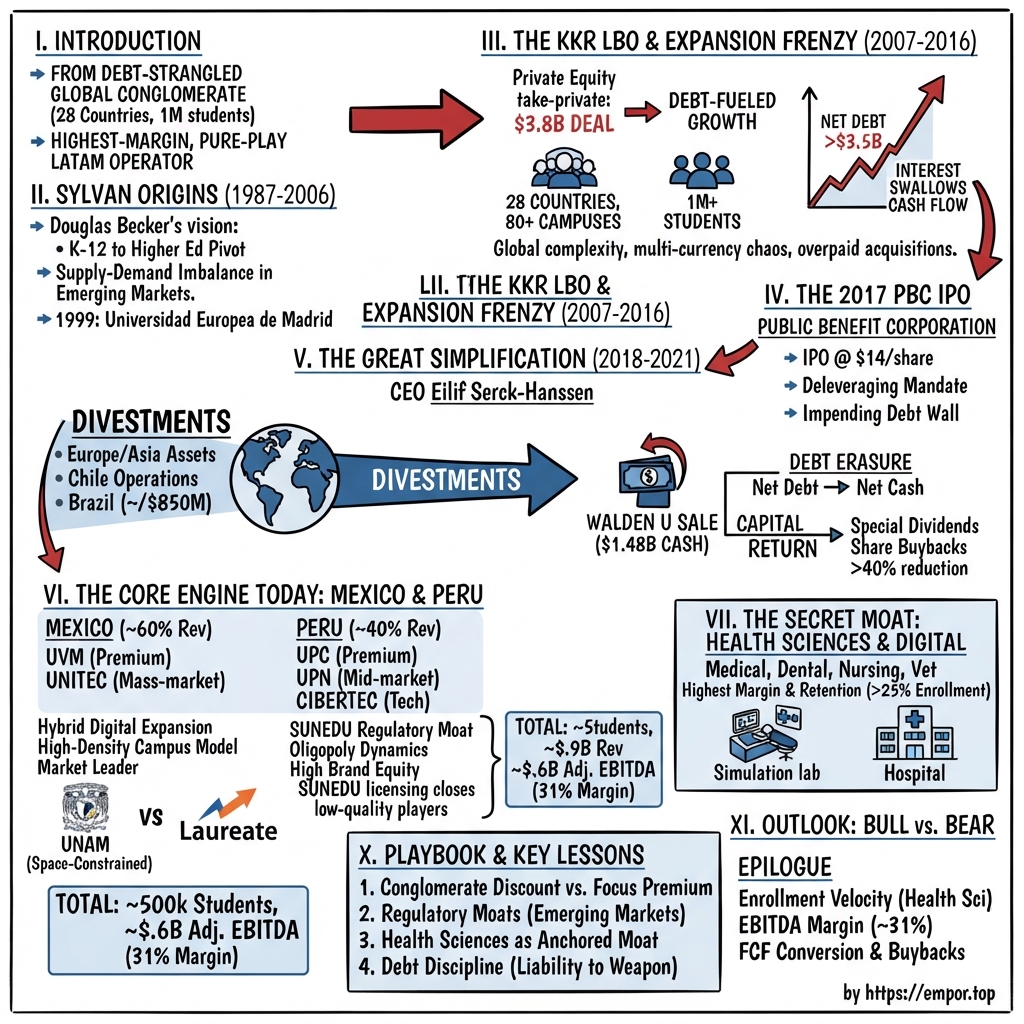
Laureate Education: The Ultimate Portfolio Turnaround in Global Higher Ed
I. Introduction & Episode Roadmap
A billion-dollar company nobody wanted
In February 2017, a company that described itself as the largest network of degree-granting universities on earth listed on the Nasdaq and asked investors what it was worth. The answer was humbling. Laureate Education priced its initial public offering at $14.00 per share, below the range its bankers had marketed, selling 35 million shares for roughly $490 million in gross proceeds.1 At the time, it enrolled more than one million students across 71 institutions in 25 countries on over 200 campuses — a vast global footprint assembled over two decades.1 However, it also carried billions of dollars in leveraged-buyout debt, and public markets decided that the heavy debt load was the defining factor.
Nine years later, the enterprise trading under the ticker LAUR bears almost no resemblance to the business that listed. It operates five institutions in exactly two countries, enrolling approximately 497,700 students at more than 50 campuses as of year-end 2025.2 The company reported $1.70 billion of revenue for 2025 and $518.9 million of Adjusted EBITDA. By June 2026, it held $223.2 million of gross debt against $161.7 million of cash — leaving net debt of roughly $61 million for a business guiding to nearly $600 million of Adjusted EBITDA.23 Between those two points, Laureate sold Walden University for $1.48 billion in cash, divested its entire Brazilian network, exited Chile, Australia, Turkey, Portugal, and Spain, distributed over $1 billion to shareholders in special cash distributions, and shrank its share base to roughly 140 million shares outstanding by March 2026, with full-year guidance assuming about 139 million weighted average diluted shares.[^4]45103
That is the headline narrative. The broader analytical question is whether the top-line restructuring tells the whole story.
The question underneath the story
The simplified version — management untangling a sprawling conglomerate to unlock trapped value — is largely accurate and well documented. However, it raises two harder questions for long-term investors. First: how much of the value creation stemmed from underlying operational improvements, and how much was simply the arithmetic of selling assets at higher multiples than the market assigned to a levered holding company? Second, and more critical looking ahead: what remains? A company with minimal net debt, no conglomerate discount left to narrow, and no further non-core assets to sell must generate growth through organic execution — enrolling more students at better price points across two emerging markets whose currencies it does not control.
A third structural question sits beneath both. Higher education in Mexico and Peru is neither a discretionary luxury purchase nor a subsidized entitlement. Instead, it occupies a distinct middle category: a major multi-year household investment funded out of income, selected deliberately, and locked in for several years. Businesses with those characteristics — long contracted duration, high switching costs, and aspiration-driven purchasing decisions — tend to exhibit greater durability than underlying GDP trends might suggest. Whether Laureate's financial performance can maintain that resilience through a prolonged downturn is a question that recent operating results have begun, but not yet finished, answering.
Roadmap
The analysis begins with Sylvan Learning Systems and founder Douglas Becker's original insight regarding emerging-market higher education — a sound concept that was ultimately expanded beyond its operational limits. It moves to the 2007 leveraged buyout, executed at $60.50 per share for roughly $3.8 billion just months before the global financial crisis, and the debt-funded roll-up that followed.6 The narrative then details the public benefit corporation IPO and its deleveraging mandate, the arrival of Chief Executive Officer Eilif Serck-Hanssen, and the multi-year divestiture campaign conducted from 2018 through 2021. Next, the focus shifts to the business as it exists today: two dual-brand university systems in Mexico and Peru, a growing fully online segment for working adults, and a health sciences franchise anchored by 24 medical schools and nine dental schools.2
From there, the analysis evaluates Laureate's competitive positioning, audits management's commitments against execution across a decade of earnings calls, applies Hamilton Helmer's 7 Powers and Porter's Five Forces to test structural advantages, and outlines the bull and bear cases alongside key operational metrics. Finally, it highlights the pressure points a skeptical activist investor would target — examining where the consensus view may be underestimating ongoing operational risks.
 Subscribe on LinkedIn
II. Sylvan Origins & Douglas Becker's Global Vision (1987–2006)
From strip-mall tutoring to a university group
The origin story does not begin in a university lecture hall. It begins in a Baltimore strip mall with a tutoring franchise focused on supplemental reading and math remediation.
Sylvan Learning Systems operated in a fragmented, highly seasonal market — providing after-school remediation and standardized-test preparation when traditional school systems fell short. Douglas L. Becker and R. Christopher Hoehn-Saric acquired a controlling stake in the business from KinderCare, completed a full takeover in 1993, and took the company public that same year.7 Becker was a serial entrepreneur in the Baltimore business community who possessed a sharp promoter's instinct for identifying where fragmented local services could be standardized, branded, and scaled.
Throughout the 1990s, Sylvan executed that exact playbook: rolling up tutoring franchises, launching a computer-based testing division, and expanding into adjacent education services. While viable, supplemental tutoring remained a tough long-term business — discretionary, highly competitive, and defined by customer relationships measured in months rather than years.
Becker's leadership style fundamentally shaped the company's strategic trajectory for the next two decades. Building and selling businesses since his teens, he combined a public commitment to education as a social good with an aggressive mandate for corporate expansion. In Becker's strategy, expanding educational access and acquiring as many institutions as credit markets would fund were treated as complementary goals.
The insight
The strategic shift that altered the company's trajectory arrived in the late 1990s, driven by a structural supply-and-demand imbalance in international higher education. In 1999, Sylvan acquired its first post-secondary institution, Universidad Europea de Madrid.7
What Becker identified across Spain, Latin America, and Asia was a demographic dynamic distinct from Western markets. In most emerging economies, state-funded universities were free or heavily subsidized, highly prestigious, and strictly rationed through competitive entrance exams. As secondary school graduation rates surged and middle-class populations expanded, demand for higher education outpaced state-funded capacity. Rather than viewing the shortage of university seats as a policy failure, Sylvan treated it as a commercial opportunity.
This thesis operated under fundamentally different economics than the U.S. for-profit education sector. In the United States, for-profit operators relied heavily on Title IV federal loan programs, leaving them vulnerable to regulatory policy changes. By contrast, in markets like Mexico and Peru, government student aid was virtually non-existent. As Laureate disclosed in its 2025 annual report, "essentially all of our revenues are generated from private pay sources as there are no material government-sponsored loan programs in Mexico or Peru."2 Because tuition is funded directly from household income, enrollment is tied to local economic health and wage growth rather than government subsidy regimes.
Furthermore, private operators in emerging markets competed on employment outcomes rather than institutional prestige. Unable to match the heritage of flagship public universities, private providers focused on practical career alignment: designing curricula around employer requirements, offering flexible evening and weekend schedules for working students, and establishing urban campuses near major employment hubs.
The pivot and the Latin American footprint
The operational shift prompted a corporate restructuring. In 2003, Sylvan sold its legacy K–12 tutoring business in a management-led buyout to form Educate, Inc., led by Hoehn-Saric. In 2004, the remaining higher education enterprise renamed itself Laureate Education.7 Divesting the legacy brand marked a complete strategic pivot toward post-secondary institutions.
During this era, Laureate assembled the core Latin American network that defines the company today. Universidad del Valle de México (UVM) joined the system in 2000, followed by Universidad Peruana de Ciencias Aplicadas (UPC) and CIBERTEC in 2004, Universidad Privada del Norte (UPN) in 2007, and Universidad Tecnológica de México (UNITEC) in 2008.2 Rather than establishing new campuses, Laureate acquired established regional institutions — UVM was founded in 1960, UNITEC in 1966, and UPC and UPN in 1994.2
Acquiring established institutions allowed Laureate to bypass the lengthy lead times required for regulatory licensing, accreditation, and alumni network development. Building a physical campus takes months; establishing decades of brand equity and graduate placement across regional employers takes generations. In the early 2000s, family-owned universities across Latin America faced succession planning challenges and capital constraints, allowing Laureate to acquire established regional assets at attractive valuations.
Once acquired, Laureate integrated these institutions into a shared global operating platform — centralizing back-office operations, standardizing curriculum development, and leveraging regional scale. That foundation — combining local brand history with centralized infrastructure — proved to be the most durable component of Laureate's strategy. However, management subsequently assumed this roll-up model could scale indefinitely across dozens of international markets using debt financing.
III. The $3.8B KKR LBO & The Global Expansion Frenzy (2007–2016)
The deal, and the calendar
On January 29, 2007, Laureate's board agreed to be acquired by an investor group led by founder and chief executive Douglas Becker. The transaction priced the company at $60.50 per share in cash, valuing Laureate at approximately $3.8 billion — a 23% premium to its early-January stock price and a multiple of 33.8 times trailing twelve-month earnings per share from continuing operations.6 The buyout consortium included Kohlberg Kravis Roberts & Co., Citigroup Private Equity, S.A.C. Capital (later Point72), Bregal Investments, StepStone, Sterling Partners, and Snow Phipps. The transaction closed in August 2007.2
Evaluating those terms against the economic calendar highlights the vulnerability of the structure. High leverage combined with a 33.8x earnings multiple and heavy emerging-market currency exposure left the enterprise exposed just twelve months before global credit markets froze. Because Becker rolled over his equity to lead the transaction, the buyout represented a shift in capital structure rather than strategic control. The existing management team retained its expansionary playbook, but now operated under a debt structure that demanded rapid growth to service high interest obligations.
The governance structure created by the buyout proved persistent. The main buyout vehicle, Wengen Alberta, Limited Partnership, remained a major shareholder for nearly two decades. As of March 2026, Wengen beneficially owned 12,485,166 shares, or roughly 8.9% of the company, alongside institutional shareholders FMR at 14.0%, Vanguard at 10.1%, and BlackRock at 7.0%.10 The decade-long sponsor presence illustrates both the time required to unwind the LBO architecture and the sustained equity overhang created as sponsors gradually reduced their positions post-IPO.
The roll-up
Over the next decade, Laureate executed one of the largest cross-border consolidation campaigns in the private equity sector. The company acquired institutions across Brazil, Chile, Mexico, Peru, Spain, Portugal, Turkey, Morocco, China, Malaysia, Australia, New Zealand, Cyprus, Italy, and the United States, where it owned Walden University. By the time Laureate prepared to return to public markets, its network encompassed more than one million students across 25 countries and over 200 campuses.1
Myth versus reality: did Laureate overpay?
The financial scale of this expansion reshaped the balance sheet. From 2008 onward, Laureate acquired roughly 50 institutions, expanding its global system to more than one million students across 88 institutions in 28 countries. Over that same period, gross debt rose from approximately $1.1 billion to $4.7 billion, driving annual interest expenses toward $200 million by mid-2015 and contributing to annual net losses in every year from 2010 onward.7
This debt-heavy roll-up created an unsustainable financial model. While the company achieved rapid top-line growth, the cost of servicing the capital structure consumed the operational gains. A four-fold increase in debt to fund 50 acquisitions left the enterprise unable to compound equity value under a heavy debt load.
A common critique suggests Laureate systematically overpaid for international education assets during the expansion. However, transaction evidence presents a more nuanced picture. Because Laureate did not disclose individual purchase multiples, asset-level acquisition prices remain unverified. Yet subsequent asset sales demonstrated notable residual value: the Brazilian network attracted a competitive auction that generated a break fee from the winning bidder, and Walden University was sold for $1.48 billion in cash to a strategic healthcare education provider.[^4] Management highlighted this execution on its fourth-quarter 2021 earnings call, stating that the divestitures were completed "at very accretive multiples."14
The primary structural flaw lay not in asset selection, but in balance sheet design. Laureate acquired legitimate educational institutions across multiple jurisdictions using dollar-denominated debt, while equity markets valued the combined enterprise at the discounted multiple of a levered conglomerate. The resulting value erosion stemmed primarily from multi-year debt carrying costs and conglomerate valuation discounts. Media coverage surrounding the 2015 IPO filing cited debt levels exceeding $4 billion, and by the 2017 listing, public markets viewed the offering primarily as a deleveraging transaction for a company carrying roughly $4.2 billion in debt.1 At peak scale, with leverage reaching four to five times EBITDA, the capital structure carried substantial risk for a business earning revenue across volatile currencies such as the Brazilian real, Chilean peso, Turkish lira, and Malaysian ringgit while servicing debt in U.S. dollars.
The overhead problem
The expansion also created significant operational complexity. Laureate's core premise was that scale would yield cost efficiencies and academic standardization across its network. However, operational synergies proved primarily effective within individual countries. A multi-campus university system in Mexico can share curriculum, administrative software, procurement, and faculty training. Conversely, operating a university in Malaysia offers limited operational synergy with an institution in Portugal. Expanding across 25 national jurisdictions required navigating 25 distinct regulatory regimes, accreditation bodies, tax codes, and labor laws, necessitating a massive central corporate infrastructure.
The impact of this corporate overhead became evident during Laureate's subsequent streamlining. Following its portfolio restructuring, management achieved approximately $45 million in annualized corporate general and administrative cost savings in a single year, with further reductions following.8 By 2025, annual corporate overhead dropped to $39.1 million against $1.70 billion in revenue.2 The contrast between the historical expense of managing a 25-country conglomerate and today's streamlined corporate center underscores the structural friction inherent in the original global model.
By the mid-2010s, Laureate's core assets in Mexico and Peru were effectively subsidizing the operating losses, working capital requirements, and debt service of the wider international network. Resolving this imbalance required private equity sponsors to pursue an initial public offering as the primary vehicle to restructure the balance sheet.
IV. The 2017 PBC IPO & The Deleveraging Mandate (2017–2018)
Going public with a conscience clause
The IPO was preceded by a distinct corporate reorganization. In October 2015, Laureate redomiciled in Delaware as a public benefit corporation — a structure that legally requires directors to balance shareholder financial interests against the interests of those materially affected by the company's conduct and a specific public benefit identified in its charter.2 Laureate's stated public benefit was expanding access to quality higher education. At the time, it was the largest enterprise to attempt a public benefit listing on a U.S. exchange.
Evaluating the public benefit structure requires separating governance reality from corporate positioning. It provided a defensible response to a common political critique of for-profit education: that private operators extract capital from student tuition. It also gave directors legal latitude to pursue long-term investments without facing immediate short-term shareholder litigation. However, it did not alter underlying operating economics. Laureate's own disclosures acknowledged this tension directly, warning that a focus on public benefit "may negatively influence our financial performance."2 Investors should view the status as a governance mechanism and a reputational asset in politically sensitive markets, rather than a competitive economic moat.
The structure also served a practical political function. In Mexico and Peru, private higher education faces periodic public scrutiny over foreign ownership and tuition pricing. Operating under a charter that obliges leadership to consider student and community impact offers useful institutional defense during legislative debates. For investors, the public benefit designation functioned primarily as political risk mitigation rather than an operational constraint — a status that ultimately did not impede subsequent portfolio divestitures, capital distributions, or share buybacks.
The reality check
The public listing on February 6, 2017, marked a pivotal transition for the enterprise.2 Pricing below its target range at $14.00 per share signaled market skepticism toward the offering.1 The underlying concerns were straightforward. Laureate asked public investors to underwrite a business exposed to more than twenty local currencies, complex regulatory regimes across multiple jurisdictions — including Chile, where policy had turned hostile toward private education — and substantial interest expense that absorbed a large share of operating cash flow. The growth model relied on ongoing debt-funded acquisitions, presenting an intricate investment thesis that public markets priced with a clear discount.
Management directed net proceeds primarily toward debt reduction.1 However, applying roughly $456 million in net proceeds against a multi-billion-dollar debt burden provided limited deleveraging. Rather than resolving the capital structure, the capital raise bought operational time, highlighting the need for broader portfolio rationalization.
The outcome illustrated a broader structural reality for highly leveraged holdings. High-quality operating assets burdened by excessive debt rarely re-rate through improved investor communications alone. Market valuations reflected a structural vulnerability: equity holders remained subordinate to substantial debt obligations secured by cash flows from volatile emerging-market currencies. Addressing this discount required fundamental balance-sheet restructuring rather than incremental messaging.
A new kind of chief executive
A leadership transition followed later that year. Founder Douglas Becker stepped down as chief executive at the end of 2017, later co-founding Cintana Education in 2019 in collaboration with Arizona State University.9 Eilif Serck-Hanssen, who had served as chief financial officer since 2008 and expanded his role to president and chief administrative officer, succeeded Becker as chief executive in January 2018.10
The transition represented a fundamental shift in corporate strategy. Becker's approach rested on cross-border consolidation, asserting that a unified global university network created value through international branding, student exchange programs, and centralized curriculum development. Serck-Hanssen brought an operational focus shaped by senior leadership roles across capital-intensive industries. His background included over five years at PepsiCo in international finance, three years at PricewaterhouseCoopers in London, and executive positions in the airline sector — serving as senior vice president and treasurer at Northwest Airlines and US Airways, co-founding Eos Airlines, and acting as chief financial officer at XOJET.10 He holds an MBA from Chicago Booth, credentials as an Associate Chartered Accountant, and an undergraduate degree in civil engineering.10
The airline industry provided a clear framework for evaluating complex operating networks. In aviation, profitability depends on strict unit economics, route-level capital allocation, active management of fuel and currency risks, and tight control over load factors. Applying that discipline to Laureate shifted executive focus from global scale to asset-level returns, prompting a rigorous evaluation of individual national markets.
That analytical shift laid the foundation for the strategic overhaul that followed.
V. The Serck-Hanssen Pivot: Portfolio Simplification & Value Unlocking (2018–2021)
The diagnosis
The strategic problem facing new leadership was straightforward, even if resolving it had been delayed for a decade. Laureate owned several high-margin, market-leading university systems alongside subscale, marginally profitable, and regulatorily exposed assets. Public equity markets priced the enterprise as a levered emerging-market conglomerate, assigning a valuation discount to the entire holding company. Meanwhile, strategic and financial buyers within individual domestic markets were willing to pay higher localized multiples for premier assets, evaluating them as leading national institutions rather than subsidiary units of a global entity.
While the valuation disconnect was clear, execution presented complex operational hurdles. Selling a higher education institution differs fundamentally from divesting a standard commercial asset. Every transaction requires change-of-control approvals from national regulatory authorities that operate independently of commercial timelines, accompanied by accreditation reviews and local political considerations. Each transaction had to be navigated under distinct legal systems, in different languages, and alongside diverse local stakeholders — including faculty, unions, and enrolled students. Furthermore, management had to run these processes largely in parallel to manage upcoming debt maturities and avoid signaling distress through a prolonged, piecemeal liquidation.
The disposals
The divestiture program spanned roughly four years, unwinding operations across Morocco, China, Malaysia, Italy, Cyprus, Turkey, Spain, Portugal, Australia, New Zealand, Chile, Brazil, and the United States. Two primary transactions generated the bulk of the proceeds.
The first major exit involved Brazil. Laureate had assembled one of the country's largest private higher education networks. By 2020, the Brazilian market presented severe headwinds: intense competition, structural oversupply in distance learning, and the unwinding of government student-financing programs that left operators with excess capacity and price-sensitive students. Laureate agreed to sell its Brazilian operations to Ânima Holding S.A. in a transaction valued at approximately 4.6 billion Brazilian reals, or roughly 4.4 billion reals — about $765 million — net of a termination fee paid to a prior bidder, Ser Educacional.11 The transaction closed on May 28, 2021.12 The competitive auction dynamic, in which two strategic buyers competed for the network and the winning bidder absorbed the break fee, indicated that local operators attached higher strategic value to the assets than public equity markets assigned to Laureate.
The Brazilian experience also shaped the company's subsequent operating strategy. The Brazilian distance-learning market had conditioned consumers to treat online study as a low-cost substitute for campus education rather than a premium, targeted product. On an earnings call in July 2026, Serck-Hanssen cited Brazil's price-discounting environment as a negative example that Laureate was deliberately avoiding in its core Mexican and Peruvian operations.3 Having navigated and exited that market, management maintained a strict positioning strategy for its remaining online programs.
The Walden endgame
The second major divestiture was Walden University. On September 11, 2020, Adtalem Global Education agreed to acquire the U.S. online institution for $1.48 billion in cash.[^4] Walden represented Laureate's largest single asset — a scaled online graduate institution with a health sciences focus that management noted on its fourth-quarter 2020 earnings call operated the largest Master of Science in Nursing program in the United States, with graduation rates exceeding 80%.8
However, the transaction faced regulatory complications shortly after signing. On September 14, 2020 — three days after announcing the agreement — Laureate received notice of a U.S. Department of Justice inquiry into Walden's nursing program regarding False Claims Act compliance.8 Responding to analyst questions on the February 2021 earnings call regarding closing certainty, Serck-Hanssen detailed the company's response: Laureate retained law firm Sidley Austin to conduct an independent review, which concluded by late 2020 without finding evidence of misrepresentation, and submitted those findings to the DOJ.8 While outlining the internal review, Serck-Hanssen declined to speculate on regulatory timing, stating it was "very hard to project specific time lines as the investigation is ongoing."8
The transaction also required change-of-control approvals from the Higher Learning Commission and the U.S. Department of Education, both of which management updated during earnings calls.8 The sale ultimately closed on August 12, 2021.4
Beyond generating cash proceeds, divesting Walden reshaped Laureate's risk profile. Walden represented the company's primary exposure to Title IV U.S. federal student aid programs, introducing regulatory risks absent from its private-pay Latin American operations. Divesting the asset eliminated direct exposure to U.S. higher education policy shifts while securing capital from a buyer organized around U.S. healthcare education.
The capital allocation
Following the asset sales, Laureate directed the proceeds primarily toward balance-sheet debt elimination and direct capital returns to shareholders rather than reinvesting in major new acquisitions. The board structured a plan of partial liquidation to distribute proceeds from the Walden transaction. A special cash distribution of $7.01 per share, totaling approximately $1.29 billion, was paid on October 29, 2021, alongside a commitment to distribute remaining net proceeds before year-end 2022.5 A second distribution of $0.58 per share, totaling roughly $105 million, followed in December 2021.5 An additional special cash dividend of $0.68 per share, totaling approximately $112 million, was paid on November 17, 2022.13 On the fourth-quarter 2021 earnings call, Serck-Hanssen summarized the outcome, stating that the company had completed its divestiture campaign, eliminated its debt burden, expanded operating margins, and returned nearly $1.8 billion of capital to shareholders.14
Alongside the divestiture campaign, management executed an internal efficiency initiative designated "Excellence in Process" to resize corporate overhead from a 25-country holding company down to a streamlined operational center for two primary markets. On the fourth-quarter 2021 earnings call, Chief Financial Officer Rick Buskirk reported that the program was complete, noting that final restructuring charges — including lease exit costs for U.S. facilities — were recognized in the fourth quarter of 2021, with no further restructuring expenses expected from 2023 onward.14 Setting a firm conclusion to non-recurring restructuring expenses provided clear visibility into normalized cash flow.
By year-end 2021, Laureate held a net cash position of $168 million.14 On its fourth-quarter 2024 earnings call, management stated that the company had returned nearly $3 billion to shareholders since 2019 through a combination of share repurchases, special distributions, and dividends.15
The portfolio rationalization demonstrated that narrowing a conglomerate discount requires management to execute asset sales, absorb transaction and tax costs, resize the organization, and return capital directly to shareholders. With the divestiture campaign complete, Laureate's operational focus shifted entirely to organic execution within its remaining Mexican and Peruvian markets.
VI. Core Business Deep-Dive: The Mexico & Peru Dual Engine
One playbook, run twice
Strip away the history and what remains is a remarkably legible business. Five institutions. Two countries. One repeated playbook.
The playbook is brand segmentation. In each market Laureate runs a premium, traditional university alongside a value, teaching-focused university, aimed at different household income tiers, with different price points and different campus footprints — but sharing curriculum, technology, procurement and administrative infrastructure underneath. It is the same structural logic that lets a consumer goods company run a premium and a mainstream brand off one supply chain.
In Mexico, Universidad del Valle de México is the premium brand, with 132,200 students at the end of 2025; Universidad Tecnológica de México is the value brand, with 137,200. Together, 269,400 students.2 Laureate's own filings, sourced to the Secretaría de Educación Pública's 2024 database, describe UNITEC as the largest private university in Mexico and UVM as a top-five university in the country.2
In Peru, Universidad Peruana de Ciencias Aplicadas is the premium brand with 78,400 students, Universidad Privada del Norte the value brand with 129,900, and CIBERTEC the technical-vocational institute with 20,000 — 228,300 students in total.2 Peru's Ministry of Education data, as cited by the company, ranks UPN as the third-largest private university in Peru and CIBERTEC as the second-largest private technical-vocational institute; UPC has been ranked first in the education sector by MERCO's institutional reputation ranking.2
The workforce behind those students numbers more than 33,900 employees, of whom 18,340 are academic staff, with more than 99% based in Mexico or Peru and most of the corporate team in the United States.2 That ratio — roughly 27 students per academic staff member, and a corporate function that is a rounding error on headcount — is the physical shape of the operating model. This is a labour business run at scale, not a technology business with an education wrapper, and readers should hold that in mind whenever the AI discussion comes up later.
The economics: Peru is the profit engine
Now the economics, and here the conventional framing needs correcting. Mexico is not the dominant profit engine. In 2025, Mexico generated $877.4 million of revenue and $229.4 million of Adjusted EBITDA; Peru generated $824.4 million of revenue and $328.6 million of Adjusted EBITDA.2 Mexico is slightly the larger revenue segment at roughly 52% of the total, but Peru produces meaningfully more profit — a segment margin near 40% against roughly 26% in Mexico.
That gap is the single most important operating fact about this company, and management has been unusually direct about its cause. Asked on the Q2 2026 call where the next wave of Mexican margin expansion comes from, chief financial officer Rick Buskirk explained that Mexico's margins had already moved from around 20% to roughly 26%, and that a substantial part of the remaining gap to Peru is structural: Laureate leases its Mexican properties and owns its Peruvian ones, a difference worth more than six percentage points of margin. Management stated it believes it can close a substantial part of that gap over the next three to five years.3
That is a useful disclosure precisely because it deflates a lazy bull argument. The Mexico-to-Peru margin gap is not 14 points of pure operational sloppiness waiting to be harvested. Roughly six points of it is a real estate decision that would cost real capital to reverse. The genuinely addressable portion — operating leverage on incremental revenue, campus consolidation, centralized cost structure — is smaller, and management's own consolidated framing is modest: expansion of roughly 30 basis points of Adjusted EBITDA margin per year.3 Investors modeling a march to Peru-like margins across the whole company are modeling something management has not promised.
One more structural feature deserves explanation, because it makes quarterly results misleading to anyone reading them casually. Mexico sits in the northern hemisphere and takes its primary intake in September; Peru sits in the southern hemisphere and takes its primary intake in the first quarter. Together the two primary cycles account for roughly 80% of annual new enrollment activity, and both fall in quarters when classes are largely out of session — so the company books its biggest commercial wins in its weakest profit quarters.16 The second and fourth quarters are the reverse: little enrollment activity, peak revenue and profit. In the first quarter of 2026, Laureate reported $273 million of revenue and negative $2 million of Adjusted EBITDA; in the second, $615.9 million of revenue and $250.6 million of Adjusted EBITDA.163 Same company, six weeks apart. Any analysis that annualises a Laureate quarter is worthless.
Why demand keeps showing up
The demand picture underneath is more encouraging, and it is where the long-term case genuinely lives. Laureate's annual report puts higher education participation, excluding technical-vocational institutes, at approximately 34% in Mexico and 42% in Peru, against roughly 55% in the United States.2 On the Q2 2026 call Serck-Hanssen used slightly different figures — Mexico around 36%, Peru in the high 40s, the U.S. in the mid-60s — but the shape is the same: a large, persistent gap that has been closing steadily for a decade.3 The economic incentive driving that closure is documented by the OECD: across member countries, employment earnings for adults aged 25 to 34 with higher education ran approximately 39% above those with only upper secondary education, with the advantage reaching 67% among adults aged 45 to 54.2
And critically, the public sector cannot absorb the demand. Management has stated that the private sector accounts for over 55% of combined university seats across the two countries.15 Public universities in both markets are free or nearly free, selective, and capacity-constrained. That is not a competitive dynamic Laureate created, and it is not one that a competitor can replicate away.
Management has also put outcome numbers behind the demand argument, and these are worth reporting with an appropriate label. In its 2025 impact report, discussed on the April 2026 call, Laureate stated that half of its newly enrolled students are first-generation university attendees, that nine in ten job-seeking graduates secure employment within twelve months, and that graduates of on-campus programs recover the nominal cost of their education in roughly three years through increased earnings relative to same-age high school graduates, with a shorter payback for working adults in fully online programs.16 These are company-produced figures using company methodology, not independently audited statistics. They are directionally consistent with the OECD wage-premium data and with the fact that families keep paying, but an investor should treat them as marketing-grade evidence rather than as verified fact.
The online engine
The newest growth vector is fully online degree completion for working adults, and it deserves its own treatment because it changes the economics in a specific way. Management sizes the fully online working-adult population at roughly 90,000 students in Mexico and 20,000 to 25,000 in Peru — around 14% of enrollment in Mexico and under 5% in Peru, against roughly 25% in the United States.3 The pricing is roughly 40% below the equivalent face-to-face program, which mechanically dilutes revenue per student, but management says contribution margin lands in the mid-50s — comparable to a campus — with essentially no capital expenditure, producing a far higher return on invested capital.3
That trade is the reason revenue and enrollment growth rates have converged recently in Peru rather than revenue outgrowing volume.3 It is not a warning sign in itself; it is the arithmetic of mix. But it does mean investors should watch enrollment growth and revenue growth as separate lines rather than assuming one implies the other.
The build-out
The campus build-out is the third leg. Laureate opened new campuses in Monterrey, Mexico, and Lima's Ate district in 2025, a Puebla campus for the September 2026 intake, with a southern Lima campus targeted for the first quarter of 2027 and a Mérida, Mexico campus for the September 2027 intake.3 Capital expenditure has risen accordingly — expenditures for long-lived assets were $103.0 million in 2025 against $71.9 million in 2024.2 This is the first genuine reinvestment cycle since the transformation, and it is the cleanest test yet of whether management can grow the physical footprint at attractive returns rather than merely harvesting an installed base.
The near-term cost of that cycle is visible and management has quantified it: new campus investment reduced expected 2026 consolidated margin expansion from roughly 75 basis points to roughly 50, with the drag concentrated in Mexico.16 A new campus loses money before it earns money — you build it, staff it, market it, and then fill it one cohort at a time over several years. That is the correct way to grow this business, and it is also exactly the pattern that makes near-term margins look worse than the underlying trend. The honest framing is that Laureate is trading reported margin today for enrollment capacity in 2028 and beyond, and investors get to decide whether they believe the capacity will fill.
Two open questions sit at the end of this section. First, both new 2025 campuses are described as performing "in line with our expectations" — an assertion with no disclosed benchmark attached.3 Second, the pipeline is deliberately weighted toward the value brands, UNITEC and UPN, which carry lower price points than the premium brands. A build-out concentrated in the value segment grows students faster than it grows revenue per student. That is a defensible strategy in markets where participation is still climbing from a low base. It is not the same thing as premium growth, and it should not be modelled as such.
VII. The Secret Moat: Health Sciences & Digital/Hybrid Delivery
The building that cannot be copied
Walk onto a Laureate campus in Lima or Mexico City and the physical difference between a general academic building and a health sciences facility is immediately obvious. One contains standard classrooms; the other houses simulation labs, anatomy facilities, dental operatories, teaching hospital affiliations, and a regulatory compliance file thick enough to demand a dedicated administrative staff.
That operational complexity forms a structural moat.
Across Mexico and Peru, Laureate operates 24 medical schools and nine dental schools.2 The company's disclosure regarding this strategy is straightforward: medical school licenses "are often the most difficult to obtain and are only granted to institutions that meet rigorous standards," and their existence "further validates the quality of our institutions and programs and increases brand awareness."2 In practice, an accredited medical school serves both as a core academic offering and as a signaling mechanism for the broader institutional brand.
The dynamics resemble a hotel group operating a flagship property. While the flagship may not generate the highest profit margin per square foot, its reputation establishes brand equity across the portfolio. A university licensed by government regulators to train physicians demonstrates compliance with stringent institutional standards—a halo effect that extends to its engineering and business programs.
The economics of health sciences differ from general education in three self-reinforcing ways. First, program duration: medical and dental degrees require significantly longer commitments than standard four-year undergraduate programs, securing several years of contracted tuition revenue per student. Second, retention: a student four years into a medical curriculum has committed substantial time and capital with few transferable alternatives, yielding retention rates that traditional marketing cannot replicate. Third, high barriers to entry: the combination of upfront capital expenditure for simulation facilities, clinical placement agreements with regional hospitals, and strict government licensing prevents new competitors from quickly replicating programs.
A fourth structural attribute is counter-cyclical resilience. During economic downturns, households may defer or reconsider discretionary business administration degrees. Conversely, families with students in advanced medical cohorts prioritize program completion, as the long-term career value dominates short-term budget constraints. This dynamic stabilizes the core enrollment base during broader macroeconomic contractions, supporting management's observation that the business model exhibits low correlation with general economic cycles.
What is disclosed, and what is not
Laureate does not report health sciences as a standalone financial segment, limiting visibility into asset-level margins. The company discloses that its three largest academic disciplines—Medicine & Health Sciences, Engineering & Information Technology, and Business & Management—together represent approximately 75% of total post-secondary enrollments.2 However, it does not break down enrollment or revenue among those three categories. Management continues to expand its medical footprint, having opened six new medical schools, two new dental schools, and one new veterinary school across its campuses in Mexico and Peru in 2024 alone.15 While strategic expansion remains evident, precise segment-level returns remain unquantified in public filings.
The hybrid dividend
The second component of the operating strategy is delivery format, which drives capital efficiency across the campus network.
Prior to the pandemic, Laureate required faculty online delivery training and mandated that students complete at least one online course. By 2019, 27% of teaching hours across the system were delivered online.14 Following full remote operations during 2020 and 2021, management established a steady-state hybrid model targeting approximately 50% digital delivery.14
This structural shift functions similarly to optimizing an airline's load factor—a parallel aligned with chief executive Eilif Serck-Hanssen's aviation background. Higher education campuses carry high fixed operating costs regardless of seat utilization. Transitioning half of instructional hours online allows a physical facility to accommodate increased student volume without a proportional expansion of real estate footprint.
As Serck-Hanssen noted on the fourth-quarter 2021 earnings call, expanding online delivery from 27% to roughly 50% effectively liberated 20 to 25 percentage points of physical campus capacity.14 This enabled Laureate to expand existing academic programs across campuses without incurring additional facility development costs, driving enrollment growth with modest capital intensity. Consequently, the recent expansion into new physical campus builds marks a shift from pure capacity optimization to active capital deployment.
This hybrid model presents two ongoing operational considerations. First, expanding online lecture formats increases student-to-faculty ratios, enhancing operating margins while introducing potential long-term academic quality risks that require monitoring. Second, fully online working-adult programs experience structurally higher attrition rates than on-campus programs—a factor Chief Financial Officer Rick Buskirk highlighted when explaining the divergence between new enrollment growth and total enrollment numbers.16 Management has addressed this challenge by restructuring digital onboarding processes and deploying AI tutoring tools, reporting improved student retention in Mexico.3 While these measures reflect a structured operational response, current disclosures provide directional commentary rather than detailed retention metrics, making ongoing tracking essential for evaluating long-term performance.
VIII. Competitive Landscape, Industry Structure, & Economic Drivers
War-gaming a new entrant
Building a competing university system from scratch in Mexico or Peru presents formidable regulatory and operational barriers.
In Mexico, a prospective operator must secure Reconocimiento de Validez Oficial de Estudios (REVOEs) for each individual academic program, granted either by the federal Secretaría de Educación Pública or state education ministries.2 In Peru, new institutions require comprehensive institutional licensing from the Superintendencia Nacional de Educación Superior Universitaria (SUNEDU), the agency created under the 2014 University Law to oversee the establishment, operation, monitoring, and closure of universities.217 Beyond regulatory hurdles, a new entrant requires prime urban real estate, qualified faculty, and years of graduate placement to build employer trust—all while competing on price against established operators with significant scale.
This market structure explains why the core group of higher education providers has remained relatively stable.
A more plausible threat comes from unbundled digital competitors aiming to capture profitable segments by offering online-only degrees without physical campuses or medical programs at lower tuition rates. Management has acknowledged this dynamic, with Chief Executive Officer Eilif Serck-Hanssen noting on the April 2026 earnings call that competitors have launched digital offerings following Laureate's expansion.16 However, the primary barrier protecting incumbents remains the official credential rather than instructional content. In Mexico, a degree requires REVOE recognition, while in Peru, it must be backed by a licensed university. Unaccredited online courses can deliver effective instruction, yet fail to confer degree credentials recognized by employers or professional associations.
The Peruvian purge
Peru provides a striking example of regulatory enforcement shaping market dynamics. SUNEDU's licensing mandate applied quality standards retroactively to existing institutions. Ultimately, 48 universities and two postgraduate schools were denied institutional licensing for failing basic quality metrics, allowing them to remain open only long enough to finish instruction for currently enrolled students.18 Notably, Universidad Alas Peruanas—previously one of Peru's largest private universities—was denied licensing under a 2022 board resolution after failing 14 of 27 evaluation indicators.1819
Commercially, this enforced wind-down created a massive wave of displaced, price-sensitive students seeking accredited alternatives. Licensed operators with available capacity, including Laureate's UPC, UPN, and CIBERTEC, absorbed significant student volume without incurring incremental marketing costs—demonstrating how strict regulatory enforcement can effectively function as a customer acquisition channel.
However, two caveats apply to this dynamic. First, the regulatory displacement represented a one-time windfall rather than a recurring growth engine, as the market consolidation has largely run its course. Second, regulatory policies remain subject to political shifts. In 2022, Peru's Congress passed legislation that reduced SUNEDU's authority and restored greater operational autonomy to universities.20 A regulatory regime powerful enough to eliminate non-compliant competitors also carries the risk of regulatory rollback or capture.
Who Laureate actually competes with
The competitive landscape varies significantly between Laureate's two primary markets. In Mexico, the elite tier is anchored by non-profit institutions such as Instituto Tecnológico y de Estudios Superiores de Monterrey (ITESM), against which Laureate benchmarks UVM in official filings.15 Laureate targets the broader middle and value segments rather than the elite tier: UVM operates just below the premier institutions, while UNITEC focuses on scale and price accessibility. In Peru, the market spans from prestigious institutions like Pontificia Universidad Católica del Perú to scaled private operators including Universidad Tecnológica del Perú and Universidad César Vallejo. Laureate's disclosures note that both national markets remain "highly fragmented and marked by large numbers of local competitors," with management expecting competitive intensity to increase over time.2
Rather than operating in a duopoly or lacking competition, Laureate's positioning relies on maintaining leading market shares across distinct price tiers, backed by established accreditation, physical infrastructure, and brand recognition built over decades.
In Mexico, Laureate maintains a structural customer acquisition pipeline that management detailed on its July 2026 earnings call. For traditional undergraduates—representing approximately 400,000 students across Mexico and Peru—recruitment relies on multi-year relationships with feeder high schools, engaging students from middle school through graduation via educational software, English language training, and career guidance.3 By contrast, customer acquisition for the approximately 100,000 fully online working adults utilizes digital lead generation, search marketing, and personalized AI recruitment tools.3
This dual approach creates two distinct acquisition models: while digital leads for online programs remain vulnerable to bidding competition, the high school outreach model forms a persistent pipeline built on multi-year institutional relationships.
The macro engine
Long-term expansion depends heavily on underlying demographic and macroeconomic trends. Mexico has a population of approximately 135 million with around 20 metropolitan areas exceeding one million residents, whereas Peru has roughly 35 million residents largely concentrated in Lima—demographic factors Chief Executive Officer Eilif Serck-Hanssen highlighted when explaining why Mexico offers a larger pipeline for new campus builds.3 Higher education participation rates in both countries continue to lag developed-market averages, while the wage premium for degree holders remains substantial. Because household tuition payments depend on income, management characterizes the operating model as "loosely correlated with economic cycles"—capturing upside during economic expansions while exhibiting demand stability during slower periods.16
Operating results during recent economic decelerations provide an empirical test of this resilience. As trade uncertainty slowed foreign direct investment in Mexico, national GDP growth decelerated from roughly 3% in the first half of 2024 to approximately 1% in the second half, with management assuming 1% GDP growth in its 2025 planning.15 Despite macroeconomic headwinds, Laureate's Mexican new enrollments grew 4% across 2025 intake cycles, expanded by another 4% in the March 2026 intake, and accelerated to 12% in the June 2026 working-adult intake.316 Sustaining mid-single-digit to low-double-digit enrollment growth during a period of sluggish GDP expansion demonstrates operational resilience, even if it does not guarantee performance through a severe economic contraction.
IX. Management Credibility, Capital Allocation, & Transcript Audit
The people
Evaluating a management team requires comparing current results against multi-year commitments rather than relying solely on present investor presentations. Chief Executive Officer Eilif Serck-Hanssen, 60, has led Laureate since January 2018 and served as president since July 2019, after joining as chief financial officer in 2008—placing him in financial leadership during the leveraged expansion he later dismantled.10 This dual history presents a complex governance picture: while leadership possessed intimate knowledge of internal operating friction, it had also overseen the balance-sheet expansion that preceded the restructuring. His equity alignment remains direct, holding 1,419,022 shares beneficially as of the 2026 proxy statement, alongside a policy requiring the chief executive officer to hold five times base salary in stock.10
Senior Vice President and Chief Financial Officer Rick Buskirk leads financial reporting, detailing quarterly seasonality, academic-calendar shifts, and constant-currency reconciliations. For an enterprise operating across two intake cycles, two hemispheres, and two volatile currencies, quarterly results can produce optical noise that obscures core operational trajectories. Laureate’s disclosure practice of isolating academic-calendar timing shifts—such as quantifying an expected $29 million favorable timing impact in the third quarter of 2026—provides institutional investors with enhanced visibility relative to peer disclosures.3
Executive messaging on earnings calls reflects a deliberate posture. When questioned on the July 2026 conference call regarding the critical September intake in Mexico—which was roughly halfway complete at the time—Serck-Hanssen provided a brief status update and declined further speculation, stating, "that's as much as I'm going to comment on that intake."3 A similar disciplined approach was evident during the Department of Justice inquiry into Walden University, where executive updates focused strictly on procedural milestones rather than speculative outcomes.
The broader executive team remains small and stable. Buskirk as chief financial officer, Marcelo Barbalho Cardoso as chief operating officer, and Leslie Brush as chief legal officer join Serck-Hanssen as the company's four named executive officers.10 Maintaining four named officers across a network of more than 50 campuses represents a lean corporate structure, reflecting the multi-year effort to shrink central administrative overhead.
The audit
An audit of historic management commitments provides concrete benchmarks for testing ongoing execution.
Promise one: directing divestiture proceeds to debt retirement and capital returns rather than acquisitions. On the February 2021 earnings call, management outlined its capital plan, noting that closing either the Walden University or Brazilian network transaction would provide sufficient liquidity to enable retirement of the bonds.8 By February 2022, management had completed both disposals, eliminated debt obligations, and returned nearly $1.8 billion of capital in a single year.14
Promise two: establishing a high-margin, cash-generative financial profile. Following portfolio rationalization, management established a three-to-five-year financial target: total enrollment compounding at 5% to 7%, constant-currency revenue growth at 8% to 10%, Adjusted EBITDA margin at 30% or above, and Adjusted EBITDA to unlevered free cash flow conversion above 50%. On the February 2025 earnings call, Buskirk stated that full-year 2025 guidance reflected attainment of that profile, while announcing that Laureate would focus on annual and quarterly guidance instead.15 While management argued that public markets had developed a clearer understanding of the streamlined business, withdrawing multi-year metrics eliminates a primary external benchmark. Setting multi-year targets is comparatively straightforward during a recovery off a depressed base; sustaining them requires organic operational execution across remaining markets.
Promise three: sustaining margin expansion and cash conversion. Full-year 2024 Adjusted EBITDA margin reached 28.7%, which management described as a historic high.15 Performance expanded further in 2025, generating $518.9 million of Adjusted EBITDA on $1,701.9 million of revenue—representing a 30.5% margin.2 Guidance for 2026 projects roughly 50 basis points of further reported margin expansion at the midpoint, with management stating that absent the drag from new campus investment it would have been closer to 75 basis points.316 Cash conversion guidance has remained aligned with target frameworks, guiding to approximately 50% of Adjusted EBITDA to unlevered free cash flow.3
Promise four: systematic return of excess capital. During the first six months of 2026, Laureate repurchased $181 million of stock, supported by a board authorization adding $150 million to the repurchase program alongside the Q2 results.3 Weighted average diluted shares fell from 157.9 million in 2023 to 148.7 million in 2025, with full-year 2026 guidance assuming approximately 139 million diluted shares—down from 140,062,673 shares outstanding as of March 24, 2026.2310
A fifth item highlights accounting disclosures under new reporting frameworks. In February 2025, Laureate introduced supplementary non-GAAP metrics—adjusted net income and adjusted earnings per share—explicitly to strip out discrete tax items and non-cash foreign exchange gains or losses on intercompany balances.15 While mid-story reporting modifications warrant close examination, the initial reconciliation resulted in lower reported profitability: 2024 adjusted net income of $209 million and adjusted EPS of $1.35 sat well below reported figures of $296 million and $1.92.15 Providing an adjusted metric that lowers headline earnings indicates a commitment to transparency regarding underlying cash performance.
Incentives and alignment
Executive compensation structures detailed in the 2026 proxy statement align annual incentives across four equally weighted performance metrics: Adjusted Financing EBITDA, revenues, new enrollments, and unlevered free cash flow, each at 25%.10 A key design feature is that Adjusted Financing EBITDA excludes the impact of foreign currency versus budgeted rates—protecting executive compensation from broad currency volatility, while simultaneously insulating management payouts from the single largest driver of reported results.10 The annual incentive plan pays zero below threshold but up to 200% at maximum, with 2025 producing an average payout of 126% of target across named executives; the chief executive's total 2025 compensation was $10,975,343, including an annual incentive payout of $1,606,800.10 Performance share units vested at 100% for the 2023 and 2024 grants and 150% for the 2025 grants.10
The live version
Recent earnings conference calls demonstrate how management responds to sell-side scrutiny regarding execution risks. On the July 2026 call, BMO Capital Markets analyst Jeff Silber asked directly about the September Mexican intake, which represents roughly 60% of the annual total. Serck-Hanssen said the intake was about halfway complete and "tracking along with my expectations, and that's as much as I'm going to comment on that intake."3 JPMorgan analyst Marcelo Santos pressed on the durability of the growth algorithm, receiving a structured response pointing to participation rates, online penetration, new campuses.3 Morgan Stanley analyst Mauricio Cepeda pressed twice on whether online growth cannibalizes higher-priced face-to-face enrollment and dilutes the bottom line. Serck-Hanssen's answer was specific: over 95% of students under 25 living near a campus choose campus programs, the fully online product is marketed to 25-to-50-year-olds, and he explicitly distinguished the approach from Brazil's distance-learning oversupply.3
Despite management's concrete answers to analytical questioning, specific operational disclosures remain missing. Public filings lack standalone financial metrics for the health sciences division as well as granular retention and completion data by modality. In both areas, management asks to be believed rather than shows the numbers.
Tracking management's narrative framework across five years of disclosures reveals consistent strategic positioning over time. In February 2022, the drivers were online penetration, lift-and-shift of programs across campuses, and excess campus capacity created by hybrid delivery.14 In February 2025, they were rising participation rates, wage premiums, affordability, and the private sector's structural share of seats.15 In July 2026, they were consolidated into three: participation rates, online penetration, and new campuses.3 The vocabulary evolved and the campus lever swapped in as the capacity dividend was consumed—but nothing was quietly dropped and no new metrics were invented to explain an operational miss.
X. Playbook: Business & Investing Lessons
Four transferable lessons emerge from this history, each carrying an essential limiting condition. Those conditions are the central point: strategic playbooks fail when copied without understanding their boundaries.
One: a conglomerate discount is only worth something if someone is willing to dissolve the conglomerate. Every levered multinational trades below the sum of its parts, and every executive team knows it. What made Laureate unusual was not diagnosing the problem, but acting on it through a plan that made the enterprise smaller, simpler, and—in headline top-line terms—substantially reduced. Revenue fell from over $4 billion at peak scale to roughly $1 billion in 2021 before rebuilding to $1.70 billion in 2025.2 The limiting condition: this strategy only works when individual assets have natural local buyers willing to pay strategic premiums. Laureate's assets did, because a market-leading university system in Brazil or Australia represents a trophy asset to a domestic operator. Few corporate conglomerates possess parts that are cleanly separable on those terms.
Two: regulatory tightening can be the cheapest customer acquisition channel that exists — once. Peru's licensing purge removed roughly 50 non-compliant institutions from the market, effectively transferring their student bases to accredited operators.18 No commercial marketing campaign could have bought that result. But a regulatory windfall is a one-time stock adjustment rather than a recurring flow: it revalues incumbent market share and then stops. The subsequent legislative weakening of SUNEDU serves as a reminder that regulatory dynamics can reverse.20 Investors must capitalize regulatory moats cautiously—they reflect political decisions as much as competitive strength.
Three: high-capital-intensity programs are a defensive asset in an industry facing digital commoditization. The competitive threat to universities from low-cost online alternatives is significant for general business degrees, but minimal for medical education. Students cannot complete clinical rotations asynchronously, and regulatory authorities will not license physicians trained purely online. Laureate's 24 medical schools and nine dental schools form the portion of its portfolio least vulnerable to digital disruption.2 The limiting condition is that this protection is capital-intensive to build and slow to expand. It functions as a defensive moat rather than a rapid growth engine.
Four: leverage is a tool whose sign depends entirely on the underlying business's volatility. The leverage that nearly broke Laureate across a 25-country portfolio with dozens of volatile currency exposures becomes readily manageable against today's two-country, private-pay cash flows. By mid-2015, interest payments on the buyout debt reached nearly $200 million annually while the enterprise recorded annual net losses every year from 2010 onward; by 2025, annual interest expense had fallen to $10.7 million.72 The takeaway is not that debt is inherently flawed, but that private equity sponsors applied maximum financial leverage to an operating structure already exposed to high operational and geopolitical risk. Today's balance sheet—holding a net-cash position—arguably sits at the opposite extreme, carrying minimal leverage against predictable operating cash flows. That represents a conservative capital policy that an activist investor would view as balance-sheet inefficiency.
XI. Analysis, Risk Radar, & Bear vs. Bull Case
Seven Powers
Applying Hamilton Helmer's 7 Powers framework demonstrates that Laureate possesses three distinct structural advantages, while lacking the remaining four.
Scale economies are real but geographically bounded. Within Mexico and Peru, operating a shared network of more than 50 campuses with standardized curriculum, centralized technology, procurement, and shared administrative infrastructure lowers cost per student. This operational efficiency is reflected in the expansion of Mexican operating margins from roughly 20% to 26%.3 However, these scale benefits stop at national borders; operating in Peru yields virtually no cost synergies in Mexico beyond sharing a modest corporate headquarters.
Switching costs are high and increase alongside program length. A student three years into a six-year medical degree at UPC faces credit-transfer losses, extended graduation timelines, and licensure uncertainty if transferring to another institution. This represents Laureate's most durable structural advantage, particularly within its expanding health sciences discipline.
Cornered resource applies narrowly to government licenses for medical and dental schools and clinical hospital placement agreements, which are scarce, slow to obtain, and impossible to acquire quickly with capital alone.2 Brand equity is closely related, anchored by UPC's top institutional ranking in Peru and UNITEC's scale leadership in Mexico.2
Laureate lacks network economies, as enrolling an additional student does not inherently increase degree value for existing students. It also lacks counter-positioning—competitors frequently replicate its dual-brand and hybrid delivery strategies, as executive management acknowledged regarding rivals introducing similar online formats.16 Finally, the company lacks proprietary process power or cornered supply-side inputs beyond educational licensing.
Five Forces
Porter's Five Forces analysis.
Threat of new entrants: Low for scaled, multi-campus university systems, but higher for unaccredited niche providers. Establishing a licensed medical school system across dozens of physical campuses requires capital and regulatory approvals that insulate incumbent operators.
Bargaining power of buyers: Moderate, taking the form of student price sensitivity rather than direct negotiation. Management explicitly noted that online programs are priced below inflation to drive volume, reflecting an active ceiling on pricing power.3
Threat of substitutes: Moderate and rising for general academic degrees, where bootcamps and short-term certificates compete, but weak for regulated professions requiring accredited degrees.
Bargaining power of suppliers: Faculty represent the primary operational input, making labor expenses the largest cost line in both operating segments; in Peru, academic and administrative labor costs totaled $294.5 million in 2025.2
Competitive rivalry: High and expanding, with public filings explicitly describing both Mexican and Peruvian markets as highly fragmented and expecting competitive intensity to rise over time.2
The activist stress test
The activist stress test. A skeptical activist investor would likely challenge four core areas.
First, potential capital allocation drift. With a net-cash balance sheet, minimal debt, and a newly authorized $150 million share repurchasing program, questions remain regarding whether management might eventually resume acquisitions. Chief Executive Officer Eilif Serck-Hanssen referenced a robust growth pipeline, including double-digit campus expansion opportunities in Mexico alone—projects that remain organic but demand significant capital.3 Annual capital expenditures increased from $71.9 million to $103.0 million year over year, representing a notable rise in capital deployment.2
Second, ongoing disclosure limitations, as filings omit standalone financial reporting for health sciences and online units, as well as retention and completion rates by modality. Third, the decision to withdraw multi-year guidance targets. Fourth, executive incentive structures that evaluate performance on constant-currency budget rates, insulating management compensation from foreign exchange fluctuations while public shareholders receive returns in U.S. dollars.10
A fifth critique centers on accounting judgments and audit oversight. PricewaterhouseCoopers LLP was submitted to shareholders for ratification as independent auditor in the 2026 proxy statement, overseeing key accounting areas including goodwill and intangible impairment testing for Mexican and Peruvian units, student bad debt allowances, and revenue recognition timing across shifting academic calendars.102 Student bad debt provisioning serves as an early operational indicator; for instance, management attributed elevated Peruvian bad debt allowances in 2024 to lagging effects of a regional recession, illustrating how financial provisions can signal underlying student stress prior to changes in headline enrollment data.15
Risk radar
Risk radar — material factors.
Currency translation risk. Foreign exchange translation represents the primary source of volatility in reported results. Because revenues and operating costs are matched in local currencies, Laureate carries negligible transaction exposure, but translating local earnings into U.S. dollars creates substantial reporting swings.15 In 2025, Mexican revenue grew 4% as reported but 9% in constant currency, as currency headwinds reduced revenue by $42.9 million and Adjusted EBITDA by $11.6 million; conversely, Peruvian currency movements added $45.4 million to revenue and $20.0 million to Adjusted EBITDA.2 Consequently, 2025 financial guidance projected flat-to-declining reported revenue alongside 6% to 7% constant-currency growth due to Mexican peso weakness.15 By mid-2026, currency trends reversed, pushing reported revenue growth to 13% against constant-currency growth of 6% to 7%.3 Evaluating underlying performance requires focusing on constant-currency metrics rather than reported headline figures.
Political and regulatory exposure. Both operating markets experience periodic political shifts. Following the initial joint review of the United States-Mexico-Canada Agreement in July 2026, which initiated an annual review process starting in 2027, management described the trade framework as fundamentally sound.3 In Peru, executive updates cited recent national elections in expressing expectations for market-oriented policy.3 While management treats these developments favorably, investors face core regulatory risks centered on domestic education policy, including institutional licensing standards, tuition controls, and private-sector tax policies. Legislative action in Peru has already demonstrated that higher education regulations remain subject to statutory revision.20
Macroeconomic and demand sensitivity. Tuition payments depend directly on household income without federal loan programs or government backstops.2 While management describes enrollment demand as loosely correlated with broader economic cycles, a severe macroeconomic downturn in Mexico would present a harsher operational test than the 1% GDP growth environment of 2025.
Technological disruption and AI adoption. Artificial intelligence presents both operational opportunities and competitive risks. Management highlighted two consecutive years of recognition from Boston Consulting Group and Google for digital marketing capabilities, noting that AI tools improved lead conversion, lowered customer acquisition costs, and introduced automated tutoring to support student retention.3 Conversely, official risk factors acknowledge that rival institutions expanding AI and machine learning tools in online education pose a competitive threat.2 While instructional tools evolve, accredited degree credentials remain the primary barrier protecting incumbent operators from digital disintermediation.
Geographic concentration. With over 99% of personnel located in Mexico and Peru, virtually all revenue originates from two national economies and two currencies.2 The portfolio simplification that enhanced operating margins simultaneously eliminated global geographic diversification, leaving consolidated performance tied directly to stability within these two primary markets.
Why it wins, and what breaks it
The bull case. Laureate holds leading positions across distinct market segments in Mexico and Peru, where post-secondary participation rates trail U.S. levels by 10 to 20 percentage points, public universities face capacity constraints, and degree wage premiums provide strong household incentives for enrollment. Growth rests on three underlying operational drivers: expanding national participation rates, increasing online penetration among working adults, and executing a multi-year physical campus development pipeline with sites already secured.3 Operating margins expand incrementally, cash conversion targets roughly 50% of Adjusted EBITDA, the balance sheet maintains a net-cash posture, and ongoing share repurchases reduce total share count annually. Under this framework, per-share earnings compound faster than top-line revenue expansion.
The bear case. The initial restructuring catalysts—asset sales, debt elimination, and corporate overhead reductions—are complete, leaving future equity value tied entirely to organic execution. Mexican margin expansion faces structural limits due to leased physical real estate, with management targeting modest annual margin gains of roughly 30 basis points. Furthermore, expansion relies heavily on online programs priced 40% below face-to-face tuition, placing pressure on revenue per student while exhibiting higher student attrition. Geographic concentration in two emerging markets leaves operations exposed to regional political shifts, economic downturns, or legislative changes in education policy. Foreign exchange translation will continue to create volatility in reported results, while the multi-year campus build-out represents a capital-intensive reinvestment cycle whose financial returns will take years to materialize.
XII. Epilogue & Conclusion
There is a version of this story where the conclusion is defined by strategic drama, and another where it is defined by predictable execution. Laureate is betting on predictable execution.
The enterprise that emerged from this multi-year transformation is structurally straightforward: private-pay tuition with no government loan reliance, five institutions across two countries, a net-cash balance sheet, and a declining share count. The strategic restructuring — the private equity buyout, global expansion, heavy leverage, asset divestitures, and major capital distributions — is complete. Looking ahead, performance depends on mid-single-digit enrollment growth, modest margin expansion, and disciplined capital deployment as the company develops new campuses in Puebla, Mérida, and southern Lima.
This operating model represents a fundamentally different investment proposition from the turnaround thesis of prior years. With portfolio rationalization concluded, the company must generate returns through organic execution in two emerging markets, managing unhedged local currency exposure while competing against domestic operators adopting similar digital and physical strategies.
Three primary metrics indicate whether this operational strategy is succeeding.
New student enrollments in Mexico and Peru, by intake cycle. New enrollment serves as the primary leading indicator for future performance — a role reflected in Laureate's executive compensation structure and quarterly intake updates.10 Because university degree programs span multiple years, a single weak intake depresses tuition revenue over several academic years, whereas a strong cohort compounds over time. The September Mexican intake warrants close attention, as management has noted it accounts for roughly 60% of annual enrollment in that market.3
Constant-currency revenue and Adjusted EBITDA growth, rather than reported figures. Fluctuations in the Mexican peso and Peruvian sol can shift reported financial results by high single digits without altering underlying operational performance, as opposing currency movements illustrated across 2025 and 2026.23 Evaluating performance in U.S. dollars risks confusing short-term currency translation with long-term business trajectory.
Free cash flow conversion and the pace of share repurchases. Management has targeted converting approximately 50% of Adjusted EBITDA into unlevered free cash flow.3 As capital expenditures rise to fund physical campus expansion, free cash flow metrics will demonstrate whether capital discipline remains intact — providing a clear signal of how effectively management allocates shareholder capital in the absence of debt service or major acquisitions.
References
-
Laureate Education Prices IPO Below Expected Range — Reuters, 2017-02-01 ↩↩↩↩↩↩
-
Form 10-K Annual Report for Fiscal Year Ended December 31, 2025 — Laureate Education, Inc. SEC Filing, 2026-02-19 ↩↩↩↩↩↩↩↩↩↩↩↩↩↩↩↩↩↩↩↩↩↩↩↩↩↩↩↩↩↩↩↩↩↩↩↩↩↩↩↩↩↩
-
Laureate Education Reports Second Quarter 2026 Results and Q2 2026 Earnings Conference Call — Laureate Education / Business Wire, 2026-07-30 ↩↩↩↩↩↩↩↩↩↩↩↩↩↩↩↩↩↩↩↩↩↩↩↩↩↩↩↩↩↩↩↩↩↩↩↩↩↩
-
Adtalem Global Education Completes Acquisition of Walden University — Adtalem Global Education Press Release, 2021-08-12 ↩↩
-
Laureate Education Announces Special Cash Distribution — PR Newswire, 2021-09-21 ↩↩↩
-
KKR-Led Consortium to Buy Laureate Education for $3.8 Billion — The Wall Street Journal, 2007-01-29 ↩↩
-
Laureate Education files IPO with $4.7 billion debt — The Baltimore Sun, 2015-10-05 ↩↩↩↩↩
-
Laureate Education Fourth Quarter and Year-End 2020 Earnings Conference Call — Laureate Education Investor Relations, 2021-02-25 ↩↩↩↩↩↩↩
-
Laureate founder Douglas Becker is now leading Cintana Education — Technical.ly ↩
-
Laureate Education, Inc. 2026 Definitive Proxy Statement (DEF 14A) — SEC, 2026 ↩↩↩↩↩↩↩↩↩↩↩↩↩↩↩↩
-
Brazil's Ânima Educação Wins Bid to Acquire Laureate's Brazilian Assets — Reuters, 2020-10-21 ↩
-
Laureate Education Announces Closing of Sale of its Operations in Brazil — PR Newswire, 2021-05-28 ↩
-
Laureate Education Announces Special Cash Dividend — PR Newswire, 2022-10-27 ↩
-
Laureate Education Fourth Quarter and Year-End 2021 Earnings Conference Call — Laureate Education Investor Relations, 2022-02-24 ↩↩↩↩↩↩↩↩↩
-
Laureate Education Fourth Quarter and Year-End 2024 Earnings Conference Call — Laureate Education Investor Relations, 2025-02-20 ↩↩↩↩↩↩↩↩↩↩↩↩↩
-
Laureate Education First Quarter 2026 Earnings Conference Call — Laureate Education Investor Relations, 2026-04-30 ↩↩↩↩↩↩↩↩↩↩
-
Superintendencia Nacional de Educación Superior Universitaria Portal — SUNEDU Perú ↩
-
¿Cuáles son las universidades con licencia denegada por Sunedu que operarán hasta 2025? — La República, 2022-11-14 ↩↩↩
-
Sunedu denegó nueva solicitud de licencia institucional presentada por la Universidad Alas Peruanas — RPP Noticias, 2022 ↩
-
Sunedu: ¿Qué significa la nueva ley que debilita esta superintendencia y devuelve autonomía a universidades? — Infobae, 2022-05-05 ↩↩↩
 LinkedIn
 WhatsApp
 Reddit
 Hacker News
 Email
Email Kindle
 RSS Feed
 Spotify
 Apple Podcasts
 Amazon Music
 Audible
 YouTube