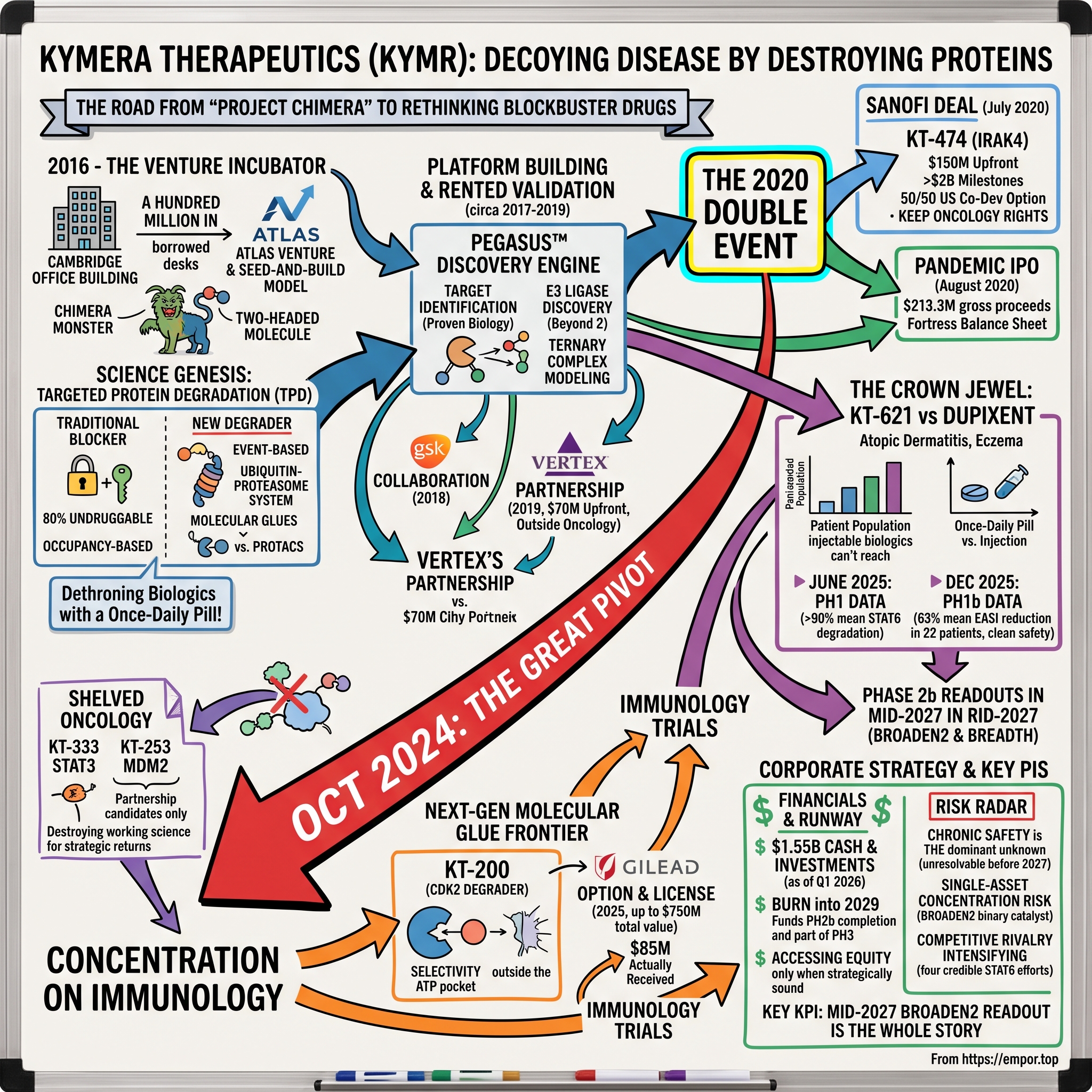
Kymera Therapeutics: Dethroning Biologics with Targeted Protein Degradation
I. Introduction & Episode Roadmap
In the spring of 2016, on the third floor of a nondescript office building in Cambridge, Massachusetts, a handful of scientists were working out of borrowed desks inside a venture capital firm. The company they were building did not have a name yet. Internally, it was called "Project Chimera" — a nod to the two-headed monsters of Greek myth, and to the two-headed molecules they intended to build. It had no laboratory of its own, no clinical program, and no drug. What it had was a thesis: that the pharmaceutical industry had spent a century learning to block proteins, when it should have been learning to destroy them.
Ten years later, that company operates under the name Kymera Therapeutics, trades on the NASDAQ under the ticker KYMR, and carries a market capitalization of roughly $9.5 billion.1 It has never sold a single dose of a commercial medicine. It has never recorded a dollar of product revenue. As of March 31, 2026, it sat on $1.55 billion in cash, cash equivalents and investments, with management guiding to a runway extending into 2029.2
That combination — no product, no revenue, a nine-figure quarterly burn, and a ten-figure balance sheet — is the puzzle worth unpacking. It is not a puzzle that resolves into a simple story of scientific brilliance. Kymera's history is better read as a case study in something more prosaic and more interesting: how a small company used other people's money to de-risk a novel technology, then made a series of hard subtraction decisions that most biotech management teams never make, and finally aimed the whole apparatus at a single, enormous, extremely well-defended commercial target.
That target is Dupixent, the injectable antibody co-developed by Sanofi and Regeneron, which recorded global net sales of roughly $17.8 billion in 2025 — up 26% year over year.3 Dupixent is one of the most successful drugs in the history of the industry. Kymera's lead asset, KT-621, is a once-daily pill designed to hit the same biological pathway. If it works at scale, it addresses a patient population that injectable biologics have never reached. If it does not, Kymera is a company with a very large bank account and a very large hole in its pipeline.
The rest of this story proceeds in sequence. First, the science — what "targeted protein degradation" actually means, in language that does not require a biochemistry degree. Then the founding, and the peculiar venture-creation model that produced the company. Then the platform-building years, and the partnership strategy that let Kymera spend other people's capital on its own validation. Then the 2020 double event — a transformational Sanofi deal and a pandemic-era IPO — that turned a private research shop into a public clinical company. Then the pivot: the decision, in late 2024, to shelve two oncology programs that were arguably working. Then STAT6, the data, and the market reaction. Then the molecular glue business with Gilead. And finally, the harder questions: what actually constitutes a moat here, what the skeptics are pointing at, and which two or three numbers genuinely matter from this point forward.
 Subscribe on LinkedIn
II. The Scientific Genesis: What is Targeted Protein Degradation (TPD)?
Start with a lock and a key, because that is how drug discovery has worked for most of its history.
A disease-causing protein floats around inside a cell doing something harmful. Traditional small-molecule drugs — aspirin, statins, most cancer drugs, essentially the entire pharmacopoeia you can swallow — work by finding a groove or pocket on that protein's surface, wedging themselves into it, and physically blocking the protein from doing its job. This is called occupancy-based pharmacology. The drug must be present, in sufficient concentration, sitting in that pocket, for the entire duration of its therapeutic effect. Stop taking it, the drug washes out, the protein resumes work.
Occupancy-based pharmacology has one enormous structural limitation, and it is not a matter of chemistry skill. It is a matter of geometry. Most proteins in the human body simply do not have a pocket. They are smooth. There is nowhere to wedge a molecule. Industry estimates have long held that the large majority of the human proteome — often cited as more than 80% — is functionally inaccessible to conventional small molecules for exactly this reason. These proteins acquired the industry nickname "undruggable," which is really a statement about the tool, not the target.
Transcription factors are the canonical example. These are the proteins that sit inside a cell's nucleus and decide which genes get switched on. They are, biologically speaking, the master switches of disease. They are also almost uniformly pocketless. Generations of medicinal chemists have thrown themselves at transcription factors and come away with nothing.
The trash-collection insight
Now consider the alternative. Every cell contains a garbage disposal system called the ubiquitin-proteasome system. It works roughly like municipal waste collection. A class of enzymes called E3 ligases act as the inspectors: they identify proteins that have outlived their usefulness and stick a small chemical tag — a molecule called ubiquitin — onto them. Think of it as a bright orange sticker that says "remove this." Once a protein accumulates enough stickers, a barrel-shaped cellular shredder called the proteasome grabs it and destroys it. The cell does this constantly, to millions of proteins, as routine housekeeping.
The insight behind targeted protein degradation is deceptively simple: rather than trying to block a bad protein, what if you could trick the inspector into tagging it?
This is event-based pharmacology, and the difference from occupancy-based drugs is profound. A degrader molecule does not need to sit permanently on its target. It needs to introduce the target to the E3 ligase, wait for the sticker to be applied, and then leave — free to go find another copy of the target protein and do it again. One drug molecule can, in principle, destroy many target molecules. Chemists call this catalytic activity. On Kymera's first-quarter 2026 earnings call, CEO Nello Mainolfi framed exactly this as the technical argument for degraders over conventional inhibitors, noting that degraders operate at "nanomolar to picomolar" exposures where a stoichiometric inhibitor would need vastly more drug to achieve comparable pathway suppression.4
Critically, a degrader also does not need a functional pocket. It only needs somewhere to hold on. Any surface groove will do, even one that has nothing to do with the protein's biological activity, because the drug is not trying to interfere with function. It is trying to arrange an introduction. This is what reopens the undruggable 80%.
Two shapes of the same idea
The field has produced two main molecular architectures.
PROTACs — proteolysis targeting chimeras — are the two-headed monsters that gave Project Chimera its name. One end of the molecule grips the target protein. The other end grips an E3 ligase. A chemical linker joins them. When both ends are engaged, the three components form what is called a ternary complex, the E3 ligase applies its ubiquitin stickers, and the target is destroyed. PROTACs are conceptually elegant but physically large — considerably heavier than conventional oral drugs — which historically made them difficult to formulate as pills.
Molecular glues are subtler and smaller. Instead of physically bridging two proteins, a glue binds to the E3 ligase alone and slightly reshapes its surface, creating a new contour that happens to be complementary to the target protein. The two proteins are then attracted to each other on their own. Glues are lower molecular weight, simpler to synthesize, and generally better behaved as oral drugs. They are also far harder to discover rationally, because you are searching for a molecule that creates an interaction that does not otherwise exist.
Why this stayed in oncology for so long
There is a reason the first two decades of degrader development happened almost entirely in cancer.
The best-known molecular glues in medicine were discovered by accident. Thalidomide and its descendants — Celgene's Revlimid and Pomalyst — turned out, decades after their introduction, to work by gluing an E3 ligase called cereblon to certain transcription factors and destroying them. That accidental precedent gave the field a validated E3 ligase to work with and a proof that degradation could produce real clinical benefit.
But oncology is also a permissive setting. Cancer patients and their physicians accept meaningful toxicity in exchange for meaningful survival benefit. Degraders could be given intravenously. They could be dosed intermittently. They could have imperfect selectivity. None of those compromises are acceptable in a patient with eczema who is otherwise healthy, expects to take a pill every morning for years, and has perfectly good — if inconvenient — biologic alternatives.
Moving degradation into immunology therefore required solving three problems simultaneously: making the molecules small enough to swallow, selective enough not to accidentally destroy anything else, and safe enough for chronic daily use in people who are not dying. For most of the 2010s, that was widely regarded as a decade-out proposition, if it was possible at all.
Which is precisely the problem a small group of people in Cambridge decided to make their business.
III. Founding Context: Project Chimera & the Atlas Venture Incubator
Bruce Booth did not set out to run a company. He set out to build one and hand it off.
Booth is a partner at Atlas Venture, the Cambridge life sciences firm, where he has worked since 2005. He is also, for a certain slice of the biotech world, a familiar voice — the author of LifeSciVC, a long-running blog in which he writes about venture creation, capital efficiency, and the structural economics of drug development with more candor than most people in his position permit themselves. Atlas practices what the industry calls seed-and-build venture creation: rather than waiting for entrepreneurs to arrive with a pitch deck, the firm identifies a scientific thesis, assembles a founding team around it, and incubates the resulting company inside its own offices until it can stand up on its own.
In early 2016, the thesis Atlas committed to was targeted protein degradation. The academic literature had begun producing convincing in-vivo evidence that degraders could work in living animals, not just in dishes. Atlas seeded the company in the spring of 2016 and incubated it in-house, with Booth serving as founding CEO — a placeholder role, by design, while the permanent team was recruited. He held the title from September 2015, when the entity was incorporated, until August 2017.5 He remains chairman of the board.
The permanent team arrived in the form of two entrepreneurs-in-residence: Nello Mainolfi and Stuart Chaffee, joined by Atlas associate Steve Robinette.6
The chemist who wanted the hard problem
Mainolfi's background matters to the story, because it explains a decision the company made very early that looked, at the time, like unnecessary difficulty.
He trained at Imperial College London and then at the Scripps Research Institute in California, and began his industrial career at the Novartis Institutes for BioMedical Research in Cambridge, where he led programs from discovery into preclinical and clinical development — including the work that produced iptacopan, the first-in-class factor B inhibitor that Novartis eventually took to FDA approval.7 Before Kymera he was head of drug discovery at Raze Therapeutics, another Atlas portfolio company, and then an entrepreneur-in-residence at the firm itself.
That is a specific kind of résumé. Mainolfi is not a platform technologist who happened into biology, nor an academic founder commercializing his own lab's discovery. He is a medicinal chemist — a person whose professional identity is built around the craft of turning an interesting molecule into an actual, swallowable, manufacturable drug. Medicinal chemists tend to be temperamentally obsessed with the unglamorous properties: oral bioavailability, metabolic stability, selectivity, the difference between a compound that works in a mouse and a compound that works in a pill.
That orientation shaped Kymera's founding bet. The obvious commercial path in 2016 was to build PROTACs against oncology targets using cereblon or VHL — the two well-characterized E3 ligases everyone in the field already used — and compete on speed. Kymera's stated ambition from the outset was different: to build a world-leading platform in the modality, discovering novel first-in-class medicines with degradation-induced pharmacology that conventional inhibitors could not replicate.8 In practice that meant investing in E3 ligase discovery itself — hunting for ligases beyond the standard two, including ones expressed preferentially in particular tissues — and investing in the chemistry required to make degraders behave like ordinary oral drugs.
The company launched publicly in October 2017 with $30 million in Series A financing from Atlas Venture, Lilly Ventures, and Amgen Ventures.9 Roughly a year later, in November 2018, it raised a $65 million Series B to push a pipeline spanning both oncology and immunology.10 The inclusion of immunology in that Series B language, in 2018, when no degrader had come close to demonstrating chronic oral safety in healthy people, is the earliest documented evidence that the eventual pivot was not an improvisation. It was the plan, waiting for the chemistry to catch up.
Whether that plan was prescient or merely fortunate is a fair question, and one worth holding onto. Plenty of 2018-era biotech decks described enormous non-oncology ambitions. What distinguishes Kymera is not that it wrote the ambition down. It is what it did next with someone else's balance sheet.
IV. Scaling the Pegasus™ Platform & Early Capital Strategy
Here is the central economic problem of a platform biotech, and it is worth stating plainly before describing how Kymera addressed it.
A platform company claims that its technology can generate many drugs, not one. But a platform is unfalsifiable until a drug from it works in a human being. Between the claim and the proof lies five to eight years and several hundred million dollars. Investors, reasonably, will not fund that gap on faith alone. So the platform company faces a choice: sell equity cheaply and repeatedly during the unproven years, diluting founders and early investors into irrelevance, or find someone else to pay for validation.
Kymera chose the second path with unusual discipline.
What the platform actually is
The company brands its discovery engine Pegasus, and the name does more marketing work than explanatory work, so it is worth decomposing.
The first pillar is target identification — using informatics to scan human genetics and disease biology for proteins that are strongly validated as disease drivers but that conventional chemistry has never been able to touch. The value here is not in finding new biology. It is the opposite: Kymera deliberately hunts for targets where the biology is already proven, often by an existing injectable biologic or by human genetics, and where the only unsolved problem is the chemistry. This meaningfully lowers biological risk while concentrating technical risk in the one area the company believes it is best at. That is a coherent strategy, and it also explains why so much of Kymera's pipeline reads like a list of pathways someone else already validated expensively.
The second pillar is E3 ligase discovery. The number of E3 ligases encoded in the human genome runs to several hundred; the number routinely used in drug discovery has historically been about two. Every additional usable ligase expands the space of degradable targets and, potentially, allows degradation to be confined to particular tissues — destroying a protein in the skin and lung, say, while leaving it intact in the bone marrow. Kymera's collaboration work with GSK in 2018 was explicitly aimed at this: a two-year discovery agreement that gave Kymera access to GSK's DNA-encoded libraries — vast collections of compounds barcoded with DNA sequences, allowing trillions of molecules to be screened at once — with novel E3 ligase discovery named as a shared objective.11 Financial terms were not disclosed.
The third pillar is ternary complex modeling. This is the least intuitive and arguably the most important. A degrader only works if the three-way handshake between drug, target, and ligase produces a geometry that positions the ubiquitin machinery correctly. Small changes in linker length or rigidity can turn a potent degrader into an inert molecule. Predicting these structures computationally — rather than synthesizing hundreds of candidates and testing empirically — is what separates a research program that iterates in weeks from one that iterates in years.
The honest analytical framing is that all three pillars are claims about productivity, not about exclusivity. Nothing here is patent-protected in the way a chemical composition is. The question of whether this constitutes a durable advantage is one the article returns to later, with evidence.
Renting validation
The partnership strategy is easier to evaluate, because it produced cash.
In May 2019, Vertex Pharmaceuticals entered a four-year strategic collaboration with Kymera, paying $70 million upfront — a figure that included an equity investment in the company — to discover degraders against targets in serious diseases outside oncology. Kymera became eligible for more than $1 billion in aggregate research, development, regulatory and commercial milestones across up to six programs, with Vertex holding options to exclusively license molecules upon designation of a development candidate.1213
Consider what that deal did for a private company with roughly $95 million raised across two prior rounds. The upfront payment alone approximated the company's entire prior venture funding. It arrived without diluting existing shareholders — an equity component aside — and it carried an implicit endorsement more valuable than the cash: Vertex, a company with genuine institutional expertise in small-molecule chemistry and a reputation for scientific rigor, had examined the platform closely enough to write a check and structure a six-program option deal around it.
This is the pattern worth naming, because Kymera repeated it four times over the next seven years. Sell optionality on programs the company cannot afford to develop itself, in therapeutic areas or geographies that are not the core commercial ambition, at terms that preserve upside if the science works. Use the proceeds to fund the programs the company does intend to own.
The strategic logic is sound. The strategic cost is also real, and deserves stating: every partnered program is a program whose economics Kymera has permanently capped. A company that partners everything ends up as a royalty stream with a research department attached — respectable, but not what a $9.5 billion valuation implies. The tension between funding today and owning tomorrow runs through the entire remainder of this story.
By mid-2020, Kymera had a validated platform, two named partners, and a lead immunology asset heading toward the clinic. What it did not have was the capital to develop that asset itself. What happened next resolved both problems at once.
V. The Sanofi Deal & The Pandemic IPO
July 2020 was a strange moment to be selling anything. It was also, as it turned out, one of the most favorable windows for biotech financing in modern history.
The pandemic had done something counterintuitive to capital markets. Rather than fleeing risk, investors had concluded that biological science was the most important thing happening in the world, and money poured into the sector at a pace not seen since the genomics bubble. Companies with preclinical assets were completing IPOs at valuations that would have been unthinkable eighteen months earlier. Kymera, which had spent four years quietly building, walked into that window with two things to sell.
The IRAK4 asset and the deal that funded everything
The first was KT-474, an oral degrader of a protein called IRAK4.
IRAK4 sits at a signaling junction inside immune cells — a switchboard through which inflammatory signals from the interleukin-1 family and the toll-like receptors must pass. Blocking it should, in principle, dampen a wide range of inflammatory diseases. Multiple companies had tried to inhibit IRAK4 with conventional small molecules with limited success, partly because IRAK4 does two jobs: it acts as an enzyme, and it acts as a physical scaffold holding a signaling complex together. An inhibitor blocks the enzyme. Only a degrader removes the scaffold as well.
In July 2020, Sanofi paid Kymera $150 million upfront for a multi-program collaboration on IRAK4 degraders in immunology and inflammation, with more than $2 billion available in development, regulatory and sales milestones, plus royalties on any eventual sales.14
The upfront number is the headline. The structural terms are the more revealing part. Kymera retained the ability to participate equally in U.S. development and commercialization of the programs — a 50/50 arrangement — and retained full rights to IRAK4 degraders in oncology and immuno-oncology entirely.14
That structure tells you something about how Kymera's management thought about its own future. The easy deal — the one a capital-constrained private company usually signs — hands global rights to the partner in exchange for a larger upfront and a royalty. It is clean, it is lucrative in the near term, and it permanently forecloses the possibility of ever building a commercial organization. By carving out co-development economics in the largest pharmaceutical market in the world, and by keeping oncology rights outright, Kymera paid a price in upfront dollars for the option to eventually become a real commercial company rather than a research boutique. Whether that option was worth its cost is, as the Sanofi relationship's later history demonstrates, not a settled question.
Going public
The second thing Kymera had to sell was equity, and the window was open.
On August 20, 2020, the company priced an upsized initial public offering of 8,684,800 shares at $20.00 per share, for expected gross proceeds of approximately $173.7 million before underwriting discounts and expenses.15 When the underwriters exercised their option in full, the deal closed at 9,987,520 shares. Concurrently, Vertex — already an investor and partner — purchased an additional 676,354 shares in a private placement at the offering price. Total gross proceeds came to approximately $213.3 million.16
Note the sequencing. The Sanofi agreement was signed in July. The IPO priced in August. A company that announces a $150 million upfront payment from a top-tier pharmaceutical partner and then walks into an IPO roadshow four weeks later is not asking investors to underwrite a hypothesis. It is asking them to fund a program that a large, sophisticated buyer has already validated with cash. The order of operations was almost certainly deliberate, and it is a template that capital-efficient biotechs have copied repeatedly since.
By the end of 2020, Kymera had transformed from a venture-backed research organization into a publicly traded clinical-stage company with a fortress balance sheet, a marquee partner, and a lead asset heading into human trials. The IRAK4 program went on to produce what the company characterized as the first proof-of-mechanism for targeted protein degradation in a randomized, placebo-controlled setting.
The next four years would test something harder than science. They would test whether management could say no.
VI. The Great Pivot: Prioritizing Immunology Over Oncology
Every clinical-stage biotech eventually confronts the same trap, and almost none escape it gracefully.
The trap works like this. A company with a platform generates multiple programs. Each program has a champion inside the organization, a set of external investigators, patients enrolled, and — critically — data that is never unambiguously bad. Phase 1 trials in oncology are designed to establish safety and find a dose; they are not designed to prove efficacy, and they almost always produce some encouraging signal. A partial response here, a complete response there, a biomarker moving in the right direction. Killing such a program requires a management team to voluntarily destroy something that appears to be working, in front of investors who have been told for years that it might be valuable.
Most teams cannot do it. They keep everything alive, spread capital thinly across the portfolio, run out of money, and are forced to sell programs from a position of weakness.
What Kymera had in oncology
By 2024 Kymera had two clinical oncology assets.
KT-333 was a degrader of STAT3, a transcription factor implicated in a range of blood cancers and solid tumors, and one of the most notorious "undruggable" targets in the field — the kind of protein whose successful degradation was itself a scientific achievement. KT-253 targeted MDM2, the protein that suppresses the tumor suppressor p53. Both had completed dose escalation and enrollment in Phase 1.17
These were not failures. They were the opposite: they were the programs that proved the platform could hit targets nobody else could hit, and they generated the early clinical activity signals that made the company's scientific claims credible. In a different capital environment, they would have been advanced.
The decision
In October 2024, alongside third-quarter results, Kymera announced it would not continue development of KT-333 or KT-253 beyond Phase 1. The stated basis was an overall assessment of the clinical oncology programs weighed against progress across the immunology pipeline. Future development of the oncology assets would proceed only through partnerships.1718
The macro context matters here. 2024 was a punishing year for biotech capital markets. Interest rates had risen sharply from the zero-bound era in which Kymera went public; the cost of equity for pre-revenue companies had risen with them. The XBI had spent two years well below its 2021 peak. In that environment, the calculus on a Phase 2 oncology program changes fundamentally. Phase 2 and Phase 3 oncology trials are expensive, slow, and — in crowded indications with incremental endpoints — deliver modest probability-weighted returns. Meanwhile, an immunology asset addressing a market where a single competitor product generates well over $15 billion annually offers a vastly larger payoff per dollar of trial spend.
The company was, in effect, applying a portfolio discipline more common in industrial capital allocation than in biotech: sizing each business to its economic weight, and refusing to let a strategically peripheral program consume capital that a strategically central one requires.
Reading the decision honestly
Two interpretations are available, and an independent reader should hold both.
The favorable reading is that this was genuine discipline — management killing its own successful science because the returns did not justify the capital, and doing so before being forced to by a financing crunch. Voluntary subtraction, announced clearly, with a stated rationale, is a behavior worth crediting. Management said it would develop oncology only via partnership, and in the years since it has behaved consistently with that statement rather than quietly reversing.
The skeptical reading is that the oncology data, while presentable, was not commercially competitive, and that "strategic prioritization" is the standard vocabulary for programs that were not going to attract Phase 2 funding on their merits. Notably, the KT-333 and KT-253 assets remained unpartnered in the periods that followed — a fact that constrains how enthusiastically one can describe them as valuable optionality sitting on the shelf. Optionality that nobody bids for is, in practice, worth close to zero.
The truthful assessment probably lies between the readings, and it does not much matter which is closer. What matters is the consequence: from late 2024 onward, Kymera became a concentrated bet. The diversification argument for owning the stock disappeared. Everything now rested on whether degraders could work as chronic oral therapies in immunology — and specifically on a molecule the company had been quietly advancing toward the clinic.
VII. The Crown Jewel: STAT6 & the Battle for Atopic Dermatitis
To understand why KT-621 became the entire investment case, you have to understand what it is attacking.
Atopic dermatitis — eczema, in ordinary speech — affects a very large population, and in its moderate-to-severe form it is genuinely debilitating: relentless itch, disrupted sleep, visible skin damage, and significant psychological burden. For decades the treatment options were topical steroids and, for the worst cases, broad immunosuppression.
Then came Dupixent. The drug, an antibody that blocks the receptor for two immune signaling molecules called IL-4 and IL-13, transformed the disease. It also created a category — "Type 2 inflammation" — that now spans asthma, chronic rhinosinusitis, eosinophilic esophagitis, prurigo nodularis, chronic urticaria, COPD and bullous pemphigoid. Its 2025 global net sales of approximately $17.8 billion place it among the largest pharmaceutical products in the world.3
But Dupixent is an injection. Patients must be trained, must maintain a refrigerated supply, must inject themselves on a schedule, and must typically clear prior-authorization hurdles imposed by payers who treat biologics as a cost center. The result is a well-documented gap: the number of patients whose disease would justify Dupixent enormously exceeds the number who receive it. On the first-quarter 2026 call, Mainolfi sized the opportunity as "nearly 50 million patients could benefit from better therapies," with current penetration limited relative to that population.4 Management framings of addressable markets always warrant discount, but the directional point — that injectable biologics under-penetrate chronic inflammatory disease — is corroborated by prescribing patterns rather than by company rhetoric alone.
Why STAT6, and why it was impossible
Kymera's approach was to go one step downstream. IL-4 and IL-13 bind their receptors on the cell surface; that signal is then carried into the nucleus by a single transcription factor: STAT6. Degrade STAT6, and the entire pathway goes dark, regardless of which upstream cytokine is doing the signaling.
The biology is elegant precisely because it is not novel. Sanofi and Regeneron spent billions proving that shutting down IL-4/IL-13 signaling treats disease. Kymera did not need to prove the biology. It needed to prove it could reach the target.
And STAT6, like every transcription factor, has no druggable pocket. This is why an oral Dupixent did not exist: not because nobody wanted one, but because conventional chemistry offered no mechanism to make one.
The evidence, in sequence
June 2, 2025 — first-in-human data. Kymera reported results from the Phase 1 healthy volunteer trial. KT-621 achieved greater than 90% mean STAT6 degradation in blood at all doses above 1.5 mg, and complete degradation in both blood and skin at all multiple-ascending doses of 50 mg or higher. Effects on Th2 biomarkers were reported as in line with or superior to dupilumab, with median TARC reduction up to 37% and median Eotaxin-3 reduction up to 63%. The safety profile was described as undifferentiated from placebo: no serious adverse events, no severe adverse events, no treatment-related adverse event occurring in more than one subject, and no clinically relevant changes in vital signs, laboratory values or ECGs.19
The skin degradation number was the one that mattered technically. Blood is easy to reach; getting a large oral molecule into diseased skin tissue at concentrations sufficient to eliminate a nuclear transcription factor is the actual chemistry problem. That result, more than anything else, validated the founding bet on drug-like properties.
December 8, 2025 — patients. The BroADen Phase 1b trial was small and, importantly, open-label and single-arm: 22 patients with moderate-to-severe atopic dermatitis, split into cohorts of 10 at 100 mg and 12 at 200 mg once daily, treated for 28 days. Mean baseline EASI — the standard Eczema Area and Severity Index — was approximately 25. Just under half had comorbid asthma or allergic rhinitis, and 23% had prior biologic exposure.20
The results: 98% median STAT6 reduction in blood at Day 29 and 94% in skin lesions, with several subjects below the limit of quantification. Mean EASI reduction was 63% across all patients — 62% at the lower dose, 63% at the higher — with 76% of patients achieving EASI-50 and 29% achieving EASI-75. Mean Peak Pruritus NRS, the itch measure patients care most about, fell 40%. Effects were measurable by Day 8. Biomarkers moved consistently: TARC down 48–55% at the two doses, Eotaxin-3 down 62–73%, IL-31 — the so-called itch cytokine — down 54–56%, and FeNO, a marker of airway inflammation, down 25–33%.20
Safety showed no serious adverse events, no severe adverse events, and no treatment-related discontinuations. Notably absent were conjunctivitis, herpes infections and arthralgias — adverse events associated with existing Type 2 and JAK-directed therapies.20
Mainolfi's characterization was that the results "exceeded our highest expectations."20 The data were subsequently presented in a late-breaking oral session at the American Academy of Dermatology Annual Meeting on March 28, 2026 in Denver.21
What the evidence does and does not establish
This is where an independent reader has to be careful, because the market's reaction — a valuation approaching $9.5 billion for a company with no approved product — prices in a great deal.
What the data genuinely establishes is strong. Target engagement is essentially complete in the relevant tissue. The pharmacology translates from blood to skin. Multiple downstream biomarkers move in the expected direction and magnitude. Clinical effect appears within a week. And the short-term safety profile shows no signal of the specific toxicities that have limited competing oral mechanisms.
What it does not establish is equally important. Twenty-two patients is a very small sample. The trial had no placebo arm, and atopic dermatitis trials are notorious for substantial placebo responses — a 63% mean EASI reduction in an open-label study cannot be directly compared to a placebo-controlled dupilumab result without meaningful caveats, however favorable the cross-trial arithmetic looks. Twenty-eight days establishes nothing about the durability of response or, more importantly, about chronic safety. STAT6 is not a peripheral protein; it participates in normal immune regulation, and the consequences of near-complete systemic elimination sustained over years are simply unknown. Four weeks of clean labs in 22 people is a necessary but nowhere near sufficient condition.
The honest summary is that KT-621 has substantially de-risked its mechanism while leaving its therapeutic profile genuinely open. Those are different questions, and the market has arguably conflated them.
Kymera has advanced KT-621 into two parallel Phase 2b trials: BROADEN2 in moderate-to-severe atopic dermatitis, with data expected mid-2027, and BREADTH in asthma, with data expected late 2027. The FDA has granted Fast Track designation for moderate-to-severe asthma, adding to a prior designation in atopic dermatitis, and the atopic dermatitis study has been expanded to include adolescents.2
Those two readouts are the whole story now. Everything else is context — which brings us to how the company is paying for them.
VIII. Next-Gen Collaborations: Gilead and the Molecular Glue Frontier
There is a version of Kymera's story in which the oncology pivot meant abandoning cancer entirely. That is not what happened. What happened is more interesting, and it says something specific about how the company thinks about risk allocation.
Recall the distinction between PROTACs and molecular glues. Kymera built its reputation on the former, but glues offer material advantages for oral drugs: lower molecular weight, simpler synthesis, better absorption. The catch is discovery difficulty. You cannot design a glue by rationally connecting two known binders; you have to find a molecule that induces an interaction between two proteins that would otherwise ignore each other.
Kymera's molecular glue program produced KT-200, an oral degrader of CDK2.
CDK2 is a cell-cycle kinase and a well-established oncology target, particularly in breast cancer, where resistance to existing CDK4/6 inhibitors has created clear clinical need. The problem with conventional CDK2 inhibitors is selectivity: CDK2's ATP-binding pocket closely resembles that of CDK1, and hitting CDK1 causes serious toxicity. On the first-quarter 2026 call, in response to a question from Guggenheim's Bradley Canino, Mainolfi explained that the glue approach achieves CDK1/CDK2 selectivity by exploiting protein-protein interaction surfaces outside the ATP pocket — a discrimination mechanism unavailable to a conventional inhibitor.4 That is a concrete, mechanistically specific claim rather than a general assertion of superiority, which makes it more testable and more credible.
The deal structure
On June 25, 2025, Kymera entered an exclusive option and license agreement with Gilead Sciences covering novel molecular glue degraders directed against CDK2. Kymera became eligible for up to $750 million in total payments, including up to $85 million in upfront and option exercise payments, plus tiered royalties ranging from high single digits to mid-teens on net product sales.2223
In April 2026, Gilead exercised its option to license KT-200, triggering a $45 million payment to Kymera. Combined with the $40 million paid at signing, that accounted for the full $85 million of upfront and option economics. Gilead assumed global rights and responsibility for development, with an IND targeted for 2027.242
Why the structure matters more than the number
$750 million in potential value is a large headline that will, in all probability, never be fully realized — biopharma milestone structures are built to generate impressive press releases, and the tail milestones are contingent on commercial success that most programs never achieve. The economically meaningful figures are the $85 million actually received and the royalty range.
The structural point is better. Kymera identified a target, solved a hard selectivity problem, took the program to the point of demonstrable value, and then transferred all subsequent financial risk to a partner with deep oncology infrastructure — while retaining royalty participation if the drug succeeds. Gilead now pays for IND-enabling work, clinical development, manufacturing and commercialization. Kymera pays for none of it and books non-dilutive cash that funds immunology trials.
This is the correct answer to the objection raised in Section VI — that shelving oncology destroyed value. It did not destroy the research value of oncology work; it changed who bears the development cost. The distinction is precise: Kymera has kept the part of oncology it is good at and cheap at (discovery) and outsourced the part it is neither good at nor cheap at relative to a large partner (late-stage clinical development).
The collaboration revenue shows up in the financials. First-quarter 2026 collaboration revenue was $34.4 million, up from $22.1 million in the prior-year period, driven by recognition of deferred revenue associated with the Gilead agreement.2 Management indicated on the Q1 call that it expected to recognize the $45 million Gilead milestone in the second quarter of 2026 upon KT-200's advancement toward the clinic.4
One caveat worth registering: this revenue is not recurring in any meaningful sense. It is episodic recognition of partnership payments, and treating it as a revenue trajectory would be a category error. Kymera remains, economically, a company that spends money.
IX. The Kymera Playbook & Corporate Strategy
Every biotech CEO says the same three things: we are focused, we are disciplined, and we have a strong balance sheet. The useful exercise is not to evaluate the claims but to evaluate the behavior across time.
The balance sheet, and what it buys
As of March 31, 2026, Kymera held $1.55 billion in cash, cash equivalents and investments, against first-quarter R&D expense of $98.2 million and G&A of $20.4 million, producing a net loss of $69.2 million after the $34.4 million of collaboration revenue.2
Management guides to a runway into 2029. On the Q1 call, the guidance was made specific in a way that is more useful than a date: the balance sheet funds completion of both KT-621 Phase 2b studies and "a large part of the first Phase III trial."4 That specificity is a form of accountability — it tells investors precisely which milestones are covered and implicitly acknowledges that a full Phase 3 program in two indications is not.
The analytical implication is worth stating plainly. A $1.55 billion cash position does not mean Kymera never raises capital again. It means Kymera does not have to raise capital before the BROADEN2 readout in mid-2027. That is the entire point. A company forced to finance ahead of a binary catalyst finances at a discount; a company that can wait finances from a position of knowledge. In a sector where the most common value-destroying event is a dilutive raise executed under duress, having removed that possibility from the next two years is a genuine, if unglamorous, achievement.
Note also that the position was not built purely from partnership income. Kymera has accessed equity markets, including follow-on offerings in 2025 filed on Form 424B5.25 The company is not self-funding; it is choosing its financing windows. That is a real distinction, and a more modest claim than "capital discipline" usually implies.
Management, measured by behavior
Nello Mainolfi has been founder, president and CEO since succeeding Booth. His compensation structure is unusual and informative. In 2024, his total reported compensation was $15,433,147, of which $14,206,647 was option awards, with a base salary of $670,000 and no stock awards at all. In 2025, total compensation was $8,545,609, comprising $693,000 salary, $7,318,859 in option awards, and $519,750 in non-equity incentive plan compensation.26
The relevant feature is not the size but the composition. Options — as distinct from restricted stock — have no value unless the share price exceeds the strike price. A CEO paid almost entirely in options is paid nothing for maintaining the status quo. The 2024 grant in particular was made in a period when the shares had not yet re-rated on STAT6 data, meaning the strike price reflected pre-catalyst levels. That is favorable alignment, though it cuts both ways: heavily option-weighted compensation also rewards volatility and can encourage risk-seeking behavior, which in a binary-outcome business is not costless. An activist would note that the pivot to a single-asset concentration and an option-heavy CEO package are, at minimum, structurally compatible.
Jared Gollob, the chief medical officer, has been in place across the entire clinical arc and was the executive who publicly emphasized the consistency of the BroADen results across endpoints rather than leading with the headline efficacy number — a framing choice that reads as clinically literate rather than promotional.20
The credibility test: the Sanofi transition
The most useful window into management behavior is the episode that went wrong.
On June 25, 2025 — the same day as the Gilead announcement — Kymera disclosed that Sanofi would not advance KT-474, the original IRAK4 asset that had already reached Phase 2b dose-ranging studies in hidradenitis suppurativa and atopic dermatitis. Sanofi instead selected KT-485, a next-generation IRAK4 degrader with what the companies described as enhanced selectivity, potency and preclinical safety. Kymera remained eligible for up to $975 million in milestones plus royalties and received a $20 million payment tied to KT-485's preclinical progress.2728
There is no way to frame the discontinuation of a Phase 2b-stage asset as good news. A partner walking away from a mid-stage clinical program after years of investment is a setback, and the fact that Kymera disclosed it in the same release cycle as a $750 million partnership deal invites the reasonable suspicion that the timing was managed.
What can be evaluated is what happened afterward. Management did not quietly de-emphasize IRAK4; the program remained in disclosures and on calls. The economics were restated explicitly rather than left ambiguous. And the successor asset progressed on the stated schedule — KT-485, also designated SAR447971, completed IND-enabling studies with clinical entry expected in 2026.2 Narrative consistency across the Q2 2025, full-year 2025 and Q1 2026 communications on this program has been reasonable. That is a lower bar than "management was right," but it is the bar that matters when assessing whether disclosure can be trusted.
Two further observations from the Q1 2026 call bear on credibility, and they point in opposite directions.
First, when analysts pressed for BROADEN2 enrollment specifics — how many patients dosed, baseline characteristics — management declined, stating they would communicate only upon completion while confirming they were "on track to complete enrollment this year."4 Refusing to provide interim enrollment color is defensible practice; disclosing partial baseline data from an ongoing blinded study would be worse. But it does mean investors have no independent means of verifying enrollment progress before the readout.
Second, and more to management's credit, when an analyst offered the friendly suggestion that even sub-dupilumab efficacy could mobilize millions of patients currently on topicals, Mainolfi accepted the logic — "you don't need biologics-like efficacy to mobilize millions of patients" — but explicitly declined to adopt it as the company's projection pending Phase 2b data.4 A management team that refuses an analyst's offer to lower its own bar is exhibiting the kind of guidance discipline that is worth noticing, because it is rare.
X. Moats, Risks, & The Investment Thesis
Now the harder question. Strip away the narrative and ask what, if anything, structurally protects this business.
Applying Helmer's 7 Powers, skeptically
Cornered Resource — partially present, weaker than claimed. The strongest version of the argument is that Kymera possesses a proprietary accumulation that competitors cannot replicate: a library of E3 ligases beyond cereblon and VHL, a corpus of ternary complex structures, and a decade of empirical degradation kinetics. The evidence that this produces real output is genuine — the company has degraded STAT6 and STAT3, transcription factors that resisted conventional chemistry entirely, and has generated a CDK2 glue with selectivity a large pharmaceutical partner was willing to pay for. That is a productivity record, not a marketing claim.
The weakness is that know-how is not a patent. Chemists move between companies. Structural methods diffuse. And the composition-of-matter patents that genuinely protect a drug protect that drug, not the platform. A useful test: if Kymera's advantage were truly cornered, competitors would not be able to enter its lead indication. They are entering. Recludix Pharma has advanced an oral STAT6 inhibitor into the clinic under a Sanofi partnership, Nurix has an oral STAT6 degrader program with Sanofi, and Gilead paid $250 million upfront for LEO Pharma's STAT6 program.2930 The existence of at least four credible STAT6 efforts, several backed by companies with vastly greater resources, is direct evidence that the barrier is high but not prohibitive.
Scale Economies in data — plausible, unproven. The claim that machine-learning ternary complex modeling improves as the structural dataset grows is theoretically sound and consistent with how computational chemistry generally behaves. But no external evidence isolates this effect. The honest verdict is: possible, unquantified, and not something to underwrite.
Counter-Positioning — the strongest power, and the real thesis. This is where the argument holds up best. Sanofi and Regeneron cannot make Dupixent oral. The molecule is an antibody; antibodies are proteins; proteins are digested. The incumbent's $17.8 billion franchise is architecturally incapable of following Kymera into the oral market. More subtly, an incumbent earning enormous margins on an injectable has limited incentive to cannibalize it with a lower-priced pill — the classic counter-positioning bind, where the incumbent's rational response is delay.
But note the limit. Counter-positioning protects against Sanofi, not against Nurix, Recludix, LEO/Gilead, or any other entrant with no injectable franchise to protect. Those competitors face the identical incentive structure Kymera does. The moat is against the incumbent, not against the field.
Porter's Five Forces
Threat of new entrants: moderate, and rising. Clinical-stage degrader development requires structural biology depth, chemistry capability and substantial capital, which limits the field. But it does not close it, as the STAT6 competitive set demonstrates. The barrier is capability, and capability can be bought — Gilead's $250 million for LEO's program being a direct demonstration of the price.
Threat of substitutes: high. This is the most underappreciated risk. Injectable biologics are entrenched, growing, and expanding into new indications, which means the standard of care Kymera must beat is a moving target. JAK inhibitors — Rinvoq, Xeljanz and others — offer oral convenience today, and while they carry boxed warnings covering cardiovascular events, thrombosis, malignancy and mortality, they are prescribed. Kymera's differentiation rests on delivering biologic-like efficacy with a clean safety profile. If Phase 2b delivers only one of the two, the substitution case weakens sharply.
Buyer power: high and structurally increasing. This deserves more attention than the science-focused version of the story usually gives it. Pharmacy benefit managers and payers exercise real control over access in Type 2 inflammation. An oral drug entering a market where a $17.8 billion incumbent has negotiated deep rebate positions will face aggressive price competition, and the incumbent has enormous room to defend on net price. Efficacy parity alone does not guarantee formulary position.
Supplier power: low. Small-molecule manufacturing is commoditized relative to biologics — a genuine structural cost advantage for oral degraders over antibodies, and one of the underrated elements of the thesis. Cost of goods for a small molecule is a fraction of that for a monoclonal antibody, which gives an oral entrant pricing flexibility an injectable competitor cannot match.
Rivalry: intensifying. Multiple well-capitalized programs are converging on the same pathway.
The current risk radar
Chronic safety is the dominant risk, and it is unresolvable before 2027. STAT6 is a physiological regulator, not a disease-specific aberration. Complete systemic degradation over years — as opposed to 28 days in 22 people — could surface effects that short trials cannot detect: infection susceptibility, hepatic signals, or immune dysregulation. Mild chronic toxicity would not necessarily kill the drug, but it would push it from first-line therapy to second-line, and the difference between those two positions is most of the commercial value. This is the single most consequential unknown.
Concentration risk is now structural. Having exited internal oncology, Kymera's equity value rests overwhelmingly on KT-621, with KT-579 — an oral IRF5 degrader that began first-in-human dosing in February 2026 after FDA IND clearance, with data expected in the second half of 2026 and a lupus proof-of-concept study to follow — as the principal second shot.3132 KT-485 provides partnered optionality but is controlled by Sanofi. There is no diversification cushion. A BROADEN2 failure would not be a setback; it would be a repricing of the entire company.
E3 ligase saturation — the theoretical possibility that high-dose degraders overwhelm cellular ubiquitination machinery and disturb normal protein turnover — remains a mechanism-level concern for the modality broadly. The catalytic efficiency Mainolfi describes argues against it at the doses in use, and no clinical signal has emerged, but it has not been affirmatively ruled out over long durations.
Regulatory and accounting notes. Kymera's revenue recognition depends on judgment-laden allocation of collaboration consideration across performance obligations under ASC 606 — the lumpy quarter-to-quarter collaboration revenue pattern reflects this, and it deserves attention when reading any single period's results. The company's FY2025 Form 10-K is the primary document for these policies.33 No material legal or regulatory overhang has been disclosed beyond the ordinary clinical and regulatory risks inherent to a development-stage biopharmaceutical company.
The activist stress test
What would a skeptical investor challenge?
Capital allocation is the obvious target, though the challenge cuts in an unusual direction. The complaint would not be that Kymera has been profligate — R&D at roughly $98 million a quarter against two Phase 2b programs and a Phase 1 is not extravagant. It would be that a $1.55 billion balance sheet against a single dominant asset represents a mismatch: either the capital should be deployed to build a second pillar of comparable value, or the concentration should be acknowledged as the defining feature of the equity rather than described as portfolio breadth.
Second, the shelved oncology assets. Management framed KT-333 and KT-253 as partnership candidates. Absent partnership, they are stranded costs — money already spent that produced neither an owned asset nor a sale. A hard-nosed reading treats them as written off.
Third, disclosure granularity. Refusing enrollment metrics ahead of a readout is defensible, but it leaves investors dependent on management's schedule assertions with no verification mechanism for the most important program in the company.
Fourth, and most fundamentally: the current valuation embeds a substantial probability that a 22-patient, open-label, four-week study predicts a placebo-controlled Phase 2b outcome. Cross-trial comparisons to dupilumab, however favorable, are not randomized evidence. That gap between what has been proven and what has been priced is the bear case in a single sentence.
The KPIs that actually matter
Three, and only three, deserve continuous tracking.
One: the BROADEN2 Phase 2b readout, expected mid-2027. This is the binary event. The specific questions are whether EASI reduction holds against placebo control at scale, whether EASI-75 rates approach the levels biologics achieve at comparable timepoints, and — equally important — whether the safety profile remains clean across a larger population and longer exposure. Everything else about this company is subordinate to this readout.
Two: KT-579 Phase 1 data in the second half of 2026, and KT-485's clinical entry under Sanofi. These are the pipeline-depth checks. If KT-579 degrades IRF5 robustly and safely in healthy volunteers, Kymera has a credible second franchise and the single-asset concentration argument weakens materially. If it disappoints, the concentration hardens. KT-485's progress additionally tests whether the Sanofi relationship remains productive after the KT-474 discontinuation.
Three: quarterly R&D expense against the runway commitment. Not the cash balance itself — the burn trajectory. Management has committed to funding both Phase 2b programs plus most of a first Phase 3 from existing resources. If R&D accelerates materially beyond current levels without a corresponding partnership inflow, the 2029 runway compresses and the possibility of a pre-readout financing — the outcome the entire capital strategy was designed to prevent — returns.
Bull versus bear
The bull case rests on a specific and internally consistent chain. Type 2 inflammation is a proven, enormous, under-penetrated market. Oral delivery removes the primary access barrier. KT-621 has demonstrated near-complete target degradation in the relevant tissue with biomarker movement matching or exceeding the incumbent's, and no safety signal to date. Small-molecule manufacturing economics permit aggressive pricing that an antibody cannot match. The incumbent cannot follow. Meanwhile the platform continues generating partnerable assets — Vertex, Sanofi, Gilead — that fund the enterprise without dilution. If BROADEN2 confirms Phase 1b, Kymera holds a first-in-class oral entrant into a market measured in tens of billions.
The bear case does not require the drug to fail outright, which is what makes it serious. It requires only that Phase 2b reveal something short of clean: modestly lower efficacy against placebo control than the open-label data implied, or a mild chronic safety signal — transaminase elevations, opportunistic infections, anything requiring monitoring — that relegates KT-621 to second-line use behind biologics. In that scenario the addressable population shrinks dramatically, competitors with faster followers close the gap, payers extract price, the unpartnered oncology assets remain worth nothing, and a $1.55 billion cash pile funds an expensive, competitive Phase 3 into a market position far weaker than the one currently priced.
Between those outcomes sits mid-2027.
XI. Outro & Key Takeaways
Three lessons survive the specifics of this company.
The first concerns the sequencing of validation and capital. Kymera's founders understood something structural about platform biotech economics: the years between "we have a technology" and "we have a drug" are when equity is cheapest and dilution most destructive. Their answer was to sell optionality on programs they could not afford to own — GSK, Vertex, Sanofi, Gilead — and use the proceeds to fund the programs they intended to keep. The Sanofi agreement four weeks before the IPO roadshow is the purest expression of that logic: raise equity after a sophisticated buyer has validated the science, not before. This is not a lesson about biology. It is a lesson about the order in which a capital-intensive business proves itself.
The second concerns the discipline of subtraction. Halting two Phase 1-complete oncology programs in October 2024 destroyed something visible in exchange for something that would not be visible for years. Most management teams cannot execute that trade, because the near-term optics are uniformly bad. Whether the assets were genuinely valuable or merely uncompetitive is arguable — and the fact that no partner has yet bid for them is evidence worth weighing against the more flattering interpretation. But the underlying principle stands: portfolio breadth in a pre-revenue company is usually a euphemism for capital spread too thin, and the decision to concentrate is the decision that determines whether a biotech is a company or a collection of experiments.
The third concerns what a balance sheet is actually for. The $1.55 billion is not a war chest in any offensive sense; Kymera is not acquiring anything. Its function is defensive and specific: it removes the need to finance before the readout that determines the company's value. In a sector where the most reliable destroyer of shareholder returns is the forced equity raise into a weak tape, buying the right to wait is a real form of value creation, and one that rarely gets credit because it shows up as an absence of bad outcomes rather than a presence of good ones.
What remains unresolved is the largest question of all. Targeted protein degradation's first wave proved the mechanism in cancer, where toxicity is tolerated and courses are short. Kymera's KT-621 is the most advanced test of the second wave: whether a technology built to destroy proteins can be given to otherwise healthy people, every day, for years, safely. Four weeks in twenty-two patients suggests it can. Nothing yet proves it.
The company has done what a company can do — built the chemistry, funded the trials, cleared the near-term financing risk, and put the question to a properly designed test. The answer arrives in mid-2027, and it will not be ambiguous.
References
-
Kymera Therapeutics Announces First Quarter 2026 Financial Results and Provides a Business Update — GlobeNewswire, 2026-04-30 ↩↩↩↩↩↩
-
Sanofi Q4 and Full Year 2025 Results Press Release — Form 6-K, SEC.gov ↩↩
-
Earnings Call Transcript: Kymera Therapeutics Q1 2026 — Investing.com, 2026-04-30 ↩↩↩↩↩↩↩
-
Drugging The Undruggable: Kymera's Targeted Protein Degradation — LifeSciVC, 2017-10 ↩
-
Targeted Protein Degradation Comes of Age — LifeSciVC, 2019-05 ↩
-
Kymera launches with $30 million to tackle targeted protein degradation — Chemical & Engineering News, 2017-10 ↩
-
Kymera Therapeutics Announces $65 Million Series B Financing to Advance Pipeline of Targeted Protein Degraders in Oncology and Immunology — PR Newswire, 2018-11 ↩
-
Kymera Therapeutics Announces Discovery Collaboration with GSK to Advance New Treatment Modality — PR Newswire, 2018-04 ↩
-
Vertex and Kymera Therapeutics Establish Strategic Collaboration to Discover and Develop Targeted Protein Degradation Medicines for Serious Diseases — Vertex Pharmaceuticals, 2019-05-15 ↩
-
Vertex pays Kymera $70M upfront to discover protein degradation drugs — Fierce Biotech, 2019-05 ↩
-
Kymera Therapeutics Announces Third Quarter 2020 Financial Results and Provides Business Update — Kymera Therapeutics IR ↩↩
-
Kymera Therapeutics Announces Pricing of Upsized Initial Public Offering — GlobeNewswire, 2020-08-21 ↩
-
Kymera Therapeutics, Inc. — Form 8-K Exhibit 99.1, FY2020 — SEC.gov ↩
-
Kymera zeros in on immunology, seeks partners for cancer candidates — Fierce Biotech, 2024-10 ↩↩
-
Kymera Therapeutics Announces Third Quarter 2024 Financial Results and Provides a Business Update — GlobeNewswire, 2024-10-31 ↩
-
Kymera Therapeutics Announces Positive First-in-Human Results from Phase 1 Healthy Volunteer Clinical Trial of KT-621, a First-in-Class, Oral STAT6 Degrader — GlobeNewswire, 2025-06-02 ↩
-
Kymera Therapeutics Announces Positive Results from BroADen Phase 1b Clinical Trial of KT-621, a First-in-Class, Oral STAT6 Degrader, in Patients with Moderate to Severe Atopic Dermatitis — GlobeNewswire, 2025-12-08 ↩↩↩↩↩
-
Kymera Therapeutics Presents KT-621 BroADen Data in Late-Breaking Research Session at the American Academy of Dermatology (AAD) Annual Meeting — GlobeNewswire, 2026-03-28 ↩
-
Gilead Sciences and Kymera Therapeutics Enter into Exclusive Option and License Agreement to Develop Novel Oral Molecular Glue CDK2 Degraders — Kymera Therapeutics IR, 2025-06-25 ↩
-
Kymera adds Gilead as research partner, while advancing new candidate with Sanofi — BioPharma Dive, 2025-06-25 ↩
-
Gilead pays Kymera $45M to glue preclinical protein degrader onto burgeoning oncology pipeline — Fierce Biotech, 2026-04 ↩
-
Kymera Therapeutics, Inc. — Definitive Proxy Statement, filed 2026-04-29 — SEC.gov ↩
-
Kymera Therapeutics Announces Sanofi IRAK4 Collaboration Update — GlobeNewswire, 2025-06-25 ↩
-
Kymera suffers Sanofi setback but secures $750M Gilead deal — Fierce Biotech, 2025-06-25 ↩
-
Recludix's oral STAT6 inhibitor enters clinic with FDA IND clearance — AllSci ↩
-
Leo Pharma's STAT6 programme draws $250M upfront from Gilead — FirstWord Pharma ↩
-
Kymera Therapeutics Expands Industry Leading Immunology Pipeline with New First-in-Class, Oral IRF5 Degrader Program — Kymera Therapeutics IR ↩
-
Kymera Therapeutics Presents New Preclinical Lupus Data for KT-579, First-in-Class, Oral IRF5 Degrader, at EULAR and FOCIS Congresses — GlobeNewswire, 2026-06-08 ↩
 LinkedIn
 WhatsApp
 Reddit
 Hacker News
 Email
Email Kindle
 RSS Feed
 Spotify
 Apple Podcasts
 Amazon Music
 Audible
 YouTube