Kohl's Corporation: The Store That Has to Earn Its Way Back
I. The Quarter That Looked Like a Turn
Picture an ordinary weekday at an ordinary Kohl's. The parking lot sits off a suburban arterial road, shared with a grocery store and a pet-supply chain. Inside the automatic doors, the first thing a shopper sees is not a rack of jeans but a black-and-white Sephora shop, its lighted mirrors and testers set out like a small prestige-beauty boutique dropped into a value department store. Off to one side, a customer is handing a padded envelope to an associate at the Amazon returns counter. Beyond that come the racks: national brands like Nike and Levi's, Kohl's own labels, home goods, and the signs announcing what this week's Kohl's Cash will be worth. Everything about the floor plan asks the same question. What, exactly, makes this store worth another visit?
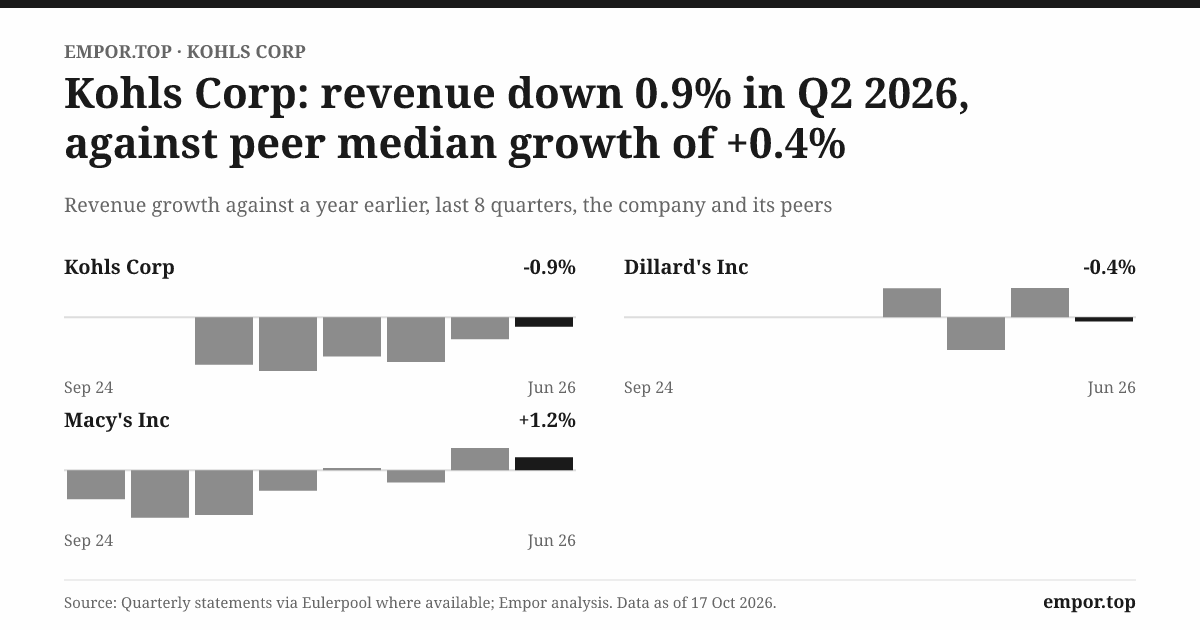
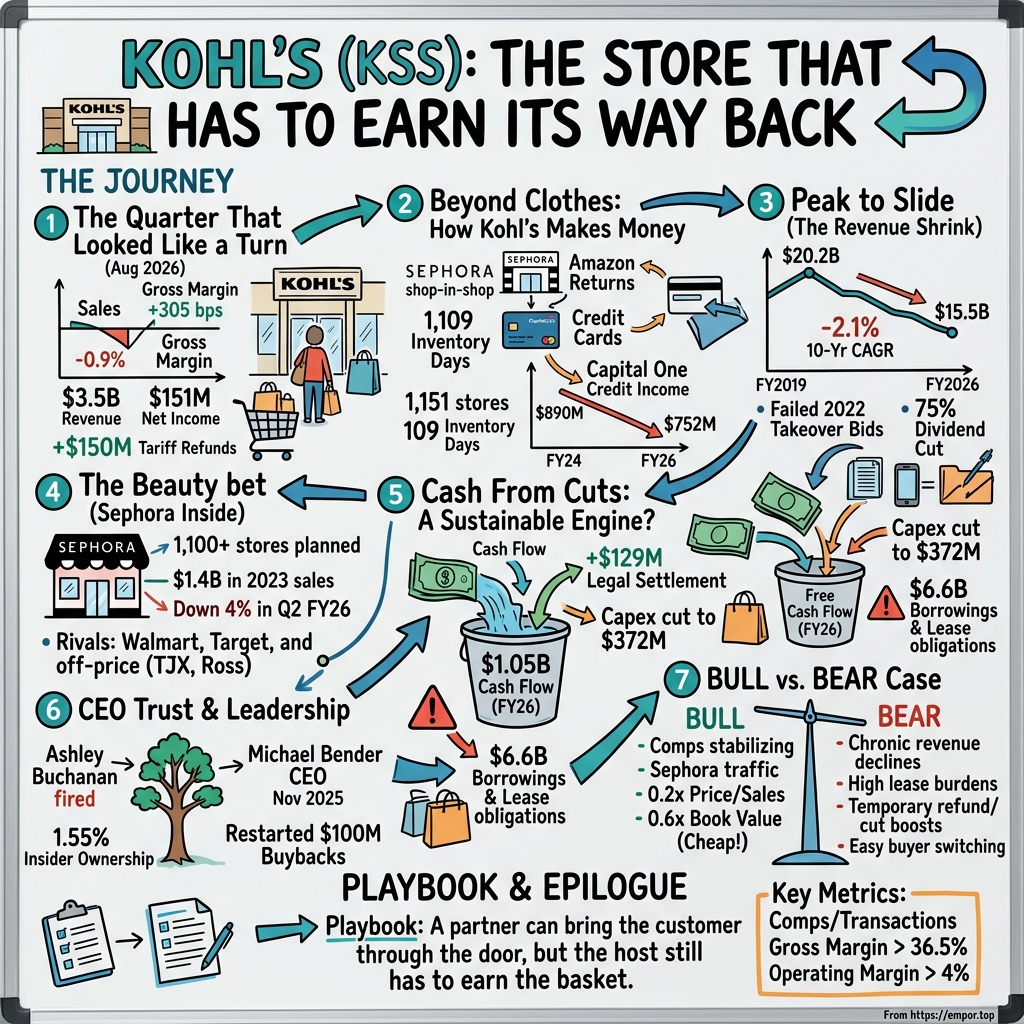
That question became a market event in late August 2026. Michael Bender, who had run the company first as interim and then as permanent chief executive, reported a second quarter that looked, for the first time in a long while, like the slide might be ending. Net sales fell just 0.9% from a year earlier, a far gentler decline than Kohl's had posted through most of the previous three years.1 Gross margin rose by 305 basis points, a jump of more than three percentage points that few department stores manage in any quarter.1 Total revenue came to about $3.5 billion and net income to about $151 million.12 And Kohl's said it would restart buying back its own shares, something it had not done in the open market for three fiscal years.1
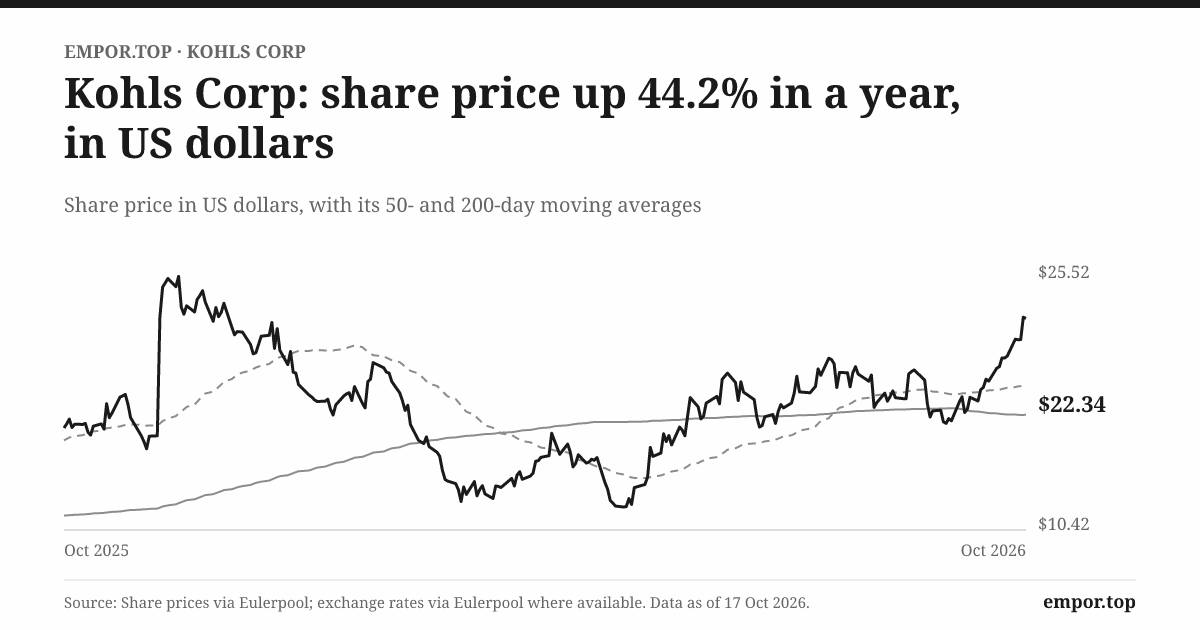
For a stock that had fallen as much as 90% from its five-year peak at one point, that was enough to change the mood.3 By mid-October the shares traded at $22.34, nearly double their 52-week low of $11.72.3 The narrative almost wrote itself: new leader, cleaner inventory, better margins, capital returning to shareholders.
The trouble is in the fine print of that gross-margin jump. A meaningful part of it came from refunds of tariffs Kohl's had previously paid, roughly $150 million that flowed back to the company and flattered both the quarter's margin and its outlook.14 A refund is real cash. It is not a better way of selling sweaters. Strip it out and the quarter still looks improved, with sales declining more slowly and inventory leaner, but the margin story becomes much less dramatic. So the honest verdict on August is narrower than the headlines. The trend got better. The test is whether sales and margins hold once that benefit fades from the comparisons, and nobody, including management, can prove that yet.
The stakes of that test are larger than one quarter. Kohl's has to answer three questions at once. Can it win back sales without discounting away the margin it just regained? Can it produce durable cash after years in which a good deal of its cash came from shrinking the business? And can a leadership team that only recently settled, after four chief executives in roughly three years, earn the credibility to be believed?
Start with what the company is today. As of August 2026, Kohl's operated 1,151 stores across 49 states, plus Kohls.com.4 It reports a single operating segment, which matters for how the story has to be told: there is no separate beauty division or credit business with its own profit line, only one retailer whose economics rise and fall together.2 That single segment, though, contains two kinds of money. The company's "total revenue" combines merchandise net sales with "other revenue," and the largest piece of other revenue is Kohl's share of its credit-card partnership with Capital One.2 When Kohl's says revenue, it means both. When it says net sales, it means only the merchandise. Keeping those labels straight is the first discipline this story needs, because the gap between them is where some of Kohl's quiet weakness has been hiding.
One more convention before the tour begins. Kohl's names its fiscal years by the calendar year in which most of their months fall, so the company calls the year that ended on January 31, 2026, "fiscal 2025." This story instead names full years by the January in which they end, so that year is FY2026 here. Quarters keep Kohl's own labels, which means the "second quarter of fiscal 2026" that ended on August 1, 2026, belongs to the year that will end in January 2027.
To understand whether August was a turn or a pause, you have to walk the store the way the cash walks it.
 Subscribe on LinkedIn
II. What the Kohl's Store Sells Besides Clothes
Follow one customer through a Saturday. She parks, heads past the Sephora shop for a refill of a skin-care serum, picks up a pair of kids' sneakers she ordered online the night before, browses a rack of Kohl's private-label sweaters, and pays at the register with her Kohl's card because it will earn her an extra discount. In twenty minutes she has touched almost every part of the business model: a partner's brand, a digital order fulfilled by a store, a private label, a national brand, and a credit product that someone else owns.
At its root, Kohl's makes money the oldest way in retail. It buys merchandise from vendors and sells it for more than it paid. Revenue moves with the number of transactions, the size of the average ticket, the mix of categories and, crucially, the depth of promotions.2 Kohl's has long trained its customers to expect coupons, sales events and Kohl's Cash, the loyalty currency that rewards today's purchase with a discount on the next one.2 That keeps people coming back, but it also means the sticker price is rarely the price, and margin depends on how much discounting the company has to do to clear its racks. The calendar matters too. Back-to-school and the holiday quarter carry the year; in the fourth quarter of FY2026, revenue reached about $5.2 billion, against roughly $3.2 billion to $3.6 billion in the other three quarters.2
The second stream of money is the one most shoppers never think about. When the customer pays with her Kohl's card, Kohl's does not lend her the money. Capital One does. Under an agreement signed in March 2022, Capital One owns and funds the card receivables and bears the underwriting risk; Kohl's receives a share of the economics, essentially the finance charges and fees left after credit losses and funding costs.2 It is a lovely business to be in when consumers pay on time and interest rates are friendly, because Kohl's collects income without putting its own balance sheet behind the loans.
It is also shrinking. Credit-card-related other revenue fell from about $890 million in FY2024 to about $752 million in FY2026, a drop of roughly 15% over two years as write-offs and borrowing costs ate into the pool.2 To put that in context, $752 million is larger than Kohl's entire operating profit for FY2026, which was about $510 million.2 The card is not a side hustle; it is a pillar. But a pillar that loses $140 million in two years cannot be counted on to cover for weak merchandise demand indefinitely, and it carries its own exposure to anything that hurts cardholders or caps the late fees that feed the pool.2
Then there is Sephora. The beauty shops look like a lease, as if Sephora rented the space, but the economics run the other way. Kohl's operates as principal: it carries the inventory, records the sales as its own, funds the build-out, and pays Sephora half of the shops' operating profit through its cost of merchandise.2 That arrangement makes Sephora at Kohl's financially material, because every dollar of beauty sales shows up in Kohl's revenue. It also means Kohl's bears the inventory and capital risk of a category it does not fully control. Sephora brings the brand, the assortment and the beauty expertise; Kohl's brings the floor, the shoppers and the balance sheet.
The Amazon returns counter deserves a smaller frame. Kohl's began accepting Amazon returns as a way to put more people through its doors, and the counters do exactly that.2 Whether those people buy anything is a different matter. A return drop-off is a convenience feature that any retailer with a partnership can offer, and Amazon has other drop-off partners. The right way to judge it is through conversion and basket size, and Kohl's does not publish how much its Amazon returns traffic spends. Until it does, the counter is better described as a possible visit than as a moat.
Now look at the store as a cash machine. For a retailer, the biggest operating asset is inventory, and at the end of FY2026 Kohl's held about 109 days of it, measured against the cost of what it sells.2 Put simply, a sweater that arrives at the distribution center tends to wait more than three months before a customer buys it. That money is tied up the whole time, and every week it sits it risks going out of style and needing a markdown. On the other side, Kohl's pays its suppliers in about 46 days, so vendors finance part of that wait.2 Receivables barely register. Trade receivables amount to about three days of revenue because customers pay at the register, and the cardholder debt sits on Capital One's books rather than Kohl's.2 That is the reverse of a typical business-to-business seller, which chases customers for months to get paid.
Those mechanics define the pressure points. Apparel demand decides how fast the inventory turns. Inventory freshness and markdowns decide what it sells for. Vendor terms decide who finances the gap. Wages and occupancy costs, the rent and upkeep on more than eleven hundred big boxes, are mostly fixed, so they bite hardest when sales fall. And everything ultimately rests on one conversion: turning a store visit into a profitable basket.
That brings the question of the store's breadth into focus. A Kohl's that offers beauty, pickup, returns, home goods and apparel under one roof can be a convenient, one-stop suburban errand. It can also be a large, costly obligation to stock and staff a box whose core categories are losing customers to more focused rivals. Which of those it has been is a matter of record, and the record starts with what happened to the sales line after the chain reached its peak.
III. The Expansion That Became a Sales Slide
There was a time when the Kohl's formula looked unbeatable. The company went public on the New York Stock Exchange on May 19, 1992, and spent the next two decades planting big, easy-to-shop stores in suburban strip centers across the country, away from the enclosed malls where traditional department stores lived.2 The pitch was simple: national brands at value prices, wide aisles, centralized checkouts, plenty of parking. It was a department store built for the minivan era, and for a long time the minivans came.
The momentum carried all the way to FY2019, when total revenue peaked around $20.2 billion and operating margin stood near 7%.2 A decade earlier, under Kevin Mansell, the business had run at margins closer to 9%.2 What followed was not one shock but a series of them, layered on a slow erosion that began before anyone had heard of COVID-19.
The pandemic year was brutal and obvious: revenue fell to about $16.0 billion in FY2021 as stores closed.2 Then came a sharp rebound to about $19.4 billion in FY2022, as stimulus checks and pent-up demand sent households back to the racks.2 That rebound is the part people remember. The part that matters more is what came after. Revenue slipped from about $18.1 billion to about $15.5 billion in FY2026.2 Over ten years the line contracted at roughly 2.1% a year; over the last three, at about 5% a year.2 That is not a pandemic story. It is a decade-long slide with a pandemic in the middle.
The labels matter here, as promised. Of that $15.5 billion of FY2026 total revenue, net sales of merchandise were about $14.8 billion; the rest was other revenue, led by the card.2 The $15.5 billion figure is not what Kohl's sold off its racks. And because card income was itself falling, the merchandise business shrank at a pace close to the headline.
What makes the slide sobering is how many strategies it outlasted. Michelle Gass, who took over as CEO in May 2018, pushed omnichannel retail, Amazon returns and, above all, Sephora.25 The Sephora partnership was announced in December 2020.5 Tom Kingsbury, a veteran merchant, succeeded Gass in December 2022 and leaned on cost cuts, store edits and a return to merchandising basics.2 Ashley Buchanan arrived in January 2025 and was gone by the end of April, a story for later. Bender has framed his focus around value, assortment and operational execution.14 Each regime had a credible thesis. None reversed the long-run contraction. That is the strongest disconfirming evidence for any claim that this time the fix is simply better management: the decline has spanned four leadership teams and survived a decade of reasonable-sounding plans.
The year Kohl's was for sale
The most dramatic chapter came in 2022, and it is often misremembered. In January that year, a consortium backed by Starboard-affiliated investors and Acacia Research reportedly offered $64 a share, valuing Kohl's at about $9 billion.6 Activists argued that the company's owned real estate was worth far more than the market gave it credit for and pressed for a sale or a sale-leaseback. The board adopted a shareholder rights plan, ran a sale process, and by June was in exclusive talks with Franchise Group at $60 a share.78 Then the financing world turned. Retail stocks sank, credit markets tightened, and lenders grew wary of a department store deal funded in large part by its own real estate. In July 2022, Kohl's ended the negotiations.7
It is worth being precise about what that episode was and was not. No deal closed. Kohl's did not buy anything at an inflated price, and it did not sell itself at one. The $60 and $64 numbers were proposals made in a world of cheap credit and higher retail earnings, and they are not a valuation benchmark for a company whose revenue has since fallen by several billion dollars. What the episode was, though, was a governance and capital-allocation inflection. It showed that the board believed the company was worth more as an independent operator than buyers would ultimately pay, and it set the clock on proving that belief.
The capital decisions around that moment make the test harder to pass. In FY2022, Kohl's spent more than $1.3 billion repurchasing its own shares, and in FY2023 more than $600 million more.29 Those buybacks were made near what turned out to be the top of the post-pandemic rebound. By FY2023, cash and short-term investments had fallen from about $1.6 billion to about $153 million, and the year produced negative free cash flow.2 Kohl's then made no open-market repurchases in FY2024, FY2025 or FY2026.2 And in the first quarter of FY2026 it cut its quarterly dividend by 75%, from 50 cents a share to 12.5 cents, so cash dividends fell from about $222 million to about $56 million.2 The sequence speaks for itself: capital was returned generously at the peak and pulled back sharply in the trough, which is roughly the opposite of the timing an owner would want.
So the old scale did not protect sales, and the capital spent at the top did not buy a better position at the bottom. If national reach, a familiar name and a well-located fleet were not enough, what could make a Kohl's visit harder to replace? Kohl's best answer has been sitting near the front door since 2021.
IV. The Beauty Shop Inside the Department Store
Walk into a newer Sephora at Kohl's and the contrast is almost theatrical. Ten steps away, the main floor runs on coupons and clearance signs. Inside the shop, the lighting is brighter, the brands are prestige names, and a beauty advisor will match a foundation shade. For a value retailer whose core shopper has been drifting toward off-price chains and mass merchants, it was a bold piece of theater: import the most aspirational brand in mid-market beauty and let its glow spill over the racks.
The bet was announced in December 2020 as a long-term strategic partnership.5 The first shops opened in 2021, and in August 2022 the companies announced plans to put Sephora in every Kohl's store, a rollout that has brought the count to more than 1,100 locations.102 The division of labor was clear. Sephora supplied the brand, the product assortment and the know-how of selling beauty. Kohl's supplied the floor space at the front of the store, the inventory investment, the staff and the execution. For Sephora, it was a way to reach suburban shoppers far from the malls where its standalone stores clustered. For Kohl's, it was a reason for a younger, more frequent customer to walk through the door.
By its own account, the bet reached real commercial scale. Kohl's said Sephora at Kohl's generated more than $1.4 billion in sales in 2023.11 For perspective, that is close to a tenth of Kohl's merchandise sales coming from a category that barely existed in its stores five years earlier. That is the clearest proof in the whole story that Kohl's can use its footprint to add a differentiated reason to visit.
What it is not is proof of current growth. On the second-quarter call in August 2026, management said Sephora sales were down 4%, and pointed to the expanded distribution of key beauty brands as a source of pressure.4 That explanation is the uncomfortable heart of the moat question. If brands that once anchored the shop can now be found at more retailers, the shop's power to pull a customer specifically to Kohl's weakens. Kohl's does not publish sales per shop, repeat-visit rates or how many Sephora shoppers also buy apparel, so investors cannot yet measure the halo that justified the front-of-store real estate. What can be measured is the conclusion that matters: after more than four years of Sephora, the company's total sales have kept falling. The shop moved beauty in-house; it has not yet moved the whole store.
Kohl's other lever is its own brands. Private labels are where a department store can earn more margin, because it is not sharing the markup with a national brand, and where it can offer something a shopper cannot find at the competitor down the road. In the second quarter, management reported 3% comparable growth in proprietary brands.4 Set beside total comparable sales down 0.9%, that is encouraging evidence that sharper assortment is working at the margin. It also means everything else in the store was declining faster than the headline, and the proprietary-brand gain has one quarter of history behind it.
Who else wants the same shopper
Now imagine the same Saturday shopper deciding where to buy her kids' back-to-school clothes. She can tap a few buttons on Amazon and have them tomorrow. She can grab them at Target or Walmart while picking up groceries. She can hunt for a bargain on a well-known label at T.J. Maxx or Ross, where the treasure-hunt pricing often beats any coupon Kohl's can offer. Or she can go to Macy's or Dillard's for a more traditional department store. Each of those rivals runs a different model. The off-price chains buy opportunistically, scooping up other retailers' excess inventory at deep discounts, which lets them undercut full-price competitors on the same labels. The mass merchants use groceries and household essentials to guarantee frequent trips. Amazon competes on selection and convenience. Kohl's sits in the middle, sometimes a value store, sometimes a department store, and that middle has been the hardest place in American retail to defend.
Run the competitive forces once, plainly. Buyers hold most of the power: millions of households, none of them large, all with many alternatives and almost no cost to switching. Suppliers hold real power too, because the national brands that draw customers sell through many retailers and increasingly direct to consumers, and because the beauty brands Sephora carries are choosing to broaden their distribution. Substitutes are everywhere, from off-price to online marketplaces. Rivalry is intense and promotional. The barrier to a new store opening is modest; the barrier to a new national chain is high, which protects incumbents only from new entrants, not from each other.
Hamilton Helmer's 7 Powers framework asks which durable advantages could let a business earn returns above its cost of capital. Kohl's has scale in the sense of a large store network and purchasing volume, but its returns on invested capital of about 4% in FY2026 suggest that scale is not translating into superior economics.2 It has brand recognition, though not the kind that lets it charge more. It has a cornered-resource argument in the Sephora relationship, which a rival cannot easily replicate, but the latest sales trend shows the partner's brands are not exclusive. Switching costs are weak, and the card's loyalty pull is a modest exception. A decade of declining revenue and heavy promotion is hard evidence against pricing power, which is the clearest test of any moat. The history does not reject the claim that Kohl's has useful assets; it narrows it to a smaller version: a well-located footprint with a few differentiated partners, not a protected franchise.
Where can Kohl's credibly win? Convenient suburban locations with easy parking; a value-focused mix of national and private brands; selected partner experiences like Sephora that add a reason to stop. Where can it lose? Assortment that feels stale, a price perception that trails off-price rivals, a digital experience that is merely adequate, and stores whose condition and service slip as staffing and capital spending are cut. Online discovery and AI-assisted shopping add pressure in a specific way: the easier it becomes to compare prices and find the same item elsewhere, the less a shopper needs to start at Kohl's. That is not a new Kohl's growth story. It is a force that makes substitution easier.
So the key test is not whether Sephora or the private labels can grow. It is whether they produce repeat, profitable trips for the whole store, or mainly shift sales within the same shrinking footprint. That question cannot be answered by traffic alone. It has to be answered with cash, and Kohl's most recent cash story is more complicated than it looks.
V. Cash From a Business Being Cut Back
Here is a puzzle. In FY2026, Kohl's revenue fell about 4%, its credit income fell, and its net profit was a modest $272 million.2 Yet free cash flow, the cash left after operating the business and paying for capital spending, came to about $1.05 billion, nearly six times the year before.2 A retailer in decline reported one of its strongest cash years in a decade. How?
Start with the longer record, because it explains why Kohl's has always generated more cash than profit. Over the twelve years from FY2015 through FY2026, Kohl's net profit added up to about $5.9 billion, while cash from operations added up to about $18.3 billion, roughly three times as much.2 The main reason is depreciation. Kohl's charges around $700 million a year against earnings for the wearing-out of stores, fixtures and systems, which reduces profit but does not cost cash in the year it is recorded.2 Lease accounting adds another non-cash layer. High cash conversion over a long period is normal for a big-box retailer. It does not make every year's free cash flow sustainable, because the stores that depreciation measures eventually need to be refreshed with real money.
Now unpack FY2026. Three things released cash from the system rather than earned it. Inventory fell by about $203 million, which turned sweaters back into dollars. Accounts payable rose by about $130 million, which meant vendors were financing more of the shelves. Other assets fell by about $91 million.2 On top of that, Kohl's received about $129 million from a settlement in the long-running credit-card interchange antitrust litigation, a one-time windfall from a case about the fees merchants pay card networks.2 Together those items account for a large share of the jump. None is equivalent to a permanent improvement in merchandise economics. Inventory can be cut only so far before the racks look thin; payables can be stretched only so far before vendors push back; a lawsuit pays once.
The other lever was spending less. Capital expenditure fell from about $577 million in FY2024 to about $372 million in FY2026, a cut of roughly a third in two years.2 Over the same period, depreciation and amortization stayed around $700 million a year.2 When a company spends on its assets roughly half of what it records as their annual wear, it is running down the fleet, at least for a while. Kohl's also cut its average headcount from about 87,000 to 84,000 in FY2026, with full-time associates down from 33,000 to 29,000, and closed 27 underperforming stores across late FY2025 and early FY2026.2 Each of those moves can be defended as discipline. Prolonged, they become a quiet tax on the shopping experience: fewer associates on the floor, older fixtures, slower checkout lines, the exact frictions that send a customer to a competitor.
So where has the free cash gone over the long run? Across the same twelve years, Kohl's generated about $10.9 billion of free cash flow and paid about $3.2 billion of dividends, roughly 30% of it.2 Yet cash and short-term investments ended FY2026 at about $674 million, some $297 million less than at the end of FY2014.2 The rest of the money went into share repurchases, including the heavy buybacks of FY2022 and FY2023, and into reducing and refinancing debt.2 In other words, a business that generated nearly $11 billion of free cash over a dozen years ended up with less cash than it started with, a shrinking sales base and a speculative-grade credit rating. The cash was real. Much of it was returned to shareholders at prices well above where the stock trades today.
What Kohl's owes
The balance sheet looks more frightening at first glance than it is, and less comfortable on closer inspection than the cash pile suggests. The headline borrowings figure is about $6.6 billion.2 Only about $1.5 billion of that is funded senior debt, the bonds Kohl's must repay in cash at maturity; the remaining roughly $5.2 billion is lease liabilities, the accounting value of rent commitments on stores and facilities.2 Leases are not optional, though. Kohl's owes roughly $440 million to $452 million in lease cash payments every year through 2030.2 Add interest expense of about $288 million in FY2026, split between funded debt and finance leases, and the fixed claims on the business before shareholders see a dollar run well above $700 million a year.2 Interest alone consumed nearly half of FY2026 operating income.2
The liquidity facts provide the balance. Cash and short-term investments recovered to about $674 million at the end of FY2026 and to about $821 million by August 1, 2026.212 Kohl's had about $1.45 billion available on its revolving credit facility and reported no revolver borrowing at either date.212 Near-term maturities are modest. There is no liquidity crisis here.
There is, however, a constraint. Credit-rating agencies treat Kohl's as speculative grade. Fitch cut its issuer default rating to BB- with a negative outlook in April 2025, citing sales erosion and lease-adjusted leverage, and other agencies moved similarly.132 Those downgrades have a direct price. They triggered coupon step-ups on Kohl's notes due 2031, lifting the rate from 3.375% to 5.125%.2 And in the second quarter of fiscal 2026, to refinance about $353 million of maturing 4.25% notes, Kohl's issued $360 million of 10% senior secured notes due 2030, pledging eleven distribution and fulfillment centers as collateral.12 Refinancing a 4.25% bond with a 10% bond secured by the company's logistics backbone is the clearest single measure of how lenders now price Kohl's risk.
That context is what turns the stock's trailing free-cash-flow yield of about 40% from a headline into a caution.3 On paper, it implies the company generates in a year cash equal to two-fifths of its market value. But the numerator was swollen by a settlement and a working-capital release, and shrunk capital spending flattered it further. It is a market snapshot, not a normalized earnings yield. The cash engine is real but smaller than FY2026 implies, and the claims on it are fixed. Who decides how to spend what remains is the next question, and the answer has changed hands more often than any investor would like.
VI. The New CEO Inherits a Trust Problem
On November 23, 2025, Kohl's board removed the word "interim" from Michael Bender's title.14 It was a quiet announcement after an extraordinarily loud year. Bender had already been running the company since May 1, 2025, when he stepped in on a day's notice after the board fired his predecessor.15 He was not an outsider brought in to shake things up. He had sat on Kohl's board since 2019, and before that he had built a long operating career in large-format retail and consumer businesses, including senior roles at Walmart and PepsiCo, and as president and CEO of Eyemart Express.16 His appointment was, in effect, the board choosing one of its own to steady a company that had cycled through leaders.
The cycle is worth telling quickly, because its consequence still hangs over every quarter. Michelle Gass left in December 2022. Tom Kingsbury, initially interim, served until January 15, 2025. Ashley Buchanan, recruited from Michaels, took over that day.16 Fewer than four months later, on April 30, 2025, the board terminated him for cause.15 An investigation overseen by the Audit Committee and conducted by outside counsel found that Buchanan had directed Kohl's to do business on highly unusual terms favorable to a vendor founded by someone with whom he had an undisclosed personal relationship, and had caused Kohl's to enter a multimillion-dollar consulting agreement involving the same person.15
That raises the related-party question directly, and the answer is narrower than it might sound. The company described a procurement and consulting conflict, not a material related-party revenue stream or an ongoing transaction that shaped the company's results.16 Kohl's cancelled the contracts, Buchanan forfeited about $26 million in unvested equity awards, and the company sought repayment of his $3.75 million cash signing incentive.16 The board acted quickly once it knew. The harder question is how it hired a chief executive whose conflicts surfaced within weeks, and that question belongs to the same board that then chose Bender.
What the CEO is paid to deliver
Bender's reported compensation for FY2026 was about $9 million: roughly $1.1 million of salary, $3.8 million of restricted stock, a $3.6 million annual incentive payment, and about half a million dollars of perquisites.16 Against a company that earned $272 million and is still losing sales, that is substantial. Total pay alone, though, is not proof of misalignment. The annual incentive is gated by operating targets the board set, and the larger share of equity is designed to vest over time.16 A more telling measure is how much of the CEO's own wealth rides on the stock. Bender was credited with 476,318 shares as of the proxy record date, most of them unvested restricted stock units rather than shares he bought.16 All directors and executive officers together owned about 1.6% of the company.16 That is modest ownership for a team asking investors to trust a turnaround.
Shareholders did not object. At the May 20, 2026 annual meeting, the say-on-pay proposal passed with about 94.3% support, and all eight directors were re-elected with limited dissent.17 A supportive vote, however, tells investors that holders accepted the pay structure. It says nothing about whether the turnaround is working.
That judgment has to come from the calls and the numbers. Across the March, May and August 2026 calls, the sales trend moved in the right direction: the year-on-year decline in quarterly revenue narrowed from about 4% in the holiday quarter to about 2% in the first quarter and about 1% in the second.218194 On the August call, management could point to concrete evidence, including the narrower comp decline, cleaner inventory, and the proprietary-brand gain, while also acknowledging the Sephora decline and the role of tariff refunds in the margin.4 Those were measurable answers. Where the message leaned on broader language about progress and momentum, the question of what happens to margin once the refunds roll off remained the one investors had to answer for themselves.
The buyback restart is the sharpest test of judgment. In the second quarter, Kohl's said it would resume repurchases, with roughly $100 million in planned purchases.1 There is a case for it: cash had rebuilt to about $821 million, the revolver was undrawn, and the shares traded well below book value.123 There is also a case against it, rooted in this company's own history. The last time Kohl's bought back stock aggressively, in FY2022 and FY2023, the purchases preceded a cash squeeze, negative free cash flow and a dividend cut. Today the company is paying 10% on its newest secured debt, carries about $450 million a year of lease payments, and has trimmed its capital spending to levels below what its stores consume. A hundred million dollars is small relative to the balance sheet, and the decision does not repeat the scale of 2022. But a lender paid 10% might reasonably ask why that cash is going to shareholders before the store fleet.
In the end, credibility here is a behavior record, not a speech. Bender's tenure on the board predates his appointment as CEO, so the board's oversight, its succession choices and its capital allocation are part of his record too. He has improved the comparisons. He has not yet turned sales positive. And the metrics that will judge him are already on the table, which brings the debate to the evidence on each side.
VII. Analysis & Bear vs. Bull Case
On October 17, 2026, a Kohl's share cost $22.34.3 At that price, the market valued the whole company at about $2.5 billion, or roughly 9 times trailing earnings, about 0.2 times annual sales and about 0.6 times book value of $37.15 a share.3 The free-cash-flow yield read about 40%. A screen full of numbers like that looks like a bargain bin. The useful question is what the price appears to assume, and whether the evidence supports a better outcome.
Begin with the bull case, stated as its holders would state it and without endorsing it. Comparable sales are improving, with the decline narrowing to under 1% in the second quarter.1 Proprietary brands grew.4 Sephora remains a substantial customer draw with more than $1 billion of annual sales at scale.11 Inventory is leaner, which should mean fewer markdowns.2 Liquidity has rebuilt, with cash up sharply and the revolver untouched.12 And management is confident enough to resume buybacks.1 Add the real estate, the 402 stores Kohl's owns, and the bull argues the equity is a cheap option on a stable middle-market retailer.2
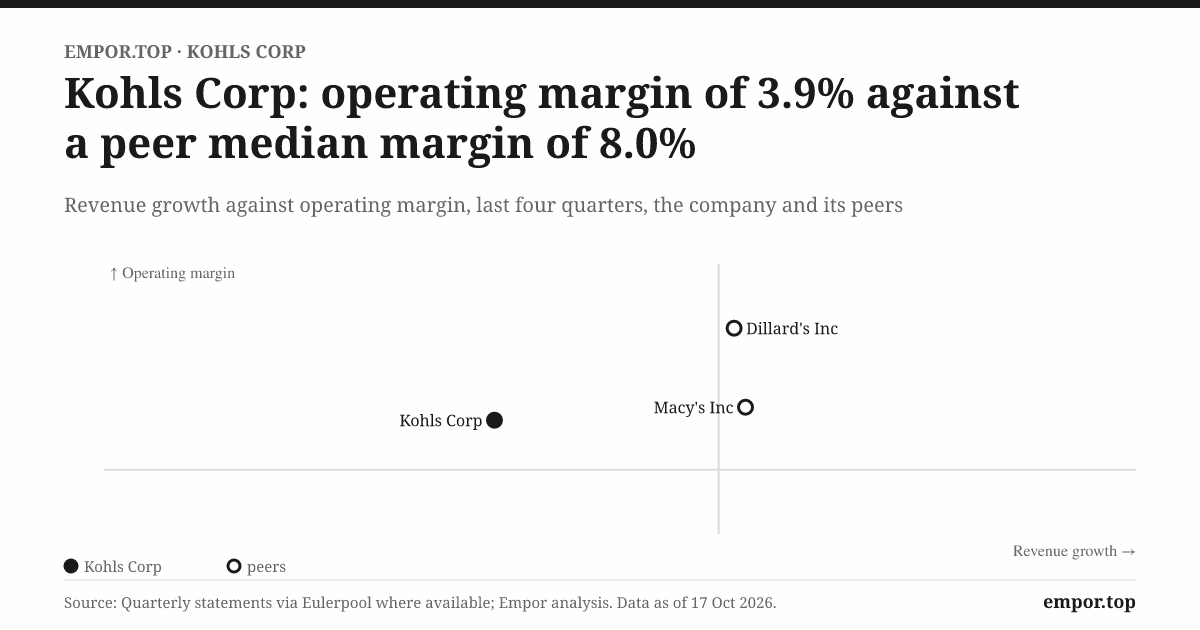
Now put the record beside each claim. Improving comps follow years of decline, and the improvement has not crossed zero. Sephora's own sales fell 4% in the latest quarter.4 Operating margin, about 3.3% in FY2026, sits far below the nearly 9% Kohl's earned in FY2015.2 And the last time management restarted generous capital returns, the downturn that followed forced a dividend cut. The history does not reject the bull case; it narrows it. Kohl's has useful assets and early improvements. It does not yet have a proven company-wide recovery.
The bear case runs on structure. Shoppers can substitute easily, and the forces laid out around the Sephora shop show why: off-price and mass merchants compete for the same value-conscious household, and national brands sell everywhere. Card income has declined for two straight years.2 Interest and lease obligations are fixed while sales are not, so every point of revenue lost falls disproportionately to the bottom line. Return on invested capital of about 4% suggests Kohl's is earning less than its cost of capital, particularly when its newest debt costs 10%.212 And the capital-spending and labor cuts that produced FY2026's cash, if prolonged, risk making the store a less appealing place to shop, which would deepen the very decline they were meant to cushion.
The real-estate thesis deserves its own stress test, because it is the bull's favorite floor. Book value per share is not liquidation value. Kohl's owns many store buildings, but it also carries about $8.3 billion of undiscounted future lease payments, which would not vanish in any wind-down, and it has pledged eleven distribution centers to secure its newest notes.212 A store's real estate is most valuable when a strong tenant pays rent, and selling it while continuing to operate inside it through a sale-leaseback simply converts ownership into another fixed lease payment. The $60 and $64 bids of 2022 were made in a world of cheap financing and higher earnings; they ended precisely because financing for a real-estate-backed retail deal disappeared.7 They are not proof of a current floor.
The temporary items need to be tracked as temporary until results show otherwise. In the second quarter, the tariff refunds materially lifted gross margin.14 The FY2026 working-capital release and the antitrust settlement lifted cash.2 The cleanest way to judge Kohl's over the next year is to watch the business once those tailwinds have rolled off.
Three measures can settle the debate. The first is comparable sales, ideally with transactions rising rather than average ticket alone; the latest reading was a decline of about 0.9%, the narrowest in years.1 The second is gross margin after tariff and promotional effects, which the second quarter flattered by about three points. The third is free cash flow after normalized working capital and capital spending; FY2026 printed about $1.05 billion, but with a lawsuit, an inventory drawdown and depressed capex behind it.2
What, then, is the market pricing? The equity discount to sales and book value looks large, but it is ambiguous. Enterprise value, which adds debt and leases, is about $8.1 billion, more than three times the equity value, and the company's net current assets are negative.3 Against peers, Kohl's sits in the middle: Macy's has generally traded at lower earnings multiples, Dillard's at a higher price-to-book on the back of heavy buybacks and minimal funded debt, and Target at a premium reflecting its scale and mass-merchant economics. In plain English, the market is treating Kohl's as a shrinking business whose cash flow is real but whose future claims, from landlords and lenders, come first. A cheap multiple can reflect a durable bargain or a correct judgment about a business that will keep shrinking. The evidence so far is not enough to establish either a floor or a turnaround.
VIII. Playbook: Business & Investing Lessons
A partner can bring the customer through the door; the host still has to earn the basket. Sephora is the best thing Kohl's has done in a decade, a $1.4 billion business built in a few years on floor space Kohl's already had. And yet, across those same years, the chain's total sales kept falling. For founders and operators, the lesson is that borrowed traffic is not borrowed loyalty. A partner solves the problem of getting someone into the building. It does not solve the problem of why they should buy anything else once inside. For investors, it is a reminder to measure a partnership by what happens to the whole store, not by the partner's own sales line.
Inventory is cash wearing a coat. In FY2026, a shrinking retailer posted one of its best cash years because it took the coat off: fewer sweaters in the warehouse, more of them financed by vendors, and a legal settlement on top. That is why a retailer can report strong cash in a weak year, and why the trick cannot repeat forever. Every retailer has a floor below which leaner inventory becomes empty racks. When a declining business suddenly throws off cash, the first question is not how much but from where.
A footprint is an option only while the store earns its rent. Kohl's suburban fleet was its great advantage when the minivans came, and it remains the asset bulls point to when they say the stock is cheap. But eleven hundred big boxes come with rent, wages, utilities and upkeep that do not shrink when sales do. The 2022 sale process showed how quickly a real-estate floor disappears when financing does, and the 10% secured notes showed how lenders now value the logistics behind the stores. A footprint is worth more than its book value only if the business inside it can keep paying for it.
A recovery is a sequence of kept promises. Four chief executives, buybacks at the top, a dividend cut in the trough, a CEO fired for cause and a board that hired him: Kohl's has spent its credibility, and it can only earn it back one quarter at a time. The new buyback is a promise. The narrowing comp decline is a promise partly kept. Investors in any turnaround should keep score the same way, by the gap between what management said would happen and what did.
IX. Epilogue
Tonight, Kohl's stands in an in-between place. The sales line is still falling, but slowly. The margin looks healthier, but partly on refunds. The cash pile is rebuilt, but partly on the release of working capital and a court settlement. The CEO is permanent, but his record as permanent CEO spans less than a year. And the shares have nearly doubled from their low, which means the market has already paid for some of the improvement it hopes to see.
The next moments that will decide the story are on the calendar. The third-quarter report, covering the period ending in early November, will be the first in which the tariff refunds offer less help to the comparison, and it will show whether gross margin can hold near the levels management has guided toward.1 Then comes the holiday quarter, the season that makes or breaks a department store, and the full-year results for FY2027 next spring, which will reveal free cash flow without the FY2026 settlement and with inventory already trimmed.
Each outcome would mean something specific. Comps turning positive across more than one quarter, especially if transactions rather than just ticket size are rising, would be the first evidence that the store is winning back customers rather than just losing them more slowly. Gross margin holding above roughly 36.5% after the refunds and markdown timing normalize would suggest that cleaner inventory and better assortment, not one-offs, did the work. Free cash flow that stays healthy while inventory, payables and capital spending stop moving in Kohl's favor would show the cash engine is durable. Operating margin sustained above 4% would give Bender the kind of record that turns a steady hand into a credible one, and would show whether the new buyback fits the balance sheet or strains it.
The opposite outcomes would mean something too. If comps slip back as the comparisons get harder, if margin falls once the refunds pass, if free cash flow shrinks to a fraction of FY2026's figure, the bear's description of a business buying time with cash would look more accurate than the bull's description of a stabilizing retailer. And the real-estate question should return only if Kohl's announces a specific transaction, with disclosed net proceeds and lease consequences, not as a reason to hold on in the meantime.
None of that has happened yet. The story remains unresolved, and the tension that remains is simple: a durable recovery requires positive sales and healthy margins without another large inventory release or another extraordinary refund to lean on.
X. Outro
Go back to the shopper at the entrance. She is walking past the Sephora shop again, past the Amazon returns counter, past the pickup shelf with her name on a bag. Kohl's has made itself useful to her in all kinds of ways: as a stage for a prestige beauty brand, a drop-off point for another company's returns, a pickup locker for her online order. Across 1,151 stores, it has built a convenient suburban network that other brands are happy to use.4
That is what makes Kohl's unlike any other retailer in this story. The same box that hosts everyone else's convenience also demands rent, wages and fresh inventory whether or not she buys a sweater. A decade of declining revenue says she has been buying fewer of them, and a billion dollars of free cash flow in FY2026 bought time without answering why.2 The test that began this story is the one that will end it: when the next shopper walks through those doors, will she come back for Kohl's, or only for what Kohl's hosts?
References
-
Q2 FY2026 results and outlook — Kohl's, 2026-08-26 ↩↩↩↩↩↩↩↩↩↩↩↩
-
Annual report and Form 10-K for fiscal year ended January 31, 2026 — SEC, 2026-03-19 ↩↩↩↩↩↩↩↩↩↩↩↩↩↩↩↩↩↩↩↩↩↩↩↩↩↩↩↩↩↩↩↩↩↩↩↩↩↩↩↩↩↩↩↩↩↩↩↩↩↩↩↩↩↩↩↩↩↩↩↩↩↩
-
Q2 FY2026 earnings call transcript — Seeking Alpha, 2026-08-26 ↩↩↩↩↩↩↩↩↩↩↩
-
Sephora and Kohl's announce long-term strategic partnership — Sephora, 2020-12-01 ↩↩↩
-
Kohl's shelves sale as market turmoil ends negotiations — Reuters, 2022 ↩↩↩
-
Form 10-K for the fiscal year ended January 28, 2023 — SEC, 2023-03-16 ↩
-
Form 10-K for the fiscal year ended January 29, 2022 — SEC, 2022-03-17 ↩
-
Sephora expansion to all Kohl's stores — Sephora, 2022-08-18 ↩
-
Sephora at Kohl's sales exceeded $1.4 billion in 2023 — Kohl's, 2024 ↩↩
-
Form 10-Q for quarter ended August 1, 2026 — SEC, 2026-09-03 ↩↩↩↩↩↩↩
-
Appointment of Chief Executive Officer Michael J. Bender — Form 8-K, SEC, 2025-11-24 ↩
-
Termination of CEO Ashley Buchanan for cause — Form 8-K, SEC, 2025-05-01 ↩↩↩
-
2026 annual-meeting voting results — Form 8-K, SEC, 2026-05-21 ↩
-
Q4 and FY2025 earnings call transcript — The Motley Fool, 2026-03-10 ↩
-
Q1 FY2026 earnings call transcript — The Motley Fool, 2026-05-28 ↩
 LinkedIn
 WhatsApp
 Reddit
 Hacker News
 Email
 Kindle
 RSS Feed
 Spotify
 Apple Podcasts
 Amazon Music
 Audible
 YouTube