Kosmos Energy: The Discoverer That Has to Prove It Can Make Cash
I. Seven Wells, and the Debt Still on the Screen
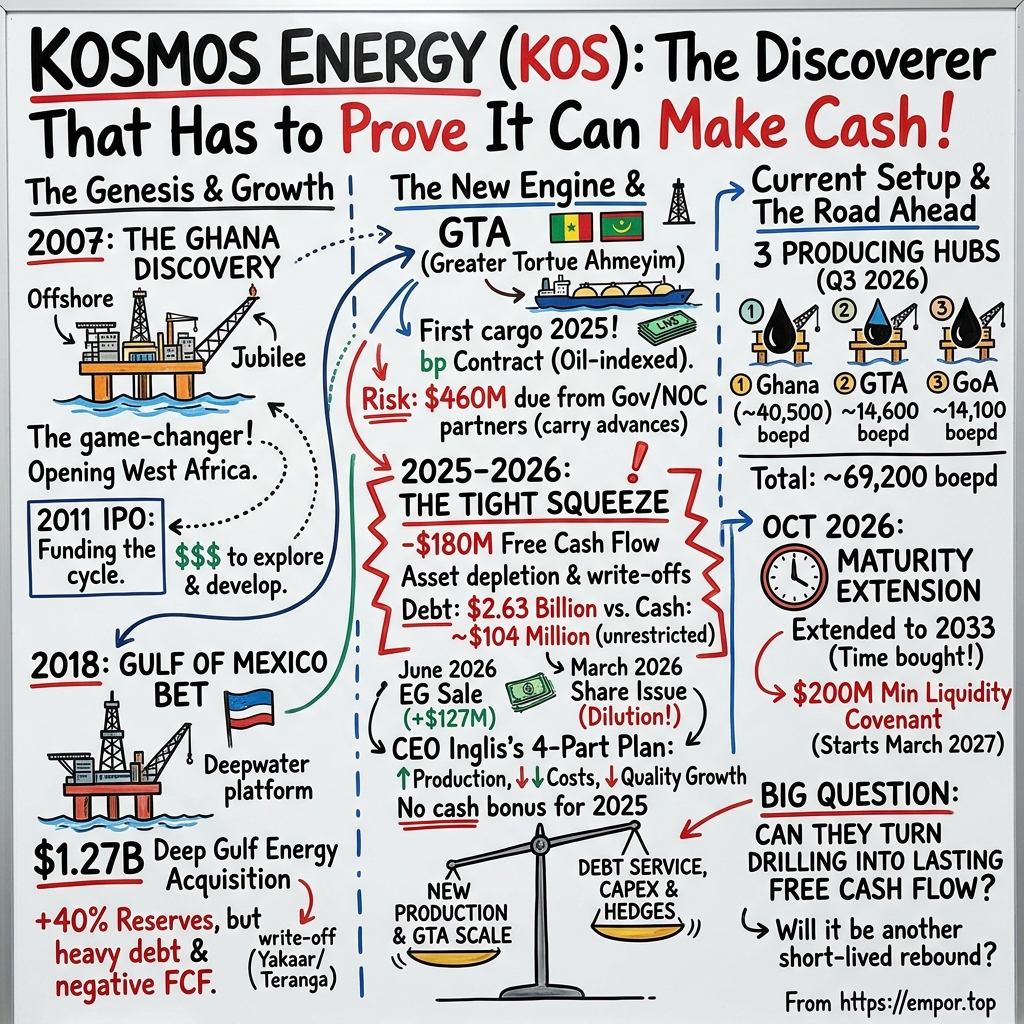
Somewhere off the coast of western Ghana, in water more than a kilometre deep, a drilling rig finished the last of seven new wells into the Jubilee field during 2026. Within weeks the effect showed on the production charts. Jubilee, the field that made Kosmos Energy famous, pumped about 84,500 barrels of oil a day gross in the third quarter, roughly 17% more than in the quarter before.1 A few hundred kilometres to the north, off the border between Mauritania and Senegal, a floating liquefaction vessel called the Gimi was turning seabed gas into liquefied natural gas, and tankers were carrying it away at a rate of eight or nine cargoes a quarter.2 For a company that had spent most of 2025 explaining missed volumes, write-offs and a falling share price, these were the pictures it had been waiting to show.
Then the slide changes, and the other number appears. At the end of September 2026, Kosmos owed lenders and bondholders about $2.63 billion.3 Its unrestricted cash was about $104 million.3 Put those two figures side by side and the company held roughly four cents of free cash for every dollar of debt. Net debt, the measure management prefers because it subtracts all cash, stood at about $2.47 billion.2 That was a real improvement, more than half a billion dollars lower than at the start of the year, but it was still more than twice the value the stock market placed on the whole company.
Two weeks before the quarterly results, Kosmos had done something that tells you which number its lenders were watching. On October 30, 2026, it amended and restated its main bank facility, a reserve-based loan secured on its oil and gas fields, and pushed the final maturity out to April 2033.4 The banks gave time. In exchange, they wrote in a new rule: from March 31, 2027, Kosmos must show at least $200 million of liquidity at each semi-annual test.4 Think of it as a landlord who agrees to a longer lease on condition that the tenant always keeps two months' rent in the bank. It is a reasonable request. It is also a request that only matters to a tenant who might one day run short.
Quarterly production gives the scale. Kosmos produced about 69,200 barrels of oil equivalent per day, net to its share, in the third quarter of 2026.2 That is a small number beside the supermajors it works alongside, which count output in millions of barrels a day, but it is the largest figure Kosmos has posted in a long while, and it came after a year in which volumes and prices both fell.
So this is the puzzle that runs through the whole story. Kosmos is very good at finding oil and gas, and it has proven that more than once. What it has not yet proven, across two decades and two listed eras, is that the fields it finds can pay for themselves and leave cash over for shareholders after the next project is funded and the lenders are paid. Over the twelve years from 2014 to 2025, the company generated about $5.3 billion of cash from operations, yet spent so much more on wells, platforms and acquisitions that free cash flow over the same period added up to roughly minus $2.4 billion.5 Cash in the bank fell from about $600 million to under $100 million across that span, and borrowings almost quadrupled.5
That history frames the three questions this story has to answer. First, can the Greater Tortue Ahmeyim gas project, known as GTA, and a refreshed Jubilee produce cash that lasts, rather than a quarter or two of good-looking volume? Second, can the debt come down without Kosmos going back to shareholders for another large share sale, as it did in March 2026? And third, can the current plan of Andrew Inglis, chairman and chief executive since 2014, deliver where earlier growth bets did not?[^6]
The way to follow the story is not through reported profit. Kosmos's earnings swing violently because of things that move no cash in the quarter: the depletion charge that spreads the cost of a field over its life, impairments when a field is worth less than its book value, and the paper gains and losses on oil-price hedges. In the second quarter of 2026 the company reported a net profit of about $184 million; in the third it reported a loss of about $43 million, while production rose.3 That kind of whiplash tells you more about accounting than about the business. The useful measures are simpler: how many barrels Kosmos actually produced against what it promised, how much cash was left after the capital program and the hedge payments, and where net debt ended up.
On those measures, 2026 looks like a turn. Whether it is a durable turn, or another rebound in a company that has had several, depends on a story that starts with a single well in 2007.
 Subscribe on LinkedIn
II. The Ghana Discovery That Made Kosmos
Kosmos began, in a sense, with a team that had already done it once. The founders came out of Triton Energy, an explorer that had found oil in places the majors had passed over and was sold to Hess in 2001 for about $3.2 billion.6 In 2003 that group started again, with fresh money from two private-equity firms, Warburg Pincus and Blackstone.6 All of the company's equity in its private years came from those two backers, which tells you what kind of venture it was: a bet by patient capital on geological judgement, with no production and no revenue for years.6
The bet was focused. Kosmos "targeted the Atlantic margin of Africa as a focus area for exploration," as it later put it.6 The idea, stripped of jargon, was that the same kind of sand-rich deposits that held oil on one side of an ancient ocean might hold it on the other, in parts of the West African coast where explorers had drilled little in deep water. Most such ideas fail. Exploration geology is a business of expensive guesses, where a single deepwater well can cost tens of millions of dollars and most come up dry or uneconomic.
In 2007, this one did not fail. Drilling in the West Cape Three Points block off Ghana, Kosmos and its partners found what became the Jubilee field, described in its own filings as "one of the largest oil discoveries worldwide in 2007."6 Ghana had never been a meaningful oil producer. Overnight it had a world-class offshore field, and Kosmos had a defining asset before it had a ticker symbol.
What happened next taught the company the shape of its business. Kosmos did not own Jubilee alone and could not develop it alone. The field straddled two licence blocks, so the partners had to "unitise" it, which means agreeing to treat it as one field and split the interests. Tullow Oil became the unit operator with about 35%; Kosmos took about 23.5% and the role of technical operator; Anadarko held another 23.5%; and the Ghana National Petroleum Corporation held 13.75%, with an option for more.6 Ghana's government approved the first phase of development in July 2009, a project of roughly $3.3 billion.6 Oil began flowing on November 28, 2010, just 42 months after discovery, a quick pace for a deepwater project of that size.6 The production vessel was designed to handle 120,000 barrels a day gross.6
That sequence is the Kosmos business model in miniature. Lease acreage that others undervalue. Drill a few expensive wildcat wells. When one hits, drill appraisal wells to understand the size. Bring in partners to share the bill, and negotiate with a host government that holds a stake, collects royalties and taxes, and approves every step. Then spend billions on shared infrastructure, usually a floating production, storage and offloading vessel, an FPSO, which is effectively a refinery-sized ship moored above the field. Only after all of that does oil reach a tanker and turn into cash.
The partners mattered from the first day. Ghana's state company had a carried interest in the blocks, meaning the private partners paid its share of exploration costs.6 The government's take through royalties and taxes would shape every barrel's economics. And Tullow, not Kosmos, operated the unit as a whole. A discoverer gets the glory and a share of the value, but not full control over how fast the field is drilled, when the vessel is shut for maintenance, or how much is spent.
Kosmos went public on the New York Stock Exchange in 2011, with Brian Maxted, a geologist and one of the original team, as chief executive.6 The listing turned the company into a public vehicle for funding the exploration cycle, and the private-equity backers still controlled a majority of the shares afterwards.6 For public investors, the pitch was clear: buy a team with a proven nose for oil, and get a cash-producing field in Ghana to fund the next search.
The logic had a hidden condition. An explorer's returns depend not just on finding oil but on converting each discovery into producing barrels before time, capital and field decline eat the value. Every year between discovery and first oil is a year of spending with no revenue. Every barrel produced also depletes the asset, so the company must keep reinvesting just to stand still. Jubilee proved Kosmos could find a field. It did not prove that the company could do it repeatedly, or that the fields it found would earn more than they cost.
The first test of that came quickly, in the field next door. Kosmos's partners on the neighbouring blocks found a cluster of discoveries, among them Tweneboa, Enyenra and Ntomme, that became the TEN project, and Kosmos had other finds such as Mahogany East and Odum.6 The early years after the listing were spent turning these into a second Ghanaian development. TEN brought first oil in August 2016.7 But that same year Jubilee's production vessel developed a fault in its turret bearing, the swivel that lets the ship rotate with wind and currents while staying connected to the wells. The vessel was shut from March until early May 2016, and Jubilee averaged about 73,700 barrels a day gross that year, well below its design rate.7 Insurance covered much of the lost revenue, but the episode showed how a single piece of shared equipment could choke a company's cash flow.7
TEN brought problems of its own. The operator struggled to manage pressure in the Enyenra reservoir, and a maritime boundary dispute between Ghana and Côte d'Ivoire, heard by an international tribunal, froze new drilling on TEN until a ruling expected in September 2017.7 By the second quarter of 2017, TEN was producing about 45,000 barrels a day against a vessel built for 80,000.8 Years later TEN's reserves were revised down for "performance, delayed drilling," and at the end of 2022 Kosmos booked an impairment of about $450 million on the asset.9
So the Ghana story contains both halves of the Kosmos character. Jubilee was a genuine discovery, quickly developed and still the company's biggest source of cash nearly two decades later. TEN was a reminder that technical success can turn into a mediocre economic outcome when the reservoir behaves badly, the equipment fails, or a border dispute stops the drill bit. A company with two Ghanaian fields operated by someone else, sharing everything with partners and a government, was also concentrated in a single country.
That concentration was the problem Andrew Inglis set out to solve.
III. From Jubilee to a $1.3 Billion Gulf Bet
Andrew Inglis arrived at Kosmos in March 2014 as both chairman and chief executive.10 He was an engineer by training who had spent about 30 years at BP, rising to deputy chief executive of its exploration and production arm from 2004 to 2007 and then to the BP board as an executive director from 2007 to 2010, while running BP's global upstream business.11 He left BP in 2010, the year of the Deepwater Horizon disaster in the Gulf of Mexico, and spent a spell at Petrofac, the oilfield services company, before taking the Kosmos job.11 He was, in other words, a big-company operator rather than a wildcatter, a man who had managed giant development portfolios and knew how a major thinks about risk, partners and capital.
The appointment signalled a change of emphasis. The founders had built Kosmos around discovery. Inglis brought the instincts of someone who had run production at scale and wanted the company to look less like an exploration fund and more like a balanced independent producer. The oil-price crash that began later in 2014 made the case for balance more urgent. Revenue more than halved between 2014 and 2016, from about $855 million to about $310 million, and the company posted net losses in every year from 2015 to 2018.5
His first big move was in gas. In 2015 Kosmos found a large gas accumulation offshore Mauritania and Senegal, which it called "one of the largest natural gas discoveries worldwide in 2015."7 Rather than try to develop it alone, Kosmos brought in BP in December 2016. BP took 62% and operatorship of the Mauritanian blocks and about a third of the Senegalese ones, committing close to $1 billion, most of it by paying Kosmos's share of future costs, plus $162 million in cash and a contingent royalty on future liquids.12 It was a classic Kosmos trade: share the prize to fund the development. That project is the GTA of this story's present, and it gets its own chapter.
The second big move went in the opposite direction, toward control. On August 6, 2018, Kosmos announced it would buy Deep Gulf Energy, a private producer in the deepwater US Gulf of Mexico backed by First Reserve, for $1.225 billion.13 The price was about $925 million in cash and $300 million in Kosmos shares issued to First Reserve, DGE's management and other holders.13 The deal completed on September 17, 2018, and with transaction costs the total came to roughly $1.275 billion.14
The strategic logic was laid out plainly. Deep Gulf brought about 25,000 barrels of oil equivalent a day of production, about 85% of it oil, lifting Kosmos's pro forma output from roughly 45,000 to 70,000 barrels a day, an increase of more than half.13 It added about 80 million barrels of proven and probable reserves, around 40% more than Kosmos had.13 And it gave Kosmos operated assets in a stable jurisdiction, with access to existing platforms where new discoveries could be tied back cheaply. Kosmos's presentation valued the deal at about 6.5 times forecast 2018 EBITDAX, a cash-earnings measure common in exploration companies that adds back exploration costs.15
Was that a good price? Kosmos argued it was accretive on cash flow and diversified the portfolio away from a single West African country.13 Kosmos's deal materials did not show a clean comparison with contemporaneous deepwater transactions on the same reserve definitions and oil-price assumptions, so the multiple alone cannot say whether Kosmos bought cheaply or dearly. The honest way to judge the acquisition is by what happened afterwards: the cash the Gulf assets generated, the impairments booked against them, and the debt they left behind.
The debt part is easy to see. The fact that Kosmos paid most of the price in cash mattered for a company with roughly $230 million of cash at the end of 2017.5 Total borrowings jumped from about $1.3 billion at the end of 2017 to about $2.1 billion a year later and never returned to the old level.5 Free cash flow in 2018, counting the acquisition, was about minus $920 million.5 The Gulf bought scale, but it bought it with leverage, and the company's equity cushion thinned from that point on: shareholders' equity fell from about $940 million at the end of 2018 to about $440 million two years later, after the 2020 oil crash and a $411 million net loss.5
The cash-return part is less clean, because Kosmos reports the Gulf as one segment among several and the original Deep Gulf assets have long since merged with later exploration and development. What the record does show is that the Gulf became a lasting third pillar. In the first nine months of 2026, the Gulf of America, as the US now calls the region, produced about $305 million of Kosmos's $1.39 billion of revenue.3 It also brought in two large, creditworthy buyers. BP and Shell each bought at least a tenth of Kosmos's oil and gas in 2025, and in the first nine months of 2026 Shell Trading took about 21% of revenue and BP about 13%.35 Kosmos notes that alternative buyers for its crude are readily available, which is true of a globally traded commodity, but the concentration is worth noticing.5
The Gulf also delivered the most painful exploration lesson of the recent era. In September 2025 the operator abandoned the Winterfell-4 well after the collapse of its production casing, the steel pipe that lines the well bore.16 Kosmos wrote off about $51 million in the third quarter of 2025, then booked roughly $178 million of Gulf impairments in the fourth quarter, largely related to Winterfell.1617 At almost the same time, in Senegal, Kosmos wrote off about $144 million of suspended well costs on the Yakaar-Teranga gas discoveries and began working with the state company Petrosen to withdraw from the block.17 Yakaar-Teranga had been one of the large gas finds of the West African campaign. It never reached a development decision on Kosmos's watch.
Neither write-off proves that buying Deep Gulf was a mistake. Winterfell was a later development, not one of the original producing fields, and Yakaar-Teranga is in a different basin altogether. What they show is narrower and more important for the investment case: acreage and technical discoveries do not automatically become commercial production. Kosmos's portfolio has contained several prospects that looked compelling on a seismic screen and on a drilling report, then ended as an accounting charge.
There is one more piece of the Ghana picture to add before moving on, because it shows where Inglis chose to put capital. In October 2021 Kosmos paid about $550 million before adjustments, of which about $456 million was paid in cash at closing, for Occidental's Ghana interests, the stakes that Occidental had inherited when it bought Anadarko.18 Kosmos added about 18% of Jubilee and 11% of TEN.18 Tullow then used its pre-emption right to take the TEN portion off Kosmos's hands for $118 million in March 2022.19 The net effect was a bigger bet on Jubilee, the asset Kosmos understood best, again financed in part with borrowing: total debt rose to about $2.6 billion at the end of 2021.5
Put the pieces together and a pattern emerges. Under Inglis, Kosmos used acquisitions and partnerships to build three producing hubs, in Ghana, the US Gulf and, eventually, Mauritania and Senegal. Each move was defensible on its own terms. Taken together, they produced a company with more production, more diversity and much more debt, and free cash flow that was negative in most years. The question the next chapter has to answer is whether the biggest of those bets, the long road to LNG off West Africa, can turn the portfolio into a set of durable producing hubs that fund themselves.
IV. GTA's Long Route from Gas Field to LNG Cargo
In mid-April 2025, a tanker named British Sponsor finished loading off the coast of Mauritania and Senegal.20 It was the first LNG cargo from the Greater Tortue Ahmeyim project, nearly a decade after Kosmos found the gas and more than six years after the partners committed to build it.2021 For Kosmos, the cargo was the moment a decade of slides became a real product with a real buyer.
The scale of what had been built explains the wait. Gas from wells in deep water flows through subsea lines to a floating production vessel, which strips out water and liquids and sends the gas onward to a near-shore hub. There, the Gimi, a floating liquefaction vessel, cools the gas to about minus 162 degrees Celsius, shrinking it roughly six hundredfold so that it can be shipped. Every piece had to work together before a single cargo could leave, and every piece had partners: BP as operator, Kosmos as a co-venturer, and the state companies of two countries, Mauritania's SMH and Senegal's Petrosen.5
The partners took the final investment decision for Phase 1 on December 21, 2018.21 The plan called for first gas around the early 2020s, and the timetable then slipped, through the pandemic, shipyard delays and commissioning work. The Gimi achieved its commercial operations date only in June 2025.3 For an explorer, those years were the hardest kind: billions committed, debt drawn, and no revenue to show for it.
The commercial architecture was designed to reduce one big risk. Kosmos's share of the Phase 1 LNG is sold to BP Gas Marketing under a long-term contract for about 2.45 million tonnes a year, priced off crude oil, running initially through 2033 with an option for the seller to extend by ten years.5 That contract means Kosmos does not have to find buyers cargo by cargo in a volatile spot market. It knows who will take the gas.
It does not, however, mean Kosmos knows what it will earn. This is the most commonly misunderstood feature of the project. A long-term contract settles who buys and roughly how much; the oil-linked formula means the price still rises and falls with crude. When oil fell in 2025, so did the value of each cargo. And contracted offtake is not a contracted margin: costs, uptime, volumes and the timing of liftings all decide how much cash the project actually returns. GTA is better thought of as an oil-price exposure delivered in gas form than as a utility-like annuity.
It also helps to separate GTA from Kosmos's other gas business. In Ghana, the Jubilee partners sell associated gas, the gas that comes up with the oil, to the state under an agreement fixed at $2.50 per million British thermal units through 2040.5 That price is low by international standards, which says something about the bargaining position of a host government that owns the pipeline and the power stations that burn the gas. GTA's LNG, by contrast, is priced off international crude and sold to a global buyer. Kosmos's two gas streams are therefore quite different economic animals.
By the third quarter of 2026, the new animal was earning its keep. GTA contributed about 14,600 barrels of oil equivalent a day of net production, about a fifth of Kosmos's total, and the project lifted 8.5 gross LNG cargoes in the quarter, slightly above guidance.2 Management said the project was on track for the upper end of its 32 to 36 cargo guidance for 2026.2 "GTA continues to perform strongly," Inglis told analysts on the third-quarter call.1 Revenue from Mauritania and Senegal reached about $66 million in the third quarter and $212 million over nine months.3
Those revenue figures carry a quiet lesson. In the third quarter, GTA delivered about a fifth of Kosmos's production but only about a sixth of its revenue, while Ghana delivered under three-fifths of production and more than half of revenue.23 Part of that gap is timing, because revenue follows liftings rather than daily output, but part is economics: an oil-linked LNG price, after liquefaction, generally earns less per barrel-equivalent than the crude coming out of Jubilee. GTA broadens the base. It is not yet the highest-margin barrel in the portfolio.
The cargo milestone also came with a less visible financial commitment. Mauritania's and Senegal's state companies hold stakes in GTA, and like many national oil companies they did not pay their share of development costs up front. Instead, the private partners, Kosmos among them, financed those shares under carry agreements, to be repaid from the state companies' future share of production. At the end of September 2026, Kosmos was owed about $460.8 million including accrued interest, up from about $437 million at the end of 2025.3 The balance earns interest, about $24 million in the first nine months of 2026, and sits on the balance sheet as a long-term receivable.3
That number deserves attention because it is so large relative to the company. It is more than four times Kosmos's unrestricted cash, and it was still rising after first LNG. Kosmos does not publish an ageing schedule or a repayment timetable for the balance, so outsiders cannot say when the money will come back. It will be recovered from project cash flows, which means it depends on the same things GTA's success depends on: steady liftings, oil prices and the commitment of two governments that are also the project's hosts and regulators. A receivable from your partner and your regulator is a different kind of asset from a receivable from a refinery.
From late 2024 through 2026, the GTA story shifted from timing to performance. The early messages were about first gas, commissioning and the date of the first cargo; the first cargo arrived in April 2025, and commercial operations were declared in June.203 By 2026 the focus was on cargo counts against guidance, and Kosmos said in the third quarter that cargoes were slightly above plan and the full year was heading for the top of the range.2 There was a cost along the way. A later reserve revision tied to the delayed ramp-up showed that time is not free in this business; each quarter of delay pushes value further out and adds financing cost.5
What would confirm GTA as a second engine? A full year of cargoes at or above the top of guidance, and, crucially, evidence that the national-oil-company balance stops growing and starts to shrink. What would undermine it? Unplanned outages at the liquefaction vessel, a fall in oil prices that compresses the LNG price, or a receivable that keeps rising long after the project matured. Kosmos has also talked about later phases of GTA, but those remain options, not plans with financing and a final investment decision.
So GTA has done the hard thing: it started. Phase 1 cargoes prove that commercial operations work. They do not yet prove that the project returns the capital Kosmos put in, on a timetable that helps a company with $2.5 billion of net debt. And just as GTA was finally getting going, the rest of the portfolio was moving the wrong way.
V. The 2025 Reset: Lower Volumes, Write-Offs and a Sale
The first half of 2025 was the moment the old engine sputtered just as the new one was trying to start. In the second quarter, Jubilee averaged only about 55,300 barrels a day gross.22 The causes were mundane and expensive: a nine-day planned shutdown of the production vessel, instability in the risers that carry oil up from the seabed, and wells in the eastern part of the field, including Jubilee Southeast, that underperformed.22 Kosmos cut its full-year production guidance to between 65,000 and 70,000 barrels of oil equivalent a day.22 Oil prices were falling at the same time.
The financial result was a sharp reset. Revenue for 2025 fell about 23%, to roughly $1.3 billion, as both sales volumes and realised prices dropped in Ghana and Equatorial Guinea.5 The first LNG and condensate sales from Mauritania and Senegal offset some of the decline but nowhere near all of it.5 The company posted a net loss of about $700 million.5 Free cash flow was about minus $180 million, even though capital spending had already been cut hard.5
It would be easy to read that loss as "just oil prices." The record says otherwise. A large part of the loss came from charges that recognised that assets were worth less than the company had carried them at. Depletion, depreciation and amortisation, the systematic expensing of a field's cost as it produces, came to about $557 million.5 Impairments, the write-downs when expected future cash flows fall below book value, came to about $178 million, largely related to Winterfell in the Gulf.517 And exploration expense nearly doubled, to about $224 million from about $120 million, because it absorbed the write-offs of Yakaar-Teranga and Winterfell-4.5
Those charges are non-cash in the year they are booked, but they are not meaningless. Depletion is the cost of the oil itself, paid years earlier when the field was developed. Impairments and exploration write-offs are capital that was spent and will not come back. Nor was the loss "just an accounting charge." The cash numbers fell too: operating cash flow dropped from about $678 million in 2024 to about $134 million in 2025.5 Lower prices, lower volumes, higher interest costs and hedges all bit at once.
The deeper point is the one the twelve-year record makes. Between 2014 and 2025, Kosmos reported cumulative net losses of about $1 billion and cumulative operating cash flow of about $5.3 billion.5 On that comparison alone, Kosmos looks like a cash machine hidden behind conservative accounting. But subtract the capital spending needed to keep and grow production, and cumulative free cash flow comes to about minus $2.4 billion.5 Free cash flow was negative in eight of the twelve years. In plain terms, Kosmos's fields generated a lot of cash before investment, and the company then reinvested all of it and more, borrowing the gap. That is normal while building a project like GTA. It becomes a problem if the projects never return enough to pay the debt back.
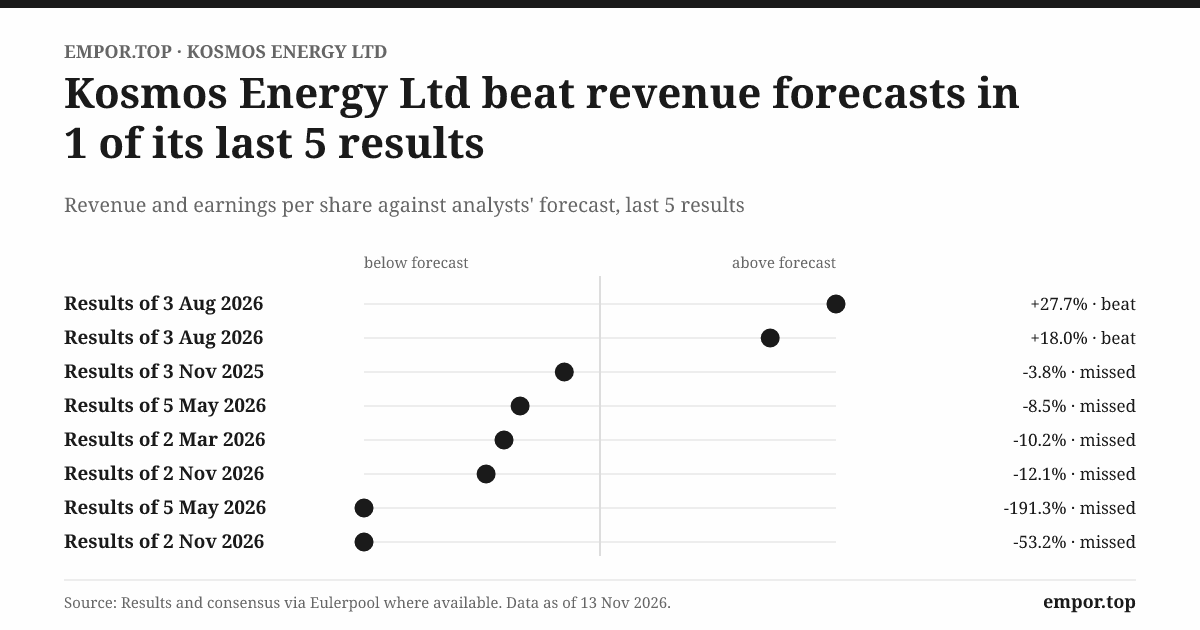
Management's response in late 2025 and early 2026 was a reset of priorities. In the third-quarter 2025 report, Jubilee volumes had recovered to about 62,500 barrels a day gross, and the company leaned on the coming Jubilee drilling campaign and GTA's ramp-up to restore growth.16 With fourth-quarter results in March 2026, Kosmos laid out the write-offs and a program built around higher production, lower costs and lower debt.17 The explanations were specific about the causes, the eastern Jubilee wells, the riser issue, the Winterfell casing failure, which gives them more credibility than a generic reference to "headwinds." The test is whether 2026 guidance was then met, and the next chapters take that up.
One of the first concrete actions was a sale. On February 24, 2026, Kosmos agreed to sell its 40.4% interest in the Ceiba field and Okume complex in Equatorial Guinea to a subsidiary of Panoro Energy.3 The headline price was $180 million, but after adjustments for the economic date and cash flows the final cash consideration at closing on June 16, 2026 was about $127 million, with up to about $39.5 million more contingent on future events.3 Kosmos used the proceeds to pay down its bank facility and booked a small gain of about $9 million.3
The sale simplified a four-country portfolio into three hubs and turned an ageing, declining asset into cash at a time when cash was scarce. It also removed production and revenue: Equatorial Guinea had contributed about $72 million of revenue in 2026 before the sale, and nothing afterwards.3 Asset sales of this kind are a way of converting future barrels into present debt reduction. That trade is sensible when the buyer pays more than the barrels are worth to you, and costly when it is forced by the balance sheet. The gap between the $180 million headline and the $127 million cash received is mostly adjustment mechanics rather than a price cut, but it shows how little room Kosmos had to wait for a better market.
So was 2025 a trough or a verdict? The volume problems at Jubilee look like a trough, because they had identifiable causes and the drilling that followed lifted output sharply. The write-offs look more like a verdict on part of the exploration portfolio, because they recognised that discoveries Kosmos had carried for years would not become producing fields on their original path. And the cash record looks like the clearest verdict of all: before GTA, the portfolio could not fund its own growth. The question for 2026 was whether the man who had led the company throughout could persuade shareholders that this time would be different.
VI. Inglis's Four-Part Plan Meets the Shareholders
At the start of 2026, Andrew Inglis framed the year around four priorities: increase production, lower costs, reduce debt, and advance quality growth opportunities.17 It was not a new vocabulary for an oil company. What gave it weight was the context. Kosmos had just reported its worst annual loss in more than a decade, its share price was on its way to lows below a dollar, and the board and chief executive who had led the company since 2014 were asking shareholders for patience again.
Inglis is now in his thirteenth year in charge, a long tenure for any chief executive and an especially long one in an industry where boards often change leaders after a bad cycle. He is both chairman and chief executive, with a lead independent director, Adebayo Ogunlesi, providing a counterweight on a board where seven of eight directors are independent.[^6] Alongside him, chief financial officer Neal Shah has been the architect of the financing side of the plan: the bond refinancings, the equity raise, the bank-facility amendment.4 The decade under this team is also the decade of cumulative negative free cash flow.
The compensation record shows how the board tried to link pay to that record. Inglis's reported pay rose from about $6.2 million in 2021 to about $9.7 million in 2023, then fell to about $5.0 million in 2025.[^6] For 2025, the compensation committee paid no annual cash bonus, after key operating targets were missed and the oil and gas price outlook weakened.[^6] Most of his reported pay comes as stock awards. The proxy's "compensation actually paid" figure, which marks equity awards to market, was about minus $2.1 million for 2025, because the shares he held and had been granted lost value.[^6]
That is alignment of a kind. A chief executive whose wealth falls when the stock falls has a reason to care about the stock. But alignment of pay is not proof of skill, and a zero bonus in a bad year is the minimum one would expect, not a sign of exceptional governance. The better test is behaviour over time: whether targets were achievable, whether misses were explained, and whether capital was allocated with the discipline the slides promised.
Shareholders offered their own verdict at the May 2026 annual meeting. Inglis was re-elected, but about 8.7 million votes were cast against him.23 The say-on-pay resolution passed, with about 10.1 million votes against.23 The sharpest signal was aimed elsewhere: about 28.1 million votes opposed the re-election of director Maria Hanssen.23 Against a share count of roughly 600 million, those are minority protests, not revolts. They are evidence of scrutiny, not of a crisis, and they suggest that the larger holders, including BlackRock, the value-oriented manager GMO and the Spanish value house Cobas, each of which held more than 5% earlier in the year, were broadly willing to back the plan.[^6]
The most consequential decision of the year, though, was not about pay. In March 2026 Kosmos sold 97.5 million new shares, and the underwriters took up their full option for another 14.6 million, a total of about 112.1 million shares.[^25] The prospectus said the money would repay debt.[^25] Net proceeds came to about $206 million.3 Issued shares rose from about 522.6 million at the end of 2025 to about 639.8 million by September 2026, an increase of more than a fifth, and shares outstanding after treasury holdings stood at about 596 million at the end of October.3
For existing shareholders, that was the price of the plan. Equity issued near the bottom of the cycle is the most expensive capital a company can raise, because each new share buys a claim on the recovery at a depressed price. The raise did what it was meant to do, but it also made explicit that operations alone could not deleverage the company fast enough to satisfy lenders and rating agencies. In that sense the share sale was a concession, and it is the single largest piece of evidence a skeptic would put against management's capital-allocation record.
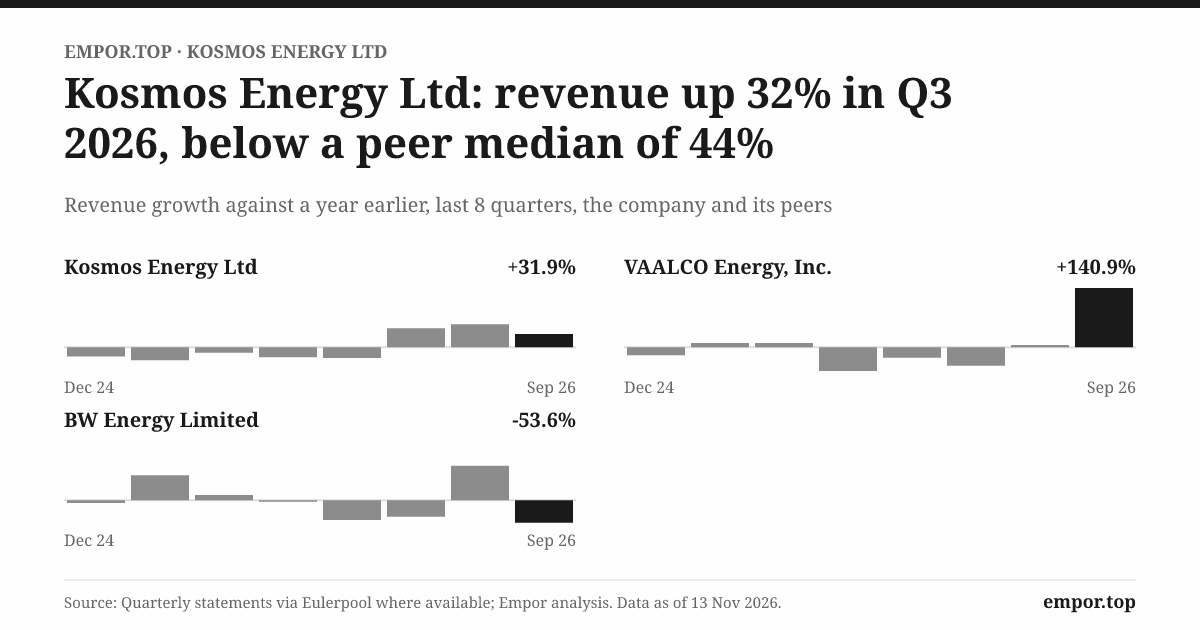
How did the plan fare against its own targets during 2026? Production delivered. By the third quarter, Kosmos was producing about 69,200 barrels of oil equivalent a day, the seven-well Jubilee campaign was complete, and GTA was heading for the top of its cargo range.2 Costs fell: production expense in the first nine months of 2026 was about $412 million, down from about $558 million a year earlier, partly because Equatorial Guinea was sold and partly because unit costs fell as volumes rose.3 Debt fell, by more than $500 million of net debt in nine months.2 On the third-quarter call, Shah said leverage was "moving towards 2x by year-end, a significant turnaround in only 12 months," and Inglis said the company was targeting year-end 2027 net debt of about $2 billion at strip prices.1
Analysts' questions on these calls tended to circle the same handful of issues: how much more dilution, how much the hedges were costing, what the 2027 capital program would look like, and how quickly debt could fall without asset sales. The answers on hedges were candid. Shah said the company was adding "what are likely to be the final hedges for our 2027 program," at levels well above 2026.1 The answers on future equity were naturally less definitive: no management team commits never to issue shares.
So has management earned credibility? It has earned a narrower version of it. The 2026 plan was delivered on its operating terms, with specific explanations for the 2025 misses and specific actions afterwards. But the debt reduction leaned heavily on shareholders and an asset sale, the long record of negative free cash flow happened on the same team's watch, and the decisive test, a year in which operations alone pay down debt, has not yet arrived. To see whether it can, one has to look at what Kosmos actually owns, barrel by barrel, and at how it competes with companies many times its size.
VII. Three Producing Hubs, One Commodity Price
Picture a single barrel of Jubilee crude on its way from reservoir to Kosmos's bank account. It is priced against Dated Brent, the global benchmark, with a small adjustment for quality and location. Before a dollar of that price reaches Kosmos, it passes through a series of hands. The government of Ghana takes royalties and, later, taxes. The cost of running the production vessel, the crew, the helicopters, the maintenance and the insurance is deducted. If Kosmos has hedged that barrel and the oil price is above its hedge ceiling, part of the upside goes to the bank on the other side of the hedge. Then the company must set aside capital to drill the next wells, because a deepwater field declines every year it is not refreshed. Only after all that does the barrel help pay interest on $2.6 billion of debt, and only after the interest is paid does anything remain for shareholders.
In the third quarter of 2026, the starting point of that chain was about 69,200 barrels of oil equivalent a day.2 Ghana, mostly Jubilee with a smaller contribution from TEN, supplied about 40,500 net barrels a day, still the dominant piece. GTA supplied about 14,600, and the Gulf of America about 14,100.2 Production expense, the cost of running the fields, was about $17.72 per barrel of oil equivalent.2 At most oil prices of recent years, that leaves a healthy margin at the field level, but it is a margin that shrinks quickly once taxes, hedges, development capital and interest are deducted.
Each hub plays a different role. Ghana is the cash engine, the place where Kosmos's discovery skill and twenty years of reservoir knowledge pay off, but it is operated by Tullow and shared with the state, and its production is a function of how often the partners drill new wells to offset decline. The third-quarter jump in Jubilee volumes came directly from the seven new wells, and Inglis said the aim was to exit the fourth quarter at gross rates "around the mid-70s," in thousands of barrels a day, well below the third-quarter peak.1 That is what natural decline looks like. Kosmos has secured a rig for a 2027 and 2028 campaign of up to ten more wells, starting around the middle of 2027.2 Jubilee is less a perpetual asset than a treadmill that must be fed.
GTA is the growth engine, contracted and long-lived, with oil-linked pricing and partner financing. The Gulf of America offers operated oil production in a stable jurisdiction and a library of nearby platforms for tie-backs, but its fields are smaller and decline quickly, which is why Kosmos keeps drilling there and why the Winterfell failure hurt. In July 2026 Kosmos also sold part of its stake in a set of Gulf blocks to a partner, Navitas, reducing its interest to about a third, another sign that the company is managing its capital commitments tightly.3 Equatorial Guinea is gone.
Now set Kosmos beside its competitors. Its partners and neighbours include Shell, BP, ExxonMobil, Chevron and TotalEnergies, companies whose upstream businesses produce many times more oil and gas, whose balance sheets carry investment-grade ratings, and whose portfolios can absorb a dry hole or a delayed project without a second thought. In that company, Kosmos is a specialist minnow. Its closest comparison is Tullow Oil, another independent built on West African discoveries, Kosmos's partner and operator at Jubilee. That is less a rivalry than a shared condition: two mid-sized explorers, both tied to the same Ghanaian fields, both discovering that a world-class discovery does not guarantee a strong balance sheet.
The useful question is not whether Kosmos has a monopoly, since nobody in this business does, but where it has an edge, and the cleanest way to look at that is through the five competitive forces that shape any industry. Buyers have plenty of power in the sense that matters. Kosmos sells a commodity priced off global benchmarks, and refiners and traders can switch suppliers freely. Concentration is visible: Shell and BP together bought about a third of Kosmos's output in the first nine months of 2026.3 Suppliers of specialised equipment, deepwater rigs, floating vessels and subsea systems hold real leverage, as the long GTA construction timetable showed. The threat of new entrants is low, because deepwater development requires billions of dollars and rare technical skills, but those barriers protect every incumbent, not Kosmos in particular. Substitutes, in the long run, include renewables and policy-driven demand shifts, which matter more for the outer years of the Jubilee gas contract and the GTA extension option than for today's cash flow. And rivalry plays out less in selling oil than in competing for acreage, partners and capital.
The force that stands out for Kosmos is a sixth one that Michael Porter's framework folds into supplier and buyer power: the host government. Ghana sets the $2.50 gas price and collects royalties and taxes. Mauritania and Senegal are partners, regulators and debtors at once, with a large carry balance owed to Kosmos.3 Senegal's state company is also the counterparty in the withdrawal from Yakaar-Teranga.17 Kosmos's ability to work with these governments is a genuine capability, but it is also a relationship in which the other side holds most of the cards.
So what is Kosmos's edge? There are two credible claims. The first is exploration and subsurface skill. Jubilee, the Mauritania and Senegal gas finds, and a string of Gulf discoveries support it. The counter-evidence comes from the same record: TEN's underperformance and impairment, the Yakaar-Teranga and Winterfell write-offs, and a long list of prospects that did not convert. Weighed together, the history narrows the claim. Kosmos is a capable finder of hydrocarbons, but its record of converting finds into high-return production is uneven, and on the evidence it is not a repeatable machine for creating value from exploration.
The second claim is the contracted LNG position, which gives Kosmos an unusual asset for a company of its size. Here the counter-evidence is timing. The cargoes now prove that commercialisation has begun, but the reserve revision tied to the delayed ramp-up and the growing carry receivable show that the value arrived later and costs more than originally planned.53 That leaves the claim intact but unproven.
What the evidence does not support is a cost moat or pricing power. Kosmos's unit costs are respectable, but they are mostly a function of the fields it happens to own and the volumes flowing through them; they fall when volumes rise and rise when production stumbles, as 2025 showed. Its prices are set in London and New York, not in its own offices.
There is one more piece of optionality worth a mention, and only a mention. In the Gulf, Kosmos is preparing to drill the Trailblazer exploration well in the first half of 2027, a prospect it describes as holding roughly 200 million barrels of oil equivalent gross that could be tied back to Shell's nearby Appomattox platform if successful.21 It is a sensible prospect, in a place where tie-backs to existing infrastructure keep costs down. It is also, today, a drilling plan with no discovery and no revenue. Kosmos's own record of converting prospects into producing fields suggests treating it as a lottery ticket with good odds for a lottery ticket, not as part of the cash-generating base.
Three numbers will tell investors whether the hub strategy is working. The first is production against guidance, especially at Jubilee and GTA, because every other number depends on it. The latest reading was strong, with third-quarter volumes at a multi-year high, but the fourth-quarter guide of 60,000 to 64,000 barrels a day, reflecting Jubilee decline and planned maintenance at the Delta House platform in the Gulf, shows the direction of travel between drilling campaigns.21 The second is the realised price after hedge settlements, because that is the price Kosmos actually banks; in the first nine months of 2026, hedge settlements cost about $175.5 million.2 The third is free cash flow after all capital spending, which was positive through the first nine months of 2026 after years of deficits.2 Watch those three and the rest of the story mostly follows.
Which brings the story to the lenders, who have their own way of watching the same numbers.
VIII. The Maturity Extension Buys Time
On October 30, 2026, Kosmos and its banks signed an amended and restated version of the company's main credit facility, the reserve-based loan that sits at the heart of its financing.4 A reserve-based loan works like a mortgage on oil fields. Banks lend against an estimate of the value of a company's producing reserves, the "borrowing base," which they reset periodically. If the fields produce less, or oil prices fall, the borrowing base can shrink, and the company must repay the difference. It is cheap, flexible money in good times and a tightening noose in bad ones.
The October amendment did three things. It extended the final maturity to April 1, 2033, giving the company more than six years before the facility must be repaid in full.4 It reduced the facility size to $1.2 billion, in line with total bank commitments, with an accordion that could add up to $550 million more.4 And it set a schedule: principal repayments will start on October 1, 2029, and continue in equal instalments every six months until maturity.4 The interest margin is 4.5% over the benchmark rate for the first three years, rising during the amortisation period.4 The banks also functionally removed a debt-service reserve account, which freed about $24 million of restricted cash in the fourth quarter.43 The fees for all of this came to about $20 million.4
In return, the banks added the new minimum-liquidity covenant: at least $200 million of liquidity, tested twice a year from March 31, 2027.4 Kosmos said it had about $570 million of liquidity after the amendment, combining cash and undrawn bank capacity, so the covenant is not close to binding today.2 But it is a reminder that the lenders see liquidity, not profit, as the thing to watch.
The amendment is part of a bigger restructuring of the debt stack that ran through 2026. In January the company issued $350 million of 11.25% senior secured bonds.3 It used that money, the equity proceeds and the Equatorial Guinea cash to repurchase or redeem nearly $400 million of older notes and to pay down the bank facility, which fell from $1.2 billion drawn at the end of 2025 to $750 million at the end of September.3 What remains is a stack of instruments with different maturities and coupons: the bank facility, several series of senior notes, $400 million of convertible notes carrying a low 3.125% coupon, the new secured bonds, and a Gulf of America term loan of about $181 million.3 Interest and financing costs ran at about $166 million in the first nine months of 2026, which is a lot of money for a company whose free cash flow over the same period was a little under $200 million.32 An 11.25% coupon on new secured debt is the clearest market signal of how lenders price Kosmos's risk.
Reported debt and available cash need to be read carefully. At the end of September, cash and cash equivalents were about $103.7 million.3 Restricted cash was another $54.4 million, money that is pledged or held for specific purposes and is not ordinary spending money.3 There is also a finance lease liability of about $63.9 million on the TEN production vessel, which Kosmos excludes from its net-debt figure but which lenders count in the facility's debt-cover calculations.2 The TEN partners have agreed to buy that vessel for $205 million gross when its lease ends in 2027, another call on cash.3 None of these items changes the picture dramatically. Together, they say that the company's real flexibility is somewhat tighter than the headline cash figure suggests.
Where did the half-billion-dollar fall in net debt come from? This is the most important question in the chapter, and the cash-flow statement answers it. In the first nine months of 2026, Kosmos generated about $446 million of operating cash and spent about $228 million on oil and gas assets.3 Its own free-cash-flow measure for the period was about $193 million.2 The Equatorial Guinea sale brought in about $127 million, and the share sale about $206 million.3 Add those up and roughly three-fifths of the debt reduction came from selling assets and selling shares, and only about two-fifths from the business itself. That does not diminish the operational turnaround; nine months of positive free cash flow after a negative 2025 is a real change. But it does mean the deleveraging of 2026 cannot be repeated in the same way, because there is no second Equatorial Guinea to sell, and every new share sale dilutes shareholders further.
The credit agencies noticed both halves. Fitch upgraded Kosmos to B- with a stable outlook in April 2026, pointing to the expected production and debt-reduction path.24 Moody's upgraded it to Caa1 with a positive outlook in June 2026, citing expected positive free cash flow and higher Ghana production, while naming high debt and leverage as constraints.[^27] Those are improvements. They are also ratings that sit deep in speculative-grade territory: Moody's Caa1 is seven notches below investment grade, Fitch's B- six. The agencies are rewarding direction, not position.
The hedges are the final piece of the puzzle. Kosmos hedges a portion of its oil sales to protect against price collapses, which is sensible for a company with this much debt and a lending base that shrinks when prices fall. But hedges cut both ways. In 2026, Kosmos's hedges were set at levels that left it paying out as prices rose: cash settlements reduced realised revenue by about $39.8 million in the third quarter alone and about $175.5 million over nine months.2 For a company whose nine-month free cash flow was under $200 million, that is a very large number. For 2027, management says it has hedged about 8 million barrels with a floor around $68 and a ceiling around $84 per barrel, levels that should cost far less if prices stay in their recent range.2
The amendment, then, did exactly what refinancings do: it bought time. It removed the near-term maturity pressure that had hung over the company and put a clear schedule in place. But it moved the test rather than passing it. From March 2027, every six months, Kosmos must show that it still has liquidity to spare; from October 2029, it must start repaying the facility. The settling evidence will come from a full year of operating and investment cash flows: whether net debt keeps falling without help from asset sales or equity, and how much headroom remains above the $200 million line when the first test arrives. Which raises the question the stock market is trying to answer every day.
IX. Analysis & Bear vs. Bull Case
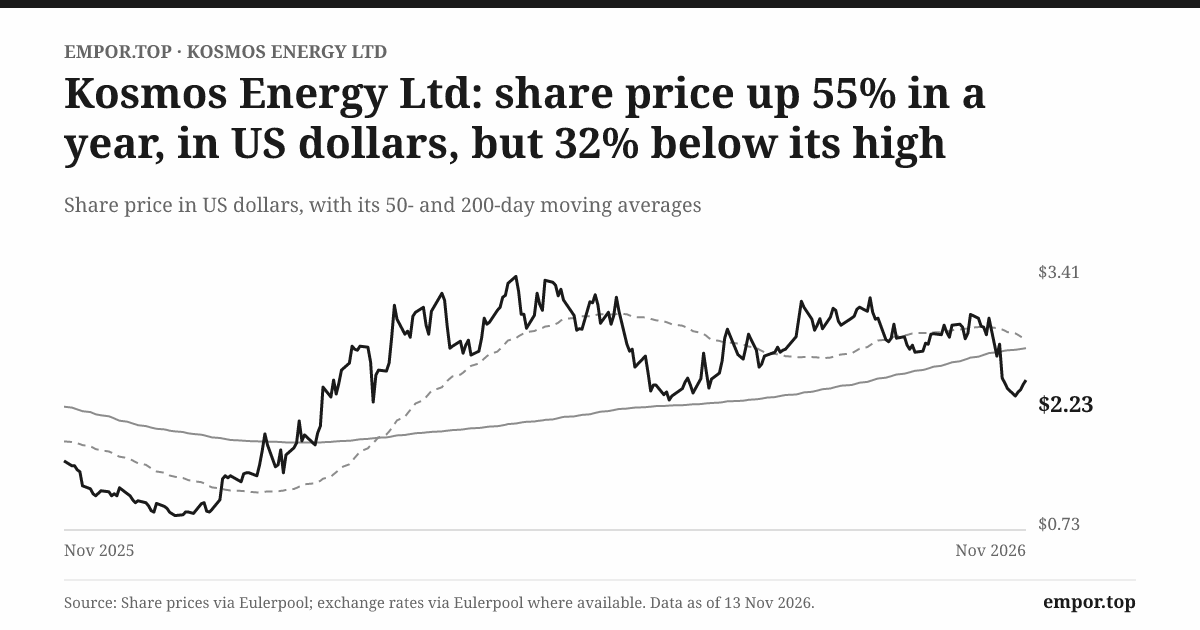
On November 13, 2026, Kosmos shares closed at $2.23. That was about a third below their 52-week high of $3.27, but more than two and a half times the 52-week low of $0.87. The stock had moved like an option on the oil price and the company's survival, with one-year volatility of nearly 90%. At that price, the company's market value was a little more than $1 billion, and its enterprise value, the market value plus net debt and other claims, was about $3.6 billion. In other words, roughly two-thirds of what the market is valuing belongs to lenders, not shareholders.
Start with the valuation trap, because it is the easiest mistake to make. Some screens show Kosmos at about 8.7 times earnings, cheap against its own five-year median of about 13 times. That figure uses earnings from 2024, the last full year Kosmos was profitable. Over the latest twelve months, Kosmos lost about 93 cents a share. The stock is not cheap on earnings; it has no earnings to be cheap on. The price-to-sales ratio of about 0.6 looks low, but sales are not cash after capital spending and interest. An enterprise value of about 9.6 times EBITDA is roughly in line with what one would pay for an ordinary producer, and higher than one would expect to pay for a leveraged one with negative trailing free cash flow; the free-cash-flow yield on the latest figures was about minus 1.5%. None of these multiples establishes that the stock is cheap or expensive. They do establish that the market is not paying for the past. It is paying for a forecast.
The bull case is that the forecast is now coming true. Production in the third quarter of 2026 was the highest in years, at about 69,200 barrels a day.2 Operating costs fell sharply.3 GTA is lifting cargoes at the top of its guidance.2 Jubilee's seven-well campaign worked, with gross production rising about 17% in a quarter.1 Net debt fell by more than half a billion dollars in nine months, and the bank facility now runs to 2033.24 Management is targeting net debt of about $2 billion by the end of 2027 at strip prices.1 The 2027 hedges are set at higher levels than those that cost so much in 2026.2 Both rating agencies have upgraded the credit.24[^27] And the company is entering a year with a new Jubilee campaign and a high-impact Gulf exploration well ahead. In this view, 2025 was the bottom of a cycle that combined weak volumes, falling prices and the last heavy spending on GTA, and every one of those is now reversing.
The bear case is just as specific. Free cash flow was negative in 2025, after a decade of deficits.5 Much of the 2026 debt reduction came from a share sale and an asset sale that cannot be repeated on the same scale.3 Hedge payments of about $175.5 million in nine months show how much of a price recovery can leak away.2 Jubilee is a treadmill that requires a fresh drilling campaign every couple of years, so 2027 will bring heavier capital spending just as the fourth-quarter guide shows volumes slipping.2 Interest costs on the debt run above $200 million a year, and the newest money cost 11.25%.3 The carry receivable from Mauritania and Senegal is still growing.3 And reported earnings remain distorted by depletion, impairments and derivative marks, which makes it harder for investors to judge underlying performance.
The deeper frame for the debate is Hamilton Helmer's idea of the seven powers, the sources of durable advantage that let a business earn more than its cost of capital. Kosmos does not have scale economies against the majors; it is far smaller than its partners. It has no network effects, no switching costs for buyers of a commodity, and no brand. Counter-positioning, a business model incumbents cannot copy, does not apply in a business the majors also pursue. Process power, an embedded way of doing things better, is the closest claim, in the form of exploration skill, but the uneven conversion record narrows it. The best case is the cornered resource: ownership of specific, high-quality reservoirs like Jubilee and long-term contracted gas at GTA. Those are real, but they are depleting assets shared with partners and governments, not permanent advantages. The framework makes the strategic point clear. Kosmos's value lies in specific assets and execution, not in a moat, which means its returns depend on operating well and on commodity prices.
A skeptical investor or an activist would push on several points. The first is capital allocation: the Deep Gulf acquisition added production at a stated multiple of about 6.5 times forecast EBITDAX, but Kosmos has not shown its lifetime return, and the borrowing it required has never been repaid.155 The second is accountability: the long run of negative free cash flow and the large 2026 dilution happened on the same leadership team's watch. The third is portfolio complexity: three countries, multiple operators, several layers of debt, hedges and a large receivable from two governments make Kosmos hard to analyse, and hard-to-analyse companies tend to trade at a discount. The fourth is the most direct: what level of production and free cash flow can pay down debt without another equity raise? Management's answer, in effect, is the target of about $2 billion of net debt by the end of 2027 at strip prices.1 That target depends on volumes and prices that management cannot fully control.
So what is the market pricing? Not a straightforward recovery, since a straightforward recovery would warrant a much higher multiple of a much more stable cash flow. It seems to be pricing a meaningful chance that the recovery works and a meaningful chance that the debt absorbs it. Three tests will tell which way the balance tips. The first is annual free cash flow after development spending and hedge settlements, measured over a full year that includes a Jubilee drilling campaign. The second is production against guidance at Jubilee and GTA. The third is net debt and headroom above the liquidity covenant once the first semi-annual tests arrive in 2027. None of these requires a forecast. Each will be visible in the company's own reports.
X. Playbook: Business & Investing Lessons
Kosmos's story is a lesson about distance: the distance between a well that finds oil and a company that makes money, measured in years, partners, debt and shareholders' patience. Three lessons from that distance belong to this company and no other.
The first is that a discovery is a beginning, not a return. In 2007 Kosmos drilled into the Jubilee field and changed a country's economic future.6 It took three and a half years, a $3.3 billion development plan and a consortium of partners to bring the first oil.6 The neighbouring TEN fields, found by the same partnership in the same rocks, ended with an impairment.9 For founders, the lesson is that technical success opens a negotiation with geology, governments, contractors and capital markets, and any of them can take the value away. For investors, it is that an exploration company should be valued on what its finds become, not on the size of the find. Kosmos found Jubilee. Its shareholders are still waiting to be paid for the decade after.
The second is that cash from operations is not cash left over. Across twelve years, Kosmos's fields generated about $5.3 billion of cash from operations, while the company reported cumulative losses of about $1 billion.5 That gap looks like hidden value. But after capital spending, the same twelve years produced free cash flow of about minus $2.4 billion.5 The fields were profitable; the company was not, because it reinvested everything and borrowed more. For investors in any capital-intensive business, from oil to semiconductors, that is the number that matters: what remains after the business has paid for its own future. Kosmos is the cleanest illustration of why "operating cash flow" on its own can mislead.
The third is that a refinancing buys a runway, and production has to pay for it. In October 2026 the banks gave Kosmos until 2033.4 They also asked it to keep at least $200 million of liquidity from March 2027 and to start repaying in 2029.4 Extensions are not cures. They are time, priced in interest and covenants. The lesson for founders and boards is that the cheapest moment to restructure a balance sheet is before the operations need it, and the lesson for investors is to watch what a company does with the time it buys.
There is a fourth, quieter lesson, about partners. Kosmos's best assets are shared with Tullow, BP, Shell and the governments of Ghana, Mauritania and Senegal. Those partners made the projects possible. They also set the gas price in Ghana, operate the fields, and owe Kosmos hundreds of millions of dollars under the GTA carry.35 A small company that wants to work with giants and governments gains access to resources it could never develop alone, at the cost of control over when, how much and how quickly it gets paid.
XI. Epilogue
Kosmos ends 2026 in a better position than it began it. The company says GTA is on course for the upper end of its 32 to 36 gross cargo guidance.2 Jubilee's drilling campaign is complete, and a rig is secured for the next one.21 Net debt is down by more than half a billion dollars, and the company is targeting a year-end figure below $2.4 billion.2 The bank facility runs to 2033.4 Trailblazer is scheduled for the first half of 2027.2
The next twelve months will play out in a recognisable sequence. First come the GTA cargoes and, just as important, the collections: steady liftings and a carry receivable that begins to shrink would turn the gas project from a promising start into a proven second engine. Then comes the management of Jubilee decline between drilling campaigns, with the fourth-quarter guidance already showing the slide from the third-quarter peak.2 In March 2027, the first minimum-liquidity test arrives, along with the full-year 2026 accounts, which will show whether the year produced real free cash flow after hedge settlements and capital spending.4 Through 2027, the new Jubilee campaign will raise spending again, and the Trailblazer well will either add a new hub prospect or a new write-off.
Each outcome would settle part of the story. Steady GTA cargoes, collections from the national oil companies, Jubilee volumes that hold up between campaigns, and net debt moving toward the $2 billion target without new shares would make the case that Kosmos has finally built a portfolio that can pay for itself. Falling production, weak cash after the 2027 drilling program, or a hedge book that again drains the upside would revive the old concern that the company is running to stand still. Trailblazer could matter later. It cannot rescue a producing base that fails to finance itself, and the company must prove that base first.
The tension that remains is the one this story began with. Kosmos has spent two decades proving that it can find oil and gas in deep water. Now it has to prove, a year at a time, that it can turn what it has found into cash it keeps.
XII. Outro
Imagine the scene off West Africa in the last weeks of 2026. Off Ghana, the rig that drilled the seven new wells will have moved on, and the field it refreshed will already have begun its slow decline. To the north, an LNG carrier will slide away from the Gimi with another cargo bound for BP's customers. Behind both, invisible but always there, will be a balance sheet with about $2.5 billion of net debt and a covenant waiting in March.
Kosmos has done this before. The story now is whether it can afford to finish the last one.
References
-
Kosmos Energy (KOS) Q3 2026 Earnings Call Transcript — The Motley Fool via Webull, 2026-11-03 ↩↩↩↩↩↩↩↩↩↩↩
-
Kosmos Energy Announces Third Quarter 2026 Results, Form 8-K Exhibit 99.1 — Kosmos Energy, 2026-11-02 ↩↩↩↩↩↩↩↩↩↩↩↩↩↩↩↩↩↩↩↩↩↩↩↩↩↩↩↩↩↩↩↩↩↩
-
Q3 2026 Form 10-Q — Kosmos Energy Ltd., 2026-11-02 ↩↩↩↩↩↩↩↩↩↩↩↩↩↩↩↩↩↩↩↩↩↩↩↩↩↩↩↩↩↩↩↩↩↩↩↩↩
-
October 2026 RBL Amendment, Form 8-K — Kosmos Energy, 2026-10-30 ↩↩↩↩↩↩↩↩↩↩↩↩↩↩↩↩
-
2025 Form 10-K — Kosmos Energy Ltd., 2026-03-02 ↩↩↩↩↩↩↩↩↩↩↩↩↩↩↩↩↩↩↩↩↩↩↩↩↩↩↩↩↩↩
-
Initial Public Offering Registration Statement, Form S-1 — Kosmos Energy, 2011-01-13 ↩↩↩↩↩↩↩↩↩↩↩↩↩↩↩
-
Kosmos Energy Announces Second Quarter 2017 Results — Kosmos Energy, 2017-08-07 ↩
-
Kosmos Energy Announces Fourth Quarter and Full Year 2022 Results — Kosmos Energy, 2023-02-27 ↩↩
-
Kosmos appoints chairman, chief executive officer — Oil & Gas Journal, 2014-01-13 ↩
-
BP agrees deal with Kosmos Energy to partner on world-class discoveries in Mauritania and Senegal — BP, 2016-12-19 ↩
-
Kosmos Energy Enters Gulf of Mexico with $1.225 Billion Acquisition of Deep Gulf Energy — Kosmos Energy, 2018-08-06 ↩↩↩↩↩
-
Kosmos Energy Completes Acquisition of Deep Gulf Energy — Kosmos Energy, 2018-09-17 ↩
-
Deep Gulf Energy Acquisition Investor Presentation — Kosmos Energy, 2018-08-06 ↩↩
-
Kosmos Energy Announces Third Quarter 2025 Results — Kosmos Energy, 2025-11-03 ↩↩↩
-
Kosmos Energy Announces Fourth Quarter and Full Year 2025 Results — Kosmos Energy, 2026-03-02 ↩↩↩↩↩↩
-
Kosmos Energy Closes Acquisition of Anadarko WCTP Company Offshore Ghana — Kosmos Energy, 2021-10-13 ↩↩
-
Tullow completes pre-emption of Deep Water Tano component of Kosmos Energy/Occidental Petroleum Ghana transaction — Tullow Oil, 2022-03-21 ↩
-
BP and Kosmos Energy's GTA project successfully exports first LNG cargo — Offshore Technology, 2025-04-24 ↩↩↩
-
Kosmos, partners reach Tortue offshore gas field FID — Oil & Gas Journal, 2018-12-21 ↩↩
-
Kosmos Energy Announces Second Quarter 2025 Results — Kosmos Energy, 2025-08-04 ↩↩↩
-
2026 Annual Meeting Results, Form 8-K — Kosmos Energy, 2026-05-28 ↩↩↩
-
Fitch Upgrades Kosmos to 'B-'; Outlook Stable — Fitch Ratings, 2026-04-27 ↩↩
 LinkedIn
 WhatsApp
 Reddit
 Hacker News
 Email
 Kindle
 RSS Feed
 Spotify
 Apple Podcasts
 Amazon Music
 Audible
 YouTube