Kinetik Holdings Inc. (NYSE: KNTK): The Delaware Basin’s Pipeline Alchemist
I. Prologue & The Delaware Basin’s Pure-Play Operator [00:00 – 00:15]
On the morning of Monday, October 24, 2022, a lawyer-turned-banker-turned-pipeline executive from Queensland stood on the balcony above the floor of the New York Stock Exchange and rang the opening bell.1 Jamie Welch was marking two milestones at once: Kinetik's transfer from Nasdaq to the Big Board, and roughly one year since the transaction that stitched the company together.1 What the ceremony obscured was the company's troubled origins. Kinetik's corporate predecessor was a midstream operator constructed to service one of the most aggressively promoted shale discoveries of the past decade. That discovery culminated in a roughly $3 billion write-down, leaving the predecessor forced to execute a reverse stock split to preserve its public listing.22
Nearly four years after that bell, Kinetik occupies an industry position few would have envisioned in 2020. It is the only sizable public midstream operator with assets located entirely in the Delaware Basin, the oil-rich western lobe of the Permian spanning West Texas and southeastern New Mexico. Its 2025 annual report documents more than 2.4 billion cubic feet per day of cryogenic processing capacity across eight complexes, more than 5,000 miles of gathering and transmission pipelines, and over 825,000 horsepower of compression.3 The company describes itself as the fourth-largest natural gas processor in the Delaware Basin and the fourth-largest across the entire Permian.4 In 2025, it generated a record $987.7 million in adjusted EBITDA, and in August 2026, management lifted its full-year 2026 guidance to between $1.04 billion and $1.10 billion.56
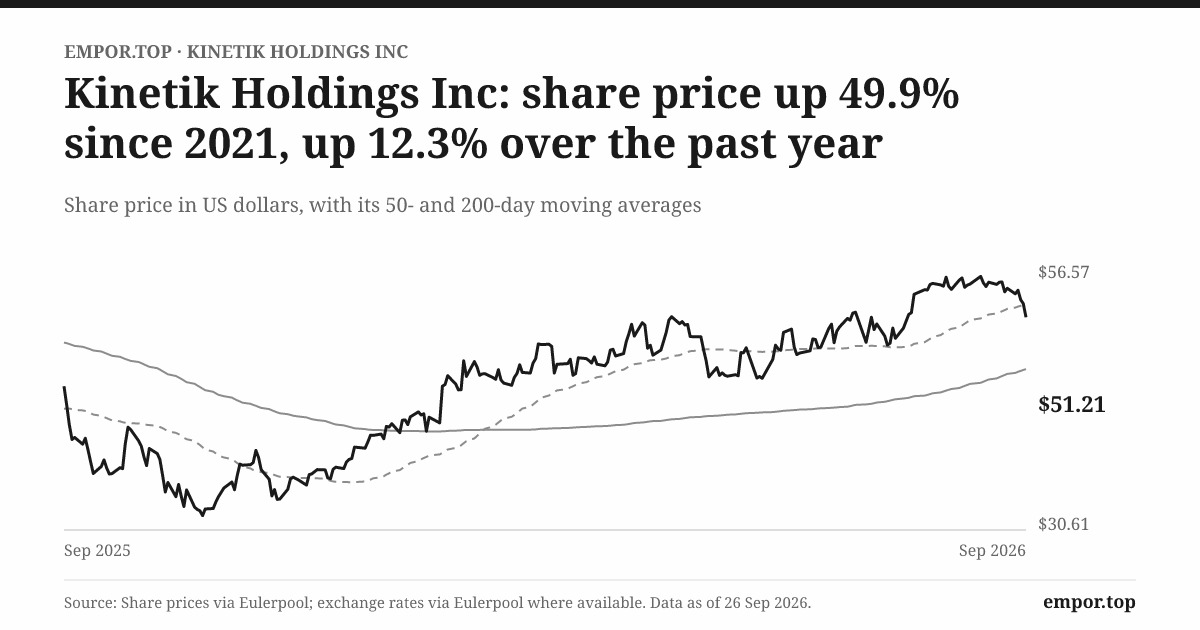
On September 9, 2026, Bloomberg reported that Kinetik was working with financial advisers to evaluate strategic options, including a potential sale of the company. Its shares closed that session at $54.55, reflecting a market equity capitalization of roughly $8.9 billion.7 That marked the second time in 2026 that sale deliberations had surfaced.8 The company forged from the collapse of the Alpine High play is now, once again, exploring a potential sale.
The Question Behind the Story
The central question is straightforward to frame but difficult to resolve: How did an operator whose original steel was laid for a dud field transform into one of the Delaware Basin's premier gathering systems? And is the Kinetik of 2026 a durable, freestanding franchise, or primarily a well-managed leveraged bet on third-party drilling across its dedicated acreage?
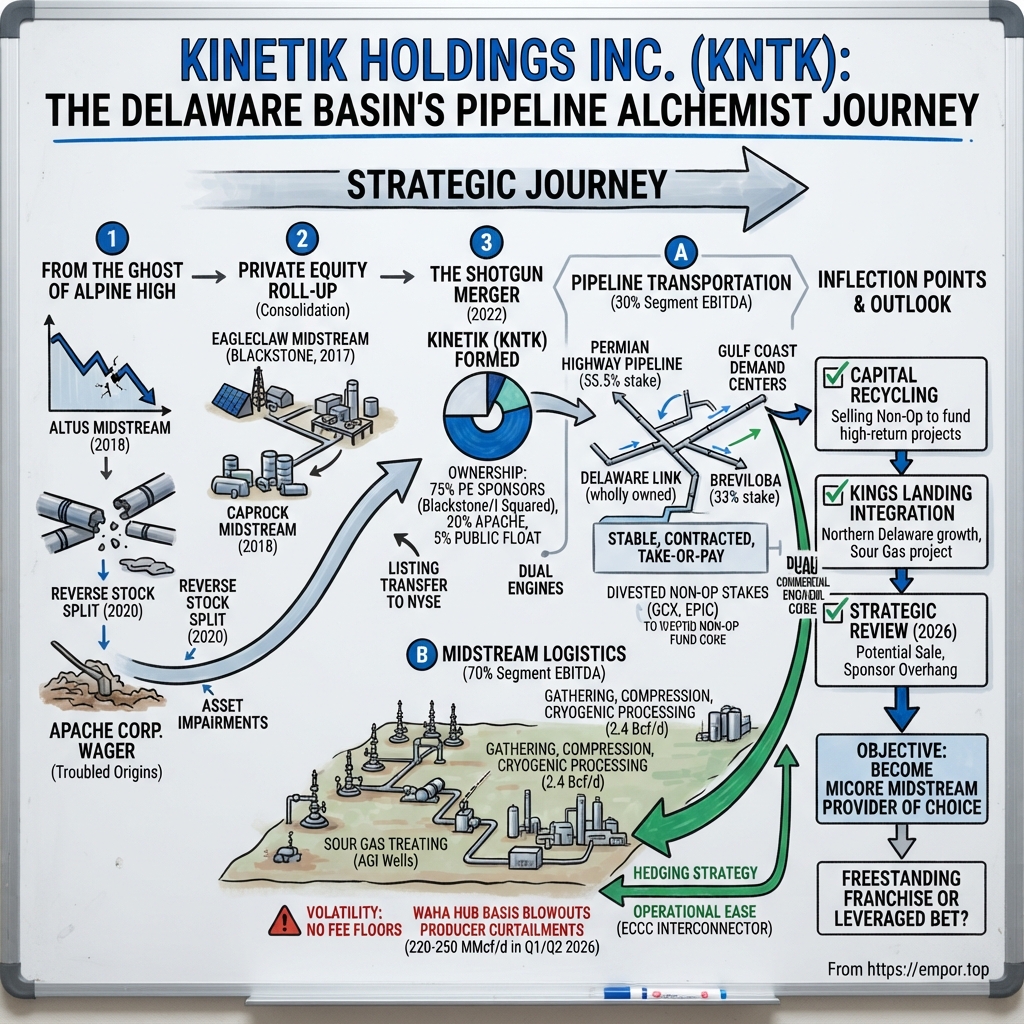
The business operates two primary engines. The first is Midstream Logistics, which gathers raw wellhead gas, compresses it, treats it, and processes it into dry residue gas and natural gas liquids (NGLs), alongside crude oil gathering and produced-water disposal. The second is Pipeline Transportation, consisting primarily of equity interests in long-haul pipelines transporting Permian volumes to the Gulf Coast, supplemented by select wholly owned transmission lines. In the first quarter of 2026, Midstream Logistics generated $179 million in segment EBITDA, while Pipeline Transportation contributed $78 million.9 That roughly 70/30 split represents an evolution from the approximately 65/35 ratio at the company's formation, reflecting deliberate divestitures of passive pipeline stakes to concentrate capital on operated infrastructure.10
By analogy, Kinetik owns the on-ramps, toll plazas, and sorting terminals at the highway entrance, along with minority stakes in several of the express lanes themselves. Midstream operators collect fees on volume throughput, but traffic flows only when upstream producers decide to leave the garage and drill. That upstream dependence underpins every element of the company's operations.
The Core Tension
Shareholders receive a quarterly dividend of $0.81 per share, or $3.24 annualized,6 representing an approximate 6% yield prior to the September buyout reports. In exchange, investors accept three major structural realities. First, balance-sheet leverage has recently hovered between 3.8x and 4.3x net debt to adjusted EBITDA.611 Second, private equity retains substantial voting control: Blackstone held 47.7% of total voting power as of March 2026.12 Third, the commercial model remains vulnerable to severe regional basis blowouts at the Waha Hub in West Texas, where local spot gas prices traded below zero for long stretches of 2024 and 2026, forcing upstream operators to pay off-takers simply to haul their gas away.139
The path to this juncture runs through a failed discovery, a private equity roll-up, an all-stock merger, a well-regarded asset swap, and a string of guidance cuts. It began in Reeves County, Texas, in 2016, with an announcement touting 75 trillion cubic feet of gas.
 Subscribe on LinkedIn
II. The Ghost of Alpine High: Apache, Altus Midstream, and the Great Shale Write-Down [00:15 – 00:35]
The Monster in Reeves County
In September 2016, Apache Corporation announced that it had identified a massive new resource play in the southern Delaware Basin. It named the prospect Alpine High, after the mountain town of Alpine to the south. Apache estimated the play held approximately 75 trillion cubic feet of rich gas and 3 billion barrels of oil under roughly 352,000 acres, supported by thousands of feet of stacked pay.2 For an exploration and production company that had lagged behind industry leaders, the discovery promised a corporate rebirth: an expansive, contiguous position assembled at minimal cost in an area rivals had largely bypassed.
Industry competitors had passed over the area for geological reasons. Alpine High sat on the gassy, structural fringe of the southern Delaware, where the formation yielded far more methane than crude oil. In North American shale development, crude oil typically generates the underlying project returns, while natural gas is treated as a low-margin associated byproduct. Apache was wagering that prolific volumes of rich gas and natural gas liquids (NGLs) could sustain commercial economics on their own.
Building the Toll Road Before the Traffic
Moving and processing that anticipated output required substantial gathering and processing systems, and Apache chose to finance that buildout using external capital. On August 8, 2018, Apache partnered with Kayne Anderson Acquisition Corp., a special purpose acquisition company, to form Altus Midstream, structured as a $3.5 billion pure-play Permian midstream C-corporation.14 The blank-check sponsor contributed roughly $952 million in cash, consisting of $380 million from its initial public offering trust account and $572 million raised through a private placement, while Apache retained an equity interest of approximately 71%.14
At inception, the operational footprint was modest compared with the project's long-term ambitions. The initial system included 380 million cubic feet per day of rich-gas processing capacity, 400 million cubic feet per day of lean-gas treating, and roughly 123 miles of gathering pipelines, alongside plans to reach approximately 1 billion cubic feet per day of cryogenic processing capacity by the close of 2020.14 In exchange, Apache dedicated approximately 340,000 contiguous net acres at Alpine High exclusively to Altus.14 The transaction closed on November 9, 2018.15
The most valuable component of the transaction proved to be an embedded slate of equity purchase options across five proposed joint-venture pipelines. Altus secured rights to acquire up to 15% of Kinder Morgan's Gulf Coast Express (GCX), up to 33% of the Permian Highway Pipeline (PHP), up to 33% of Enterprise Products Partners' Shin Oak NGL line, up to 15% of EPIC Crude, and 50% of the Salt Creek NGL header.14 At the time of the deal, these pipeline options appeared to be secondary structural features. Within two years, they became the enterprise's sole source of economic survival.
The Rock Said No
Upstream activity decelerated rapidly. Apache drilled 100 wells across Alpine High in 2018 and 82 in 2019, before materially reducing planned capital spending to what Altus's 2019 annual report disclosed as "no future drilling plans at Alpine High."15 Regional natural gas prices collapsed as surging Permian associated gas overwhelmed regional takeaway capacity, eroding the commercial returns of a gas-weighted shale play.2 In February 2020, Apache took a roughly $3 billion write-down tied to Alpine High and reallocated its exploration capital offshore to Suriname.2 Steven Keenan, the senior exploration executive most closely associated with the discovery, had resigned roughly five months earlier.2
Altus absorbed the impact directly. Following Apache's decision to halt development at Alpine High, Altus recorded approximately $1.3 billion of impairment charges across its gathering, processing, and transmission assets in the fourth quarter of 2019.15 Clay Bretches, the company's chief executive officer at the time, stated that Altus would have to pivot to pursuing third-party volumes to fill its newly constructed Diamond processing complex.2 For a midstream operator whose commercial viability had been anchored entirely to a single sponsor's drilling program, that shift marked a distressed change of course.
The public equity tracked the field's collapse. By mid-2020, Altus's Class A common shares had fallen far enough that the board carried out a 1-for-20 reverse stock split, effective June 30, 2020, specifically to regain compliance with Nasdaq's $1.00 minimum bid price rule.16 The move compressed roughly 325 million shares into approximately 16 million.16 A company launched through a blank-check transaction at the standard $10 baseline in late 2018 had, within two years, been reduced to trading as a penny stock.
The Life Raft
Altus avoided restructuring because it exercised its long-haul pipeline options, securing an equity interest of 16% in GCX, approximately 26.7% in PHP, 33% in Shin Oak, and 15% in EPIC Crude.15 These major transmission lines were supported by long-term, take-or-pay volume commitments from shippers across the Delaware and Midland basins. Cash flow from those assets did not depend on whether Apache drilled another well in Reeves County; it depended on the broader Permian's ongoing need to move gas and liquids to Gulf Coast demand centers in Houston and Corpus Christi. Altus had been transformed, in effect, into an equity holding company for regional transmission lines tethered to a largely underutilized processing complex in the desert.
Testing the First Thesis
The Alpine High collapse provides a clear test of a classic midstream underwriting premise: that a dedicated acreage commitment from a sizable producer guarantees durable, contracted returns. The play demonstrated the structural limitation of that convention. An acreage dedication guarantees exclusivity, meaning that any hydrocarbons extracted within the dedicated boundary must flow through the operator's gathering system. It does not require the producer to drill or produce a single barrel. While Altus's contractual framework remained intact, cash flow from its dedicated gathering footprint evaporated because the producer concluded that the underlying rock was not worth drilling.
Acreage dedications are not without value; they secure operating territory and prevent rival gatherers from capturing volumes from newly drilled wells. Yet the critical lesson remains: dedications are only as good as the underlying geology and the counterparty's economic incentive to drill it.
That insight remains central to evaluating Kinetik in 2026. While the modern company operates with a broader, more diversified producer base and higher-quality core acreage, gathering volumes remain sensitive to third-party capital budgets and drilling schedules, as market dynamics in 2025 and 2026 demonstrated. At the same time, the retreat from Alpine High left behind an underutilized processing complex situated adjacent to some of the most active acreage in the basin. For a neighboring midstream operator facing volume growth and processing bottlenecks, that stranded infrastructure represented a valuable solution. That counterparty turned out to be a Blackstone portfolio company operating only a few miles away.
III. The Private Equity Roll-Up: Blackstone, EagleClaw, and the Southern Delaware Land Grab [00:35 – 00:55]
Buying Into the Boom
In April 2017, while Apache was promoting Alpine High, Blackstone was making a quieter bet in the same neighborhood. On April 17, 2017, EagleClaw Midstream Ventures and its sponsor, EnCap Flatrock Midstream, agreed to sell EagleClaw to funds managed by Blackstone Energy Partners and Blackstone Capital Partners for approximately $2 billion in cash, supported by roughly $1.25 billion in stapled debt financing from Jefferies.17
At the time of the transaction, EagleClaw operated more than 375 miles of gathering pipeline, 320 million cubic feet per day of processing capacity, an additional 400 million cubic feet per day under construction, and more than 220,000 acres of long-term volume dedications spanning Reeves, Ward, and Culberson counties.17 The transaction established EagleClaw as the largest privately held midstream operator in the Delaware Basin. David Foley, the Blackstone energy executive who would later chair Kinetik's board of directors, highlighted the commercial relationships EagleClaw chief executive officer Bob Milam and his team had built with prominent Permian operators.17
The strategic rationale was straightforward. While the Midland Basin on the eastern side of the Permian had seen earlier, denser development, the Delaware Basin offered thicker stacked pay zones and a higher gas-to-oil ratio, positioning it as the next major growth fairway. Because every newly drilled oil well in the basin produced associated gas that required gathering, treating, and processing, midstream infrastructure was essential to regional development. EagleClaw's commercial advantage lay in aggregating dedications across multiple third-party exploration and production companies, providing volume diversification at the exact moment Altus Midstream remained bound to a single sponsor's drilling schedule.
Rolling It Up
Blackstone then executed a standard private equity playbook: expanding its anchor platform through debt-financed bolt-on acquisitions. In May 2018, EagleClaw agreed to acquire Caprock Midstream for $950 million, securing additional gathering and processing infrastructure across the southern Delaware.18 The platform consolidated these assets under BCP Raptor Holdco, an entity owned "principally funds associated with Blackstone and I Squared Capital" that would eventually become Kinetik's controlling shareholder.19 EagleClaw also established a footprint in long-haul takeaway: when Kinder Morgan and EagleClaw sanctioned the Permian Highway Pipeline on September 5, 2018, each partner held an initial 50% equity stake in the roughly 430-mile, 2 billion cubic feet per day project, subject to options for anchor shippers such as Apache.20 The partnership gave Blackstone direct ownership in the same critical natural gas artery where Altus held an equity option.
Aggressive platform roll-ups build operating scale, but they also accumulate debt. A private midstream operator expanded through stapled leverage and debt-financed acquisitions relies on continuous volume expansion to service its balance sheet. When drilling activity slows—whether triggered by a macroeconomic downturn or producer capital discipline—that leverage quickly turns restrictive. The collapse in crude prices during the spring of 2020 subjected midstream balance sheets across the basin to severe pressure. Because EagleClaw operated as a privately held entity, its exact financial leverage during that downturn remained undisclosed. However, its sponsors subsequently chose to pursue an all-stock merger with a publicly listed peer rather than an initial public offering, indicating that access to public market liquidity and available processing capacity took priority over raising new cash.
Enter the Deal Maker
The architect of that combination arrived through an unconventional career path. Jamie Welch had practiced corporate law as a barrister and solicitor in Melbourne and at Milbank, Tweed, Hadley & McCloy in New York before transitioning to investment banking. He served as a senior vice president in utilities and project finance at Lehman Brothers, and beginning in 1997 spent sixteen years at Credit Suisse First Boston, where he ultimately led EMEA investment banking and the Global Energy Group.21
In June 2013, Welch joined Energy Transfer Equity as group chief financial officer and head of business development under Kelcy Warren, helping direct one of the most aggressive debt-funded acquisition campaigns in the modern pipeline sector.21 That tenure concluded abruptly: Energy Transfer filings disclose that Thomas Long replaced Welch as group CFO effective February 5, 2016.22 The following month, Welch filed suit against the company in Dallas County, alleging breach of contract regarding compensation agreements and an equity interest in the Lake Charles LNG export project.23 The management shakeup occurred in the midst of Energy Transfer's contentious, ultimately terminated attempt to acquire The Williams Companies.
Welch transitioned back to private equity shortly thereafter. In July 2016, he became a senior adviser to Blackstone Energy Partners. He joined the board of EagleClaw's parent company in June 2017, and in April 2019 assumed the roles of president and chief executive officer of BCP Raptor Holdco's general partner, later taking on CFO responsibilities as well.21 His professional background reflected that of an experienced transactional specialist skilled in asset valuation, capital structure engineering, and midstream asset negotiations, alongside firsthand experience navigating boardroom friction within sponsor-controlled entities. Both capabilities would leave a distinct imprint on Kinetik's strategic direction, particularly in its aggressive portfolio recycling and complex private equity governance.
Why Consolidation Made Sense
By 2021, the commercial logic of consolidation was visible on any Delaware Basin pipeline map. EagleClaw's gathering volumes were expanding toward its processing capacity limits, while Altus possessed modern, underutilized cryogenic facilities starved of rich gas feedstock. The two gathering footprints were directly adjacent in the southern Delaware. Constructing a greenfield cryogenic processing facility typically requires 18 to 24 months and hundreds of millions of dollars in capital expenditure, whereas accessing neighboring idle capacity required only short pipeline tie-ins. The operational synergy was undeniable. The remaining challenge was structuring an all-stock transaction between a private-equity-backed operator and an Apache-dominated public midstream company on terms acceptable to both controlling sponsors.
IV. The Shotgun Marriage: How Altus and EagleClaw Merged to Create Kinetik [00:55 – 01:18]
The Deal
The transaction was structured as a reverse merger, a mechanism allowing a privately held platform to access the public markets by merging into an already listed entity. Under the agreement, the publicly traded Altus issued 50 million Class C common shares to the unitholders of BCP Raptor Holdco. When the transaction closed on February 22, 2022, BCP's equity sponsors and management controlled approximately 75% of the combined enterprise, Apache Midstream retained roughly 20%, and Altus's pre-merger public shareholders were diluted down to a float of about 5%.19 Kinetik's Class A common stock began trading on Nasdaq under the ticker KNTK at the market open on February 23, 2022.19 Operationally, roughly 208 EagleClaw employees and 56 former Apache employees formed the new operating workforce.10
In practical terms, Blackstone and its investment partners secured majority control of a publicly listed corporation, Apache transitioned from an active sponsor-operator to a minority investor seeking an orderly exit, and an unaffiliated public float of just 5% served as the initial price-discovery mechanism for a multi-billion-dollar midstream enterprise. Public investors purchasing KNTK in 2022 were acquiring a narrow sliver of trading liquidity alongside two dominant institutional owners positioned to monetize their positions over time.
Why the Deal Was Structured This Way
The merger architecture resolved distinct structural constraints facing each party. A conventional initial public offering for BCP Raptor would have required formal roadshows, rigorous valuation discovery, and the challenge of marketing a heavily leveraged private platform amid volatile energy markets. An outright sale for cash would have required identifying a strategic buyer willing to pay upfront for volume growth that was still unproven on the ground. The reverse merger bypassed both hurdles. Altus offered an active listing, compliant SEC reporting infrastructure, and modern processing capacity that EagleClaw could utilize immediately. For Apache, the transaction converted an illiquid, controlling interest in a stranded gathering footprint into a tradable minority stake in a diversified midstream operator with a clear path toward market monetization. For Blackstone, it delivered operational control of a public vehicle without expending corporate cash.
Midstream consolidation frequently occurs when counterparties exchange intractable structural dilemmas for workable commercial compromises. What distinguished Kinetik was the sheer concentration of its initial ownership. Because roughly 95% of the equity sat in institutional hands, the daily share price was set by a very thin public float, while genuine economic control resided with sponsors whose long-term objective was executing block sales. Consequently, the company's equity narrative after 2022 centered on gradually widening that public float through secondary offerings, even as management worked to convince income-seeking investors that a high cash distribution compensated for the inherent governance overhang.
What Was Promised
The merger presentation established aggressive commercial and financial baselines. Management guided that approximately 65% of combined EBITDA would be generated by Delaware gas gathering and processing, with the remaining 35% contributed by equity interests in long-haul pipeline joint ventures. The company marketed itself as the largest natural gas processor in the Delaware Basin and the fourth-largest across the entire Permian, emphasizing that more than 85% of projected 2022 EBITDA was underpinned by take-or-pay agreements and existing production.10 Management also established two specific balance-sheet targets: 3.5x leverage and investment-grade credit ratings by the end of 2023.10 David Foley of Blackstone assumed the role of chairman of the board, while Welch declared that Kinetik's goal was to become "the midstream service provider of choice for the Texas Delaware Basin."10
The transaction also concentrated control over long-haul takeaway capacity. By combining the Altus and EagleClaw interests, Kinetik emerged from the merger with a combined 53.3% equity stake in the Permian Highway Pipeline, alongside partners Kinder Morgan and ExxonMobil.24 That equity interest subsequently rose to 55.5% in a transmission line rated at 2.65 billion cubic feet per day.3
Engineering for Retail Investors
Two early corporate actions illustrated management's approach to cultivating market support. In May 2022, the board approved a 2-for-1 stock split distributed in the form of a share dividend, expanding the total share count to approximately 135 million. The stated purpose of the split was to enhance trading liquidity and make the stock "more accessible to its employees and investors."25 Following the split, the board set the quarterly dividend at $0.75 per share, representing an annualized distribution of $3.00.25 That investor-relations push culminated in the company's transfer to the New York Stock Exchange in October 2022.1 The commercial positioning was unmistakable: an attractive cash yield, a prominent Big Board listing, and executive leadership actively marketing the stock to income-focused investors.
Checking the Promises
The claim being tested: the combination would quickly turn pro forma synergies into a stronger balance sheet and higher per-share cash flow.
The operational record proved mixed. On the physical system, commercial synergies materialized as planned: routing EagleClaw's rich wellhead gas into Altus's modern processing facilities filled capacity that would have otherwise required hundreds of millions of dollars in capital expenditure to build from scratch. Throughput expanded as planned: processed gas reached 1.53 billion cubic feet per day in the first quarter of 2024, up 13% year over year.26 Leverage briefly complied with expectations, dropping to 3.4x by the close of 2024.27
However, the commitment to secure investment-grade credit ratings by the end of 2023 was missed. In June 2024, Fitch Ratings affirmed Kinetik's operating subsidiary at BB+, one notch below investment grade.28 Balance-sheet leverage subsequently expanded: Kinetik finished 2025 with a leverage ratio of 3.8x and net debt to adjusted EBITDA of 3.9x, leading management to adjust its stated target range to between 3.5x and 4.0x.5 In late 2025, net debt to adjusted EBITDA rose to 4.3x.11 While falling a single rating notch short of investment grade is not fatal to midstream operations, it represents a definitive corporate commitment tied to a hard deadline that went unfulfilled. For public shareholders, it provides a measurable baseline against which future leverage guidance should be evaluated.
The institutional motivations behind the transaction also require objective assessment. The merger injected no fresh equity into the operating business. Instead, it provided EagleClaw's private equity sponsors with a liquid, publicly traded security they could monetize over time, while handing Apache a path to salvage value from an abandoned exploration play. That structure did not diminish the genuine industrial logic of linking adjacent gathering systems, but it established liquidity for controlling insiders as the primary transaction driver. The secondary offerings, ongoing share overhang, and recurring strategic review deliberations that followed were the natural consequence of that design.
The central operational question that followed was how this consolidated system functioned on the ground, and why its two commercial engines carried fundamentally different operational and commodity risk profiles.
V. The Engine Room: Midstream Logistics vs. Pipeline Transportation [01:18 – 01:45]
A Molecule's Route
Consider a single molecule of natural gas produced from a horizontal wellhead in Eddy County, New Mexico. It surfaces alongside crude oil, produced water, and—in parts of the northern Delaware Basin—corrosive contaminants like hydrogen sulfide and carbon dioxide, known as sour gas. A low-pressure gathering pipeline carries the raw stream to a field compressor station, which elevates the pressure to move it onward to a centralized processing complex. There, the stream is dehydrated, stripped of acid gases, and chilled in a cryogenic unit to roughly minus 120 degrees Fahrenheit. At that extreme temperature, heavier hydrocarbons—ethane, propane, butanes, and natural gasoline—condense out of the gas stream as natural gas liquids (NGLs). What remains is dry methane, the residue gas that heats homes and fuels power generation.
From the plant tailgate, those separated products take divergent logistical paths. The NGL stream enters long-haul pipes like Shin Oak heading toward the Mont Belvieu fractionation complex near Houston. The dry residue gas either sells locally at the Waha Hub in West Texas or enters an interstate pipeline like the Permian Highway Pipeline bound for Gulf Coast demand centers. At nearly every stage of that physical journey, Kinetik can capture a fee or an operating margin.
Midstream Logistics: The Fee Engine
The Midstream Logistics segment encompasses gathering, compression, treating, cryogenic processing, crude gathering and stabilization, and produced-water disposal, supported by approximately 580,000 barrels per day of permitted water disposal capacity.3 Most revenue is generated through unit fees levied on volume throughput. The crucial contractual detail, which Kinetik's chief financial officer stated directly on the first-quarter 2026 earnings call, is that there are no fee floors in its gathering and processing contracts.9 If an upstream customer halts production, Kinetik collects no gathering fee.
A secondary layer of contracts exposes Kinetik to commodity prices through percent-of-proceeds arrangements—where the processor keeps an agreed share of the NGL and residue gas value—and regional marketing margins. While Kinetik did not disclose a unified company-wide fee-versus-commodity percentage in its filings, management actively hedges that residual exposure. As of spring 2026, the company had hedged roughly 50% of its transport-spread exposure, 75% of its propane and butane volumes, and 85% of its crude and condensate volumes.9 Simultaneously, management worked to convert volume exposure into stable fee revenue: about 75% of legacy Durango volumes were amended to include larger fee components, alongside contract terms extended out to 2039.9
Pipeline Transportation: The Toll Road
Following years of portfolio rationalization, Kinetik's remaining Pipeline Transportation footprint consists of a 55.5% equity interest in the Permian Highway Pipeline (a 2.65 billion cubic feet per day trunkline to the Gulf Coast), a 33% interest in the Breviloba joint venture underlying the 600,000-barrel-per-day Shin Oak NGL line, and the wholly owned 1.0 billion cubic feet per day Delaware Link pipeline.3 These transmission assets generate predictable, utility-like cash flows underpinned by long-term, take-or-pay shipper agreements. In the first quarter of 2026, segment EBITDA declined year over year, not because of deteriorating pipeline operations, but because Kinetik divested its equity interest in EPIC Crude.9 That shrinking share of overall cash flow was a deliberate capital reallocation choice, examined in Section VI.
Delaware Link: Choosing the Exit
The wholly owned Delaware Link pipeline, rated at 1.0 billion cubic feet per day, plays a vital operational role across the system.3 When residue gas clears a processing plant, it requires an immediate takeaway outlet. If Kinetik's only physical outlet were the local Waha market, every bout of pipeline congestion would translate directly into operational bottlenecks. Delaware Link provides the system with an alternative route, connecting processed residue gas directly into long-haul lines like PHP rather than forcing it onto the local spot hub. Think of it as a facility with a secondary exit: it cannot prevent traffic jams on the highway, but it ensures the operator is not trapped when the front door is blocked. That dual-path egress is why management repeatedly claimed that Kinetik and its producer customers were "well positioned with egress." It also explains why the clearest commercial benefit of that takeaway access appeared in marketing margins rather than steady gathering throughput.
The Waha Problem
This recurring regional bottleneck represents the defining operating risk for Kinetik. Because the Permian Basin produces natural gas primarily as an associated byproduct of crude oil extraction, upstream producers do not halt drilling merely because gas prices weaken. When long-haul pipeline takeaway capacity out of the basin fills up, surplus gas becomes trapped, and local hub prices can plunge deep into negative territory. In 2024, Waha spot prices traded below zero on 46% of trading days through early September, including every single session from July 26 onward, bottoming at negative $6.41 per million British thermal units on August 29.13 The commercial startup of the Matterhorn Express pipeline, a 2.5 billion cubic feet per day line to Katy near Houston, delivered temporary relief around that time.13
That relief did not endure. In the first five months of 2026, Waha spot prices traded positive on only 13 days, averaging negative $4.81 per MMBtu across March and April.9 On Kinetik's first-quarter 2026 earnings call, Welch acknowledged the severe market dislocation, remarking that "seeing negative pricing for Waha going into October is truly hard to fathom."9
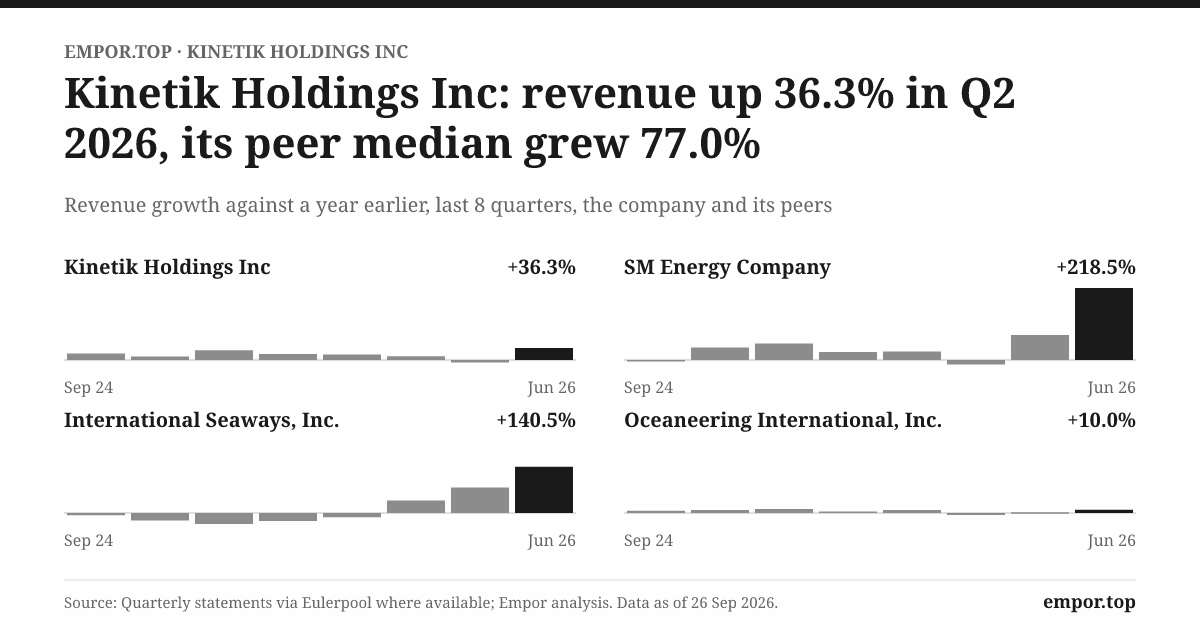
For Kinetik, negative Waha pricing is a double-edged sword. It hurts volumes. Upstream producers operating gas-weighted acreage, or lacking firm downstream transport to the Gulf Coast, occasionally shut in production rather than pay off-takers to haul their gas away. Kinetik's price-related processing curtailments widened to roughly 220 million cubic feet per day in the first quarter of 2026—more than double the approximately 100 million cubic feet per day management had anticipated—forcing the company to trim its 2026 processed-volume growth guidance from high single digits down to low-to-mid single digits.9 Second-quarter curtailments deepened to about 250 million cubic feet per day, leaving processed volumes flat year over year at 1.74 billion cubic feet per day.6
It also expands margins. Because Kinetik controls firm takeaway capacity on PHP and other corridors, a wide price divergence between Waha and Gulf Coast trading points creates lucrative arbitrage opportunities. Kinetik's marketing arm purchases deeply discounted in-basin supply and sells it at Gulf Coast index prices. Management estimated this basis spread capture added approximately $20 million to 2026 EBITDA.9
What the Calls Show
This two-sided commercial exposure has been a regular theme on quarterly conference calls. On the first-quarter 2024 call, during an earlier stretch of sub-zero pricing, Welch pointed out that daily Waha prices had averaged negative $0.72 per MMBtu across March and April. He maintained that customers had "benefited handsomely" by selling delivered volumes at the Gulf Coast, asserting that Kinetik and its counterparty base were "very well positioned with egress" to premium demand centers.26 In the same remarks, however, he acknowledged upstream curtailments at Alpine High during March, noting that volume had recovered afterward.26
Management's characterization was accurate but incomplete. Two years later, despite substantial industry investment in new pipeline takeaway capacity, curtailments across Kinetik's system were materially larger than those seen in 2024.
The operational takeaway is that pipeline egress protects Kinetik's marketing margin, not its gathering volume. When an upstream producer decides not to flow gas, Kinetik's firm PHP capacity cannot replace those uncollected gathering fees. Kinetik has hedged its commodity price risk effectively, but it retains direct exposure to upstream volume curtailments—the same vulnerability that undermined Altus in 2019, even if that risk is now dispersed across multiple third-party operators rather than concentrated in a single sponsor.
Myth vs. Reality: "Fee-Based Means Stable"
The myth: A fee-based midstream operator functions like a bond-like utility insulated from commodity cycles.
The reality: Fee-based contracts protect against price volatility on the volumes that actually flow through the system; they provide no protection against volume reductions. Kinetik's own operating disclosures confirm that limitation. Processed volumes averaged 1.75 billion cubic feet per day in the second quarter of 2025, 1.84 in the third, 1.79 in the fourth, and 1.74 in the second quarter of 2026.291156 Throughput was essentially flat across that twelve-month span, even as Kinetik added processing capacity. Adjusted EBITDA still reached record levels in 2026 because of improved NGL recoveries, wide marketing spreads, and disciplined operating costs, not because more molecules entered the system.6
The more precise reality is that Kinetik maintains a diversified fee foundation that absorbs commodity price shocks well, while its volumetric expansion remains bound to producer drilling schedules and basin takeaway constraints. The critical test for the franchise is whether processed volumes can ramp toward the roughly 2.2 billion cubic feet per day exit rate management guided for 2026 as new takeaway capacity comes online.6
Holding a large long-haul pipeline portfolio alongside a volume-sensitive gathering franchise raised an obvious strategic question: could passive pipeline stakes be liquidated to fund the expansion of core gathering infrastructure? Kinetik's most consequential transactions did exactly that.
VI. Capital Allocation Masterclass or Leverage Tightrope? The Durango Acquisition & The GCX Trade [01:45 – 02:08]
Two Deals Announced Together
On May 9, 2024, alongside its first-quarter operating results, Kinetik announced two major transactions designed to be evaluated as a single portfolio restructuring.30
The sale: Kinetik agreed to divest its 16% equity interest in the Gulf Coast Express pipeline to an affiliate of ArcLight Capital Partners for up to $540 million, consisting of $510 million in cash at closing and an additional $30 million contingent upon the GCX board approving a qualifying capacity expansion.30 The transaction valued Kinetik's minority interest at roughly 10.4x expected 2024 EBITDA.30 GCX was a high-performing, fully contracted trunkline that Kinetik did not operate; private infrastructure funds like ArcLight valued its predictable, utility-like distributions at a premium compared to the public market valuation assigned to Kinetik's broader gathering platform.
The purchase: Simultaneously, Kinetik agreed to acquire Durango Permian from Morgan Stanley Energy Partners for $765 million in cash and equity, plus up to $75 million in contingent consideration linked to the ultimate construction cost of the Kings Landing processing plant.30 The consideration comprised approximately $315 million in cash and 11.5 million Class C common shares, with 3.8 million shares delivered at closing and 7.7 million deferred to July 1, 2025.30 Durango added roughly 420 million cubic feet per day of processing capacity (inclusive of the Kings Landing expansion), doubled Kinetik's gathering pipeline network, and brought approximately 60 new upstream producer customers onto the system.30
Alongside the acquisition, Kinetik secured a 15-year gathering and processing agreement in Eddy County, requiring roughly $200 million of capital investment through 2026 at an estimated build multiple of approximately 5x run-rate EBITDA.30 Executive leadership highlighted that, upon closing and completing the development projects, Kinetik would "own and operate over 2.4 billion cubic feet per day of processing capacity, entirely in the Delaware Basin."30
Why New Mexico
The Durango transaction expanded Kinetik north across the state line into Eddy and Lea counties, which management characterized as "the most active counties in the Permian Basin."30 That represented a meaningful strategic reorientation. Historically, Kinetik's gathering footprint had been anchored in the southern Delaware across West Texas, rooted in the legacy Alpine High acreage. The northern Delaware contains some of the most productive crude-oil acreage in North America, with a substantial share located on federal land administered by the Bureau of Land Management. By acquiring Durango, Kinetik diversified its volume base away from gassier southern acreage toward prolific, oil-directed drilling fairways.
The northern Delaware acreage also introduced a distinct technical hurdle: a large proportion of its natural gas stream is sour. Processing sour gas requires treating the stream to remove corrosive hydrogen sulfide and carbon dioxide, followed by the safe disposal of that concentrated acid gas—typically by injecting it deep underground through specially permitted acid gas injection (AGI) wells. Because these subsurface permits are rigorous and time-consuming to secure, existing treating and disposal capacity provides an enduring competitive barrier to entry.
Pricing the Trade
Management presented the dual transactions as an exercise in multiple arbitrage: monetizing a passive, non-operated asset at approximately 10.4x and redeploying that capital into an operated gathering network at a lower multiple. Kinetik guided that Durango was acquired at roughly 6.5x expected 2024 EBITDA, with that multiple projected to compress to approximately 5.5x once the Kings Landing plant entered commercial service.30 Divesting assets at ten times EBITDA and acquiring operated infrastructure at six times creates clear economic value—provided the underlying asset performs according to underwriting projections.
The vulnerability in that underwriting rested on the timeline. The projected 5.5x multiple depended entirely on Kings Landing entering service on budget and on schedule. The actual project timeline revealed material execution friction:
- In May 2024, management guided that Kings Landing would reach completion in April 2025.30
- By February 2025, the target startup had slipped to the end of June 2025.27
- In August 2025, Kinetik lowered its full-year 2025 EBITDA guidance, pointing to Kings Landing's delayed commissioning alongside weaker commodity pricing and higher operating costs.29
- The facility finally achieved full commercial in-service in late September 2025, roughly five months behind its original target.11
On Kinetik's third-quarter 2025 earnings call, Chief Financial Officer Trevor Howard acknowledged that the pace of initial volume ramp-up had "fell short of our initial expectations," with management estimating the commissioning delay reduced 2025 EBITDA by roughly $20 million.31 When Kings Landing finally came online, Welch noted that the plant was capturing "new volumes behind our system that had been curtailed for up to two years."11 While that confirmed significant pent-up producer demand across the northern Delaware, it also demonstrated the revenue lost while the processing capacity sat incomplete.
Testing the "Disciplined Capital Recycler" Claim
The primary bull argument for Kinetik centers on management's disciplined capital recycling. That proposition warrants an objective review beyond simple headline transaction multiples.
Evidence supporting the claim. The GCX transaction initiated a broader divestiture campaign executed on similar valuation logic. In 2025, Kinetik sold its 27.5% equity interest in EPIC Crude as part of a joint transaction in which Plains All American acquired 55% of the pipeline from Diamondback Energy and Kinetik. Kinetik realized $504.2 million in net cash proceeds and booked a $415.4 million gain on the sale.4 It subsequently deployed $175.5 million in January 2025 to acquire Permian Resources' Barilla Draw gathering infrastructure, expanding crude and gas gathering within its core operating basin.4 Across 2024 and 2025, the strategic blueprint remained coherent: monetize non-operated stakes at infrastructure-fund valuations and redeploy capital into operated gathering systems where Kinetik directly controls customer commercial relationships and project expansions.
Evidence challenging the claim. 1. Forecasting volatility. Kinetik's initial 2025 guidance targeted Adjusted EBITDA of $1.09 billion to $1.15 billion.27 Management lowered that forecast in August to between $1.03 billion and $1.09 billion, and cut it again in November to a range of $965 million to $1.005 billion.2911 Full-year 2025 Adjusted EBITDA ultimately came in at $987.7 million, roughly 12% below the midpoint of initial guidance.5 On the third-quarter call, Welch addressed the performance shortfall directly, acknowledging that "over the past four quarters, we have stumbled," adding that leadership was "forensically analyzing and improving our forecasting assumptions" and committing that "we will absolutely do better, and I will not rest until we do."31 Kinetik's stock dropped roughly 6% in pre-market trading following the release, falling to around $35.60.31 While executive accountability was evident, three downward revisions within a single fiscal year pointed to forecasting deficiencies. 2. Exchanging steady distributions for volume exposure. Each divestiture substituted contracted, take-or-pay pipeline distributions for gathering and processing fees dependent on upstream drilling schedules. In the first quarter of 2026, Midstream Logistics EBITDA grew 12% year over year on largely flat throughput, while Pipeline Transportation cash flows contracted following the EPIC Crude divestiture.9 The portfolio deliberately shifted capital toward the more operationally variable business segment. 3. Balance-sheet leverage. Divestiture proceeds did not materially reduce corporate leverage over this period. Leverage stood at 3.4x at year-end 2024, climbed to 4.3x net debt to EBITDA in the third quarter of 2025, and settled at 3.84x by mid-2026.27116 Transaction proceeds funded capital projects, bolt-on acquisitions, and equity repurchases rather than permanent debt retirement.
Assessment. The operational record does not justify the label of an unblemished "masterclass." It supports a more qualified conclusion: Kinetik's leadership demonstrated strong acumen in asset pricing—selling passive pipeline stakes at premium multiples to fund operated infrastructure—but proved less reliable in operational forecasting and scheduling. Durango's industrial rationale remains intact: Kings Landing is operating, and the commercial commitment to Kings Landing II confirms strong regional demand. However, the anticipated financial accretion arrived nearly a year behind schedule and following multiple guidance cuts. The benchmark for evaluating execution discipline going forward is whether Kings Landing II—which achieved a final investment decision in May 2026 at an estimated cost of $260 million, targeting a mid-2028 completion—delivers on schedule and within budget.6 A second project delay would establish a persistent operational pattern.
A Diligence Aside: The Gap Between EBITDA and Cash
Kinetik reports financial results across three non-GAAP metrics: Adjusted EBITDA, distributable cash flow (DCF), and free cash flow. Evaluating all three is essential, as their trajectories diverge significantly.
Consider the second quarter of 2026. Kinetik reported record Adjusted EBITDA of $280.8 million. Distributable cash flow—which deducts net interest expense, cash taxes, and maintenance capital expenditures required to maintain existing steel—totaled $194.9 million. Free cash flow—which further deducts discretionary growth capital expenditures—amounted to $105.2 million.6 With roughly 162.4 million shares outstanding and a quarterly distribution of $0.81 per share, paying the dividend requires approximately $130 million each quarter.6 Consequently, during Kinetik's strongest operating quarter on record, the dividend was covered by DCF but generated a cash shortfall after growth capex, with the difference absorbed by the balance sheet.
GAAP accounting presents further divergence. Net income stood at $123.1 million for the second quarter of 2026 but totaled only $118.0 million across the first six months of the year.6 That dynamic reflects the first quarter of 2026, in which the company posted a modest net GAAP loss despite reporting record Adjusted EBITDA at the time.96 Conversely, 2025 GAAP net income was heavily bolstered by the $415.4 million accounting gain recorded on the EPIC Crude sale.3 These divergences do not indicate operational distress; rather, they underscore that in a capital-intensive midstream enterprise, large non-cash depreciation, debt service, and transactional gains obscure GAAP results, and that generating record EBITDA is not equivalent to achieving self-funding status after dividends and growth capital.
Kinetik's capital structure also carries direct interest rate sensitivity. In 2025, the company refinanced its credit facilities with a $1.6 billion unsecured revolving credit facility and a $1.15 billion unsecured term loan, while issuing $250 million of 6.625% sustainability-linked senior notes due 2028 to augment its existing debt stack.4 For an operator carrying a BB+ credit profile that funds ongoing gathering buildouts via floating-rate bank debt, interest rate movements exert direct balance-sheet pressure that fully contracted long-haul pipelines do not face.
The Regulatory Side of Moving North
Expanding into New Mexico elevated Kinetik's exposure to regulatory oversight. Upstream development on federal acreage requires formal permits from the Bureau of Land Management, while New Mexico state agencies enforce stringent venting, flaring, and emissions rules. Furthermore, processing northern sour gas depends entirely on operational acid gas injection capacity. The sour-gas treating conversion at Kings Landing secured regulatory clearance and was under active construction in spring 2026, targeting a year-end 2026 phase-one startup, while drilling on its dedicated AGI well was underway in mid-2026.96 These project milestones represent concrete operational hurdles that public investors can track directly.
Every one of these capital allocation decisions required approval from a board of directors where a single private equity sponsor held effective voting control. The strategic incentives and governance dynamics of that controlling shareholder form the next chapter of Kinetik's trajectory.
VII. Jamie Welch, Governance, and the Sponsor Overhang: A Credibility & Activist Stress Test [02:08 – 02:26]
The CEO
Welch does not fit the mold of a conventional midstream chief executive. While most of his industry peers rose through engineering or field operations, Welch built his career as a corporate lawyer and investment banker, bringing a background that makes him uniquely comfortable debating asset valuation on earnings calls and parrying analyst skepticism. His corporate trajectory has been closely tethered to private equity sponsors: serving as a senior adviser to Blackstone, stepping in as director and chief executive of Blackstone’s private gathering platform, and ultimately leading the publicly traded vehicle that Blackstone controls.21 The company's 2026 proxy statement reported that Welch held approximately 2.7% of total voting power, a substantial personal equity stake that aligns his financial interests with outside shareholders.12 It also means his ultimate monetization, like Blackstone’s, is tied to the valuation and timing of an eventual corporate transaction.
That executive temperament emerges most clearly in the wake of operational setbacks. Following third-quarter 2025 results, Welch offered a blunt assessment, acknowledging that "over the past four quarters, we have stumbled," and committed to a rigorous internal review—promising leadership was "forensically analyzing" its budgeting methods—rather than attributing shortfalls to commodity fluctuations.31 While that transparency reflected executive accountability, the counterweight was that guidance cuts had become a recurring pattern, with each revised forecast having been introduced with absolute confidence.
The Ownership Structure
The 2026 proxy statement delineates voting control with absolute clarity. Blackstone holds 47.7% of combined voting power, primarily through 65.5 million Class C shares alongside 11.9 million Class A shares, while I Squared Capital commands 11.5%, almost entirely in Class C.12 Under the governing stockholders agreement, Blackstone holds the right to designate three directors and I Squared one. The Blackstone designees are board chairman David Foley, JP Munfa, and Karen Putterman, while I Squared is represented by Michael Kumar.12 Those Class C shares—totaling 97.6 million as of February 2026, against 64.6 million Class A shares—are held almost entirely by the sponsors through the underlying operating partnership structure.3
The proxy classifies nine of the ten directors as independent under New York Stock Exchange guidelines, anchored by independent lead director Laura Sugg.12 That governance designation complies with exchange rules by treating private equity sponsor representatives as non-management directors, even if public minority shareholders view substantial sponsor board representation through a more skeptical lens.
These disclosures also clarify a common market misconception that I Squared had largely divested its position. As of the March 2026 proxy, I Squared continued to hold 11.5% of the vote and an active board seat.12 While sponsor-affiliated entities have conducted periodic trimming—such as on September 22 and 23, 2026, when ISQ Global Fund II GP sold 64,131 shares for approximately $3.44 million at prices between $53.50 and $54.01—those modest transactions remain far short of a formal exit.32
The Selldown So Far
Apache was the first foundational sponsor to stage an exit. In March 2024, Apache Midstream monetized 11,373,801 Class A shares through an underwritten secondary offering priced at $33.75 per share, accompanied by a standard greenshoe option for underwriters.[^33] Kinetik received none of the offering proceeds.[^33] By year-end 2024, Kinetik disclosed that Apache had liquidated its remaining equity holding.27 For an exploration company that had initially established Altus to finance the infrastructure for Alpine High, the reverse merger ultimately provided a liquid mechanism to convert stranded gathering steel into corporate cash—a pragmatic conclusion to a troubled shale wager.
Blackstone, by contrast, has executed no comparable monetization. Its 47.7% equity holding carried a market value of roughly $4 billion at September 2026 trading levels, a volume far too massive to liquidate through routine public secondary offerings without inducing steep market discounts.127 That structural concentration represents the primary overhang on Kinetik’s equity, and it explains why strategic review deliberations surfaced in 2026. For a private equity sponsor holding nearly half of an $8.9 billion enterprise, orchestrating an outright corporate sale represents the most efficient path to liquidity.
An Activist's Critique
If a constructive activist investor—seeking per-share value optimization rather than an outright proxy battle—were to evaluate Kinetik’s financial record across 2025 and 2026, the critique would center on four core vulnerabilities.
1. Buybacks at elevated leverage. During 2025, Kinetik repurchased $176 million of Class A common stock and declared $3.12 per share in dividends.512 Over that same span, net debt expanded to 4.3x adjusted EBITDA while corporate credit ratings remained stalled at BB+.1128 The board defended that capital deployment as part of a formal framework balancing "annual dividend increases and share repurchases."12 The skeptical critique is straightforward: an operator that missed its target for an investment-grade balance sheet and revised earnings guidance downward three times in twelve months funded equity repurchases with borrowed capital rather than retiring debt. The counterargument rests on transaction timing: repurchasing equity between $35 and $40 per share, well below the valuations subsequently reported in buyout deliberations, represents accretive capital allocation if a sale materializes.317 The ultimate validity of that capital deployment rests on the final realization price.
2. Dividend coverage. Dividend coverage stood at 1.2x for full-year 2025 before strengthening to 1.47x in the second quarter of 2026.56 Management's articulated capital policy targets annual dividend growth of 3% to 5% until coverage achieves 1.6x, after which distribution growth will match underlying cash flow.33 While coverage exceeding 1.0x indicates the dividend is funded by distributable cash flow, growth capital requirements constrain financial flexibility. Management raised 2026 capital expenditure guidance to approximately $560 million and projected annual outlays of $500 million to $600 million through 2027 and 2028—capital sufficient to construct roughly one greenfield cryogenic plant each year.633 Absorbing that level of capital expenditure alongside an annualized dividend commitment of approximately $525 million (supported by 162.4 million shares at $3.24) while carrying leverage near 3.8x leaves minimal margin for operational disruption.6 Howard framed the strategy by arguing that "elevated reinvestment today builds the earnings base that funds growing returns tomorrow."33 That thesis articulates the commercial wager clearly, but its success hinges entirely on upstream producers delivering anticipated volumes.
3. Alignment in a sale process. Blackstone captures the largest dollar windfall from an acquisition at a premium, representing the textbook culmination of a private equity investment horizon. While public minority holders also stand to benefit from a takeover premium, potential misalignments center on transaction structure: cash versus equity consideration, timing considerations, and whether terms prioritize a controlling holder's requirement for full liquidity over maximizing long-term per-share value. Minority investors face the question of whether any proposed transaction will require separate approval by unaffiliated Class A common shareholders. With no definitive agreement announced as of late September 2026, those contractual safeguards remain untested.
4. Forecasting credibility. While operational forecasting was examined in the context of capital recycling, an activist would focus squarely on the internal budgeting discipline that produced three guidance downgrades in 2025, followed by a first-quarter 2026 outlook that modeled less than half of the physical volume curtailments that actually occurred on the system.9
Management's Record on Its Commitments
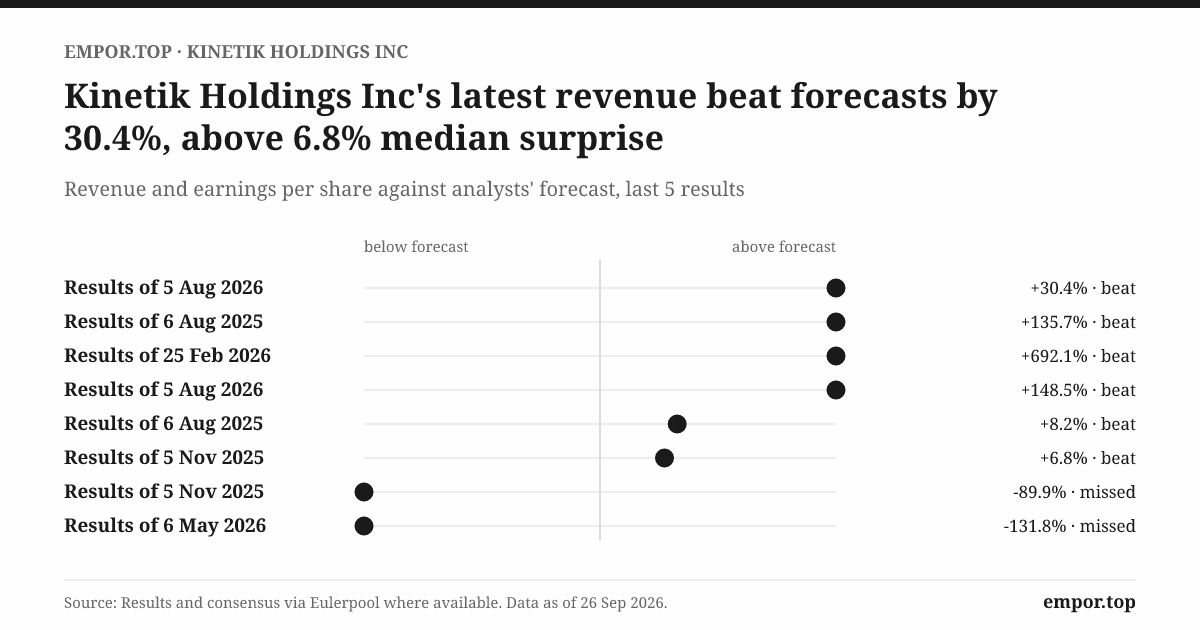
Evaluating management's broader execution against its initial targets yields a nuanced score sheet. The balance-sheet leverage goal established in 2022 was briefly achieved in 2024 before expanding again; the commitment to secure investment-grade credit ratings went unfulfilled; the commercial startup of Kings Landing slipped by roughly five months; and full-year 2025 earnings guidance was downgraded three separate times. Conversely, the cash dividend has never been reduced, having been increased twice since the 2022 combination to $3.12 declared in 2025 and $0.81 per quarter in 2026.126 Furthermore, operational momentum improved in 2026: management lifted full-year Adjusted EBITDA guidance to between $1.04 billion and $1.10 billion—up from an initial range of $950 million to $1.05 billion—bolstered by a record second-quarter Adjusted EBITDA of $280.8 million.6
The objective profile that emerges is an executive team highly skilled in transactional engineering and candid regarding operational missteps, yet consistently prone to scheduling optimism. The immediate operational benchmark is whether that upgraded 2026 earnings guidance holds firm through year-end, with implied third- and fourth-quarter EBITDA targets of $260 million to $270 million and $270 million to $280 million, respectively.6
That dynamic brings into focus the fundamental question facing investors: whether Kinetik’s concentrated operating footprint justifies its financial leverage and generous distribution policy, or whether underlying performance simply tracks broader Permian basin fundamentals.
VIII. Strategy Playbook, Porter's 5 Forces & Hamilton Helmer's 7 Powers [02:26 – 02:46]
How Producers Choose a Gatherer
When an exploration and production company in the Delaware Basin designs a new drilling program, it solicits competitive bids from midstream operators. Kinetik competes directly against major integrated midstream corporations—including Targa Resources, Enterprise Products Partners, Energy Transfer, and Western Midstream Partners—alongside well-funded private gatherers. Upstream producers evaluate operators based on netback realizations (the revenue retained after gathering, compression, treating, and processing fees), system runtime and operating pressure, sour-gas treating capabilities, and firm flow assurance to Gulf Coast pricing points. Brand equity and personal relationships carry far less weight than netback economics and operational reliability. Kinetik’s commercial pitch emphasizes its singular focus as a Delaware Basin pure play backed by firm long-haul takeaway capacity to the Gulf Coast. Whether that positioning delivers a durable competitive moat can be evaluated through two established strategic frameworks.
Hamilton Helmer's 7 Powers
Scale economies: moderate, local. Operating more than 2.4 billion cubic feet per day of processing capacity and over 825,000 horsepower of compression enables Kinetik to spread fixed operational overhead across a centralized asset base and route gas dynamically between processing complexes.3 A concrete example is the Eddy County to Culberson County (ECCC) pipeline, placed into commercial service in 2026 to link the company's northern and southern gathering footprints. This interconnector allowed Kinetik to route surplus northern Delaware volumes into underutilized southern processing facilities while Kings Landing II was under construction—an arrangement management characterized as a lower-capital interim solution.69 The limitation is that Kinetik remains only the fourth-largest natural gas processor in its own operating basin.4 Integrated peers such as Targa Resources and Enterprise Products Partners control broader gathering systems alongside proprietary downstream fractionation complexes and marine export terminals that Kinetik lacks. Consequently, Kinetik’s scale advantages provide operating efficiencies against smaller independent gatherers, but minimal cost leadership against integrated midstream majors.
Switching costs: strong for connected wells, weak for new ones. Once a wellhead is tied into a gathering system under a long-term dedication spanning 10 to 15 years, the operational and contractual switching costs are substantial. Disconnecting that production would require constructing duplicate gathering pipelines, acquiring contested rights-of-way, and navigating protracted legal disputes. The amended Durango gathering agreements extending through 2039 reflect this commercial lock-in.9 However, these switching costs protect only actively connected acreage. Every new development phase or uncommitted drilling unit is subject to open, competitive bidding. Moreover, as the Alpine High downturn demonstrated, robust contractual exclusivity cannot force an upstream producer to drill if underlying wellhead economics turn negative.
Cornered resource: moderate and possibly growing. Permitted acid gas injection (AGI) wells, sour-gas treating facilities, and established pipeline corridors represent physical assets that competitors cannot readily replicate. In the northern Delaware Basin, securing state and federal environmental permits for subsurface acid-gas disposal involves extensive technical reviews and prolonged administrative timelines. Kinetik moved to expand that specialized footprint at Kings Landing, with site civil work and AGI well drilling underway in mid-2026.6 If regional sour-gas volumes continue to expand while disposal permits remain constrained, permitted AGI capacity could evolve into a meaningful competitive barrier. Because this infrastructure was still in construction in 2026, however, that advantage remains prospective rather than fully realized.
Counter-positioning: weak to moderate. Kinetik’s counter-positioning rests primarily on its status as a Delaware Basin pure play. Large, diversified midstream operators occasionally manage upstream gathering networks to feed proprietary downstream fractionation or export assets, allowing a pure-play gatherer to market itself as more responsive to localized field requirements. That dynamic represents an operating service distinction rather than a structural economic moat, making its durability dependent entirely on day-to-day execution.
Network effects, process power, branding: minimal. Network effects, process power, and brand recognition do not generate material economic advantages. While pipeline gathering grids become more operationally flexible as interconnections expand, gathering systems do not exhibit true self-reinforcing network effects. Cryogenic processing utilizes standard commercial refrigeration and separation technology provided by third-party industrial engineering vendors. Upstream producers award gathering agreements based on commercial fee structures and flow reliability rather than corporate brand identity.
Overall: Kinetik’s competitive advantages are local, physical, and contractual. While they provide meaningful protection for established gathering infrastructure and support commercial bids on contiguous acreage, they do not constitute a structural moat capable of delivering superior risk-adjusted returns on new capital across an entire commodity cycle.
Porter's Five Forces
Buyer power: high and rising. Buyer power represents the most significant external pressure on Kinetik's business model. Upstream operators across the Delaware Basin have consolidated aggressively. APA Corporation completed its acquisition of Callon Petroleum on April 1, 2024, absorbing roughly 120,000 net Delaware acres.34 Diamondback Energy finalized its $26 billion merger with Endeavor Energy Resources on September 10, 2024, creating an upstream operator with extensive acreage and substantial commercial leverage.35 Diamondback and Kinetik previously acted as co-sellers in the EPIC Crude divestiture—a direct reminder that large producers often hold equity in midstream infrastructure and possess the financial capacity to construct proprietary gathering systems when commercial terms dictate.4 Consolidated exploration and production companies exercise significant leverage to negotiate lower gathering fees, extended contract durations, and more flexible volume commitments. Kinetik’s recent commercial contract amendments—which extended contract maturities while increasing fixed-fee components—indicated that the company retained sufficient bargaining power to defend terms, although the specific rate adjustments were not disclosed in detail.9
Threat of new entrants: low to moderate. The threat of greenfield entrants is low to moderate. Constructing a modern cryogenic processing complex requires 18 to 24 months of capital outlays, and surface rights-of-way throughout the core Delaware fairway are heavily congested. The primary competitive challenge stems not from private equity startups, but from established midstream competitors expanding existing footprints or scaled upstream producers installing proprietary field gathering systems.
Supplier power: moderate. Supplier power is moderate, driven by elevated costs for field compression units, electric utility service, and specialized rental equipment. Kinetik explicitly cited higher rental equipment expenses and rising electricity tariffs as key drivers behind its downward earnings guidance revisions in 2025.29 Management countered these inflationary pressures through equipment insourcing, compression lease optimization, an operational analytics initiative with Palantir, and Diamond Volt—a planned 40-megawatt behind-the-meter power generation facility scheduled to enter service in the second quarter of 2027.96 These cost-containment initiatives represent operational mitigations whose long-term financial benefits must be judged by audited cost trajectories.
Threat of substitutes: low. The threat of direct product substitutes is minimal. Environmental regulations enforced by Texas and New Mexico authorities require exploration and production companies to capture and transport associated natural gas, sharply restricting routine flaring and venting. The primary operational alternative is shutting in production and keeping hydrocarbons in the formation—a commercial choice observed during prolonged negative Waha pricing episodes that directly curtails Kinetik’s throughput volumes.
Rivalry: high. Competitive rivalry remains intense. Kinetik competes directly against well-capitalized, diversified midstream operators for every uncommitted acreage dedication across the Delaware Basin.
Why Kinetik Could Win From Here
The bull case for Kinetik centers on three distinct operational drivers: 1. Production volumes were deferred rather than permanently lost. Welch noted that incoming Kings Landing volumes had been shut in behind the gathering system for up to two years prior to plant commissioning, and the curtailments observed across 2026 reflected temporary price-driven shut-ins rather than reservoir depletion.116 On the second-quarter 2026 earnings call, executive leadership reported that independent upstream operators had accelerated drilling activity while large producers had advanced development schedules across the southern Delaware and New Mexico.33 2. Substantial regional takeaway capacity is coming online. Management highlighted approximately 5 billion cubic feet per day of scheduled pipeline takeaway additions out of the Permian Basin by the first quarter of 2027.5 The commercial startup of these long-haul corridors should alleviate basin takeaway constraints, support local Waha hub pricing, reduce field curtailments, and enable system throughput to expand toward the guided 2026 exit rate of roughly 2.2 billion cubic feet per day.6 3. Direct connectivity to diversified downstream demand. Kinetik secured a five-year liquefied natural gas supply contract with INEOS for 0.5 million tonnes per annum at Port Arthur, secured additional firm Gulf Coast takeaway beginning in 2028, and entered fee-based residue-gas transportation agreements serving regional power generation projects, including CPV Basin Ranch and Pecos Power.119 These commercial off-take arrangements provide dedicated downstream flow assurance, partially insulating customer volumes from localized Waha hub dislocations.
What Could Break the Case
The bear case is grounded in equally specific operational and structural risks. If newly commissioned takeaway trunklines fill more rapidly than anticipated—mirroring the short-lived pricing relief that followed the startup of the Matterhorn Express pipeline—Waha spot prices could drop back into negative territory, triggering renewed producer shut-ins and restricting gatherer volume growth.139 Furthermore, ongoing upstream consolidation concentrates commercial power among fewer producers capable of negotiating fee reductions upon contract renewal. Finally, Kinetik must continue competing against larger, integrated midstream peers that can bundle wellhead gathering with proprietary downstream fractionation, storage, and waterborne export docks that Kinetik does not operate.
The next section combines these dynamics into formal bull and bear investment cases and identifies the key operational milestones to monitor.
IX. The Bear vs. Bull Case & The 3 Critical KPIs [02:46 – 03:02]
The Bull Case
1. Prolific acreage and customer diversification. Altus foundered because of Alpine High's poor geology. Today, Kinetik's volume expansion is driven by the northern Delaware fairway across Eddy and Lea counties alongside the productive core of the southern Delaware. Its counterparty roster extends far beyond a single anchor driller: the Durango acquisition alone added approximately 60 upstream customers.30 As long as Permian basin production expands, Kinetik's gathering throughput should grow in tandem.
2. Earnings resilience through the basin bottleneck. Record second-quarter 2026 Adjusted EBITDA of $280.8 million, an upgraded full-year outlook, and management's report that producer curtailments had eased since mid-June indicate the business held up through severe negative Waha pricing.633 If roughly 250 million cubic feet per day of curtailed volumes return to the system as new takeaway corridors open, the potential volume rebound is substantial compared with second-quarter throughput of 1.74 billion cubic feet per day.6
3. A funded, scheduled infrastructure pipeline. The Kings Landing processing complex is operational, the ECCC pipeline connector is in service, the sour-gas treating conversion remains on track for late 2026, and Kings Landing II has reached a final investment decision targeting mid-2028 commercial service. Management has already authorized advance orders for long-lead equipment to support processing expansions beyond Kings Landing II.6
4. Strategic interest establishing a valuation floor. Western Midstream reportedly approached Kinetik in early 2026, and Bloomberg reported in September that a formal sale process could launch within weeks.87 That corporate interest demonstrates that industry peers recognize strategic value in the gathering system. Equity markets responded accordingly, with shares rising approximately 11% in after-hours trading following the February report and roughly 5% upon the September report.87
The Bear Case
1. Volume volatility without contract protections. Gathering agreements carry no fee floors, regional Waha spot prices face recurring sub-zero blowouts, and processed volumes remained essentially flat from mid-2025 to mid-2026—demonstrating that volumetric growth remains tied to downstream pipeline capacity and upstream drilling decisions that Kinetik cannot control.96
2. Increasing upstream counterparty leverage. Aggressive consolidation among exploration and production companies—evidenced by Diamondback Energy absorbing Endeavor and APA Corporation acquiring Callon Petroleum—creates massive upstream operators with the bargaining power to demand lower gathering rates and the financial scale to build proprietary midstream networks.3534
3. Elevated leverage alongside substantial capital commitments. Carrying leverage near 3.8x net debt to Adjusted EBITDA, a BB+ credit rating, annual capital expenditures guided to approximately $560 million, and an annualized dividend obligation exceeding $500 million leave minimal margin for error if 2027 volumes disappoint.628
4. A history of scheduling and forecasting friction. Three downward revisions to Adjusted EBITDA guidance in 2025 and a roughly five-month commissioning delay at Kings Landing suggest that public investors should apply an operational discount to management's project timelines and earnings forecasts.291131
5. Transaction uncertainty and sponsor overhang. Investing.com reported that no final decision had been made and that Kinetik could choose to remain independent.7 If negotiations conclude without a transaction, the equity risks surrendering whatever takeover premium it carried, leaving Blackstone’s near-48% voting position as an unresolved market overhang.
Myth vs. Reality: "A Takeover Sets the Floor"
The myth: Once a sponsor-controlled midstream operator explores a sale, downside equity risk is capped because a strategic buyer will pay a meaningful takeover premium.
The reality: Two reported sale processes in seven months have yet to produce an announced deal.87 Both reports characterized the review as preliminary, with the September report explicitly noting that Kinetik could remain independent.7 In the interim, the stock rose substantially, meaning any prospective buyer's premium must now be paid on top of an equity valuation that already reflects elevated buyout speculation. Controlling sponsor actions also send mixed signals: entities affiliated with I Squared Capital sold small blocks of shares at prices between $53.50 and $54.01 in late September 2026 while strategic deliberations were underway.32 While the volume was modest and does not establish I Squared’s view of intrinsic value, it demonstrates that at least one controlling sponsor was willing to monetize equity at prevailing market prices ahead of any transaction announcement.
The narrower, supportable conclusion is that strategic interest confirms industry buyers see value in the gathering system, and that an outright corporate sale represents Blackstone’s cleanest route to liquidity. Whether that delivers a premium to late-2026 trading prices depends on private bids that remain undisclosed. The practical test is whether a formal bidding process begins and whether any definitive agreement guarantees equal treatment and structural protections for unaffiliated Class A public shareholders.
Weighing the Two
Holding the bull and bear arguments side by side leads to a clear operational synthesis: Kinetik’s physical asset base is materially stronger than in the Altus era, its earnings demonstrated resilience through an acute regional pricing crisis, and its primary vulnerability—volume sensitivity to Waha basis blowouts and producer drilling decisions—has been mitigated by hedging and diversification, but not eliminated. The claim that Kinetik operates as an insulated, fee-based compounder is contradicted by flat throughput and volume curtailments. The defensible conclusion is that Kinetik is an efficiently managed, leveraged Delaware Basin gathering franchise whose performance through 2027 depends heavily on regional pipeline takeaway.
The Three KPIs to Track
1. Processed gas volumes (Bcf/d). Throughput provides the most direct measure of physical producer demand and confirms whether newly commissioned regional takeaway corridors are relieving in-basin congestion. Investors should track quarterly volumes against the 1.74 billion cubic feet per day posted in the second quarter of 2026 and management's guided exit rate of roughly 2.2 billion cubic feet per day, alongside the curtailment figures management discloses.6
2. Net debt to Adjusted EBITDA. Balance-sheet leverage determines whether Kinetik can simultaneously fund growth capital, pay dividends, and execute opportunistic share repurchases without straining liquidity. Management’s articulated operating range is 3.5x to 4.0x.5 A sustained climb above 4.0x during an elevated capital expenditure cycle would signal financial strain, whereas steady progress toward 3.5x would revive the prospect of an investment-grade credit rating.
3. Dividend coverage ratio. Distributable cash flow coverage indicates whether operating cash flows comfortably support the quarterly distribution. Management has identified a 1.6x coverage ratio as the benchmark for expanding annual dividend growth beyond its current 3% to 5% pace.33 Because coverage is calculated before growth capital expenditures, it must be evaluated alongside free cash flow net of project outlays.
The overarching question hovering above these operational metrics is whether Kinetik will remain an independent company long enough for them to matter.
X. Epilogue & Strategic Options: The Consolidation Endgame [03:02 – 03:15]
The Industry Backdrop
Kinetik's deliberations over a potential sale unfold against a wave of consolidation across both upstream production and midstream logistics. In the upstream sector, Diamondback Energy's $26 billion acquisition of Endeavor Energy Resources and APA Corporation's purchase of Callon Petroleum reshaped the counterparty landscape across the Delaware Basin.3534 In midstream, Plains All American's acquisition of a majority stake in the EPIC Crude pipeline demonstrated that strategic buyers remained willing to pay premium multiples for Permian takeaway infrastructure.4 When Western Midstream's initial approach surfaced in February 2026, market observers framed the overture within broader structural tailwinds: surging liquefied natural gas export capacity along the Gulf Coast and rising power demand from regional data centers had elevated the strategic value of natural gas infrastructure, with the Delaware Basin recognized as one of the few North American basins with substantial inventory runway.8 At the time of that initial outreach, Kinetik carried an enterprise valuation of approximately $7.2 billion.8
The Two Reports
That initial February 2026 report indicated that Kinetik had begun preparing a sale process following an approach from Western Midstream, the midstream operator roughly one-third owned by Occidental Petroleum, though discussions were characterized as preliminary and without a formal bid.8 Seven months later, on September 9, 2026, Bloomberg reported that Kinetik was working with financial advisers to evaluate strategic options, including a sale, and could launch a formal auction process within weeks. The report cautioned that the company could elect to remain independent, while representatives for both Kinetik and Blackstone declined to comment.7
Between those two reports, Kinetik's market equity capitalization climbed from roughly $7.2 billion in February to approximately $8.9 billion in September.87 That valuation expansion reflected two converging drivers: an operational recovery highlighted by record second-quarter financial results and upwardly revised full-year guidance,6 alongside heightened takeover speculation. For any prospective acquirer, that run-up presents a concrete financial hurdle. A buyer must now layer an acquisition premium atop an equity valuation that already embeds significant deal expectations, making transaction economics more demanding than headline speculation suggests.
Possible Buyers
Prospective strategic and financial acquirers fall into three distinct categories.
Western Midstream, which reportedly initiated contact, would capture meaningful Delaware gathering scale directly adjacent to its existing footprint.8 Because Western Midstream relies on sponsor Occidental Petroleum for a substantial portion of its volume, absorbing Kinetik's multi-producer gathering network would accelerate customer diversification.
Large integrated midstream corporations—such as Targa Resources, Enterprise Products Partners, or Energy Transfer—could route Kinetik's gathered natural gas liquids into proprietary downstream fractionation complexes and marine export docks. Capturing that downstream integration value represents an economic benefit Kinetik cannot achieve as a standalone gathering pure play. A bid from Energy Transfer would carry historical irony, given Welch's former tenure as its group chief financial officer. However, none of these integrated peers had been reported as active suitors in the reviewed disclosures.
Infrastructure investment funds represent a third logical cohort. Private equity and infrastructure buyers have repeatedly assigned higher valuation multiples to Kinetik's non-operated pipeline assets than public equity markets assigned to the consolidated gathering franchise, as evidenced by the GCX and EPIC Crude divestitures.304 A private fund could apply that same underwriting logic to the entire company, evaluating whether a take-private transaction could unlock value through subsequent asset carve-outs.
What Minority Holders Should Watch
If strategic review deliberations transition into a binding transaction, public minority shareholders should evaluate three specific structural terms beyond headline consideration.
Form of consideration. An all-stock transaction with a larger midstream operator would convert Kinetik common stock into equity in an integrated enterprise—and potentially an energy master limited partnership subject to distinct tax treatment, including Schedule K-1 reporting. An all-cash transaction would immediately crystallize value while triggering taxable capital gains. Blackstone's corporate requirements for a clean, block-level monetization may diverge from the priorities of retail income investors holding the stock for its dividend yield, which stood at roughly 6.1% at a late-September 2026 share price of $52.54.32
Minority shareholder protections. When a private equity sponsor holding effective voting control sits on both sides of a corporate evaluation, governance safeguards become critical. Standard mechanisms include the appointment of an independent special committee, formal fairness opinions, and an explicit majority-of-the-minority shareholder approval condition. The presence or absence of that voting condition will signal whether the board is granting public unaffiliated investors a genuine veto over final transaction terms.
The standalone operational alternative. If negotiations terminate without an agreement, Kinetik retains an operational roadmap: completing the Kings Landing II expansion, bringing sour-gas treating into service, activating incremental firm Gulf Coast takeaway beginning in 2028, and adhering to a dividend distribution framework anchored by cash-flow coverage.69 The viability of that standalone thesis depends on the volume recovery projected for 2027. Investors must evaluate Kinetik's fundamental earnings power on its operational merits, rather than viewing the equity solely through the lens of an impending buyout.
What the History Shows
Kinetik's trajectory offers three broader lessons for energy infrastructure investing.
First, midstream returns remain tethered to upstream geology. Altus Midstream's collapse and Kinetik's subsequent emergence played out across the exact same geographic basin. The decisive difference was the quality of the rock the gathering steel accessed and the commercial diversification of the producers drilling it. Contractual exclusivity, long-term dedications, and fee-based frameworks cannot manufacture physical volume throughput. Only upstream capital expenditure deployed into economic reservoirs can.
Second, portfolio recycling generates economic value when asset pricing discrepancies exist, but execution determines the ultimate outcome. Monetizing passive long-haul pipeline stakes at approximately 10x EBITDA to acquire operated gathering systems at roughly 5.5x to 6.5x represented sound transactional engineering.30 Yet the project delays at Kings Landing and three successive guidance cuts in 2025 demonstrated that transaction accretion is only as dependable as commercial project execution. Kinetik's operating history affirms the strategic logic of the asset swap while underscoring the risks of operational over-optimism.
Third, corporate ownership structures dictate transaction outcomes. A midstream enterprise engineered through a reverse merger to provide private equity sponsors with eventual market liquidity is now actively evaluating that monetization. Public minority investors have collected steady quarterly dividends and benefited as the share price rebounded from its late-2025 lows.317 How any formal sale process is structured and governed will ultimately determine whether public shareholders participate equitably in the sponsor's exit.
The corporate narrative remains open. Kinetik may be absorbed by a larger integrated midstream operator seeking Delaware Basin scale, or it may remain independent, relying on regional takeaway expansions slated for 2027 to validate its volume growth thesis. In either scenario, the company forged from the write-down of Alpine High has established itself as an essential gathering platform across the Delaware Basin—with balance-sheet leverage, private equity voting control, and exposure to regional Waha basis differentials remaining the defining variables of its investment profile.
References
-
Kinetik Announces Transfer of Its Common Stock Listing to New York Stock Exchange — Kinetik Investor Relations, 2022-10-10 ↩↩↩
-
Apache Ditches Alpine High After $3B Writedown — Rigzone, 2020-02-27 ↩↩↩↩↩↩↩
-
Kinetik Holdings Inc. Form 10-K for Fiscal Year Ended December 31, 2025 — U.S. SEC EDGAR, 2026 ↩↩↩↩↩↩↩↩
-
Kinetik Holdings (NYSE: KNTK) Books EPIC Sale Gains and Refinances Debt — FY2025 10-K Summary — Stock Titan, 2026 ↩↩↩↩↩↩↩↩
-
Kinetik Reports Fourth Quarter and Full Year 2025 Results and 2026 Guidance (Exhibit 99.1) — U.S. SEC EDGAR, 2026-02-25 ↩↩↩↩↩↩↩↩
-
Kinetik Reports Record Second Quarter 2026 Results and Raises Full Year 2026 Guidance (Exhibit 99.1) — U.S. SEC EDGAR, 2026-08-05 ↩↩↩↩↩↩↩↩↩↩↩↩↩↩↩↩↩↩↩↩↩↩↩↩↩↩↩↩↩↩↩↩↩
-
Kinetik Stock Jumps 5% on Potential Sale Exploration Report — Investing.com, 2026-09-09 ↩↩↩↩↩↩↩↩↩↩↩
-
Pipeline Operator Kinetik Explores Sale as Pipeline Merger Mania Sweeps Delaware Basin — Pipeline Technology Journal, 2026-02-23 ↩↩↩↩↩↩↩↩↩
-
Kinetik (KNTK) Q1 2026 Earnings Call Transcript — The Motley Fool, 2026-05-07 ↩↩↩↩↩↩↩↩↩↩↩↩↩↩↩↩↩↩↩↩↩↩
-
Altus Midstream Is Now Kinetik — GlobeNewswire, 2022-02-22 ↩↩↩↩↩
-
Kinetik Reports Third Quarter 2025 Financial and Operating Results and Revises 2025 Financial Guidance (Exhibit 99.1) — U.S. SEC EDGAR, 2025-11-05 ↩↩↩↩↩↩↩↩↩↩↩
-
Kinetik Holdings Inc. Definitive Proxy Statement (Schedule 14A) for 2026 Annual Meeting — U.S. SEC EDGAR, 2026-04-06 ↩↩↩↩↩↩↩↩↩↩
-
Natural Gas Pipeline Capacity from the Permian Basin Is Set to Increase — U.S. Energy Information Administration, 2024-09-10 ↩↩↩↩
-
Apache Corporation and Kayne Anderson Acquisition Corp. Announce Agreement to Create Altus Midstream Company (Exhibit 99.1) — U.S. SEC EDGAR, 2018-08-08 ↩↩↩↩↩
-
Altus Midstream Company Form 10-K for Fiscal Year Ended December 31, 2019 — U.S. SEC EDGAR, 2020 ↩↩↩↩
-
Altus Midstream Announces One-for-Twenty Reverse Stock Split (Exhibit 99.1) — U.S. SEC EDGAR, 2020-06-29 ↩↩
-
Blackstone Energy Partners to Acquire EagleClaw Midstream Ventures — EnCap Flatrock Midstream, 2017-04-17 ↩↩↩
-
Blackstone-Backed EagleClaw to Acquire Caprock Midstream for $950 Million — Reuters, 2018-05-10 ↩
-
Altus Midstream and EagleClaw Midstream Complete Combination to Create Kinetik — Business Wire, 2022-02-22 ↩↩↩
-
Kinder Morgan and EagleClaw Announce Final Investment Decision on Permian Highway Pipeline Project — Kinetik Investor Relations, 2018-09-05 ↩
-
Jamie Welch — Board of Directors Biography — Kinetik Investor Relations ↩↩↩↩
-
Energy Transfer Equity Form 8-K/A: Thomas E. Long Replaces Jamie Welch as Group CFO — U.S. SEC EDGAR, 2016-02-11 ↩
-
Ex-Energy Transfer CFO Files Contract Suit Over Firing — Law360, 2016-03-11 ↩
-
Kinetik Holdings Inc. Form 10-K FY2022, Permian Highway Pipeline LLC Financial Statements Exhibit — U.S. SEC EDGAR, 2023 ↩
-
Kinetik Announces Two-for-One Stock Split and Dividend (Exhibit 99.1) — U.S. SEC EDGAR, 2022-05-19 ↩↩
-
Kinetik Holdings Inc. Q1 2024 Earnings Call Transcript — Yahoo Finance, 2024-05 ↩↩↩
-
Kinetik Reports Fourth Quarter and Full Year 2024 Results and 2025 Guidance (Exhibit 99.1) — U.S. SEC EDGAR, 2025-02-26 ↩↩↩↩↩
-
Fitch Affirms Kinetik Holdings LP at 'BB+'; Outlook Stable — Fitch Ratings, 2024-06-20 ↩↩↩
-
Kinetik Reports Second Quarter 2025 Financial and Operating Results and Updates Full Year 2025 Guidance (Exhibit 99.1) — U.S. SEC EDGAR, 2025-08-06 ↩↩↩↩↩
-
Kinetik Announces Durango Permian Acquisition and Sale of Gulf Coast Express Interest (Exhibit 99.1) — U.S. SEC EDGAR, 2024-05-09 ↩↩↩↩↩↩↩↩↩↩↩↩↩↩
-
Earnings Call Transcript: Kinetik Holdings Q3 2025 Sees EPS Miss, Stock Dips — Investing.com, 2025-11 ↩↩↩↩↩↩↩
-
ISQ Global Fund II GP, Kinetik Director, Sells $3.44m KNTK Shares — Investing.com, 2026 ↩↩↩
-
Earnings Call Transcript: Kinetik Tops Q2 2026 Estimates and Lifts Outlook — Investing.com, 2026-08 ↩↩↩↩↩↩
-
APA Corporation Completes Callon Petroleum Company Acquisition, Increasing Permian Production — World Oil, 2024-04-01 ↩↩↩
-
Diamondback Energy Completes $26 Billion Merger with Endeavor Energy — World Oil, 2024-09-12 ↩↩↩
 LinkedIn
 WhatsApp
 Reddit
 Hacker News
 Email
Email Kindle
 RSS Feed
 Spotify
 Apple Podcasts
 Amazon Music
 Audible
 YouTube