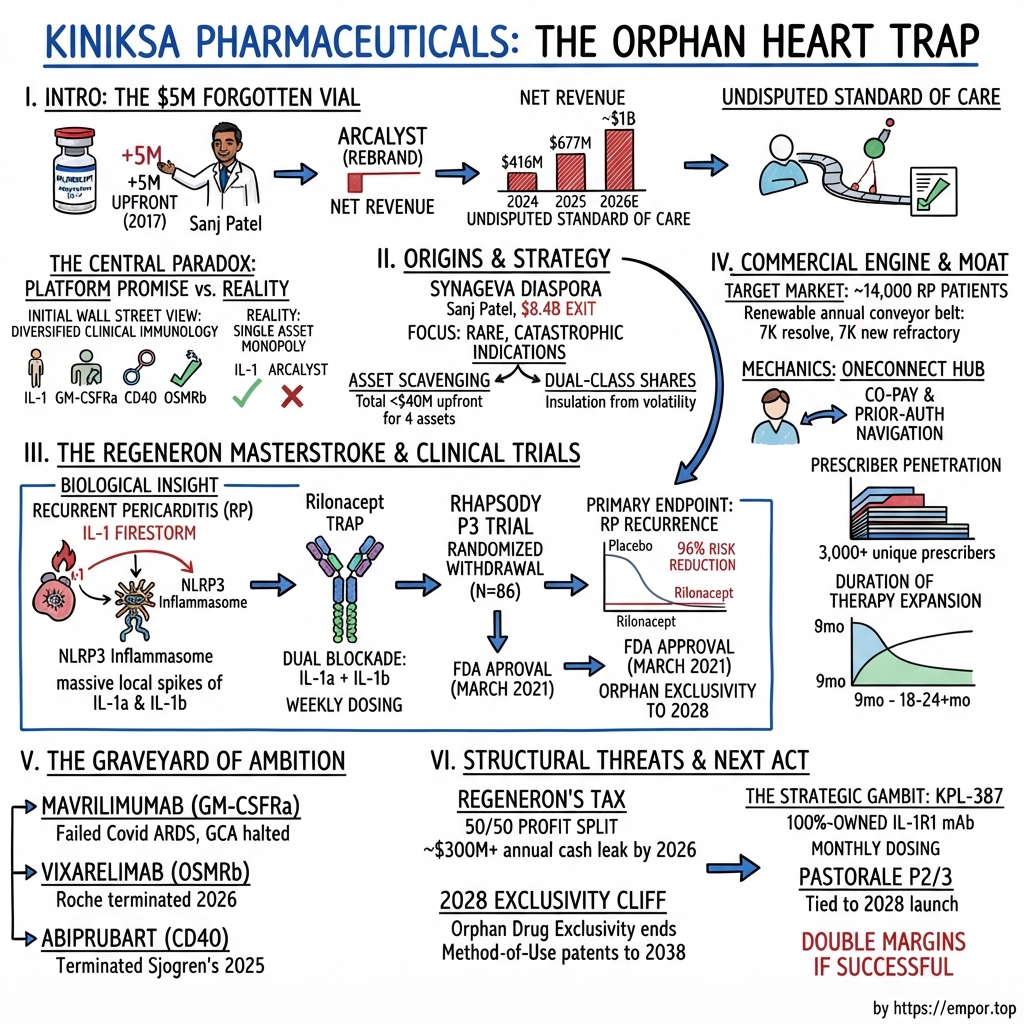
Kiniksa Pharmaceuticals: The Orphan Heart Trap
I. Introduction & Episode Roadmap
Picture the patient at the center of this story, because everything else follows from her.
She is forty-one. Three months ago she had what an emergency room diagnosed as viral pericarditis — inflammation of the sac surrounding the heart. The pain was sharp, positional, worse lying flat, and frightening enough to prompt an immediate workup for a myocardial infarction. Discharged with prescriptions for ibuprofen and colchicine, she was told the condition would resolve. It did. Then it returned, and returned again. By her third flare she was taking prednisone, and by the fourth she had settled into the cycle that characterizes recurrent pericarditis: every attempt to taper the steroid brought debilitating chest pain back within days. She stayed on prednisone — gaining weight, losing bone density, and coping with chronic insomnia — not because the steroid resolved the underlying disease, but because withdrawing from it was intolerable.
For most of the twentieth century, that cycle represented the standard clinical experience for recurrent pericarditis. The condition had no approved targeted therapy and no universally accepted biological mechanism. Cardiology as a specialty had focused on structural and vascular interventions — stents, valves, and catheter ablations — leaving inflammatory pathways largely unexplored.
Meanwhile, in a storage freezer in Tarrytown, New York, sat the answer.
The cold open. In September 2017, a small, privately held biotech signed a licensing agreement with Regeneron Pharmaceuticals for a molecule that was then a low commercial priority. The drug was rilonacept — an interleukin-1 fusion protein Regeneron discovered in the early 2000s and received FDA approval for in February 2008 to treat Cryopyrin-Associated Periodic Syndromes, an ultra-rare genetic autoinflammatory disorder diagnosed in only a few hundred American patients. For Regeneron, the molecule was a minor asset in a portfolio increasingly dominated by Eylea and Dupixent.
The licensee was Kiniksa Pharmaceuticals, founded two years earlier by Sanj K. Patel. The financial terms were strikingly modest by biopharma standards. Across the life of the agreement, Kiniksa paid Regeneron $32.5 million in upfront fees and regulatory milestones — the entire acquisition cost for worldwide rights, excluding the Middle East and North Africa, to develop and commercialize the molecule for every indication outside oncology and local ocular or otic delivery.1
Nine years later, that molecule — commercialized as ARCALYST — generated $677.6 million in net product revenue in 2025, an increase of 62% year over year.2 In the second quarter of 2026 alone, ARCALYST generated $243.6 million, prompting management to raise full-year 2026 revenue guidance to between $980 million and $995 million.3 A legacy biologic that Regeneron opted not to advance into a Phase 3 cardiovascular trial is now approaching blockbuster scale in a disease category that historically lacked an approved targeted therapy.
The paradox at the center of Kiniksa. When Kiniksa completed its initial public offering on Nasdaq in May 2018 at $18.00 per share, raising roughly $170.7 million in gross proceeds inclusive of the underwriters' option, public investors were not buying a rilonacept monoculture.4 They were capitalizing a diversified clinical-stage immunology pipeline: four licensed or acquired programs addressing distinct biological pathways — interleukin-1, GM-CSF receptor alpha, CD40, and oncostatin M receptor beta. The core thesis was platform optionality across multiple shots on goal, with rilonacept viewed as one asset among several.
What followed offers one of the starkest natural experiments in biotech capital allocation in the public markets. Every non-IL-1 pipeline program either failed in the clinic or was abandoned. Mavrilimumab missed its primary endpoint in a Phase 3 trial for COVID-19-related acute respiratory distress syndrome in December 2021, and Kiniksa terminated the MedImmune license agreement in February 2025.51 Abiprubart, an anti-CD40 antibody developed as a potential multi-indication autoimmune franchise, saw its Phase 2b trial in Sjögren's Disease discontinued in February 2025 after the company spent nearly $90 million on the program over two years.1 Vixarelimab, out-licensed to Genentech and Roche in 2022 in a transaction initially seen as external validation of Kiniksa's asset-selection strategy, was removed from Roche's clinical pipeline in early 2026 following an interim futility analysis.6
The commercial yield of Kiniksa's non-IL-1 pipeline stands at zero. Yet in September 2026, Kiniksa is more valuable, profitable, and cash-generative than at any prior point in its corporate history. The single asset initially treated as a secondary candidate became the entire operating business.
Why this story matters for investors. Kiniksa is less a case study in de novo drug discovery than an illustration of three dynamics central to specialty pharmaceuticals: the economic return on licensing neglected legacy assets from large biopharma companies; the structural divergence between a licensed franchise and a proprietary one; and the terminal value of a commercial monopoly when the company does not control its own manufacturing and remits half its operating profits to its licensor.
That profit structure forms the core tension in the business model. Kiniksa splits ARCALYST operating profits 50/50 with Regeneron after deducting cost of goods sold and agreed commercialization expenses.1 In 2025, that contractual arrangement generated $229.5 million in collaboration expenses paid from Kiniksa to Regeneron.2 Meanwhile, Kiniksa's seven-year Orphan Drug exclusivity for ARCALYST in recurrent pericarditis expires in March 2028.1 Management's primary hedge against both headwinds — KPL-387, an internally owned, once-monthly subcutaneous IL-1 receptor antibody — initiated its pivotal Phase 3 trial only in mid-2026.3
A note on the consensus narrative. Market commentary around Kiniksa generally breaks into two opposing camps, neither of which fully captures the setup. The bull thesis views Kiniksa as an exceptional asset identifier that captured enterprise value where Regeneron saw none — an interpretation challenged by Kiniksa's three consecutive program failures outside IL-1. The bear thesis portrays Kiniksa as a single-product operator renting an asset from a supplier that captures half the margin while facing an exclusivity expiration in eighteen months — a view that understates six consecutive years of commercial outperformance. A rigorous assessment must weigh both dynamics simultaneously: the strength of the current cash-flow engine versus the structural limits imposed by the contract and the calendar.
The roadmap. The analysis begins with the Synageva heritage that formed Kiniksa and the orphan-drug commercial framework Patel established. It examines the structure of the 2017 Regeneron transaction, the pivotal RHAPSODY trial that established rilonacept as a standard of care in recurrent pericarditis, and the commercial field model that persuaded general cardiologists to adopt specialty biologic prescribing. It then conducts a post-mortem on the discontinued pipeline assets, models the financial drag of the Regeneron profit split alongside the March 2028 exclusivity expiration, evaluates the clinical and economic feasibility of transitioning patients to KPL-387, and concludes with a competitive framework, a review of corporate governance, and the core operational metrics that will determine the equity's terminal value.
The story begins with the founding team and the playbook developed at Synageva.
 Subscribe on LinkedIn
II. Founder DNA & The Synageva Playbook (2011–2015)
Sanj K. Patel's résumé does not read like that of a conventional scientist-founder. He earned a B.Sc. with honors from the University of the South Bank in London, completed management and business studies at Ealing College, and completed a pharmacology research program at the Wellcome Foundation.7 He is neither a physician nor a Ph.D., and — contrary to occasional characterization — not a licensed pharmacist. He is, by training and background, a commercial operator.
That distinction matters because Kiniksa's core competency has never been de novo discovery biology. Instead, the company was built around asset evaluation: determining what a therapy is worth to a patient, a prescriber, and a payer, and acquiring programs that larger pharmaceutical developers had deprioritized.
The Genzyme apprenticeship. Patel spent 1999 to 2008 at Genzyme, ultimately serving as head of U.S. sales, marketing, and commercial operations for the Genzyme Therapeutics franchise.7 Genzyme during that era established the blueprint for the modern rare-disease business model: develop enzyme replacement therapies for lysosomal storage disorders — such as Cerezyme for Gaucher disease and Fabrazyme for Fabry disease — and distribute them to small patient populations at six-figure annual prices. In that framework, commercial durability stemmed less from impenetrable molecular IP than from the surrounding operational infrastructure: patient-finding networks, specialty field support, and dedicated reimbursement navigation.
That operational framework informed Patel's next venture. In June 2008, he founded Synageva BioPharma, targeting sebelipase alfa for lysosomal acid lipase deficiency — an ultra-rare, monogenic disorder with an objective biochemical endpoint and no approved alternative. In June 2015, Alexion Pharmaceuticals acquired Synageva for approximately $8.4 billion.8
The core insight, and its limits. The Synageva playbook — which Kiniksa inherited almost intact — centered on several clear criteria: avoid crowded indications in oncology or broad rheumatology, where pharmaceutical majors commit hundreds of millions of dollars to demonstrate incremental efficacy; instead, target severe, mechanistically defined disorders with high unmet need; select clinical endpoints objective enough that a compact trial can generate a clear regulatory readout; secure orphan drug designations; and rely on clinical urgency to establish favorable reimbursement.
While commercially effective in defined settings, this approach had clear boundaries. Synageva's success occurred in enzyme replacement for a monogenic condition where replacing a missing enzyme directly addressed the underlying pathology. Kiniksa subsequently entered immunology, where biological pathways are redundant and disease drivers are rarely singular. The playbook traveled effectively across commercial and regulatory execution, but faced distinct scientific hurdles in clinical translation — an asymmetry that shaped the company's subsequent pipeline performance.
Assembling the band. Kiniksa was founded in July 2015, shortly after the Alexion transaction closed, with Patel serving as chief executive and chairman from inception.7 Former Synageva executives and directors joined the new company. Barry Quart, Robert Biggar, and Thomas Malley, each of whom served on Synageva's board, joined Kiniksa's board in 2015 and 2016.7 Mark Ragosa, who has served as chief financial officer throughout Kiniksa's public life, came from the same executive circle. This continuity has provided long-term management stability — an operational factor evaluated later in this analysis alongside corporate governance considerations.
The corporate architecture was established with equal deliberation. Originally formed in Bermuda, the company subsequently redomiciled and trades as Kiniksa Pharmaceuticals International, plc, with shareholder rights governed by English law.1 The equity base features four share classes: Class A ordinary shares carrying one vote per share; Class B ordinary shares carrying ten votes per share; and Class A1 and Class B1 ordinary shares, held entirely by entities affiliated with certain directors, carrying no voting rights but convertible into voting shares on 61 days' notice.1 The governance implications of this structure are examined later, though the framework provides less unilateral founder control than traditional dual-class structures suggest.
The in-licensing spree, and what it cost. Between 2016 and 2019, Kiniksa assembled its clinical pipeline through external licensing and asset purchases rather than internal discovery:
- Vixarelimab (anti-OSMRβ) — acquired outright from Biogen in September 2016 via an asset purchase for $12.0 million in upfront payments.9
- Rilonacept (ARCALYST) — licensed from Regeneron in September 2017.1
- Mavrilimumab (anti-GM-CSFRα) — licensed from MedImmune, subsequently part of AstraZeneca, in December 2017.1
- Abiprubart (anti-CD40) — acquired in 2019 through the purchase of Primatope Therapeutics, which held an exclusive license from Beth Israel Deaconess Medical Center carrying milestone obligations of up to $1.2 million and a low single-digit royalty.1
The aggregate upfront capital deployed to assemble this four-pathway clinical portfolio was modest — under $50 million across all four assets, at a time when peers frequently paid nine figures for individual Phase 1 candidates. As an option-acquisition strategy, the transaction terms reflected disciplined balance-sheet management.
That cost structure also reflected counterparties' risk assessments. Kiniksa secured these programs at low upfront valuations because well-resourced pharmaceutical developers had concluded their risk-adjusted potential was limited. On three of the four assets, those initial commercial and scientific reservations were ultimately validated by clinical pipeline attrition. On the fourth, Regeneron's commercial deprioritization left substantial value on the table. A portfolio producing one commercial product alongside three pipeline terminations reflects standard clinical attrition rates as much as programmatic asset selection — a dynamic evaluated in Section VI.
The one program that succeeded began with an inquiry regarding an unpromoted biologic in a corporate freezer.
III. The In-Licensing Masterstroke: Regeneron & ARCALYST (2017)
To understand why the Regeneron transaction was available at all requires understanding what rilonacept is and why the molecule sat idle.
The trap, explained plainly. Most biologic therapies are monoclonal antibodies — Y-shaped proteins engineered to bind a single molecular target. Rilonacept is structured differently: it is a "cytokine trap." Regeneron scientists took the binding domains of two distinct human cell-surface receptors that capture interleukin-1 — IL-1 receptor type 1 and IL-1 receptor accessory protein — and fused them to the Fc tail of a human antibody. The resulting fusion protein acts as a soluble decoy. Circulating through the bloodstream, it mimics the cell-surface receptor, binds IL-1 molecules with higher affinity than native receptors, and clears them before they can dock with target cells.
The functional analogy resembles an emergency response network. If a signaling chemical acts like a messenger running to a local fire station to dispatch trucks, rilonacept serves as a decoy station built along the road, intercepting the messenger before the alarm sounds. Two operational features stem from this architecture. First, the trap binds both IL-1α and IL-1β — the two distinct signaling molecules in the family — rather than isolating just one. Second, the antibody backbone extends its circulating half-life, supporting once-weekly subcutaneous dosing rather than daily administration.
Why it languished. Approved in February 2008 for CAPS, rilonacept addressed a patient population small enough that even successful commercialization would never move Regeneron's numbers.1 Meanwhile, Regeneron's broader pipeline — led by aflibercept (marketed as Eylea) and dupilumab (Dupixent) — was compounding into multi-billion-dollar global franchises. Regeneron's decision was not an oversight; it reflected portfolio prioritization. A large-cap biopharmaceutical developer cannot justify committing clinical development teams and specialty commercial infrastructure to an indication whose revenue potential appears capped at a few hundred million dollars. The opportunity cost of personnel and capital outweighed the asset's standalone potential.
That capital-allocation gap created the opening Kiniksa exploited.
The biological insight: pericarditis as an IL-1 fire. In recurrent pericarditis, the conventional sequence of nonsteroidal anti-inflammatory drugs, colchicine, and corticosteroids historically treated the condition as an intractable pain syndrome with an iatrogenic steroid dependency built in.
The biological thesis Kiniksa pursued was that recurrent pericarditis is not non-specific idiopathic inflammation, but an autoinflammatory disorder driven by the NLRP3 inflammasome. Once triggered, this intracellular protein complex releases active IL-1 into the pericardial space. Critically, IL-1 binds back to local receptors and stimulates further inflammasome activity. The result is a self-sustaining autocrine loop: inflammation generates IL-1, which amplifies inflammasome signaling, releasing more IL-1. Neutralizing IL-1 breaks that continuous circuit.
Clinical precedent partially supported the hypothesis. Anakinra, marketed as Kineret by Swedish Orphan Biovitrum (Sobi), is a recombinant IL-1 receptor antagonist that had been prescribed off-label in refractory pericarditis with documented clinical benefit. Mechanistically, the difference is modest: anakinra binds the IL-1 type 1 receptor directly, blocking both IL-1α and IL-1β signaling. The critical distinctions were practical. Anakinra requires daily subcutaneous injections, causes frequent injection-site reactions, and never secured an FDA label for recurrent pericarditis. Rilonacept's longer half-life permitted once-weekly dosing, and Kiniksa was prepared to fund and execute the registrational trial required to secure regulatory approval.
The commercial differentiator was not primarily an unproven biological target. It was dosing convenience combined with regulatory execution.
The deal structure. The September 2017 agreement granted Kiniksa an exclusive license under Regeneron's intellectual property to develop and commercialize ARCALYST worldwide excluding the Middle East and North Africa, for all indications other than oncology and local ocular or otic administration.1 Cumulative payments to Regeneron across upfront fees and regulatory milestones totaled $32.5 million, including a $20.0 million payment in the first quarter of 2021 upon FDA approval.2 Upon positive RHAPSODY data, Regeneron transferred the biologics license application to Kiniksa; upon approval in March 2021, Kiniksa assumed U.S. sales and distribution for the legacy CAPS and DIRA indications as well.1
The central economic terms govern the franchise in perpetuity: profits on ARCALYST sales are split evenly with Regeneron. Operating profit is calculated after deducting cost of goods sold, customary commercialization expenses including the specialty field force, and marketing and promotional costs, with promotional expenses capped at contractually defined levels. Furthermore, Kiniksa and Regeneron split evenly any proceeds received from licensees, sublicensees, and distributors, including upfronts, milestones, and royalties.1
That revenue-sharing provision means Kiniksa cannot bypass the 50% split by out-licensing ARCALYST to regional commercial partners. For example, the 2022 agreement granting Hangzhou Zhongmei Huadong Pharmaceutical rights to develop and commercialize ARCALYST across an Asia-Pacific territory excluding Japan is subject to the same arithmetic.1
Regeneron also agreed to manufacture all of Kiniksa's ARCALYST supply, clinical and commercial, under a separate supply agreement. As structured, Kiniksa's licensing partner owned the underlying intellectual property, controlled drug substance manufacturing, and collected half the operating profits.
What the deal actually was. Popular market accounts often describe the transaction as acquiring a major commercial franchise for $32.5 million. In corporate finance terms, Kiniksa acquired a call option for $32.5 million and agreed to pay for the underlying cash flows in perpetuity through a 50% profit interest. For a private, clinical-stage biotech with no commercial revenue in 2017, that structure was financially rational: it replaced prohibitive upfront licensing fees with variable, performance-contingent obligations, enabling the company to fund Phase 3 development without extreme equity dilution. Yet the contract functions as a perpetual lease whose rent rises directly with commercial scale. By 2025, that annual collaboration expense had reached $229.5 million.2
The value of that option rested entirely on clinical validation in the clinic. That proof arrived with the pivotal trial.
IV. Clinical De-Risking: The RHAPSODY Phase 3 Masterclass (2018–2021)
Every clinical trial contains a moment of moral and commercial tension. In a randomized-withdrawal study, that tension arrives at a single, defined juncture: the day investigators take a patient who has finally stopped hurting and, in double-blind fashion, either keep them on the active therapy or switch them to saline.
That was the protocol in RHAPSODY. Sixty-one patients who had endured months of debilitating chest pain, who had been tapered off steroids, and who had stabilized on an experimental biologic were randomized—with roughly half quietly assigned to placebo. The study protocol then simply waited to see whose symptoms returned.
The design functions only when a sponsor holds high conviction in a molecule's efficacy. If the drug is ineffective, patients are subjected to withdrawal and relapse without clinical justification. If the drug works, it produces an unmistakable clinical contrast: a placebo arm that relapses in full view of prescribers.
Kiniksa validated that hypothesis, delivering one of the most decisive Phase 3 readouts in recent cardiovascular medicine.
The randomized-withdrawal design, explained. A standard superiority trial randomizes an unselected cohort to active drug or placebo at baseline and tracks outcomes over time. In a condition characterized by episodic, irregular flares, that conventional approach requires large patient registries and prolonged observation periods.
The randomized-withdrawal format reorders that sequence. Every patient first receives active drug during an open-label run-in while clinicians taper baseline medications. Only patients who demonstrate an objective clinical response advance to the double-blind phase, where investigators randomize them to continue active therapy or switch to placebo. The primary endpoint measures time to disease recurrence.
The architecture addresses a distinct clinical question. Rather than measuring average population-level efficacy, it asks what occurs when an effective therapy is abruptly withdrawn from a documented responder. In a disorder defined by recurrence upon steroid taper, that matches the clinical reality physicians confront at the bedside. The design also intentionally enriches the study population with proven responders—a methodology regulators review with care, as the resulting regulatory label reflects maintenance of disease control rather than primary response across an unselected population.
RHAPSODY's result. The registrational trial enrolled 86 adolescent and adult patients presenting with an active pericarditis recurrence. After stabilizing on open-label rilonacept while tapering off nonsteroidal anti-inflammatory drugs, colchicine, and oral corticosteroids, clinical responders were randomized to continue weekly rilonacept or switch to matching placebo. During the randomized-withdrawal phase, just 2 of 30 patients receiving rilonacept (7%) experienced a flare, compared with 23 of 31 patients on placebo (74%). In a Cox proportional-hazards model, the hazard ratio stood at 0.04, with a 95% confidence interval of 0.01 to 0.18 and a p-value below 0.001. The results were published in The New England Journal of Medicine by Klein, Imazio, Cremer, and the RHAPSODY investigators.10
Reading the number honestly. A hazard ratio of 0.04 represents an extraordinary statistical finding, translating to an estimated 96% reduction in the relative risk of recurrence at any given time point. Yet the wide confidence interval—spanning 0.01 to 0.18—reflects the compact size of the study cohort, and the protocol architecture reflects an enriched sample. The data do not demonstrate that rilonacept eliminates 96% of recurrences across an unselected real-world population. Rather, they prove that among patients who respond to rilonacept and then discontinue treatment, clinical relapse is near-certain, whereas among those maintained on therapy, recurrence remains rare.
That outcome establishes clinical dependency alongside biological efficacy. Commercially, documented dependency is a powerful driver of enterprise value: it converts an episodic rescue treatment into an ongoing maintenance regimen. This dynamic underpins the clinical switching costs examined later in this analysis. A cardiologist who reads the RHAPSODY trial understands what occurred when patients stopped taking the drug—an evidentiary anchor that proved more influential with prescribers than commercial marketing.
Myth versus reality on the run-in. Secondary market commentary frequently asserts that 100% of enrolled patients successfully discontinued corticosteroids during the open-label run-in. Kiniksa's regulatory filings do not substantiate that blanket claim, and it should not be treated as clinical fact. The verified trial data establish a more precise result: patients were tapered off nonsteroidal anti-inflammatory drugs, colchicine, and corticosteroids throughout the run-in, and those who achieved clinical response advanced to randomization. Conflating total enrollment with the enriched responder subgroup overstates what the clinical trial established.
From breakthrough to label. The FDA granted Breakthrough Therapy designation for rilonacept in recurrent pericarditis in 2019 and Orphan Drug designation in 2020, followed by full approval in March 2021 for the treatment of recurrent pericarditis and reduction in risk of recurrence in adults and children 12 years and older.1
Two characteristics of the regulatory label proved commercially decisive. First, ARCALYST became the first and only FDA-approved therapy for recurrent pericarditis, leaving off-label alternatives like anakinra at a structural disadvantage with commercial payers. Second, the approved indication did not mandate a minimum threshold of prior flares or restrict eligibility to patients who had failed specific prior lines of treatment. As chief medical officer John Paolini noted on the fourth-quarter 2025 earnings call, the label "simply states for the treatment of recurrent pericarditis and reduction in risk of recurrence," providing the company with "the foundations to grow and evolve the treatment paradigm."11 A restrictive second-line or third-line label would have constrained the addressable market; the broad indication gave Kiniksa commercial latitude to position the drug earlier in the treatment pathway.
The approval also conferred seven years of U.S. Orphan Drug exclusivity, running through March 2028.1 That statutory window established the operational timetable that now shapes the company's clinical pipeline and corporate strategy.
What it did not de-risk. RHAPSODY established definitive biological proof of concept. It did not, however, resolve whether general cardiologists—clinicians accustomed to prescribing oral statins, antiplatelet agents, and blood thinners, and performing catheter-based interventions—would adopt an injectable biologic. Prescribing ARCALYST required patient self-injection of a therapy reconstituted from lyophilized powder, distributed through closed specialty pharmacies, and requiring complex prior-authorization paperwork. In March 2021, whether community cardiology practices would navigate that specialty-biologic workflow remained an unproven commercial proposition.
V. The Commercial Engine: Sizing the Market & The OneConnect Moat
Consider the practical distribution challenge Kiniksa faced in the spring of 2021: commercializing rilonacept was an operational and logistical hurdle before it was a clinical one.
A general cardiologist in a community practice—say, in suburban Ohio—sees perhaps two or three recurrent pericarditis patients a year. That physician's prescribing habits were formed around oral generics that cost pennies, are dispensed at a local retail pharmacy, and require no insurance pre-authorization. ARCALYST costs orders of magnitude more, arrives through a closed specialty pharmacy network, requires prior authorizations, and comes as a lyophilized powder the patient must reconstitute and inject subcutaneously every week. For that cardiologist, writing the prescription is less a clinical decision than an administrative burden—and administrative friction is where specialty biologic launches frequently stall.
Multiply that hurdle geographically. Recurrent pericarditis patients are not concentrated in major academic medical centers. They are scattered across community clinics in every mid-sized American city, treated by physicians who had never heard of the drug and may not have recognized the condition as an ongoing autoinflammatory syndrome distinct from the initial acute pericarditis episode that first brought the patient to care.
Kiniksa's first full launch year produced $38.5 million in ARCALYST net product revenue.12 Five years later, management guided full-year 2026 net product revenue toward nearly a billion dollars. The gap between those two figures reflects a commercial buildout that warrants examination as a distribution solution rather than an inevitable growth trajectory.
The shape of the market. Kiniksa's claims analysis, cross-validated with published epidemiological estimates, identifies a prevalent population of roughly 40,000 patients in the United States each year who seek and receive medical treatment for recurrent pericarditis. Within that total, the company's core commercial focus is the approximately 14,000 patients with persistent underlying disease, multiple recurrences, and inadequate response to conventional therapy. The remaining cohort of roughly 26,000 patients is experiencing a first recurrence.1
The economically defining feature of this addressable pool is not its absolute size, but its renewal. Management describes the median duration of the disease as approximately three years, and the average total duration of ARCALYST therapy as also approximately three years—deliberately matched.3 A patient population defined as prevalent per year, with a multi-year but finite disease course, behaves neither like a lifelong chronic therapy market nor like a one-time acute episode. The pool refills: stabilized patients resolve their underlying inflammation and discontinue treatment, while newly symptomatic individuals experience repeated flares and enter the pool. That dynamic explains why market penetration within a fixed-size pool can continue climbing while top-line revenue compounds—the underlying denominator regenerates over time.
Investors should recognize this dynamic as a structural characteristic of the disease category, but also treat it as a management model derived from claims data rather than an externally audited epidemiological census. It remains the single most important operational assumption underpinning any commercial valuation of the franchise.
Myth versus reality on patient turnover. A widely repeated market interpretation asserts a 50% annual turnover rate in the multiple-recurrence cohort—the equivalent of roughly 7,000 patients resolving and 7,000 entering each year—which would turn the target population into a self-replenishing conveyor belt. Kiniksa has not disclosed or verified that 50% figure, and it should not be treated as established fact. What the company has disclosed is more modest and analytically verifiable: a prevalent treated population sized on an annual basis, a median disease duration of approximately three years, and an average duration of therapy aligned with that timeframe. Those metrics support the direction of the renewal argument without substantiating the precise velocity. The distinction is critical: the difference between a patient pool that replaces half its volume annually and one that turns over across a three-year cycle is the difference between an indefinitely expanding market and one that eventually encounters saturation. Investors should monitor the disclosed penetration series directly rather than assuming an unverified refresh rate.
The penetration curve. The disclosed adoption trajectory into the 14,000-patient multiple-recurrence cohort provides the clearest window into commercial execution:
- End of 2024: approximately 13%
- Mid-2025: approximately 15%
- End of 2025: approximately 18%
- End of Q2 2026: approximately 21%113
That represents an expansion of roughly eight percentage points of market penetration over eighteen months, achieved at an accelerating absolute pace. In addition, approximately 20% of all ARCALYST prescriptions have been written for patients experiencing a first recurrence—the larger 26,000-patient group—meaning the reported penetration metric understates total treated patients.11
The revenue ramp, and what changed inside it. Net product revenue ran $38.5 million in 2021, $122.5 million in 2022, $233.2 million in 2023, $417.0 million in 2024, and $677.6 million in 2025, against 2026 guidance of $980 million to $995 million.1223 From an analytical standpoint, what matters is not merely the compounding top line, but the fact that sequential growth accelerated in 2026: the second quarter delivered more than $29 million in sequential net revenue growth, which management described as the largest quarterly net revenue increase since launch.13
Five years into a commercial rollout, within a rare disease of fixed prevalence, accelerating sequential growth is counterintuitive. Specialty launches typically decelerate as the most accessible, severely affected patients are captured. Three operational drivers explain this acceleration, each carrying different degrees of durability.
First, guideline endorsement. In August 2025, the American College of Cardiology published concise clinical guidance for recurrent pericarditis that positioned IL-1 pathway inhibition as a second-line approach immediately after failure of NSAIDs and colchicine—ahead of oral corticosteroids.11 This publication was the most important commercial catalyst in ARCALYST's history after regulatory approval, and it occurred independently of Kiniksa's corporate marketing. It shifted rilonacept's place in the clinical algorithm from a last-resort rescue therapy to an accepted second-line standard of care, offering community cardiologists institutional backing for a prescribing decision they previously had to make on their own. On the second-quarter 2026 earnings call, chief commercial officer Ross Moat attributed a substantial share of recent growth to disseminating this guidance to general cardiologists who were largely unaware it existed.13
Second, prescriber breadth. By the end of 2025, more than 4,150 healthcare professionals had written an ARCALYST prescription, of whom roughly 29%, or more than 1,200, had written for two or more patients.11 By the end of the second quarter of 2026, the cumulative prescriber base exceeded 5,000, with approximately 450 physicians writing their first prescription in the quarter and about 150 more crossing into repeat prescribing.313 Against an addressable universe management sizes at more than 25,000 healthcare professionals who manage recurrent pericarditis patients, the base is still thin.13
The repeat-prescriber metric is the decisive operational indicator. A first prescription can be driven by a pharmaceutical sales call or an insistent patient. A second prescription from the same physician indicates that the therapy demonstrated clinical efficacy in practice and that the administrative onboarding was manageable. That roughly 29% repeat-prescriber ratio has held steady as the overall base expanded—evidence that newly onboarded prescribers convert into recurring prescribers at the same rate as early adopters, rather than reflecting diminishing returns from lower-tier targets.
Third, distribution and access mechanics. Kiniksa established a dedicated specialty cardiology sales force, a network of collaborative pericardial disease centers, and a proprietary patient-support program branded Kiniksa OneConnect. The hub handles reimbursement navigation, affordability support, and the logistics of guiding a patient from initial prescription to first dose.1
The financial proof of this operational execution appears in gross-to-net realizations: gross-to-net deductions ran 7.2% year-to-date through the second quarter of 2026, down from 8.6% in the first quarter.13 For a specialty biologic, single-digit gross-to-net deductions are exceptionally low. They demonstrate that Kiniksa captures nearly the full list price without aggressive commercial discounting, driven by favorable payer coverage for the sole approved therapy in an indication where the alternatives are emergency department visits and chronic steroid toxicity.
Management has also begun investing directly in demand generation: a targeted direct-to-consumer campaign called Heart's Home launched in April 2026, alongside machine-learning models designed to identify optimal physician engagement timing based on diagnostic coding patterns.13 Because these digital initiatives remain early-stage and unproven, they represent factors to monitor rather than established structural drivers.
The economics of the machine. Because Regeneron manufactures ARCALYST under their collaboration agreement, Kiniksa carries essentially no manufacturing capital expenditures—property and equipment purchases were $1.6 million in all of 2025.2 The reported profit-and-loss structure for 2025 reflected this asset-light framework: $677.6 million of product revenue, $77.7 million of cost of goods sold, $229.5 million of collaboration expenses, $96.9 million of research and development, and $196.3 million of selling, general, and administrative expense, producing $77.2 million of operating income and $59.0 million of net income.2
The collaboration expense line reflects the operating leverage in the franchise. ARCALYST collaboration profit—the net pool shared equally between the partners—reached $459 million for full-year 2025, up 96% year over year, and $176.1 million in the second quarter of 2026, up 68%.1113 Collaboration profit is compounding faster than top-line sales, which is the hallmark of operating leverage: because the commercial infrastructure is largely built, incremental revenue flows through to operating profit at a high marginal rate. That leverage provides concrete evidence that Kiniksa has built a highly cash-generative commercial franchise rather than one sustained solely by escalating sales expenditure.
It also means that half of that operational leverage accrues directly to Regeneron. That contractual reality leads directly to the pipeline programs that failed to replicate this success.
VI. Historical Falsification Layer: The Pipeline Graveyard (2021–2026)
Here is the core thesis to be evaluated, framed as public market investors originally underwrote it: Kiniksa is a multi-asset immunology platform whose management can identify undervalued clinical programs across diverse biological pathways and convert them into commercial products. While commercial execution in pericarditis has succeeded, testing the asset-selection and clinical translation hypothesis requires auditing the company's complete development record.
The historical record is unambiguous, and evaluating it requires placing direct research and development expenditures alongside clinical outcomes rather than reviewing pipeline setbacks in isolation. Kiniksa's segment disclosures break down direct research and development expense by individual program.2
Case 1: Mavrilimumab. Licensed from MedImmune in December 2017, mavrilimumab is a fully human monoclonal antibody targeting the alpha subunit of the GM-CSF receptor—a pathway implicated in macrophage-driven inflammation.1 Kiniksa initially pursued the candidate in rheumatoid arthritis and giant cell arteritis before pivoting during the pandemic to address COVID-19 hyperinflammation.
That COVID-19 pivot became the program's defining inflection point. In 2020, on the strength of early treatment-response signals in a small cohort of severely ill patients, Kiniksa launched a Phase 2/3 trial in COVID-19-related acute respiratory distress syndrome. On December 28, 2021, the company announced that the Phase 3 cohort failed to meet its primary endpoint—the proportion of patients alive and free of mechanical ventilation at day 29.5 Shares declined sharply following the disclosure.
While the giant cell arteritis program had generated positive Phase 2 data, it faced tocilizumab—an established IL-6 inhibitor with an approved label—and required an extensive Phase 3 commitment that Kiniksa was unwilling to finance independently. In February 2025, Kiniksa delivered formal notice terminating the MedImmune agreement for convenience.1 The underlying rights reverted to the licensor, leaving the program without commercial output.
The COVID-19 trial remains the most revealing episode in the portfolio. In 2020, numerous biopharmaceutical developers redirected anti-inflammatory assets toward COVID-19 based on preliminary evidence, and most failed. Kiniksa was not an outlier in attempting the trial. However, the program consumed corporate capital and management bandwidth during the critical initial commercial rollout of ARCALYST. Furthermore, it relied on an evidence base—early responses in an uncontrolled case series—that the company's own randomized trial subsequently refuted. For investors, the episode illustrates how management evaluated preliminary clinical signals when pursuing a substantial potential market.
Case 2: Vixarelimab. Acquired from Biogen in September 2016 for $12.0 million upfront, vixarelimab targets oncostatin M receptor beta, blocking signaling from both oncostatin M and IL-31, a cytokine central to pruritic signaling.9 Kiniksa advanced the antibody into clinical trials for chronic pruritic conditions, including prurigo nodularis.
In the third quarter of 2022, Kiniksa out-licensed worldwide rights to Genentech and Roche. The contract delivered an $80.0 million upfront license fee, followed by $20.0 million in 2023 upon drug supply delivery and a $15.0 million clinical development milestone, alongside eligibility for up to approximately $600 million in contingent development, regulatory, and commercial payments.9 At the time, market commentary viewed the partnership as institutional validation of Kiniksa's asset-selection model by an established global developer.
Genentech subsequently advanced the molecule into a Phase 2 trial for idiopathic pulmonary fibrosis and systemic sclerosis-associated interstitial lung disease. That study was terminated following an unblinded interim analysis indicating futility, without safety concerns. In early 2026, Roche removed the candidate from its clinical pipeline during a quarterly portfolio review.6 By the end of the first quarter of 2026, Kiniksa had recognized the full transaction price under the Genentech agreement as revenue, with no collaboration revenue recognized in either the first quarter of 2026 or the prior-year period.9 Consequently, the remaining milestone and royalty streams hold negligible expected value.
The transaction nevertheless produced a meaningful return on invested capital. Kiniksa deployed $12 million in upfront capital and realized $115 million in cash, making vixarelimab the company's most profitable non-IL-1 transaction. Crucially, that financial return reflected commercial monetization rather than clinical validation, as Roche's subsequent development effort ended in futility. The outcome highlights management's ability to monetize developmental optionality with a better-capitalized partner, rather than a proven record of picking successful clinical molecules.
Case 3: Abiprubart. Acquired through the 2019 purchase of Primatope Therapeutics, abiprubart is an anti-CD40 antibody designed to block the CD40–CD40L co-stimulatory pathway regulating T-cell-dependent B-cell activation—a mechanism historically constrained by thromboembolic toxicities seen with earlier anti-CD40L candidates.1 Kiniksa framed the molecule as a multi-indication autoimmune pipeline asset and initiated a Phase 2b trial in Sjögren's Disease.
The program's financial requirements were substantial. Direct research and development expense on abiprubart reached $28.4 million in 2023 and $59.5 million in 2024, representing nearly $88 million across two years—the largest direct capital commitment to a single developmental candidate in the company's history.2 In February 2025, Kiniksa announced it would discontinue development in Sjögren's Disease and evaluate strategic alternatives for the asset, attributing the decision to strategic reprioritization toward cardiovascular indications and broader capital allocation priorities.14 Industry reporting identified approximately $19 million in costs already incurred in connection with the wind-down alongside $14 million to $17 million in projected closeout obligations, primarily related to manufacturing supply agreements.15 Direct spending on abiprubart totaled $6.1 million in 2025 as clinical operations concluded.2
The abiprubart decision can be interpreted through two distinct lenses. The constructive interpretation emphasizes capital preservation: management halted the program before committing to a costly Phase 3 campaign against competing programs from AbbVie, Novartis, and Johnson & Johnson, freeing capital to support KPL-387. The financial statements corroborate this shift: direct R&D spending declined 13% in 2025 even as the KPL-387 program expanded, driven primarily by the wind-down of abiprubart expenditures.2
The more critical interpretation notes that an effective asset-selection framework should not require nearly $88 million in direct spending and an extensive Phase 2b trial to reach a conclusion framed simply as "strategic reprioritization." Because Kiniksa did not report a clear efficacy readout, the underlying clinical drivers remained opaque to public investors.
The verdict, weighed. Across three non-IL-1 candidates evaluated over nearly a decade—spanning three distinct biological pathways, three different acquisition structures, and one partnership with a major global pharmaceutical developer—Kiniksa converted zero assets into commercial products. That outcome reflects a consistent historical pattern across independent programs under the same leadership team.
The thesis that Kiniksa operates as a diversified immunology platform capable of translating clinical-stage candidates across multiple biological targets is unsupported by the clinical record.
What the record demonstrates instead is a narrower operational competency: Kiniksa has acquired early-stage assets at modest entry valuations and terminated funding when clinical hurdles mounted—exiting two programs through contract termination and divesting a third to a larger partner for roughly ten times its initial acquisition cost. That track record reflects disciplined financial risk management rather than repeatable drug discovery, supporting a business valuation tied to capital allocation rather than a diversified platform multiple.
Consequently, the core investment question shifts: can Kiniksa successfully develop and commercialize a wholly owned molecule within the specific pericardial disease market it currently dominates? That proposition carries no direct corporate precedent, as Kiniksa has never advanced an internally developed candidate through regulatory approval. KPL-387 represents its first attempt.
Before evaluating that candidate, however, the financial architecture of the existing franchise explains why a replacement molecule became necessary.
VII. The Structural Threats: Regeneron's Tax & The 2028 Cliff
Every quarter, Kiniksa reports an operating line item called collaboration expenses. It is the largest single cost in the business, exceeding the entire budget of the sales and marketing organization, and represents what economists describe as a permanent claim on the enterprise.
The size of the claim. Collaboration expenses rose from $56.5 million in 2023 to $128.3 million in 2024, and reached $229.5 million in 2025.2 In the second quarter of 2026 alone, collaboration expenses reached $88.1 million, compared with $52.4 million in the prior-year period.3 Annualized at that second-quarter run rate, Kiniksa transfers more than $350 million each year to Regeneron. That obligation expands in lockstep with commercial volume and, based on full-year 2026 guidance, exceeds Kiniksa's entire annual research and development budget several times over.
The arithmetic shapes Kiniksa's financial profile. The company reported $59.0 million in net income for 2025 on $677.6 million in revenue—yielding a net margin below 9% for a specialty biopharmaceutical business operating with a monopoly label, near-zero manufacturing capital expenditures, single-digit gross-to-net deductions, and no funded debt.2 An enterprise marketing a wholly owned biologic at identical sales volumes would generate materially wider operating margins and substantial free cash flow. The margin constraint does not stem from commercial inefficiency; it is embedded in the licensing contract.
An accounting judgment worth understanding. Kiniksa records ARCALYST sales as full net product revenue at the top line and accounts for Regeneron's profit share below gross margin as an operating line item labeled collaboration expenses.2 This presentation reflects standard accounting principles—Kiniksa acts as the principal in commercial transactions, holds the Biologics License Application, and records trade receivables. However, it creates an analytical consideration for investors: top-line revenue overstates the economic value Kiniksa retains, and that divergence widens as sales expand. A company reporting identical underlying cash flows net of its partner's interest would show lower revenue alongside substantially higher operating margins. When benchmarking Kiniksa's valuation multiples or operating leverage against specialty pharmaceutical peers, analysts must explicitly account for the collaboration expense rather than treating it as a standard overhead cost. Because Kiniksa reports the collaboration profit breakdown in its disclosures and reviews the dynamic on quarterly calls, this dynamic represents a valuation comparability factor rather than an informational deficiency.
One thing that is changing. In its annual report, Kiniksa disclosed that Regeneron initiated a technology transfer of the ARCALYST drug substance manufacturing process in 2023, with Kiniksa qualifying Samsung Biologics as its replacement contract manufacturer while third-party testing laboratories assume analytical release testing.1 The commercial supply agreement with Regeneron terminates once that transfer is complete.
This transition represents an important operational shift. While it leaves the 50/50 commercial profit split intact, it eliminates Kiniksa's sole-source dependency on its licensor, establishing a standard contract development and manufacturing framework. Furthermore, fully burdened technology-transfer expenses incurred by both companies are deducted from net sales prior to the profit split, meaning Regeneron effectively co-funds the transition to its replacement contract manufacturer.1 Completing this qualification remains a critical milestone to monitor, as any supply disruption during a biologic technology transfer represents a disclosed operational risk that could destabilize patient adherence in an ongoing therapy.
The exclusivity matrix, stated precisely. Kiniksa's intellectual property and regulatory exclusivity framework involves distinct legal layers:
- The primary U.S. composition-of-matter patent covering rilonacept expired in 2020, and corresponding foreign patents expired in 2023.1 The underlying molecular structure carries no composition patent protection.
- Five issued U.S. patents covering methods of using ARCALYST to treat recurrent pericarditis provide statutory protection through 2038, excluding potential patent term adjustments.1
- Seven years of Orphan Drug exclusivity granted with the March 2021 approval extend through March 2028.1
- The standard twelve-year reference-product exclusivity under the Biologics Price Competition and Innovation Act attached to the initial 2008 approval for CAPS and has expired. Kiniksa explicitly states in its regulatory risk disclosures that reference-product exclusivity does not attach to the approval of a supplemental BLA, "potentially creating the opportunity for biosimilar competition, subject to any Orphan Drug exclusivity."1
How vulnerable is the franchise after March 2028? Evaluating commercial durability requires distinguishing among three distinct competitive threats.
A biosimilar rilonacept. This risk is frequently highlighted by market skeptics, yet it appears the least imminent. Rilonacept is a dimeric fusion protein rather than a standard monoclonal antibody, presenting complex analytical characterization and manufacturing hurdles for generic biologic developers. In addition, recurrent pericarditis is managed through dedicated cardiology practices and specialty pharmacies rather than high-volume retail distribution, limiting the automatic-substitution incentives that make retail biosimilars commercially viable. Developing a biosimilar fusion protein requires significant capital and multi-year comparative clinical trials. While no biosimilar development candidate has been publicly disclosed as of late 2026, early-stage private development is not always visible in regulatory databases, meaning the absence of public announcements does not confirm the permanent absence of development activity.
Generic entry via the lapsed CAPS pathway. Because the original twelve-year reference exclusivity has lapsed, a competitor could theoretically file an application referencing the 2008 approval. After Orphan Drug exclusivity expires in March 2028, such an applicant would still face Kiniksa's method-of-use patents running to 2038 if it sought to market for recurrent pericarditis. An applicant could attempt a "skinny label" strategy—carving out the protected pericarditis indication and seeking approval solely for CAPS and DIRA. Yet the commercial return on that strategy appears limited: CAPS and DIRA represent a tiny patient population, recurrent pericarditis accounts for virtually the entire commercial market, and off-label commercial promotion is prohibited by law. Nevertheless, method-of-use patents offer narrower legal protection than composition-of-matter claims, leaving enforcement dependent on unpredictable and expensive patent litigation.
Internal obsolescence. This represents the operational threat management is directly addressing. ARCALYST is supplied as a lyophilized powder requiring weekly reconstitution and self-injection. Reconstitution, needle preparation, and weekly dosing represent cumulative friction points for patients maintained on therapy over an average treatment course of three years. An alternative product offering simplified administration and lower dosing frequency could take substantial market share even without biosimilar competition.
Synthesizing. Through early 2028, ARCALYST remains heavily insulated by its sole-approved regulatory status, clinical guideline endorsement, established payer coverage, and the high clinical risk of flare recurrence upon discontinuation. After March 2028, however, the commercial moat shifts to method-of-use patents, the technical friction of biosimilar characterization, and established physician prescribing habits. That defense provides meaningful near-term operational protection, but it offers a less secure foundation than primary composition-of-matter exclusivity and cannot sustain long-term pricing power indefinitely.
Management's underlying strategy, therefore, does not rely on defending ARCALYST in perpetuity. It centers on transitioning the patient base to a wholly owned successor.
VIII. The Next Act: Cannibalizing Yourself with KPL-387 & KPL-1161
On February 25, 2025 — the same day it announced the discontinuation of abiprubart and the termination of the MedImmune license — Kiniksa announced that it would develop KPL-387 in recurrent pericarditis and reoriented the entire company around cardiovascular indications.14 In a single corporate update, management signaled the formal conclusion of the multi-asset immunology platform thesis and introduced its replacement.
What KPL-387 is, and why it exists. KPL-387 is a fully human immunoglobulin G2 monoclonal antibody that binds human interleukin-1 receptor 1, inhibiting signaling from both IL-1α and IL-1β.1 Mechanistically, it targets the same autoinflammatory circuit as ARCALYST through an alternative route: rather than intercepting circulating cytokines with a decoy trap, it blocks the receiving dock on the cell surface.
Two properties make it the strategic centerpiece of the business.
It is wholly owned. Kiniksa discovered and developed KPL-387 internally, eliminating collaboration splits and royalty obligations to external licensors like Regeneron, MedImmune, Biogen, or Beth Israel Deaconess Medical Center. The intellectual property landscape, however, requires careful distinction. Kiniksa owns pending applications covering formulations and manufacturing methods, with one U.S. formulation patent already issued expiring in 2045, and a pending application covering methods of use in recurrent pericarditis which, if granted, would expire in 2046.1 Notably, the company discloses that it cannot obtain composition-of-matter patents on the antibody's amino acid or nucleic acid sequences — so KPL-387's protection would rest on formulation and method-of-use patents plus twelve years of BPCIA data exclusivity and, if criteria are met, seven years of orphan exclusivity from its own approval.1 The FDA granted Orphan Drug designation for KPL-387 in pericarditis in October 2025.1
It offers convenient, monthly liquid dosing. Unlike ARCALYST's weekly reconstituted powder, KPL-387 is formulated as a pre-mixed liquid injection administered once every four weeks, with an autoinjector planned as the eventual commercial presentation.11
Behind it sits KPL-1161, an Fc-modified antibody engineered for an extended circulating half-life, targeting quarterly subcutaneous dosing. The candidate remained in preclinical development as of mid-2026, with a Phase 1 first-in-human trial expected to initiate by the end of 2026.3
The Phase 2 result, read carefully. On July 28, 2026, Kiniksa reported an interval analysis from the dose-focusing Phase 2 portion of its integrated Phase 2/3 trial. Up to approximately 80 participants experiencing a recurrence despite treatment with NSAIDs and colchicine were randomized across four equal arms — evaluating 100-milligram and 300-milligram doses administered either biweekly or monthly — with background oral therapies tapered within two weeks to achieve KPL-387 monotherapy.13
In the 300-milligram monthly cohort, clinical response was rapid: median time to treatment response and pain relief both stood at 4.0 days (with a 95% confidence interval of 3.0 to 6.0 days), while C-reactive protein levels normalized at a median of 8.0 days (95% CI 7.0 to 9.0 days). Efficacy was described as durable across the monthly dosing interval, and tolerability consistent with the known safety profile of IL-1 pathway inhibition.3 Management also disclosed that the 100 mg arms "showed some effect but not at the level to support further study," and that 300 mg biweekly — more drug — delivered no incremental benefit over monthly.13
That last finding provides critical insight into the candidate's clinical pharmacology. Demonstrating that doubling drug exposure yields no incremental clinical benefit indicates that the 300-milligram monthly dose sits along the plateau of the dose-response curve — exactly what drug developers look for before committing capital to a pivotal study. Conversely, asked directly by an analyst about median follow-up and whether any recurrences occurred, Paolini declined, stating the disclosure was limited because the study is ongoing.13 Investors should therefore view the Phase 2 readout as validation of dose selection rather than proof of durable recurrence prevention — an efficacy endpoint the Phase 2 portion was not designed to evaluate.
PASTORALE. The pivotal Phase 3 portion is now enrolling and dosing. It is an event-driven, double-blind, placebo-controlled randomized-withdrawal study of up to approximately 85 participants, evaluating KPL-387 300 mg subcutaneously once monthly in a liquid formulation, with a primary endpoint of time to first adjudicated pericarditis recurrence during the randomized-withdrawal period.3 Structurally, PASTORALE replicates RHAPSODY's clinical trial design: an enriched responder cohort, a randomized-withdrawal phase, matching clinical endpoints, and a similarly compact patient sample.
In parallel, Kiniksa is conducting a supplemental Phase 2 trial evaluating dosing regimens to transition patients from standard anti-inflammatory therapies — including anakinra and rilonacept — onto KPL-387 monotherapy. Paolini was explicit about its purpose: it exists to write the dosing and administration section of the label so clinicians can move patients across therapeutic lines.13 In effect, Kiniksa is funding a clinical study whose primary commercial objective is to provide a clear regulatory pathway for moving its existing patient base off ARCALYST.
The economics of the switch, and the risks. The financial implications of this transition are substantial. Every patient transitioned from ARCALYST to KPL-387 eliminates the 50% operating profit remittance to Regeneron. Based on the second-quarter 2026 collaboration profit run rate, fully converting the existing commercial franchise would roughly double Kiniksa's retained operating profit on identical product volume. Management guides to a potential commercial launch in the 2028 to 2029 window — deliberately positioned against the March 2028 exclusivity expiration.3
Executing this internal transition, however, carries concentrated strategic risks that extend beyond clinical efficacy.
Clinical risk. PASTORALE relies on an enriched responder design in a compact patient cohort. While RHAPSODY produced an exceptional hazard ratio, clinical replication in small randomized-withdrawal trials is never guaranteed. A clinical setback — or an ambiguous readout that secures regulatory approval without demonstrating decisive superiority over existing care — would leave Kiniksa reliant on the shared Regeneron franchise indefinitely.
Timing risk. Launch guidance pointing to the 2028 or 2029 window leaves minimal operational cushion against the March 2028 exclusivity expiration. Any delay in Phase 3 enrollment, an extended regulatory review, or a manufacturing scale-up bottleneck would compress or eliminate the transition window, exposing the franchise to potential competitive pressure before the successor is established.
Conversion risk. Transitioning an established patient base presents a distinct commercial friction. Kiniksa's core educational message for ARCALYST has emphasized that patients achieve clinical stability on therapy, that treatment discontinuation triggers disease recurrence, and that clinicians should maintain therapy throughout the multi-year disease course. Persuading a community cardiologist to switch a well-managed, symptom-free patient to a new molecular entity challenges the treatment continuity Kiniksa spent five years promoting. While Kiniksa's internal market research reported that 75% of surveyed patients preferred the target product profile of KPL-387, and over 90% of physicians indicated a high willingness to prescribe it for newly diagnosed patients, those findings reflect stated preferences gathered by the sponsor and primarily apply to new starts rather than switches.11 How readily community prescribers will disrupt active, stable therapy remains an unproven commercial proposition.
Competitive risk. A commercial launch in 2029 would introduce KPL-387 into an evolving therapeutic landscape. Kiniksa's commercial success has demonstrated that recurrent pericarditis represents a near-billion-dollar annual market — a commercial opportunity that was largely unrecognized when the company acquired rilonacept in 2017. That demonstrated market scale may attract competing interleukin-1 pathway candidates, altering the competitive dynamics Kiniksa confronts at launch.
IX. Strategic Analysis: 7 Powers & Porter's 5 Forces
Frameworks are useful only when applied with the disconfirming evidence attached. Applied to Kiniksa, most standard competitive categories return "not applicable" — an outcome that is itself diagnostic, as it concentrates the company's competitive standing into two or three specific operational dynamics.
Hamilton Helmer's 7 Powers.
Cornered Resource — present, time-bounded, and encumbered. Kiniksa holds the only FDA-approved label in recurrent pericarditis, five issued U.S. method-of-use patents extending to 2038, and Orphan Drug exclusivity through March 2028. That represents a genuine cornered resource, but the qualifications are severe: primary composition-of-matter protection expired years ago, the underlying license requires remitting half the operating profits to Regeneron, and the regulatory exclusivity wall expires in roughly eighteen months. It is a cornered resource held on a commercial lease with a visible termination date.
Switching Costs — the strongest power in the franchise, grounded in clinical evidence. The RHAPSODY withdrawal arm demonstrated the clinical risk of stopping therapy: a 74% recurrence rate in the placebo group.10 An average duration of therapy of approximately three years, matched to median disease duration, indicates patients remain on therapy rather than cycling off prematurely.3 High payer approval rates keep gross-to-net deductions in the single digits.13 These are observable prescribing behaviors rather than theoretical switching costs.
The critical limitation is that these switching costs protect the therapeutic mechanism, not necessarily ARCALYST specifically. They deter a cardiologist from withdrawing interleukin-1 inhibition altogether. They do not prevent a clinician from transitioning a patient to a competing or successor IL-1 inhibitor with a more convenient administration profile — the exact commercial cannibalization Kiniksa hopes to engineer with KPL-387, and an opening a competitor could exploit. In short, switching costs are high against discontinuation, but considerably lower against in-class substitution.
Counter-Positioning — moderate and eroding. Kiniksa built a dedicated specialty cardiology commercial organization that was economically viable at an operational scale no large pharmaceutical company would have prioritized in 2018, when recurrent pericarditis was an unproven commercial market. That structural asymmetry is now eroding: with ARCALYST approaching a $1 billion annual run rate, Kiniksa has proved the market's commercial scale, placing the indication directly on the radar of well-capitalized biopharma competitors.
Network Effects — none. Biologic prescribing generates no direct network effects. Clinical guideline endorsements and peer-to-peer physician education facilitate adoption through professional networks, but that represents clinical diffusion rather than a network effect — and it lowers adoption barriers for any future IL-1 inhibitor, not just Kiniksa's.
Scale Economies — moderate and demonstrated. Collaboration profit compounding 68% against 55% revenue growth in the second quarter of 2026 provides empirical evidence of operating leverage on a largely fixed commercial cost structure.13 Management argues that KPL-387, if approved, can launch directly into this established specialty field infrastructure at minimal incremental expense. While operationally logical, that thesis remains commercially untested.
Branding — narrow. Within community cardiology, ARCALYST has achieved category-defining recognition. Yet branding in specialty therapeutics carries limited defensive power: physicians write prescriptions based on approved indications, clinical trial data, and payer coverage rather than brand loyalty — and the brand attaches to a product Kiniksa ultimately aims to replace.
Process Power — modest and easily overstated. The OneConnect reimbursement and patient-support infrastructure represents genuine execution capability, as reflected in single-digit gross-to-net deductions. However, specialty access and patient-hub operations are established commercial disciplines supported by mature third-party service providers. This reflects solid operational execution rather than proprietary, inimitable process power.
Porter's Five Forces.
Bargaining power of suppliers — the dominant competitive force. Regeneron's 50% profit interest functions as a perpetual supplier claim that expands alongside commercial success, cannot be renegotiated unilaterally, and captures half of any out-licensing proceeds. While the Samsung Biologics technology transfer reduces Kiniksa's manufacturing dependency, the licensor's contractual profit claim remains untouched. This single financial obligation shapes Kiniksa's corporate strategy more than any other variable.
Competitive rivalry — currently negligible, structurally temporary. ARCALYST faces no direct FDA-approved competitor in recurrent pericarditis. Off-label anakinra requires daily subcutaneous injections and lacks a dedicated commercial sponsor in this indication. For now, ARCALYST enjoys a near-monopoly, but the duration of that shelter is governed strictly by the regulatory exclusivity calendar.
Threat of new entrants — low in the near term, rising over time. Barriers to entry remain substantial: executing an event-driven trial in a dispersed rare disease, deploying a dedicated cardiology sales force, and securing favorable payer coverage. Yet Kiniksa has eliminated the single greatest barrier that deterred competitors in 2017: proof that recurrent pericarditis is a blockbuster commercial opportunity. That demonstration is now public knowledge.
Bargaining power of buyers — low today, facing arithmetic pressure. Single-digit gross-to-net deductions indicate minimal payer resistance at present, supported by sole-approved status, documented reductions in emergency department visits, and formal guideline endorsements. The long-term vulnerability is financial visibility: as product sales approach $1 billion at orphan price points, the franchise inevitably attracts greater scrutiny from pharmacy benefit managers. Drug pricing policy has seen continuous legislative and state-level transparency initiatives that the company explicitly identifies among its risk factors.1 Management noted that the first quarter of 2025 benefited from a one-time surge of patients transitioning to commercial therapy following Medicare Part D redesign under the Inflation Reduction Act — a clear reminder that statutory payment changes directly impact commercial realization.11
Threat of substitutes — moderate and clinically bounded. Off-label anakinra, generic colchicine and oral corticosteroids, and surgical pericardiectomy in refractory cases remain available alternatives. None poses a credible threat to ARCALYST on efficacy or tolerability. Instead, their existence serves primarily as an economic boundary, constraining how aggressively the company can price without triggering aggressive payer utilization management.
The synthesis. Kiniksa's competitive moat is narrow, deep, and time-delimited. It rests on two fundamental pillars: a first-and-only regulatory label with a statutory expiration date, and clinically documented disease recurrence upon treatment cessation that discourages discontinuation. Most other conventional competitive advantages are either absent or secondary. That structure does not denote an unviable business, but it defines a highly concentrated one. Ultimately, the investment thesis reduces to two operational questions: how long the existing monopoly can be defended, and whether Kiniksa can transition its patient base onto an internally owned molecule before that protective moat recedes.
X. Management, Governance, & Skeptical Investor Stress Test
Evaluating Kiniksa's management team requires separating two records that corporate presentations often blend: commercial commitments versus clinical-development projections. The two histories diverge sharply.
The commercial record. On commercial guidance, Kiniksa's track record through 2026 has been to establish a baseline target and systematically raise it. The company opened the year with net product revenue guidance of $900 million to $920 million on January 12, lifted that range to $930 million to $945 million in late April, and raised it again to $980 million to $995 million on July 28.163 Two upward revisions across seven months reflects conservative baseline budgeting rather than speculative optimism—a pattern that contrasts with the frequent downward revisions common among commercial-stage biopharmaceutical peers.
Management has also demonstrated a willingness to highlight operational headwinds unprompted. On the fourth-quarter 2025 earnings call, chief commercial officer Ross Moat pre-emptively flagged seasonal first-quarter friction stemming from annual payer plan adjustments and co-pay resets, while explicitly reminding investors that the prior-year first quarter had received a one-time boost from Medicare Part D redesign transitions.11 Disclosing an unfavorable year-over-year comparison before sell-side analysts detect it reinforces management credibility.
The narrative record. The scientific narrative warrants closer scrutiny, as the corporate evolution reveals a distinct messaging pivot.
Through 2021 and 2022, Kiniksa presented itself to Wall Street as a broad-spectrum immunology platform. Investor presentations from that era featured mavrilimumab, vixarelimab, and abiprubart alongside ARCALYST. By February 2025, however, annual regulatory filings redefined the mission, stating the business was focused on "the identification, development and commercialization of therapeutic medicines for patients suffering from debilitating cardiovascular diseases with significant unmet medical need."1 That rewording represents a fundamental strategic retrenchment rather than a minor positioning tweak.
Following the clinical data was the correct capital-allocation decision, yet management executed the pivot with minimal retrospective disclosure. The abiprubart discontinuation was attributed broadly to "strategic reprioritization" and "capital allocation considerations" rather than to a disclosed data outcome, and management has offered no subsequent public accounting for why a program that absorbed nearly $88 million in direct research outlays was initiated and then halted without an efficacy readout.214 On subsequent quarterly conference calls, sell-side analysts focused almost exclusively on ARCALYST commercial velocity and KPL-387 dosing regimens, leaving the strategic reversal largely unexamined. That silence highlights how commercial momentum can overshadow developmental setbacks.
Governance, stated accurately. The company's multi-class capital structure is frequently described as granting absolute insider control, but regulatory disclosures show a more nuanced distribution. As of December 31, 2025, Class A ordinary shares accounted for approximately 72% of aggregate voting power and Class B shares held approximately 28%, with executive officers and senior leadership collectively holding roughly 25% of aggregate voting power.1 The company's 2026 proxy statement confirms that no single shareholder owns a majority of the voting shares, noting that executive officers, directors, and affiliated entities collectively hold roughly 33.91% of voting power — "although they do not vote together as a group."17
This structure confers significant insider influence rather than absolute voting control; an organized shareholder coalition is not structurally barred from exercising dissent. The subtler governance questions lie elsewhere: the Class A1 and Class B1 shares held entirely by director-affiliated entities carry no votes but convert into voting shares on 61 days' notice, providing insiders with a dormant voting reserve, while the board's heavy concentration of Synageva alumni raises legitimate questions regarding whether a long-tenured, socially cohesive board provides sufficiently independent challenge.17 Executive compensation has generated negligible friction: say-on-pay advisory support reached approximately 99% at the 2025 annual meeting, reflecting broad shareholder satisfaction alongside commercial outperformance — a measure of investor sentiment rather than proof of board independence.17 Patel's 2026 base salary was set at $995,000 with an 80% target bonus alongside standard equity grants, a compensation package broadly consistent with peers at similar commercial scale.17
The dilution record, tested. Market commentary occasionally asserts that Kiniksa funded its commercial scale without shareholder dilution. The historical record indicates otherwise. Beyond the 2018 IPO, Kiniksa completed a follow-on offering and concurrent private placement in February 2019 at $18.26 per share for aggregate gross proceeds of approximately $85 million, a second transaction on May 18, 2020, at $18.25 for approximately $79.6 million gross, and a third on July 24, 2020, at $21.00 for approximately $155.0 million gross.18 Reflecting these capital calls, the company's weighted average diluted shares outstanding rose from roughly 29.5 million in 2018 to roughly 74.2 million in 2025.2
A precise reading shows this dilution was strictly front-loaded: Kiniksa tapped public equity markets aggressively during its pre-commercial and early clinical phases through mid-2020, but has executed no public equity offerings since. Financing cash inflows across 2023, 2024, and 2025 came entirely from share issuances under equity incentive and employee stock purchase plans, net of shares surrendered for employee tax obligations — generating $1.5 million, $12.3 million, and $33.0 million, respectively.2 Supported by zero funded debt, the balance sheet has been self-sustaining throughout its commercial inflection.3 The claim that Kiniksa has been self-funded since achieving commercial scale is factually accurate; the assertion that it never diluted public shareholders is false.
Profitability, tested. Statements regarding Kiniksa's operating profitability also require scrutiny. Kiniksa reported operating income of $77.2 million in 2025, marking its first year of positive operating income after posting operating losses of $45.6 million in 2024 and $25.2 million in 2023.2 While the company reported positive bottom-line net income in earlier periods, those gains reflected accounting items rather than core commercial operations: reported net income of $14.1 million in 2023 was produced by a $30.7 million tax benefit, and reported net income of $183.4 million in 2022 was driven by a $172.3 million tax valuation adjustment.19 Operational cash generation presents a clearer metric: net cash provided by operating activities totaled $13.3 million in 2023, $25.7 million in 2024, and $138.0 million in 2025, delivering total net cash generation of $170.4 million for full-year 2025 and approximately $58 million in the second quarter of 2026, which closed with $525.9 million in cash and short-term investments.2113 Even with this cash generation, cumulative operational outlays remain substantial: the company's accumulated deficit stood at $462.1 million at the end of 2025, reflecting historical investments that commercial earnings have not yet fully recouped.2
The activist's brief. An activist or short-seller would construct a focused bear case: Kiniksa is an unhedged single-product business that remits half of its operating profits to an external supplier, faces the expiration of its statutory Orphan Drug exclusivity in March 2028, and possesses a clinical development record marked by three terminated programs outside interleukin-1. The enterprise has never guided a proprietary, internally discovered molecule through regulatory review, yet it asks the market to capitalize a successor candidate whose pivotal timeline leaves no margin for clinical delay. Cumulative earnings remain well below its historical accumulated deficit, board relationships reflect longstanding collegial networks, and the core market sizing underpinning the equity — roughly 14,000 annual multiple-recurrence patients with a three-year median disease duration — is an internal claims projection unsupported by independent epidemiological audits.
The response, on the evidence. Management's rebuttal rests on verified operating performance rather than speculative projections: an eight-percentage-point expansion in market penetration across eighteen months, a cumulative prescriber network exceeding 5,000 physicians with a durable repeat-prescriber ratio, single-digit gross-to-net deductions, and accelerating sequential revenue that prompted two upward guidance revisions during 2026. These commercial cash flows have built a $525.9 million cash reserve with zero debt. Furthermore, against the charge of poor capital allocation, management points to audited operating discipline: research and development expenses fell 13% in 2025 even as the KPL-387 trial expanded, reflecting a demonstrated willingness to curtail lower-priority spending rather than subsidize unviable programs into Phase 3.2
Both perspectives reflect the verifiable record, but they address distinct operating dimensions: one evaluates pipeline productivity, while the other measures commercial field execution. The investment proposition depends on whether the cash-generative commercial machine can sustain its trajectory long enough for the scientific development pipeline to deliver its successor.
XI. The Playbook: Durable Business & Investing Lessons
Strip away the specifics of interleukin biology and pericardial anatomy, and Kiniksa's corporate history reduces to a concise set of strategic decisions that recur across specialty pharmaceuticals and throughout businesses built on in-licensed assets. Seven core lessons emerge, each paired with an operational caveat drawn from the company's verified record rather than from abstract theory.
1. The riches are in the gaps of big pharma's attention — and the gaps are structural, not accidental. Regeneron did not necessarily misjudge rilonacept; it concluded that the molecule could not compete for internal resources against clinical programs an order of magnitude larger. That opportunity-cost asymmetry is permanent and systematically exploitable: an enterprise whose entire market valuation represents a rounding error to a global pharmaceutical developer can rationally resource a program that the larger peer cannot justify staffing. The generalizable lesson for investors is to seek assets whose market value is constrained by an incumbent's organizational priorities rather than by underlying biological efficacy. The corresponding caveat, demonstrated across Kiniksa's broader pipeline, is that most deprioritized assets are inexpensive for good reason.
2. Trial design is a strategic decision, not a technical one. RHAPSODY's randomized-withdrawal architecture generated a hazard ratio that minimized clinical hesitation among prescribers, while enrolling just 86 patients. Crucially, the protocol established a lasting behavioral asset: every cardiologist who reviews the trial data observes what clinical withdrawal produces—a 74% recurrence rate in the placebo cohort—creating an evidentiary anchor more durable than method-of-use patent claims. When evaluating clinical-stage biopharma, analysts must examine protocol design not only for statistical power, but for the prescribing psychology it embeds in clinicians. Kiniksa's decision to replicate this randomized-withdrawal design in PASTORALE underscores that management views trial architecture as a primary commercial asset.
3. Terminating programs is a capability, and it should be evaluated on capital efficiency rather than on the act itself. Kiniksa halted three non-performing programs, avoiding the prolonged balance-sheet erosion common among clinical-stage peers that sustain failing candidates to preserve a platform valuation. Yet operational discipline is rarely absolute. Abiprubart consumed nearly $88 million in direct research outlays across two years and enrolled an extensive Phase 2b study before being discontinued for reasons management attributed broadly to capital allocation rather than clinical outcomes. The analytical test is not simply whether management eventually cuts unviable assets, but how much shareholder capital is deployed prior to termination and whether the clinical rationale is transparently disclosed. On the first measure, Kiniksa acted with reasonable discipline; on the second, disclosures remained opaque.
4. A 50/50 collaboration is a lease on a business, and the rent scales with commercial success. This dynamic represents the most transferable corporate-finance lesson in the narrative. Structures that convert substantial fixed development costs into performance-contingent liabilities are rational for capital-constrained biotechs, remaining advantageous until the product achieves commercial scale. At that inflection point, the variable payout becomes the largest operating expense on the income statement and a permanent claim on enterprise value. Kiniksa's strategy—initiating a wholly owned successor candidate timed against statutory exclusivity expiration—is the logical operational hedge. However, the necessity of funding a de novo Phase 3 program highlights how costly and operationally demanding it is to unwind an encumbered licensing structure once the underlying franchise achieves scale.
5. Distinguish monetizing an asset from validating a clinical judgment. Kiniksa acquired vixarelimab for $12.0 million upfront and subsequently realized $115.0 million in cash from Genentech and Roche. While that transaction generated an exceptional financial return on invested capital, market commentary initially interpreted the licensing deal as external institutional validation of Kiniksa's asset-selection model. Roche's subsequent Phase 2 study ended in clinical futility. When a global developer licenses an early-stage candidate, it is acquiring developmental optionality. An option premium reflects an acquirer's portfolio construction and risk budget, not an external validation of the biological hypothesis.
6. Market creation and market share are different businesses, and only one of them is defensible. Kiniksa did not capture market share in recurrent pericarditis; it built the therapeutic category. That execution—physician education, diagnostic coding awareness, clinical guideline codification, and payer reimbursement navigation—required substantial operational investment. Yet category creation functions as a public good: an educated prescriber base, codified clinical practice guidelines, and established prior-authorization pathways all persist long after statutory exclusivity expires, directly benefiting subsequent entrants. An enterprise that spends five years proving a rare indication represents a near-billion-dollar commercial market simultaneously eliminates the primary barrier to entry that deterred potential competitors. That structural vulnerability underpins Kiniksa's post-2028 outlook and explains the urgency behind KPL-387.
7. Where a single disclosed operating metric drives the whole model, treat it as an assumption, not a fact. Virtually every financial projection for Kiniksa relies on an internal model derived from claims data: an addressable treated population of approximately 14,000 multiple-recurrence patients coupled with an estimated three-year disease duration. While this estimate is internally consistent and cross-validated against published literature, it remains an unaudited management model. Sparse epidemiological data are common across orphan diseases, but that structural uncertainty requires analysts to anchor valuations to observable operational proxies—such as repeat-prescriber conversion, quarterly penetration gains, and gross-to-net stability—rather than compounding financial projections on top of an unverified baseline estimate.
XII. Epilogue & Forward Watchlist: The 3 Core KPIs
In September 2026, Kiniksa is an enterprise that was proven right about one condition and wrong about almost everything else—and has responded by reorganizing itself entirely around that single success.
The strategic position can be summarized without embellishment. Kiniksa holds a monopoly label in a cardiovascular indication it largely defined as a commercial category, executes that franchise effectively enough to approach a billion dollars in annual product revenue five years after launch, generates substantial operational cash flow, carries no debt, and remits roughly half of what the franchise earns to its licensor. It faces the expiration of its statutory Orphan Drug exclusivity in March 2028. Its response is to attempt a consequential act of internal cannibalization—replacing its only marketed therapy with a wholly owned, once-monthly liquid candidate—on an operational timeline with minimal slack, relying on an internal development apparatus that has never shepherded a proprietary molecule to regulatory approval.
The baseline thesis is straightforward: ARCALYST continues penetrating a renewing patient pool; clinical guidelines pull the biologic earlier into treatment algorithms; cash accumulates; PASTORALE delivers a clear registrational readout; and Kiniksa transitions its commercial base onto KPL-387 between 2028 and 2029, roughly doubling retained operating profit on equivalent unit volumes. In that scenario, the March 2028 exclusivity expiration passes with minimal disruption.
The failure modes are specific and operational rather than macroeconomic. PASTORALE could fail or produce an ambiguous readout insufficient to displace an established standard of care, stranding Kiniksa on its 50/50 collaboration economics indefinitely. Or PASTORALE could succeed clinically but suffer enrollment delays, creating an unprotected commercial gap between exclusivity expiration and product launch. Alternatively, adoption could plateau as the accessible patient cohort is captured and remaining candidates prove structurally harder to identify—the commercial ceiling most specialty launches eventually confront. Finally, expanding commercial scale could attract payer scrutiny, compressing the single-digit gross-to-net deductions that currently underpin the franchise's unit economics.
What appears least likely on the visible evidence is the risk most frequently cited by skeptics: an immediate biosimilar entrant in March 2028. Developing a dimeric fusion protein poses steep technical hurdles, and no competitive candidate has surfaced in public clinical pipelines.
The second-layer items worth monitoring. Several secondary operational variables also warrant attention. The technology transfer of ARCALYST drug substance manufacturing to Samsung Biologics remains underway, and its timely completion is critical to de-risking a single-source biologic in an ongoing therapy. Drug pricing policy introduces another ongoing consideration: federal statutory revisions and state-level price transparency initiatives remain active, following a Medicare Part D redesign that previously shifted quarterly patient flows. In addition, executive concentration is pronounced: the chief executive, chief commercial officer, chief medical officer, and chief financial officer collectively guide the entire operational and strategic narrative. Finally, abiprubart remains formally available for strategic alternatives, leaving room for an asset divestment or a final write-off of remaining book value.
With no funded debt to refinance, no leverage covenants to monitor, and no going-concern reservations in regulatory filings, the balance sheet is not where operational risk resides.13 The risk resides in the clinic and on the calendar.
The metrics that matter. Three operational indicators will determine the equity's trajectory:
1. Penetration of the multiple-recurrence cohort alongside repeat-prescriber conversion. The reported penetration progression—from 13% at year-end 2024 to 21% by mid-2026—remains the clearest gauge of whether commercial adoption is accelerating or approaching saturation. Pairing this trajectory with repeat-prescriber counts is essential, as that ratio separates recurring clinical adoption from one-off trial prescriptions. A quarter in which penetration gains decelerate while cumulative prescribers rise would indicate clinicians are testing the therapy without converting into regular prescribers—the earliest indicator of an approaching ceiling.
2. PASTORALE enrollment velocity, readout timing, and the transition-study readout. The primary variable is the clinical schedule rather than endpoint efficacy alone. With management targeting a commercial launch in the 2028 to 2029 window against a March 2028 exclusivity expiration, any delay in clinical enrollment directly narrows the transition buffer. The supplemental transition study demands equal scrutiny: it will establish whether the regulatory label provides explicit dosing instructions for moving active ARCALYST patients onto KPL-387, which represents the core economic justification for the program.
3. Net operational cash generation after the collaboration remittance. The critical cash-flow metric is neither top-line revenue nor the shared collaboration profit pool, but retained operational cash. Kiniksa generated $170.4 million in net cash from operations in 2025 and approximately $58 million in the second quarter of 2026, building its cash and short-term investment reserve to $525.9 million. This retained cash flow will determine whether Kiniksa can fund the PASTORALE registrational campaign, KPL-1161 early clinical trials, and commercial launch preparation organically—without tapping public equity markets and compromising its self-funded capital structure.
Beyond these three metrics, corporate history, platform framing, and pipeline post-mortems serve as background context.
What distinguishes Kiniksa for long-term investors is neither a statutory monopoly that is temporary by design nor a commercial growth rate that must eventually normalize. It is that enterprise value hinges on a single operational milestone that will resolve publicly, on a defined schedule, through a clinical trial currently enrolling patients. Most biopharmaceutical investments depend on complex management judgments or fragmented market dynamics; this setup resolves into verifiable clinical data.
Whether that readout delivers favorable economics remains an open question, and Kiniksa's corporate history provides ample reason for analytical caution. The company was decisively right about recurrent pericarditis and wrong about every other indication it pursued. The PASTORALE trial asks whether management can be right about recurrent pericarditis twice.
References
-
Kiniksa Pharmaceuticals International, plc Form 10-K for the fiscal year ended December 31, 2025 — SEC EDGAR, 2026-02-24 ↩↩↩↩↩↩↩↩↩↩↩↩↩↩↩↩↩↩↩↩↩↩↩↩↩↩↩↩↩↩↩↩↩↩↩↩↩
-
Kiniksa Pharmaceuticals International, plc Form 10-K, Consolidated Financial Statements and MD&A — SEC EDGAR, 2026-02-24 ↩↩↩↩↩↩↩↩↩↩↩↩↩↩↩↩↩↩↩↩↩
-
Kiniksa Pharmaceuticals Reports Second Quarter 2026 Financial Results and Recent Portfolio Execution, Form 8-K Exhibit 99.1 — SEC EDGAR, 2026-07-28 ↩↩↩↩↩↩↩↩↩↩↩↩↩↩↩↩
-
Kiniksa Pharmaceuticals, Ltd. Form 10-Q for the quarter ended September 30, 2020 (Use of IPO Proceeds) — SEC EDGAR, 2020-11 ↩
-
Kiniksa Announces Results from Phase 3 Trial of Mavrilimumab in COVID-19-Related ARDS — GlobeNewswire, 2021-12-28 ↩↩
-
Roche drops $100M Kiniksa fibrosis drug from phase 2 pipeline as part of quarterly clearout — Fierce Biotech, 2026 ↩↩
-
Kiniksa Pharmaceuticals, Ltd. Definitive Proxy Statement on Schedule 14A (Director Biographies) — SEC EDGAR, 2020 ↩↩↩↩↩
-
Alexion to buy Synageva for $8.4 billion in rare disease push — Reuters, 2015-05-06 ↩
-
Kiniksa Pharmaceuticals International, plc Form 10-Q for the quarter ended March 31, 2026 (Out-Licensing and Asset Purchase Agreements) — SEC EDGAR, 2026-04-28 ↩↩↩↩
-
Phase 3 Trial of Interleukin-1 Trap Rilonacept in Recurrent Pericarditis — New England Journal of Medicine (via PubMed), 2021-01-07 ↩↩
-
Kiniksa Pharmaceuticals Q4 and Full Year 2025 Earnings Call Transcript — Investing.com, 2026-02-24 ↩↩↩↩↩↩↩↩↩↩↩
-
Kiniksa Pharmaceuticals, Ltd. Form 10-K for the fiscal year ended December 31, 2022 (ARCALYST Product Revenue, 2021–2022) — SEC EDGAR, 2023-03-02 ↩↩
-
Kiniksa Pharmaceuticals International Q2 2026 Earnings Call Transcript — MarketBeat, 2026-07-28 ↩↩↩↩↩↩↩↩↩↩↩↩↩
-
Kiniksa Pharmaceuticals Announces Development of KPL-387 in Recurrent Pericarditis and Updates Corporate Strategy — GlobeNewswire, 2025-02-25 ↩↩↩
-
Kiniksa adds to Sjögren's exodus with trial termination, axes AstraZeneca asset — Fierce Biotech, 2025-02-25 ↩
-
Kiniksa Pharmaceuticals Provides Corporate Update, Form 8-K Exhibit 99.1 — SEC EDGAR, 2026-01-12 ↩
-
Kiniksa Pharmaceuticals International, plc Definitive Proxy Statement on Schedule 14A — SEC EDGAR, 2026-05-19 ↩↩↩
-
Kiniksa Pharmaceuticals, Ltd. Form 10-Q for the quarter ended September 30, 2020 (Follow-On Offerings and Private Placements) — SEC EDGAR, 2020-11 ↩
-
Kiniksa Pharmaceuticals, Ltd. Form 10-K for the fiscal year ended December 31, 2022 (Consolidated Statements of Operations and Income Taxes) — SEC EDGAR, 2023-03-02 ↩
 LinkedIn
 WhatsApp
 Reddit
 Hacker News
 Email
Email Kindle
 RSS Feed
 Spotify
 Apple Podcasts
 Amazon Music
 Audible
 YouTube