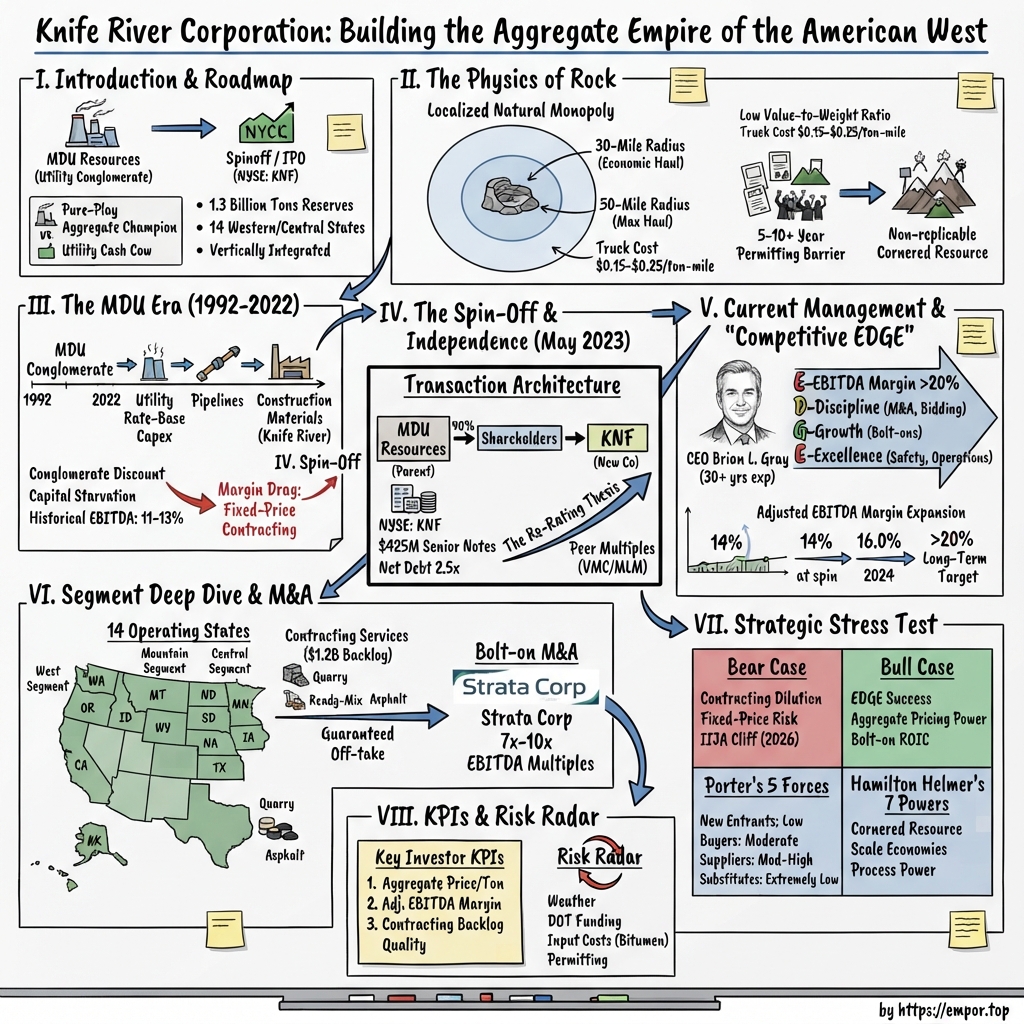
Knife River Corporation: Building the Aggregate Empire of the American West
I. Introduction & Episode Roadmap (00:00 – 12:00)
On the morning of June 1, 2023, executives from Bismarck, North Dakota, stood on the balcony above the New York Stock Exchange floor and rang the opening bell for a company almost nobody in Manhattan knew. The ticker was KNF, the product was rock, and the shares closed that first regular-way session at $35.02.
Nineteen months later, on January 22, 2025, the stock reached a peak of $108.83. By August 28, 2026—the most recent close prior to publication—it traded at $64.24, giving Knife River Corporation a market capitalization of roughly $3.6 billion, well below its 52-week high of $96.28.1
That arc—obscurity, euphoria, and subsequent repricing—defines the company's public story and makes Knife River worth careful analysis. Its fortunes do not turn on technological breakthroughs or consumer trends. The business extracts rock across fourteen U.S. states, crushes it, occasionally mixes it with cement or bitumen, and frequently paves it onto highways. While the core trade is as old as the automobile, Knife River's ownership structure, executive incentives, and quarterly market scrutiny have fundamentally changed.
The core thesis, stated plainly. Knife River spent three decades as a subsidiary of MDU Resources Group, a Bismarck-based utility holding company that primarily delivered electricity and natural gas across the northern Plains. MDU acquired its first aggregates operation in 1992, leveraging coal-mining expertise developed since acquiring a coal asset in 1945 to fuel its power plants.2 Over the subsequent thirty years, the construction-materials division acquired more than ninety complementary businesses.3 On May 31, 2023, MDU distributed roughly 90% of Knife River's shares to its shareholders—at a ratio of one Knife River share for every four MDU shares—establishing the construction-materials business as an independent public entity.4
The spun-off enterprise possessed substantial assets: today, it holds 1.3 billion tons of permitted aggregate reserves, 208 active aggregate sites, 135 ready-mix concrete plants, 55 asphalt plants, and nine liquid asphalt terminals, which generated $3.15 billion in revenue in 2025.3 Management identifies Knife River as the fourth-largest producer of sand and gravel in the United States.5
The physics of rock. Understanding the industry requires examining one key economic reality: aggregate is heavy and inexpensive. Knife River sold 32.5 million tons of aggregates in 2025 at an average price of $18.99 per ton.3 A standard twenty-ton truckload is worth approximately $400 at the plant gate. Because transportation expenses—diesel, drivers, and maintenance—are high relative to product value, shipping aggregates over long distances quickly erodes profit margins. As Knife River noted in its 10-K filing, construction materials "are expensive to transport due to their weight ratios, so they are generally produced and delivered locally or regionally. Access to well-positioned reserves is critical."3
Consequently, the aggregates industry does not function as a single national market. Instead, it consists of localized markets defined by transport distance from a quarry. Within its regional radius, a permitted quarry holds significant market power; outside it, the quarry cannot compete effectively. This structural dynamic underpins the company's vertical integration, acquisition strategy, and market valuation.
For readers unfamiliar with the sector, the terminology is straightforward. "Aggregates" refers to crushed stone, sand, and gravel extracted from open pits or quarries and screened to size. "Ready-mix" is concrete batched to specification and transported in rotating drum trucks. "Asphalt" consists of aggregate coated in a petroleum binder and applied hot. "Contracting services" encompasses the crews and equipment that execute paving, site grading, and structural work. Knife River operates across all four segments, raising strategic questions regarding optimal capital allocation among them.
The strategic arc. Three primary themes shape this analysis. The first is the transition from a utility subsidiary to a standalone public company, evaluating whether independence altered operational execution or merely corporate structure. The second centers on CEO Brian Gray, a civil engineer who joined a family-owned Oregon gravel company in 1993, and his "Competitive EDGE" initiative. This plan raised the adjusted EBITDA margin from 12.4% in 2022 to 15.8% in 2025—reflecting measurable operational gains, though remaining below management's long-term target of exceeding 20%.678 The third is the valuation gap between Knife River and pure-play aggregate producers. The market capitalizes Knife River's earnings at a lower multiple, largely because pure-play peer Vulcan Materials generated a 29.3% adjusted EBITDA margin in 2025.9 By comparison, Knife River's 15.8% margin reflects the fact that roughly 37% of its revenue stems from lower-margin contracting services—such as site grading and bridge construction—which delivered an 11.2% gross margin.3
A fourth underlying factor is operational volatility: annual financial results remain heavily dependent on weather conditions and state department of transportation bidding schedules. Knife River employed 5,298 people at year-end 2025, with headcount expanding to nearly 6,900 during peak summer construction.3 This seasonal expansion of roughly one-third creates pronounced quarterly earnings fluctuations despite stable multi-year demand.
What this story covers. The analysis examines the structural economics of localized aggregate reserves, the thirty-year conglomerate period and its impact on margin discipline, the execution of the corporate spin-off, and management performance relative to stated targets—including a second-quarter 2026 earnings release that triggered a nearly 12% single-day stock decline. It also evaluates segment performance and acquisition activity, which has absorbed over $1.4 billion in capital since the separation and raised net leverage from 2.2x to 3.2x over a six-month period.710 Finally, it details the bull and bear cases, both anchored by federal infrastructure policy and the upcoming expiration of federal highway funding on September 30, 2026.11
First, however, it is necessary to examine why permitted rock reserves can offer durable competitive advantages—and where those economic moats meet operational limits.
 Subscribe on LinkedIn
II. The Physics & Economics of Aggregates: Why Rock is a Cornered Resource (12:00 – 28:00)
Picture a county planning commission meeting in a small city in western Oregon on a Tuesday evening. The agenda item is a conditional use permit for a gravel pit—thirty acres, twenty years of reserves, three miles from a state highway. Roughly sixty residents have shown up to voice concerns about truck traffic on county roads, dust, crusher noise starting at six in the morning, groundwater impacts, and property values. The applicant has already spent four years and a seven-figure sum on hydrological studies, traffic analyses, reclamation plans, and legal fees. The commission votes to continue the hearing to a future date.
That meeting, repeated across thousands of local jurisdictions, illustrates the real economic moat. It is not built on patents, brand equity, or proprietary software, but on municipal land-use politics.
An oligopoly disguised as a commodity. On paper, construction aggregate appears to be the ultimate undifferentiated commodity. Crushed stone is crushed stone. The company's 10-K describes the industry as "highly fragmented," featuring "thousands of construction materials producers" competing on "price, service, quality, delivery time and proximity to the customer."3 Every word of that disclosure is accurate.
Yet it misleads if read as a measure of local competitive intensity. The same filing immediately adds an essential qualifier: "limitations on the distance that materials can be transported efficiently results in primarily local or regional operations. Accordingly, the number and size of competitors varies by geography and product lines."3
What that means in practice is a stark contrast. Nationally, the industry looks fragmented, leaving individual producers without market-wide pricing power. Locally, within a valley served by only two pits, the structure functions as a duopoly. Both the national fragmentation statistic and the local concentration reality are accurate, but only the localized market power shows up in operating margins.
Why freight is the whole game. Consider the underlying economics implicit in Knife River's disclosures. The company reported an average aggregate selling price of $18.99 per ton in 2025—a figure that includes freight and delivery revenue.3 Management has emphasized that this blended figure distorts underlying pricing trends. In the first quarter of 2026, reported aggregate pricing rose only about 1% year over year, but Chief Executive Officer Brian Gray attributed nearly the entire shortfall to geographic mix, noting that adjusting for geography yielded a 4.1% increase. The Mountain region, he explained, sells more unprocessed pit-run material and sits its downstream processing plants directly on its reserves. Consequently, both its operating costs and realized prices are structurally lower than in regions where Knife River rails or barges material to distribution yards.12
That distinction reveals a critical structural detail: the headline price-per-ton metric is heavily influenced by product mix rather than unit pricing power alone. As a result, Knife River's aggregate economics vary substantially across its geographical footprint, and tracking average selling prices without adjusting for regional mix presents an incomplete picture of underlying performance.
The regulatory moat, tested. The assertion that permitted reserves represent an irreplaceable asset is central to the industry's investment case, a point reinforced by Knife River's own disclosures: "New quarry sites can take years to develop and in a number of states in which we operate it can be difficult to permit new aggregate sites or expand existing aggregate sites due to community resistance and regulatory requirements."3
However, that regulatory moat is not absolute. A reserve generates economic value only if it can be mined profitably. In 2023, Knife River recorded $5.8 million in non-cash impairments "as a result of certain other aggregate sites no longer being economically feasible to mine and having no remaining value."8 Rock in the ground that cannot be delivered to customers at a profit is an accounting write-down rather than a competitive advantage.
While $5.8 million is modest relative to Knife River's total asset base, it demonstrates a key principle: aggregate reserves represent an economic claim rather than a purely geological asset, and changing market conditions can erase that value.
More significantly, a substantial portion of the company's reserve base is leased rather than owned outright. Of its 1.3 billion tons of total reserves, 741 million tons sit on owned property, while 563 million tons are located on leased land.3 Knife River estimates roughly 43 years of production life across its owned reserves. On leased ground, the weighted-average remaining lease term is approximately 15 years, compared to an estimated 52 years required to fully extract the material—a gap management bridges by assuming "that leases will be renewed to allow sufficient time to fully recover these reserves."3 While lease renewal is standard industry practice, nearly 43% of the company's total reported reserves depend on future landlord agreements over coming decades. Consequently, the headline figure of 1.3 billion tons consists of 741 million tons of fully controlled reserves alongside a large leased tail subject to long-term renewal terms.
Pricing power, and where the evidence actually is. Clearer evidence of pricing power in Knife River's operating record comes from recent price realizations: management secured high-single-digit average price increases in both 2024 and 2025.613 On the fourth-quarter 2025 earnings call, Chief Financial Officer Nathan Ring noted that a portion of the 2025 gain stemmed from the acquisition of Strata Corporation, which carried higher delivery-inclusive pricing. He guided to mid-single-digit price growth for 2026 as the Strata comparison normalized.13 This disclosure clarifies that legacy operations demonstrated steady mid-single-digit organic pricing, while acquisitions temporarily elevated reported averages.
Whether these increases reflect true pricing power or routine cost pass-through during an inflationary environment became clearer in mid-2026. In the second quarter of 2026, mix-adjusted aggregate pricing rose 8%. However, management simultaneously reduced its full-year guidance for aggregate margin expansion from approximately 200 basis points to roughly 100 basis points.1014 Gray explained that fuel surcharges effectively recovered input costs but generated minimal margin, while a 41% surge in delivered volumes shifted revenue toward lower-margin freight. "Our delivery typically is at a lower margin than our aggregates are at the plant," Gray told analysts.14 This dynamic highlights that revenue expansion driven by freight cost recovery does not yield the same margin expansion as core plant-gate price increases.
Why there is no substitute, in plain terms. The structural demand for aggregate rests on physical necessity. Concrete consists primarily of cement paste binding aggregate particles, with stone forming the structural skeleton that comprises the vast majority of the volume. Asphalt exhibits an even higher stone concentration: Knife River's disclosures show it is composed of roughly 95% aggregate bound by 5% liquid asphalt, covering approximately 94% of the three million miles of paved roads in the United States.3 No alternative material replaces rock at scale. While recycled asphalt pavement and crushed demolition concrete are routinely reused at the margin, both originate from infrastructure built with virgin aggregate. The recycled supply remains entirely dependent on primary extraction.
Perishability further reinforces localized market dynamics. Both ready-mix concrete and hot-mix asphalt begin setting immediately upon production, constraining the effective delivery radius of a batch plant to roughly a one-hour drive. As Knife River notes in its 10-K, both products require "delivery to within close proximity to the production facility."3 While a quarry can economically ship aggregate by rail over long distances, ready-mix trucks cannot endure extended transit times.
A note on how reserves get counted. Since 2021, U.S. mining disclosures have operated under SEC Regulation S-K Subpart 1300, which defines strict reporting standards for reserves. Knife River's 208 active aggregate sites include only locations meeting these regulatory criteria, excluding five sites classified as exploration-stage or project-specific.3 Reserve estimates are compiled by internal mining engineers and operational staff alongside third-party geologists, with senior management evaluating and approving quantity estimates, site classifications, and key assumptions.3 Although this process aligns with standard industry practice, the headline reserve totals reflect internal estimates reviewed by management under regulatory guidelines rather than independent third-party audits.
The peer standard. The financial potential of an aggregates-focused business is illustrated by pure-play peers. In 2025, Vulcan Materials generated $2.32 billion in adjusted EBITDA on $7.94 billion in revenue—a 29.3% margin, representing a 160-basis-point expansion—while shipping 226.8 million tons and raising aggregates cash gross profit per ton by 7% to $11.33.9 That metric represents a cash figure excluding depreciation, making it distinct from Knife River's GAAP aggregates gross margin of 18.5% on $617.1 million in aggregate revenue.3 Nevertheless, the substantial margin gap—roughly 29% for Vulcan compared to roughly 16% for Knife River—is persistent and driven primarily by segment mix rather than operational execution alone.
This gap frames the central question surrounding Knife River's evolution: why did an enterprise controlling vast aggregate reserves generate utility-level returns for three decades?
III. The MDU Conglomerate Era: Decades as the Utility Cash Cow (1992–2022) (28:00 – 48:00)
The name originates from a river. The Knife River winds through west-central North Dakota, where an early twentieth-century coal-mining operation took its name from the waterway. MDU Resources acquired that coal business in 1945 to fuel its electric generating stations—operating as a vertically integrated utility securing its own fuel supply.2 The utility's centennial history documents the key strategic pivot: in 1992, "MDU Resources uses its coal-mining expertise to venture into aggregate mining, acquiring its first operation to get into the construction materials and mining business."2 By 2001, the coal assets had been sold, and mining operations focused entirely on aggregates.2
The initial expansion into construction materials stemmed from operational overlap rather than a deliberate strategy to acquire cornered aggregate resources. MDU recognized that core earth-moving capabilities—dragline operations, environmental permitting, land reclamation, and heavy hauling—transferred directly from lignite mining to gravel extraction. This practical origin shaped the company's subsequent development.
Thirty years of bolt-ons. From that initial 1992 purchase, the company expanded across the Pacific Northwest, the Rocky Mountains, and the northern Plains by acquiring local family-owned operations. By the time of the corporate separation, it had "acquired and integrated over 90 complementary businesses."3 CEO Brian Gray joined the enterprise through this acquisition stream, entering Morse Bros.—a family-owned business in Corvallis, Oregon—in 1993 as a quality-control lab technician. Knife River acquired Morse Bros. in 1998, and Gray remained with the organization.15
This acquisition structure influenced company operations. Rather than functioning as a centralized corporate development team in Bismarck, acquisitions were executed by regional managers acquiring local competitors. By 2007, the company had consolidated dozens of legacy regional brands under a single corporate name.15 This approach preserved regional operational knowledge but created structural complexity—leaving a decentralized network of local businesses operating with distinct pricing practices, cost structures, and equipment fleets.
The margin problem, quantified. Pre-spin financial records reveal the operational performance of the business under utility ownership. In 2021, revenue of $2.23 billion generated $294.7 million in adjusted EBITDA, representing a 13.2% margin. In 2022, revenue rose 14% to $2.53 billion, while adjusted EBITDA reached $313.4 million—causing the adjusted EBITDA margin to decline to 12.4%.8
This margin contraction during a period of strong construction demand highlights a key operational challenge. Despite double-digit top-line growth, the business converted a smaller proportion of incremental revenue into profit. This pattern indicates a volume-focused bidding strategy operating during an inflationary environment without dynamic pricing mechanisms to offset rapid cost increases in liquid asphalt, diesel, and labor during 2021 and 2022.
In localized aggregate markets, producers with pricing power typically expand margins during inflationary periods by raising prices ahead of rising input costs. Knife River's inability to maintain margins during this cycle reflected underdeveloped commercial pricing systems.
Free cash flow performance reflected similar capital inefficiencies. The business generated $19.0 million in free cash flow in 2021 and $52.2 million in 2022.8 Relative to a multi-billion-dollar asset base, these figures represented modest returns on invested capital. Annual capital expenditures remained elevated—totaling $174.2 million in 2021 and $178.2 million in 2022—without generating corresponding cash flow.8
The inheritances that do not appear in the pitch deck. Two primary structural legacies from utility ownership persisted through the spin-off.
The first involves labor obligations. Of the 5,298 employees working for the company at year-end 2025, 599 were union members covered by 39 separate collective-bargaining agreements, two of which were under negotiation.3 While most contracts include no-strike provisions with binding arbitration, managing 39 distinct negotiations adds operational complexity. Additionally, the company participates in multiemployer pension plans, which carry potential withdrawal liabilities if an employer exits or if a plan experiences mass withdrawal.3 Knife River's executive compensation framework explicitly allows adjustments to adjusted EBITDA for multiemployer pension withdrawal liabilities, reflecting board oversight of this financial exposure.5 Legacy single-employer defined-benefit plans were closed to new entrants in 2006 and frozen at the end of 2009, capping future growth in those specific liabilities.8
The second legacy involves brand consolidation and institutional relationships. Unifying dozens of acquired regional operators under the Knife River banner starting in 2007 established standardized safety protocols and centralized training—including a company-owned training facility where managers and supervisors average 15 years of tenure.15 However, local commercial relationships with state departments of transportation remain concentrated among individual project superintendents rather than institutionalized corporate assets.315 In an industry reliant on regional permitting and municipal client trust, executive tenure provides operational stability, while staff turnover presents an uncapitalized operational risk.
Testing the conglomerate-discount thesis. The standard rationale for corporate spin-offs suggests that high-quality assets are constrained by capital allocation priorities within conglomerate structures, and that independence unlocks hidden value. Capital allocation at MDU required construction materials to compete for investment against regulated utility rate bases and natural gas pipelines, which operated under lower risk tolerances.
However, financial data indicates that pre-spin margin pressures were not primarily driven by capital starvation. Capital expenditures averaged 7% to 8% of annual revenue under MDU ownership, representing steady reinvestment. The primary constraint was commercial discipline—specifically dynamic pricing implementation, disciplined project bidding, and standardized operational practices across more than 200 aggregate sites.
Management disclosures support this operational diagnosis. On the fourth-quarter 2025 earnings call, Gray detailed gross margin improvements achieved between 2022 and 2025 across product lines: aggregates gross margin increased by 450 basis points, ready-mix concrete by 300 basis points, asphalt by 570 basis points, liquid asphalt by 450 basis points, and contracting services by 280 basis points.13 These gains resulted from internal commercial pricing initiatives and plant-level operational adjustments rather than major new capital deployments. This performance indicates that pre-spin margin drag resulted primarily from operational underperformance rather than structural capital starvation alone.
A fair verdict on the era. MDU's thirty-year ownership established a substantial market position: a permitted, geographically dense reserve base across states with strict land-use regulations, acquired at historical private-market valuations. Concurrently, that period embedded a lower-margin contracting division and a volume-oriented bidding culture that management continued addressing into 2026. Evaluating the spin-off requires accounting for both the strategic reserve assets and these inherited operational structures.
By late 2022, the central strategic question focused on how independent management would restructure these operations following corporate separation.
IV. The Spin-Off & Independence: Un-docking KNF (May 2023) (48:00 – 66:00)
Corporate separations are usually described in the language of strategic clarity. They are more accurately described in the language of corporate plumbing. Before a subsidiary can be handed to shareholders, management must decide how much debt it carries out the door, who retains the cash, and what the parent keeps.
The architecture. MDU set the record date at May 22, 2023, and completed the distribution on May 31, handing its shareholders one Knife River share for every four MDU shares held while retaining approximately 10% of the new company's stock. Regular-way trading in KNF began on the New York Stock Exchange on June 1, and the company entered the S&P MidCap 400.4 The separation qualified as tax-free for U.S. federal income tax purposes.3 Brian Gray, who had been appointed to lead the business earlier that year, became president and chief executive officer of the newly public company.54
The retained stake carried greater market significance than its size suggested. A parent company holding 10% of a newly spun subsidiary creates an equity overhang, as investors anticipate that those shares will eventually enter the market. MDU resolved that uncertainty quickly, disposing of the retained position through a tax-free exchange later in 2023 rather than selling shares into the open market over time. For Knife River shareholders, that transaction eliminated a technical overhang on the stock within months of its public debut.
The balance sheet it was handed. Knife River did not launch debt-free. Ahead of the separation, it issued $425 million in senior notes carrying a 7.750% coupon and maturing on May 1, 2031, alongside term loans and a revolving credit facility, with the majority of the proceeds transferred to Centennial, its immediate pre-spin parent within the MDU group.38 This capital structure reflected a standard spin-off extraction, allowing the parent company to monetize the subsidiary's borrowing capacity prior to distribution.
This financing structure primarily served the parent entity. The debt was incurred by the subsidiary being spun off, while the capital proceeds flowed upstream to MDU. Consequently, Knife River shareholders inherited an independent company already burdened with the borrowing costs of its own separation.
The borrowing terms represented a significant financial commitment. The 7.750% fixed coupon secured in the spring of 2023 reflected high capital costs in a rising interest rate environment for a company without an independent credit track record. By mid-2026, with roughly $1.6 billion of gross debt outstanding, that note remains the highest-cost component of Knife River's capital structure ahead of its 2031 maturity.10 It represents an ongoing cost of corporate independence.
Initial leverage, however, remained manageable. By year-end 2023, the company carried $271.6 million in variable-rate term loans at an effective rate of 7.24% while generating $219.7 million in free cash flow during its first partial year as a public enterprise—a tenfold increase over 2021.8 That cash flow expansion offered clear evidence of operational separation, though the figure benefited from favorable working-capital shifts and a temporary reduction in capital expenditures to $124.3 million.
The equity story it was sold on. Knife River debuted as a $2.8 billion revenue enterprise controlling 1.1 billion tons of aggregate reserves, 180 active aggregate sites, 102 ready-mix concrete plants, and 56 asphalt plants across five reporting segments.8 The initial proposition presented to public investors anchored on two financial targets: a near-term adjusted EBITDA margin goal of 15% and a long-term objective of "exceeding 20 percent."6
The business achieved its initial margin target early. Adjusted EBITDA margin reached 15.3% in 2023 and expanded to a record 16.0% in 2024, generating $463.0 million of adjusted EBITDA on $2.90 billion of revenue.6 Public markets initially rewarded the performance: Knife River shares closed 2023 at $66.18 and reached $101.64 by the end of 2024, nearly tripling from their initial regular-way closing price over nineteen months.
What the market verdict actually said. That rapid valuation increase reflected both operational gains and enhanced financial visibility. Prior to June 2023, the business operated as a subsidiary segment within a utility holding company, lacking dedicated sell-side coverage, standalone financial reporting, product-line volume and pricing disclosures, or quarterly analyst calls focused on aggregates margins. Transitioning into an independent public entity made the business fully legible to capital markets. Consequently, a portion of the initial equity re-rating stemmed from market transparency rather than structural improvements in underlying operations alone.
That distinction is critical for evaluating ongoing performance, as informational gains represent a one-time valuation adjustment. With reporting transparency established, equity performance depends strictly on operational results. The market response in 2026 highlighted this reality: on August 4, 2026, second-quarter results showing 13% revenue growth and an elevated full-year revenue outlook triggered a double-digit stock decline, as investors reacted to profit margin pressures.10
The governance that came with independence. Corporate separation also required forming an independent board of directors aligned with the company's operational demands. Board Chair Karen B. Fagg, an engineer who previously ran an environmental and engineering services firm and directed Montana's Department of Natural Resources and Conservation, brings direct experience in land-use regulation and environmental permitting—the key administrative areas governing quarry assets.5 The board also includes two former chief executive officers of publicly traded construction materials companies. All director nominees other than Brian Gray are classified as independent under NYSE and SEC rules, the board is transitioning toward full annual director elections, and a double-trigger change-in-control severance plan was adopted in August 2024.5 This structure reflects standard corporate governance practices for an independent mid-cap company.
Stress-testing the spin, three years on. Three years following the separation, an analysis of corporate performance suggests that initial efficiency gains were front-loaded, highlighting three ongoing operational challenges.
First, early margin expansion was driven largely by pricing adjustments during an inflationary period and selective contract bidding. Management characterized these as "quality-over-quantity initiatives" that deliberately reduced lower-margin material volumes to prioritize profitability.6 While effective in boosting initial margins, commercial selectivity represents a finite operational adjustment that cannot be repeatedly duplicated.
Second, inherited leverage shaped subsequent growth options. Lacking sufficient excess cash flow to fund large-scale acquisitions outright, management relied on bolt-on purchases financed through incremental debt—a strategy that functions effectively while balance sheet capacity exists but grows constrained as leverage increases.
Third, long-term margin targets became less explicit in formal disclosures. The 2024 results release stated the "long-term goal of exceeding 20 percent" explicitly.6 By contrast, the 2025 Form 10-K described the Competitive EDGE initiative as driving "sustained Adjusted EBITDA margin expansion towards our long-term goal"—without restating the number.3 While management continued to reference margin expansion during earnings calls, omitting the specific 20% metric from the annual report in a year when adjusted EBITDA margin declined from 16.0% to 15.8% represents a notable shift in formal guidance.7
That progression summarizes the post-separation record: corporate independence demonstrably improved cash generation and initial operating margins, but margin expansion decelerated as long-term targets proved more challenging to achieve. Which brings the analysis to the executive leading that operational strategy.
V. Current Management & The "Competitive EDGE" Playbook (2023–Present) (66:00 – 86:00)
Chief Executive Officer Brian Gray represents an executive archetype common in industrial operations: an operator who tracks the unit cost of running a specific crusher in an individual pit and monitors sales dashboards with the detail other executives reserve for equity prices. During Knife River's first-quarter 2026 earnings call, an analyst questioned why reported aggregate pricing appeared soft. Gray responded with a detailed breakdown of geographic cost structures, the ratio of pit-run to processed material in Montana, and rail transport dynamics across North Dakota and Oregon, concluding: "I look at our sales dashboards frequently, and I can tell you and reassure you that what I see for the same product coming out of the same plant" supports mid-single-digit pricing.12
That plant-level perspective from the chief executive's office reflects both Knife River's operational strength and its potential strategic limit.
Brian Gray. Gray, 55, holds a civil engineering degree from Oregon State University and began his career in a quality-control lab testing aggregates for asphalt production.515 He joined Morse Bros. in 1993 and entered Knife River when the company acquired Morse Bros. in 1998. Beginning in January 2012, he served as region president of Knife River Corporation – Northwest, leading eight acquisitions and helping construct the company's primary training center.515 He was appointed president of the holding entity on March 1, 2023, and chief executive officer on May 3, 2023—a thirty-year internal progression, making him the sole executive director on Knife River's board.5
This executive background highlights operational familiarity alongside structural risks. An executive promoted entirely from within reflects the corporate culture built over decades, including the volume-oriented bidding practices that produced a 12.4% adjusted EBITDA margin in 2022. While Gray has targeted those operational habits directly, the enterprise transformation is being executed by long-serving internal leadership rather than an outside turnaround manager brought in to restructure operations.
The board of directors partially offsets this internal focus through external industry expertise. Two independent directors contribute pure-play leadership experience: Thomas W. Hill, who founded Summit Materials and served as its chief executive from 2009 to 2020 after leading Oldcastle's materials division, and William J. Sandbrook, who led U.S. Concrete from 2011 to 2020.5 Chief Financial Officer Nathan W. Ring, 50, is also an MDU veteran with 21 years at the former parent, including service as MDU's controller and chief accounting officer.5 Consequently, external sector perspective resides on the board rather than within top operational management.
Executive compensation and incentive alignment. Contrary to common assumptions regarding capital allocation metrics, Knife River's executive compensation is not tied to return on invested capital. According to the company's 2026 proxy statement, annual cash incentives depend on adjusted EBITDA targets alongside safety metrics weighted at 10% of the total award.5 Long-term equity incentives consist of 65% performance stock units (PSUs) and 35% restricted stock units, with PSUs vesting based on two equally weighted metrics: relative total shareholder return against a 36-company peer group and three-year adjusted EBITDA margin growth, with potential payouts ranging from zero to 200% of target.5
This structure directly rewards stated operational goals by tying compensation to margin expansion. However, it contains no explicit return-on-capital requirements for an enterprise deploying substantial capital into acquisitions. Compensation tied strictly to absolute EBITDA and EBITDA margin expansion creates incentives to acquire additional earnings power regardless of total capital deployed. Management has noted that completed acquisitions were secured at high-single-digit EBITDA multiples.1213
Additionally, Knife River does not publish its specific adjusted EBITDA margin growth targets in advance, stating that disclosure "could result in competitive harm and would reveal information about our long-range financial goals, which are not otherwise public."5 As a result, investors can evaluate performance targets only after the measurement period concludes. Despite this limited forward visibility, advisory say-on-pay proposals received 95% shareholder approval at the 2025 annual meeting.5
Deconstructing the Competitive EDGE playbook. Management's operational strategy, designated as "Competitive EDGE," stands for EBITDA Margin Improvement, Discipline, Growth, and Excellence.3 Beyond executive branding, the program organizes four distinct operational initiatives:
Dynamic pricing represents the core commercial change. Instead of relying on traditional annual price schedules issued each autumn, regional sales teams reprice aggregates, ready-mix concrete, and asphalt continuously based on real-time input costs tracked via proprietary bidding dashboards. Gray noted in early 2026 that dynamic pricing implementation was in its "later innings" across legacy sites, while acquired operations were still being integrated into the platform.12 This commercial model contributed to high-single-digit price realizations in 2024 and 2025, while enabling real-time adjustments for diesel fuel spikes in 2026.612
Process Improvement Teams—known internally as "PIT Crews"—operate as mobile technical squads that evaluated 58 additional production facilities in 2024.6 These interventions produced measurable cost gains: per-unit aggregate production costs declined by over 10% year over year in the first quarter of 2026, while ready-mix delivery productivity improved by 12% per hour.1214
Bidding discipline requires rejecting project bids below established margin thresholds, serving as the primary mechanism behind the company's intentional volume reductions in 2024.6
Excellence focuses on operational standardization and workplace safety, leading to the company's lowest recorded incident rates in 2025.13
Operational execution in 2026. Financial performance during 2026 provided a test of this management framework, revealing both operational capabilities and earnings volatility.
In February 2026, management issued full-year guidance projecting revenue between $3.3 billion and $3.5 billion and adjusted EBITDA of $520 million to $560 million, implying a midpoint adjusted EBITDA margin of roughly 16%—effectively flat relative to 2025.7 Following a first quarter in which revenue expanded 16% and adjusted EBITDA margin grew 290 basis points, CFO Nathan Ring informed investors that full-year results were expected to "trend toward the upper half" of guidance ranges.12 When asked why management did not formally raise guidance, Gray noted: "We still have 90% of our construction season in front of us."12
That conservative posture was validated by second-quarter results. On August 4, 2026, Knife River reported a 13% increase in second-quarter revenue to $938.6 million, but adjusted EBITDA declined 1% to $139.7 million, causing the adjusted EBITDA margin to contract by 200 basis points to 14.9%.10 In response, Knife River's stock price dropped nearly 12% in a single session, falling from $78.84 to $69.51.
Management attributed approximately $24 million of the quarterly EBITDA shortfall to three distinct factors: roughly $10 million from elevated energy costs, $10 million from weather delays and project timing, and $8 million from an unfavorable contracting mix.14 Specific operational disruptions included a Texas paving program where rainfall reduced planned deliveries from 200,000 tons to less than 15,000 tons, schedule shifts on a naval dry-dock project in Hawaii, and extended winter weather in Alaska that restricted heavy truck transport through mid-June.14 Consequently, management raised full-year revenue guidance to between $3.4 billion and $3.6 billion while maintaining adjusted EBITDA guidance within the original range, steering expectations toward the midpoint rather than the upper end.1014
These disclosures highlight three operational details. First, management provided quantified, itemized factors behind the quarterly variance. Second, Gray acknowledged that delayed Texas paving volumes would defer into 2027 rather than recover during late 2026, as contractor equipment schedules were already fixed.14 Third, raising top-line revenue guidance while lowering margin expectations indicated that incremental revenue growth carried lower profitability than originally budgeted.
Executive pay responsiveness. The alignment of executive compensation with performance was demonstrated in 2025. Gray's annual non-equity incentive compensation—the cash bonus tied to adjusted EBITDA and safety targets—declined nearly 45%, from $1,825,838 in 2024 to $1,006,253 in 2025, despite a base salary increase from $880,000 to $1,000,000. His total reported compensation fell from $6,941,573 to $5,820,868.5 Chief Financial Officer Nathan Ring's annual incentive compensation experienced a similar reduction, falling from $710,399 in 2024 to $342,755 in 2025.5
This payout structure yields two analytical conclusions. First, operational results in 2025 fell short of internal board targets despite record total adjusted EBITDA, indicating that absolute profit expansion was driven substantially by acquired operations rather than organic target achievement. Second, the compensation committee maintained established performance metrics without discretionary adjustments, reducing executive cash bonuses during a year highlighted publicly for record financial results.
Strategic messaging across reporting periods. Executive communications across quarterly earnings calls have maintained consistent strategic framing. The company's four operational pillars—markets, vertical integration, self-help, and culture—were presented consistently across early and mid-2026 disclosures.121314 Core operational metrics, including dynamic pricing execution, PIT Crew deployments, target acquisition multiples in the high single digits, and a long-term net leverage target of 2.5x, remained central to management commentary without shifting strategic frameworks during quarterly earnings pressure.
The principal operational variance occurred in Oregon, where initial February expectations of performance "broadly in line with 2025" were revised in August following lower-than-anticipated state highway project lettings.714 Management had previously noted in February that "public funding is a big part of our success also in Oregon and clarity on that will be important," identifying state budget dependency prior to the mid-year slowdown.13
Operational seasonality. Seasonal patterns remain a dominant factor in Knife River's financial performance. The company recorded net losses of $35.3 million in the first half of 2026 and $18.1 million in the first half of 2025.10 Historically, approximately 10% of annual revenue is generated in the first quarter and 25% in the second quarter, with CFO Nathan Ring projecting that roughly 55% of full-year adjusted EBITDA is realized during the third quarter alone.1214 Consequently, full-year profitability depends heavily on operating conditions between June and November. The acquisition of Strata Corporation in North Dakota further amplified this seasonal concentration by increasing winter operational drag.13
This seasonal structure frames the operational mechanics of Knife River's broader asset network.
VI. Segment Deep Dive & M&A Strategy: Rock, Asphalt, and Regional Dominance (86:00 – 106:00)
In January 2025, Knife River quietly redrew its own map. The former Pacific and Northwest segments merged into a single West; North Central and South merged into Central. The company was left with four reportable segments: West, Mountain, Central and Energy Services, with prior periods recast.3 Segment reorganisations are usually cosmetic. This one was not entirely — it was explicitly done "to streamline operations and further facilitate EDGE implementation," standardising processes across a wider span of control.6 It also had the incidental effect of folding a struggling Oregon business in with high-performing California, Alaska and Hawaii operations, which makes the reader's job harder and is worth keeping in mind.
West: the margin engine with a problem. The West spans Alaska, California, Hawaii, Oregon and Washington, holds 705.1 million tons of reserves — over half the company total — and generated $1.21 billion of revenue in 2025 at a 19.3% EBITDA margin, the best of the geographic segments.3 It is where the prestressed concrete business sits, where the Navy's multi-billion-dollar P-209 dry dock programme at Pearl Harbor is being supplied, and where military and North Slope energy work has been elevated.13
It is also where 2026 went wrong. West revenue fell 9% in the second quarter and segment EBITDA fell 19%, with backlog down 16% year over year to $235.7 million.10 The cause was Oregon. Having told investors in February 2026 that Oregon would perform "broadly in line with 2025" on a roughly flat state construction budget, Gray conceded in August that Oregon DOT bid lettings for asphalt paving had come in under $5 million — far below expectation — pushing regional contractors to chase work in adjacent states.714
This is the clearest single test of the moat thesis in the company's recent record, and it is instructive. Knife River's Oregon reserves did not disappear. Its permits did not lapse. Its competitors did not undercut it on rock. What happened is that its dominant customer — a state government — simply stopped putting work out to bid. A cornered resource is worthless in a quarter when nobody is buying, and roughly 81% of Knife River's contracting revenue comes from public-sector customers, with nine state DOTs among its top 15 accounts.3 Concentration of that kind is a genuine limitation on the "local monopoly" framing: the monopolist is negotiating with a monopsonist.
The broader lesson is one that applies to every asset-based business selling into public budgets: the durability of the asset and the durability of the demand are two separate questions, and only one of them is in the company's control.
Mountain: the growth story, and where the margin went. Idaho, Montana, Wyoming and, since 2026, Utah — 226.2 million tons of reserves, $644.0 million of 2025 revenue at a 15.5% EBITDA margin, and the most contracting-heavy mix in the company at 58% of segment revenue.3 Mountain revenue jumped 34% in the second quarter of 2026 on acquisitions and paving volume. Segment EBITDA was flat, and margin fell from 17.6% to 13.1%.10
That combination — revenue up a third, profit unchanged — is the vertical-integration thesis under pressure. The theory says paving work pulls through high-margin aggregates and asphalt. The second quarter says that when the paving itself is bid thin and performance bonuses have not yet been earned, the pull-through arrives later than the revenue does. Gray defended the trade explicitly, telling analysts the company had consciously bid asphalt paving more aggressively to secure work and capture downstream material sales.14 That is a coherent strategy. It is also, precisely, the volume-for-margin trade that the EDGE bidding-discipline pillar was created to stop. Investors are entitled to ask which principle governs when they conflict.
Central: the acquisition laboratory. Iowa, Minnesota, North Dakota, South Dakota and Texas — 372.8 million tons of reserves, $1.00 billion of 2025 revenue, a 15.9% margin, and the most public-sector-weighted mix in the company at 93%.3 This is where Strata landed, where Texcrete landed, and where the North Dakota DOT's construction budget for 2026 was estimated at $745–810 million of bid lettings against $345 million in 2025 — a more than doubling.3 Central delivered second-quarter revenue up 28% and EBITDA up 21% in 2026.10
One further Mountain detail deserves recording, because it bears on the acquisition thesis: the three deals completed in the first quarter of 2026 all landed in this segment, and management has been strengthening the region's leadership with what Gray called "more materials focused talent" — an implicit acknowledgement that a paving-led region needed rebalancing toward the higher-margin upstream business.13
Energy Services: small, and better than it looks. Nine liquid asphalt terminals across eight states, with storage capacity of roughly 413,000 tons, producing $338.0 million of 2025 revenue at a 16.2% margin.3 Its function is dual: it supplies the binder that Knife River's own asphalt plants need — asphalt mix being roughly 95% aggregate and 5% liquid asphalt — and it sells to third parties, including competitors.3 The segment posted a 19.2% EBITDA margin in the second quarter of 2026, the highest in the company.10
The hedging claim deserves a caveat. Owning terminals gives Knife River supply security and working-capital advantages in the binder market; it does not insulate the company from bitumen prices, which are set by refiners. The 2022 margin collapse happened with these terminals already in the portfolio.
The segment has also been absorbing its own integration. Albina Asphalt, acquired before 2025, entered its second full year of operation in 2026 with operational improvements still being implemented, and management has been merging West Coast liquid asphalt operations to capture synergies — an effort that contributed to a 40% EBITDA improvement in the segment in the first quarter of 2026.1213 The segment's job is to make the asphalt business work; judged on that, it has been doing it.
The acquisition engine. This is where the capital goes, and the pace has been striking. Since implementing EDGE in 2023 the company completed 11 acquisitions through the end of 2025.3 In 2024: six deals for $131 million.6 In 2025: five deals for $610.0 million of acquisition spend, plus $178.6 million of organic growth projects and $169.5 million of maintenance capital — roughly $958 million of total deployment in a single year.7 In the first quarter of 2026 alone, three more deals for $174 million: Morgan Asphalt in Salt Lake City, which established a Utah platform, plus Sparrow Enterprises in Helena and Donaldson Brothers Ready Mix in Montana's Bitterroot Valley.12
The cadence tells you something on its own. This is not a company doing one deal a year and integrating carefully; it is running a continuous acquisition programme with a dedicated business development team whose build-out was itself a named driver of higher overhead in 2024 and 2025.13
The anchor transaction was Strata Corporation, acquired March 7, 2025 for $454.0 million — the largest deal in company history. It added roughly 30 years of aggregate reserves, 24 ready-mix plants, three asphalt plants, a construction division, and rail and trucking assets in North Dakota and northwestern Minnesota.3 It was funded partly by a new $500 million Term Loan B maturing in 2032, arranged alongside an expansion of the revolving credit facility from $350 million to $500 million.3
Gray's description of the sourcing model is consistent across calls and rings true: negotiated deals with family owners, done at high-single-digit EBITDA multiples, originated by local regional teams rather than bankers, with Knife River often receiving the first call because sellers know the acquirer.1213 Nearly 100 acquisitions of institutional practice stand behind it.12
The organic move that explains the strategy better than any deal. Buried in the first-quarter 2026 call is a sequence that illustrates how the pieces are meant to interlock. Some years ago Knife River greenfielded a quarry called Honey Creek near Austin, Texas — a rare act, given how hard new permits are to obtain — to supply high-quality aggregates to its own downstream plants and to third parties. That quarry now feeds an expanded asphalt plant in Bryan, Texas, capacity added specifically to serve a $112 million state highway paving contract. It also supplies the ready-mix operations of Texcrete, a College Station business acquired in December 2025 that had previously been buying aggregates from third parties and that more than doubled Knife River's Texas ready-mix volumes in a single quarter.1213
That is four separate profit pools — quarry, asphalt plant, paving crew, ready-mix — assembled around one hole in the ground, in a corridor management calls the "triangle within the triangle" between Dallas, Houston and San Antonio.12 It also shows the sequencing logic: build or buy the rock first, then acquire the downstream demand, then convert the acquired company's third-party purchases into internal sales. Gray is explicit that this conversion is where a meaningful part of acquisition value comes from — not cost synergies, but redirecting a target's raw material spend inward.12
The honest caveat is that this is one worked example, presented by management, in the company's strongest demographic market. It demonstrates the mechanism exists. It does not establish how often the mechanism is fully realised across nearly a hundred acquisitions, and Knife River does not disclose deal-level returns.
Testing the M&A record. The strongest support for the strategy is arithmetic: buying at high-single-digit multiples while the public company itself is capitalised at roughly ten to eleven times trailing adjusted EBITDA — an implied figure derived from a $3.6 billion market capitalisation, $1.59 billion of net debt and $501.6 million of trailing twelve-month adjusted EBITDA at June 30, 2026 — creates value on day one, before any synergy.10 Management's identified synergies are credible and mundane: purchasing power on cement, oil and equipment; PIT Crew process transfer; back-office consolidation.12
The counter-evidence is threefold and matters.
First, integration drags on reported results in ways that are easy to under-model. Strata's first-quarter seasonal losses were a headwind in both 2025 and 2026, and legacy lower-margin contracting backlog acquired with these businesses was still rolling off through the third quarter of 2026.1214 Newly acquired operations also sit outside dynamic pricing until their existing quotes are honoured and their teams retrained.12
Second, the deals import contracting mix. Strata came with a construction division. Morgan Asphalt came with paving services.12 Every such deal makes the consolidated business slightly more contractor and slightly less quarry — the opposite of the mix shift the valuation thesis requires.
Third, and most immediately, the pace has consumed balance-sheet capacity faster than promised. Net leverage stood at 2.2x at the end of 2025, below the 2.5x long-term target.7 By June 30, 2026 it was 3.2x, following a $400 million incremental Term Loan B issued on May 15, 2026.10 Ring had told investors in February that the company would go "maybe closer to 3" for the right deal and for a short duration, and in May reaffirmed an expectation of finishing 2026 with no revolver borrowings and leverage near 2.5x.1213 Peak seasonal borrowing genuinely explains part of the move — leverage was 3.1x at the same point in 2025 — but the absolute debt load rose from $1.18 billion to $1.62 billion in six months.710 Whether the year-end deleveraging promise is kept is a specific, checkable test of management's word, and it will be answered in February 2027.
The verdict on the acquisition strategy: the entry multiples are demonstrably attractive and the sourcing advantage appears real, but the strategy has not yet been observed through a downturn, it dilutes the mix it is meant to improve, and it has moved leverage above target ahead of schedule. It should be judged as promising and unproven rather than validated.
VII. Strategic Position, Frameworks & Skeptical Investor Stress Test (106:00 – 122:00)
If a skeptical fund manager were building the short case, the opening line would write itself: this is a construction contractor that owns some quarries, valued as though it were a quarry company that does some contracting.
Let us war-game it properly.
The competitive field. Knife River names its large public competitors directly: Amrize, Cemex, CRH, Eagle Materials, Granite Construction, Heidelberg Materials, Martin Marietta, Construction Partners and Vulcan Materials.3 The more relevant observation is what it says about the rest: "Smaller, independent operators make up the majority of our competition."3 Knife River is not primarily fighting Vulcan. It is fighting the family firm three valleys over — the same firms it buys.
The public comparison set has also thinned. Summit Materials, once the natural mid-cap comparable and still a member of Knife River's compensation benchmarking peer group, was taken private and is described in the company's own proxy as "formerly a publicly traded integrated supplier of construction materials."5 Consolidation at the top of the industry has removed a reference point and, arguably, increased the scarcity value of a listed vertically integrated materials platform.
The multiple gap, explained rather than lamented. Vulcan's 29.3% adjusted EBITDA margin against Knife River's 15.8% is not a valuation opinion; it is a mix fact.97 Knife River's 2025 revenue split roughly 63% construction materials and 37% contracting services, and contracting carried an 11.2% gross margin against 18.5% for aggregates.35 Contracting revenue is also inherently riskier: it is recognised over time using cost-to-cost input methods, meaning reported profit depends on management's estimate of total costs to complete. Knife River's auditor, Deloitte & Touche, has served since 2002 and flagged precisely this — contracting services revenue recognition — as the critical audit matter in the 2025 audit.3 That is standard for the industry and not a red flag, but it is the correct place for a skeptic to look: an estimate-dependent revenue line is where optimism hides.
So the multiple gap is rational. The bull case is not that it is unjust; it is that it should narrow as materials grow faster than contracting. The bear case is that acquisitions keep importing contracting, and 2026's own numbers support the bear: second-quarter contracting revenue grew 19.5%, faster than any material product line's revenue growth except asphalt.10
There is a second comparable set that receives less attention and is arguably more apt. Granite Construction and Construction Partners are both named competitors and both sit closer to Knife River's actual mix of materials and self-performed civil work.3 Construction Partners in particular runs an aggregates-and-asphalt-and-paving model in fast-growing states. Investors benchmarking Knife River only against Vulcan and Martin Marietta are comparing it to the business it aspires to resemble rather than the one it currently is, and will systematically conclude it is cheap. Benchmarking against the vertically integrated paving companies produces a different and less flattering read.
Hamilton Helmer's 7 Powers, applied honestly. Of the seven powers, three are plausibly present and four are not.
Cornered Resource is the strongest. Permitted reserves in jurisdictions that will not permit new ones are the textbook case, and roughly 90% of Knife River's aggregate volume comes from markets where management says it holds a leading position.12 The qualification, established earlier, is that 563 million tons sit on leases whose terms are shorter than the extraction timeline.3
Scale Economies operate locally, not nationally. Density of quarries, plants and trucks within a freight radius lowers unit cost and lets Knife River bid work a distant competitor cannot reach. Evidence: a more than 10% reduction in per-unit aggregate production costs achieved through standardisation.12 The limit is that these economies do not compound across regions — a bigger Texas position does not make Alaska cheaper.
Process Power is the most contestable claim, and it is the one management implicitly makes with the "profit multiplier" language: that a single project can be monetised through a dozen distinct entry points — as general contractor, subcontractor, or supplier of aggregates, asphalt or ready-mix to itself, to the owner, or to a competitor.12 The logic is genuinely attractive. The 2026 Mountain segment result, where a third more revenue produced no more profit, shows it is not automatic.10
Absent: no Network Economies (a bigger Knife River does not make its rock more useful to any given customer), no meaningful Switching Costs (a DOT re-bids every project), no Branding power (aggregate specifications are written by engineers, not marketers), and no Counter-Positioning (nothing about the model is structurally impossible for incumbents to copy — it is the incumbent model).
Porter's Five Forces. New entrants: genuinely low threat in aggregates, given permitting; materially higher in contracting, which the 10-K concedes is "typically less capital-intensive than construction materials and has relatively fewer barriers to entry."3 The two halves of the business have opposite entry dynamics, and that asymmetry is the whole valuation debate in miniature.
Buyer power: low for private customers inside a freight radius; meaningfully higher for public agencies than the "local monopoly" story implies. Nine state DOTs sit within a top-15 customer group representing about 21% of revenue, and no single customer exceeds 10%.3 Formal concentration is therefore modest — but Oregon in 2026 demonstrated that a single agency's letting schedule can move a segment's results, which is buyer power exercised through timing rather than price.
Supplier power: low for rock the company owns; real for liquid asphalt, cement and diesel. Knife River consumes 20–25 million gallons of diesel annually and estimates roughly 80% is covered by mitigation — surcharges, contractual escalators, forward purchases and dynamic pricing.12 Roughly $10 million of unrecovered energy cost in a single quarter in 2026 shows what the uncovered 20% costs.14
Substitutes: minimal. Recycled asphalt pavement and crushed concrete displace some virgin material, but asphalt is still about 95% aggregate by composition, and no structural substitute exists.3
The asymmetry is worth naming: Knife River's suppliers of the two most volatile inputs — bitumen and diesel — are the oil majors and refiners, over whom a $3 billion materials company has no leverage whatsoever.
Rivalry: moderate in materials, intense in contracting, where price is the primary award criterion. Gray confirmed in August 2026 that competitive bidding had intensified, particularly in Oregon.14
Myth versus reality. Four consensus statements about Knife River deserve correction.
Myth: Knife River is an aggregates company. Reality: in 2025, aggregates generated $617.1 million of gross revenue against $1.38 billion from contracting services, and aggregates contributed $114.1 million of gross profit against $154.3 million from contracting.3 Contracting is the larger business by both revenue and gross profit dollars. Aggregates are the strategic asset; they are not yet the earnings engine.
Myth: the 1.3 billion tons of reserves are a fortress. Reality: 563 million of those tons are leased on terms substantially shorter than the time required to extract them, with renewal assumed rather than contracted.3 The owned 741 million tons — roughly 43 years of production — are the fortress. The rest is an option.
Myth: the IIJA is the demand story. Reality: management's own framing has moved decisively toward state funding, and the numbers support it. State DOT budgets across Knife River's footprint rose about 15% into 2026 while budgets elsewhere were roughly flat, with ten of fourteen states at records.12 Federal reauthorization matters enormously to the industry, but Knife River's near-term backlog was built on state programmes, and North Dakota's own construction budget more than doubling had nothing to do with Washington.3
Myth: the spin-off unlocked a re-rating that has further to run mechanically. Reality: the multiple gap versus pure-play peers is explained by a mix and margin difference that is currently widening rather than narrowing, because acquisitions keep adding contracting exposure.10 Any further re-rating has to be earned through mix, not awarded through structure.
The bear case, argued at full strength. A short-seller would make four points. One: this is a cyclical contractor with a quarry attached, and the contracting half is growing faster than the materials half, so the mix argument runs backwards. Two: leverage rose from 2.2x to 3.2x in six months to fund deals, while a 7.750% coupon sits on the balance sheet until 2031, and return on invested capital ran at roughly 5% on a trailing basis — below any plausible cost of capital.710 Three: the margin target lost its number in the annual report in the same year the margin fell.37 Four, and largest: the Infrastructure Investment and Jobs Act — a $1.2 trillion programme authorised from 2022 through 2026 — expires September 30, 2026.311 On August 8, 2026 the Senate voted 90-6 to attach a short-term extension to a continuing resolution running through December 11, 2026, but that extension excluded the advance appropriations that had supplied $36.8 billion annually, leaving stakeholders warning of a shortfall of that magnitude from October 1.11 A company with 81% public-sector contracting revenue faces genuine funding-cliff exposure, and management's position — "we fully expect Congress to reauthorize another long-term infrastructure bill" — is a forecast, not a fact.13
The bull case, argued at full strength. One: the reserve position is real, was assembled at private-market prices, and cannot be recreated. Two: the self-help programme has produced measurable, multi-year gains across every product line, not just the easy one.13 Three: state-level funding, which management argues is more durable than federal, has been strong — DOT budgets across Knife River states rose approximately 15% in 2026 against roughly flat elsewhere, with ten of fourteen states at record budgets, and North Dakota's programme more than doubling.312 Four: the acquisition pipeline is deep, fragmented and sourced at multiples well below the company's own. Five: demographics favour the footprint, with Knife River states projected to grow roughly twice as fast as the rest of the country through 2050.12 Six: data centres are emerging as genuine incremental demand — the company was supplying 21 such projects as of February 2026, with essentially none of it in backlog, meaning any conversion is upside to guidance rather than embedded in it.13
That last point deserves the discipline the rest of this piece has applied. Supplying twenty-one data centre projects is not the same as a contracted revenue stream. Gray was careful about this himself, noting the work was mostly material supply with "virtually 0 amount of dollars in our backlog."13 Marquee project participation is not commercialisation until it shows up as booked, margined work.
Where the evidence lands. The cornered-resource claim survives, narrowed: it is strong where reserves are owned and demand is present, and it provides no protection when the buyer stops buying. The margin-expansion claim survives, narrowed: three years of consistent product-line gross margin improvement is real evidence of operating capability, but consolidated margin has now gone sideways for two years as acquisitions dilute it, and the ">20%" destination remains unsupported by any disclosed timeline. The capital-allocation claim is unproven: entry multiples are attractive, integration has been competent, but leverage has run ahead of stated policy and no deal has yet been tested through a construction downturn.
The events that would resolve these questions are specific, and they arrive on a schedule.
VIII. Key Investor KPIs, Risk Radar & Playbook Lessons (122:00 – 136:00)
In November, somewhere in North Dakota, a crew will finish the last lift of asphalt on a state highway job before the ground freezes. Whether the state inspector signs off on a quality bonus, and whether the crew finishes before winter weather sets in, will do more to determine Knife River's reported 2026 results than executive decision-making in a boardroom. That seasonal, project-level reality defines the construction materials business and shapes how investors must evaluate performance.
Tracking a company with four reportable segments, five product lines, and shifting guidance across prices, volumes, backlog, and leverage can obscure core drivers. Analytical clarity requires focusing on three fundamental metrics.
The three metrics that matter.
First: aggregates gross profit per ton, rather than average selling price. Knife River reports a blended average selling price that includes freight and delivery revenue, requiring management to adjust for geographic and product mix when explaining quarterly pricing trends.1210 A cleaner signal is unit profitability: the gross profit retained per ton sold. In 2025, Knife River generated $114.1 million in aggregates gross profit across 32.5 million tons.3 By comparison, pure-play peer Vulcan Materials reached $11.33 in cash gross profit per ton in 2025 on a cash-basis definition.9 Evaluating Knife River's aggregates gross profit per ton isolates core mining profitability from freight pass-throughs and acquisition mix shifts. Consequently, management's revised 2026 guidance—reducing expected aggregates margin expansion from roughly 200 basis points to approximately 100 basis points—serves as a primary indicator of underlying pricing power.14
Second: consolidated adjusted EBITDA margin, tracked against acquisition activity. Adjusted EBITDA margin reached 16.0% in 2024 before easing to 15.8% in 2025.67 Because newly acquired companies initially carry lower operating margins and often add contracting revenue, the critical test is whether consolidated margins expand while acquisitions continue. If margin expansion occurs only during periods without acquisition activity, it would challenge management's claim that acquisitions are margin-accretive. Investors should monitor whether consolidated margins progress toward long-term targets or if the explicit target of exceeding 20% remains omitted from annual report disclosures.
Third: contracting backlog and its underlying gross margin. Backlog expanded 38% to $1.03 billion ($1,032.1 million) at year-end 2025 and reached $1.22 billion ($1,216.0 million) by June 30, 2026—though remaining below the prior-year peak of $1.25 billion ($1,253.4 million).310 Knife River disclosed that its year-end 2025 backlog carried lower expected gross margins than the prior year, though management maintained that self-performing asphalt paving would enhance realized margins through material pull-through and performance bonuses.313 Second-quarter 2026 contracting margin compression directly tested that thesis.10 Backlog total volume alone is an incomplete metric; tracking backlog volume alongside contracting gross margin direction reveals true underlying contract quality.
Evaluating these metrics requires a full-year perspective. Knife River management repeatedly notes that first-quarter results account for roughly 10% of annual revenue and that quarterly margin fluctuations reflect seasonal weather variations across operating regions.12 Single-quarter results carry limited analytical weight; multi-quarter trends provide the authoritative operational signal.
The risk radar, mechanism by mechanism.
Seasonality and weather represents an annual operating condition rather than an unexpected tail risk. With approximately 55% of full-year adjusted EBITDA realized during the third quarter, severe weather during peak construction season does not simply defer revenue—it can permanently eliminate full-year earnings, as crew and equipment schedules cannot absorb lost days.14 Chief Executive Officer Brian Gray cited this constraint regarding delayed 2026 Texas paving volumes: lost shipments deferred into 2027 because fixed operational schedules prevented near-term recovery.14
Public funding represents the company's largest demand exposure, split between federal and state levels. Federally, the highway funding reauthorization gap remains unresolved as of late August 2026.11 At the state level, public funding remains broader, supported by management disclosures showing strong state DOT budget allocations during 2026.312 State bid-letting schedules offer a more precise forward signal than federal legislative headlines, as demonstrated by Oregon in 2026, where reduced state project lettings directly constrained segment performance.14
Input cost volatility transmits through diesel fuel and liquid asphalt. While fuel surcharges, contractual escalators, forward contracts, and dynamic pricing mitigate absolute cost increases, recovering input expenses through freight surcharges generates minimal profit margin, mechanically diluting percentage margins.1214
Permitting and reserve replacement acts as a long-term structural constraint. While not visible in short-term quarterly results, land-use permitting dynamics dictate the multi-decade asset value of the West segment, where more than half of total reserves sit in states with strict regulatory environments.3
Financing expenses impose ongoing cash flow obligations. With gross debt reaching $1.62 billion, a fixed 7.750% senior note maturing in 2031, and floating-rate term loans tied to SOFR, interest expense increased by $26.7 million in 2025 due to higher average debt balances.310 Debt-funded acquisitions increase interest expense prior to delivering full EBITDA contributions. SEC filings through mid-2026 indicate no formal rating agency actions; balance sheet leverage metrics remain the key balance sheet indicator to monitor.
Demand from artificial intelligence infrastructure represents an incremental demand source operating through traditional material supply. Knife River does not supply hyperscalers with specialized technology products; it supplies concrete pads, aggregate sub-bases, and site access roads. Management reported serving as a preferred supplier to a West Coast hyperscaler, delivering prestressed concrete to data center projects in the Pacific Northwest, and tracking project pipelines across Wyoming, North Dakota, Oregon, and Idaho—the latter driven by semiconductor facility construction near Boise.1213
Regional markets in Knife River's footprint attract data center construction due to core infrastructure factors: accessible industrial power, available land and water, and affordable housing for construction workforces.12 However, this translates into standard construction material volume sold at typical margins rather than high-margin technology supply contracts, competing for the same production crews and batch plants as public highway work. It provides incremental volume rather than a structural shift in business economics.
Accounting judgments warrant ongoing observation. Beyond contracting revenue cost-to-cost estimates, goodwill undergoes annual fourth-quarter impairment testing using a 3% long-term growth rate assumption—unchanged across 2023, 2024, and 2025—with operating segments and the West segment's prestress division serving as reporting units.3 Long-lived assets, including aggregate reserves, comprised 56% of total assets at year-end 2025.3 As goodwill expanded from $519.7 million at year-end 2025 to $584.0 million by June 2026 through acquisitions, testing sensitivity to demand downturns increases.10 No impairment was recorded in 2025, and Strata Corporation was excluded from the internal-controls evaluation during its initial year under standard SEC provisions for recent acquisitions, after contributing 6.2% of consolidated revenue.3
Ownership structure reflects institutional index tracking. Institutional investors hold the majority of shares, led by BlackRock at 11.9% and T. Rowe Price at 6.7%, alongside Vanguard's 10.69% position disaggregated across subsidiaries for reporting purposes in March 2026.5 The shareholder register features no activist fund positions. Corporate governance policies prohibit share hedging and pledging, require the chief executive officer to hold stock equal to six times base salary, feature a declassifying board, and maintain an independent board chair.5
These risk factors represent standard industrial operating realities: weather patterns, public agency budgets, energy prices, and municipal land-use permitting. Evaluating the equity centers on whether current market valuations adequately reflect these operational characteristics.
Four durable lessons.
The physics of heavy products. Materials with low value-to-weight ratios create localized geographic markets protected by transport economics. High freight costs relative to product value restrict distant competitors from entering a quarry's local delivery radius, allowing disciplined regional operators to generate stable operating returns.
Spin-offs unlock focus, not physics. Knife River's cash generation and operating margins improved following corporate separation, reflecting focused management attention, dynamic pricing implementation, and commercial selectivity rather than structural changes to underlying reserve assets. Independent management can execute operational refinements that a parent conglomerate overlooked, but corporate restructuring alone does not alter underlying sector economics.
Self-help programs yield finite gains. Management demonstrated that dynamic pricing and operational standardization across quarries can expand product-line gross margins without major capital deployment.13 However, operational efficiency initiatives face diminishing returns once initial opportunities are captured—a dynamic Chief Executive Officer Brian Gray acknowledged by noting margin gains are non-linear.13 Operational self-help serves as a multi-year contributor, with acquisitions expanding the operating base available for future optimization.
Segment mix dictates valuation multiples. The primary strategic factor shaping Knife River's long-term market valuation remains its revenue balance between construction materials and contracting services. Contracting provides captive aggregate volumes and steady public-sector demand, but lower operating margins cap consolidated valuation multiples relative to pure-play aggregate producers. Acquisition choices that alter this segment balance will ultimately dictate whether the market values the enterprise as a pure-play aggregate producer or an integrated civil contractor.
IX. Epilogue & Final Verdict (136:00 – 140:00)
The Knife River still flows through west-central North Dakota, past the ground where a coal company took its name more than a century ago. The enterprise that carries the name now employs thousands of people across fourteen states and shares little with that original operation beyond a capacity for moving earth and an instinct for acquiring regional competitors.
Three years after its public debut, the company's operational scorecard is genuinely mixed, resisting a simple summary in either direction.
What chief executive Brian Gray and his leadership team have achieved is tangible: adjusted EBITDA grew from $313.4 million in 2022—the final full year under utility ownership—to $496.5 million in 2025, driven by a roughly 24% revenue expansion and a 340-basis-point margin improvement.8713 Gross margins expanded across all five product lines over three years. Dynamic pricing transitioned from a strategic concept to standard practice across legacy sites. Management completed and integrated eleven acquisitions without operational missteps, securing entry multiples well below the company's public trading multiple. That execution represents a solid operational record, outperforming typical post-spin-off expectations.
What remains unresolved, however, is equally significant. Consolidated adjusted EBITDA margins have moved sideways for two years, and management's long-term target of exceeding 20% lacks a published timeline—and was omitted from the 2025 annual report. Net leverage has risen above management's long-term target ahead of schedule to finance acquisitions whose ultimate returns will not be clear for years, under an executive compensation structure that rewards absolute EBITDA and margin growth without enforcing capital-return hurdles. The lower-margin contracting business—the primary drag on valuation—is currently outpacing the higher-margin materials division. Furthermore, the primary federal funding stream for Knife River's public customers expires at the end of September 2026, with Congress attaching only a short-term extension to a continuing resolution through December 11.11
Evaluating Knife River's outlook requires tracking a set of specific operational benchmarks. If aggregates gross profit per ton increases through 2027 alongside continued acquisitions, the core reserve moat and self-help thesis will gain validation. If net leverage returns to roughly 2.5x by the February 2027 earnings release, as management has twice publicly projected, the commitment to capital discipline will achieve its first clear confirmation.1213 If contracting gross margins recover in the second half of 2026 as low-margin acquired backlog rolls off, the vertical-integration model will overcome its primary operational test. Finally, if Congress enacts a multi-year surface transportation reauthorization at or above historical funding levels, the public demand base underpinning the enterprise will be secured for another cycle.
Conversely, if aggregates margins stall while leverage remains elevated and contracting continues to outgrow materials, the argument for a valuation re-rating largely evaporates, leaving a regional industrial operator appropriately priced for its current asset mix.
Any single shortfall would narrow the investment thesis; several occurring together would disprove it.
Achieving a fundamental re-rating requires more than incremental acquisitions or favorable weather. It requires a sustained multi-year trend in which materials revenue outpaces contracting growth, unit gross profits expand through an economic downturn, and balance sheet leverage declines concurrently. Knife River has not yet demonstrated this combination across a full construction cycle during its three years as an independent public company, having operated in an exceptionally well-funded infrastructure environment.
Current evidence indicates Knife River is not a pure-play aggregate producer in waiting. It is a well-managed, geographically distinct, acquisitive producer of construction materials and civil contractor, possessing a scarce permitted reserve base, a proven operational improvement program, an elevated leverage profile, heavy public-sector customer concentration, and a valuation that reflects those balanced realities. Whether the enterprise achieves a premium valuation depends on sustaining a revenue shift toward higher-margin materials while continuing to acquire lower-margin contracting operations.
The rock reserves will remain in the ground for decades. The unresolved question is what level of financial returns management can build on top of them.
References
-
Knife River Corporation Form 10-K for the fiscal year ended December 31, 2025 — SEC EDGAR, 2026-02-20 ↩↩↩↩↩↩↩↩↩↩↩↩↩↩↩↩↩↩↩↩↩↩↩↩↩↩↩↩↩↩↩↩↩↩↩↩↩↩↩↩↩↩↩↩↩↩↩↩↩↩↩↩↩↩↩↩↩↩↩↩
-
Knife River Corporation Completes Spinoff from MDU Resources — Knife River Investor Relations, 2023-06-01 ↩↩↩
-
Knife River Corporation 2026 Definitive Proxy Statement (Form DEF 14A) — SEC EDGAR, 2026-04-06 ↩↩↩↩↩↩↩↩↩↩↩↩↩↩↩↩↩↩↩↩
-
Knife River Corporation Reports Fourth Quarter and Full-Year 2024 Financial Results (Form 8-K, Exhibit 99) — SEC EDGAR, 2025-02-13 ↩↩↩↩↩↩↩↩↩↩↩↩
-
Knife River Corporation Reports Fourth Quarter and Full-Year 2025 Financial Results — Knife River Investor Relations, 2026-02-17 ↩↩↩↩↩↩↩↩↩↩↩↩↩↩
-
Knife River Corporation Form 10-K for the fiscal year ended December 31, 2023 — SEC EDGAR, 2024-02-27 ↩↩↩↩↩↩↩↩↩↩
-
Vulcan Reports Fourth Quarter and Full Year 2025 Results — PR Newswire, 2026-02-17 ↩↩↩↩
-
Knife River Corporation Reports Second Quarter 2026 Financial Results (Form 8-K, Exhibit 99) — SEC EDGAR, 2026-08-04 ↩↩↩↩↩↩↩↩↩↩↩↩↩↩↩↩↩↩↩↩↩↩↩
-
Stakeholder Pressure Increases as IIJA Funding Expiration Draws Nearer — Holland & Knight, 2026-08 ↩↩↩↩↩
-
Knife River (KNF) Q1 2026 Earnings Call Transcript — The Motley Fool, 2026-05-06 ↩↩↩↩↩↩↩↩↩↩↩↩↩↩↩↩↩↩↩↩↩↩↩↩↩↩↩↩↩↩↩↩↩↩↩↩
-
Knife River (KNF) Q4 2025 Earnings Call Transcript — The Motley Fool, 2026-02-17 ↩↩↩↩↩↩↩↩↩↩↩↩↩↩↩↩↩↩↩↩↩↩↩↩↩
-
Earnings call transcript: Knife River misses Q2 2026 profit view, shares fall — Investing.com, 2026-08-04 ↩↩↩↩↩↩↩↩↩↩↩↩↩↩↩↩↩↩↩↩
-
CEO reflects on Knife River's culminating moment — Pit & Quarry ↩↩↩↩↩↩
 LinkedIn
 WhatsApp
 Reddit
 Hacker News
 Email
Email Kindle
 RSS Feed
 Spotify
 Apple Podcasts
 Amazon Music
 Audible
 YouTube