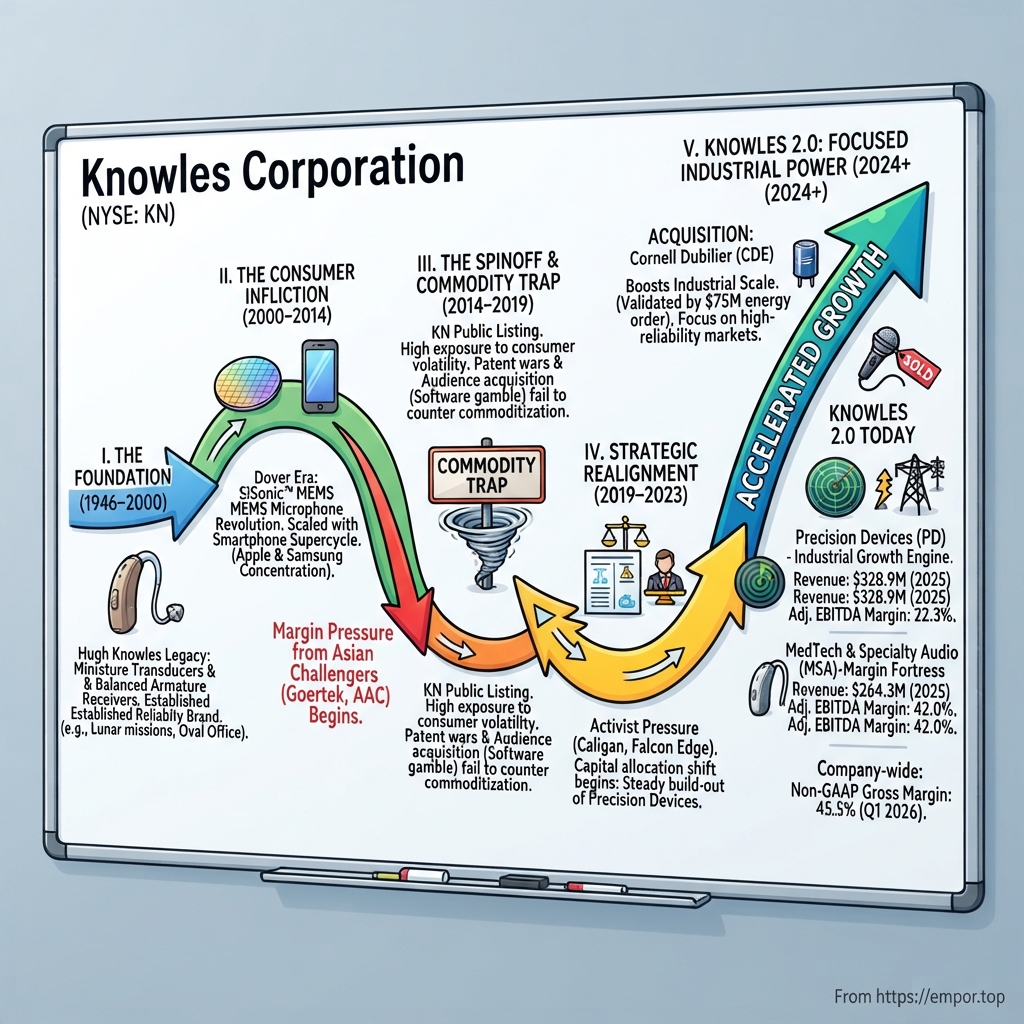
Knowles Corporation (NYSE: KN): The Acoustic Giant That Escaped the Smartphone Trap
I. Introduction & Episode Roadmap [00:00 – 12:00]
Two microphones, forty years apart
July 1969. An astronaut in a pressurized suit stepped off a ladder onto lunar dust, and six hundred million people listened as his voice crackled across a quarter of a million miles. Knowles Corporation has long anchored its founding narrative to that broadcast: according to the company's 75th-anniversary history, the words Neil Armstrong spoke on the lunar surface passed through a Knowles microphone.1 Northwestern University's Knowles Hearing Center, endowed by the founder's family, describes the heritage more broadly, noting that Knowles transducers flew on lunar missions and recorded conversations in the Oval Office.2 While no NASA documentation confirming the specific Apollo 11 component was identified for this reporting, the corporate lore remains revealing. It underscores how Knowles long defined its engineering identity: a designer of miniature acoustic parts engineered not to fail.
Fast-forward four decades to the rise of modern mobile hardware. By the early 2010s, a Knowles invention known as the SiSonic microphone—a sliver of machined silicon that converts acoustic waves into electrical signals—shipped inside hundreds of millions of handsets. In 2013, Apple accounted for roughly a quarter of Knowles' total revenue, while 삼성전자 Samsung Electronics contributed another 15%.3 Knowles had established itself as an essential, high-volume supplier to the global smartphone buildout.
Then, on December 30, 2024, Knowles announced the sale of that foundational franchise. It offloaded the consumer MEMS microphone unit to Syntiant, a venture-backed edge-AI semiconductor startup, for a headline valuation of $150 million in cash and stock.4 That same division had delivered $256.2 million in revenue during 2023.5 In effect, Knowles parted with its signature product line for roughly 0.6 times annual sales.
The big question
Why would a component manufacturer sell its signature franchise for less than one year of revenue, and what remains of the business today?
The operational rationale was straightforward: Knowles determined that smartphone microphones had turned into low-margin commodities. Economic value resided in two far less visible segments: miniature transducers and balanced armature receivers for hearing aids, alongside specialized ceramic capacitors and radio-frequency filters utilized in defense radar, medical implants, utility-grid equipment, and industrial power infrastructure.
Examining this transition reveals the commercial consequences of customer concentration, the friction between pioneering an engineering standard and capturing its long-term profit pool, and whether a leadership team that spent a decade navigating a commoditizing consumer market deserves credit for completing a structural turnaround.
The numbers today
For fiscal year 2025, Knowles reported $593.2 million in revenue from continuing operations, an increase of 7% from $553.5 million in 2024.6 Operations are structured into two operating segments:
- Precision Devices (PD), comprising high-reliability capacitors and RF filtering components, generated $328.9 million in 2025, delivering an adjusted EBITDA margin of 22.3%.7
- MedTech & Specialty Audio (MSA), covering hearing health components and specialized acoustics, generated $264.3 million, with an adjusted EBITDA margin of 42.0%.7
The financial split highlights an uneven profile. Precision Devices provides greater scale and top-line expansion, while MedTech & Specialty Audio generates nearly double the operating profitability per dollar of revenue. The market thesis for Knowles in 2026 relies on both segments performing in tandem: MSA serving as a high-margin cash generator, and PD functioning as the industrial growth engine.
Company-wide non-GAAP gross margin reached 44.5% in 2025.6 That profitability profile aligns more closely with a specialty industrial component producer than a consumer electronics packaging vendor. By the first quarter of 2026, non-GAAP gross margin expanded further to 45.5%.8
The episode arc
This analysis examines Knowles' transformation across five distinct phases:
- Hugh Knowles' post-war acoustic laboratory and the development of miniature hearing-aid transducers that established the company's core margins.
- The Dover Corporation era, during which Knowles developed the silicon MEMS microphone and scaled alongside consumer mobile hardware.
- The 2014 public spinoff, peak exposure to Apple, and the subsequent margin compression caused by competing packaging vendors
歌尔股份 Goertekand瑞声科技 AAC Technologies. - The 2019 activist campaign spearheaded by Caligan Partners and Falcon Edge Capital.
- The balance-sheet reallocation: acquiring Cornell Dubilier for $263 million, divesting consumer MEMS to Syntiant, and restructuring around specialized industrial niches.
Each foundational premise of the bull case is measured against the company's reported operating results. The inquiry begins where the company's defensible margins first originated: inside the human ear.
 Subscribe on LinkedIn
II. The Hugh Knowles Legacy & The Miniature Transducer (1946–2000) [12:00 – 30:00]
The radio operator who never went to graduate school
Hugh Sheldon Knowles was born in 1904. According to Northwestern University's biographical account, he graduated from high school at 14 and was operating merchant-marine radios at 16.2 While he later earned a physics degree, practical experimentation defined his career. Knowles accumulated more than 50 patents, served as president of the Acoustical Society of America, and was elected to the National Academy of Engineering in 1969—the year of the Apollo 11 lunar landing.9
The company traces its roots to 1946.10 Northwestern's records date the formal establishment of Knowles Electronics to 1954.2 The two milestones reflect a continuous evolution: Hugh Knowles launched his acoustics venture immediately after the Second World War, and the hearing-aid component specialist that became Knowles Electronics took institutional shape during the mid-1950s.
Miniaturization made hearing health a logical focus in the early post-war era. As vacuum tubes yielded to transistors, hearing instruments no longer required bulky external battery packs strapped to the wearer's chest. Once amplification was solved, the primary physical bottlenecks became the input and output transducers: the miniature microphone and the tiny speaker, known in audiologic engineering as the receiver.
The physics of a balanced armature, in plain English
To understand the company's foundation, consider the mechanical challenge Knowles addressed. Standard speakers—such as those in automotive doors or laptop chassis—rely on dynamic drivers, in which an electromagnetic coil attached to a cone moves back and forth within a magnetic field. That design functions effectively when physical volume is unconstrained. Shrunk to the size of a grain of rice inside an ear canal, however, the mechanism encounters severe physical constraints: tiny moving parts struggle to displace air efficiently, electrical drain rises, and acoustic fidelity deteriorates.
A balanced armature receiver operates on an entirely different mechanical principle. A miniature metal reed—the armature—is suspended between two permanent magnets so that opposing magnetic fields cancel out into equilibrium. When an electrical audio signal passes through an internal coil wrapped around the reed, it disrupts that balance, tilting the armature thousands of times per second. A drive pin transfers this vibration to a thin diaphragm. Because the reed begins in mechanical equilibrium, it requires minimal electrical current to oscillate, and the complete assembly can be enclosed inside a protective metallic housing measuring only a few millimeters long.
The operational dynamic resembles a seesaw with two evenly balanced children: a modest touch produces instant motion, whereas starting a conventional dynamic driver resembles pushing a swing from a dead stop.
For hearing instruments, the implications were transformative: a sealed, durable transducer capable of running continuously on a miniature battery cell. The primary barrier was precision manufacturing. Winding microscopic coils, centering an armature between magnets within single-digit micron tolerances, and sustaining identical acoustic response across mass production cannot be learned from a manual. It requires accumulated factory-floor expertise—a form of proprietary process power that remains Knowles' most durable competitive asset.
The reliability brand
The lunar broadcast narrative, regardless of specific part numbers, illustrates a consistent commercial posture. Knowles established its reputation in high-consequence environments where component failure carried severe costs: inside an ear canal, aboard an aerospace vehicle, or in courtroom recording systems. That operating focus—delivering precision hardware for mission-critical uses—defined the core franchise to which the company ultimately returned decades later.
Myth vs. reality: the "unassailable acoustic moat"
Historical engineering leadership did not mean Knowles enjoyed an unlimited moat across all miniature acoustics. The company's subsequent operating record demonstrated clear commercial boundaries.
Balanced armature transducers gained adoption in high-end in-ear stage monitors and audiophile earphones. Yet the mass-market wireless earbud sector that expanded rapidly in the 2010s relied predominantly on low-cost dynamic drivers. Consumer hardware brands prioritized unit cost and acceptable audio performance over clinical fidelity. Knowles' own portfolio actions highlighted that structural ceiling: in February 2016, the company announced the sale of its consumer-facing speaker and receiver business, an operation that held $328.6 million in goodwill on its balance sheet.11
The strategic takeaway was straightforward: the technological advantage did not translate into an automatic economic moat across high-volume consumer goods. Knowles' manufacturing defensibility held up when serving regulated medical device makers and professional audio clients willing to pay for exacting tolerances and zero-failure reliability. It eroded when consumer device manufacturers could substitute cheaper, adequate components. That tension between technical superiority and commercial pricing power recurred throughout Knowles' history—and reached its apex with the company's next signature breakthrough under a new corporate parent.
III. The Dover Conglomerate Years & The SiSonic Revolution (2000–2013) [30:00 – 52:00]
A conglomerate goes shopping
On August 21, 2005, Dover Corporation, a multi-industrial conglomerate whose portfolio spanned commercial refrigeration to industrial fuel pumps, agreed to acquire Knowles Electronics for approximately $750 million in cash.12 For Dover, Knowles represented a textbook conglomerate purchase: a niche market leader boasting robust operating margins and specialized engineering capabilities, folded into a diversified industrial holding structure.
Dover's component acquisitions extended well beyond Knowles Electronics. Over subsequent years, Dover built a broader communication technologies platform by purchasing a sequence of specialized component vendors, including Vectron, Novacap, Syfer, Dielectric Laboratories, Voltronics, and Sound Solutions.3 Several of these businesses—specifically Novacap, Syfer, Dielectric Laboratories, and Voltronics—manufactured high-performance ceramic capacitors and microwave components. When Knowles was later spun out as an independent public company, it inherited those assets. The Precision Devices segment that stands as Knowles' largest operating business in 2026 was not an ad hoc post-2020 invention; its operational foundation was assembled during the Dover conglomerate era.
That corporate lineage provides an important corrective to the popular assumption that Knowles engineered a sudden pivot into industrial electronics. Knowles possessed an industrial technology portfolio throughout this period, though its steady cash generation was overshadowed for a decade by the explosive rise of mobile devices.
The engineer who would run the show
The executive who would guide Knowles through this expansion joined the organization in 2000. Jeffrey S. Niew built his early career in components, working in Hewlett-Packard's optoelectronics division from 1988 to 1994 and at circuit-protection manufacturer Littelfuse from 1995 to 2000.13 At Knowles Electronics, he advanced to chief operating officer in 2007, president in 2008, and chief executive in 2010, subsequently serving as a Dover vice president and CEO of Dover Communication Technologies from 2011 to 2014.13
Niew's operational background centered entirely on engineered micro-components marketed to major original equipment manufacturers. That experience carried distinct trade-offs: it fostered deep fluency in cleanroom fabrication, yield management, and OEM qualification cycles, but it also reflected an entire career spent on the supplier side of commercial negotiations—a background that helps explain why Knowles accommodated heavy customer concentration for as long as it did.
SiSonic: putting a microphone on a chip
Before the commercialization of SiSonic, mobile handsets relied predominantly on electret condenser microphones (ECMs). An ECM operates much like a miniature drum: a charged polymer membrane is stretched over a conductive backplate, translating sound waves into subtle shifts in electrical capacitance. While ECMs were inexpensive and acoustically adequate, they suffered from a severe manufacturing bottleneck: the polymer membrane could not withstand the elevated temperatures of automated surface-mount assembly.
Modern high-volume printed circuit boards are assembled using reflow soldering, an automated process where populated circuit boards pass through industrial thermal ovens to melt solder paste and bond components in place. Because an ECM's plastic membrane warped and degraded in reflow heat, handset manufacturers had to install microphones manually or route them through secondary assembly stations, creating additional labor overhead and persistent quality defects.
A micro-electro-mechanical systems (MEMS) microphone bypassed this physical constraint by etching the transducer diaphragm directly out of silicon through semiconductor photolithography. Because its internal membrane was silicon rather than polymer, the component could pass through reflow ovens alongside standard application processors and memory chips without structural damage. For handset manufacturers scaling global production, an acoustic transducer that handled like any standard surface-mount chip eliminated an expensive assembly-line chokepoint.
Knowles delivered its first commercial SiSonic MEMS microphone in 2003. By September 2009, cumulative volume crossed the one-billion-unit threshold, establishing Knowles as the undisputed global volume leader in silicon acoustic hardware.14
The smartphone supercycle
The arrival of the iPhone and the broader Android ecosystem accelerated that demand curve into an industrial supercycle. Handset architectures shifted rapidly from incorporating a single voice microphone to integrating multi-transducer arrays: dedicated inputs for voice capture, secondary microphones to sample and cancel ambient noise, and additional units for video recording and voice-assistant recognition. Every incremental acoustic port on a mobile bill of materials translated into another volume shipment for Knowles.
Between 2010 and 2011, industry research firm Yole Développement estimated that Knowles controlled more than 80% of the worldwide MEMS microphone market.15 Even as rival packaging suppliers entered the sector, research firm IHS estimated that Knowles still captured 59% of global packaged MEMS microphone revenue in 2013, up from 55% the prior year.16
This period marked the apex of Knowles' consumer electronics volume. By 2013, Apple represented 25% of Knowles' total revenue and Samsung contributed 15%, with the company's ten largest customers collectively accounting for 65% of sales.3 Mobile consumer electronics generated 64% of total company revenue that year.17
What the golden era concealed
Generating two-fifths of corporate revenue from two consumer device manufacturers turned an apparent technology franchise into a structural dependency. When a primary customer is Apple—a procurement organization known for aggressively qualifying dual and triple supply sources to exert pricing leverage—a supplier's market share is only as durable as the buyer's willingness to keep ordering at prevailing vendor margins.
Industry observers have argued that Dover underinvested in proprietary intellectual property and allowed operating costs to expand during these peak volume years. While that critique remains unverified by corporate filings and should be treated as market opinion rather than established fact, the underlying structural risk was documented in the company's operating figures: Knowles relied heavily on a single high-growth product family, sold into a concentrated buyer base, and anchored to a packaging innovation that rival vendors could replicate once merchant MEMS dies became accessible. Dover elected to spin Knowles off near the cyclical peak of that mobile hardware expansion, leaving the newly independent public company to absorb the commercial adjustments that followed.
IV. The Spinoff & The Commodity Trap: The Rise of Chinese Challengers (2014–2018) [52:00 – 1:20:00]
Opening bell
On March 3, 2014, Knowles Corporation began trading on the New York Stock Exchange under the ticker KN. The separation from Dover Corporation had been completed on February 28, with Dover shareholders receiving one Knowles share for every two Dover shares held, distributing roughly 85 million shares.10 Jeffrey Niew, who had led Dover Communication Technologies, assumed the chief executive role.10
The newly independent public entity operated as a corporate hybrid: anchored by a high-margin hearing-health franchise and a legacy ceramic capacitor portfolio, but dominated by high-volume smartphone acoustic parts. In 2014, mobile consumer electronics accounted for 60% of Knowles' $1,141.3 million in total revenue, with Apple and Samsung together contributing 32% of total sales.17 Wall Street valued the company according to its primary top-line driver: a smartphone component supplier exposed to the cycles of consumer hardware.
The anatomy of a commodity trap
Knowles soon encountered the classic mechanics of a consumer electronics commodity trap, defined by three structural forces:
First, the buyer controls the specification. Major smartphone manufacturers set component dimensions, acoustic performance standards, and signal-to-noise ratios. Once those operating thresholds were established, any vendor capable of manufacturing to the specification became commercially interchangeable.
Second, the buyer controls the volume allocation. Handset manufacturers routinely divided component orders across multiple vendors—such as 60/40 or 50/50 allocations—using the prospect of reallocation to extract annual price reductions. Knowles' public disclosures illustrated the resulting revenue volatility: exposure to Apple shifted from 25% of total sales in 2013 to 20% in 2014, rebounded to 25% in 2015, and dropped to 17% in 2016.3171118 Those swings highlighted an original equipment manufacturer actively disciplining its supplier base.
Third, the core technology is no longer proprietary. As merchant silicon manufacturing matured, the proprietary advantage that had protected Knowles' early lead deteriorated.
Enter the packagers
A MEMS microphone consists of two primary elements: the silicon acoustic die that detects sound pressure waves, and the protective package—comprising the housing, application-specific integrated circuit (ASIC), and acoustic port—that allows the component to be surface-mounted onto a circuit board. Knowles maintained an integrated manufacturing model, fabricating both the silicon die and the finished package. Its emerging competitors did not need to replicate that vertical footprint.
German chipmaker Infineon Technologies supplied merchant MEMS microphone dies to Chinese packaging specialists including AAC, Goertek, and Gettop, according to 2014 industry analysis from IHS.16 By 2015, IHS estimated that Knowles manufactured 43% of global MEMS microphone dies—entirely for internal consumption—while Infineon captured 31% of die production by supplying Goertek, AAC, and BSE, with オムロン Omron producing another 13%.19
The structural consequences were significant. Packaging houses in Shandong or Shenzhen could purchase high-grade silicon dies from a merchant European semiconductor fab, assemble them inside standard housings, and supply qualified microphones to major handset makers without having spent a decade engineering silicon MEMS transducers. Infineon's manufacturing scale in merchant dies effectively neutralized Knowles' vertical integration, making the underlying sensor technology accessible to third-party packaging assemblers.
Goertek, based in Weifang, emerged as an especially formidable competitor due to its integration across Apple's supply chain. IHS estimated that approximately 70% of Goertek's business was tied to Apple.19 Goertek could offer handset brands bundled acoustic sub-assemblies and surface-mount manufacturing services at a volume Knowles was not structured to match.
Market-share data tracked the resulting shift. Knowles retained the global volume lead in 2015, generating more than double the shipment units and revenue of its nearest competitor.19 By 2021, however, research firm Yole Développement reported that Goertek's microphone subsidiary commanded 30% of global revenue compared to Knowles' 27%.20 The company that had established the commercial MEMS microphone sector had become one of two roughly equal suppliers in an increasingly price-competitive market.
The patent war
Knowles sought to defend its market share through intellectual property litigation. On June 21, 2013, the company filed a complaint with the U.S. International Trade Commission alleging that Goertek infringed three patents governing silicon microphone packaging: U.S. Patents 7,439,616, 8,018,049, and 8,121,331.21 The case was designated Investigation No. 337-TA-888, "Certain Silicon Microphone Packages and Products Containing Same."22
The ITC represented an impactful legal venue because it possesses the authority to issue exclusion orders prohibiting the importation of infringing articles into the United States, including finished handsets incorporating covered components. In August 2014, Administrative Law Judge E. James Gildea issued an initial determination finding that Goertek infringed all three asserted patents, confirmed their validity, and recommended a limited exclusion order.21
Despite that favorable initial finding, the litigation did not culminate in an import ban. On February 13, 2015, prior to a final determination by the full Commission, Knowles and Goertek announced a comprehensive global settlement. While specific financial terms remained confidential, the agreement included a worldwide cross-license covering both companies' MEMS microphone patent portfolios and established a framework for a commercial relationship, leading both parties to terminate the ITC investigation.17
Myth vs. reality: the patent and first-mover moat
The initial investment thesis following the 2014 spinoff held that Knowles' early engineering lead and patent portfolio would provide a legal barrier to protect operating margins against fast followers.
Subsequent commercial developments challenged that premise. Knowles secured an initial determination before the ITC yet concluded the dispute with a cross-license. The conflict had escalated across multiple venues, including the ITC, a federal district court in Illinois, the U.S. Patent and Trademark Office, and Chinese administrative courts and patent authorities.17 A cross-licensing pact with an aggressive challenger did not preserve an economic moat; it established a commercial truce that formalized the challenger's presence in the market. Goertek's subsequent climb to market-share parity underscored the operational limits of patent defense in high-volume consumer hardware.
The broader strategic lesson concerns commercial leverage. Patents protect specific technical implementations, but they cannot insulate a supplier when primary customers actively cultivate secondary and tertiary sources. When an original equipment manufacturer seeks alternative vendors to diversify risk and reduce component costs, legal enforcement functions as a temporary delaying tactic rather than a permanent barrier to competition.
The Audience gamble
With acoustic hardware margins coming under pressure, Knowles attempted to move higher up the value chain into software and digital signal processing. On April 30, 2015, Knowles agreed to acquire Audience Inc., a developer of voice-processing chips and audio software, for approximately $5.00 per share in cash and stock, representing an enterprise value of roughly $85 million net of Audience's cash reserves.23 The transaction was projected to generate approximately $25 million in annual cost synergies.23 The acquisition closed on July 1, 2015,24 with Knowles' filings recording a total purchase price of approximately $93.0 million, comprising $61.6 million in cash and 3.2 million Knowles common shares.25
The strategic rationale appeared coherent: combine Knowles' hardware microphones with Audience's noise-suppression algorithms to market integrated audio processing systems, expanding dollar content per handset.
Market dynamics, however, worked against standalone audio processing. Demand for discrete voice-processor chips had weakened as primary silicon architectures consolidated. Smartphone manufacturers and mobile chipset vendors—most notably Apple and Qualcomm—increasingly integrated noise cancellation and voice processing directly into their primary application processors. A standalone audio semiconductor struggled to compete against functionality bundled into the primary system-on-chip that handset makers were already purchasing. The Audience acquisition did not alter Knowles' long-term consumer trajectory: consumer microphones continued to face margin compression, culminating nearly a decade later in the sale of the entire consumer MEMS microphone unit.
For investors, the Audience transaction illustrated the difficulty of escaping a commodity trap by purchasing peripheral software capabilities while selling into the same concentrated customer base. The acquisition encountered the same architectural barrier as the patent litigation: handset manufacturers controlled the component ecosystem. When management later emphasized disciplined capital allocation, the Audience acquisition served as a cautionary benchmark in component M&A. Yet elsewhere on Knowles' balance sheet, a different set of niche industrial assets operated under entirely different commercial dynamics.
V. The Hearing Health Fortress: MedTech & Specialty Audio [1:20:00 – 1:42:00]
Inside an audiologist's office
Picture a hearing clinic in suburban Minneapolis or Zurich. A 74-year-old retired teacher sits in a soundproof booth, pressing a button each time she hears a faint tone. The audiologist maps her hearing loss frequency by frequency, then fits an instrument no larger than a coffee bean behind her ear, running a thin wire to a receiver that rests inside her ear canal. She will wear it sixteen hours a day, every day for five years, and she will return to the clinic the moment it crackles.
Inside that receiver sits a Knowles balanced armature. The patient has never heard of Knowles, and the audiologist rarely interacts with component vendors. But the engineering team at the hearing-aid manufacturer knows precisely who manufactured it, and qualifying an alternative component introduces substantial redesign costs and regulatory friction.
That operational reality anchors the MedTech & Specialty Audio (MSA) segment—the division within Knowles that most resembles a traditional economic franchise.
Segment mechanics
MSA generated $253.5 million of revenue in 2024 and $264.3 million in 2025, delivering segment adjusted EBITDA margins of 43.6% and 42.0% respectively.7 For an electronic component manufacturer, that represents exceptional profitability: roughly 42 cents of every revenue dollar converts into operating cash earnings at the segment level prior to corporate overhead.
Two caveats accompany those returns. First, adjusted EBITDA margin compressed by 160 basis points between 2024 and 2025. Second, top-line expansion remains modest. MSA grew approximately 4% in 2025, and in the second quarter of 2026 revenue increased just 2% year-over-year to $68.5 million.26 Management has calibrated expectations accordingly: at its May 2025 Investor Day, Knowles targeted long-term organic growth of only 2% to 4% annually for MSA.27 While aggressive bull cases occasionally project high-single-digit expansion, the company's official targets reflect a mature market.
MSA functions as a cash generator rather than a growth driver. Its role in the broader corporate structure is to harvest steady cash flows to service corporate obligations and fund capital allocation across the wider business.
The industry structure
The global hearing instrument sector is dominated by five original equipment manufacturers: Sonova (Phonak, Unitron), WS Audiology (Widex, Signia), Demant (Oticon), GN Store Nord (ReSound), and Starkey.28 Industry research valued this market at $6.66 billion in 2023, projecting expansion to approximately $8.55 billion by 2029—a compound annual growth rate of roughly 4.25%.28 That modest pace aligns directly with Knowles' 2% to 4% organic target for MSA.
The upstream supply chain for critical acoustic components is even more concentrated. Danish manufacturer Sonion is described by its financial advisers as "one of the world's two developers and manufacturers" of advanced balanced-armature receivers and high-end hearing-aid microphones.29 The other producer is Knowles. While precise market shares remain undisclosed, the two companies form a duopoly supplying the global hearing-aid industry.
Correcting a popular story: Sonion is not captive
A persistent narrative in the Knowles investment case suggests that Sonion is owned by William Demant Invest, the controlling holding company behind Demant, which would theoretically lead competing hearing-aid makers to favor Knowles as a neutral, non-captive supplier.
Corporate records contradict that claim. According to Sonion's disclosures, the company has been owned by Novo Holdings A/S since September 2014.30 Novo Holdings, the investment vehicle of the Novo Nordisk Foundation, acquired Sonion from private equity firm Altor Fund III; at the time of the transaction, Sonion employed more than 3,200 people, generated approximately $154 million in 2013 revenue, and operated production facilities in Vietnam and the Philippines.2930
This distinction reshapes the competitive dynamic. Knowles does not enjoy a structural advantage as the sole neutral supplier counterbalancing a captive rival. Instead, it operates as one of two independent producers competing head-to-head against a well-capitalized peer backed by one of Europe's largest institutional endowments. The market represents an attractive duopoly governed by high switching costs, but it remains an active contest between two independent specialists.
Switching costs, the real moat
The source of MSA's sustained profitability lies in the friction of redesigning medical hearing hardware.
A miniature receiver cannot be swapped out like an interchangeable commodity. The component is acoustically paired to the hearing instrument's molded shell, sound tubing, acoustic venting, and proprietary digital signal processing algorithms. Modifying the receiver forces the device manufacturer to recalibrate the complete acoustic architecture and re-verify performance. Because hearing aids are regulated medical devices, component substitutions also trigger formal regulatory re-filings and quality audit documentation. An OEM that has validated a Knowles balanced armature across a multi-year product lifecycle faces little incentive to disrupt a proven platform to achieve marginal component savings.
While market commentary often cites 18 to 24 months as the standard recertification and re-engineering window for component redesigns, that timeline functions as an operating rule of thumb rather than a codified regulatory deadline. The underlying commercial reality, however, remains clear: the integration friction creates substantial switching costs, locking in supplier relationships across device lifecycles.
The concentration twist
Despite the defensible structure of the medical market, customer concentration persists. In 2025, WS Audiology accounted for 11% of Knowles' total revenue, down from 14% in 2024.31 Another 10% of consolidated revenue came from TTI, Inc., an electronic components distributor serving Precision Devices.31 Contrary to occasional investor assumptions that Knowles eliminated double-digit customer exposures following its consumer divestiture, its SEC filings indicate that single-entity concentrations remain.
Relying on a medical device OEM for 11% of sales carries different risk characteristics than past smartphone exposures. WS Audiology cannot readily swap out balanced armatures for merchant-packaged alternatives from a third-party packaging house. Nevertheless, a three-percentage-point decrease in revenue share over a twelve-month period highlights lingering volatility: it may reflect device refresh timing, customer inventory rebalancing, or incremental share gains by Sonion. Knowles does not break out individual client order patterns.
Myth vs. reality: the OTC hearing-aid boom
In August 2022, the US Food and Drug Administration finalized a rule creating a new category of over-the-counter hearing aids for adults with perceived mild to moderate hearing loss, allowing sales without a medical exam, prescription or audiologist fitting.32 The rule took effect on October 17, 2022.33
The initial bull thesis was intuitive: cheaper devices sold at retail pharmacies and online storefronts would bring millions of new consumers into the market, and every unit would require miniature receivers and microphones.
The reported evidence does not support an OTC boom. MSA's revenue growth of approximately 4% in 2025 and 2% in the second quarter of 2026 shows no OTC-driven inflection, and management's own 2% to 4% long-term target does not model one.72627
The more durable demand driver is demographic. The World Health Organization projects that nearly 2.5 billion people will experience some degree of hearing loss by 2050, and more than 700 million will require hearing rehabilitation.34 That demographic shift provides reliable, slow-moving demand—the foundation for a steady annuity rather than an accelerating growth narrative.
The OTC thesis remains unproven as a meaningful volume catalyst for Knowles. MedTech & Specialty Audio endures as an entrenched, highly profitable, slow-growth medical franchise. That cash engine provides essential stability, but for top-line expansion, Knowles' forward trajectory depends on the other half of its portfolio: the specialty capacitors and microwave components Dover had quietly assembled two decades earlier.
VI. Precision Devices & The M&A Engineering Shift (2017–2023) [1:42:00 – 2:08:00]
A capacitor on a warship
Consider a naval destroyer's radar sweeping the horizon. Each pulse of radio energy requires a sudden, massive burst of power, drawn from banks of capacitors that store electrical charge and discharge it in a microsecond. If a component fails in a corrosive marine environment, the radar's performance degrades. The capacitor engineered for that mission bears little resemblance to the tiny multilayer ceramic capacitors scattered by the hundreds across a smartphone circuit board. It is built to withstand high voltages, extreme temperatures, mechanical shock, and decades of operational service. It is qualified by defense contractors part by part, and once certified, it typically remains embedded in the design for the life of the platform.
That is the domain of Precision Devices.
What a capacitor does, for non-engineers
At its simplest, a capacitor is an electrostatic reservoir for electrical charge. Where a chemical battery stores energy and releases it gradually, a capacitor stores charge in an electric field and can discharge it almost instantaneously, smooth out electrical ripples in a power supply, or filter out unwanted frequencies from a radio signal. Every electronic circuit requires them.
The commodity end of the global capacitor market—producing the billions of tiny ceramic chips soldered into smartphones and laptops—is dominated by Asian giants such as 村田製作所 Murata Manufacturing and 삼성전기 Samsung Electro-Mechanics. Knowles does not compete in that high-volume, price-sensitive arena. Instead, it operates at the specialty end: engineering components that endure extreme voltages and operating temperatures, support implantable medical devices, or operate inside defense radar systems. These are lower-volume, higher-margin products where buyers prioritize zero-failure reliability over unit-cost discounts.
The quiet build-out
Following its 2014 spinoff, Knowles steadily expanded this segment through bolt-on acquisitions. In January 2017, the company purchased a capacitor manufacturer for $3.7 million; in January 2018, it acquired Compex for a net $18.7 million; and in January 2019, it bought DITF Interconnect for $11.1 million.35 In May 2021, Knowles executed a larger transaction, acquiring Integrated Microwave Corporation—a designer and manufacturer of RF filters for defense and communications applications—for $80.8 million in cash.36
Individually, none of these transactions transformed the company's financial profile. Taken together, however, they demonstrated where management was allocating capital while public attention remained focused on the volatility of the consumer microphone business.
Cornell Dubilier: buying a century of capacitors
Then came a transformative step. On September 18, 2023, Knowles announced an agreement to acquire Cornell Dubilier Electronics (CDE), a Liberty, South Carolina-based manufacturer of film, electrolytic, and mica capacitors, for $263 million.37 In the same press release, Knowles announced it was initiating a strategic review of its consumer MEMS microphone business, retaining Jefferies as financial adviser.37 The pairing of those announcements formed a clear strategic statement: the company was acquiring industrial scale while preparing to exit consumer mobile hardware.
CDE brought a century of manufacturing heritage. According to company records, William Dubilier first utilized mica to construct a capacitor in 1909, and his enterprise merged with Cornell Radio in 1933 to form Cornell Dubilier.38 At the time of the transaction, the business generated more than $135 million in annualized revenue and served a diversified industrial base of more than 35,000 customers.37
The acquisition closed on November 1, 2023.39
How the deal was paid for
The transaction's funding structure offered notable financial flexibility. Knowles paid $140 million in cash at closing and financed the remaining $123 million through an interest-free seller note, structured with $50 million due after one year and $73 million due after two.37 The cash portion was funded through cash on hand and borrowings under the company's revolving credit facility, leaving pro forma net leverage at approximately 1.4 times EBITDA.37
Rather than drawing the full purchase price from its credit line, Knowles secured seller financing, effectively borrowing nearly half the consideration at zero interest for up to two years. Knowles repaid the initial $50 million installment on November 1, 2024, with the remaining $68.5 million balance due in November 2025.40
The multiple, and its caveat
Knowles stated that the purchase price represented 9.6 times CDE's trailing twelve-month adjusted EBITDA, including run-rate cost synergies.37
That qualifying phrase warrants scrutiny. Presenting an acquisition multiple "including synergies" incorporates cost savings that management expects to realize in the future, rather than profits the standalone business had already generated. Unadjusted for those projected synergies, the effective purchase multiple was higher, though Knowles did not disclose a standalone multiple in its transaction announcement. While presenting multiples inclusive of anticipated synergies is standard corporate practice, it flatters the headline valuation metric.
Valuation multiples in the specialty passive-component sector provide relevant context. In 2020, Japanese industrial manufacturer 京セラ Kyocera paid approximately $1.03 billion to acquire the roughly 28% minority stake in AVX Corporation it did not already own, at $21.75 per share.41 While verified transaction EBITDA multiples for that transaction were not publicly detailed for direct comparison, the deal illustrated that strategic buyers have historically paid substantial premiums for control of specialty capacitor franchises. That peer context provides directional support for the view that Knowles secured a reasonable valuation for CDE, even if post-acquisition execution remained the ultimate test.
Myth vs. reality: execution and integration
The investment thesis for CDE assumed that Knowles was acquiring a stable, highly diversified, and defensible industrial franchise. Operational execution provided an immediate test.
During the fourth-quarter 2024 earnings call in February 2025, management disclosed a shipment shortfall of more than $3 million in the quarter, attributing the delay to operational friction from consolidating specialty film capacitor manufacturing plants, and noted that the catch-up would extend through the second quarter of 2025.42 Internal restructuring had temporarily disrupted customer deliveries.
On that same call, however, management highlighted a commercial win: a new order exceeding $75 million, accompanied by a significant customer prepayment, from a new client in the energy sector, with at least $25 million expected to ship in 2026.42 That contract represents a key commercial validation for the CDE acquisition, suggesting that the specialty film platform can secure major design wins in expanding industrial markets like electric grid infrastructure and energy storage.
Evaluating these initial milestones requires balancing operational risk against commercial potential. The delivery shortfall was modest in dollar terms and tied to a discrete facility integration with a defined recovery timeline. Conversely, the $75 million energy order demonstrates substantial demand, but remains backlog rather than realized revenue until products ship and pass qualification. Subsequent operational results pointed toward steady absorption: Precision Devices revenue increased from $300.0 million in 2024 to $328.9 million in 2025, while segment adjusted EBITDA margin expanded from 20.2% to 22.3%.7 Momentum continued into 2026, with second-quarter Precision Devices revenue rising 25% year-over-year to $98.3 million.26
The CDE transaction has demonstrated tangible top-line expansion, but it also ties segment performance to large, episodic industrial programs and customer qualification schedules that Knowles does not fully control. The pace of deliveries on that flagship energy order across 2026 serves as a key indicator of whether CDE can sustain its growth trajectory. Yet even as Knowles integrated its industrial acquisitions, completing the structural transformation required addressing the legacy operation that had anchored the company for twenty years.
VII. The Final Break: Divesting Consumer MEMS & Knowles 2.0 (2024–2026) [2:08:00 – 2:28:00]
Twelve months of limbo
When a company publicly announces a "strategic review" of a core operating unit, the clock starts ticking. Key personnel begin updating their credentials, major customers evaluate backup suppliers, and competitors quietly signal to procurement officers that the division's future is uncertain. Every month without an executed agreement risks eroding the asset's commercial value.
Knowles navigated that limbo for a full year. The strategic review began alongside the CDE acquisition announcement in September 2023.37 It was not until September 19, 2024, that Knowles announced a definitive agreement to sell its consumer MEMS microphone business to Syntiant Corp.5
The deal
The headline consideration was $150 million, structured as $70 million in cash and $80 million in Syntiant Series D-2 preferred stock.5 Syntiant, founded in 2017 and based in Irvine, California, manufactures ultra-low-power neural decision processors—semiconductors engineered to run edge-AI models, such as voice wake-word detection, directly on hardware rather than in the cloud.43 Prior to the transaction, the startup had raised over $100 million in venture capital, including a $55 million funding round in 2022 backed by Renesas and other strategic investors.43
The industrial logic for Syntiant was clear: integrate always-on neural inference silicon directly with the acoustic microphones that supply the sound. For Knowles, the imperative was simpler: complete its structural exit from consumer mobile hardware.
Knowles announced the completion of the sale on December 30, 2024.44 Its regulatory filings subsequently recorded December 27, 2024, as the formal closing date.40
What Knowles actually got
The headline announcement and the underlying accounting figures told distinctly different stories.
The $70 million in cash consideration was subject to customary working-capital adjustments. Knowles' SEC filings recorded $63.6 million in cash consideration received, translating to $58.0 million net of cash transferred with the business.40 The $80 million of preferred stock was recorded at an initial fair value of $77.2 million.40 Factoring in estimated post-closing adjustments, total consideration was recorded on the balance sheet at approximately $141.9 million.45
The transaction also included ongoing financial commitments. Knowles agreed to provide Syntiant with a transition and separation-cost credit of up to $13.5 million, of which $3.1 million remained outstanding at June 30, 2026, and was paid in July 2026.45 In addition, Knowles extended $6.4 million in debt financing to Syntiant maturing in March 2029, carrying an 8% interest rate starting in May 2026.45
Taken together, the realized net cash proceeds from divesting a division that generated $256 million in 2023 revenue totaled roughly $60 million at closing—prior to absorbing the separation credit and the seller loan. The remainder of the transaction value was locked in an illiquid equity position in a privately held startup.
Skeptical audit: the Syntiant paper
How should investors evaluate that $80 million preferred equity stake?
Preferred stock in a venture-backed enterprise typically carries liquidation preferences over common shares, providing some downside cushion. However, it remains subordinated to senior debt, lacks a liquid public trading market, and depends entirely on Syntiant achieving commercial traction in an edge-AI processor market where well-capitalized semiconductor incumbents are developing competing always-on audio architectures.
Knowles accounts for the investment under the measurement alternative at cost, adjusted for observable transactions or impairments. The carrying value stood at $77.2 million as of September 30, 2025.46 During the fourth quarter of 2025, Syntiant issued a $6.2 million dividend in the form of additional Series D-2 preferred shares, expanding Knowles' carrying value to $83.4 million at December 31, 2025—where it remained through June 30, 2026.645 Knowles recorded no impairment charges against the asset through the second quarter of 2026.45
A payment-in-kind dividend settled in additional shares rather than cash is common in venture capital structures, but its financial reality is clear: the balance-sheet carrying value expanded on paper, not in distributable cash. For governance-focused investors, another disclosure in the 2025 proxy statement stands out: Jeffrey Niew holds a seat on Syntiant's board of directors.13 While board representation allows Knowles to monitor its investment, it also places the chief executive in the position of evaluating the valuation and financial health of an enterprise whose governance he directly influences. The absence of an accounting impairment to date does not confirm that the carrying value reflects realizable market value; it merely indicates that no triggering event has mandated a write-down under public reporting standards.
The broader takeaway is that the $150 million headline valuation substantially overstated the immediate economic value Knowles secured. In practical terms, Knowles divested a mature, price-pressured business with extreme customer concentration in exchange for approximately $60 million in net cash and a venture-backed call option on an edge-AI startup. Whether a superior alternative existed cannot be determined from external filings. What the transaction unequivocally achieved was the elimination of customer exposure: Apple had accounted for 16% of Knowles' consolidated revenue in 2023 before the consumer unit was reclassified into discontinued operations.39
Knowles 2.0 in the numbers
With the consumer microphone unit removed, the financial profile of the continuing enterprise shifted markedly.
Consolidated revenue rose 21% in 2024 to $553.5 million, primarily reflecting a full twelve-month contribution from Cornell Dubilier, and advanced a further 7% in 2025 to $593.2 million.476 Non-GAAP gross margin held steady at 44.3% in 2024 and expanded to 44.5% in 2025.476 Trailing adjusted EBITDA reached $140.2 million in 2025.7
Top-line momentum strengthened through the first half of 2026. First-quarter revenue grew 16% year-over-year to $153.1 million.8 Second-quarter revenue rose 14% to $166.8 million, propelled by double-digit expansion in Precision Devices.48 For the full year 2026, management guided to consolidated revenue growth of 10% to 12% and adjusted EBITDA growth exceeding 20%, supported by third-quarter revenue guidance between $167 million and $177 million.48
Cash generation, however, presented a more complex picture. Knowles reported adjusted free cash flow of $93.8 million in 2024, supported by $130.1 million in operating cash flow and capital expenditures of $13.6 million.47 For 2025, the company reported adjusted free cash flow of $114.4 million; yet GAAP operating cash flow contracted to $114.0 million while capital expenditures more than doubled to $32.1 million.6 Because reported adjusted free cash flow surpassed operating cash flow minus capital expenditures, investors must examine management's non-GAAP adjustments closely rather than treating the adjusted metric as pure cash conversion. The cadence remained uneven into early 2026, with first-quarter operating cash flow registering slightly negative at minus $0.7 million.8
The investment thesis initially posited that shedding consumer MEMS fabrication would immediately push free cash flow conversion past 80%. Disclosed performance through 2025 and early 2026 demonstrated that capital requirements have not vanished: capital expenditures escalated in 2025 as Knowles funded capacity expansion within Precision Devices to support industrial contract wins. While reallocating capital into higher-margin industrial passive components aligns with management's strategic priorities, it challenges assumptions that Knowles 2.0 operates as an asset-light compounder.
In sum, Knowles 2.0 has delivered accelerated top-line growth and resilient gross margins in the mid-40% range—the core operational requirements of the portfolio pivot. Cash conversion remains more volatile and warrants continued scrutiny. Whether this portfolio overhaul represents proactive strategic foresight or an overdue exit from a commoditized market ultimately depends on how one evaluates the leadership team that steered Knowles through both eras.
VIII. Management, Activism & Capital Allocation Audit [2:28:00 – 2:48:00]
The 13D arrives
On March 11, 2019, a Schedule 13D filing appeared on the SEC's EDGAR system. Caligan Partners, led by David Johnson and Samuel Merksamer, alongside Falcon Edge Capital, led by Richard Gerson, disclosed a combined 6.7% stake in Knowles and announced their intention to nominate directors to the board.49 Regulatory filings indicated the investor group had formed on January 8, 2019.49
Activist campaigns of this type generally advance a familiar agenda: divest underperforming assets, return capital to shareholders, and halt acquisitions that fail to earn their cost of capital. The activist group formally nominated Merksamer and Jonathan Christodoro for board seats.50
The settlement
The proxy contest never reached a shareholder vote. On May 9, 2019, Knowles announced a cooperation agreement with Caligan, Falcon Edge, and Patriot Global Management. Under the settlement, Steven F. Mayer joined the board immediately, expanding it to ten members, while the parties agreed to select an additional mutually acceptable independent director the following year.51 The agreement also phased out the staggered board, ensuring that beginning in 2021, all directors would stand for election annually.51 In exchange, the activist funds withdrew their slate and entered into customary standstill provisions.51 In May 2020, Knowles appointed Michael S. Wishart to its board.52 Company announcements did not state whether Wishart was the specific independent director contemplated under the settlement terms.
Did the activists change the strategy?
It is tempting to draw a direct causal line from the 2019 activist campaign to the portfolio restructuring executed in 2023 and 2024. The operational chronology, however, demonstrates correlation rather than causation. Bolt-on acquisitions in Precision Devices had already begun well before the activists filed their 13D, with transactions completed in 2017, 2018, and January 2019.35 Furthermore, the decisive structural moves—acquiring Cornell Dubilier and divesting consumer MEMS—materialized four to five years after the settlement.
What the campaign indisputably achieved was structural governance reform: declassifying the board and instituting annual director elections provided shareholders with stronger mechanisms of corporate accountability. Whether the pressure accelerated management's strategic pivot or merely reinforced a capital reallocation process already underway cannot be conclusively determined from the public record.
The CEO
Jeffrey Niew has run Knowles since before the spinoff and remained president and CEO as of the first-quarter 2026 earnings release.8 He also joined the board of Commercial Vehicle Group as an independent director in December 2024.53
In February 2025, the board granted Niew a special award of 81,788 performance share units with a target value of $1.5 million, tied to performance over 2025–2027.54 Special awards granted outside the standard annual compensation cycle are typically designed to ensure executive retention through multi-year operational transitions. Investors should consult the proxy statement to verify the precise financial metrics governing the grant; specific claims regarding plan benchmarks and executive equity ownership levels remain unconfirmed in public disclosures.
The management credibility scorecard
What does the operational record demonstrate?
Where the evidence is favorable:
- Management executed a structural exit from the consumer microphone business that had defined the enterprise for most of its public history—a capital reallocation decision that corporate leadership teams often defer indefinitely.
- The Cornell Dubilier acquisition was structured with notable capital discipline, securing nearly half the purchase consideration through an interest-free seller note.37
- When facility consolidation within the specialty film capacitor business caused operational delays, management promptly disclosed the dollar shortfall, identified the root cause, and outlined an operational recovery schedule on its earnings call.42
- Balance-sheet management remained conservative, with net leverage declining to 0.4 times adjusted EBITDA and net debt falling to $59.8 million by the end of 2025, even as the company sustained share repurchases.7
Where the evidence is unfavorable:
- The 2015 Audience acquisition represented an ill-timed bet on software integration within the same concentrated smartphone customer base that was already commoditizing acoustic hardware, failing to alter the division's commercial trajectory.23
- The exit from consumer MEMS microphones occurred a full decade after the spinoff, during which leadership observed its global market share slip from clear volume dominance to rough parity with Goertek before taking structural action.1620
- The ultimate divestiture of the consumer MEMS unit yielded only about $60 million in net cash for a franchise generating over $250 million in annual revenue, leaving the remaining transaction value tied up in illiquid preferred equity of a privately held startup.405
- The strategic review process required a full twelve months to reach a definitive agreement, prolonging organizational uncertainty.
Capital allocation: buybacks and balance sheet
Knowles repurchased $53.7 million of common stock in 2024, $65.0 million in 2025, and $22.5 million during the first half of 2026.47645 The board approved a new $150 million share repurchase authorization in February 2025, with $106.5 million remaining available as of June 30, 2026.45 Total debt stood at $131.0 million as of June 30, 2026, drawn against a $400 million revolving credit facility that matures in February 2028, offset by $49.6 million in cash and cash equivalents.45
This capitalization profile represents a conservative balance sheet. The central question surrounding capital allocation is therefore not solvency or leverage, but strategic judgment. Management has indicated to investors that approximately four percentage points of its long-term annual revenue growth target is expected to derive from acquisitions.27 That strategy signals that further transactions lie ahead. Given the divergence between the value-destructive Audience acquisition and the accretive Cornell Dubilier purchase, the discipline exercised on future M&A transactions will serve as a definitive test of leadership's capital allocation framework.
An activist perspective also raises a governance consideration: with an $83.4 million preferred equity stake in Syntiant, a chief executive occupying a seat on Syntiant's board, and a promissory note outstanding to the company, is Knowles' ongoing relationship with its former consumer unit managed with strict arm's-length independence? While public filings reveal no evidence of impropriety, the intertwined financial and governance links warrant ongoing transparency. Evaluating whether these strategic maneuvers have established a genuinely defensible enterprise requires stepping back to analyze the company's competitive positioning through established strategic frameworks.
IX. Strategic Analysis: Five Forces & 7 Powers [2:48:00 – 3:05:00]
A war-game exercise
Consider a competitive war game: a well-capitalized challenger decides to attack Knowles across its two remaining businesses. Where would an entrant begin, and how long would that campaign take?
Entering consumer MEMS microphones proved feasible because competitors could purchase merchant silicon dies from Infineon, assemble components to customer-dictated specifications, and capitalize on handset makers eager to qualify secondary sources. Challenging Knowles in miniature hearing-aid receivers or mission-critical defense capacitors presents entirely different operational barriers. It demands decades of accumulated process know-how, winning qualification program by individual program, and convincing risk-averse medical and aerospace engineers to risk mission-critical systems on an unproven supplier. That competitive asymmetry underpins the Knowles 2.0 thesis. Evaluating that positioning through established strategy frameworks clarifies where the enterprise is genuinely insulated—and where vulnerabilities persist.
Porter's Five Forces
Threat of new entrants: low to moderate. In hearing-health transducers, the global market operates effectively as a two-supplier duopoly between Knowles and Sonion, protected by precision manufacturing processes that are exceptionally difficult to replicate at commercial scale.29 In specialty capacitors, rigorous military, aerospace, and medical qualification cycles establish meaningful barriers to entry. The limitation is that these barriers stem from accumulated operational expertise and multi-year qualification cycles rather than statutory patent monopolies. A well-funded competitor backed by patient strategic capital could steadily develop capabilities over a decade—much as Chinese packaging assemblers did in consumer MEMS microphones.
Supplier power: moderate. Specialty capacitor production relies on specialized dielectric materials, including high-purity ceramic formulations, engineered dielectric films, and precious metal pastes, where specific supply chains can be concentrated. Because Knowles does not disclose individual raw-material supplier exposures in detail in its public filings, this force represents an unquantified operating risk requiring ongoing monitoring rather than a quantified cost barrier.
Buyer power: moderate. Customer dynamics distinguish Knowles 2.0 from its historical corporate configuration. Knowles no longer contends with a single consumer OEM representing a quarter of consolidated sales. Yet customer concentration has not vanished: WS Audiology accounted for 11% of 2025 revenue, while electronic distributor TTI contributed 10%.31 In hearing health, the five dominant device manufacturers are sophisticated corporate buyers capable of driving rigorous commercial negotiations, and Sonion provides a credible, high-volume alternative. In Precision Devices, selling through distributors such as TTI aggregates orders across thousands of industrial end-users, dispersing end-customer pricing power while granting the distributor commercial influence over inventory cycles and order pacing.
Threat of substitutes: low in core medical applications, elevated at the consumer perimeter. The underlying physics of acoustic displacement firmly favors balanced armatures inside the narrow confines of an ear canal for prescription hearing instruments. However, mass-market audio hardware demonstrates that adequate, lower-cost dynamic drivers capture volume when buyers prioritize price over clinical acoustic fidelity. The strategic risk for MSA is that if hearing health and consumer hearables converge—a trend the FDA's over-the-counter framework was expected to accelerate—cheaper dynamic transducers could capture marginal unit share. To date, MSA's steady, low-single-digit top-line trajectory indicates that material substitution has not occurred within core clinical channels.
Industry rivalry: moderate. Within hearing health, rivalry resembles a stable duopoly between two independent specialists disciplined by high switching costs. In specialty capacitors, Knowles competes against substantially larger peers, including Vishay Intertechnology and Kyocera AVX, which operate with broader product catalogs and larger global distribution networks. Knowles maintains an advantage through its focused specialization in high-voltage, high-reliability niches, balanced by the disadvantage of smaller procurement scale relative to diversified electronic component conglomerates.
Hamilton Helmer's 7 Powers
Helmer's framework identifies seven potential sources of persistent, outsized economic returns: scale economies, network economies, counter-positioning, switching costs, branding, cornered resources, and process power.
Switching costs: strong in MSA, meaningful in Precision Devices. Qualifying a balanced armature within a regulated hearing aid or embedding a ceramic capacitor inside a defense radar system entails substantial engineering friction, testing expense, and regulatory recertification risk. This dynamic constitutes the most defensible power across Knowles' current portfolio. Its structural boundary is that switching costs insulate incumbent platform programs, not future design wins. With every generational device refresh or system redesign, rival producers such as Sonion or Vishay compete on an open footing for next-generation platform allocations.
Process power: strong in MedTech & Specialty Audio. Decades of proprietary shop-floor calibration, microscopic coil winding, and mechanical tolerance management required to manufacture balanced armatures at uniform acoustic yields embody the tacit organizational knowledge central to process power. Because these capabilities are deeply embedded in institutional manufacturing routines rather than codified in public patents, they are notoriously difficult for competitors to replicate. The persistent two-player structure of the global hearing-aid transducer market over several decades provides concrete empirical evidence of this power.
Cornered resource: weak. The thesis that Knowles commands an insurmountable advantage as the sole independent supplier to hearing-aid OEMs is contradicted by Sonion's independent ownership under Novo Holdings.30 Knowles does not possess a cornered asset in the Helmer taxonomy; rather, it controls one of two established manufacturing platforms capable of serving the clinical audiologic industry.
Scale economies: negative in legacy consumer microphones. Knowles maintained substantial global volume scale in consumer MEMS microphones, yet that scale failed to protect operating margins once Infineon began supplying merchant dies to competing packaging assemblers at equivalent scale.19 That historical compression serves as the central cautionary case study justifying Knowles' portfolio transformation away from high-volume consumer electronics.
Branding, network economies, counter-positioning: absent. Knowles operates as a component supplier where industrial and medical customers procure hardware based on technical datasheets, tolerances, and zero-defect track records rather than consumer brand equity, and electronic micro-components generate no inherent network effects.
What the frameworks conclude
Viewed through these analytical lenses, Knowles 2.0 commands one durable, portfolio-wide power in switching costs, supported by strong but narrow process power within hearing health, while possessing no proprietary cornered resources.
This configuration explains why operating margins in MedTech & Specialty Audio remain elevated and resilient. It also demonstrates why Knowles cannot rely on structural inertia alone: sustaining profitability requires defending platform allocations against an equally capable duopoly rival in Sonion, while Precision Devices must continuously win design qualifications program by individual program across industrial, defense, and energy applications. Those competitive dynamics yield broader strategic lessons for component manufacturers navigating the transition from consumer volume to industrial reliability.
X. Playbook: Business & Investing Lessons [3:05:00 – 3:18:00]
1. The monopsony poison pill
In 2013, Apple and Samsung together generated 40% of Knowles' revenue.3 Supplying the world's most successful consumer hardware platforms did not guarantee long-term supplier wealth; it created structural dependency. When a concentrated buyer dictates technical specifications, reallocates volume allocations across multiple vendors, and actively qualifies competing supply chains, the economic surplus generated by component innovation shifts upstream to the buyer. Investors evaluating any electronic component vendor face a straightforward inquiry: can the customer credibly qualify alternative suppliers, and does that customer possess the commercial incentive to do so? In consumer MEMS microphones, the answer to both questions proved to be an unequivocal yes.
2. Knowing when to cannibalize your identity
Knowles ultimately divested the consumer acoustic franchise most closely associated with its modern corporate identity. While executing that separation required organizational resolve, the operational record reveals the severe financial cost of delay. Industry market-share data documented the structural erosion over a full decade, tracking Knowles from commanding global dominance around 2010 to rough parity with Goertek by 2021.1520 Divesting earlier in that lifecycle might have captured a substantially higher valuation before packaging commoditization took hold. The strategic takeaway extends beyond an executive's willingness to shed a crown jewel: leadership must act before the broader market permanently prices the franchise as an interchangeable commodity.
3. The value of being one of two
Conventional market commentary often framed Knowles as a neutral supplier benefiting from a captive rival. The underlying economic dynamic is more instructive: in a concentrated medical market governed by high switching costs, operating as one of only two qualified suppliers can sustain robust operating profitability even without a captive-competitor conflict. MedTech & Specialty Audio's 42.0% segment adjusted EBITDA margin in 2025 is the evidence.7 The structural vulnerability of any duopoly, however, is that pricing power depends on both producers remaining economically rational. If either player attempts to purchase unit share through aggressive price competition, the margin umbrella collapses for both.
4. Niche industrial moats can beat mass-market volume, but only if the niche grows
In its inaugural year as an independent public company, Knowles generated more than $1.1 billion in revenue in 2014.17 In its restructured configuration, the enterprise operates at roughly half that top-line scale while delivering substantially higher gross and operating margins. Trading consumer volume for specialty profitability is a legitimate corporate strategy, but it carries a strict operating condition: specialized niche franchises must expand, or they risk deteriorating into slowly eroding annuities. That dynamic explains why sustained revenue expansion in Precision Devices matters so fundamentally to the forward thesis—and why the final section turns to the specific operational tests that will determine whether Knowles 2.0 is delivering on its promise.
XI. The Bear vs. Bull Case & What to Watch [3:18:00 – 3:28:00]
The bull case
Re-rating potential. Knowles no longer operates with the volatile revenue profile of a smartphone supplier. If public markets reclassify the enterprise as a specialty industrial and medical technology producer, its valuation framework could align more closely with specialty component peers rather than discounted consumer hardware packaging vendors. While speculative market commentary occasionally models aggressive valuation multiples based on premium peer groups, the evidence-based case rests on a structural reality: Knowles has reshaped its business mix around defensible, higher-margin niches.
Margin expansion. Profitability has tracked the portfolio shift. Non-GAAP gross margin reached 45.5% in the first quarter of 2026.8 At its May 2025 Investor Day, management established a five-year target calling for 300 to 500 basis points of adjusted EBITDA margin expansion, alongside annual adjusted EBITDA growth of 10% to 14%.27 For full-year 2026, management guided to adjusted EBITDA growth exceeding 20% on top-line revenue expansion of 10% to 12%, reflecting anticipated operating leverage as industrial component volume expands.48
Demographic and defense tailwinds. Both operating divisions align with durable macro drivers. The World Health Organization's hearing-loss projections provide MedTech & Specialty Audio with a long runway of recurring demographic demand.34 Concurrently, elevated defense procurement, power-grid modernization, and utility-scale energy storage demand high-reliability passive components—commercial opportunities validated by the $75 million energy-sector capacitor order announced in early 2025.42
A conservative balance sheet. Knowles closed 2025 with net leverage at 0.4 times adjusted EBITDA, providing financial flexibility to pursue strategic acquisitions without straining its capital structure.7 Management has established an internal leverage ceiling of 2.75 times net debt to EBITDA, leaving substantial headroom under its credit facilities.27
The bear case
Growth is concentrated in a single engine. With management projecting long-term organic growth of just 2% to 4% annually for MedTech & Specialty Audio,27 consolidated top-line expansion depends almost entirely on Precision Devices and external acquisitions. If industrial demand decelerates—whether through defense budget timing, utility project delays, or a broader manufacturing downturn—Knowles possesses no secondary growth driver to offset the shortfall.
Lumpy, program-driven revenue. While Precision Devices expanded 25% year-over-year in the second quarter of 2026, a meaningful portion of that top-line performance was tied to discrete industrial awards, including the flagship energy contract.2642 Large-scale project revenue is inherently episodic; program deliveries can taper as contracts conclude, making single-quarter growth rates an unreliable proxy for baseline demand.
Cyclical industrial exposure. Exiting smartphones insulated Knowles from consumer handset cycles, but replaced it with exposure to industrial capital-expenditure cycles. Distribution channels such as TTI—which generated 10% of revenue in 2025—amplify cyclicality through inventory rebalancing: when component distributors destock, manufacturer revenue can contract sharply even while underlying end-market consumption remains stable.31
The Syntiant paper asset. The $83.4 million carrying value of Syntiant Series D-2 preferred stock represents a material balance-sheet asset.45 Because the holding is an illiquid stake in a venture-backed startup facing intense competition from incumbent semiconductor vendors, any down-round financing or commercial misstep could force Knowles to record a sizable non-cash impairment.
Capital allocation and integration risk. Management's long-term financial model relies on acquisitions to generate approximately four percentage points of annual revenue growth, necessitating continuous dealmaking.27 Knowles' corporate history reflects starkly divergent M&A outcomes, contrasting the value-destructive Audience acquisition in 2015 against the strategic addition of Cornell Dubilier in 2023. Future transactions will test whether management maintains capital discipline or overpays to fulfill top-line commitments.
Hearing-health customer concentration. WS Audiology accounted for 11% of consolidated revenue in 2025, down from 14% in 2024.31 While fluctuations can stem from standard device refresh cycles or supply-chain adjustments, any sustained share shift toward Sonion would challenge the premise that MedTech & Specialty Audio operates as an unassailable commercial fortress.
The three KPIs that matter most
1. Precision Devices organic revenue growth. This metric serves as the primary gauge of the portfolio transformation. Management has targeted 6% to 8% annual organic revenue expansion for Precision Devices.27 Delivering organic growth within or above that range over multiple quarters would prove that the expanded capacitor and RF platform represents a compounding industrial business rather than a static collection of acquired revenue. Sustained underperformance, by contrast, would indicate that the strategic overhaul was primarily a portfolio reshuffle.
2. Consolidated non-GAAP gross margin. Sustaining gross margins in the mid-40% range—and progressing toward the high-40% territory typical of specialty electronic components—would verify that divesting consumer MEMS permanently elevated the corporate margin baseline. A reversion toward the low-40% range would signal either emerging pricing pressure in hearing health or an adverse product mix within industrial capacitors.
3. Free cash flow conversion. Disclosed reporting in 2025 highlighted a divergence between adjusted free cash flow and standard operating cash flow less capital expenditures. Investors should track unadjusted cash generation relative to adjusted EBITDA, alongside management's stated target of delivering operating cash flow equal to 16% to 20% of revenue.27 Consistent execution against that cash benchmark is required to confirm that Knowles 2.0 converts its operating margins into distributable owner earnings.
XII. Epilogue & Primary Research Roadmap [3:28:00 – 3:35:00]
The transcript trail
For investors seeking to track the Knowles transformation through corporate disclosures, several primary documents trace the operational trajectory:
- The September 18, 2023 strategic realignment. The joint announcement of the Cornell Dubilier acquisition and the strategic review of consumer MEMS microphones marked the formal transition toward Knowles 2.0.37
- The September 19, 2024 divestiture agreement. The Form 8-K filing details the transaction structure with Syntiant, delineating the net cash proceeds and the $80 million Series D-2 preferred equity position.5
- The fourth-quarter 2024 earnings call (February 13, 2025). Leadership's inaugural comprehensive review of continuing operations, disclosing the manufacturing consolidation delay in specialty film capacitors alongside the $75 million energy-sector contract win.42
- The May 13, 2025 Investor Day. Management's formal articulation of its multi-year financial framework, targeting 8% to 10% annual revenue expansion (comprising 4% to 6% organic growth and approximately 4% via acquisitions), 10% to 14% adjusted EBITDA growth, and segment-specific milestones.2755
- The second-quarter 2026 earnings release (July 23, 2026). Disclosed results showing top-line acceleration in Precision Devices and updated guidance for the full fiscal year.48
The third-quarter 2026 earnings release, scheduled for late October, will provide the next operational checkpoint, indicating whether momentum in Precision Devices is holding and whether deliveries under the flagship energy contract are proceeding as planned.
Final reflection
Hugh Knowles founded his enterprise on an exacting standard: engineering miniature components for mission-critical environments where failure carried unacceptable consequences. For two decades, the consumer smartphone boom pulled the business into a divergent commercial paradigm—one governed by rapid obsolescence, interchangeable second-sourcing, and pricing dictated by volume buyers. Knowles 2.0 represents an intentional return to the founder's original operating territory.
Yet a strategic return does not equate to commercial triumph. MedTech & Specialty Audio remains an entrenched, highly lucrative cash generator, but its organic expansion is constrained and it faces a formidable, well-capitalized competitor in Sonion. Precision Devices offers top-line momentum, yet that growth is tethered to discrete industrial programs and arduous qualification cycles that must be contested and won platform by platform. Meanwhile, the executive leadership that orchestrated this restructuring is the same team that executed the Audience acquisition and navigated a ten-year slide from market dominance to commodity parity in consumer MEMS. The coming quarters of Precision Devices expansion, gross margin resilience, and cash-flow conversion will reveal whether Knowles has established a genuinely durable industrial specialty model, or merely retreated to a smaller, less visible operational frontier.
References
-
Knowles Corporation Celebrates 75 Year Anniversary — The Hearing Review, 2021-11-09 ↩
-
History — Knowles Hearing Center, Northwestern University ↩↩↩
-
Knowles Corporation Annual Report on Form 10-K for fiscal 2013 — U.S. Securities and Exchange Commission, 2014 ↩↩↩↩↩
-
Syntiant Completes Acquisition of Knowles' Consumer MEMS Microphone Division — Syntiant Corp., 2024-12-30 ↩
-
Knowles Signs a Definitive Agreement for the Sale of the Consumer MEMS Microphone Business (Form 8-K Exhibit 99.1) — Knowles Corp. / SEC, 2024-09-19 ↩↩↩↩↩
-
Knowles Reports Q4 and Full Year 2025 Financial Results (Form 8-K Exhibit 99.1) — Knowles Corp. / SEC, 2026-02-05 ↩↩↩↩↩↩↩
-
Knowles Q4 2025 Supplemental Financial Information (Form 8-K Exhibit 99.2) — Knowles Corp. / SEC, 2026-02-05 ↩↩↩↩↩↩↩↩↩
-
Knowles Reports Q1 2026 Financial Results and Provides Outlook for Q2 2026 (Form 8-K Exhibit 99.1) — Knowles Corp. / SEC, 2026-04-23 ↩↩↩↩↩
-
Knowles Corporation Debuts as Independent, Public Company Following Spin-Off from Dover Corporation — Knowles Corp., 2014-03-03 ↩↩↩
-
Knowles Corporation Annual Report on Form 10-K for fiscal 2015 — U.S. Securities and Exchange Commission, 2016 ↩↩
-
Knowles Electronics Holdings, Inc. Form 8-K (Dover acquisition agreement) — U.S. Securities and Exchange Commission, 2005-08-23 ↩
-
Knowles Corporation 2025 Proxy Statement (DEF 14A) — U.S. Securities and Exchange Commission, 2025-03 ↩↩↩
-
Knowles Acoustics Ships 1 Billionth SiSonic MEMS Microphone — Electronic Specifier, 2009-09-07 ↩
-
MEMS microphone providers see big market opps, big competition — Semiconductor Digest, 2011-04 ↩↩
-
Knowles and Infineon are top suppliers of packaged MEMS microphones — EDN, 2014-06-23 ↩↩↩
-
Knowles Corporation Annual Report on Form 10-K for fiscal 2014 — U.S. Securities and Exchange Commission, 2015 ↩↩↩↩↩↩
-
Knowles Corporation Annual Report on Form 10-K for fiscal 2016 — U.S. Securities and Exchange Commission, 2017 ↩
-
Revenue growth sounding strong for suppliers of packaged MEMS microphones — Semiconductor Digest, 2016-10-18 ↩↩↩↩
-
An Analysis of Consumer MEMS Microphones (Yole Développement) — Edge AI and Vision Alliance, 2022-10-12 ↩↩↩
-
Knowles Wins ITC Suit Over Microphone Patents — Law360 (via Covington & Burling), 2014-10-16 ↩↩
-
Certain Silicon Microphone Packages and Products Containing Same, Inv. No. 337-TA-888 — Federal Register, 2014-09-09 ↩
-
Knowles to Acquire Audience (Form 8-K Exhibit 99.1) — Audience Inc. / SEC, 2015-04-30 ↩↩↩
-
Knowles Completes Acquisition of Audience, Inc. — Knowles Corp., 2015-07-01 ↩
-
Knowles Corporation Quarterly Report on Form 10-Q for Q2 2015 — U.S. Securities and Exchange Commission, 2015 ↩
-
Knowles Q2 2026 Supplemental Financial Information (Form 8-K Exhibit 99.2) — Knowles Corp. / SEC, 2026-07-23 ↩↩↩↩
-
Knowles Investor Day 2025 Presentation — Knowles Corp. / SEC, 2025-05-13 ↩↩↩↩↩↩↩↩↩↩
-
Global Hearing Aids Market Outlook 2024-2029 — Research and Markets via GlobeNewswire, 2024-02-16 ↩↩
-
FIH Partners advised Novo A/S on the acquisition of Sonion — FIH Partners ↩↩↩
-
Knowles Corporation Annual Report on Form 10-K for fiscal 2025 — U.S. Securities and Exchange Commission, 2026 ↩↩↩↩↩
-
FDA Finalizes Historic Rule Enabling Access to Over-the-Counter Hearing Aids for Millions of Americans — U.S. Food and Drug Administration, 2022-08-16 ↩
-
Medical Devices; Ear, Nose, and Throat Devices; Establishing Over-the-Counter Hearing Aids — Federal Register, 2022-08-17 ↩
-
Deafness and hearing loss (fact sheet) — World Health Organization ↩↩
-
Knowles Corporation Quarterly Report on Form 10-Q for Q1 2019 — U.S. Securities and Exchange Commission, 2019 ↩↩
-
Knowles Corporation Quarterly Report on Form 10-Q for Q2 2021 — U.S. Securities and Exchange Commission, 2021 ↩
-
Knowles Announces Next Phase of Transformation to an Industrial Technology Company (Form 8-K Exhibit 99.1) — Knowles Corp. / SEC, 2023-09-18 ↩↩↩↩↩↩↩↩↩
-
Knowles Corporation Annual Report on Form 10-K for fiscal 2023 — U.S. Securities and Exchange Commission, 2024 ↩↩
-
Knowles Corporation Quarterly Report on Form 10-Q for Q1 2025 — U.S. Securities and Exchange Commission, 2025 ↩↩↩↩↩
-
Kyocera $1.03 billion acquisition of remaining AVX shares — Davis Polk & Wardwell, 2020 ↩
-
Knowles Q4 2024 Earnings Call Transcript — Equibles, 2025-02-13 ↩↩↩↩↩↩
-
AI Chip Company Syntiant Raises $55 Million to Accelerate Growth — Syntiant Corp., 2022-03-28 ↩↩
-
Knowles Corporation Completes the Sale of its Consumer MEMS Microphone Business to Syntiant (Form 8-K Exhibit 99.1) — Knowles Corp. / SEC, 2024-12-30 ↩
-
Knowles Corporation Quarterly Report on Form 10-Q for Q2 2026 — U.S. Securities and Exchange Commission, 2026 ↩↩↩↩↩↩↩↩↩
-
Knowles Reports Q3 2025 Financial Results (Form 8-K Exhibit 99.1) — Knowles Corp. / SEC, 2025-10-23 ↩
-
Knowles Reports Q4 and Full Year 2024 Financial Results (Form 8-K Exhibit 99.1) — Knowles Corp. / SEC, 2025-02-13 ↩↩↩↩
-
Knowles Reports Q2 2026 Financial Results and Provides Outlook for Q3 2026 (Form 8-K Exhibit 99.1) — Knowles Corp. / SEC, 2026-07-23 ↩↩↩↩
-
Schedule 13D filed by Caligan Partners and Falcon Edge Capital regarding Knowles Corporation — U.S. Securities and Exchange Commission, 2019-03-11 ↩↩
-
Knowles Corporation Preliminary Proxy Statement (PREC14A) — U.S. Securities and Exchange Commission, 2019-04 ↩
-
Knowles Announces Agreement with Caligan Partners, Falcon Edge Capital and Patriot Global Management (Form 8-K Exhibit 99.1) — Knowles Corp. / SEC, 2019-05-09 ↩↩↩
-
Knowles Appoints Michael S. Wishart to Board of Directors (Form 8-K release) — Knowles Corp. / SEC, 2020-05-18 ↩
-
Commercial Vehicle Group Elects Jeffrey Niew to Board of Directors — Commercial Vehicle Group / SEC, 2024-12-12 ↩
-
Knowles Corporation Form 8-K (special performance share unit award) — U.S. Securities and Exchange Commission, 2025-02-24 ↩
-
Knowles Investor Day 2025 — Knowles Corp. Investor Relations, 2025-05-13 ↩
 LinkedIn
 WhatsApp
 Reddit
 Hacker News
 Email
Email Kindle
 RSS Feed
 Spotify
 Apple Podcasts
 Amazon Music
 Audible
 YouTube