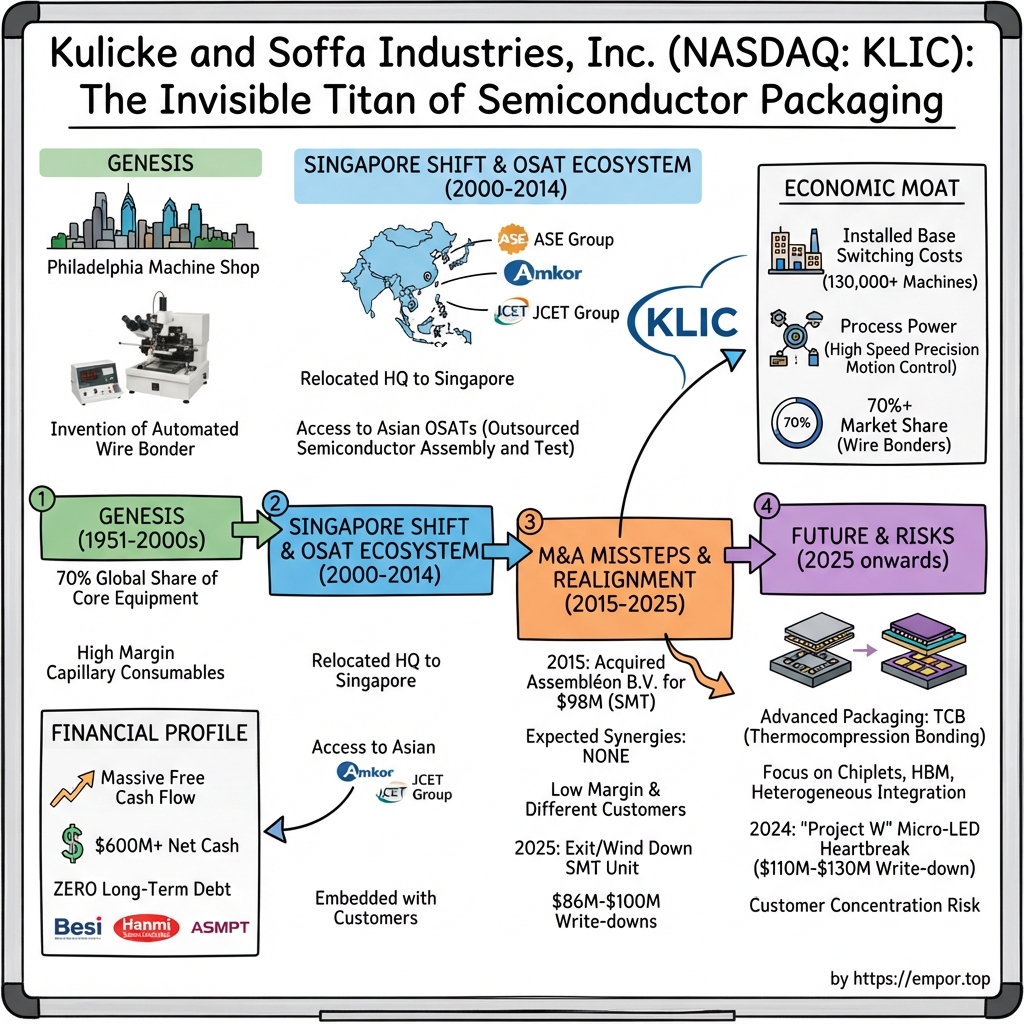
Kulicke and Soffa Industries, Inc. (NASDAQ: KLIC): The Invisible Titan of Semiconductor Packaging
I. Introduction & Episode Roadmap
On the morning of August 6, 2026, a conference call operator opened a routine quarterly earnings session for a company most investors have never knowingly encountered. Within ninety seconds, the interim chief executive of Kulicke and Soffa Industries delivered a figure that would have seemed improbable eighteen months earlier: revenue for the June quarter had grown 36.2% sequentially and 123% year-over-year to $330.4 million.1 Guidance for the September quarter pointed to roughly $375 million.1 The first analyst on the line, Krish Sankar of TD Cowen, opened with a single word before his question: "Congrats."2
Understanding why that call mattered requires examining what happens inside a semiconductor package—the unglamorous portion of chip manufacturing rarely featured on magazine covers.
Every microprocessor, memory die, power management chip, and automotive sensor begins as a rectangle of patterned silicon a few millimeters across. That rectangle cannot function in isolation. It contains hundreds or thousands of metal pads, each smaller than a red blood cell, with no direct connection to the outside world. Building those bridges has long relied on wire bonding. For seventy-five years, it has remained the dominant assembly method: a machine feeds gold or copper wire thinner than a human hair through a ceramic nozzle called a capillary, melts the tip into a microscopic ball, presses it onto the silicon pad using ultrasonic vibration and heat, then arcs the wire to the package substrate and welds it down. The entire operation takes a few thousandths of a second, with modern machines repeating the sequence more than twenty times per second, continuously for years.
Kulicke and Soffa builds those machines. It has done so since 1951, when two engineers established a custom toolmaking shop in Philadelphia four years after Bell Labs demonstrated the transistor.3 The company describes itself in its annual report as "a global leader in semiconductor assembly technology."4 Management's internal estimate, offered by then-CEO Fusen Chen on a February 2025 earnings call, is more specific: a 75% to 80% share of the global ball bonder market and above 90% share in NAND flash assembly.5 While these are management estimates rather than independently audited metrics, industry participants broadly recognize K&S as the sector's incumbent standard.
The core strategic tension lies in that incumbency. For much of the past four years, leading the wire bonding market resembled manufacturing premium horse-drawn carriages in 1910. Industry consensus held that Moore's Law was slowing, that the future belonged to advanced packaging—stacking chips vertically and connecting them with copper pillars or direct copper-to-copper hybrid bonds—and that wire bonding was a legacy process facing steady disintermediation. K&S revenue fell from $1.50 billion in fiscal 2022 to $654.1 million in fiscal 2025.6 Over that same period, profitability evaporated; fiscal 2025 GAAP net income stood at just $0.2 million on $654 million of revenue.6
The expansion of AI data center infrastructure altered that trajectory. Management argued on the recent earnings call that data centers rely on wire bonding "at least as much as, if not more than traditional semiconductor markets such as smartphones and PCs," pointing out that networking chips, power management devices, and NAND storage continue to require wire bonds even alongside advanced AI accelerators.2 Whether this demand represents a structural shift or a temporary cyclical surge remains a central underwriting question.
K&S presents a study in contrasts: market dominance in an essential chokepoint, a multi-year record of capital destruction outside its core, an ongoing executive transition, and an advanced packaging initiative that is only now producing tangible revenue.
The roadmap for this analysis: First, the origin—from a Philadelphia machine shop to the global standard in chip assembly. Second, the Asian migration, including shifting the corporate center of gravity to Singapore to align with customer manufacturing hubs. Third, an M&A post-mortem examining the 2015 acquisition of Dutch firm Assembléon and its formal wind-down a decade later. Fourth, the core economics of the wire bonding franchise and cash flow generation. Fifth, "Project W"—the concealed display program whose March 2024 cancellation created a substantial P&L drag, alongside the overlooked legal settlement. Sixth, governance, executive incentives, and historical capital deployment. Finally, the competitive landscape, the bear case, key takeaways, and the operating metrics that will determine whether the recent earnings inflection reflects a cyclical peak or a permanent re-rating.
 Subscribe on LinkedIn
II. The Genesis of Micro-Assembly: From Philadelphia Machine Shop to Silicon Backbone (1951–2000s)
In July 1951, two engineers who had met while working at Proctor Electric put their ambitions on paper and formed a partnership in Philadelphia.3 Frederick W. Kulicke Jr. and Albert Soffa were not initially targeting semiconductors—the transistor was four years old and still largely a laboratory curiosity. Instead, they built a custom engineering and toolmaking business designed to solve complex mechanical problems for industrial clients.
Their key opportunity arrived when the defining manufacturing bottleneck of the microelectronics era walked through their door.
By the late 1950s, Bell Labs, Fairchild Semiconductor, and Texas Instruments had demonstrated how to fabricate transistors and early integrated circuits on silicon wafers. However, none had developed an efficient method for getting electrical signals off the die. Early assembly was conducted manually under microscopes by technicians with high manual dexterity—meaning the era's most advanced technology depended on human eyesight and hand assembly. Yields were low, throughput was restricted, and every additional transistor on a chip compounded the problem by requiring more input/output pads and interconnected wiring.
Kulicke and Soffa recognized that chip assembly was fundamentally a motion control challenge rather than a simple materials problem. If a machine could position a tool over a microscopic pad to within a fraction of a micron, apply precise force, heat, and ultrasonic energy, and repeat that sequence thousands of times per hour without mechanical drift, it could automate the most labor-intensive step in electronics manufacturing.
The Physics of a Bond, Explained Simply
Understanding the physics of a wire bond clarifies why chip packaging presents a formidable engineering barrier.
Fusing two metal components typically requires melting them. On a silicon die, however, extreme heat would destroy the underlying microscopic transistors. Wire bonding addresses this constraint through ultrasonic welding: the machine presses wire against a bonding pad with controlled force and vibrates it laterally at ultrasonic frequencies. This vibration scrubs away the microscopic oxide layer on both surfaces and generates localized friction energy, causing the metals to interdiffuse and form a solid-state metallurgical bond in milliseconds without melting the substrate.
The wire bonder must position a ceramic capillary—a precision-hollow needle—over a die pad located via machine vision, descend, activate the ultrasonic transducer, retract, arc the wire in a controlled three-dimensional loop to prevent electrical shorting against adjacent wires, and weld the far end to the package substrate. On a modern high-volume bonder, this cycle repeats more than twenty times per second.
Executing this process reliably requires more than a single patented invention. It relies on accumulated operational know-how: capillary tip geometry, ultrasonic waveform shaping, linear motor servo tuning, vision algorithms that track shifted die pads, and loop-shaping software that keeps 25-micron wire aligned. Consequently, the wire bonder market has presented a high barrier to entry for startups, as no single breakthrough allows a competitor to bypass decades of process refinements.
The Consumable Tail
The founders' second major strategic insight was that bonding capillaries wear out over time.
Because a ceramic capillary degrades after a set number of bonding cycles, operators must replace it periodically to preserve yield. Every bonder sale therefore creates an ongoing revenue stream: customers continuously purchase capillaries, wedge tools, spare parts, and associated software and services over the operating life of the equipment. K&S systematically built out this aftermarket model and continues to manufacture capillaries in company-owned facilities in Israel and China—a geographic footprint that carries notable geopolitical risk.4
This consumable tail helps distinguish K&S from pure capital equipment providers. While equipment sales drop during industry downturns, aftermarket sales track active semiconductor production rather than factory expansion. As K&S notes in its disclosures, aftermarket revenues "are more directly tied to semiconductor unit consumption rather than capacity requirements."4 This dynamic creates a baseline revenue floor during cyclical contractions, even if that floor remains subject to broader volume swings.
K&S completed its initial public offering of 100,000 shares in 1961.3 Over the following four decades, the company navigated severe semiconductor industry downturns—including the memory busts of the mid-1980s, the corrections of 1996 and 1998, and the dot-com contraction—while establishing itself as the primary assembly platform for integrated device manufacturers such as Texas Instruments, Intel, and Motorola. These manufacturers standardized their back-end facilities, technician training, and process recipes around K&S machinery.
This installed base gave K&S strong customer lock-in. However, it also exposed the business to geographic concentration risks as chip assembly shifted away from Western manufacturing hubs.
In August 2026, K&S reached its 75th anniversary, a milestone management highlighted on its recent earnings call.2 As of the end of fiscal 2025, the company operated with 2,551 full-time employees and 41 temporary workers globally—a relatively lean footprint for an industry supplier, enabled by a manufacturing model reliant on outsourced parts and subassemblies.4
III. The Singapore Shift & The OSAT Ecosystem (2000–2014)
Picture a semiconductor company's balance sheet in 1990. It owns fabs. It owns test floors. It owns assembly plants, usually in Malaysia or the Philippines, staffed by thousands of operators. Vertical integration was the industry's default because nobody else could do any of it.
Now picture 2010. The fab has been outsourced to 台積電 TSMC. The design has been separated into a fabless company. And the assembly and test step — the part that involves wire bonders — has been handed to a new category of contractor entirely: the OSAT, or Outsourced Semiconductor Assembly and Test provider.
The rise of the OSATs was the single most consequential structural change in K&S's customer base in its history. 日月光半導體 ASE Group in Taiwan, Amkor Technology with its Korean manufacturing heritage, 長電科技 JCET Group in China, 力成科技 Powertech Technology, 通富微電 Tongfu Microelectronics — these firms consolidated the back-end of the industry into a handful of enormous, capital-hungry, ruthlessly cost-focused buyers, and they were almost entirely located in East and Southeast Asia.
For an equipment vendor headquartered in Fort Washington, Pennsylvania, this was an existential logistics problem. Semiconductor assembly equipment is not shipped and forgotten. It is installed, qualified against the customer's specific package, tuned, and then supported continuously — because when a bonder goes down on a line running at 90% utilisation, the customer is losing money by the hour. Application engineers need to be on the floor within hours, not days. Spare parts need to be in-region. Demonstration labs need to be where customers can walk into them.
The Relocation
So in 2010, K&S moved its operational centre of gravity — and eventually its principal executive offices — from Pennsylvania to Singapore.7 The company broke ground on a purpose-built site in May 2012 and opened a headquarters of nearly 200,000 square feet in February 2014, developed in conjunction with Mapletree Industrial Trust, housing corporate offices, manufacturing, R&D, sales and service, and a customer training centre.7
The company remains, legally, a Pennsylvania corporation, and its filings still list dual principal executive offices at 23A Serangoon North Avenue 5 in Singapore and 1005 Virginia Drive in Fort Washington.4 But operationally the decision was unambiguous. Ball bonder, wedge bonder, and advanced packaging platform manufacturing is done in Singapore.4
What did this buy? Three things worth naming precisely, because "we moved closer to customers" is the kind of statement companies make that means nothing.
First, response time. Same-day travel to the overwhelming majority of the world's semiconductor assembly floors is a hard operational advantage that competitors headquartered in the United States or Europe cannot replicate without making the same move.
Second, engineering co-location. Advanced packaging development is not a product you design and then sell; it is a joint process development exercise with a specific customer's specific device. Fusen Chen described the timeline candidly on a 2024 call: K&S began engaging one IDM customer on thermocompression bonding in 2021 and began shipping in volume roughly eighteen months later.8 You cannot run an eighteen-month joint qualification from twelve time zones away.
Third — and management has never emphasised this, but it is real — Singapore's tax and industrial policy environment. K&S's effective tax rate has run in the low-to-mid twenties in recent years, well below a full US statutory-plus-state burden.4
The Franchise at Its Peak
What emerged from the Asian migration was a genuinely dominant position in the highest-volume category of assembly equipment. The scale of that dominance became visible during the pandemic-era boom: fiscal 2021 revenue of $1.52 billion and fiscal 2022 revenue of $1.50 billion, with fiscal 2022 operating income of $470.1 million — an operating margin above 31% on a business that four years earlier had earned single-digit operating margins.6
That is the shape of the franchise. It is not a smooth compounder. It is a business with high incremental margins and almost no ability to forecast, sitting on top of an industry that alternates between panic-buying and total abstinence. Fusen Chen put the amplitude plainly on a February 2025 call, contrasting a peak quarterly revenue run-rate near $1 billion annualised against a fiscal 2023–2024 average "just over $300 million," and defining a "normal year" as roughly $500 to $600 million.5
The main direct rival across this period was ASM Pacific Technology — now ASMPT Limited, listed in Hong Kong — which competes across wire bonding and holds broader reach into surface-mount and die-attach equipment. K&S's own filings name a wider competitive set: Hesse GmbH, Han's Laser Technology, BE Semiconductor Industries N.V., Hanwha Precision Machinery, パナソニック Panasonic Holdings, Yamaha Robotics Holdings, and Nordson Corporation on the equipment side; PECO, ディスコ Disco Corporation, and Small Precision Tools on consumables.4
Two things are notable about that list. It is long — this is not a monopoly in the legal sense. And it is heterogeneous — most of those competitors attack one slice of K&S's portfolio rather than the whole thing. That structure is the source of both K&S's resilience in its core and its persistent difficulty whenever it has tried to expand beyond it.
Which brings us to the expansion attempt.
IV. M&A Capital Deployment & The Assembléon Stumble (2015–2025)
In January 2015, K&S closed a transaction that looked, on paper, like the obvious next move for a company with a fortress balance sheet and a maturing core market. It acquired Assembléon B.V., a Netherlands-based maker of surface-mount technology pick-and-place equipment, for approximately $98 million in cash.9[^10]
The logic was clean enough to fit on a single slide. K&S owned the step where a die gets connected inside a chip package. Assembléon owned an adjacent step: placing finished components onto printed circuit boards. Both were high-precision placement problems. Both served electronics manufacturing. K&S would become an end-to-end assembly solutions provider, cross-sell into a broader customer base, and diversify away from the semiconductor cycle.
It did not work. It took a decade to formally admit it did not work.
Why the Synergy Was Structurally Unavailable
The strategic error was not paying too much — roughly one times revenue for a capital equipment business is not an obviously reckless multiple. The error was a misreading of who the customer was.
K&S's customer is a semiconductor packaging specialist: an OSAT or an IDM back-end operation, buying tools that are qualified against device-level yield specifications, purchased by process engineering organisations that care about interconnect reliability at the micron scale. Assembléon's customer is a board-level electronics assembler, buying tools that are qualified against placement rate and component-mix flexibility, purchased by manufacturing operations that care about cost per placement.
These are different buyers, in different companies, with different budgets, evaluating on different criteria. There was no cross-sell to be had. A purchasing manager at an OSAT has no authority over, or interest in, board assembly equipment. Meanwhile, the SMT market K&S had entered was dominated by entrenched Japanese incumbents with decades of installed base and scale — Fuji, パナソニック Panasonic, ヤマハ発動機 Yamaha Motor — which meant K&S was now the subscale challenger in a commoditising market, the exact inverse of its position at home.
The pattern deserves a name, and it has one: buying an adjacency that resembles your core technologically but not commercially. The mechanical similarity of "precision placement" was real. The economic similarity was zero.
The Activist Notices, in Real Time
It is worth pausing on how quickly this was flagged, because it speaks to whether the failure was foreseeable or only obvious in hindsight.
On December 1, 2015 — eleven months after the deal closed — Breithorn Capital Management, holding roughly 1.2% of the shares, sent a public letter to the K&S board.10 Breithorn argued that "the Company's approach to capital allocation has left much to be desired," noted that K&S held $482 million in net cash as of October 2015 against roughly $75 million of operating need, and said explicitly of Assembléon that "early results are not encouraging" and that the "stated earnings accretion and revenue growth goals will not be achieved."10 The fund recommended halting acquisitions, executing $250 million of buybacks, and considering a sale of the company.
Breithorn was right about the acquisition on a roughly one-year lag. That is a meaningful data point on management's M&A judgment: the thesis was falsifiable quickly, and it was falsified quickly, and it still took nine more years to act.
The Wind-Down
On March 25, 2025, the K&S board approved a strategic plan to cease the Electronics Assembly equipment business entirely, "in an effort to prioritize core semiconductor assembly business opportunities and enhance overall through-cycle financial performance."4 Because the operations were Dutch, the cessation required a formal consultation process with works councils and union representatives, which K&S initiated in its third fiscal quarter of 2025 and had substantially completed by the fiscal year end.4
The charges tell the story with unusual clarity. For fiscal 2025, K&S recorded $87.5 million of total pre-tax charges relating to the cessation: $31.5 million of inventory write-downs, $34.9 million of goodwill and intangible asset impairments, $4.9 million of long-lived asset impairments, $5.3 million of employee termination benefits, and $10.9 million of adverse purchase commitments.4 The goodwill component alone — a full impairment of $19.2 million across the APS segment and the "All Others" category — brought K&S's cumulative goodwill impairment to approximately $64.2 million, up from $45.0 million a year earlier.4
Read that sequence carefully. K&S paid roughly $98 million for a business, ran it for a decade, and then wrote off roughly $87.5 million to shut it down. The intervening decade's operating contribution was not separately disclosed, but a business that management ultimately characterised as a distraction from "core semiconductor assembly business opportunities" was plainly not carrying its cost of capital.
What It Says About the Company
Two conclusions, and they point in different directions.
The negative one: this was capital destruction in a business that generates enormous cash and therefore always faces the temptation to deploy it. The acquisition was made when the core looked mature and the balance sheet looked idle. That is precisely the psychological setup in which bad deals get done, and K&S walked into it with an outside investor pointing at the trap within a year.
The more generous one: the eventual exit was clean, decisive, and taken in the middle of a severe downcycle when the accounting hit was maximally painful and least convenient. Management could have kept the business limping along and avoided the headline charge. It did not. Whether that reflects a genuinely changed capital allocation philosophy or simply the arithmetic of a business too small to matter is a question the next few years of M&A behaviour will answer — and the arrival of a permanent CEO makes that question live again.
V. Segment Breakdown & Core Business Economics: The Wire Bonding Monopoly
Stripping away the advanced packaging narrative reveals where the company's revenue actually originates.
In fiscal 2025, K&S generated $654.1 million in total net revenue.4 Ball Bonding Equipment—the core high-volume wire bonder franchise—contributed $293.0 million, or 44.8% of the total.4 Wedge Bonding Equipment, which uses specialized geometries to bond thicker aluminum or copper wire for power semiconductors and automotive modules, added $110.6 million, or 16.9%.4 Advanced Solutions, the unit housing thermocompression bonding and next-generation packaging platforms, generated $72.7 million, or 11.1%.4 Aftermarket Products and Services delivered $156.1 million, or 23.9%.4 A residual "All Others" category accounted for the remaining $21.7 million.4
That breakdown summarizes the core business model in five numbers: roughly 62% of revenue came from equipment sales, nearly a quarter from servicing and supplying the installed base, and just 11% from next-generation platforms.
By comparison, in fiscal 2024, ball bonding contributed $357.8 million while Advanced Solutions generated $52.9 million.4 Ball bonding revenue contracted 18.1% year over year while advanced packaging expanded 37.6%—showing that while the portfolio transition was underway, advanced packaging remained too small to offset the cyclical contraction in wire bonding.4
Why Aftermarket Matters More Than Its Revenue Line
The stability of the aftermarket segment represents the company's most important structural feature.
In fiscal 2025—the most challenging operating year in K&S's recent history, yielding just $0.2 million in GAAP net income on $654 million in revenue—aftermarket revenue held at $156.1 million, down just 2.4% from the prior year.46 Over that same period, ball bonder equipment revenue dropped 18.1%.4 During the 2021–2022 cyclical peak, annual aftermarket revenue ranged between $197 million and $205 million.11 Thus, across a cycle where equipment sales swung by more than a factor of four, aftermarket revenue remained bounded within a predictable range of $150 million to $205 million.
This resilience reflects the underlying installed base. It acts as a financial stabilizer, explaining why K&S has avoided equity dilution or heavy debt loads during industry downturns.
However, aftermarket revenue does not fully cover baseline overhead. Non-GAAP operating expenses run at roughly $70 million per quarter, or $280 million on an annualized basis.12 While the recurring aftermarket business provides a durable revenue floor, it does not guarantee trough profitability. K&S can navigate cyclical troughs indefinitely without solvency risk, but earning meaningful profits requires equipment volume.
Because K&S does not disclose exact active machine counts, the aftermarket line serves as the primary metric for installed base value—measuring recurring cash generation regardless of new tool shipments.
Why Wire Bonding Refuses to Die
Industry forecasts have long predicted that flip-chip and advanced packaging technologies would reduce wire bonding to a shrinking legacy niche. While that prediction holds true at the highest performance tier, wire bonding remains dominant across broader semiconductor assembly.
The primary driver is unit economics. Wire bonding remains exceptionally cost-effective. A ceramic capillary and fine wire spool on a standard bonder can execute more than twenty connections per second at a fraction of the capital cost of advanced packaging equipment. For microcontrollers, power management integrated circuits, analog sensors, automotive control units, and NAND flash memory, wire bonding delivers the required electrical performance at an unmatched cost per connection. Advanced packaging is essential for extreme interconnect density, but it commands a substantial cost premium.
Consequently, most global semiconductor packages still utilize wire bonds. Furthermore, expanding AI infrastructure is generating incremental demand for mature packaging formats. On the August 2026 earnings call, management noted that data centers rely on wire-bonded chips for networking, hardware communications, power management, and storage, with approximately 40% of the NAND flash market—where K&S estimates its ball bonder market share above 90%—supplying data center builds.25
While management claims require careful evaluation, recent financial results align with this dynamic. In the June 2026 quarter, general semiconductor equipment revenue rose 52.6% sequentially to $227.2 million, memory segment revenue increased 8.8% to $34.0 million, and automotive and industrial revenue grew 9% to $24.2 million.2 These figures reflect demand for an established packaging standard facing capacity constraints rather than technology obsolescence.
The Constraint Is Now Capacity, Not Demand
Production capacity has emerged as the primary operational bottleneck. On the August 2026 call, Steelhead Securities analyst Dave Duley questioned the company's total manufacturing capacity limits. Interim Chief Executive and Chief Financial Officer Lester Wong responded that K&S had expanded output roughly fourfold over two quarters, emphasizing that management was focused on preserving market share amid surging demand.2 Addressing whether K&S could sustain a $450 million quarterly revenue run rate, Wong declined to provide specific targets but noted the firm had previously supported $400 million quarterly volumes.2
Operating metrics further highlight these constraints. As of August 2026, factory utilization in China exceeded 95%, with utilization across both memory and general semiconductor lines reaching approximately 90%. Customer purchase orders extended into the March 2027 quarter, a duration management described as unusually long.2
Order backlog reflects similar momentum. K&S closed fiscal 2025 with $245.3 million in backlog, up 65% from $148.6 million a year earlier, prior to the acceleration in shipment rates.4
The Customer Concentration Problem
Customer concentration presents an ongoing strategic counterweight. Sales to K&S's ten largest customers represented 54.8% of net revenue in fiscal 2025 and 53.6% in fiscal 2024.4 Capital expenditure decisions by a select group of OSAT providers and IDMs directly dictate K&S's annual financial performance.
The May 2024 booking of a 1,000-unit RAPID Pro ball bonder order from a Chinese assembly customer demonstrates this sensitivity.8 A single order from one customer can significantly alter quarterly results, leaving K&S vulnerable when major buyers pause procurement. Furthermore, company disclosures confirm that backlogs remain flexible: "A majority of our orders are subject to cancellation or deferral by our customers with limited or no penalties."4
Ultimately, K&S maintains a well-entrenched technical monopoly operating within a concentrated customer ecosystem. While its market position protects market share, total equipment volume remains governed by broader semiconductor capital expenditure cycles.
VI. Advanced Packaging, TCB, & The "Project W" Micro-LED Disaster
On March 11, 2024, Kulicke and Soffa informed the market that a customer had cancelled a program internally designated as Project W, prompting the company to cease activities and wind down the initiative.13 Management initially guided to pre-tax charges, including asset impairments, of between $110 million and $130 million.13
The company never officially named the customer, disclosing only that "one of its customers" engaged K&S "with the development and future mass production of certain technologies relating to advanced display."4 Supply-chain reporting at the time attributed the contract to Apple for a micro-LED display project—most plausibly intended for an Apple Watch—an identification that gained wide traction across industry press.14 However, that connection remains a supply-chain inference rather than a confirmed corporate disclosure.
What Was Actually Being Built
The underlying technology posed a severe mechanical challenge. A micro-LED display consists of millions of microscopic light-emitting diodes, each smaller than a grain of dust, that must be transferred from a source wafer onto a display substrate with micron-level precision. Assembling these displays sequentially using standard pick-and-place tools would require days per unit. To address this bottleneck, K&S developed Luminex, an ultra-high-speed die transfer platform engineered to place microscopic dies at mass-production speeds.
The initiative aligned with K&S's core technical focus on high-precision motion control. However, by tailoring the tool exclusively to a single customer's specification and product roadmap, the company exposed itself to substantial single-customer counterparty risk.
The Damage, Precisely Stated
The financial fallout landed in fiscal 2024, when K&S recorded $104.7 million in total Project W charges. This total included a $57.3 million inventory write-down, $2.9 million in purchase order cancellation fees, and $44.5 million in long-lived asset impairments—comprising $38.0 million in property, plant, and equipment (mostly leasehold improvements), $3.0 million in right-of-use assets, and $3.5 million in asset retirement obligations.4 In assessing fair value, management wrote off these assets entirely, projecting their future cash flows at zero.4 Management also estimated that the cancellation eliminated approximately $15 million in second-half fiscal 2024 revenue.8
Driven largely by these non-cash write-downs, K&S ended fiscal 2024 with a GAAP net loss of $69.0 million on net revenue of $706.2 million.6
The Part Most Coverage Missed
While initial reporting framed the cancellation as an unmitigated $120 million loss, subsequent disclosures painted a more nuanced financial picture.
On November 4, 2024, K&S executed a settlement agreement under which the customer agreed to reimburse $86.2 million for project-related costs and expenses.4 In the first quarter of fiscal 2025, ended December 2024, K&S recognized $15.1 million of that settlement as net revenue for delivered products and recorded the remaining $71.1 million as a gain relating to business cessation.4 K&S received the full cash payment in the second quarter of fiscal 2025, ended March 29, 2025.4
This reimbursement caused a sharp divergence between GAAP and non-GAAP results, pushing first-quarter GAAP diluted earnings per share to $1.51 compared with non-GAAP EPS of $0.37.5 As interim Chief Financial Officer Lester Wong explained on the earnings call, tools ordered prior to cancellation whose costs had already been impaired were recognized during the quarter, providing a temporary boost to gross margins.5
Accounting for the settlement, net pre-tax project charges stood at roughly $18.5 million against $104.7 million in initial write-downs. Combined with lost revenue and years of redirected engineering capacity, Project W resulted in a meaningful operational setback rather than an existential crisis. The recovery demonstrated disciplined contracting, showing K&S did not build custom infrastructure without contractual recourse.
Even so, the strategic vulnerability remains clear. The recovery was negotiated post-cancellation and was not guaranteed when the project collapsed. Former Chief Executive Fusen Chen acknowledged on a subsequent call that deep customer co-development is essential for entering new markets, noting that "there will always be a potential risk that a project may be canceled by the end customer."8 While accurate, that framing leaves unaddressed how much single-customer exposure K&S can safely absorb.
From Project W to TCB: The Real Advanced Packaging Story
The broader strategic shift following Project W involved redeploying engineering resources. Management stated after the cancellation that technical teams were reallocated to accelerate memory, advanced dispense, and advanced packaging initiatives.8
That reallocation centered on thermocompression bonding (TCB). Unlike traditional wire bonding, which connects electrical leads along a die's perimeter, TCB places a die face-down onto a substrate or lower die, applying heat and force to fuse thousands of microscopic copper pillars simultaneously. This method is critical for stacking chiplets, integrating heterogeneous logic, and building high-bandwidth memory (HBM). Standard TCB uses chemical flux to clean copper oxides, requiring a post-bond wash step that grows increasingly difficult as die gaps shrink.
K&S's proprietary alternative, Fluxless Thermocompression (FTC), eliminates liquid flux by using formic acid or plasma to remove oxides. This enables direct copper-to-copper bonds with zero die gap across interconnect pitches ranging from 35 microns down to 5 microns.8 Early in 2025, Chen argued that FTC offers key performance advantages of hybrid bonding "without the licensing fees, brand production requirements, or other issues associated with initial hybrid bonding technologies."5
Commercial adoption is beginning to materialize. K&S reiterated its target of exceeding $100 million in Advanced Solutions segment revenue for fiscal 2026, while Wong projected fiscal 2027 TCB revenue between $150 million and $200 million on the August 2026 call.2 To support this growth, K&S committed $20 million to expand its Singapore production footprint—deploying $12 million in fiscal 2026—with completion targeted for the first half of fiscal 2027 to provide capacity for $400 million in annual Advanced Solutions revenue.12
Expanding capacity to $400 million against a $100 million run-rate signals aggressive expansion. Pressed on this gap by analysts, Wong stated that growth would depend on three drivers: expanding logic market share, entering new memory applications, and overall market growth.12
The HBM Gap — the Bear Case's Sharpest Edge
Wong's commentary highlighted K&S's primary strategic vulnerability: "we're not in memory right now. We're not HBM."12
High-bandwidth memory for AI accelerators represents the largest and fastest-growing market for thermocompression bonding, a segment where K&S currently holds negligible share. South Korea's Hanmi Semiconductor established an early stronghold supplying HBM TC bonders to SK Hynix, while ASMPT and Besi have secured market share during HBM4 qualification cycles.15
K&S's memory entry remains in early qualification. The company shipped its initial HBM system during the first quarter of fiscal 2026 to a U.S. customer, targeting HBM4E specifications.16 As of May 2026, that tool remained under evaluation.12 Concurrently, K&S is advancing a hybrid bonding program, targeting customer delivery of a tool in the first half of fiscal 2027 alongside investments in panel-level packaging architectures.2
Consequently, K&S holds a defensible position in fluxless TCB for advanced logic chips, yet remains largely absent from the high-volume memory market driving current industry expansion. While management has been transparent regarding this gap, the most lucrative advanced packaging segment of the current AI buildout continues to be captured by competitors.
VII. Management, Governance, & Capital Allocation under Lester Wong & Fusen Chen
On October 28, 2025, Kulicke and Soffa announced that Dr. Fusen Chen would retire as President and Chief Executive Officer effective December 1, 2025, for health reasons, and that Lester Wong, Executive Vice President and Chief Financial Officer, would serve as Interim CEO.17 Chen agreed to remain as an advisor to the board for twelve months while the board initiated a search for a permanent successor evaluating both internal and external candidates.17
Three weeks later, on the fiscal fourth-quarter earnings call, Wong opened not with operating metrics but with a personal update: "Fusen is actively recovering and doing well, and we appreciate everyone's thoughts and concerns."16 Sell-side analysts—including Krish Sankar of TD Cowen and Tom Diffely of D.A. Davidson, the latter noting he had covered the company on and off for twenty-five years—offered well wishes to Chen before turning to questions on NAND utilization.16 The exchange illustrated the long-standing familiarity between wall street analysts and company leadership.
Fusen Chen: The Portfolio Builder
Chen assumed the CEO role on October 31, 2016, joining K&S from Mattson Technology, where he served as President and CEO and returned the loss-making supplier to profitability.18 Prior to Mattson, he served as an executive vice president at Novellus Systems overseeing all semiconductor business units.18 He holds a PhD in materials science and engineering from the State University of New York and a bachelor's degree from Tsing Hua University in Hsinchu, Taiwan.18
Over his nine-year tenure, Chen sought to expand the company beyond its core wire bonding market. While K&S maintained market leadership in traditional interconnects, Chen directed research and development toward organic adjacencies, including advanced packaging, thermocompression bonding, vertical wire technology, advanced dispense systems, and power semiconductor tooling. Summarizing Chen's tenure on the transition call, Wong described his legacy as "an organization defined by growth, agility and close customer focus," highlighting market share gains in leading-edge logic alongside initial positions in DRAM, power semiconductors, and dispense.16
A comprehensive evaluation requires weighing these developments against execution challenges. Chen's leadership coincided with the multi-year attempt to integrate Assembléon, which ultimately resulted in an $87.5 million pre-tax shutdown charge in fiscal 2025, as well as the cancellation of Project W. Additionally, public management forecasts occasionally outpaced commercial reality. In May 2024, Chen stated that K&S anticipated its advanced packaging portfolio "to approach $200 million in annual revenue by fiscal year 2025."8 Actual Advanced Solutions revenue for fiscal 2025 reached $72.7 million.4 Although management's internal definition of advanced packaging encompassed products beyond the formal reporting segment, the resulting gap underscored the aggressive assumptions embedded in early forecasts—a relevant consideration when assessing current TCB targets.
Lester Wong: The Steward
Wong brings a legal and financial background to the chief executive role. He joined K&S in September 2011 as Senior Vice President, Legal Affairs and General Counsel, assumed interim CFO responsibilities in November 2017, was named permanent CFO in December 2018, and was promoted to Executive Vice President in January 2022.19 Before joining K&S, Wong served as General Counsel at GigaMedia and held senior legal roles at CDC Corporation and Cowen Latitude Asia.19
Wong's communications on earnings calls emphasize financial discipline and quantitative parameters. Asked by Charles Shi of Needham in August 2026 whether fiscal 2027 revenue could return to the pandemic-era peak of $1.5 billion seen in fiscal 2021 and 2022, Wong declined to forecast such levels, stating: "those were extreme levels. That was like a global pandemic, right? So that's a very high bar."2 His unwillingness to extrapolate peak conditions during an operational upcycle offered a measured perspective on near-term growth.
From a corporate governance standpoint, K&S currently operates under a dual-role leadership structure during a cyclical surge and factory expansion, with Wong serving simultaneously as Interim CEO and CFO while the board conducts its executive search. In connection with his interim appointment, the board granted Wong a one-off restricted stock unit award of 10,338 shares on December 1, 2025, scheduled to vest on the first anniversary.19 The modest size of the grant indicates a transitional retention arrangement while the permanent leadership plan is finalized.
The Incentive Structure, and What Fiscal 2025 Revealed
K&S structures executive compensation around specific financial targets and relative market performance.
The annual cash incentive program is funded based on two equally weighted performance metrics: Net Income and Operating Margin. For fiscal 2025, the compensation committee set the target Net Income at $53.6 million with a threshold of $16.1 million, and target Operating Margin at 6.4% with a threshold of 1.9%.19 Full-year unadjusted results came in at $0.2 million for Net Income and negative 0.49% for Operating Margin.19 Because both metrics fell below minimum thresholds, no performance-based cash bonuses were awarded under the plan for the year.
Long-term equity incentives rely entirely on relative total shareholder return (TSR). One hundred percent of performance share units (PSUs) vest based on K&S's relative TSR performance measured against a peer group of approximately 65 technology companies.19 Management previously assigned a 25% weighting to organic revenue growth benchmarked against direct competitors BE Semiconductor Industries N.V. and ASMPT Limited, but eliminated the metric after concluding that severe industry cyclicality distorted short-term revenue comparisons.19
Relying exclusively on relative TSR aligns long-term executive payouts with market outperformance in a cyclical industry, though it can also decouple compensation from standalone operational metrics if sector-wide valuations rise. Realized pay outcomes reflect this structure: disclosures in the 2026 proxy statement report actual executive compensation paid to the CEO of $3.2 million in fiscal 2025, compared to a Summary Compensation Table total of $7.1 million, as relative TSR landed at the 39th percentile of the comparator group.19
The Ownership Question
Insider equity ownership at Kulicke and Soffa remains modest across the board and executive team.
As of December 8, 2025, all directors, nominees, and executive officers as a group—ten individuals—beneficially owned 651,409 shares, representing 1.2% of total outstanding stock.19 Lester Wong personally held 110,743 shares.19 The largest individual block among current and former named executives belonged to retired CEO Fusen Chen, who held 1,161,725 shares, or 2.2%.19
Institutional index funds represent the company's largest equity holders: BlackRock held 8,216,352 shares, or 15.7%, while The Vanguard Group held 3,228,082 shares, or 6.2%.19 Regulatory filings confirm there were no related-party transactions requiring disclosure under Item 404(a) during fiscal 2025.19
This capital structure defines K&S as a professionally managed corporation driven by institutional stewardship rather than founder control. Management operates without major family or founder equity stakes, placing emphasis on board oversight and formal incentive alignment to govern capital allocation decisions.
Capital Allocation: The Actual Record
Apart from M&A execution, K&S's balance sheet management and capital return program have provided significant financial stability through industry downturns.
The company operates with zero long-term debt.20 As of the quarter ended July 4, 2026, K&S held $368.6 million in cash and cash equivalents alongside $148.0 million in short-term investments, yielding $516.6 million in total liquid assets against $38.1 million in total debt—consisting entirely of finance lease obligations.20 Net cash after subtracting lease liabilities stood at $330.5 million.20
Total liquid assets declined from the $581.5 million reported in March 2025.20 Rather than reflecting operational cash drain, the cash absorption funded working capital to support a 123% year-over-year quarterly revenue expansion. Between March 2025 and July 2026, inventories expanded from $155.7 million to $227.1 million, while accounts receivable rose from $173.9 million to $329.5 million.20 Maintaining a debt-free balance sheet enabled K&S to finance this working capital surge internally without drawing on credit facilities.
Share repurchases have been executed counter-cyclically during market pullbacks. During the fiscal 2025 downturn, K&S repurchased 2.4 million shares—representing nearly 5% of outstanding stock—for $96.5 million.16 That followed $150.8 million deployed for buybacks in fiscal 2024 and $281.3 million during the peak demand year of fiscal 2022.11 The board authorized a new $300 million share repurchase program on December 2, 2024, which retained approximately $233.8 million in remaining capacity as of October 4, 2025.54
Over the long term, share buybacks have meaningfully reduced the share count. Weighted average diluted shares fell from 77.3 million in fiscal 2014 to 53.4 million in the June 2026 quarter—a 31% reduction over twelve years.620 In an industry where cyclical revenue peaks recur over multi-year periods, share retirement has served as a primary driver of per-share earnings growth.
Dividend policy has prioritized stability over expansion. K&S maintained a quarterly dividend of $0.205 per share throughout fiscal 2025, totaling $0.82 per share for the year at a total cash cost of $54.1 million.411 The board declared an identical $0.205 per share dividend for the quarter payable July 8, 2026, keeping the payout flat despite the operational recovery.21 At an August 2026 share price near $91.31, the dividend yields under 1%, serving primarily as a baseline capital return signal rather than an income-oriented yield.22
Cash generation across full industry cycles highlights the company's underlying cash flow engine. Free cash flow totaled $367.2 million in fiscal 2022, $129.0 million in fiscal 2023, $14.9 million in fiscal 2024, and $96.4 million in fiscal 2025.11 The maintenance of positive free cash flow at the trough of a major downcycle—even while absorbing the non-cash write-downs from Project W—demonstrates an adaptable operational cost structure.
VIII. Hamilton Helmer's 7 Powers & Porter's 5 Forces Analysis
Applying strategic frameworks to Kulicke and Soffa produces a clear structural split: the core wire bonding franchise scores high across nearly every competitive dimension, while the higher-growth advanced packaging initiative scores lower on most. The central investment question hinges on which of these two profiles ultimately dictates long-term performance.
Helmer's 7 Powers
Process Power — Strong, in the core only. Process power stems from accumulated operational know-how rather than patents or contracts. Kulicke and Soffa's ability to execute high-speed, sub-micron bonding across thousands of package types reflects decades of refinement in servo control, vision algorithms, and transducer mechanics. The practical evidence of this capability is the company's ability to quadruple production capacity within two quarters without compromising yield or market share, according to management.2 However, this operational expertise does not automatically extend to thermocompression or hybrid bonding, which rely on entirely different physical mechanisms and failure modes.
Switching Costs — Strong. Outsourced assembly providers build entire operating workflows around K&S systems, including certified technicians, custom automation software, pre-qualified process recipes, and specialized consumable inventories. Replacing a vendor requires requalifying individual package lines and risking production yields—an expensive proposition where yield disruptions can far outweigh equipment costs. The primary evidence of these switching costs is the relative stability of aftermarket revenue through cyclical contractions that reduced equipment sales by more than half.4
Scale Economies — Moderate. K&S maintains significant research expenditure, allocating $149.6 million to R&D in fiscal 2025—representing nearly 23% of trough revenue—and $151.2 million in fiscal 2024.6 Spreading those fixed R&D costs across a dominant ball bonder market share provides an advantage over smaller competitors. However, carrying an R&D intensity above 20% during cyclical troughs compresses profitability, contributing to the negative operating margin in fiscal 2025.6 Consequently, scale economies offer meaningful operating leverage only during high-volume periods.
Counter-Positioning — This is the threat, not the power. Direct wafer-to-wafer hybrid bonding presents a structural threat to traditional packaging methods. Competitors like Besi have built market positions around hybrid bonding, while K&S has argued that fluxless thermocompression offers comparable copper-to-copper connectivity at a lower cost of ownership, without demanding hybrid bonding's licensing fees or cleanroom standards. Nevertheless, management has accelerated its own hybrid development; interim CEO Lester Wong noted in May 2026 that K&S considers hybrid bonding a viable long-term solution, making it necessary to invest and expand customer engagements.12 That statement marked a shift toward greater urgency. The key test will be whether K&S's hybrid bonding tool, scheduled for customer delivery in the first half of fiscal 2027, secures commercial qualification.2
Branding, Network Economies, Cornered Resource — Not applicable. Capital equipment procurement yields minimal brand premium, offers no network effects, and features no cornered raw resources. K&S's competitive standing remains anchored in operational execution.
Porter's Five Forces
Threat of New Entrants — Very Low. Decades of accumulated manufacturing know-how, extensive patent coverage, and strong customer reluctance to risk line qualification make new entry into the high-volume ball bonder market remote.
Bargaining Power of Buyers — High. Concentration remains high, with the ten largest customers accounting for 54.8% of fiscal 2025 revenue and holding order backlogs that can generally be cancelled or deferred without penalty.4 These sophisticated buyers frequently adjust capital spending during market downturns. The primary constraint on buyer power is high switching costs and a lack of immediate alternatives, allowing customers to defer orders but limiting their ability to substitute vendors.
Threat of Substitutes — Moderate, and asymmetric. Advanced packaging formats—including flip-chip, multi-dimensional wafer-level packaging, and hybrid bonding—serve as substitutes for wire bonding at the leading edge, where extreme interconnect density justifies higher capital costs. For mainstream logic, analog, power, and NAND memory, wire bonding maintains a clear cost advantage. The primary risk is not the obsolescence of wire bonding, but rather that market growth migrates toward advanced packaging faster than K&S can establish leadership. If chiplet architectures extend into mid-range semiconductors, wire bonding's addressable market could compress from the top down.
Bargaining Power of Suppliers — Low, with a specific caveat. K&S relies primarily on an outsourced manufacturing model for subassemblies while producing its high-margin ceramic capillaries internally.4 However, company disclosures highlight a reliance on sole-source suppliers for critical technology components and raw materials, which results in reduced control over manufacturing timelines.4 During periods of rapid capacity expansion, supply chain bottlenecks among sole-source providers represent a potential constraint on shipment volume.
Rivalry — High and intensifying. ASMPT remains K&S's primary direct competitor in core wire bonding, while Besi and Hanmi Semiconductor hold established positions in advanced packaging segments. In addition, Hanwha Precision Machinery, Shinkawa (under Yamaha Motor), and regional entrants such as Han's Laser contest specialized market niches.4 While competitive dynamics in traditional wire bonding remain mature, competition in advanced packaging is intense as suppliers vie for limited customer qualification slots where K&S is not the established incumbent.
Synthesis
Kulicke and Soffa maintains a durable, evidence-backed competitive position in a mature market tied to baseline semiconductor unit growth, but it has yet to secure a dominant standing in high-growth advanced packaging segments. Management's strategy centers on deploying cash flows from the core wire bonding franchise to fund expansion into advanced packaging. While this strategy mirrors the diversification effort behind the Assembléon acquisition, thermocompression bonding is technologically closer to K&S's core capabilities and targets the same customer base—addressing the key structural mismatch that undermined Assembléon.
IX. Skeptical Investor Stress Test & Current Material Risk Radar
Consider an activist investor evaluating Kulicke and Soffa today and drafting a campaign letter. What would the core thesis be? The answer has changed materially over the past twelve months as several historically popular criticisms have lost their force.
The Cash Hoarding Critique — Weaker Than It Looks
The classic bear argument against K&S was that management sat on an oversized cash pile earning modest money-market yields while the company's market valuation languished. That critique carried real weight in late 2015 when activist fund Breithorn Capital highlighted $482 million in net cash against a much smaller market value.10
That thesis is far less persuasive today. With a market capitalization of roughly $4.8 billion in early August 2026, the company's $516.6 million in cash and short-term investments represents approximately 11% of total market value, with the net figure lower once accounting for finance leases.2022 Furthermore, that capital is actively deployed: funding a working capital expansion of more than $200 million to support the operational ramp, alongside the ongoing Singapore manufacturing expansion.2012 Demanding an aggressive leveraged recapitalization or large tender offer today would force a company in the middle of a supply-constrained upcycle to finance inventory with expensive debt. The cash hoarding argument that landed in 2015 no longer applies in 2026.
A narrower version of the critique retains validity. K&S has not raised its quarterly dividend since fiscal 2025 despite the sharp earnings inflection, and leadership has remained notably quiet regarding share repurchase execution during the recent operational recovery.21 Investors can reasonably ask how management intends to deploy a balance sheet projected to generate substantial cash flow over the next two years—and whether capital allocation will prioritize disciplined returns or risk another ill-fated acquisition.
The R&D Productivity Critique — This One Still Bites
K&S allocated $149.6 million to research and development in fiscal 2025 and $151.2 million in fiscal 2024 against total revenues of $654.1 million and $706.2 million, respectively.6 Over the past five fiscal years, cumulative R&D spending has exceeded $700 million.6
What has that investment produced? On one hand, it delivered a proprietary position in fluxless thermocompression bonding for logic, which is now generating commercial revenue and offers a path toward management's $150 million to $200 million target for fiscal 2027.2 On the other hand, that same R&D budget funded Project W before its cancellation, an advanced dispense line that remains in evaluation years after being highlighted as a growth driver, and a vertical wire initiative that former CEO Fusen Chen estimated would generate under $20 million in fiscal 2025 and $50 million in 2026, but which interim CEO Lester Wong reframed in May 2026 as "more of a '27 and beyond play."512 Crucially, the spending yielded no position in high-bandwidth memory, the single highest-value advanced packaging market of the current cycle, where competitors captured early market share.15
The pattern across development programs reveals a consistent dynamic: K&S's technical roadmaps are directionally sound but chronically delayed. Investors underwriting fiscal 2027 growth targets should apply a haircut for timing rather than technological viability.
A related concern involves historical capital impairments. K&S recorded a $19.2 million goodwill write-off in fiscal 2025, bringing cumulative impairments to approximately $64.2 million, which includes a prior write-down of its Lithography reporting unit in fiscal 2023.4 Across the past decade, three separate acquired or incubated initiatives—Assembléon, lithography, and display technology—were either written down or closed entirely. This represents a troubled track record in non-core and adjacent capital deployment.
The Current Material Risk Radar
Cyclical whiplash, in the upward direction. The conventional bear case emphasizes an impending cyclical collapse. However, the more immediate operational risk is that the current demand surge reflects aggressive inventory buffering by customers rushing to secure factory capacity, setting up a subsequent digestion phase. K&S has recent experience with this dynamic: Wong explicitly attributed the trough in fiscal 2023 through 2025 to "the digestion of the tremendous amount of inventory that was built up in '21, '22."16 Disclosures provide no guarantee against a repeat pattern. Management counters that factory utilization rates of 90% to 95% indicate customers are purchasing tools out of operational necessity rather than stockpiling.2 Utilizing factory operating rates to monitor real end-market demand remains a critical metric for investors.
Geopolitical and China concentration. In fiscal 2024, mainland China accounted for $416.7 million of K&S's $706.2 million in total revenue, or roughly 59%, with Taiwan, Malaysia, Hong Kong, South Korea, Japan, and the Philippines comprising most of the balance.23 In August 2026, management confirmed that Chinese factory utilization exceeded 95% and that Chinese customers "continue to build factories."2 This geographic reliance represents the company's single largest concentration risk. Wire bonders primarily serve mature and mid-range semiconductor nodes that currently fall outside strict U.S. export restrictions. However, that status remains a policy decision rather than a permanent exemption, and K&S explicitly notes in filings that international trade restrictions and tariffs introduce "substantial uncertainties."4 Expanding trade sanctions to mature-node packaging equipment would immediately impair earnings power.
A supply chain footnote worth noting. K&S manufactures its proprietary bonding capillaries at facilities in Israel and China, maintaining a key production site and corporate office in Haifa.4 While filings state that operations in Israel were not materially impacted through fiscal 2025 despite regional conflict, housing a high-margin consumables business across two geopolitically sensitive locations creates an understated single point of failure.4
Advanced packaging disintermediation. The structural threat remains that chiplet architectures migrate down-market faster than K&S scales its TCB portfolio, compressing the addressable market for wire bonding. While the technological shift is real, timing is paramount. Recent performance—highlighted by a 52.6% sequential increase in general semiconductor revenue driven largely by data center demand—indicates that mainstream packaging demand remains robust for now.2
Execution and leadership. Lester Wong currently serves simultaneously as Interim CEO and CFO, steering a major manufacturing expansion, accelerating hybrid bonding development, pursuing HBM customer qualifications, and overseeing a permanent CEO search during an aggressive cyclical ramp. With more than nine months elapsed since the transition was announced, an extended leadership vacuum increases the risk that an external hire could alter corporate strategy midway through an operational cycle.
Accounting judgment. Full-year fiscal 2025 disclosures contained clean audit opinions without going-concern qualifications or financial restatements.4 Nevertheless, recent GAAP performance has experienced heavy distortions from non-recurring items—including a $104.7 million charge in fiscal 2024, a $71.1 million settlement gain in fiscal 2025, and $87.5 million in cessation costs that same year—creating a wide divergence between GAAP and non-GAAP earnings.4 Evaluating true underlying operational trends requires normalizing for these non-operational adjustments.
X. Playbook & Investing Lessons
Lesson 1: The invisible standard is worth more than the visible brand. K&S occupies a manufacturing step that few end consumers ever see, in a market too modest in size to attract well-funded new entrants and too technically specialized to attack from the outside. The company has maintained that positioning for seven decades. The underlying economic proof rests in its aftermarket revenue, which moved within a narrow band even as equipment sales swung by a factor of four.411 The broader lesson for investors is that durable economics often reside in unglamorous manufacturing chokepoints, where a lack of public visibility can help preserve long-term returns.
Lesson 2: Technological adjacency is not commercial adjacency. The Assembléon acquisition involved technology that was mechanically similar to core wire bonding but commercially unrelated. The end buyers were different managers in separate corporate divisions working with distinct budgets, rendering technical synergies unusable. K&S spent roughly $98 million to acquire the business and wrote off approximately $87.5 million a decade later.94 The crucial diagnostic question for any adjacent expansion is not whether a company can build the machinery, but whether the same customer signs both purchase orders. For K&S's thermocompression bonding unit, the answer is yes: tools are sold to the same integrated device manufacturers, foundries, and outsourced assembly providers that buy wire bonders.
Lesson 3: Single-customer development is a bet, and it should be structured like one. Custom development for Project W consumed years of engineering resources and generated $104.7 million in pre-tax charges when the customer canceled the program.4 What protected K&S from a complete loss was contractual structure: a reimbursement agreement that ultimately recovered $86.2 million.4 Deep customer engagement remains essential for equipment suppliers entering new markets. However, commercial terms serve as primary risk management, and investors evaluating concentrated co-development initiatives must inspect the contractual protections if a project is abandoned.
Lesson 4: A debt-free balance sheet is an operating asset, not idle capital. K&S navigated a severe downturn that cut revenue by 57% from its peak, absorbed two nine-figure write-offs, maintained annual R&D spending above $145 million, repurchased nearly 5% of its outstanding shares at depressed valuations, and subsequently funded a working capital expansion exceeding $200 million to capture the operational recovery—all without issuing new equity or drawing down debt facilities.61620 Operating with cash buffers drew years of activist criticism for hoarding capital. Yet lacking those buffers would have risked shareholder dilution at the cyclical trough.
Lesson 5: Watch what management does with the cycle's second gear. Over the next eighteen months, the critical metric for K&S will extend beyond top-line revenue. The key test centers on how a newly appointed permanent CEO—inheriting a re-rated equity value and a refilling balance sheet—chooses to allocate capital. Corporate history demonstrates that for K&S, the primary strategic risk during industry expansions is not underinvestment, but misdirected deployment.
XI. The Investment Thesis: Bull vs. Bear Case & Key KPIs to Watch
The Bull Case
The core bullish argument holds that the market spent three years pricing Kulicke and Soffa as a structurally declining legacy asset, only to discover a supply-constrained beneficiary of expanded artificial intelligence infrastructure.
Concrete financial evidence underpins this reappraisal. Revenue grew 36.2% sequentially in the June 2026 quarter with gross margin reaching 47.8%, generating GAAP earnings per share of $1.07 and non-GAAP EPS of $1.20—compared with September quarter guidance targeting roughly $375 million in revenue, a 48% gross margin, and non-GAAP EPS of $1.42.1 For context, the company generated just $0.28 of non-GAAP EPS in the September 2025 quarter.16 That represents a more than fivefold expansion in quarterly earnings power over four quarters, driven almost entirely by operating leverage on a fixed non-GAAP expense base that management held near $70 million per quarter throughout the cyclical trough.16
That operating leverage is the central engine of the financial recovery. Because K&S maintained flat operating expenses through the downturn, the trough generated severe margin compression, but the subsequent recovery produced sharp earnings acceleration. Gross margin expanded from 45.7% in the September 2025 quarter to 49.3% in March 2026 and 47.8% in June 2026, with management guiding to 48% for the September 2026 quarter.16121
Beyond cyclical recovery, wire bonding demand is expanding into growing structural markets. Power semiconductors for vehicle electrification drive wedge bonding sales, where K&S has introduced specialized clip-attach, pin-welding, and high-current platforms.12 Simultaneously, data center buildouts fuel ball bonder demand across networking chips, power management units, and NAND storage.2 Finally, the advanced packaging portfolio is delivering commercial revenue: management projects over $100 million in Advanced Solutions revenue for fiscal 2026, targets $150 million to $200 million in thermocompression bonding revenue for fiscal 2027, and is constructing manufacturing infrastructure capable of supporting $400 million in annual segment volume.212
These growth drivers are backed by strong balance sheet protection: a net cash position exceeding $330 million, zero long-term debt, positive free cash flow generation through cyclical troughs, and a diluted share count reduced by nearly one-third over the past twelve years.20116
The Bear Case
The bear case does not dispute recent financial results; rather, it challenges how long those results can endure.
First, K&S remains a cyclical capital equipment provider operating near a cyclical peak, making peak-earnings multiples potentially misleading. Management has explicitly avoided extrapolating current momentum: interim CEO Lester Wong declined to offer guidance beyond a single quarter, characterized the fiscal 2021–2022 pandemic peak as extreme, and limited forward visibility to the first half of fiscal 2027.2 Historical cycle volatility remains stark, illustrated by full-year revenue contracting from $1.50 billion in fiscal 2022 to $654.1 million in fiscal 2025.6 Assuming a linear multi-year growth trajectory disregards seventy-five years of semiconductor capital equipment history.
Second, a major strategic gap persists in high-bandwidth memory. K&S holds negligible market share in HBM assembly, where the highest-value thermocompression bonding demand is concentrated and where competitors such as Hanmi Semiconductor, ASMPT, and Besi have secured key customer positions.1512 K&S maintains only a single HBM evaluation tool currently in qualification with a U.S. customer.16 Should HBM and hybrid bonding dominate advanced packaging architectures while K&S remains primarily a logic-TCB supplier, the addressable growth market will remain well below the $400 million capacity footprint currently under construction.
Third, customer and geographic concentration remain elevated, with Chinese demand leading the recent operational recovery.223 K&S continues to generate more than half its revenue from ten key customers, operates under cancellable backlogs, and derived roughly 59% of fiscal 2024 net revenue from mainland China.423 Consequently, potential trade policy shifts in Washington or Beijing represent an immediate threat to earnings power.
Fourth, historical program execution counsels caution regarding management timelines. Former management forecasts of advanced packaging revenue approaching $200 million by fiscal 2025 ultimately yielded $72.7 million in actual Advanced Solutions revenue.84 Similarly, commercial adoption of vertical wire technology slipped from a fiscal 2026 growth story into a 2027 and beyond prospect.12 While strategic direction has proven sound, commercial execution has consistently lagged initial timelines.
Fifth, governance structures introduce ongoing uncertainty. K&S operates under an Interim CEO who simultaneously serves as CFO, an unresolved executive search process extending past nine months, aggregate director and officer share ownership of just 1.2%, and a decade-long track record of impairing acquired or incubated non-core assets.194
The Three KPIs That Matter
Evaluating Kulicke and Soffa's ongoing trajectory requires monitoring three key operational metrics each quarter:
1. Advanced Solutions segment revenue and customer breadth. This metric determines whether K&S can evolve from a cyclical wire bonder supplier into a diversified advanced packaging franchise. Management's public benchmarks are explicit: exceeding $100 million in Advanced Solutions revenue in fiscal 2026, achieving $150 million to $200 million in TCB revenue in fiscal 2027, and completing capacity expansion for $400 million in annual volume.212 Investors must track reported segment revenue against these targets alongside customer diversification across IDMs, foundries, and OSATs, as validating the $400 million capacity expansion requires broad adoption rather than single-customer reliance.12 Specific near-term catalysts include whether the U.S. HBM evaluation tool converts into volume production orders, and whether the hybrid bonding system scheduled for the first half of fiscal 2027 achieves customer qualification.
2. Aftermarket Products and Services revenue. Aftermarket revenue offers an unvarnished signal of installed-base utilization, insulated from the timing volatility of new equipment orders. Because consumables track active chip production, rising aftermarket sales confirm genuine end-market demand. Conversely, if aftermarket revenue stagnates or declines while equipment sales remain elevated, order books are likely outstripping underlying utilization—signaling an inventory build similar to the dynamic that preceded the 2023–2025 cyclical contraction.
3. Net cash balance and diluted share count. Evaluated together, these balance sheet metrics reveal whether management is translating cyclical cash generation into per-share value or accumulating capital for speculative deployment. Sustained cash accumulation paired with counter-cyclical share repurchases confirms disciplined capital return. Conversely, rapid cash accumulation without share retirements—or abrupt shifts in capital deployment that fail to reduce share count—signals a potential return to non-core M&A, where K&S has historically destroyed capital.
The central thesis reduces to a single premise: Kulicke and Soffa's core wire bonding franchise remains a highly profitable, defensible market leader currently benefiting from cyclical recovery; its advanced packaging growth initiative remains unproven at the scale management is building for; and the primary determinant of long-term capital allocation will be the permanent leadership choice made by the board.
References
-
Kulicke & Soffa Reports Third Quarter 2026 Results — Kulicke & Soffa Investor Relations, 2026-08-05 ↩↩↩↩
-
Kulicke & Soffa Q3 Fiscal 2026 Earnings Call Transcript (August 6, 2026) — Seeking Alpha, 2026-08-06 ↩↩↩↩↩↩↩↩↩↩↩↩↩↩↩↩↩↩↩↩↩↩
-
History of Kulicke and Soffa Industries, Inc. — FundingUniverse / International Directory of Company Histories ↩↩↩
-
Kulicke and Soffa Industries, Inc. Annual Report on Form 10-K for the Fiscal Year Ended October 4, 2025 — US SEC, 2025-11-20 ↩↩↩↩↩↩↩↩↩↩↩↩↩↩↩↩↩↩↩↩↩↩↩↩↩↩↩↩↩↩↩↩↩↩↩↩↩↩↩↩↩↩↩↩↩↩↩↩↩↩↩↩
-
Kulicke & Soffa Q1 Fiscal 2025 Earnings Call Transcript (February 5, 2025) — Seeking Alpha, 2025-02-05 ↩↩↩↩↩↩↩↩
-
Kulicke and Soffa Industries, Inc. Consolidated Statements of Operations, Fiscal 2014–2025 (Form 10-K filings) — US SEC ↩↩↩↩↩↩↩↩↩↩↩↩↩
-
Kulicke & Soffa Creates Connections and Redefines Solutions at the Grand Opening of Its Corporate Headquarters — Kulicke & Soffa Investor Relations, 2014-02-20 ↩↩
-
Kulicke & Soffa Q2 Fiscal 2024 Earnings Call Transcript (May 2, 2024) — Seeking Alpha, 2024-05-02 ↩↩↩↩↩↩↩↩
-
Kulicke & Soffa to Acquire Assembléon for $98 Million — EE Times, 2014-12-15 ↩↩
-
Breithorn Capital Management Delivers Letter to the Board of Directors of Kulicke & Soffa Industries Outlining Recommendations for Unlocking Significant Shareholder Value — PR Newswire, 2015-12-01 ↩↩↩
-
Kulicke and Soffa Industries, Inc. Consolidated Statements of Cash Flows and Segment Disclosures, Fiscal 2021–2025 (Form 10-K filings) — US SEC ↩↩↩↩↩↩
-
Kulicke & Soffa Q2 Fiscal 2026 Earnings Call Transcript (May 7, 2026) — Seeking Alpha, 2026-05-07 ↩↩↩↩↩↩↩↩↩↩↩↩↩↩↩
-
Kulicke & Soffa Industries, Inc. Quarterly Report on Form 10-Q for the Quarter Ended March 30, 2024 — US SEC, 2024-05-02 ↩↩
-
Micro-LED Project Cancellation Impairment Analysis: Kulicke & Soffa — DIGITIMES, 2024-03-13 ↩
-
SK hynix Reportedly Places HBM4 TC Bonder Order With ASMPT Amid Hanmi–Hanwha Patent Clash — TrendForce, 2025-12-12 ↩↩↩
-
Kulicke & Soffa Q4 Fiscal 2025 Earnings Call Transcript (November 20, 2025) — Seeking Alpha, 2025-11-20 ↩↩↩↩↩↩↩↩↩↩↩
-
Kulicke and Soffa Industries, Inc. Announces CEO Transition — PR Newswire, 2025-10-28 ↩↩
-
Kulicke & Soffa Appoints Fusen Chen as President and CEO — Kulicke & Soffa Investor Relations, 2016-10-03 ↩↩↩
-
Kulicke and Soffa Industries, Inc. Definitive Proxy Statement on Schedule 14A — US SEC, 2026-01-22 ↩↩↩↩↩↩↩↩↩↩↩↩↩↩
-
Kulicke and Soffa Industries, Inc. Quarterly Reports on Form 10-Q, Fiscal 2025–2026 — US SEC ↩↩↩↩↩↩↩↩↩↩
-
Kulicke & Soffa Declares Quarterly Dividend of $0.205 — Kulicke & Soffa Investor Relations, 2026-05-27 ↩↩
-
Wall Street Journal Market Data: Kulicke & Soffa Industries Inc (KLIC) — Wall Street Journal, 2026 ↩↩
-
Kulicke and Soffa Industries, Inc. Form 10-K for Fiscal Year Ended September 28, 2024, Geographic Revenue Disclosure — US SEC, 2024-11-15 ↩↩↩
 LinkedIn
 WhatsApp
 Reddit
 Hacker News
 Email
Email Kindle
 RSS Feed
 Spotify
 Apple Podcasts
 Amazon Music
 Audible
 YouTube