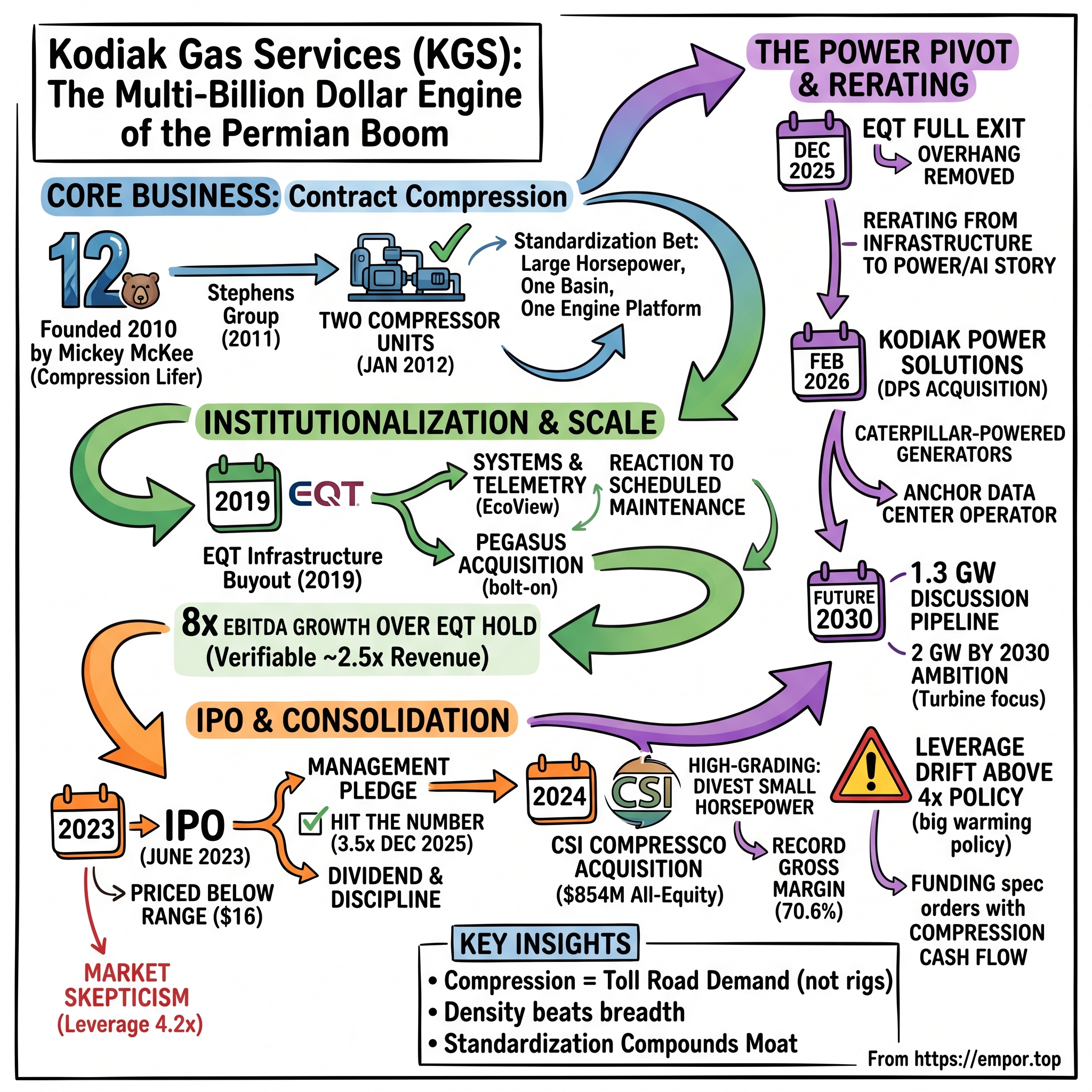
Kodiak Gas Services: The Multi-Billion Dollar Engine of the Permian Boom
I. Introduction & Episode Roadmap
On the morning of June 29, 2023, a Texas company with a bear on its logo rang the opening bell at the New York Stock Exchange and promptly got a lesson in market humility. Kodiak Gas Services had gone on the road asking for $19 to $22 a share. The book came back thin. Bankers cut the size, cut the price, and got the deal done at $16.00 — sixteen million shares, roughly $256 million of gross proceeds, a listing priced well below the range on a summer Thursday when nobody on Wall Street particularly wanted to own an oilfield services company.12
Three years later, in July 2026, the same shares changed hands in the mid-$60s. The company carried a market capitalization north of six billion dollars. To put a hard number on how recent the move was: in early December 2025, EQT's fund vehicle sold its final 9.76 million shares in an underwritten block at $34.60 apiece.3 Everything above that happened in roughly seven months.
So what changed? Not the machines. Kodiak still does the same unglamorous thing it did in 2012 — it owns big natural gas compressors, parks them at wellheads and gathering stations across West Texas, and charges customers a monthly fee to keep them running. The equipment is loud, heavy, and covered in a permanent film of caliche dust. There is no software subscription, no network effect, no consumer brand.
What changed is that the market slowly, and then very suddenly, stopped pricing Kodiak like an oilfield service vendor and started pricing it like infrastructure — and then, in early 2026, bolted an artificial-intelligence power story on top of it.
The unglamorous physics underneath
Before any of the finance makes sense, the machinery has to. Natural gas is not a liquid you pump; it is a compressible fluid that moves only when pushed from higher pressure to lower pressure. A brand-new shale well has enough reservoir pressure of its own to shove gas into a gathering line. Within months, that pressure falls. Within a couple of years, it can fall below the pressure in the pipeline the well is supposed to feed — and at that moment the well stops flowing, not because the gas is gone, but because it has nowhere lower to go.
A compressor fixes that. It is, in essence, a very large piston engine driving a very large pump: burn a slipstream of the produced gas to turn a crankshaft, use that crankshaft to squeeze the rest of the gas, and hand it off to the pipeline at a pressure high enough to travel. Think of it as the circulatory system's heart. The pipelines are arteries. Without something rhythmically pushing, the whole network is inert plumbing.
That is why compression behaves less like a service and more like a toll road. A producer can defer a frac crew, cancel a workover, renegotiate with a sand hauler. What a producer cannot do is switch off the compressor and keep selling gas. The demand is not correlated to drilling activity so much as to the installed base of wells that already exist and are already declining — which is a far more stable variable than the rig count.
The roadmap
This is a story in four movements.
The first is the founding: Robert "Mickey" McKee, a compression lifer, formed the Kodiak group of companies in May 2010, partnered with Little Rock's Stephens Group in June 2011, and set his first two compressor units in January 2012.4 The strategy from day one was narrow and slightly contrarian — big horsepower only, one basin, one engine platform.
The second is the institutionalization: in February 2019, EQT's infrastructure funds bought Kodiak from Stephens and spent nearly seven years turning a founder-run fleet operator into something that could survive public-market scrutiny.45
The third is the consolidation: six months after that discounted IPO, Kodiak announced an $854 million all-equity acquisition of its listed rival CSI Compressco — a deal that doubled down on scale at precisely the moment the market was questioning whether Kodiak had too much debt already.6
The fourth, and by far the most contested, is the power pivot: on February 5, 2026, Kodiak agreed to pay approximately $675 million for Distributed Power Solutions, a fleet of Caterpillar-powered generators serving data centers and microgrids, closing the deal on April 1 and rebranding it Kodiak Power Solutions.7
Each of those movements is defensible on its own terms. Whether they add up to a durable compounder or a well-timed rerating on an AI narrative is the question this piece exists to test. The compression business is genuinely excellent and the evidence for that is unusually clean. The power business is genuinely new, largely uncontracted, and being funded with a capital program that management has openly said will push leverage above its own stated target.8 Both things are true at once, and an investor who only sees one of them is not looking hard enough.
Start with the machines.
 Subscribe on LinkedIn
II. Thermodynamics & The Outsourcing Boom: What is Contract Compression?
Stand in a Permian Basin gas gathering yard in August and the first thing you notice is the sound — a low, continuous industrial thrum that you feel in your sternum before you consciously hear it. The second thing is the heat coming off the coolers. The third, if you look closely, is that almost every skid on the pad wears somebody else's logo. The producer owns the wells and the pad. It does not own the machine keeping the pad alive.
That arrangement — contract compression — is the entire business.
Why the gas keeps coming even when the drilling stops
Two physical facts drive the demand curve, and both of them are more interesting than "drilling activity."
The first is pressure decline, described above. Every producing well in North America is, on a long enough timeline, a future compression customer. As reservoir pressure falls, the compression requirement per unit of gas rises. Squeezing gas from 40 psi up to pipeline pressure takes considerably more horsepower than squeezing it from 200 psi. So a maturing basin needs more horsepower per Mcf every year, mechanically, regardless of whether anyone drills another well.
The second is gas lift, and it is the reason the Permian in particular is a compression machine. The Permian is nominally an oil basin. But shale oil wells stop lifting their own liquids fairly quickly — the well fills with fluid that the reservoir can no longer push to surface. The standard remedy is to take high-pressure gas and inject it back down the annulus of the wellbore. The injected gas aerates the fluid column, makes it lighter, and the well starts producing again. That gas has to be compressed to be injected, then it comes back up mixed with the produced gas, and it has to be compressed again to be sold.
The consequence is structural: compression demand in the Permian is tied to the installed well count and the gas-oil ratio, not to the rig count. Gas-oil ratios in the basin have been climbing for years as the rock matures. On Kodiak's first-quarter 2026 call, McKee pointed directly at "increasing GORs in the Permian Basin" as a demand driver alongside new takeaway capacity.8 More gas per barrel means more horsepower per barrel, even in a flat-oil world.
That is the single most important structural claim in the bull case, and unlike most such claims it rests on geology rather than management enthusiasm.
The outsourcing decision
Why does a company the size of a major integrated producer rent its compressors instead of buying them?
Partly balance sheet, but mostly labour. A high-horsepower reciprocating gas engine is a machine with hundreds of moving parts running continuously in a hostile environment. It needs oil analysis, valve work, ignition tuning, emissions monitoring, and a mechanic who can diagnose a knock over the phone at 2 a.m. Building that capability in-house means hiring, training, and retaining a specialised workforce for an activity that generates zero incremental barrels.
Kodiak's pitch is that it does this at a scale nobody's internal team can match, with more than 700 Caterpillar-certified technicians on staff.7 The evidence that customers agree is not rhetorical — it is transactional. In the first quarter of 2026, Kodiak bought a package of large-horsepower units directly from a Permian producer and simultaneously signed a seven-year contract to operate them, deploying roughly $24 million of capital for about 20,000 horsepower.8 A producer that owned working compressors chose to sell them and rent them back. Asked about it on the call, McKee's framing was blunt: it is "really not a core competency for a lot of these customers to own and operate their own compression."8
That is the outsourcing thesis with a cash receipt attached, and it matters more than any slide deck. It also tells you something about the pricing environment — a producer only does a sale-leaseback if the operating economics beat ownership, and Kodiak only does it if the return clears its hurdle. Both parties think they won, which usually means the constraint being traded is neither capital nor equipment, but people.
The high-horsepower sweet spot
Not all compression is the same business. A small wellhead unit under 1,000 horsepower is a light, portable, low-capital asset that follows drilling activity around and comes off contract when a well is shut in. A large unit — the multi-megawatt Caterpillar 3600-series packages Kodiak favours — is a multi-million-dollar installation bolted to a concrete foundation at a central gathering point, wired into a station, and connected to pipelines in several directions.
Small horsepower is a rental business. Large horsepower is an infrastructure business. The distinction shows up in contract length, in churn, and in margin.
Kodiak has been deliberately, and somewhat counterintuitively, shrinking part of its revenue base to move further up that curve. Management has been selling non-core small-horsepower units even though, as McKee acknowledged on the Q1 2026 call, those units command a higher revenue rate per horsepower — just at a lower margin.8 The result is visible in a single metric: average horsepower per revenue-generating unit rose from 943 at the end of the first quarter of 2025 to 977 a year later, while peers' average unit size moved the other way.8
Selling revenue to buy margin and duration is a real capital-allocation choice with a real cost, and it is the kind of thing that shows up in results a year later rather than in a press release. It showed up.
The regulatory tailwind, honestly assessed
Emissions regulation is frequently cited as an outsourcing driver — modern fleets with telemetry are easier to permit and monitor than aging owner-operated iron, and Kodiak markets an emissions and equipment monitoring capability under the EcoView name. The mechanism is plausible: if compliance requires continuous data, an operator with a fleet-wide telemetry backbone has a cost advantage over one that does not.
But it is worth being precise about what is proven and what is asserted. What Kodiak has demonstrated with numbers is that real-time monitoring lowers its own costs — CFO John Griggs attributed a first-quarter 2026 reduction in compression parts expense directly to telemetry investment catching failures earlier.8 What has not been separately quantified in company disclosure is how much incremental business regulation has driven to Kodiak specifically. Treat the cost benefit as evidenced and the regulatory-share-gain argument as directionally sensible but unmeasured.
Which raises the obvious question: how did a company founded in 2010 end up owning the premium end of this market at all?
III. The Stephens Era & The Founding of Kodiak (2010–2019)
There is a version of the American energy origin story where the founder is a wildcatter with a geology degree and a hunch about a rock formation. Kodiak's is not that. Mickey McKee's founding insight was about fleets.
The operator who had already seen the movie
Before Kodiak, McKee spent 2003 to 2010 at CDM Resource Management, a contract compression company, where he ran sales and engineering and was responsible for the engineering and fleet management group — meaning he owned the relationships with the OEMs, the specification decisions on what equipment to buy, and the commercial job of selling the resulting horsepower.9
That is an unusual combination of seats. Most compression executives come up either through sales or through the shop. McKee sat at the junction, which is precisely the vantage point from which you can see the thing that later defined Kodiak: that the profitability of a compression fleet is determined years in advance, at the moment you decide what equipment to standardise on.
He formed the Kodiak group of companies in May 2010 and served as its President from formation, adding the chief executive title in 2019.49 The early going was not a rocket ship. It took until June 2011 to bring in an institutional backer, and until January 2012 to set the first two compressors in the field.4 Two units. That is the entire company at the start of 2012 — a founder, a plan, and two machines.
Why Stephens, and why it mattered
The Stephens Group, based in Little Rock, Arkansas, is a family-capital firm with a long institutional memory and a reputation for patience rather than for financial pyrotechnics. Backing a two-compressor startup in a capital-devouring asset class is a decision that only makes sense if you are underwriting the operator rather than the multiple.
The structural point is that compression is a business where growth consumes cash. Every new unit is capital out the door today against a contracted revenue stream that pays back over years. A fleet growing quickly will show ugly free cash flow no matter how good its unit economics are. That is an awkward profile for a lender and an impossible one for a public shareholder base that has not been taught how to read it — which is exactly the misunderstanding that would greet Kodiak at its IPO a decade later.
Under Stephens, Kodiak grew from two units to become, by the company's own account, the third-largest contract compression provider and the largest privately held one in the world within about five years.4 That growth was funded by capital that did not demand quarterly free cash flow, which is the entire value of a patient private owner in an asset-heavy business.
The standardisation bet
The strategic choice that separates Kodiak from a generic fleet roll-up was made early and never really revisited: build almost the entire fleet on one engine family.
Anyone who has run a mixed vehicle fleet understands the logic intuitively. Standardising on a single platform compounds in three directions at once.
Supply. A buyer that orders the same engine year after year in size becomes a priority customer to the manufacturer, which matters enormously when the manufacturer's order book is full. This is not theoretical. By the first quarter of 2026, lead times for the large-horsepower engines used in gas compression had stretched past 180 weeks — more than three years from order to delivery.8 In that environment, a supply relationship is not a procurement detail; it is the growth constraint.
Labour. A mechanic trained on one platform gets faster on it every year. A mechanic asked to service five platforms is a generalist forever. Kodiak has built this into an internal training operation it calls the Bears Academy and opened a new training facility in Midland in mid-2026, extending the curriculum to power and electrical work.8 The point of a training academy is not culture; it is that in a business where the scarce input is skilled hands, the ability to manufacture skilled hands internally is a genuine cost position.
Working capital. A single-platform fleet needs one set of spare parts. A mixed fleet needs several, sitting in warehouses across a basin, financed and depreciating.
The counter-argument — and it is real — is that standardisation is also concentration. A single-source dependency on one engine family is a supply-chain risk with no hedge. Asked directly on the Q1 2026 call whether Kodiak was looking beyond Caterpillar to secure engines, McKee's answer was notably about shop space and relationships rather than about diversifying platforms: he described locking up engines and packaging capacity through 2028 and working on 2029, but did not describe a second-source strategy.8 Investors should read the standardisation moat and the supplier-concentration risk as the same fact viewed from two sides.
By the back half of the 2010s, Kodiak had a fleet, a basin, a platform, and a service reputation. What it did not have was the balance sheet to press the advantage at the scale the Permian was about to demand. That problem got solved in February 2019.
IV. EQT's Infrastructure Playbook: Scaling 8x
When EQT's infrastructure funds acquired Kodiak from The Stephens Group in February 2019, the transaction was less an exit than a change of gearbox.4
EQT is a Stockholm-headquartered alternative asset manager whose infrastructure strategy is built around a specific thesis: that certain asset-heavy businesses which the market misfiles as "cyclical services" are actually contracted, essential, repeat-revenue infrastructure — and that the arbitrage is available to whoever is willing to fund them like infrastructure rather than like services. Toll roads, fibre, district heating, and — in this case — the machines that make gas move.
What institutional ownership actually bought
The visible change was capital velocity. Within seven months of the buyout, Kodiak announced the acquisition of Pegasus Optimization Managers, its first meaningful bolt-on under the new owner.4 That set the template: EQT was not there to harvest cash flow, it was there to buy horsepower.
The less visible change was infrastructure of a different kind — systems. Over the EQT period Kodiak consolidated onto an enterprise resource planning platform and built out the fleet telemetry backbone that it markets as EcoView. Describing that as an "AI transformation" would be overselling it. What it actually is, is more prosaic and more valuable: instrumenting every engine so that the company knows, continuously, what each machine is doing.
The reason that matters is a concept worth pausing on for non-industrial readers. In a maintenance-heavy business there are two ways to service a machine. Reactive: wait for it to break, then send a truck. Scheduled: service everything on a calendar whether it needs it or not. Both are expensive — the first in downtime and emergency parts, the second in unnecessary labour and parts consumed early. Continuous monitoring enables a third mode: intervene when the data says a specific component is degrading, and not before.
Kodiak's own numbers now support that this works. In the first quarter of 2026, compression parts expense fell as a direct result of telemetry-enabled monitoring reducing failures, and contract services adjusted gross margin reached 70.6% — the seventh consecutive quarterly increase and a company record.810 Seven consecutive quarters is the important part of that sentence. One quarter of margin expansion is weather. Seven is a process.
The scaling claim, examined
The private-equity narrative around this period is that Kodiak's revenue and EBITDA grew "over 8x" during EQT's hold. This is the kind of claim that deserves a sceptical look rather than a footnote, because it depends heavily on the starting point chosen and on whether acquired horsepower is treated as growth.
What the audited public record supports: Kodiak reported revenue of $532.4 million in 2020 and $1.31 billion in 2025 — roughly 2.5x over five years, achieved with the help of a major acquisition along the way.1112 The pre-2020 figures that would anchor an 8x calculation are not in the public filings, because the company was private. Investors should treat the 8x figure as a sponsor's characterisation of a period that is not fully disclosed, and anchor on the verifiable path instead: a business that roughly two-and-a-half-folded revenue over five years and, more importantly, expanded margins while doing it.
The margin point is the one that survives scrutiny. Growing revenue by buying assets is easy. Growing revenue while gross margin climbs seven quarters in a row means the incremental horsepower is being run better than the base, which is the difference between accumulation and compounding.
The concentration decision
The other durable legacy of the EQT era is geographic. Kodiak concentrated in the Permian rather than spreading across the Appalachian, Bakken, and Haynesville plays, and by the CSI transaction it had over 2.8 million horsepower in the Permian alone.6
Concentration is usually a word investors flinch at. Here it is the source of the cost advantage, for a reason that is almost embarrassingly simple: a technician's day is mostly driving. If a technician can service four units in a day because they are twenty minutes apart, the labour cost per unit is a quarter of what it is for a competitor whose units are two hours apart. Density does not just improve margins; it improves response time, which is what customers actually buy.
The risk is equally simple and should be stated plainly: a Permian-specific shock — takeaway constraints collapsing in-basin gas prices, a regulatory event, a sustained collapse in oil prices that idles the basin — hits Kodiak harder than a diversified competitor. Kodiak has bought operating leverage with geographic risk. Through 2026 that trade has paid. It is not a trade that pays in every state of the world.
By 2023, EQT had built what it wanted: the largest large-horsepower compression fleet in the country, concentrated where the gas was, running on instrumented iron. What it needed next was a way out.
V. The June 2023 IPO & Combating Market Skepticism
The IPO did not go well, and the reason it did not go well is the most analytically interesting thing about it.
A deal that priced into a closed window
Kodiak had marketed the offering at $19 to $22. It priced 16 million shares at $16.00 — below the range — for roughly $256 million of gross proceeds, with a 30-day underwriter option on an additional 2.4 million shares. Trading began on the NYSE on June 29, 2023, and the offering closed on July 3.12
Pricing below range is a specific market signal. It says the order book did not fill at the price the sellers wanted, which in mid-2023 was not entirely idiosyncratic — the energy IPO window was effectively shut and generalist funds had spent the better part of a decade being punished for owning oilfield services.
But there was a company-specific objection too, and it was a fair one.
The leverage problem
Kodiak came public levered. Griggs later put the number precisely on the record: leverage was 4.2x at the time of the IPO.8 For a business the market filed under "oilfield services" — cyclical, capital-intensive, activity-dependent — 4.2x looked aggressive bordering on reckless. For a business filed under "contracted midstream infrastructure," 4.2x looked ordinary.
The entire equity story from 2023 onward is the argument between those two filings.
The debt itself was not a mistake in the ordinary sense; it was the residue of a growth programme. Every dollar of it had gone into revenue-generating horsepower under contract. But a public shareholder base does not extend credit for intent. It wants to see the leverage come down.
The pledge
McKee and Griggs responded with a playbook that was notable mostly for being specific, dated, and falsifiable — three qualities that are rarer in investor communication than they should be.
The commitment made at the IPO was to reduce leverage from 4.2x to 3.5x by the end of 2025.8 Not "over time." Not "as market conditions permit." A number and a deadline.
Alongside it came a dividend — an unusual choice for a levered growth company, and a deliberate signal. Paying a substantial, growing quarterly dividend while deleveraging is a public commitment device: it removes the option of quietly spending the cash on something else. The dividend reached $0.49 per share by the first quarter of 2026, and management disclosed a coverage ratio of 2.9x against discretionary cash flow — meaning the payout consumed roughly a third of the cash the business generated after maintenance spending.10
The third leg was capital discipline: growth capital directed only at contracted large-horsepower projects. That constraint is easy to state and hard to keep, and it is the one worth watching most closely, because — as Section VIII will show — Kodiak has since chosen to relax it in a new business line.
What actually happened to the promise
Here is the part that matters for assessing management credibility, and it deserves to be said without decoration: they hit the number on the date. Kodiak's credit agreement leverage ratio was 3.5x as of December 31, 2025 — the exact target, in the exact quarter promised, roughly thirty months after the commitment was made.12
That is a meaningful data point in a sector where guidance discipline is not the norm. Griggs has since gone back to it repeatedly and unprompted as a reference for the company's newer promises — on the Q1 2026 call he volunteered the history explicitly: leverage was 4.2x at the IPO, the commitment was 3.5x by end-2025, "and we did on target."8
An investor should register both halves of that. Management earned credibility by delivering a hard, dated target. Management is now spending that credibility to ask for permission to lever back up. Whether that is a fair trade depends entirely on what they levered up to buy — which, in December 2023, was a competitor.
VI. Benchmarking the Big M&A: The CSI Compressco Acquisition
Six months after an IPO that priced below range because investors thought the balance sheet was stretched, Kodiak announced it was buying a company with $619 million of net debt attached.
The timing was either tone-deaf or extremely well calculated. It turned out to be the latter, but the reasoning is worth walking through carefully rather than accepting the outcome as proof of the process.
The terms
On December 19, 2023, Kodiak agreed to acquire CSI Compressco LP in an all-equity transaction valued at approximately $854 million including the assumption of $619 million of net debt, based on Kodiak's December 18 closing price. CSI unitholders received 0.086 Kodiak shares per common unit — about $1.65 per unit — and ended up owning roughly 14% of the combined company on a fully diluted basis.6
The combination created the industry's largest contract compression fleet at approximately 4.3 million revenue-generating horsepower, with over 2.8 million horsepower in the Permian. CSI brought roughly 1.2 million horsepower across about 4,800 compressor packages, plus complementary lines in gas treating and aftermarket services. Management identified at least $20 million of annual run-rate cost synergies and told investors the transaction would be leverage-neutral after synergies while preserving the 3.0–3.5x year-end 2025 target.6
The deal closed on April 1, 2024.13
Why all-equity was the right currency — and the honest objection
Using stock to buy a company is, in the standard framework, a signal that management thinks its own shares are expensive. Kodiak's shares in December 2023 were not obviously expensive; they were trading not far from a discounted IPO price.
The better reading is that all-equity was a balance sheet decision rather than a valuation decision. Kodiak had made a public promise about leverage. Paying cash — or worse, raising debt — would have broken it in the first year. Paying in shares transferred the dilution to existing holders but kept the deleveraging commitment intact.
That is a defensible trade, and it is also exactly the sort of thing an activist would push back on. The pushback would go: you diluted existing shareholders by roughly 14% at a depressed share price in order to protect a leverage metric, and the shares subsequently quadrupled. In hindsight, cash or debt would have been dramatically cheaper capital.
That criticism is analytically valid and worth holding. The counter is that a company thirty months from a credibility-testing IPO promise does not get to optimise for hindsight, and that breaking the leverage pledge in year one would have cost more than 14% of the equity in permanently impaired investor trust. Reasonable people can disagree. What is not disputable is that the choice was consistent with the stated strategy, which is the standard by which management narrative discipline should be judged.
The structural logic
Set the financing aside and the industrial case was strong.
Contract compression is a business where density and scale compound. CSI's horsepower sat largely in the same basins Kodiak already covered, which meant the incremental units could be absorbed into existing service routes — the marginal cost of servicing a unit that is already on a technician's daily loop approaches zero. That is why the $20 million synergy number, which looks modest against an $854 million transaction, understates the value: route density improvements show up in gross margin rather than in a synergy line item.
The complementary businesses mattered too. Gas treating — removing hydrogen sulphide and carbon dioxide so gas meets pipeline specification — and aftermarket services gave Kodiak more of the wellsite scope, which is the classic path from vendor to embedded infrastructure partner.
High-grading the acquired fleet
The most instructive part of the integration is what Kodiak did not keep.
CSI's fleet skewed smaller-horsepower than Kodiak's. Rather than run it, Kodiak began systematically divesting non-core small units — the same programme discussed in Section II that pushed average unit size from 943 to 977 horsepower.8 Proceeds went toward the debt that came with the deal.
This is worth naming for what it is: buying a company and then selling roughly the part of it that does not fit is a genuinely disciplined act, and a rarer one than it sounds. The standard acquirer keeps everything, because divesting looks like admitting the deal was smaller than advertised. Kodiak took the optics hit — accepting lower headline revenue-per-horsepower — in exchange for a structurally better fleet.
The proof arrived in the margin line. Contract services adjusted gross margin reached 69.2% in the fourth quarter of 2025 and 68.4% for the full year, then 70.6% in the first quarter of 2026.1210 A fleet that was diluted by an acquisition in 2024 was running at record margins by 2026. That sequence is difficult to produce by accident.
Which brings the story to the part where the private-equity owner finally walked out the door.
VII. The EQT Sell-Down and Deleveraging Masterclass (2024–2025)
Every private-equity-backed IPO carries the same shadow: the sponsor still owns most of the company, everybody knows the sponsor is leaving, and nobody wants to buy shares in front of a seller.
Kodiak entered 2025 with EQT affiliates holding approximately 43.1% of the stock.12 That is an enormous overhang. It functions as a ceiling on the multiple, because any investor doing the work knows that several hundred million dollars of supply is coming and has no reason to pay up ahead of it.
The exit, executed
Over the course of 2025, EQT's vehicles — primarily Frontier TopCo Partnership — worked through the position via a series of underwritten secondary offerings and Rule 144 sales, disposing of approximately 38.5 million shares in non-dilutive transactions from which Kodiak itself received no proceeds.12 The final block came in early December 2025: 9,762,573 shares at $34.60, raising about $335.5 million.3 By December 2, 2025, the position was zero, and EQT publicly confirmed the full exit on December 11, closing out a partnership of nearly seven years and the first IPO out of its infrastructure platform.14
The operating performance underneath
The sell-down worked because the fundamentals gave buyers something to underwrite.
Full-year 2025 revenue grew 13% to $1.31 billion and adjusted EBITDA grew 17% to $715 million — EBITDA growing meaningfully faster than revenue, which is the signature of margin expansion rather than volume expansion.12 Free cash flow was $229.6 million after growth investment, and the company returned $263 million to shareholders through dividends and repurchases across the year.12
Two of those figures sit uncomfortably together and should be flagged rather than smoothed over: Kodiak returned $263 million while generating $229.6 million of free cash flow. Returning more than free cash flow in a year is not automatically imprudent — it can reflect divestiture proceeds and balance sheet capacity — but it is the kind of thing that only works while leverage is falling for other reasons. It is not a repeatable formula, and management has not presented it as one.
The leverage target was met exactly, as covered above. Fleet utilisation ended the year at 97.7% on 4.35 million revenue-generating horsepower.12 Utilisation near 98% in an asset-heavy business essentially means the fleet is sold out; the binding constraint on growth is not demand, it is how fast new machines can be obtained.
The rerating — and what actually caused it
Here the popular narrative and the price history diverge, and the divergence is instructive.
The tidy story says removing the sponsor overhang caused the rerating. The dates do not support it. EQT's last shares cleared at $34.60 in December 2025, well after the deleveraging target was visibly on track and the operating record was established.3 The move from the mid-$30s to the mid-$60s came in the first half of 2026 — after the Distributed Power Solutions announcement on February 5, 2026, and after the first-quarter results and expanded power guidance on May 11.710
The honest read: the sponsor exit and the deleveraging removed the discount, allowing Kodiak to be valued as infrastructure rather than as levered oilfield services. The power pivot supplied the premium on top. Those are two different rerating events with two very different risk profiles, and conflating them is how investors end up owning a growth story while believing they own a yield story.
The compression business earned its multiple. The power business has been granted one in advance.
VIII. The Next Frontier: Kodiak Power Solutions & AI Data Center Demand (2026)
The most consequential fact about the American electricity grid in 2026 is that it cannot connect new load fast enough. Utilities in the fastest-growing regions have been quoting large industrial customers interconnection timelines measured in years. For a hyperscaler racing to stand up AI compute capacity, a five-year wait for grid power is not an inconvenience; it is a competitive death sentence.
Somebody was going to sell them electricity in the meantime.
The transaction
On February 5, 2026, Kodiak announced an agreement to acquire Distributed Power Solutions, LLC for approximately $675 million — $575 million in cash plus 2,401,278 Kodiak shares valued at roughly $100 million. DPS brought approximately 384 megawatts of Caterpillar-powered distributed generation, a mix of reciprocating engines and turbines. Kodiak put the price at 7.4x estimated full-year 2026 adjusted EBITDA and expected the deal to be immediately accretive to earnings and discretionary cash flow per share.7
Crucially, DPS was not a concept. It carried an operating anchor: roughly 100 megawatts serving a major data center operator, an islanded primary-power contract that McKee later described on the earnings call as being in its third year of operation and delivering on a 99.9% reliability guarantee.78 DPS President Scott Milligan framed the sale as a platform decision — a business that had built a fleet and an operating capability but needed a larger owner to scale it.7
The deal closed April 1, 2026, and the business now goes to market as Kodiak Power Solutions.8
Why it isn't as strange as it sounds
Behind-the-meter generation means exactly what it says: instead of drawing power from the grid, the customer generates it on site. In this case, by burning natural gas in reciprocating engines or industrial turbines to spin generators — the same physics as any power plant, just distributed, modular, and fast to deploy.
For Kodiak, the mechanical overlap is the whole argument. A Caterpillar reciprocating engine driving a compressor and a Caterpillar reciprocating engine driving a generator are, from a maintenance perspective, close cousins. Same combustion, same valve trains, same oil analysis, same failure modes, same parts catalogue, and — critically — the same certified technicians. Kodiak already employs more than 700 of them.7
That is a genuine adjacency, and it distinguishes this from the more common pattern of an industrial company buying its way into a hot sector with no operating relationship to what it already does. The competence being transferred — keeping large gas engines running at very high availability, with parts and people positioned to respond — is precisely the competence the customer is buying.
There is a further reason it fits: the failure standard is similar. Compression customers buy uptime because downtime means deferred gas sales. Data center customers buy uptime because downtime means a stopped training run. Both are businesses where 99% is a failing grade.
The plan, and its size
What Kodiak announced on May 11, 2026 was considerably more ambitious than the acquisition itself, and this is where the risk profile changes.
Management disclosed orders for more than 260 megawatts of additional generation capacity beyond the acquired fleet — roughly 50/50 reciprocating engines and turbines — with about 61 megawatts arriving in 2026 and the remainder between 2027 and 2029. It described advanced discussions with multiple counterparties for a further 1.3 gigawatts on a broadly ratable schedule through the end of the decade. The stated target: 300 to 500 megawatts of additions per year through 2030, reaching roughly 2 gigawatts of distributed power capacity by year-end 2030, weighted toward turbines — approximately 25% reciprocating and 75% turbine — because turbines offer greater power density for the 200-to-300 megawatt data center projects Kodiak is pursuing.8
The economics management put forward: equipment at roughly $1.1–1.2 million per megawatt, plus balance-of-plant bringing the all-in figure to about $1.5 million per megawatt, targeting unlevered returns above 15% and EBITDA build multiples around 5x — comparable to compression, with longer contract duration.8 Contract terms under discussion run 10 to 15 years, frequently with extension options.8
The uncomfortable part
Now the part a promotional treatment would skip.
Kodiak is ordering this equipment substantially ahead of contracts. Asked directly by an analyst whether the incremental megawatts were pre-contracted or ordered on spec, McKee's answer was candid: it is "more of an educated type of, I guess, guess," informed by the inbound pipeline, with contracts expected to follow over the subsequent months.8
That is a materially different capital allocation posture than the one Kodiak sold at its IPO, where growth capital went only into fully contracted projects. Management is not hiding it. Griggs told investors plainly that leverage should be expected to "drift above our 4x long-term leverage target," describing it as periodic and temporary while the foundation is built.8 The scale is real: 2026 power growth capital expenditure guidance of $400–500 million against compression growth capital expenditure of $245–275 million.8 The new business, in its first partial year, is set to consume more growth capital than the business that generates essentially all the cash.
Set against that, three mitigations deserve weight. First, the equipment being bought is genuinely scarce — in a market with multi-year lead times, holding delivery slots is itself a commercial asset, and ordering ahead of contracts may be the only way to have anything to sell. Second, Kodiak has an operating precedent for buying scarce iron ahead of demand and filling it, which is essentially what it has done in compression for a decade. Third, Griggs was explicit that the compression business — with what he called extremely limited exposure to near-term commodity price moves — is the funding source.8
Against those: the demand estimates management cited on the call, including hyperscaler AI-related capital spending potentially exceeding $5 trillion through 2030 and over 30 gigawatts of planned data centers in Texas, are third-party projections, not contracted backlog.8 The distinction between a total addressable market and a signed contract is the distinction that determines whether this capital cycle creates value or destroys it.
Sizing it honestly
For 2026, Kodiak guided the new Power Infrastructure segment to full-year revenue of $95–125 million at a 60–70% adjusted gross margin, against total company adjusted EBITDA guidance of $820–860 million.8 Power is, this year, a rounding error on earnings and a very large number on the capital account.
Griggs was refreshingly direct about why the power margin range is so wide: Kodiak had owned the business five weeks; DPS had deliberately kept much of its fleet on short-term contracts precisely so it could redeploy capacity into a large long-term deal if one landed; and Kodiak wants to preserve that flexibility rather than optimise near-term margin.8 That is a coherent explanation rather than an evasion, and the willingness to guide wide instead of guiding precisely and missing is consistent with how this management team has behaved since the IPO.
So the honest characterisation is this: contract compression remains the company — the cash, the margin, the contracted duration, and the credit quality. Kodiak Power Solutions is a call option, funded with the compression business's balance sheet, on a demand thesis that is highly credible in aggregate and almost entirely uncontracted in the specific.
The valuation has already priced a fair amount of that option. Which makes the durability of the underlying compression franchise the thing that matters most.
IX. Competitive Moat Analysis: 7 Powers & Porter's 5 Forces
Strip away the AI narrative and ask the foundational question: if compression is such a good business, why hasn't capital flooded in and competed the margins away?
The answer is a stack of interlocking constraints, and it is worth being disciplined about which are durable and which merely reflect the current cycle.
Hamilton Helmer's 7 Powers, applied
Cornered Resource — engine allocation. The single most powerful barrier in this industry right now is not capital. It is delivery slots. Lead times for the large-horsepower engines used in gas compression exceeded 180 weeks by early 2026, and packaging shop capacity — the yards that assemble engines and compressors into deliverable units — is booked out on a comparable timeline.8 A new entrant with unlimited funding still cannot buy horsepower before 2029. Kodiak, by contrast, has 2027 and 2028 fully secured and is working on 2029.8
The critical caveat: this is a cycle-dependent cornered resource. Supply constraints are, historically, self-correcting — manufacturers add capacity, and the moat that looked structural in year three of a boom looks ordinary in year seven. McKee's own view, offered on the Q1 2026 call, is that demand will continue to outstrip supply "for the foreseeable future."8 That is a management forecast, not a fact, and an investor underwriting Kodiak's growth path is implicitly underwriting it.
Scale Economies — geographic density. Covered in Section IV: clustered assets convert directly into lower cost per unit and faster response. This is durable in a way the supply constraint is not, because it is a function of Kodiak's installed base rather than of the manufacturing cycle. It also compounds — winning the next contract in a dense area is cheaper to serve than the last one, so the density advantage widens with share.
High Switching Costs. A large compression package is a multi-million-dollar installation on a foundation, tied into pipelines. Replacing it means disconnecting, craning out, craning in, re-tying, and commissioning — during which the customer's gas is not flowing and revenue is not being earned. The cost of switching is dominated not by the equipment but by the deferred production.
The evidence that customers behave accordingly is in the contract terms. Kodiak signed a ten-year compression services contract extension with a top customer during the first quarter of 2026 and was finalising another ten-year extension with a second top customer.8 Ten-year terms in an oilfield services relationship are not normal. They are how customers behave toward infrastructure.
Process Power — an emerging fourth. Seven consecutive quarters of gross margin expansion in a business with no pricing monopoly is the signature of an operating system rather than a market condition. It is the least visible of Kodiak's advantages and possibly the hardest to copy, because it is embodied in trained people, instrumented iron, and integrated data systems rather than in any single asset. Management is extending it — including a planned rollout of large language model tooling to help technicians with parts location and troubleshooting in the second half of 2026.8 Whether that delivers is unproven; the seven quarters that preceded it are not.
Porter's Five Forces
Supplier power: high, and the principal structural vulnerability. When a supplier's order book is three years long, the supplier sets terms. Kodiak's mitigation is being a large, predictable, long-standing buyer — but this is a relationship advantage, not a contractual one, and it does not eliminate the exposure.
Buyer power: moderate, and improving in Kodiak's favour. Customers are large and sophisticated. But they need gas to flow, cannot switch cheaply, and are increasingly lengthening contracts to lock in equipment availability. The most telling evidence of the balance of power is the pricing outcome: Kodiak realised a 3.7% year-over-year price increase to $23.31 per ending revenue-generating horsepower in the first quarter of 2026, and management expects pricing strength to continue into 2027.8 Raising price to sophisticated industrial buyers in consecutive years is a hard test, and it is being passed.
Threat of new entrants: very low, currently. Capital intensity plus equipment scarcity plus the need for a trained technician base plus the customer's reluctance to hand mission-critical uptime to an unproven operator. The barrier is real. Its most binding component is cyclical.
Threat of substitutes: low but non-zero. Electric-drive compression is the alternative — cleaner and cheaper to run where high-voltage power exists. In remote oilfields it frequently does not, and the AI power crunch has made grid access scarcer. McKee noted on the Q1 2026 call that compression has been "moving away from electric" because of grid access.8 Neatly, the same phenomenon driving Kodiak's power business is suppressing the main substitute for its compression business.
Rivalry: consolidating, and rational. The industry has fewer, larger players following Kodiak's own consolidation, and the binding constraint on all of them is supply rather than demand. Constrained supply plus rational participants produces price discipline — which is exactly what the pricing data shows.
The competitive position, summarised
The compression moat is genuine and multi-layered, with one durable pillar (density and process), one strong pillar (switching costs), and one powerful but cycle-dependent pillar (equipment scarcity). An investor should size the position with the awareness that the pillar currently generating the most excitement is the one most likely to erode.
The power business, by contrast, has essentially none of these protections yet. Kodiak competes there against independent power producers, equipment lessors, and well-capitalised specialists, with no installed base, no density, and no switching costs — only the operating capability and the same equipment scarcity that everyone else faces. McKee's answer when an analyst asked how Kodiak wins that business was, fairly, that it would compete on the same service and uptime basis it always has.8 That is a reasonable plan. It is not yet a moat.
X. The Kodiak Playbook: Key Strategic & Investing Lessons
Three transferable lessons come out of this history, and each has a limit worth naming alongside it.
Lesson 1: Standardisation is a compounding decision made once. The choice to build on a single engine platform looked like a constraint in 2012 and looks like a moat in 2026. It produced supplier priority, faster mechanics, and leaner inventory — three advantages that reinforce each other over a decade and cannot be replicated quickly by a competitor that chose flexibility instead.
The limit: standardisation and single-source dependency are the same decision. Kodiak has no disclosed second-source strategy for its core engine platform. In a supply disruption, the advantage inverts.
Lesson 2: Density beats breadth in any business where the cost is a person in a truck. Concentrating in one basin rather than spreading across five produced structurally better margins and better service, and it is why an acquired fleet could be absorbed at improving rather than diluting margins.
The limit: density is correlated risk. A basin-specific shock has no offset in this portfolio.
Lesson 3: Adjacency is defined by capability, not by end market. The most seductive error in corporate strategy is chasing a hot end market with capabilities that do not transfer. Kodiak's move into distributed power passes the capability test — same engines, same technicians, same parts, same uptime standard — which is more than can be said for most diversifications announced into an AI narrative.
The limit: passing the capability test is necessary, not sufficient. Kodiak is transferring an operating capability into a market where it has no commercial position, no installed base, and no contracted backlog for the capacity it is buying. Capability adjacency tells you the company can run the assets. It does not tell you it can fill them at the returns it has underwritten. That question resolves over the next several quarters, in signed contracts.
A fourth lesson, less about strategy than about communication: specific, dated, falsifiable targets are the cheapest credibility a management team can buy, and the most expensive to fake. Kodiak said 3.5x by the end of 2025 and delivered 3.5x at the end of 2025. That single fact is doing an enormous amount of work in how investors are currently receiving a much more speculative capital programme.
XI. The Investment Case: Bull vs. Bear & Risk Radar
The risk radar
Supply chain — the constraint that cuts both ways. Kodiak's growth path depends on receiving equipment on schedule. With engine lead times past three years and packaging capacity booked out comparably, any slippage directly caps growth.8 The same scarcity that protects the moat means Kodiak has no ability to accelerate if demand surprises to the upside, and no alternative supplier if a delivery slips. Turbine procurement for the power business adds a second, less familiar supply chain with, as Griggs noted, larger upfront progress payments than compression requires.8
Capital allocation and leverage — the live issue. This is the risk that has actually changed. A company that spent thirty months earning credibility by deleveraging has committed to a power capital programme of $400–500 million in 2026 alone and has told investors leverage will move above its 4x long-term target.8 Net debt stood at $2.7 billion at the end of the first quarter of 2026, with credit agreement leverage at 3.6x.10 Kodiak has termed out debt sensibly — issuing $1 billion of senior notes due 2031 at 5.875% in February 2026 and using proceeds to redeem the 2029 notes and pay down the revolver — so refinancing risk is manageable in the near term.10 The risk is not the debt structure. It is that the equipment being bought with it is not yet under contract.
Counterparty quality in the new business. Compression customers have consolidated into large, increasingly investment-grade producers — a credit profile that improved without Kodiak doing anything. The data center market is, in Griggs's own framing, "a much wider marketplace" of developers and end users, and he said counterparty credit would be baked into which contracts Kodiak pursues.8 The acknowledgment is appropriate. The exposure is real: a 15-year contract is only worth its duration if the counterparty survives it.
Permian concentration and takeaway. In-basin gas price weakness from pipeline bottlenecks can slow producer activity. The structural offset is that gas volumes must still be compressed to move at all, which is why compression demand has historically been more resilient than drilling activity. More than 5 Bcf/d of additional Permian takeaway capacity was expected online by the end of 2026, which management framed as a demand accelerant — customers asking whether they could pull forward 2027 equipment orders.8
The activist stress test. A sceptical investor would press on four things. First, the 14% dilution taken in the CSI transaction at a depressed share price. Second, the shift from "fully contracted growth capital" to ordering power equipment on an "educated guess" — a strategy change that deserves more explicit framing than it has received. Third, capital returns of $263 million against $229.6 million of free cash flow in 2025, immediately preceding a major capital programme.12 Fourth, and most fundamentally: the company is now two businesses with different risk profiles, different capital intensities, and different competitive positions, reported in segments only from 2026 — and conglomerate structures reliably trade at a discount unless the operating overlap is proven rather than asserted.
To management's credit, the disclosure response has been to increase granularity: separate segment reporting for compression and power, separately guided capital expenditure for each, and explicit warning about leverage drift.8 Investors will be able to check the power business's returns independently, which is exactly what should be demanded.
Why win
The case for Kodiak from here rests on the compression business being structurally better than the market historically believed, plus an option.
The compression evidence is unusually concrete. Utilisation at 98% means the fleet is effectively sold out.8 Pricing rose 3.7% year over year to $23.31 per horsepower with management expecting more.8 Gross margin expanded seven consecutive quarters to 70.6%.8 Customers signed ten-year extensions.8 Fully contracted 2026 deliveries with over 40% of 2027 deliveries already contracted.8 Growth is capped by supply, not demand, with a stated path to at least 5.2 million horsepower.8 Those are not narrative claims; they are operating facts that would be visible if they reversed.
Layer on gas-oil ratios rising in the Permian, LNG export demand pulling on Gulf Coast volumes, and grid scarcity pushing compression back toward gas drive rather than electric — and the base business has multiple independent demand drivers.
The option is power: 384 megawatts acquired, 260 ordered, 1.3 gigawatts in advanced discussion, a 2 gigawatt ambition by 2030, at target unlevered returns above 15%.78 If even a fraction converts into 10-to-15-year contracts at those returns, it is a large addition to a company currently guiding to $820–860 million of adjusted EBITDA.
Why not
The bear case does not require the compression business to break. It requires two more modest things.
First, the option costs more than it returns. Kodiak spends $400–500 million in 2026 and comparable sums annually thereafter, contracts arrive slower or at lower returns than the >15% unlevered target, leverage stays elevated, and the company ends up with a capital-hungry second business that dilutes the returns of an excellent first one. The base rate for industrial companies entering adjacent markets during a demand boom, ordering ahead of contracts, is not encouraging.
Second, the scarcity moat normalises. Manufacturers add capacity. Lead times compress from three years toward one. New entrants and existing peers add horsepower. Pricing power fades, and 70% gross margins prove to be a cycle peak rather than a structural level. Nothing in Kodiak's operating record prevents this; the process advantage would survive, but the pricing tailwind would not.
Third, and more remote, the grid catches up. If utility interconnection timelines shorten materially, behind-the-meter gas generation reverts to a bridge solution rather than permanent infrastructure. McKee's own account is that customer perception has moved the other way — from bridging to grid interconnection toward permanent supply, with expected wait times stretching from six-to-eight years to "maybe never."8 That is a customer-sentiment observation, not a regulatory fact, and it is the assumption most exposed to policy change.
The KPIs that actually matter
Three, and only three.
1. Contract services (compression infrastructure) adjusted gross margin. This is the cleanest read on whether the operating machine is still improving. It rose seven consecutive quarters to 70.6% in the first quarter of 2026, and management guided the full year to 68.5–70%.8 Sustained readings at or above the guided range confirm the process advantage is real and durable. A rollover — particularly one not explained by input costs like lube oil and fuel — would be the earliest signal that the moat is a cycle.
2. Contracted megawatts in the power business. Not ordered megawatts, not megawatts in discussion — signed, long-duration contracts. Kodiak has committed capital ahead of contracts and promised quarterly updates.8 The conversion rate from the 1.3 gigawatt discussion pipeline into executed 10-to-15-year agreements at the stated return threshold is the single variable that determines whether the power pivot creates or destroys value.
3. Net debt to adjusted EBITDA against the 4x policy. Management has pre-announced that leverage will drift above 4x temporarily during the build phase and then delever as contracts season.8 The number to watch is not the peak but the shape: how high, how long, and whether the promised deleveraging arrives on the schedule described — because this is precisely the promise structure Kodiak has kept before, which makes it a fair test of whether the credibility earned between 2023 and 2025 is still being honoured.
Fleet utilisation is worth a glance — it has run near 98% and any sustained move below 95% would signal demand softening — but at current levels it is a confirmation metric rather than a leading one.812
XII. Epilogue
There is a particular kind of business that the public markets are structurally bad at pricing: capital-intensive, unglamorous, contracted, and situated inside an industry that carries a cyclical label. The label does the pricing. The contracts do the earning. Occasionally the gap between the two is wide enough to matter.
Kodiak spent three years closing that gap. It came public at a discount because it looked like oilfield services, and then it methodically produced the evidence of something else — leverage down to a promised number on a promised date, margins up seven quarters in a row, utilisation effectively at capacity, customers signing ten-year terms, and a fleet high-graded by selling the parts of an acquisition that did not fit. None of that was narrative. All of it was checkable.
Having earned that revaluation, the company has now put a portion of it at risk on purpose. The distributed power business is a genuine capability adjacency into one of the largest infrastructure demand shocks in a generation, and it is also several hundred million dollars a year of equipment ordered ahead of the contracts meant to fill it, funded by a balance sheet that management has said will stretch. That is not a criticism; it is a description. Management has been notably candid that this is what they are doing and why.
What makes Kodiak worth following is that both stories are now running at once, and they will resolve on different clocks. The compression business reports its verdict every quarter in a margin line. The power business will report its verdict in signed contracts, over years. The company that built its credibility on hitting a specific number by a specific date has taken on a promise that is far harder to keep and far harder to check.
The bear on the logo was always a strange fit for a business about pressure and airflow. It fits the current chapter better: something large and patient that has been very good at surviving in a hard place, now walking into unfamiliar country because that is where the food is.
References
-
Kodiak Gas Services, Inc. Prices Initial Public Offering — Kodiak Gas Services Investor Relations, 2023-06-28 ↩↩
-
Kodiak Gas Services prices compressed IPO well below the range at $16 — Renaissance Capital, 2023-06-29 ↩↩
-
EQT exits remaining stake in Kodiak Gas Services, a leading provider of natural gas contract compression services in the United States — PR Newswire, 2025-12-11 ↩↩↩
-
Kodiak Gas Services, Inc. — Form 10-K for fiscal year 2025, SEC EDGAR, 2026-02-26 ↩
-
Kodiak Gas Services, Inc. to Acquire CSI Compressco LP in an $854 Million All-Equity Transaction — Kodiak Gas Services Investor Relations, 2023-12-19 ↩↩↩↩
-
Kodiak Gas Services to Acquire Distributed Power Solutions — Kodiak Gas Services Investor Relations, 2026-02-05 ↩↩↩↩↩↩↩↩
-
Kodiak Gas Services, Inc. (NYSE:KGS) Q1 2026 Earnings Call Transcript — Insider Monkey, 2026-05-11 ↩↩↩↩↩↩↩↩↩↩↩↩↩↩↩↩↩↩↩↩↩↩↩↩↩↩↩↩↩↩↩↩↩↩↩↩↩↩↩↩↩↩↩↩↩↩↩↩↩↩↩↩↩
-
Kodiak Gas Services, Inc. press release dated May 11, 2026 (First Quarter 2026 Results) — SEC EDGAR ↩↩↩↩↩↩
-
Kodiak Gas Services, Inc. — Form S-1/A (IPO Prospectus), SEC EDGAR, 2023-06-20 ↩
-
Kodiak Gas Services Reports Fourth Quarter and Full Year 2025 Financial Results; Provides Full Year 2026 Guidance — Kodiak Gas Services Investor Relations, 2026-02-26 ↩↩↩↩↩↩↩↩↩↩
-
Kodiak Gas Services, Inc. Announces Completion of CSI Compressco LP Acquisition — Kodiak Gas Services Investor Relations, 2024-04-01 ↩
-
EQT exits remaining stake in Kodiak Gas Services — EQT Group, 2025-12-11 ↩
 LinkedIn
 WhatsApp
 Reddit
 Hacker News
 Email
Email Kindle
 RSS Feed
 Spotify
 Apple Podcasts
 Amazon Music
 Audible
 YouTube