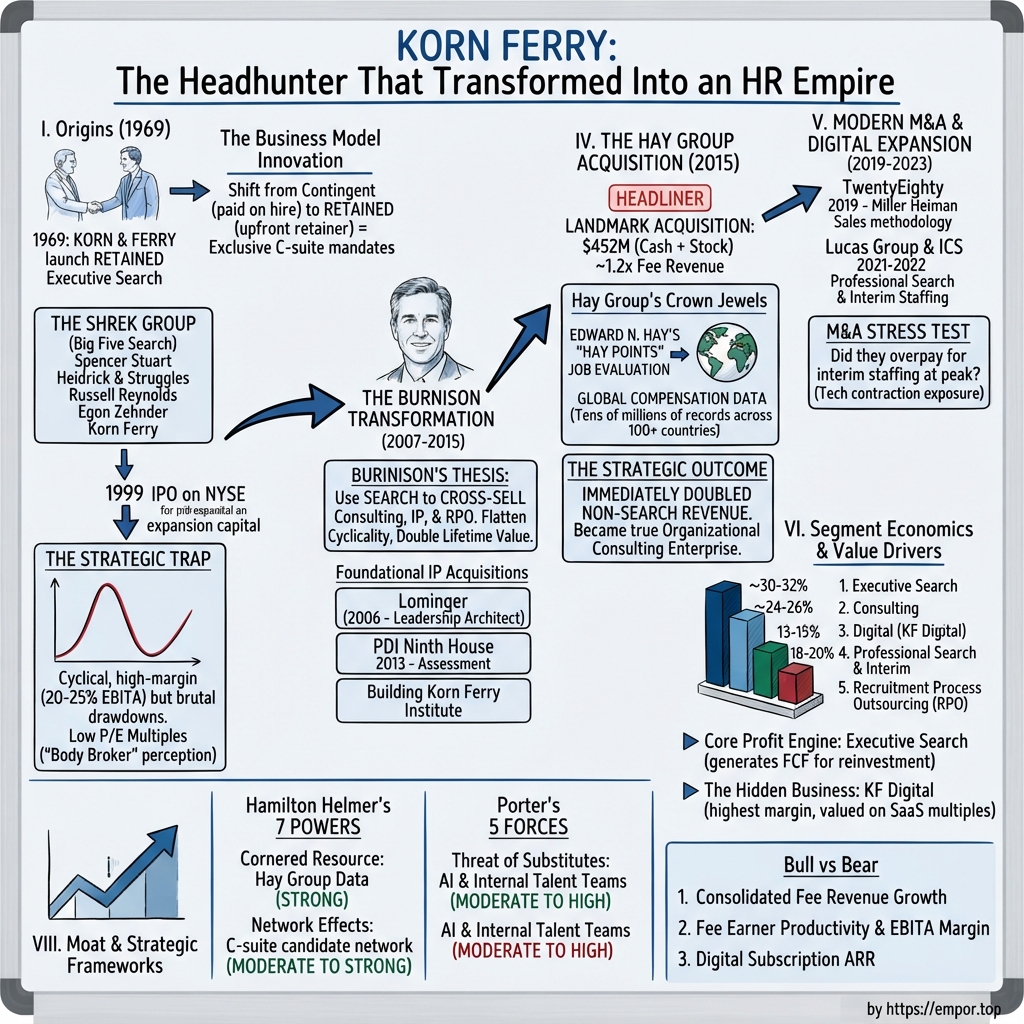
Korn Ferry: The Headhunter That Transformed Into an HR Empire
I. Introduction & Episode Roadmap [08 Mins | 00:00 - 08:00]
On June 29, 2026, a company that began in 1969 as two accountants with a Rolodex in a rented Century City office agreed to write the largest check in its history. Korn Ferry announced a definitive agreement to acquire AMS — the London-based recruitment outsourcing firm formerly known as Alexander Mann Solutions — from OMERS Private Equity for approximately £850 million, or about $1.1 billion, in cash and stock.1 The transaction was more than twice the size of the Hay Group acquisition that defined the firm's prior decade, aiming squarely at the operational engine of the talent industry: managing corporate hiring functions at scale under multi-year contracts.
That is a striking evolution for a firm whose name historically conjured wood-paneled boardrooms and discreet outreach to sitting chief executives.
The central question facing investors in NYSE: KFY is straightforward to state yet complex to resolve. Is Korn Ferry fundamentally a cyclical executive search firm operating under the banner of a high-margin consultancy — a business vulnerable to a sharp pullback in corporate hiring? Or has management, led by chief executive Gary Burnison since 2007, built a structurally distinct enterprise: a data-and-IP business driven by recurring contracts, anchored by an executive search franchise that generates unparalleled C-suite access?
The financial evidence supports aspects of both arguments.
Consider the undisputed operational performance. For fiscal 2026, ended April 30, 2026, Korn Ferry reported fee revenue of $2.91 billion, up 6.5% year over year, adjusted EBITDA of $497.8 million at a 17.1% margin, and net income of $277.4 million.2 Adjusted diluted earnings per share reached $5.28.2 Executive search — the legacy core — generated $924.1 million, representing less than a third of total fee revenue.2 The remaining $2 billion stemmed from consulting, digital IP subscriptions, professional search, interim staffing, and recruitment process outsourcing. On the fourth-quarter earnings call, chief financial officer Robert Rozek highlighted five consecutive quarters of top-line growth in an industry where competitors "continue to contract or just performing less worse."3
Yet public markets remain skeptical. Trading at $84.19 per share in mid-August 2026, Korn Ferry carried a market capitalization of roughly $4.3 billion — representing sixteen times trailing adjusted earnings, and under eight times trailing adjusted EBITDA when netting more than $1.1 billion in cash against $399 million in long-term debt.45 This valuation multiple reflects a conventional staffing firm following a strong cycle rather than a technology-enabled advisory firm.
The central thesis to test across this narrative is that over two decades Korn Ferry executed one of the most persistent roll-up-and-diversify strategies in professional services — anchored by the $452 million Hay Group acquisition in 2015 and expanded dramatically through AMS — deliberately shifting its economic center of gravity away from transactional search toward recurring, contracted, IP-backed revenue.6 Whether that shift has established durable earnings resilience or merely swapped one form of cyclical exposure for another remains the critical analytical question.
The narrative structure follows this strategic transformation. It begins with the firm's origins: two Peat Marwick partners escaping corporate bureaucracy and establishing the retained pricing model that professionalized executive search. It then details the Gary Burnison era, examining how leadership leveraged search relationships as an entry point for broader consulting and digital services. Next comes an evaluation of the 2015 Hay Group transaction — dissecting valuation, integration challenges, and strategic returns. The analysis then turns to modern M&A, assessing interim-staffing acquisitions completed near the peak of a hiring cycle alongside the recent AMS agreement. Subsequent sections examine segment economics to determine true profit drivers, assess the performance of Korn Ferry Digital, evaluate management credibility against three years of transcript records, test the firm's competitive moat using strategic frameworks, and run an activist stress test. Finally, the analysis outlines primary risk factors, constructs the bull-bear case, and isolates the core operating metrics governing the firm's outlook.
The story begins with two accounting partners who recognized an unaddressed market and set out to build an independent firm.
 Subscribe on LinkedIn
II. Founding & The Retained Headhunting Playbook (1969–2000s) [12 Mins | 08:00 - 20:00]
In November 1969, Lester Korn and Richard Ferry walked out of Peat, Marwick, Mitchell & Co. — the accounting giant that would eventually become KPMG — and set up Korn/Ferry Enterprises in Los Angeles.7 The founding inventory, as the company's own history tells it, amounted to one phone, one assistant, and a Rolodex.8
They were complementary partners. Korn held a UCLA MBA, had begun doctoral studies at Harvard Business School, and in 1963 took over Peat Marwick's West Coast executive search desk — a minor assignment within an accounting firm that offered an early view into how American corporations actually chose their leaders.7 Ferry was the operator: an Ohio native with an accounting degree from Kent State, he had co-founded a firm before joining Peat Marwick in 1965 and eventually took over the same search desk from Korn.7 Korn focused on sales, while Ferry built the firm's infrastructure. Both were partners at a Big Eight accounting firm who were "chafing at the constraints encountered in working for a large firm."7
The central commercial insight was not that corporations needed external hiring assistance, but when and how they paid for it.
The prevailing industry model was contingent search, where recruiters were compensated only upon a successful placement. While client-friendly on the surface, contingency search incentivized high volume over diligence, encouraging recruiters to send résumés to multiple employers simultaneously and prioritize quick closes. Major corporate boards were unlikely to entrust confidential chief executive successions to commission-driven recruiters.
Retained search inverted that incentive structure. Clients paid a substantial upfront retainer — typically about one-third of the placed executive's first-year cash compensation, billed in installments regardless of outcome — in exchange for exclusivity, confidentiality, and dedicated focus. Retained fees converted a transactional placement into an advisory engagement. Crucially, up-front capital enabled Ferry to build a centralized research team that systematically mapped executive talent across industries so that consultants were not starting each search from zero.7 The price point also created a natural market filter: charging a third of a major compensation package effectively locked the firm into high-end executive placements.
The model scaled rapidly. By its third year, the firm generated approximately $1.8 million in revenue with a staff exceeding forty employees.7 A brief public detour followed: in 1972, Korn and Ferry took the company public on the over-the-counter market, selling roughly a quarter of the business for under $1 million. When the stock dropped from $8 to $5 despite top-line growth, the founders repurchased all public shares at $7 apiece in 1974 and returned to private ownership, having decided the administrative burden of public ownership was not worth the currency.7 Decades before modern professional services roll-ups, the founders tested whether public markets would fairly value a human-capital business and concluded they would not.
International expansion followed corporate client footprints rather than a master plan: merging with Britain's G.K. Dickinson and opening a Tokyo office in 1972, taking a stake in Latin America's Hazzard and Associates in 1977, expanding to Australia via Guy Pease Associates in 1979, and acquiring England's Carre Orban International for $20 million in 1993.7 By the mid-1980s, roughly a quarter of revenue came from outside the United States.7
Over this period, Korn Ferry joined the premier tier of retained search firms — an informal aristocracy alongside Spencer Stuart, Heidrick & Struggles, Russell Reynolds Associates, and Egon Zehnder. This peer group operated with distinct structural dynamics.
All five firms benefited from high barriers to entry at the top of the market, where risk-averse board nominating committees refused to experiment with unproven vendors. However, that barrier protected the overall category rather than any single firm. Within the group, competition centered almost entirely on individual consultants. Boards hired specific recruiters with proven sector track records, meaning key client relationships frequently followed individual partners when they changed firms.
This dynamic created an industry characterized by high gross margins, minimal capital requirements, strong top-of-market pricing power, but limited durable enterprise value. While the other four major search firms remained private to avoid public-market valuation discounts, Korn Ferry chose public ownership.
Public markets consistently valued pure-play retained search like cyclical staffing businesses with no contracted backlog. Because retained search lacked recurring revenue streams or structural customer lock-in, investors applied discounts for key-person risk. Consequently, Korn Ferry's valuation fluctuated wildly with macro hiring cycles.
The economic downturn of the early 1990s exposed this cyclical vulnerability. As executive hiring froze, annual revenue slid from $103.3 million in 1989 to $97.3 million in 1991, and the firm cut roughly a fifth of its staff.7 Lester Korn left in 1991; Richard Ferry took the chairman, president and CEO roles.7 During the subsequent recovery, management established multi-year retainer agreements with anchor clients like AT&T, Johnson & Johnson, and General Electric — an early, primitive attempt to convert episodic assignments into something resembling subscription revenue.7 In 1997, the firm launched Careerlink, an internet-based mid-management recruiting venture later rebranded Futurestep.78
On February 11, 1999, Korn/Ferry International listed on the New York Stock Exchange, selling 11.8 million shares at $14.00 apiece to raise roughly $130 million of gross proceeds, raised into the teeth of the dot-com boom to fund international build-out and the Futurestep experiment.9
What the founders established was an operational benchmark in executive search. What they had not solved was the public valuation challenge that drove them private in 1974. Pure-play search produced high margins in economic expansions but suffered sharp pullbacks in recessions, as corporate recruitment remained highly deferrable. Because client relationships resided largely with individual partners rather than the corporate brand, equity markets priced the business cheaply.
Overcoming that structural limit required a leader focused on financial engineering and institutional diversification — an executive who was about to take the helm.
III. The Burnison Transformation: Rewiring the DNA (2007–2015) [15 Mins | 20:00 - 35:00]
Gary Burnison did not come up through executive search. He arrived in 2002 as chief financial officer — later chief operating officer — with a background that included the top finance role at a jet engine components maker and a partnership at KPMG. In July 2007, he became chief executive. Nineteen years later he remained in the chair, describing the fourth quarter of fiscal 2026 as his ninety-sixth earnings call.103
That tenure provides rare continuity of authorship for a services roll-up. It also establishes clear accountability: any long-term execution successes or strategic shortfalls rest squarely on the same leadership team.
Burnison's central thesis was straightforward: executive search is a powerful entry point into corporate boardrooms, but a limited standalone terminal business. Placing a chief executive establishes board-level trust and provides a live diagnostic of a client's leadership gaps. Yet a pure-play headhunter monetizes that access only once for an episodic fee, then waits months or years for the next search mandate.
The strategic imperative was to cross-sell into those search relationships. If Korn Ferry could extend search assignments into compensation benchmarking, leadership assessment, succession planning, organizational design, and enterprise recruitment, each client relationship would generate multiple revenue streams attached to multi-year contracts rather than single-quarter hiring budgets.
Executing that strategy required standardized, proprietary intellectual property. A consulting practice reliant strictly on the personal judgment of individual partners faces the same key-person risk as retained search, limiting both scalability and valuation multiples.
The initial step was modest. In August 2006, Korn/Ferry paid $24 million in cash for Lominger Limited and its associated consulting and IP entities.11 Lominger provided a leadership competency library — a codified taxonomy for defining and scoring behavioral competencies across roles, industries, and geographies. This created a shared vocabulary for talent: once a client embedded Lominger's framework into its job descriptions, performance reviews, and succession plans, switching vendors introduced significant organizational friction.
In 2008, the firm established the Korn Ferry Institute as its research and analytics arm to formalize individual consultant expertise into repeatable methodologies.8 The commercial objective was to increase fee revenue per consultant by shifting from hourly advisory work to licensed proprietary tools and delegated frameworks.
In late 2012, Korn/Ferry expanded its IP footprint by acquiring PDI Ninth House for $80 million, plus up to $15 million in earnouts based on eighteen-month operational targets.12 PDI brought executive assessment, coaching, and talent-strategy data, adding a measurement layer to Lominger's structural framework and enabling the firm to evaluate internal leadership pipelines against external benchmarks.
Between 2006 and 2013, Korn Ferry deployed approximately $120 million on IP acquisitions against a revenue base approaching $1 billion. This measured pace represented a series of integration tests rather than an aggressive roll-up, leaving fee revenue largely tied to search and equity markets continuing to price the business as a cyclical recruiter.
While public markets did not immediately re-rate the stock as fee revenue hovered around $1 billion, this initial phase allowed management to test cross-selling dynamics and refine its IP integration playbook. Consequently, when larger strategic opportunities emerged, the firm possessed an established framework for absorbing and monetizing acquired IP across its search network.
However, competency frameworks and assessment tools provided methodology rather than unique scarcity. To build a durable competitive moat, Korn Ferry required proprietary, non-public data that competitors could not easily replicate — specifically, comprehensive global compensation datasets accumulated over decades.
That asset belonged to Hay Group, a firm built since 1943 that would become available in 2015.
IV. The Watershed Moment: The $452M Hay Group Acquisition (2015) [18 Mins | 35:00 - 53:00]
In 1943, Philadelphia consultant Edward N. Hay set out to solve a challenge common to every expanding corporate enterprise: evaluating and comparing fundamentally dissimilar job roles on a standardized scale.
His solution became the Hay Guide Chart-Profile Method, widely known as "Hay Points." The methodology evaluated roles across key dimensions — required know-how, problem-solving latitude, and operational accountability — generating an objective numerical score for the position rather than the individual occupying it. Suddenly, a plant manager in Dortmund and a treasury director in São Paulo could be evaluated on the exact same scale. Standardizing job classifications enabled corporate clients to attach structured salary bands to specific grades, benchmark compensation levels across industries, and determine with empirical precision whether key executives were paid above or below market rates.
While administrative on the surface, this capability underpins high-stakes corporate governance decisions. It establishes compensation structures for hundreds of thousands of corporate employees, informs pay-equity audits, and satisfies expanding regulatory pay-transparency requirements. Furthermore, building such a database from scratch is virtually impossible; the requisite raw material — proprietary, confidential compensation data — is surrendered by corporations only in exchange for access to peer datasets. Seven decades of incumbency solved a network-effect challenge that capital alone could not replicate.
On September 24, 2015, Korn Ferry announced an agreement to acquire Hay Group for approximately $452 million — structured as roughly $252 million in cash, net of acquired cash and purchase price adjustments, and $200 million in Korn Ferry common stock.6 The transaction closed on December 1, 2015.6
The deal structure reveals how management evaluated its own equity currency. Funding nearly 45% of the purchase price with shares signaled a desire to align acquired talent with long-term performance. In a human-capital firm where assets leave the building every evening, equity consideration helped retain key producers while preserving balance sheet flexibility for a company that had historically maintained conservative leverage. The mix of cash and stock enabled Korn Ferry to acquire a business whose fee revenue rivaled its existing consulting practice without straining its liquidity.
Valuation metrics reflected disciplined pricing relative to mid-2010s market benchmarks. Hay Group was acquired at approximately 1.2 times fee revenue — a multiple well below prevailing valuations for enterprise HR-technology and data assets, and significantly lower than the twelve-to-fifteen-times EBITDA multiples common among premium management consultancies. That valuation discount reflected tangible operational challenges: Hay Group operated as a partnership-structured, geographically dispersed consultancy with uneven profit margins, legacy software systems, and a large partner network whose long-term brand loyalty remained untested.
These structural differences created substantial integration friction.
The two organizations represented opposing corporate cultures. Retained executive search relies on individualistic, relationship-driven origination, where a partner's personal book of business defines their status and compensation directly tracks individual production. Conversely, Hay Group consultants worked methodically through collaborative teams to deliver standardized analytical diagnostics, operating under partnership-style compensation models. Fusing the two businesses required search partners to introduce consulting colleagues into their top executive relationships, while asking Hay consultants to adapt to a corporate compensation structure — providing neither group with an immediate incentive to collaborate.
Korn Ferry never disclosed post-acquisition partner attrition, and public filings offer no mechanism to quantify lost revenue. However, operational performance over the subsequent decade indicated that cross-selling momentum built gradually rather than rapidly. As late as fiscal 2025 — nearly ten years after the acquisition — management reported cross-solution referral rates in the mid-20% range as a share of consolidated fee revenue. On the fourth-quarter fiscal 2026 call, CFO Robert Rozek acknowledged that the metric had been "stuck at 25% for a number of quarters" despite internal incentive programs broadened and enhanced since roughly 2018.3 An immediate structural integration would not have required a decade-long internal referral program to drive cross-business origination.
Ultimately, the Hay Group integration proved strategically sound but commercially slow. While the long-term value materialized, realization required an extended operating-model transformation that remained ongoing in 2026.
The acquisition's immediate impact lay in the data assets acquired. The scale of Korn Ferry's underlying intelligence base became unique among mid-cap advisory firms: on the fourth-quarter fiscal 2025 earnings call, Burnison cited 108 million assessments completed, rewards data covering 28 million professionals across 31,000 companies, engagement data on 38 million employees, and culture benchmarks compiled from 7 million respondents across more than 500 organizations.13 By the fourth-quarter fiscal 2026 call, total assessments conducted had expanded to 113 million.3
This asset base rebalanced the company's financial profile. Prior to Hay Group, Korn Ferry functioned primarily as an executive search firm with advisory add-ons. Following the merger, non-search advisory revenue matched search revenue in scale, allowing the firm to position itself as a broader organizational consultancy.
The transaction also introduced a subtle operational advantage: it created recurring client touchpoints. Executive search is inherently episodic, with corporate boards initiating chief executive searches infrequently. By contrast, compensation benchmarking occurs annually, job architecture reviews repeat periodically, and pay-equity reporting represents an ongoing compliance requirement in major international jurisdictions. Maintaining the compensation relationship places consultants in the boardroom every year, providing early visibility when clients require succession planning, leadership assessment, or executive search.
Consequently, the Hay Group acquisition is best evaluated less by immediate revenue expansion and more by client contact frequency. The cross-referral momentum visible by 2026 relies directly on that positioning: a consultant embedded in a client's annual compensation review maintains a distinct origination advantage over a search consultant initiating outreach after years of inactivity.
Whether public equity markets would re-rate Korn Ferry based on this expanded profile remained an open question — one that subsequent acquisitions would test even more aggressively.
V. The Modern M&A Era & Digital Expansion (2019–2023) [15 Mins | 53:00 - 68:00]
If the Hay Group deal was a chess move, what followed was closer to a land grab — and it is where the capital allocation record gets genuinely contestable.
The first move was thematically consistent with everything before it. On November 1, 2019, Korn Ferry completed the acquisition of three businesses from TwentyEighty — Miller Heiman Group, AchieveForum and Strategy Execution — for approximately $110 million.14 Miller Heiman was the marquee asset: the firm behind the Strategic Selling methodology that had become something close to an industry standard for structuring complex business-to-business sales processes. The logic was the Lominger logic applied to a new department. Korn Ferry already sold organisations a shared language for leadership; now it could sell them a shared language for selling. Sales-force effectiveness is also, usefully, a training-and-content business with recurring licensing characteristics rather than a bespoke consulting engagement.
Then the world changed, and so did the shopping list.
The pandemic hit Korn Ferry's search business the way every recession had: fiscal 2021 revenue fell to $1.82 billion, roughly an eighth below the prior year, and net income dropped to $114 million.5 What followed was the sharpest labour-market whipsaw in modern memory. By 2021, companies could not hire fast enough, and the scarcest commodity was not executive talent but competent professionals who could start on Monday.
Korn Ferry responded by buying its way into interim and professional staffing. It announced the acquisition of Atlanta-based Lucas Group on October 22, 2021 and closed it on November 1 — a professional search and contract staffing firm founded in 1970, serving middle-market clients across accounting, finance, HR, IT, legal, sales and supply chain.15 Korn Ferry's fiscal 2022 filings put the consideration at $90.9 million net of cash acquired.16 On August 1, 2022, it closed the acquisition of Infinity Consulting Solutions, a New York-headquartered provider of senior IT interim professionals operating from nine US offices, for approximately $99.3 million net of cash.1716 Along the way came smaller bolt-ons in specialised search and interim, including Patina Solutions, Salo and Salveson Stetson.8
Now the uncomfortable question. Did Korn Ferry buy staffing capacity at the top of the cycle?
The timing was, at minimum, unhelpful. Both Lucas Group and ICS were acquired during the window when temporary-staffing demand and bill rates were at post-pandemic highs — and were followed almost immediately by a white-collar contraction that management itself has repeatedly characterised as a multi-year labour recession. On the third-quarter fiscal 2026 call, Burnison referred to "the last 36 months, which I consider a labour recession," and Rozek described an interim staffing industry that had "been challenged for more than 36 months."18 Buying into a market weeks before a three-year downturn is not a demonstration of cycle-reading skill.
But the outcome has been better than the timing deserved, and the reason is instructive. Professional Search & Interim generated $561.1 million of fee revenue in fiscal 2026, up 11.4% on the prior year, at a 21.6% adjusted EBITDA margin — the second-highest segment margin in the company, behind only Digital.2 In the fourth quarter, professional search grew 17% and interim 12%, with interim hourly bill rates having climbed from roughly $100 when Korn Ferry entered the business to about $150.3 Rozek attributed a meaningful part of that outperformance to the ecosystem: more than ten percent of interim revenue arrives as an internal referral from another part of the firm — engagements, in his framing, that "never would have existed had they not been part of the Korn Ferry family."3
Read carefully, that is a real finding and a partial vindication. The acquired staffing businesses have performed better inside Korn Ferry than they plausibly would have standing alone, because the parent supplies demand the standalone firm could not originate and because the firm pushed the offering up-market rather than competing on price. What it does not prove is that the price paid was good; it proves the assets were not wasted. Two related deals — Trilogy International, a London-headquartered digital interim talent provider with offices in Galway and New York, closed on November 1, 2024 on undisclosed terms, and it sat within the roughly $44 million Korn Ferry spent on M&A across fiscal 2025 — appear on the evidence to have been better-timed, bought into weakness rather than strength.1913 Burnison called the Trilogy investment "an absolute home run" on the fiscal 2026 fourth-quarter call, and it is one of the few acquisitions he singles out by name and unprompted.3
On accounting risk, the picture is calmer than the narrative implies. Goodwill stood at $950.6 million at April 30, 2026, against total assets of $4.06 billion and shareholders' equity of $1.97 billion — meaningful, but not the balance-sheet-dominating figure that a serial acquirer of overpriced services businesses would carry.5 In fiscal 2024, at the trough of the white-collar downturn, Korn Ferry took $68.6 million of net restructuring charges to resize its workforce, alongside small fixed-asset and lease impairments, but reported no indicators requiring goodwill impairment testing.20 That is worth noting precisely because the interim reporting unit was where impairment risk was most plausible. Investors should keep watching it, but the charge has not materialised.
And then, on June 29, 2026, the strategy changed gear entirely.
Korn Ferry agreed to acquire AMS for approximately £850 million — roughly £659 million (about $881 million) in cash and £191 million (about $255 million) in around 3.6 million Korn Ferry shares — funding the cash portion with about $300 million on hand and roughly $581 million drawn on its existing revolver.1 AMS, founded in 1996 by Rosaleen Blair, runs recruitment outsourcing across more than 120 countries and carries approximately $650 million of run-rate annual fee revenue and roughly $100 million of adjusted EBITDA, which management expects to reach about $140 million within a year of closing.1 The transaction is targeted to close in Korn Ferry's fiscal second quarter of 2027, brings more than $1.5 billion of contracted remaining fees, and takes the combined workforce past 16,000.121
The headline arithmetic: at roughly eleven times current adjusted EBITDA — or about eight times if the $140 million target is achieved — Korn Ferry paid a fuller multiple than it did for Hay Group, and it did so for a business in outsourcing rather than IP. Buying AMS roughly triples the scale of Korn Ferry's RPO franchise and converts it from a $367 million supporting act into the company's largest single revenue line. UBS analyst Josh Chan's read on the deal was that it "gives them significant scale in RPO and makes them one of the clearest leaders" in that market.21 The stock rose 2.3% on the announcement, to $72.19 — a polite rather than enthusiastic reception.22
It is also, notably, a bet against the fashionable view. In a year when investors were rewarding anything labelled AI, Korn Ferry spent more than a billion dollars on contracted human recruiting delivery. Management's implicit argument is that when technology commoditises sourcing, the value migrates to whoever owns the client contract and the process — not to whoever writes the matching algorithm. That thesis is coherent. It is also, for now, entirely unproven, and it materially raises the stakes on execution.
Two features of the transaction deserve to be weighed on their own before the story moves on.
The first is what it does to revenue quality versus revenue mix. RPO contracts are multi-year, renewable, and embedded in client operations — genuinely the most durable revenue in the talent industry. Layering $650 million of it onto a $2.9 billion base takes contracted forward fees past $3 billion and makes the company's revenue materially more visible than it has ever been.12 Against that, RPO carries the thinnest margins in the portfolio and puts Korn Ferry into direct, sustained competition with large outsourcing specialists on operational cost per hire rather than on the strength of a board relationship. The firm is buying durability and paying for it in mix.
The second is the balance-sheet inflection. Korn Ferry has run for years with more cash than debt — net cash of roughly $504 million at April 30, 2026.5 Funding AMS with about $300 million of that cash plus roughly $581 million of revolver capacity flips the company from net-cash to net-debt in a single transaction.15 That is manageable against nearly $500 million of annual adjusted EBITDA, and it is exactly the sort of firepower a strong balance sheet exists to deploy. But it is a one-time option being spent, and it removes the cushion that let Korn Ferry buy Trilogy into a weak market and repurchase shares into a dislocated one. The next downturn will be met with less flexibility than the last.
VI. Segment Economics & Value Drivers: Where the Money Is Made [20 Mins | 68:00 - 88:00]
Strip away the strategic narrative, and Korn Ferry in fiscal 2026 operated as five distinct businesses attached to a single corporate client list. Evaluating where earnings actually originate—and where they stall—is critical to assessing the firm's true economic model.
Executive search remains the primary profit engine. The segment generated $924.1 million in fee revenue in fiscal 2026—representing roughly 32% of consolidated revenue—and produced $237.4 million in adjusted EBITDA at a 25.7% margin, expanding from 24.4% the prior year.2 It remains the highest-margin scaled operating unit in the portfolio, requiring minimal capital while collecting retainers upfront. In the fourth quarter of fiscal 2026, search fee revenue rose 7%, extending an eight-quarter streak of year-over-year growth.3
That sustained momentum warrants close examination, as executive search historically correlates closely with corporate confidence and executive turnover—both of which were muted across the broader economy. Chief Executive Gary Burnison acknowledged the anomaly, noting that given the labor market over the preceding three years, historical data suggested search revenue should have contracted rather than expanded.18 Management attributed this resilience to demographic pressures, pointing to roughly 10,000 American baby boomers retiring daily and pandemic-era executives stepping down,18 alongside corporate boards seeking new leadership profiles suited for an artificial-intelligence transition.23
While demographic turnover provides a steady baseline of demand, relying on it to declare executive search structurally counter-cyclical oversimplifies the risk. A more compelling indicator of structural positioning lies in pricing power: average fees per engagement increased nearly 10% over two years, a trend Burnison attributed to winning larger, higher-level board and C-suite mandates.3 Expanding average fee size during a period of sluggish overall hiring volume signals strong top-of-market competitive positioning, though it does not eliminate vulnerability to broader macroeconomic downturns.
Consulting represents the largest headcount segment with more conventional advisory economics. Fee revenue rose 4.4% in fiscal 2026 to $691.7 million, producing $118.4 million in adjusted EBITDA at a 17.1% margin, down slightly from 17.4% the prior year.2 That margin contraction during a period of top-line growth highlights the unit's labor-intensive cost structure. Korn Ferry has raised billable rates substantially, pushing average hourly billing from the high $200s several years ago to approximately $460 by late fiscal 2026 as engagements shifted toward broader organizational strategy and enterprise transformation.24 Well over 40% of new consulting assignments represented contracts exceeding $500,000.18 Management attributed the modest margin pressure to higher incentive bonus accruals tied to revenue outperformance.18
The broader strategic constraint centers on competitive scope. Korn Ferry does not compete with strategy houses like McKinsey, BCG, or Bain for high-level corporate strategy mandates. Instead, it targets the organizational and human-capital layer—job architecture, pay structures, leadership development, and assessment—competing directly against Mercer, Aon, Willis Towers Watson, and the advisory practices of the Big Four accounting firms. While this represents a sizable, defensible market, its 17% operating margin reflects traditional professional-services economics rather than premium strategic-advisory pricing.
Digital carries the central thesis for software-like valuation expansion, but top-line growth has stalled. Segment fee revenue reached $363.5 million in fiscal 2026, flat compared to fiscal 2025.2 Segment profitability remained high, delivering $113.1 million in adjusted EBITDA at a 31.1% margin—the highest margin profile across the firm.2
This dynamic creates a clear tension for investors. The Digital business—comprising subscriptions and software licenses for proprietary compensation databases, leadership assessments, and job taxonomies—boasts the margin characteristics of a software asset. However, flat revenue across consecutive years at 14% of total fee revenue indicates that the unit currently operates as a high-margin data annuity rather than a fast-compounding software enterprise.
Management offered a specific operational explanation for the stagnant revenue. On the second-quarter fiscal 2026 earnings call, Burnison disclosed that the firm had reduced its dedicated Digital sales force by approximately 35%, transitioning sales responsibilities toward broader enterprise relationship managers to cross-sell digital assets across the entire consultant network.24 Signs of that distribution pivot emerged late in the fiscal year: subscription and license fee revenue expanded 10% in the fourth quarter,3 while new subscription and license business grew 30% year over year in the third quarter.18 Subscriptions and licenses accounted for 43% of total Digital new business in fiscal 2026, up from 40% in the prior-year period, demonstrating an internal shift toward higher-quality recurring revenue.13
The catalyst for accelerating digital growth rests on Talent Suite, a unified platform launched on November 17, 2025 and fully rolled out in January 2026 following accelerated depreciation on legacy software.2418 Previously, Korn Ferry maintained separate databases for compensation, assessment, and talent development. Talent Suite consolidated these assets into a single platform with unified data architecture, enabling clients to analyze compensation, employee capability, and succession requirements within an integrated system.
Burnison described the platform as an enterprise tool rather than a standalone digital product, emphasizing its integration across all consulting and search lines.18 However, commercial adoption remains early: of the roughly 6,000 corporate clients using Talent Suite, approximately 70% subscribe to only a single application within the platform.18 This metric highlights a substantial cross-selling opportunity, while also revealing that client adoption across multiple modules remains unproven.
Recruitment Process Outsourcing and interim staffing operate on volume and operational scale. RPO generated $367.1 million in fee revenue in fiscal 2026 at a 15.7% adjusted EBITDA margin.2 Under multi-year contracts to manage client hiring operations, RPO embeds Korn Ferry into client workflows and technology platforms, creating high switching costs alongside lower, delivery-intensive margins. New contract wins remain highly volatile quarter-to-quarter: RPO secured $253 million in contract awards in the second quarter of fiscal 2026 (84% renewals), $54 million in the third quarter (78% new client logos), and $137 million in the fourth quarter (74% new logos).24183 CFO Robert Rozek noted that roughly half of historical RPO fee revenue originated as internal referrals from other Korn Ferry segments.24
The clearest measure of Korn Ferry's structural transformation is its contracted backlog, a metric introduced in fiscal 2025 as estimated remaining fees under existing contracts. At the end of fiscal 2026, this backlog reached $1.883 billion, up 10% year over year, with approximately 57% expected to convert to revenue within twelve months.23 This committed forward fee base will nearly double upon closing the AMS acquisition, which adds over $1.5 billion in contracted fees.1
Two structural dynamics define the consolidated financial picture.
First, earnings remain heavily concentrated in high-margin units. Executive search generated 32% of fee revenue and 48% of total segment adjusted EBITDA in fiscal 2026, while Digital generated 12.5% of fee revenue and 23% of segment EBITDA.2 Combined, these two units represented under 45% of revenue but produced roughly 71% of segment operating profit. Conversely, Consulting, RPO, and interim staffing generate the majority of revenue and headcount but deliver lower profit margins. Consequently, adding approximately $650 million in lower-margin RPO revenue through the AMS acquisition will expand total earnings while diluting overall profit margins.1 To achieve consolidated margin expansion, Korn Ferry must drive further growth in Search and Digital, both of which are already operating near historical peak profitability.
Second, capital intensity has increased. Capital expenditures reached $85 million in fiscal 2026, up from $62 million the prior year, driven primarily by investments in Talent Suite and internal productivity tools.313 Reinvesting roughly 3% of fee revenue into technology represents a shift for a firm that historically operated with low capital requirements. While management expects capital spending to normalize toward $60 million to $65 million annually,18 the key financial test remains whether capitalized software investments generate accelerating subscription revenue growth rather than simply increasing ongoing capital consumption.
VII. Primary Source Analysis: Conference Calls & Management Credibility [15 Mins | 88:00 - 103:00]
A recurring pattern on Korn Ferry's earnings calls provides its own analytical data point: when an analyst asks a targeted segment question, Chief Executive Gary Burnison regularly pivots to the enterprise as a whole.
When asked about executive search market share, the chief executive responds by framing the broader addressable market: "I look at the market opportunity as $300 billion. I think the search market is probably $14 billion or $15 billion. So we tend to look at the $300 billion."3 When asked about regional search margins in North America, Chief Financial Officer Robert Rozek demurs: "I wouldn't focus necessarily on Search in North America. I would just keep you focused on the range that we have talked about from an overall Korn Ferry perspective in the 16% to 18%."3 When questions arise about whether digital revenue growth is decelerating, management redirects the discussion to contracted backlog, win-loss rates, and overall enterprise client relationships.18
This communication style can be interpreted in two ways, both of which contain analytical truth. On one hand, it aligns with leadership's commitment to operating as a single unified firm with multiple solutions—an approach formalized in the first quarter of fiscal 2027 when the company officially adopted a new reporting structure. On the other hand, it functions as a practical defense mechanism that obscures underperformance in specific units. It is no coincidence that the shift away from granular segment discussions occurred while digital revenue remained flat across two consecutive fiscal years.
That reporting change represents the company's most consequential disclosure decision in years. Beginning in the first quarter of fiscal 2027, Korn Ferry replaced its five global solution segments with three geographic reporting regions—the Americas, EMEA, and Asia-Pacific. Solution-level detail is now provided only for new business, fee revenue, and contracted backlog across three consolidated groupings: Executive Search, Talent and Organizational Solutions (combining consulting and digital), and Workforce Solutions (combining RPO and interim staffing).3 Management committed to releasing recast historical financials under these new lines following its first-quarter Form 10-Q filing in September 2026.3
The stated rationale reflects an internal reorganization Burnison pursued for over a year, structuring industries as accelerators, solutions as innovators, and geographies as integrators under regional leaders responsible for client relationships.3 Yet the cost to market transparency is substantial. Under the regional structure, Digital's standalone profitability disappears into geographic totals, as does Executive Search's 25.7% margin. Consequently, investors can no longer independently verify the bull case's core assertion: that a high-margin, IP-driven software business is successfully scaling within a broader services enterprise. Management is effectively asking for trust on the exact performance metrics where accountability requires detailed disclosure.
By contrast, management's record on quarterly guidance demonstrates consistent discipline. In June 2025, executive leadership guided first-quarter fiscal 2026 fee revenue to between $675 million and $695 million, with an adjusted EBITDA margin target of 16.8% to 17.2%.13 In December 2025, third-quarter guidance projected $680 million to $694 million in fee revenue at a 17.2% to 17.4% margin.24 By March 2026, fourth-quarter guidance anticipated $730 million to $750 million at a 17.1% to 17.3% margin; the company ultimately delivered $759.8 million in fee revenue at a 17.0% margin.182 While top-line revenue exceeded the upper bound, the margin landed slightly below the target range. When Goldman Sachs analyst George Tong questioned why margins remained flat year over year despite top-line growth, Burnison offered a direct explanation: "If you look at the revenue overperformance in the quarter, you have to pay people for that. And so we ended up having to book more bonus expense."3 Providing a candid, operational explanation for margin pressure under analyst questioning reinforces management's overall reporting credibility.
Management has also maintained a high degree of narrative consistency across quarterly calls. Throughout fiscal 2025 and fiscal 2026, leadership repeated the same core economic framework: the white-collar labor market remained in a multi-year downturn; aging demographics provided an enduring structural tailwind; and artificial intelligence would enhance productivity rather than disintermediate services because the primary constraint in talent management is labor supply, not labor demand. Whether this macroeconomic perspective proves entirely accurate remains open to debate, but maintaining a steady framework through varying operating conditions—rather than altering the narrative quarterly—signals strategic clarity.
Skepticism remains justified, however, where management's stated ambitions diverge from reported execution metrics. Burnison noted that he would "like to see" cross-solution referrals reach "a good 35%" of total revenue.24 Yet actual performance tells a more gradual story: referral rates hovered around 25% to 26% for multiple quarters before reaching 27.6% in the second quarter of fiscal 2026, 27.2% in the third quarter, and 29.1% in the fourth quarter.24183 While gaining 300 basis points in a single year represents tangible progress after extended stagnation, CFO Robert Rozek acknowledged that compensation incentives alone could not drive further gains: "I made the program richer. Again, we have broadened it out, and we were kind of stuck. I think this next level of achievement is really driven by the behaviors and practices."3 At the current trajectory, reaching the 35% benchmark remains at least two years away.
Similarly, Burnison's assertion on the second-quarter call that the firm was "only using 10% of our potential" offers little analytical value.24 Far more revealing was his concrete disclosure in that same call: among the roughly 4,500 enterprise clients that generate 90% of fee revenue, about two-thirds purchase only 1.5 to 2 solutions.18 This metric highlights a substantial, quantifiable cross-selling opportunity. However, because management does not report client penetration depth on a regular basis, investors cannot easily track whether cross-selling efforts are systematically deepening these accounts.
Executive compensation structure reflects a mix of performance alignment and plan-adjusted incentives. The framework ties annual cash bonuses and 60% of named-executive equity awards to performance-based restricted stock units linked to fee revenue, adjusted EBITDA, and strategic key performance indicators. In fiscal 2025, performance metrics met criteria above target levels though below maximum caps, resulting in an annual incentive payout for Burnison equal to 194.8% of target.25 A bonus payout approaching twice the target level during a fiscal year in which reported fee revenue experienced a slight decline warrants investor attention. While compensation targets are calibrated against internal annual operating plans rather than prior-year reported results, this dynamic demonstrates how plan-adjusted incentives can diverge from public shareholder returns.
A distinct aspect of Burnison's communication style is his willingness to express explicit macro pessimism during earnings calls. Across recent quarters, he described a cost-of-living crisis in blunt terms, dismissed moderating inflation figures as "an absolute joke because that's on a base of up 50%," characterized low employee turnover as "actually not a good thing," and referred to the operating backdrop as a white-collar labor recession for seven consecutive quarters even while Korn Ferry expanded top-line revenue.1318
Highlighting macroeconomic headwinds while continuing to deliver growth can enhance leadership credibility by setting conservative expectations. However, a persistent macro-recession narrative also provides a ready explanation for underperforming business units. For instance, flat performance in the Digital segment over two fiscal years was frequently framed against a challenging economic backdrop, even though management acknowledged that the slowdown was directly connected to a deliberate 35% reduction in the unit's dedicated sales force.24
Meanwhile, Chief Financial Officer Robert Rozek's conservative management of the balance sheet established the financial cushion required for major strategic transactions, setting up the broader capital allocation debate.
VIII. Moat & Strategic Frameworks: 7 Powers & 5 Forces [15 Mins | 103:00 - 118:00]
Evaluating Korn Ferry through formal strategic frameworks isolates where the firm possesses defensible competitive advantages—and where its business model remains exposed.
Cornered Resource represents the firm's most defensible asset. Hamilton Helmer's 7 Powers framework defines a cornered resource as a valuable asset secured on preferential terms that competitors cannot replicate at a reasonable cost. Korn Ferry's Hay-derived compensation and job-architecture dataset fits this criteria. Proprietary rewards data covering tens of millions of workers across tens of thousands of organizations, 113 million assessments, roughly 15,000 success profiles, and evaluation standards embedded in corporate human resources systems since the 1940s cannot be scraped, bought, or easily reconstructed.31324 The rise of enterprise artificial intelligence has enhanced the scarcity value of this data. While public large language models can generate generic compensation estimates, they lack access to confidential, verified cross-company benchmark pay data. Management maintains a guarded stance toward these assets; on the fourth-quarter fiscal 2026 earnings call, Chief Executive Gary Burnison noted that while Korn Ferry operates seventeen internal AI workstreams, leadership remains "very, very protective" against allowing proprietary assessment data outside the firm.3
The immediate operational test of whether this dataset accelerates revenue growth lies in European Union pay-transparency regulations. Directives mandating detailed pay disclosures for employers with more than 250 workers in EU member states require standardized job classifications, comparative market benchmarks, and equity auditing tools—capabilities native to Korn Ferry's software platform. On earnings calls, Burnison estimated the total market opportunity at "a couple of billion dollars," adding that securing "10%, 20% of that" would generate meaningful growth.24 While that figure reflects management's projection rather than an audited addressable market, the regulatory driver represents the most concrete near-term catalyst for a Digital segment where fee revenue remained flat across fiscal 2025 and 2026.
Brand and network effects show strength in executive search but offer minimal advantage across other segments. In C-suite search, reputational gravity operates as a self-reinforcing flywheel: prominent candidates accept calls from established firms, attracting premier mandates, which in turn yield high-profile placements. This dynamic explains why five global search houses have led the market for decades. However, this reputation serves as an industry-wide barrier rather than a firm-specific moat, as private peers such as Spencer Stuart, Russell Reynolds Associates, and Egon Zehnder share the same advantage. Furthermore, this brand equity lacks spillover power: corporate clients rarely select a recruitment process outsourcing provider or an interim IT contractor based on a vendor's board-level headhunting reputation.
Switching costs vary widely across the portfolio. High switching costs exist in Recruitment Process Outsourcing, where managing a client's end-to-end hiring function integrates Korn Ferry into corporate workflows and software platforms, turning a vendor change into an operational overhaul. Switching costs are similarly high for organizations that build internal pay grades and job taxonomies on Hay methodology, as replacing the framework requires re-evaluating every role across the enterprise. Conversely, switching costs remain modest in traditional consulting, where engagements are frequently re-bid, and are negligible in executive search, where each search mandate represents an independent hiring decision.
Process power presents a compelling operational thesis with mixed empirical support. Management argues that Korn Ferry possesses a unique organizational ability to originate and execute multi-solution engagements across legacy business units. Supporting evidence includes cross-solution referral rates reaching 29.1% by late fiscal 2026, key Marquee and Diamond accounts generating 40% of total fee revenue while growing at 9% to 10% compared to a portfolio baseline of 3% to 4%, and disclosure indicating that 77% of enterprise clients purchase two or more solutions, with over half utilizing three or more.31813 Countering this thesis, however, is the extended timeline required to achieve these cross-selling metrics, alongside disclosure from management that roughly two-thirds of its core 4,500 enterprise accounts continue to purchase fewer than two solutions.
Scale economies provide moderate operating leverage. Centralized enterprise technology, shared global back-office functions, and standardized administrative controls—what Chief Financial Officer Robert Rozek termed a "plug and play" corporate infrastructure—reduce the marginal cost of integrating new acquisitions and expanding revenue.13 Operational productivity data demonstrates this trend: fee revenue per employee expanded by approximately one-third over a three-year period, while consolidated adjusted EBITDA margins widened by more than 300 basis points.18 While a portion of this efficiency gain reflects structural normalization following post-pandemic over-hiring across professional services, it also demonstrates baseline operating leverage.
Evaluating the firm under Michael Porter's Five Forces framework highlights distinct competitive pressures across segments.
Threat of new entrants is structurally bifurcated. Entry barriers are exceptionally high at the apex of retained executive search, where board-level relationships and corporate governance trust require decades to build. Conversely, barriers to entry are minimal in mid-market recruitment and general staffing, where low capital requirements invite constant fragmentation. Korn Ferry's acquisitions in professional search and interim placement have expanded its exposure to this lower-barrier segment, an entrant risk the firm attempts to counter by shifting mandates up-market—a strategy supported by rising average hourly interim bill rates.
Buyer power is moderate to high, with pricing pressure increasing in expanding business lines. Corporate procurement departments aggressively negotiate fees for recruitment outsourcing and consulting contracts, especially during macroeconomic slowdowns. Buyer power is far weaker for chief executive and director searches, where the financial and strategic risks of a failed placement outweigh fee considerations. However, Korn Ferry's deliberate strategic shift toward RPO and interim staffing—accelerated by the pending acquisition of AMS—increases the proportion of enterprise revenue subject to procurement-driven fee pressure.
Supplier power—represented by senior advisory talent—remains a core operational vulnerability. Top-performing search partners and senior consultants maintain primary client relationships, creating ongoing key-person risk. The privatization of Heidrick & Struggles on December 10, 2025, in a transaction valued at approximately $1.3 billion led by Advent International and Corvex Private Equity, intensifies talent competition.26 Unburdened by quarterly public-market reporting, private-equity-backed competitors can offer aggressive compensation packages to recruit key producers. Korn Ferry's pool of roughly 1,800 revenue-generating partners and principals represents the asset most exposed to competitive poaching.3
Threat of substitutes presents an evolving industry challenge. Internal corporate talent acquisition teams, professional networking platforms, and automated candidate-sourcing algorithms continue to compress margins in mid-tier recruitment. Burnison countered that Korn Ferry focuses on high-stakes leadership roles—targeting the approximately 20 million management positions within a 171 million-person U.S. labor force, concentrated among 25,000 domestic enterprises with over 1,000 employees—where hiring decisions depend on executive fit and assessed potential rather than candidate identification.18 While this distinction holds for executive search, it is less applicable to professional search and interim staffing, segments that generate nearly a fifth of fee revenue and face direct competitive pressure from automated recruitment tools.
Competitive rivalry remains intense and structurally altered. Following the buyout of Heidrick & Struggles, Korn Ferry stands as the sole publicly traded firm among the top-tier retained executive search houses. When asked on an earnings call about potential changes in competitor behavior post-buyout, Burnison minimized the impact, calling Heidrick "a great brand" while noting that management had not observed shifts in market dynamics.24 For investors, however, the departure of Heidrick & Struggles from public exchanges eliminates direct peer benchmarking in executive search, removing an external metric to evaluate management's market-share expansion claims.
Overall assessment: Korn Ferry's competitive moat is defensible but narrower than corporate communications suggest. Its strongest structural protection resides in proprietary compensation data and embedded job-architecture methodologies, supplemented by high switching costs in multi-year RPO contracts. Outside these specific domains, competitive advantages in consulting, interim staffing, and executive search remain subject to partner mobility, technology disintermediation, and macro hiring cycles.
IX. Activist & Skeptical Investor Stress Test [12 Mins | 118:00 - 130:00]
Imagine the deck an activist writes. It practically assembles itself.
Slide one: the multiple. Korn Ferry trades around sixteen times trailing adjusted earnings and, adjusting for a substantial net cash position, roughly seven to eight times EBITDA.452 Inside that valuation sits a business — Digital — generating $113 million of EBITDA at a 31% margin from subscription and licence revenue backed by irreplaceable proprietary data.2 A standalone data-and-analytics asset with those characteristics would not trade at seven times EBITDA. The activist's conclusion writes itself: the market is applying a staffing multiple to a data business because the data business is buried inside a staffing business.
Slide two: the conglomerate discount. Five solutions, three regions, and — after AMS — an outsourcing operation that will be the largest single revenue line. Separate the IP business, the argument goes, and let it be valued properly. Sell or spin the interim and RPO operations to a strategic buyer who values contracted volume.
Slide three, and this is where the argument gets weaker. The break-up thesis assumes the parts are separable. The disclosed evidence says they are not. Roughly half of RPO fee revenue historically originated as an internal referral.24 More than ten percent of interim revenue does the same.3 Referred business across the firm reached 29.1% of consolidated fee revenue.3 The largest accounts, using multiple solutions, grow at roughly triple the portfolio rate.18 Separate the pieces and a meaningful share of the RPO and interim revenue base does not survive the divorce — those engagements exist because a search partner was already in the room.
The genuinely strong activist point is narrower and harder to dismiss: if the cross-sell is the whole thesis, why has it taken a decade, and why is the primary metric still six points short of management's own aspiration? That question does not have a good answer beyond "organisational change is slow."
Slide four: capital allocation. Here the record is mixed in an interesting way. Korn Ferry has been disciplined about returns of capital — $221 million returned to shareholders in fiscal 2026 through buybacks and dividends, against $173 million in fiscal 2025, with the quarterly dividend raised 15% to $0.55 in March 2026, the seventh increase in six years.31318 In the fourth quarter alone the company repurchased 1,240,458 shares for approximately $78.8 million, executing on Rozek's explicit commitment from the prior call to lean harder into buybacks — a small but real instance of management doing exactly what it said it would.23
The stress point is what happens now. The AMS transaction draws roughly $581 million on the revolver and spends about $300 million of cash, transforming a company with more than $1.1 billion of gross cash and net cash on the balance sheet into a genuinely levered one.15 Burnison's own framing of the long-run split — "60% of our growth has been organic and 40% has been inorganic" — is a candid acknowledgement that this is an acquisitive company, and acquisitive companies with drawn revolvers have less room for buybacks when the stock is cheap.3 The activist question is direct: after years of promising balanced capital allocation, management just committed more than a billion dollars to the lowest-margin, most competitive, most people-intensive segment in the portfolio. Is that discipline, or is it empire-building at the point of maximum strategic pressure from AI?
The defensible answer is that AMS brings over $1.5 billion of contracted fees and pushes total remaining contracted revenue past $3 billion, which is exactly the durability the entire twenty-year strategy has been chasing.121 The uncomfortable answer is that RPO carried a 15.7% margin in fiscal 2026 — the lowest of any segment — and management is betting it can lift AMS's EBITDA from roughly $100 million to $140 million within a year of closing, a 40% improvement that has been promised but not yet earned.21
Slide five: disclosure. The timing of the segment reporting change is the activist's cleanest shot. Moving to regional reporting in the same period as a transformational RPO acquisition means investors will not be able to isolate, from fiscal 2027 onward, either Digital's standalone margin trajectory or the true profitability of the enlarged outsourcing business. Management has committed to recast historicals and continued solution-level revenue and new-business disclosure.3 Revenue without profitability is half a picture. Investors should press for the other half.
Slide six: governance and accountability. A nineteen-year chief executive tenure is a double-edged fact. It has given the strategy authorship continuity that few roll-ups enjoy, and Burnison has been unusually willing to describe his own strategic shifts as self-criticism rather than triumph — "I looked in the mirror a year ago… you're representing yourself to Wall Street, you're dividing before you're uniting" is not standard chief-executive language.3 But long tenure also compresses succession optionality, and Korn Ferry has not publicly detailed a succession plan for either Burnison or Rozek, who has been chief financial officer since 2012. For a company whose entire commercial proposition is helping other boards manage leadership transition, that is a fair question for a shareholder to ask, and the irony is not lost on anyone who follows the sector.
Where the skeptic's case lands, in aggregate, is not that Korn Ferry is badly run — the operating evidence says otherwise — but that the company keeps making itself harder to value. Every strategic step of the past decade has widened the portfolio, and every widening step has made the high-margin data business a smaller proportion of a larger whole while simultaneously reducing the disclosure that would let investors price it separately. The persistent single-digit-EBITDA multiple is not obviously a market error. It may be a rational response to a business that has become progressively more difficult to see inside.
X. Risk Radar: Current Threats to the Economics [10 Mins | 130:00 - 140:00]
Five primary operational risks threaten Korn Ferry's cash flows, ranked by direct financial impact.
1. AI disintermediation of mid-tier placements. The primary threat is not that artificial intelligence will replace executive search for Fortune 100 chief executives; Chief Executive Gary Burnison's argument that cultural alignment, behavioral traits, and leadership drivers cannot be inferred from a résumé remains compelling at the C-suite level.3 Instead, the vulnerability lies one tier down. Professional search and interim placement—which together generate nearly a fifth of fee revenue—rely on matching defined skill sets to specific roles, a task well-suited to large language models. If a client's internal human resources team can generate a credible candidate shortlist for a mid-level director position without paying an external placement fee, the addressable market for those services shrinks regardless of execution quality. Management counters that the firm deliberately competes at the higher end of the market and points to rising bill rates as evidence of an improving mix.18 That trend demonstrates adaptation rather than immunity, however, and the pending acquisition of AMS materially expands exposure to volume recruiting delivery just as automated sourcing technology matures.
2. A prolonged white-collar hiring freeze that outlasts demographic tailwinds. Korn Ferry navigated roughly three years of what management characterized as a labor recession, supported by baby boomer retirements and leadership-profile turnover.18 Yet demographic shifts and post-pandemic executive turnover represent temporary buffers rather than permanent structural drivers. Boomer retirements will eventually taper, and C-suite burnout will normalize. If broader corporate hiring confidence fails to recover before those tailwinds subside, executive search—the source of the firm's highest profit margins and nearly all cross-selling referrals—will face renewed pressure without an operational cushion.
3. Partner attrition to private equity and boutique firms. The privatization of Heidrick & Struggles under private equity ownership creates a well-capitalized competitor capable of offering guaranteed compensation packages to top revenue producers without public-market oversight.26 At the same time, barriers to founding boutique firms remain exceptionally low, allowing senior partners to depart with established client relationships. Korn Ferry mitigates this key-person risk by encouraging consultants to sell institutional intellectual property rather than individual networks, since departing partners cannot take the firm's proprietary compensation database. That defense strengthens as the Talent Suite platform becomes more deeply embedded in client workflows, making software adoption critical well beyond the Digital segment itself.
4. Heightened integration and goodwill impairment risks. The pending AMS transaction significantly expands the firm's operational integration burden. Korn Ferry's experience with Hay Group demonstrated that fusing corporate cultures in professional services requires years, while recruitment process outsourcing operates on narrow profit margins with minimal room for cost overruns. Although the balance sheet remained clean prior to the deal—carrying $950.6 million in goodwill with no impairment indicators identified during the fiscal 2024 downturn—adding substantial goodwill attached to a lower-margin, volume-driven outsourcing enterprise fundamentally alters the balance-sheet risk profile.520
5. Direct sensitivity to geopolitical disruption. Geopolitical risk represents an immediate operating vulnerability rather than generic boilerplate. When questioned on the fourth-quarter fiscal 2026 earnings call about why new business growth outside recruitment outsourcing slowed to 2%, Gary Burnison responded directly: "it's a little thing called the war. So, the Middle East. It definitely had an impact in a big way on the levels of new business."3 Conflict in the Middle East dampened new business across both EMEA and Asia-Pacific regions. Operating across roughly 100 countries transmits international instability directly into quarterly bookings, leaving management's expectation of eventual pent-up demand plausible but unproven.3
Beyond core operating threats, data privacy and cybersecurity represent critical structural risks to the firm's core data assets. Korn Ferry maintains confidential compensation records and psychometric assessment results covering tens of millions of individuals across roughly one hundred jurisdictions with contrasting regulatory frameworks.3 While Gary Burnison frames data protection in commercial terms—emphasizing that the firm is "in the trust business"—the legal and regulatory consequences are equally significant.3 A major data breach or enforcement penalty would impair the company's most defensible asset, inflicting reputational damage that operational execution could not quickly repair. While no such breach has been reported and the probability remains low, data security represents the most critical tail risk facing the enterprise.
Two secondary items warrant monitoring on the watch list rather than the primary risk register. First, the accelerated depreciation of the legacy Talent Hub platform upon launching Talent Suite was disclosed transparently following an analyst inquiry from Tobey Sommer of Truist—a positive accounting indicator given that hidden write-offs often signal underlying asset impairment.24 Second, capital expenditures increased to $85 million in fiscal 2026 from roughly $62 million in fiscal 2025, with Robert Rozek guiding annual spending back toward $60 million to $65 million.31318 If technology investment remains elevated without generating a corresponding acceleration in Digital segment revenue, free cash flow conversion will quietly deteriorate.
XI. The Investment-Story Spine: Bull vs. Bear Case [12 Mins | 140:00 - 152:00]
Why Korn Ferry wins from here.
The bull case does not rest on executive search, nor should it. It hinges on a specific, testable claim: Korn Ferry owns proprietary talent data that competitors cannot replicate and has, for the first time, established the technical platform to sell it as a unified enterprise solution. Talent Suite's harmonized data architecture converts disparate datasets into a powerful analytical asset, enabling clients to link assessment scores, compensation benchmarks, and leadership development content within a single query—a capability no peer can match without the underlying data base.24
Distribution execution is also improving. Cross-solution referrals expanded roughly 300 basis points in a single year after extended stagnation, driven by disciplined operating procedures—including biweekly leadership reviews of major open engagements—rather than compensation adjustments that had previously stalled.3 The firm's largest accounts, which utilize multiple solutions, generate top-line growth at roughly three times the portfolio average.18 With two-thirds of the 4,500 core enterprise clients currently purchasing fewer than two solutions, deepening account penetration across existing relationships represents substantial organic upside without requiring new client acquisition.18
The transition toward contracted revenue provides the clearest evidence of structural transformation. Remaining fees under existing contracts reached $1.883 billion at the end of fiscal 2026, up 10% year over year, while the pending AMS transaction adds more than $1.5 billion in contracted fees.21 A firm that a decade ago operated with minimal forward visibility will carry over $3 billion in contracted future revenue. While this committed backlog does not eliminate macro cyclicality, it alters downturn dynamics: contracted recruitment outsourcing and consulting engagements maintain baseline revenue even as spot executive search mandates pause.
The demographic argument, while frequently emphasized by leadership, remains analytically sound. If the U.S. labor force adds five million workers over the next decade compared to twenty to twenty-five million over the preceding two decades, the scarcity of senior management talent will intensify.18 Under those structural conditions, organizations capable of identifying, assessing, and developing leadership talent command sustained pricing power.
Why it might not.
The bear case is equally grounded in empirical disclosures, starting with the segment central to the valuation thesis. Digital generated identical fee revenue in fiscal 2026 and fiscal 2025—reflecting zero growth rather than a temporary deceleration.2 While management offers operational explanations and points to an expanding subscription mix, two consecutive years of flat top-line performance challenge the compounding software narrative. If Digital fails to inflect in fiscal 2027 following the full launch of Talent Suite and implementation of European pay-transparency regulations, the IP portfolio functions as a stable annuity rather than a high-growth asset, undermining the case for software-like multiple expansion.
Second, diversification across business lines has provided less cyclical insulation than corporate messaging suggests. Executive search, professional search and interim staffing, and recruitment process outsourcing together generated roughly $1.85 billion in fiscal 2026 fee revenue—approximately 64% of the consolidated total—and all three remain directly tied to corporate hiring volumes.2 Consulting adds another discretionary expense layer. The only genuinely counter-cyclical revenue resides in Digital subscriptions and software licenses, which represent a fraction of a unit that comprises just 14% of fee revenue. In practice, Korn Ferry has diversified across different stages of the hiring cycle rather than away from cyclical hiring demand—an exposure further concentrated by the AMS transaction.
Third, competitive positioning in consulting caps margin expansion. Operating at a 17.1% adjusted EBITDA margin and contracting slightly, the consulting practice earns returns typical of human-capital advisory firms rather than premium strategy houses.2 It does not compete for C-suite corporate strategy mandates against McKinsey or BCG, while facing direct competition from Mercer, Aon, Willis Towers Watson, and the Big Four accounting firms in its core domain. Consequently, driving enterprise adjusted EBITDA margins toward 18% to 20% requires a favorable mix shift toward higher-margin Digital revenue, returning the analytical focus to the primary growth constraint.
Fourth, allocating over $1 billion to acquire a lower-margin recruitment outsourcing business—at a time when automated tools are reducing recruiting delivery costs—represents a strategic wager that operational scale and long-term contracts outweigh algorithmic sourcing. While that thesis may prove valid, it reflects a capital allocation choice characteristic of a volume-driven services firm rather than a high-margin intellectual property owner.
Myth versus reality.
Three consensus narratives about the company warrant scrutiny against reported disclosures.
Myth: Korn Ferry remains fundamentally an executive search firm. Reality: Executive search generated 32% of fiscal 2026 fee revenue, with the majority of headcount deployed across consulting, outsourcing, and interim staffing delivery.2 Characterizing the business strictly as a headhunting firm is outdated, even though executive search remains the primary source of operating profit and board-level client access.
Myth: Artificial intelligence will disintermediate elite headhunters. Reality: Executive search fee revenue expanded across eight consecutive quarters as generative AI tools matured, while average fees per engagement increased nearly 10% over two years.3 Technology-driven disintermediation primarily impacts high-volume recruiting and mid-level placements rather than confidential C-suite successions. The threat centers on mid-market services—precisely the business lines Korn Ferry expanded through recent acquisitions.
Myth: Korn Ferry Digital functions as a hidden SaaS enterprise deserving a standalone premium valuation. Reality: Digital reported identical fee revenue in fiscal 2026 and fiscal 2025, and will lose standalone segment reporting starting in fiscal 2027.23 While the unit exhibits software-like profit margins, its revenue growth profile resembles a mature data asset. Applying high software revenue multiples to a business unit with flat top-line performance misprices its underlying growth trajectory.
Applying formal strategic frameworks yields a balanced structural assessment. Korn Ferry possesses one clear Helmer power—a cornered resource in proprietary compensation and assessment datasets—alongside a category-level brand power in elite search shared with four private peers, moderate switching costs in recruitment outsourcing and job architecture, and an emerging process power that has taken a decade to materialize in financial metrics. Under Porter's Five Forces, the firm faces intense competitive rivalry, expanding buyer power in volume service lines, persistent supplier power among key revenue-generating partners, and substitute risks concentrated in mid-market placement. Korn Ferry operates as a well-positioned business with a defensible but narrow competitive edge—neither an unassailable monopoly nor an undifferentiated commodity.
XII. 1–3 KPIs That Matter Most [05 Mins | 152:00 - 157:00]
Three primary operating metrics will determine whether Korn Ferry's strategic transformation is succeeding.
First: Digital subscription and license fee revenue, alongside its share of segment revenue. This represents the firm's most critical financial disclosure, serving as the sole direct measure of recurring, high-margin, IP-backed revenue across the enterprise. Investors should track the subscription and license line specifically rather than total Digital fee revenue, as a mix shift toward subscription revenue continued throughout fiscal 2026 even while total segment revenue remained flat. Under the regional reporting structure implemented in fiscal 2027, solution-level revenue will continue to be disclosed within Talent and Organizational Solutions. If subscription revenue compounds at a double-digit rate while Talent Suite adoption expands beyond the roughly 70% of clients currently using a single application, the high-margin software thesis is validated. If top-line growth remains stagnant, the unit operates as a high-margin data annuity rather than a scaling technology platform.
Second: Estimated remaining fees under existing contracts, and the proportion recognizable beyond twelve months. Introduced in fiscal 2025, this contracted backlog directly measures the revenue durability management set out to establish. The composition of this backlog is more analytical than its absolute dollar value: a longer conversion timeline reduces the firm's vulnerability to short-term corporate hiring pullbacks. Following the close of the AMS acquisition, total backlog figures will expand significantly, making organic backlog growth and the split between single-year and multi-year commitments the primary metrics of underlying stability.
Third: Cross-solution business referrals as a percentage of consolidated fee revenue. Management has publicly targeted a benchmark of roughly 35%, up from 29.1% at the end of fiscal 2026 and approximately 25% two years earlier.324 This metric provides the cleanest empirical test of whether enterprise cross-selling represents genuine operational integration, functioning as the key origination mechanism behind outperformance in recruitment process outsourcing and interim staffing. Because cross-referral rates would decelerate first if internal collaboration stalled, this metric serves as the leading indicator of integration health.
Consolidated adjusted EBITDA margin, evaluated against management's 16% to 18% target range, functions as an operational constraint rather than a growth driver, indicating whether revenue expansion is producing structural leverage or relying on higher delivery costs.3 Ultimately, margin trajectory reflects the execution of the three core metrics above rather than operating as an independent signal.
XIII. Epilogue & Playbook Lessons [08 Mins | 157:00 - 165:00]
In 1974, Lester Korn and Richard Ferry bought their company back off the public market at $7 per share after concluding that investors would not fairly value a business whose assets rode home in the elevator every evening.7 Half a century later, their successor continues to fight that same battle—and the AMS acquisition, bringing more than $1.5 billion of contracted fees, represents the firm's latest and most expensive attempt to win it.1
Three broader lessons emerge from this transformation.
The first is escaping the service business trap. Korn Ferry's underlying insight was that a transactional service can be more valuable as a client acquisition channel than as a standalone product. Executive search does not scale easily, but the C-suite access it secures provides a powerful entry point. The playbook sought to leverage that transactional access to institutionalize client relationships into proprietary data and tools that departing partners could not take with them. Yet two decades of execution demonstrate how slow that conversion can be: leadership articulated the strategy in the late 2000s, but internal cross-referral metrics began moving decisively only in 2026.
The second lesson centers on which acquisitions truly compound. The 2015 acquisition of Hay Group for $452 million delivered an irreplaceable asset—decades of confidential compensation and job-evaluation data—that becomes increasingly scarce as artificial intelligence commoditizes publicly available information.6 By contrast, buying Lucas Group and ICS for roughly $190 million combined added billable headcount just before temporary-staffing demand softened.1617 Both types of acquisitions contributed to top-line growth, but in fundamentally different ways: the intellectual property purchase established a durable market position, whereas the staffing acquisitions generated volume revenue that required continuous defense through pricing and internal referrals. Measured against these benchmarks, the AMS transaction represents a headcount-and-contracts acquisition executed at an IP-scale valuation, justifying heightened scrutiny.
The third lesson exposes the limits of diversification as a structural defense. Korn Ferry's operating margins remained resilient throughout a three-year labor recession, supported by consulting and digital services that sustained earnings while executive search slowed.18 However, diversification mitigates cyclical shocks rather than eliminating them. Roughly two-thirds of fee revenue remains tied to corporate hiring budgets, while the firm's counter-cyclical core—recurring subscription and license revenue from proprietary data—remains a small fraction of overall revenue and generated zero growth in fiscal 2026.
Ultimately, Korn Ferry has spent two decades demonstrating that a relationship business built on individual partner judgment can be partially systematized, partially digitized, and partially converted into contracted revenue. The defining word remains partially. The company has established a significantly more durable enterprise than the pure-play search firm that listed at $14 per share in 1999.9 Yet management has not yet proven that its highest-value digital data assets can compound independently. With Talent Suite fully deployed, European pay-transparency mandates taking effect, AMS integration underway, and a new regional reporting structure obscuring segment-level metrics, fiscal 2027 will test whether that transformation is complete.
References
-
Korn Ferry Announces Definitive Agreement to Acquire AMS — Korn Ferry Investor Relations, 2026-06-29 ↩↩↩↩↩↩↩↩↩↩↩↩↩
-
Korn Ferry Announces Fourth Quarter and Full Year FY'26 Results of Operations — Korn Ferry Investor Relations, 2026-06-23 ↩↩↩↩↩↩↩↩↩↩↩↩↩↩↩↩↩↩↩↩↩↩↩
-
Korn Ferry Fourth Quarter Fiscal Year 2026 Earnings Call Transcript — Korn Ferry, 2026-06-23 ↩↩↩↩↩↩↩↩↩↩↩↩↩↩↩↩↩↩↩↩↩↩↩↩↩↩↩↩↩↩↩↩↩↩↩↩↩↩↩↩↩↩↩
-
Korn Ferry Market Data & Stock Quote — Wall Street Journal ↩↩
-
Korn Ferry SEC EDGAR Company Profile & Filings (CIK 0000056679) — U.S. Securities and Exchange Commission ↩↩↩↩↩↩↩↩
-
Korn Ferry Acquires Hay Group for $452 Million — Hunt Scanlon Media, 2015-09-24 ↩↩↩↩
-
History of Korn/Ferry International — FundingUniverse (International Directory of Company Histories) ↩↩↩↩↩↩↩↩↩↩↩↩↩↩
-
Korn Ferry International Form 8-K, February 1999 IPO Completion — U.S. Securities and Exchange Commission, 1999 ↩↩
-
Korn Ferry Company Overview & Reuters Stock Profile — Reuters ↩
-
Korn/Ferry Acquires Lominger Limited Inc. — Chief Learning Officer, 2006-08-21 ↩
-
Korn/Ferry to Pay $80 Million for Leadership Firm — Workforce.com, 2012 ↩
-
Korn Ferry Fourth Quarter Fiscal Year 2025 Earnings Call Transcript — Korn Ferry, 2025-06-18 ↩↩↩↩↩↩↩↩↩↩↩
-
Korn Ferry Completes Acquisition of Miller Heiman Group — Korn Ferry Investor Relations, 2019-11-01 ↩
-
Korn Ferry to Acquire Lucas Group — Hunt Scanlon Media, 2021-10-22 ↩
-
Form 10-K for Fiscal Year Ended April 30, 2024 — Korn Ferry / SEC EDGAR, 2024-06-26 ↩↩↩
-
Korn Ferry Acquires Infinity Consulting Solutions — Korn Ferry, 2022-08-01 ↩↩
-
Korn Ferry Third Quarter Fiscal Year 2026 Earnings Call Transcript — Korn Ferry, 2026-03-09 ↩↩↩↩↩↩↩↩↩↩↩↩↩↩↩↩↩↩↩↩↩↩↩↩↩↩↩↩
-
Korn Ferry Closes Acquisition of Trilogy International — Korn Ferry, 2024-11-01 ↩
-
Korn Ferry Form 10-K for Fiscal Year Ended April 30, 2024 — SEC EDGAR, 2024-06-28 ↩↩
-
Korn Ferry to acquire AMS in $1.1 billion deal — Staffing Industry Analysts, 2026-06-29 ↩↩↩
-
Blank Rome Represents Korn Ferry as Lead Counsel in Its Agreement to Acquire Alexander Mann Solutions for $1.1 Billion (£850 Million) — Blank Rome LLP, 2026 ↩
-
Korn Ferry Second Quarter Fiscal Year 2026 Earnings Call Transcript — Korn Ferry, 2025-12-09 ↩↩↩↩↩↩↩↩↩↩↩↩↩↩↩↩↩
-
Korn Ferry Definitive Proxy Statement (Form DEF 14A) — SEC EDGAR, 2025-08-08 ↩
-
Heidrick & Struggles Completes Take-Private Transaction Backed by Advent International, Corvex Private Equity — Heidrick & Struggles, 2025-12-10 ↩↩
 LinkedIn
 WhatsApp
 Reddit
 Hacker News
 Email
Email Kindle
 RSS Feed
 Spotify
 Apple Podcasts
 Amazon Music
 Audible
 YouTube