KB Home: The Builder That Learned to Sell Before It Builds
The Detroit Model Home: Origins of a First-Time-Buyer Machine
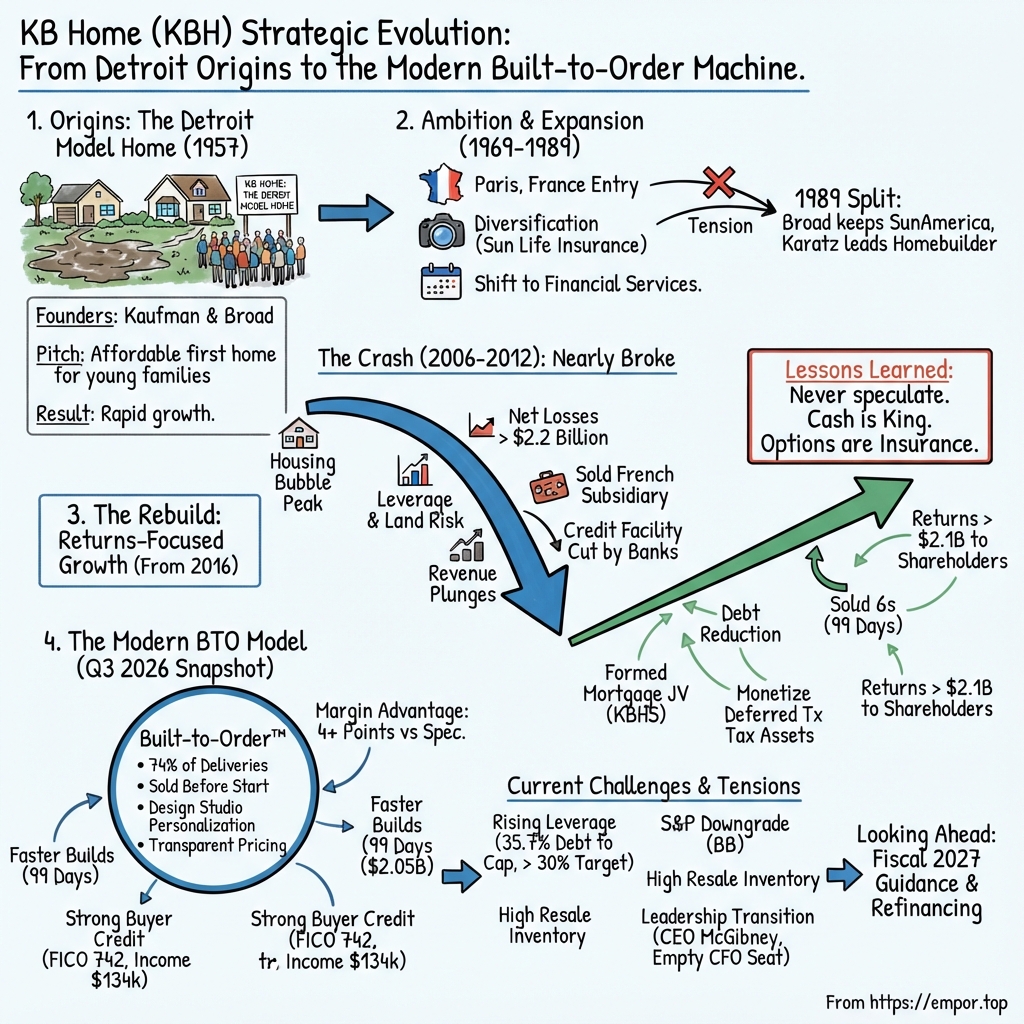
Picture a muddy lot in Madison Heights, Michigan, in 1957. Two model homes, a few flags, a hand-lettered sign. Behind them stand two young men from Detroit: Donald Kaufman, a builder, and Eli Broad, a young accountant who had decided the numbers of American homebuilding added up to more than anyone was taking. They had put in $25,000 between them. That first year, Kaufman and Broad sold about 136 houses at an average price of roughly $12,500, for $1.7 million in sales.1
The pitch was simple, and it is the same pitch KB Home makes today. Build a well-designed first home for a young family, price it below what the rest of the market charges, and keep the machine moving. Early company histories describe Kaufman and Broad's homes as typically priced "thousands of dollars below the statewide average." In 1962 the company brought attached townhouses to the market and sold 400 units in 30 days.1 The customer was someone who did not yet own anything, and the product was a door into the middle class.
Almost seventy years later, that customer is still the core of the business. On the September 22, 2026 earnings call, management said about half of KB Home's buyers were purchasing their first home. Buyers who financed through the company's mortgage joint venture had average household income of about $134,000, an average FICO score of 742, and an average cash down payment of about $76,000, or 16% of the price.2 The founding idea survived. The customer has changed: today's first-time buyer is older, earns more, and must bring far more cash to the table than a 1957 Detroit autoworker did.
The decades between those two moments were a story of ambition, then sprawl, then focus. Kaufman & Broad went abroad and entered the Paris market in 1969; by 1985 it was the third-largest homebuilder in France.1 In 1971 it bought Sun Life Insurance Company, and the company's center of gravity moved toward financial services. That tension ended in 1989 with a split. Broad kept the insurance business, which became SunAmerica, and the homebuilder became Kaufman and Broad Home Corporation under a young executive named Bruce Karatz.1
Karatz's early moves pointed toward the modern KB Home. He pulled out of markets that were not working, including Illinois, New Jersey, Germany and Belgium, and pushed the company into the fast-growing interior West: Arizona, Nevada, Colorado and Utah.1 The company renamed itself KB Home in 2000, adopting what customers already called it, and reported revenue of $4.57 billion in 2001.1 That Sun Belt and West Coast footprint, heavy in California and Nevada, is still the company's biggest asset and its biggest source of volatility.
Two features of the modern franchise also took shape in this period. The first is what KB Home now trademarks as its Built to Order™ process. Buyers pick a lot and a floor plan, then personalize the home at a design studio "generally centrally located within our served markets," choosing from "a wide range of choices in the major aspects of their future home."3 The second is a direct line to the entry-level buyer, which later became a formal mortgage joint venture.
The Karatz years also produced the company's first real crisis of trust. In November 2006, as the housing boom was ending, a board investigation found that KB Home had used incorrect measurement dates for its annual stock option grants from 1998 through 2005. Karatz, who had led the company for 34 years, left immediately and agreed to repay about $13 million in option gains. The head of human resources was fired, and the chief legal officer resigned.4
Karatz had been paid $155.9 million in 2005, mostly from option exercises.5 In April 2010 a federal jury convicted him on four counts, including mail fraud and false statements to the company's auditors, and acquitted him on sixteen others.6
The man who took over was Jeffrey Mezger, who had joined in 1993 and had run U.S. homebuilding operations as chief operating officer since 1999. The board said it had cleared him of any role in the option-dating errors.4 Mezger was an operator, not a dealmaker. Over two decades, his public remarks tended to focus on land, build times and sales pace rather than big strategic visions. He would run the company for the next twenty years.
It is worth pausing on what kind of company Mezger inherited. The KB Home of 2006 was built for a boom. It had expanded across the fastest-growing, most speculative housing markets in the country, particularly in the West and Sun Belt. Those were the places where prices had risen the most and where they would fall the hardest. Its incentive culture, as the option scandal showed, rewarded executives richly when the stock rose. A builder's scale in a boom looks like strength, but every extra lot bought at peak prices becomes a liability when prices fall.
The scandal matters for today's investor for another reason. It is the clearest example in KB Home's own history of a board failing to oversee pay and disclosure. That failure belonged to a different leadership team twenty years ago, and nothing in the current record suggests it has recurred. But it is part of the institutional memory. It helps explain why the company's modern public messaging leans so heavily on words like "disciplined," "transparent" and "programmatic." Those words are a response to a history, and investors should judge them by behavior, not vocabulary.
Mezger's timing was terrible. He became CEO at the peak of the largest housing bubble in American history, and his first job would be keeping the company alive. The founding model of cheap first homes for young families was about to meet the credit crisis head-on.
 Subscribe on LinkedIn
The Crash: How KB Home Nearly Broke
The scale of what happened between 2006 and 2012 is hard to grasp until you see it laid out. In fiscal 2006, KB Home delivered 32,124 homes and generated $9.38 billion in revenue.7 Three years later, in fiscal 2009, it delivered 8,488 homes on revenue of $1.82 billion.8 Revenue fell about 80% in three years. Imagine a restaurant chain going from serving a full dining room every night to four tables, while still paying rent on every building it signed for at the top.
For a homebuilder, that rent is land. Builders buy or option land years before they build on it, betting that today's price will look reasonable when the houses finally sell. When prices collapse, the land on the balance sheet is suddenly worth less than what was paid, and accountants force the company to write it down.
In fiscal 2007, KB Home recorded $1.41 billion in pretax charges for inventory impairments, joint venture impairments and abandoned land option contracts, along with $107.9 million of goodwill impairments. It also wrote off $514.2 million of deferred tax assets it no longer expected to use. The net loss for the year was $929.4 million.7
The following year was just as bad. Fiscal 2008 brought a net loss of $976.1 million, driven by another $748.6 million of inventory and joint venture impairments and option abandonments, $68.0 million of goodwill impairments, and a further $355.9 million deferred-tax valuation charge.8 Losses continued: $101.8 million in 2009,8 $178.8 million in 2011, and $59.0 million in 2012.9 Leaving out 2010 entirely, the losses from 2007 through 2012 add up to more than $2.2 billion.
Mezger moved fast, and the sequence shows what a builder can and cannot control in a collapse. KB Home sold its French subsidiary in fiscal 2007, booking a $438.1 million after-tax gain. That year it cut debt by $758.5 million and finished with $1.33 billion in cash.7 Leaving France meant giving up the old international ambition in exchange for liquidity at home. It was the right trade.
The France sale also carries a lesson for today. Selling what can be sold to protect the core is the kind of move a builder can make only once. Today KB Home is a pure U.S. homebuilder with a mortgage joint venture. It has no comparable non-core asset left to sell if the balance sheet ever needs support again.
The banks set the other boundary. In the third quarter of 2008, KB Home amended its unsecured revolving credit facility, cutting the commitment from $1.3 billion to $800 million and loosening the covenants on minimum tangible net worth and financial ratios.10 A revolver is a builder's emergency credit line, and cutting it by nearly 40% was the lenders' way of saying they would not fund a large bet on a recovery. The company had drawn nothing on it at the time, and Mezger emphasized "more than $1.5 billion in liquidity" and a cash balance of $942.5 million.10 Even so, active community count had fallen 38%.10
The crash is the key to understanding today's KB Home. By the 2009 annual report, Mezger had turned the painful lessons into an operating framework called KBnxt. It was "a disciplined, fact-based and process-driven approach" built around what customers wanted, careful land buying, and "commencing construction of a home only after a purchase contract has been signed."8 That last phrase, in plain English, says: never again build thousands of homes nobody has agreed to buy.
This is where the Built to Order identity comes from. In 2026 it is marketed as a customer-choice feature. It started as a survival rule: in a downturn, the most dangerous asset a builder owns is a finished house with no buyer, sitting on land bought at the top.
It is worth explaining why abandoning options appears among the charges, because it will matter again in 2026. When a builder has optioned land, the deposit is the price of flexibility. If the land is no longer worth buying, the builder walks away and writes off the deposit and any pre-development costs. That hurts, but it is a known, limited loss. Owned land has no such exit. If its value falls below cost, the builder has to write it down, and it still owns the land. The crash taught KB Home, and every other builder, that options are insurance, and that the premium is worth paying.
The crash also changed who KB Home served. A builder that sold homes at an average price of about $246,500 in 20129 was serving a much more price-sensitive buyer than the one it serves now. Over the next decade, rising land costs, fees and construction costs pushed average selling prices close to twice that level. The "first-time buyer" label stayed the same, but the household that could afford a KB Home was increasingly well-off.
The recovery was slow. In fiscal 2012 the company still delivered only 6,282 homes, less than a fifth of its 2006 volume, and posted a small loss.9 For shareholders who had bought in during the boom, it was a lost decade.
Picture the view from a KB Home division office in those years. Communities that had been planned for hundreds of homes sat half-finished. Streets were paved and lit for houses that would not be built for years. Option contracts that had looked cheap in 2005 were being handed back, one by one, with the deposits written off. The job of a division president changed from selling homes to deciding which land to give up. A generation of KB Home managers, including Rob McGibney, then working his way up in the Las Vegas division, managed through that environment.
That experience shaped a specific instinct, one that shows up repeatedly in today's conference calls: the reluctance to build homes before a buyer signs, and the willingness to walk away from land that no longer works. The cost of that instinct is slower growth in good years. The benefit is supposed to be survival in bad ones.
The crash left three permanent marks. The first is a cultural aversion to speculative building. The second is caution about holding too much land. The third is a habit of explaining every capital decision through balance-sheet safety. The rest of this story tests how consistently KB Home has lived by those lessons once the danger passed, and in particular how closely its current "land-light, buy back stock" strategy follows what the crash taught. The first test came during the long rebuild.
The Rebuild: Returns-Focused Growth and the Buyback Machine
By 2016 the emergency was over, and KB Home faced a quieter question: what is a recovered homebuilder for? Mezger's answer, which he added the board chairmanship to that year,11 was a "returns-focused growth plan." The plan targeted higher revenue, better homebuilding operating margins, and stronger return on invested capital, return on equity and leverage ratios. It also aimed to monetize the deferred tax assets the company had written off during the crash.3
The plan started with debt. KB Home set a goal of cutting debt by $250 million by 2019 and passed it in 2017 alone, reducing debt by more than $300 million that year.3 Deliveries rose to 10,909 homes in 2017 from 9,829 in 2016, across seven states and 35 major markets, in four regions: West Coast (California), Southwest (Arizona and Nevada), Central (Colorado and Texas), and Southeast (Florida and North Carolina).3
Around the same time, KB Home built the second pillar of the modern model. In late 2016 it formed KBHS Home Loans, a 50-50 unconsolidated joint venture with Stearns Lending, which began operating in 2017.3 A mortgage JV gives the builder two things. It earns fee income without putting mortgages on its own balance sheet, and it gives the builder early visibility into whether buyers in the backlog can actually qualify. In the third quarter of 2026, 85% of KB Home's buyers financed through KBHS, which management said leads to "more certainty in closing dates."2
A mortgage JV also carries a quieter risk worth naming. When most buyers finance through a builder-affiliated lender, the builder's own view of backlog quality depends on a partner's underwriting and on that partner's health. The arrangement has worked well, and the 85% capture rate shows buyers use it. But it is a dependency, and it concentrates a lot of the backlog's credit visibility in a single channel.
Then came the pandemic boom, and with it the best profits in the company's history. In fiscal 2022, KB Home earned $816.7 million, or $9.09 per diluted share, on housing revenue of $6.88 billion and a housing gross margin of 24.3%.12 Those margins reflected a rare stretch when buyers competed for houses instead of the other way around. They were not a new steady state for the business.
Fiscal 2023 showed what the business could earn as the boom cooled but before the down cycle arrived. Housing gross margin was still 21.2%, and net income was $590.2 million, or $7.03 per diluted share.13 It was in this profitable, supply-constrained period that KB Home's reliance on spec homes grew. Build times were long, buyers wanted homes quickly, and a finished house could still be sold at a good margin. The drift away from BTO was rational when it began. The problem was that it continued after the conditions that justified it had passed.
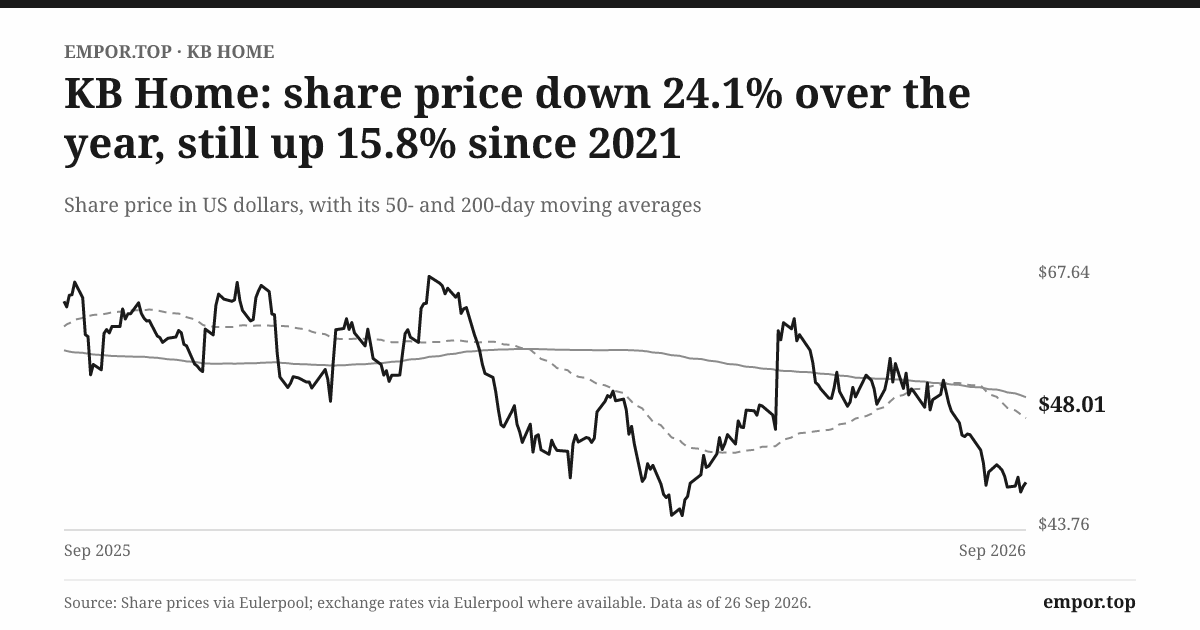
As the cash came in, KB Home turned into a steady buyer of its own stock. It repurchased 9.2 million shares for $411.4 million in fiscal 2023,13 $350 million of stock in fiscal 2024,14 and 9.4 million shares for $538.5 million, at an average of $57.37 a share, in fiscal 2025.15 By September 2026, Mezger could say the company had returned more than $2.1 billion to shareholders through buybacks and dividends over five years and had reduced its share count "by more than one-third."2
The investor case for this is clear. Book value per share rose from "over $50.00" at the end of fiscal 202313 to $61.75 at the end of fiscal 202515 and $62.56 at the end of August 2026.16 Management has repeatedly described buying stock below book value as accretive to both earnings per share and book value per share, and in the third quarter of 2026 it repurchased about 890,000 shares "at an average price below our current book value per share."2 Buying a dollar of net assets for less than a dollar sounds like easy money.
Here the crash record has to come back in, because it tests the claim directly. Book value for a homebuilder is mostly land and houses under construction, recorded at cost. In 2007 and 2008 alone, KB Home wrote more than $2 billion of that kind of book value off through impairments and option abandonments.78 A stock trading below book is not automatically cheap.
It can also be the market's forecast that some of the land will be written down. The buyback math works only if book value holds up through the next downturn. The 2007–2008 record shows it can fall quickly, and the fiscal 2025 inventory and land-option charges of $32.1 million, against $4.6 million a year earlier, are a small early sign of stress.15
Balance-sheet capacity is a second limit. At the end of fiscal 2025, management said it was targeting a debt-to-capital ratio "in the neighborhood of 30%" to support its BB+ credit rating, and it described the buyback as "programmatic."17 By August 31, 2026, notes payable had risen to $2.11 billion from $1.69 billion at fiscal year-end, cash had fallen to $159 million, and debt-to-capital had reached 35.7%.16
In July 2026, S&P Global Ratings lowered KB Home to BB from BB+.18 On the Q3 call, Zelman's Alan Ratner asked directly how much higher leverage could go if free cash flow did not improve. Mezger answered with a list of variables (land spend, development timing, work in progress) and a prediction that land spend would "come down a little," not with a leverage ceiling.2
The conclusion is narrower than the bull case wants it to be. The buyback program has cut the share count dramatically and raised book value per share, and that is real. But the last twelve months show it is partly financed with debt, and it has pushed leverage beyond management's own stated target during the same period that a credit agency moved the rating the other way.
That does not reject the claim that the buyback has been disciplined. It does limit it: the program is disciplined only for as long as book value holds and leverage comes back toward 30%. Watch whether the "up to $50 million" per quarter pace continues as long as debt-to-capital stays above that target.
The buyback machine depended on something else: steady margins from the core product. And through 2023 and 2024, the core product had quietly changed.
Built to Order, Lost and Found
In December 2025, on the fourth-quarter call, Mezger said something unusually candid for a homebuilding CEO. Discussing the difference between building for a signed buyer and building on speculation, he said: "You can fool yourself with a spec start into thinking you're gonna make this margin, and then lo and behold, five months later, it's down four or five points."17
That remark admitted that KB Home had drifted away from the model the crash had taught it. By the fourth quarter of fiscal 2025, only 57% of deliveries were Built to Order homes, well below what management called its "historical 70% or higher."17 How did a company that defined itself by building to order end up with more than four in ten homes built on speculation?
McGibney, then president and chief operating officer, explained on the same call. During the post-pandemic supply-chain crunch, build times stretched to 220 to 240 days. At that point it was hard to sell a Built to Order home to a buyer who could buy a resale house or a competitor's finished spec home and move in months earlier. So KB Home started building specs. "Frankly," he said, "we created an internal conflict with ourselves with those specs that we started."17
It helps to explain the economics of that conflict. A Built to Order home is sold before it is started. The buyer chooses the options, the price is set, and the builder knows its costs before it pours concrete. A spec home is started on a guess. If demand softens while it is being built, the builder has to discount it or offer mortgage-rate buydowns to move it. McGibney quantified the difference: BTO homes typically earn about four percentage points more gross margin than inventory homes, usually in a three-to-five-point range.2 On a $475,000 house, four points is about $19,000 of gross profit per home.
The pivot back was abrupt. Management stopped starting new specs, matched starts to BTO sales, and opened new communities that had no spec inventory competing with them.17 The BTO share of deliveries rose from 57% in the fourth quarter of fiscal 2025 to 60% in the second quarter of fiscal 2026, and then to 74% in the third quarter, higher than management had expected.219 Total unsold inventory fell to 26% of production from 41% a year earlier, and finished unsold homes fell to 9% from 16%. The company also had about 1,100 homes sold but not yet started.2
Build times helped. BTO homes averaged 99 days from start to completion in the third quarter of 2026, 23 days (or 19%) faster than a year earlier, and management is targeting 90 days.2 This matters because the original objection to BTO was the wait. A buyer who waits a little over three months can lock a mortgage rate more cheaply than one who waits eight months. Faster builds also mean inventory turns over more quickly, so the same dollar of capital produces more deliveries each year.
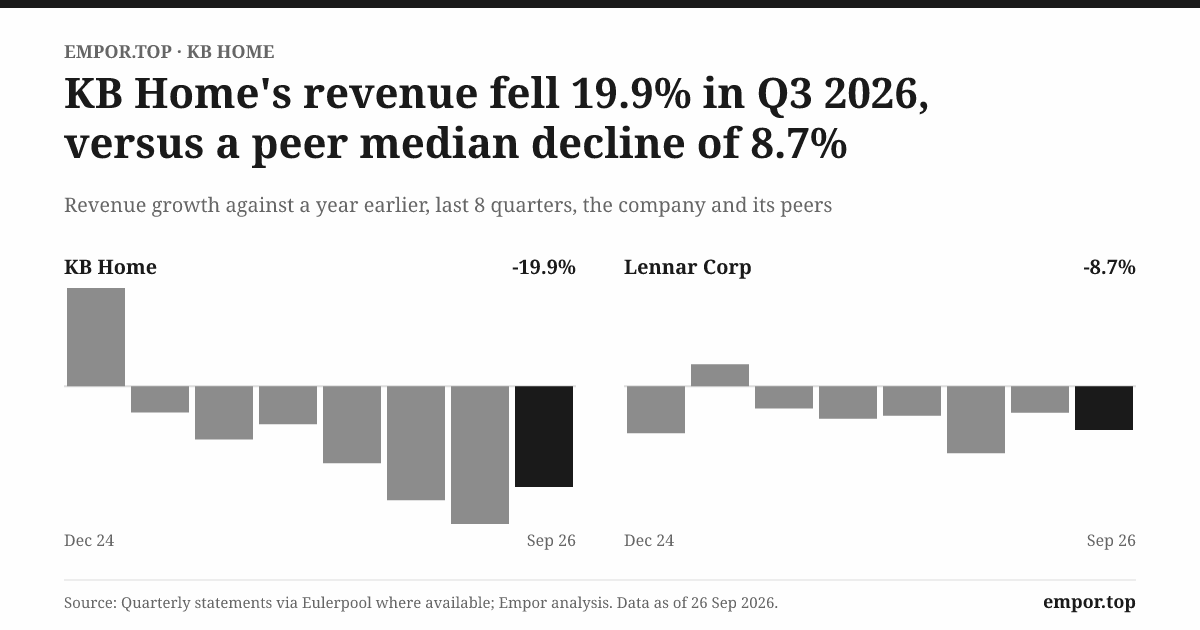
McGibney opened his Q3 remarks with a line that doubles as a thesis statement: "A market like this one tests what a business model is built on. Our Built to Order model was designed to perform in exactly these conditions."2 The quarter supports part of that claim. Adjusted housing gross margin rose from 15.7% in the second quarter to 16.8% in the third, and management credited the better-than-expected BTO mix.2 Backlog grew year over year for the first time in four years, reaching 4,398 homes worth $2.05 billion.16
The same quarter also shows the limits of the claim. Adjusted gross margin was still down from 18.9% a year earlier.16 Management then guided the fourth quarter to a lower margin, 16.0% to 16.6%, about one point below what it had implied in June. It said the reason was that it had reached its BTO target "earlier than we thought," leaving "less incremental margin benefit from BTO mix" for the fourth quarter.2 Put simply, the one-time lift from switching from spec to BTO has mostly already happened. From here, margins depend on pricing power, costs and mix, the same factors every builder faces.
There is a second limit. Net orders fell 12% in the third quarter, and monthly orders per community fell to 3.1 from 3.8 a year earlier.16 BTO protects margins partly by giving up sales pace. A buyer who cannot or will not wait for a home to be built, or who wants the rate buydown a competitor offers on a finished spec, goes elsewhere. Management's long-run goal is about four sales per community per month, and McGibney acknowledged the company is "trending below that this year."2
Weighing the evidence, the claim that BTO is a structural margin advantage survives in narrower form. The four-point BTO-versus-spec spread is consistent across management's statements, and the third quarter showed the mix shift working. But the evidence does not support the stronger version, that BTO makes KB Home resilient in a downturn.
Margins are still falling year over year, order pace has dropped, and the company itself drifted away from BTO in 2022–2024 when market conditions made it inconvenient. That drift is the most important disconfirming evidence in the record: management has shown it will give up the model under pressure. Watch whether the BTO share stays at or above 70% of deliveries while absorption stays below four a month. If spec starts creep back to chase volume, the thesis is weakened.
How a KB Home community actually sells
One underappreciated part of the BTO machine is the ritual before a community opens. McGibney walked analysts through it on the Q3 call. The process starts with a sign on a bare parcel and a QR code. It moves to grassroots marketing with local businesses and real estate agents, builds as land development visibly begins, and builds again once model homes go up. By the grand opening, the sales team is working a list of pre-qualified prospects. The goal, McGibney said, is to sell "about 2 months of our expected run rate of sales in the first week to 10 days" after opening.2
This matters because it is how a BTO builder solves its biggest weakness. A spec builder can always sell a finished home to whoever walks in. A BTO builder needs a pipeline of buyers willing to commit before anything is built, and a new community with an enthusiastic interest list is the easiest place to find them.
That is why management linked new community openings so closely to its BTO mix, and why it expects to open about 115 new communities in fiscal 2026 while roughly as many sell out.2 The flip side is that the model depends on a steady flow of new openings. When openings slip, as some higher-priced Southern California communities did this year, both the sales pace and the mix suffer.2
The design studio is the other lever. KB Home says buyers can choose the "features, finishes, and ultimately a sales price" that fit their budget, which McGibney described as "a real tool to manage affordability."2 In practice, a buyer who is stretched can take fewer upgrades, and a buyer with more money can spend more.
That gives KB Home a way to adjust the effective price of a home without cutting the advertised base price. It is a real advantage in a market where every dollar of monthly payment counts. The company has also been simplifying the studio offering to cut costs, a reminder that the menu of choices is always balanced against efficiency.2
On the Q3 call, analysts tested whether the model's promises hold under stress. Zelman's Alan Ratner asked whether a sharp rise in rates forces KB Home to offer closing-table incentives to buyers who signed contracts expecting lower rates. McGibney said it "happens," but that the adjustments had been "minimal overall," and that faster build times make it cheaper to lock buyers' rates early.2 It was a candid answer. It also confirms that BTO does not fully protect the backlog from rate shocks. It shortens the period of exposure.
All of this rests on land, the part of the business investors most often misread.
The Land Question: How "Light" Is KB Home Really?
For a builder, land works like inventory ordered years in advance. There are two ways to control it. A builder can own lots outright, which ties up capital and exposes the company to impairments if prices fall. Or it can option them: pay a deposit for the right, but not the obligation, to buy later, often in stages as it builds. Options cost more per lot, but they limit the downside to the deposit. In 2008 KB Home learned what heavy land ownership costs in a crash. "Land-light" is shorthand for controlling more of the pipeline through options.
The industry has moved decisively toward options. At the end of fiscal 2025, D.R. Horton, the largest U.S. builder by volume with 84,863 homes closed that year, owned only 25% of its 591,900 lots and controlled the other 75% through purchase contracts.20 Lennar, the second-largest, has pursued what it calls a "land light strategy," including through its Millrose spin-off, though its management has acknowledged challenges in maintaining it.21
KB Home's record here is more mixed than the word "land-light" suggests. It did move sharply toward options at one point. At the end of fiscal 2023, it owned about 73% of its lots.13 During fiscal 2024 it grew its lot pipeline 37% to 76,703 lots and flipped the mix to about 51% owned and 49% under contract.14 That was a real shift, largely toward optioned growth.
Since then, the mix has moved back toward ownership. Owned lots rose to 57% at the end of fiscal 2025,15 59% at the end of the first quarter of 2026,22 62% at the end of the second,23 and about 60% at the end of the third.16 Total lots fell from 76,703 to 61,581 over that period.1416 Most of the decline came from optioned land: at the end of fiscal 2025 management said the option lot position was 27% lower than a year earlier, "due to our continued focus on only allocating capital to positions that align with our strategy and return expectations."17
There are two ways to read this. The generous reading is underwriting discipline. When deals no longer met return hurdles in a weakening market, KB Home walked away from options, which is exactly what options are for. McGibney said so on the Q3 call: the company had "walked from many of the deals that we've had under contract because they just no longer met our returns."2 The less generous reading is that the owned share rose because the company kept buying and developing land it already committed to while cutting the flexible part of the pipeline.
In the third quarter it spent $722.3 million on land acquisition and development, up 40% from the prior quarter,16 and McGibney said most of the increase came from development and fees on "land that was previously purchased."2 Mezger acknowledged the land market had been "a little chunky," with "a couple of big deals," and McGibney described the two large Las Vegas Valley positions added the previous year: Meriden in Henderson and Sandstone in North Las Vegas.2
Those two communities show both sides of owning land. Las Vegas is, in McGibney's words, "one of the most land-constrained markets in the country." Meriden opened with five product lines, and Sandstone had an interest list of more than 300 potential buyers before opening.2 In a land-constrained market, owning a large position can be a real advantage because competitors cannot easily get comparable lots. But the Las Vegas Valley is also where homebuilders have historically suffered the sharpest swings in prices. A large owned position there is a bet on the cycle as well as a bet on execution.
Analysts have pressed on this point before. On the December 2025 call, KBW's Jade Rahmani asked whether more option walk-away charges were coming in fiscal 2026. Dillard, then CFO, described them as "a normal part of our land procurement process" and said the company was "holding the line with really stringent underwriting standards."17 It was a reasonable answer, but it was not a forecast. Walk-away charges are the visible cost of discipline. Impairments on owned land, if they come, would be the visible cost of having too little of it.
A simple example shows why the owned share matters. Take a hypothetical $480,000 home expected to earn a 16% gross margin, or about $77,000. If local prices fall 15%, the selling price drops by about $72,000, and nearly all of the expected profit is gone. If prices stay down, accounting rules can require the builder to write down the owned lot and any work in progress on it. If the same lot were optioned and not yet bought, the builder could walk away and lose only its deposit. So the difference between 25% owned and 60% owned is not just a statistic. It determines how much of the balance sheet is exposed to that kind of hit.
Both readings hold at once, and together they produce the tension investors should keep in mind. Year to date, land spending of $1.79 billion is down 8%,16 while buybacks continue and leverage rises. KB Home is simultaneously spending less on land in total, holding a larger share of its land outright, and returning cash to shareholders. Compared with D.R. Horton's 25% owned, KB Home at about 60% owned is carrying far more land risk per lot on its balance sheet, while paying for buybacks partly with debt.
The measured conclusion: KB Home is not a land-light builder by current industry standards, and its direction since 2024 has been away from that model, not toward it. The 2024 shift was real but partly reversed. Management's underwriting discipline in walking from options is credible and supported by the charges it took.
The claim that the company has solved its crash-era exposure to land is unproven at best. The number to watch is the owned share of total lots. A move back below 55% alongside stable land spend would support a lighter model. A move above 65% while buybacks continue would be the signal the old risk is building back.
That brings the story to the people who make these calls and to the promises they have made about them.
Guidance and Credibility: A Record Under Test
Every homebuilder guides into a fog made of mortgage rates, consumer confidence and resale inventory. The real question is not whether a company misses. It is how often, by how much, whether the misses point in one direction, and how management explains them. KB Home's record over the last five fiscal years is more nuanced than "serial guidance-cutter," and that nuance is worth working through year by year.
Fiscal 2022: cut, then a narrow miss. In March 2022, KB Home guided to housing revenue of $7.20 billion to $7.60 billion.24 In June it narrowed that to $7.30–7.50 billion, even as the cancellation rate jumped to 17% from 9% a year earlier.25 By September, cancellations had reached 35% of gross orders, and the company gave only fourth-quarter guidance of $1.95–2.05 billion.26
It delivered $1.932 billion in the fourth quarter, just below the low end, and $6.88 billion for the year, about $500 million below the June midpoint. Fourth-quarter cancellations had reached 68%.12 The miss was real, but so was the rate shock that caused it. Mortgage rates moved faster that year than almost anyone in the industry expected.
Fiscal 2023 and 2024: underpromise, overdeliver. In January 2023, with conditions described as challenging, KB Home guided to a wide $5.00–6.00 billion.12 By September it was projecting about $6.31 billion,27 and it finished with housing revenue of $6.37 billion.13 Fiscal 2024 guidance started at $6.40–6.80 billion,13 and the company delivered $6.90 billion in housing revenue out of $6.93 billion in total revenue.1415 Any claim that KB Home cuts and misses every year has to deal with these two years, when it beat its initial ranges comfortably.
Fiscal 2025: three cuts, landing at the last range. In January 2025, management guided to $7.00–7.50 billion.14 In March that fell to $6.60–7.00 billion, with gross margin guided at 19.2–20.0%.28 In June it fell to $6.30–6.50 billion and a 19.0–19.4% margin.29 In September it fell again to $6.10–6.20 billion.30 The company delivered $6.21 billion in housing revenue and an 18.6% gross margin.15 It landed at the top of its final range, but about $1 billion, or roughly 14%, below the midpoint of its first one, and below the June margin range.
Fiscal 2026: a wide range walked down. In December 2025, KB Home guided to $5.10–6.10 billion and deferred margin guidance until March.1517 In March the range became $4.80–5.50 billion.22 In June it became $4.90–5.30 billion, with full-year gross margin of 16.1–16.5%.23 In September it narrowed to $4.90–5.10 billion, and margin guidance was trimmed to 16.0–16.2%.16 The midpoint has fallen from $5.60 billion to $5.00 billion. At the same time, the company met or exceeded its quarterly guidance in the second and third quarters, and third-quarter housing revenue landed exactly at the midpoint.232
One smaller credibility marker is worth noting. In December 2025, Mezger said "the first quarter margins are the low watermark," with improvement expected each quarter afterward.17 Reported housing gross margin was 15.3% in the first quarter and 15.2% in the second,2223 so on a reported basis the low actually came one quarter later. The difference was small, and the adjusted margin did improve by the third quarter. But this is the kind of confident statement that helps explain why the market discounts management's outlook.
Taken together, the record rejects the strong version of the bear claim, that KB Home habitually overpromises. The fiscal 2023 and 2024 beats are clear counterevidence. It supports a narrower claim: in years when the housing market weakens, KB Home's initial full-year outlook has been too optimistic, cuts come in steps rather than all at once, and the final number lands near the bottom of the original range or below it. That pattern appeared in 2022, 2025 and 2026. Quarter-to-quarter execution has been more reliable than full-year forecasting.
Management has explained its misses openly, pointing to rates, consumer caution and resale competition, and it has not blamed outside parties unreasonably. Its explanations have been specific. On the Q3 call, it attributed the fourth-quarter ASP cut of about $20,000 to fewer higher-priced Southern California closings, a shift in which Southern California communities were delivering, and some "missed community openings," while noting that Northern California had held up.2
What is missing is an explanation of why the initial ranges keep starting high in soft years. The practical test for investors is the fiscal 2027 outlook, due in the next report. How wide it is, and where the midpoint sits relative to the backlog, will show whether the lesson has been learned.
The tone of the Q3 Q&A reinforced this. When Barclays' Matthew Bouley asked what the first half of fiscal 2027 might look like, McGibney said, "we're not giving guidance on '27," and pointed to "pretty volatile and choppy" conditions.2 When Bank of America's Rafe Jadrosich asked whether community count would grow next year, McGibney called it "a roundabout way of asking for community count guidance" and declined.2
There was also a structural reason the fiscal 2026 range was so wide at the start. In December 2025, management said its beginning backlog covered only 27% of the midpoint of its full-year delivery target, compared with 34% at the start of fiscal 2025.17 For a builder, the backlog is the part of the year already sold. Starting with less of it means more of the year depends on sales not yet made, in a spring selling season nobody could forecast. A wide range was honest. A midpoint that high was not conservative.
Holding back guidance in a volatile market is defensible, and arguably wiser than issuing another wide range that later gets walked down. But it also means investors enter the new fiscal year with less forward visibility from management than they had a year earlier, which was when that wide range first appeared.
A final comparison adds context. KB Home is not alone in facing a weaker market: Lennar's CEO cited the same headwinds in September 2026, including rising mortgage rates, inflation and more resale competition.31 A company revising its outlook in that environment is not, by itself, a sign of weak management.
What would set KB Home apart is whether its BTO model, which is meant to deliver better visibility than spec building, actually produces more accurate forecasts. So far the evidence does not show that. A company that sells before it builds should, in principle, forecast better than one that builds on speculation. That promise has not yet been reflected in the full-year numbers.
The credibility question comes at an awkward time, because the people giving the guidance have just changed.
The Handoff: McGibney, Mezger, and an Empty CFO Chair
On January 28, 2026, KB Home announced the end of an era. Robert McGibney, 51, would become president and chief executive officer on March 1, succeeding Mezger. Mezger, 70, would become the company's first executive chairman after twenty years as CEO and thirty-three years at the company.11
Mezger's legacy is easier to measure than most CEOs'. He took over a company in scandal at the top of a bubble, kept it solvent through six years of losses, rebuilt its operating model around building homes for buyers who had already signed, and then turned it into a large buyer of its own stock.
His record also includes the 2022–2024 drift toward spec building and a run of optimistic full-year guidance in down years. In his announcement, he described McGibney's "exceptional performance" and his strong understanding of the business model.11 That is the right thing for a departing CEO to say. The better test is whether McGibney changes anything.
McGibney's career is a textbook internal succession. He studied accounting and finance at Missouri State University and joined KB Home in 2000 in its Las Vegas division. He became division president in 2012, regional general manager in 2016, and regional president in 2018. He was named executive vice president and chief operating officer in 2021, president in 2024, and CEO in 2026.11
He has spent about 26 years inside one company, much of it running operations in one of the most land-constrained, cyclical markets in the country. When the Q3 call reached Meriden and Sandstone in Las Vegas, McGibney called the local team "one of our best teams in the company."2 Las Vegas is where he learned the business.
The strengths of this kind of succession are real. McGibney knows the divisions, the trade partners and the land teams. The BTO reset, the build-time improvements and the value-engineering program he described on the Q3 call (standardizing floor plans, cutting exterior offsets and overhangs, simplifying design-studio options) are the work of an operator.2 His answers on the Q3 call were detailed: he quantified the BTO margin spread, explained the Southern California miss in specifics, and admitted, "We were not pleased with the results that we've got."2
The early decisions of the McGibney era are mostly about costs. In the third quarter, the SG&A ratio was 11.3%, up from 10.0% a year earlier, mainly because of lower operating leverage. Management said this was partly offset by lower performance-based compensation and a 6% year-over-year reduction in personnel.2 Cutting headcount during a downturn is standard practice for a builder. The more telling sign is what McGibney did not change: the BTO strategy, the buyback, the 22% margin target and the community-by-community approach to pricing all continued as before.
The limits are just as clear. An insider succession brings continuity, not a fresh look. Mezger remains executive chairman and still opens the earnings calls. On the September 2026 call he gave the market overview and answered the leverage question, while McGibney handled operations.2 Two-headed leadership during a transition is common, but it makes accountability harder to pin down. When the fiscal 2027 guidance arrives, it will be hard for outsiders to tell whose forecast it is.
Then there is the finance function. Jeff Kaminski, CFO for more than 14 years and the executive Mezger credited with helping improve KB Home's financial structure, announced his retirement in September 2024.32 His successor, Robert Dillard, joined from Sonoco Products, where he had been CFO from June 2022 to January 2025, and had earlier held leadership roles at Domtar and Stanley Black & Decker.
He started on March 31, 2025.33 On April 29, 2026, KB Home disclosed that Dillard had resigned, effective May 8. His tenure was about thirteen months. The 8-K said the decision was "not related to any disagreement with KB Home or its financial or accounting policies or practices," and it did not name a successor.3433
The standard language about no disagreement should be taken at face value; there is no evidence of an accounting dispute. But the timing matters. Dillard's tenure covered the June and September 2025 guidance cuts, the wide initial fiscal 2026 range, and its first reduction in March 2026.
He was the executive who described the buyback as "programmatic."17 He then left about two months after the CEO handoff, as the S&P downgrade approached. On the September 2026 call, the financial review was given by Chief Accounting Officer Bill Hollinger, and Treasurer Thad Johnson was also on the line. No CFO was introduced.2
A skeptical investor or activist would focus on three questions. First, why did an externally recruited CFO leave after thirteen months, and was it a disagreement over capital allocation, which would not be an "accounting" disagreement under the 8-K language? Second, who owns the balance-sheet framework, including the 30% leverage target, while the CFO seat is empty? Third, does an executive chairman who has run the company for two decades still set the strategic agenda? The public record does not answer any of these, and nothing in it suggests misconduct. They are open governance questions, not accusations.
On the wider governance picture, this review of company releases, 8-K filings and earnings coverage from 2024 through September 2026 found no activist campaign, no merger or acquisition activity, and no restatement. That result is bounded to those sources and that period. It is not a clean bill of health. The last serious governance failure, the options scandal, is twenty years old and involved a different leadership team. It is still a reminder that the board's oversight of pay and disclosure has failed before.
The new team has inherited a company whose story tends to be told in slogans. The next section tests the most common ones.
Myth vs Reality
Myth: "KB Home is a land-light builder." Reality: At about 60% owned lots, KB Home holds far more of its land outright than D.R. Horton, which owns 25%.1620 Its ownership share has risen since fiscal 2024, not fallen.1415 It is lighter than it was in fiscal 2023, when about 73% of its lots were owned,13 and heavier than most large peers today. The accurate description is "moderately land-heavy, with a disciplined option book."
Myth: "Built to Order makes KB Home recession-resistant." Reality: BTO reduces inventory risk and adds about four points of margin compared with spec homes,2 but it does not create demand. Order pace fell to 3.1 per community per month in the third quarter of 2026,16 and full-year gross margin guidance is roughly 16%, down from 18.6% in fiscal 2025.1516 BTO protects margins in a downturn but does not prevent them from falling. The company's own move toward specs in 2022–2024 shows that the model bends when market conditions push against it.
Myth: "Management always cuts guidance." Reality: Fiscal 2023 and 2024 both ended well above their initial ranges.121314 The pattern of repeated cuts shows up in weakening markets, meaning 2022, 2025 and 2026, and not in every year. The accurate criticism is that initial guidance has been too optimistic in downturns. It is not a charge of general unreliability.
Myth: "Buying back stock below book value is free money." Reality: It is only as good as the book value. KB Home wrote off more than $2 billion of inventory and related value during 2007–2008.78 Book value for a homebuilder depends on land prices. Buybacks below book make sense if land values hold and leverage stays in range. As of August 2026, leverage is above management's own 30% target.1716
Myth: "KB Home's buyers are stretched subprime first-timers." Reality: The average KBHS borrower has a 742 FICO score, $134,000 of household income and a 16% cash down payment, and 8% of third-quarter buyers paid all cash.2 Credit quality is strong. The pressure on buyers comes from affordability, meaning the monthly payment, not from their creditworthiness. That distinction matters: the risk is slower orders, not a wave of loan defaults.
Myth: "A growing backlog means the recovery has started." Reality: Backlog rose 2% to 4,398 homes, the first year-over-year increase in four years,16 but net orders fell 12% in the same quarter.16 Part of the backlog growth is mechanical. BTO homes stay in backlog longer because they are sold before construction starts, so the company converted only 60% of its backlog into deliveries in the third quarter, compared with 71% a year earlier.2 A larger backlog built on a slower conversion rate is better visibility, not necessarily more demand. The real signal of a recovery would be net orders rising year over year.
Myth: "A new CEO means a new strategy." Reality: McGibney has spent his entire 26-year career at KB Home and helped design the current operating model.11 Every major element of the strategy continued through his first two quarters as CEO. Investors expecting a strategic reset should not. What may change is execution style, and that will show up in results over several quarters, not in announcements.
With the myths set aside, the competitive picture is clearer.
Competition: War-Gaming KB Home Against D.R. Horton, Lennar and the Resale Market
Imagine a young couple in suburban Phoenix on a Saturday in September 2026. They have three options within a ten-minute drive. The first is a KB Home community where they can choose a floor plan, pick finishes at the design studio, and move in about 100 days after construction starts. The second is a finished spec home from a national builder, with a rate buydown that lowers their payment for the first few years. The third is a ten-year-old resale house down the street, whose owner has cut the price twice.
On the Q3 call, Mezger named the third option as the real rival: "resale inventory, which is our largest competitor, has increased to its highest levels in a decade, and we're seeing pricing starting to decline."2 McGibney added detail. Texas resale markets had been "more of a pace story than a price story," but sellers were now starting to "capitulate," and Florida resale inventory remained elevated.2 This matters because resale supply dwarfs new-home supply. When existing owners, who were locked in by low mortgage rates, finally list and cut prices, every new-home builder loses pricing power at the same time.
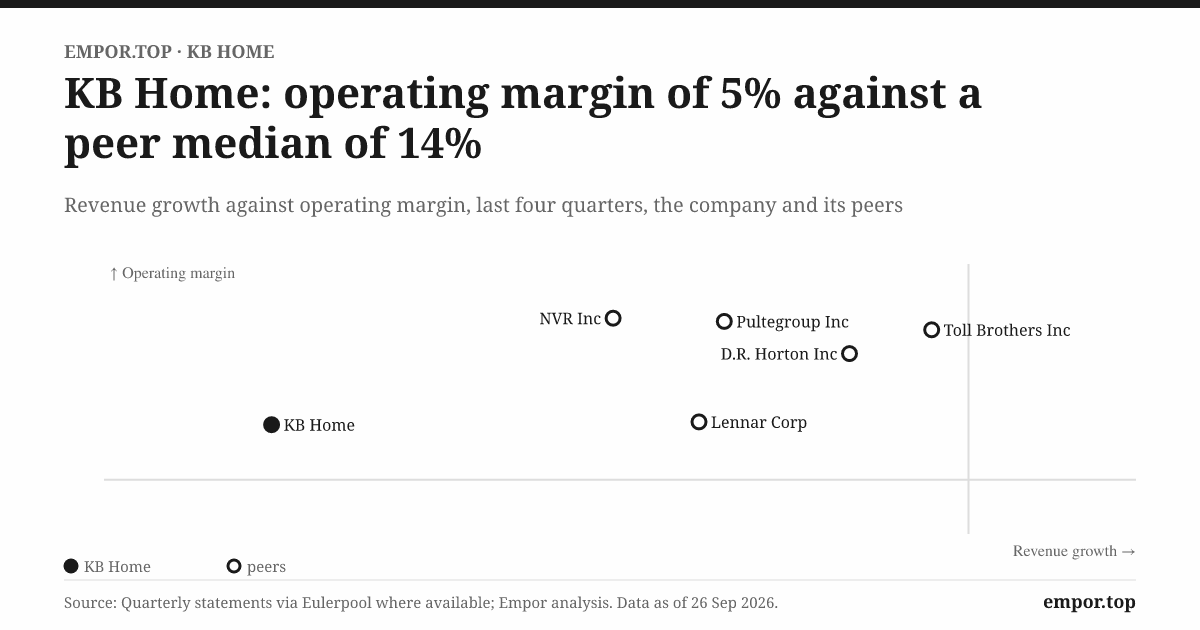
The second competitor is the large spec-focused builders. D.R. Horton closed 84,863 homes in fiscal 2025 and reported fourth-quarter home sales gross margin around 20%.20 Lennar delivered 82,583 homes in fiscal 2025 while running incentives and price adjustments of about 14% in the fourth quarter, and its gross margin fell to 17.0%.21 KB Home delivered 12,902 homes in fiscal 2025.15 It is a top-ten public builder33 but operates at about one-seventh the volume of either giant.
That scale gap decides the purchasing battle. Horton and Lennar buy lumber, appliances and labor on a national scale that KB Home cannot match. KB Home does have its own tools. McGibney cited "deep supplier relationships," national contract rebidding, and value engineering that lowered direct costs on homes started in the third quarter, both sequentially and year over year.2
With industry starts falling, having about 1,100 homes sold but not yet started gives KB Home some leverage with trade partners who need work.2 The Q3 call also admitted that costs rose through the quarter because of fuel, tariffs and general inflation, and that fourth-quarter direct costs would be slightly higher.2
Labor is the cost analysts are watching most closely. Bouley asked whether immigration enforcement and competition for construction workers from data-center projects, both raised by a peer the week before, were affecting KB Home. McGibney said the pressure was "mostly on the material side," that with industry starts down "we really haven't had a lot of issues getting labor to our job sites," and that KB Home had set up fuel surcharges it could remove if fuel prices fell.2 That is reassuring for now. It also shows that KB Home's cost position depends heavily on the rest of the industry building less. If the market recovers and starts rise across the industry, the labor advantage of a quiet market will go away.
The mortgage joint venture is a quieter competitive weapon. Large builders run their own mortgage operations and use them aggressively for rate buydowns on spec homes. KB Home's JV plays a different role. It gives management a clear view of whether buyers in the backlog will qualify, and it lets the company lock rates early on a home that takes about three months to build.2 The builder that wins in a high-rate market is not the one that gives the biggest buydown.
It is the one that can close its backlog without surprises. KB Home's 18% cancellation rate in the third quarter, up only slightly from 17% a year earlier,16 suggests the model is holding. Compare that with the 68% cancellation rate in the fourth quarter of 2022,12 when build times were far longer and mortgage rates rose suddenly, leaving buyers exposed for months between contract and closing.
Pricing transparency is also a marketing choice. Mezger has argued that setting a real base price, rather than a high list price with hidden discounts, "allows us to advertise our compelling pricing directly on our website" and helps "build trust with our customers."17 For a first-time buyer comparing monthly payments on a phone, a clear price is easier to act on than a negotiated package of incentives. The trade-off is that when the market weakens, KB Home's price cuts are visible to everyone, including buyers who signed at the old price.
KB Home's real differentiation is its pricing approach. Management says it offers "transparent and affordable prices rather than inflated prices masked by heavy incentives."17 In practice, KB Home adjusts base prices, while spec builders tend to keep list prices high and discount through mortgage-rate buydowns. The strategic bet is that a buyer who designs their own home values it more and needs less discounting. The Q3 call confirmed limits here too. When rates jumped, some backlog buyers needed "minor adjustments, either just to keep them in the deal or to get them qualified."2
Northern California is a useful example of how geography shapes KB Home's results. For years, McGibney said, the region was "one of our biggest revenue drivers and biggest profit drivers," before the company "kind of lost some of that business" and had to rebuild it.2 High-priced Bay Area communities can lift the company's average selling price and margin on their own. That makes the rebuild valuable, but it also means a handful of communities can swing a quarter's results, in either direction.
Geography is both an asset and a liability. KB Home's California exposure produces high prices and, when it works, high margins. In the third quarter, Northern California performed as planned, while Southern California became "a more competitive environment" that forced price cuts and was the main cause of the lower fourth-quarter outlook.2
Lower land-cost markets such as Texas accounted for most of the year-over-year drop in revenue.2 Because the company is concentrated in a smaller number of West Coast and Sun Belt markets than the national giants, its results swing more with conditions in each of those markets.
The war-game conclusion: KB Home cannot beat Horton or Lennar on cost or scale, and it cannot control resale supply. Its winning ground is narrow but real: buyers who value customization and price transparency, at communities where it has a good land position, with a mortgage JV that manages the backlog closely. That is a niche strategy inside a commodity industry. It can earn good returns, but it will not escape the housing cycle.
Bull Case, Bear Case, and What to Watch
The framework view
Porter's five forces explain why homebuilding is a hard business, and KB Home's position within each force is worth spelling out.
Buyer power is high and rising. The customer can walk to a resale home or a spec home with a rate buydown, and resale inventory is at a decade high.2 A homebuyer makes the largest purchase of their life with no loyalty to any one builder, which makes every sale a negotiation.
Supplier power is mixed. Landowners and municipalities have real leverage, and McGibney pointed to "pretty significant fee increases" in many markets.2 Labor and materials suppliers have less leverage when industry starts are falling, which is why KB Home's direct costs on new starts fell in the third quarter even as fuel and tariffs pushed the other way.2
Threat of substitutes is high. Renting, buying a resale home, and waiting all compete for the same household. For a first-time buyer, waiting is the most underrated substitute: Mezger described buyers who hold off after every rate move to "see if rates are coming back down."2
Threat of new entrants is low at KB Home's scale, because land access and capital are real barriers. But local private builders are always present, and they compete hard on individual parcels.
Rivalry is intense and currently fought on price, as Lennar's roughly 14% incentives show.21 In this kind of market, returns come from land timing and operating discipline, not from structural protection.
Hamilton Helmer's 7 Powers asks a sharper question: does KB Home have a durable advantage that lets it earn returns above its cost of capital over time?
Scale economies: no. KB Home is sub-scale compared with the leaders, as the delivery gap described above makes clear.
Network economies: none. One buyer's purchase does not make the product more valuable to the next.
Switching costs: minimal. A signed BTO buyer who has made design choices is somewhat committed until closing, but that lock-in lasts only a few months and ends at the closing table.
Branding: modest. KB Home is a known name among first-time buyers in its markets, but the evidence of a price premium is weak. Its average selling price reflects geography more than brand.
Cornered resource: partial at best. Individual land positions such as the Las Vegas assets are unique locally, but they are bought at market prices and do not give a lasting company-wide advantage.
Counter-positioning: this is the most interesting candidate. A BTO, transparent-pricing model is hard for spec-heavy giants to copy without giving up their volume-first approach. The weakness is that KB Home itself abandoned the model in 2022–2024, which shows the position is a choice rather than a moat.
Process power: plausible and partly proven. The 99-day build time, the pre-opening interest-list process described earlier, and the BTO-versus-spec margin spread are learned routines that are hard to copy quickly.2
The honest verdict is that KB Home has, at most, a modest process-and-positioning edge. It has no structural power in the Helmer sense. Its returns will depend on executing well through the cycle, not on sitting behind a moat.
Why KB Home can win from here
The bull case has four parts, each with some evidence. First, the BTO reset is done. At 74% of deliveries it is above management's historical threshold, and the margin spread is consistent.2 Second, build times have fallen sharply, which reduces capital tied up in each home and lets the company "sell further into the year for same-year delivery."2 Third, the buyer base is financially strong, so the risk is slower demand rather than credit losses.2
Fourth, the backlog is growing again year over year for the first time in four years,16 and management expects to enter fiscal 2027 with a larger backlog than it had entering 2026. Mezger added a cyclical argument: traffic is down only about 10%, and "if you get a little jolt of consumer confidence, you'll see a lift in housing demand."2 If rates ease, a company with a leaner inventory position and a reduced share count will see earnings per share recover faster than earnings overall.
Faster build times also have a cash benefit that is easy to miss. Mezger explained on the Q3 call that over the last three years KB Home's inventory had grown by only "a few hundred million" even as build times fell sharply. The company used the cash released by faster construction partly for buybacks and largely for land acquisition and development.2 In other words, operational improvement, not just profit, has been funding capital returns. That source of cash is finite. Once build times reach the 90-day target, the one-time release of working capital will be largely over.
There is also a specific mix tailwind. Northern California, historically one of KB Home's largest profit centers, is being rebuilt with new higher-priced, higher-margin communities. McGibney told analysts the region was "3 quarters to a year out" from reaching equilibrium and that he expected "some mix benefit" to continue as it ramps.2 If Southern California's delayed openings arrive as promised, the fiscal 2027 geographic mix could look better than fiscal 2026's. That is a management projection, not a result, and Southern California just showed how quickly such projections can change.
The activist's stress test
A skeptical long-short investor looking at KB Home would not start with the houses. They would start with the capital allocation. The case would go like this. The company is spending up to $50 million a quarter on buybacks2 while debt-to-capital sits nearly six points above its own target,1617 cash has fallen to $159 million,16 the revolver has $415 million drawn,2 and the credit rating has been cut.18
Buying back stock below book value makes sense only if book value is conservative. With margins at about 16% and falling in the fourth quarter, the activist would ask the board to explain why buybacks should come before restoring the balance-sheet target, and to disclose the impairment-testing assumptions behind the land book.
The same skeptic would push on accountability. Who owns the fiscal 2027 forecast, the new CEO or the executive chairman? When will a permanent CFO be named? Why did the last one leave after thirteen months? None of these questions implies wrongdoing. Together they describe a company whose governance is sound on paper but whose decision-making is currently spread across a transition.
An activist would push for a CFO appointment, a clear leverage policy that sets buybacks by formula, and a set date for the executive chairman role to end. Investors do not need an activist to ask for these things. They can watch whether management provides them on its own.
Where the stock sits
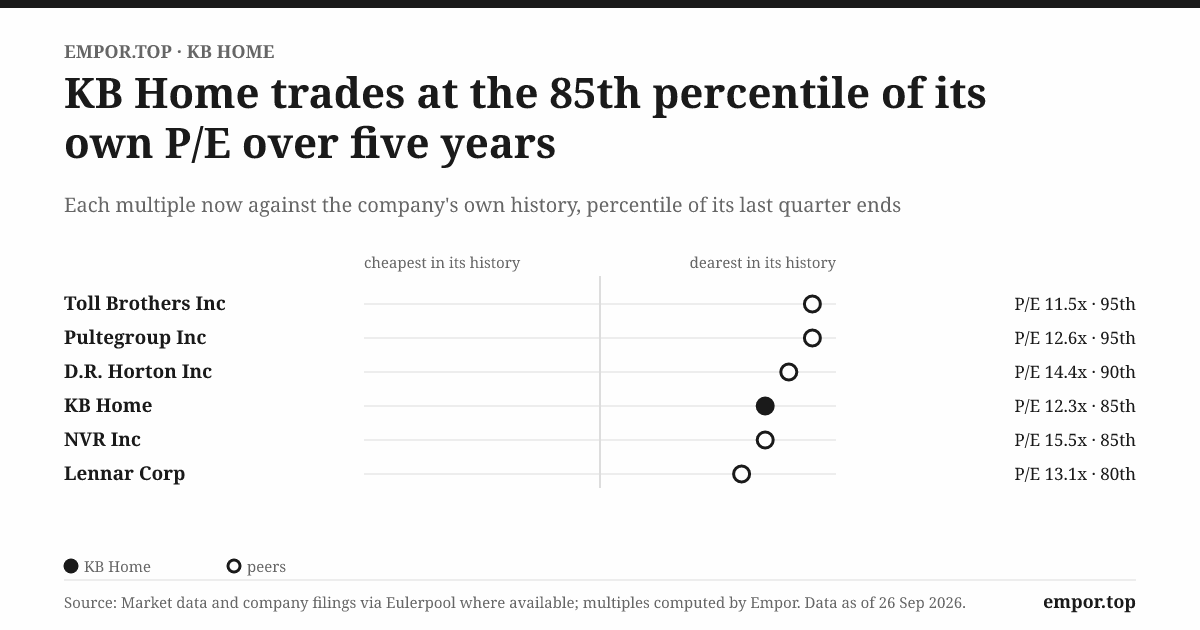
Management has said its third-quarter buybacks were done at prices below book value per share,2 which means the market is valuing KB Home's net assets at a discount. For a homebuilder, that kind of discount usually signals doubt about one of three things: the value of the land, the durability of margins, or the company's ability to turn book value into returns above its cost of capital.
At a roughly 16% gross margin, return on equity is well below what it was in fiscal 2022–2024. The discount is the market's statement that it does not yet believe the 22% margin target. Whether that doubt is too pessimistic depends on the three measures below, not on management's reassurance.
What could break the case
The bear case is also concrete. Margins are falling, not stabilizing: fiscal 2026 gross margin guidance of about 16% is well below the 22% long-term target management still cites,2 and the BTO mix benefit has mostly been used. Leverage is rising, a credit rating has been cut, and the buyback continues.1618
About 60% of lots are owned, which keeps impairment risk meaningful if prices keep falling, and McGibney acknowledged pricing is "starting to decline in more of our markets."2 Full-year guidance has been walked down three times this year. And the company is managing all of this with a new CEO, an executive chairman still in the room, and no permanent CFO.234
The macro risk is specific rather than generic. On the Q3 call, Mezger described persistent inflation "driven in part by fuel prices," and noted that the Federal Reserve had raised rates the week before.2 HousingWire put mortgage rates around 7.57% at the time of the report.31 For KB Home, each step up in rates cuts directly into what a first-time buyer can afford each month.
Tariffs and fuel feed into direct costs with a one-quarter lag.2 Refinancing risk is manageable in the short term: management said at the end of fiscal 2025 that there were no debt maturities until June 2027.17 That date is now nine months away, and it will arrive in a higher-rate market with a lower credit rating.
Operating leverage makes the downside sharper than the gross margin alone suggests. Homebuilding operating income in the third quarter was 5.2% of revenue, down from 8.1% a year earlier, as both lower gross margin and higher SG&A as a share of revenue took a bite.2 When revenue falls about 20%, overhead does not fall as fast. If fiscal 2027 volumes stay flat or fall further, even a stable gross margin would leave operating margins under pressure.
The calibrated verdict on the thesis
Testing each main claim against the company's own history gives this picture. The BTO advantage is real but smaller than the marketing suggests: a margin premium, not protection from the cycle. The land-light claim does not hold up at current ownership levels and trends.
Capital allocation has been effective at reducing the share count, but it is untested through a real impairment cycle under current leadership, and the last twelve months have pushed leverage above the company's own target. Management credibility is mixed: reliable quarter to quarter, too optimistic at the start of down years, and now complicated by leadership turnover. None of these points settles the investment question. Together they define what the next four quarters need to show.
The three numbers that matter
Net orders per community per month (absorption). This measures whether BTO is winning buyers or just protecting margins while volume shrinks. Management's goal is about four. The third quarter of 2026 came in at 3.1.162
Adjusted housing gross margin, read alongside BTO share of deliveries. This shows whether the margin recovery can continue now that the mix shift is largely done. The measures to compare it against are the fiscal 2026 guidance of about 16% and the 22% long-term target.162
Debt-to-capital ratio. This shows whether the buyback is being funded by the business or by borrowing. The relevant comparisons are management's 30% target and the 35.7% ratio at the end of the third quarter of 2026.1716
Beyond the three measures, three events will test the story over the next year. The fourth-quarter report will bring the first full-year outlook for fiscal 2027 issued under McGibney, and its width and midpoint will show whether the forecasting lessons of 2025 and 2026 have been learned. The appointment of a permanent CFO, or continued silence on the role, will show how the board is handling the finance seat. And the approach of the first debt maturity in June 202717 will show whether KB Home refinances on acceptable terms with a BB rating, or cuts buybacks to preserve cash.
The couple in Phoenix will decide much of this story, along with millions like them. If they choose the KB Home floor plan because it fits their budget and their taste, the company's sixty-nine-year-old idea still works. If they choose the discounted resale house down the street, no amount of process discipline will fully offset it. For now, KB Home is building fewer homes, more of them for buyers who have already signed. That is a more careful strategy, not necessarily a more profitable one.
References
-
KB Home (KBH) Q3 2026 Earnings Call Transcript — The Motley Fool, 2026-09-23 ↩↩↩↩↩↩↩↩↩↩↩↩↩↩↩↩↩↩↩↩↩↩↩↩↩↩↩↩↩↩↩↩↩↩↩↩↩↩↩↩↩↩↩↩↩↩↩↩↩↩↩↩↩↩↩↩↩↩↩↩↩↩↩↩↩↩↩↩↩
-
KB Home Form 10-K for fiscal year ended November 30, 2017 — U.S. SEC, 2018 ↩↩↩↩↩
-
KB Home announces results of stock option investigation and management changes (8-K Exhibit 99.2) — U.S. SEC, 2006-11-12 ↩↩
-
KB Home CEO resigns amid options probe — NBC News, 2006-11-13 ↩
-
Former KB Home CEO convicted of federal fraud charges related to stock option backdating — U.S. Attorney's Office, Central District of California, 2010-04-21 ↩
-
KB Home Reports 2007 Fourth Quarter and Full Year Results (8-K Exhibit 99.1) — U.S. SEC, 2008-01-08 ↩↩↩↩↩
-
KB Home Form 10-K for fiscal year ended November 30, 2009 — U.S. SEC, 2010 ↩↩↩↩↩↩
-
KB Home Form 10-K for fiscal year ended November 30, 2012 — U.S. SEC, 2013 ↩↩↩
-
KB Home Reports 2008 Third Quarter Results (8-K Exhibit 99.1) — U.S. SEC, 2008-09-26 ↩↩↩
-
KB Home Names Robert McGibney Chief Executive Officer — KB Home Investor Relations, 2026-01-28 ↩↩↩↩↩
-
KB Home Reports 2022 Fourth Quarter and Full Year Results (8-K Exhibit 99.1) — U.S. SEC, 2023-01-11 ↩↩↩↩↩
-
KB Home Reports 2023 Fourth Quarter and Full Year Results (8-K Exhibit 99.1) — U.S. SEC, 2024-01-10 ↩↩↩↩↩↩↩↩
-
KB Home Reports 2024 Fourth Quarter and Full Year Results (8-K Exhibit 99.1) — U.S. SEC, 2025-01-13 ↩↩↩↩↩↩↩
-
KB Home Reports 2025 Fourth Quarter and Full Year Results — KB Home Investor Relations, 2025-12-18 ↩↩↩↩↩↩↩↩↩↩
-
KB Home Reports 2026 Third Quarter Results — PR Newswire, 2026-09-22 ↩↩↩↩↩↩↩↩↩↩↩↩↩↩↩↩↩↩↩↩↩↩↩↩
-
KB Home Q4 2025 Earnings Call Transcript — MarketBeat, 2025-12-18 ↩↩↩↩↩↩↩↩↩↩↩↩↩↩↩↩↩↩
-
KB Home Downgraded To 'BB' From 'BB+' On Weaker Operating Performance — S&P Global Ratings, 2026-07 ↩↩↩
-
KB Home Q3 Earnings Call Highlights — MarketBeat, 2026-09-22 ↩
-
D.R. Horton Reports Fourth Quarter and Fiscal 2025 Earnings (8-K Exhibit 99.1) — U.S. SEC, 2025-10-28 ↩↩↩
-
Lennar Reports Fourth Quarter and Fiscal 2025 Results — Lennar Investor Relations, 2025-12-16 ↩↩↩
-
KB Home Reports 2026 First Quarter Results (8-K Exhibit 99.1) — U.S. SEC, 2026-03-24 ↩↩↩
-
KB Home Reports 2026 Second Quarter Results (8-K Exhibit 99.1) — U.S. SEC, 2026-06-23 ↩↩↩↩
-
KB Home Reports 2022 First Quarter Results (8-K Exhibit 99.1) — U.S. SEC, 2022-03 ↩
-
KB Home Reports 2022 Second Quarter Results (8-K Exhibit 99.1) — U.S. SEC, 2022-06-22 ↩
-
KB Home Reports 2022 Third Quarter Results (8-K Exhibit 99.1) — U.S. SEC, 2022-09-21 ↩
-
KB Home Reports 2023 Third Quarter Results (8-K Exhibit 99.1) — U.S. SEC, 2023-09-20 ↩
-
KB Home Reports 2025 First Quarter Results (8-K Exhibit 99.1) — U.S. SEC, 2025-03-24 ↩
-
KB Home Reports 2025 Second Quarter Results (8-K Exhibit 99.1) — U.S. SEC, 2025-06-23 ↩
-
KB Home Reports 2025 Third Quarter Results (8-K Exhibit 99.1) — U.S. SEC, 2025-09-24 ↩
-
KB Home's build-to-order pivot pays off, but buyers remain cautious — HousingWire, 2026-09 ↩↩
-
KB Home Chief Financial Officer to Retire in Early 2025 — KB Home Investor Relations, 2024-09-30 ↩
-
KB Home CFO Robert Dillard to step down this month — HousingWire, 2026-05 ↩↩↩
-
KB Home Form 8-K (CFO resignation) — U.S. SEC, 2026-04-29 ↩↩
 LinkedIn
 WhatsApp
 Reddit
 Hacker News
 Email
Email Kindle
 RSS Feed
 Spotify
 Apple Podcasts
 Amazon Music
 Audible
 YouTube