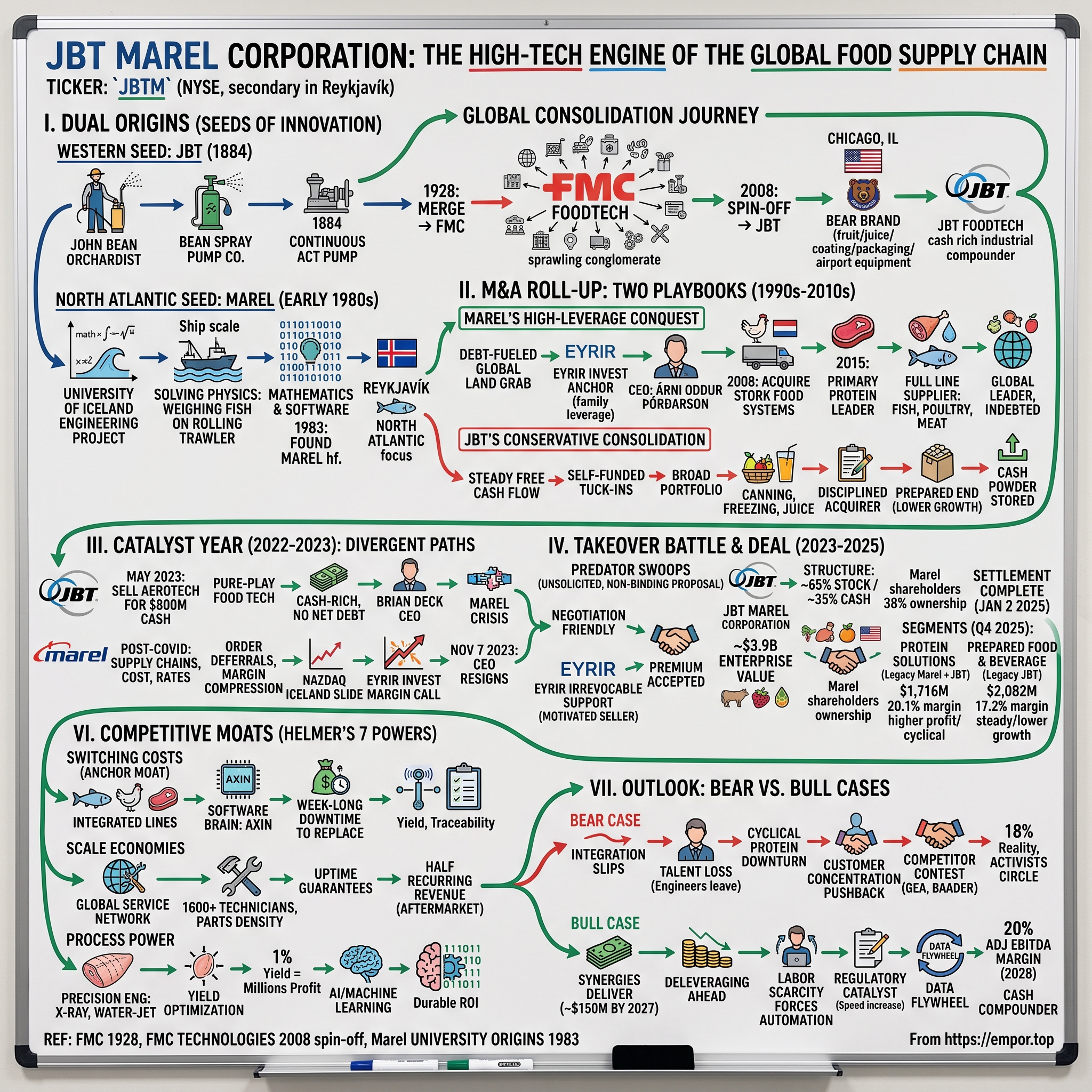
JBT Marel Corporation: The High-Tech Engine of the Global Food Supply Chain
I. Introduction & Episode Roadmap
Pull apart a chicken nugget and you will find, in a sense, a machine. Not inside the breading, but behind it: the deboning system that stripped the meat from the carcass at a hundred-odd birds a minute, the vision sensor that graded each fillet by weight and color, the water-jet knife that portioned it to the gram, the forming drum that pressed it into that unmistakable dinosaur or clover shape, the fryer, the spiral freezer, the packaging line. A modern protein plant is less a kitchen than a car factory that happens to run on flesh. And an outsized share of the equipment inside it now carries one of two brand lineages that, as of January 2025, sit under a single roof: JBT Marel Corporation, listed in New York under the ticker JBTM and, in a nod to its Icelandic half, secondarily in Reykjavík.
This is a story about how the unglamorous middle of the food supply chain — the capital equipment that turns animals and fruit into shrink-wrapped, barcoded product — quietly consolidated into an oligopoly, and how two very different companies on two different continents spent forty years racing to own the factory floor before finally colliding.
The spark that fused them was not a grand strategic vision announced from a stage. It was a margin call. JBT, a cash-rich American industrial platform run by a former treasurer named Brian Deck, had spent 2023 turning itself into a pure-play food-technology company by selling off its airport ground-support business for $800 million.1 Across the Atlantic, its larger, more advanced rival — Marel hf., the pride of Icelandic engineering — was reeling. Its stock had slumped, and its founding-family anchor shareholder, Eyrir Invest, had borrowed heavily against those very shares. When the price fell far enough, the bank moved. On November 7, 2023, Marel's long-serving chief executive Árni Oddur Þórðarson abruptly resigned after lenders took control of his family's pledged stock.[^3] Two and a half weeks later, JBT knocked on the door with an unsolicited proposal.2 The predator had arrived at the precise moment the prey was leaderless.
The core thesis worth interrogating across this episode is a technological one: food processing is migrating from crude mechanical cutting to something closer to precision manufacturing — AI-guided, X-ray-sighted, sensor-fed, software-orchestrated. In an industry this consolidated, the prize goes to whoever can merge the physical machines with the software brain that runs them. JBT Marel's leadership argues it now owns both halves. The skeptic's job — and ours — is to ask what evidence actually supports that claim, and what could break it.
Here is the road we will travel. First, the dual origin myths: a California orchardist in 1884 fighting an insect with a spray pump, and a University of Iceland engineering project in the early 1980s trying to weigh a fish on a rolling trawler. Then the parallel roll-ups — Marel's debt-fueled global land grab versus JBT's cautious, cash-funded tuck-ins — that produced two market leaders in adjacent halves of the same industry. Then the catalyst year of 2023, when JBT armed itself with cash and Marel's balance sheet detonated. Then the takeover battle itself and the financial architecture of the roughly $3.9 billion deal that resulted. Then a hard look at the combined company's segments and economics, its competitive moats tested against Hamilton Helmer's 7 Powers and Porter's Five Forces, and finally the bull and bear cases that will determine whether this merger was a masterstroke of opportunistic capital allocation or an expensive integration headache dressed up as one.
 Subscribe on LinkedIn
II. The Dual Origins of JBT and Marel: Seeds of Industrial Innovation
The Western Seed: An orchardist declares war on an insect
In the 1880s, the almond and prune orchards of the Santa Clara Valley — a place that would, a century later, be renamed Silicon Valley — were under siege. The culprit was the San Jose scale, a tiny sap-sucking insect that encrusted branches and killed trees. Spraying them by hand with a lever-operated pump was slow, exhausting, and hopeless against an infestation moving faster than a person could work. One frustrated grower in Los Gatos, John Bean, happened to also be an inventor. In 1884 he built a continuous-action, high-pressure piston pump that could deliver a steady jet of insecticide without the endless manual pumping — and in doing so founded the Bean Spray Pump Company.16
It is a fitting origin for a company that would spend the next 140 years selling machines whose entire value proposition is doing a messy agricultural job faster, more consistently, and with less human labor. That through-line — automation as an answer to the physical limits of the human body — never really changed. Only the job did.
The pump business grew, and in 1928 Bean Spray Pump merged with two other equipment makers, Anderson-Barngrover and Sprague-Sells, to form the Food Machinery Corporation — FMC.16 Over the following decades FMC became a sprawling American industrial conglomerate of the mid-century type: it made citrus juice extractors and canning machinery, but also military landing craft, agricultural chemicals, and oilfield equipment. If you want a single image of how far the company roamed from John Bean's orchard, consider that the same corporate lineage that pressed orange juice also built armored amphibious vehicles for the U.S. military and pumped chemicals — the classic postwar conglomerate that believed management competence was a portable skill you could apply to anything. Along the way it kept innovating in food: a continuous hydrostatic cooker in the 1960s that let canneries sterilize product in an unbroken flow rather than in batches, and, in the early 1980s, one of the first wire-guided automated guided vehicles — driverless factory carts — a technology that would resurface, decades later, inside the combined company's warehouse-automation business.16
The food-processing DNA was always in there, but for a long time it was one limb of a many-armed giant. That structure eventually broke apart, as conglomerates tend to when investors decide the discount for complexity outweighs the benefits of diversification. In 2008, FMC Technologies — itself already a spin-off from the old FMC — carved out its airport and food equipment businesses into a separately listed company headquartered in Chicago and gave it back the name of the founder: John Bean Technologies Corporation, or JBT.16 The choice to resurrect the 1884 name for a 2008 IPO was telling; a company can spin off from a conglomerate carrying no history, but JBT reached back more than a century for an identity, signaling that the food-equipment franchise, not the airport business, was the soul of the enterprise.
The 2008 JBT that emerged was a curious two-headed creature. One head made food-processing equipment; the other made the boarding bridges, cargo loaders, and de-icing trucks that service commercial aircraft. For fifteen years the market treated JBT as a solid, unexciting industrial compounder — a company that generated cash, bought small bolt-on businesses, and rarely made headlines. Remember that airport half. It becomes the fuel for everything that follows.
The North Atlantic Seed: Weighing a fish on a heaving sea
Now travel to Iceland, and to a genuinely hard physics problem. A fishing trawler in the North Atlantic is never still. It pitches, rolls, and heaves in three dimensions at once. A conventional scale — which works by measuring the force a mass exerts under steady gravity — is useless on such a deck, because the ship's own acceleration adds and subtracts phantom weight with every wave. Yet knowing the exact weight of the catch, as it comes aboard, is the difference between a profitable voyage and a wasteful one.
In the late 1970s, a project at the University of Iceland set out to solve exactly this: build a scale that could mathematically subtract the motion of the sea and report the true weight of a fish in real time.15 The solution required marrying electronics, sensors, and early computing power — motion-compensating, computerized scales. In 1983, two of the people behind that work, Rögnvaldur Ólafsson and Þórður Vigfússon, founded a company to commercialize it: Marel hf.15
The cultural contrast with John Bean is worth pausing on. Where JBT's ancestor was a lone orchardist solving a problem with mechanical brute force, Marel was born inside a university engineering department, solving a problem with mathematics and software. That distinction — hardware-first versus software-and-sensors-first — echoes down the decades and, ultimately, becomes the strategic rationale management would later offer for putting the two companies together. Iceland, a nation whose economy has always been disproportionately about pulling protein out of cold water, was the ideal proving ground. A country that small, that dependent on fish, and that highly educated produced exactly the kind of niche, high-tech industrial champion that Marel became.
From the onboard scale, Marel expanded naturally outward along the fish it was weighing: if you can weigh it, you can grade it by size; if you can grade it, you can sort it; if you can sort it, you can portion it and route it. Each capability pulled the company deeper into the processing plant, from the trawler deck to the factory line. This is the crucial part of the Marel origin story for an investor to internalize, because it reveals the company's fundamental instinct. Marel never really thought of itself as selling machines. It thought of itself as selling measurement and control — the ability to know precisely what was moving through a plant and to act on that knowledge in real time. The physical steel was merely the body; the sensors and software were the point. That is a very different mental model from a traditional equipment maker, and it explains why Marel, decades later, would treat its Innova software platform as the strategic center of gravity rather than an afterthought bundled with the hardware.
By the time it turned its attention beyond fish to poultry and red meat, Marel had learned the lesson that would define it — that the money was not in selling a single clever machine, but in supplying the entire integrated line, sensors and software included. A plant that buys one Marel grader might buy a rival's deboner next door. A plant whose entire line, from live-bird intake to packaged product, runs on Marel equipment stitched together by Marel software is a customer for life. That insight — that the value compounds when you own the whole line rather than a piece of it — is the same insight that would eventually make combining with JBT so tempting, because JBT owned pieces of the food plant that Marel did not.
For the long-term investor, the takeaway from these two origin stories is not nostalgia. It is that both companies were, from birth, in the business of replacing human labor and human judgment with machines and measurement — a demand driver that has only intensified as food-plant labor has grown scarcer and more expensive. The question the rest of this story asks is which of the two playbooks for scaling that business — Marel's aggressive, leveraged one, or JBT's conservative, cash-funded one — actually created more durable value, and what happened when they were forced to merge.
III. The M&A Roll-up: Two Playbooks of Global Consolidation (1990s–2010s)
Marel's high-leverage global conquest
By the 2000s, Marel had a problem that every ambitious niche champion eventually confronts: Iceland is small, fish processing is a limited market, and organic growth alone would never make it a global leader. The answer was acquisition, and the enabler was a distinctly Icelandic investment vehicle called Eyrir Invest, founded by Þórður Magnússon and his son Árni Oddur Þórðarson. Eyrir accumulated a dominant position in Marel — eventually around 24.7% of the shares, making it by far the largest owner3 — and Árni Oddur, an intense, deal-driven financier, took the Marel chief executive seat in 2013. Under his leadership Marel became something like an industrial roll-up wearing the clothes of an engineering company.
The transformative move came in 2008, when Marel agreed to acquire the Stork Food Systems division of the Dutch group Stork N.V. for €415 million.11 This was not a tuck-in; it roughly doubled Marel's revenue and, crucially, vaulted it into poultry processing at global scale. Stork brought the deep know-how of high-speed chicken lines — the deboning, cut-up, and evisceration systems that turn a live bird into tray-ready parts at industrial tempo. Overnight, the Icelandic fish-scale company became a serious poultry player, with a large Dutch engineering and manufacturing base that remains central to the business today.
Seven years later Marel completed the set. In late 2015 it agreed to buy MPS Meat Processing Systems, another Dutch specialist, for €382 million, closing the deal in early 2016.12 Where Stork gave Marel poultry, MPS gave it red meat — the pork and beef primary processing lines, plus adjacent competencies in water treatment and food logistics. With that, Marel could credibly pitch itself as the only true full-line supplier across all three major proteins: fish, poultry, and meat. Management's framing to the market was that Marel dominated the global primary and secondary protein processing market with a share often described in the low-to-mid twenties percent — a claim worth flagging as management's own characterization rather than an independently audited figure, since precise market-share numbers in this fragmented industry are notoriously slippery.
There is a piece of empire-building psychology worth naming here. Árni Oddur Þórðarson ran both Marel and, through his family, Eyrir Invest — the entity whose stake gave the family its grip on the company. That dual role meant the same person who set Marel's acquisitive strategy also controlled the shareholder vehicle that had to finance staying in control as the company issued equity and took on debt to grow. It is a structure that aligns founder and company beautifully on the way up and, as we will see, catastrophically on the way down. When one family's investment vehicle is both the anchor shareholder and personally leveraged against the stock, the company's share price stops being merely a scoreboard and becomes a live wire running straight into the founder's own solvency.
The strategic logic of the roll-up was sound; the financing was aggressive on two levels at once. Marel funded its conquest with a heavy reliance on debt at the operating-company level, and Eyrir Invest amplified the leverage a second time by borrowing against its Marel shares to maintain its controlling stake. In good times this double leverage looked like conviction and alignment — the founding family had its fortune riding on precisely the same shares as public investors, which is exactly the kind of skin in the game investors usually applaud. The structural fragility of that arrangement only becomes visible when the stock falls, because leverage does not merely magnify losses; stacked leverage magnifies them twice, and margin calls arrive precisely when a company can least afford the distraction. We will return to that fragility with some drama.
JBT's conservative, cash-flow consolidation
JBT ran the opposite playbook, and the contrast is instructive because it is ultimately a story about two different philosophies of risk. Rather than a few transformative, debt-financed megadeals, its food division — JBT FoodTech — pursued a steady drumbeat of small, self-funded acquisitions across canning, freezing, sterilization, juice extraction, coating, and packaging. The company generated strong free cash flow, carried modest leverage, and rolled that cash into tuck-ins it could digest without straining the balance sheet. Each individual deal was small enough that a single misjudgment could not sink the ship, and the cumulative effect over a decade was a broad, resilient portfolio assembled without the balance-sheet strain that a roll-up usually implies. It was, in the language of long-term investors, a disciplined serial acquirer — the kind that compounds quietly rather than swinging for transformation, and precisely the kind of behavior that leaves a company with dry powder when a once-in-a-generation opportunity appears.
The philosophical difference matters because it maps directly onto how the 2023 crisis played out. Marel's leverage was a bet that growth would outrun the debt; it worked for years and then, when the macro environment turned, became the very thing that felled the founder. JBT's conservatism looked, for years, like a lack of ambition — a company leaving growth on the table while its Icelandic rival grabbed the glamorous primary-protein market. But conservatism is a form of stored optionality. The company that keeps its powder dry looks timid right up until the moment it doesn't, and then it looks like a genius. That is the reversal at the heart of this whole story.
But conservatism has a ceiling. For all its cash generation, JBT was largely locked out of the single biggest prize in the industry — primary protein processing, the high-volume front end of poultry and meat plants — because Marel and a handful of European rivals already held that territory. JBT's food business skewed toward the "prepared" end: fruit and juice, ready meals, aseptic filling, cooking and freezing. Profitable and stable, but growth-constrained. Two leaders had emerged in adjacent halves of the same industry, each strong where the other was weak. In a rational world, someone would eventually try to combine them. What neither could have scripted was that the trigger would come not from a boardroom strategy session but from a balance-sheet crisis — and that the healthier, smaller company would be the one holding the gun.
IV. The Catalyst Year: Divergent Paths and a Collateral Crisis (2022–2023)
JBT loads the cannon
Every great opportunistic acquisition requires two things: a target that becomes cheap, and a buyer that happens to be liquid at exactly the right moment. The second half of that equation was engineered deliberately, and it began with Brian Deck deciding that JBT should stop being two companies pretending to be one.
Deck, who had become chief executive in December 2020 after years as the company's chief financial officer, was a capital-allocation-minded operator rather than a product visionary — the sort of leader who thinks in terms of return on invested capital and portfolio shape. He concluded that JBT's airport equipment arm, AeroTech, for all its profitability, was a cyclical, capital-hungry business with little strategic overlap with food. So in May 2023 JBT agreed to sell AeroTech to Oshkosh Corporation for $800 million in cash, a transaction that closed on August 1, 2023.1
In a single move, JBT transformed itself. It became a pure-play food and beverage technology company, and — more importantly for what came next — it was sitting on a large cash pile with essentially no net debt. This is the underappreciated hinge of the entire story. The AeroTech sale was framed publicly as portfolio simplification, but its practical effect was to hand Brian Deck a loaded balance sheet at the exact moment a much larger rival was about to become vulnerable. Whether that timing was foresight or fortune, the discipline to raise the cash before the opportunity appeared is precisely the behavior that separates opportunistic acquirers from reactive ones.
Marel's post-pandemic squeeze
While JBT was simplifying, Marel was suffering. The post-COVID environment was brutal for capital-equipment makers. Supply chains snarled, component and freight costs soared, and — most damagingly — central banks raised interest rates at the fastest pace in a generation. For a company that sells multi-million-dollar processing lines to food producers, higher rates are poison twice over: they raise Marel's own cost of its considerable debt, and they make customers defer big capital projects. Order intake softened, margins compressed, and Marel's share price on Nasdaq Iceland slid.
For most public companies, a falling stock is a disappointment. For Marel, given how it was owned, it was the trigger on a loaded weapon.
The collateral drama in Reykjavík
Recall that Eyrir Invest — the founding family's vehicle, chaired within the family and run by the same Árni Oddur who ran Marel — had borrowed against its Marel shares. This is the oldest hazard in leveraged finance: pledge an asset as collateral, and when the asset's price falls below a threshold, the lender can demand more collateral or seize what it holds. As Marel's stock fell through 2023, Eyrir's loans moved toward that line. The primary lender, the Icelandic bank Arion banki, moved to enforce, taking control of a slice of the Eyrir shares that had been pledged.
The consequence was swift and personal. On November 7, 2023, Árni Oddur Þórðarson resigned as chief executive of Marel, effective immediately.[^3] Marel's official announcement cited personal reasons and thanked him for a decade of growth; the Icelandic financial press reported the fuller story of the margin call and his dispute with Arion banki over the seized collateral. Either way, the substance was the same: the man who had been the strategic and financial center of gravity of Marel for a decade was gone, forced out by the failure of a leverage structure he himself had built. Into the breach stepped Árni Sigurðsson, the deputy chief executive — a Harvard MBA who had joined Marel in 2014 — first as interim and then as permanent chief executive, charged with steadying a company that had just lost its leader, its share-price momentum, and the confidence of its largest shareholder in one blow.
Here, then, was the setup no strategist could have drawn up. A leaderless, indebted, undervalued global leader in protein processing. A cash-rich, debt-free rival across the ocean, freshly focused and hunting. And a controlling shareholder so desperate to repay its own bank debt that it had every incentive to sell. The pieces were on the board. What happened next was a takeover that blurred the line between rescue and raid.
V. The Takeover Battle and Deal Architecture (2023–2025)
The predator swoops
Seventeen days after Árni Oddur's resignation, JBT made its move. On November 24, 2023, it submitted an unsolicited, non-binding proposal to acquire Marel — an offer of €3.15 per share, structured mostly as JBT stock with a slice of cash.2 Marel's board, now steadied under new management, rejected it as opportunistic and inadequate. The timing made the "opportunistic" charge hard to deny: JBT had shown up within three weeks of its rival being decapitated. But being opportunistic and being right are not mutually exclusive, and JBT was not going away.
What followed was a textbook example of a proposal that starts hostile and is negotiated into friendliness through the twin levers of a rising price and a motivated seller. On December 13, 2023, JBT came back with an enhanced proposal of €3.40 per share, an eight percent bump that implied an enterprise value of roughly €3.4 billion and represented a premium of more than forty percent to Marel's undisturbed pre-bid share price.13 The higher number softened the board, but the decisive factor was not the board at all. It was Eyrir Invest.
The dance of valuations, and the shareholder that had to sell
Eyrir's predicament was the fulcrum of the entire negotiation. The vehicle was desperate to repay Arion banki and its other lenders, and the only way to do that was to monetize its Marel stake. A cash-and-stock takeover that let it exit was not a threat to Eyrir; it was salvation. Eyrir therefore signed an irrevocable undertaking to support JBT's offer with respect to its 24.7% holding.3 That single signature changed the board's math entirely. When the largest shareholder — holding a quarter of the company — has publicly and bindingly committed to a deal, the board's leverage to hold out for more evaporates. The independent directors were, in effect, negotiating with a gun already pointed at their own register.
This is where a neutral observer should sit with the discomfort of the situation. The deal that JBT ultimately struck was, by most measures, a fair-to-generous premium for Marel's public shareholders. But it was also a deal in which the company's controlling owner had an acute, idiosyncratic reason to sell — its own leverage crisis — that had nothing to do with Marel's intrinsic long-term value. Minority holders were carried along by the liquidity needs of the majority. Whether they got full value for a scarce, high-quality industrial asset, or whether they were cashed out at a cyclical low forced by someone else's margin call, is a genuinely open question, and one that flatters JBT's timing more than it flatters the price Marel's owners accepted.
The definitive agreement and the architecture of the deal
The parties signed a definitive transaction agreement on April 4, 2024.3 The headline terms valued Marel's equity at approximately €2.7 billion and, including Marel's net debt of roughly €0.7 billion, implied an enterprise value of about €3.5 billion, or around $3.9 billion.3 (Some secondary press coverage circulated a €4.1 billion figure, but the primary transaction documents put the enterprise value at approximately €3.5 billion.)
The structure was elegantly built to serve both sides' needs. Marel shareholders could elect all cash (€3.60 per share), all stock (0.0407 JBT shares per Marel share), or a blend (€1.26 in cash plus 0.0265 JBT shares) — with proration ensuring the aggregate consideration landed at roughly 65 percent stock and 35 percent cash.3 The stock-heavy mix mattered: it meant JBT did not have to raise a mountain of debt to fund an all-cash purchase, preserving the balance-sheet discipline that had made the deal possible in the first place. When the dust settled, Marel shareholders would own approximately 38 percent of the combined company.3 The cash component gave Eyrir and other sellers the liquidity they needed; the stock component kept JBT's leverage manageable and gave Marel's owners continued upside in the combined entity.
The mechanics dragged on for the better part of a year through regulatory clearances and an Icelandic voluntary takeover-offer process. Settlement completed on January 2, 2025, and the newly renamed JBT Marel Corporation began trading on January 3, 2025, under the ticker JBTM — primary listing on the New York Stock Exchange, secondary listing on Nasdaq Iceland, preserving the company's dual identity.4[^13] Weeks later, Eyrir Invest announced it had repaid all its lenders and become debt-free, its remaining stake now a roughly 6.6 percent holding in JBT Marel that represented the bulk of its assets.[^6] The leverage crisis that had started the whole chain of events was, for Eyrir, finally resolved — by selling most of the company its founders had built. For JBT's shareholders, the question now was whether Brian Deck had bought a bargain or a burden. That answer lives in the economics of the combined giant.
VI. The Combined Giant: Segment Deep-Dive & Economics
The shape of the new company
Step back and look at what emerged on the far side of the merger. JBT, a roughly $1.7 billion-revenue company before the deal, absorbed a business nearly as large as itself and became a food-technology enterprise with combined revenue of just under $3.8 billion in its first full year together. Reported revenue for fiscal 2025 came in at $3,798.2 million.56 Adjusted EBITDA reached approximately $600 million, an adjusted EBITDA margin of 15.8 percent.5 Those are the vital statistics of a company that roughly doubled in size overnight and now spans essentially the entire food-processing value chain, from the moment an animal or a piece of fruit enters a plant to the moment finished product leaves it shrink-wrapped.
The 15.8 percent margin is the number to anchor on, because everything in management's forward story is about moving it higher. For context, that margin sits below where best-in-class industrial-technology businesses operate, and below Marel's own historical peaks — a reflection both of the cyclical trough the industry passed through and of the costs of stitching two companies together. Management's entire investment pitch rests on the claim that 15.8 percent is a floor to be climbed from, not a ceiling.
The two segments
In the fourth quarter of 2025, JBT Marel realigned itself into two reportable segments, and the logic of the split tells you how the company now thinks about itself.6
Prepared Food and Beverage Solutions is the larger of the two, generating $2,082.0 million of revenue in fiscal 2025 at a 17.2 percent adjusted EBITDA margin.6 This is largely the legacy JBT world: fruit and juice processing, ready meals, aseptic filling, cooking, coating, freezing, and — a newer wrinkle — warehouse automation and automated guided vehicles. It sells into the downstream, value-added end of food: the dairy, bakery, pet-food, and packaged-goods plants. Its demand is driven by long, slow, reliable tailwinds — urbanization, the global drift toward convenience and packaged foods, and the automation of the back half of food plants. It is the steadier, more predictable engine.
Protein Solutions generated $1,716.2 million of revenue at a notably higher 20.1 percent adjusted EBITDA margin.6 This is legacy Marel plus JBT's own protein systems: the primary processing, harvesting, deboning, portioning, sorting, freezing, and packaging of poultry, pork, beef, and fish. It is the front end of the protein plant — higher-margin, more technologically intensive, and considerably more cyclical, because it depends on food producers making large, discretionary capital-investment decisions that they defer the moment their own margins tighten. The higher profitability of Protein Solutions is a genuinely important fact: it says the crown jewel JBT bought is the more profitable half of the combined company, which is a point in favor of the deal's strategic logic even if the price is debatable.
The synergy engine — and the burden of proof
Every acquirer promises synergies, and every skeptic should treat those promises as unproven until the cash actually shows up. JBT Marel's numbers here are, so far, tracking. In its first year the company realized about $43 million of cost synergies and exited 2025 at roughly an $85 million annualized run-rate.5 It reported approximately $30 million of order (revenue) synergies as well, from cross-selling combined JBT-and-Marel lines to customers — the concrete example management cites is integrated lines for products like chicken nuggets and hamburger patties that draw equipment from both legacies.9
At its March 2026 investor day, management laid out the fuller ambition: a target of roughly $150 million in annual run-rate cost synergies by the end of 2027, achieved by consolidating facilities, aligning procurement, and eliminating redundant administrative functions.7 Stretch further out and the company set a "NextGen" objective of a 20 percent adjusted EBITDA margin by 2028 — more than four percentage points above the 2025 level.7 On the deleveraging side, the story has been credible: leverage that stood near four times EBITDA at the deal's close was down below 2.9 times by the end of 2025 and 2.6 times by the first quarter of 2026, with management targeting roughly two times by year-end 2026.910
Here is the honest analytical read. The synergy delivery to date is real, the deleveraging is ahead of plan, and the segment margins — especially Protein Solutions at 20 percent — suggest the underlying businesses are healthy. That is genuine evidence of execution, not mere rhetoric. But the largest, hardest-to-capture synergies (supply-chain regionalization, facility consolidation) are back-end-loaded into 2027, and the 20 percent margin target for 2028 requires the company to both finish integrating and ride a protein capital-spending upcycle at the same time. The early results earn management some benefit of the doubt; they do not yet prove the destination.
The 2026 guidance and the early read on the cycle
Look at how management set expectations for 2026 and you get a window into its confidence. Alongside its 2025 results, the company guided to full-year 2026 revenue of $3,990 million to $4,065 million and adjusted EBITDA of $675 million to $710 million — implying roughly five to seven percent revenue growth and a margin stepping up to 17.0 to 17.5 percent, a gain of about 145 basis points at the midpoint.5 It paired that with an adjusted earnings-per-share target of $8.00 to $8.50, up nearly 30 percent at the midpoint, the compounding effect of margin expansion and deleveraging flowing through to the bottom line.9 Guidance is not achievement, but the shape of it matters: management chose to promise visible margin expansion in year two rather than defer all the improvement to the back-loaded 2027–2028 window, which raises the stakes on near-term execution.
The first data point against that guidance was encouraging. In the first quarter of 2026, revenue rose about ten percent to $936 million, and the company swung to net income of roughly $45 million from a $173 million loss a year earlier — the prior-year loss reflecting the heavy accounting charges that accompany a merger's first months.810 Adjusted EBITDA was about $142 million at a 15.2 percent margin, and free cash flow of roughly $100 million represented conversion of about 70 percent of adjusted EBITDA — a healthy figure for a capital-equipment business and a sign the working-capital drag of integration was not choking cash generation.10 More telling than the profit line were the orders: order intake exceeded $1 billion for a second consecutive quarter and grew about 17 percent year over year, producing a book-to-bill ratio of roughly 1.14 — meaning the company booked new orders considerably faster than it converted backlog into revenue.10 A book-to-bill above one is the clearest single signal that the protein capital cycle, after roughly two years of customer underinvestment, had turned back up. Management reaffirmed its full-year guidance on that first-quarter call rather than raising it, a restraint that reads as either conservatism or caution depending on your priors.8
Tariffs, geography, and the honest accounting of headwinds
A neutral treatment has to note the frictions management flagged rather than glossed. Tariffs were a live issue through 2025 and into 2026 for a company that manufactures across the United States and Europe and ships globally. On its calls, management quantified the drag concretely: tariffs cost roughly 50 basis points of margin in 2025, and in 2026 the elimination of one tariff regime was, in the chief financial officer's framing, "essentially offset" by increases in other duties, netting to a headwind of roughly 25 to 50 basis points after mitigation.910 Notably, Brian Deck was candid that the company did not expect to pass the entire burden to customers — "we don't feel it's 100 percent on the customers' backs" — an admission that pricing power, real as it is, has limits when input costs jump industry-wide.9 On geographic risk, management sized its Middle East exposure at less than five percent of revenue and reported no noteworthy impact on the order book from regional tensions, a useful piece of specificity for anyone tempted to over-weight geopolitical headlines.10
Capital allocation: the discipline test
The most revealing strategic disclosures came at the March 2026 investor day, where management laid out an explicit capital-allocation hierarchy: first, deleverage to a target of roughly 2.0 to 2.5 times net-debt-to-EBITDA; second, invest organically; third, resume strategic and disciplined mergers and acquisitions with a bar of double-digit cash return on invested capital within three to five years; fourth, repurchase shares to offset dilution; and last, maintain the dividend.7 Deck was emphatic on the calls that acquisitions stay paused until integration and deleveraging are complete — "we are laser-focused on completing the integration" — and the company raised a convertible note in September 2025 to pre-fund the retirement of debt maturing in 2026.9 For a serial acquirer to publicly holster its weapon while it digests the largest deal in its history is exactly the behavior a long-term investor should want to see; the test is whether management honors that stated order of priorities once the balance sheet is repaired and the temptation to deal returns.
The investor-day frame put numbers on the ambition: a five-to-seven-percent organic revenue growth rate through 2028, cumulative free cash flow of more than $1 billion over 2026–2028, and segment margin goals of roughly 23 percent for Protein Solutions and 21 percent for Prepared Food and Beverage by 2028.7 These are the flags against which management has asked to be judged. Which brings us to the deeper question of whether this business has the kind of durable competitive advantages that would let it hold those margins once the integration story is over.
VII. Playbook: The Competitive Moats & Helmer's 7 Powers
Switching costs: the anchor moat
To understand why a food processor rarely rips out its equipment supplier, you have to understand what it is actually buying. It is not buying a machine. It is buying an integrated, running factory line, calibrated to its specific products, wired into its yield tracking, its inventory systems, and its food-safety traceability — the paperwork that lets a plant prove, if a regulator or a retailer asks, exactly which bird ended up in which package on which day.
That integration is where the deepest moat lives, and it runs through software. Marel's legacy production-management platform, Innova, functions as the nervous system of a protein plant — collecting data from every sensor and scale on the line, running yield analytics, and orchestrating the flow of product. Post-merger, JBT Marel has been consolidating its digital tools, including JBT's own service platform, under a unified brand it calls AXIN.14 Whatever the branding, the strategic point is durable: once a processor's entire plant floor, its yield optimization, and its traceability records are built around this software layer, swapping the underlying hardware for a competitor's — a GEA or a BAADER — is not a purchasing decision. It is a plant-wide surgery involving weeks of downtime, revalidation, and operator retraining, all while the line that generates the customer's revenue sits idle. In Helmer's framework, this is switching cost in close to its purest form: the incumbent wins not because its next machine is necessarily better, but because leaving is ruinously expensive.
A neutral caveat belongs here. Switching costs protect the installed base; they do not automatically win new plants or greenfield lines, where a competitor competes on a level field. The moat is strongest at the point of expansion and replacement within an existing customer, and weaker at the point of first entry — which is one reason competition for large new-build projects remains real.
Scale economies and the aftermarket engine
The second power is scale, and it expresses itself most clearly through the aftermarket. Roughly half of JBT Marel's revenue is recurring — spare parts, preventive and prescriptive maintenance, remote diagnostics, consumables, and software.7 This is the single most important economic fact about the company, because it transforms the profile of the business. A pure equipment maker lives and dies by the capital-spending cycle; a company where half of revenue comes from servicing an enormous installed base has a shock absorber under it. When customers defer buying new lines in a downturn, they still need to keep the lines they own running — and they pay JBT Marel to do it.
Scale makes that aftermarket engine hard to replicate. With a roughly $3.8 billion revenue base and an installed footprint of hundreds of thousands of machines across the world, JBT Marel can afford to station localized service technicians and stock parts inventory within reach of customers in geographies where a smaller regional rival simply cannot justify the fixed cost. More installed machines means more service density; more service density means faster uptime guarantees; better uptime wins the next equipment sale. It is a flywheel that compounds with size. Management's stated ambition — captured in the NextGen plan — is to raise aftermarket penetration from roughly 40 percent of the installed base toward 50 percent or more, which, if achieved, would both grow revenue and further stabilize the cash flows.7 Whether penetration actually rises is a clean, trackable test of the thesis.
Process power and intellectual property
The third power is subtler and rests on decades of accumulated engineering: process power, expressed as proprietary technology that competitors cannot easily match. Consider X-ray-guided portioning. A poultry breast is an irregular, three-dimensional object of varying density; cutting it into precise, equal-weight portions without wasting meat is genuinely hard. JBT Marel's systems use X-ray and computer vision to see inside and around each piece, then direct high-speed water-jet knives to cut for maximum yield.
The economics of that precision are enormous and worth spelling out plainly, because this is where the technology stops being a gadget and becomes a profit lever. A large poultry processor runs on thin margins and vast volumes. Every one percent improvement in yield — one percent more saleable meat recovered from the same birds — can translate into millions of dollars of annual profit for a major processor like Tyson or JBS. When your equipment can credibly demonstrate a yield uplift, you are not selling a machine on price; you are selling a return on investment that the customer can calculate. That is pricing power grounded in measurable customer economics, and it is the hardest kind of moat for a low-cost competitor to erode — because the customer is not comparing sticker prices, but comparing the total value of the meat that ends up in the box.
There is a compounding wrinkle to the process power that is easy to miss and increasingly important: data. Every line JBT Marel installs generates a continuous stream of information about how real product behaves in a real plant — how a breast of a given weight and density responds to a given cut, how yields drift with temperature or bird size. That accumulated application data is the raw material for the next generation of the technology, including the machine-learning models that will make the vision and cutting systems smarter over time. A company with hundreds of thousands of machines in the field has a data advantage over a smaller rival that is difficult to close, because the smaller rival simply cannot observe as many cuts. This is the closest the business comes to a genuine flywheel between its installed base and its product edge — more machines in the field yield more data, which yields better algorithms, which yield better machines. It is also, for now, more of a promise than a demonstrated moat; management talks about the data advantage, but the proof will be in whether JBT Marel's yield and uptime figures pull measurably ahead of the field over the next several years.
The open question that hangs over all three powers is how much of the yield-and-automation advantage is uniquely JBT Marel's versus available, in some form, from GEA and BAADER too. Process power is only a moat to the extent it is scarce, and the honest answer is that the top competitors are sophisticated engineering companies in their own right, not stragglers. The competition section takes up that question directly.
VIII. Risks, Activist Stress Tests, & Bear vs. Bull Cases
The integration risk radar
Start with the risk that is most within management's control and therefore most revealing of its competence: integration. JBT Marel is not one culture but at least three — the Chicago corporate headquarters of legacy JBT, the engineering-driven European operations Marel built in the Netherlands through Stork and MPS, and Marel's own Icelandic home in Garðabær, a place where Marel was a source of national pride. Blending an American, capital-allocation-led corporate culture with a proud Northern European engineering culture is exactly the kind of thing that looks trivial on a synergy slide and turns out to be the whole game in practice.
The specific hazard is talent. The value JBT paid for lives substantially in the heads of Marel's engineers — the people who understand the X-ray algorithms, the water-jet control systems, and the software. If those people leave, feeling steamrolled by an American acquirer, the moat erodes from the inside regardless of what the org chart says. It is notable, and a modest positive signal, that Marel's former chief executive Árni Sigurðsson stayed on as the combined company's chief strategy officer rather than departing — a sign the acquirer worked to retain, not merely absorb, the Icelandic leadership. On the earnings calls through 2025 and into 2026, integration questions from analysts were framed around the financial and operational mechanics — supply-chain regionalization, facility consolidation — rather than around cultural fracture, which suggests that, at least so far, the human integration has not visibly broken.910 "So far" is doing real work in that sentence.
The capital-expenditure cycle and customer concentration
The second material risk is cyclicality, and it is structural rather than fixable. The aftermarket half of the business is stable, but the equipment half — especially Protein Solutions — swings with the capital-spending decisions of food processors. When chicken or pork producers see their own margins compress, or when interest rates make financing a new line expensive, they defer projects, and JBT Marel's order intake falls. The company lived through exactly this in 2022–2023. Management noted on recent calls that protein customers had endured "roughly two years of underinvestment" before orders began recovering strongly in late 2025 and into 2026, with orders exceeding $1 billion in consecutive quarters and a book-to-bill ratio above one.910 That recovery is encouraging, but it also underscores the point: this is a business whose front half is at the mercy of a cycle it does not control.
Customer concentration is a related, if less quantified, concern. JBT Marel sells to the giants of global protein — the Tysons, JBS's, and Cargills of the world — and those customers wield real scale and bargaining power. The company does not disclose a precise revenue concentration by customer, so the exact exposure is not public. But the structural reality is that a handful of enormous processors account for a meaningful share of the addressable market, and they have every incentive to push back on pricing or to develop alternative sourcing for components. A supplier's pricing power is only as strong as its customers' lack of alternatives, and these particular customers are large enough to create their own.
There is an offsetting subtlety, though, and it cuts toward the bull side. A regulatory catalyst that management repeatedly flagged illustrates how the demand can be switched on by forces entirely outside the customer's own margin cycle. In the United States, poultry line speeds are capped by the Department of Agriculture; management has pointed to the possibility that regulators could raise the permitted maximum — the figure cited on the calls was a move from roughly 140 birds per minute toward 175 — which, Deck argued, "would precipitate investment all around."10 The mechanism is intuitive: if every poultry plant in America is suddenly allowed to run its lines faster, every plant needs new, faster equipment more or less at once, regardless of where the broader capital cycle happens to sit. That is the kind of exogenous, industry-wide demand trigger that a scaled full-line supplier is uniquely positioned to harvest — and a reminder that this business's fortunes are shaped as much by regulation and labor economics as by any single customer's mood.
The activist stress test
Now put on the hat of a skeptical activist investor and ask what you would attack. The answer writes itself: execution against the targets. Management has planted two very public flags — roughly $150 million of run-rate synergies by the end of 2027 and a 20 percent adjusted EBITDA margin by 2028.7 Those numbers are now the yardstick by which the market will measure this management team, and they cut both ways. Hit them, and the story of a brilliantly-timed, well-executed transformation is validated. Miss them — let the synergies slip, let integration friction delay the margin expansion, let a protein downturn stall the top line — and JBT Marel becomes a textbook target for an industrial-focused activist. The pitch would be familiar: a complex, cross-border integration that overpromised, a margin structure lagging peers, and a portfolio that could be simplified or a management team that could be replaced. The company's own aggressive target-setting is what hands a future activist its script.
On the credibility ledger, the early evidence is mixed-to-favorable. Management set concrete, quantified targets rather than vague aspirations; it has so far delivered the synergies and deleveraging on or ahead of schedule; and it has been willing on calls to name specific operational problems — the clearest example being the warehouse-automation and automated-guided-vehicle inefficiencies in the Prepared Food and Beverage segment that the company flagged and committed to resolving by early in the second quarter of 2026 rather than burying.9 Naming a problem with a date attached is the behavior of a team that keeps score honestly, and it is a useful contrast to the vaguer "we're pleased with our progress" language that lower-quality management teams substitute for accountability.
The NextGen framework unveiled at the investor day organized the whole ambition around five pillars: a customer-first service organization built on a field force of more than 1,600 technicians; an integrated value proposition selling equipment, software, and service together rather than as separate line items; capturing the full market through cross-selling across the combined portfolio; operational distinctiveness through continuous improvement under a "JBT Marel Business System"; and strategic, disciplined acquisitions once the balance sheet allows.7 Strip away the corporate labeling and what remains is a coherent thesis: monetize the installed base harder through service and software, sell the combined portfolio into customers each legacy company could only half-serve, and grind out cost through operational rigor. It is a sensible plan. The counterweight, which no framework can dissolve, is that the hardest work is still ahead — the deepest synergies and the top of the margin ramp both live in 2027 and 2028 — and a first year of hitting the easier, front-loaded targets does not guarantee the back-loaded ones. Discipline claimed is not discipline proven until the cycle tests it, and the cycle always eventually tests it.
The competitive war-game: Porter and Helmer
Run the industry through Porter's Five Forces and the structure that emerges is, on balance, attractive. Start with rivalry. It is concentrated among a small number of serious players rather than fragmented into a price war. The most direct peer is GEA Group, the German process-technology giant that spans food, dairy, refrigeration, and packaging and competes across a broad swath of JBT Marel's territory. The other is BAADER, a privately held German-Icelandic specialist with deep roots in fish and poultry processing — notably, another company with Icelandic DNA competing in the same protein niche where Marel was born. Around the edges sit broader industrial names like Bühler, Krones, Tetra Pak, Middleby, and Alfa Laval, each strong in particular slices. The point for an investor is that none of these is a fly-by-night discounter; rivalry is real, but it is rivalry among a handful of well-capitalized engineering firms that mostly compete on capability and total cost of ownership rather than on headline price. That is the kind of rivalry that preserves industry profitability rather than destroying it.
The threat of new entrants is low. The capital required, the accumulated process know-how built over decades, the global service network needed to support installed equipment, and the switching costs protecting incumbents together form a formidable barrier — and, tellingly, no credible new entrant has appeared to challenge the established players. The threat of substitutes is muted, because there is no alternative to physically processing protein and food; a chicken still has to be deboned and portioned by something, and the only question is who supplies the machine that does it. The two genuine pressure points are buyer power, given the scale of the largest food processors already discussed, and, to a lesser degree, supplier power for specialized components and the semiconductors that increasingly sit inside intelligent equipment. On the whole, this is a consolidated oligopoly with high barriers to entry and rational competitors — the kind of industry structure long-term investors tend to like, and a meaningful part of the reason the combined company can plausibly aim for margins in the high teens and beyond.
Where does JBT Marel's own market position sit within that structure? Management describes a serviceable addressable market of roughly $50 billion growing at three to four percent a year and positions the company as the scaled leader by breadth of line.7 It is worth flagging as an analytical caution that the frequently-repeated claim of a 20-to-30-percent share of primary protein processing is not something an independent observer can cleanly verify; market-share figures in a fragmented, privately-populated industry are estimates, and even generous third-party data on the pre-merger companies put JBT's share of its combined sectors closer to the high teens. The safe conclusion is that JBT Marel is a leader — very possibly the leader by full-line breadth — but that precise share claims should be treated as directional rather than exact.
Against Helmer's 7 Powers, JBT Marel can credibly claim three: switching costs, scale economies, and process power, each discussed above. What it largely cannot claim are network effects (a food processor's equipment does not become more valuable because other processors use the same brand), counter-positioning (there is no new business model here that incumbents can't copy — this is scale-on-scale), or the softer powers of branding and cornered resources. Three of seven is a strong hand for an industrial company, but it is worth being precise that the moat is built on installed-base lock-in and scale, not on anything a competitor is structurally prevented from eventually building for a new customer.
The bull case
The bull case is a compounding story. Integration proceeds smoothly, the synergies land, and margins climb past 17 percent in 2026 on the way to the 20 percent target — pulling free cash flow and returns on capital up with them. The secular tailwind does the rest: chronic and worsening labor shortages in food plants across the developed world force processors to automate whether the cycle is favorable or not, because there simply are not enough people willing to do the work. A single regulatory nudge — a USDA decision to raise permitted poultry line speeds, which management has flagged as a potential catalyst — could unleash a wave of investment across the installed base.10 Meanwhile the aftermarket engine, growing its penetration of that installed base, smooths the cash flows and funds both deleveraging and, eventually, capital returns. In this version, JBT Marel is a scaled, moaty, cash-generative compounder bought at a cyclical low.
The bear case
The bear case is an execution-and-power story. Integrating the Icelandic, Dutch, and American organizations proves harder and slower than the slides imply; key engineers leave; project execution slips; and the back-loaded 2027 synergies never fully materialize. The protein capital cycle, having just recovered, rolls over again on the next macro shock, and Protein Solutions' cyclicality reasserts itself. The giant customers — Tyson, JBS, Cargill — use their scale to grind down pricing or to source components independently, capping the margin expansion. And the competitors do not stand still: GEA and BAADER contest every new-build line, eroding the notion that the moat extends to fresh business rather than just the installed base. In this version, the 20 percent margin target quietly becomes an 18 percent reality, the activists circle, and the deal is remembered as fairly-priced rather than brilliant.
What to actually watch
For an investor tracking this company over the coming years, the noise-to-signal ratio is best managed by focusing on a very small number of indicators. Three stand out. First, order intake and book-to-bill in Protein Solutions — this is the cleanest read on where the protein capital cycle actually is, independent of management's narrative about it. Second, adjusted EBITDA margin against the 17 percent-plus interim and 20 percent-by-2028 milestones — the single number that tells you whether the synergy and integration promises are converting into real economics or slipping. Third, aftermarket/recurring revenue as a share of the total and its penetration of the installed base — because that is the moat and the shock absorber both, and its trajectory reveals whether the flywheel is actually turning. Everything else is commentary.
IX. Epilogue & Outro
There is a pleasing symmetry to this story that should not be mistaken for inevitability. A California orchardist in 1884 built a pump to spray an insect off his trees. Two Icelandic engineers in 1983 built a scale to weigh a fish on a heaving deck. Neither could have imagined that their inventions would, 140 years and 40 years later respectively, be joined into a single company orchestrating a meaningful slice of how the world turns animals and plants into packaged food. Both companies were, at their core, always doing the same thing — replacing the limits of human muscle and human judgment with machines and measurement — and the world's growing scarcity of food-plant labor has only made that mission more valuable.
But the deeper lesson of JBT Marel is not about food or even about technology. It is about capital allocation and timing. Brian Deck's real achievement was not inventing anything; it was arranging JBT's affairs so that when a rare opportunity appeared, the company was ready to seize it. He sold a good business — AeroTech — to become simpler and to raise cash, and that cash became the weapon that let him acquire a larger, more advanced rival at the precise moment its own financial leverage had rendered it vulnerable. It is a near-perfect illustration of a truth long-term investors know well: that the returns from a great acquisition are usually determined less by the quality of the asset, which everyone can see, than by the price and the timing, which only the disciplined and the liquid can exploit.
Whether it proves to be a great acquisition, of course, is not yet settled. The asset is genuinely good, the industry structure is genuinely attractive, and the moats — switching costs, scale, process power — are real if not impregnable. But the price was paid to a seller under duress, the integration is only partly done, the biggest synergies are still promises, and the whole thing rides a protein cycle no one controls. From saving orchards and weighing fish to running the automated backbone of the global food supply chain, the story so far is one of two brilliant engineering companies and one shrewdly-timed piece of financial engineering. The next chapter — whether JBT Marel earns the compounding returns its structure makes possible, or merely proves that a good deal and a good business are not the same thing as a great outcome — is still being written on the factory floor.
References
-
Oshkosh Corporation to Acquire AeroTech Business from JBT Corporation for $800 Million — Business Wire, 2023-05-30 ↩↩
-
US Food Tech Firm JBT Makes 3.4 Bln Merger Proposal to Iceland's Marel — Reuters, 2023-11-24 ↩↩
-
JBT and Marel Execute Definitive Transaction Agreement — Business Wire, 2024-04-04 ↩↩↩↩↩↩
-
JBT Corporation Completes Settlement of its Voluntary Takeover Offer of Marel hf. and Commences Trading as JBT Marel Corporation — Business Wire, 2025-01-03 ↩
-
JBT Marel Corporation Reports Fourth Quarter and Full Year 2025 Results and Establishes 2026 Guidance — JBT Marel Investor Relations, 2026-02-23 ↩↩↩↩
-
Form 10-K (Annual Report) for the Fiscal Year Ended December 31, 2025 — JBT Marel Corporation, 2026-03-02 ↩↩↩↩
-
JBT Marel 2026 Investor Day Presentation (Form 8-K Exhibit 99.1) — JBT Marel Corporation, 2026-03-26 ↩↩↩↩↩↩↩↩↩
-
JBT Marel Corporation Reports First Quarter 2026 Results and Reiterates Full-Year 2026 Guidance — JBT Marel Investor Relations, 2026-05-04 ↩↩
-
JBT Marel (JBTM) Q4 2025 Earnings Call Transcript — The Motley Fool, 2026-02-24 ↩↩↩↩↩↩↩↩↩
-
JBT Marel (JBTM) Q1 2026 Earnings Call Transcript — The Motley Fool, 2026-05-05 ↩↩↩↩↩↩↩↩↩↩
-
Agreement to Acquire the Stork Food Systems Division of Stork N.V. — GlobeNewswire (Marel), 2007-11-28 ↩
-
Marel Agrees to Acquire MPS Meat Processing Systems — GlobeNewswire (Marel), 2015-11-21 ↩
-
JBT Corporation Submits Enhanced Proposal to Acquire Marel hf. — Business Wire, 2023-12-13 ↩
-
Marel — Wikipedia (company founding and University of Iceland origins) ↩↩
-
JBT Corporation — Wikipedia (Bean Spray Pump 1884, FMC 1928, 2008 spin-off) ↩↩↩↩
 LinkedIn
 WhatsApp
 Reddit
 Hacker News
 Email
Email Kindle
 RSS Feed
 Spotify
 Apple Podcasts
 Amazon Music
 Audible
 YouTube