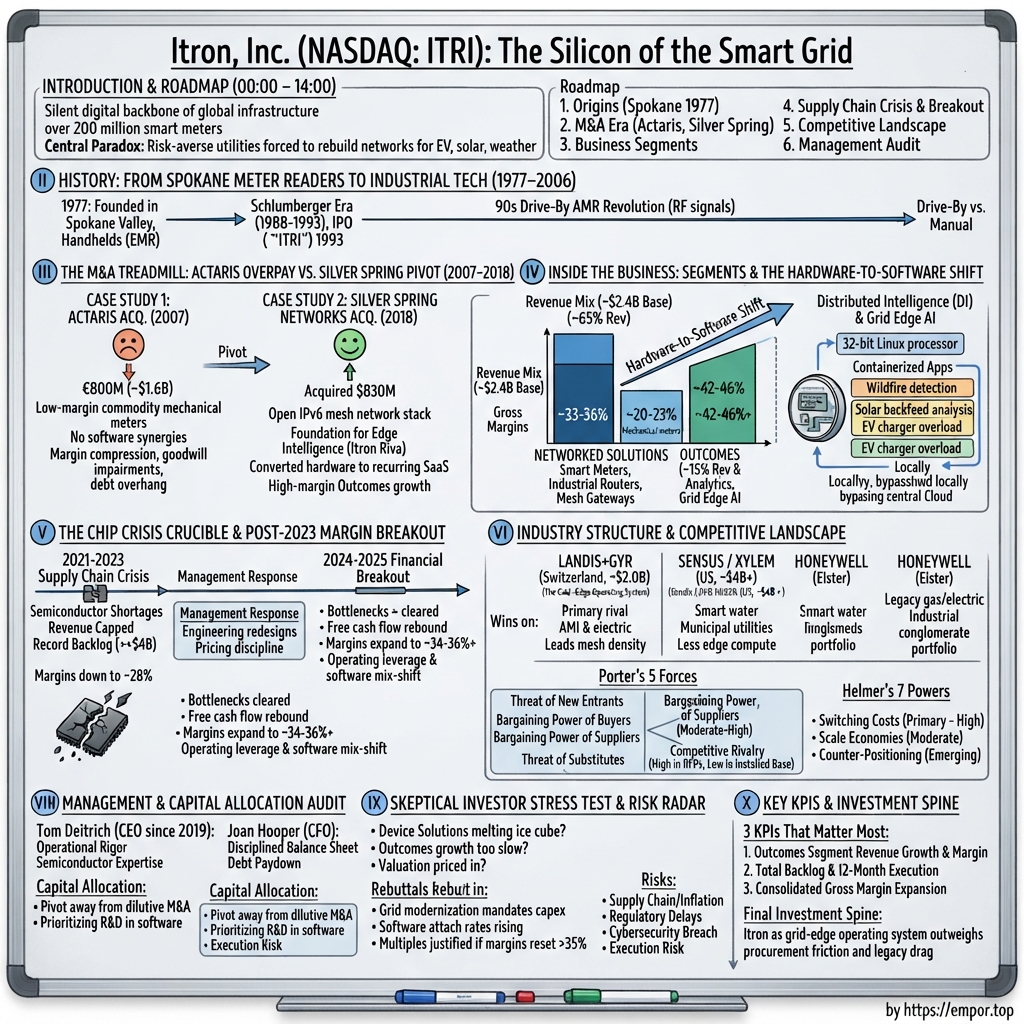
Itron, Inc. (NASDAQ: ITRI): The Silicon of the Smart Grid
I. Introduction & Episode Roadmap
On a February morning in 2026, a winter storm named Fern dragged a sheet of ice from Texas to Maine. Transformers exploded in the dark. Distribution lines sagged and snapped. Utility crews from a dozen states convoyed toward the damage before the freezing rain stopped falling.
Somewhere in the middle of that response — invisible to almost everyone whose lights went out — a piece of software logged 3.5 million hours of restoration work, tracking crew positions, hazard assessments, damage reports, and worker check-ins. Itron Chief Executive Officer Tom Deitrich cited the figure on an earnings call a week later, framing the company's newest acquisition as essential infrastructure.1 The incident illustrates Itron's fundamental positioning: not merely a meter manufacturer, but an underlying intelligence layer operating quietly when the electrical grid faces peak stress.
Headquartered in Liberty Lake, Washington — a suburb of Spokane far removed from Silicon Valley — Itron generated $2.37 billion in revenue in 2025 and holds a market capitalization of roughly $4.4 billion.23 Servicing around 8,000 customers globally, its energy forecasting software supports 90% of North American independent system operators and more than 70% of the continent's electricity operators.1 Its physical endpoints — including meters, gas modules, water registers, grid sensors, and network gateways — total hundreds of millions across five continents. Yet despite its scale, the company remains largely overlooked in discussions surrounding the artificial intelligence-driven demand for electricity.
The central paradox
Itron operates at the intersection of two conflicting structural forces. Utilities rank among the world's most conservative capital allocators. As regulated monopolies, their capital expenditures require approval from state public utility commissions, their hardware assets sit on balance sheets for 15 to 20 years, and their procurement timelines extend over multi-year cycles.
Simultaneously, these conservative institutions must modernize electricity, gas, and water distribution networks to handle unprecedented operational pressures. They face residential electric vehicle charging added driveway by driveway, rooftop solar systems reversing traditional one-way power flow, data center operators requesting interconnection within 18 months rather than six years, and increasingly severe weather events that exceed historical design standards.
The result is an industry with cautious operational habits facing rapid structural demands. That friction represents Itron's primary addressable market. As Deitrich noted on the first-quarter 2026 earnings call, distribution networks "were not designed for the complexity created by distributed energy resources, increasing industrial and AI-driven demand, resource scarcity, and escalating weather volatility."4 Management contends that when physical grid expansion cannot keep pace with demand, extracting efficiency from existing infrastructure through software and sensors offers the fastest, most cost-effective alternative.
Whether this operational necessity translates into an attractive investment thesis remains the key question.
The core thesis under examination
The bullish case for Itron depends on a strategic transition: moving from hardware manufacturing toward high-margin networking, software, and recurring service revenue built upon an established, sticky customer base. In 2025, the company delivered a 37.7% adjusted gross margin, $374 million in adjusted EBITDA, $7.13 in non-GAAP diluted earnings per share, and free cash flow of $383 million — representing 16.2% of revenue.2 Each figure marked an all-time company high, achieved even as consolidated revenue fell 3% year over year.
This divergence — contracting top-line sales alongside record profitability — defines Itron's current financial profile. Proponents view the margin expansion as evidence of a successful structural pivot toward high-margin software and services. Skeptics contend the company is maximizing short-term margins while its foundational hardware volume slows. By the second quarter of 2026, adjusted gross margin reached 41.4% despite a 7% year-over-year revenue decline.5 Investors maintain a cautious stance: trading at $101.56 in mid-August 2026, the stock sits well below its 52-week peak of $142.3
Episode roadmap
Phase 1 examines the company's origins in a northern Idaho garage in 1977 and traces the shift from manual meter reading to automated radio telemetry.
Phase 2 analyzes key historical acquisitions, including the $1.6 billion purchase of Actaris — which ultimately triggered roughly $714 million in cumulative goodwill impairments — and the $830 million acquisition of Silver Spring Networks, which established Itron's core networking technology.
Phase 3 reviews current operations across four distinct reporting segments, examining their financial performance and the roll-out of distributed intelligence applications embedded at the meter level.
Phase 4 evaluates the 2021–2023 semiconductor supply chain constraints, detailing how component shortages temporarily stalled a $4 billion backlog before triggering subsequent margin expansion.
Phase 5 surveys the competitive landscape, examining market dynamics as key pure-play competitors consolidate operations.
Phase 6 assesses management strategy, capital allocation priorities, and primary downside risks, evaluating valuation metrics against ongoing revenue volatility in major segments.
The narrative begins with a fundamental operational bottleneck: the manual collection of utility data.
 Subscribe on LinkedIn
II. History: From Spokane Meter Readers to Industrial Tech (1977–2006)
In the mid-1970s, a utility meter reader in the Inland Northwest faced an arduous routine: covering a 400-home route equipped with only a clipboard, pencil, flashlight, and dog repellent. Each reading was transcribed manually, returned to a central office, and re-keyed into a mainframe by data-entry clerks who had never seen the meter. Every manual step introduced potential errors, which frequently surfaced as customer billing disputes.
In 1977, a small group of engineers in Hauser Lake, Idaho — operating, by the company's account, out of a garage — recognized that meter reading was fundamentally an information management problem.67 Their central insight was straightforward: the primary cost of meter reading lay not in walking the physical route, but in manual data transcription. Equipping field technicians with portable computers rather than paper clipboards eliminated a costly, error-prone clerical step while enabling same-day ingestion into utility billing systems.
This innovation established Itron's foundational product category: electronic meter reading (EMR). The company shipped its first-generation handheld computers in 1980.6 Essentially ruggedized calculators equipped with digital memory, these devices initiated an operational template that Itron has followed for nearly five decades: helping utilities convert manual field labor into structured digital data.
Itron also established early hardware manufacturing capabilities. It introduced the A6 in 1978 as the industry's first polyphase single-disk electricity meter, followed by the J5S hybrid electromechanical residential meter in 1979.6 During the 1980s, the company expanded internationally, establishing a manufacturing facility in Indonesia in 1984, integrating the Flostar and Woltex water meter lines in 1986, and completing acquisitions in Germany and Italy in 1987.6 Even during its first decade, Itron built a multi-commodity footprint spanning electricity, gas, and water metering — a diversified structure that remains a key differentiator today.
The AMR revolution: a van doing the work of a hundred people
A major technological shift occurred in 1990 when Itron introduced commercial-scale automatic meter reading (AMR) for natural gas and electricity.6 The system relied on an encoder receiver transmitter (ERT) attached to the meter. The low-power radio module periodically woke up, broadcast consumption data over a short-range radio frequency signal, and returned to a low-power state. A utility vehicle equipped with a rooftop receiver could drive down a street at 30 miles per hour and collect thousands of meter readings within an hour.
The economics proved compelling for utility operators. Routes that previously required an entire worker-day could be completed in minutes by a single vehicle. Automated data collection drastically reduced estimated billings — historically a major source of customer complaints — while enabling remote reads for meters located in locked basements, behind gated yards, or beneath heavy snowfall.
Market adoption accelerated quickly. By December 1995, Itron had shipped its five-millionth ERT module and captured roughly 80% of North American AMR installations.7 Backed by this commercial momentum, the company completed its initial public offering on NASDAQ in November 1993.7 Between 1992 and 1995, annual revenue more than doubled from $67.8 million to $155.3 million.7
This expansion established Itron's primary competitive moat. Rather than relying solely on patent protections or brand recognition, the company benefited from deep operational lock-in: a utility deploying millions of ERT modules made a multi-decade commitment to Itron's proprietary radio protocols, decoding software, and ongoing technical support. Replacing that ecosystem would require physical visits to millions of customer locations, explaining why Itron's client relationships frequently span decades.
Myth versus reality: the Schlumberger question
A persistent industry myth suggests that Itron was acquired by oilfield services giant Schlumberger in the late 1980s and subsequently spun off through its 1993 IPO. The historical record indicates the opposite sequence.
Itron was never a Schlumberger subsidiary. Instead, in 2004 — eleven years after its IPO — Itron acquired Schlumberger's electricity metering division, a franchise dating back to 1899 that included manufacturing and sales operations in the United States, Canada, Mexico, Taiwan, and France.6 That transaction transformed Itron into a large-scale solid-state electricity meter manufacturer, moving it beyond its legacy identity as a data-collection system provider attached to third-party hardware.
This distinction provides crucial context for evaluating Itron's corporate trajectory. The company did not inherit global manufacturing scale from a parent conglomerate; it purchased that scale using debt as an independent public entity. That aggressive acquisition strategy set a precedent that would define both its market reach and its subsequent strategic missteps.
The stickiness that was, and the one that wasn't
By the mid-2000s, Itron occupied a powerful yet vulnerable strategic position. On one hand, it enjoyed long-term relationships with municipal and investor-owned utilities within a concentrated buyer market where major accounts drove substantial volume. Protracted utility procurement cycles insulated the company from abrupt competitive shifts, while regulatory rate-base frameworks encouraged utilities to capitalize infrastructure hardware expenditures.
On the other hand, AMR was fundamentally a one-way communications technology. While drive-by data collection successfully automated manual reading, it could not support real-time grid management. As utilities began requiring two-way capabilities — such as remote service disconnects, dynamic time-of-use pricing, and immediate outage notifications — the limitations of single-direction radio telemetry became clear.
As the industry shifted toward two-way smart metering networks, Itron responded by acquiring legacy hardware scale just as grid value was beginning to shift toward networking protocols and software management — setting up a costly strategic transition.
III. The M&A Treadmill: The Actaris Overpay vs. The Silver Spring Pivot (2007–2018)
The shift that changed everything
Advanced Metering Infrastructure — AMI — is the industry term for two-way utility communications. Instead of a meter broadcasting consumption data to a passing van, every endpoint joins a persistent communications network that connects back to the utility's operations center. The meter functions as an intelligent node that can be read on demand, disconnected remotely, and queried immediately when a local power outage occurs.
The most consequential architectural decision in AMI involved network topology. One approach favored cellular connections, renting bandwidth from telecom carriers. Another relied on point-to-multipoint towers. A third option — which ultimately dominated North American deployments — used radio frequency (RF) mesh technology. In an RF mesh system, each meter acts as a low-power radio node that relays data for neighboring endpoints, enabling the network to self-organize and self-heal. As additional meters join, the network grows denser and more resilient rather than capacity-constrained — operating more like a city's sidewalk network than a central telephone exchange.
Itron faced this industry transition in 2007 with a fundamental strategic choice: acquire the communications network layer, or expand its physical hardware base.
Case study one: Actaris, and the cost of buying the boxes
Itron chose hardware scale. In February 2007, the company announced the acquisition of European metering provider Actaris Metering Systems, closing the transaction on April 18, 2007.89 The deal carried an equity value of €800 million alongside the retirement of roughly $644 million in Actaris debt, representing a total transaction value of approximately $1.6 to $1.7 billion.8 Funding comprised about $1.1 billion in senior secured credit facilities underwritten by UBS, a $235 million private stock placement completed in February 2007, and existing cash.8 Management projected that the acquired business would contribute $720 million to $730 million in revenue and $110 million to $115 million in adjusted EBITDA in its first full year.8
On paper, the transaction dramatically expanded Itron's global footprint. It instantly positioned the company among the largest electricity, gas, and water metering suppliers worldwide, adding established market positions across Europe, Latin America, Africa, and Asia. Management's stated rationale was cross-market expansion: Actaris would introduce Itron's AMR and AMI technologies into international markets, while Itron would distribute Actaris's gas and water hardware across North America.8
However, the strategic logic overestimated the value of international hardware scale. Actaris primarily manufactured mechanical and basic electronic meters sold into dozens of fragmented national markets, each governed by distinct regulatory standards, currencies, labor structures, and public tendering processes. Very little of this revenue generated software margins or connected to networked architectures. Furthermore, utilities in these markets were, in aggregate, less incentivized to invest in grid intelligence than North American investor-owned utilities because local regulatory frameworks did not offer comparable rate-base returns for software capital expenditures.
By funding an acquisition of unmoated hardware manufacturing at the peak of an industrial cycle using substantial debt, Itron left itself exposed just ahead of the 2008 global financial crisis. The expected cross-selling synergies — attaching high-margin software to Actaris's installed base — required European utilities to modernize at a pace they did not maintain.
The financial consequences materialized over the following decade. In the third quarter of 2011, Itron conducted an interim impairment test and recorded a $540.4 million goodwill write-down linked to two reporting units within its Itron International segment.[^10] On February 7, 2014, the company disclosed an additional pre-tax non-cash goodwill impairment of $173.2 million in its Electricity segment, citing delays in global smart grid rollouts, reduced sales volumes, and pricing pressure across Europe and Asia-Pacific.[^10] Combined, these charges represented roughly $714 million in recognized value destruction — approximately 45% of the original deal value — while the debt burden constrained capital allocation toward networking technologies.
The episode demonstrated that volume scale within a commoditizing hardware layer does not construct a defensible economic moat, and paying a strategic premium for unintegrated manufacturing capacity converts growth challenges into long-term balance-sheet leverage.
Case study two: Silver Spring Networks, and buying the layer above
Eleven years after the Actaris announcement, Itron executed a contrasting transaction focused on network architecture.
Silver Spring Networks was a Silicon Valley firm that had completed an initial public offering while advocating for open networking standards in utility infrastructure. The company challenged traditional meter manufacturers by selling utilities an IPv6-based wireless mesh network as the primary system, treating the physical meter as a secondary endpoint. Because its architecture relied on open protocols rather than proprietary hardware interfaces, utilities could connect additional third-party devices to the network, including streetlights, line sensors, and distribution automation hardware. Prior to its acquisition, Silver Spring had delivered over 26.7 million network-enabled devices across five continents, covering an end-customer footprint of roughly 200 million people.[^11]
For an incumbent reliant on meter manufacturing, Silver Spring represented a structural challenge: an architecture premised on the concept that value resides in the network software layer rather than the physical enclosure.
Itron announced the acquisition of Silver Spring on September 18, 2017, at $16.25 per share in cash — representing an enterprise value of approximately $830 million net of $118 million in acquired cash, and a 25% premium over the prior closing price.10 The transaction closed on January 5, 2018.[^11] Management targeted approximately $50 million in annualized run-rate cost synergies within three years of closing.10
Evaluating the two transactions highlights a clear strategic distinction: while Actaris brought manufacturing capacity and fixed overhead, Silver Spring provided a unified communications layer that compounded in utility value over time. Subsequent software offerings — including distributed intelligence applications, analytics tools, network-as-a-service delivery models, and grid-edge management tools — rely on this networking foundation. The acquired business was integrated into Itron Networked Solutions, which became the company's largest operating segment.[^11]
This strategic transition carried operational caveats. Silver Spring had experienced slowing revenue growth as an independent public entity prior to the sale, and Itron paid a full valuation multiple. However, the transaction allowed Itron to neutralize a competitive threat while upgrading its core software architecture at a significantly lower capital cost than the Actaris purchase.
Itron pursued complementary bolt-on acquisitions during this period following the same architectural strategy: acquiring SmartSynch in 2012 for cellular communications capability, Comverge in 2017 for demand response management, and Elpis Squared in 2024 for grid operations analytics.6 Each transaction targeted software capabilities and networking protocols rather than physical manufacturing assets.
By 2018, Itron had reoriented its technological architecture toward networked infrastructure. However, the company still faced operational challenges around cost structure, product mix optimization, and upcoming global semiconductor supply shortages.
IV. Inside the Business: Segments, Economics, and the Hardware-to-Software Shift
Modern residential electricity meters bear little resemblance to legacy electromechanical devices with spinning aluminum disks. Instead, a contemporary meter functions as an edge computing node, equipped with a 32-bit microprocessor running an embedded Linux operating system, flash memory, a cellular or radio transceiver, and containerized software capability — the same architecture that allows data centers to execute isolated workloads on shared hardware.
This transformation of physical meters into intelligent endpoints underpins Itron's modern business model. By transitioning hardware endpoints into programmable computers, the company establishes a proprietary channel capable of deploying software across roughly 200 million connected locations globally.
The four segments, and why they behave so differently
As of 2026, Itron operates across four distinct reporting segments with contrasting economic profiles.
Networked Solutions serves as the company's core operating anchor, generating roughly 60% of total revenue. In the second quarter of 2026, the segment delivered $339 million in revenue alongside a 42.8% adjusted gross margin and a 33% operating margin.5 Comprising advanced metering infrastructure (AMI) hardware — such as radio-enabled electricity meters, gas and water modules, network gateways, and routers — alongside mesh-management head-end software, the segment relies on multi-year utility deployment cycles. Because public utility commissions regulate these rollouts over three- to four-year implementation periods, revenue offers long-term visibility but exhibits quarterly volatility. A schedule delay in a single major project can significantly alter consolidated quarterly results.
This operational volatility was evident during the first half of 2026, as Networked Solutions revenue fell 14% in the first quarter and 17% in the second quarter, with management attributing both contractions to deployment timing rather than customer cancellations.45 While timing explanations remain difficult to verify prior to revenue realization, management guided consolidated third-quarter 2026 revenue to between $590 million and $600 million — representing a projected return to year-over-year growth — and stated that a substantial majority of second-half revenue was already secured under contract.5
Device Solutions accounts for approximately 20% of consolidated revenue, encompassing standalone meters and measurement hardware lacking advanced communications features. Segment revenue reached $111 million in the second quarter of 2026.5 The division has contracted in recent years due to deliberate strategic restructuring. In 2022, Itron actively phased out low-margin and non-connected product lines — reducing segment revenue by approximately $50 million during the first half of that year — and divested its non-communicating commercial and industrial mechanical gas unit, which had generated roughly $100 million in annual sales.11
Despite expectations that Device Solutions would operate as a declining cash generator with gross margins in the low-20% range, the segment produced a 34.8% adjusted gross margin and a 28.3% operating margin in the second quarter of 2026, near historical highs.5 Chief Executive Officer Tom Deitrich noted that the segment is performing ahead of its 2027 financial targets and projected revenues will stabilize near current levels.4 Margin expansion was driven by exiting commoditized product categories, consolidating manufacturing facilities, and selling remaining volume into a supply-constrained market. However, profitability gains derived from portfolio rationalization face inherent structural limits as top-line contraction reaches its baseline.
Outcomes represents Itron's software and services business, generating roughly 17% of total revenue. The segment provides cloud analytics, leak and theft detection, transformer load management, demand response tools, energy forecasting, and managed services. In the second quarter of 2026, Outcomes produced $96 million in revenue — up 13% year over year — alongside a 38.8% adjusted gross margin and a 21.3% operating margin.5 The quarterly expansion followed full-year 2025 revenue growth of 23%.2
The segment's margin profile reveals notable operational nuances. Contrary to typical software models, Outcomes generated a lower adjusted gross margin in the second quarter of 2026 than Networked Solutions — 38.8% compared to 42.8%.5 This difference reflects revenue composition: a significant portion of Outcomes sales derives from implementation and professional delivery services rather than software licenses alone. Deitrich noted that recurring revenue represents roughly two-thirds to three-quarters of segment sales, with recurring mix expected to rise over time.4 Concurrently, the segment demonstrated operating leverage, with operating margin expanding 290 basis points year over year in the second quarter of 2026 on 13% top-line growth.5
Resiliency Solutions was established in 2026 following two strategic acquisitions. Itron announced the purchase of Urbint — a developer of AI-enabled emergency response, damage prevention, and safety software — on October 6, 2025, for $325 million, closing the transaction on November 3, 2025.121 Two weeks later, on November 17, 2025, the company announced the $525 million acquisition of Locusview, a provider of digital construction management software that digitizes field infrastructure data from project planning through closeout; that transaction closed in January 2026.132 Together, the acquisitions represented a total cash expenditure of $850 million.1
In the second quarter of 2026, Resiliency Solutions generated $16 million in revenue, achieving a 75% adjusted gross margin and a 28% operating margin.5 Management projected full-year 2026 segment revenue of $65 million to $70 million with adjusted gross margins near 70%.1 The transactions are expected to dilute 2026 earnings per share by approximately $0.38 — primarily due to forgone interest income on the $850 million cash balance used for funding — with management anticipating net earnings accretion by late 2027.1
The hidden layer: distributed intelligence
Beyond individual segment metrics, Itron's strategic differentiation relies heavily on distributed intelligence (DI) capabilities embedded across Networked Solutions and Outcomes.
Distributed intelligence shifts data analytics from centralized cloud servers directly to edge meters. Because modern endpoints sample electrical voltage and current thousands of times per second, transmitting raw high-frequency waveforms continuously would overload network bandwidth. By executing containerized software applications locally at the meter, endpoints process electrical waveforms in real time and transmit data only when actionable anomalies occur. Key applications include:
- High-impedance fault detection, identifying energized conductors touching tree branches to help prevent utility-caused wildfires before protective relays trip.
- Solar back-feed monitoring, detecting reverse power flows on circuits originally designed for unidirectional distribution.
- Electric vehicle load management, isolating transformer strain caused by residential charging demand.
Architecturally, edge computing shifts meters from single-transaction hardware sales into ongoing software platforms. Itron reported approximately 28 million licensed applications active in the second quarter of 2026, up more than 50% year over year, following a 2025 performance in which DI-capable endpoints grew 25% and total licensed applications increased 70%.51 The company also manages over 3 million connected demand-response endpoints — such as smart thermostats and load switches — capable of shedding roughly 70 gigawatt-hours of load annually.1
On the second-quarter 2026 earnings call, management detailed two customer implementations illustrating the financial impact of grid-edge analytics. A West Coast investor-owned utility serving four to five million endpoints utilized coordinated EV charge management to remain within existing circuit limits, deferring or avoiding more than $1 billion in capital expenditures for transformer upgrades. In the Southeast, a utility with approximately one million endpoints achieved a 12% to 15% reduction in outage duration and a 3% to 5% decrease in outage frequency after deploying DI applications.5
These outcomes highlight the core economic rationale for distributed intelligence: positioning software-driven grid monitoring as a low-cost substitute for physical capital expenditure. For utilities operating under regulatory rate scrutiny and affordability mandates, operational efficiency offers an immediate alternative to asset expansion. However, as these figures reflect company-reported case studies rather than independent industry audits, investors must evaluate them as directional metrics rather than guaranteed baseline results across all customer deployments.
To track this operational transition, management introduced annual recurring revenue (ARR) as a key financial disclosure alongside its full-year 2025 results, reporting $368 million.2 By the second quarter of 2026, ARR reached $417 million, representing a 21% year-over-year increase.5 While ARR accounts for under 18% of Itron's $2.4 billion revenue base, its growth rate expands roughly four times faster than consolidated sales — underscoring the ongoing shift toward higher-margin recurring revenue.
V. The Chip Crisis Crucible & The Post-2023 Margin Breakout
In August 2022, Chief Executive Officer Tom Deitrich faced an unusual dilemma when presenting quarterly results to market analysts. Itron carried a record total backlog of $4.1 billion, a record 12-month backlog of $1.7 billion, a quarterly book-to-bill ratio of 1.4 to 1, and zero customer cancellations—yet its quarterly revenue had just declined 12%.11
This divergence highlighted an extraordinary operational bottleneck: demand for smart grid infrastructure remained robust, but Itron was unable to secure the physical components required to manufacture and ship its products.
What actually broke
While public coverage of the 2021–2022 semiconductor shortage focused heavily on cutting-edge logic processors and automotive electronics, Itron's bottleneck stemmed from a less publicized category: mature-node analog components. These legacy chips perform essential functions such as power conditioning, sensor management, and radio communication. Because chip manufacturers had not added mature-node fabrication capacity for years, supplies tightened rapidly during the global supply shock. In the second quarter of 2022, component shortages restricted Itron's revenue by more than $100 million—matching the first quarter's impact—with the Networked Solutions segment enduring the heaviest disruption.11
The company also faced secondary supply chain vulnerabilities. Although Itron had previously diversified its direct purchasing away from China, its upstream suppliers remained exposed. Second-quarter 2022 operations were severely impacted by disruptions several tiers upstream, including shortages of semiconductor lead frames caused by pandemic lockdowns in China.11 This multi-tiered exposure presented a severe management challenge, as visibility into sub-tier vendor supply chains was limited.
The financial toll was substantial. In the second quarter of 2022, consolidated gross margin fell 140 basis points year over year to 29.2%, squeezed by elevated component acquisition costs and factory inefficiencies stemming from unpredictable parts deliveries.11 Device Solutions gross margin collapsed to 13%,11 while non-GAAP diluted earnings per share dropped to $0.07.11 For the full year 2022, Itron reported revenue of $1.80 billion—down from $2.50 billion in 2019—a GAAP operating loss of $7 million, and free cash flow of under $5 million.[^10] Net leverage reached 3.8 times EBITDA.11
Facing persistent component constraints, management sharply reduced its full-year 2022 financial outlook. Full-year revenue guidance was lowered from $2.0 billion–$2.1 billion down to $1.85 billion–$1.90 billion, while non-GAAP earnings per share expectations were cut from $1.25–$1.75 to $0.70–$0.90.11
How management handled it — the credibility test
The supply disruption served as a critical test of how management navigated operational crisis under market scrutiny.
Initial management forecasts proved overly optimistic on two occasions. The original 2022 guidance explicitly assumed a significant recovery in component availability during the second half of the year—a premise that Chief Financial Officer Joan Hooper subsequently acknowledged with the note that "unfortunately, that hasn't happened."11 Management had also initially estimated the full-year supply impact at roughly $200 million, a threshold the company exceeded by mid-year. While relying on supplier availability estimates was understandable, twice issuing guidance based on unverified vendor timelines revealed vulnerabilities in operational forecasting.
Conversely, management provided granular transparency regarding specific operational constraints. Rather than attributing struggles to generic macro headwinds or demand softness, executive communications detailed exact supply bottlenecks—including analog chips, lead frames, and overseas lockdowns—and outlined concrete mitigation measures. Itron redesigned products to accept alternative chipsets, established multi-sourcing arrangements, purchased components through secondary channels, and accumulated inventory as parts became available.11 When analyst Ben Kallo asked whether recovery would occur as a rapid snapback, Hooper noted that the rebound would be gradual—constrained first by supplier capacity, then by Itron's manufacturing output, and ultimately by customers' physical installation capacity.11
Concurrently, management addressed long-standing commercial contracts. Deitrich noted that Itron had begun indexing contracts and repricing existing backlog in 2021, renegotiating terms with utility customers bound to pre-inflation pricing structures.11 Altering signed agreements with regulated utility monopolies required significant commercial leverage and established client relationships. The repricing strategy progressed over several years; on the first-quarter 2026 earnings call, Deitrich confirmed that the final pre-inflation backlog had completed delivery, serving as a key driver of recent margin expansion.4
The breakout, and what it proves
Following the supply chain trough, Itron executed a strong financial recovery. Annual revenue rose from $1.80 billion in 2022 to $2.17 billion in 2023 and $2.44 billion in 2024, before normalizing at $2.37 billion in 2025.[^10] GAAP net income recovered from a $9.7 million loss in 2022 to $96.9 million in 2023, $239.1 million in 2024, and $301.1 million in 2025.[^10] Annual free cash flow expanded from under $5 million to $383 million.2
The expansion in profitability proved even more pronounced. Consolidated gross margin expanded from a trough near 29% in 2022 to 37.7% for full-year 2025, reaching 41.4% in the second quarter of 2026.1125 This performance represented approximately 1,200 basis points of gross margin expansion over four years.
Evaluating the durability of this margin expansion requires decomposing its underlying drivers. Disclosed management data highlights four contributing factors: - First, the complete roll-off of pre-inflation backlog represents a structural price reset that is now complete and will not repeat.4 - Second, factory footprint consolidation and overhead reductions provided permanent operational efficiencies, with Hooper confirming that major manufacturing footprint rationalization is complete.5 - Third, portfolio pruning—specifically exiting low-margin, non-communicating product lines—elevated average gross margins by eliminating lower-margin volume. - Fourth, shifting revenue mix toward higher-margin Outcomes and Resiliency Solutions segments provided ongoing structural support.
Because factory consolidation and backlog repricing represent completed level-shifts, the rate of margin expansion is expected to moderate. Hooper confirmed this trajectory during the second-quarter 2026 call, guiding full-year 2026 gross margin to "very close to 40%" following two consecutive quarters above that threshold.5
A final benchmark evaluates management's long-term execution against its public commitments. In 2024, Itron introduced a 2027 target operating model calling for revenue between $2.6 billion and $2.8 billion, gross margin of 36% to 38%, adjusted EBITDA of 15% to 17% of revenue, and free cash flow conversion of 10% to 12% of revenue.14 By year-end 2025—two years ahead of schedule—the company met or exceeded its target gross margin, EBITDA margin, and free cash flow conversion metrics.1 However, top-line growth lagged behind operational gains; Deitrich acknowledged on the fourth-quarter 2025 earnings call that 2027 revenue would likely land "towards the lower end of the range."1
This operational pattern demonstrates that while Itron successfully controlled internal costs, product mix, and cash conversion, its overall revenue trajectory remains bound to external factors—namely, the multi-year pace at which utilities and state regulators approve and deploy infrastructure capital. These dynamics set the stage for Phase 5, which examines the competitive landscape and market consolidation across smart grid infrastructure.
VI. Industry Structure & Competitive Landscape: The Grid-Edge Battlefield
To understand why competition in this industry looks nothing like competition in enterprise software, sit through a state public utility commission hearing.
A utility wants to spend, say, $400 million deploying advanced metering across its territory. It cannot simply do it. It must file a case, justify the spend, quantify the customer benefit, survive intervention from consumer advocates arguing that ratepayers should not fund it, and obtain approval. That process takes years. Pilot projects run two to three years. Full deployments span five to ten. The hardware then sits in the rate base for fifteen to twenty.
Itron will not even record a booking until regulatory approval is in hand — a discipline Deitrich has repeatedly emphasized, and one with a real cost: it makes quarterly bookings look lumpy and occasionally alarming.511 The compensating benefit is that backlog, once recorded, essentially does not cancel. Hooper made the point directly on the Q1 2026 call when asked about the difference between reported backlog and remaining performance obligations under ASC 606: many contracts contain termination-for-convenience clauses because regulators require them, which strips them out of the RPO figure in the filings, but "nobody ever cancels," and Itron forecasts revenue off the gross backlog rather than the accounting-defined subset.4
That is an accounting judgment worth flagging. The gross backlog Itron headlines — $4.4 billion as of mid-2026 — is materially larger than its RPO disclosure.5 Management's defense is empirical: the historical cancellation record supports it. An investor should verify that in the 10-K rather than accept it, because the entire visibility argument rests on it.
The competitor set, honestly assessed
Landis+Gyr is the closest thing Itron has to a pure-play peer, and the most interesting story in the sector right now — because it has spent the last year deliberately getting smaller.
For years the framing was Itron versus Landis+Gyr as roughly matched global rivals. That framing is now obsolete. Landis+Gyr reported FY2025 net revenue of $1,166.2 million, up 4.2%, with adjusted EBITDA of $167.5 million at a 14.4% margin.15 Then it sold its entire EMEA business to AURELIUS for $215 million, with the transaction closing on April 8, 2026, and guided FY2026 revenue down to $1.075–1.125 billion as a consequence.15 The company is now an Americas-and-Asia-Pacific business, roughly 45% of Itron's size, with a committed backlog of $3.9 billion against Itron's $4.4 billion.155
Two readings are available. The charitable one: Landis+Gyr did what Itron arguably should have done with Actaris a decade earlier — cut the low-margin geography loose and concentrate on where the money is. Its adjusted EBITDA margin guidance of 14.5–15.5% for FY2026 is respectable and improving.15 The competitive reading: a rival that has just shed a third of its revenue and is mid-integration of a divestiture is a rival with less R&D scale and more internal distraction, in a market where the buyer's single greatest fear is vendor discontinuity. Deitrich's remark on the Q4 2025 call — that in U.S. electricity "the big are getting bigger and the smaller are definitely getting squeezed, and we being the largest are clearly a beneficiary" — is self-serving, but the structural evidence does not contradict it.1
Sensus, part of Xylem, is the dominant force in smart water and a serious player in fixed-network RF.16 Its parent gives it balance-sheet depth Itron cannot match. But water is a fundamentally different business: lower data rates, lower value per endpoint, municipal buyers with smaller budgets, and — critically — no equivalent of the electricity grid's edge-compute problem. Nobody needs to detect a high-impedance fault in a water main. Deitrich acknowledged on the Q4 2025 call that U.S. water had slowed and that this was visible "in probably some of the competitive landscape that's out there," while noting European water remained strong.1 Water is where Itron competes least advantageously and cares least.
Honeywell, through its Elster franchise, holds a strong legacy position in gas and electricity metering. The strategic distinction is one of corporate attention: metering is one line in a sprawling industrial conglomerate rather than the whole company. In a market where the differentiating investment is a software and networking platform requiring sustained R&D — Itron spent $207 million, or 8.7% of revenue, on R&D in 2025 — conglomerate ownership tends to underinvest relative to a pure-play.[^10]
Hubbell (Aclara), Schneider Electric, and Siemens compete around the edges: niche grid hardware, distribution automation, and enterprise grid software such as DERMS and ADMS. They matter mainly as integration partners and as the reason Itron cannot claim to own the whole utility software stack. Itron's networking layer must interoperate with somebody else's distribution management system and somebody else's customer information system, which caps how much of the customer's wallet it can address.
Where Itron wins, and where it loses
It wins where three conditions coincide: the customer is a North American electricity or gas utility, the deployment is large enough that network architecture matters, and the utility is trying to monetize intelligence rather than just automate billing. In those tenders Itron brings edge compute, an open IPv6 mesh, an analytics portfolio, and — increasingly — an asset-lifecycle story running from construction management through operations to emergency response. The Q4 2025 Exelon renewal, structured as a multi-year, multi-application agreement, is the shape of the win it wants.1
It loses on price in commodity tenders: emerging-market water and gas replacement cycles where nobody will pay for a Linux container in a meter. It has largely stopped chasing those, which is why Device Solutions keeps shrinking and its margin keeps rising.
The genuinely new development in 2026 is the mid-market. Itron's Platform-as-a-Service offering — where a smaller utility rents the capability rather than capitalizing the deployment — produced wins with 1789 Lux Partners and several municipalities, plus expansions at the Los Angeles Department of Water and Power and the Sacramento Municipal Utility District.5 This matters because municipal and public-power utilities have historically been shut out of grid-edge technology by capital constraints. If PaaS genuinely unlocks that tier, it expands the addressable market and, being subscription-based, does so in a form that feeds ARR rather than lumpy project revenue. It is early. Deitrich called it "no longer... in concept any longer," which is a low bar.5
VII. Moat Analysis: 7 Powers & Porter's 5 Forces at the Utility Edge
Strategic frameworks are useful only when they discriminate — when applying them alters the core investment thesis. Evaluating Itron through Hamilton Helmer's 7 Powers and Michael Porter's 5 Forces adversarially rather than as a checklist highlights where the company holds genuine structural protection and where its competitive boundaries stall.
Hamilton Helmer's 7 Powers
Switching costs — the primary power, and genuinely high. High switching costs serve as the foundation of Itron's economic moat. Displacing the company from a deployed utility territory requires four simultaneous replacements: millions of physical endpoints, the mesh network infrastructure, integration into the utility's billing and customer information systems, and integration into its operational control software. Each component carries regulatory approval and a 15-to-20-year asset life. Furthermore, utility tolerance for operational risk during system cutovers is minimal, as metering failures trigger immediate billing disruptions and regulatory scrutiny.
Empirical evidence supports this structural stickiness. Chief Executive Officer Tom Deitrich's assertion that backlog converts without cancellations is supported by a decade of financial disclosures.5 Similarly, a fourth-quarter 2025 contract helping a major early-adopter utility transition from legacy AMI hardware to next-generation technology without replacing existing infrastructure demonstrates switching costs in practice: the friction of a total system overhaul led the customer to pay Itron for a gentler upgrade path.1
However, switching costs protect the installed base rather than uncommitted contract tenders. A utility initiating a new procurement owes no legacy loyalty to Itron. Additionally, Itron's strategic commitment to open, standards-based IPv6 networking architecture inherently lowers device-layer lock-in over time — effectively trading a portion of its long-term moat depth for broader initial market access.
Scale economies — moderate. Annual research and development spending of roughly $207 million across a $2.4 billion revenue base creates a meaningful barrier to entry: a new market entrant cannot easily fund a competitive mesh stack, an edge-compute platform, an analytics suite, and 15-year hardware warranty obligations simultaneously.[^10] However, scale economies represent a relative advantage. Compared to multi-industry conglomerates like Xylem or Honeywell, Itron lacks an overall balance-sheet scale advantage, relying instead on sector focus — a strategic distinction that does not inherently guarantee long-term cost superiority.
Counter-positioning — emerging, and narrow. Management contends that embedding analytics software directly into containerized meters counter-positions Itron against cloud-first software vendors whose business models rely on backhauling raw grid data. Pure software providers cannot easily replicate this model, as doing so would require acquiring hardware operations — an asset-heavy step their capital structures and software architectures were not designed to support.
While this structural difference provides a narrow advantage, counter-positioning is most effective against constrained incumbents. The relevant cloud software competitors are market entrants rather than entrenched utility incumbents, meaning structural differentiation from emerging software vendors does not provide complete competitive protection.
Cornered resource and process power — largely absent. Itron lacks exclusive access to critical raw materials, and its manufacturing operations, while streamlined, do not offer a sustainable proprietary advantage. Brand equity yields minimal pricing power in a procurement environment driven by competitive request-for-proposal processes. Network economies operate in a technical sense — as mesh network performance improves with endpoint density — but not in a true economic sense, since the value of Itron's network to one utility does not increase when another utility adopts the same platform.
Evaluating the 7 Powers framework yields one strong power in switching costs, one moderate power in scale economies, one narrow emerging power in counter-positioning, and four absent powers. This produces a defensive moat concentrated primarily within the installed customer base, protecting existing profitability far more effectively than it drives new top-line expansion.
Porter's Five Forces
Threat of new entrants: very low. Strict 15-year warranty requirements, extensive regulatory certifications, multi-year sales cycles, and risk-averse utility buyers create high barriers to entry. While venture-backed software firms regularly enter the application layer, clearing hardware and network infrastructure hurdles remains cost-prohibitive for new entrants.
Bargaining power of buyers: high before contract, low after. Concentrated investor-owned utilities exercise significant leverage during competitive RFP bidding processes. However, buyer leverage inverts once a contract is executed and deployment begins. This structural asymmetry explains why Itron often accepts modest margins to secure an initial network footprint, generating long-term returns through subsequent network expansion, software licensing, and hardware refreshes.
Bargaining power of suppliers: moderate to high, and demonstrated. Supplier power was vividly illustrated during the 2021–2022 semiconductor supply crisis, and component volatility remains an active factor. On the second-quarter 2026 earnings call, Deitrich highlighted memory pricing as an area of supply tightness that management is actively managing.5 Chief Financial Officer Joan Hooper noted that Itron utilizes strategic advance purchases to hedge commodity and component price exposure.5
Threat of substitutes: low. Modern distribution grids cannot execute billing, feeder balancing, or outage management without automated endpoints. The primary operational substitute is deferral — a cash-constrained utility choosing to delay infrastructure upgrades — which manifests as extended deployment schedules rather than lost market share.
Competitive rivalry: high in tenders, low inside the footprint. Rivalry remains intense during initial RFP bids but drops significantly within established customer footprints. This dynamic has driven broader industry consolidation toward a smaller group of scaled providers.
The Porter's Five Forces assessment confirms a business model characterized by strong defensive protections alongside structural growth constraints. Itron remains well-positioned to maintain steady profitability and defend its installed base, with long-term revenue expansion naturally constrained by the multi-year pace of utility regulatory approvals.
VIII. Management & Capital Allocation Audit: Deitrich's Operational Turnaround
When Itron named Tom Deitrich president and chief executive officer on August 6, 2019, the appointment initially appeared incongruous to those viewing Itron primarily as a meter manufacturer.17 Deitrich was not a traditional metering executive. Instead, he brought an extensive background in semiconductor operations and contract manufacturing, having served as senior vice president and general manager of digital networking at Freescale Semiconductor from 2012 to 2015, and previously heading Freescale's RF, analog, sensor, and cellular products group from 2009 to 2012, alongside earlier roles at Flextronics, Sony Ericsson, and General Electric.17 He had originally joined Itron in 2015 as executive vice president and chief operating officer.17
In hindsight, the board appointed an executive with deep semiconductor supply-chain expertise eighteen months before a global crisis. When the mature-node semiconductor market bottlenecked in 2021, Itron was led by an operator who understood foundry allocations, the engineering timelines required to qualify alternative chipsets, and how to evaluate vendor lead times. That operational background proved critical during the supply disruptions.
Deitrich's management strategy is reflected in three consistent practices across seven years of executive communications.
Portfolio rationalization. The divestiture of the commercial and industrial mechanical gas unit, the deliberate scaling back of low-margin Device Solutions hardware, and the consolidation of manufacturing facilities all reduced overall sales volume.115 While individual steps appeared as top-line contraction, together they explain how a company experiencing declining consolidated revenue reached record gross margins.
Disciplined communication around external factors. When analyst Scott Graham of Seaport Research asked Deitrich on the second-quarter 2026 call to project a full-year book-to-bill ratio, Deitrich declined, stating: "It's not something that's strictly within our hands. The regulatory cycle is what really is the last piece in the puzzle."5 When Graham subsequently suggested Itron was shifting focus away from large utility deployments toward smaller municipal projects, Deitrich countered: "No, I really don't think it is. You're trying to draw a pattern where there just isn't one."5 Declining to adopt an overly favorable analyst narrative regarding volatile quarterly bookings reflects a pragmatic communication stance.
Focus on recurring performance metrics. Management has consistently directed market attention from quarterly bookings to backlog, project pipelines, and annual recurring revenue (ARR). Itron formally introduced ARR as a standard financial disclosure in its full-year 2025 results rather than limiting it to verbal commentary.2 While introducing new reporting metrics during periods of top-line contraction often draws scrutiny, Itron maintained full transparency regarding underperforming metrics—disclosing year-over-year bookings declines in 2025, a 3% annual revenue contraction, and a 2027 revenue outlook tracking toward the lower end of guidance.1
Chief Financial Officer Joan Hooper has managed the financial strategy alongside Deitrich throughout this operational cycle. Her communication on earnings calls is notably direct; when 2022 supply chain assumptions proved overly optimistic, she acknowledged the shortfall candidly.11 Her balance-sheet strategy reflects the key strategic decisions executed over the past year.
Capital allocation: the record and the open question
The principal lesson of the 2007 Actaris transaction—avoiding heavy leverage to acquire commoditized hardware—appears reflected in recent capital allocation. Since 2018, Itron has directed capital exclusively toward software platforms and networking protocols.
However, recent financial execution presents a nuanced capital allocation picture.
Itron closed 2025 with $1.02 billion in cash, $1.265 billion in total debt, and a net leverage ratio of 0.7 times EBITDA—a conservative balance sheet supported by $383 million in annual free cash flow.12 The company subsequently deployed $850 million to acquire software providers Urbint and Locusview.1 In February 2026, Itron issued an upsized $700 million of 0.00% convertible senior notes due in 2032 at an initial conversion price of $123.77 per share—a 30% premium over the prevailing $95.21 stock price—using approximately $100 million of the proceeds to repurchase 1.05 million shares.18 In March 2026, the company retired $460 million of its 2021 convertible notes.4 By the second quarter of 2026, total debt stood at $1.6 billion, cash reserves reached $745 million, and net leverage rose to 2.3 times EBITDA, with an additional $52 million in share repurchases completed during the quarter.5
This capital structure shift highlights three key financial considerations:
First, securing zero-coupon convertible financing at a 30% conversion premium provided low-cost capital, allowing Itron to fund growth initiatives without incurring immediate interest expense.
Second, the timing of share repurchases appears disciplined. Executing buybacks at $95 in February 2026 and around $80 in the second quarter—compared to a 52-week high of $142—focused capital deployment during periods of share price weakness.183
Third, reduced interest income has created a significant headwind for short-term net earnings. Itron's 2026 earnings per share contraction primarily reflects financial restructuring rather than operational deterioration. During the second-quarter 2026 earnings call, management's year-over-year EPS bridge showed that operational gains added $0.15 per share, whereas reduced interest income subtracted $0.13 and higher taxes removed $0.12.5 Deploying cash reserves for acquisitions temporarily reduced interest income while the acquired businesses undergo integration through late 2027. Consequently, the lower headline earnings in 2026 reflect a capital allocation re-investment cycle rather than weakening core demand.
Credibility scorecard
Evaluated against public financial targets, management's execution demonstrates clear operational gains alongside top-line headwinds. Cost structure, gross margin, and cash conversion benchmarks set for 2027 were achieved two years ahead of schedule.1 Conversely, multi-year revenue growth targets have lagged, an outcome management explicitly acknowledged rather than revising.1 During the 2021–2022 supply chain crisis, executive disclosures remained detailed, even as initial supplier recovery timelines required subsequent adjustment.11 Strategic positioning around grid-edge intelligence has remained consistent across reporting periods, with segment reporting adjusted only to reflect structural portfolio changes.
From a corporate governance perspective, Itron operates under professional management rather than founder ownership. Insider equity holdings remain modest, with executive compensation heavily weighted toward performance restricted stock units tied to operating margin expansion and relative total shareholder return.[^10] This incentive structure aligns closely with management's demonstrated results—prioritizing margin expansion and cash conversion—while highlighting the ongoing challenge of accelerating top-line revenue growth within regulated utility markets.
IX. Skeptical Investor Stress Test & Current Risk Radar
Evaluating Itron through the lens of a skeptical activist investor reveals several critical pressure points that challenge the company's valuation thesis.
Bear argument one: this is a shrinking hardware company wearing a software costume
The bears present a straightforward case centered on top-line contraction. Networked Solutions, the largest segment and primary growth engine, saw revenue decline 15% in the fourth quarter of 2025, 14% in the first quarter of 2026, and 17% in the second quarter of 2026.145 Device Solutions contracted across all three periods as well. Consolidated revenue fell 3% in full-year 2025, while full-year 2026 guidance implies roughly 1% top-line growth at the midpoint.5 Total bookings in 2025 also dropped about 4% compared to 2024.1 Critics contend that flat-to-declining revenue over a multi-year period sits uncomfortably alongside management's narrative of addressing a structural growth market.
Management's counter-argument emphasizes deployment timing within multi-year utility programs, pointing to a robust $4.4 billion backlog with zero structural cancellations. The company notes that its sales pipeline expanded 27% from year-end 2024 to year-end 2025 while continuing to grow, and that Outcomes backlog rose 58% year over year to exceed $1 billion.51
Evaluating both perspectives reveals that skeptics point to documented historical results, whereas bulls rely on forward-looking indicators. The coming quarters will serve as a decisive test. Management guided third-quarter 2026 revenue to between $590 million and $600 million, implying roughly 8% sequential growth in the second half of the year with a substantial majority already secured under contract.5 If those figures materialize, the timing explanation gains credibility; if deployments slip further, the market may reevaluate Itron's top-line visibility model.
Bear argument two: Outcomes is too small and too slow to re-rate the company
Generating roughly 17% of consolidated revenue and growing between 13% and 22% quarterly, the Outcomes segment remains too small to elevate Itron's overall growth rate to software-multiples levels.54 Furthermore, the segment's gross margin has trailed that of Networked Solutions, challenging the premise that software growth drives overall margin expansion.5 Additionally, annual recurring revenue (ARR) of $417 million—despite growing 21% year over year—represents less than one-fifth of total revenue.5
Supporters argue that software adoption among conservative utilities follows a non-linear trajectory, as software applications are generally added to the rate base only after regulatory bodies issue approvals, which tend to occur in batches. Proponents highlight leading operational metrics, such as licensed applications growing over 50% year over year and distributed intelligence endpoints expanding 25%, as indicators of future revenue conversion.51
However, the timeline for software adoption has been drawn out. The Outcomes segment has faced expectations of imminent inflection since at least 2022, when Cowen analyst Jeff Osborne noted that the division had been "a bit slower to evolve than both myself and investors have expected," prompting Chief Executive Officer Tom Deitrich to cite network deployment schedules.11 While segment growth has since accelerated, expansion remains fundamentally tied to physical hardware rollouts: software applications cannot deploy until Networked Solutions installs the underlying mesh network. This structural dependency places a practical limit on rapid SaaS-style re-rating.
Bear argument three: the margin gains are priced in, and partly borrowed from the future
Approximately 1,200 basis points of gross margin expansion since 2022 have served as the primary catalyst for the equity story. However, as detailed in the operational analysis, the primary drivers of this expansion are largely spent: the delivery of pre-inflation backlog is complete, factory footprint consolidation is finished, and portfolio rationalization operates primarily by shedding low-margin revenue. Management has guided full-year 2026 gross margin to "very close to 40%"—reflecting a slight moderation from the 41%-plus levels achieved in the first half of the year.5 If gross margins plateau while top-line revenue remains flat, earnings expansion becomes heavily reliant on share repurchases and tax adjustments rather than core operational leverage.
Bulls contend that Resiliency Solutions—carrying gross margins between 70% and 75%—will mathematically elevate consolidated margins as the unit scales, a mechanism Chief Financial Officer Joan Hooper has explicitly highlighted.51 Nevertheless, with projected full-year 2026 segment revenue of $65 million to $70 million, its absolute contribution to consolidated margins will remain modest in the near term.1
Capital allocation strategy also presents points of debate. Itron deployed $850 million toward the acquisitions of Urbint and Locusview, yet management acknowledged that initial financial results did not rely on immediate sales synergies. In April 2026, Hooper noted that reported results "have not really included any synergies per se," as integration teams prioritized operational stability within the acquired units.4 While deliberate integration can protect core operations, the strategic rationale—cross-selling new software tools into Itron's 8,000-customer base compared to the acquired entities' smaller initial client footprints—remains a prospective catalyst.1 Earnings accretion projected for late 2027 represents the key benchmark for evaluating these investments.
Material risk radar
Supply chain and component inflation. The 2021–2022 supply shock demonstrated that component shortages can constrain Itron's revenue independent of end-market demand. Memory pricing represents the primary watch item in current operations.5 While multi-sourcing practices, product redesign capabilities, and advance component purchases have strengthened supply chain resilience, hardware manufacturing retains inherent input risks.
Regulatory timelines and utility rate scrutiny. Regulatory approval cycles represent a key operational variable that often manifests as deployment delays rather than project cancellations. Public utility commissions under pressure to limit consumer rate increases may defer infrastructure expenditures. While Deitrich has noted that regulatory schedules "shape when programs move forward, rarely whether they move at all," multi-year delays can weigh on medium-term financial performance.5
Government policy and grant programs. Shifts in federal infrastructure funding introduce policy-driven volatility. For example, Department of Energy Grid Resilience and Innovation Partnerships (GRIP) projects experienced temporary holds and cancellations before being succeeded by the SPARC program.4 Although Itron reported no contract cancellations stemming from the transition, the episode underscores how specific demand segments remain linked to evolving federal policy frameworks.
Cybersecurity exposure. Operating wireless mesh networks and software applications within critical utility infrastructure elevates cybersecurity management to a core operational requirement. Given that utility client relationships depend heavily on system reliability, any network integrity breach would represent a significant commercial risk. While no material breach has occurred, the potential severity makes cybersecurity a critical focus area.
Artificial intelligence and software defensibility. Market participants have questioned whether generative AI tools could disrupt vertical software offerings, including Itron's recently acquired platforms, as highlighted by JPMorgan analyst Mark Strouse on the fourth-quarter 2025 earnings call.1 Deitrich responded that proprietary defense relies on continuous field-data collection—generated by thousands of technicians using operational software daily—and cited utility implementations utilizing AI models to coordinate storm response crews.1
Customer concentration and capital cycles. Deitrich has emphasized that roughly two-thirds of U.S. electric utilities operate strictly as distribution entities, arguing that generation investments do not inherently displace distribution capital expenditures.5 Nevertheless, Itron's core commercial operations remain tied to the capital expenditure cycles of the utility sector, concentrating revenue performance within a single primary industry.
X. Playbook, Key KPIs & The Investment Spine: Why Itron Wins (or Doesn't)
Three lessons worth extracting
One: hardware can be a Trojan horse, but only if the software is real. Itron's model is to place physical endpoints at modest margins and monetize intelligence on top over fifteen years. The mechanism is sound and the evidence is accumulating — 28 million licensed applications, $417 million of ARR growing 21%, Outcomes backlog above $1 billion.51 But the general lesson has a hard condition attached: the Trojan horse only pays if there is actually an army inside. For a decade after Actaris, Itron had the horse and not the army. The endpoints were deployed; the software attach did not materialize at scale. What changed was not the strategy but the acquisition of an architecture capable of carrying software, and the fifteen years of engineering that followed.
Two: never pay a strategic price for a commoditizing layer. The Actaris–Silver Spring contrast is close to a controlled experiment. Same acquirer, same industry, roughly comparable check sizes in inflation-adjusted terms, opposite outcomes. The variable was whether the acquired asset sat above or below the point where value was migrating. Actaris was scale in measurement hardware, purchased just as measurement was commoditizing. Silver Spring was an architecture, purchased just as architecture was becoming the control point. Roughly $714 million of impairment versus the foundation of the current company.[^10]
Three: monopsony buyers make terrible customers and wonderful annuities. Everything painful about selling to utilities — the multi-year cycles, the regulatory gatekeeping, the brutal tenders, the lumpy bookings — is the same thing that makes the revenue durable once won. An investor who is irritated by Itron's quarterly volatility is being irritated by the mechanism that produces its retention. The correct response is to lengthen the holding period or not own it.
The three KPIs that actually matter
One: annual recurring revenue, and its growth rate. This is the cleanest single measure of whether the transformation is real. It cuts across segments, captures Outcomes and Resiliency Solutions and the recurring sliver of Networked Solutions, and is not distorted by deployment timing. It stood at $417 million in Q2 2026 with management guiding mid-teens to 20% growth for the year.51 Watch whether the growth rate holds as the base gets larger, and watch whether ARR keeps rising when Networked Solutions revenue is falling — that is the specific test of whether the software business can stand on its own.
Two: total backlog and, more importantly, twelve-month backlog. Backlog was $4.4 billion in mid-2026, with twelve-month backlog around $1.6 billion at the end of 2025.51 Quarterly bookings are too noisy to be useful — Deitrich is right about that. But the trajectory of twelve-month backlog is the best available forward read on whether deployments are genuinely accelerating or perpetually sliding right. Cross-check it against the RPO footnote in the 10-K to see how much of the gross figure is cancellable.
Three: consolidated adjusted gross margin. Not because higher is automatically better, but because it is the compression point where mix shift, pricing discipline, and manufacturing efficiency all resolve into one number. The relevant question from here is no longer "is it expanding?" — it has expanded roughly 1,200 basis points. It is "does it hold near 40% when Networked Solutions volume returns?" A margin that gives back 200 basis points as hardware mix recovers tells you the expansion was mix arithmetic. A margin that holds tells you it was structural.
Where to look next
For anyone continuing this work, the highest-value primary sources are specific. The 2024 investor day materials establish the target operating model against which everything since should be judged, and Itron has signalled it will reset those targets at a new investor day in the coming year.14 The Q4 2025 and Q1/Q2 2026 calls contain the live debate about deployment timing and the acquisition integration.145 And the Q2 2022 call remains the best available window into how this management team behaves when the news is bad — read it alongside the 2024–2025 results to see which of its promises were kept.11
The investment spine
Why Itron wins from here: it holds the largest installed base in North American grid-edge infrastructure at exactly the moment when utilities are being forced to extract more capacity from distribution networks they cannot afford to rebuild. Its switching costs are genuine and demonstrated by a backlog that does not cancel. Its nearest pure-play competitor has shrunk by a third by choice. Its cost structure has been rebuilt to a level management targeted for 2027 and reached in 2025, and its cash generation — $383 million of free cash flow on $2.37 billion of revenue — funds both software acquisitions and buybacks without strain.2151
Why it might not: the growth is not there yet, and has not been for two years. The segment that must grow keeps declining on "timing." The software segment that is supposed to re-rate the company is structurally tethered to the hardware segment that is stalling. The margin expansion that drove the equity story drew heavily on one-time and subtractive sources that are now exhausted. And $850 million has been deployed into two businesses whose synergies remain, by management's own account, entirely prospective.4
The resolution is unusually well-specified, which is a gift to anyone doing this work. Management has committed to a second half that grows roughly 8% sequentially, mostly from contracts already signed.5 It has committed to acquisition accretion by the end of 2027.1 It has committed to ARR growth in the mid-teens to 20%.1 These are falsifiable claims with dates attached.
Itron spent its first three decades converting physical labor into data, its fourth decade nearly destroying itself buying the wrong kind of scale, and its fifth decade rebuilding around a network it had to purchase from a company that was trying to disrupt it. It has arrived at 2026 with the right architecture, the right cost structure, and a market that genuinely needs what it makes. What it does not yet have is proof that the need converts into growth on a timetable investors can underwrite. That proof, or its absence, will arrive in the next few quarters.
References
-
Itron Fourth Quarter 2025 Earnings Conference Call — Itron, Inc., 2026-02-17 ↩↩↩↩↩↩↩↩↩↩↩↩↩↩↩↩↩↩↩↩↩↩↩↩↩↩↩↩↩↩↩↩↩↩↩
-
Itron Announces Fourth Quarter and Full Year 2025 Financial Results — Itron, Inc., 2026-02-17 ↩↩↩↩↩↩↩↩↩↩
-
Itron, Inc. (ITRI) Financial Quote & Company Profile — Reuters ↩↩↩
-
Itron First Quarter 2026 Earnings Conference Call — Itron, Inc., 2026-04-28 ↩↩↩↩↩↩↩↩↩↩↩↩↩↩
-
Itron Second Quarter 2026 Earnings Conference Call — Itron, Inc., 2026-07-28 ↩↩↩↩↩↩↩↩↩↩↩↩↩↩↩↩↩↩↩↩↩↩↩↩↩↩↩↩↩↩↩↩↩↩↩↩↩↩↩↩↩↩↩↩↩↩↩
-
History of Itron, Inc. — FundingUniverse / International Directory of Company Histories ↩↩↩↩
-
Itron to acquire Actaris Metering Systems for $1.6 billion — Renewable Energy World, 2007 ↩↩↩↩↩
-
Itron Completes Acquisition of Actaris Metering Systems — WaterWorld, 2007-04-19 ↩
-
Itron agrees to acquire Silver Spring Networks in $830M deal — Utility Dive, 2017-09-18 ↩↩
-
Itron Second Quarter 2022 Earnings Conference Call — Itron, Inc., 2022-08-04 ↩↩↩↩↩↩↩↩↩↩↩↩↩↩↩↩↩↩↩↩
-
Itron Signs Definitive Agreement to Acquire Urbint, Inc. — Itron, Inc., 2025-10-06 ↩
-
Itron Signs Definitive Agreement to Acquire Locusview, Ltd. — Itron, Inc., 2025-11-17 ↩
-
Itron Investor Presentations & Event Transcripts — Itron, Inc. ↩↩
-
Landis+Gyr Announces Q4 and Full-Year FY 2025 Financial Results — Landis+Gyr Group AG, 2026-05-07 ↩↩↩↩↩
-
Xylem Inc. Investor Relations (Parent of Sensus) — Xylem Inc. ↩
-
Itron Names Tom Deitrich President and Chief Executive Officer — Itron, Inc., 2019-08-06 ↩↩↩
-
Itron Prices Upsized $700.0 Million 0.00% Convertible Senior Notes Offering — Itron, Inc., 2026-02-24 ↩↩
 LinkedIn
 WhatsApp
 Reddit
 Hacker News
 Email
Email Kindle
 RSS Feed
 Spotify
 Apple Podcasts
 Amazon Music
 Audible
 YouTube