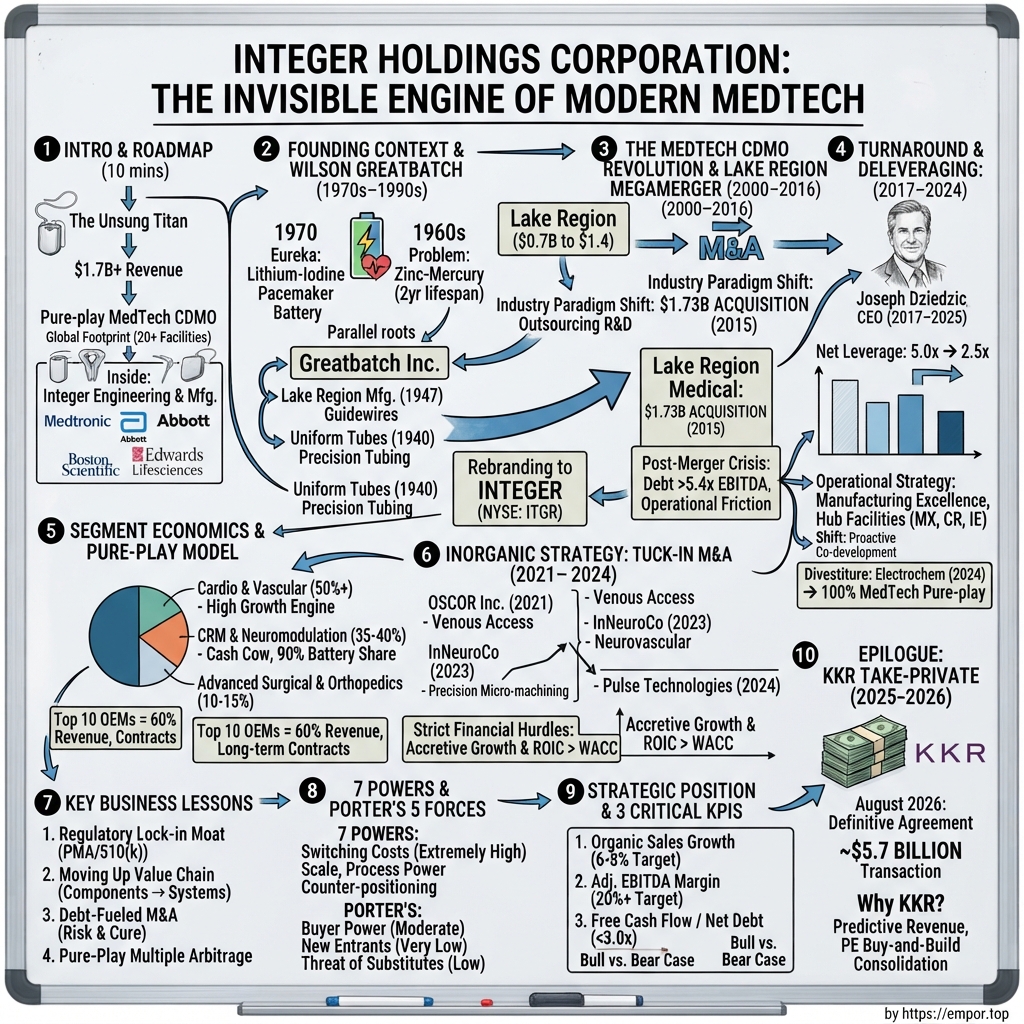
Integer Holdings Corporation: The Invisible Engine of Modern MedTech
I. Introduction & Episode Roadmap
On the morning of August 3, 2026, Integer Holdings did something almost no public company does: it published a quarterly earnings release and, in the same breath, cancelled the conference call that was supposed to explain it. The numbers were soft — second-quarter sales of $464 million, down 2.6% from a year earlier, with GAAP operating income from continuing operations down 42% to $35 million.1 But the reason the call was scrapped had nothing to do with the numbers. Integer had agreed to sell itself to KKR for $127 a share in cash, an all-cash transaction the parties valued at roughly $5.7 billion of enterprise value.2 After twenty-six years as a public company, the invisible engine of modern medtech was going dark.
Most investors have never heard of Integer Holdings. Almost all of them have, at some point, touched its work. When a cardiologist threads a guidewire through a femoral artery, when an electrophysiologist ablates the tissue causing atrial fibrillation, when a neurosurgeon implants a stimulator to interrupt chronic pain signals, when a pacemaker keeps a heart in rhythm for a decade without a battery change — the logo on the box says Medtronic, Abbott, Boston Scientific, or Edwards Lifesciences. The engineering underneath frequently says Integer.
That is the business of a contract development and manufacturing organization, or CDMO. Integer is the largest pure-play version of it in medical devices. Think of it as the Foxconn of implantables, except that comparison flatters Foxconn and undersells Integer: assembling a phone is a logistics problem, while building a component that will sit inside a human chest for ten years without failing is a metallurgy, chemistry, sterility, and regulatory problem simultaneously. In 2025 the company generated $1.854 billion of sales, up 8% reported and 6.4% organically, with adjusted EBITDA of $402 million.3 It operated 33 facilities across the United States, Mexico, Ireland, the Dominican Republic, Uruguay, Malaysia, China, Costa Rica, and Switzerland — roughly 2.3 million square feet of manufacturing and engineering space — and employed about 11,000 people.4
This is the story of how a battery inventor's side project in upstate New York became a $5.7 billion private-equity target, and it is worth telling honestly, because the arc is not a straight line up and to the right. It contains one of the more instructive value-destroying acquisitions in mid-cap medtech, a genuine and well-executed operational turnaround, a portfolio strategy that finally produced a clean pure-play story, and then — in the space of nine months — a demand shock that management did not see coming, two consecutive guidance cuts, a strategic review, and a sale.
The story ahead:
- How Wilson Greatbatch's obsession with battery chemistry solved a problem that was killing pacemaker patients, and how that solved problem became a fifty-year franchise.
- How the medtech industry's shift toward outsourced manufacturing set up the 2015 acquisition of Lake Region Medical for $1.73 billion — a deal that doubled revenue and nearly broke the balance sheet.
- How Joseph Dziedzic spent eight years cleaning it up, and what the numbers say about whether the cleanup actually created value or merely repaired damage.
- How Integer pruned itself into a pure-play, buying capability and selling the parts that did not fit.
- Why the CDMO moat is real but narrower than it sounds, and how the events of late 2025 exposed exactly where it is thin.
- And finally, why KKR was willing to pay a 51.8% premium to Integer's pre-announcement price for a business that was, at that moment, guiding to a year of declining revenue.2
The unifying question is the one every long-term investor should ask about a supplier business: does Integer own its customers, or do its customers own Integer? The company's answer, repeated across a decade of investor presentations, is that regulatory lock-in and early design-in make it structurally sticky. The events of the last four quarters offer an unusually clean natural experiment to test that claim. The stickiness began with a battery.
 Subscribe on LinkedIn
II. Founding Context & The Genius of Wilson Greatbatch (1970s–1990s)
In the mid-1960s, a cardiac pacemaker was a miracle with an expiration date. The device worked. The chemistry did not. Early implantable pacemakers ran on primary zinc-mercury cells that generated hydrogen gas, could not be hermetically sealed, and lasted somewhere between one and two years. That meant a patient whose life had been saved by a pacemaker was signing up for repeat surgery, every couple of years, indefinitely — each one carrying infection risk, anesthesia risk, and cost. The device that prevented sudden cardiac death had become a subscription to the operating theater.
Wilson Greatbatch already knew this problem intimately, because he had helped create it. An electrical engineer trained at Cornell and the University at Buffalo, Greatbatch had co-developed the first successful implantable cardiac pacemaker in the late 1950s — the story of the wrong resistor, pulled from the wrong bin, producing an intermittent pulse instead of a steady signal, is one of the genuine accidents in medical history.5 He went on to hold more than 325 patents and was inducted into the National Inventors Hall of Fame.6
What separates Greatbatch from most inventors is what he did next. Instead of iterating on the device, he went after the constraint. In 1968, troubled by battery life, he acquired rights to a lithium-iodine-polyvinylpyridine cell design, and in 1970 he founded Wilson Greatbatch Ltd. to commercialize it.5 The physics were elegant: a lithium anode paired with an iodine-based cathode produces a solid-state electrolyte layer as it discharges, which means no liquid to leak, no gas to vent, and a slow, predictable decay curve. A clinician could look at the voltage and know roughly how much life was left. By 1972 pacemakers using the chemistry were reaching patients, and battery life went from roughly two years to about ten.5
The analogy worth holding onto: Greatbatch did not build a better engine, he invented a fuel that let the engine run five times longer. And because the fuel had to survive inside a body — sealed, sterile, non-toxic, and utterly non-negotiable on reliability — the barrier to entry was never really the patent. It was the manufacturing discipline. A battery that fails in a laptop is an annoyance. A battery that fails in an implanted defibrillator is a death. That distinction is the origin of everything Integer later became: a business whose product is, fundamentally, the absence of failure.
By the 1990s, Wilson Greatbatch Ltd. supplied or licensed the overwhelming majority of the world's pacemaker and implantable-defibrillator batteries — the Lemelson-MIT program put the figure at around 90%.5 That share is a historical characterization rather than an audited current disclosure, and it should be read as such; Integer's own filings do not publish a battery market share. But the direction is not in dispute. Greatbatch had a near-monopoly in a product category where a customer's switching decision required re-validating an entire implantable device.
Two other companies were quietly building the other half of what became Integer, and both were founded by people with no particular interest in medicine.
In 1947, Joe Fleischhacker Sr. and two fellow Honeywell engineers pooled $1,200 to make fishing lures and tackle in a renovated chicken coop behind the Fleischhacker family home in Minnetonka, Minnesota. They named it Lake Region, after the lakes they liked to fish.7 Making fishing tackle turns out to require exactly one core competency: winding fine wire into precise coils, consistently, at low cost. When Minnesota's nascent pacemaker industry needed pacing coils, Lake Region already knew how to make them. The company evolved into the dominant supplier of guidewires — the thin, steerable wires that let a physician navigate a catheter through the vascular system. In a 2011 interview, Mark Fleischhacker put Lake Region's world guidewire share at roughly 75%.7
In 1940, Albert H. Manwaring founded Uniform Tubes in Pennsylvania to make high-precision, small-diameter metal tubing.8 Tubing is the least glamorous product in medicine and one of the most load-bearing: every catheter, every delivery system, every introducer sheath begins as a tube whose wall thickness and concentricity must hold to tolerances measured in microns.
Three companies, three founders, three utterly different origin stories — a fishing-lure shop, a tubing mill, and a battery lab. What they shared was a business model that only works if you are boringly, relentlessly precise, and a customer base that could not easily replace them.
Greatbatch itself spent the 1990s doing something that would matter for the next thirty years: it took its zero-defect battery competence and rented it out to other industries. Under the Electrochem brand, the company sold high-reliability cells into defense, aerospace, and oil-and-gas downhole drilling — markets where a dead battery is an expensive hole in the ground rather than a dead patient, but where the reliability spec is similar. It was a sensible use of excess capability. It would also, twenty-five years later, become the thing Integer had to sell in order to be valued properly.
On September 29, 2000, the company went public on the New York Stock Exchange as Wilson Greatbatch Technologies under the ticker "GB," pricing at $16 per share — the midpoint of a $15 to $17 range — with an over-allotment exercise that raised an additional $12.0 million in October.9 The IPO mattered less as a financing event than as a structural one. Greatbatch now had a currency. And in a fragmented industry of several hundred small suppliers, a public currency is a consolidation machine waiting to be switched on.
III. The MedTech CDMO Revolution & The Lake Region Megamerger (2000–2016)
To understand why the next fifteen years unfolded the way they did, you have to understand a change in how large medical device companies decided to spend money.
Through the 1980s and 1990s, a Medtronic or a Boston Scientific made most of its own parts. Vertical integration was a point of pride and, in a regulated industry, a form of control. Then three things happened at once. Clinical trial requirements got heavier and more expensive, pushing R&D budgets up. Hospital purchasing consolidated into group purchasing organizations with real negotiating leverage, pushing device prices down. And the technology inside devices got more specialized — laser micromachining, nitinol shape-setting, hydrophilic coatings, parylene deposition — such that maintaining in-house expertise across every discipline became absurdly capital-intensive for a company whose actual competitive advantage was clinical evidence and a physician sales force.
The rational response was to outsource the atoms and keep the molecules of competitive advantage. Let a specialist own the cleanroom, the capital equipment, and the process engineering; keep the clinical data, the brand, and the surgeon relationship. Integer's own filings describe the resulting industry as "highly fragmented amongst several hundred companies, many of which we believe have limited manufacturing capabilities and limited sales and marketing expertise" — with very few able to offer the full scope of services.4 That fragmentation is the strategic setup: a customer base consolidating into a handful of giants, facing a supplier base of hundreds of subscale shops. Somebody was going to roll up the supply side.
Greatbatch decided it would be that somebody, and in August 2015 it swung as hard as a company its size can swing.
On August 27, 2015, Greatbatch signed a definitive agreement to acquire Lake Region Medical for approximately $1.73 billion in cash and stock.10 The structure tells you how strained the deal was: roughly $478 million in cash, about 5.1 million shares and options issued to Lake Region's equity holders, and the assumption of approximately $1 billion of Lake Region net debt.10 Lake Region had itself been assembled — it merged with Accellent in 2014, combining Lake Region's guidewire dominance with Accellent's catheter capability, under private equity ownership.11 Greatbatch was buying a leveraged roll-up with a leveraged balance sheet of its own.
The strategic logic was genuinely good. Greatbatch was strong in implantable power and CRM components; Lake Region was strong in the vascular delivery systems that were becoming the growth engine of interventional medicine. Combined revenue was roughly $1.5 billion with more than 9,000 employees, making it one of the largest medical device outsource manufacturers in the world.10 Management projected net annual operating-profit synergies of $25 million in 2016 rising to at least $60 million by 2018, and said the deal would add at least 10% to adjusted cash earnings per share in the first year.10
The deal closed in October 2015. What followed is a case study in why a good strategic rationale and a good outcome are different things.
Start with the arithmetic. Greatbatch put roughly $1.73 billion of value into an asset while carrying substantial existing debt, and the combined entity ended 2015 and 2016 with an enterprise value dominated by borrowings rather than equity. By the close of 2016, Integer's public equity market capitalization had fallen to roughly $906 million against an enterprise value of about $2.58 billion — meaning the debt was worth nearly twice the stock. GAAP net income for 2016 was effectively negligible, and returns on invested capital sat in the low single digits. The market's verdict was blunt: shareholders had funded an asset purchase whose economics accrued, for the time being, to lenders.
The operational story was messier than the financial one. Integrating two large manufacturing networks means reconciling incompatible ERP systems, overlapping plants, duplicate quality systems, and — critically in this industry — customer-specific validated processes that cannot simply be moved. Consolidating machined-component production into a Lake Region plant in Brooklyn Park, Minnesota was one such effort.12 In a regulated environment, every transfer of a line from one site to another triggers requalification. Miss a validation window and you miss customer deliveries. Miss customer deliveries in medtech and you do not get a warning letter from the customer; you get quietly designed out of the next program.
Amid the strain, the company also completed a separation it had announced before the Lake Region deal: on March 14, 2016, Greatbatch spun off its neuromodulation subsidiary QiG Group as Nuvectra Corporation, distributing the shares to holders.13 Nuvectra took the Algovita spinal cord stimulation system with it, and Greatbatch retained a long-term supply agreement to manufacture it — the beginning of a customer relationship that would still be showing up in Integer's segment commentary a decade later, as a planned decline.
Then came the renaming. Effective June 30, 2016, Greatbatch, Inc. became Integer Holdings Corporation, with the shares trading as ITGR from July 1.[^14] The company's explanation was that the Greatbatch name had become "more closely associated with battery technology than the broader range of capabilities" it now offered, and that "integer," meaning whole or complete, signalled the union of the Greatbatch Medical, Lake Region Medical, and Electrochem brands — while honoring the three founders: Manwaring, Fleischhacker, and Greatbatch.8
A neutral reading: rebrandings in the middle of a difficult integration are usually a tell. They are cheap, they generate a positive news cycle, and they signal to the organization that the past is settled. What they do not do is fix leverage or delivery performance.
Neither did they satisfy the board. On March 27, 2017, Thomas J. Hook stepped down as President and CEO, effective immediately, after more than a decade leading the company through the acquisition spree that culminated in Lake Region.14 The board's framing — that with the integration "substantially complete," the timing was right for new leadership — was the standard corporate formulation.14 Hook had also relocated the company's headquarters from western New York to Texas, an unpopular decision in Buffalo that had already strained local goodwill.15 He joined Q Holding Company as CEO later that year.
Integer entered 2017 with a coherent industrial logic, a broken capital structure, and no chief executive. Fixing the second problem would consume the next six years.
IV. The Turnaround & Deleveraging Playbook: The Dziedzic Era (2017–2024)
Joseph W. Dziedzic did not arrive as a savior from outside. He had been on Integer's board since February 2013, watched the Lake Region deal get approved, and stepped in as interim President and CEO in March 2017 when Hook departed. On July 17, 2017, the board removed the interim label.16
His background explains almost everything about the eight years that followed. Dziedzic spent roughly two decades at General Electric across six businesses, including GE Medical Systems and a CFO role at GE Aviation Systems North America, before serving as Executive Vice President and CFO of The Brink's Company from 2009 to 2016.16 This is not an inventor's résumé or a salesman's résumé. It is a process-and-capital résumé — someone trained in an organization that treats operating rhythm, cost variance, and cash conversion as the substance of management rather than the accounting of it.
That training showed up immediately in the first big decision, which was not an operational one at all. It was a sale.
In May 2018, Integer agreed to divest its Advanced Surgical and Orthopedics product lines to MedPlast — later Viant — for $600 million in cash, closing on July 2, 2018.17 The AS&O business was real revenue with real customers, but it sat in slower-growing, more commoditized end markets, and it consumed capital that Integer could not afford to tie up. Integer applied roughly $550 million of the proceeds to debt reduction, including redeeming its 9.125% senior notes, repaying the revolving credit facility, and prepaying term loans.17 Management framed the outcome plainly: a smaller, roughly $1.2 billion revenue company with higher margins, better returns on invested capital, and materially lower leverage.17
Read that decision the way a capital allocator would. Integer had bought scale in 2015 and then, three years later, sold scale to pay for it. The 9.125% coupon on those senior notes is the tell — that is distressed-adjacent pricing for a company with real assets and real customers. Retiring it was arguably worth more than the earnings the divested business would have produced. It was also an admission, in cash, that the 2015 deal had been financed too aggressively.
With the balance sheet stabilized, Dziedzic turned to the plants. The program Integer eventually branded the Integer Production System is lean manufacturing applied to a network that had been assembled rather than designed: consolidating redundant sites, shifting volume toward lower-cost hubs in Mexico, Ireland, Costa Rica, and the Dominican Republic, and grinding out direct labor and direct material efficiency line by line. On the company's earnings calls, CFO Diron Smith has consistently described the profit algorithm in exactly two components — operating expense leverage on volume, plus gross margin expansion from the production system.18 That consistency across years of calls is itself a data point about management credibility: the explanation of how profit is supposed to arrive has not changed to fit whatever happened in the quarter.
The second strategic shift was commercial rather than industrial, and it is the one Integer's bull case rests on. Rather than bidding for mature production transfers — where the specification is fixed and the only variable is price — Integer pushed to be engaged at the design stage of a customer's next-generation product. The company measures this with a metric it calls product development sales: the fees customers pay Integer to help design and develop new devices. Management has said those sales have grown more than 300% since 2017, with roughly 80% tied to products aimed at higher-growth markets.18
The logic is sound and worth stating plainly, because it is the mechanism behind everything else. If Integer helps design the part, Integer's process becomes the specification. Once that specification is embedded in the customer's regulatory filing, moving to another supplier is not a purchasing decision; it is a regulatory project. Development revenue is thus a leading indicator of production revenue five to seven years out — a genuinely useful disclosure that most component suppliers do not provide.
The caveat, which the events of late 2025 would make painfully concrete, is that being designed into a product only pays if the product sells.
The deleveraging arithmetic did work. Integer entered the Dziedzic era with GAAP-basis net debt to EBITDA above six times and exited 2025 at a reported net total debt leverage of 3.0 times trailing four-quarter adjusted EBITDA, at the midpoint of a target range of 2.5x to 3.5x.3 Along the way the company refinanced opportunistically: in March 2025 it issued $1.0 billion of 1.875% convertible senior notes due 2030, upsized from an initial $750 million on strong demand, with a conversion price of approximately $87.20 per share.[^20] That transaction cut interest expense by roughly $14 million in 2025 alone and contributed about $0.33 to adjusted EPS — a meaningful chunk of the year's 21% adjusted EPS growth.18
Which brings us to the honest part of the assessment. Integer's adjusted numbers over the Dziedzic years are genuinely strong: from 2022 through 2025, sales compounded at 12% and adjusted operating margin expanded by nearly 400 basis points.18 But the GAAP picture is more sober. In 2025, GAAP net income was $102.8 million against adjusted net income of $226 million — a gap of well over two times, driven substantially by $64.3 million of intangible amortization from the acquisition program.4 Goodwill alone stood at $1.111 billion on total assets of $3.411 billion.4 Returns on invested capital, computed on GAAP earnings, have run in the mid-single digits for years — below any plausible cost of capital for a leveraged industrial.
The generous interpretation is that amortization of acquired intangibles is a non-cash accounting echo of the 2015 deal and tells you little about the current cash-generating business. The skeptical interpretation is that a decade of returns below the cost of capital is exactly what the accounting is trying to tell you, and that the Lake Region purchase price was never fully earned back. Both readings can be true simultaneously: the operating turnaround was real, and it was largely a recovery of value lost rather than the creation of new value.
The portfolio pruning continued to the end. In September 2024 Integer agreed to sell Electrochem Solutions — the non-medical energy business, with about $34 million of trailing twelve-month revenue — to Ultralife Corporation for $50 million in cash, closing on October 31, 2024, with proceeds directed to debt paydown.1920 Electrochem had been part of the company's identity since the 1990s. Selling it for less than one and a half times revenue was not a value-maximizing trade on its own terms. It was a positioning trade: it made Integer a 100% medical technology company, comparable to medtech peers rather than to a diversified industrial.
Governance and the discipline of stated objectives
One underrated feature of the Dziedzic era was the decision to publish a small number of long-term financial objectives and then repeat them, unchanged, for years: grow organic sales roughly 200 basis points above the company's end markets, grow adjusted operating income about twice as fast as sales, and hold net leverage between 2.5 and 3.5 times adjusted EBITDA.18
That is a genuinely useful form of accountability, and it is rarer than it should be. A management team that publishes three durable targets invites the market to grade it against them every quarter, which is precisely why most teams prefer vaguer language. Integer's specific incentive plan metrics and weightings are set out in the annual proxy statement rather than in earnings materials, and the company does not detail them on calls. But the public framework itself is the tell: an executive team that keeps score in the open is easier to evaluate than one that redefines success each year.
The test of such a framework is what happens when the targets are missed. That test arrived in late 2025, and the results — discussed in detail later — are mixed: management kept the objectives intact rather than quietly resetting them, which is to its credit, while simultaneously offering visibility metrics that did not hold up.
The final act of the era was a succession. On April 24, 2025, Integer announced that Dziedzic would retire as President and CEO and leave the board effective October 24, 2025, with Chief Operating Officer Payman Khales — who had joined in February 2018 and run the Cardio & Vascular business until October 2024 — succeeding him and joining the board.21 Dziedzic stayed on as an advisor through March 31, 2026 to smooth the transition.22
Six months of orderly planning, and then the handover went sideways in the last five days.
V. Segment Economics, Core Drivers, & The Pure-Play MedTech CDMO Model
Before we get to what went wrong, it is worth being precise about what Integer actually sells, because the shape of the revenue explains both the strength and the fragility.
Integer reports two operating product lines plus a residual bucket. In 2025, Cardio & Vascular generated $1.107 billion of sales, up 16.6% reported and 10.2% organically. Cardiac Rhythm Management & Neuromodulation generated $669 million, up 1.2%. Other Markets — a shrinking collection of non-core activity — contributed $78 million, down 26.9% reported.3
Note what is missing from that list. The outline of Integer's history frequently includes an Advanced Surgical & Orthopedics segment; it no longer exists inside Integer, having been sold in 2018. The residual "Other Markets" line is largely a manufacturing service agreement with the buyer of that business plus the now-completed exit from portable medical.23 Anyone modeling Integer as a three-segment company with an orthopedics arm is modeling a company that stopped existing eight years ago.
Cardio & Vascular is the growth engine and roughly sixty percent of sales. This is the world of things that travel through blood vessels: guidewires, introducers, steerable sheaths, delivery systems for transcatheter aortic and mitral valves, neurovascular catheters used to pull clots out of stroke patients, and — the category that has driven the last several years — electrophysiology. Electrophysiology means treating arrhythmias by deliberately destroying small amounts of heart tissue. For decades this was done with radiofrequency energy, essentially controlled heat. The disruptive newer approach is pulsed field ablation, or PFA, which uses short, high-voltage electrical pulses to kill cardiac cells selectively while sparing the esophagus and phrenic nerve nearby. PFA has been adopted extraordinarily quickly, and Integer supplies components used across the ablation procedure — access, navigation, mapping, and the ablation devices themselves — irrespective of which energy modality wins.
Cardiac Rhythm Management & Neuromodulation is the legacy franchise and the cash foundation. It contains the direct descendants of Wilson Greatbatch's work — batteries, capacitors, feedthroughs, and increasingly complete implantable pulse generators for pacemakers and defibrillators — plus the neuromodulation devices that use the same architecture to stimulate the spinal cord or brain instead of the heart. Growth here is slower and steadier. The interesting sub-story is what management calls "emerging customers with PMA products": venture-backed innovators building novel implantable therapies who need a partner with an existing FDA-inspected quality system rather than building one from scratch. Sales to customers in the introduction and launch phases grew from about $10 million in 2018 to roughly $125 million in 2024, and management has repeatedly guided to a 15% to 20% compound growth rate for that cohort over three to five years, with about 40 such customers in development.18
That cohort is the most interesting thing in Integer's portfolio and also the most volatile, for a reason that should be obvious in hindsight: a startup's demand forecast is a hypothesis about a market that does not yet exist.
What the hard parts actually are
It helps to understand why an OEM cannot simply do this itself, because the answer is not that the work is secret. It is that the work is finicky in ways that take years to get right.
Take nitinol, the nickel-titanium alloy that makes modern interventional medicine possible. Nitinol has shape memory: bend it, and it springs back to a shape that was set into its crystal structure by heat treatment. That property is what lets a stent be compressed into a catheter the width of a spaghetti strand and then self-expand into a rigid scaffold inside an artery. Shape-setting nitinol is a matter of temperature, timing, and fixturing, and the tolerance for error is small — get it slightly wrong and the device either fails to expand fully or fatigues after a few million heartbeats.
Or take parylene, one of the coating technologies Integer bought outright in 2025. Parylene is deposited as a vapor that condenses into a pinhole-free polymer film measured in microns, coating every surface of an object including the inside of crevices. On an implantable electrode, it provides electrical insulation without adding meaningful bulk. There is no way to brush it on; it requires a vacuum chamber, a specific precursor chemistry, and validated process control.
Or take micro-machining and laser processing — cutting features into metal tubing at scales where the heat of the laser itself can alter the metal's properties a few microns away from the cut. This is the capability Pulse Technologies brought.
None of these are exotic sciences. All of them are disciplines where the difference between a 60% yield and a 97% yield is a decade of accumulated process knowledge sitting in the heads of specific engineers and the parameters of specific machines. That is what an OEM is really buying when it outsources: not capacity, but somebody else's learning curve.
Now the customer structure, which is where the analytical tension lives. In 2025, Integer's three largest customers — Abbott Laboratories, Boston Scientific, and Medtronic — each exceeded 10% of total sales and collectively accounted for approximately 49% of revenue, up from 47% in 2024.424 Roughly 70% of sales sit under multiyear agreements.18 Firm backlog at December 31, 2025 was approximately $675 million, most of it expected to ship within a year.4
Half your revenue from three customers is a genuine concentration risk, and Integer's own risk factors say so directly, warning that pricing pressure is persistent: "we have reduced prices for some of our customers in recent years, and we expect customer pressure for continued price reductions in future periods."4 That sentence deserves to be read twice. It is the company acknowledging, in a legal document, that its contractual position does not confer pricing power in the ordinary sense. The moat protects volume and incumbency; it does not protect price.
The economics that result are those of a high-quality industrial rather than a medical device company. Gross margin runs in the high twenties. Adjusted operating margin reached 17.3% in 2025, up 76 basis points year over year, with adjusted EBITDA margin near 21.7%.18 Capital intensity is real — capital expenditure ran about 5% of sales in 2025, at $91 million — and working capital absorbs cash, with days sales outstanding near 68 and days of inventory near 65.3
That last point matters more than it looks. In 2025, Integer converted $402 million of adjusted EBITDA into $196 million of operating cash flow and $105 million of free cash flow, because a $90 million increase in receivables ate a large share of the earnings.3 Free cash flow was roughly 26% of adjusted EBITDA. For a business marketed on the durability of its contractual revenue, that is a modest conversion rate, and it constrains how much of the deleveraging story is genuine cash generation versus balance sheet engineering.
The structural point to carry forward: Integer's customers are large, sophisticated, and few; its contracts secure position rather than profitability; and its cash conversion is mediocre because complex manufacturing for demanding customers requires carrying inventory and financing receivables. The moat is best understood as protection against displacement, not as protection against margin compression or volume swings. Which is precisely what the next chapter tested.
VI. Inorganic Strategy & Tuck-In M&A Benchmark (2021–2024)
If the Lake Region deal was Integer swinging for the fences, the decade that followed was Integer learning to bunt.
The shift was deliberate and, to management's credit, explicitly stated rather than quietly executed. After 2018, the company stopped pursuing transformational scale and started buying capability: small, cash-financed acquisitions of businesses with a specific technical skill that Integer could sell into its existing customer base. On the fourth-quarter 2025 call, Khales quantified the discipline — since 2021, Integer has invested roughly 5.8% of sales in capital expenditure and over $700 million in tuck-in acquisitions, while keeping leverage inside the 2.5x to 3.5x band.18
The individual deals are worth walking through, because together they trace exactly where management believed the growth was:
- Aran Biomedical (April 2022, approximately $131.1 million, with up to roughly $10.9 million of contingent consideration). A Galway, Ireland business specializing in implantable textiles and polymer-based coverings — the fabric components inside stent grafts, structural heart implants, and vascular devices.25 The strategic point was less the product than the location: Ireland is a European medtech manufacturing cluster with a deep engineering labor pool and favorable proximity to customers' EU operations.
- Oscor Inc. (completed December 1, 2021, $220 million). A privately held business in Palm Harbor, Florida with operations in the Dominican Republic and offices in Germany, roughly 900 employees, making specialized medical devices, venous access systems, diagnostic catheters, and implantable devices.26 Oscor did two things for Integer: it added proprietary products where Integer could earn a device margin rather than a component margin, and it added low-cost Caribbean manufacturing capacity.
- InNeuroCo (effective October 1, 2023, $42 million plus contingent consideration). A Florida neurovascular catheter specialist whose products treat ischemic stroke and intracranial aneurysms, funded from the revolving credit facility.27 Mechanical thrombectomy — physically extracting a clot from a brain artery — is one of the highest-growth interventional categories in medicine, and it requires catheters that are simultaneously flexible enough to navigate the cerebral vasculature and strong enough not to collapse under aspiration.
- Pulse Technologies (January 2024, $140 million). A complex micro-machining, laser processing, and surface treatment specialist serving structural heart, heart pumps, and electrophysiology.28 Pulse is the clearest example of the strategy: not a product line, a process capability that Integer could apply across its whole customer base.
- Precision Coating and VSi Parylene (2025, approximately $152 million and $24.0 million respectively). Surface modification businesses — the coatings that make a guidewire slippery when wet, or that insulate an electrode without adding measurable thickness.29 These were explicitly vertical integration moves: Integer had been buying coating services from third parties, and now performs them in-house.
Step back and the pattern is coherent. Every deal added either a process Integer's customers were already paying someone for, or a position in a therapy area growing faster than the medtech average. Management set a stated bar of accretion to organic growth and returns above the cost of capital within a defined window. On the surface, execution looked good: the Precision Coating and VSi acquisitions alone contributed roughly $59 million of inorganic revenue in 2025.30
Now the skeptical view, which an activist would press hard.
First, the tuck-ins mask the organic picture. In 2025, reported growth of 8% became organic growth of 6.4% once acquisitions, the portable medical exit, and currency were stripped out.3 That is still respectable, but roughly a fifth of headline growth was purchased. In 2026, with the acquisition contribution annualizing away, the underlying trajectory became visible — and it was negative.
Second, the returns math is unforgiving at the consolidated level. Integer spent over $700 million on acquisitions since 2021 and carries $1.111 billion of goodwill and a heavy intangible base, yet GAAP returns on invested capital have remained in the mid-single digits.4 Individual deals may well clear their hurdle rates on management's internal math; the consolidated financial statements do not yet show a company earning its cost of capital. When a business tells you its acquisitions must deliver returns above WACC within three years, the appropriate follow-up is: then why has consolidated ROIC not moved?
Third — and this is the second-layer diligence point — research and development spending has been declining while the acquisition program ran. Integer's RD&E expense was $62.0 million in 2023, $53.4 million in 2024, and $49.5 million in 2025.424 The company's explanation is structurally reasonable: much of Integer's development work is customer-funded and therefore lands in revenue rather than expense, and RD&E timing follows customer milestone achievement.23 But a company whose thesis is early design-in engagement, showing three consecutive years of declining internal development expense while buying capability instead of building it, is at minimum a question worth asking. Buying process expertise is faster than developing it. It is also more expensive, and it does not compound the way in-house engineering talent does.
The fourth observation is the one that ages best: capital allocation shifted toward shareholders precisely as growth slowed. In November 2025 the board authorized a share repurchase program of up to $200 million; Integer bought back roughly $50 million of stock in the fourth quarter of 2025 and another $50 million via accelerated repurchase in the first quarter of 2026, purchasing approximately 700,000 and 600,000 shares respectively.23 Buying stock in the low-to-mid $80s, months before agreeing to sell the company at $127, looks in hindsight like sound capital allocation. It also increased net debt at a moment when the operating outlook was deteriorating: net total debt rose $74 million in the first quarter of 2026, primarily because of the buyback.23
The honest summary of Integer's inorganic era: disciplined in size, coherent in logic, defensible in individual cases, and not yet proven in aggregate returns. What the tuck-ins undeniably did was reposition the revenue mix toward faster-growing therapies. What they did not do was make the revenue less dependent on other people's product launches — a dependence that was about to become the whole story.
VII. Playbook: Business, Strategy, & Investing Lessons
Integer's history offers four lessons that generalize well beyond medical devices. Each is stated here with its limit attached, because a lesson without a boundary condition is just a slogan.
Lesson 1: Regulatory lock-in is a real moat, but it protects the wrong variable.
In Class III implantable devices — the highest-risk category, requiring Pre-Market Approval rather than a simpler 510(k) clearance — the manufacturing process is part of the approved submission. Change the supplier of a critical component and the OEM may need to file a PMA supplement, generate new biocompatibility and reliability data, and requalify the line. That is millions of dollars and often a year or more of elapsed time, during which the product's commercial momentum is at risk.
The practical result is that Integer is what the industry calls sole-sourced on much of its book — a point Khales made directly on the third-quarter 2025 call when pressed on whether volume could be lost permanently: "we are mostly sole sourced in our business."30
Here is the limit. Regulatory lock-in guarantees that if the device sells, Integer supplies it. It guarantees nothing about how much the device sells, and it guarantees nothing about the price Integer receives — because the OEM's procurement organization knows perfectly well that Integer's alternative to accepting a price-down is losing a relationship it spent years and millions of dollars earning. Lock-in cuts both ways. It is a moat around volume that doubles as a fence around the supplier.
Lesson 2: Moving up the value chain changes what you are exposed to, not how much.
Integer's evolution from selling batteries to selling sub-assemblies to selling complete finished devices is textbook value-chain migration. Higher content per device, deeper customer integration, more of the bill of materials. Khales confirmed on the same call that for the affected products, Integer had "a good portion of a bill of material."30
The trade-off is rarely discussed: as content per device rises, the supplier's revenue becomes a more leveraged bet on that specific device's commercial success. A company selling one small component into fifty devices is diversified by construction. A company selling half the bill of materials into ten devices is not. Integer chose depth, and depth means concentration.
Lesson 3: Debt-funded M&A can build a structural moat and destroy equity value at the same time.
The Lake Region acquisition genuinely created the combined capability set that made Integer strategically valuable — the very platform KKR eventually bought. It also compressed the equity to under $1 billion of market value against roughly $1.7 billion of net debt within a year, forced the sale of a $600 million business at what was effectively a distressed timeline, and consumed most of a decade in repair work.
The generalizable rule is not "avoid leverage." It is that leverage converts execution risk into solvency risk. Greatbatch's integration problems in 2016 would have been an ordinary bad year for an unlevered company. With five-plus turns of debt, they were an existential question. Investors evaluating any acquisitive roll-up should ask a simple counterfactual: if the synergies arrive two years late, does the capital structure survive it?
Lesson 4: Pure-play positioning is a real source of multiple expansion — and a legitimate use of divestiture.
Selling Electrochem for $50 million did not move Integer's earnings. It moved Integer's peer group. A conglomerate discount is not a fiction; investors genuinely apply lower multiples to businesses whose parts require separate analysis, and analysts covering medical technology have neither the time nor the mandate to value an oilfield battery business.
The limit here is important too. Multiple expansion from portfolio simplification is a one-time gain, and it is only sustainable if the remaining business actually performs. Integer completed its transformation into a pure-play medtech CDMO in late 2024, achieved the cleaner story, and then within twelve months delivered an organic revenue decline. The market did not sustain a premium multiple on tidiness alone.
A fifth lesson, which Integer's story teaches by accident: the supply chain sees demand late and distorted.
This is the deepest structural insight in the whole case, and it applies to every component supplier in every industry. Khales explained it with unusual clarity on the first-quarter 2026 call: "what we sell to our customers are things that likely go into their production sometime one to three quarters ahead."23
A supplier is therefore never observing end demand. It is observing its customer's production plan, which is a function of the customer's own demand forecast plus the customer's inventory posture plus the customer's willingness to hold safety stock. When end demand surprises to the upside, the customer over-orders to avoid stocking out. When end demand disappoints, the customer stops ordering entirely until the excess inventory clears. The supplier experiences both moves amplified — the classic bullwhip. Integer's backlog, purchase orders, and rolling twelve-month customer forecasts all provide genuine visibility into what the customer intends to build. None of them provide visibility into whether patients and physicians will actually use the device.
VIII. 7 Powers & Porter's 5 Forces Analysis
Frameworks are only useful if you let them produce uncomfortable answers. Applied honestly to Integer, they produce a business that is well defended in some dimensions and considerably more exposed in others than its own investor materials suggest.
Hamilton Helmer's 7 Powers
- Switching Costs — Strong, and the primary power. The combination of PMA-embedded process specification, cleanroom and ISO 13485 certification, customer-specific validated tooling, and multi-year qualification timelines makes displacement genuinely expensive. Integer's own language — that it is "mostly sole sourced" — is corroborated by the fact that during the 2025–2026 demand collapse, management could state repeatedly and without contradiction from analysts that none of the lost volume reflected insourcing, share loss, or supplier substitution.3023 That is meaningful evidence. When a supplier's revenue falls 4% and no competitor picked up the business, the switching-cost claim has been tested and held.
- Scale Economies — Moderate, weaker than claimed. Integer is the largest pure-play medtech CDMO, and spreading compliance infrastructure, quality systems, and automation capital across 33 sites and $1.85 billion of revenue is a genuine advantage against a several-hundred-shop fragmented field. But note the mechanism's limit: much of Integer's capital equipment is program-specific, validated for a particular customer's part. Fixed-cost absorption therefore does not flex the way it does in a genuinely fungible factory. That is exactly why first-quarter 2026 adjusted operating margin fell 230 basis points on a revenue increase of 0.5% — "lower fixed cost absorption" was management's explanation.23 A business with strong scale economies should not lose that much margin on flat revenue.
- Process Power — Moderate to strong. Proprietary battery chemistries including lithium carbon monofluoride and silver vanadium oxide, precision laser ablation, nitinol shape-setting, micro-machining, and coating deposition constitute accumulated know-how that is difficult to replicate and largely resides in people and procedures rather than patents. This is real. It is also, increasingly, purchasable — Integer itself acquired several of these capabilities rather than developing them, which suggests competitors can too.
- Counter-Positioning — Weak to moderate. The claim is that OEMs cannot re-insource without diluting focus on clinical R&D and sales. That is true at the margin but not structural: Medtronic, Abbott, and Boston Scientific all retain substantial in-house manufacturing and could bring work back if the economics justified it. Integer's filings acknowledge competition "from existing and prospective customers that employ in-house capabilities."4 There is no business-model conflict preventing insourcing; there is only a cost-benefit calculation, and cost-benefit calculations change.
- Branding, Network Economies, and Cornered Resource — Essentially absent. No patient chooses a device because Integer is inside it. Integer's customers do not become more valuable to each other. And while the company holds meaningful IP, no single asset is indispensable.
Porter's Five Forces
- Bargaining Power of Buyers — High, and the binding constraint. Three customers, half the revenue, sophisticated procurement organizations, and an explicit disclosure that price reductions are expected to continue.4 The switching cost moat protects Integer's seat at the table but not its share of the value created there. This is the single most important structural fact about the business.
- Bargaining Power of Suppliers — Low to moderate. Integer's principal inputs include platinum, titanium, nitinol, gold, tantalum, iridium, and specialty polymers.4 These are commodity-priced but medical-grade-certified, which creates qualification friction and geopolitical exposure — the company's own risk factors cite wars in Ukraine and the Middle East, tensions around China and Taiwan, and tariffs as sources of price and availability volatility.4 On the first-quarter 2026 call, management characterized inflation as "not material" to the outlook and disruption risk as minimal, noting that customers typically collect product from Integer's facilities, limiting freight exposure.23
- Threat of New Entrants — Very Low. Capital intensity, cleanroom infrastructure, quality system maturity, FDA inspection history, and the decade it takes to accumulate qualified programs constitute an effective barrier. Nobody starts a medtech CDMO from scratch; they buy one.
- Threat of Substitutes — Low at the therapy level, non-trivial at the modality level. Structural heart disease, stroke, and bradycardia require physical intervention, and pharmacological substitutes are not imminent. But within categories, technology substitution is fast and brutal, as PFA's rapid displacement of radiofrequency ablation demonstrated. Integer's hedge is that it supplies components used across ablation modalities — a genuine diversification within the category, and one that partially worked in 2026 even as specific programs collapsed.
- Competitive Rivalry — Moderate and rising. Integer competes with Resonetics, Nordson Medical, Cretex Medical, Teleflex's OEM business, and dozens of niche specialists, many of them private-equity owned and pursuing the same buy-and-build logic. Integer's filings note that competitive advantage rests on "reputation, quality, delivery, responsiveness, breadth of capabilities, including design and engineering support, price, customer relationships and increasingly the ability to provide complete supply chain solutions."4 Price appears in that list. It is not a monopolist's list.
How Integer compares with the field
The competitive set is worth describing concretely, because "fragmented industry" is a phrase that hides more than it reveals.
Integer's closest analogues are almost all private, and most are private-equity owned — which is itself a statement about how this industry is capitalized. Resonetics has grown rapidly through acquisition into laser processing, nitinol, and microfabrication, competing head-on with Integer's Pulse and Precision Coating capabilities. Nordson Medical sits inside a larger diversified public parent and brings strength in fluid components, catheters, and molded parts. Cretex Medical and Teleflex's OEM arm occupy overlapping niches in machining, extrusion, and complex assembly. Below them sit hundreds of specialists doing one process very well.
Two conclusions follow.
First, Integer's differentiation is breadth rather than depth. In almost any single process, some specialist is as good or better. What Integer offers is the ability to take a program from design through component manufacture, sub-assembly, sterile finished device, and regulatory documentation without the customer managing a dozen vendors. Its filings identify exactly this — "the ability to provide complete supply chain solutions rather than only producing and providing individual components" — as an increasingly decisive competitive factor.4
Second, that differentiation is being actively contested by rivals running the identical playbook with private capital and no quarterly earnings constraint. Integer's tuck-in program was not a proprietary insight; it was table stakes in an industry where several buyers were bidding for the same specialist assets. That competitive dynamic helps explain both why Integer paid the multiples it paid and why a private-equity owner would want the platform.
The synthesis, stated plainly. Integer possesses a strong defensive moat and a weak offensive one. It is very hard to remove and very hard to replace, which protects the downside of its installed base. It has little ability to raise price, limited ability to flex costs against volume swings, and no control over the demand that ultimately determines its revenue. That combination produces a business with high revenue durability and low revenue predictability — an unusual and underappreciated pairing, and one that explains both why the stock traded at a modest multiple for years and why a private-equity buyer eventually found it attractive.
IX. Strategic Position, Bull vs. Bear Case, & The 3 Critical KPIs
On October 23, 2025, Joseph Dziedzic opened what he described as his sixty-fourth and final earnings call as a public-company chief executive or chief financial officer. He did not hide his disappointment. "When the CEO transition process began, I did not envision my last earnings call would include a reduction in our financial outlook," he told analysts.30
The quarter itself had been fine — better than fine. Sales rose 8% to $468 million, adjusted operating income rose 14%, and adjusted earnings per share rose 25% to $1.79.31 The problem was what customers had told Integer during the quarter about next year.
Three recently launched products — two in electrophysiology, one in neuromodulation — were not being adopted at the rate their manufacturers had projected. Those customers cut their forecasts. Because the three products had ramped hard through the first half of 2025 and together represented nearly 6% of Integer's total sales that year, the reversal was arithmetically brutal: a 3% to 4% headwind to 2026 revenue before anything else happened.18
The stock fell sharply. And the sequence that followed is the most useful evidence any investor has for judging both this business and this management team.
What management said, and what happened next
Payman Khales, who became CEO the following day, framed the event consistently on that call and every call since: the products remain on the market, Integer remains the supplier, and none of the volume was lost to insourcing, share shift, or a competitor. Analysts pushed hard on this. Citi's Joanne Wuensch asked whether he had ever seen multiple customers revise forecasts simultaneously; Khales called it "an aberration" and "highly unusual."30 Truist's Richard Newitter asked directly whether Integer's forecasting process needed to change; Khales said the algorithm had not changed and pointed to backlog of roughly $730 million as evidence of continued visibility.30 Wells Fargo's Nathan Treybeck pressed on whether 2025 growth had included inventory build; management conceded it was "probably an element of both" — real demand softness and channel inventory.32
Then three things happened that a careful reader should weigh against the "aberration" framing.
First, the backlog did not hold. By December 31, 2025, firm backlog had fallen to approximately $675 million from the roughly $730 million cited in October — a decline of about 8% in a single quarter.4 The metric management had offered as reassurance moved in the wrong direction.
Second, the cash flow guidance missed badly. In October, Integer guided 2025 operating cash flow to $230 million to $240 million and free cash flow to $130 million to $140 million.31 Actual operating cash flow came in at $196 million and free cash flow at $105 million — roughly $40 million and $30 million short respectively, primarily because receivables ballooned.3 On the February call, the shortfall was reported factually as "a $9 million decrease from the prior year" without an explicit reconciliation to the guidance given four months earlier.18 That is a disclosure choice worth noting: the company hit its sales and EPS ranges and did not dwell on the cash miss.
Third, and most damaging to the "one-time" narrative, it happened again. On April 30, 2026, Integer cut 2026 guidance a second time — reported sales to $1.805 billion to $1.835 billion, down 1% to 3%, with organic sales flat to down 1%.33 Critically, the new reduction had nothing to do with the original three products, whose trajectory was tracking as forecast. It came from a different set of electrophysiology products, plus what Khales called "further risk adjustments across our portfolio" to guard against additional erosion.23 Two separate customer-forecast shocks in two consecutive quarters, in the same end market, is harder to describe as an aberration.
To management's credit, the explanation offered in April was mechanically coherent rather than evasive. Khales argued that the extraordinary speed of PFA adoption had made forecasting unusually difficult for OEMs, who had over-provisioned across every EP product category to avoid stocking out during a technology transition, and were now normalizing as the picture clarified.23 He also declined to blame the end market, noting the EP market was still expected to grow in the mid-to-high teens in 2026 versus north of 20% in 2025, with procedure volumes running roughly 10% to 12%.23 That is an honest answer: the market is fine, our order flow is not, and the difference is inventory.
Myth versus reality
Three consensus beliefs about Integer deserve correction.
Myth: Regulatory lock-in makes CDMO revenue quasi-contractual and predictable. Reality: lock-in determines who supplies the part, not how many parts get bought. Integer lost roughly 3% to 4% of its revenue base in a single planning cycle without losing a single program. Durability and predictability are different properties, and investors routinely conflate them.
Myth: Integer is a defensive medtech compounder tied to procedure volumes. Reality: Integer sits one to three quarters upstream of procedures, so it is exposed to its customers' inventory decisions far more directly than to patient volumes. It behaves less like a medical device company and more like a specialty industrial supplier with a medtech end market.
Myth: Diversification across roughly 39 emerging PMA customers reduces risk. Reality: emerging customers are the highest-variance part of the book precisely because their products are new and their forecasts are hypotheses. The cohort that grew from about $10 million of sales in 2018 to roughly $125 million in 2024 delivered much of the upside and then delivered the downside.18
The three KPIs that matter
Everything else in Integer's disclosure is commentary. Three numbers carry the case:
- Organic sales growth versus management's stated market growth rate. Integer's long-standing objective is to grow organic sales 200 basis points above its end markets, which it defines as growing 4% to 6%.23 This single metric tests the entire design-in thesis: if early engagement genuinely wins content, organic growth should exceed the market consistently across cycles, not just in years when a customer's launch happens to ramp. Integer delivered 6.4% organic growth in 2025 and guided to flat-to-negative in 2026 — the first real interruption of the streak.333
- Adjusted operating margin, and specifically its behavior when volume declines. Management's algorithm is operating expense leverage plus production-system gross margin gains, with a target of growing adjusted operating income twice as fast as sales.18 The stress test is the downside: first-quarter 2026 margin fell 230 basis points on essentially flat revenue, revealing how much of the cost base is fixed.23 Watching whether margin recovers sequentially as volume returns is the cleanest read on whether the production system is a durable structural gain or a volume-dependent one.
- Free cash flow conversion from adjusted EBITDA, alongside net leverage. Integer converted about a quarter of adjusted EBITDA into free cash flow in 2025, and net leverage drifted from 3.0x at year end to 3.2x by mid-2026 as buybacks and softer earnings collided.31 For a business whose entire post-2017 story was deleveraging discipline, the direction of travel in the first half of 2026 is the number that matters most.
The bull case
- Structural outsourcing tailwind. OEMs facing rising clinical trial costs and hospital pricing pressure have a persistent incentive to convert fixed manufacturing cost into variable purchased cost. Integer is the scaled pure-play beneficiary in an industry of several hundred subscale competitors.4
- Position in the fastest-growing therapy areas. Electrophysiology, neurovascular thrombectomy, and structural heart are among the highest-growth categories in interventional medicine, and Integer supplies across modalities rather than betting on one.
- A development pipeline with genuine lead-time visibility. Product development sales up more than 300% since 2017, roughly 80% weighted to high-growth markets, with launches scheduled across every growth category in the second half of 2026 and 2027.18
- Cost position and footprint. Manufacturing hubs in Mexico, Ireland, Costa Rica, and the Dominican Republic give Integer a structurally lower cost base than customers could achieve in-house in high-cost geographies.4
- Demonstrated operating improvement. Nearly 400 basis points of adjusted operating margin expansion from 2022 to 2025 is not an accounting artifact; it reflects real plant-level work.18
The bear case and activist stress test
- Customer concentration with no pricing power. Half of revenue from three buyers who explicitly and repeatedly demand price reductions is the single hardest fact in the file.4 A concentrated short would argue that Integer's economics are permanently capped by the procurement departments of three companies.
- Demand visibility is worse than disclosed. Backlog and rolling twelve-month forecasts proved to be poor predictors twice in six months. An activist would ask why the company continued to cite backlog as a visibility metric in October while it was already deteriorating.
- Operating leverage cuts both ways, hard. A cost base that surrenders 230 basis points of margin on flat revenue is not the cost base of a business with strong scale economies.23
- Capital allocation timing. Spending $100 million on buybacks across two quarters while guidance was being cut and leverage was rising is defensible in hindsight given the eventual sale price, but at the time it added debt into a deteriorating outlook.23
- Returns on capital have never justified the acquisition program. More than $700 million of tuck-ins since 2021, over $1.1 billion of goodwill, and GAAP returns on invested capital still in the mid-single digits.418 The burden of proof sits with management, and eleven years after Lake Region it has not been discharged in the consolidated statements.
- The 2027 recovery is a forecast, not a plan. Management's confidence in returning to 200 basis points above market growth rests on new product launches whose adoption rates are, by the company's own recent experience, unforecastable.
Risk radar, restricted to what actually applies
The material risks here are demand and concentration, not macro. Input cost inflation is real but management characterized it as immaterial and manageable, with limited freight exposure because customers collect product from Integer's plants.23 Supply chain risk is genuine on specialty medical-grade metals — platinum, titanium, nitinol, tantalum, iridium — with the company's filings citing wars, tariffs, and Asia tensions as sources of volatility.4 Refinancing risk is modest given the 2030 convertible maturity. The one accounting judgment worth flagging is goodwill: with $1.111 billion of goodwill against $3.411 billion of total assets and a business that just posted two consecutive guidance cuts, impairment testing carries more weight than it did a year ago.4
Which brings us to the outcome that resolved the debate before the market could.
X. Epilogue & The $5.7B KKR Private Equity Take-Private (2025–2026)
There is a particular kind of corporate announcement that arrives with two press releases on the same morning, and Integer issued exactly that pairing twice in four months.
The first came on April 30, 2026. Alongside first-quarter results and a second guidance cut, Integer disclosed that its board had initiated a strategic review — considering a sale, merger, or business combination against the value of continuing to execute the standalone plan — with Goldman Sachs as financial advisor and Davis Polk & Wardwell as legal counsel.34 The stated trigger was not distress. It was demand: interest in Integer had "intensified in recent months," and the board decided that was reason enough to test the market.34
Analysts were openly skeptical about the timing. Oppenheimer's Suraj Kalia put it bluntly, saying the decision was "a little bit hard to digest, especially given where the stock is."23 It was a fair challenge. Announcing a strategic review with the shares beaten down after a guidance cut is, in the ordinary course, the weakest possible negotiating position. Khales's answer was that the board had a fiduciary obligation to test heightened inbound interest and that a possible outcome was simply continuing standalone.23
Three months later the answer arrived. On August 3, 2026, Integer entered into a definitive agreement to be acquired by an affiliate of investment funds managed by KKR in an all-cash transaction, with holders receiving $127 per share.2 Beyond the headline premium to the pre-review price, the consideration represented approximately 28.8% above Integer's 30-day volume-weighted average price through July 31, 2026 — a useful second reference point, because it strips out the run-up that occurred once the market began pricing in a sale.2
The mechanics reveal a well-prepared process. Integer's board approved unanimously. KKR lined up Centerview Partners, Barclays, Citi, and Raymond James as financial advisors and Kirkland & Ellis as legal counsel, with debt arranged through Citi, KKR Capital Markets, Barclays, UBS, and Jefferies.237 There is no financing condition — meaningful, because it removes the most common source of deal failure. Closing is expected by the end of 2026, subject to the stockholder vote and regulatory approvals.2 KKR partner Max Lin described Integer as "an exceptional platform with highly differentiated capabilities" and said the firm looked forward to partnering with management and the company's 11,000 associates; KKR also signalled its intention to establish a broad-based employee ownership program after closing, consistent with a model it has applied across its industrials portfolio.2
Trade and financial press framed the transaction the same way, and the framing is instructive. Coverage emphasized that the buyer was acquiring one of the world's largest medical device CDMOs serving cardio and vascular, neuromodulation, and cardiac rhythm management markets — that is, a platform defined by its position across therapy areas rather than by any single product.35 Reporting also noted that KKR's approach followed the strategic review Integer had launched in April after receiving strong inbound interest, and that the deal was expected to close by year end subject to conditions.36
There is a quiet detail buried in that sequence worth pulling out. The review was announced on the same morning that Integer told the market its year would be worse than previously guided. A board that believed the shares were about to recover would ordinarily wait. A board that had already received unsolicited approaches at attractive prices would not. The timing suggests the second situation, and the eventual outcome — a substantial premium struck three months later, with no financing contingency and unanimous approval — is consistent with a process that was further along than the April announcement implied.
Why a private equity buyer, and why now
Run the valuation arithmetic and the logic becomes clear. At roughly $5.7 billion of enterprise value against 2025 adjusted EBITDA of $402 million, KKR paid a mid-teens multiple — against 2026 guidance that had been withdrawn but last stood at $375 million to $399 million, the multiple is somewhat higher.2333 That is not a distressed price. It is a full price for a trough year, which tells you what the buyer believes.
Four factors plausibly drove it:
- The disruption is cyclical, not structural — if you believe management. Every element of the 2025–2026 shortfall was inventory and adoption-rate driven. No programs were lost. If the second-half 2026 recovery and 2027 reacceleration materialize, the buyer acquired a growing asset at trough earnings. If they do not, KKR bought a mid-teens multiple on a declining business. That is the single bet embedded in the price.
- The moat is more valuable to a private owner than a public one. A supplier with high revenue durability and low quarterly predictability is precisely the asset that public markets punish and private owners prize. Integer's stock fell hard on a demand shock that changed nothing about its five-year competitive position. Removing the quarterly reporting cycle converts that volatility from a valuation problem into a non-event.
- The industry is still fragmented and consolidating. Several hundred subscale suppliers, a customer base that increasingly wants fewer and larger partners, and no dominant consolidator. Buy-and-build in medtech CDMO is a well-understood private equity thesis, and it is far easier to execute when each acquisition does not have to be defended to public shareholders as immediately accretive.
- The cash flow is improvable. Integer's mediocre conversion of EBITDA into free cash flow — driven by receivables and inventory — is exactly the kind of problem private ownership is designed to attack. The multi-year ERP modernization that management announced in early 2026, explicitly citing improved working capital management as a goal, is a program with a payback horizon that public investors tend to discount and private owners are happy to fund.18
What could still go wrong
The transaction is not complete, and several items remain live. Stockholder approval is required and had not occurred as of late August 2026. Regulatory clearances remain outstanding. And the routine legal overhang has appeared: on August 19, 2026, Kaskela Law announced an investigation into whether the $127 price was adequate and whether Integer's directors satisfied their fiduciary duties in agreeing to it.38 Investigations of this kind accompany nearly every take-private and rarely alter outcomes, but they are worth naming rather than ignoring.
One structural detail deserves attention because it affects the economics for existing holders. Integer's $1.0 billion of convertible notes carry a conversion price of approximately $87.20 per share.[^20] At a $127 deal price, those notes are meaningfully in the money, and their settlement mechanics form part of the consideration arithmetic that the merger proxy addresses.
Integer as a private company
What comes next is legible even from outside. The capability set KKR bought is concentrated in electrophysiology, neurovascular, structural heart, and neuromodulation, with manufacturing capacity in Ireland, Mexico, Costa Rica, and the Dominican Republic that can absorb more volume. The pipeline of emerging PMA customers — roughly 40 development relationships, only a fraction of which have products on the market — represents genuine optionality that pays off over five to ten years rather than four quarters.18 Expect consolidation of smaller specialists, continued vertical integration into processes Integer currently buys, and investment in automation that a leveraged public company would have struggled to justify against near-term margin targets.
The closing thought for investors
Integer's twenty-six years as a public company produced a company that ends more valuable than it began, but the path is a caution rather than a template. The 2015 bet on Lake Region created the strategic asset KKR ultimately wanted and, in doing so, destroyed the equity value that would have accrued to shareholders who owned it. The turnaround that followed was competently executed and measurably real, yet the consolidated returns on capital never rose to the level that would justify calling it value creation rather than value repair. And the final chapter demonstrated, with unusual clarity, that a supplier's moat protects its position without protecting its earnings.
The deepest lesson is the one about information. Integer knew exactly what its customers had ordered and exactly what they had forecast. It did not know — could not know — whether physicians would adopt the devices those orders were meant to build. Every business that sits one layer behind the end customer carries that blind spot. The best of them, Integer included, build genuine structural advantages that make them nearly impossible to replace. What no amount of switching cost can buy is visibility into demand that has not happened yet.
References
-
Integer Holdings Corporation Reports Second Quarter 2026 Results — Integer Holdings Corporation, 2026-08-03 ↩↩
-
Integer to Be Acquired by KKR in Transaction Valued at Approximately $5.7 Billion — Integer Holdings Corporation, 2026-08-03 ↩↩↩↩↩↩↩↩
-
Integer Holdings Corporation Reports Results for Fourth Quarter and Full Year 2025 — Integer Holdings Corporation, 2026-02-19 ↩↩↩↩↩↩↩↩↩↩
-
Integer Holdings Corporation 2025 Annual Report (Form 10-K) — Integer Holdings Corporation, 2026-02 ↩↩↩↩↩↩↩↩↩↩↩↩↩↩↩↩↩↩↩↩↩↩
-
Wilson Greatbatch — Lemelson-MIT Program, Massachusetts Institute of Technology ↩↩↩↩
-
Lake Region Medical: A family business and a med-tech pioneer — Star Tribune ↩↩
-
Greatbatch, Inc. Renamed Integer Holdings Corporation — GlobeNewswire, 2016-06-27 ↩↩
-
Wilson Greatbatch Technologies Raises Additional $12.0 Million In Initial Public Offering — GlobeNewswire, 2000-10-16 ↩
-
Greatbatch Signs Definitive Agreement to Acquire Lake Region Medical for $1.73 Billion — Greatbatch, Inc. Form 8-K Exhibit 99.1, U.S. Securities and Exchange Commission, 2015-08-27 ↩↩↩↩
-
Greatbatch Announces Completion of Nuvectra Spin-Off — GlobeNewswire, 2016-03-14 ↩
-
Integer Announces Leadership Change — GlobeNewswire, 2017-03-27 ↩↩
-
Hook steps down as Integer Holdings CEO; had moved Greatbatch to Texas — The Buffalo News, 2017 ↩
-
Integer Announces Appointment of Joseph W. Dziedzic as President and Chief Executive Officer — GlobeNewswire, 2017-07-17 ↩↩
-
Integer Completes Divestiture of Advanced Surgical and Orthopedics Product Lines — Integer Holdings Corporation Form 8-K Exhibit 99.1, U.S. Securities and Exchange Commission, 2018-07 ↩↩↩
-
Integer (ITGR) Q4 2025 Earnings Call Transcript — The Motley Fool, 2026-02-19 ↩↩↩↩↩↩↩↩↩↩↩↩↩↩↩↩↩↩
-
Integer Holdings Corporation Completes Divestiture of Non-Medical Business for $50 Million — Integer Holdings Corporation, 2024-11-01 ↩
-
Ultralife Corporation Completes Acquisition of Electrochem Solutions, Inc. — Ultralife Corporation, 2024-11 ↩
-
Integer Announces CEO Succession Plan — Integer Holdings Corporation Form 8-K Exhibit 99.1, U.S. Securities and Exchange Commission, 2025-04-24 ↩
-
Payman Khales Assumes Role as Integer President and CEO — Integer Holdings Corporation, 2025-10-24 ↩
-
Integer (ITGR) Q1 2026 Earnings Call Transcript — The Motley Fool, 2026-04-30 ↩↩↩↩↩↩↩↩↩↩↩↩↩↩↩↩↩↩
-
Integer Holdings Corporation 2024 Annual Report (Form 10-K) — Integer Holdings Corporation, 2025-02 ↩↩
-
Integer buys Aran Biomedical for $131.1 million — Medical Design & Outsourcing, 2022-04 ↩
-
Integer completes $220M Oscor acquisition — Medical Design & Outsourcing, 2021-12 ↩
-
Integer scores a big Q3 earnings beat, closes tuck-in acquisition — MassDevice, 2023-10 ↩
-
Integer acquires Pulse Technologies for $140M — MedTech Dive, 2024-01 ↩
-
Integer acquires Precision Coating from Katahdin Industries — Medical Design & Outsourcing, 2025-01 ↩
-
Earnings call transcript: Integer Holdings Q3 2025 beats expectations, stock drops — Investing.com, 2025-10-23 ↩↩↩↩↩↩↩
-
Integer Holdings Corporation Reports Third Quarter 2025 Results — Integer Holdings Corporation, 2025-10-23 ↩↩
-
5 Revealing Analyst Questions From Integer Holdings's Q3 Earnings Call — StockStory, 2025-10-30 ↩
-
Integer Holdings Corporation Reports First Quarter 2026 Results — Integer Holdings Corporation, 2026-04-30 ↩↩↩
-
Integer Announces Strategic Review to Maximize Stockholder Value — Integer Holdings Corporation, 2026-04-30 ↩↩
-
KKR to take Integer private for $5.7B — MedTech Dive, 2026-08-03 ↩
-
KKR to take medical equipment maker Integer Holdings private in $5.7 billion deal — CNBC, 2026-08-03 ↩
-
Kirkland Advises KKR on $5.7 Billion Acquisition of Integer — Kirkland & Ellis LLP, 2026-08 ↩
-
INTEGER HOLDINGS: Kaskela Law Announces Probe into Adequacy of $127.00 Per Share Buyout Price — Business Wire, 2026-08-19 ↩
 LinkedIn
 WhatsApp
 Reddit
 Hacker News
 Email
Email Kindle
 RSS Feed
 Spotify
 Apple Podcasts
 Amazon Music
 Audible
 YouTube