Disc Medicine: The Daylight Test
The sunlight test
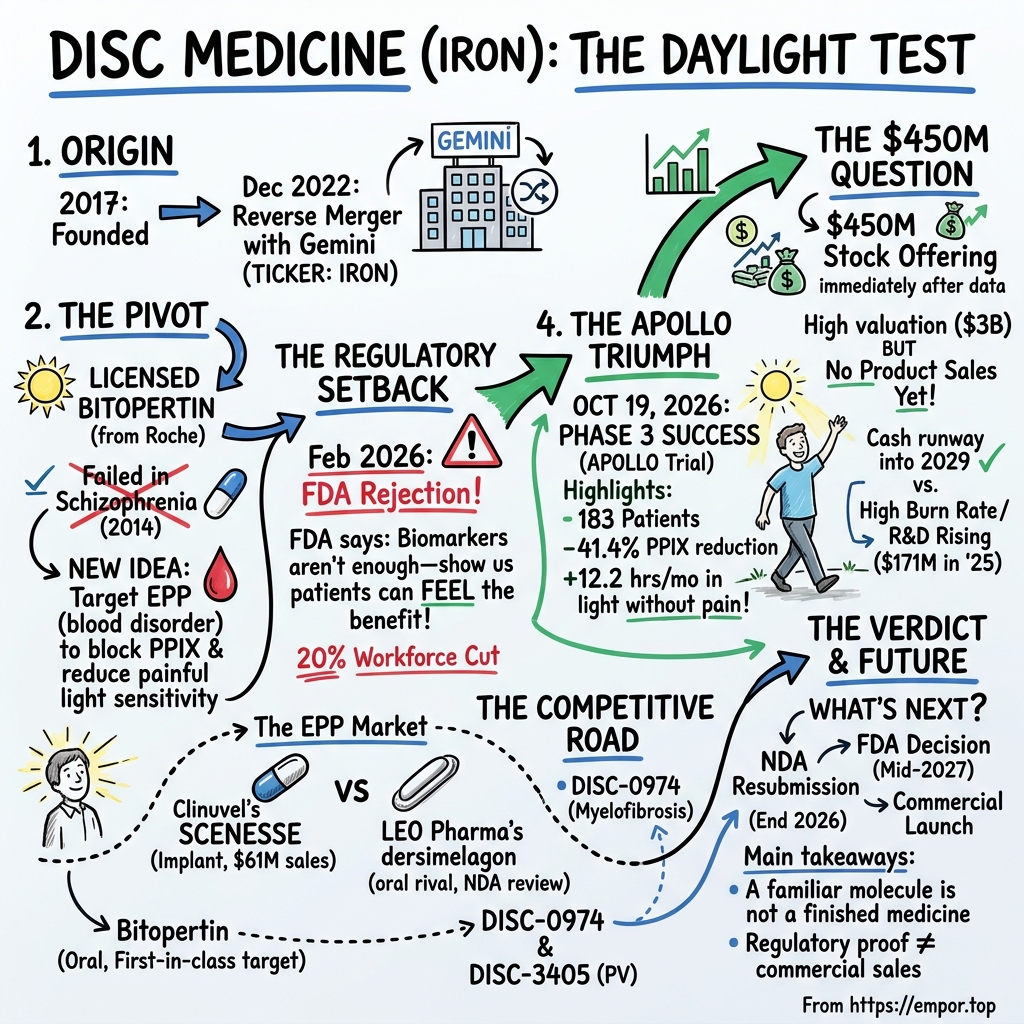
For most people, a sunny afternoon is something that happens to them. For a person with erythropoietic protoporphyria, it is something to be budgeted. A walk to the car, a school sports day, a lunch on a terrace: each one is a withdrawal from an account that can be overdrawn in minutes, and the penalty is not a sunburn but a deep, burning pain beneath the skin that can last for days. That is why the number Disc Medicine put out on the morning of October 19, 2026 was not a lab value or a p-value first. It was a measure of hours. Patients taking the company's oral drug, bitopertin, spent on average 12.2 more hours a month in light without pain than patients on placebo by the sixth month of treatment.[^1]
The trial was called APOLLO, and it was the pivotal Phase 3 study the company had been running while it waited for the Food and Drug Administration. It enrolled 183 adults and adolescents across the United States, Canada, Europe and Australia, randomized evenly to a 60 milligram daily tablet or a dummy pill, and followed them for six months.[^1] Bitopertin cut whole-blood protoporphyrin IX, the toxic pigment that drives the disease, by 41.4% relative to placebo. It reduced the rate of phototoxic reactions, increased cumulative pain-free time in light across the full six months, lengthened the time adults could spend in sunlight before the warning tingle that precedes an attack, and improved patients' own global ratings of how they felt.[^1] Every one of those comparisons was statistically significant. The company's headline was blunt: success on all primary and secondary endpoints.[^1]
Then, the very next day, Disc did what biotechnology companies so often do on their best news. It sold stock. The company priced six million new shares at $75 each, a $450 million deal, with an option for the underwriters to buy another 900,000 shares.1 Net proceeds would be roughly $422 million.1 The pairing is worth sitting with for a moment, because it captures the whole company in two press releases. The first said the science had cleared its hardest test so far. The second said that clearing the test was not the same as being paid for it.
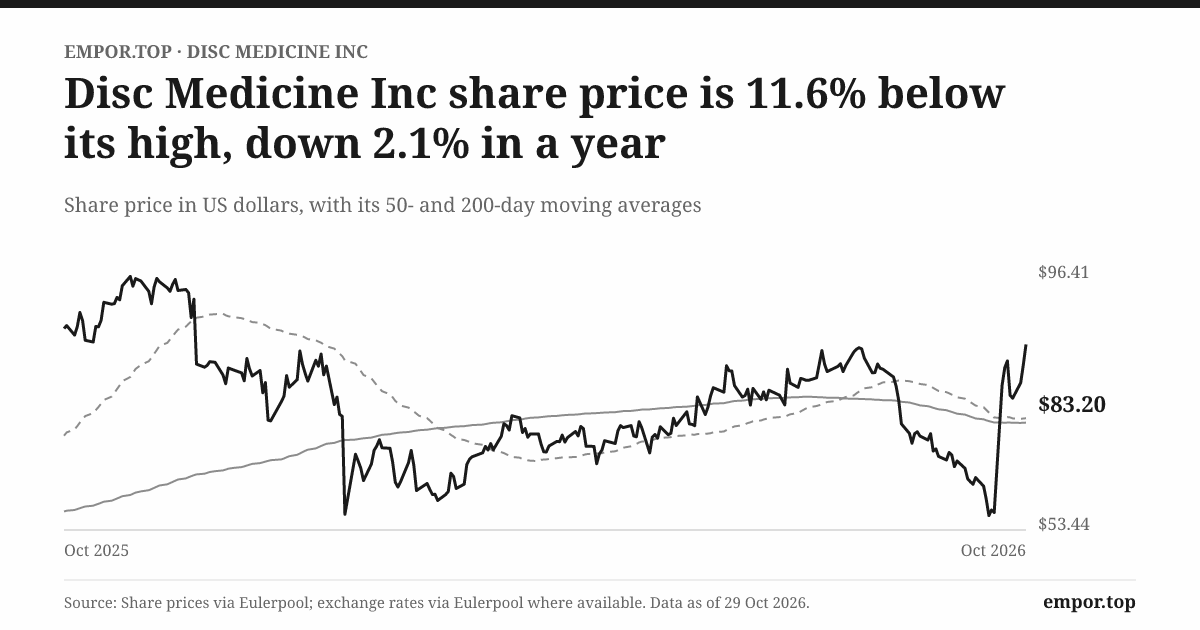
The price told its own story. By October 29, the shares closed at $83.20, giving Disc a market value of about $3.0 billion on the share count reported before the new issue, and an enterprise value of about $2.4 billion.3 Those are large numbers for a company that has never sold a single tablet. As of today, Disc has no approved products and no product revenue; it says plainly that it is still developing its candidates.3
So what, exactly, is this business? It is a pre-commercial hematology company with one lead asset that now has positive pivotal data, two earlier-stage clinical programs that manipulate the body's iron-regulating hormone in opposite directions, and a long habit of paying for all of it by issuing shares. Its headquarters are in Watertown, Massachusetts, its 2025 staff numbered 155 full-time employees, and roughly two-thirds of them worked in research and development.3 It has a chief executive who has run the company since 2020 and a board stocked with the venture investors who built it.
Four questions sit on the table. The first is regulatory. The FDA rejected bitopertin once already, in February 2026, and Disc plans to resubmit its application by the end of this year with a decision anticipated by mid-2027.1 Will the agency accept APOLLO as the clinical proof it asked for? The second is competitive. Another oral EPP drug, dersimelagon, already has an FDA application under priority review, with a decision expected by the end of February 2027.14 Can Disc reach patients before, or at least distinctly from, the next oral rival? The third is strategic. Disc's other programs are interesting biology, but are they medicines or expensive options? And the fourth is financial: what does a $3 billion valuation mean for a company whose income statement is all cost?
APOLLO answered the question the FDA had been asking. It did not answer any of the others. The drug has cleared a major scientific hurdle; the company now has to prove it can clear the regulatory one again and then the commercial one for the first time. To see why both remain open, the story has to go back to how Disc came to own a public listing, and a molecule, that were both built by someone else.
 Subscribe on LinkedIn
The listed company came through Gemini's door
Disc Medicine began in 2017 as a small venture-backed company with an unfashionable obsession: red blood cells.3 Its first ideas centered on hepcidin, the hormone the liver uses to decide how much iron the body absorbs and releases, which scientists sometimes call the master regulator of iron metabolism. Turn hepcidin up and iron gets locked away; turn it down and iron flows into the bone marrow to make red cells. Disc's earliest programs were exactly those two levers: an oral compound to raise hepcidin for diseases where the body loads too much iron, and an antibody to lower it for anemias caused by chronic inflammation and blood cancers.7
The company's co-founder, Brian MacDonald, served as interim chief executive while the scientific base was laid. In January 2020, Disc announced that John Quisel would take over as president and chief executive from February 25 of that year, with MacDonald staying on as a senior advisor and director.7 Quisel was an unusual pick for a red-cell company, and a revealing one. He held a biology degree from Harvard, a master's from Stanford, a PhD in biology from MIT and a law degree from Harvard Law School.7 He had spent more than a decade at Acceleron Pharma, joining in 2006 and rising through legal, intellectual property, business development and corporate strategy roles to become chief business officer.7 Acceleron was itself a hematology and rare-disease company, so Quisel arrived knowing the field. More importantly, he arrived as a dealmaker: someone whose career had been spent working out which molecules a company should own, on what terms, and how to keep them.
That background shaped what happened next. Over the following years Disc assembled its pipeline largely by licensing. The antibody that would become DISC-0974 came from AbbVie under a 2019 agreement; bitopertin came from Roche in 2021; DISC-3405 came from Mabwell in 2023.3 The pattern was clear early. Disc was not primarily a discovery shop inventing molecules from scratch. It was a company that identified biological rationales in red-cell disease and then went shopping for assets that might exploit them.
The route to the public market was equally pragmatic. On August 10, 2022, Disc announced it would merge with Gemini Therapeutics, a listed eye-disease company that had collapsed into a shell.6 Gemini had gone public through a special purpose acquisition company sponsored by Foresite Capital, with shares starting to trade in February 2021. Its lead drug, GEM103, was meant for an advanced form of age-related macular degeneration. Then the wheels came off. Gemini cut 20% of its staff in October 2021, launched a strategic review in January 2022, changed chief executives, let go of 80% of its remaining employees and abandoned GEM103 work.6 What was left was a Nasdaq listing and about $92 million of cash.6
That cash and listing were what Disc wanted. Disc's shareholders would own about 72% of the combined company and Gemini's about 28%, before a concurrent private financing of roughly $54 million from existing Disc backers that included OrbiMed, Atlas Venture and 5AM Ventures.6 The combined company expected about $175 million, enough to fund operations into 2025.6 Eight of nine directors would come from Disc, the company would take Disc's name, and Disc's management would run it.6 Quisel explained the logic without romance: rather than waiting for a friendly window to file for an initial public offering, the company could "control our future" and make sure its molecules completed their clinical course.6 It was mid-2022, the biotech market was in a deep slump, and a conventional IPO was not a reliable option.
The deal closed in late December 2022, and the stock began trading under the ticker IRON.5 Legally, Gemini was the surviving public entity; in substance, Disc was the business. The company's own accounts treat the private Disc as the operating company and accounting predecessor, consolidating its subsidiary Disc Medicine Opco, while Gemini's legacy assets were handled separately under a contingent value right arrangement that gave old Gemini holders any value those assets might later yield.3 That arrangement is why there is no second business hiding inside the listed company. When Disc later out-licensed legacy Gemini intellectual property to Oak Bay Biosciences, the deal carried a $0.2 million upfront payment and contingent milestones, a footnote rather than a franchise.3
This history matters for investors in a narrow but useful way. Disc has no IPO prospectus. The document that introduced it to public shareholders was a merger proxy and prospectus on Form S-4, written to persuade Gemini holders to approve a combination, not to sell a new issue to fresh buyers.5 The October 2026 offering, with its prospectus supplement, was a later financing, not a debut.1 And because the public record only begins at the end of 2022, the company's listed history is short: less than four years of quarterly reports, nearly all of them losses.
The reverse merger also tells you something about the people involved. Gemini had just shown how quickly a single-asset biotech can run out of road when its biology does not deliver. Disc's founders and investors had watched that happen up close, and took its listing anyway, because what Disc owned instead was a portfolio built on a different bet: that molecules others had given up on could work in diseases nobody had tried them in. The most important of those molecules had a very public past.
The molecule Roche had already tested in schizophrenia
On January 21, 2014, Roche delivered bad news to one of the biggest bets in psychiatry. Bitopertin, a pill the Swiss drugmaker had pushed into six Phase 3 studies, had missed the primary endpoint in the first two.8 The trials had added bitopertin to standard antipsychotic medication in adults with schizophrenia whose so-called negative symptoms (the flattened emotion, social withdrawal and lack of motivation that existing drugs barely touch) persisted despite treatment. After 24 weeks, the drug did not significantly reduce those symptoms compared with placebo.8 The safety record, at least, looked similar to what Roche had seen in earlier testing.8 Roche said it would wait for the remaining studies before deciding next steps.8 Those later studies did not rescue the schizophrenia program.
To understand why a failed psychiatric drug ended up in a blood-disorder company, it helps to know what bitopertin does. It blocks a protein called glycine transporter 1, or GlyT1, which pulls the amino acid glycine into cells. In the brain, Roche's theory was that more glycine around certain nerve receptors would sharpen signaling and lift negative symptoms. But glycine has another job entirely. It is the first raw material in the assembly line that makes heme, the iron-carrying core of hemoglobin. Developing red blood cells use GlyT1 to stock up on glycine for that assembly line.9
Now picture the assembly line in a patient with erythropoietic protoporphyria. The last station, an enzyme called ferrochelatase, is supposed to slot iron into a ring-shaped molecule called protoporphyrin IX to finish heme. In EPP the enzyme is deficient, so the half-finished rings pile up.3 Those rings, PPIX, are photosensitizers: when light hits them in the blood vessels of the skin, they generate reactive molecules that cause intense pain. Disc's insight was simple to state. If the end of the line is jammed, slow down the beginning. Starve the red-cell factory of a little glycine, and it should produce less PPIX. Preclinical studies supported the idea that GlyT1 inhibition reduced the toxic metabolites that cause erythropoietic porphyrias.9
On May 27, 2021, Disc announced an exclusive worldwide license from Roche to develop and commercialize bitopertin and related backup compounds.9 The announcement emphasized the drug's history as an asset: more than 4,000 healthy volunteers and patients had taken part in more than 30 clinical trials, including Phase 2 and Phase 3 trials in psychiatric disorders.9 The same release conceded that efficacy in the central nervous system had not been established.9 Quisel called the deal "a major milestone in establishing Disc Medicine as a leader in hematology."9
Here is where the most common version of the story needs a correction. The tidy narrative goes like this: bitopertin was already a proven, de-risked drug, and Disc merely pointed it at a new disease. The record supports a narrower claim. Roche's trials gave Disc a large body of human safety and dosing data, which is valuable because it lets a small company skip years of early work and start with some confidence about how the drug behaves in people. They did not provide any evidence that the drug works in EPP. The schizophrenia failures do not count against the EPP hypothesis, because they tested a different mechanism in a different organ. But they do count against any claim that bitopertin was a "proven" medicine. It was a familiar molecule with a clean-ish track record and a new reason to exist.
The economics of the license reflect that status. Disc paid Roche an initial $4.5 million and issued it about 2.85% of the combined company at the time of the Gemini merger.3 In exchange, Roche kept a long tail of upside: up to $50 million of milestones for the first indication, $35 million for a second, up to $120 million tied to sales thresholds, and tiered royalties on net sales from the high single digits to the high teens.3 Disc paid a $10 million milestone in June 2025, and the next payment, $15 million, falls due on U.S. approval.3 Roche also gets a share of proceeds if Disc strikes a later deal around the drug.9 In plain terms, Roche did not sell bitopertin. It rented it out, for a small entry fee and a meaningful cut of any eventual sales. For a future bitopertin business, every dollar of revenue will carry a royalty somewhere between roughly 8 and 19 cents to Basel, depending on the tier.
There is a second quiet complication in that history. A drug first synthesized in the 2000s carries old patents. Disc's own filings show that the U.S. composition-of-matter patent licensed from Roche expires in 2026, with related process, intermediate and crystalline-form patents running out between 2026 and 2028.3 Disc has built a newer estate of its own, with patent families covering the treatment of EPP and related porphyrias that run to 2041 or 2042 and others extending into the 2040s.3 It also holds U.S. orphan drug designation for bitopertin in EPP.3 Method-of-use patents and orphan exclusivity can protect a rare-disease drug, but they are a different kind of fortress from a patent on the molecule itself. That distinction will matter later, when the question becomes how long any commercial advantage lasts.
What Disc built on the Roche molecule was a playbook it would repeat: acquire rights to a biological idea cheaply, with most of the cost deferred into milestones and royalties, then spend heavily on clinical trials to find out whether the idea is real. The licensing is the cheap part. The trials are the expensive part, and so is the moment when a regulator decides whether the evidence is good enough. For bitopertin, that moment arrived in February 2026, and it did not go the way Disc had planned.
The FDA asked for proof patients could feel
By the autumn of 2025, Disc was behaving like a company about to launch. It had submitted a new drug application for bitopertin in September 2025, seeking accelerated approval.3 The FDA accepted the filing in November.3 In between, in October 2025, Disc received one of the first Commissioner's National Priority Vouchers, a new pilot program designed to deliver FDA reviews in two months or less for medicines deemed to serve national priorities.312 Disc had been hiring a commercial team and building launch infrastructure; selling, general and administrative costs rose sharply as it did.3 The plan, as observers described it, was approval and launch in early 2026.12
On February 13, 2026, the agency said no.10 The complete response letter, addressed to Disc's chief regulatory officer, is worth reading closely, because it is unusually clear about what was missing. Accelerated approval rests on two questions, the FDA explained. First, does the drug have an effect on the proposed surrogate endpoint, a lab measurement standing in for clinical benefit? Second, is that surrogate, including the size of the change, reasonably likely to predict benefit patients would actually experience?10
On the first question, the FDA agreed with Disc. Its randomized, double-blind Phase 2 trial, AURORA, had shown that 60 milligrams of bitopertin beat placebo on the percent change in whole-blood PPIX, and the open-label BEACON study in Australia had provided confirmatory evidence.10 On the second question, the agency was skeptical. It called the PPIX reduction, about 40% from baseline at the higher dose, "relatively modest," and said it was unknown whether a change of that size was reasonably likely to predict clinical benefit.10 Then it delivered the sentence that defined the next eight months: the trials "did not show evidence of association" between the percent change in PPIX and the sunlight-exposure endpoints measured, despite the strong mechanistic and biological plausibility behind the biomarker.10
The FDA's conclusion was precise. For approval, Disc would need an adequate and well-controlled trial demonstrating efficacy on clinical endpoints, and the agency suggested the obvious route: finish the ongoing trial and, if it succeeded, submit the results for traditional approval.10 The ongoing trial was APOLLO.
A useful way to think about the distinction is a car's fuel gauge. If a mechanic tells you a new part lowers fuel consumption, and the gauge shows the tank draining more slowly, that is encouraging. But the question you actually care about is whether you can drive farther. If the gauge moves and the odometer does not, you start to wonder what the gauge is measuring. AURORA's data were exactly that awkward. Disc's own annual report shows the 60 milligram dose cut PPIX by 41.7% against an 8.1% increase on placebo, but the sunlight-time results were not statistically significant versus placebo, even though the drug reduced phototoxic reactions with pain by 75%.3 The open-label BEACON study had shown dramatic improvements, including a 92% fall in full phototoxic reactions, but open-label studies in a disease measured partly by patient diaries are vulnerable to expectation effects.3 The FDA was not saying the drug did nothing. It was saying the evidence did not yet prove that the thing the drug changed was the thing that mattered.
The rejection was also a public embarrassment for the voucher program. Bitopertin had been among the first programs awarded a CNPV, and critics had already raised questions about the scheme's legality and vulnerability to political influence.12 A drug that receives a priority voucher one autumn and a rejection the following winter tells investors something useful about the FDA in this period: a faster review clock does not lower the evidentiary bar. The voucher bought speed. It did not buy approval.
Quisel's public response was measured. "The CRL will delay the potential approval of bitopertin," he said, "but we have confidence in the ongoing APOLLO trial."12 The company said it would respond to the letter once APOLLO read out and expected an updated FDA decision by mid-2027.12 Management did not, in its public statements, dispute the agency's reasoning or blame the review process. That restraint is worth noting, because it is evidence about how a management team handles a miss: it accepted the regulator's framing and pointed to the experiment already running.
The operational response came two weeks later. On February 26, 2026, the board approved a restructuring that cut about 20% of the workforce, primarily in commercial functions and certain supporting roles, at a cost of about $2 million, mostly severance.11 Against a year-end staff of 155, that was roughly 30 people, many of them hired in anticipation of a launch that was no longer imminent.311 The cut was proportionate rather than drastic. Disc kept its research engine intact, kept APOLLO running, and trimmed the part of the company built for a 2026 launch. Yet the expense line shows how much launch spending had already been embedded. Selling, general and administrative costs in the first half of 2026 were $41.8 million, up from $27.3 million a year earlier, and even in the second quarter, after the cuts had begun, they were $18.1 million against $15.1 million a year before.4 The company had pulled back from a launch posture, not dismantled one.
Then came October. APOLLO had been guided to a fourth-quarter 2026 readout, and it arrived on October 19 with positive topline results.3[^1] The striking thing, read beside the complete response letter, is which number did and did not change. The PPIX reduction in APOLLO, 41.4% versus placebo, was essentially the same size the FDA had called "relatively modest."[^1]10 The biomarker did not get better. What changed was the odometer. APOLLO showed, in a placebo-controlled, double-blind trial, that patients gained pain-free time in light and suffered fewer phototoxic reactions.[^1] That is precisely the clinical-endpoint evidence the FDA asked for.
The safety picture also became clearer, and it is not trivial. Dizziness was the most common treatment-emergent side effect in the bitopertin group, affecting half of patients, though the company described it as mostly mild or moderate and generally transient, and reported no adverse events above Grade 3.[^1]2 For a once-daily pill that a patient might take for decades, a side effect that hits one in two people will matter to prescribers and payers, even if it fades. Detailed results have not yet been presented at a medical meeting; they will be, and the full data set will reveal more about how durable the benefit was, how dizziness affected adherence, and how the gains varied across patients.2
So the regulatory verdict is this. February was a real setback, not a rejection of the drug's biology. October addressed the missing link more directly than the earlier trials ever could. But a positive topline result is not an approval. The FDA will now review a resubmission that must fully answer every deficiency in the letter, including a comprehensive safety update drawing on all bitopertin studies regardless of indication, which means Roche's old psychiatric trials come back into the file.10 The agency will set the label, the population and the warnings. And it will do all of that while weighing a second oral EPP drug that it may approve first.
An oral drug enters a market with a rival already moving
Imagine two patients with EPP in 2027. The first lives near one of the specialist centers that administer SCENESSE, the only approved therapy for the disease. Every couple of months she visits a clinic, where a trained clinician inserts a tiny dissolving implant under the skin of her hip. The implant releases afamelanotide, a synthetic version of a hormone that stimulates melanin, darkening the skin and giving it a measure of protection. Her insurer pays for it, because over the past six years the company behind SCENESSE has built the reimbursement machinery. The second patient lives three hours from the nearest center. For her, the treatment proposition is different: what she wants is something she can take at home, without a procedure. The question for Disc is how many patients look like the second, and whether a pill is enough to win them.
The first patient's treatment is the product of a long, unglamorous campaign by CLINUVEL Pharmaceuticals, an Australian company that won European approval for SCENESSE in 2014 and FDA approval in October 2019, treating its first U.S. patient in April 2020.13 In the fiscal year ended June 2025, SCENESSE sales were $61.1 million, up about 5.5% from $57.9 million the year before, and they made up roughly nine-tenths of Clinuvel's revenue.13 The company was profitable, earning net income of about $23 million.13 It had expanded its network to 120 trained and accredited centers in North America by the end of 2025, and over 100 national and local private insurers in the United States reimbursed the drug, along with the Department of Veterans Affairs.13 Clinuvel described itself as having no direct commercial competitors for adult EPP.13
Those figures do two jobs in this story. First, they prove that EPP is a real market. A rare disease with around 14,000 diagnosed patients in the United States, by Disc's estimate from claims data, can support a profitable specialty product.3 Second, they cap the enthusiasm. A therapy that has been on the U.S. market for six years, in a market with no approved alternative, is generating about $61 million a year globally and growing at single digits. That is evidence that treated EPP is a niche, not a blockbuster in waiting. It is not a precise estimate of Disc's addressable market, because a pill may reach patients an implant cannot, and pricing for a new oral therapy could differ. But anyone who models bitopertin as a multi-billion-dollar drug in EPP alone has to explain why the market's only incumbent, after half a decade, sells a small fraction of that.
Clinuvel also faces its own clock. Its U.S. orphan exclusivity expired in October 2026, and it cites a patent expiring in 2027 that could open the door to competing products.13 In other words, the incumbent's legal protections have thinned just as new oral entrants approach.
The more urgent threat to Disc, however, is not the implant. It is the other pill. Dersimelagon is an oral, once-daily drug that works on the same melanocortin 1 receptor that afamelanotide targets, essentially an at-home version of SCENESSE's mechanism.14 It was developed by 田辺三菱製薬 Mitsubishi Tanabe Pharma, now operating as Tanabe Pharma, whose global Phase 3 trial, INSPIRE, reported statistically significant and clinically meaningful results across primary and secondary endpoints earlier in 2026, including a significant lengthening of average daily sunlight exposure before the first warning symptoms.14 In August 2026, LEO Pharma, the Danish dermatology specialist, agreed to buy worldwide rights for up to $435 million in upfront and near-term milestone payments, plus later milestones and royalties; it closed the deal on September 18, 2026, the same day it announced that the FDA had accepted the dersimelagon application with priority review and a decision date by the end of February 2027.14
Lay those dates side by side and the war game becomes clear. If both drugs succeed, dersimelagon could reach the U.S. market roughly a few months before bitopertin, backed by a dermatology company with an established sales force, and approaching the same patients with the same core pitch: a daily pill for a disease that has only had an implant. Disc would be second, not first, to the oral-EPP market. A third candidate, PORT-77 from Portal Therapeutics, a BridgeBio subsidiary, is in early Phase 2 for EPP.3 The days when EPP was a one-product market are ending.
What then differentiates bitopertin? The honest answer has two layers. The first is mechanism. Afamelanotide and dersimelagon protect the skin from the consequences of PPIX by darkening it; bitopertin attacks the source by making less PPIX. Disc's argument is that going upstream is more fundamental. It is a reasonable scientific argument, and APOLLO supports it. But a biological explanation is not a commercial moat. Patients and physicians will judge by what they experience: how much more time outside, how fast the benefit arrives, how it holds up over years, what the side effects feel like, and how much paperwork it takes to get the prescription filled.
The second layer is the evidence package. APOLLO measured both the biomarker and patient-relevant endpoints, including pain-free light time and phototoxic reactions, and reported improvements in patients' global impressions of change and severity.[^1] Dersimelagon's INSPIRE trial used a related but distinct primary measure, sunlight exposure before prodromal symptoms.14 Cross-trial comparisons are treacherous because designs, populations and endpoints differ, and neither company has yet published full head-to-head-relevant data. What can be said is that both drugs now have positive pivotal trials, and the differentiation battle will be fought over details not yet public: durability, tolerability, including bitopertin's dizziness rate, and whether some patients respond better to one mechanism than the other. One plausible future is that physicians use the drugs as complements or sequences rather than substitutes. That would be good for patients and not obviously bad for Disc, but it is a hypothesis, not a finding.
It helps to step back and look at the forces shaping this little market. Rivalry is moving from one approved therapy to at least three products within a couple of years, and possibly more. Substitutes are real and cheap: the oldest treatment for EPP is avoiding light, along with protective clothing, and many patients have built their lives around it. Barriers to entry are high but not insurmountable; a new entrant needs a positive controlled trial, a manufacturing process and an FDA approval, and two companies have already cleared or nearly cleared that bar. Buyers matter more than the small patient count suggests, because specialty centers and payers decide who gets access, and Clinuvel's six-year buildout of centers and insurer coverage shows how much work that takes. Suppliers matter too. Disc owns no manufacturing facilities; it relies on contract development and manufacturing organizations, obtains supplies from single-source manufacturers on purchase orders and has no long-term supply agreements, while a commercial process for bitopertin's four-step synthesis is still being established at a contractor.3 There is no customer concentration in Disc's sales yet, for the simple reason that there are no sales.
There is one more competitive force that does not show up in these frameworks but matters a great deal: what a patient is willing to pay, in money and inconvenience, for a few more hours of daylight. The APOLLO gain of about 12 hours a month is roughly 25 minutes a day.[^1] To a person who has to plan every exposure, that can be the difference between attending a child's outdoor game and watching from the car. It can also seem modest beside the full freedom patients want. How payers value that time, and how patients judge it against side effects, is a pricing question no trial can settle.
So the moat verdict is plain. Disc's asserted advantages are oral administration, a mechanism that targets PPIX at the source, and a portfolio focused on red-cell pathways. APOLLO converts the first two from hypotheses into clinical facts. None of the three has yet been validated by pricing, repeat use, durable retention or commercial share, and the oral advantage will be shared with dersimelagon from day one. The evidence supports a smaller claim than "moat": bitopertin is likely to be a differentiated entrant in a small, contested market, if approved. Whether it can command a premium price or a leading share is unknown, and the first quarters of reported sales will be the falsifying test.
That commercial uncertainty would be manageable in a company with a profitable base. Disc has none. Even a strong clinical product has to carry a company without product revenue, which is why the day after APOLLO looked the way it did.
The $450 million question
The sequencing on October 19 and 20 was textbook. Disc released the APOLLO data on a Monday and held a corporate call to walk analysts through it.[^1][^22] By the next day, it had priced a large stock offering.1 The prospectus supplement listed the uses of the roughly $422 million in net proceeds: research and clinical development, potential commercialization of bitopertin for EPP and its close cousin X-linked protoporphyria, pre-commercial work for other candidates, working capital, and possibly in-licensing, acquisitions or investments in complementary businesses.1
Every biotech investor recognizes the move. Raise money when the stock is up and the news is fresh, because the next window might not open. The question a skeptic should ask is why a company that already had hundreds of millions in the bank needed to do it at all. The answer lives in the cost structure.
Start with the income statement, because it tells a simple story. Disc still has no product revenue.3 Meanwhile, research and development spending climbed from about $69 million in 2023 to about $171 million in 2025, roughly two and a half times in two years, as APOLLO and the Phase 2 programs ramped up.3 Net loss widened from about $76 million to about $212 million over the same stretch.3 In the first half of 2026, R&D ran at $92.8 million and SG&A at $41.8 million, and the net loss was $123 million.4 This is not a business with a cost problem in the usual sense. It is a business doing exactly what its model requires, spending more as its trials get bigger and later-stage, and it has no revenue to offset the spending.
Cash tells the same story with slightly smaller numbers. In 2025, Disc used about $180 million in operating cash, against the $212 million net loss.3 The difference is not some hidden earnings quality; it mostly reflects $34.3 million of stock-based compensation and other non-cash charges, partly offset by accretion on investment securities, with small working-capital movements on top.3 Over the six years from 2020 to 2025, cumulative net losses came to about $518 million and cumulative operating cash outflow to about $447 million.3 Both figures measure the same thing: the price of running clinical trials without a product to sell. In the first half of 2026, operating cash use was $106.4 million, a pace of more than $200 million a year.4
One accounting judgment sits inside those figures and deserves a sentence. Disc's auditor, EY, singled out the accrual for external research and development, $11.5 million at the end of 2025, as a critical audit matter, because clinical sites and contractors bill on schedules that do not match when the work is actually done, and management has to estimate the gap.3 That accrual rose to $14.3 million by June 2026.4 It is a normal feature of trial-heavy companies, not a red flag, but it is the main place where judgment shapes the reported loss. The company also reported that a previously identified material weakness in IT general controls had been remediated by the end of 2025, and EY gave clean opinions on both the financial statements and internal controls.3
Now the financing history, which is where the model becomes visible. Since the Gemini merger, Disc has raised money in almost every year: about $62 million in February 2023, $148 million in June 2023, $172.5 million in June 2024, $243 million in January 2025, $211 million net in October 2025, plus at-the-market sales of stock along the way.3 October 2026 added the largest single raise yet. The new shares lift the count from about 38.3 million at the end of June 2026 to about 44.3 million, an increase of roughly 16% in one stroke, or 18% if the underwriters exercise their option in full.1 Disc has disclosed no share buybacks. This is the honest description of the operating model to date: equity financing is not an occasional emergency tool for Disc; it has been the primary source of funding for nearly every program the company runs.
The money has bought a substantial cushion. Cash and investments stood at about $791 million at the end of 2025 and $717.7 million at June 30, 2026, mostly in U.S. Treasuries, agency securities and corporate debt.34 Disc's preliminary, unaudited estimate put the figure at about $683 million by the end of September.1 That treasury is not merely a war chest; it is a real line in the income statement. In 2025, interest income of about $28 million, less $3.6 million of interest expense, softened the pretax loss by about $24 million.3 It also means the company's reported losses will look a little better when rates are high and its balance is large, and a little worse when either falls.
Before the October deal, Disc said its cash would fund operations into 2029; with the net proceeds, it now says into 2030, excluding any revenue from bitopertin or other products.1 That guidance is the central credibility test of the financial story. The useful question is not whether the runway is long. It is whether, over the next two years, the actual cash use tracks what the guidance implies, and whether the share count keeps climbing anyway. Disc has extended its runway repeatedly; it has done so mostly by raising money, not by spending less.
Debt plays a supporting role, and it should be described proportionately. Disc has a loan facility with Hercules Capital that can provide up to $200 million in tranches. It had drawn $30 million by the end of 2025 and another $30 million in June 2026, for $60 million in total.4 There is no principal due in 2026 or 2027, about $4.4 million in 2028 and about $55.6 million in 2029, plus an end-of-term charge of about $4.1 million.4 An amendment pushed the first minimum-cash covenant test out to July 2028.4 Against a cash pile more than ten times the drawn debt, this is not a refinancing risk. It is an option on cheaper-than-equity funding for a launch, with covenants that will matter if the company draws more heavily.
How has Disc deployed the capital it raised? Not on acquisitions of operating companies; there is no such record from which to judge whether it overpaid. Its major capital decisions have been licenses and the trials that test them. The Mabwell deal for DISC-3405 is the clearest example of the structure. 迈威生物 Mabwell, the Shanghai biotech that discovered the anti-TMPRSS6 antibodies, received a $10 million upfront payment in January 2023, with up to $127.5 million in development and regulatory milestones across up to three indications and up to $275 million in commercial milestones, plus royalties from low to high single digits; Disc's rights exclude Greater China and Southeast Asia.3[^21] Disc has since paid $5 million in October 2023, $10 million in September 2025 and $5 million in February 2026 as the program advanced.3 The AbbVie license for DISC-0974 was cheaper still: a $0.6 million initial payment, shares in the company, up to about $150 million in milestones and a low-single-digit royalty, with a $3 million milestone paid in January 2025.3 Headline contingent values such as Mabwell's $412.5 million are not acquisition prices. Most of that money is owed only if the drug works and sells. The real price of these assets is the trial spending that follows the license, and that is where Disc's capital has gone.
The people overseeing that spending have been paid well for it, mostly in stock. Quisel's reported compensation rose from about $0.9 million in 2023 to about $10.0 million in 2025, of which roughly $8.7 million was stock and option awards; his salary in 2025 was $695,000.18 Chief financial officer Jean Franchi, in the role since February 2024, received about $4.2 million in 2025.18 Those totals rose as annual losses widened, which is not a contradiction in a development company, where pay is meant to track pipeline milestones rather than profit, but it means shareholders are paying executives largely in the same currency the company uses to fund trials. Executive officers and directors together owned about 3.8% of the company in the April 2026 proxy.18 The largest holders were FMR, at about 13.9%, AI DMI, an entity controlled through Access Industries, at about 7.9%, and RA Capital, at about 5.8%; board member Liam Ratcliffe is affiliated with Access.18 There is no controlling shareholder.
Shareholder votes at the June 2026 annual meeting were mostly comfortable. The advisory vote on executive pay passed with about 33.5 million votes in favor and 0.4 million against.19 The one visible sign of dissent fell on Donald Nicholson, the director who had chaired the board when Quisel was hired, who received about 5.4 million withheld votes, far more than other nominees.197 The filings do not explain the protest, and it was not large enough to threaten his seat, but in a company where the board approves every dilutive raise, it is a data point worth tracking.
The verdict on the financing is balanced but clear. Disc has substantial liquidity and no near-term debt wall. Its development model consumes about $200 million a year and has depended entirely on dilutive equity. The October raise extends strategic room and allows Disc to prepare a launch without negotiating from weakness, but it increases the share count by roughly a sixth and does not demonstrate that commercialization will ever fund the pipeline. That proof, if it comes, will arrive in the form of product revenue. Until then, every program Disc runs is ultimately paid for by its shareholders, which is why the value of the programs beyond bitopertin matters so much.
Two more shots on goal
On September 9, 2026, a few weeks before APOLLO, Disc's second-most-advanced idea got its first public test in patients. At the Society of Hematologic Oncology meeting in Houston, investigators presented early results from RESTORE-PV, a Phase 2 trial of DISC-3405 in polycythemia vera.15 PV is a blood cancer in which the bone marrow overproduces red cells, thickening the blood and raising the risk of clots and strokes. The oldest treatment is also the most medieval: regular phlebotomy, draining blood to keep the hematocrit, the share of blood made up of red cells, below 45%. Patients may need it every few weeks. It is tiring, it worsens iron deficiency, and many patients hate it.
DISC-3405 attacks the problem through iron. It is an antibody that blocks an enzyme called TMPRSS6, which normally keeps hepcidin in check. Block the enzyme and hepcidin rises; hepcidin locks iron away; and without iron, the overactive marrow cannot make as many red cells.15 In the first cohort of the trial, among the 13 patients who had completed 26 weeks, the average number of phlebotomies over 26 weeks fell from 4.0 before treatment to 0.6 afterwards, and about 62% of patients needed no phlebotomy at all through week 26.15 Hematocrit stayed below 45% on average, hepcidin rose and serum iron fell as the mechanism predicted, and most patients reported improved symptom and fatigue scores.15 The drug was generally well tolerated in the 38 patients in the safety analysis, with no dose-limiting toxicities and no discontinuations because of side effects; the most common events were mild abdominal pain and injection-site reactions.15
Those numbers are encouraging. They are also from 13 patients in an open-label study with no control group, presented by investigators working with the company. The second cohort, testing a less frequent dose, has not yet reported efficacy.15 And DISC-3405 is not alone. Protagonist's rusfertide, a hepcidin mimetic, has completed a Phase 3 trial in PV, and Regeneron, Silence Therapeutics and Ionis are among other companies pursuing hepcidin-directed approaches.3 Disc is a follower in PV, not a pioneer. The initial findings are a signal, not a registration result; sample size, durability and safety over longer exposure will decide whether the mechanism offers enough clinical value to justify a Phase 3 trial. Disc is also testing DISC-3405 in sickle cell disease, where a Phase 1b trial began in October 2025, and plans to report initial sickle-cell data and a RESTORE-PV update by the end of 2026.315
DISC-0974 pushes iron the other way. It is an antibody that blocks hemojuvelin, a co-receptor that helps the liver make hepcidin, so less hepcidin is produced and iron is freed to reach the bone marrow.17 Its target is anemia in myelofibrosis, another blood cancer, in which scarring of the marrow and chronic inflammation drive hepcidin up and starve red-cell production of iron. Anemia is one of the most debilitating features of the disease, and many patients become dependent on transfusions. Disc is also running a Phase 2 trial in anemia associated with inflammatory bowel disease, which began in the first quarter of 2026.3
The RALLY-MF data presented in mid-2026 were the strongest pipeline evidence Disc has outside bitopertin. Among 50 evaluable patients, about 56% achieved a major hematologic response, an identical rate whether or not patients were also taking a JAK inhibitor, the standard drug class for myelofibrosis.1617 Among patients who were not transfusion-dependent, 55% met the primary endpoint of a sustained hemoglobin rise of at least 1.5 grams per deciliter for 12 weeks or more; overall response rates, which include smaller improvements, ranged from 68% in that group to 88% among the small cohort of heavily transfused patients.16 Among those requiring transfusions, 64% of low-transfusion patients and half of high-transfusion patients became transfusion-independent for extended periods.17 Hemoglobin gains correlated with improved fatigue scores.17
These are interim, single-arm data, and the investigators themselves noted the lack of a control group as a limitation.16 Safety needs watching: about 41% of patients had Grade 3 or higher adverse events and about 20% serious adverse events, though myelofibrosis patients are sick and many events reflect the disease; two patients had decreased renal function, which was not considered drug-related.17 The competitive benchmark is also demanding. Physicians already use erythropoiesis-stimulating agents, steroids and danazol off-label; GSK's momelotinib is approved for myelofibrosis patients with anemia; and Bristol-Myers Squibb's luspatercept has completed a Phase 3 trial in the disease.3 Anemia management in myelofibrosis is no longer an empty field. A 56% major response rate looks impressive in isolation; whether it holds up in a randomized trial against or alongside these options is the question that will determine value.
It is tempting to describe this portfolio as a platform. Disc does: three clinical programs spanning heme synthesis and iron regulation, built by the same team, in the same corner of hematology. The evidence supports a more limited statement. The programs share a scientific worldview and a development organization, and that may lower the cost of running trials in related diseases. But the assets came from three different licensors, use three different molecular approaches, and have not yet produced a single approval. A platform in the sense investors pay for is a machine that repeatedly turns biology into approved drugs at lower cost. Disc has not yet shown that the machine works once.
The next catalysts are already on the calendar. Disc will need fuller RALLY-MF data and a discussion with the FDA at the end of Phase 2 to define a pivotal trial in myelofibrosis. RESTORE-PV will report updated results, including results from its second cohort, and the sickle-cell trial will deliver initial data by the end of this year.15 Each of those readouts will decide whether the program earns a Phase 3 budget, and each Phase 3 trial will cost far more than anything that came before.
That is the crux for anyone weighing the valuation. A program at Disc's stage is a call option: it has real value, but the option premium is paid in cash every year, and most options in drug development expire worthless. The question investors face now is how much of today's $3 billion rests on a first product that has not yet been launched, and how much on trials still years from revenue.
Playbook: Business & Investing Lessons
Put two scenes side by side. In January 2014, Roche's executives told investors that bitopertin had failed its first two Phase 3 schizophrenia trials.8 In October 2026, Disc told investors that the same molecule had succeeded in all endpoints of a Phase 3 trial in 183 patients with a rare blood disorder.[^1] Same pill. Different disease. Different question. And, crucially, a different bar of evidence. The first lesson from Disc lives in the gap between those two dates.
A familiar molecule is not a finished medicine. Disc licensed a drug that had been given to more than 4,000 people, which made the safety work easier and the initial bet cheaper.9 But the prior record told Disc nothing about whether the drug could relieve EPP, and the company still had to spend years and hundreds of millions of dollars to find out. The wider lesson for founders is that repurposing is a genuine strategy, not a shortcut: it buys a head start on safety, never on efficacy. For investors, a phrase like "clinically validated molecule" deserves a follow-up question every time: validated for what?
A biomarker can point to the mechanism; patients have to prove the benefit. Disc's first approval attempt rested on a lab measurement that moved exactly as the biology predicted, and the FDA said that was not enough because the trials showed no link between the change and how patients lived.10 APOLLO reduced PPIX by almost exactly the same amount, and it worked because it also measured hours in daylight.[^1] The lesson for any company relying on surrogate endpoints is that the regulator's question is never "did the number move?" but "does the number tell us anything patients would notice?" And the lesson for investors in a priority-review era is that faster review clocks change the timing of a decision, not the standard behind it.
A license buys a chance, not a moat. Disc's portfolio was assembled for small upfront payments: $4.5 million to Roche, $10 million to Mabwell, $0.6 million to AbbVie.3 That was capital-efficient. It also means that every future dollar of bitopertin revenue carries a high-single-digit to high-teens royalty to Roche, that DISC-3405's economics are shared with its originator and limited geographically, and that the molecules depend on contract manufacturers Disc does not control.3 The licensing model let a small company own a late-stage asset; it did not give that company exclusive advantages a competitor cannot replicate. LEO Pharma, after all, used the same model to acquire dersimelagon.14
Cash buys time; repeated share issuance spends ownership. Since its listing, Disc has raised equity in every year, culminating in a $450 million offering the day after its biggest success.13 Each raise was rational on its own terms, and together they have given the company one of the longest runways in its peer group. But the bill for that runway is paid by every existing shareholder, whose stake in any future bitopertin profit shrinks with each issue. The lesson is simple and specific to this company: in a pre-revenue biotech, the share count is the real cost line.
The playbook all comes back to evidence. Disc has shown it can reframe an old asset, design a trial that addresses a regulator's specific objection, and finance itself through a setback. Those are real skills. They are not yet proof of a medicine business. Disc's credibility will be earned through an FDA approval, controlled follow-up data in its other programs, and reported product revenue that starts to pay for the next experiment, not through the size of its pipeline alone.
Analysis & Bear vs. Bull Case
On October 29, Disc traded at about 5.1 times its book value on the pre-offering share count.3 Conventional multiples are useless here. Price-to-earnings cannot be calculated because there are no earnings, and enterprise-value-to-sales cannot be calculated because there are no product sales.3 So the useful way to read the valuation is to ask what it implies.
Start with some simple arithmetic. At $83.20, the roughly 44 million shares outstanding after the October offering are worth about $3.7 billion. Add back roughly $60 million of debt and subtract the roughly $1.1 billion of cash the company expects after the offering's net proceeds land on top of its September balance, and the market is paying something around $2.6 billion for the enterprise: the bitopertin franchise, the two clinical programs, and the organization that runs them.14 That is not a price for a speculative early-stage pipeline. It is a price that assumes bitopertin will very likely be approved and become a meaningful commercial product, with additional value assigned to the hepcidin programs.
The bull case rests on APOLLO's double-blind, placebo-controlled evidence on clinical endpoints, which addressed the FDA's stated concern; the agency's letter pointed to completing the trial as the route to traditional approval.10[^1] Clinuvel's profitable SCENESSE business shows that EPP patients and payers will pay for a therapy that gives them more daylight.13 Disc's patent estate for EPP treatment extends into the 2040s, and its orphan designation could add regulatory exclusivity on approval.3 DISC-0974 and DISC-3405 offer potential second and third products in diseases larger than EPP.1615 The company says its cash will fund operations into 2030.1 On this view, $2.6 billion buys a nearly derisked first product and two free shots on goal.
The bear case deserves equal weight. Approval is pending, and a resubmission requires a full safety update and a new review; the agency could narrow the label, demand more analyses, or highlight the dizziness that affected half of APOLLO patients.10[^1] Dersimelagon has priority review and an earlier decision date, so Disc may be the second oral drug, not the first.14 The incumbent's sales after six years on the U.S. market suggest the treated EPP market is small, and Disc has never set a price, won a payer contract or launched a product.13 Roche's royalties will take a high-single-digit to high-teens share of net sales.3 The rest of the pipeline consists of clinical programs with single-arm data, approved competitors and late-stage rivals.3 Supply rests on single-source contract manufacturers without long-term agreements.3 And the company's own history shows that it funds itself by issuing shares, with the count rising by about a sixth in October alone.1 On this view, $2.6 billion already prices in an approval that has not happened, a launch that has not begun, and a pipeline success rate that history does not support.
The same industry forces sharpen both cases: rivalry is intensifying, substitutes are available, specialty centers and insurers will shape adoption, and single-source manufacturing gives suppliers leverage over Disc.
Hamilton Helmer's framework of seven sources of durable power makes the moat question concrete. Disc has no scale economies; it is sub-scale by definition. There are no network effects in EPP treatment. Switching costs may emerge if patients stabilize on a drug and see no reason to change, but they are not established. Disc has no brand with patients or physicians yet. The one power it may plausibly hold is a cornered resource: exclusive rights to bitopertin and its EPP patents, plus specialized know-how in heme and iron biology. That is real, but it is asset-level protection, the kind that lasts as long as the patents and exclusivities do and that a competitor with a different mechanism can route around, as dersimelagon shows. The "platform moat" is not established. The honest description is a company with one probably approvable asset, protected by method-of-use patents and orphan rules, entering a contested niche.
A skeptical investor would press hardest on the October raise. Why sell $450 million of stock when the company already held almost $700 million and said that was enough into 2029?1 Management's stated answer is in the use of proceeds: launch preparation for bitopertin, pre-commercial work on other candidates, and flexibility for in-licensing.1 That answer is defensible; a company preparing to launch against a well-funded competitor while starting pivotal trials in two other programs could plausibly need well over $1 billion. But the "in-licensing, acquisitions or investments" line is the one to watch. It gives management license to expand the portfolio further, which is how Disc was built, and also how development companies keep burning cash indefinitely. The test of capital discipline will be whether the next 18 months bring launch spending and focused pivotal trials, or another round of licenses that resets the runway clock.
Three numbers will reveal which story is true. The first is the bitopertin regulatory and commercial milestone: the company plans to resubmit by year-end and expects a decision by mid-2027; after that, the key reading becomes quarterly net product sales, which currently stand at zero.1 The second is operating cash use, which ran at about $106 million in the first half of 2026, an annualized pace above $200 million and up from about $180 million in 2025.43 The third is the share count, which rose from about 38.3 million in June to about 44.3 million after the offering.1 If sales rise, burn stabilizes and the share count stops climbing, the medicine-business thesis is being confirmed. If burn rises and the share count keeps climbing regardless of sales, the company is still a well-funded clinical portfolio.
The risks are specific, not generic. FDA review could produce a narrower label than hoped. Launch and reimbursement execution are untested, and Disc trimmed its commercial team in February. Dersimelagon may reach patients first. The pipeline's single-arm data could fail in controlled trials. A disruption at a single-source manufacturer could delay launch supply. And continued cash burn means continued dilution. What is not a material risk on the current record is refinancing: the debt is small, the maturities are distant, and the cash is large. The valuation cannot be settled with earnings or sales multiples today. It can only be settled by events.
Epilogue
Tonight, Disc Medicine stands in a strange in-between place. It has the clinical data a commercial company would envy, the bank balance of a mid-cap drugmaker, and the income statement of a startup. The next eighteen months will decide which of those descriptions survives.
The first event is the paperwork. The company says it plans to resubmit its new drug application by the end of 2026 and anticipates an FDA decision by mid-2027.1 The resubmission must answer the February letter's deficiencies and include a complete safety update across bitopertin trials, from Roche's schizophrenia studies to APOLLO.10 The agency could approve quickly; it could ask for additional analyses; it could approve with a narrow label or a cautious warning about dizziness. Each outcome changes the commercial story. A clean approval for both EPP and X-linked protoporphyria in adults and adolescents would make bitopertin a credible first-line oral option. A restrictive label would make it a niche within a niche.
The second event is the competitor's. LEO Pharma's dersimelagon has a decision date by the end of February 2027.14 If it is approved first, Disc will launch into a market where physicians and payers have already seen an oral EPP drug and set expectations for its price and paperwork. Bitopertin's job will then be to show that its upstream mechanism produces a distinct enough experience to earn its own place, perhaps in patients who respond poorly to melanocortin drugs, or as a complement to them. Watching how LEO prices dersimelagon and how fast it wins coverage will be the best real-world preview of Disc's own launch.
The third event, if approval comes, is the first sales report. The numbers to watch will be net product revenue, the number of treatment centers and insurers covering the drug, gross margin after the Roche royalty, and how quickly launch spending rises against sales. Clinuvel's six-year buildout to 120 centers13 shows how much work the launch could take. Disc will not have six years before investors start asking whether the launch is working.
The fourth thread runs in parallel. The company expects updated RESTORE-PV data and first sickle-cell results by the end of 2026.15 DISC-0974 needs mature RALLY-MF data and an agreed pivotal design.16 The decision to fund Phase 3 trials in either program will be the moment Disc chooses whether to remain a single-product company or to bet a large part of its new cash on becoming a hematology franchise. It will also show whether the runway into 2030 still holds once those trials are budgeted.1
The central questions are now tied to observable settling events. Will the FDA accept the evidence? The mid-2027 decision will tell. Can Disc reach patients distinctly from the next oral rival? The first year of sales against dersimelagon's will tell. Can the other candidates become medicines? Controlled trials will tell. And what does a $3 billion valuation mean? Over the next few years, the combination of product revenue, cash use and the number of new shares issued will answer that. APOLLO changed the odds of a first product. It did not change the fact that approval and commercialization are still ahead, and that the company, not the molecule, is now the thing being tested.
Outro
Somewhere tonight, a patient with EPP is checking tomorrow's forecast and deciding which errands can happen before the sun climbs too high. Disc's story is built around that calculation. Its bet on bitopertin has now cleared a major clinical test.[^1]
That is what makes the result powerful: it joins a molecule the FDA could measure to an experience patients recognize. But more daylight is a clinical result. Approval, access and adoption are commercial ones, and they will be measured not in hours of sunlight but in prescriptions, payer contracts and the slow accumulation of revenue. Disc has passed the sunlight test. The daylight test, whether this company can turn hours in the sun into a business that pays for itself, starts now.
References
-
Prospectus Supplement, Form 424B5 — Disc Medicine, Inc., 2026-10-20 ↩↩↩↩↩↩↩↩↩↩↩↩↩↩↩↩↩↩↩
-
Bitopertin Meets All Endpoints in Phase 3 APOLLO Trial for EPP — HCPLive, 2026-10-19 ↩↩
-
2025 Annual Report on Form 10-K — Disc Medicine, Inc., 2026-02-26 ↩↩↩↩↩↩↩↩↩↩↩↩↩↩↩↩↩↩↩↩↩↩↩↩↩↩↩↩↩↩↩↩↩↩↩↩↩↩↩↩↩↩↩↩↩↩↩↩↩↩↩↩↩
-
Quarterly Report on Form 10-Q for quarter ended June 30, 2026 — Disc Medicine, Inc., 2026-07-30 ↩↩↩↩↩↩↩↩↩↩
-
2022 Merger Proxy/Prospectus, Form S-4/A — Gemini Therapeutics, Inc., 2022-12-01 ↩↩
-
Disc Medicine to go public via reverse merger with Gemini Therapeutics — BioPharma Dive, 2022-08-10 ↩↩↩↩↩↩↩
-
John Quisel, JD, PhD Joins Disc Medicine as President and Chief Executive Officer — BioSpace, 2020-01-28 ↩↩↩↩↩
-
Roche Provides Update on First Two of Six Phase 3 Studies of Bitopertin in Schizophrenia — Roche, 2014-01-21 ↩↩↩↩↩
-
Disc Medicine Expands Hematology Pipeline with Worldwide Licensing Agreement for Bitopertin — Disc Medicine via PR Newswire, 2021-05-27 ↩↩↩↩↩↩↩↩
-
FDA Complete Response Letter for bitopertin NDA 220707 — FDA, 2026-02-13 ↩↩↩↩↩↩↩↩↩↩↩↩
-
Restructuring Plan, Form 8-K — Disc Medicine, Inc., 2026-02-27 ↩↩
-
FDA turns down 'national priority' drug from Disc Medicine — pharmaphorum, 2026-02-16 ↩↩↩↩↩
-
LEO Pharma Announces FDA Acceptance of Dersimelagon NDA with Priority Review and Closes Acquisition from Tanabe Pharma — LEO Pharma, 2026-09-18 ↩↩↩↩↩↩↩↩
-
DISC-3405 Reduces Phlebotomy Events and Controls Hematocrit in Polycythemia Vera — OncLive, 2026-09-10 ↩↩↩↩↩↩↩↩↩↩
-
DISC-0974 Produces Meaningful Hematologic Responses in Myelofibrosis-Associated Anemia — Targeted Oncology, 2026-06-02 ↩↩↩↩↩
-
Selcodebart Yields Hematologic Responses and Reduces Transfusion Burden in Myelofibrosis-Related Anemia — OncLive, 2026-09-10 ↩↩↩↩↩
-
Proxy Statement for 2026 Annual Meeting — Disc Medicine, Inc., 2026-04-28 ↩↩↩↩
-
2026 Annual Meeting Voting Results, Form 8-K — Disc Medicine, Inc., 2026-06-18 ↩↩
 LinkedIn
 WhatsApp
 Reddit
 Hacker News
 Email
 Kindle
 RSS Feed
 Spotify
 Apple Podcasts
 Amazon Music
 Audible
 YouTube