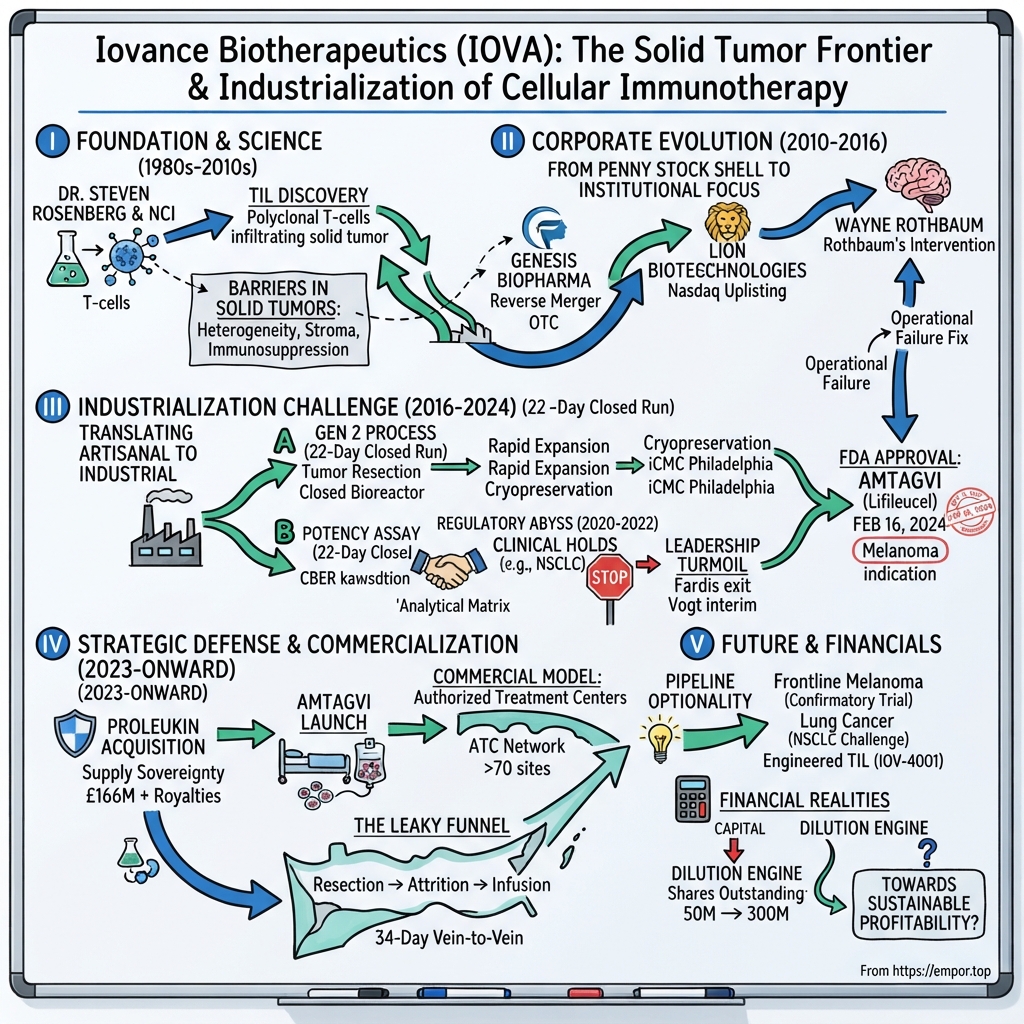
Iovance Biotherapeutics: The Solid Tumor Frontier and the Industrialization of Cellular Immunotherapy
I. Introduction and the Solid Tumor Holy Grail
On the afternoon of February 16, 2024, the U.S. Food and Drug Administration approved the first cellular therapy for patients with unresectable or metastatic melanoma, delivering on an immunotherapy concept oncologists had pursued for roughly four decades.1 The treatment, branded as Amtagvi and known generically as lifileucel, came from Iovance Biotherapeutics—a biotechnology firm that had originated as an over-the-counter penny-stock shell.7
The approval marked a pivotal shift in oncology. Since 2017, cellular immunotherapy had represented one of cancer medicine's most visible frontiers, with synthetic CAR-T therapies such as Kymriah and Yescarta driving dramatic remissions in blood cancers like leukemia and lymphoma. Yet every approved cell therapy targeted hematologic malignancies. Liquid tumors account for only a small fraction of all cancer diagnoses; the overwhelming majority of patients develop solid tumors in the lungs, breasts, colon, or skin. For seven years, the cell therapy revolution remained locked out of the solid tumors responsible for most cancer mortality.
Amtagvi breached that barrier. Rather than relying on synthetic genetic engineering, the therapy employs a patient's own immune cells: extracting tumor-infiltrating lymphocytes directly from resected tumor tissue, expanding them into the billions at a dedicated facility in Philadelphia, and infusing them back into the patient's bloodstream.
The scientific milestone, however, sits beside a far more volatile corporate record. Iovance emerged from an over-the-counter shell via reverse merger, survived an activist boardroom overhaul, saw its shares plummet from above $50 to below $6, lost its chief executive amid an unresolved regulatory dispute over potency assays, spent nearly a quarter-billion dollars acquiring an off-patent cytokine therapy essential to its regimen, and diluted common shareholders sixfold. Understanding how the company navigated those crises to secure a first-in-class approval—and whether it can build a self-sustaining business around it—is the central focus of this analysis.
Initial commercial data reflects both the promise and the operational friction of the model. In 2024, its first partial year on the market, Amtagvi and the acquired Proleukin franchise generated $164.1 million in total product revenue, including approximately $48.7 million from Amtagvi and $25.0 million from Proleukin in the fourth quarter, supported by a network expanding past 70 authorized treatment centers.[^3] While demonstrating clinical adoption, the regimen imposes severe logistical demands: surgical tumor resection, a 34-day manufacturing turnaround, a week of lymphodepleting chemotherapy to condition the patient, and up to six doses of high-dose interleukin-2, a cytokine bearing a boxed warning that often necessitates inpatient intensive-care monitoring.[^12] Against that commercial intake, the company continued to burn hundreds of millions of dollars in operational cash.
This dynamic defines Iovance's core investment thesis: Amtagvi is an authentic therapeutic breakthrough accompanied by an exceptionally demanding logistical footprint. The debate centers on whether the high barrier to entry created by that operational complexity can yield a durable, profitable franchise before capital constraints intervene.
The narrative begins with Steven Rosenberg's foundational work on tumor-infiltrating lymphocytes at the National Cancer Institute, before tracing the corporate reorganizations across Genesis Biopharma and Lion Biotechnologies. It then examines the industrial challenge of condensing a six-to-eight-week academic protocol into a 22-day closed manufacturing run at the Philadelphia Navy Yard, the regulatory impasse from 2020 through 2022 that prompted executive turnover, the defensive acquisition of Proleukin, the ongoing commercial rollout, pipeline expansion, and the financial metrics that will determine whether the industrialization of cell therapy can achieve sustainable profitability.
 Subscribe on LinkedIn
II. The Science: Steven Rosenberg, the NCI, and the Biology of TILs
In the late 1980s, inside a surgical pathology laboratory at the National Cancer Institute in Bethesda, Maryland, Steven Rosenberg and his colleagues tested a biological premise that ran counter to conventional oncology. Researchers took freshly resected fragments of human melanoma, minced them into pieces a few millimeters across, and placed them in culture wells flooded with recombinant interleukin-2. For days, the wells showed little change. Then the culture fluid clouded—not with proliferating cancer cells, but with an expanding population of tumor-infiltrating lymphocytes.
Understanding the significance of that cellular expansion requires examining the fundamental biological barrier that had long stymied solid-tumor drug development.
Why solid tumors are fortresses. Chimeric antigen receptor T-cell (CAR-T) therapies succeeded in hematologic malignancies largely because every malignant B-cell expresses a uniform surface marker: the CD19 protein. By engineering a T-cell receptor to recognize CD19, researchers created a targeted therapy with a single, universal address. Liquid tumors also circulate primarily through the bloodstream and lymphatic system—the exact compartments where immune cells naturally patrol—allowing engineered cells to engage their targets without having to penetrate dense tissue architecture.
Solid tumors present the opposite biological environment across every dimension. Malignant solid lesions are genetically heterogeneous, meaning rarely do all tumor cells express the same antigen profile; selectively killing cells that express a given target simply allows non-expressing variants to multiply. Furthermore, solid tumors are physically encased in extracellular stroma, a dense fibrous matrix that circulating T-cells must actively penetrate. Once inside, the microenvironment is chemically hostile: hypoxic, acidic, and populated by immunosuppressive regulatory T-cells and myeloid-derived suppressor cells that disable cytotoxic immune responses. An engineered T-cell directed against a single antigen faces physical exclusion, antigen escape, and immediate biochemical suppression.
The TIL insight. Rosenberg's approach inverted the therapeutic strategy: rather than engineering a synthetic receptor and introducing foreign cells into the tumor, locate and harvest the immune cells that had already successfully infiltrated it.
In most solid tumors, a subset of the patient's endogenous immune cells has already entered the tumor mass—tumor-infiltrating lymphocytes, or TILs. These cells have already traversed the stromal barrier and recognized the malignancy through its neoantigens—the patient-specific mutated proteins that cannot be predicted by an off-the-shelf therapeutic. Crucially, TILs are naturally polyclonal: they consist of thousands of individual T-cell clones recognizing dozens or hundreds of distinct tumor targets, providing a native defense against antigen heterogeneity. In the untreated patient, however, these lymphocytes are vastly outnumbered, biochemically exhausted, and suppressed by the surrounding tumor microenvironment.
Rosenberg's protocol extracted those lymphocytes, supplied them with interleukin-2—the critical cytokine growth signal they lacked inside the tumor—allowed them to multiply from thousands into billions in culture, and reinfused them into the patient. His research team demonstrated that this method could induce regression of extensive visceral metastases in patients who had exhausted standard therapies, occasionally producing complete, durable remissions. The historical arc of that work, from laboratory discovery to eventual regulatory approval, has been documented extensively in the cancer research literature.2
Yet for decades, commercial translation stalled. The therapy remained confined to a few academic medical centers because the process was bespoke, manual, variable between batches, and clinically hazardous.
The three-legged stool. The therapeutic regimen is not a single drug but three interlocking clinical interventions, where removing any component undermines the entire treatment.
First, lymphodepletion. Before infusion, the patient undergoes roughly a week of non-myeloablative conditioning chemotherapy using cyclophosphamide followed by fludarabine. The objective is not tumor cytoreduction, but the temporary clearance of the patient's existing immune cells. Eliminating endogenous lymphocytes removes regulatory T-cells that would suppress the infused cells and creates a cytokine "sink," allowing homeostatic growth factors such as IL-7 and IL-15 to accumulate unconsumed for the incoming TILs.
Second, the infusion itself: billions of expanded CD4+ and CD8+ T-cells, delivered via a single intravenous infusion over roughly thirty to sixty minutes.
Third, high-dose intravenous interleukin-2—aldesleukin, marketed as Proleukin—administered in up to six doses following infusion. Interleukin-2 provides the survival, activation, and proliferation signals required to keep the transferred cells functional in vivo rather than clearing within days.
The price of the third leg. High-dose interleukin-2 introduces severe systemic toxicity. At therapeutic doses, the cytokine triggers systemic capillary leak syndrome: vascular walls become permeable, fluid extravasates into tissues, blood pressure plummets, and pulmonary edema can develop. Concurrently, patients experience profound cytopenias from conditioning chemotherapy, creating acute vulnerability to severe infections. Consequently, the regimen cannot be administered in community oncology clinics; it mandates inpatient hospitalization with intensive-care hemodynamic monitoring. This toxicity profile underpins the boxed warning on the FDA-approved label, which cites risks of treatment-related mortality, prolonged severe cytopenias, severe infections, and cardiopulmonary and hemorrhagic toxicity.[^12]
A final biological hurdle precedes treatment: manufacturing TILs requires sufficient viable tumor tissue. A patient must present with a resectable lesion measuring at least 1.5 centimeters in diameter in an anatomically accessible location. Patients whose disease manifests solely as diffuse micrometastases or lesions wrapped around critical vascular structures are ineligible before the manufacturing process can begin.
Each biological constraint directly shapes the commercial model. In autologous cell therapy, tumor biology dictates the clinical infrastructure, and infrastructure dictates operating margins. Before Iovance could test whether that model could be industrialized at commercial scale, however, it had to secure the intellectual property and clinical know-how developed at the NCI—from a corporate predecessor that was, at the time, in severe disarray.
III. Corporate Genesis: From Penny-Stock Chaos to Wayne Rothbaum's Intervention
Every corporate origin story carries its foundational myth. Iovance's began not in a research garage, but inside a corporate shell.
The entity that would ultimately commercialize Amtagvi originated as Genesis Biopharma, an enterprise assembled through a reverse merger and traded on the over-the-counter bulletin board—a venue where legitimate microcaps routinely mingled with speculative promotional schemes. In 2011, Genesis executed the defining transaction of its early history: signing a Cooperative Research and Development Agreement with the National Institutes of Health, licensing the TIL technology developed in Steven Rosenberg's laboratory.
That CRADA was the enterprise's primary asset. Beyond the agreement, the business floundered. Chronically undercapitalized and financed through warrant-heavy structures that encumbered its capitalization table, the company generated minimal clinical progress under founder Manish Singh. It held one of the most compelling solid-tumor cell therapy assets in oncology, but possessed virtually no organizational infrastructure to develop it.
In 2013, the company renamed itself Lion Biotechnologies and uplisted to the Nasdaq Global Market—a change in trading venue that did not resolve its underlying operational deficits. A stock listing is not a commercial strategy.
Enter Wayne Rothbaum. By 2015, the company had drawn the interest of Wayne Rothbaum, an investor who operated largely outside the public spotlight. Rothbaum ran Quogue Capital, his private family office, and managed no outside capital—a structural freedom that insulated him from quarterly redemption pressures, investor letters, or the career risk of enduring multi-year operational turnarounds. Rothbaum's reputation in biotechnology had been established through Acerta Pharma, which he co-founded and financed to develop the BTK inhibitor acalabrutinib (later marketed as Calquence), culminating in an acquisition by AstraZeneca valued at up to $4 billion.
Rothbaum's investment thesis on Lion was distinctly operational rather than biological. He did not argue that the science was underappreciated; the NCI's clinical data had been public for years. Rather, he identified that the failure mode was operational. TIL remained, empirically, the only cellular modality that had generated durable complete responses in solid tumors. What had never been constructed was an organization capable of manufacturing those cells reproducibly, at commercial scale, and to regulatory standards. That was not an intractable biological mystery; it was an engineering, manufacturing, and governance challenge that capital and reconstituted leadership could address.
Rothbaum intervened directly: accumulating a stake between the high single digits and low teens, securing a board seat, replacing legacy executives, and orchestrating a recapitalization that backed the company with institutional capital and a focused operating plan.
Maria Fardis. The board's most consequential hire arrived in 2016 with the recruitment of Dr. Maria Fardis as chief executive officer. A chemist by training, Fardis brought extensive drug development experience from Pharmacyclics, where she had worked on the landmark oncology drug ibrutinib, and subsequently served as chief operating officer at Acerta through the AstraZeneca acquisition. Having partnered with Rothbaum during that previous success, she brought operational credibility to the exact clinical and regulatory disciplines Lion lacked.
In 2017, management rebranded the company again: Lion Biotechnologies became Iovance Biotherapeutics, trading under the ticker IOVA. While corporate name changes are often cosmetic, this rebrand was a deliberate exercise in institutional hygiene—an explicit attempt to sever, in the minds of institutional analysts and index funds, any lingering association with its penny-stock origins.
The falsification check on the reboot. The standard market narrative holds that the 2016 overhaul permanently excised the microcap legacy and installed institutional-grade stewardship. An examination of the factual record narrows that claim.
While governance and clinical leadership improved substantially, the legacy burdens did not vanish. The foundational NIH CRADA carried trailing royalty obligations and strict intellectual property boundaries; the core technology arrived encumbered, imposing enduring claims against the franchise's future operating margins. Nor did the capital structure become streamlined. Financing corporate expansion through recurring secondary equity offerings did not end with the rebrand; it accelerated, compounding per-share dilution over the subsequent eight years. The governance reboot established operational competence, but it did not deliver an unencumbered balance sheet—a distinction whose conflation distorted investor expectations for years.
What the restructured management team did secure was the mandate to confront the central industrial challenge: translating an artisanal academic protocol into a standardized factory process.
IV. Industrializing the Artisan: Building the "Gen 2" Process and iCMC
A foundational reality explains much of Iovance's enterprise valuation and historical capital consumption: in autologous cell therapy, the product is the process.
There is no discrete chemical compound or recombinant protein to patent that fully captures the franchise's value. Because each patient's cellular harvest is biologically unique, the proprietary asset—and the intellectual property that health authorities actually license—is the manufacturing procedure itself: the precise sequence of enzymatic digestion, proprietary media formulations, bioreactor conditions, expansion kinetics, cryopreservation, and analytical release testing that reliably transforms a resected tumor fragment into an infusible drug product. Iovance committed roughly a decade and hundreds of millions of dollars to developing that standardized regimen, creating an operational moat rooted in proprietary process engineering.
Gen 1 versus Gen 2. The original academic protocol developed by Rosenberg's laboratory—retrospectively designated Generation 1, or Gen 1—required six to eight weeks. It relied on open, manual flask systems: technicians pipetted culture media by hand, monitored individual growth curves, and introduced irradiated feeder cells subject to significant lot-to-lot biological variability. This labor-intensive setup carried high contamination risks and a substantial rate of batch failures. Furthermore, because Gen 1 produced a fresh, unfrozen cell suspension, the entire clinical sequence demanded rigid real-time synchronization: the moment cells finished expanding, the patient had to complete lymphodepletion in precise alignment with that schedule.
While manageable for an academic center treating a select group of clinical-trial subjects, that artisanal model could not support commercial scale. In aggressive metastatic disease, a two-month manufacturing lag created severe clinical attrition; many patients either suffered rapid disease progression that rendered them medically ineligible or died before their cellular infusions were complete.
The Gen 2 platform compressed this timeline into a 22-day closed process: standardized enzymatic digestion of the tumor, culture expansion in closed bioreactors to eliminate manual handling and contamination risk, controlled interleukin-2-driven rapid expansion, and, crucially, cryopreservation of the finished cell product.
Why freezing changes everything. Cryopreservation transformed what had been an unscalable academic procedure into an industrial supply chain. Storing the expanded cells at cryogenic temperatures allows comprehensive quality-control release testing to finish before the product ever leaves the facility, ensuring the batch meets rigorous viability and potency specifications prior to administration. The frozen cells can be transported globally in liquid-nitrogen dewars and stored indefinitely on-site at treatment centers. Most importantly, it decouples the manufacturing timeline from the patient's clinical status. The therapeutic dose rests in a hospital freezer until the patient completes lymphodepletion, demonstrates stable organ function, and secures an inpatient intensive-care bed. Where fresh manufacturing forced clinical teams to bend to the laboratory's schedule, cryopreservation turned cell therapy into storable inventory.
The steel in the ground. Management's second pivotal decision involved manufacturing infrastructure. Early-stage biotechnology companies typically outsource production to contract development and manufacturing organizations such as Lonza, WuXi AppTec, or Catalent to conserve capital. Iovance chose instead to vertically integrate, committing more than $150 million to construct the Iovance Cell Manufacturing Center—a 136,000-square-foot facility at the Philadelphia Navy Yard.
That decision carried an onerous financial trade-off. Constructing an internal manufacturing plant required absorbing substantial fixed overhead, depreciation, and carrying costs years before generating a dollar of commercial revenue, transferring cash directly from equity issuances into physical infrastructure. In exchange, Iovance acquired operational sovereignty: proprietary manufacturing know-how remained protected from third-party contract manufacturers that served industry peers, production slots were shielded from external scheduling conflicts, and long-term cost of goods could be directly managed rather than leased at contractor margins.
Whether that strategic gamble was justified depended entirely on manufacturing throughput. A 136,000-square-foot facility amortized across a few hundred patients annually generates punishing per-patient unit costs; amortized across thousands of patients, the fixed overhead yields the gross margins characteristic of high-margin biopharmaceuticals rather than specialized hospital services. Iovance staked its enterprise on eventually reaching that higher-volume threshold, though through the 2024 fiscal year, commercial volume remained in the lower utilization band.
The clinical proof. Running in parallel with the facility buildout was the pivotal clinical trial designed to validate both the platform and the capital expenditure: C-144-01, evaluating lifileucel in patients with advanced metastatic melanoma who had progressed following checkpoint inhibitor therapy.
The trial enrolled a patient cohort with virtually no remaining treatment options. Every participant had failed prior anti-PD-1 or anti-PD-L1 antibody therapy, such as pembrolizumab or nivolumab; those harboring BRAF V600 mutations had typically also progressed on targeted BRAF and MEK inhibitors. For patients at this stage of disease, historical median overall survival hovered between six and seven months, with no established standard of care capable of producing durable disease control.
In this heavily pretreated population, lifileucel achieved an objective response rate of roughly 31%, characterized by exceptional durability. Median duration of response was not reached during initial follow-up intervals, and a subset of responders maintained complete remissions lasting years. In oncology, a 31% overall response rate is modest in isolation, but achieving long-lasting, deep remissions in patients with a six-month life expectancy represented a landmark clinical signal. That emphasis on depth and durability over broad but transient response established the clinical rationale for TIL therapy, ultimately leading the FDA to grant accelerated approval based on overall response rate and durability of response.1
The hype peak. Equity markets swiftly capitalized on the clinical results. By late 2020, shares of Iovance traded above $50, elevating the company's valuation to several billion dollars despite generating zero commercial revenue. Investors priced the equity on the presumption that a first-in-class solid-tumor cell therapy would secure immediate regulatory clearance and rapidly expand across other solid oncology indications.
The market had fully priced the biological breakthrough. It had not accounted for the regulatory gauntlet ahead.
V. The Regulatory Abyss: Potency Assays, Clinical Holds, and Leadership Turmoil
The crisis that nearly derailed Iovance did not stem from a failed clinical trial, a safety disaster, or competitive displacement. Instead, it centered on an analytical chemistry problem that initially resembled a technicality.
The potency assay problem. Under U.S. biologics regulations (21 CFR 610.10), every licensed biologic must possess a validated potency assay: a quantitative laboratory test demonstrating that each manufactured lot exhibits its intended biological activity, and that commercial batches match the clinical lots that generated pivotal trial data. The regulatory logic was straightforward: before commercial distribution of an expensive, high-risk biological therapy, regulators require verifiable metrics confirming that each batch is biologically active.
Designing that test for lifileucel, however, exposed a fundamental mismatch between biologics regulation and autologous cell therapy. The product comprises a polyclonal population of billions of T-cells harvested from an individual patient's tumor, targeting an uncharacterized and patient-specific constellation of somatic mutations. There is no uniform receptor to quantify and no universal target antigen against which to test binding affinity; by design, the active biological ingredient differs in every single patient lot. While a small-molecule potency assay measures chemical purity and concentration, and a CAR-T assay can quantify transgene expression and target-cell lysis against a defined cell line, an autologous TIL batch offered no single biochemical marker to measure in vitro. In TIL therapy, the biological reality was that potency could only be definitively established inside the patient's body.
The FDA's Center for Biologics Evaluation and Research (CBER) rejected that ambiguity. Regulators mandated what the industry termed an assay matrix—a multi-parameter panel of complementary laboratory tests that collectively characterized biological mechanism and viability, paired with analytical data confirming comparability between commercial-scale batches and earlier clinical material.
The consequence was a multi-year operational stall. In October 2020, May 2021, and again in 2022, Iovance disclosed that regulatory feedback required additional assay development, matrix validation, or comparability studies. The planned biologics license application slipped by roughly three years—three years of operational cash burn, continuous equity dilution, and commercial infrastructure being repeatedly assembled and recalibrated against an elusive target date.
May 18, 2021. The organizational breaking point arrived in May 2021, when Iovance announced another regulatory postponement requiring further matrix development with the FDA. The following morning, Maria Fardis resigned.[^7]
The market reaction was immediate: the stock dropped more than 40% in a single trading session, wiping out billions of dollars in market value. The abruptness of the departure signaled to institutional investors that the board had lost confidence in the existing regulatory strategy, that the potency impasse was more severe than disclosed on prior earnings calls, or both.
The accidental CEO. Into the chief executive role stepped Dr. Frederick Vogt, initially named interim president and CEO. Vogt had served as the company's general counsel since 2016. His dual background was uncommon for a biopharmaceutical chief executive: holding both a doctorate in chemistry and a law degree, his training was oriented toward intellectual property law and regulatory negotiation rather than commercial operations.
In hindsight, the appointment aligned with the company's binding constraint. In 2021, Iovance did not primarily require commercial marketing expertise; it required a rigorous technical and legal negotiation with CBER led by someone who understood both the biological chemistry and the regulatory framework. Vogt assumed leadership of an unsettled organization, an exhausted shareholder base, and a strained relationship with the regulatory agency holding the key to the company's commercial survival.
The second crisis. Iovance eventually resolved the assay matrix requirements, submitted its application, and secured the landmark melanoma approval. Yet just as that regulatory milestone neared, the broader clinical pipeline suffered a major disruption. In the Phase 2 IOV-LUN-202 trial evaluating lifileucel in non-small cell lung cancer, a patient died from an adverse event associated with the lymphodepletion conditioning regimen, prompting the FDA to place the trial on clinical hold in late December 2023.
The market treated the hold as an existential question rather than an isolated clinical adverse event. The investment thesis for TIL therapy depended on expanding beyond melanoma into far larger solid-tumor indications, notably lung cancer. If the lymphodepletion conditioning regimen—the non-negotiable first component of the three-part therapeutic protocol—proved too toxic for the older, medically fragile, pulmonary-compromised patient population typical of lung cancer, Iovance risked being confined to advanced melanoma rather than establishing a broad solid-tumor platform.
The FDA lifted the clinical hold in March 2024 after Iovance implemented protocol modifications and intensified safety monitoring.4 While clinical trial enrollment resumed, the episode underscored the physiological boundaries of the regimen and consumed valuable developmental runway in a competitive oncology landscape.
Falsification: what management said versus what happened. During the 2019 and 2020 market peak, management consistently characterized commercial readiness as imminent and the regulatory pathway as well-defined. The subsequent operational record disconfirmed those claims on three fronts.
First, leadership repeatedly underestimated the analytical rigor CBER would demand for a first-in-class autologous biologic. Regulatory hurdles framed on quarterly conference calls as routine logistical steps expanded into a three-year impasse. Given that potency regulations under 21 CFR 610.10 were well-established, heightened regulatory scrutiny for an unprecedented cellular product was an operational risk that management failed to anticipate.
Second, the cost to equity holders was severe: between late 2020 and 2023, Iovance's share price collapsed from above $50 to below $6—a drawdown exceeding 85%, driven by execution delays rather than clinical efficacy failures.
Third, the operational delay directly compounded shareholder dilution. Because each delayed quarter required ongoing operational cash burn funded through secondary equity issuances, investors who owned the equity during the scientific breakthroughs in 2020 held a substantially diluted economic interest by the time the therapy reached approval in 2024.
The dynamic demonstrated a recurring principle in capital-intensive biotechnology: regulatory delay does not merely postpone commercial value; it permanently dilutes existing shareholders by transferring equity ownership to late-stage financiers. That reality led directly to the second defining capital allocation decision of the Vogt era—a defensive transaction designed not to generate speculative upside, but to protect the core franchise from strategic vulnerability.
VI. Capital Allocation and Strategic Defense: The Proleukin Acquisition and the Dilution Engine
In late 2022, Iovance faced an acute capital allocation dilemma. The company was burning more than $350 million annually, the biologics license application had yet to secure approval, and cash reserves were a matter of persistent market concern. Yet management proposed committing roughly a quarter of a billion dollars to acquire a recombinant protein first approved in 1992—an off-patent drug with no organic sales growth, burdened by a severe toxicity profile that the broader immuno-oncology field was actively trying to engineer out of existence.
On a conventional biopharmaceutical acquisition screen, the transaction appeared indefensible. Operationally, however, it was practically mandatory.
The deal. In January 2023, Iovance agreed to acquire worldwide rights to Proleukin (aldesleukin) from Clinigen, completing the transaction in May 2023.[^5] The consideration included an upfront cash payment of £166.7 million—approximately $207.2 million at prevailing exchange rates—plus £2.4 million for existing inventory, a £41.7 million regulatory milestone payable upon lifileucel's first melanoma approval, and ongoing double-digit royalties on global net sales. That regulatory milestone was triggered upon FDA approval in February 2024.
Why it made sense anyway. The strategic logic rested on three arguments, in descending order of operational importance.
The primary justification was supply-chain sovereignty—the factor that ultimately warranted the price. Clinigen was the sole global supplier of Proleukin. Aldesleukin is not an interchangeable excipient in the Amtagvi regimen; it is an indispensable component of the three-part protocol, explicitly designated in regulatory filings and mandated for every treated patient. A quality failure, an adverse facility inspection, or an unexpected production halt at a third-party manufacturer would have halted not only commercial distribution but every active clinical trial. For a business whose entire enterprise value hinged on a single regulatory asset, leaving that vital supply line in the hands of an unhedged counterparty represented an unacceptable point of failure.
This vulnerability dictated the transaction's pricing dynamics. Clinigen occupied what commercial negotiators describe as a hostage position: without guaranteed aldesleukin supplies and the proprietary manufacturing data referenced in the BLA, lifileucel could not secure regulatory clearance. Iovance did not pay a growth premium; it paid a defensive hostage premium. In evaluating the transaction, the proper benchmark was not what a generic cytokine franchise was worth on a discounted cash flow basis, but the total enterprise value of the Amtagvi program multiplied by the probability of a catastrophic third-party supply disruption. Under that calculus, spending roughly $250 million functioned as essential insurance.
The second rationale was margin capture. Because every Amtagvi patient receives up to six doses of interleukin-2, owning the drug converted what would have been a significant cost-of-goods expense into an internal revenue stream. That contribution was substantial: Proleukin generated $25.0 million in revenue during the fourth quarter of 2024 alone.[^3] However, that financial contribution carried a critical operational caveat. Proleukin revenue is recognized upon wholesale shipment rather than at patient infusion, and the figure includes sales for non-melanoma indications outside the Amtagvi regimen. Consequently, the reported intake reflected channel stocking rather than direct patient volume. Analysts who treated quarterly Proleukin revenue as a one-to-one proxy for Amtagvi patient throughput were reading a noisy commercial signal.
The third rationale—securing intellectual property to develop improved, lower-toxicity interleukin-2 variants—warranted far more skepticism. Management contended that owning aldesleukin provided a proprietary foundation to engineer pegylated or targeted cytokine variants designed to eliminate capillary-leak toxicity. Yet that thesis contained an unresolved strategic contradiction: if next-generation cytokine engineering succeeded, it would render the newly acquired 1992 asset obsolete, effectively cannibalizing the purchase price; if it failed, the franchise remained tethered to a toxic cytokine whose severe adverse effects represented the primary clinical bottleneck to broader commercial adoption. While the defensive rationale for the acquisition stood firmly on its own, the offensive pipeline thesis remained unconvincing.
The dilution engine. Running beneath every strategic milestone in the company's history was an expanding share count—a structural dynamic essential to evaluating Iovance as an investment.
Common shares outstanding climbed from roughly 50 million in 2016 to more than 300 million by the end of 2024—a sixfold expansion over the period3 during which the company advanced from pre-clinical obscurity to commercial approval. The per-share arithmetic was unforgiving: an investor who saw the company's overall enterprise value multiply fivefold across that span still experienced negative per-share returns due to relentless equity dilution.
The financing mechanics followed a familiar biotechnology playbook. Immediately following the February 2024 approval—as the stock re-rated on the regulatory announcement—management executed an underwritten public offering of 23 million shares at $9.15, raising $211.4 million in gross proceeds.5 Issuing equity into positive news is standard practice for capital-intensive biotechnology firms, allowing leadership to fortify balance sheets from a position of relative market strength rather than distress. Alongside periodic underwritten offerings, Iovance maintained at-the-market facilities—programmatic share sales that continuously dripped equity into the open market—to preserve liquidity buffers against an operating cash burn that exceeded $350 million in 2024.3
For long-term shareholders, this structural expansion represents the central financial hurdle. Commercializing Amtagvi was a historic scientific breakthrough, but clinical adoption alone is not sufficient. To deliver lasting value to equity holders, the company's operational cash flow must ultimately outpace share dilution—a milestone the business had not yet approached in its first decade of development.
VII. Amtagvi's Historic Approval and the Commercial Battlefield
Approval day was the easy part.
The FDA's accelerated approval on February 16, 2024, covered adults with unresectable or metastatic melanoma previously treated with a PD-1 blocking antibody and, for BRAF V600-mutant patients, a BRAF inhibitor with or without a MEK inhibitor.1 Accelerated approval meant the agency accepted overall response rate and durability as surrogate endpoints reasonably likely to predict clinical benefit. That regulatory pathway carried an explicit condition: the company was required to conduct a confirmatory randomized trial to verify clinical benefit, without which the agency could withdraw commercial authorization.
The product label itself documented the operational friction awaiting commercial launch. The boxed warning covered treatment-related mortality, prolonged severe cytopenias, severe infection, and cardiopulmonary and hemorrhagic toxicity.[^12] In clinical practice, each of those warnings translated directly into institutional overhead: a dedicated inpatient hospital bed, a trained intensivist, on-site blood bank support, and specialized clinical monitoring protocols.
Unit economics. Management established a wholesale acquisition cost of $515,000 for the one-time infusion, with Proleukin adding roughly twenty to thirty thousand dollars per treatment cycle.
That headline figure, however, was less informative than it appeared, for two structural reasons.
First, reimbursement mechanics governed hospital adoption. As an inpatient hospital therapy, Amtagvi was reimbursed primarily through Medicare's Diagnosis-Related Group system—supported by New Technology Add-on Payments—alongside negotiated commercial contracts. Because the hospital, rather than the patient, purchased the therapy upfront, the medical center bore substantial working-capital risk: financing a half-million-dollar inventory outlay before collecting from insurers. For many institutional balance sheets, that cash-flow float created a meaningful operational bottleneck rather than an administrative routine.
Second, and more decisive for equity valuation, manufacturing costs were dominated by fixed facility overhead rather than variable raw materials. With the 136,000-square-foot Philadelphia plant carrying substantial baseline carrying costs, gross margin was almost entirely a function of volume. An autologous infusion that carried punishing unit costs at an annual run-rate of several hundred patients yielded attractive biopharmaceutical margins at several thousand. Consequently, manufacturing throughput—rather than list price—represented the primary economic lever governing the franchise.
The authorized treatment center machine. Cellular immunotherapy cannot be distributed through conventional pharmaceutical channels; commercialization required constructing dedicated institutional infrastructure.
Iovance's commercial model operated through authorized treatment centers qualified to execute the complete clinical sequence. The network scaled from an initial cohort of roughly 30 centers to over 70 authorized centers across 32 states by the end of 2024,[^3] establishing a clinical footprint that management asserted placed the vast majority of eligible U.S. patients within accessible travel distance of an active facility.
Onboarding an individual center typically required three to six months because an authorized site functioned as an integrated clinical program rather than a transactional customer. The process required coordinating and training four separate hospital divisions: surgical oncology to harvest tumor tissue to specification; the cellular therapy laboratory to manage cryogenic receipt, storage, and thawing; medical oncology to oversee conditioning chemotherapy and cell infusion; and critical care to manage high-dose interleukin-2 toxicity. Alongside clinical readiness, institutional administration required formal Pharmacy and Therapeutics committee authorization and financial approval to carry a half-million-dollar inventory item on the hospital balance sheet.
That institutional friction constituted Iovance's most durable competitive moat: onboarding costs were absorbed by the hospital rather than the manufacturer and remained largely non-transferable. A medical center that committed six months to constructing an Amtagvi program made a substantial investment in Iovance's proprietary ordering portal, chain-of-custody protocols, and manufacturing specifications. A prospective competitor developing an alternative TIL therapy could not inherit that institutional setup; it would need to convince each hospital system to replicate the entire onboarding process.
The 34-day gauntlet. The complete logistical loop from surgical resection to patient infusion—the vein-to-vein sequence—averaged approximately 34 days.
At the authorized center, a surgical oncologist excised a tumor lesion measuring at least 1.5 centimeters in diameter, packaging the specimen for immediate cold-chain courier transport to Philadelphia. At the Navy Yard facility, the 22-day closed manufacturing run took place: cellular isolation, rapid expansion, cryopreservation, and analytical release testing. The validated therapeutic dose returned to the hospital in a specialized liquid-nitrogen shipper. Following roughly a week of inpatient conditioning chemotherapy with cyclophosphamide and fludarabine, clinical teams administered the cell infusion, followed by up to six doses of high-dose interleukin-2 under continuous inpatient monitoring.
The leaky funnel. This operational sequence exposed the commercial model to a harsh biological reality: patient attrition.
Published clinical data across cellular therapy programs indicated that a meaningful proportion of advanced cancer patients—commonly estimated between 15% and 25%—who underwent tumor resection never received their intended cellular infusion. The underlying mechanisms were clinical rather than operational. Over a 34-day manufacturing window, patients with aggressive metastatic disease frequently experienced rapid disease progression, suffered organ deterioration that disqualified them from high-dose interleukin-2, or died before infusion; in a smaller fraction of cases, an individual batch failed analytical release testing.
The financial consequences were immediate. Iovance recognized Amtagvi revenue solely upon successful patient infusion. Every resected patient who exited the funnel prematurely consumed manufacturing capacity, specialized courier logistics, and quality-control testing while generating zero recognized revenue. Operational attrition directly depressed realized gross margins and diminished facility utilization.
The drop-off dynamic also affected physician behavior. A community oncologist who referred several patients and observed candidates deteriorate before reaching infusion faced strong disincentives to refer subsequent cases. Funnel conversion was therefore not merely an internal efficiency metric; it served as a primary governor of referral growth.
These operational realities explained why the commercial ramp in the first full years following approval proved more challenging than initial market projections suggested—and why the ultimate valuation of the business depended on demonstrating a viable second act beyond salvage melanoma.
VIII. Pipeline Optionality Versus Biological Reality
Every platform biotechnology company tells a version of the same story: the initial regulatory approval is merely a beachhead, and the primary commercial prize lies in the broader pipeline behind it. While that narrative occasionally holds true, rigorous valuation requires distinguishing genuine clinical optionality from promotional corporate projections.
Post-PD-1 melanoma provided Iovance with an authentic commercial monopoly in a refractory patient population that had exhausted standard care. Yet that salvage market remains inherently constrained. Assessing the company's enterprise value ultimately depends on what the remainder of the pipeline can realistically deliver.
Frontline melanoma: TIL-Vance-301. The company's most consequential clinical study is its confirmatory trial. The Phase 3 TIL-Vance-301 trial evaluates Amtagvi in combination with pembrolizumab against pembrolizumab monotherapy in treatment-naïve advanced melanoma. The study serves two critical functions: it provides the randomized clinical data required by the FDA to convert accelerated approval into full regulatory clearance, and it offers the vehicle to advance Amtagvi from salvage therapy into the frontline setting.
The commercial arithmetic appears compelling. The annual post-PD-1 salvage population in the United States comprises roughly five to seven thousand patients. The frontline advanced melanoma population is roughly two to three times that size. Advancing into first-line treatment would effectively triple the addressable patient base. Crucially, frontline patients are also medically healthier, presenting with greater organ reserve, better tolerance for interleukin-2 toxicity, and lower historical attrition rates through the 34-day manufacturing window.
Yet the commercial hurdle is behavioral, and it is formidable. Unlike post-PD-1 disease, frontline advanced melanoma is not an underserved therapeutic vacuum. Established checkpoint doublets—such as nivolumab paired with relatlimab, or nivolumab with ipilimumab—already generate substantial, durable responses through routine outpatient infusions that require no surgical resections, no conditioning chemotherapy, and no intensive-care admissions. Persuading community and academic oncologists to route newly diagnosed patients into surgical tumor harvesting, a month-long manufacturing wait, lymphodepleting chemotherapy, and high-dose interleukin-2 demands a clinical efficacy benefit large enough to overcome an immense operational gap. A modest, statistically significant improvement in progression-free survival will likely prove insufficient; shifting frontline clinical practice against well-tolerated existing standards historically requires demonstrating an unambiguous overall survival advantage.
Lung cancer: prize or mirage? Non-small cell lung cancer represents the clinical indication that could fundamentally transform the enterprise—an oncology market roughly ten times larger than melanoma and the leading cause of cancer mortality worldwide.
However, the underlying biology presents steep headwinds. Melanoma is uniquely suited to tumor-infiltrating lymphocyte therapy because it exhibits an exceptionally high tumor mutational burden, where years of ultraviolet damage generate an abundance of recognizable neoantigens, making it historically the most immune-responsive solid tumor. In contrast, most epithelial carcinomas feature lower mutational burdens, sparser baseline lymphocyte infiltration, and denser, more immunosuppressive stroma. Sparser immune infiltration yields fewer viable lymphocytes capable of industrial expansion.
Patient physiology compounds the difficulty. Resecting lung lesions involves substantially higher surgical risk than harvesting accessible cutaneous or lymph node metastases. Furthermore, patients with non-small cell lung cancer are typically older and often present with significant smoking-related cardiopulmonary compromise—making them the population least equipped to tolerate a conditioning and cytokine regimen characterized by capillary leak syndrome and pulmonary edema. The December 2023 patient fatality in the IOV-LUN-202 trial was not an anomalous operational setback; it reflected the direct, predictable intersection of an intensive cellular regimen with a clinically fragile patient cohort.4
Consequently, non-small cell lung cancer represents a speculative, high-variance scientific endeavor whose commercial probability warrants heavy discounting, rather than an automatic market multiplier to attach to the melanoma business.
Cervical, endometrial, and engineered TIL. Beyond melanoma and lung cancer, LN-145 demonstrated encouraging Phase 2 activity in cervical cancer, but commercial dynamics evolved rapidly around it. The regulatory approval of antibody-drug conjugates such as tisotumab vedotin (Tivdak) and the integration of pembrolizumab into frontline chemotherapy regimens reshaped standard care in advanced cervical disease—treatments administered without inpatient hospitalization or surgical resection. Demonstrating clinical activity in single-arm trials does not ensure commercial adoption against less disruptive outpatient therapies.
The company's most scientifically intriguing pipeline candidate is IOV-4001, a genetically modified TIL product utilizing TALEN gene editing to knock out the PD-1 gene directly within harvested lymphocytes. The mechanistic rationale is elegant: rather than administering systemic checkpoint inhibitors to prevent tumors from inactivating infused immune cells, researchers disable the inhibitory receptor within the therapeutic cells before infusion. If successful, the approach could streamline the overall regimen and potentially deepen clinical responses. However, the program remains in early clinical development, years away from commercialization, and functions as long-dated scientific optionality rather than a near-term revenue driver.
Evaluated as a whole, the pipeline presents a stark hierarchy: one confirmatory trial that is structurally essential to preserving and expanding the core melanoma business, alongside a series of broader oncology programs where human biology and clinical tolerability, rather than operational execution, represent the binding constraints. The company's near-term trajectory rests predominantly on commercial execution within the therapeutic franchise it already holds—directing attention squarely toward the leadership and governance responsible for managing it.
IX. Management, Governance, and Credibility Under the Microscope
A peculiar governance anomaly sits at the center of Iovance, revealing more about the enterprise than any strategic slide presentation.
Frederick Vogt was appointed interim president and chief executive officer in May 2021. He proceeded to lead the company for years—negotiating the resolution of the potency assay impasse with the FDA's Center for Biologics Evaluation and Research, completing and defending the biologics license application, executing the Proleukin acquisition, building a commercial organization from scratch, launching the first solid-tumor cell therapy in history, and completing multiple capital raises—all while the board conducted what was, by any conventional corporate standard, an exceptionally unhurried executive search.
Why keep the interim tag? Because the board disclosed no formal rationale, evaluating the arrangement requires weighing competing explanations rather than asserting motive. One possibility was board indecision or the difficulty of recruiting an outside chief executive willing to assume control of a company mired in regulatory uncertainty. A second was that the provisional title signaled strategic optionality: an enterprise positioning itself for an eventual buyout has little incentive to recruit a permanent chief executive. A third, more pragmatic explanation was that an interim designation preserved board flexibility at minimal cost while navigating a protracted operational crisis.
Whatever the original intent, the operational effect was unambiguous. An open-ended interim title creates governance friction: it preserves optionality for directors, but signals provisional leadership to prospective employees, commercial partners, and hospital administrators at the exact moment a complex commercial launch demands institutional certainty.
Compensation. The board's approach was reflected in the company's 2024 proxy filing.6 Vogt's total compensation for the year reached approximately $10.95 million, with roughly $9.97 million awarded in stock grants tied directly to the regulatory approval milestone. While heavily compensating an executive for achieving the defining binary outcome of the enterprise was defensible on its face, it highlighted the structural contradiction running throughout the company's history. Milestone-driven equity grants awarded upon approval represented another claim on the same share count that had already diluted common shareholders sixfold. Although say-on-pay proposals secured shareholder approval, proxy advisory firms routinely scrutinize rapid share expansion, and funding corporate operations through equity while granting sizable equity packages to executive leadership inevitably invited skepticism.
The shadow shareholder. Wayne Rothbaum's enduring presence as both a director and substantial shareholder remained an atypical feature for a commercial-stage biotechnology firm. His economic alignment was tangible: his position represented personal capital rather than fee-collecting institutional funds, and he had repeatedly invested in follow-on equity offerings rather than allow his stake to be diluted passively.
Yet the corporate governance critique of that arrangement is worth articulating. A dominant, long-tenured director who was instrumental in handpicking executive leadership provides strategic stability, but also introduces entrenchment risk. The same steadfast conviction that prevents a board from selling assets prematurely during a market trough can also deter directors from refreshing a leadership structure that has outlived its utility, or from executing a truly independent chief executive search. Concentrated insider ownership serves as a stabilizing asset when the underlying strategy is working, but becomes an obstacle when course correction is required.
Credibility, scored over time. An objective appraisal of management credibility requires dividing the operational record into two distinct phases.
The missteps from 2020 through 2022 were substantial. Management projected regulatory confidence it could not substantiate, repeatedly portrayed potency assay comparability on earnings calls as a manageable technical workstream until delays became undeniable, and failed to prepare equity markets for a three-year regulatory detour. The abrupt departure of the chief executive in 2021—occurring with no formal succession plan in place and necessitating the immediate appointment of the general counsel as interim head—indicated a board reacting to external crises rather than anticipating them.
Conversely, the operational execution across 2023 and 2024 was tangible and documented. Leadership resolved the regulatory deadlock with CBER and secured commercial approval. The company completed construction and validation of the iCMC facility, negotiated and integrated the Proleukin acquisition under tight capital constraints, achieved its target network of authorized treatment centers, and delivered full-year 2024 product revenue of $164.1 million, landing directly within its stated guidance range of $160 million to $165 million—the first time in corporate history that management established a commercial target and hit it.[^3]
That achievement carried analytical weight because it provided the first verifiable evidence of forecasting discipline. Management's messaging on the February 2025 earnings call reflected that operational shift, pivoting from defensive regulatory explanations toward operational metrics: cash burn management, patient throughput across authorized centers, and international regulatory submissions with the European Medicines Agency, Health Canada, the U.K. Medicines and Healthcare products Regulatory Agency, and Swissmedic.[^3]
Yet a single year of meeting financial targets offered a narrow foundation upon which to declare a permanent shift in forecasting culture, and subsequent operational realities quickly tested that thesis. Through 2025, the commercial ramp proved significantly more demanding than initial projections suggested, forcing management to lower annual guidance and restructure the company's cost base as spending was realigned with slower-than-anticipated infusion rates.[^13] For institutional investors, that trajectory—meeting an initial commercial target, followed by missing a more ambitious second-year projection—proved highly instructive. It suggested that the primary forecasting challenge was not management veracity, but the inherent difficulty of predicting commercial throughput for an autologous cellular therapy whose funnel remains governed by hospital bed capacity, rigorous conditioning protocols, and patient survival across a 34-day manufacturing window.
The appropriate assessment of leadership is therefore neither the outright skepticism warranted during the 2021 regulatory stall nor the unreserved praise voiced around the 2024 approval. Rather, the record reveals a capable operational team that demonstrated technical and regulatory competence under duress, but had yet to establish that it could reliably forecast an autologous commercial business.
X. Strategic Frameworks: Helmer's 7 Powers and Porter's 5 Forces
Evaluating the durability of Iovance's commercial business requires examining a fundamental structural question: if Amtagvi succeeds commercially, what prevents a competitor from capturing the market?
Helmer's 7 Powers.
Process Power — strong, and the primary moat. This represents the structural advantage Iovance actually possesses. The Gen 2 protocol and the Philadelphia manufacturing facility embody roughly a decade of accumulated, tacit operational knowledge in culturing, cryopreserving, and releasing autologous polyclonal T-cells at commercial scale. That know-how is inherently difficult to codify, harder to replicate, and validated against exacting regulatory release standards. The clearest validation comes from competitor attrition: Instil Bio, the best-funded pure-play rival in unmodified TIL, discontinued development of its lead program ITIL-168 following manufacturing setbacks and restructured dramatically.[^10] A well-capitalized competitor pursuing an equivalent biological premise failed at the precise operational step Iovance solved. Process power is only credible when well-resourced peers attempt to replicate it and fail.
Cornered Resource — moderate. The foundational NIH CRADA position, worldwide rights to aldesleukin, and the CBER-validated potency assay matrix together constitute assets a new entrant cannot simply purchase. Yet each carries clear boundaries: the CRADA imposes trailing obligations rather than granting an unencumbered exclusive, aldesleukin is an off-patent molecule, and the analytical assay framework is replicable in principle by any competitor willing to commit the necessary years and capital.
Switching Costs — strong, and under-appreciated. Because individual medical centers absorb the substantial administrative, clinical, and laboratory onboarding costs internally, those investments remain program-specific and non-transferable. Once a treatment center embeds Iovance's ordering protocols and chain-of-custody procedures into its institutional workflow, replacing that infrastructure creates significant institutional resistance, making switching costs one of the company's most durable medium-term defenses.
Scale Economies — moderate, and entirely prospective. Fixed-cost absorption at the Philadelphia facility represents the economic difference between a specialized hospital service and a high-margin biopharmaceutical business. While that operational leverage is grounded in real manufacturing economics, it remains contingent on reaching production volumes the company has yet to demonstrate. An economic advantage that materializes only above an unreached throughput threshold functions as an operational plan rather than an existing moat.
Counter-Positioning — absent. Iovance does not employ a business model that incumbent pharmaceutical companies are structurally prevented from adopting out of fear of cannibalization. Large oncology firms such as Merck or Bristol Myers Squibb could absorb a viable solid-tumor cell therapy without threatening their core revenue streams.
Network Economies — absent. Infusing an additional patient at one authorized treatment center confers no direct therapeutic or economic utility on a patient treated at another. While minor institutional learning effects may refine internal protocols over time, the model exhibits none of the self-reinforcing dynamics of a true network.
Branding — emerging at best. Amtagvi defined a therapeutic category, generating meaningful early awareness among thoracic and surgical oncologists. Yet oncology brand loyalty ultimately aligns with survival curves rather than trade names; a competing therapy demonstrating superior progression-free or overall survival would rapidly overcome initial brand recognition.
Porter's 5 Forces.
Buyer power — high. The direct purchasers are hospital systems billing Medicare and commercial insurers. Reimbursement frameworks under inpatient Medicare Severity Diagnosis-Related Groups, paired with add-on payment mechanisms, effectively dictate realizable pricing, while medical centers bear considerable working-capital strain financing half-million-dollar inventory outlays upfront. Neither commercial payers nor hospital balance sheets are price-insensitive.
Supplier power — deliberately neutralized. Prior to 2023, supplier leverage represented the acute vulnerability in the business model, concentrated entirely in a single source for aldesleukin. Management committed roughly a quarter of a billion dollars to acquire Proleukin specifically to extinguish that dependency, transforming what had been a severe operational bottleneck into an internal asset.
Threat of new entrants — low. The convergence of high capital expenditure, specialized manufacturing facilities, and multi-year regulatory assay development creates a formidable barrier to entry, as evidenced by the attrition of earlier venture-backed competitors.
Threat of substitutes — high and rising. Substitution, rather than direct head-to-head competition, represents the primary existential risk to the franchise. The principal competitive threat to Amtagvi is not another autologous TIL product; it is any oncologic modality that matches its clinical efficacy without requiring surgical resection, a month-long manufacturing turnaround, conditioning chemotherapy, and intensive-care monitoring. T-cell engaging bispecific antibodies are supplied in off-the-shelf vials; individualized neoantigen mRNA regimens, such as the Moderna and Merck collaboration in melanoma, target patient-specific neoantigens through routine outpatient injections; and allogeneic cell therapies aim to bypass patient-specific harvesting altogether. Every alternative modality competes on clinical convenience and administration speed—the precise parameters where autologous cell therapy faces its steepest operational friction.
Rivalry — low. Within the specialized domain of post-PD-1 tumor-infiltrating lymphocytes, Iovance operates without a direct commercial peer.
The structural evaluation reveals a clear operational profile: Iovance built a genuine, durable moat against direct imitation, but remains vulnerable to technological obsolescence emerging from adjacent therapeutic classes where manufacturing moats offer no defense. It is, in essence, a well-fortified castle built in a valley.
XI. The Historical Falsification Layer: Stress-Testing the Core Claims
Rigorous analysis is not the accumulation of supporting facts. It requires a deliberate search for evidence capable of breaking the core thesis, followed by a verdict on whether that thesis survives.
Claim 1: "A first-in-class autologous cell therapy approval creates an impenetrable moat."
The most compelling disconfirming evidence is neither theoretical nor distant. It unfolded within the same therapeutic modality in recent biotechnology history.
In 2010, the FDA approved Dendreon's Provenge—the first autologous cellular immunotherapy in oncology, indicated for metastatic prostate cancer and priced at roughly $93,000. It was celebrated in terms remarkably similar to those later applied to Amtagvi: a scientific first, an entirely new therapeutic category, and a validated biological platform. Anticipating surging commercial demand, Dendreon built out extensive manufacturing capacity. What followed instead was a collision with familiar structural frictions: a specialized workflow that clashed with routine community oncology and urology practice, logistical complexity across the vein-to-vein chain, patient attrition, and reimbursement friction. Decisively, oral targeted therapies arrived in the same indication shortly after launch. While abiraterone and enzalutamide were administered as convenient daily pills, Provenge remained an intensive, multi-visit cellular procedure. Within roughly five years of its landmark approval, Dendreon filed for bankruptcy.
The parallel is not exact. Provenge demonstrated only a modest survival benefit without dramatic tumor regressions, whereas lifileucel induces deep, durable remissions in a patient population that has exhausted standard options. That clinical distinction is substantive. Yet the mechanism of failure—a cell therapy displaced not by a superior cellular competitor, but by a far more convenient alternative modality—illustrates the precise substitution risk confronting Iovance.
Commercial CAR-T franchises offer a secondary piece of disconfirming evidence. While commercial leaders such as Gilead's Kite division, Novartis, and Bristol Myers Squibb avoided insolvency, each has contended continuously with extended turnaround times, out-of-specification batches, and inpatient bed constraints. Autologous cell manufacturing does not become frictionless at scale; it simply becomes larger.
Verdict: The moat claim survives, but only in a narrowed form. Iovance established a genuine operational moat against direct imitation, substantiated by the clinical and operational retreat of rival TIL developers. It did not, however, construct a moat against therapeutic substitution. The historical record in cellular medicine demonstrates that substitution by convenience represents the primary failure mode. The decisive disconfirming signal is not a rival TIL approval; it is a late-stage readout from an off-the-shelf modality in post-checkpoint melanoma delivering comparable response depth and durability.
Claim 2: "The Proleukin acquisition was disciplined capital allocation that secured long-term value."
Evaluated strictly as a standalone investment, the transaction appears value-destructive: committing more than $250 million in upfront and milestone payments, alongside ongoing double-digit royalties, for a decades-old, off-patent biologic with no organic growth and a severe toxicity profile that the broader oncology field is actively working to engineer away. Furthermore, if Iovance's own next-generation cytokine programs succeed, the asset's value will decline by the company's own hand.
Yet the proper analytical benchmark is the counterfactual: without guaranteed aldesleukin supplies, Amtagvi could not have secured regulatory clearance or maintained commercial distribution. The defensible conclusion is not that the acquisition represented visionary capital allocation; it was an unavoidable operational necessity. Framing the transaction as a strategic masterstroke inverts the underlying causality. Management did not uncover an undervalued commercial asset; it recognized a single point of failure and paid the price required to eliminate it.
Verdict: The claim of disciplined capital allocation is rejected in its promotional framing. The acquisition was a mandatory defensive purchase that removed an unhedgeable supply-chain vulnerability. The metric that retrospectively validates the capital outlay is uninterrupted clinical and commercial supply during the commercial ramp—an operational non-event, which is precisely what insurance is purchased to provide.
Claim 3: "Pipeline expansion into NSCLC and common solid tumors multiplies the addressable market tenfold."
The disconfirming evidence here is biological and concrete. Cutaneous melanoma is an outlier malignancy: it exhibits the highest tumor mutational burden in oncology, rich baseline lymphocyte infiltration, and exceptional immune responsiveness. The biological characteristics that enable TIL therapy to succeed in melanoma are precisely the features most lacking in the broad epithelial carcinomas that constitute that tenfold market expansion. Empirically, the fatal adverse event in the IOV-LUN-202 trial demonstrated what clinical pharmacology already suggested: lymphodepleting conditioning pushes the boundary of physiological tolerability in older patients with pulmonary comorbidities, meaning the therapeutic safety margin narrows precisely where the commercial market expands.
Historical base rates reinforce that skepticism. The translation rate of melanoma-derived immunotherapies into epithelial solid tumors has been consistently low across modalities; immune checkpoint inhibitors themselves, which fundamentally altered melanoma prognosis, yield far more modest activity across unselected carcinomas.
Verdict: The simplistic market multiplier is rejected. Non-melanoma pipeline indications represent speculative, high-variance scientific optionality rather than baseline enterprise value. A confirmatory clinical signal would require a non-melanoma cohort demonstrating both an objective response rate competitive with existing outpatient standards and a safety profile manageable outside intensive-care settings. Without both milestones, pipeline expansion remains a laboratory research program rather than a commercial growth driver.
A note on what has not been tested. These verdicts reflect the company's disclosed operating record, regulatory filings, and reported commercial performance through 2026. They do not constitute an assertion that no contradictory evidence will emerge—only that across the specific mechanisms and timeframes examined, the documented evidence points consistently to these conclusions.
XII. Bull Versus Bear and the Metrics That Matter
Setting the competing arguments side by side reveals which operational evidence will ultimately decide the investment debate.
The bull case.
The foundation is commercial exclusivity in salvage therapy. For the five to seven thousand U.S. patients annually who exhaust checkpoint inhibitors and targeted therapies in advanced melanoma, Amtagvi remains the sole approved therapeutic option offering a meaningful likelihood of durable, complete remissions. Therapeutic monopolies in refractory patient populations are rarely fragile. Achieving meaningful market penetration across that cohort supports a domestic revenue base in the high hundreds of millions of dollars—theoretically sufficient to transition the enterprise into a self-sustaining business.
The second pillar is operating leverage. Because gross margins are governed by fixed-cost absorption at the Philadelphia facility, incremental manufacturing volume is exceptionally accretive. Expanding throughput from hundreds of annual infusions to well over a thousand significantly widens margins on each revenue dollar, providing a direct mechanism for a cash-burning business to reach cash-flow generation without relying on price increases or strategic pivots.
The third component is the confirmatory trial as an organic call option. If lifileucel combined with pembrolizumab demonstrates superior efficacy over pembrolizumab monotherapy in frontline advanced melanoma, the existing manufacturing infrastructure can address a patient population two to three times larger and clinically healthier—yielding higher conversion rates, reduced patient attrition, and higher throughput across the same fixed asset base.
The fourth driver is geographic expansion. Regulatory filings with the European Medicines Agency, the U.K. Medicines and Healthcare products Regulatory Agency, Health Canada, and Swissmedic open an international addressable population comparable to the domestic market,[^3] capable of being commercialized directly or through regional partnerships while amortizing the same manufacturing capital base.
The final argument centers on strategic acquisition. An established multinational oncology pharmaceutical company with entrenched hospital relationships and global commercial infrastructure could acquire Iovance, eliminating redundant corporate overhead and integrating Amtagvi into an international distribution network that would otherwise take an independent company a decade to construct. The board's multi-year retention of an interim chief executive title remains, at minimum, consistent with maintaining strategic buyout optionality.
The bear case.
The primary physical bottleneck is institutional capacity. Administering high-dose interleukin-2 mandates dedicated inpatient beds and specialized critical-care nursing, and medical centers cannot expand intensive-care capacity on a drug manufacturer's timeline. This creates a commercial dynamic where volume is constrained by hospital infrastructure rather than prescriber demand. Expanding the authorized treatment center network broadens geographic reach, but it does not increase the physical bed capacity an individual institution can allocate to a regimen that requires specialized inpatient monitoring for a week or longer.
Second is patient attrition across the vein-to-vein sequence. The funnel leaks most severely among the most advanced cases—the precise population for whom salvage Amtagvi is indicated. Premature patient drop-off depresses realized gross margins, discourages community oncologist referrals, and severely complicates financial forecasting, as the company's 2025 guidance revisions demonstrated.[^13]
Third is persistent equity dilution. This risk is specific to shareholders rather than the therapeutic platform. An enterprise sustaining elevated operational cash burn, supported by recurrent underwritten equity offerings and continuous at-the-market share sales, converts clinical and commercial progress into per-share value at a punishingly slow rate. Common equity holders can correctly assess the drug's clinical utility and still suffer negative returns if share expansion outpaces operational growth.
Fourth is therapeutic obsolescence. Competing modalities in clinical development—such as off-the-shelf bispecific T-cell engagers, individualized neoantigen mRNA vaccines, and allogeneic cell therapies—seek to treat the same refractory oncology populations without requiring surgical resection, a month-long manufacturing turnaround, conditioning chemotherapy, or high-dose cytokine support. Iovance's manufacturing moat offers no structural protection against outpatient alternatives; indeed, a capital-intensive, fixed-overhead manufacturing facility becomes a financial liability if the treatment paradigm shifts toward off-the-shelf therapies.
An activist investor evaluating the enterprise would likely target three governance and strategic vulnerabilities: the protracted interim chief executive arrangement as an institutional governance deficit; the decision to internalize capital-intensive manufacturing rather than utilizing contract manufacturers in light of a commercial ramp that lagged initial expectations; and the timing of recurring secondary equity offerings relative to milestone-based executive equity awards. None of those criticisms are insurmountable, but all represent valid corporate governance challenges.
The three metrics.
First, quarterly patient infusions and the resection-to-infusion conversion rate. Reported revenue is an imperfect indicator because it blends Amtagvi infusions with Proleukin wholesale shipments and is subject to distributor purchasing cycles. Patient infusions reflect genuine clinical demand, while the conversion ratio—measuring resected tumor specimens against completed infusions—reveals whether patient attrition across the manufacturing window is improving or deteriorating. Expanding infusion numbers accompanied by a steady or rising conversion rate provide the clearest evidence of an operationally viable commercial model.
Second, manufacturing performance: vein-to-vein turnaround time and batch success rates. The 34-day operational cycle and the out-of-specification rate serve as the vital signs of the manufacturing platform. Compressing turnaround times reduces the window for disease progression, mitigates patient attrition, and increases throughput at the Philadelphia facility. Conversely, an increasing out-of-specification rate would provide the earliest operational warning that proprietary process controls are slipping—a development that would carry far greater structural consequence than a single quarter's revenue fluctuation.
Third, operating cash burn relative to net liquidity. This relationship governs the timing, size, and dilutive impact of future capital raises, dictating how much ultimate enterprise value is preserved for existing shareholders. The central financial calculation is whether the trajectory of commercial revenue can narrow operating cash burn before existing reserves require another dilutive equity offering.
Tracked in tandem, those three metrics resolve the fundamental investment thesis. The rest is commentary.
XIII. Epilogue and Durable Business Lessons
The defining image of this corporate narrative is not the regulatory press release. It is a liquid-nitrogen dewar in the cargo hold of a courier flight, carrying billions of cells harvested and expanded for an individual patient in a hospital bed, whose endogenous immune system was cleared through conditioning chemotherapy days earlier in anticipation of their arrival. Nothing about that sequence is scalable in the manner of software or conventional small-molecule pharmaceuticals; it had to be industrialized incrementally, one logistical constraint at a time, across more than a decade of operational development.
Four strategic lessons emerge from the operational record.
Biology is half the battle; manufacturing is the moat. In autologous cell therapy, the product is the process, meaning the durable corporate asset is not merely the scientific discovery, but the physical infrastructure and tacit operational know-how required to make that discovery reproducible at commercial scale. Competitor attrition in this sector has been overwhelmingly operational rather than clinical. For investors evaluating cellular or genetic medicines, analyzing the manufacturing facility, release analytics, and batch reliability is often as decisive as appraising the underlying biological mechanism of action.
The potency assay blindspot. Regulators apply rigorous industrial manufacturing standards to biologics, and the more novel the product class, the less precedent exists for satisfying them. Iovance forfeited roughly three years of developmental runway and more than 85% of its peak market capitalization navigating an analytical release-testing requirement codified in federal biologics regulations from the outset. For any enterprise commercializing an autologous modality that resists conventional analytical characterization, assay validation is not a technical chemistry-manufacturing-controls detail to be delegated down the organization; it is a primary strategic and governance risk that belongs on the board agenda.
The hostage premium is sometimes the right price. Conventional transaction discipline dictates against paying a premium for an off-patent biologic with stagnant organic sales and high systemic toxicity. Operating reality, however, dictates that a sole-source input required to secure regulatory approval and maintain commercial distribution is not a conventional asset acquisition; it is an enterprise insurance policy. Under that calculus, the asset's economic value is governed by the enterprise value it protects rather than the cash flows it generates on a standalone basis. Distinguishing between a value-destructive acquisition and essential supply-chain defense dictates sound capital allocation.
Conviction and dilution are not opposites; they are a trade. The multi-year journey from an over-the-counter shell to commercial approval was viable only because patient, concentrated capital funded the organization through protracted regulatory crises. Yet that strategic endurance was financed through recurrent equity issuances, ensuring that the earliest shareholders absorbed the heaviest per-share dilution. Both realities coexisted. The analytical discipline for investors is to evaluate enterprise value and share count as two distinct trajectories, recognizing that a corporate enterprise can achieve an historic therapeutic milestone while the original equity investment remains impaired.
Amtagvi demonstrated that cellular immunotherapy can penetrate the solid-tumor microenvironment to generate deep, durable remissions in patients who have exhausted standard oncologic care. That clinical milestone permanently expanded the boundaries of cancer medicine.
Whether that achievement translates into a durable, self-sustaining commercial business remains an unresolved question. That verdict will not be delivered in medical journals, but in quarterly patient infusion counts, resection-to-infusion conversion rates, and the speed with which operational cash flow can narrow the company's operating burn. The science is established. The business model is not.
References
-
FDA Approves First Cellular Therapy to Treat Patients with Unresectable or Metastatic Melanoma — U.S. Food and Drug Administration, 2024-02-16 ↩↩↩
-
Tumor-Infiltrating Lymphocyte Therapy in Melanoma: The Historic Journey from Bench to Bedside — AACR Cancer Discovery, 2024-04-01 ↩
-
Iovance Biotherapeutics, Inc. Form 10-K for the Fiscal Year Ended December 31, 2024 — U.S. Securities and Exchange Commission, 2025-02-25 ↩↩
-
FDA Lifts Clinical Hold on Iovance's Phase 2 IOV-LUN-202 Trial in Non-Small Cell Lung Cancer — Fierce Biotech, 2024-03-04 ↩↩
-
Iovance Biotherapeutics Form 8-K Regarding Underwritten Public Offering of Common Stock — U.S. Securities and Exchange Commission, 2024-02-22 ↩
-
Iovance Biotherapeutics Definitive Proxy Statement (Schedule 14A) — U.S. Securities and Exchange Commission, 2024-04-29 ↩
-
FDA Grants Accelerated Approval for Iovance's Amtagvi, the First Cell Therapy for Solid Tumors — BioPharma Dive, 2024-02-16 ↩
 LinkedIn
 WhatsApp
 Reddit
 Hacker News
 Email
Email Kindle
 RSS Feed
 Spotify
 Apple Podcasts
 Amazon Music
 Audible
 YouTube