Innovex International: The Oilfield Roll-Up That Inherited a Public Company
I. The $53 Million Verdict Meets the Next Big Contract
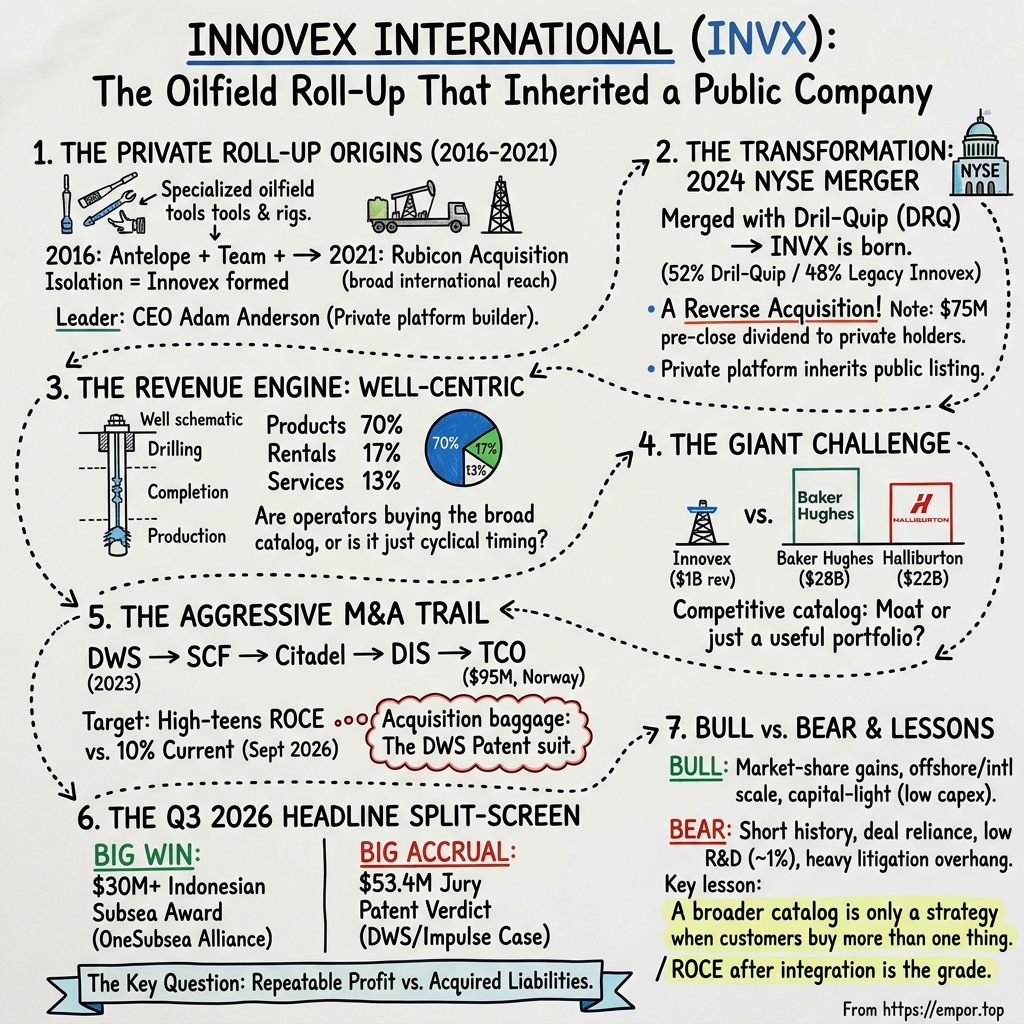
Picture the split screen. On one side of Innovex International's third-quarter 2026 earnings call sat the kind of news every oilfield equipment company wants to announce: a subsea wellhead award in Indonesia worth more than $30 million, plus more than $9 million of additional subsea work won through the company's alliance with OneSubsea.1 On the other side sat the kind of news nobody wants to explain: a federal jury in Texas had found that DWS, a business Innovex bought, willfully infringed a competitor's patents, and the company had accrued $53.4 million against the case.2 One headline describes revenue that has not yet arrived. The other describes a cost that has not yet been paid. Between them is the whole investment question.
The quarter itself was respectable. Revenue was about $265 million, up 10% from a year earlier, and adjusted EBITDA, the industry's favourite measure of cash earnings before interest, taxes and non-cash charges, came in around $55 million.3 That is roughly a 21% margin, which is healthy for a company that mostly machines, assembles and rents steel tools for oil and gas wells. But adjusted EBITDA is a number management builds by stripping things out, and one of the things stripped out was the litigation charge. The jury's award was $47.6 million; the accrual was larger because it includes estimates of what else the court may add.2 Put the charge against a quarter's worth of operating profit and it is clear why reported net income looked so different from the adjusted story the company led with.
There was a third detail on that call, quieter than either headline and arguably more revealing. When management walked through three new projects it highlighted as future growth opportunities tied to its most recent acquisition, the combined revenue those projects had produced to date was less than $2 million.1 That is not a criticism of the projects. New oilfield products often take years to move from first installation to routine purchase orders. It is simply a reminder that an award, a technical first and a press release are promises, and a promise is not yet a line on the income statement.
Innovex is not a tiny company feeling its way. Revenue in 2025 was $978.3 million, close to a billion dollars.4 Yet its comparable financial history is unusually short. The company in its current form exists because of a September 2024 merger in which a privately assembled oilfield platform combined with a listed manufacturer of offshore equipment, and the accounting history that investors see before that date belongs to the private side.4 So the usual tools, a decade of revenue, a cycle's worth of margins, a long record of acquisitions and their outcomes, are not fully available. The investor has to reason from three years of consolidated figures, a handful of deals and a lot of management narrative.
That narrative raises four questions, and this story is organized around them. The first is whether growth is organic or acquired: when revenue rises, is it because customers are buying more Innovex products, or because Innovex bought more companies? The second is whether product breadth creates an edge customers will pay for, or merely a longer catalog. The third is whether the acquisitions have been priced and integrated well enough to earn more than they cost. The fourth is whether cash generation and management execution can withstand the risks, including a large patent case and an industry that has humbled many confident consolidators.
The split screen from the Q3 call is a fair metaphor for all four. A $30 million-plus contract is evidence that customers trust Innovex with expensive, safety-critical subsea equipment. A $53.4 million accrual is evidence that buying businesses also means buying their histories. And the three projects with less than $2 million of revenue sit in the gap between the two: real commercial traction, not yet proven economics. To understand which side of the screen will matter more, the story has to go back to how this company was built, which is mostly a story about putting specialists together.
 Subscribe on LinkedIn
II. A Company Built by Combining Specialists
The Innovex name was born not in a garage or a lab but in a merger. In 2016, three specialist oilfield tool companies, Antelope Oil Tools, Team Oil Tools and Isolation Technologies, combined to form Innovex.5 Each was a niche business of the kind that populates the oil patch: small manufacturers that make one category of downhole product extremely well, sell it to operators and service companies, and live or die by the drilling rig count. Antelope was known for casing equipment, the hardware that helps steel pipe go into a newly drilled hole and stay centred there. Team Oil Tools made completion tools, the plugs and sleeves that let an operator isolate sections of a well during fracturing. Isolation Technologies made related downhole hardware. Separately, each was a supplier. Together, the founders argued, they could be a platform.
The man in charge of that platform from 2016 onward was Adam Anderson, who led Legacy Innovex through its private years and now runs the listed company.6 Anderson is not a founder-inventor in the classic oilfield mould, the engineer who patents a tool and builds a company around it. His record is that of a platform builder: someone who sees fragmented markets, buys or merges specialists, and tries to make the sum worth more than the parts. That distinction matters for everything that follows, because a platform builder's results depend on deal discipline and integration more than on any single invention.
The second chapter arrived in March 2021, in the trough after the pandemic oil crash, when Innovex completed its acquisition of Rubicon Oilfield International.5 Rubicon brought something the original trio largely lacked: an international footprint and a portfolio that stretched across drilling, well construction, completion and intervention, the full arc of a well's life.5 The company described the combination as creating a leading independent global provider of high-value oilfield products and technical services.5 Timing mattered. Buying in a downturn, when sellers are motivated and valuations are depressed, is the classic consolidator's opportunity, and it is also the moment when integration is hardest because everyone is cutting costs at once.
It is worth being clear about what kind of company this was before it became public. Innovex was a sponsor-backed private platform. Its largest owner was Amberjack Capital, an energy-focused private equity firm whose funds remained the company's biggest shareholder after the merger.6 Private equity sponsors buy companies to sell them, eventually, and a roll-up's natural exit path is either a sale to a larger strategic buyer or a public listing. In 2023 and early 2024, Legacy Innovex pursued the second route directly: it filed to go public, and in March 2024 it withdrew that registration statement.7 The reason for the withdrawal is the next chapter of this story.
What did the private years prove? They proved Anderson's team could assemble a broad catalog and keep it running through a severe downturn. They did not, by themselves, prove that the acquired products grew faster under Innovex ownership, that customers bought more of them because they came from one supplier, or that the deals earned more than their cost of capital. Those claims would require product-level revenue histories, organic growth rates and returns on each acquisition, and the company does not publish them for the private period.
The unsettled question, then, is a version of the oldest question in any roll-up. A broader catalog can be a genuinely better way to serve a customer: one call, one invoice, one engineering team that understands how the casing hardware interacts with the completion tools. Or a broader catalog can be a rationale for doing more deals, with "cross-selling" serving as the slide that justifies each purchase. The private Innovex had a plausible version of the first story. In 2024, it found a faster way than an IPO to tell it to public investors.
III. The Merger That Put Innovex on the NYSE
On March 18, 2024, two very different oilfield companies announced they would become one.8 On one side stood Dril-Quip, a Houston manufacturer of offshore drilling and production equipment with a long history on the New York Stock Exchange under the ticker DRQ. Dril-Quip made subsea wellheads, the heavy steel assemblies that sit on the seabed and anchor a deepwater well, along with connectors and other offshore hardware. It had a respected engineering name and a public listing, but its own results had been uneven. On the other side stood Legacy Innovex, private, acquisitive, focused largely on land wells and eager for public capital. Three days later, Legacy Innovex withdrew the registration statement for its own IPO.7 It no longer needed to ring the bell itself. It inherited a company that already had one.
The deal closed on September 6, 2024.4 Dril-Quip, the legal registrant, changed its name to Innovex International; the ticker changed from DRQ to INVX, and the combined company carried on as a listed company without ever having held an initial public offering in the usual sense.4 The ownership split told its own story. Legacy Dril-Quip shareholders ended up with about 52% of the combined company and Legacy Innovex shareholders with about 48%.8 The transaction issued 32.2 million shares to Legacy Innovex holders.4 By ownership, Dril-Quip's shareholders were the slight majority. By control of the narrative, the management team and the name, Innovex had won.
The accounting made that second fact official. The merger was treated as a reverse acquisition, with Legacy Innovex as the accounting acquirer.4 In plain language, the lawyers' version of events says Dril-Quip absorbed Innovex, while the accountants' version says Innovex bought Dril-Quip. Because accountants decide which history appears in the financial statements, investors who look at Innovex International's pre-merger results see Legacy Innovex's numbers, not Dril-Quip's. Dril-Quip's long public record becomes, in effect, the history of an acquired business. That is why the comparable consolidated series begins only in 2023, and why year-over-year comparisons across 2024 and 2025 mix one company's results with two companies' results.
The strategic case was straightforward and, on paper, sensible. Legacy Innovex brought a broad, well-centric product line weighted toward North American land and international onshore work. Dril-Quip brought subsea and wellhead technology, relationships with offshore operators and national oil companies, and the listing. The combination promised scale, cost savings from consolidating overlapping facilities, and the chance to sell Innovex products to Dril-Quip's offshore customers and Dril-Quip's wellhead technology into Innovex's channels.8 The detailed proxy and prospectus laid out the deal mechanics for shareholders who had to vote on it.9
There is a capital-allocation detail inside the transaction that deserves to be seen for what it was. Before closing, Legacy Innovex paid its holders a $75 million dividend.9 That money left the private company and went to its owners, chief among them the sponsor, before the combination. It was not an investment in the combined business. Combined with an all-stock exchange, it meant Legacy Innovex holders took some cash off the table at closing and kept nearly half the equity of a larger listed company. That is a reasonable structure for a sponsor that wants liquidity, and Dril-Quip shareholders approved it, but it belongs on the ledger of who got what, not on the ledger of growth investment.
The merger also produced a number that flattered the first year's results. Because the fair value of the Dril-Quip assets Innovex received exceeded the value of the consideration under acquisition accounting, the company booked an $85.8 million bargain-purchase gain in 2024.4 A bargain-purchase gain is an accounting acknowledgment that the buyer, in the accountants' judgment, paid less than the identifiable net assets were worth. It is non-cash and it does not recur. It also helps explain why 2024 reported net income was $140.3 million while 2025's was much lower.4 Anyone measuring operating progress by net income across those two years would conclude the business got worse. Some of the apparent decline is simply the absence of a one-time accounting gain.
The bargain gain carries a second, more pointed implication. Dril-Quip's shareholders effectively sold their company, measured on the accountants' fair-value basis, for less than its net assets. That says something about how the market had been valuing Dril-Quip before the deal, and something about the negotiating leverage of a private platform offering a public company a new management team and a growth story.
So the merger was not an Innovex IPO, and it was not a simple acquisition. It was a combination of two businesses with different histories, customers and footprints, run by the team from the smaller-by-ownership side. The test the merger set for itself was concrete: did both sides' products find customers together, did consolidating facilities lower costs, and did the combined company earn better returns than either would have alone? To answer that, it helps to understand what an oil company actually buys from Innovex, and when.
IV. What Customers Buy When They Build a Well
Follow a single well from the first day of drilling to the day it starts producing, and you can see Innovex's business model in motion. A drilling rig bores a hole thousands of feet into the earth. As it goes, the operator lowers steel casing to line the hole, and the casing needs hardware: centralizers to keep the pipe in the middle of the hole so cement can surround it evenly, float equipment at the bottom, and tools that reduce friction so the pipe can travel through long horizontal sections without getting stuck. When drilling is done, the well must be completed: sections are isolated with plugs and packers so they can be fractured one stage at a time. Offshore, all of this sits beneath a wellhead on the seabed, the anchor point for everything above it. Later, the well may need intervention tools for maintenance. At each stage there is something Innovex can sell, rent or service.
That is the "well-centric" idea in a single image. The company's pitch is that one supplier can provide many of the pieces an operator needs across the life of the well, and that this breadth is more valuable than a single great product.
The money arrives in three forms. In 2025, Innovex generated about $685 million from product sales, about $126 million from services and about $167 million from rentals.4 Products, the tools and equipment sold outright, were roughly 70% of the total. Rentals, where Innovex owns equipment and leases it to customers for a job, were about 17%. Services, including technical support at the wellsite, made up the rest. The accounting follows the mechanics: standard product revenue is generally recognized when the product is delivered, while rental revenue is recognized evenly over the rental term.4
That mix answers an important question directly. Innovex does not have a recurring-revenue business in the way a software or maintenance company does. The company does not disclose a recurring-revenue share, standard contract lengths or minimum purchase commitments from customers.4 Rentals add some duration, because equipment on rent keeps earning for as long as the job lasts, but the dominant engine is product sales, and product sales happen when someone is building a well. Demand is tied to drilling programs, completion activity, offshore project schedules and, ultimately, oil companies' capital budgets.4 When those budgets shrink, there is no contractual floor that keeps orders coming.
Many of Innovex's products also have an unusual property: they are consumed by the well. A centralizer bolted to casing stays in the hole forever, cemented in place. A completion plug is drilled out or dissolved. A float shoe never comes back to the surface. That makes the business more repeatable than a capital-equipment maker that sells a machine once a decade, because every new well needs a fresh set of parts. It is the closest thing Innovex has to a razor-and-blades model, with one crucial difference: the operator decides each time which blade to buy, and a qualified competitor's blade fits the same razor. Rentals work differently. A friction-reduction tool or a piece of drilling equipment goes down the hole, comes back, is inspected and goes out on the next job, so the economics depend on how often the fleet is working. Idle rental tools still depreciate, which is why rental-heavy businesses earn very good returns in busy years and disappointing ones when rigs are stacked.
The geography of the business shapes how that cycle feels. U.S. land activity reacts quickly: shale operators can add or drop rigs within months when oil prices move, and suppliers to those rigs feel it almost immediately. International and offshore projects run on longer investment horizons, and Innovex says those markets tend to be less cyclical than North America.4 The trade-off is timing. Offshore projects are large and planned years in advance, which provides visibility, but deliveries are lumpy, and the revenue lands when the equipment ships, not when the contract is signed.
The fourth quarter of 2025 showed how lumpy that can be. Subsea deliveries came in above expectations, and management explained that part of the strength reflected deliveries that had been expected in the first quarter of 2026 arriving early.10 That is good news in the sense that customers were ready and the factory performed. It is also a warning about reading any single quarter. When revenue is pulled forward, the next quarter has a harder comparison, and a strong headline can owe as much to scheduling as to demand.
The filings also leave a gap that matters for the investment case. Innovex does not provide profit by product family or a segment-margin breakdown that would show whether its wellhead equipment earns more than its casing hardware, whether rentals carry higher margins than sales, or whether acquired lines are more profitable than legacy ones.4 Investors see one consolidated margin. That makes it hard to test the claim that breadth itself creates value, because the evidence would live in exactly those product-level numbers.
Which leads to the question at the centre of any supplier story. An operator building a well has choices. It can buy each component from the best specialist, or it can buy a bundle from one of the giant integrated service companies that can supply almost everything, from drilling to completion to production. Why would it choose a company with roughly a billion dollars of revenue over vendors many times its size? The answer Innovex gives is plausible. Whether it can prove that answer with customer and pricing evidence is the question the next part of the story has to test.
V. A Smaller Catalog Against Oilfield Giants
Imagine the procurement meeting at a major oil company planning a multi-year drilling campaign. On the table are bids from specialists and from the integrated giants. Halliburton reported about $22 billion of revenue in 2025.11 Baker Hughes reported about $28 billion.12 SLB, the largest oilfield services company in the world, was larger still.[^13] Around them are TechnipFMC, Weatherford, Aker Solutions and NOV, each a formidable competitor in at least some of Innovex's product lines.4 Innovex, at roughly $1 billion of revenue in 2025, is a fraction of the size of the biggest of these.4 On a pure scale comparison, it should lose this meeting.
Scale comparisons can mislead, though. The relevant contest is rarely company against company; it is product against product and region against region. Halliburton's total revenue includes huge pressure-pumping and drilling services businesses that do not compete with a centralizer or a subsea wellhead. In any one product category, Innovex may be facing a division of a giant, a regional specialist, or a single-product private company. So the question is not whether Innovex is smaller than SLB. It obviously is. The question is whether, in the narrow markets where it competes, it has an advantage that lets it win business at good margins.
Management's answer starts with market share. In its 2024 annual report, Innovex estimated its pro forma market share at about 13% in North America and about 12% internationally and offshore across its addressable markets.4 Those are meaningful positions for a company of its size. They are also management's own estimates, built on its own definition of the markets it serves, and they are not an independently audited share series. The company has not published a consistent year-by-year share history that would let an investor see whether those percentages are rising, flat or falling. A share estimate without a time series is a snapshot, not a trend.
The second plank is the "one catalog" claim. On the fourth-quarter 2025 call, management said customers were using multiple Innovex solutions in the same wellbores, and linked that behaviour to cross-selling and margin support.10 This is exactly the right claim to make if breadth is a moat: if an operator who buys Innovex casing hardware also buys its friction-reduction tools, completion plugs and rental equipment for the same well, Innovex captures more of each well's spend and the operator gains simplicity. The difficulty is that the claim is qualitative. The company does not disclose how many wells use more than one Innovex product line, how that number has moved over time, or what share of revenue comes from multi-product customers. Comparing the language across calls, the cross-selling theme recurs, but the evidence offered is description rather than a measured rate of repeat, multi-product use.
Run the forces that shape a supplier's economics and the picture sharpens. Buyers here include major oil companies, independents and national oil companies, some of the most sophisticated and powerful purchasers in industrial markets. Innovex disclosed that no single customer accounted for 10% or more of revenue in 2024 or 2025.4 That diversification protects against the loss of any one account, but low concentration is not the same as low buyer power. A large oil company that buys only a few percent of Innovex's output can still run competitive tenders, split awards between vendors and push hard on price, precisely because Innovex needs it more than it needs Innovex.
The company says customers choose suppliers on technology, service quality, safety record and price.4 Notice that price is on that list. In a market where safety and reliability are table stakes and multiple qualified vendors exist, switching costs for many products are modest: an operator can qualify a second centralizer supplier, or a second plug supplier, without rebuilding its operations. Subsea wellheads are a partial exception. Once a field is designed around a particular wellhead system, follow-on equipment and service for that field tend to stay with the original vendor, which is one reason offshore awards matter strategically. But the filings provide no retention rates, lost-bid data or price-realization figures that would show durable pricing power across the portfolio.
There is also a substitution threat that comes from the giants themselves. When an integrated service company offers an operator a bundled package, drilling services, completion services and the associated hardware under one contract, it can price the hardware aggressively to win the larger service work. Innovex cannot bundle a fracturing fleet with its plugs. Its answer is to be the best independent option for the hardware itself and to be easy to work with across many components. That is a real position, and the company's share estimates suggest it has worked. It is a narrower moat than "breadth" alone implies.
So where does the evidence leave the competitive thesis? It narrows it rather than rejecting it. Innovex has credible market positions, a diversified customer base, management testimony that customers use multiple products in the same wells, and a growing offshore franchise where switching costs are higher. What it lacks is published proof of the mechanisms a moat requires: measured retention, multi-product attach rates and evidence that it can hold price when activity softens. The strongest test is ahead, not behind: whether share gains and multi-product deployments persist through a weaker drilling cycle without discounting. Until then, the moat is credible but unproven. And because so much of Innovex's breadth was acquired rather than built, the next question is whether the company paid sensible prices to assemble it.
VI. The Acquisition Math: Small Tickets, Real Returns?
Watch the deal flow after the merger, and Innovex looks less like a company digesting one large combination and more like a platform that never stopped shopping. First came DWS, Downhole Well Solutions, a Texas business with rental drilling equipment and friction-reduction tools. Innovex had made a 20% investment in DWS in 2023, and in December 2024 it announced it would buy the rest.13 Then came SCF, then Citadel, then DIS, and in June 2026 the largest of the recent purchases, Norway's TCO Group.14 Each deal was small relative to the company. Together they define the platform's growth strategy.
DWS shows the logic most clearly. Friction-reduction tools solve a very physical problem: as horizontal wells grow longer, steel pipe dragging along the bottom of the hole generates so much friction that it can stall before reaching the end. Tools that make the pipe vibrate or reduce drag let operators drill and case longer laterals, which is where shale economics have been heading for years. Innovex said it paid about 3.8 times DWS's trailing twelve-month adjusted EBITDA, and the purchase price reported in its acquisition presentation was about $103.7 million.13 For context, a multiple under four times means that, if earnings held steady, the business would pay back its price in cash earnings in well under five years. That is a low multiple by most industrial standards, and it reflects both the cyclicality of land-focused oilfield businesses and Innovex's bargaining position as an existing minority owner.
The newer deals had different purposes. SCF, bought for about $17.7 million, was aimed at building a lower-cost machining supply chain: in effect, buying the capability to make parts more cheaply rather than buying a new revenue stream.4 Citadel cost about $69.7 million.2 DIS cost about $17.6 million including contingent earnouts, payments that depend on the business hitting future targets, and on the second-quarter 2026 call management described the price as about four times trailing EBITDA.15 For Citadel, Innovex has not published a comparable standalone EBITDA figure, so its multiple cannot be assessed on the same basis.
TCO deserves the most weight, because it is both the largest recent deal and the clearest bet on international growth. Innovex agreed to buy TCO for about $95 million, which it described as about 5.4 times TCO's 2025 adjusted EBITDA of $17.6 million.14 TCO is a Norwegian company known for well-completion and testing technologies, including glass and ceramic barrier plugs used to isolate wells temporarily and then dissolve or break away. In 2025, it had about $70 million of revenue, an adjusted EBITDA margin around 25% and roughly $11 million of free cash flow.16 Those are attractive economics: a margin somewhat above Innovex's own and genuine cash generation. On paper, Innovex bought a profitable international business at a modest multiple.
And yet the Q3 call brought back the quiet detail from the opening split screen: the projects remained early.1 Some of the growth the deal was meant to deliver remains a pipeline rather than a revenue stream.
How should a listener weigh the multiples? Carefully. DWS at 3.8 times and TCO at 5.4 times are company-provided measures, calculated on company definitions of adjusted EBITDA, for businesses with different growth rates, geographies and risk profiles. They do not on their face show overpayment. But Innovex has not published enough comparable deal data, its own or the sector's, to claim it buys systematically cheaper than peers. A low entry multiple is helpful. It is not the return.
The return is what matters, and here Innovex supplies its own yardstick. Management targets return on capital employed in the high teens. ROCE measures how much operating profit the business generates on the money tied up in it. As of September 2026, trailing ROCE was about 10%.1 Management has argued that the company's large net cash position depresses the measure, since idle cash counts as capital but earns little.1 That is a fair technical point. It does not change the arithmetic that the acquisitions, which consume capital and add goodwill and intangibles to the denominator, must eventually lift the numerator by more. A string of four-to-five-times deals should, if the earnings hold and integration works, produce returns well above 10%. The consolidated figure has not yet shown that.
The arithmetic is worth spelling out, because it explains why low multiples alone do not settle the question. A business bought at five times EBITDA earns roughly 20 cents of EBITDA for every dollar paid. But EBITDA is before depreciation, before taxes and before the working capital and equipment the business needs to keep running. Once those are deducted, and once the integration costs and any inherited liabilities are added to the purchase price, a 20% headline yield can shrink toward the low teens. That is still respectable. It is not automatically the high-teens return management targets, and it leaves little room for an acquired product line that stops growing after the sale. The math works best when acquisitions grow faster under Innovex than they did on their own, which brings the story back to cross-selling: the reason to own TCO's plugs inside a larger catalog is that Innovex can sell them to customers TCO could not reach. That is the claim the consolidated ROCE will eventually test.
Capital allocation also includes what the company does with its own shares, and here the record has two strands that are easy to confuse. In February 2026, existing stockholders sold 5.75 million shares in a secondary offering, and Innovex separately bought and retired 575,000 shares for about $14.1 million.17 In August 2026, Amberjack-affiliated holders sold another 5.0 million shares.2 Innovex received no proceeds from either secondary.17 The buyback reduced share count modestly; the secondary sales transferred ownership from the sponsor to public investors. One is a company decision about capital. The other is the sponsor's exit.
So the acquisition question comes down to a choice between two futures. In one, integration works, DWS and TCO grow, the supply-chain purchase lowers costs and ROCE climbs toward the target, proving the platform can compound. In the other, the platform needs a steady diet of new deals to keep reported growth moving, each bought at a reasonable multiple and each adding capital faster than it adds returns. The record so far is too short to tell those futures apart. That makes the people choosing the deals, and the incentives they work under, unusually important.
VII. The CEO Who Built the Platform Now Has to Prove It
When the merger closed in September 2024, the combined company's leadership looked a lot like the private company's. Adam Anderson, who had led Legacy Innovex since 2016, became chief executive of the listed company.6 Kendal Reed, who had joined the private platform's corporate-development work in 2016 and served as Legacy Innovex's chief financial officer since 2019, became CFO.6 Reed's background reads like a résumé designed for a roll-up: corporate development, mergers and acquisitions, treasury and post-deal integration before taking the finance seat.6 This is a team that has spent a decade buying and combining businesses. The public company is their platform, and its results are now their scorecard.
Leadership continuity has genuine advantages. The same people who designed the strategy are accountable for executing it, the acquisition playbook is institutional rather than borrowed, and the proxy and filings show no CEO or CFO turnover since the merger.6 There is no new management team blaming predecessors. If the platform underdelivers, the explanation will come from the people who built it.
The compensation design tries to link that accountability to outcomes shareholders care about. Executives receive a base salary, an annual cash incentive and equity awards, including performance units whose payout depends on total shareholder return and return on capital employed.6 Tying pay to ROCE is a meaningful choice for an acquisitive company, because it penalizes deals that add revenue without adding proportionate profit. Anderson's total reported compensation was about $2.9 million in 2024 and about $3.3 million in 2025; Reed's 2025 total was about $1.5 million.6 These are moderate figures for the chief executive of a company approaching a billion dollars in revenue.
The 2024 net-income comparison is distorted by the merger's one-time bargain-purchase gain.4 Strip that out and the underlying trajectory is less dramatic. A fairer test of pay is whether operating returns are improving, and on that measure, with ROCE around 10% against a high-teens target, the performance units have more to prove than to reward.
Ownership is where the alignment picture becomes more complicated. At the March 2026 proxy record date, Anderson beneficially owned about 514,000 shares and Reed about 218,000.6 Anderson's stake was less than 1% of the company.6 That is real money for an individual, but it is small relative to the company and tiny next to the sponsor. Jason Turowsky, managing partner of Amberjack Management, was reported as beneficial owner of about 22.8 million shares, or 33.2%, through Amberjack-affiliated funds.6 A one-third holder in a company with otherwise dispersed ownership has influence that no one else at the table can match.
That influence cuts two ways. A sponsor with a large stake has a powerful interest in the long-term value of its shares. But a sponsor is also a seller by design. The sponsor sell-downs continued in February and August 2026.172 The February prospectus showed the main Amberjack fund at about 31.5% before that sale and about 25.5% assuming full sale and the associated repurchase.17 After the August sale, its stake had fallen further, but an updated percentage was not disclosed in the Q3 filing.2 Innovex has also disclosed a potential corporate-opportunity conflict under its stockholders agreement, the kind of provision that allows a sponsor's other portfolio companies to pursue opportunities that might otherwise belong to Innovex.4 None of this is unusual for a sponsor-backed company. All of it matters for judging whose time horizon governs capital allocation.
The 2026 annual meeting offered a small but readable signal. Say-on-pay passed comfortably, with about 61.8 million votes for and about 0.6 million against.18 Director John Lovoi, by contrast, received about 7.3 million votes against.18 That is not a rejection, and directors draw opposition for many reasons, including board-tenure policies, committee roles and proxy-adviser guidelines. But it stands out against an otherwise lopsided vote and is worth tracking at the next meeting.
The record of promises against outcomes is still short. The merger's scale and synergy thesis is still being tested. Analysts on the fourth-quarter 2025 and third-quarter 2026 calls pressed management on organic growth, margins and the pace of deals, and management's answers emphasized market-share gains, new international awards and the integration of acquired businesses.101 What those answers have not yet supplied is a quantified organic growth bridge that separates the legacy businesses from the acquired ones. The tension remains: does sponsor influence support patient platform building, or will continued sell-down weaken the alignment management cites? One way to test any management team is to follow the cash.
VIII. Cash Looks Strong—But What Kind of Strong?
The most flattering number in Innovex's 2025 annual report is not revenue or EBITDA. It is cash. Net income was about $83 million, and operating cash flow was about $191 million, more than twice as much.4 For a manufacturer, turning a dollar of reported profit into more than two dollars of operating cash looks like a sign of exceptional quality. The real story is more instructive than that ratio.
Start with the bridge from profit to cash. Some of the gap is ordinary and repeatable: depreciation and amortization of about $61 million and stock-based compensation of about $14 million are charges that reduce reported income without consuming cash.4 A company that has made acquisitions carries amortization of acquired intangibles, which inflates this gap, and that will persist as long as the deals remain on the books. The rest of the gap came from working capital. Receivables released about $18 million and inventory released about $47 million of cash in 2025.4
Those working-capital releases are the important part. When a company collects customer bills faster or sells down its warehouse, cash comes in that was previously tied up. That is good management, and after a merger it often reflects deliberate work: consolidating inventories, rationalizing overlapping product lines, cleaning up collections. But it is not a recurring source of cash. Inventory can only be reduced so far before the shelves are too thin to serve customers, and if the business grows, working capital will consume cash rather than release it.
Contrast 2024. That year, operating cash flow of about $93 million was below reported net income of about $140 million, which included the non-cash bargain-purchase gain.4 Put the two years together and the lesson is that neither year's conversion ratio is the business's normal state. One year flattered profit with accounting; the next flattered cash with working capital.
The first nine months of 2026 added a third distortion. Operating cash flow was about $96 million against net income of about $35 million.2 Much of that gap comes from the $53.4 million litigation provision, which reduced net income but has not been paid. The company said payment is not expected before post-trial motions and any appeal conclude.2 So today's cash flow statement shows the expense without the outflow. If the liability is ultimately paid at or near the accrued amount, the cash will leave in some future period, and that period's cash flow will look correspondingly weaker.
The company's capital-light claim survives this scrutiny, with a caveat. Capital expenditures were about $35 million in 2025, roughly 3.6% of revenue, and about $19 million in the first nine months of 2026, about 2.5% of revenue.42 For a company that owns a rental fleet and manufacturing plants, that is a modest burden. Research and development was about $6.7 million in 2025, below 1% of revenue.4 The low R&D figure invites two readings. One is efficiency: much product development in this industry happens on the shop floor, alongside customers, and is not booked as formal R&D. The other is that Innovex buys much of its innovation through acquisitions rather than building it, which shifts the cost from the R&D line to the purchase price.
Two more items deserve attention. The first is receivables. Net trade receivables rose from about $238 million at the end of 2025 to about $252 million at September 2026.2 On rising revenue, that is not alarming, and the allowance for doubtful accounts fell over the same period as the company wrote off old balances.2 But Innovex does not publish an aging table showing how much is overdue and by how long, so investors cannot see whether collection speeds are holding.
The second is a recovery that flattered 2025. Innovex had a long-running receivable from a former agent in Saudi Arabia. In 2025, recoveries on that balance produced a $13.6 million year-over-year improvement in bad-debt expense, which lowered selling, general and administrative costs.4 In 2026, that benefit did not recur, and SG&A rose partly as a result.2 A one-time recovery that lowers costs in one year makes the following year's cost comparison look worse, even if nothing in the underlying business changed.
The liquidity position itself is solid. At September 30, 2026, Innovex had about $189 million of cash and restricted cash, no borrowings on its revolving credit facility and about $165 million of availability under it.2 The $200 million asset-based revolver, secured by substantially all of the company's assets, matures in 2030 and includes a 1.10 times fixed-charge coverage covenant that applies only under specified conditions, such as low availability.2 There is no near-term refinancing pressure. Long-term debt and finance leases totalled only about $18 million.2
The verdict on cash is that Innovex converts earnings into cash well and needs relatively little capital to run, but the headline conversion ratios overstate what repeats. The right number to watch is cash from operations after working capital normalizes and after the patent liability is resolved. And that liability, it turns out, came attached to one of the acquisitions management cites as a model.
IX. The DWS Acquisition Came With a Patent Case
In 2023, a Canadian company called Impulse Downhole Solutions sued DWS in federal court in Texas, alleging that DWS's friction-reduction tools infringed Impulse's patents.19 At the time, Innovex owned 20% of DWS. By the end of 2024, it had agreed to buy the rest.13 The lawsuit, in other words, was already pending when Innovex decided to take full ownership. That matters, because it means the risk was visible during diligence, and the question becomes not whether Innovex knew but how it priced and protected against it.
The case moved slowly and then all at once. Before trial, two of the asserted claims were dismissed.19 In 2026, a jury found the remaining asserted patent claims valid and infringed, and found the infringement willful.2 Willfulness is the important word. In U.S. patent law, a finding that infringement was willful allows a judge to increase damages, up to three times the jury's award, and can support an award of attorney fees. That helps explain the $53.4 million accrual.2
The jury's number is not the final bill. As of September 30, 2026, no judgment had been entered and post-trial motions were pending.2 Innovex said the ultimate loss could differ materially from the accrual and that a bond may be required during the appeal.2 A bond would tie up cash or credit capacity without the money actually leaving the company, which is one reason the litigation is a balance-sheet consideration even before any payment. The case had already been on investors' radar on the first-quarter call, well before the verdict, and the Q3 call returned to it after the accrual.201
How big is this relative to the deal? The DWS purchase price reported in the acquisition presentation was about $103.7 million.13 The accrual is roughly half that. It is tempting to conclude that the patent case wiped out half the deal's value, but that shortcut is wrong in two directions. The final liability is not fixed and could fall on appeal or rise with enhanced damages. And DWS has produced earnings since the acquisition; a business bought at under four times EBITDA generates a substantial share of its purchase price in cash within a couple of years. The fair way to see it is that the patent case is a material cost that belongs inside the DWS return calculation, reducing what was, on announcement, an attractive entry multiple.
There is a second-order question that matters more for the platform than for DWS alone. What did acquisition diligence cover, and what protections did Innovex negotiate? Purchase agreements often include indemnities, escrows or price adjustments for known litigation. The filings do not describe any indemnity recovery offsetting the accrual, which suggests the liability sits largely with Innovex. For a company whose strategy is a sequence of acquisitions, the discipline of pricing and contracting around known risks is part of the investment case. One verdict does not prove that discipline is weak. It does make the question legitimate, and investors will want to hear management explain exactly how the exposure was assessed when the deal was signed.
There is also an operating question. Friction-reduction tools were part of the reason DWS was attractive. If the patents remain in force and an injunction or royalty follows, DWS may need to redesign products or pay to keep selling them. Innovex has not disclosed a product-level revenue figure for the affected tools, so the operating exposure cannot be sized from outside.
The verdict does not establish that DWS was a bad acquisition. It does change the story's tone. An acquisition-led strategy is judged on whether each deal earns more than its full cost, and full cost includes the liabilities that come with the business. The patent case is the first large, visible example of that principle in Innovex's public history. Whatever the final number, it will be paid out of the same cash flow that is supposed to fund the next growth chapter, which management says will be written offshore.
X. The Next Growth Case Is Offshore—and Still Needs Conversion
Twenty thousand pounds per square inch is pressure most people never encounter. It is roughly the weight of a large car pressing on a postage stamp, and some of the deepest offshore reservoirs in the world operate near it. Equipment rated for those conditions is among the most demanding hardware in the oil industry. In 2026, Innovex announced a successful installation of a 20,000-psi subsea system, the kind of technical milestone that inherited Dril-Quip engineering made possible.3 Alongside it came the subsea awards: more than $30 million for a wellhead project in Indonesia and more than $9 million of further work through the OneSubsea alliance.1
This is the growth story management is now telling. On the Q3 call, it pointed to 2027 growth driven by subsea work, new international markets and acquired products, and described a subsea outlook extending into 2027 and 2028.1 For the fourth quarter of 2026, management guided to revenue of about $260 million to $270 million and adjusted EBITDA of about $53 million to $58 million.1 That guidance, if met, would leave the fourth quarter roughly in line with the third. It is guidance, not results, and the 2027–28 subsea outlook is further away still.
The operating record for 2026 so far gives the guidance some context. Revenue for the first nine months was about $749 million, up about $44 million year over year, or roughly 6%.2 Net income fell to about $35 million from about $69 million.2 GAAP operating income fell to about $44 million from about $107 million.2 That is a sharp decline on growing revenue, and the explanation is not a vague reference to macro conditions. Decompose it and the biggest single item is the $53.4 million litigation provision. Add acquisition-related costs from the year's deals, freight and logistics pressure, and the absence of the prior year's Saudi-agent recovery, and most of the decline is accounted for.2 The underlying business has not collapsed. But it has not demonstrated margin expansion either, and some of these pressures, logistics costs in particular, are not one-time.
Why does offshore matter strategically? Because it is the most plausible route to a less cyclical revenue base. U.S. land activity can swing violently within a year. Offshore projects are planned on longer horizons, and once a field is built around a wellhead system, follow-on work tends to stay with the original vendor. Innovex says its international and offshore markets tend to be less cyclical than North America.4 If the company can shift its mix toward those markets, it could smooth earnings and earn better returns on the equipment it designs.
The OneSubsea alliance adds an interesting wrinkle to the competitive picture. OneSubsea is the subsea business led by SLB, one of the giants Innovex competes against elsewhere.[^13] Selling wellhead work through that channel means Innovex can reach projects it might not win on its own, but it also means part of its offshore growth depends on a partner that is, in other product lines, a rival. Coopetition of this kind is common in the oilfield, and it can be a sign that Innovex's engineering is valued by the biggest players. It is also a reminder that the partner sets much of the channel's terms.
There is a cost to the offshore shift. Large projects bring lumpy delivery timing, as the early subsea shipments in late 2025 showed. They also bring currency exposure. In 2025, about 29% of Innovex's revenue came from entities transacting primarily in currencies other than the U.S. dollar, and the company does not engage in material hedging.4 As TCO, a Norwegian business, joins the portfolio, that exposure grows. A weaker Norwegian krone or other currency moves against the dollar can reduce reported earnings even when the business performs well locally. It is a secondary risk, but a real one.
The central question is conversion. A contract award is the start of a process: engineering, manufacturing, delivery schedules, installation and finally revenue recognition, usually at delivery. Innovex does not publish a formal backlog figure with the kind of order-to-revenue history that would let investors measure how reliably awards turn into sales and on what timeline. The three TCO-related projects with less than $2 million of combined revenue to date are a reminder that early traction can take time to become meaningful revenue.1 The 20,000-psi installation is an engineering achievement; the company has not yet shown how many repeat orders follow it.
The operating test for the offshore story is therefore specific. Can growth in offshore and international work offset North American cyclicality and raise returns, rather than simply adding another source of volatility? If subsea revenue grows steadily, margins hold and ROCE improves, the strategy will have proven itself. If revenue arrives in bursts, margins swing with delivery timing and returns stay near current levels, offshore will have diversified the business without improving it. That distinction sets up the full debate.
XI. Analysis & Bear vs. Bull Case
Put three signals on one dashboard and the investment case comes into focus. The first is revenue growth: about $978 million in 2025 with adjusted EBITDA of about $188 million, and modest growth in the first nine months of 2026.43 The second is return on capital: about 10% trailing at September 2026 against management's high-teens target.1 The third is conversion: whether subsea wins and acquired products turn into delivered revenue and cash. Everything else in the debate feeds one of those three.
The spine of the argument is simple. Growth creates value only when the revenue, acquired or organic, earns returns above the capital it consumes. A roll-up can grow revenue indefinitely by buying businesses. It creates value only if each purchase earns more than its cost and the combination earns more than the parts.
The bull case has real evidence behind it. Innovex is capital-light by oilfield standards, with capex in the low single digits as a share of revenue. At September 30, 2026, it had no borrowings on its revolver and about $189 million of cash, giving management room to invest, absorb a litigation payment and continue acquiring without straining the balance sheet.2 Its disclosed acquisition multiples have been modest. The company cites market-share gains, multi-product use in the same wells and new offshore awards. TCO added a high-margin international business. If integration works and organic growth continues, ROCE should rise toward the target as earnings grow faster than the capital base.
The bear case has real evidence too. The comparable history is short and distorted by the merger and acquisitions. The industry is cyclical, and Innovex competes against far larger suppliers in most of its product lines. Disclosed R&D is low, ROCE is well below target, and the patent case is material with an uncertain final cost. The competitive evidence also leaves pricing power and the durability of the company's market-share gains unproven.
The moat question can be tested against two frameworks. Customers are powerful buyers, even though no single customer exceeds 10% of revenue.4 The SCF purchase, aimed at lowering machining costs, suggests Innovex sees value in controlling part of its supply chain.4 Integrated service companies pose a substitution threat, while rivalry includes Baker Hughes, Halliburton, SLB, TechnipFMC, Weatherford, Aker Solutions and NOV.4 Qualification and safety requirements limit entry, but small specialists continue to emerge.
Hamilton Helmer's seven powers sharpen the test. Scale economies are limited, network economies do not apply, and counter-positioning has a partial claim. Switching costs are concentrated in subsea wellheads, brand matters modestly, and patents could be a cornered resource, though the Impulse case shows they can cut both ways. Process power, the embedded know-how of manufacturing and integrating many small businesses, is the platform's most plausible claim, and it is precisely the one that ROCE is supposed to prove.
The evidence still falls short of proving a durable advantage.
An activist looking at the company would ask pointed questions. Why does management not publish an organic growth bridge separating legacy and acquired businesses? Why does the company not report multi-product attach rates if cross-selling is central to the thesis? What indemnity protections did it negotiate in the DWS acquisition? With ROCE at 10%, why continue acquiring rather than proving returns on the existing portfolio first? These are not accusations; they are the disclosures that would settle the debate.
Three indicators matter most. The first is organic revenue growth, separated between legacy and acquired businesses; Innovex does not publish it as a consistent series. The second is ROCE against the high-teens target; it was about 10% at September 2026.1 The third is the conversion of subsea awards and orders into revenue and cash, visible today only through management's call commentary and the timing of deliveries.
What would the market need to believe to pay up for this business? That ROCE will climb toward the target and that acquisitions will compound rather than merely accumulate. Investors who buy the shares are effectively betting on management's ability to raise returns while growing. The skeptics are betting that the platform's growth depends on continuing acquisitions, and that each new deal postpones the moment when returns can be judged on the existing portfolio.
XII. Business & Investing Lessons
Go back to September 2024. A listed company with a long history on the New York Stock Exchange changes its name and ticker, and the private platform that agreed to merge with it becomes, in the accountants' eyes, the buyer. Innovex's story since then holds lessons that belong to this company specifically.
The first lesson is that a broader catalog is a strategy only when customers buy more than one thing. Innovex has built that catalog through mergers and acquisitions, and management says customers use multiple products in the same wellbores. Until that claim is measured and published, it remains a claim, and a catalog that customers buy one piece at a time is just a collection of small businesses with a shared logo. For founders building platforms, the lesson is to measure cross-selling from the first day, because the whole thesis depends on a number that is easy to assert and hard to prove.
The second lesson is that a good acquisition multiple is an entry point, and ROCE after integration is the grade. Innovex's disclosed deal multiples look attractive on paper, but consolidated ROCE remains well below management's own target, and the DWS patent case has materially changed the return calculation. A low multiple tells you what the buyer paid for last year's earnings. It says nothing about the liabilities that came in the box, the integration costs that follow, or whether the acquired product grows once the founder has cashed out. Investors should judge acquirers not by the multiples they announce but by the returns the combined business delivers two and three years later, and roll-up managements should expect to be judged that way.
The third lesson is that cash is a result, but working-capital releases tell you how much of it repeats. Innovex's cash flow has been affected by working-capital releases, a non-cash accounting gain and an unpaid accrual. Each year's ratio tells a different story, and the true measure only becomes visible over several years.
The fourth lesson concerns cyclicality and accountability. Oilfield activity rises and falls, and every oilfield company faces that risk. But cyclicality should not become an all-purpose explanation. Company-specific costs did much of the work behind falling operating income despite revenue growth in 2026. Delivery timing, integration choices, logistics costs and the decision to keep acquiring are management decisions. The skill in reading a company like Innovex lies in separating what the market does to the business from what management does with it. In oilfield services, the cycle is the weather; the company is still responsible for the roof.
The fifth lesson is the one embedded in the title. An inherited listing is a shortcut to the market, not to a track record. Legacy Innovex withdrew its own IPO filing after announcing a merger that gave it a listing without a conventional IPO.7 It was a clever route, and it delivered liquidity for the sponsor through secondary offerings. What it could not deliver was a long public record. A conventional IPO candidate arrives with years of audited history under one name; Innovex arrived with a reverse-acquisition accounting history and a combined company that had never reported a full year together. For investors, the lesson is to extend the evaluation period when a company enters the market sideways, because the history needed to judge it is still being written.
XIII. Epilogue
Somewhere off Indonesia, a wellhead that exists today as an order and an engineering drawing will be machined, tested, shipped and lowered to the seabed. In a federal courtroom in Texas, lawyers for DWS will argue that a jury got it wrong. Somewhere in Norway, the TCO team is learning to report to a new American parent. Those three scenes, a delivery, a ruling and an integration, will do more to decide what Innovex is worth than any slide in the next investor presentation.
Tonight, Innovex stands at an interesting moment. TCO has only recently joined the portfolio. The patent case remains unresolved, with post-trial motions pending and an appeal likely. Management is promising international and offshore growth into 2027 and 2028. Management's ROCE target is in the high teens, and the trailing figure is about 10%.1 The gap between those two numbers is the distance this company still has to travel, and it is the clearest single measure of whether the platform is working.
The next decision points are clear. The Impulse case will move through post-trial motions and possibly appeal, and the final liability may differ materially from the $53.4 million accrued.2 TCO will deliver its first full year under Innovex ownership, and its growth projects will either begin producing meaningful revenue or stay small. The DIS earnouts will show whether that business hits the targets on which part of its price depends. And Amberjack's ownership disclosures will show how far the sponsor has sold down after the August 2026 secondary.
Management's next calls will reveal whether the 2027 growth narrative changes, whether the pace of acquisitions slows or accelerates, and whether the ROCE target stays where it is. Each of those will be a signal. A management team that reaffirms a target and then meets it earns credibility. One that quietly adjusts it, or keeps acquiring without showing returns, invites skepticism.
What would confirm the story? Organic growth that management can separate from acquired growth. ROCE rising toward the target. Repeat cross-selling that shows up in numbers rather than anecdotes. Strong cash generation after working capital normalizes and the patent liability is paid. What would weaken it? Growth that comes mostly from deals. ROCE stuck near current levels. Subsea revenue arriving in bursts rather than building steadily. Additional litigation costs. Each of those outcomes will be visible in the filings over the next several quarters.
The first full-year report for 2026 will be the first natural checkpoint. It will be the year in which the litigation accrual, the TCO purchase and the absence of the Saudi recovery all sit inside one set of numbers, which means it will flatter nothing. If adjusted earnings hold up and cash generation stays strong without another large working-capital release, the platform will have shown a resilience the bear case doubts. If the cash conversion falls back toward net income once inventories stop shrinking, the 2025 cash story will be revealed as the one-time cleanup it may have been.
The tension that remains is the one this story began with: is Innovex compounding, or simply getting larger? The answer will not come from any one contract, verdict or deal. It will come from the accumulation of quarters in which returns either rise or do not. Getting larger is easy for a company with cash, a revolver and a sponsor-trained instinct for deals. Compounding requires the harder thing: that the businesses already bought earn more next year than this year, without needing the next purchase to make the totals grow.
XIV. Outro
Return to the split screen from the Q3 call: the Indonesian subsea award1 and the $53.4 million patent accrual.2 Both belong to the same company, and both were produced by the same strategy: buy specialists, broaden the catalog, win bigger customers, and trust that the whole will earn more than the parts.
There is something fitting about that pairing. Most oilfield roll-ups are judged on a single axis, the price of oil and the count of rigs, and they rise and fall with the weather of the industry. Innovex asks to be judged on a second axis as well: whether a former private platform can make each new specialist worth more inside the family than outside it. The contract on the left of the screen is the case for yes. The accrual on the right is the reminder that every specialist arrives with its own past.
The proof will not be in the deal headlines or the contract announcements. It will be in whether the catalog compounds customer value and capital returns once the headlines fade. For Innovex, the well is the market, but the return on every deal is the story.
References
-
Q3 2026 Earnings Call Transcript — Stock Analysis, 2026-10-30 ↩↩↩↩↩↩↩↩↩↩↩↩↩↩↩
-
Q3 2026 Form 10-Q — Innovex International, 2026-11-04 ↩↩↩↩↩↩↩↩↩↩↩↩↩↩↩↩↩↩↩↩↩↩↩↩↩↩
-
Q3 2026 Earnings Release — Innovex International, 2026-10-29 ↩↩↩
-
2025 Form 10-K — Innovex International, 2026-02-24 ↩↩↩↩↩↩↩↩↩↩↩↩↩↩↩↩↩↩↩↩↩↩↩↩↩↩↩↩↩↩↩↩↩↩↩
-
Innovex Downhole Solutions Completes Acquisition of Rubicon Oilfield International — Innovex, 2021-03-10 ↩↩↩↩
-
2026 DEF 14A Proxy Statement — Innovex International, 2026-03-27 ↩↩↩↩↩↩↩↩↩↩↩
-
Innovex IPO Registration Withdrawal (Form RW) — SEC, 2024-03-21 ↩↩↩
-
Innovex / Dril-Quip Merger Presentation — SEC Exhibit 99.1, 2024-03-18 ↩↩↩
-
Innovex / Dril-Quip Merger Proxy Statement/Prospectus — SEC, 2024-07-29 ↩↩
-
Q4 2025 Earnings Call Transcript — The Motley Fool, 2026-05-04 ↩↩↩
-
Innovex Enters Into Agreement to Acquire TCO Group — Innovex, 2026-06-15 ↩↩
-
Q2 2026 Earnings Call Transcript — The Motley Fool, 2026-08-10 ↩
-
Form 424B7 Prospectus Supplement — Innovex International, 2026-02-27 ↩↩↩↩↩
-
2026 Annual Meeting Voting Results — Innovex International, 2026-05-11 ↩↩
-
Impulse Downhole Solutions Ltd. et al. v. Downhole Well Solutions, LLC, Order — U.S. District Court for the Southern District of Texas, 2026-08-06 ↩↩
-
Q1 2026 Earnings Call Transcript — The Motley Fool, 2026-05-06 ↩
 LinkedIn
 WhatsApp
 Reddit
 Hacker News
 Email
 Kindle
 RSS Feed
 Spotify
 Apple Podcasts
 Amazon Music
 Audible
 YouTube