Inspire Medical Systems, Inc.: The Implant That Had to Get Paid For
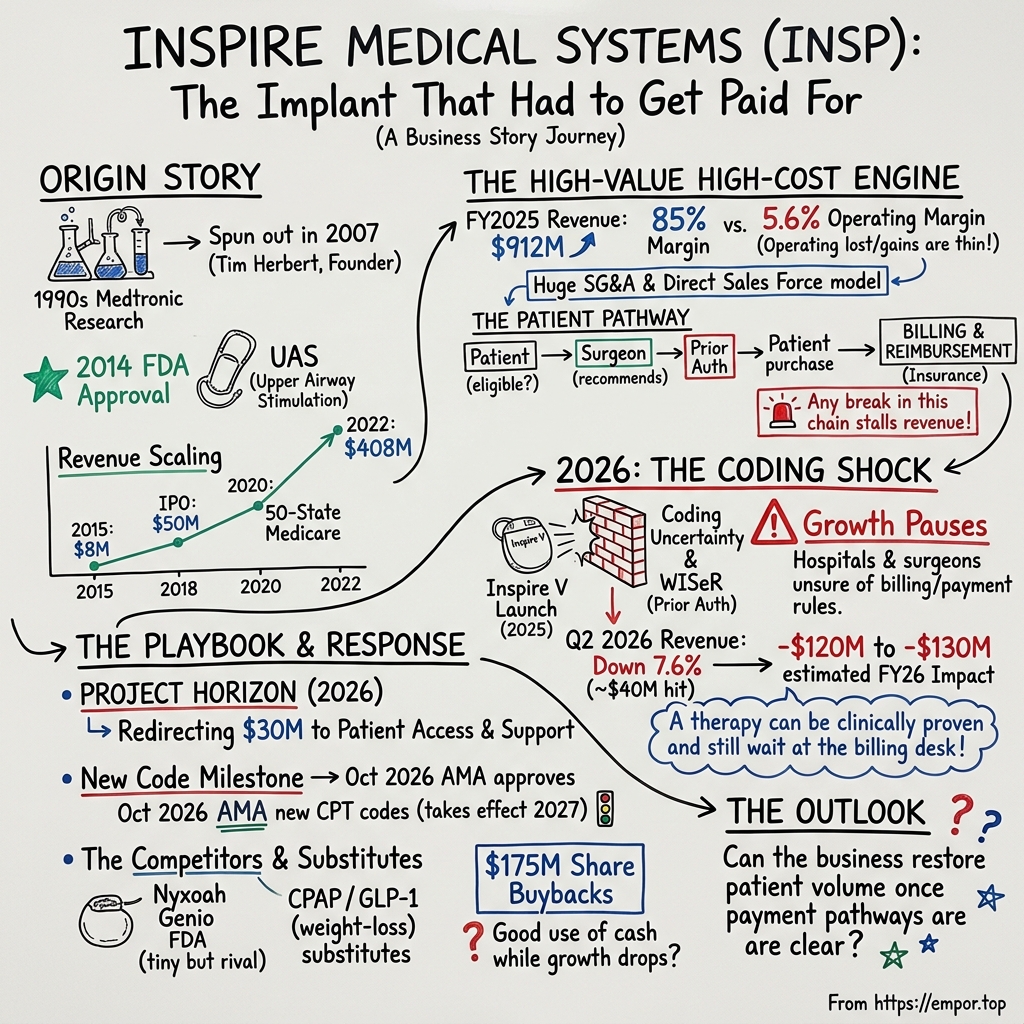
I. The Code That Stopped the Growth Story
Picture an ear, nose and throat surgeon in early 2026 with a list of patients who want the same thing. Each one has obstructive sleep apnea. Each has tried the mask-and-hose machine that most sleep doctors prescribe first, and each has given up on it. Each has been told about a small implant that sits under the skin of the chest, senses the body's attempts to breathe, and nudges the tongue forward so the airway stays open through the night.
The newest version of that implant, Inspire V, had gone on sale in the United States the previous May.1 Surgeons liked it. Patients were asking for it. And yet in surgery schedulers' offices and hospital billing departments across the country, the cases were slowing down.
The reason had nothing to do with whether the device worked. It had to do with a five-digit number. American medicine runs on procedure codes, the shorthand that tells an insurer what a surgeon did and how much the surgeon and the hospital should be paid for it. In late 2025, after Medicare published its payment rules for 2026, the code that most surgeons had been using for Inspire V stopped being the right one for Medicare patients, and nobody could say with confidence what the right one was.1
Inspire's own annual report described "confusion on the appropriate reimbursement and coding for our products" from the government agency that runs Medicare and the regional contractors that administer it.1 At the same time, Medicare switched on a new pilot in six states that required prior authorization, reviewed with the help of artificial intelligence, for procedures like this one.12 A hospital that is not sure how it will be paid, and a surgeon who is not sure what fee will arrive, tend to do something entirely rational. They wait.
That is the paradox at the heart of this story. Demand for a new medical device can be real, the device can be better than the one it replaces, and still the revenue can stall, because in American healthcare the patient is not the one who pays and the company is not the one who sends the bill.
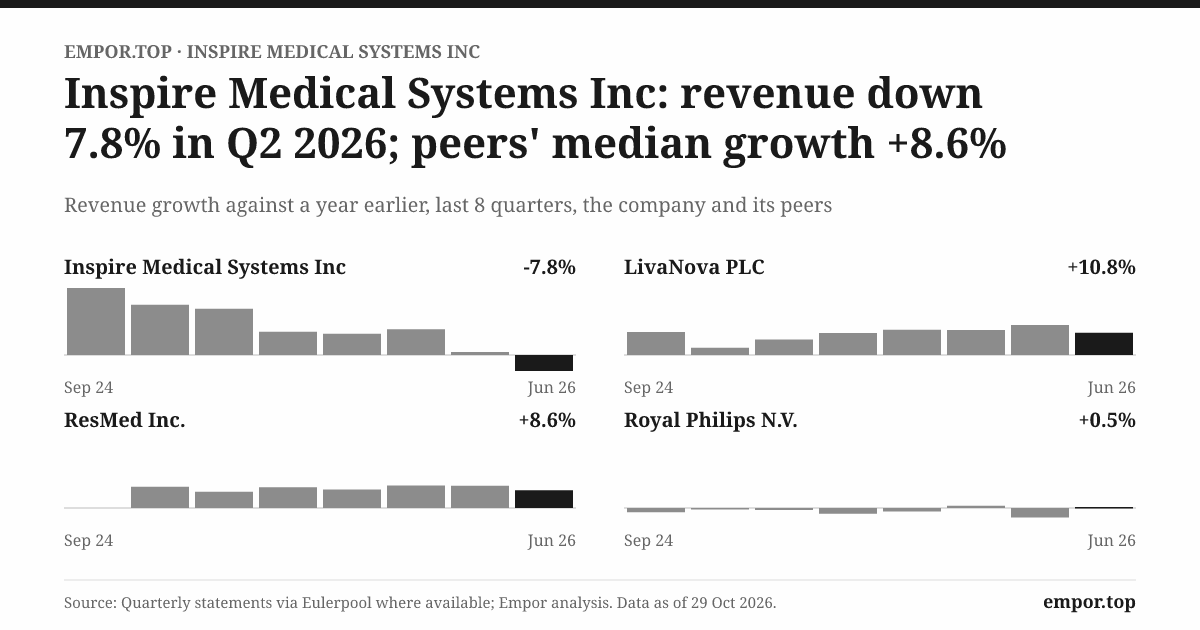
For Inspire Medical Systems, the cost of that pause was enormous. In the first quarter of 2026, management estimated that coding confusion and the Medicare pilot, known as WISeR, had taken about $20 million out of revenue.2 In the second quarter, the estimate was roughly $40 million, and revenue fell 7.6% from a year earlier to about $200.6 million.34
For the full year, management put the damage at somewhere between $120 million and $130 million.4 Twelve months earlier, investors had been arguing about how fast this company could grow. Now they were arguing about whether it could grow at all.
To understand why that was so jarring, look at what came before. Inspire sold about $8 million of product in 2015. In 2025 it sold $912 million, a rise of 13.6% on the prior year.1 Across that decade, revenue compounded at roughly 60% a year, the kind of curve that medical-device investors see a handful of times in a career.
Yet over the twelve months to June 2026, revenue was down about 8%.5 This was not a soft quarter inside a long expansion. It was the first time in the company's public life that the growth line pointed down.
So the questions this story has to answer are sharper than they look. Did Inspire build a durable therapy business, one that patients and surgeons would return to once the paperwork was sorted out? Or did it build a growth engine that only ran smoothly while the reimbursement system cooperated?
Can the founder who has led the company since 2007 restore growth without starving the product pipeline or burning through the cash pile? And when the company spent $175 million buying back its own shares in 2025, did it put surplus capital to work at the right moment, or did it spend ammunition it would soon need?1
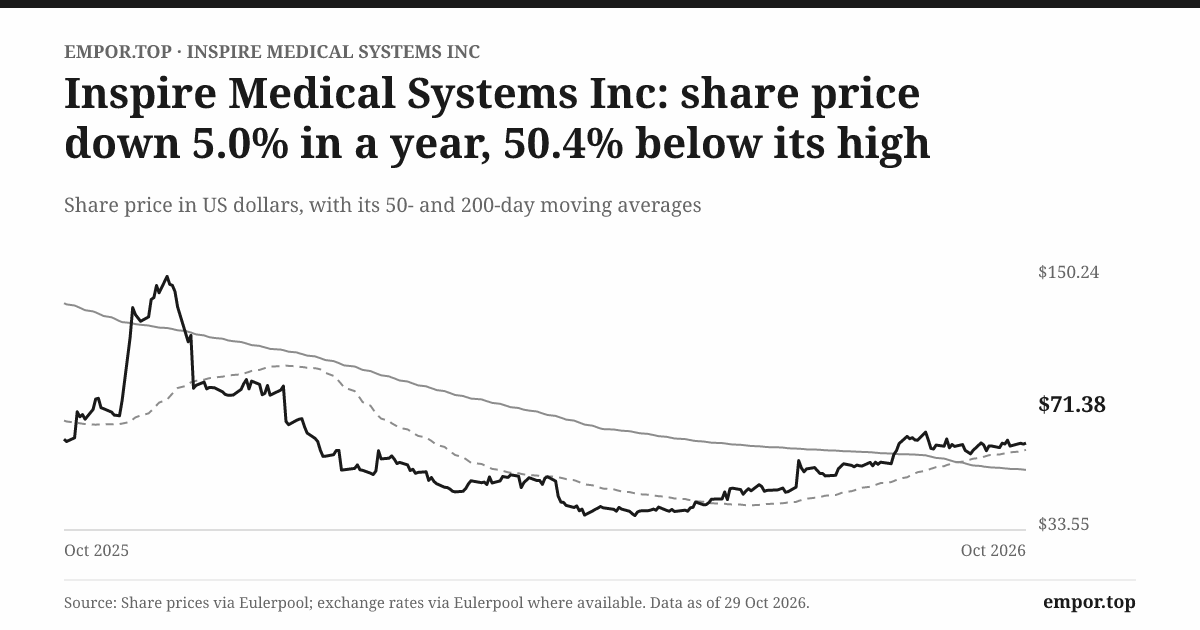
The market has already rendered a provisional opinion. On October 29, 2026, Inspire's shares closed at $71.38, about half their level at the 52-week high of nearly $144.6 That price is itself a rebound: at the low point of the past year, the shares changed hands below $40.6
The whole company is valued at about $2.1 billion, with roughly $1.8 billion of enterprise value once its cash is netted out.6 Four days from now, on November 2, Inspire will report its third-quarter results, and the next piece of evidence will arrive.6 This story stops just short of it.
To see how a company could get to $912 million of revenue and then trip over a billing code, the story has to go back to a lab inside Medtronic, and to the engineer who walked out of it with an idea that no insurer yet knew how to pay for.
 Subscribe on LinkedIn
II. From Medtronic's Lab to a Public Company
Tim Herbert spent eleven years at Medtronic, from 1996 to 2007, and the list of jobs he held there reads like a syllabus for the company he would later run: product development, clinical research, sales, marketing, and, tellingly, healthcare reimbursement management.7 He trained as an electrical engineer at North Dakota State University and added an MBA from the University of St.
Thomas in St. Paul.7 He is a Minnesota medical-device lifer in the most literal sense, a product of the Twin Cities ecosystem that grew up around Medtronic's pacemakers and spun out generations of companies built on the idea that a small electrical signal, delivered to the right nerve at the right moment, can change how a body behaves.
The idea Herbert carried out of Medtronic was that kind of signal. Obstructive sleep apnea happens when the muscles of the throat relax during sleep and the tongue and soft tissue fall back and block the airway. The sleeper stops breathing, the brain panics, the sleeper half-wakes, gasps, and drifts off again, sometimes dozens of times an hour.
Medtronic had worked on the concept of stimulating the hypoglossal nerve, which controls the tongue, since the 1990s.8 It was not a priority for one of the world's largest device makers. So in November 2007 the predecessor of Inspire Medical Systems was spun off from Medtronic, and Herbert became its chief executive.8
What followed was the long, quiet stretch that every medical-device startup has to survive and most do not. Inspire had to prove that the therapy worked well enough for the Food and Drug Administration, and it had to raise the money to do so privately. Before its stock market debut, the company had raised about $119 million from private placements of preferred shares.8 Much of that went into a single pivotal study.
The STAR trial began in 2010 at 22 centers and enrolled 126 patients who could not tolerate or did not benefit from continuous positive airway pressure, the mask therapy known as CPAP.8 The measure that matters in sleep apnea is the apnea-hypopnea index, essentially the number of times an hour a sleeper's breathing stops or becomes dangerously shallow. At the start of the trial the median patient was experiencing about 29 such events an hour.
Twelve months after implantation, the median had fallen to about nine, a reduction of roughly 70%.8 The results were published in the New England Journal of Medicine in January 2014.8 On April 30, 2014, the FDA approved Inspire's upper airway stimulation system for a subset of adults with moderate to severe obstructive sleep apnea who had failed or could not tolerate CPAP.9
It is tempting to treat that approval as the moment Inspire was born as a business. It was not. FDA approval told doctors the device was safe and effective. It said nothing about who would pay for it, how a hospital would bill for it, or how a patient who had given up on a mask years earlier would ever hear about it. The first full year after approval brought only modest revenue.8
Paying for the cure
The real work of the next six years was not engineering. It was persuading insurers. When Inspire filed to go public in April 2018, its prospectus described a coverage map that was still mostly a patchwork. About 230 commercial payors had reimbursed hospitals and surgery centers for Inspire procedures, but they had done so case by case through prior authorization, and only six commercial payors had written formal positive coverage policies.8 Medicare paid on a medical-necessity basis. Several large insurers still regarded the therapy as experimental.8
That is the context for what Herbert's team built. Each new coverage policy turned a slow, case-by-case fight into a routine approval, and each routine approval let a surgeon add another patient. The company went public on the New York Stock Exchange in May 2018 and raised about $112 million of net proceeds, followed by a December 2018 offering that raised another $69.8 million for the company while some early holders sold shares.10 Revenue that year was about $50.6 million.10
The money funded the playbook that made Inspire famous: a large direct sales force, direct-to-consumer television advertising that sent snorers to their doctors, and an army of reimbursement specialists who helped surgeons' offices win authorizations. Coverage broadened year after year. Today, all seven of Medicare's regional administrative contractors cover Inspire therapy when patients meet certain criteria, and the company says its therapy is covered for more than 300 million lives in the United States.1
Revenue followed the coverage map with remarkable fidelity, rising from about $115 million in 2020 to about $408 million in 2022, roughly three and a half times in two years.11 Further registered offerings in April 2020 and August 2022 kept the balance sheet full while losses continued.1
There is a version of the Inspire story that most investors carried around during those years. It goes like this: a brilliant device, a giant untreated population, and a company that simply had to sell into it. The record supports a more specific version. The device was differentiated, and the clinical data were real. But the growth curve bent upward not when the FDA approved the device, but when the payment system learned how to process it. Inspire spent its first decade turning a medical approval into a reimbursable procedure, one insurer at a time.
That distinction left an enduring question hanging over the company. How much of the growth came from a clinically superior device that patients would seek out regardless, and how much from the steady, laborious expansion of access, the kind of expansion that could, in principle, run backwards? The answer depends on understanding what Inspire actually sells, and to whom.
III. The Therapy Became a Sales Force and Reimbursement Business
Follow one patient through the system and count the people who have to say yes.
She is in her fifties, overweight but not severely so, and she has been told by a sleep physician that she stops breathing more than thirty times an hour. She was prescribed CPAP, wore the mask for a few weeks, and put it in the closet. Maybe she saw an Inspire television advertisement, or maybe her sleep doctor mentioned it. First, someone has to identify her as a candidate and refer her to an ENT surgeon trained in the procedure.
The surgeon needs to confirm that her anatomy fits, which until recently usually meant a separate procedure called drug-induced sleep endoscopy, in which a doctor puts the patient into an artificial sleep and threads a camera down the throat to see how the airway collapses. Then her insurer has to approve the operation in advance.
Then a hospital or ambulatory surgery center has to schedule an operating room, buy the device, perform the implant, bill the insurer, and get paid an amount that covers the cost of the device and the facility. The surgeon bills separately for the professional fee. Weeks later, the device is switched on and tuned.
Inspire is not paid by the patient, and it is not paid by the insurer. Its customer is the hospital or surgery center that buys the implant.1 That simple fact turns a medical-device company into something closer to a logistics company for a care pathway. A failure at any point, whether a referral that never happens, a surgeon with a full calendar, a denied authorization, or a hospital nervous about payment, delays a system sale.
The business model on paper is plain. Inspire sells its neurostimulation systems to hospitals and surgery centers, mostly through its own direct sales organization in the United States, with distributors covering a few markets in Asia.1 It recognizes revenue when a system ships or arrives, depending on the terms. Most customer contracts are short-term product sales with a single obligation: deliver the device.1 There is no subscription, no disclosed recurring revenue stream, and no minimum-purchase commitment that would guarantee next year's sales.1 Each dollar of revenue is earned one procedure at a time.
That has a hidden virtue. No single customer accounted for more than 10% of revenue in 2025, so no single hospital system can dictate terms.1 The less flattering corollary is that the company's real bargaining counterparty is not any one hospital but the payment system behind all of them.
About a quarter to almost a third of U.S. implants have historically been in traditional fee-for-service Medicare, nearly half in commercial insurance, and a further 15% to 20% in privately run Medicare Advantage plans.1 In practice, then, a few large insurers and one government program write the economics of every procedure Inspire's customers perform. The business is also concentrated geographically: almost 96% of 2025 revenue came from the United States.1
Eighty-five cents of gross profit, five cents of operating profit
Now look at what each dollar of revenue becomes. In 2025, for every $100 of systems Inspire sold, it kept about $85 after the cost of making them.1 That is the kind of gross margin usually associated with software, not hardware, and it has held at around 85% from 2023 through 2025.1 It reflects a device that is expensive to invent and validate but relatively cheap to manufacture, and a price that hospitals accept because the procedure is reimbursed.
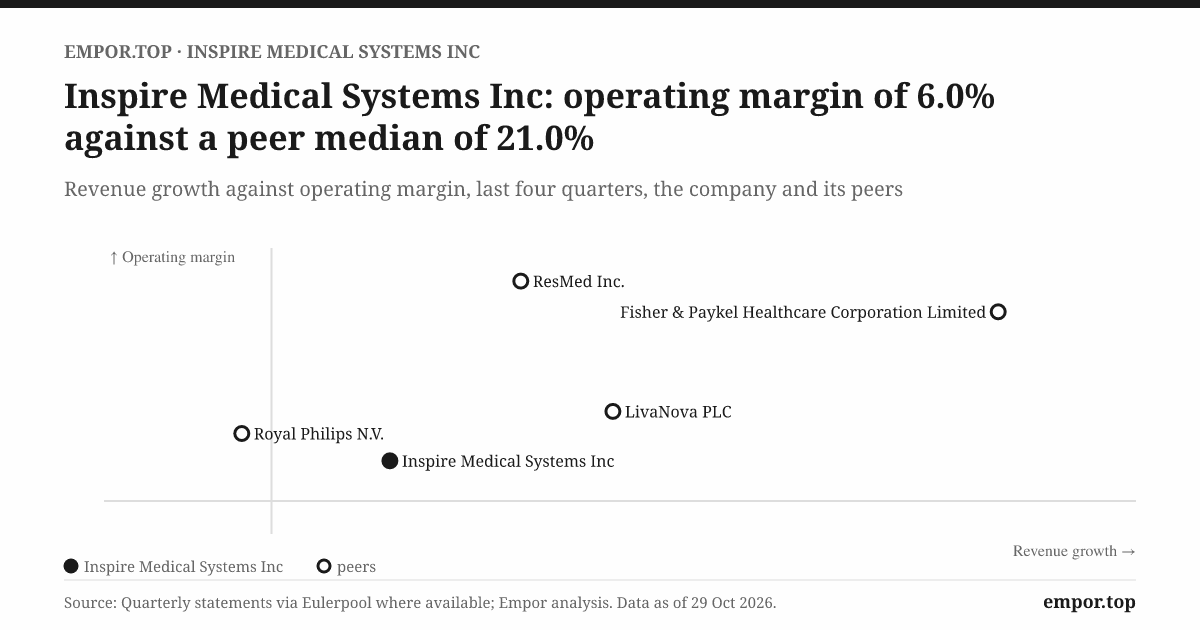
Then the expenses arrive. Selling, general and administrative costs consumed about $625 million in 2025, roughly 69% of revenue.1 Research and development took another $103 million.1 What was left was about $51 million of operating income, an operating margin of about 5.6%.1 Of every $100 of sales, about $85 survived manufacturing, and only about $5.60 survived the rest of the business.
That gap is the most important single fact about Inspire's economics. The device is cheap to make. Getting it into patients is not. The sales territories, field clinical representatives who attend implants and program devices, marketing to consumers, reimbursement support, physician training and the corporate overhead of a public company together absorb almost everything the gross margin produces. At the end of 2025 the company had 295 U.S. sales territories and 275 field clinical representatives.1
The trend, at least until 2026, was moving in the right direction. Inspire lost about $40 million at the operating line in 2023, earned about $36 million in 2024, and about $51 million in 2025.1 That is real operating leverage: revenue grew faster than the cost base, and the company crossed into profitability. But it is worth being precise about how far it went.
Three years of rapid growth took the operating margin from about minus 6.5% to plus 5.6%, a swing of roughly twelve percentage points.1 For a company whose gross margin sits above 85%, an operating margin in the mid-single digits says that the commercial machine remains the dominant cost, not a fading start-up expense.
There is a bull's reading and a bear's reading of the same structure. The bull says the commercial machine is the moat. It took a decade and hundreds of millions of dollars to build the coverage, the surgeon base and the patient-referral pipeline, and a rival would have to spend the same to catch up. The bear says the commercial machine is the business, and it is fragile. A company whose revenue depends on a long chain of approvals, each owned by someone else, has less control over its destiny than its gross margin implies.
In 2026, both readings were tested at once. The complexity that made Inspire hard to copy also made it vulnerable to a change in any single link of the chain. And just as one link, the payment code, began to wobble, a competitor arrived with its own FDA approval.
IV. The First-Mover Edge Meets Its First Serious Test
On August 8, 2025, more than eleven years after Inspire's original approval, the FDA approved a second hypoglossal nerve stimulator for American patients: the Genio system made by Nyxoah, a Belgian company.12 Its first U.S. commercial sales followed in September 2025.13 For the first time since 2014, a surgeon who wanted to implant a tongue-nerve stimulator in an American patient had a choice.
To understand what that choice means, it helps to understand what the therapy actually does. Think of the airway during sleep as a soft tube that can collapse when the muscles around it relax. CPAP keeps the tube open by blowing air into it through a mask, like inflating a balloon from the inside. Hypoglossal nerve stimulation takes the opposite approach: it keeps the tube open by pulling the tongue forward, like a guy wire holding up a tent.
Inspire's original system did this with three implanted pieces: a small pulse generator in the upper chest, a stimulation lead wrapped around a branch of the hypoglossal nerve, and a separate sensing lead placed between the ribs to detect breathing so that stimulation could be timed to each breath.1
Inspire V, approved by the FDA in August 2024 and launched in the United States in May 2025, moved the respiratory sensor inside the generator, so the sensing lead was no longer needed.1 That means a simpler, shorter operation for the surgeon, and, as the company says, a system that is less expensive to manufacture.1
The original FDA approval covered adults aged 22 and older with an apnea-hypopnea index between 20 and 65 who had failed or could not tolerate CPAP.9 Nyxoah's Genio approval, eleven years later, covered adults with an index between 15 and 65 who had failed, could not tolerate or were ineligible for standard treatments, a list that explicitly includes drug therapy such as tirzepatide.12
Genio stimulates both sides of the hypoglossal nerve, and Nyxoah has run trials in patients whose airways collapse in a ring-like pattern known as complete concentric collapse, a group that has historically been excluded from Inspire's labeling.13
Eleven years alone, then a rival
How strong is Inspire's position, really? The case for a durable edge rests on several things that are real. The first is evidence. Inspire has the longest clinical record in the category: the STAR trial with five-year follow-up, a registry called ADHERE, which completed a 5,000-patient real-world cohort by 2026, and a growing body of studies suggesting that patients on Inspire have lower rates of cardiovascular events than matched patients.2
The company reported revision and explant rates of 1.7% and under 1%, respectively, for 2024.2 It says surgeons have treated more than 135,000 patients with the therapy.2 In medicine, that kind of history builds trust.
The second is the installed base of skill. Every surgeon who has done dozens of Inspire implants has climbed a learning curve, and every hospital that has billed Inspire procedures for years has trained its coding staff around them. The third is coverage. Inspire spent a decade turning case-by-case approvals into written insurance policies, and a rival must either inherit those policies or fight for its own.
Now apply the hard test. A moat is proved by what customers do when they have a choice: whether they stay, whether they pay full price, whether a competitor wins business from them. On those questions, Inspire's disclosures are silent. The company does not publish market share, physician retention, price realization or competitive win rates. Until August 2025 there was no American competitor, so there was no record to test against. A first mover with no rival has, by definition, never lost a head-to-head contest, and it has never won one either.
Switching costs deserve the same care. For a patient who already has an Inspire implant, the switching cost is high: no one rips out a working neurostimulator to try a different brand. But that protects only the installed base of patients, and Inspire's revenue comes from new implants. For the next patient, the surgeon can choose either device. The friction lies with the surgeon and the hospital, which must learn a new procedure, a new programming system and a new reimbursement path. That friction is real, but it erodes with every surgeon Nyxoah trains.
Scale offers the strongest current reassurance. Inspire sold $912 million of systems in 2025.1 Nyxoah generated about €10 million of Genio sales in the same year, reported an operating loss of about €83.5 million and ended the year with about €48 million of cash and financial assets, alongside a going-concern discussion in its annual filing.13 At the close on October 29, 2026, the entire company was valued at about $94 million on trailing revenue of roughly $25 million.14 Nyxoah's entry matters because it is a credible, FDA-approved alternative with a broader indication.
It does not yet show that Inspire is losing meaningful share. When an analyst asked on the first-quarter call whether centers were shifting to the new device, Herbert said that coding and the Medicare pilot were dominating centers' attention, "much less having the ability to introduce a new topic," and the finance chief said the revised outlook included nothing new for competition.2 That is plausible, and also convenient: a period of billing chaos is a hard time for any new device to gain a foothold, and it will not last forever.
The boundary between the two companies is also being fought in the courts. Inspire sued Nyxoah for patent infringement in Delaware in May 2025; Nyxoah countersued in the same court in September, claiming that both Inspire IV and Inspire V infringe its patents, and in December it took a separate case to Europe's Unified Patent Court in Munich.1
Nyxoah has also challenged Inspire patents at the U.S. Patent Trial and Appeal Board.1 At the end of 2025, Inspire had accrued nothing for these disputes because it could not estimate an outcome.1 Neither side has won anything yet. The cases are a live test of how much of Inspire's position is legally protected, rather than proof in either direction.
The bigger substitutes
The more important competitors are not other implants. CPAP remains the first-line treatment for obstructive sleep apnea, and ResMed, which built its business on commercializing CPAP in the late 1980s, reported about $5.1 billion of revenue in the fiscal year to June 2025.15 That figure is not a like-for-like comparison, because ResMed sells masks, machines and software across sleep and respiratory care. It is a reminder of where most patients go first, and of the fact that Inspire's market is defined by the patients for whom the mask fails.
Then came the drugs. On December 20, 2024, the FDA approved Eli Lilly's Zepbound, a GLP-1-class weight-loss drug, as the first medication for moderate to severe obstructive sleep apnea in adults with obesity.16 Its trials ran for 52 weeks in 469 adults and produced a statistically significant reduction in breathing events compared with placebo.16 Inspire's management has argued that these drugs could help the business over time, because weight loss can bring heavier patients within the body-size range in which an implant works.14
On the second-quarter call, Herbert said the drugs did not "really change our overall demand for Inspire therapy as we move forward."4 But his own finance chief told investors in May that, in the short term, revenue was "being adversely impacted by their increasing prevalence and adoption," and the company's annual report lists patients delaying treatment while they try GLP-1 drugs among the reasons growth slowed in 2025.21 Management's two statements are not contradictory, but they do bound each other: the drugs may widen the funnel eventually, and they are narrowing it now.
So where does the evidence leave the moat? It narrows the claim rather than rejecting it. Inspire has a clinical lead, a trained surgeon base, broad coverage and the scale to outspend its only implant rival many times over. Those are genuine advantages. What the evidence does not support is the stronger claim that Inspire owns the category.
Its lead was earned partly by being first through the regulatory and reimbursement gates, and both gates are now open to others. The numbers that would confirm a durable edge are ones the company does not publish: share of new implants, surgeon retention, and pricing. The numbers investors can watch are U.S. implant-driven revenue growth now that Genio is on sale, and whether the coding fix arrives for Inspire alone or for the whole category.
That last point matters because the most damaging blow to Inspire in 2026 did not come from Nyxoah or from Eli Lilly. It came from inside the reimbursement system that Inspire had spent a decade mastering, and it arrived just as the company was launching the best product it had ever built.
V. Inspire V Arrived as the Billing Rules Changed
In January 2026, Inspire previewed its year-end numbers and its plans for the year ahead. Revenue for 2025 had come in at about $912 million, up roughly 14%, with fourth-quarter sales of about $269 million.17 Herbert called 2025 "a transition year for the company with the launch of the Inspire V system," and said that "momentum grew significantly throughout the second half of the year."17 The company guided to 2026 revenue of $1.003 billion to $1.013 billion, growth of 10% to 11%, and the billion-dollar milestone was there on the page.17
On coding, the tone was measured. Herbert described "recent reimbursement developments as a positive step" and said the company was working with the relevant agencies "to gain clarification on coding."17 The same release introduced a new chief financial officer, Matt Osberg.17
Within four months, that billion-dollar guidance was gone.
The mechanics are worth understanding in plain terms, because they are the whole story of 2026. Every procedure in American medicine is described by a Current Procedural Terminology code, maintained by the American Medical Association. Each code carries a payment that Medicare sets every year and that commercial insurers use as a reference in their contracts.
Inspire IV, the older system with its separate breathing-sensor lead, had its own code, 64582, which describes implanting a hypoglossal nerve stimulator together with a sensor.1 Inspire V had no sensor lead, so throughout 2025 surgeons billed its implants under a different, more general code for implanting a nerve stimulator, 64568.1 Commercial insurers, including the largest by volume, wrote that code into their policies.1
Then, after Medicare published its final 2026 payment rules in November 2025, the guidance for Medicare patients shifted. Inspire's annual report said the company believed the Inspire V procedure would move to the older 64582 code, together with a modifier, -52, which signals a reduced service.1 The company estimated that the modifier could cut the surgeon's professional fee by roughly 10% to 50% of the base rate, and warned that a large reduction "will likely influence physicians' willingness to perform the Inspire V procedure."1 That is the crux.
A surgeon's fee for this procedure is only a small fraction of the total bill, which is dominated by the hospital's payment for the device and the operating room. But a surgeon who suspects she will be paid half as much for a newer procedure than an older one has every reason to slow down, use the older device, or wait.
Then the situation became more confusing, not less. Medicare created a temporary facility code, known as a C-code, for Inspire V, with a hospital payment equal to that of the older procedure, and the regional Medicare contractors began writing it into their local policies.2 For surgeons, the contractors listed 64582 but were silent on whether a modifier was required.2 Commercial insurers stayed with 64568; UnitedHealthcare adopted that code into its policy in April 2026.2
The American Hospital Association's newsletter suggested a third option, an unlisted code that required manual review.2 So the same device could be billed one way for a Medicare patient and another way for a commercial patient, and a third way if a hospital followed the trade association's guidance. When an analyst asked on the first-quarter call why Medicare and commercial payers would use different codes for the same procedure, Herbert answered candidly: "it's just simply not typical. You just don't see events like this."2
On top of the coding confusion sat the Medicare pilot. WISeR, a program run by the Centers for Medicare & Medicaid Services from January 2026 through 2031, requires prior authorization, with artificial-intelligence-assisted review, for certain procedures in six states: New Jersey, Ohio, Oklahoma, Texas, Arizona and Washington.1 Traditional Medicare had not previously required prior authorization for Inspire procedures. Herbert told analysts that "all six of the WISeR states have a different system and there is variability in each."2 For a procedure that already demanded a long chain of approvals, the pilot added a new link.
Management's numbers, quarter by quarter
What makes this episode instructive is that management attempted to quantify it in real time, and then revised its quantification.
On May 4, Osberg reported first-quarter revenue up 1.6% to about $204.6 million and estimated that the coding and WISeR disruption had cost about $20 million.2 Then came the bigger number. Because commercial implants lag prior authorizations by about a quarter, and authorization submissions had fallen as hospitals "put on the brakes," as Herbert put it, the hit in the second quarter would be worse: about $40 million to $50 million.2
For the full year, the company estimated the total damage at $120 million to $150 million and cut its revenue outlook to $825 million to $875 million.2 It forecast a second-quarter revenue decline of 9% to 11% and an adjusted operating loss of $10 million to $15 million.2 Osberg stressed that the estimates reflected "high-level assumptions based on currently available data."2
The analysts on that call did what good analysts do and checked the arithmetic. One asked whether the entire guidance cut was due to reimbursement. Osberg conceded that it was not. The midpoint of guidance had fallen by more than the estimated coding damage, and "there's a gap there," he said; some of it came from GLP-1 drugs and some was "harder to put your finger on."2 Another asked how the company could estimate a $20 million effect at all, and Osberg described triangulating trends against last year and against expectations: "obviously there's estimation involved with that."2 Those answers deserve credit for honesty. They also show the limits of the figures: the coding impact is a management estimate built on a counterfactual, not an audited fact, and the company itself acknowledged that some of the slowdown sat outside it.
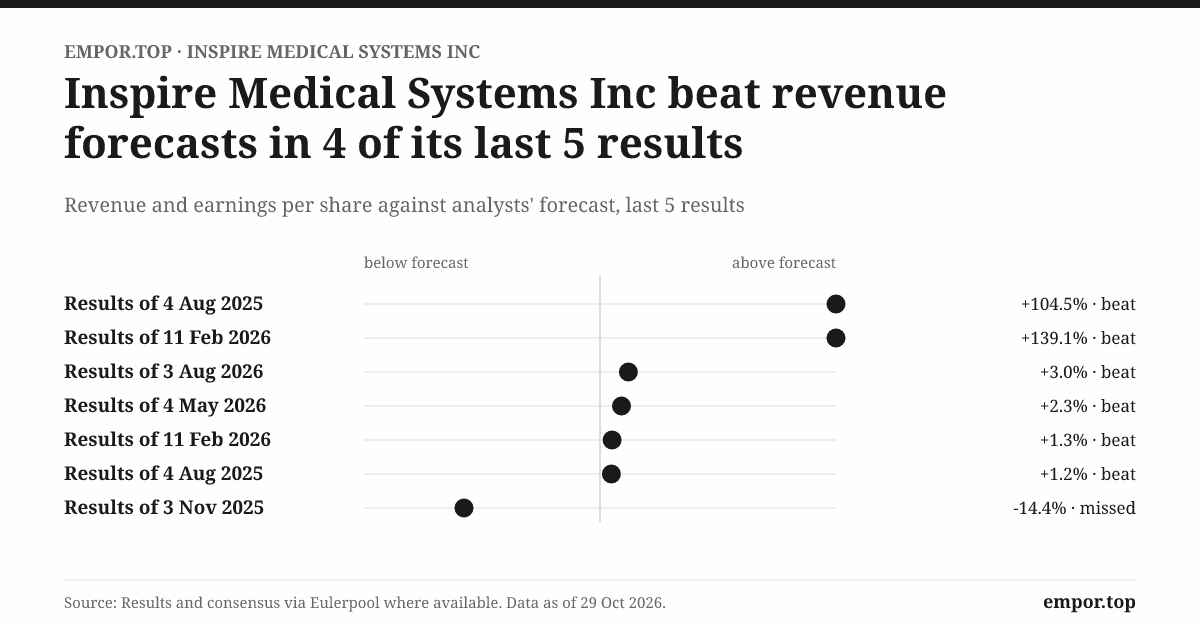
On August 3, the second-quarter numbers came in better than the May forecast. Revenue fell 7.6% to about $200.6 million, compared with the guided decline of 9% to 11%.32 Instead of the guided adjusted operating loss, the company reported adjusted operating income of about $3.2 million, and a small GAAP operating loss of about $0.5 million.3
Osberg estimated the second-quarter coding and WISeR impact at about $40 million, at the low end of the earlier range, and narrowed the full-year estimate to $120 million to $130 million.4 Guidance moved up modestly, to $835 million to $875 million.3 For the third quarter, the company guided to revenue down 8% to 10% from a year earlier, but up from the second quarter, with adjusted operating income around breakeven.4
Two things happened on the cost side. Operating expenses fell 7.4% year over year to about $172 million.3 And gross margin rose 150 basis points to 85.5%, which the company attributed to a higher mix of Inspire V.3 Herbert said Inspire V was "by far and away the majority" of second-quarter implants.4 The new device, in other words, was doing exactly what it was designed to do for the profit and loss statement: cheaper to make, so each sale was more profitable. What it could not do was make the procedure easier to bill.
The second-quarter call also revealed that the company's first attempt to fix the problem permanently had stumbled. A new code for a single-lead system had not been approved at the AMA's April panel meeting, and Inspire had filed a revised application jointly with another industry participant for the September meeting.4
On the payment side, Medicare's proposed 2027 rates offered some comfort: the hospital outpatient payment for an Inspire V procedure was proposed at about $35,400, up about 12%, and the surgery-center rate at about $31,700, up about 15%.4 The surgeon's proposed fee under 64582 was about $699, down about 4%.4 Of Medicare's regional contractors, two required the -52 modifier, with fee reductions that Herbert said had ranged from zero to 30% of the national average.4
The code arrives, on a long fuse
On October 1, 2026, Inspire announced that the AMA's CPT Editorial Panel had approved a new set of Category I codes that "accurately describe and include the Inspire V system," covering implantation of a single lead and a pulse generator.18 Herbert said the dedicated codes would "create a clearer, more consistent path for coding and reimbursement."18 It was a genuine victory for the company, and for the category.
It also came with a long fuse. The new codes are scheduled to take effect on January 1, 2028.18 Before then, Medicare must value them: a proposed valuation is expected in July 2027 and a final one in November 2027, after review by the AMA's relative-value committee and surveys of surgeons.18 For the whole of 2027, surgeons and hospitals will still be working with the bridge codes.
So was the 2026 setback a temporary coding detour, or a sign that Inspire had underestimated how much its growth depended on reimbursement mechanics? The fairest reading is both. The product itself did not fail. Gross margin rose, Inspire V became the dominant system, and second-quarter results beat the company's own cautious forecast.
But a company led by a former reimbursement manager launched a product without a code that fit it, at a time when Medicare was tightening its rules, and the result was a $120 million-plus hole in a single year's revenue. Management had been warned: the annual report spelled out the modifier risk in February.1 The January guidance, which excluded "any contribution from increased reimbursement," still assumed double-digit growth.17 That guidance did not survive the first quarter.
The AMA approval is a constructive step, not proof of recovery. The test from here is not another press release about codes. It is whether quarterly revenue returns to growth, whether prior-authorization submissions recover, and whether surgeons in the two contractor regions that require the modifier keep operating. And the person accountable for passing that test is the same founder who has run the company since the day it left Medtronic.
VI. Herbert's Reset: Cut Costs to Reinvest in Patient Access
There is a particular kind of pressure that falls on a founder-CEO when the growth story breaks for the first time. Tim Herbert had been the only chief executive Inspire had ever had. He took the company from a spin-off with an idea, through a decade of trials and coverage fights, to the doorstep of a billion dollars in revenue. In 2024 he also became chair of the board.7 By the summer of 2026, he was the man who had to explain why the doorstep had moved.
His answer was Project Horizon. Announced with the second-quarter results, the company framed it as a way to "create additional investment capacity to accelerate revenue growth," through aligning resources, streamlining the organization and consolidating production.3 The headline target was about $30 million of annualized capacity to redirect toward growth.3
The first phase was expected to cost $20 million to $25 million in pre-tax restructuring charges, of which about $4 million to $5 million would be employee-related and $16 million to $20 million would be non-cash, mostly impairment of production equipment held at a manufacturing vendor.34 Most actions were scheduled for the third quarter and were expected to be substantially complete by the end of 2026.3
Where would the freed-up money go? Herbert described patient access, education and support through the treatment journey: more investment in prior-authorization help through the company's SleepSync platform, and a post-implant engagement program called Inspire Connect.4 He was explicit that the benefit to patient flow would come mostly in 2027.4
That is an important clarification. Project Horizon is not a new product and not a new market. It is a reallocation of the existing budget away from overhead and toward the links in the care chain that broke in 2026. Its logic is coherent. Its return has not yet been demonstrated.
The manufacturing question
One element of Horizon carries more risk than the headline suggests. On the second-quarter call, Herbert said that "right now, our products are single sourced," and that the company was consolidating production while planning to bring on additional manufacturing sites.4 When an analyst asked whether dual-source manufacturing was being eliminated, Herbert replied: "We'll be able to provide more information in the near future."4 For a company that relies on contract manufacturers and some sole-sourced components, any production transition introduces quality and continuity risk.1 It also sits on top of a large inventory position.
Inventory rose from about $80 million at the end of 2024 to about $145 million a year later, and to about $170 million by June 2026.15 Inspire's auditor singled out the reserve for excess and obsolete inventory, about $1.3 million at the end of 2025, as a critical audit matter because estimating future demand across product generations requires judgment.1
The company already took a $2.1 million charge in 2025 for excess Inspire IV components.1 A supply-chain consolidation that writes down vendor equipment, during a year when demand forecasting has been unusually hard, is precisely the moment to watch that reserve.
The CFO changed hands just as the storm hit. Matt Osberg became chief financial officer in early 2026, succeeding Richard Buchholz.7 Osberg came from outside medical devices: he had been chief financial officer of Apogee Enterprises, a glass and architectural-products company, and before that of Helen of Troy, the consumer-products group, after earlier finance roles at Best Buy and a decade at Ernst & Young.7 That background matters for one reason. His first two earnings calls were spent quantifying a reimbursement shock in a device business, and his answers, including the admission of a "gap" the coding estimate did not explain, were notably direct.
Herbert's own alignment was meaningful but not controlling. He beneficially owned about 1.1% of the shares in March 2026, including options and trust holdings, and had pledged 39,390 shares as collateral for a personal line of credit, an arrangement approved under the company's insider-trading policy.7 His reported compensation for 2025 was about $7.7 million, most of it, about $6.0 million, in stock awards, with a cash incentive of about $0.96 million.7
That incentive came from a management plan that paid out at 111.4% of target, based on revenue, operating income, patient-flow measures, product-development goals and inventory days.7 The design is sensible: it ties pay to more than one accounting number, and the inventory-days metric is notable given what happened next. But a skeptical shareholder could fairly point out that the plan paid above target for a year whose closing message, launch momentum, was followed within weeks by a cut of roughly $150 million to the year's revenue outlook, and that inventory days in fact rose sharply over 2025.1
Shareholders registered their own views at the April 2026 annual meeting. The say-on-pay vote passed comfortably, with about 22.5 million votes for and 0.6 million against.19 But the amendment to the company's incentive plan, which governs future equity grants, drew about 8.8 million votes against and 14.3 million for, roughly 38% opposition.19 Director Gary Ellis received about 5.9 million withheld votes, far more than any other nominee.19 Eight of nine continuing directors are independent; Herbert combines the roles of chair and chief executive.7 None of this amounts to a governance crisis. It does show a shareholder base willing to say no to more dilution.
Two legal matters also sit in the background. A securities class action filed in December 2025 alleges that the company made misleading statements about the Inspire V launch between August 2024 and August 2025; a derivative suit followed in January 2026, and no loss has been accrued.1 Separately, the Department of Justice issued a civil investigative demand in January 2025 relating to the False Claims Act and Anti-Kickback Statute, and the company says it is cooperating.1 Neither matter has a disclosed financial estimate, and neither has been resolved.
Measured over 2026, management's record is mixed in an instructive way. The January message overstated the year badly. The May reset was large, specific and accompanied by an admission of uncertainty. The August results beat the reset, and the full-year damage estimate narrowed. That pattern, over-optimism followed by conservative re-basing, is common in companies that have hit their first real wall. The question is which version of management investors will meet from here.
The skeptical investor's challenge to Horizon is simple. The commercial machine is the competitive advantage. The company had already cut U.S. sales territories from 335 at the end of 2024 to 295 a year later, and to about 280 by mid-2026, even as it built out field clinical representatives to about 300.14
When an analyst asked in May how much of the territory reduction was planned and how much was attrition, Herbert answered that it was "a combination of both."2 Cutting overhead to fund prior-authorization help is a reasonable trade. Cutting the commercial and clinical-support effort that drives procedure volume would be a dangerous one. The disclosures so far describe the former, and the proof will be whether implant growth returns in 2027.
There is another way to judge whether the turnaround is real, and that is to look past the income statement into the cash.
VII. The Profits Were Real; the Earnings Story Was Not That Simple
In 2025, Inspire's net income jumped to about $145 million, nearly three times the previous year and the best result in the company's history.1 On a per-share basis, earnings almost tripled. A casual reader of a stock screener would conclude that the business had taken a dramatic step up in profitability. It had not.
The clue is in the tax line. For years, Inspire had accumulated losses that could be used to offset future taxes. Accounting rules require a company to hold a valuation allowance against those tax assets until it is confident it will earn enough profit to use them. In 2025, having turned profitable, Inspire released most of that allowance and booked a one-time deferred tax benefit of about $88.8 million.1 Pretax income was about $65.7 million; the tax benefit turned it into $145 million of net income.1 Strip out that release, and the year's underlying profit was a fraction of the headline.
The operating line tells the cleaner story. Operating income rose from about $36 million in 2024 to about $51 million in 2025.1 That is real improvement, but the step is measured in tens of millions, not in the hundred-million-dollar leap the net-income figure implies. And the tax benefit has a mirror image. In the first quarter of 2026, the company's effective tax rate was 571%, because share awards vesting at a stock price far below their grant price created tax shortfalls.2 When the stock falls, stock-based compensation does not just dilute shareholders. It also flows through the tax line.
Following the cash
Over the eleven years from 2015 to 2025, Inspire's cumulative net income was a loss of about $76 million. Its cumulative cash from operations was positive, about $105 million.111 How can a company that lost money overall generate cash? The main answer is stock-based compensation, an expense on the income statement that does not use cash.
In 2024 alone it amounted to about $116 million, and it rose again in 2025, partly because of accelerated recognition for retirement-eligible employees.1 To put that in perspective, 2024's stock compensation was more than three times that year's operating income. Shareholders pay that cost through dilution rather than through the bank account, which is why buybacks and share counts matter so much later in this story.
Working capital moves cash between periods too. In the first half of 2026, falling receivables released about $16 million of cash as revenue shrank, while rising inventory absorbed about $25 million.5 That is a characteristic pattern of a business whose sales have slowed faster than its supply chain: customers owe less, and the warehouse holds more.
Then there is investment in the business itself. Capital spending, on manufacturing equipment and tooling for Inspire V, the SleepSync software platform, and IT and facilities, ran at about $38 million to $39 million a year in 2024 and 2025.1 Over the full decade, capital spending more than consumed the operating cash: cumulative free cash flow from 2015 to 2025 was negative, about $19 million.111
The recent record is better. Free cash flow was about $91 million in 2024 and about $78 million in 2025, a clear sign that the business had become self-funding at the operating level.1 But two good years after a decade of burn do not make a long cash-generation record. They establish a starting point.
The treasury cushion
At the end of June 2026, Inspire held about $415 million of cash and investments and had no funded borrowings.35 The portfolio is conservative, consisting of U.S. Treasuries, investment-grade corporate debt, commercial paper and money-market funds, with nothing maturing beyond three years.1 It also generates income that matters.
In 2025, other income, mostly interest and dividends, was about $14.7 million, roughly a fifth of pretax income.1 In the second quarter of 2026, when the company posted a small operating loss of about $0.5 million, interest and dividend income of about $3.7 million kept pretax income positive.5 In a quarter of weak operating profit, the treasury, not the business, produced the reported earnings.
The balance sheet is strong but not costless. Operating leases add about $41 million of future commitments, and purchase obligations to suppliers, mostly for inventory, stood at about $90 million at the end of 2025.1 Neither is borrowing, but both are claims on cash. Other income in 2025 also included a $4.0 million impairment on a strategic investment, a reminder that the company's smaller external bets do not always work.1 Inspire has not built its strategy around acquisitions; its main capital decisions have been internal product investment, the treasury portfolio and, in 2025, share repurchases.
Research and development deserves a note of its own here. Reported R&D expense fell from about $117 million in 2023 to about $103 million in 2025, from almost 19% of revenue to about 11%.1 Part of that is accounting: about $12.7 million of 2025 product-development costs were allocated to cost of goods and inventory rather than expensed as R&D.1
Even adjusting for that, the company is spending a smaller share of revenue on future products than it did two years ago, and Project Horizon is designed to shift spending further toward patient access. That may be the right choice for a company whose bottleneck is billing rather than technology. It does put more weight on the current product line.
So the conclusion is balanced but clear. The operating improvement of 2024 and 2025 was real, and the business generated positive free cash flow in both years. But the 2025 earnings headline was mostly a tax event, stock compensation is a large real cost that the cash flow statement hides, and the latest quarters show a business whose operating profit is near zero while interest income props up the bottom line. That raises the question that any shareholder in 2025 should have asked: with growth slowing and a reimbursement risk already disclosed, was the cash better kept or returned?
VIII. The Buybacks: A Return of Capital Before the Growth Test Was Settled
On August 11, 2025, Inspire's board authorized a new share repurchase program of up to $200 million, running until August 2027.1 It came on top of a $150 million authorization in 2024, part of which had been used for an accelerated share repurchase that retired about 409,000 shares at an average price of roughly $190.1
By the end of 2025, the company had spent $100 million under the new program, buying about 1.08 million shares, and $100 million of authority remained.1 In November and December alone, it bought about 524,000 shares at average prices between about $88 and $99.1 Including the earlier authorization, total repurchases in 2025 came to about $175 million.1
Set that number beside the business's own cash record. In 2025, free cash flow was about $78 million.1 The company spent more than twice that buying back stock, drawing down its cash and investments from about $446 million at the end of 2024 toward $405 million at the end of 2025, with taxes paid on employee equity awards contributing to the decline.1
Across the full decade, cumulative free cash flow was negative. The buybacks were not a distribution of surplus cash the business had reliably produced over many years. They were a deliberate decision to deploy part of the capital raised from equity investors back into the company's own stock, made while product investment, a new manufacturing footprint and a launch were all still underway.
Did the share count actually fall?
It did, briefly. Shares outstanding fell from about 29.7 million at the end of 2024 to about 28.6 million at the end of 2025.1 By June 2026, the count had climbed back to about 28.9 million as equity awards vested and were settled.5 Some of the reduction the buyback bought was therefore given back within six months by the same stock awards that flatter the cash flow statement. That is the mechanism to keep in mind: a company that pays its people heavily in stock must keep buying shares just to stand still.
What the board paid
It is easy to judge buybacks with the benefit of the subsequent share price, and it is not entirely fair. The shares closed at $71.38 on October 29, 2026, well below the prices paid in late 2025 and less than half the 52-week high of about $144.6 The earlier accelerated repurchase, at around $190 a share, looks worse still. But the right question is not whether the stock later fell. It is whether, at the time, the board had a well-supported view that the shares were worth more than it paid, and whether the purchases left the company enough capacity to fund its growth.
On the first test, the timing is uncomfortable. By the second half of 2025, growth had already slowed from above 20% to the low teens.1 Management's own annual report was about to describe the modifier risk to Inspire V's physician fee, a securities class action was filed over statements about the launch, and patients were delaying treatment while they waited for Inspire V or tried GLP-1 drugs.1 Buying back shares in volume in November and December 2025, weeks before the coding confusion became visible in the numbers, was a bet that those risks were small. They were not.
On the second test, the evidence is more reassuring for now. At the end of June 2026, the company held about $415 million of cash and investments with no debt, and Project Horizon is funded by reallocating existing spending rather than by new capital.3 There is no sign yet that the buybacks starved the business. Notably, management has said little about repurchases since the reset; none of the 2026 earnings materials made them a theme.
A skeptical investor, the kind who writes letters to boards, would put the challenge bluntly. Why buy back $175 million of stock in a year when growth was decelerating, inventory was nearly doubling and a reimbursement risk was already visible in the company's own filings? Why let equity compensation claw back part of the reduction within months? And why keep $100 million of authority outstanding while revenue is falling?
The board's best answer would be that the company had more cash than it could deploy at good returns, that the shares were cheap relative to long-term value, and that the balance sheet remains strong even after the purchases. That answer can only be judged against what comes next: operating cash flow, capital spending, share count and, above all, whether implant growth returns.
The repurchases were a claim about priorities. They said the business was durable enough that returning capital came before building a cushion. The rest of the story is a test of that claim.
IX. Analysis & Bear vs. Bull Case
On October 29, 2026, an investor scanning valuation screens would have found Inspire looking almost absurdly cheap by its own history. The shares traded at about 15.5 times trailing earnings, against a five-year median of about 72 times.6 The free cash flow yield was about 5.6%.6 The stock sat at roughly half its 52-week high, after a fall of almost 88% from peak to trough at its worst point over the past five years.6 On the surface, this is the profile of a fallen growth stock priced for permanent damage.
Look one layer deeper and the cheapness becomes less clean. The trailing earnings behind that 15.5 multiple include the one-time tax benefit from 2025, so the multiple is flattered by an accounting event that will not recur. On operating measures, the stock is not cheap at all: the enterprise is valued at about 21.5 times EBITDA and about 33 times operating profit.6
The five-year median P/E reflects a completely different regime, when the company was growing 25% to 100% a year and investors paid for the curve. A low multiple against that history says mainly that the market no longer believes in the curve. The price on screen is asking a narrower question: will Inspire's operating profit, today a mid-single-digit share of revenue, grow into the valuation once procedure growth resumes?
The bull case begins with what Inspire has that no one else has at scale. It has more than a decade of FDA-approved commercial experience, the deepest clinical evidence base in the category, coverage the company says reaches more than 300 million American lives, a trained network of surgeons and field clinical representatives, and gross margins above 85% that are moving up as Inspire V takes over the mix.13
None of these assets were destroyed in 2026. The payment chain is being repaired: Medicare proposed higher 2027 facility payments, and the AMA approved dedicated codes.418
In the bull's telling, the 2026 revenue gap is mostly deferred demand. Herbert said in May that patients waiting on authorization "still require treatment," and that the company was working to keep them in the funnel.2 If even part of that backlog converts in 2027, while Project Horizon redirects $30 million toward authorization support and patient engagement, revenue could return to growth without the company needing a new product or a new market. And because Inspire V is cheaper to make, each recovered procedure would carry more gross profit than it did in 2024.
The bear begins from a different observation: this is a single-therapy business, concentrated in the United States, whose sales depend on decisions by people the company does not control. Almost all revenue comes from one family of devices sold into one healthcare system.1 The 2026 decline showed how quickly a change in coding rules can interrupt growth, even for a therapy with a strong clinical case.
The dedicated code does not take effect until 2028, so 2027 will still run on bridge arrangements and contractor-by-contractor modifier policies.184 The Medicare pilot may expand to more states; Herbert acknowledged as much and said the company was preparing so that it "doesn't have as much of a disruptive effect."4
Meanwhile the choice set for patients is widening. A second FDA-approved implant with a broader indication is on sale, and a drug class that was barely part of the sleep apnea conversation three years ago now carries its own FDA approval for the condition.1216 Management itself has said that GLP-1 drugs are hurting revenue in the near term.2 And the high gross margin on the new device did not prevent revenue from falling. The bear would say the 2026 episode was not an accident but a preview: when the payment system wobbles, Inspire's revenue wobbles with it, because its demand passes through so many hands.
Who really holds the power
Run the industry through Michael Porter's five forces and the picture sharpens. Buyer power is the decisive force, but it does not sit where one might expect. The hospitals and surgery centers that buy the device are fragmented, and none accounts for more than a tenth of revenue.1
The real buyers are the payors behind them, which set the codes, rates and authorization rules; 2026 showed what happens when they change them.1 That is concentrated and powerful buyer influence.
Supplier power is moderate and rising in importance. Inspire depends on contract manufacturers and some sole-sourced components, and its products are currently single-sourced while it consolidates production.14 A supply disruption would not raise costs so much as stop sales.
The threat of substitutes is high and diverse. CPAP remains the first-line therapy; oral appliances and surgery exist; and GLP-1 drugs are now an approved alternative for many patients with obesity.1516 The threat of new entrants was low for a decade, because a new hypoglossal stimulator needed its own pivotal trial and FDA approval, but Nyxoah's arrival proved the barrier can be crossed.12 Rivalry among implant makers is currently limited by sheer scale difference, though litigation in two jurisdictions shows it is already intense where it counts.1
Taken together, the five forces describe an attractive niche with one dominant risk: the buyer is the payment system, and the payment system can change the rules.
Hamilton Helmer's seven powers offer a stricter test, because each power requires both a benefit and a barrier that keeps rivals from copying it.
Scale economies exist at the commercial level. Inspire's sales, clinical-support and reimbursement infrastructure is spread across roughly $900 million of revenue; a small rival must carry a similar fixed cost on a fraction of the volume, which is part of why Nyxoah lost far more than it sold in 2025.13 That is a real advantage, but it is a cost advantage over a weak rival, not a barrier against a well-funded one.
Switching costs apply to implanted patients, who will not change devices, and to some extent to surgeons and hospitals, which have learned Inspire's procedure, programming and billing. They do not apply to the next patient's choice, and that is where revenue is earned.
Brand is plausible. Inspire has spent years advertising directly to consumers, and the company name has become shorthand for the therapy among some patients and physicians. But the company does not publish the evidence that would prove brand power, such as price premiums or referral share.
Cornered resource is the power most often claimed for Inspire and least supported. The FDA approval, the coverage policies and the patents were exclusive for a decade, but the approval is now shared, coverage can be won by others, and the patent fight is unresolved.112 Counter-positioning, network economies and process power do not obviously apply.
So the honest scorecard is two powers with real evidence, scale and switching costs, both narrower than they first appear, one plausible power in brand, and a cornered-resource claim that the events of 2025 and 2026 have weakened. That is a good business position. It is not an impregnable one.
Why does Inspire win from here? Because its starting position is far ahead of anyone else's: more clinical data, more trained surgeons, more payor relationships and more revenue to spend on all of them. If the reimbursement environment stabilizes, the company with the largest commercial machine is the best placed to capture the demand. These are credible assets. But the filings do not provide market share, win-loss records or surgeon retention, so the durability of the edge rests on inference rather than proof.
Why might it not? Because 2026 showed that the higher-margin product did not prevent the decline; because a payor can change a code faster than a company can retrain its customers; because Nyxoah is now approved for a broader patient group; and because weight-loss drugs may substitute for implants among some patients even as they help others qualify. The risk is less a single knockout than a slow narrowing: lower growth, more competition and more reimbursement friction compressing a business that needs volume to cover its commercial cost base.
It is worth keeping technology disruption in proportion. Artificial intelligence is not the immediate threat to an implanted neurostimulator. Ironically, the most direct AI touchpoint in this story is on the payor side: the WISeR pilot uses AI-assisted review to decide prior authorizations.2 The real threats are alternative therapies, coding and reimbursement policy, surgeon capacity and supply continuity.
Three measures will decide which case is right. The first is quarterly revenue growth, which fell from 12.6% in the fourth quarter of 2025 to minus 7.6% in the second quarter of 2026.173 The company does not report implant counts each quarter, so revenue is the closest public proxy for procedure volume. The second is the prior-authorization trend, which management described as declining in the first quarter and improving in the second, but does not quantify.42
Because commercial implants lag authorizations by about a quarter, it is the earliest signal. The third is inventory against demand: inventory reached about $170 million in June 2026, up from about $80 million eighteen months earlier, while revenue fell.5 If demand recovers, that stock becomes sales; if not, it becomes write-downs.
Pair those with operating margin and stock compensation to judge whether recovered growth turns into per-share value. Valuation, in the end, is a test of what normalized earnings look like once the tax benefit is gone, the coding fog lifts and the company decides how much of its gross margin it must keep spending to sell the device. The market, at $71, is pricing a recovery, but not a return to the old growth regime.
X. Playbook: Business & Investing Lessons
Inspire's decade is one of the great commercialization stories in modern medical devices: an implant that grew from an $8 million business in 2015 to $912 million in 2025, then watched a coding dispute push its revenue below the previous year's.18 Its lessons are not generic. They belong to this company and this moment.
The first lesson is that a therapy can be clinically proven and still wait at the billing desk. Inspire V was approved by the FDA, liked by surgeons and cheaper to make, and in early 2026 its procedures slowed anyway because no one was sure which five-digit code to put on the claim.
For founders in regulated industries, approval is the first of several gates, and the last gate, payment, is often the one controlled by the most people. For investors, the question about a medical device is never only "does it work?" but "who has to agree it should be paid for, and how often do they change their minds?"
The second lesson is that a high gross margin is not the same as a high operating return. Inspire keeps about $85 of every $100 after making the device and about $5.60 after selling it.1 The gap is the cost of the care pathway: territory managers, clinical reps, consumer advertising, authorization support. A device business that must build the market around its product will spend most of its gross profit doing so, and the operating margin, not the gross margin, tells you how close it is to finishing the job.
The third lesson is that cash can tell a better story than earnings, or a less flattering one. Over a decade, Inspire lost money on paper and generated cash from operations, because stock compensation is a cost the cash flow statement does not show. Then, in 2025, its earnings nearly tripled on a tax release while operating profit rose modestly. In either direction, the headline number misled. Investors who read the cash flow statement, the stock compensation line and the tax note together saw the business as it was.
The fourth lesson is that returning capital is a claim about priorities. Inspire spent $175 million on its own shares in 2025, more than twice that year's free cash flow, in the months before its growth broke.1 Some of the reduction in shares was undone by equity awards within six months.5 A buyback is not just a financial transaction. It is the board's statement that the business is durable enough to need less cushion, and the market will grade that statement on what happens next.
XI. Epilogue
Tonight, Inspire stands at a hinge. Its shares have more than recovered from their lows of the past year but remain about half below their peak.6 It holds about $415 million of cash and investments with no debt.3 It has a new chief financial officer, a restructuring program finishing its first phase, and an AMA decision that gives its newest product a code of its own, starting in 2028.18 And on Monday, November 2, after the market closes, it will report its third-quarter results.6
The company has told investors what to expect: revenue down 8% to 10% from a year earlier, but up from the second quarter's $200.6 million, with adjusted operating income around breakeven, inside a full-year range of $835 million to $875 million.34 The third quarter was also expected to include most of Project Horizon's restructuring charges, including the non-cash impairment of vendor production equipment.4 Investors will be listening for things that numbers alone cannot show.
The first is whether management can separate the coding effect from underlying patient demand. In May, the finance chief admitted that the guidance cut was larger than the coding estimate and that part of the gap was hard to pin down.2 If the coding damage keeps narrowing while revenue does not recover, the unexplained part of the slowdown, GLP-1 drugs, surgeon capacity, competition, becomes the story.
The second is whether the bridge codes are producing dependable payment, and whether prior authorizations are improving in the six WISeR states. Herbert said the company had learned that each state ran a different system.2 If the program expands, as he acknowledged it could, the learning curve starts again in new states.4
The third is the supply chain. Gross margin should keep rising as Inspire V dominates the mix; if it does not, the manufacturing consolidation may be costing more than planned. Inventory and the obsolescence reserve are the places a transition shows strain first.
The fourth is whether Project Horizon shows up in patient flow rather than merely in the expense line. The company has promised the benefits mainly in 2027.4 Savings are easy to announce and easy to measure. Procedures recovered through better authorization support are the only proof that matters.
And the fifth is the capital question. With $100 million of buyback authority still outstanding, every quarter is a fresh decision about whether to buy shares or keep the cushion.1
A strong third quarter would not settle the debate, but it would suggest the 2026 shock was a detour on a long road. A weak one, especially weak revenue alongside an improving coding picture, would suggest the road itself has narrowed. The October code approval improves the path. It does not walk it.
XII. Outro
Somewhere tonight, a patient who once gave up on a CPAP mask is asleep without one. A small device in her chest senses each attempt to breathe and sends a pulse to the nerve that moves her tongue, and her airway stays open until morning. She does not think about procedure codes, Medicare contractors, prior-authorization portals or the hospital billing office that argued over how to describe her operation.
That is the strange genius and the strange vulnerability of Inspire Medical Systems: its growth depends on an entire chain of people agreeing that the device works and that the procedure is worth paying for. For a decade, Tim Herbert's team built that chain one surgeon, one insurer and one hospital at a time. In 2026, one link slipped, and the whole machine slowed. The next chapter will be written not in the operating room, where the therapy has already proven itself, but in the daytime world of codes and claims, where Inspire must prove it again.
References
-
2025 Form 10-K — Inspire Medical Systems, Inc., 2026-02-13 ↩↩↩↩↩↩↩↩↩↩↩↩↩↩↩↩↩↩↩↩↩↩↩↩↩↩↩↩↩↩↩↩↩↩↩↩↩↩↩↩↩↩↩↩↩↩↩↩↩↩↩↩↩↩↩↩↩↩↩↩↩↩↩↩↩↩↩↩↩↩↩↩↩↩↩↩↩↩↩↩↩↩↩
-
Q1 2026 Earnings Call Transcript — Inspire Medical Systems, Inc., 2026-05-04 ↩↩↩↩↩↩↩↩↩↩↩↩↩↩↩↩↩↩↩↩↩↩↩↩↩↩↩↩↩
-
Q2 2026 Earnings Release — Inspire Medical Systems, Inc., 2026-08-03 ↩↩↩↩↩↩↩↩↩↩↩↩↩↩↩↩
-
Q2 2026 Earnings Call Transcript — Inspire Medical Systems, Inc. via Stock Analysis, 2026-08-03 ↩↩↩↩↩↩↩↩↩↩↩↩↩↩↩↩↩↩↩↩↩↩↩↩↩↩
-
Q2 2026 Form 10-Q — Inspire Medical Systems, Inc., 2026-08-03 ↩↩↩↩↩↩↩↩
-
Inspire Medical Systems Statistics & Valuation — Stock Analysis, 2026-10-29 ↩↩↩↩↩↩↩↩↩↩↩
-
2026 Proxy Statement — Inspire Medical Systems, Inc., 2026-03-20 ↩↩↩↩↩↩↩↩↩
-
Form S-1 — Inspire Medical Systems, Inc., 2018-04-06 ↩↩↩↩↩↩↩↩↩↩
-
PMA P130008, Inspire Upper Airway Stimulation System — U.S. Food and Drug Administration, 2014-04-30 ↩↩
-
2018 Annual Report — Inspire Medical Systems, Inc., 2019-02-27 ↩↩
-
Inspire Medical Systems Investor Relations — Inspire Medical Systems, Inc. ↩↩↩
-
PMA P240024, Nyxoah Genio System 2.1 — U.S. Food and Drug Administration, 2025-08-08 ↩↩↩↩↩
-
Nyxoah Stock Price & Overview — Stock Analysis, 2026-10-29 ↩
-
FDA Approves First Medication for Obstructive Sleep Apnea — U.S. Food and Drug Administration, 2024-12-20 ↩↩↩↩
-
Q4 and FY2025 Preliminary Results and 2026 Outlook — Inspire Medical Systems, Inc., 2026-01 ↩↩↩↩↩↩↩
-
Inspire Medical Systems Announces Approval of New Hypoglossal Nerve Stimulation CPT Codes by the AMA Editorial Panel — Inspire Medical Systems, Inc., 2026-10-01 ↩↩↩↩↩↩↩
-
2026 Annual Meeting Results, Form 8-K — Inspire Medical Systems, Inc., 2026-05-05 ↩↩↩
 LinkedIn
 WhatsApp
 Reddit
 Hacker News
 Email
 Kindle
 RSS Feed
 Spotify
 Apple Podcasts
 Amazon Music
 Audible
 YouTube