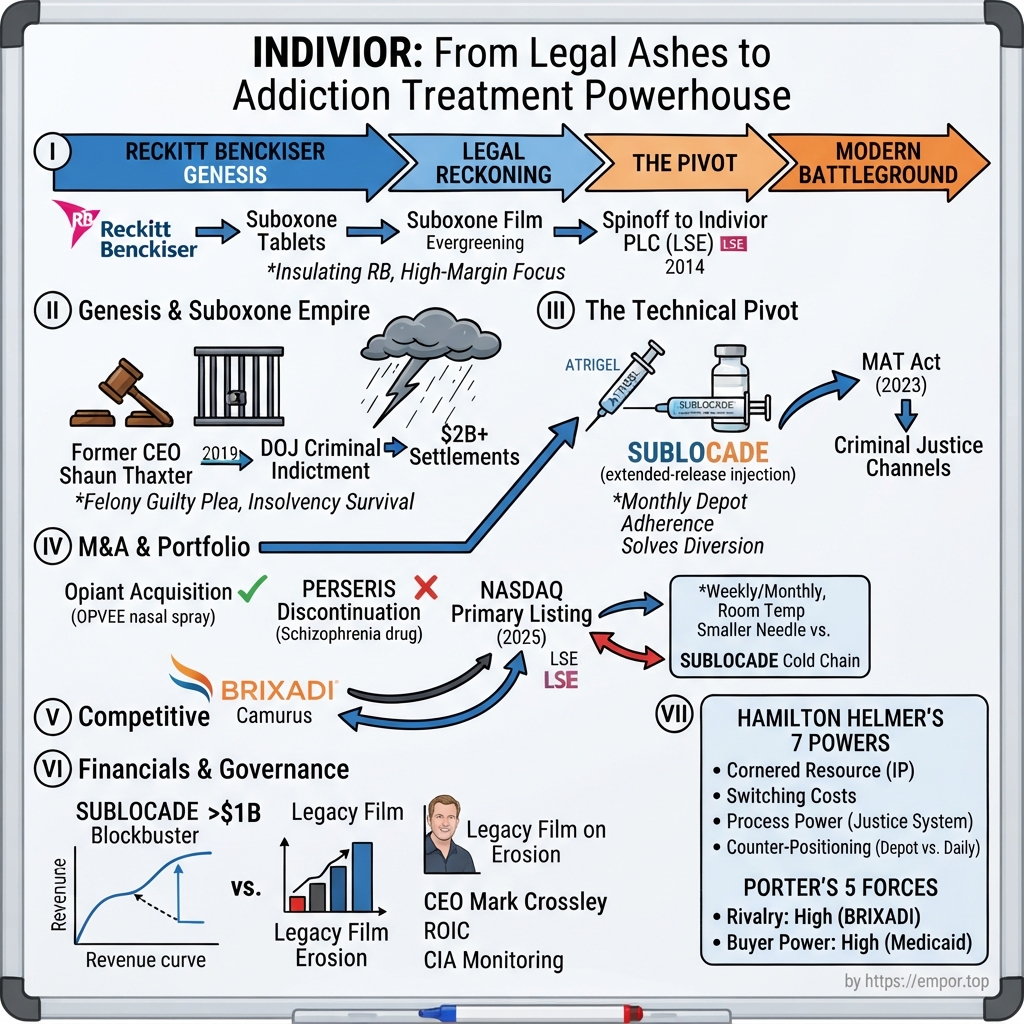
Indivior Pharmaceuticals: The Addiction Treatment Powerhouse's Legal Survival & Long-Acting Injectable Pivot
I. Introduction & Episode Roadmap (0:00 – 0:10)
On the morning of Monday, August 3, 2026, investors who dialed into what they expected to be Indivior's routine second-quarter earnings call heard something else entirely. The operator's opening line signaled the shift: "Good day, welcome to the conference call and webcast to discuss the merger of Supernus Pharmaceuticals and Indivior Pharmaceuticals." Two separate earnings releases had gone out an hour earlier. Both were superseded by a single announcement — an all-stock merger of equals that would fold Indivior into a company named Supernus, Inc., headquartered in Rockville, Maryland, trading under the ticker SUPN, run by a CEO who did not work at Indivior.1
It marked a major transition for a company that six years earlier faced a federal criminal indictment, an operating subsidiary preparing to plead guilty to a felony, a former chief executive sentenced to federal prison, and a legacy franchise being dismantled by generic competition. Rather than entering bankruptcy court, Indivior arrived at the negotiating table in 2026 as the larger party in a merger of equals, with its shareholders acquiring roughly 56.5% of the combined entity alongside a $1.0 billion pre-closing cash dividend.1
The core hook. The central question is how a specialty pharmaceutical division buried inside a British consumer-products conglomerate best known for Lysol and Dettol survived a combined federal, state, and civil legal hurricane costing over $2 billion across two corporate families, before rebuilding itself around a once-monthly depot injection that now generates more than $1 billion annually.
Company snapshot. Indivior Pharmaceuticals, Inc. (NASDAQ: INDV) is, as of August 2026, a US-domiciled specialty pharmaceutical company focused almost entirely on medication for opioid use disorder. In the second quarter of 2026, it reported total net revenue of $343 million, up 14% year over year, with $253 million generated by SUBLOCADE, its extended-release buprenorphine injection.2 For the twelve months ended June 30, 2026, net revenue reached approximately $1.3 billion with adjusted EBITDA of $613 million — representing a 46% margin — against net debt of $251 million, or roughly 0.4 times EBITDA.1
Episode thesis. While conventional commentary frames Indivior as a recovery story following its legal settlements, the critical question for investors is whether SUBLOCADE's market position is structurally defensible or merely benefiting from a temporary head start in an underpenetrated market where a well-funded competitor is gaining ground. Indivior management asserts its market share has stabilized at 76% of the long-acting injectable category.1 However, conflicting reporting from its competitor's licensor presents a different calculation, creating the analytical gap explored here.
Roadmap. The analysis moves through the Reckitt Benckiser genesis and the Suboxone empire; the legal reckoning and criminal prosecutions; the technical pivot to ATRIGEL and SUBLOCADE; the M&A record, including a failed acquisition; the mechanics of the opioid treatment market and the competition with BRIXADI; financial metrics and capital allocation; management credibility evaluated against prior guidance; strategic frameworks; a bull and bear stress test; and practical takeaways for long-term investors.
Before examining those developments, it is necessary to understand why a company known for household cleaning products ended up owning one of the most consequential addiction medicines of the past quarter-century.
 Subscribe on LinkedIn
II. The Reckitt Benckiser Genesis & Suboxone Empire (0:10 – 0:35)
Picture a corporate portfolio review at Reckitt Benckiser in the mid-2000s. On one page: Lysol, Dettol, Air Wick, Finish, Clearasil — consumer brands sold through supermarkets in a hundred countries, managed by marketers focused on shelf space and share of voice. On another page, almost as an afterthought: a small pharmaceutical unit in Richmond, Virginia, selling a sublingual tablet to addiction clinics. The unit had grown out of Reckitt's long history with buprenorphine — a molecule the company's British predecessor firms had developed as an analgesic beginning in the 1970s.
The unusual aspect was not that Reckitt owned a pharmaceutical business, but that the unit performed exceptionally well.
The pharmacological breakthrough
Understanding the business requires examining one key mechanism of pharmacology, as the company's entire economic structure rests on it.
Opioids act by binding to brain receptors. A full agonist — such as heroin, oxycodone, methadone, or fentanyl — fully activates the receptor. Higher doses produce a linear increase in effect, including respiratory suppression. That linear progression is what makes overdose fatal.
Buprenorphine is a partial agonist. It binds tightly to the receptor but only partially activates it, causing its physiological effect to plateau. Beyond a certain threshold, additional buprenorphine does not increase respiratory depression — a property known as the ceiling effect. Consequently, fatal respiratory failure from buprenorphine alone is rare. Additionally, buprenorphine's high binding affinity displaces other opioids from the receptor, preventing full agonists like heroin or fentanyl from producing a high.
By suppressing withdrawal and cravings while blocking other opioids and offering a safety ceiling against overdose, buprenorphine represented a significant advance over methadone, a full agonist requiring daily supervised clinic visits. Buprenorphine could be prescribed for home use.
However, take-home access introduced a secondary risk: diversion and misuse via injection. Reckitt addressed this by pairing buprenorphine with naloxone, an opioid antagonist. Administered sublingually, naloxone passes through the system unabsorbed. Crushed and injected, however, it triggers immediate, severe withdrawal. Branded as Suboxone, the sublingual tablet received FDA approval in 2002 alongside orphan drug designation as the first buprenorphine product for opioid addiction.3
The product life cycle playbook
Suboxone tablets lost exclusivity in 2009.3 Typically, patent expiration opens the market to generics, triggering automatic pharmacy substitution and wiping out 80% to 90% of branded revenue within a few years.
Reckitt's pharmaceutical division anticipated this cliff. In October 2008, the company filed a new drug application for a sublingual film strip that dissolved under the tongue. The FDA approved the film on August 30, 2010, and launch followed the next month.3 Because pharmacists could not automatically substitute generic tablets for a film prescription, prescribers who wrote for film effectively bypassed generic tablet competition.
This strategy — known in the pharmaceutical industry as a "product hop" — was executed aggressively. The division launched a marketing campaign promoting the film as safer around children, a messaging strategy that later triggered federal criminal prosecution. Commercially, the move succeeded: the film captured the overwhelming majority of market share before generic tablets could establish a foothold.
For investors, this transition established a recurring strategic pattern. Indivior's business model relied on proprietary delivery mechanisms rather than novel active molecules. Off-patent buprenorphine remained widely available, but Reckitt — and subsequently Indivior — owned proprietary delivery technologies that insulated the franchise. A moat built on delivery systems rather than underlying active compounds offers real protection, but remains vulnerable to rival delivery innovations and regulatory scrutiny over anticompetitive market shifting. Both risks eventually materialized.
The 2014 spinoff
By 2014, the pharmaceutical business posed strategic liabilities for Reckitt Benckiser. As a global consumer products firm, Reckitt relied on consumer trust in household hygiene and home goods. Its pharmaceutical arm, meanwhile, marketed an opioid-based treatment, faced escalating federal and FTC inquiries regarding the tablet-to-film switch, and confronted substantial legal exposure.
Reckitt completed the demerger on December 23, 2014, listing Indivior PLC on the London Stock Exchange as an independent company.3 While management cited strategic focus as the rationale, the move effectively insulated the consumer conglomerate from ongoing U.S. regulatory and legal investigations.
That corporate isolation proved incomplete, as Reckitt ultimately paid more to settle Suboxone-related liabilities than Indivior itself. For Indivior, independence meant absorbing incoming legal and financial pressures without access to a parent balance sheet.
That pressure arrived in April 2019.
III. The Legal Reckoning: Criminal Prosecution & Financial Cleanup (0:35 – 1:05)
There is a specific document at the heart of this legal reckoning: a data submission sent in October 2012 to MassHealth, the Massachusetts Medicaid program.
Indivior's operating subsidiary sought to expand MassHealth coverage for Suboxone Film. To support its application, the subsidiary submitted data indicating that Suboxone Film had the lowest rate of accidental pediatric exposure among all buprenorphine medications in Massachusetts. The Department of Justice later established that this claim was false, and that the company knew it was false.4
Accidental pediatric ingestion is a significant safety concern for public healthcare programs. A film strip that resembles a candy wafer is not inherently safer than a tablet. However, promoting a product as safer around children offered a compelling narrative to Medicaid directors making formulary decisions, reframing a commercial preference as a public health imperative.
The mismarketing allegations
The federal case, filed in the U.S. District Court for the Western District of Virginia, extended beyond the MassHealth submission. Federal prosecutors alleged a multi-year campaign to market Suboxone Film to physicians, pharmacists, and state Medicaid officials as safer and less prone to accidental pediatric exposure than tablets without supporting clinical evidence — and to steer patients toward film to shield the franchise from lower-cost generic tablets.4
The Federal Trade Commission pursued a parallel antitrust action, alleging that the tablet-to-film switch, combined with a campaign to disparage tablets, constituted a deceptive scheme to preserve monopoly power rather than a genuine product improvement.5
In April 2019, a federal grand jury indicted Indivior PLC. For a specialty pharmaceutical firm reliant on government healthcare reimbursement, a parent-level criminal indictment represented an existential threat: a conviction could have triggered exclusion from Medicare and Medicaid, effectively ending the business.
The criminal and executive fallout
The proceedings concluded on July 24, 2020. Indivior Solutions — an operating subsidiary rather than the parent holding company — pleaded guilty to a single felony count of making false statements relating to healthcare matters. Indivior entities agreed to pay $600 million in total, comprising approximately $289 million in criminal fines, forfeiture, and restitution, alongside roughly $300 million to resolve civil False Claims Act liability.4 Because the guilty plea was restricted to the subsidiary, the parent company avoided debarment from federal healthcare programs.
Executive accountability followed under the Responsible Corporate Officer doctrine, which holds corporate leaders liable for regulatory violations occurring within their organizations without requiring proof of direct personal involvement. Former chief executive Shaun Thaxter pleaded guilty to a misdemeanor count under this doctrine. On October 22, 2020, a federal court sentenced Thaxter to six months in prison, a $600,000 fine, and forfeiture.6 Prison sentences for pharmaceutical executives over marketing practices remain rare, establishing the ruling as a prominent regulatory benchmark.
Indivior Inc. separately paid $10 million in July 2020 to settle FTC monopolization charges.7
The $2 billion-plus bill
The former parent company absorbed even larger financial penalties. On July 11, 2019, Reckitt Benckiser Group plc agreed to pay $1.4 billion — including $647 million in forfeited proceeds, $700 million in civil settlements with federal and state authorities, and $50 million to the FTC — to resolve its criminal and civil liabilities stemming from Suboxone marketing.8 Reckitt signed a non-prosecution agreement and accepted a three-year ban on manufacturing or selling Schedule I, II, or III controlled substances in the United States.5
A multi-year wave of civil litigation followed over the subsequent five years:
In June 2023, a coalition of 42 state attorneys general settled antitrust claims regarding the tablet-to-film transition for $102.5 million.9 In August 2023, Indivior agreed to a $30 million settlement with an end-payor class. In October 2023, the company reached a $385 million settlement to resolve direct purchaser antitrust class action claims — the largest single civil payout in the series — with a federal court granting final approval and awarding class counsel approximately $120.6 million in legal fees.10 In July 2024, Indivior paid $85 million to resolve remaining end-payer claims prior to trial and established a $75 million reserve for a settlement with municipalities and Native American tribal nations.11
A residual legal tail remains. Individual private plaintiff claims, primarily alleging neonatal abstinence syndrome, remained in early procedural stages as of mid-2024, with Indivior asserting it possesses meritorious defenses.11 While representing an unquantified liability, these claims appear unlikely to threaten corporate solvency.
Why the company survived
Indivior's survival hinged on key structural factors. The Department of Justice resolution allowed payments to be structured across multiple years rather than requiring an immediate lump-sum payout. In 2020, Indivior generated $647 million in revenue while reporting a net loss of $148 million, making a single $600 million payment unfeasible. Spreading the obligations allowed operating cash flow to service the legal debt while the business transitioned.
The company carried this obligation until November 2025, when it prepaid the remaining $295 million balance using cash on hand, terminating the Department of Justice resolution agreement and recognizing a $4 million settlement gain.12 Chief Executive Joe Ciaffoni characterized the prepayment as a strategic move to eliminate a major liability and streamline the capital structure.12 The settlement also ended federal compliance oversight and simplified the company's profile for potential strategic transactions.
Indivior's ability to absorb over $2 billion in cumulative legal costs across both corporate entities relied on three structural pillars: a corporate architecture that allowed a subsidiary to absorb the felony conviction, a manageable payment schedule, and the commercial expansion of a second core product. Without SUBLOCADE ramping up during this period, cash flows from the declining, generic-exposed film business would have been insufficient to cover the legal liabilities.
That brings the focus to the product that stabilized the business — and the delivery technology behind it.
IV. The Phoenix Rises: SUBLOCADE & The Long-Acting Injectable Pivot (1:05 – 1:35)
On November 30, 2017 — sixteen months before the federal indictment — the FDA approved SUBLOCADE, the first once-monthly injectable buprenorphine formulation for moderate to severe opioid use disorder.13 At the time, the decision appeared to be a routine line extension designed to defend a mature addiction franchise. In hindsight, it was the single strategic move that determined whether Indivior would survive as a going concern into 2026.
The technology, explained simply
SUBLOCADE is a drug-device combination. Buprenorphine is dissolved in a biodegradable polymer solution — the ATRIGEL delivery system — and injected subcutaneously using a pre-filled syringe. Upon contact with body fluids, the polymer precipitates out of solution and solidifies into a small depot under the skin. That depot slowly biodegrades over the following weeks, releasing buprenorphine into the bloodstream at a controlled rate.13
In practical terms, rather than requiring daily oral dosing, a clinician administers a single time-release depot once a month that dissolves continuously on schedule.
The clinical consequences flow directly from these delivery mechanics, directly targeting the primary failure points of daily oral therapy:
Adherence. Opioid use disorder is a relapsing medical condition where impaired decision-making is a central feature of the pathology. Asking a patient in early recovery to make a flawless choice every morning requires the illness to cooperate with its treatment. A monthly injection replaces thirty daily decisions with a single clinical event.
Plasma continuity. Daily sublingual films produce fluctuations between peak and trough drug concentrations. The long-acting depot maintains stable plasma concentrations, which is critical in an era dominated by high-potency synthetic opioids like fentanyl, where temporary drops in blood level create immediate relapse risks.
Diversion. Sublingual film strips can be concealed, traded, or sold; a subcutaneous polymer depot cannot be diverted once administered. This non-divertible profile makes the formulation viable for use within correctional facilities.
Regulatory and structural tailwinds
Two external shifts expanded the market opportunity for long-acting buprenorphine.
The first was the elimination of the federal X-waiver requirement. For two decades, prescribing buprenorphine for opioid addiction required a specialized DEA waiver that imposed mandatory training hours and strict patient caps — creating a regulatory bottleneck that excluded most physicians from addiction medicine. Congress eliminated the waiver through the Mainstreaming Addiction Treatment Act, part of the Consolidated Appropriations Act, 2023, allowing any clinician with a standard DEA registration to prescribe buprenorphine.14 This expanded the potential prescriber base significantly.
The second factor was the rise of illicit fentanyl. As high-potency synthetic opioids replaced heroin across illicit drug markets, clinicians faced a greater need for continuous, high-dose buprenorphine coverage. Patient tolerance for higher doses increased accordingly. By early 2026, the 300-milligram SUBLOCADE dose represented 63% of total product utilization, reflecting a sustained trend toward higher-dose maintenance.15
Indivior also expanded the commercial scope of the product through label modifications. In February 2025, the FDA approved updated labeling that permitted rapid initiation — enabling clinicians to start SUBLOCADE after a single dose of transmucosal buprenorphine followed by a one-hour observation period, reducing the required initiation timeline from approximately one week to roughly one hour — while expanding injection sites to include the thigh, buttock, and upper arm alongside the abdomen.16 A supporting non-inferiority trial demonstrated that 66.4% of patients on the rapid-induction protocol successfully received a second injection, compared to 54.5% under standard induction.16
Compressing the initiation window from a week to one hour carries substantial commercial implications. Under the traditional protocol, patients entering a clinic had to remain compliant on daily oral doses for several days before returning for an injection. In a patient population frequently experiencing housing instability, transportation hurdles, and fluctuating motivation, requiring a multi-day delay resulted in high attrition. Rapid initiation allows clinicians to convert patient intent into a long-acting depot during the initial visit.
Commercial adoption of the rapid-initiation protocol has progressed gradually. By the first quarter of 2026, approximately 9% of new patients were starting on the accelerated second-dose regimen, while 23% of active prescribers had adopted the expanded label in their practices.15 These metrics represented modest gains from 7% of new patients and 17% of active prescribers in the prior quarter.17 While the label expansion provides a clinical advantage, operational uptake across treatment settings remains an ongoing rollout rather than an immediate catalyst.
Distribution: the unglamorous moat
The most durable element of SUBLOCADE's market position lies in its specialized sales and distribution infrastructure rather than the active molecule or delivery polymer alone.
Navigating the criminal justice channel requires an operating model distinct from traditional pharmaceutical detailing. Sales targets include county sheriffs, state departments of corrections, and drug court administrators. Purchasing decisions follow legislative budget cycles and involve correctional healthcare contractors, while local clinical implementation rests with jail infirmary staff. The core value proposition — a non-divertible medication that provides continuous therapeutic coverage through post-release re-entry, when overdose risk peaks — aligns with institutional priorities, but navigating these institutional channels requires dedicated sales resources.
To capture this opportunity, Indivior established a dedicated justice systems sales organization, expanding team headcount by 25% across 2023 and 2024 and adding approximately 120 new correctional accounts in the first half of 2024 alone to reach over 700 active justice system accounts.11 Concurrently, the company built an alternate sites of care network encompassing more than 1,200 locations across 22 states with five specialty partners by mid-2024, enabling community physicians to administer the injection without taking on specialty pharmacy administrative overhead.11
This specialized commercial footprint reflects what strategy frameworks term Process Power — an accumulated combination of institutional relationships, contract structures, and operational workflows built over several years that competitors cannot rapidly replicate.
However, this distribution channel carries operational trade-offs. Institutional and criminal justice purchasing has proven subject to budget timing variations and political funding cycles, making account revenue unpredictable and generating recurring quarterly performance variances. Before analyzing those operational friction points, the narrative turns to how management deployed its operating cash flow.
V. M&A, Portfolio Pruning & Capital Allocation (1:35 – 2:05)
Capital allocation is where management teams are most honestly revealed, because unlike earnings guidance, a check cannot be revised in retrospect. Indivior's record over the past four years contains one acquisition that failed, one product shutdown that was necessary, one corporate relocation, and ultimately a merger that ends the company's independent existence. Taken together, these actions reflect a management team that absorbed expensive strategic lessons and subsequently accelerated its strategic pivot.
The Opiant acquisition, and what went wrong
In November 2022, Indivior agreed to acquire Opiant Pharmaceuticals for approximately $145 million upfront — $20 per share in cash — plus contingent value rights worth up to $8.00 per share tied to commercial milestones.18 The deal closed on March 2, 2023.19
The target asset was OPVEE, a nalmefene nasal spray. Nalmefene is a long-acting opioid antagonist — an overdose reversal agent similar to naloxone, the active ingredient in Narcan, but with a substantially longer duration of action. The commercial logic appeared compelling on paper: high-potency synthetic opioids like fentanyl can outlast a single dose of naloxone, causing patients to experience secondary re-sedation after initial resuscitation. A longer-acting antagonist was designed to prevent that relapse into overdose. FDA approval followed in 2023.20
However, the product failed to gain commercial traction. Total OPVEE net revenue for all of 2024 reached roughly $15 million, with the vast majority coming from two bulk orders placed by the U.S. Biomedical Advanced Research and Development Authority — a government defense stockpile purchaser rather than a repeatable commercial channel.21
The commercial failure stemmed not from pharmacological efficacy, but from customer alignment. The primary buyers of overdose reversal medications are first responders, public health departments, and harm-reduction organizations — a stakeholder community with deeply held institutional practices. Nalmefene's extended duration created a severe practical trade-off: a longer-acting antagonist can trigger prolonged, acute precipitated withdrawal. Harm-reduction advocates argued this severe distress would make revived individuals resistant to engaging with emergency medical services. Chief Executive Mark Crossley acknowledged on the July 2024 earnings call that pushback from harm-reduction organizations had been "larger than we would expect," framing the company's response around real-world evidence programs.11
That promotional strategy proved short-lived. In September 2025, Indivior settled an enforcement action brought by the New York Attorney General over its marketing of OPVEE, agreeing to cease promotion, refund public funds expended by New York state entities, and accept returns of unused inventory.22 Indivior subsequently discontinued sales and marketing support for OPVEE entirely, maintaining distribution only to fulfill remaining contractual and regulatory obligations.23
The final scorecard was stark: Indivior expended $145 million in upfront capital for an asset generating minimal organic commercial demand, drew state regulatory action over its marketing claims, and dismantled commercial support within two and a half years of acquisition. The contingent value rights did not mitigate the capital loss, as contingent structures protect buyers against operational underperformance rather than complete commercial failure.
Furthermore, a recurring pattern emerged across Indivior's corporate history. Two of the firm's most significant legal liabilities — the MassHealth false statements detailed earlier and the New York OPVEE settlement — shared a common origin: advancing promotional safety claims to public healthcare payers before establishing supportive empirical evidence. This pattern represents an essential factor when evaluating management's commercial projections.
PERSERIS: the discontinuation that was right
On July 9, 2024, Indivior announced the immediate cessation of sales and marketing for PERSERIS, an extended-release risperidone injection for schizophrenia. Concurrently, management lowered full-year 2024 revenue guidance to between $1.15 billion and $1.215 billion, down from $1.24 billion to $1.33 billion, while reducing expected adjusted operating profit to between $285 million and $320 million, down from $330 million to $380 million.24 Indivior shares fell approximately 44% in a single trading session.24
PERSERIS had generated nearly 4% of total net revenue in 2023.24 Management attributed the shutdown to regulatory guidance issued during the second quarter of 2024, which was expected to expand step-therapy restrictions across the long-acting antipsychotic category, rendering the subscale asset economically unviable.24 The commercial exit eliminated approximately 130 positions, incurred a restructuring charge of roughly $65 million, and generated approximately $50 million in annualized cost savings.11
Separating the execution of the guidance revision from the underlying asset allocation highlights the strategic rationale. PERSERIS operated as a minor market participant in a therapeutic segment dominated by established franchises, including Janssen's Invega line and Alkermes' Aristada. Operating without channel scale, proprietary formulation advantages, or label differentiation, Indivior possessed no structural competitive advantage. Reallocating capital away from a fourth-tier antipsychotic to concentrate resources behind a market-leading long-acting buprenorphine franchise represented sound portfolio pruning.
While the strategic termination was sound, its timing — delivered as a reactive mid-year profit warning rather than an orderly strategic divestment — represented a major point of friction for equity investors.
The corporate migration
Indivior executed a multi-step corporate restructuring to shift its primary equity listing to Nasdaq from the London Stock Exchange, effective June 27, 2024.25 In June 2025, the company announced the complete cancellation of its residual secondary LSE listing, which took effect on July 25, 2025.26 The structural transition concluded on January 26, 2026, when Indivior finalized its corporate redomiciliation from the United Kingdom to the United States following shareholder approval at an extraordinary general meeting on December 11, 2025, structured via a UK court-sanctioned scheme of arrangement. Under the reorganization, Indivior PLC became Indivior Ltd., a wholly owned subsidiary of a new Delaware holding company, Indivior Pharmaceuticals, Inc., with shareholders exchanging equity on a one-for-one basis under the existing INDV ticker.27
The strategic rationale was rooted in capital market alignment: the company generated the overwhelming majority of its revenue within the United States, its primary institutional investor base was domestic, and qualification for U.S. market indexes required U.S. GAAP accounting alongside domestic incorporation. Crossley outlined this strategic roadmap to investors in July 2024, confirming the transition to U.S. GAAP reporting beginning with the March 2025 Form 10-K filing to qualify for index inclusion.11
The corporate migration achieved its objectives selectively. Although Indivior's valuation expanded through 2025 and early 2026, isolating the impact of listing geography from a doubling of adjusted EBITDA remains unfeasible. The core benefit was structural: establishing a U.S. domicile expanded institutional access and eliminated administrative barriers to executing an all-stock transaction with a U.S.-listed peer.
The merger
That structural repositioning culminated on the morning of August 3, 2026.
Under the transaction terms, Supernus shareholders receive 1.5401 shares of Indivior common stock for each Supernus share held. Prior to closing, Indivior will distribute a $1.0 billion special cash dividend to pre-closing Indivior stockholders, funded through a $650 million term loan arranged by Citibank alongside existing balance-sheet cash. Upon completion, Indivior shareholders will hold approximately 56.5% of the combined entity, with Supernus shareholders holding roughly 43.5% on a fully diluted basis across approximately 215 million total shares. The combined board of directors will comprise eight members, split equally between the two legacy companies. Supernus Chief Executive Jack Khattar will lead the combined executive team, while Indivior Director Tony Kingsley will serve as non-executive chairman. The unified organization will assume the Supernus corporate name, trade under the SUPN ticker, and maintain headquarters in Rockville, Maryland. Transaction close is anticipated in the fourth quarter of 2026, subject to shareholder and regulatory approvals.1
On a pro forma trailing twelve-month basis ended June 30, 2026, the combined organization represented approximately $2.2 billion in net revenue and $888 million in adjusted EBITDA — including $125 million in targeted annual cost synergies, reflecting a 41% operating margin — alongside pro forma net debt of $878 million and net leverage of approximately 1.0 times EBITDA.1 SUBLOCADE represents the largest single asset within the combined portfolio, generating approximately 44% of total pro forma revenue.1
Three key elements of the transaction structure warrant detailed scrutiny:
First, the classification of the transaction as a "merger of equals" conceals a significant asymmetry in operating contribution. Indivior generates approximately 60% of combined revenue and roughly 80% of combined adjusted EBITDA, yet legacy Indivior shareholders retain only 56.5% of equity ownership. The $1.0 billion upfront cash dividend serves as the primary mechanism bridging this valuation gap. The central question for Indivior shareholders voting on the deal is whether that cash distribution adequately compensates for relinquishing operational management to Supernus leadership.
Second, the projected synergy model relies exclusively on cost reduction. Executive management attributed the $125 million in target synergies to corporate overhead elimination and administrative efficiencies, explicitly declining to model commercial revenue synergies. When Barclays analyst Glen Santangelo questioned how the combination accelerates organic growth without revenue synergies, Khattar emphasized that enhanced balance-sheet scale provides expanded capital to support five core growth assets and future business development.1 This justification represents a capital-allocation rationale rather than an operational synergy. Khattar confirmed that the respective commercial organizations exhibit minimal overlap, requiring the combined entity to maintain four distinct sales forces.1 Consequently, the combination functions as a financial and balance-sheet consolidation rather than an integrated commercial integration.
Third, the synergy targets appear conservative relative to the combined cost structure. Jefferies analyst Dennis Ding noted on the announcement call that a $125 million cost-reduction target appears modest given the combined operating scale, suggesting additional restructuring potential across Indivior's international operations.1 Supernus CFO Tim Dec responded by reiterating Supernus's historical track record of meeting or exceeding public synergy targets, leaving the ultimate realization of operational efficiency to post-closing execution.
VI. Core Business Mechanics & Competitive Landscape (2:05 – 2:35)
Evaluating Indivior's long-term competitive position requires analyzing the broader opioid use disorder treatment landscape, where the vast majority of eligible patients have yet to transition to long-acting formulations.
Market structure
Chief Executive Joe Ciaffoni outlined the patient funnel during the August 2026 earnings call: approximately eight to nine million Americans misuse opioids, four to five million receive a formal diagnosis of opioid use disorder, and roughly two million currently receive treatment with buprenorphine in any form.1 Within that treated cohort, long-acting injectables represent only 8.5% to 9% of total prescriptions — a penetration figure management has cited across multiple quarters.15
This low baseline serves as a foundational pillar of the investment thesis. Even without expanding its relative market share against competitors, Indivior operates in an environment where over 90% of treated patients continue on daily oral therapies, creating extended room for growth through category conversion alone.
Management frequently draws comparisons to the schizophrenia market, where long-acting injectable penetration reaches approximately 30%. Ciaffoni has cited internal market research supporting eventual long-acting injectable penetration of 20% to 30% in opioid use disorder, while declining to publish a peak revenue forecast.17 Investors should view this benchmark as a directional framework rather than a precise financial forecast: patients with schizophrenia are frequently treated within structured institutional systems with legal or clinical adherence oversight, whereas opioid use disorder treatment functions predominantly in voluntary, outpatient settings.
Category expansion has accelerated. Growth in the long-acting injectable segment approached 18% in the fourth quarter of 2025 and 23% in the first quarter of 2026.1715 Concurrently, expansion in the underlying oral buprenorphine market — the primary source for injectable conversions — also quickened in early 2026, a trend management attributes in part to Indivior's direct-to-consumer advertising expanding the overall pool of treated patients.15
The competitor deep-dive
BRIXADI (Camurus / Braeburn) — the primary threat. The FDA approved BRIXADI in May 2023 as a weekly and monthly extended-release buprenorphine injection for moderate to severe opioid use disorder.2829 Swedish developer Camurus licensed U.S. commercial rights to Braeburn in 2014.
BRIXADI's advantages stem from practical delivery mechanics rather than active pharmacology. It offers a weekly administration option alongside a monthly depot, accommodating patients hesitant to commit to a 30-day formulation or whose clinical stability remains variable. The injection utilizes a smaller gauge needle and stores at room temperature, eliminating the refrigeration requirement that complicates logistics for SUBLOCADE in correctional facilities and mobile clinics.
These commercial advantages have driven measurable market gains. Camurus reported that BRIXADI captured over 30% of the U.S. long-acting buprenorphine market by year-end 2025, expanding to approximately 32% in the first quarter of 2026, while royalty revenue from Braeburn's net sales rose 87% in 2025 to 396.5 million Swedish kronor.30 Braeburn has expanded its U.S. commercial organization, and media reports in September 2025 indicated Camurus was negotiating to acquire Braeburn outright to establish direct operational control over U.S. distribution.31 A successful acquisition would consolidate BRIXADI under a single, vertically integrated corporate entity rather than a split-tier licensor structure.
VIVITROL (Alkermes). As a monthly injectable formulation of naltrexone, Vivitrol acts as a full opioid antagonist, blocking opioid receptors completely. This mechanism requires patients to undergo full detoxification prior to initiation. That steep induction barrier limits Vivitrol's adoption across general outpatient care, though it remains a competitive option in correctional facilities where incarcerated populations are already detoxified.
Generic sublingual film. Generic manufacturers including Dr. Reddy's Laboratories, Alvogen, and Teva Pharmaceutical Industries continue to supply generic versions of legacy Suboxone Film, which Indivior no longer actively promotes in the United States. Revenue erosion has progressed more slowly than anticipated, with management noting stable generic pricing and moderating market share decline across both the fourth quarter of 2025 and the first quarter of 2026, prompting upward revisions to film revenue expectations.1732 This gradual decline has provided a steady source of cash flow to support the corporate transition.
Myth vs reality: the market share arithmetic
Reconciling competitive disclosures reveals an analytical discrepancy regarding category share.
Indivior maintains that SUBLOCADE commands a stable 76% category share of U.S. long-acting injectables, a figure Ciaffoni reiterated across earnings calls in late 2025, early 2026, and August 2026, noting that market share has remained constant for six to seven consecutive quarters.115 Meanwhile, Camurus reports that BRIXADI reached approximately 32% of the U.S. long-acting buprenorphine segment.30
Because the combined figures exceed 100%, the two companies are using differing market denominators. Indivior's calculation likely incorporates a broader category definition — potentially including Vivitrol or other non-buprenorphine products — whereas Camurus measures strictly long-acting buprenorphine. Variations in unit-versus-revenue metrics and reporting periods also contribute to the divergence. Ciaffoni addressed the discrepancy by stating that Indivior possesses "perfect data on the vast majority of the market" and applies "a consistent methodology," defending management's reporting while acknowledging the underlying data remains proprietary and unverifiable.17
The operational reality suggests BRIXADI is capturing a notable portion of new patient starts in outpatient clinics, while SUBLOCADE preserves its entrenched lead among established patients and inside criminal justice channels. Stock and flow metrics can temporarily diverge: Indivior set sequential records for new patient initiations — logging approximately 31,800 in the first quarter of 2026 (up 29% year over year) and 32,816 in the second quarter — indicating strong absolute volume growth.152
However, management has gradually shifted public focus away from market share metrics. When asked whether direct-to-consumer investments would drive share gains, Ciaffoni remarked that minor share fluctuations were "really not material," emphasizing net revenue, new patient initiations, and overall category expansion instead.15 While this perspective aligns with an underpenetrated market, it also reflects standard corporate narrative adjustments when facing market share pressure.
Indivior's defensive playbook
Alongside the label updates detailed previously, Indivior's commercial defense centers on three primary initiatives: refining sales force messaging around rapid initiation; expanding commercial dispense yields through specialty pharmacy service agreements (completing five agreements by the first quarter of 2026 to align commercial yields with the 80% benchmark achieved in non-commercial channels); and advocating to transition long-acting injectables from medical benefit to pharmacy benefit coverage in states where medical benefit restrictions create administrative barriers for prescribers.1517
Improving dispense yields represents a low-profile but financially significant lever. Ciaffoni noted that each one-percentage-point improvement in commercial mix relative to budget generates approximately $8 million in incremental net revenue for a brand of SUBLOCADE's scale.15 Operational enhancements of this nature contributed directly to Indivior raising its 2026 financial guidance twice.
VII. Segment Financials & Revenue Drivers (2:35 – 2:55)
The financial history here is genuinely strange, and reading it straight through is the fastest way to understand what changed.
Reported revenue: $960 million in 2018, then $785 million in 2019 as generic film erosion bit, then $647 million in 2020 at the trough, then $791 million, $901 million, $1.093 billion, $1.188 billion, and $1.239 billion in 2025.33 Reported net income over the same span swung from $263 million of profit in 2018 to a $148 million loss in 2020, back to $205 million of profit in 2021, to losses in 2022 and 2023 of $44 million and $129 million, to essentially breakeven at $2 million in 2024, and then to $210 million in 2025.33
Those GAAP swings are almost entirely litigation and restructuring charges moving through the income statement, not operating volatility. Which is precisely why the market focuses on adjusted EBITDA — and why an investor should always check what is being adjusted out. In Indivior's case, for most of the last six years, the answer was legal settlements that were absolutely real cash.
The revenue hierarchy today
SUBLOCADE. In the second quarter of 2026 it produced $253 million of net revenue, up 21% year over year, of which $238 million came from the US on 18% dispense unit volume growth.2 Full-year 2026 SUBLOCADE guidance now sits at $1.010–1.050 billion, implying roughly 20% growth at the midpoint.2 Cumulatively, more than 545,000 US patients had been prescribed the product since its 2018 launch, of which the most recent quarters contributed a disproportionate share — a quarter of that total was added in the five quarters through March 2026.15
Legacy sublingual film. Sublingual and other products contributed $57 million in the second quarter of 2026.2 Unpromoted, generically challenged, and steadily declining — but with pricing that has held up better than expected, producing high-margin cash that funds the rest of the business.
PERSERIS. $5 million in the second quarter of 2026, a runoff line rather than a business.2
OPVEE. Effectively zero as a commercial franchise following the marketing discontinuation.
The concentration is stark and worth stating plainly: this is a one-product company with a decaying annuity attached. Approximately three-quarters of revenue comes from SUBLOCADE, and after the merger closes it will represent roughly 44% of a more diversified base.1 Diversification is, in fact, one of the more defensible strategic rationales for the transaction — a point Ciaffoni made explicitly when he said the going-forward company will have five growth drivers across four therapeutic areas rather than one.1
The margin story is the real story
Here is what actually changed at Indivior between 2024 and 2026, and it was not the top line.
Revenue grew from $1.188 billion in 2024 to $1.239 billion in 2025 — about 4%.33 Adjusted EBITDA over the same period grew 20%, to $428 million.17 Then in the first half of 2026, adjusted EBITDA more than doubled year over year in both quarters: $164 million in the first quarter, up 112%, and $186 million in the second, up 111%.322 Full-year 2026 adjusted EBITDA guidance now implies roughly 68% growth.2
Revenue did not double. Costs collapsed.
Non-GAAP operating expenses were $622 million for full-year 2025 and are guided to $430–450 million for 2026.17 Second-quarter 2026 non-GAAP operating expenses were $112 million, down 33% year over year.2 The cuts came from headcount reductions, restructuring of the R&D and medical affairs organizations, and footprint consolidations, at a cost of $120 million in charges during 2025 of which only about $28 million was cash.17
The analytical conclusion is unambiguous, and it cuts both ways. Indivior's 2025–26 earnings transformation was a cost story with a revenue story arriving later. Gross margin runs in the mid-80s and has been broadly stable, so the operating leverage came from shrinking the denominator, not expanding the numerator.15 That is entirely legitimate value creation — the prior cost base was clearly bloated relative to a single-product commercial model. But it is also a one-time reset. Ciaffoni has been explicit that the company is "leveraging, not growing" its cost structure and should stay under $450 million of operating expense going forward.15 From here, incremental margin expansion has to come from revenue growth against a fixed cost base, and the R&D cuts that helped deliver it have consequences we will come to.
Cash and the balance sheet
The company ended the second quarter of 2026 with $249 million of cash and investments against $487 million of long-term debt.2 Cash flow from operations was guided at approximately $340 million for 2026, up from an earlier $300 million estimate.1517
Two financing decisions in 2026 are worth flagging as genuinely good execution. In the first quarter, Indivior completed an upsized $500 million senior convertible notes offering due 2031, using most of the proceeds to repay the remaining $333 million balance on its term loan — cutting the coupon from 9.5% to 0.625%.15 Refinancing high-coupon term debt into a low-coupon convertible after a share price recovery is textbook opportunism, and the interest saving is real money against a business generating a few hundred million of operating cash flow. The offsetting consideration, as always with converts, is that the cheap coupon is purchased with equity optionality; the dilution shows up later if the shares perform.
The company also repurchased shares steadily: 4.0 million shares at an average of $31.45 for $125 million in the first quarter, and 4.7 million shares for $175 million in the second, bringing 2026 year-to-date repurchases to 8.6 million shares for $300 million against a $400 million authorization.152 Cumulatively over five years the company has bought back $525 million of stock at an average price of $16.74 — a genuinely good average against a share price that has traded far above that in 2026.15
VIII. Management Credibility, Incentives & Governance (2:55 – 3:15)
There is a moment on the July 25, 2024 earnings call that is worth preserving in full, because everything about management credibility at this company flows from it.
Analyst David Amsellem of Piper Sandler asked whether SUBLOCADE guidance contemplated competitive headwinds from BRIXADI or merely Medicaid disenrollment. Chief executive Mark Crossley answered: "The guide, we have extreme confidence with regards to what we've guided on SUBLOCADE, and that includes all the factors we currently see in the market, the transitory issues as well as competitive pressures."11
He also reaffirmed, in the same session, the company's two headline targets: exiting 2025 at a $1 billion SUBLOCADE net revenue run rate and achieving greater than $1.5 billion in peak annual net revenue. He characterized the pressures as "transitory." He noted that four out of five new patients were choosing SUBLOCADE.11 And he announced a new $100 million buyback as "a strong indication of our confidence."11
Seventy-seven days later, on October 10, 2024, Indivior withdrew the $1 billion exit-2025 run-rate target and cut full-year SUBLOCADE guidance again to $725–745 million, citing faster-than-expected adoption of the competing long-acting injectable, variability in criminal justice system account funding, and lower trade stocking.34 The >$1.5 billion peak target was, for the moment, retained.34
That sequence — "extreme confidence" in July, target withdrawn in October, following a July guidance cut that had already knocked 44% off the shares — is the single most damaging fact in Indivior's management credibility record. It is not that the company missed. Companies miss. It is that management characterized a structural competitive threat as "transitory" while a well-capitalized rival was taking new-patient share, and reinforced that characterization by buying back stock.
Crossley stepped down. On February 27, 2025, Indivior announced Joseph Ciaffoni as chief executive, effective from the May 2025 annual general meeting.35 The framing at the time was a mutual agreement following a distinguished tenure; the market read it as accountability for the 2024 guidance sequence.36
The new team
Joe Ciaffoni arrived with an unusual on-ramp: he joined Indivior's board as an independent non-executive director in December 2024, two months before being named CEO — meaning he had seen the company's internal reality before accepting the job.35 He was 53 at appointment, with more than thirty years in pharmaceuticals and biotech, most recently as president and chief executive of Collegium Pharmaceutical, and earlier in senior roles at Endo International, Biogen and Shionogi.35 Collegium is a useful tell: it is a pain and CNS specialty company built on disciplined commercial execution and acquired assets rather than internal discovery, which is precisely the operating model Ciaffoni has since installed at Indivior.
His vocabulary is relentlessly operational. Where Crossley talked about paradigm shifts and conviction, Ciaffoni talks about dispense yields, commercial mix percentages, message delivery on every call, and phases of a named program. The "Indivior Action Agenda," rolled out in July 2025, has three explicitly sequenced phases: Generate Momentum (completed in 2025), Accelerate (2026), and Breakout (second half of 2026).17
Structuring a turnaround as numbered phases with stated exit criteria is a genuine credibility mechanism, because it creates checkpoints management can be held to. Ciaffoni repeatedly used the phrase "earn our way to Phase III," which is a way of pre-committing not to do acquisitions until operating performance justified them.15
Ryan Preblick, the chief financial officer, is the continuity figure — he was CFO through the 2024 guidance disaster and remains in the seat. His 2026 execution has been strong: the convertible refinancing, the DOJ prepayment, and disciplined buyback timing. Investors weighing management quality should note both facts.
Pat Barry, chief commercial officer, and Christian Heidbreder, chief scientific officer, round out the team that presents on calls.
Testing the new narrative against its own record
Ciaffoni's team has now set and beaten targets three times in a row. February 2026 guidance called for SUBLOCADE net revenue of $905–945 million and adjusted EBITDA of $535–575 million.17 By April, after a quarter of 20% dispense unit growth, guidance rose to $950–990 million and $620–660 million.32 By August, after 18% dispense growth and record new patient starts, SUBLOCADE guidance rose again to $1.010–1.050 billion, with total revenue guidance of $1.295–1.365 billion.2
Two raises in two quarters, from a management team that inherited a credibility deficit, is the strongest available evidence that the guidance culture changed. It is also, in fairness, exactly what a team that deliberately set a low initial bar would produce. The distinguishing evidence is that the underlying operating metrics moved too — prescriber counts up 19% year over year, record new patient starts, LAI category growth accelerating — rather than the beats coming purely from gross-to-net true-ups.15
On that point, credit where due: management has been unusually explicit that gross-to-net adjustments flattered results. The first quarter of 2026 included a $14 million gross-to-net benefit, full-year 2025 included approximately $49 million on SUBLOCADE and $55 million on film, and Preblick repeatedly warned that prior-year releases would serve as a headwind through 2026.1517 Volunteering that a portion of reported growth is accounting true-up rather than demand is the opposite of the 2024 pattern.
Where the new team's story has already frayed
Two areas deserve sceptical attention.
The pipeline was abandoned, not managed. In April 2026 Indivior disclosed that INDV-2000, its orexin-1 receptor antagonist, missed its prespecified primary endpoint in Phase II, and that it would not advance INDV-6001 — a longer-interval injectable licensed from Alar Pharmaceuticals — into Phase III.15 Heidbreder's explanation for the latter was candid and technically detailed: achieving clinically meaningful plasma concentrations in a fentanyl-dominated environment would have required a more complex induction protocol than SUBLOCADE's, plus manufacturing scalability concerns and limited anticipated differentiation for payers.15 That is a defensible portfolio decision, honestly explained.
But the cumulative effect is that Indivior entered its merger with essentially no internal pipeline. Every R&D program of consequence has been discontinued, out-licensed, or shelved. The cost savings that drove the EBITDA transformation came substantially from dismantling R&D and medical affairs.15 A company with a durable growth driver and no pipeline is, structurally, a company that must eventually buy its future — which is precisely the position that made a merger attractive.
The patent runway story has moved. On the first-quarter 2026 call, Ciaffoni said Indivior has 12 Orange Book-listed patents running from 2031 to 2038 and was pursuing additional applications "that have the potential to extend out to 2044 to 2046."15 On the August 2026 call, the same executive described pending applications that "if granted, would take IP out to 2042 to 2044."1 Both statements are hedged with "if granted," and the difference may reflect nothing more than which specific applications were being referenced. But a two-year downward drift in the outer edge of a patent estate, stated by the same person four months apart, is the kind of detail worth tracking rather than accepting.
The more solid part of that claim is not the patents at all. It is manufacturing. Ciaffoni noted there have been no Paragraph IV certifications filed against SUBLOCADE to date, attributing this partly to the difficulty of producing a sterile long-acting injectable via aseptic manufacturing.1 For generic entrants, replicating a polymer depot drug-device combination under sterile conditions is a materially harder engineering problem than copying a tablet — and the absence of Paragraph IV filings after eight years on market is objective evidence, not management assertion.
Governance and incentives
Indivior operated under a five-year Corporate Integrity Agreement with the HHS Office of Inspector General entered on July 24, 2020, with the fifth and final reporting period beginning January 1, 2025.37 The CIA imposed compliance infrastructure, certification, and monitoring obligations. Its expiry removes an administrative burden; whether it removes a behavioral constraint is a question the New York OPVEE settlement makes fair to ask.
On compensation, executive incentives have been oriented to adjusted EBITDA, SUBLOCADE net revenue, and returns on capital. Investors should note the tension inherent in an EBITDA-weighted scheme at a company whose EBITDA growth came predominantly from cost reduction: an incentive structure that pays for margin can pay handsomely for shrinking, and the same structure creates pressure to classify recurring costs as restructuring. The $120 million of 2025 simplification charges — of which only $28 million was cash — is exactly the sort of item a sceptical analyst should test against subsequent expense run rates.17 To management's credit, the 2026 operating expense guidance is low enough that the savings appear to be real rather than reclassified.
IX. Strategic Frameworks: 7 Powers & 5 Forces (3:15 – 3:30)
Analytical frameworks deliver value only when they force clear strategic verdicts. Applied to Indivior in mid-2026, the assessment reveals a solid operating business rather than an unassailable fortress.
Hamilton Helmer's 7 Powers
Cornered Resource — real, but time-delimited. The ATRIGEL delivery system and 12 Orange Book-listed patents running from 2031 to 2038 provide a genuine cornered resource: exclusive access to an asset that independently enhances corporate value.1 The durable strength of this advantage relies on two factors investors can objectively verify: the patent expiration schedule is public, and the absence of any Paragraph IV generic challenge over eight years confirms significant manufacturing barriers. In contrast, prospective patent extension applications stretching into the 2040s remain unverified and should be excluded from core baseline valuations.
Switching Costs — substantial and structurally durable. Once a patient achieves stability on a monthly depot injection, the clinical friction of switching therapies is exceptionally high. Changing treatments requires re-induction, adjusting to a new plasma concentration profile, navigating a fresh administration schedule, securing updated prior authorizations, and risking clinical relapse in a vulnerable population. Prescribers remain appropriately hesitant to disturb stable regimens. This represents Indivior's most defensible strategic power, consistent with market trends where BRIXADI captures incremental new patient starts while SUBLOCADE retains its established patient base.
Process Power — strong in institutional channels, limited elsewhere. The specialized criminal justice sales infrastructure, more than 700 active correctional accounts, and an established alternate-sites-of-care network represent operational capabilities built over several years that rivals cannot easily replicate simply by expanding sales headcount.11 However, this Process Power remains channel-specific. In general outpatient clinics where BRIXADI competes most aggressively, Indivior's edge is far thinner — an operational reality confirmed by management's own acknowledgment that it retains "significant runway to improve" commercial execution.1
Counter-Positioning — largely exhausted. SUBLOCADE originally counter-positioned against daily sublingual films, including Indivior's legacy product line. Counter-positioning provides a strategic advantage when incumbents cannot respond without cannibalizing their core business. Because BRIXADI operates without a legacy film franchise to protect, counter-positioning has ceased to act as an active defensive moat and has normalized into an early-mover head start.
Scale Economies, Network Economies, Branding — immaterial. Long-acting buprenorphine exhibits no meaningful network effects, consumer brand equity carries little weight when institutional payers dictate access, and manufacturing scale yields modest margin advantages. While direct-to-consumer advertising attempts to generate patient-level demand, the initiative remains an early-stage commercial test.
Porter's Five Forces
Bargaining power of buyers — high, serving as the primary commercial constraint. State Medicaid programs and pharmacy benefit managers exert substantial leverage over market access. Payers frequently demand steep rebates, mandate step-therapy protocols, and in multiple jurisdictions restrict long-acting injectables to medical benefit coverage, placing administrative and financial burdens on healthcare providers.17 That structural pressure directly caused the commercial exit of PERSERIS. Although Indivior reports broader than 85% availability across commercial and Medicaid channels, broad formulary access does not guarantee favorable net pricing.1
Rivalry — intense and escalating. The long-acting segment features two well-resourced competitors navigating rapid market expansion, alongside potential ownership consolidation on the rival side. Category volume is currently growing fast enough to absorb dual participation, allowing competition to manifest as a race for net-new patient starts rather than price discounting. Baseline product pricing has remained steady, with total revenue variance driven primarily by channel mix.11
Threat of substitutes — moderate. Generic sublingual films remain cost-effective and clinically sufficient for compliant patients. Daily methadone maintains its position within specialized opioid treatment programs, while Vivitrol occupies a specialized niche. Potential long-term substitutes like GLP-1 receptor agonists represent an emerging variable — with Eli Lilly conducting Phase II trials in opioid use disorder expected to read out around 2028 — though executives Joe Ciaffoni and Christian Heidbreder noted these candidates are being studied as complementary add-on therapies to buprenorphine rather than direct replacements.151 Near-term substitution risk remains modest, while multi-decade risk stays unquantified.
Threat of new entrants — low to moderate. High regulatory hurdles, complex sterile depot manufacturing, and specialized distribution requirements deter potential entrants. The primary commercial threat stems from the expansion of the existing market competitor rather than new market entrants.
Supplier power — low. Active buprenorphine represents a commoditized active pharmaceutical ingredient. Indivior further mitigated supply risk by investing in dedicated internal manufacturing infrastructure aimed directly at product security.15
The composite verdict. Indivior commands one primary strategic power in high patient switching costs, a channel-constrained process power within criminal justice, a time-bound patent and manufacturing estate, and an exhausted counter-positioning posture — operating within a sector where institutional buyers hold significant leverage and competitive rivalry is intensifying. Viewed through this strategic lens, the Supernus merger represents a pragmatic response to a commercial moat that is real, yet insufficient to sustain a multi-decade standalone enterprise.
X. Investment Story Spine: Bull vs. Bear Case & Key KPIs (3:30 – 3:45)
The operational and financial evidence resolves into a clear analytical test: what drives the core investment thesis for Indivior from here, and what factors would invalidate it?
Why it wins
The category is 9% penetrated. This low baseline forms the central pillar of the bull case. In a market where roughly two million individuals receive buprenorphine and fewer than one in ten receives a long-acting injectable formulation, both primary competitors can expand significantly for years without diminishing each other's patient base.1 Category expansion rather than market-share capture serves as the principal growth driver — a dynamic supported by company data showing long-acting injectable category growth approaching 23% in early 2026.15
Demand response to marketing is measurable. Following the October 1, 2025 launch of the "Move Forward in Recovery" direct-to-consumer campaign, key leading indicators moved substantially: branded online search volume increased 60% in the fourth quarter of 2025 compared to pre-launch levels, customer relationship management enrollments rose from approximately 60 per month to roughly 1,400, provider-finder searches exceeded 30,000 in the first quarter of 2026, and prompted brand awareness among buprenorphine users expanded from 15% to 50% in internal research.17151 Significantly, overall oral buprenorphine market growth accelerated in parallel, indicating that consumer detailing is expanding the broader pool of treated patients rather than merely reallocating existing volume.15 This provides concrete evidence that volume growth is organic and demand-driven rather than relying solely on commercial sales force expansion.
The cost base has been permanently reset. Operating expenses guided below $450 million against a revenue base approaching $1.3 billion generate structural operating leverage. Consequently, incremental SUBLOCADE revenue yields high incremental profit margins.
The balance sheet is clean. The Department of Justice obligation is fully extinguished, major antitrust class actions are settled, the term loan has been refinanced into convertible notes at a 0.625% coupon, and net leverage stands at approximately 0.4 times EBITDA.12151 For an enterprise facing potential insolvency in 2020, this completes a fundamental financial recovery.
What breaks it
BRIXADI continues capturing net-new patient starts. The bear case does not depend on SUBLOCADE revenue contracting. It requires only that its principal competitor captures a disproportionate share of category expansion while Indivior's legacy installed base gradually churns. Camurus' reported segment share expansion from over 30% at year-end 2025 to approximately 32% in the first quarter of 2026 aligns with this pattern.30 Room-temperature storage and flexible weekly dosing represent functional logistical advantages over monthly refrigerated depots, while a potential acquisition of distributor Braeburn by Camurus would eliminate the economic split currently limiting U.S. commercial investment.31
Patent or manufacturing exclusivity erodes faster than anticipated. The Orange Book patent estate begins expiring in 2031, leaving terminal-value calculations sensitive to the timing of generic entry. While the absence of Paragraph IV challenge filings to date provides short-term visibility, a single generic manufacturer successfully developing sterile aseptic depot manufacturing capabilities would alter the long-term cash flow profile.
Payer reimbursement terms tighten. Medicaid finances the majority of opioid use disorder treatment. State budgetary pressures, redetermination-driven coverage losses, and stricter prior-authorization requirements directly impair net revenue per unit. The 2024 experience — when Medicaid disenrollment altered patient retention curves and reduced annual SUBLOCADE net revenue by roughly $30 million — demonstrated that policy shifts represent a tangible commercial risk.11 When asked in February 2026 about 2027 Medicaid funding risks, Ciaffoni declined to provide explicit projections, arguing that at an 8% to 9% category penetration rate, growth would not be materially disrupted by minor shifts in Medicaid enrollment.17 While logically plausible, this assertion remains an executive argument rather than empirical proof.
Merger execution and pure-play dilution. The proposed transaction introduces integration friction, governance dilution (with Indivior equity holders retaining majority ownership but relinquishing executive management), and the loss of dedicated exposure to the opioid treatment market. It also increases pro forma net leverage from 0.4 times to approximately 1.0 times EBITDA to finance the $1.0 billion pre-closing cash dividend.1 If the projected $125 million in cost synergies underperform or Supernus's legacy portfolio slows, Indivior shareholders will have traded a high-margin single-product asset for a more complex corporate structure outside their operational control.
The activist stress test
If an activist investor evaluated this transaction, four primary criticisms emerge alongside one central counter-argument:
First, the strategic rationale reflects potential execution gaps in organic pipeline development. Throughout 2025 and early 2026, management informed investors that its "Phase III Breakout" strategy would center on acquiring commercial-stage assets featuring over $200 million in peak sales potential, extended patent exclusivity, and clear clinical differentiation, funded by expanding debt leverage up to 3.0 times EBITDA.1715 The executed deal instead yields minority board representation, no executive leadership seats, and corporate adoption of the target's name. When asked on the announcement call by Stifel analyst Christian Glennie to detail alternative structures considered, Ciaffoni asserted that the merger preserves balance-sheet flexibility while satisfying strategic growth priorities, though he did not cite specific competing transactions evaluated by the board.1
Second, internal pipeline depletion necessitated external consolidation. By cutting research and development expenditures to expand EBITDA margins and subsequently abandoning both Phase II clinical candidates, the company structurally transformed into an entity dependent on external asset acquisitions to sustain long-term growth.
Third, commercial disclosure metrics remain opaque. The cited 76% market share figure relies on a proprietary internal methodology that cannot be reconciled with peer public disclosures, leaving the underlying volume denominator unverified.
Fourth, governance history warrants oversight. The commercial failure of OPVEE, followed by a state attorney general settlement regarding promotional claims while operating under a federal Corporate Integrity Agreement, indicates recurring compliance risks in public payer marketing.
The primary counter-argument centers on recent operational turnaround execution: management expanded adjusted EBITDA from $428 million in 2025 toward a guided $620 million to $660 million in 2026, prepaid a $295 million Department of Justice liability, refinanced high-cost debt, and executed $300 million in share repurchases within six months.1721215 Operating performance over the preceding eighteen months reflects substantial financial optimization regardless of strategic deal mechanics.
The KPIs that actually matter
Evaluating Indivior's ongoing trajectory requires monitoring three critical metrics:
1. U.S. SUBLOCADE dispense unit volume growth. Unit volume provides the clearest measure of underlying patient demand, isolated from gross-to-net accounting adjustments, channel mix shifts, and inventory fluctuations that management has cited as quarterly variance drivers. The relevant operational trajectory spans 7% volume growth in 2025, 20% in the first quarter of 2026, and 18% in the second quarter.17152
2. New patient initiation rates relative to competitor market share. New patient starts serve as a leading indicator for the sustained patient base two years out, whereas competitor market share reflects net-new category capture. Analyzing quarterly new-patient start records alongside Camurus' disclosed U.S. market share clarifies true commercial momentum.
3. Free cash flow conversion from adjusted EBITDA. Following legal settlement completions and cost structure optimization, free cash flow generation determines future capital allocation flexibility. Management's 2026 operating cash flow target of approximately $340 million against guided adjusted EBITDA of $620 million to $660 million establishes the baseline conversion benchmark.15
XI. Playbook: Business & Investing Lessons (3:45 – 3:55)
Lesson 1: The next product is the only real insurance policy. Indivior's legal exposure was existential, and no amount of financial engineering would have saved a company whose sole asset was being simultaneously prosecuted and genericized. What saved it was that SUBLOCADE had been approved in November 2017 — before the federal indictment — and was already scaling while settlements were being negotiated. The investable generalization: when assessing a company facing a known legal or patent cliff, the question is never how good the lawyers are. It is what is already approved, launched, and generating revenue. Pipeline assets do not count; cash flow does.
Lesson 2: Kill subscale positions faster than feels comfortable. PERSERIS was a fourth-tier product in a category where Indivior possessed no structural advantage and payers held all the leverage. Shutting it down freed roughly $50 million of annual spend and, more importantly, redirected management focus. The lesson is not simply to cut costs; it is that a portfolio position with no identifiable source of competitive advantage will not acquire one through additional investment, making capital more valuable when redeployed. The corollary — visible in the OPVEE outcome — is that this discipline should be applied at the acquisition stage, before capital is committed, by asking what specific advantage the acquirer brings to the asset's commercialization. Indivior possessed no advantage in selling to harm-reduction organizations, and the commercial results reflected that reality.
Lesson 3: Non-traditional channels are where durable advantage hides. The most defensible capability Indivior built was not a molecule; it was the ability to sell into county jails, state departments of corrections, and drug courts — channels where the buyer is a government procurement officer, the budget is legislative, and the standard pharmaceutical playbook is ineffective. Competitors could match the product long before they could match those institutional relationships. When evaluating any business, investors should ask whether its distribution footprint is something a well-funded rival could replicate in eighteen months. If yes, the moat rests on the product; if no, the moat rests on distribution, which is usually far more durable.
Lesson 4: Listing geography removes friction; it does not create value. Indivior's migration from London to Nasdaq to a U.S. domicile was rational — most revenue is generated domestically, the primary investor base is American, and U.S. index inclusion requires domestic GAAP reporting and incorporation. The move plausibly broadened the shareholder base and simplified an all-stock U.S. merger. However, the share price recovery through 2025 and 2026 coincided with adjusted EBITDA more than doubling, making it a mistake to attribute the re-rating to listing mechanics rather than operational earnings growth. Corporate structure is a lubricant, not an engine.
Lesson 5: Read what management said last year, not just this year. The single most valuable diligence exercise available on Indivior costs nothing: reading the July 2024 earnings call alongside the October 2024 announcement. "Extreme confidence" followed within eleven weeks by a withdrawn target provides an objective data point on how executive management behaves under pressure — an insight visible only to investors who track historical transcripts. The management team installed in 2025 subsequently set and beat targets across successive quarters, providing tangible evidence of an operational shift. However, that progress can be evaluated with confidence only because the prior record provides a clear baseline for comparison.
XII. Epilogue (3:55 – 4:00)
Twelve years after Reckitt Benckiser spun off a business it sought to distance itself from, and six years after its operating subsidiary pleaded guilty to a federal felony, Indivior Pharmaceuticals is preparing to merge into an entity bearing another company's name.
That framing might suggest a defeat, but the commercial reality is more nuanced. Indivior shareholders will retain a 56.5% majority stake in the combined organization while receiving a $1.0 billion pre-closing cash dividend. The business they contribute generates $613 million in trailing twelve-month adjusted EBITDA at a 46% margin with negligible net debt — a financial profile that appeared improbable in mid-2020, when the company was reporting operating losses, absorbing a $600 million regulatory settlement, and seeing its former chief executive sentenced to federal prison.146
What the transaction acknowledges, however, is that a single-product enterprise in a duopoly, operating without an active internal pipeline and facing patent expirations beginning in the early 2030s, carries a limited horizon as a standalone entity. While executive management framed the transaction on the August earnings call around building a central nervous system leader and expanding commercial scale, the underlying deal mechanics reflect a pragmatic financial consolidation for a single-asset model.
The coming twelve to twenty-four months will answer the central operational questions: whether shareholders approve the transaction in the fourth quarter of 2026; whether SUBLOCADE can sustain mid-to-high-teens dispense unit volume growth as direct-to-consumer advertising matures; whether BRIXADI's market share continues climbing through the low thirties, particularly if Camurus acquires Braeburn to consolidate U.S. commercial distribution; whether the targeted $125 million in cost synergies represents a baseline or a cap; and whether an underpenetrated market — where fewer than one in ten treated patients receives a long-acting injectable — expands rapidly enough for both therapies to sustain volume growth.
The competitive contest in long-acting buprenorphine remains active. Moving forward, one of its primary pioneers will simply operate under a new banner.
References
-
Supernus Pharmaceuticals and Indivior Pharmaceuticals to Merge, Creating a Diversified CNS Biopharmaceutical Leader with Significant Scale (including joint merger conference call, August 3, 2026) — Supernus Pharmaceuticals / Indivior, 2026-08-03 ↩↩↩↩↩↩↩↩↩↩↩↩↩↩↩↩↩↩↩↩↩↩↩↩↩↩
-
Indivior Reports Second Quarter 2026 Financial Results and Raises Full-Year 2026 Guidance — Indivior Pharmaceuticals, Inc., 2026-08-03 ↩↩↩↩↩↩↩↩↩↩↩↩↩↩
-
Indivior PLC — Form 10 Registration Statement (Form 20FR12B) — U.S. Securities and Exchange Commission, 2016 ↩↩↩↩
-
Indivior Solutions Pleads Guilty to Felony Charge and Indivior Entities Agree to Pay $600 Million to Resolve Criminal and Civil Investigations — U.S. Department of Justice, 2020-07-24 ↩↩↩↩
-
Reckitt Benckiser Group plc to Pay $50 Million to Consumers, Settling FTC Charges that the Company Illegally Maintained a Monopoly over the Opioid Addiction Treatment Suboxone — U.S. Federal Trade Commission, 2019-07-11 ↩↩
-
Former Indivior CEO Sentenced To Jail In Connection With Misleading Marketing Of Opioid Abatement Drug — U.S. Department of Justice, 2020-10-22 ↩↩
-
Indivior Inc. to Pay $10 Million to Consumers, Settling FTC Charges the Company Illegally Maintained a Monopoly — U.S. Federal Trade Commission, 2020-07 ↩
-
Reckitt Benckiser Group plc Agrees to Pay $1.4 Billion to Resolve Potential Criminal and Civil Liability Related to Suboxone Marketing — U.S. Department of Justice, 2019-07-11 ↩
-
Attorney General Phil Weiser announces $102.5 million settlement with Suboxone maker for alleged illegal monopoly tactics — Colorado Attorney General, 2023-06-02 ↩
-
Judge OKs $385 Million Antitrust Settlement Over Suboxone Plot — Bloomberg Law ↩
-
Indivior PLC Half Year 2024 Results — press release and earnings conference call, Form 6-K Exhibit 99.1 — U.S. Securities and Exchange Commission, 2024-07-25 ↩↩↩↩↩↩↩↩↩↩↩↩↩
-
Indivior Concludes Legacy U.S. Department of Justice Matter — Indivior, 2025-11-20 ↩↩↩↩
-
FDA Approves SUBLOCADE (Buprenorphine Extended-Release), the First and Only Once-Monthly Injectable Buprenorphine Formulation to Treat Moderate to Severe Opioid Use Disorder — Indivior, 2017-11-30 ↩↩
-
MAT Act Implementation and Removal of the X-Waiver Requirement — Substance Abuse and Mental Health Services Administration, 2023-01-12 ↩
-
Indivior Reports First Quarter 2026 Financial Results and Raises Full-Year 2026 Guidance — press release and Q1 2026 earnings conference call — Indivior Pharmaceuticals, Inc., 2026-04-30 ↩↩↩↩↩↩↩↩↩↩↩↩↩↩↩↩↩↩↩↩↩↩↩↩↩↩↩↩↩↩↩↩↩↩
-
Indivior Announces FDA Approval of Label Changes for SUBLOCADE (buprenorphine extended-release) Injection — Indivior, 2025-02 ↩↩
-
Indivior Reports Fourth Quarter and Full-Year 2025 Financial Results — press release and Q4/FY2025 earnings conference call — Indivior Pharmaceuticals, Inc., 2026-02-26 ↩↩↩↩↩↩↩↩↩↩↩↩↩↩↩↩↩↩↩↩
-
Indivior to Buy Opiant Pharma for $145 Million to Expand Addiction Portfolio — Reuters, 2022-11-14 ↩
-
Indivior inks $145M Opiant buyout to add nasal opioid overdose drug to portfolio — Fierce Pharma ↩
-
Indivior slims headcount, weighs Opvee divestiture in first phase of multiyear restructuring plan — Fierce Pharma ↩
-
Indivior to stop marketing Opvee, controversial overdose-reversal medication — STAT News, 2025-09-30 ↩
-
Indivior to discontinue Opvee marketing after New York settlement — Fierce Pharma, 2025-09-30 ↩
-
Indivior Cuts Revenue Guidance and Halts Sales of Schizophrenia Drug PERSERIS — Reuters, 2024-07-09 ↩↩↩↩
-
Indivior Cancels London Listing to Move Primary Trading to US Nasdaq — Bloomberg, 2024-05-23 ↩
-
Indivior Announces Intention to Cancel Secondary Listing on London Stock Exchange; Primary Listing on Nasdaq to be Maintained — Form 8-K Exhibit 99.1, U.S. Securities and Exchange Commission, 2025-06-02 ↩
-
Indivior Announces Completion of Redomiciliation to the United States — Indivior, 2026-01-26 ↩
-
FDA Approves New Buprenorphine Treatment Option for Opioid Use Disorder — U.S. Food and Drug Administration, 2023-05-23 ↩
-
FDA Approves BRIXADI Weekly and Monthly Buprenorphine Extended-Release Injection for the Treatment of Moderate to Severe Opioid Use Disorder — Camurus AB, 2023-05-23 ↩
-
Camurus Full Year Report 2025 (Q4) — Camurus AB, 2026-02 ↩↩↩
-
Rumour mill has Camurus buying partner Braeburn — pharmaphorum, 2025-09 ↩↩
-
Indivior Pharmaceuticals, Inc. — Form 10-Q for the quarterly period ended June 30, 2026 — U.S. Securities and Exchange Commission, 2026 ↩↩↩
-
Indivior Pharmaceuticals, Inc. — Form 10-K for the fiscal year ended December 31, 2025 — U.S. Securities and Exchange Commission, 2026-02-26 ↩↩↩
-
Indivior Provides Preliminary Q3 2024 Results; Updates FY 2024 Guidance; Group Continues to Expect SUBLOCADE Peak Net Revenue of >$1.5 Billion — Indivior PLC, 2024-10-10 ↩↩
-
Indivior Announces Joseph Ciaffoni Appointed Chief Executive Officer — Indivior, 2025-02-27 ↩↩↩
-
Indivior changes CEO after warning sales will fall in 2025 — pharmaphorum, 2025-02-27 ↩
-
Corporate Integrity Agreement Between the Office of Inspector General of the Department of Health and Human Services and Indivior Inc. — HHS Office of Inspector General, 2020-07-24 ↩
 LinkedIn
 WhatsApp
 Reddit
 Hacker News
 Email
Email Kindle
 RSS Feed
 Spotify
 Apple Podcasts
 Amazon Music
 Audible
 YouTube