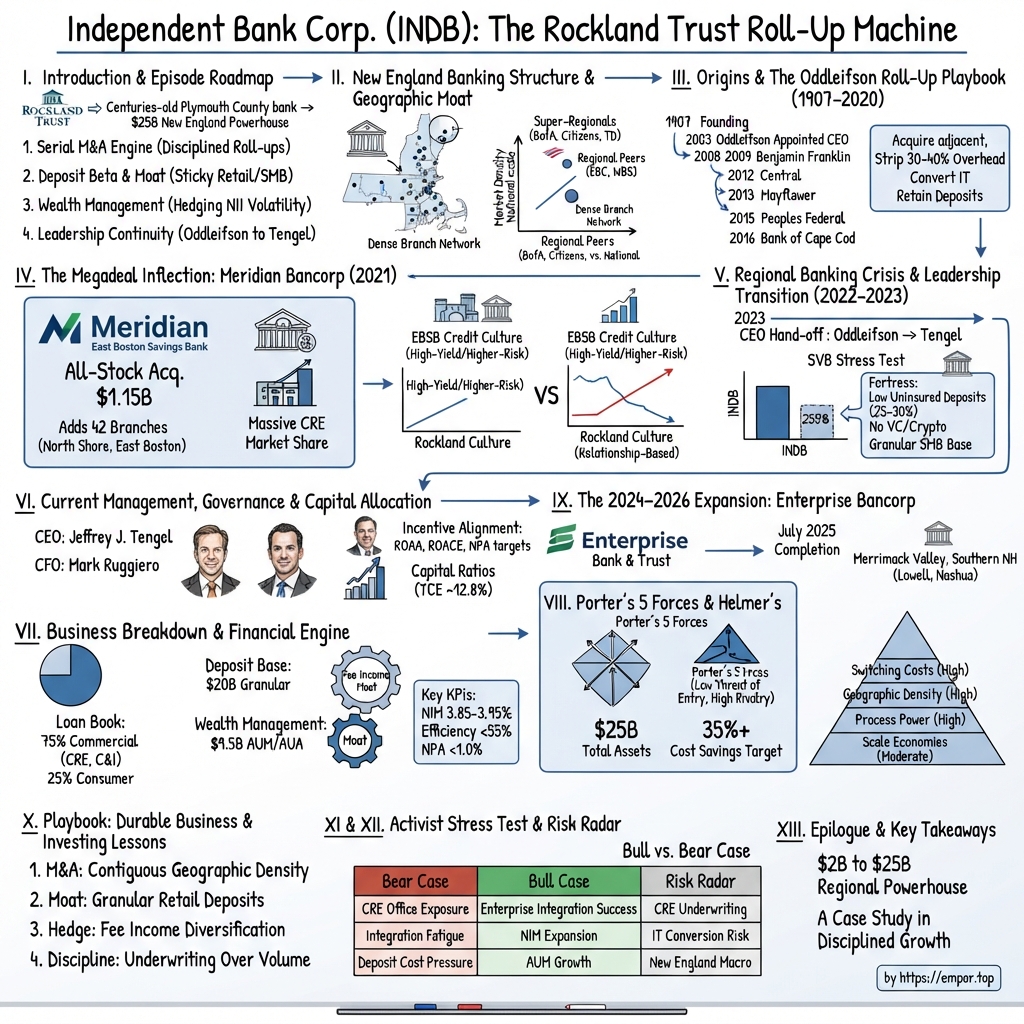
Independent Bank Corp. (INDB): The Rockland Trust Roll-Up Machine
I. Introduction & Episode Roadmap (12 min)
On the morning of July 17, 2026, the analysts dialing into Independent Bank Corp.'s second-quarter earnings call expected the usual choreography: a CEO reading prepared remarks about margin, a CFO walking through basis points, then twenty minutes of polite interrogation about office loans. Instead, Jeff Tengel opened with something else entirely. "Before we discuss our quarterly results," he said, "I wanted to share an update on my health." He reminded listeners that the company had filed an 8-K in February disclosing his non-Hodgkin's lymphoma diagnosis. Then: "I'm happy to report that I've finished my treatments and learned last Friday that I am cancer-free and in remission."1
What followed was five straight analysts — from Piper Sandler, KBW, Raymond James, Seaport, Stephens, Barclays — opening their questions with congratulations before pivoting to commercial real estate paydowns. It was a small, human moment inside a very unsentimental business. And it captures something essential about this company: Independent Bank Corp. is a $25 billion balance sheet that still behaves, in temperament and in its investor relationships, like a community bank from Plymouth County, Massachusetts.
Because that is exactly what it is. Independent Bank Corp. trades on the NASDAQ under INDB, but almost nobody in New England calls it that. They call it Rockland Trust — the operating bank, founded in 1907 by a group of local businessmen who wanted an institution to "promote the business activity and growth of Rockland and its vicinity," and who did so by taking over the First National Bank of Rockland.2 The holding company structure came much later, in 1985, when Rockland Trust merged with Middleborough Trust Company and both became subsidiaries of a newly formed parent.2
Today that parent holds roughly $25.0 billion in total assets, $20.4 billion in deposits, and $18.4 billion in loans, operating more than 150 branches across Eastern Massachusetts, Worcester County, Rhode Island, and southern New Hampshire.34 It is, by asset size, one of the largest banks headquartered in Massachusetts — and it got there almost entirely by buying other banks.
The core premise. How does a suburban South Shore trust company end up with more Massachusetts deposit share than most super-regionals bother to fight for? The answer is not technology, not a product breakthrough, and not a charismatic founder. It is twenty years of consecutive, geographically contiguous, mostly small acquisitions — followed by two much larger ones — executed with a specific and repeatable playbook: buy the adjacent bank, keep the deposits, cut a third of the overhead, convert the systems over a weekend, and move on.
That is the story. But this is a story with real tension in it, and the tension is worth stating up front, because the consensus narrative around INDB is more flattering than the evidence supports.
The four threads of this episode:
The serial M&A engine. From Slade's Ferry Bancorp in 2008 through Benjamin Franklin, Central Bancorp, Mayflower, Peoples Federal, the Cape and islands banks, and Blue Hills Bancorp, Rockland Trust compounded scale by consolidating institutions that could no longer carry their own compliance and technology costs.5 Then came two step-changes: the $1.15 billion all-stock acquisition of Meridian Bancorp — parent of East Boston Savings Bank — announced in April 2021, and the Enterprise Bancorp deal announced in December 2024 and closed on July 1, 2025.678 The second of those transactions is still being digested as of this writing.
Deposit beta and the funding moat. The single most defensible thing about this franchise is the cost of its money. In the second quarter of 2026, with the Federal Reserve on hold and competitors advertising aggressively, Rockland Trust held its total cost of deposits flat at 1.36% while growing non-time deposits by more than $300 million.19 For a bank of this size in this rate environment, that is genuinely unusual. Whether it is durable is the question we will test.
Wealth management as ballast. The Investment Management Group ended June 2026 with $9.5 billion in assets under administration, contributing to fee income of $42.4 million in the quarter.9 Management frames this as the natural hedge against net interest income volatility. It is real, it is growing, and — as we will see — it is also small relative to the balance sheet it is supposed to stabilize.
The leadership handoff. Christopher Oddleifson ran this bank from 2003 to early 2023, taking assets from just over $2 billion to nearly $20 billion.10 His successor, Jeffrey J. Tengel, arrived from M&T Bank with a commercial banking résumé and no prior tie to the South Shore. He inherited a bank that had just doubled, a rate cycle that was about to break the regional banking sector, and an office loan book that would consume years of his attention.
The thread that runs through all four: Rockland Trust's advantage has never been that it is clever. It is that it is local, dense, and patient — and that those three things, in a business built on other people's money, turn out to be worth more than cleverness. To understand why, we need to start with the market itself.
 Subscribe on LinkedIn
II. New England Banking Structure & The Geographic Moat (18 min)
Drive south out of Boston on Route 3 on a summer Friday and you pass through the geography of this entire business. Quincy, Braintree, Weymouth, Hingham, Norwell, Pembroke, Plymouth — then the Sagamore Bridge and the Cape, where the population triples between June and September and the deposit balances swell with it. Rockland Trust's CFO, Mark Ruggiero, described exactly that seasonality on the second-quarter 2026 call: deposits dipped to roughly $19.6 billion mid-quarter before rebounding hard, "a lot of activity on the Cape and the islands that's more seasonal," compounded by tax-time outflows.1
That sentence tells you more about the franchise than any slide. This is not a bank that funds itself in wholesale markets. It funds itself from households and small businesses inside a hundred-mile radius, and it can tell you, quarter by quarter, why the money moved.
Why New England is a density game. Massachusetts is a strange banking market. Household wealth per capita is high, the economy is anchored by hospitals, universities, life sciences, and professional services rather than a single cyclical industry, and municipal and commercial deposits are scattered across hundreds of towns rather than concentrated in a few corporate treasuries. Layer on top of that a long tradition of mutual savings banks and co-operative banks — institutions with no shareholders, often sub-$1 billion in assets, deeply embedded in their towns.
The consequence is that market share in Eastern Massachusetts is not won by having the best mobile app. It is won by having a branch in the town where the plumbing contractor's office is, a lender who knows the family that owns the strip mall, and a credit committee willing to underwrite a property it can drive past. National banks can match the technology. They cannot easily match the density of relationships, and they generally do not want to bother with a $3 million loan on a Weymouth industrial condo.
Conversely, a new entrant cannot simply appear. Bank charters are scarce, capital requirements are meaningful, and the compliance and cybersecurity infrastructure required to run even a modest bank has become a fixed cost that scales terribly below a few billion dollars in assets. De novo bank formation in Massachusetts has been close to nonexistent for years. That is the structural reason a roll-up strategy worked here at all: the sellers were not distressed so much as structurally exhausted.
The competitive board. Directly across the table sit Eastern Bankshares, the other large Massachusetts-headquartered commercial bank; Washington Trust Bancorp, the Rhode Island specialist; and Berkshire Hills Bancorp, working the western Massachusetts and upstate corridor. Webster Financial covers Connecticut and metro New York. Above them all sit the balance sheets that can outspend everyone: Citizens Financial Group, M&T Bank, Bank of America, and TD Bank, each with retail distribution across the region and technology budgets Rockland Trust cannot approach.
The rivalry is intense and it shows up in pricing. On the first-quarter 2026 call, Tengel described the commercial real estate market as "very, very competitive," squeezed simultaneously "at the low end with a lot of the smaller banks and the mutuals" and "at the larger end too with some of the larger banks."11 By the second quarter, he was blunter: two relationships accounting for $120 million of paydowns had refinanced away, one of them "on terms and conditions that we were very uncomfortable with."1 That is a bank choosing to lose business rather than match structure — admirable discipline, and also a direct, measurable cost to loan growth. Both things are true.
Disruption cuts the other way too. On the same call, an analyst raised "the continued disruption in Connecticut with Webster being sold" and asked whether Rockland could recruit lenders there. Tengel confirmed active conversations about standing up a loan production office, most likely in Hartford, and pointed to the Providence LPO as precedent — "It's all about the people. We wouldn't do it if we couldn't get the right people on the ground."1 Consolidation among rivals creates hiring windows; Rockland's stated approach is to walk through them with teams rather than acquisitions.
The economics, in plain English. A bank makes money on the spread between what it earns on assets and what it pays for funding. Net interest margin is that spread expressed as a percentage of earning assets. Two mechanics drive it.
The first is repricing. Loans and bonds made years ago at low rates mature and get replaced at today's rates. Ruggiero has quantified this repeatedly: in the second half of 2026 the bank expected roughly $200 million per quarter of securities to roll off at around a 2% coupon and be reinvested near 5%, which alone should add roughly 15 basis points per quarter to the securities book yield.1 Think of it as a conveyor belt of old, cheap assets being swapped for new, expensive ones — a tailwind that runs, by management's own estimate, through 2027 and begins to fade in early 2028.1
The second is deposit beta — the share of a Fed rate move that a bank passes through to depositors. This is where Rockland Trust's structure matters. Ruggiero described the mechanism unusually candidly on the fourth-quarter 2025 call: the bank runs a large book of small-balance core accounts where the pass-through is only 5% to 10%, and a smaller book of rate-sensitive money where it does deliberate "exception pricing" at 70% to 80% beta. Blended, that produces roughly a 20% beta on non-time deposits.12 In the fourth quarter of 2025, the bank cut its cost of deposits by 12 basis points against an average Fed funds decline of 40 — a realized beta near 30%, "right in line with our expectations."12
The plain-English version: most of Rockland's depositors are not shopping. They keep an operating account because their payroll runs through it. That inertia is the moat, and it is worth roughly the difference between a 1.36% cost of funds and the 3%-plus that a wholesale-funded competitor pays.
Efficiency as the third variable. Spread income and fee income get consumed by operating costs, and the efficiency ratio measures how much. Rockland Trust reported an efficiency ratio of 55.37% in the second quarter of 2026 — better than the 57.17% operating figure for full-year 2025, itself flattered relative to the 61.79% GAAP number that included merger charges.913 Sub-55% has become the informal benchmark management works toward. It has not consistently been achieved.
So what should an investor take from the market structure? That the moat here is real but narrow in kind: it is a funding-cost advantage sustained by physical density and relationship inertia, not a growth engine. It protects earnings in a rate shock. It does not, by itself, generate loans. Which is precisely the tension that has defined the company's last two years — and to understand how it was built, we go back to a shoe town in 1907.
III. Origins & The Oddleifson Roll-Up Playbook (1907–2020) (22 min)
The founding story is short and unromantic, which is fitting. In 1907, a group of Rockland, Massachusetts businessmen decided the town needed a bank of its own to support local commerce, received approval on September 10 for their proposal to take over the First National Bank of Rockland, and opened for business.2 Rockland then was a manufacturing town in Plymouth County — the kind of place where the bank's customers were the people who owned the shops and the small factories, and where the loan officer knew whose son was taking over the business.
For most of the twentieth century, nothing dramatic happened. The bank grew with its towns. In 1985, it merged with Middleborough Trust Company and both institutions became subsidiaries of a new holding company, Independent Bank Corp., which listed on NASDAQ.2 By the early 2000s, Independent Bank Corp. had just over $2 billion in assets — a perfectly respectable Southeastern Massachusetts community bank, and one of dozens.10
2003: the catalyst. Then the board hired Christopher Oddleifson. Over the next two decades, Oddleifson took the bank from that $2 billion base to nearly $20 billion, expanding from Southeastern Massachusetts to over 120 retail branches plus commercial lending, residential lending, and investment management offices across the state.10 When he announced his retirement in January 2023, American Banker framed it plainly as the end of a twenty-year term.14 He stayed on in an executive advisory role through the end of 2023 to smooth the handoff.10
What Oddleifson understood — earlier than most — was a structural shift in the economics of small banking. The compliance burden that followed the 2008 crisis and the Dodd-Frank Act, combined with the escalating cost of core processing systems, digital channels, cybersecurity, and BSA/AML infrastructure, imposed a fixed cost floor on every chartered bank in America. A $700 million mutual savings bank in Norfolk County had to buy essentially the same regulatory plumbing as a $7 billion commercial bank, and amortize it over one-tenth the asset base. Those institutions were not failing. They were slowly being taxed out of independence.
That created a supply of willing sellers — and the buyer who could integrate them fastest and most cheaply would compound the fastest.
The playbook, stated simply. Rockland Trust's approach across a dozen transactions has been consistent enough to describe as a formula. Acquire a bank whose branches sit adjacent to, or inside, the existing footprint — never a market the credit team cannot drive to. Take out roughly 30% of the target's operating expense base, since the duplicated back office, executive suite, and compliance function are precisely what made the target uneconomic in the first place. Convert the acquired bank's customer accounts onto Rockland's core system over a single weekend, so the disruption window is measured in hours. Keep the deposits — the entire economic case depends on it. And then push Rockland's broader commercial lending, treasury management, and wealth products through the newly acquired customer base.
Each step is a source of risk. Adjacency limits the universe of targets. The 30% cost take-out means firing people in towns where the bank is trying to keep customers. Weekend conversions fail spectacularly when they fail. And deposit retention is the assumption on which the accretion math rests.
The milestones. The engine started during the financial crisis, when weak banks were cheap and buyers were scarce. Rockland Trust acquired Slade's Ferry Bancorp in March 2008 for $102.2 million, establishing a Bristol County anchor, and followed with Benjamin Franklin Bancorp in April 2009 for $84.5 million, extending into Norfolk County.5 Buying during a banking panic requires a board willing to underwrite credit when nobody else will — and it is the single highest-return decision in this company's history, though it looked reckless at the time.
The next phase was densification. Central Bancorp closed in November 2012 for $52.0 million, pushing into the Greater Boston suburbs, and Mayflower Bancorp followed in November 2013 for $40.3 million, thickening the home market in Plymouth County.5 These were small — $40 million to $50 million transactions against a bank then in the $5 billion range — and that was the point. Small deals are forgiving. A conversion that goes badly on 10 branches is an embarrassment; on 100 branches it is a crisis.
In February 2015, Peoples Federal Bancshares was acquired for $141.8 million, delivering something the bank had never had: branches inside Boston proper, in Allston, Brighton, West Roxbury, and Jamaica Plain.5 That mattered because urban retail deposits are the gateway to urban commercial lending, and because it began repositioning Rockland Trust in the minds of Boston-area businesses from "the bank down the Cape" to a regional commercial player.
In 2016 came the Cape and the islands, via the acquisition of New England Bancorp, parent of Bank of Cape Cod, and an expanded island footprint.5 Cape Cod, Martha's Vineyard, and Nantucket are unusual banking markets: seasonal, wealthy, and structurally short of local institutions. They deliver exactly the kind of low-cost, high-balance, sticky deposits — and wealth management prospects — that a suburban commercial bank craves. The seasonality Ruggiero described a decade later is the direct legacy of these deals.
Then, in 2019, the step-up. Blue Hills Bancorp closed on April 1, with each Blue Hills shareholder receiving 0.2308 Independent shares plus $5.25 in cash; the customer and brand conversion happened over the weekend of June 8.15 The deal pushed Rockland Trust past $11.6 billion in assets and added Boston's Seaport District, Milton, Dedham, and Nantucket.15 The Seaport in 2019 was the most-watched development corridor in New England. Buying into it via a converted thrift, rather than a de novo branch build, was a characteristic move: acquire the customers and the deposits, skip the greenfield expense.
By the end of 2020, then, the pattern was established and the results were visible. Assets had grown roughly fivefold in seventeen years. The bank had never bought outside its region. It had never bought an asset class it did not underwrite itself. And it had never, so far, broken a conversion.
The question every serial acquirer eventually faces is whether the playbook scales — whether the discipline that works on a $50 million deal survives a transaction ten or twenty times larger. In April 2021, Rockland Trust decided to find out.
IV. The Megadeal Inflection: Merging with Meridian / East Boston Savings Bank (2021) (20 min)
To appreciate what Rockland Trust did in 2021, it helps to understand what East Boston Savings Bank actually was.
Founded in the nineteenth century in one of Boston's most fiercely local neighborhoods, EBSB — under its holding company Meridian Bancorp — had spent the 2010s becoming something quite different from a neighborhood thrift. It grew fast, and it grew by lending against Greater Boston real estate: multi-family, construction, and commercial real estate, at yields that a conservative underwriter would look at twice. Its balance sheet was concentrated, its growth was impressive, and its risk profile was, by any reasonable comparison, more aggressive than Rockland Trust's.
Which is exactly why the deal was interesting — and exactly why it carried risk.
The transaction. On April 22, 2021, Independent Bank Corp. and Meridian Bancorp announced a merger agreement under which Rockland Trust would acquire East Boston Savings Bank in an all-stock transaction valued at approximately $1.15 billion, with each Meridian shareholder receiving 0.2750 of an Independent share.6 The deal closed on November 12, 2021.7
Put that number in context. Rockland Trust had spent the preceding thirteen years buying banks for $40 million, $50 million, $100 million, $140 million. Blue Hills, its largest to that point, was a fraction of this. Meridian was, in a single stroke, roughly the size of every prior acquisition combined and then some. It took the combined institution past $20 billion in assets and added dozens of branches across the North Shore and East Boston.7
The strategic logic. Three things made it compelling. First, geography: the North Shore and East Boston were the last large gap in an otherwise continuous arc from Rhode Island around Boston to Cape Cod. Second, deposits: EBSB brought a large, granular retail deposit base in dense urban and near-urban neighborhoods — the same raw material that funds everything else. Third, commercial real estate scale: Rockland Trust instantly became a top-tier lender in the Greater Boston CRE and multi-family market.
That third item is where the story turns. In 2021, with rates near zero and Boston multi-family valuations climbing, a large CRE book looked like an asset. Within eighteen months, with the Federal Reserve raising rates at the fastest pace in four decades and hybrid work gutting office demand, it looked like an exposure.
Did Rockland overpay? The honest answer is that it depends entirely on which cost you count. An all-stock deal at a premium to tangible book value dilutes the acquirer's tangible book per share on day one, and the deal is judged by how fast retained earnings and cost savings earn that dilution back. Rockland Trust's stock in early 2021 was itself trading at a healthy multiple of tangible book, which is what made an all-stock deal palatable — the acquirer was, in effect, paying with an expensive currency.
But the real bill came later and in a different form. The transaction pushed Rockland Trust's commercial real estate concentration — regulatory shorthand for CRE loans as a percentage of total risk-based capital — well above where management wanted it. By the third quarter of 2025, after years of deliberate reduction and before absorbing another acquisition, the ratio was still 295%; management had been openly working toward getting it "below 300%."16 It reached 289% at year-end 2025, 283% by the first quarter of 2026, and 278% by the second.12111
That is a five-year deleveraging project. Read the sequence carefully and it tells you something the deal announcement did not: a material portion of what Rockland Trust bought in 2021, it subsequently decided it did not want. Management has been consistent in its language — Tengel has repeatedly described the effort as reducing "transactional" CRE while defending "relationship-based" CRE, and in the first quarter of 2026 said the bank had "achieved most of the targeted reduction."11 That is a credible, specific framing, and the execution has been real. It is also, unavoidably, an admission that the acquired book contained lending Rockland Trust would not have originated.
The credit culture collision. This is the most instructive part of the Meridian episode for investors. When a conservative underwriter buys an aggressive one, the acquirer inherits not just loans but a pipeline, a set of borrower expectations, and lenders trained to say yes to structures the acquirer would decline. Rockland Trust's response was to run those balances off — a slow, expensive, unglamorous process that shows up in financial statements as weak loan growth, not as a loss.
And that is exactly what happened. Years later, the office portfolio inherited and originated across this era was still consuming management attention. Tengel has been using a baseball metaphor on calls to describe progress: by the fourth quarter of 2025 he estimated the credit cycle was at "8" innings, with Ruggiero joking that "we might be making the call into the bullpen soon."12 By mid-2026 the tone had shifted — on the second-quarter call, an analyst pointed out that Tengel had been saying "seventh inning" on office for a couple of quarters and asked whether the eighth was near. His answer: "it still feels like this long seventh inning."1
That exchange is worth pausing on, because it is a small but genuine credibility datapoint. Management said "eighth inning" in January 2026 and "long seventh inning" in July 2026. The metaphor moved backwards. To their credit, they said so plainly rather than reframing it, and paired it with specifics: a $22 million syndicated non-performer that resumed interest payments in July, a $17.4 million single-tenant life science office property fully reserved and being brokered for sale.1 Specificity under pressure is the behavior you want. Directional accuracy on a forecast is what you would prefer.
Integration execution. On the operational metrics, Meridian went well enough that management repeated the model. Branches were rationalized, the conversion held, and the deposit base largely stayed. The integration risk that materialized was not operational — it was credit-cultural, and it took five years to work through.
Which produces the honest verdict on Meridian: a deal that delivered the deposits and the geography it promised, at the cost of a CRE concentration problem that consumed half a decade of balance sheet capacity. Whether that trade was worth it depends on what you think those East Boston and North Shore deposits are worth at 1.36% in a 4% world. It is a defensible trade. It was not a free one.
And it was, in any case, quickly overtaken by events. Four months after the Meridian closing, the Federal Reserve began raising rates.
V. The Regional Banking Crisis & Leadership Transition (2022–2023) (18 min)
There is a specific kind of vertigo that comes from taking over a company right before its industry breaks. Jeffrey J. Tengel got the full dose.
The handoff. On January 9, 2023, Rockland Trust and Independent Bank Corp. announced that Tengel would succeed Oddleifson as chief executive, effective on or about February 6.10 He was not a South Shore lifer. He was a career large-bank commercial banker: most recently Senior Executive Vice President and Head of Commercial Specialty Banking at M&T Bank, and before that President of People's United Financial prior to M&T's acquisition of it. Earlier still, he had been at PNC following its purchase of National City, where he had served as Executive Vice President of Corporate Banking overseeing specialized industries, capital markets, commercial real estate, equipment finance, and private equity. He holds a B.S. in accounting from Marquette University and an M.B.A. from the Weatherhead School of Management at Case Western Reserve University.10
Read that résumé against the company he was inheriting and the board's intent is obvious. Rockland Trust had just absorbed a large urban CRE book and needed someone who had managed large, diversified commercial portfolios through cycles — and who had been on the receiving end of two major bank integrations and could therefore see them from the acquired employee's perspective. Board chair Donna L. Abelli framed the appointment around continuity: "Our strategic direction is unchanged, and we are confident that Jeff Tengel will leverage his robust commercial banking experience and people-first leadership style to maintain Rockland Trust's best-in-class culture."10
Five weeks after he took the chair, Silicon Valley Bank failed.
Myth vs. reality: the "untouched" bank. The consensus story about Rockland Trust in March 2023 is that it sailed through — no venture concentration, no crypto exposure, no duration-mismatched securities portfolio funded by a few hundred tech treasuries. Structurally, that is true, and it is the whole point of a granular retail deposit base: a bank whose average account is a household checking balance cannot experience the kind of coordinated, app-driven flight that killed SVB.
But "untouched" overstates it. The first-quarter 2023 results tell a more textured story. Deposits fell to $15.3 billion at March 31, 2023, down $606.8 million or 3.8% from year-end 2022, which the company attributed to a combination of industry-wide dislocation, seasonality, competitive rates, and customers redeploying excess liquidity.17 Core deposits slipped from 87.9% of total deposits to 85.6% as money migrated into higher-yielding time deposits, and net income of $61.2 million, or $1.36 per diluted share, declined from the prior quarter on higher interest expense and increased borrowings taken on to offset the deposit reduction.17
So: no run, no emergency, no crisis of confidence — but a real outflow, a real mix shift, and a real earnings hit. The moat did what a moat does. It slowed the water; it did not stop it. Investors should hold both facts simultaneously, because the second one is the better predictor of how this bank behaves in future stress.
On the frequently cited claim that uninsured deposits sat at roughly 25%–30% of the total during this period: that specific figure is not something this article can verify from primary disclosure, and it is therefore recorded here as not disclosed. What is disclosed — the actual deposit decline, the core deposit mix shift, and the borrowing increase — is more useful anyway, because it is measured rather than inferred.
The grind that followed. The acute phase of the crisis lasted weeks. The chronic phase lasted years. As the Federal Reserve pushed policy rates above 5%, the arithmetic of a deposit franchise inverted. For a decade, non-interest-bearing checking had been nearly free money whose value was invisible because nothing paid anything. Suddenly, every dollar sitting in a zero-rate account had a visible opportunity cost, and customers noticed.
Money migrated: from checking to savings, from savings to money market, from money market to certificates of deposit. Each step up the ladder cost the bank real basis points. Meanwhile, Rockland Trust's loan and securities books were full of assets originated in 2020 and 2021 at rates that now looked absurd. Net interest margin compressed through 2023 and into 2024 — the classic asset-sensitive-on-paper, liability-repricing-in-practice squeeze that afflicted essentially every community and regional bank in America.
The strategic response was not clever financial engineering. It was refusing to compete on price. Ruggiero has articulated the philosophy repeatedly and consistently: the bank has "never looked to lead with rate," and in the first quarter of 2026 he acknowledged watching "some flow of excess customer funds leave for pricing that we are not willing to match," arguing that flat deposit balances alongside a 10 basis point reduction in deposit cost was "a strong outcome of this philosophy."11
That is a genuine strategic choice with a genuine cost, and it is worth naming precisely: Rockland Trust systematically trades balance-sheet growth for funding cost. In a rising-rate environment that choice protects the margin. In a competitive deposit market it caps growth. An investor evaluating this company has to decide whether they are buying a compounder or a spread-defense machine — because management has been unusually clear that it is the latter.
By late 2024, the margin had begun to turn as the repricing conveyor belt started delivering. And with the balance sheet stabilizing, Tengel did the thing his predecessor would have recognized instantly. He went shopping. But before that story, it is worth examining who is actually running this bank, how they are paid, and what they do with the capital.
VI. Current Management, Governance & Capital Allocation (16 min)
There is a moment in the January 2026 earnings call that reveals the governance reality of this company better than any proxy paragraph. Piper Sandler's Mark Fitzgibbon, having established that capital was building faster than the bank could deploy it, laid out the trap: organic growth is modest, M&A is off the table, and the stock is expensive relative to tangible book. "So I guess how else — if M&A is out of the equation and buybacks are out of the equation, organic growth doesn't get you there? Do you raise the dividend? Or is there something else that we're missing?"12
Ruggiero's answer was direct: buybacks were not out of the equation, and the target was to "keep capital fairly flat via buyback through 2026."12 Six months later, the bank had done exactly that — repurchasing $63.3 million of stock in the first quarter and $75.0 million in the second, completing one authorization and announcing a new $200 million plan in May.119 When Raymond James's Steve Moss asked in July whether the payout ratio should now be thought of as 100% of quarterly earnings, Ruggiero said "100% is the minimum," and added that he was "not against borrowing to execute more buyback than that."1
That is a management team that said what it would do and then did it, at scale, within two quarters. On capital allocation specifically, the guidance-to-execution record is strong.
The people. Tengel's leadership style, as it reads across four years of transcripts, is notably unpromotional. He describes problems in innings rather than percentages, names loans by size, and volunteers bad news — the CRE guidance cut in the second quarter of 2026, the acknowledgment that a refinancing was lost on terms the bank found uncomfortable, the concession that the credit metaphor had gone backwards. The February 2026 disclosure of his non-Hodgkin's lymphoma diagnosis, made via 8-K with a stated intent to continue in the role with schedule adjustments, was handled the same way.1 By July he reported completing treatment and reaching remission.1
For investors, the relevant governance question is not sentiment but succession depth, and the honest answer is that the company has not disclosed a named successor plan. The mitigating structure is that Mark Ruggiero — CFO and Executive Vice President, who also runs consumer lending — carries an unusually large share of the external narrative. Read any transcript and Ruggiero handles the substantive Q&A: credit specifics, loan-by-loan reserve detail, margin mechanics, capital targets. He is, functionally, the operating explainer of this company, and the continuity he provides is real. Whether that constitutes succession planning is a different question.
Myth vs. reality: how they are actually paid. The common summary — that INDB's compensation is tied to return on assets, return on equity, relative total shareholder return, and non-performing asset guardrails — is only partly right, and the corrections matter.
The 2025 annual cash incentive scorecard, disclosed in the 2026 proxy, weighted operating earnings per share at 30%, operating return on average assets at 15%, operating return on average equity at 15%, the operating efficiency ratio at 15%, and individual performance at 25%.13 There is no explicit non-performing asset metric in the scorecard. The single largest company weighting is EPS — a metric that acquisitions and buybacks can move independent of underlying returns.
Long-term equity is where the real alignment sits, and it is not relative TSR. Performance-based restricted shares granted in February 2025 vest based on return on average tangible common equity measured against the proxy peer group over the three-year period ending December 31, 2027: nothing vests below the 25th percentile, 25% at the 25th percentile, 50% at median, and 100% at the 75th percentile or above.13 Critically, there is a hard gate — no performance shares vest at all if tangible book value at the end of the period does not exceed tangible book value at the start.13
That tangible book value gate is the most shareholder-friendly provision in the entire compensation structure, and it deserves more attention than it gets. It is a direct structural brake on value-destructive M&A: a large dilutive acquisition that fails to earn back its tangible book dilution within the measurement window can zero out the CEO's performance equity. For a serial acquirer, that is precisely the right instrument.
The scorecard produced results in 2025 that landed close to target across the board: operating EPS of $5.64 against a $5.56 target, operating ROA of 1.17% against 1.16%, operating ROE of 7.87% against 7.80%, and an operating efficiency ratio of 57.17% against a 57.16% target — a 99.9% achievement on that last metric that is almost comically precise.13 The scorecard was explicitly adjusted mid-year to account for the July 1 closing of the Enterprise acquisition.13 Adjusting targets for a transaction the company chose to undertake is standard practice and defensible; it is also the kind of thing a skeptical shareholder should read carefully rather than skip.
Myth vs. reality: skin in the game. The claim that insider ownership signals meaningful alignment does not survive the ownership table. As of December 31, 2025, all directors and executive officers as a group — 23 individuals — held 785,848 shares, or 1.6% of the company.13 Tengel personally held 39,916 shares.13 The largest single insider holding belongs to Kenneth S. Ansin, at 401,004 shares — more than half the entire group total, and a legacy of the Enterprise transaction, which brought Ansin and Joseph C. Lerner onto the board.138
The actual register is index-dominated: BlackRock at 14.3%, Vanguard at 12.02%, Dimensional Fund Advisors at 5.4%, and State Street at 5.0% — roughly 37% of the company held by four passive or quasi-passive managers.13 Ownership guidelines require the CEO to hold three times base salary in stock, the CFO two times, and other executives one time, and all executives satisfied them.13 Those are ordinary thresholds, met. They are not founder-level alignment, and investors should not pretend otherwise. What discipline exists comes from the incentive design, the clawback policy adopted in October 2023, and the tangible book value gate — not from managers risking personal fortunes.13
The capital record. Beyond buybacks, the dividend has been the other pillar. The board raised the quarterly payout 8.5% to $0.64 per share in the first quarter of 2026 and declared it again in June, extending a record that reportedly spans 15 consecutive years of increases and 33 consecutive years of payments.111819 Capital ratios ended the second quarter of 2026 with common equity tier 1 at 12.80% and tangible common equity to tangible assets at 9.69% — both above management's stated long-term targets of roughly 11.75%–12% CET1 and 8.75%–9% tangible capital.912
The reading is straightforward: this is an over-capitalized bank returning capital because it cannot currently find enough loans it wants to make. That is honest capital allocation. It is also, structurally, what a business looks like when its funding advantage exceeds its asset-generation ability — which brings us to the engine itself.
VII. Business Breakdown & Financial Engine (25 min)
Strip away the branch network and the century of history, and Independent Bank Corp. is three businesses stacked on top of one another. One gathers cheap money. One lends it out. One sells advice to the people who own the money. They are not equal in size, and they are not equal in quality.
1. Commercial banking: the earnings engine and the worry.
Roughly three-quarters of the loan book is commercial, split between commercial real estate and commercial and industrial lending. The composition has been shifting deliberately and measurably: C&I rose from 22% of total loans at year-end 2024 to 25% by the first quarter of 2026.11
That shift is the central strategic project of the Tengel era, and it deserves to be understood mechanically rather than as a slogan. Commercial real estate lending is collateral-driven — the bank underwrites a building, its tenants, and its cash flows. It is capital-intensive, concentration-prone, and — as the office cycle demonstrated — subject to structural demand shocks that no amount of credit committee discipline can forecast. Commercial and industrial lending is relationship-driven: a working capital line, equipment financing, a term loan to a middle-market manufacturer or distributor. C&I loans are smaller, floating-rate more often, and — critically — they drag deposits with them. A company that borrows on a revolver keeps its operating account, its payroll, and its treasury management at the same bank.
Ruggiero made the connection explicit: the C&I focus "helped fuel an almost 50% increase in new commercial deposit generation in 2025 versus the prior year."12 That is the strategic logic in one sentence. C&I lending is not just a diversification play; it is a deposit acquisition channel.
The execution has been real but uneven. C&I balances grew 9% organically in 2025.12 In the second quarter of 2026, excluding a $37 million decline from a deliberately exited dealer floor plan business, C&I rose $116 million — about 10% annualized, and described as broad-based across market segments.1 Meanwhile investment CRE and construction fell $176 million in the same quarter on heavy payoffs, including $120 million from just two relationships, both refinanced away.1 Ruggiero noted that the bank has "very few $50 million exposures in the book at all, so to have two of them pay off is pretty unusual."1
The result: total loans essentially flat, with the mix improving underneath. Management cut its full-year CRE and construction guidance to flat-to-down and raised the C&I outlook to the high end of mid-single-digit growth.1 The approved commercial pipeline, however, grew 63% quarter-over-quarter to $510 million, split roughly evenly between CRE and C&I, with new commercial originations pricing in the mid-6% range.1
That pipeline is the most important forward-looking operating datapoint in the company. If it converts, the balance sheet returns to growth and operating leverage improves. If it does not — if payoffs keep outrunning originations — then a bank earning a 1.34% return on assets is doing so on a shrinking asset base, which is not a durable formula.9
The dealer floor plan exit is a useful window into how this management team handles a bad business. Tengel explained on the fourth-quarter 2025 call that the roughly $100 million portfolio financed inventory for very small used car dealerships, that the bank lacked "the right systems that help track the collateral," that the loans were small, and that industry consolidation made the outlook poor.12 The bank exited. That is unglamorous, correct, and — because it suppresses reported loan growth for four quarters — the kind of decision that costs a CEO in the short run. It is a credibility marker.
2. Consumer and retail banking: the funding engine.
The $20.4 billion deposit base is the reason this company exists in its current form. Demand deposit accounts — the true non-interest-bearing operating money — represent roughly 28% of total deposits, which management notes is approximately where the bank sat pre-pandemic.12 That recovery matters: most banks saw DDA share balloon during the 2020–2021 liquidity flood and then bleed out as rates rose. Returning to the pre-pandemic baseline rather than falling below it suggests the underlying relationships, not just the excess cash, came back.
The gathering mechanism is deliberately low-tech. Ruggiero described new consumer money as still "very much community bank driven with a free checking product that doesn't bring in a lot of big single deposit relationships, but it brings in a lot of units, and it adds up in dollars over time."1 On the business side, it is treasury management, word of mouth, and the C&I channel. Legacy Rockland Trust branches opened a record 6,921 new business relationships in 2025, with 97% of branches achieving positive net new business relationship growth and 100% achieving positive net new consumer growth.12
Those are the operating metrics that actually underlie the funding cost, and they are more informative than the deposit balance itself. A bank can buy deposits in a week. It cannot buy 3,463 net new business relationships.
There is a live tension here worth flagging. In mid-second-quarter 2026, the bank introduced a 4% short-term money market special, and Ruggiero was candid that new money was arriving roughly 50/50 between free checking and promotional balances, producing an all-in weighted average cost on new deposits of about 2%.1 He guided cost of deposits to drift up toward 1.40% in the second half and said the bank should "revisit the promo strategy."1 The June spot cost of deposits had already ticked to 1.38%.1
Translation: the flat 1.36% headline was achieved partly by paying up at the margin. The moat is holding, but it is being defended with money, and the cost is rising. That is worth watching more closely than the headline.
3. Wealth management: the ballast.
The Investment Management Group ended the second quarter of 2026 with $9.5 billion in assets under administration, up from $9.2 billion, where it had been essentially flat for three quarters — including through the market volatility of early 2026, when positive net flows and relative portfolio performance offset market declines.911 The Enterprise transaction contributed $1.4 billion of that total.16
The economics are attractive in a way banking economics generally are not: fee revenue scales with assets, requires almost no capital, and does not carry credit risk. Total wealth-related revenue of $14.9 million in the second quarter included managed money fees plus tax preparation ($537,000 in the quarter, seasonally elevated), estate planning, and a business advisory services line where the bank helps owners prepare for and manage the sale of their companies.19 Tengel flagged that last business as "an early sign of being a real positive catalyst for potential AUM inflows" — which is a smart adjacency, since the moment a middle-market owner sells their business is precisely the moment a large liquid portfolio needs a manager, and the bank already knows them.1
The honest limitation: $9.5 billion of AUA generating roughly $60 million of annualized revenue against a bank producing over $200 million of net interest income per quarter is ballast, not a second engine.9 It smooths. It does not offset. When an analyst probed a rising fee-to-AUA ratio on the second-quarter call, Ruggiero declined to claim credit, saying fee ratios had been "relatively flat" and the lift came from ancillary services.1 That refusal to over-claim is characteristic and creditable.
The three KPIs that actually matter.
Everything above reduces to three numbers an investor should track — not calculate, but watch — because they capture the entire investment case.
First: adjusted net interest margin and cost of deposits, together. The reported margin includes purchase accounting accretion — the non-cash benefit of marking acquired loans to fair value and amortizing the discount back into income — which is lumpy and mechanically declining. The number that matters is the core, adjusted margin: 3.76% in the second quarter of 2026, up four basis points, against reaffirmed fourth-quarter guidance of 3.90%–3.95% inclusive of a 10 basis point accretion assumption, "though likely on the low end of that range."19 Paired with it, the cost of deposits. Margin expansion driven by asset repricing is durable; margin expansion that evaporates when deposit costs rise is not.
Second: the efficiency ratio. At 55.37% in the second quarter, with full-year core expense guidance of $553–$557 million plus $5–$6 million of one-time systems conversion costs, this is the test of whether scale is actually producing operating leverage.91 Rockland Trust has spent two decades arguing that acquisitions spread fixed costs across a larger base. The efficiency ratio is where that claim is either confirmed or exposed.
Third: non-performing assets and net charge-offs. Second-quarter net charge-offs were $911,000, or two basis points annualized, with year-to-date charge-offs at six basis points and a five-quarter average of nine.19 Non-performing assets stood at $103.8 million, or 56 basis points of total assets, with the allowance at 1.06% of loans.9 The gap between those two facts — very low realized losses alongside elevated and slightly rising non-performers — is the crux of the credit debate, and it will be resolved in the CRE and construction books over the next several quarters.
Three numbers. Funding cost, operating cost, credit cost. In a bank, that is the whole business.
VIII. Porter’s 5 Forces & Helmer’s 7 Powers Analysis (15 min)
Frameworks are only useful when they are applied honestly, which means being willing to grade a company's advantages as weaker than its management describes them. Applied to Rockland Trust, the picture is of a business with one genuinely strong power, two moderate ones, and a great deal of ordinary competitive exposure.
Porter's Five Forces.
Threat of new entrants: low. This is the cleanest of the five. A new bank in Massachusetts requires a charter, regulatory approval, capital, and a compliance and technology stack whose fixed cost is punishing at small scale — the same economics that made Rockland Trust's sellers sell. Fintech challengers can attack payments and consumer lending, but the thing Rockland Trust actually owns — insured operating deposits from local businesses, embedded in payroll and treasury workflows — has proven remarkably resistant to disintermediation. Rating: genuinely protective.
Bargaining power of depositors: moderate to high, and rising. This is the force that has moved most against the bank. In a zero-rate world, depositors had no leverage because there was nothing to leverage. Above 4%, they do. The 4% money market special and the guided drift in deposit cost toward 1.40% are the visible evidence.1 The counterweight is genuine: the split-beta structure means the majority of the base does not shop. But management itself concedes the environment is "highly competitive" and that the promotional strategy needs revisiting. Rating: the moat is real and it is under sustained pressure.
Bargaining power of borrowers: moderate. Quality commercial borrowers in Eastern Massachusetts have many lenders. The evidence is the $120 million of second-quarter paydowns from two relationships, one on structure Rockland declined to match.1 Relationship lending limits pure price-shopping at the small end — a $2 million borrower values the banker who returns calls — but at $50 million exposures, the market clears on terms. Rating: real constraint on pricing power in the growth segment.
Threat of substitutes: moderate. Money market funds compete directly for deposits and have been winning share industry-wide. On the asset side, private credit and non-depository financial institutions have absorbed enormous volumes of middle-market lending. Notably, Rockland Trust has almost no exposure to that channel — Tengel stated flatly that the bank has no initiatives aimed at the NDFI or private credit space beyond a couple of small local leasing relationships.1611 That is a deliberate abstention that costs growth and avoids a risk category that has grown opaque industry-wide. Rating: substitutes constrain both sides of the balance sheet.
Competitive rivalry: high. Eastern Massachusetts contains an unusual density of similarly sized, similarly positioned banks all pursuing the same middle-market customers. Fitzgibbon's question on the January 2026 call — whether a well-structured merger of equals among them could work — was itself an acknowledgment of overcapacity.12 Tengel's answer was a clear no: "I have a bias against MOEs just because they're difficult to manage. There's more risk in it. The ones that have worked, I think, are fewer than the ones that haven't."12 Rating: intense, structural, unlikely to ease.
Helmer's Seven Powers.
Switching costs: high, and the strongest single power here. This is where the moat genuinely lives. A consumer checking account is moderately sticky. A commercial operating relationship — payroll, ACH origination, positive pay, lockbox, merchant services, a revolver, and a banker who knows the seasonality of the business — is deeply sticky, because switching means re-plumbing the company's cash flows. This is why the C&I strategy and the deposit franchise are the same strategy. Evidence: DDA at 28% of deposits held through a violent rate cycle, and deposit cost held flat in a competitive quarter.121
Cornered resource / geographic density: moderate to high. Rockland Trust has branch density and share in specific, affluent sub-markets — the South Shore, Plymouth County, Cape Cod, and the islands — that would be economically irrational for a competitor to replicate. Whether this is a true cornered resource or simply an accumulated distribution advantage is debatable; branch density is replicable by acquisition, as Rockland itself has demonstrated a dozen times. Rating: real, but purchasable.
Process power: moderate, not high. The claim that decades of New England CRE underwriting constitute a distinctive process advantage is the one this analysis would push back on hardest. The evidence cuts both ways. Realized charge-offs have been genuinely excellent — nine basis points averaged over five quarters is top-decile performance.1 But the bank also acquired a CRE book in 2021 that it then spent five years reducing, and it has carried an office problem through multiple years of "innings" commentary. Process power should mean the acquirer's underwriting standards travel intact into acquired portfolios. Here they had to be retrofitted. Rating: strong credit culture, unproven credit process at acquisition scale.
Scale economies: moderate. A $25 billion asset base absorbs compliance, cybersecurity, and core platform costs better than a $2 billion one — that is the entire twenty-year thesis. But the efficiency ratio in the mid-50s is competitive, not dominant, and the company is currently spending $5–$6 million on a one-time core conversion while standing up an AI governance function with, by management's own description, three dedicated individuals.112 Against national banks spending billions on technology, Rockland Trust's scale is sufficient to survive, not to lead. Tengel's stated AI approach — a centralized steering committee, "relatively easy use cases as we build muscle memory," explicitly avoiding "the proverbial boiling the ocean" — is sensible risk management and an implicit acknowledgment that the bank will be a fast follower, not an innovator.111
Branding, counter-positioning, network economies: essentially absent as sources of durable advantage. Local brand affection is real and commercially useful — it lowers customer acquisition cost — but it is not pricing power. There is no network effect in deposit-taking.
The synthesis. Rockland Trust's competitive position rests on one strong power (commercial switching costs), one purchasable one (density), and adequate scale. That is a defensible franchise, not an unassailable one. It explains a durable funding-cost edge and a high floor on returns. It does not explain outsized growth — and any investment case that requires outsized growth from here is relying on something other than these forces.
Which raises the obvious question. If the powers are defensive rather than expansionary, where does growth come from? Management's answer, in December 2024, was to go buy it.
IX. The 2024–2026 Expansion: Enterprise Bancorp & The Northern Pivot (18 min)
Enterprise Bank was not, culturally, a normal acquisition target. Founded in Lowell, Massachusetts, it had spent decades building a fiercely community-oriented commercial bank in the Merrimack Valley — a corridor of former mill cities north of Boston that had spent the 2010s reinventing themselves — and pushing north into southern New Hampshire. Its founder and chairman, George Duncan, was a genuine local institution.
Which is why the most revealing thing Tengel said about the deal had nothing to do with financial metrics.
On the October 2025 call, describing the integration, he stepped out of the script: "The typical pattern in most of the acquisitions I've been involved in is for the acquired CEO to get a big payday and ride off into the sunset. In the case of Enterprise, their former Chairman and Founder, George Duncan, remains actively involved as an advisor to our Board, chairs the newly created Lowell Advisory Board, and continues to be an advocate for Rockland Trust and the community." And then, with more feeling than bank CEOs usually permit themselves: "Simply put, they care."16
That is the human core of what is otherwise a straightforward consolidation.
The transaction. Independent Bank Corp. and Enterprise Bancorp signed a merger agreement on December 8, 2024, announced the following day, in a cash-and-stock transaction valued at approximately $562 million in aggregate, or $45.06 per Enterprise share.20 Enterprise shareholders received 0.60 Independent shares plus $2.00 in cash for each share held, with Independent expecting to issue roughly 7.5 million shares and pay $27.1 million in cash.20 The deal was projected to deliver cost savings equal to 30% of Enterprise's annual operating expenses and to be approximately 16% accretive to Independent's earnings per share in 2026, the first full year of combined operations, assuming full phase-in.20
Myth vs. reality on the synergy target: the frequently repeated "35%-plus" cost savings figure is not what the company guided to. The stated target was 30%, and management reaffirmed exactly that number on the third-quarter 2025 call, to be fully realized during 2026.1620 Precision matters here, because the difference between 30% and 35% on an acquired expense base is the difference between a deal that works and a deal that works better than promised.
The transaction closed on July 1, 2025. Final purchase accounting put total consideration at $503.1 million — $477.2 million of equity representing 7,478,906 shares, plus $25.9 million in cash — below the announcement-date value because Independent's share price had moved.421
The strategic case. Geographically, it did something none of the prior deals had: it took Rockland Trust out of Massachusetts. Lowell, Lawrence, and the Merrimack Valley extended the footprint north; Nashua and Manchester opened southern New Hampshire, a market with no state income tax, meaningful in-migration from Massachusetts, and a commercial base Rockland Trust had never served. Combined with the existing Rhode Island presence, the franchise became a genuinely tri-state one. The pro forma institution reached roughly $25.0 billion in assets, $20.4 billion in deposits, and $18.4 billion in loans.39
What the calls revealed. The Q&A across four quarters is where the real integration story lives, and it contains both genuine outperformance and a genuine miss.
The outperformance was in retention. Rockland Trust closed no Enterprise branches and retained all Enterprise branch employees.16 It retained close to 100% of client-facing commercial personnel, and over 90% of Enterprise employees who received offers accepted them.16 Excluding brokered funds and municipal deposits, every Enterprise branch exceeded the bank's 95% deposit retention target, with roughly 60% showing stable or increasing balances — against an industry norm in which an acquired bank typically loses 10% of deposits.12 Enterprise bankers' third-quarter 2025 originations ran 27% above the prior-year period, and in the fourth quarter the acquired branches opened 271 new business relationships and 837 new consumer relationships.1612
Those are unusually good integration numbers, and they validate the specific mechanism management credits: because the two banks had similar credit cultures, "there has not been the typical transition period where the acquired bankers must figure out where the new bank's credit appetite is."16 This is the strongest available evidence that the roll-up playbook is a real capability rather than a narrative.
The miss was in the marks. The deal was originally modeled to produce 9.8% tangible book value dilution. Actual dilution came in around 7%, because the loan interest and credit marks were smaller than modeled.16 That sounds like good news — and on the capital line, it was. But marks are two-sided: a smaller discount on acquired loans means less accretion income flowing back through the margin. Ruggiero said so directly: "we anticipate slightly lower earnings accretion than originally modeled as well."16
The consequence showed up immediately. Third-quarter loan accretion came in at roughly eight basis points of margin against guidance implying meaningfully more, which Ruggiero attributed to timing, noting the total accretable loan interest and credit mark of approximately $160 million would flow in over five to seven years but would be "lumpy due to prepayments, individual loan payoffs, and repricing events."16 Seaport's Laurie Hunsicker pressed the point in detail, and Ruggiero conceded the number should move up while declining to pick one.16
That exchange is a fair illustration of both the strength and the limitation of this management team's disclosure. The strength: they explained the miss mechanically, on the same call, without deflection. The limitation: purchase accounting accretion is a genuinely low-quality earnings component, and a reported margin flattered by it — 3.90% reported in the first quarter of 2026 versus a core figure eight basis points higher than the prior quarter — requires investors to do adjustment work management could do for them more prominently.11
The costs were real. Merger expenses ran $23.9 million in the third quarter of 2025 alone, primarily severance and professional fees, with roughly $22 million more having flowed through Enterprise's own books pre-close as change-of-control payments.16 Day-two CECL provisioning on non-purchase-credit-deteriorated acquired loans added $34.5 million — an accounting requirement that forces an acquirer to book a lifetime loss reserve on performing acquired loans it just marked to fair value, effectively double-counting credit risk in the first reporting period.16 The combination drove GAAP third-quarter net income to $34.3 million, or $0.69 per diluted share, against adjusted operating net income of $77.4 million, or $1.55.16 That gap — a 55% haircut to reported earnings — is what large bank acquisitions look like in the quarter they close.
The conversion. Enterprise's customer accounts converted over the weekend of October 11, 2025, and Tengel described it as going "exceptionally well."16 Separately — and this is a distinct project frequently conflated with it — Rockland Trust is migrating its entire bank from the Horizon core platform to IBS, both within the FIS ecosystem. That conversion was originally scheduled for May 2026. It slipped to October 2026. Ruggiero explained the delay candidly: the team wanted more time, and "you need to get the core provider with the weekend where they can facilitate the conversion as well. So it's almost similar to scheduling an acquisition deal where you need the FISs of the world to be able to have a slot."12
A five-month slip on a core conversion is not alarming — choosing more preparation over a deadline is the right instinct, and Tengel's framing was appropriately grim: "we got to get the conversion right. You don't get a second chance if you don't."12 But it is a schedule miss, it carried $3.2 million of consulting cost through the first half of 2026 with more concentrated in the third quarter, and it means the single largest operational risk this company faces sits ahead of it as of this writing, not behind it.1
And what about the next deal? For six consecutive quarters, management's answer has been the same. Asked in January 2026, Tengel said M&A "is not one of them" among priorities.12 Asked in July, he said "the M&A answer would be the same as it's been in past quarters."1 The one carve-out he has offered: a registered investment advisor acquisition to build wealth management, "because it doesn't involve a big systems conversion. I think the execution risk is much less."12
Consistency across six quarters of being asked the same question by the same analysts is, in itself, a credibility signal. Whether it survives a 12.80% CET1 ratio and a stock trading well above tangible book is the open question — and it is precisely the question the tangible book value vesting gate was designed to discipline.
X. Playbook: Durable Business & Investing Lessons (15 min)
Step back from the quarter-to-quarter detail and this company offers four transferable lessons — each of which has an important limiting condition that the standard telling omits.
1. The roll-up works when the map is contiguous.
Every acquisition in Rockland Trust's history sits adjacent to territory it already served. Bristol County touched Plymouth County. Norfolk County touched both. Boston proper touched the inner suburbs. The North Shore touched Boston. The Merrimack Valley touched the North Shore. Southern New Hampshire touched the Merrimack Valley. Drawn on a map, twenty years of transactions form a single expanding blot, never a scatter of dots.
That is not aesthetics. Contiguity is what makes the cost synergies real — overlapping back offices, a single credit committee, one compliance function, shared marketing — and what keeps the credit team inside its circle of competence. The counter-example is the long history of banks that bought "attractive growth markets" 1,500 miles away and discovered they could not underwrite there. Rockland Trust has never made that mistake, and its abstention from the NDFI and private credit lending that has driven much of the industry's recent growth is the same discipline expressed on the asset side.16
The limiting condition: contiguity eventually runs out of adjacent targets, or the remaining ones are too large to be safe. Rockland Trust has arguably reached that point in Eastern Massachusetts — which is why the growth conversation has shifted from acquisitions to loan production offices and lender hiring.
2. Deposit franchises are options that only pay off in a storm.
For the decade after 2008, a granular retail deposit base was worth approximately nothing in reported earnings. Every bank funded itself for free. The community bank with 200,000 small checking accounts and the wholesale-funded specialist looked identical on the income statement, and the specialist grew faster.
Then rates went to 5%, and the option struck. The difference between funding a balance sheet at 1.36% and at 3.5% is, on $20 billion of deposits, more than $400 million of annual pre-tax income. That is the entire value of the franchise, and it was invisible for ten years.
The limiting condition — and it is the one most often skipped: this option is not free to hold. Maintaining 150-plus branches, thousands of employees, and a physical presence in small towns is an ongoing expense that shows up every quarter in the efficiency ratio, whether rates are at zero or five percent. Rockland Trust pays that premium continuously and collects on it episodically. An investor buying a deposit franchise is buying insurance, and insurance has a cost.
3. Fee income diversifies, but the honest word is "smooths," not "offsets."
The wealth management business does real work. It generates revenue uncorrelated with the yield curve, requires no capital, and — through the business advisory line serving owners selling their companies — sits naturally adjacent to the commercial franchise.1
The limiting condition: at roughly $9.5 billion of AUA against a $25 billion balance sheet, the fee engine cannot offset a serious margin compression event.9 It can turn a bad quarter into a mediocre one. Investors who describe fee income as a "hedge" against net interest income are overstating the magnitude by an order of magnitude. The right frame is ballast in the hull, not a second engine.
4. Underwriting discipline is expensive, and the expense is the proof.
The most counterintuitive lesson here is that credit discipline shows up in financial statements as bad news. When Rockland Trust let $120 million refinance away rather than match a structure it disliked, the reported outcome was a loan growth miss and a guidance cut.1 When it exited the floor plan business, the reported outcome was a $100 million headwind to growth.12 When it ran off transactional CRE, the reported outcome was five years of shrinking commercial real estate balances.11
None of those decisions produced a headline that looked good. All of them are the mechanism by which nine-basis-point charge-offs happen.1
The limiting condition, and it is the sharpest one: discipline and stagnation are indistinguishable in the short run. A management team that consistently reports flat loan growth while explaining that the market is irrational is either protecting shareholders or losing competitively, and the two look identical for several years. The only way to tell them apart is what happens on the other side of the cycle — whether the disciplined bank picks up share and quality assets when the aggressive lenders retrench. Rockland Trust's 2008–2009 acquisitions suggest it has done this before. It has not yet demonstrated it in this cycle.
The through-line: this is a company that has repeatedly chosen the slower, safer option and been proven right on a long enough time horizon. The investing question is whether the time horizon required is longer than most shareholders will hold — and what happens if this cycle's test arrives in a form the playbook has not seen.
XI. Activist / Skeptical-Investor Stress Test & Risk Radar (16 min)
Imagine a skeptical investor building the short case, or an activist writing the letter. What would they attack? Not the deposit franchise — that is unambiguously good. They would attack four things, and each has genuine merit.
Attack one: the office book is a slow bleed with no announced end date.
The bear's exhibit is the transcript record itself. Across 2025 and 2026, management has provided quarter-by-quarter loan-level detail on office credits: a $22 million syndicated non-performer charged down and held flat for multiple quarters; a $17.4 million single-tenant life science property carrying a full reserve against updated broker opinions of value; a $27 million relationship extended for two years with injected equity; a $9.9 million participation impaired by federal lease pullbacks in an out-of-market property.11216
The disclosure is genuinely excellent — better than most banks of this size provide. But the pattern is what a skeptic seizes on: loans move into criticized status, get extended, get brokered, occasionally get charged down, and the aggregate barely moves. Non-performing assets rose from $85.7 million at year-end 2025 to $98.7 million in the first quarter of 2026 to $103.8 million in the second.12119 Charge-offs stay negligible, which the bull reads as sound collateral and the bear reads as deferred recognition.
The bear's strongest specific point is the extension mechanism. When a bank grants short-term extensions to criticized commercial real estate loans while awaiting sales or refinancings, it is making a judgment that time will resolve the problem. Sometimes it does — the $27 million relationship that was upgraded after equity injection is exactly that.16 Sometimes it converts a credit problem into a longer, larger credit problem. The bull's counter is the realized loss record, which is close to pristine.1
Management's own guidance is that the office issue is "identifiable and manageable" with "no quick fix."11 That is probably accurate. It is also an admission that this drags on.
Attack two: integration fatigue and a shrinking balance sheet.
Two large acquisitions in four years, plus a full core platform migration, is a heavy operational load for a bank this size. Since the 2021 transaction, this company has been continuously integrating, converting, or de-risking something. Meanwhile, total loans have gone essentially nowhere: CRE and construction down, C&I up, consumer roughly flat.
The activist's framing writes itself: management has spent $1.7 billion of shareholder capital on acquisitions to assemble a balance sheet that is not growing, and is now returning capital via buyback because it cannot deploy it. The counter — that the acquisitions bought deposits and geography rather than loan growth, and that the deposit franchise is what generates the return — is legitimate. But it requires believing that a bank should be valued on its liabilities rather than its assets, which is a sophisticated argument that market multiples do not always reward.
Attack three: the funding advantage is being defended with money.
The 4% money market special, the roughly 2% all-in cost on new deposits, the guided drift toward 1.40%, and the June spot rate already at 1.38% all point the same direction.1 The bear argues that the celebrated 1.36% cost of deposits is a lagging measure of a franchise built in a low-rate era, and that marginal pricing — what the bank pays for the next dollar — has already converged toward competitors. If deposit growth requires promotional pricing, the moat is being monetized rather than compounded.
Ruggiero has essentially conceded the mechanism while arguing the mix still works.1 Investors should watch the gap between the average cost of deposits and the new-money cost. If it narrows persistently, the thesis is weakening.
Attack four: governance, concentration, and accountability.
The activist points to the 1.6% combined insider stake, an incentive scorecard whose largest company weighting is EPS rather than a returns or risk metric, mid-year adjustment of targets for a self-initiated acquisition, and 2025 achievement landing within a rounding error of target on every measure.13 None of this is improper. All of it is the kind of structure that produces target-hitting rather than outperformance.
The strongest governance rebuttals are the tangible book value vesting gate and the October 2023 clawback policy — both genuine, both shareholder-protective.13 The weakest link is the absence of a disclosed succession framework, which the CEO's 2026 health episode made concrete rather than theoretical. The board's handling — prompt 8-K disclosure, continuity of strategy, no interim appointment — was reasonable. It was not a substitute for a named plan.
The current risk radar.
Commercial real estate refinancing and debt service coverage. Loans underwritten in 2019–2021 at low rates are maturing into a market where new commercial money prices in the mid-6% range.1 A property whose rents supported a 4% coupon may not support 6.5%, regardless of occupancy. This is the mechanism that converts an interest rate problem into a credit problem, and it operates on a multi-year lag. Rockland Trust's disclosure of criticized balances by maturity quarter is genuinely useful here and should be read every quarter.
Core systems conversion execution. The October 2026 Horizon-to-IBS migration is the largest single operational risk in front of this company. A failed or degraded conversion damages exactly the asset the entire thesis rests on — the operating relationships of small businesses whose payroll runs through the bank. There is no financial hedge for this risk; there is only preparation. The company has budgeted $5–$6 million of one-time cost and expects some added consulting expense in the fourth quarter for customer-facing support post-conversion.1
New England macro concentration. Every loan, deposit, and wealth relationship sits within roughly a hundred miles of Boston. Massachusetts business confidence, as measured by the Associated Industries of Massachusetts survey, sat in the high 40s for five consecutive months through late 2025 — below the neutral 50 threshold.16 Through 2026, management has cited the Iran war and its effect on oil prices, tariffs, inflation in labor and healthcare, and a federal government shutdown as sources of client caution, describing the customer mindset as "cautious" while noting no meaningful stress in the loan portfolios.1116
A live regulatory and political overhang worth flagging: Massachusetts rent control. Management identified the prospect of rent control as suppressing multi-family construction lending through early 2026, with investors "on the sidelines."11 Following the decision reported on the second-quarter call, Tengel noted some asset sales that likely would not otherwise have occurred and cap rates that had "come in a bit," while cautioning it was too early to see a demand surge — and importantly, that the organization behind the measure "will have the ability in two years to reintroduce that as a ballot measure."1 For a bank whose largest commercial portfolio is multi-family, that is a recurring policy risk with a defined reset clock.
Technology and AI. Not a near-term threat to a relationship deposit franchise, but a long-term cost question. Rockland Trust's AI program consists of a governance committee and, per the 2026 guidance, three dedicated individuals.12 Management has explicitly conditioned further investment on demonstrated payback offsetting other expenses.12 That is disciplined. It is also, at national-bank scale, rounding error — and the risk is not that AI disintermediates the bank, but that competitors' cost structures improve faster.
XII. Bull vs. Bear Case & What to Watch (15 min)
The bull case, stated at its strongest.
The core argument is operating leverage arriving on a franchise that has already absorbed its costs. Between the first and fourth quarters of 2025, operating EPS rose 60%, operating return on assets improved 40 basis points, and operating return on average tangible common equity improved 529 basis points.12 That trajectory continued: second-quarter 2026 net income of $81.8 million, or $1.70 per diluted share, produced a 1.34% return on assets and a 14.05% return on average tangible common equity — against $51.1 million and materially weaker returns in the year-ago quarter.9
Management has committed to specific fourth-quarter 2026 targets: a 1.4% return on average assets and a 15% return on average tangible capital, reaffirmed on consecutive calls.111 Those are concrete, falsifiable, near-term, and the company is close to them.
The margin path supports it. The securities repricing conveyor should deliver roughly 15 basis points per quarter of securities yield lift in the second half of 2026, with additional loan and securities repricing benefit running through 2027.1 New commercial originations at mid-6% against a 1.36% cost of funds is a spread that compounds. The $510 million approved pipeline suggests loan growth returns.1 Management guided to mid-single-digit commercial loan growth in 2027 if CRE stabilizes.1
Capital return amplifies everything. At 12.80% CET1 against a long-term target of roughly 11.75%–12%, with a stated intention to return at least 100% of earnings and willingness to borrow to do more, share count shrinks while EPS grows.9121 Wealth management crossing $10 billion of AUA adds capital-free revenue.9
And underneath it all sits the Enterprise integration evidence: near-100% commercial banker retention, above-target deposit retention, no branch closures, and acquired lenders producing 27% above prior-year volumes.1612 If the roll-up capability is real, optionality on the next transaction is real too — even if management currently disclaims interest.
The bear case, stated at its strongest.
The bear does not dispute the profitability improvement. The bear disputes its source and durability.
Start with what is driving the earnings recovery: purchase accounting accretion, securities repricing, and share count reduction. All three are mechanical. All three are finite. Accretion declines as the acquired mark amortizes — management's own guidance embeds only 10 basis points of it by the fourth quarter of 2026.1 Securities repricing benefit, per Ruggiero, largely exhausts by early 2028.1 Buybacks shrink the share count but also shrink capital. None of this is franchise growth.
Meanwhile, the actual business is not growing. Total loans have been flat to declining. CRE guidance was cut mid-year. The bank is losing refinancings to competitors on structure. Deposit growth requires 4% promotional pricing. The efficiency ratio, at 55.37%, is competitive but not improving dramatically despite a $25 billion asset base assembled expressly to generate scale economies.9
Then add credit. Non-performing assets have risen three consecutive quarters. The office metaphor moved backwards from eighth inning to long seventh. The allowance at 1.06% of loans sits against a portfolio with 278% CRE concentration — down from the peak, but still elevated relative to the 300% regulatory attention threshold and far above most similarly sized commercial banks.19
And the largest identifiable operational risk — a full core platform conversion for a $25 billion bank — is still ahead, on a timeline that has already slipped once.
The bear's synthesis: this is a well-run, conservatively managed bank whose earnings recovery is substantially mechanical, whose loan book is shrinking, whose funding advantage is being defended with rising marginal costs, and which trades at a meaningful premium to a tangible book value of $48.34 per share.9 The quality is real. The question is what is already priced.
What would falsify each case.
The bull case breaks if the $510 million pipeline fails to convert and loans decline again, if deposit cost drifts materially above the guided 1.40%, if the October conversion disrupts service, or if a single large CRE credit produces a charge-off that dwarfs the current nine-basis-point run rate.
The bear case breaks if commercial loan growth returns to mid-single digits in 2027 as guided while deposit costs hold, if the office book resolves through the disclosed sales and refinancings without material loss, and if the efficiency ratio moves through 55% and stays there.
The three things to watch.
First, the adjusted net interest margin alongside the cost of deposits. Not the reported margin — the core one, stripped of purchase accounting accretion, paired with what the bank pays for money. Guidance calls for 3.90%–3.95% by the fourth quarter of 2026, likely at the low end, with deposit costs drifting toward 1.40%.1 The relationship between those two numbers is the entire economic engine.
Second, commercial real estate non-performing loans and net charge-offs. Watch the direction of the criticized and classified balances by maturity quarter — the disclosure management provides in its earnings deck — and whether resolutions come through sales at or near carrying value. Two basis points of quarterly charge-offs against $103.8 million of non-performers is a gap that will close in one direction or the other.19
Third, wealth management organic net flows. Not total AUA, which moves with markets, but net new client assets. It is the only line in this company that grows without consuming capital or credit risk, and the business advisory channel targeting owners selling their companies is the specific mechanism to watch.1
XIII. Epilogue & Key Takeaways (10 min)
In September 1907, a group of businessmen in a Massachusetts manufacturing town received approval to take over their local national bank because they wanted an institution that would lend to people they knew.2 Nearly 120 years later, the enterprise that grew out of that decision holds roughly $25 billion in assets, operates more than 150 branches across three states, and manages $9.5 billion for clients — and it still funds itself the same way, from households and small businesses within driving distance of its credit committee.39
The transformation from a $2 billion Plymouth County bank to a $25 billion tri-state institution was not the product of a single insight. It was the accumulated result of roughly a dozen acquisitions executed over two decades, each one adjacent to the last, each one buying deposits and relationships rather than growth stories, each one integrated on a schedule measured in weekends.
What that history actually demonstrates is narrower than the standard telling allows. It demonstrates that a disciplined acquirer operating inside a defined geography, with a genuine funding-cost advantage and a credit culture willing to lose business, can compound scale for a very long time without a blowup. It does not demonstrate that the model generates organic growth — because for the last several years, it has not. It does not demonstrate immunity to stress, because deposits did leave in 2023 and non-performing assets have risen through 2026.179 And it does not demonstrate that the playbook scales indefinitely, because the two largest transactions each produced complications — a five-year CRE deleveraging in one case, a purchase accounting shortfall and a delayed core conversion in the other.111612
What can be said with confidence is this. Independent Bank Corp. has a funding franchise that most banks its size would trade a great deal for, and it has been managed by people who consistently choose the slower option and explain themselves in specifics when things go wrong. It has an incentive structure with a genuine tangible book value gate and a governance structure with genuinely modest insider ownership. It is over-capitalized and returning capital because it cannot currently find enough assets it wants. And it is carrying the largest operational risk of its recent history — a full core platform migration — into the autumn of 2026.
The investing question that remains is not whether Rockland Trust is a good bank. The evidence says it is. The question is whether a business whose competitive advantage is defensive by nature — a lower cost of funds, defended with rising marginal pricing, deployed into a loan market where it keeps declining the terms on offer — can convert that advantage into growth on the other side of this cycle, as it did after 2008. That answer will arrive in the pipeline conversion, the office resolutions, and the October conversion weekend. Not in the narrative.
References
-
Independent Bank Corp. (INDB) Q2 2026 Earnings Call Transcript — Seeking Alpha, 2026-07-17 ↩↩↩↩↩↩↩↩↩↩↩↩↩↩↩↩↩↩↩↩↩↩↩↩↩↩↩↩↩↩↩↩↩↩↩↩↩↩↩↩↩↩↩↩↩↩↩↩↩↩↩↩↩↩↩↩↩
-
Independent Bank Corp. Completes Acquisition of Enterprise Bancorp, Inc. — Business Wire, 2025-07-01 ↩↩↩
-
Independent Bank Corp. Form 10-K for fiscal year 2025 — SEC EDGAR, 2026-02 ↩↩
-
Independent Bank Corp. Investor Presentation (acquisition history and deal values) — SEC EDGAR, 2019 ↩↩↩↩↩
-
Independent Bank Corp. and Meridian Bancorp, Inc. Sign Merger Agreement for Rockland Trust Company to Acquire East Boston Savings Bank — Rockland Trust, 2021-04-22 ↩↩
-
Independent Bank Corp. Completes Acquisition of Meridian Bancorp, Inc. — Business Wire, 2021-11-12 ↩↩↩
-
Independent Bank Corp. Announces Completion of Enterprise Bancorp, Inc. Acquisition and Appointment of Kenneth S. Ansin and Joseph C. Lerner as Directors — Business Wire, 2025-06-30 ↩↩
-
Independent Bank Corp. Reports Second Quarter Net Income of $81.8 Million — Business Wire / StockTitan, 2026-07-15 ↩↩↩↩↩↩↩↩↩↩↩↩↩↩↩↩↩↩↩↩↩↩↩↩↩
-
Rockland Trust Company and Independent Bank Corp. Appoint Jeffrey J. Tengel as Chief Executive Officer — Rockland Trust, 2023-01-09 ↩↩↩↩↩↩↩
-
Independent Bank Corp. (NASDAQ:INDB) Q1 2026 Earnings Call Transcript — Insider Monkey, 2026-04-17 ↩↩↩↩↩↩↩↩↩↩↩↩↩↩↩↩↩↩
-
Independent Bank Corp. (INDB) Q4 2025 Earnings Call Transcript — Seeking Alpha, 2026-01-23 ↩↩↩↩↩↩↩↩↩↩↩↩↩↩↩↩↩↩↩↩↩↩↩↩↩↩↩↩↩↩↩
-
Independent Bank Corp. 2026 Proxy Statement (DEF 14A) — Independent Bank Corp., 2026-03-24 ↩↩↩↩↩↩↩↩↩↩↩↩↩↩
-
CEO of Independent Bank Corp. to step down after 20-year term — American Banker, 2023-01-09 ↩
-
Independent Bank Corp. Completes Acquisition of Blue Hills Bancorp, Inc. — Business Wire, 2019-04-01 ↩↩
-
Independent Bank Corp. (NASDAQ:INDB) Q3 2025 Earnings Call Transcript — Insider Monkey, 2025-10-17 ↩↩↩↩↩↩↩↩↩↩↩↩↩↩↩↩↩↩↩↩↩↩↩↩
-
Independent Bank Corp. Reports First Quarter Net Income of $61.2 Million (Exhibit 99.1) — SEC EDGAR, 2023-04-19 ↩↩↩
-
Independent Bank Corp. Announces Quarterly Dividend — Business Wire, 2026-06-18 ↩
-
Independent Bank declares $0.64 per share dividend — Investing.com, 2026-06-18 ↩
-
Independent Bank Corp. and Enterprise Bancorp, Inc. Sign Merger Agreement for Rockland Trust to Acquire Enterprise Bank (Exhibit 99.1) — SEC EDGAR, 2024-12-09 ↩↩↩↩
-
Independent Bank Corp. 2025 Annual Report on Form 10-K — key metrics summary, StockTitan, 2026 ↩
 LinkedIn
 WhatsApp
 Reddit
 Hacker News
 Email
Email Kindle
 RSS Feed
 Spotify
 Apple Podcasts
 Amazon Music
 Audible
 YouTube