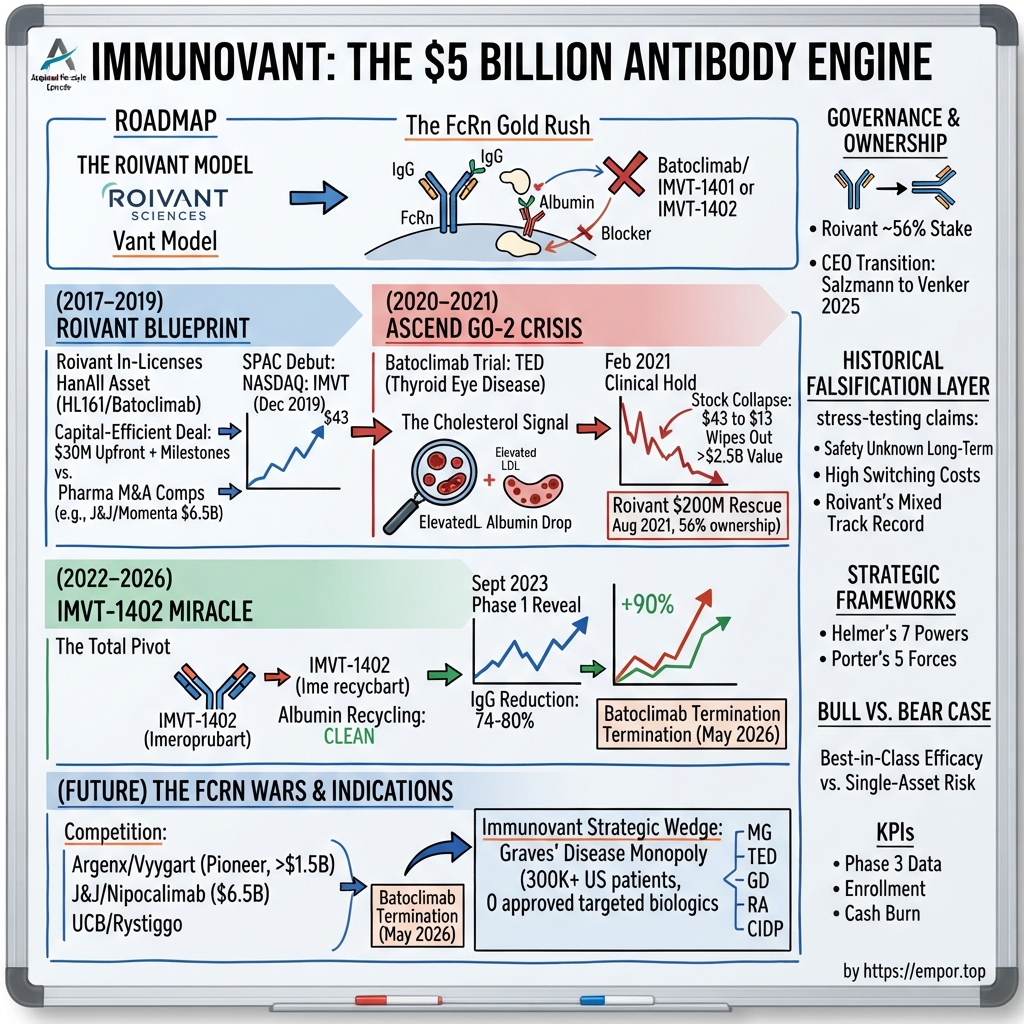
Immunovant: The $5 Billion Antibody Engine & The Battle for FcRn
I. Introduction & Episode Roadmap
On the morning of February 2, 2021, a small New York biotechnology company published a press release running barely 500 words. It cited no drug failure, patient death, or regulatory action. Instead, it disclosed a single laboratory value: in a mid-stage trial of its primary asset, patients receiving the high dose experienced an average LDL cholesterol increase of roughly 65% by week twelve.1 The company voluntarily paused dosing before regulators requested it.
Investors reacted swiftly. The stock, which had closed the previous session at $43.30, fell 42% in a single day to close at $25.08 on trading volume more than twenty times normal. The decline continued over the following months; by early August, shares traded below $8, reducing a market valuation that had exceeded $4 billion in January to a few hundred million dollars by summer.
That company was Immunovant, Inc. While clinical-stage biotechs frequently face existential crises, Immunovant's subsequent trajectory was unusual. As of August 29, 2026, the company commands a market capitalization of roughly $8.5 billion, maintains six active clinical programs, and holds $797.8 million in cash—all while accumulating more than $1.9 billion in cumulative losses over nine years without generating a single dollar of product revenue.184
The FcRn gold rush. Immunovant's core premise relies on a single biological mechanism. Immunoglobulin G (IgG) antibodies serve as the immune system's long-range defenses, persisting in the bloodstream for weeks rather than hours due to a recycling protein called the neonatal Fc receptor, or FcRn. Acting like a conveyor belt inside vessel-lining cells, FcRn intercepts IgG antibodies targeted for disposal and returns them to circulation. While this mechanism preserves antibodies fighting infections, it also prolongs the survival of autoantibodies that attack the body's own thyroid, neuromuscular junctions, or peripheral nerves.
Blocking FcRn halts this recycling process. Pathogenic antibodies degrade alongside normal IgG, reducing blood IgG levels by 60% to 80% within weeks. Crucially, FcRn inhibition does not destroy antibody-producing B cells or broadly suppress immune function like steroids or traditional immunosuppressants. Because it acts as a targeted clearance mechanism rather than broad immune suppression, industry observers compare FcRn blockers to the anti-TNF biologics that transformed autoimmune disease treatment in the late 1990s: a single mechanism applicable across multiple diseases.
Commercial results support that comparison. Market pioneer argenx reported $4.2 billion in 2025 sales for its FcRn blocker Vyvgart—a 90% year-over-year increase—and achieved its first full-year operating profit.5 Johnson & Johnson paid approximately $6.5 billion in cash for Momenta Pharmaceuticals in 2020 primarily to acquire a single FcRn antibody.6 Immunovant's regulatory filings note third-party estimates putting more than four million patients in the US and Europe within reach of the mechanism across more than twenty publicly announced indications.2
What this story is about. Immunovant represents a direct bet on FcRn biology and a case study in modern biotech finance. Its trajectory traces the "Vant" operating model created by Roivant Sciences—the parent firm founded by Vivek Ramaswamy on the premise that drug development is constrained more by fragmented management focus than a scarcity of candidate molecules. The company's history encompasses a $30 million licensing deal with South Korea's HanAll Biopharma, a SPAC listing, a safety crisis that wiped out most of its equity value, a dilutive parent-company rescue, the parallel development of a candidate that doubled the stock in one session, and the quiet discontinuation of its founding asset in April 2026.
The sections ahead trace that arc across nine movements:
First, the Roivant "Vant" blueprint and the December 2017 license from 한올바이오파마 HanAll Biopharma that provided Immunovant's original asset.
Second, the December 2019 listing through a special-purpose acquisition company and the eighteen months of clinical momentum that followed.
Third, the ASCEND GO-2 trial crisis: what the cholesterol elevation signal revealed, why the underlying biology indicated a molecule-specific issue, and how the market decline unfolded over six months.
Fourth, the $200 million parent-company financing that stabilized the firm, the parallel development of IMVT-1402, and the September 2023 trading session in which the stock nearly doubled.
Fifth, the competitive economics of the FcRn class in 2026—measuring argenx's $4.2 billion franchise alongside therapies from Johnson & Johnson, UCB, and emerging developers against standard treatments.
Sixth, clinical mechanics and market sizing across Graves' disease, myasthenia gravis, difficult-to-treat rheumatoid arthritis, CIDP, Sjögren's disease, and cutaneous lupus.
Seventh, executive leadership and governance: the April 2025 management transition, Roivant's majority stake, and the preferred share structure securing board control regardless of equity ownership levels.
Eighth, a structured evaluation of the primary investment claims—testing safety profiles, competitive positioning, and capital management against Immunovant's operational record.
Ninth, strategic evaluation frameworks, bull and bear scenarios, key performance metrics, and the broader lessons of navigating a major clinical setback.
One framing note before examining this history: Immunovant's current valuation remains a forecast. The company has not yet commercialized a product, and pivotal clinical data that will test its core thesis arrive in 2027. Its story offers a clear natural experiment in how public markets price a biological mechanism and how a controlled subsidiary manages investor capital while awaiting clinical proof.
 Subscribe on LinkedIn
II. The Roivant Blueprint & The HanAll In-Licensing Bet (2017–2019)
The founding insight behind Roivant Sciences was not scientific. It was organizational. Vivek Ramaswamy, then a hedge fund analyst covering biotech, kept noticing the same pattern: promising clinical-stage molecules sitting inert inside large pharmaceutical companies and small foreign biotechs, not because the data were bad but because nobody senior had the bandwidth or the incentive to champion them. Portfolio prioritization inside a company with forty programs is a political process, and orphaned assets are its casualties.
Roivant's answer was structural. License the orphan asset for modest upfront capital. Wrap it in a dedicated subsidiary — a "Vant" — with a small team whose entire professional existence depends on that one molecule. Give the Vant its own board, its own equity currency, and often its own listing. Keep centralized functions at the parent. The bet is that concentrated attention plus aligned equity beats the diversified indifference of a large pipeline.
It is worth being clear-eyed about what this model is and is not. It is not drug discovery. Roivant has never claimed to invent molecules; it claims to be better at recognizing which existing ones deserve capital and then running them harder. That makes the Vant model closer in spirit to a specialist private equity firm than to a research institute — the value creation comes from selection, financing and execution, not from the bench. And like a private equity firm, its record should be judged on the fate of individual deployments, not on the elegance of the thesis. That is a standard this particular story will be held to repeatedly.
The counterparty. The molecule came from 한올바이오파마 HanAll Biopharma, a Seoul-listed pharmaceutical company whose domestic business has historically rested on conventional prescription and over-the-counter products, and which had spent years building an antibody research capability alongside it. HanAll's anti-FcRn program was exactly the kind of asset the Vant model was built to find: real science, generated by a competent team, sitting inside a company with neither the balance sheet nor the Western regulatory apparatus to take it through US and European Phase 3 trials on its own.[^18] For HanAll, the deal converted a research program into upfront cash, cost-sharing, milestone participation and a royalty on somebody else's commercial risk. For Roivant, it converted cash into an option on a mechanism. Both sides got what they wanted, which is generally the sign of a well-constructed licensing trade rather than a steal.
Immunovant's founding trade. On December 19, 2017, Roivant Sciences GmbH signed a license agreement with HanAll Biopharma of South Korea for an anti-FcRn antibody then known as HL161, later batoclimab.4 The terms are worth dwelling on, because they define the economics of everything that followed. Roivant paid $30.0 million upfront. It agreed to share up to $20.0 million of HanAll's research and development costs, an obligation that has since expired. It committed to regulatory and sales milestones — as of June 30, 2026, $32.5 million of milestone events had been paid and up to $420.0 million remained potentially payable. And it agreed to tiered royalties running from the mid-single digits to the mid-teens as a percentage of net sales.4
The licensed territory covered the United States, Canada, Mexico, the European Union, the United Kingdom, Switzerland, the Middle East, North Africa and Latin America.4 HanAll retained Korea, Japan and Greater China — an important detail, because it means Immunovant has never controlled the global asset. It controls the rich markets, which is where the money is, but it is a licensee, not an owner. The rights were assigned down to Immunovant's Swiss subsidiary in December 2018 for $37.8 million.4
Now hold that $30 million upfront next to the comparison that Roivant's own investors have used ever since. In August 2020, Johnson & Johnson agreed to acquire Momenta Pharmaceuticals for approximately $6.5 billion in cash, at $52.50 per share — roughly a 70% premium — primarily to obtain global rights to nipocalimab, a different antibody against the same receptor.6 Two anti-FcRn assets, at roughly comparable clinical maturity, separated by a factor of more than two hundred in acquisition cost.
That comparison is genuinely flattering to the Vant model, and it is also incomplete. Roivant bought early, which is exactly when the price of a molecule is low and the probability of failure is high. J&J bought late, after Momenta had de-risked the asset in patients. The $30 million was not clever pricing so much as it was an option premium — and, as the next section makes clear, the option turned out to be on the wrong molecule. What survived was not batoclimab but the right of first refusal over HanAll's back-up and next-generation antibodies embedded in the same contract.4 That clause, almost certainly a boilerplate afterthought in 2017, later became the entire company.
The 2019 listing. Immunovant did not IPO in the conventional sense. On December 19, 2019, it completed a share exchange with Health Sciences Acquisitions Corporation, a special-purpose vehicle sponsored by the healthcare crossover fund RTW Investments, and began trading on Nasdaq under IMVT.7 Proceeds exceeded $100 million, earmarked for three Phase 2 programs in the anti-FcRn asset: Graves' ophthalmopathy — thyroid eye disease — myasthenia gravis, and warm autoimmune hemolytic anemia.7
The choice of vehicle tells you something about how Roivant thought about capital markets. A SPAC in late 2019, before the 2020–21 mania, was not a fashionable route; it was a fast and certain one, with a sophisticated healthcare sponsor rather than a retail-facing promoter. Rod Wong, RTW's founder and HSAC's chief executive, and Pete Salzmann, whom Immunovant had recruited as CEO earlier that year, were both quoted at closing in terms that emphasized speed to patients.7
Salzmann is worth introducing properly, because his fingerprints are on every decision through 2025. He is a physician — University of Chicago's Pritzker School of Medicine — with a Stanford MBA and roughly two decades at Eli Lilly, where he ran US immunology and served as global clinical development leader for baricitinib, Lilly's JAK inhibitor. He was, in other words, not a scientist-founder but a large-pharma immunology development executive: someone whose instinct was to run disciplined registrational programs across many indications rather than to fall in love with a molecule.
What it meant. By the end of 2019, Immunovant had assembled the classic Vant package: a de-risked-enough asset acquired cheaply, a public listing providing currency, a credentialed development executive, and a controlling parent absorbing the corporate overhead. Total capital deployed to get there was, by biotech standards, trivial. The model looked vindicated. It had simply not yet been tested by contact with real patients over real durations — which is precisely what was about to happen.
III. The ASCEND GO-2 Crisis: The 70% Crash & The Safety Pause (2020–2021)
Through 2020, the story was as good as biotech stories get. Batoclimab — a fully human monoclonal antibody that latches onto FcRn and stops it from rescuing IgG — was producing deep antibody knockdown in early studies, in a formulation that patients could inject under the skin rather than sitting in an infusion chair. Thyroid eye disease, one of its lead indications, had just been transformed commercially by Horizon Therapeutics' Tepezza, proving payers would fund expensive biologics for a disease that makes eyes bulge painfully forward. By late January 2021 the stock traded around $40 and the company's market value sat above $4 billion, on the strength of a molecule that had never completed a Phase 3 trial.
Then the safety monitoring data from ASCEND GO-2, the Phase 2b trial in thyroid eye disease, came back.
The signal. Reviewing preliminary unblinded data from roughly forty patients through week twelve, Immunovant found dose-dependent elevations in total and LDL cholesterol. Mean LDL was up approximately 65% in the 680 mg group and approximately 40% in the 340 mg group, with no increase in controls.1 The company paused dosing across both the thyroid eye disease and warm autoimmune hemolytic anemia programs — a voluntary decision, made to inform patients, investigators and regulators and to redesign the monitoring program.1 By week twenty, eight weeks after the last dose, cholesterol had returned to baseline or below across groups.1 The same signal was subsequently identified in the hemolytic anemia program in June 2021.
The biology, in plain terms. FcRn does not only recycle IgG. It performs the same rescue service for albumin, the workhorse protein that keeps fluid inside blood vessels and ferries fatty acids around the body. Batoclimab binds FcRn in a way that impairs both jobs at once. In a later Phase 1 study of 70 healthy participants published in Drug Safety in April 2025 — with authors from Immunovant — serum albumin fell by up to 37% at weekly doses of 255 mg and above, reversing within about four weeks of stopping.8
The leading explanation is that the liver, sensing lower albumin, responds with a nonspecific compensatory surge of lipoprotein production, pushing LDL up. Honesty requires noting that the authors could not confirm the link at the individual level: while mean results across dose cohorts moved as the theory predicts, there was no statistical correlation between how much a given person's albumin dropped and how much their LDL rose, and the paper concluded the precise mechanism remains incompletely understood.8 That caveat matters later, because a mechanism you cannot fully specify is a mechanism you cannot confidently engineer around.
Why it was a class problem, not a company problem — until it wasn't. The critical strategic question in February 2021 was whether every FcRn blocker would do this. If the answer were yes, the entire mechanism was compromised and argenx was in trouble too. The answer turned out to be no, and the reason is architectural. Efgartigimod is an engineered fragment of the IgG constant region that competes with IgG at its own docking site on the receptor. Batoclimab and IMVT-1402 are fully human monoclonal antibodies that bind FcRn from a different angle — and where a molecule lands determines what else it disrupts.217 Two drugs, same target, different consequences, which meant the problem was Immunovant's alone.
That distinction is what turned a bad quarter into an existential one. A mechanism-wide safety issue would have been shared misery with a well-funded rival and a plausible path to a class-wide solution. A molecule-specific liability, in a company with one molecule, is simply a broken company. The warm autoimmune hemolytic anemia program, one of the three indications the 2019 listing was raised to fund, never recovered from the pause.17 It does not appear among the six indications Immunovant is running today, though the company still holds a patent family covering the use of anti-FcRn antibodies in that disease with applications that could run to 2040 — a reminder that in biotech, abandoned indications leave intellectual property behind them like tide marks.2
Market destruction. The one-session move was severe but not, as is sometimes claimed, a 70% wipeout: the shares fell roughly 42% on February 2, 2021, from $43.30 to $25.08. The seventy percent came later, and slower, as it usually does. Through the spring the stock ground down through the twenties and teens; by August 2, 2021 it traded at $7.74. Peak to trough, holders lost more than 80% of their money over six months. A securities class action was filed against the company, certain officers and an HSAC board member in February 2021; the court entered judgment for the defendants in April 2024, plaintiffs did not appeal, and the litigation concluded.2
The distinction between the one-day drop and the six-month decline is not pedantry. A single-day crash is a repricing of one data point. A six-month bleed is the market working through a harder question: if the molecule's core mechanism produces the problem, can any dose or any co-medication fix it?
The rescue, and what it cost. Roivant had spent much of 2021 exploring taking Immunovant back in-house entirely, as part of its own path to a public listing. On August 2, 2021, it abandoned that plan and instead injected $200 million, buying 17,021,276 shares at $11.75 — a roughly 15% premium to the twenty-day volume-weighted average — and lifting its stake from 57.5% to 63.8%.9 Immunovant's pro forma cash rose to about $600 million.9
Note carefully what happened to the share price on the day of the rescue: it fell from $10.46 to $7.74. Investors did not read a premium-priced $200 million infusion as a vote of confidence. They read the withdrawal of the buyout as the removal of a floor, and the issuance of 17 million shares at $11.75 into a stock that promptly traded at $7.74 as a transfer of value to the controlling holder at a moment of maximum minority weakness. Whether that reading is fair is debatable — Roivant was the only buyer willing to write the cheque, and a premium to VWAP is not obviously abusive — but it is the reading the tape delivered, and it is the reason "Roivant rescue" and "shareholder-friendly" are not synonyms in this story.
Two tracks. Publicly, through 2021 and 2022, Immunovant pursued the obvious fix: lower doses, and co-administration of a statin to blunt the lipid effect. That work was real, and it was eventually published — atorvastatin substantially reduced the cholesterol increases without meaningful drug-drug interaction.8 Privately, the company and HanAll were advancing a different molecule entirely, engineered to avoid the problem rather than manage it. Which of those two tracks the company genuinely believed in is the sharpest test of management candour in the whole history, and it is taken up directly in Section VII.
IV. The IMVT-1402 Miracle & The Total Pivot (2022–2026)
Antibody engineering is, at heart, a shape problem. FcRn is a receptor with more than one docking site: one region where IgG attaches, another where albumin does. Batoclimab binds in a way that interferes with both. The design brief for the successor molecule was therefore narrow and specific: keep the tight grip on the IgG-binding region, and stay off the albumin site.
That successor, IMVT-1402—now carrying the international nonproprietary name imeroprubart—emerged from what the company describes as a multi-step, multi-year research program run jointly with HanAll to design highly potent anti-FcRn antibodies optimized for simple subcutaneous injection.4 The second design constraint was as commercially important as the first. Argenx's original Vyvgart required intravenous infusion; formulating it for subcutaneous administration required co-formulation with Halozyme's hyaluronidase enzyme to dissolve tissue matrix so larger volumes could be injected. While effective, that approach introduces third-party royalty obligations and limits delivery device options. Immunovant designed IMVT-1402 for small-volume administration via the YpsoMate autoinjector manufactured by Ypsomed AG—an off-the-shelf device used across multiple commercial products and implemented across every IMVT-1402 clinical trial, ensuring the commercial delivery system is evaluated directly during clinical development.2
September 2023. In September 2023, initial Phase 1 data in healthy adults in New Zealand were released in two tranches. In the 300-milligram multiple-ascending-dose cohort, four weekly subcutaneous doses produced a statistically significant 63% reduction in mean total IgG from baseline. In the 600-milligram cohort, four weekly doses drove a 74% reduction.2 Across all dose levels, reductions in albumin and increases in LDL cholesterol were non-existent or minimal—yielding safety metrics comparable to placebo.2 Adverse events were limited to mild or moderate intensity.
The market response on September 26, 2023, was immediate: the stock closed at $39.96, up from $20.28 in the prior session, nearly doubling on trading volume of 35 million shares compared to its typical one million.10 Parent entity Roivant saw its equity value rise by roughly 25%. Investors repriced the business not around a single product candidate, but around broad platform optionality: a selective FcRn blocker capable of deep IgG reduction without lipid liabilities could target multiple IgG-mediated autoimmune indications.
Management capitalized on the valuation surge immediately. In October 2023, Immunovant completed an underwritten public offering of roughly 8.5 million shares at $38.00, alongside a private placement of 4.5 million shares to Roivant at the same price, generating $466.7 million in combined net proceeds.2 Issuing equity at $38 shortly after a data-driven rally represented effective capital-markets execution, significantly strengthening the balance sheet.
It is important to distinguish early pharmacology from long-term clinical safety. Data from sixty-eight healthy volunteers receiving weekly doses over a few weeks confirm target engagement, but they provide limited insight into safety and efficacy in patients with chronic autoimmune conditions over extended durations. Immunovant's regulatory filings reflected this distinction through measured framing—describing the candidate as "potentially best-in-class" with a "potentially favorable safety profile" and "no or minimal" lipid impact.2 Public markets in late 2023, however, priced in a far more definitive outcome.
The long goodbye to batoclimab. For nearly three years, Immunovant ran clinical development for both molecules concurrently. Batoclimab generated relevant clinical evidence regarding FcRn inhibition. In March 2025, the Phase 3 trial in myasthenia gravis met its primary endpoint: the 680-milligram high dose improved Myasthenia Gravis Activities of Daily Living (MG-ADL) scores by 5.6 points compared to 3.6 for placebo at week 12, while the 340-milligram dose yielded a 4.7-point improvement. Total IgG fell by 74% and 64% in the high- and low-dose cohorts respectively, with 42% of high-dose patients achieving minimal symptom expression versus 7% on placebo.11 In chronic inflammatory demyelinating polyneuropathy, a Phase 2b trial demonstrated an 84% responder rate among patients who achieved at least a 70% reduction in IgG.11 Then-CEO Pete Salzmann framed the findings around a core scientific thesis: deeper IgG suppression correlates directly with superior clinical responses.11 Yet alongside these results, Immunovant announced it would not pursue regulatory approval for batoclimab in either indication.11
The decision to shelve two positive registrational-grade studies highlights a rare dynamic in biotech development: trials for an initial asset effectively served as proof-of-concept validation for its successor, confirming the mechanism's dose-response relationship at the cost of a full clinical development cycle.
The proof-of-concept study in Graves' disease reinforced this relationship. Among 25 patients, twelve weeks of high-dose batoclimab produced a mean 77% IgG reduction and an 80% overall response rate, with 60% of patients discontinuing antithyroid medications entirely; stepping down to the lower dose reduced IgG suppression to 65% and the drug-free response rate to 40%.2 Patients attaining at least 70% IgG reduction achieved nearly three times the drug-free response rate of those who fell short of that threshold—64% compared to 23%.2 Furthermore, six-month off-treatment follow-up data presented in September 2025 showed that 17 of 21 patients maintained normal thyroid hormone levels, as pathogenic thyroid-receptor antibodies remained suppressed despite total IgG rebounding.2
April 2026: the end. Two Phase 3 trials in thyroid eye disease read out on April 2, 2026. Neither met its primary endpoint, defined as the proportion of patients achieving at least a two-millimeter reduction in proptosis at week 24 following twelve weeks of high-dose therapy and twelve weeks of low-dose maintenance.12 The underlying data, however, revealed a clear pattern: patients experienced greater clinical improvement during the high-dose phase than during the step-down period.12 The trial design—a forced dose reduction driven by batoclimab's cholesterol liability—ultimately compromised the study's efficacy potential.
Following the readout, Immunovant officially discontinued batoclimab across all indications, recognizing $39.0 million in contractual termination costs while maintaining $42.5 million in non-cancelable obligations accrued on its balance sheet as of June 30, 2026.34 In April 2026, the company notified HanAll of its decision to indefinitely suspend development and initiated discussions regarding the potential return of territorial rights.4 SEC filings highlight an ongoing risk that HanAll may contest Immunovant's contractual interpretation, presenting a potential legal overhang for a company whose core intellectual property remains tied to that master agreement.4
Market reaction to the Phase 3 failure was muted: the stock closed at $24.50 on April 2, down slightly from $25.10 the previous day. Investors had largely discounted batoclimab well before the official announcement, shifting Immunovant's equity valuation almost entirely to IMVT-1402.
The first patient data. Seven weeks later, on May 20, 2026, Immunovant released its first clinical efficacy data for IMVT-1402 in a patient population. The results came from a potentially registrational trial in anti-citrullinated-protein-antibody-positive, difficult-to-treat rheumatoid arthritis—a patient cohort that had exhausted conventional biological therapies. Among 165 evaluable participants, 86.7% had failed two or more advanced treatment classes, had lived with the condition for an average of 12.8 years, and exhibited severe baseline disease activity, averaging 24.2 tender and 16.7 swollen joints.4
At week 16, 72.7% of patients achieved an ACR20 response (a 20% improvement in symptoms), 54.5% reached ACR50, and 35.8% reached ACR70, with non-completers categorized as non-responders.4 Efficacy remained consistent among the subset of 107 patients who had failed both a JAK inhibitor and an anti-TNF agent—a highly treatment-refractory group—where response rates reached 72.0% for ACR20, 53.3% for ACR50, and 37.4% for ACR70.4 The stock surged from $26.29 to $35.56 on the day of the release, driven by volume of nearly 20 million shares.
These initial results carry important methodological qualifications. Period 1 of the trial was open-label, meaning both patients and investigators were aware of active treatment. Immunovant mitigated evaluation bias by utilizing independent, blinded assessors for joint count evaluations.4 However, patient-reported outcome components of the ACR scale cannot be fully blinded in an open-label format, leaving room for expectation effects in patients with long disease histories. The definitive test lies in Period 2: a randomized withdrawal design in which week 16 responders either remain on treatment or switch to placebo, with the primary endpoint evaluated at week 28.4 That readout, expected later in 2026, will establish whether these clinical gains persist under blinded, placebo-controlled conditions.
Concentration by design. Following the discontinuation of batoclimab, Immunovant is operating as a single-asset enterprise: six clinical trials reliant on one molecule, one mechanism, and one target dose profile. While management characterizes this structure as operational focus, it presents substantial pipeline concentration risk. Any unpredicted safety or efficacy setback at the molecule level would directly impact every active program across the company's clinical portfolio.
V. Core Business Economics & Competitive Landscape (FcRn Wars)
To evaluate Immunovant's competitive position, consider the single metric shaping the entire class. Immunovant's regulatory filings state that across eight indications in Phase 2 and Phase 3 trials, deeper IgG reductions consistently correlate with superior clinical outcomes—a relationship supported by its own batoclimab trials in Graves' disease, myasthenia gravis, and CIDP, where a 70% IgG-reduction threshold repeatedly separated better clinical responses from worse ones.2
If that correlation holds in ongoing studies, the FcRn market becomes a battleground where biological potency is the primary differentiator. Immunovant projects that continuous weekly 600 mg dosing of IMVT-1402 can yield roughly 80% IgG reduction—a deeper clearance level, it argues, than rival candidate programs have demonstrated.4
Conversely, if that relationship breaks down—if antibody reduction beyond a certain point delivers diminishing clinical returns or elevates infection risks—Immunovant risks entering a crowded field as a fourth-to-market player whose primary distinction is a delivery autoinjector.
The incumbent. Market leader argenx represents a fully established commercial competitor. Its therapy Vyvgart gained initial approval for generalized myasthenia gravis as an intravenous infusion in 2021, followed by the subcutaneous formulation Vyvgart Hytrulo in 2023, a label expansion into CIDP in 2024, and a prefilled syringe option in 2025.2 For calendar year 2025, net product sales reached $4.2 billion across approximately 19,000 patients—including $1.3 billion in the fourth quarter alone—allowing the company to fund $1.4 billion in research and development while generating $1.1 billion in operating income.5 argenx is also advancing next-generation follow-ons, including ARGX-213 in a registrational study and ARGX-124 in early-stage development.2 Crucially, in March 2026, argenx announced plans to launch its own registrational trial in Graves' disease later in 2026.2
That expansion directly challenges the simplest narrative surrounding Immunovant. The concept of an uncontested Graves' disease market now faces a direct competitor backed by thousands of existing patients, an established specialty distribution network, and mature payer relationships.
The rest of the field. Additional competitors are expanding across the class. Johnson & Johnson secured approval for nipocalimab under the brand name IMAAVY in 2025 for adult and adolescent myasthenia gravis, backed by global commercial capabilities.26 UCB's rozanolixizumab, marketed as RYSTIGGO, received approval in 2023 for both AChR- and MuSK-antibody-positive myasthenia gravis.2 Meanwhile, Viridian Therapeutics is advancing two engineered FcRn inhibitors in Phase 1 trials.2
Beyond FcRn mechanisms, alternative therapeutic modalities present significant substitution risks. Complement inhibitors such as Soliris, Ultomiris, and Zilbrysq maintain approvals in myasthenia gravis, while Amgen's CD19-targeted UPLIZNA secured approval in December 2025 for AChR-positive patients.2 In CIDP, Phase 3 trials are evaluating alternative mechanisms, including Sanofi's riliprubart, Dianthus's DNTH103, and argenx's empasiprubart.2 In Graves' disease, alternative development candidates include Biohaven's Phase 1 IgG degrader BHV-1300, Merida Biosciences' MER511, Yarrow Bioscience's anti-TSHR antibody YB-101, TSH receptor antagonists from Crinetics and Lycia, Sanofi's Phase 2 BTK inhibitor rilzabrutinib, and a preclinical anti-TRAb antibody from Viridian.2
Immunovant's wedge, examined. Immunovant's emphasis on Graves' disease targets a market where standard treatments have remained essentially unchanged for decades. Medical management relies primarily on antithyroid drugs, which suppress hormone synthesis without addressing the underlying autoantibodies.2 Invasive alternatives—thyroidectomy or radioactive iodine ablation—frequently leave patients dependent on lifelong hormone replacement, while radioiodine therapy carries the risk of exacerbating thyroid eye disease.2 Consequently, patient adoption of radioactive ablation fell from over 50% in 2005 to approximately 11% by 2021.2 This shift has created an expanding patient population with inadequately controlled disease who reject destructive procedures.
Citing Inovalon medical claims data, Immunovant estimates the overall U.S. Graves' disease population at roughly 880,000 patients, including approximately 330,000 who have relapsed on antithyroid medications while avoiding ablation.2 Internal chart reviews covering more than 140 endocrinologists indicate that 25% to 30% of patients remain inadequately controlled.2 While these metrics represent company-sponsored calculations, the broader clinical dynamic—a sizable patient base seeking disease-modifying pharmacotherapy—is aligned with historical treatment patterns.
Immunovant applies a similar market-sizing framework across its other target indications. In difficult-to-treat rheumatoid arthritis, of the approximately 820,000 U.S. patients receiving advanced disease-modifying drugs, about 15% have failed two or more biologic classes; with 70% of that subset testing autoantibody-positive, management identifies a target pool of roughly 85,000 patients.2 In myasthenia gravis, the U.S. prevalence ranges from 59,000 to 116,000 patients, with roughly 35% experiencing inadequate disease control.2 In CIDP, an estimated 58,000 U.S. patients include approximately 30% with persistent symptoms.2 Finally, in cutaneous lupus, out of roughly 153,000 patients across two primary subtypes, about half remain inadequately managed.2
What FcRn blockade is actually displacing. The broader commercial momentum of the FcRn class stems from limitations in traditional treatment options. Patients with autoantibody-mediated conditions have historically relied on intravenous or subcutaneous immunoglobulin, systemic corticosteroids, plasma exchange, or non-selective immunosuppressants. Intravenous immunoglobulin offers clinical benefit but carries risks of severe headaches, thromboembolism, and hemolysis, while involving lengthy administration procedures, periodic supply shortages, and limited availability in certain regions.2 Subcutaneous immunoglobulin often demands external infusion pumps and multiple injection sites to manage high administration volumes.2 Plasma exchange requires invasive central venous access, chronic corticosteroid use exposes patients to metabolic and cardiovascular toxicities, and traditional immunosuppressive drugs carry substantial risks of cytopenias, nephrotoxicity, bone marrow suppression, and infertility.2
Against these options, a weekly self-administered subcutaneous injection designed to selectively degrade pathogenic antibodies represents a distinct therapeutic approach. This functional shift explains the rapid commercial adoption observed by argenx and supports projections of sustained market expansion across the FcRn class.
Stress-testing the market size. Industry analysts frequently project total global revenues for the FcRn class to reach between $10 billion and $15 billion. Aggregating Immunovant's target patient estimates across its six active indications yields a U.S. addressable population of several hundred thousand individuals prior to European expansion.2 From a broader perspective, commercial launches in initial indications have rapidly built multi-billion-dollar product revenues, while third-party industry forecasts cited in company filings estimate that more than four million patients across the U.S. and Europe fall within the scope of FcRn inhibition across more than twenty announced indications.2
However, total addressable market figures define upper boundaries rather than definitive sales forecasts. Realized commercial revenues face three structural constraints: clinical adoption rates in chronic autoimmune care are typically restricted by diagnostic drop-offs, specialist referral bottlenecks, and restrictive payer coverage policies; net realized prices often contract significantly relative to list prices as competitive rebates expand; and commercial crowding is intensifying, with Immunovant competing alongside at least three established FcRn developers in initial indications and five alternative therapeutic mechanisms in Graves' disease. While the aggregate market opportunity is clearly multi-billion-dollar, Immunovant's ultimate market share remains unproven.
Myth versus reality. Three prominent market assumptions regarding Immunovant require empirical qualification.
Myth: Immunovant holds an uncontested monopoly in Graves' disease. Reality: Immunovant holds a timing lead rather than a monopoly, and that position faces active competition. argenx announced in March 2026 that it would initiate a registrational Graves' trial in 2026, while at least five non-FcRn therapeutic modalities—including an IgG degrader, TSH receptor antagonists, an anti-TSHR antibody, a BTK inhibitor, and an anti-TRAb antibody—are currently undergoing clinical evaluation.2 Immunovant's primary advantage consists of an approximately two-year development lead alongside initial patient proof-of-concept data.
Myth: Early clinical trials have resolved long-term safety questions. Reality: Phase 1 healthy-volunteer studies and 16-week open-label rheumatoid arthritis trials evaluate short-term pharmacology, whereas registrational programs extend from 24 to 52 weeks—a crucial window given that batoclimab's historical safety signals exhibited dose- and duration-dependent characteristics.12 Definitive safety validation depends on pivotal trial readouts through 2027.
Myth: Roivant's majority ownership ensures comprehensive financial backing. Reality: Roivant carries no contractual obligation to fund Immunovant's ongoing operational losses, and past capital infusions were executed under distressed market conditions.9 Furthermore, Roivant is currently allocating capital toward its own commercial operations and share repurchases.15 A controlling entity that acquires subsidiary equity during market drawdowns functions as an opportunistic investor rather than a financial guarantor.
What the economics actually look like. Immunovant's financial resources are heavily focused on these ongoing clinical trials. For the fiscal quarter ended June 30, 2026, research and development expenses included $42.9 million allocated to endocrine programs (more than double the prior-year period), $22.3 million to rheumatology (nearly triple), and $25.5 million to neurology—contributing to total quarterly R&D expenditure of $142.6 million and a net loss of $153.2 million.4 As of fiscal year-end, the company maintained 315 employees, with approximately 85% dedicated to research and development functions.2 Operating without commercial manufacturing facilities or physical infrastructure, Immunovant's cost structure is almost entirely driven by clinical trial execution and personnel.
This lean operational model provides flexibility, allowing management to reallocate capital rapidly—as demonstrated by the discontinuation of batoclimab. However, it also means that if IMVT-1402 encounters clinical or regulatory failure, the company retains minimal residual asset value, operating without commercialized products, physical production facilities, or recurring royalty streams.
VI. Management, Governance, & Roivant's Control Structure
On April 21, 2025, Immunovant announced that Pete Salzmann was retiring as chief executive and board member, and that Eric Venker—Roivant's president and chief operating officer—would replace him.13 The same announcement moved Renee Barnett out of the chief financial officer role and installed Tiago Girão, previously CFO of another Roivant affiliate.13 Both replacements came directly from the parent entity, while Immunovant simultaneously narrowed its clinical focus.13
Executive governance changes of this magnitude—replacing both the chief executive and chief financial officer simultaneously with parent company leadership eighteen months before pivotal trial readouts—typically signal a controlling shareholder asserting direct operational oversight. Contemporaneous coverage drew the straightforward conclusion that Roivant sought hands-on control over a subsidiary that had become its most valuable asset by market capitalization.13
Who Venker is. Eric Venker holds an M.D. from the Yale School of Medicine and a Pharm.D. from the St. Louis College of Pharmacy, practiced at New York-Presbyterian/Columbia University Medical Center, and served as a clinical pharmacist at Yale New Haven Hospital before joining Roivant in 2014.14 As a career Roivant executive who rose to lead parent company operations, Venker brought an execution and operational profile rather than a traditional drug-discovery background. That orientation matched Immunovant's operational demands: driving trial enrollment speed, scaling up manufacturing, executing regulatory strategy, and preparing for commercial launches across six indications concurrently.
Venker's compensation was structured with a base salary of $672,000 and a target annual bonus of 72.25% of base, subject to compensation committee review.[^15] For a biotechnology firm commanding an $8.5 billion valuation, this cash package was modest, concentrating executive compensation in equity tied directly to clinical trial outcomes.
Company disclosures also reveal notable insider cash movements: during fiscal year 2026, Immunovant received $52.1 million in proceeds from option exercises, driven primarily by former executive officers, and collected an additional $20.1 million in the quarter ended June 30, 2026, similarly generated by option exercises from former executives and a director.24 While stock options carry fixed expiration schedules, these transactions meant that net financing inflows in those periods were substantially driven by departing insiders monetizing equity holdings.
The control architecture. Roivant Sciences Ltd. held approximately 55.2% of the voting power in Immunovant's outstanding common stock as of May 14, 2026.2 Under Nasdaq listing rules, Immunovant qualifies as a "controlled company," allowing it to opt out of several corporate governance requirements designed to protect public minority shareholders.2
Beyond common stock ownership, governance control is anchored by 10,000 shares of Series A preferred stock held by Roivant. Carrying minimal economic value, this stock class is structurally decisive: as long as Roivant maintains at least 50% voting power, the Series A holder elects four of Immunovant's seven directors; if its voting power falls between 40% and 50%, it elects three directors; and between 25% and 40%, it retains the right to elect two directors.2 Additionally, the board size is fixed at seven members and can only be modified through a resolution approved by a majority of Series A directors.2 Under these terms, Roivant can sell down its equity stake to a quarter of the company while maintaining direct board representation.
For public minority investors, this capital structure eliminates practical ballot-box leverage. Activist campaigns, proxy contests, or shareholder-led strategic reviews are structurally precluded, leaving Roivant's economic interests as the primary governance check on management.
Those interests do not always align with standalone public shareholders. Roivant operates as a diversified parent entity holding approximately $3.9 billion in consolidated cash as of June 30, 2026, while funding a commercial launch in dermatomyositis and repurchasing 7.3 million of its own shares for $208.7 million in that single quarter.15 While Immunovant focuses exclusively on a single biological target, Roivant manages capital at the portfolio level—creating scenarios where parent-level financial strategy, such as the August 2021 rescue financing, prioritizes consolidated balance sheet objectives over standalone subsidiary optics.
Ownership dynamics beyond the parent. With Roivant holding a controlling stake, the effective public float represents less than half of total outstanding shares, and Roivant absorbed roughly two-thirds of the equity issued across Immunovant's two most recent financings.2 This concentrated structure restricts public share liquidity, heightening stock price volatility as demonstrated by the equity trading between $14 and $45 over the past twelve months despite limited fundamental clinical updates.18 It also limits institutional position-building and means any future decision by Roivant to sell down its holding would materially impact trading liquidity regardless of the underlying science.
Related-party plumbing. Immunovant relies on parent company infrastructure rather than maintaining fully standalone corporate operations. Under shared services agreements, Roivant charges fully loaded employee costs plus a markup for development, administrative, and financial activities, while third-party vendor expenses are cross-charged at cost under agreements terminable on 90 days' notice.4 While eliminating redundant overhead for a 315-person company, this structure creates ongoing related-party transactions between entities under common control.
Accounting judgments worth understanding. In a pre-revenue biotechnology company, financial reporting relies heavily on expense accrual estimates. Immunovant's filings identify clinical trial cost accruals as a key accounting judgment, with expenses recognized based on unbilled contract research organization services estimated from patient enrollment rates and study progress.4 Managing six active trials while winding down a seventh creates significant operational scope for accrual timing to influence reported quarterly R&D expenditure.
Two additional accounting details affect spending interpretation. First, historical R&D expenses were reported net of third-party cost-sharing reimbursements covering batoclimab manufacturing and trials, meaning total gross expenditure on the discontinued asset exceeded net reported figures.4 Second, $42.5 million in non-cancelable contractual commitments for batoclimab remains in accrued liabilities, having been recognized as R&D expenses in prior periods, requiring future cash disbursements from current reserves.4 Ernst & Young LLP has audited Immunovant since 2018, issuing an unqualified opinion on internal controls as of March 31, 2026, with filings disclosing no going-concern qualifications or material legal proceedings through June 30, 2026.24
The people question. Immunovant employed 315 full-time staff at fiscal year-end, with roughly 55% holding advanced degrees and 85% dedicated to R&D functions, while women represent over half of both the overall workforce and the senior executive team.2 This organizational structure reflects a clinical development enterprise that has not yet built a commercial organization. Filings explicitly state that potential regulatory approvals will require substantial additional expenditure for market research, commercial infrastructure, and sales personnel.4
The balance sheet, honestly assessed. Immunovant held $797.8 million in cash and cash equivalents as of June 30, 2026, down from $902.1 million at fiscal year-end.34 Management states these reserves will fund operations through the potential commercial launch of IMVT-1402 in Graves' disease.4 However, set against operating cash burn—which reached $407.3 million in fiscal year 2026 and $124.4 million in the quarter ended June 30, 2026—the current balance provides approximately six quarters of cash runway, extending into late calendar 2027.24 With topline Graves' disease data expected in calendar 2027 and regulatory BLA reviews typically consuming up to a year, existing cash reserves are tightly matched against commercialization timelines.
Management's disclosures acknowledge these capital constraints. The company's quarterly filing indicates that leadership is evaluating development plan expansions—including additional late-stage clinical investments not included in current operating plans—and intends to update cash runway guidance once those plans are finalized.4 For investors, the projected "runway to launch" represents a baseline operating model rather than a guarantee against future equity dilution, particularly given Immunovant's history of executing public equity offerings at $38.00, $20.00, and $21.00 per share across consecutive years.2
VII. Mandatory Historical Falsification Layer (Stress-Testing Thesis Claims)
Three claims carry essentially all of Immunovant's equity value. Each deserves to be tested against the company's own operational record rather than generic biotech risk factors.
Claim 1: IMVT-1402's clean safety profile is established and de-risks the Phase 3 programs.
The mechanism that would break this claim is exposure duration. Batoclimab's safety issue was not visible on day one; it was time-dependent and emerged in clinical patients rather than healthy volunteers.
The disconfirming evidence sits inside Immunovant's own history. The February 2021 signal was detected at week 12 in a diseased population, and the lipid elevation proved dose-dependent, scaling directly with drug exposure.1 By contrast, IMVT-1402's foundational safety observations came from healthy adults in New Zealand who were dosed weekly for only a matter of weeks.2 The registrational Graves' trials run 26 and 52 weeks; the myasthenia gravis study runs 26 weeks; and the CIDP trial runs 24 weeks.2 The exposure gap between what has been cleanly observed in Phase 1 and what is currently being tested in Phase 3 represents roughly an order of magnitude.
Second, the batoclimab experience illustrates how costly a late-emerging safety problem can be. Immunovant carried that asset for more than eight years from licensing to termination, ran it through two Phase 3 trials in thyroid eye disease and a positive Phase 3 in myasthenia gravis that it ultimately chose not to file, and closed out the program with $39.0 million in contractual termination costs.11123 Fiscal 2026 research and development expenses alone reached $456.7 million, with batoclimab accounting for a substantial portion.3
Third, the mechanistic understanding remains incomplete. The company's own published research failed to establish an individual-level correlation between albumin decline and LDL elevation.8 Engineering a candidate around a partially understood off-target mechanism represents a calculated clinical bet, not a solved problem.
Against those concerns, the affirmative evidence should be weighed fairly. IMVT-1402 has now been administered to patients rather than solely healthy volunteers: the difficult-to-treat rheumatoid arthritis trial enrolled 170 participants through a 16-week open-label phase, and the company reported the drug was well tolerated with no new drug-related safety signals identified.4 That progress is meaningful—sixteen weeks in heavily pretreated, chronically ill patients extends well past the timeframe in which batoclimab's lipid signal initially surfaced.
There is also a category error worth noting because it recurs throughout the biotechnology sector. A clean Phase 1 trial is a technical milestone, not a commercial guarantee, and Immunovant's track record illustrates how poorly technical milestones can translate into commercial value. Batoclimab met its primary endpoint in a Phase 3 myasthenia gravis trial by a statistically robust margin, yet generated zero dollars in product revenue because management determined the asset was not commercially viable.11 It demonstrated an 80% response rate in a Graves' proof-of-concept study with durable off-treatment responses at week 48, yet still ended in a $39.0 million termination charge.23 Over nine years, Immunovant has converted technical success into commercial product revenue at a rate of zero. While each individual development decision was defensible, that historical baseline must be kept in mind when evaluating the next positive clinical readout.
Conclusion: the claim survives, narrowed. The defensible statement is that IMVT-1402 has shown no albumin or lipid liability through roughly sixteen weeks in a single patient population, materially reducing—though not eliminating—the risk that batoclimab's safety issue recurs. Confirmation requires 26- and 52-week safety data from the Graves' disease and myasthenia gravis studies in 2027 showing no dose-dependent albumin decline or statin-requiring LDL elevation. Falsification would take the form of any dose-dependent lipid or albumin drift in longer-duration trials, or an infection signal emerging under sustained 80% IgG suppression.
Claim 2: Best-in-class potency lets IMVT-1402 take share from Vyvgart in established markets.
The mechanism that would break this claim is not biology; it is commercial inertia.
The disconfirming evidence is strong and current. Market leader argenx generates $4.2 billion in annual sales, grew 90% in 2025, treats approximately 19,000 patients, and has already established the commercial infrastructure that takes new entrants years to build: specialty pharmacy distribution, payer coverage contracts, patient support programs, and deep neurologist familiarity.5 argenx has also transitioned to subcutaneous administration and prefilled syringes, closing most of the convenience gap Immunovant aimed to exploit.2 In specialty neurology, physicians manage patients over decades and hesitate to switch stable individuals given the clinical risks involved; the default medical practice is to leave working therapies unchanged.
Furthermore, Immunovant is not currently generating trial data that would compel physicians to switch. Its registrational trials in myasthenia gravis and CIDP are randomized, placebo-controlled studies rather than head-to-head comparisons against efgartigimod.2 Without comparative superiority data, formulary committees evaluating a fourth-to-market entrant are far more likely to demand price concessions than to reorganize clinical treatment pathways.
The most revealing perspective comes from parent-company leadership. Asked on an August 6, 2026 earnings call how IMVT-1402 fits into myasthenia gravis and CIDP as the competitive landscape evolves, Roivant Chief Executive Matt Gline noted that argenx had done "a really great job" establishing the market and becoming the treatment of choice, acknowledging that "they may very well remain the class leader there." Gline added that Immunovant expects to "find lots of operating room around them," emphasizing that capturing even a modest share of a market that size represents a substantial commercial opportunity.15 That statement reflects management explicitly stepping back from a broad share-capture narrative.
Conclusion: the strong version of this claim is rejected by the evidence, including management's own framing. The defensible version is that myasthenia gravis and CIDP represent markets large enough that a differentiated fourth entrant can build a viable business with modest market share, primarily targeting treatment-naive patients or those cycling off other therapies—rather than converting Vyvgart's installed base. Investors modeling neurology as a share-shift story are anticipating outcomes that management itself is not promising. Falsification of even this narrower version would occur if severe pricing pressure becomes evident in argenx's realized net prices, or if Immunovant's trial data fails to show clear differentiation on endpoints like minimal symptom expression.
Claim 3: The Vant model produces superior asset selection and disciplined capital allocation.
The mechanism that would break this claim is the outcome of prior asset deployments.
The historical record is mixed, and evaluating that balance matters more than embracing either extreme. On asset selection: the molecule Roivant in-licensed in 2017 for $30 million was discontinued in 2026 without securing regulatory approval, after consuming nearly a decade of development and hundreds of millions of dollars.412 The candidate that ultimately saved the firm was the back-up antibody included in the original contract—a valuable contractual provision rather than a uniquely selective initial pick.
On capital allocation, the scorecard contains notable successes alongside clear missteps. Supporting the claim: selling equity at $38.00 per share within weeks of the September 2023 data release demonstrated excellent market timing;2 discontinuing batoclimab within weeks of its Phase 3 readout rather than pursuing costly subgroup analyses was disciplined;12 and deciding in March 2025 not to file for batoclimab approval in myasthenia gravis despite positive Phase 3 results showed a willingness to forgo a commercial approval that might have distracted from its superior successor.11
Weighing against the claim: the August 2021 rescue financing issued shares to the parent company at a price the public market immediately discounted;9 subsequent equity offerings raised $450 million at $20.00 per share in January 2025 and $543.7 million at $21.00 per share in December 2025—both well below 2023 levels—with Roivant purchasing 16.8 million and 16.7 million shares respectively, effectively allowing the parent entity to average down while public shareholders absorbed dilution at depressed valuations.2 Total shares outstanding rose to 206.3 million by June 30, 2026.4 Meanwhile, the statin co-administration program was publicly advanced and published as a viable solution for batoclimab while IMVT-1402 was being developed in parallel—a dual-track approach that represented reasonable scientific risk-hedging, but also maintained the lead asset's valuation long after internal focus had shifted to its replacement.8
Conclusion: the claim is substantially narrowed. The evidence supports a specific, more modest proposition—that the Vant structure excels at securing low-cost optionality, executing prompt program terminations, and timing opportunistic equity raises—rather than demonstrating superior initial molecule selection. Across a nine-year operating history, the initial asset failed, and recovery depended on a contractual back-up clause alongside favorable equity market windows. Confirmation of this narrowed version requires IMVT-1402 to achieve regulatory approval on schedule without further indication write-offs. Falsification would occur if the core asset suffers another late-stage failure, particularly one stemming from mechanism-based liabilities that were identifiable in earlier clinical data.
VIII. Strategic Frameworks: Helmer's 7 Powers & Porter's 5 Forces
Hamilton Helmer's 7 Powers. Helmer's test is strict: a power must both raise a firm's price or lower its cost, and be protected by a barrier a competitor cannot cheaply overcome. Applied to a pre-revenue biotechnology company, most of the seven powers simply do not apply—and establishing that distinction provides a clearer picture than attempting to manufacture them.
Counter-positioning represents the strongest available candidate, though its impact remains time-limited. Immunovant's model rests on a value proposition an incumbent finds challenging to replicate immediately: achieving high-depth IgG suppression through a simple autoinjector without the monitoring burdens associated with first-generation compounds, while prioritizing indications the market leader has not yet commercialized. The barrier is not that argenx lacks the capability to build a comparable offering, but rather that its existing commercial franchise, Halozyme-enabled subcutaneous formulation, and established prescriber base make aggressive self-cannibalization strategically complex. However, argenx is advancing ARGX-213 into registrational studies and announced plans for a Graves' disease trial in 2026, illustrating how an established market leader acts to blunt counter-positioning.2 Consequently, this strategic lead should be evaluated in quarters rather than years.
Process power remains plausible but unproven. Immunovant has conducted clinical trials across six indications and accumulated a specialized body of dose-response data—specifically the 70% IgG reduction threshold observed across Graves' disease, myasthenia gravis, and CIDP—that competitors must generate independently.2 Its Graves' disease trial protocol, which incorporates antithyroid drug titration into primary endpoints, reflects operational insights into clinical trial design for that disease. Whether this knowledge provides a durable operational advantage or merely a temporary head start will depend on enrollment velocity and trial readout timelines.
Cornered resource is the structurally weakest element. The core antibody candidates originated from HanAll's research programs and are held by Immunovant under a territorial license.4 Immunovant does not own an internal antibody discovery engine. Its commercial rights are bounded by geography, tied to milestone and royalty structures, and—as demonstrated by ongoing batoclimab discussions—subject to counterparty interpretation and potential dispute.4 Should IMVT-1402 achieve commercialization, top-tier royalties in the mid-teens percentage range on net sales flow to HanAll under the licensing arrangement.
Switching costs currently work against Immunovant, as the firm lacks commercial patients. In its initial target market, however, the dynamic is unique: patients with Graves' disease currently have no approved targeted biologic therapies to switch away from. Establishing switching costs in an unpenetrated indication presents fewer obstacles than overcoming them in an established market, serving as a primary driver behind prioritizing Graves' disease first.
Scale economies are absent today and offer limited future leverage. While biologics manufacturing features fixed-cost efficiency at scale, Immunovant relies on third-party contract manufacturers, converting potential scale advantages into supplier relationships governed by contractual minimums.4 Network economies do not apply to prescription pharmaceuticals. Branding remains a long-term prospect; in specialty biologics, brand equity accrues to therapies with multi-year clinical track records among prescribers, describing established market products rather than pre-revenue candidates.
In summary, Immunovant possesses one temporary strategic advantage, one unproven operational capability, and a reliant position on its primary asset—the licensed intellectual property. A enterprise relying primarily on regulatory exclusivity and patent protection for licensed assets operates not as an insulated monopoly, but as a competitive challenger on a defined timeline.
Porter's Five Forces. Rivalry is intense and expanding: the market features four approved FcRn product formulations, next-generation pipeline candidates from argenx and Viridian, and at least six alternative biological mechanisms in development for Graves' disease alone.2 Industry rivalry also impacts clinical trial execution, as Immunovant's risk disclosures acknowledge competition for patient recruitment against parallel trial programs and approved alternatives.2
Buyer power is substantial and asymmetric. Prescribing physicians dictate clinical selection, while economic buyers—including pharmacy benefit managers and commercial insurers—historically exert pricing pressure and demand expanding rebates from later market entrants. In Graves' disease, buyer power is initially moderated by the absence of approved targeted biologics, though pricing leverage will normalize as subsequent competitors enter the market.
Supplier power is concentrated across two main areas. HanAll controls the underlying intellectual property, while contract manufacturing organizations manage physical production. In April 2026, Immunovant executed a drug substance manufacturing agreement featuring a minimum financial commitment of approximately $22.8 million, with inflation-indexed price adjustment.4 Without internal manufacturing infrastructure, unit production costs remain subject to third-party contract terms.
Substitutes present significant structural competition. FcRn inhibition competes not only within its class, but also against complement inhibitors, CD19- and CD20-directed B-cell therapies, BTK inhibitors, and emerging cell therapy approaches in autoimmune disease.2 These alternative modalities address autoantibody-mediated conditions through distinct biological mechanisms, with several evaluating potential treatment durability without requiring continuous weekly administration.
New entrants face substantial capital requirements, given that late-stage clinical development in immunology requires hundreds of millions of dollars. Capital availability for autoantibody clearance mechanisms remains strong, as demonstrated by the December 2025 VYNE-Yarrow merger and Biogen's $5.6 billion acquisition of Apellis in March 2026, reflecting how rapidly capital consolidates around commercial immunology opportunities.2
The resulting environment pairs a commercially promising biological target with an intensely competitive industry structure—underscoring why prioritizing Graves' disease represents a core structural requirement rather than a routine commercial choice.
IX. Bull vs. Bear Case & Key Performance Indicators
The bull case. The positive investment thesis for Immunovant relies on four primary pillars:
First, the clinical dose-response data. If deeper IgG suppression consistently yields superior therapeutic outcomes, biological potency becomes a key commercial differentiator. In this framework, Immunovant's targeted 80% IgG clearance at a weekly 600-milligram dose of IMVT-1402 offers a competitive edge.4 Clinical evidence from predecessor batoclimab trials across three indications—specifically the 64% versus 23% drug-free response rate in Graves' disease once IgG reduction crossed the 70% threshold—provides strong preliminary support for this potency thesis.2
Second, the market opportunity in Graves' disease. Immunovant targets an underserved patient population with an established first-mover advantage, anticipating topline data from two registrational trials in 2027.2 During Roivant's August 2026 earnings call, Chief Executive Officer Matt Gline argued that conventional competitive framing is secondary, stating that because no novel Graves' therapy has emerged in decades, the immediate commercial objective is establishing new prescribing habits ahead of potential market entrants.15 Under this strategy, Immunovant aims to pioneer the targeted biologic market segment before defending its market share.
Third, commercial expansion into difficult-to-treat rheumatoid arthritis. Should Period 2 randomized withdrawal data validate initial open-label response rates, refractory rheumatoid arthritis represents a larger commercial opportunity than Graves' disease. Rheumatology features established biologic prescribing pathways, reducing the operational burden of physician education. Furthermore, this mechanism gained third-party validation when Johnson & Johnson's proof-of-concept trial of nipocalimab in anti-TNF-refractory rheumatoid arthritis demonstrated that deeper autoantibody reduction correlated directly with improved clinical responses.2
Fourth, balance sheet backing through key data readouts. Immunovant maintains sufficient reserves under its current plan, supported by parent company Roivant, which held approximately $3.9 billion in consolidated cash as of mid-2026 and has historically provided financial support.15
The bear case. Conversely, the counter-thesis centers on six structural vulnerabilities:
First, single-asset concentration risk. Following the discontinuation of batoclimab, Immunovant's entire enterprise valuation depends on IMVT-1402. Any unpredicted safety or efficacy issue in longer-duration trials would impair all six clinical programs simultaneously, given their shared molecule, dosing profile, and biological mechanism.
Second, formidable incumbent competition. Commercial leader argenx commands a $4.2 billion franchise growing at 90% annually, operates profitably with subcutaneous formulations, funds next-generation candidates, and announced plans in 2026 to enter Graves' disease.52
Third, cash burn and dilution risk. Operating cash burn of approximately $130 million per quarter against cash reserves of $797.8 million presents a finite runway, particularly as management evaluates expanding late-stage clinical trials.4 Historical capital raises—including consecutive equity offerings in 2025 priced at roughly half of 2023 peak levels—highlight potential future share dilution.2
Fourth, lack of commercial infrastructure in a fragmented specialty. Establishing a commercial presence in endocrinology requires educating a widely distributed community physician base, unlike the concentrated specialist networks typical of neurology. Penetrating this market involves shifting long-standing treatment habits while competing against established sales organizations.
Fifth, therapeutic substitution risk. FcRn clearance functions as a continuous maintenance therapy, requiring ongoing administration to prevent antibody rebound. While batoclimab follow-up data suggested prolonged suppression of thyroid-specific autoantibodies at Week 48 despite overall IgG recovery, this remains an unproven hypothesis rather than an approved label claim.2 Meanwhile, competing B-cell depletion strategies and cell therapies are pursuing durable, drug-free remission, which could reduce demand for chronic weekly infusions or injections.
Sixth, reimbursement and access hurdles. Even as a first-in-class therapy, IMVT-1402 will face payer-mandated step edits and prior authorization requirements, obligating physicians to document prior treatment failures before securing reimbursement approval.
Governance and operational inquiries. Institutional investors examining Immunovant's corporate structure highlight four primary operational questions. First, why a single-asset enterprise pays a markup to its controlling parent for shared corporate services, and what benchmark validates those fees as arm's-length arrangements.4 Second, why equity offerings priced at $20.00 and $21.00 per share allocated approximately two-thirds of issued stock to Roivant, allowing the parent entity to expand its ownership percentage while public shareholders absorbed equity dilution.2 Third, what contractual contingencies exist if HanAll Biopharma challenges Immunovant's handling or termination of batoclimab, given that all candidate rights originate from the master license agreement.4 Fourth, what governance protections remain for public minority holders when Series A preferred shares guarantee Roivant board representation even if its common equity ownership falls to 25%.2 While logical management justifications exist for these structures, minority shareholders lack governance mechanisms to enforce policy changes.
Evaluating investment asymmetry. The analytical balance between the bull and bear perspectives is asymmetric. The bull case relies primarily on a single, testable biological premise: that deeper IgG suppression yields superior clinical efficacy and that IMVT-1402 can maintain this suppression safely over 52 weeks. This premise is supported by data across three indications from batoclimab trials alongside external validation from competitor studies in rheumatoid arthritis.2 Conversely, the bear case involves multiple independent operational and commercial risks—such as commercial inertia, payer friction, dilution, or competing therapeutic modalities—any of which could materialize independently.
Consequently, Immunovant's equity functions less like a diversified biotechnology pipeline and more like a targeted option on a specific clinical question. Upcoming pivotal trial readouts in 2027 will largely determine whether the underlying scientific premise translates into commercial value.
Key performance indicators. Monitoring Immunovant's ongoing execution requires tracking three core metrics:
First, long-term clinical safety and efficacy data for IMVT-1402. The primary valuation determinant is the 26- and 52-week data from pivotal Graves' disease trials, alongside 2027 myasthenia gravis readouts. Key indicators include whether the proportion of patients achieving euthyroid status and discontinuing antithyroid medications demonstrates statistically significant separation from placebo, while serum albumin and LDL cholesterol levels remain stable at the 600-milligram weekly dose. Demonstrating efficacy without a clean safety profile replicates batoclimab's clinical limitations, while safety without superior efficacy reduces commercial differentiation.
Second, quarterly operating cash burn relative to capital reserves. Assessing quarterly net cash used in operating activities against existing cash balances—in conjunction with updated management runway guidance following late-2026 trial readouts—will clarify financing requirements. Discrepancies between current spending rates and projected launch timelines represent the primary driver of potential equity dilution, particularly given management's indications that clinical scope may expand.4
Third, clinical trial execution timelines across all six active programs. In the absence of commercial revenue, trial progression serves as the primary operational benchmark. Management's guidance projects topline results in cutaneous lupus and updated rheumatoid arthritis data in the second half of 2026, pivotal Graves' disease and myasthenia gravis readouts in 2027, and CIDP and Sjögren's disease data in 2028.16 Adherence to these milestones will provide the definitive test of the executive leadership team installed in April 2025.
X. Epilogue & Playbook Lessons
The most durable lesson of Immunovant's history is not about immunology. It is about what a company is when its only product is a hypothesis.
The survival playbook. Immunovant survived February 2021 for three reasons that are worth separating. First was the back-up provision: the 2017 license did not cover a single antibody, but batoclimab "and certain back-up and next-generation antibodies," including what became IMVT-1402.4 That clause almost certainly cost little at the negotiating table, yet it ultimately saved the firm. The transferable lesson for in-licensing is that an option on a successor candidate can prove more valuable than the lead asset—and it is cheapest to acquire before the primary molecule encounters clinical trouble.
Second was a controlling shareholder with a balance sheet and a reason to write a check. That safety net is unavailable to most clinical-stage biotechs, and it came at a substantial cost to minority equity holders.
Third was the speed of program termination. Immunovant discontinued batoclimab within weeks of the April 2026 trial miss rather than consuming capital mining trial subgroups, and the market's negligible reaction confirmed the decision was already priced into the stock.12 Shutting down an asset the market has already written off costs nothing in equity value while reclaiming the scarcest resource in drug development: the focus of its scientific team.
The listing lesson. A second, less comfortable lesson sits in the 2019 SPAC transaction. Immunovant reached public markets on the strength of Phase 2 mechanism data, backed by a crossover healthcare sponsor with deep sector expertise—representing the ideal version of a special-purpose acquisition listing. Yet that structure also introduced public retail shareholders into a single-asset developer just fourteen months before a safety readout that cut equity value in half within a single session. A securities class action followed within weeks, spanning three years before judgment was entered for the defendants.2 While the listing vehicle did not cause the underlying trial signal, it compressed the timeline between a publicly traded security and a binary clinical event far faster than a conventional initial public offering with traditional lock-up periods and extended diligence typically allows. For public investors, non-traditional market entry routes signal how much analytical scrutiny early clinical data have actually absorbed.
The Vant model, assessed. Roivant's structure functioned as designed: acquiring optionality at low upfront cost, concentrating executive focus, and shuttering a failing lead asset without institutional sentimentality. Yet it did not validate the primary claim of its promoters by identifying a winning candidate at outset. Nine years after inception, the initial molecule failed, and corporate recovery relied on contractual fine print alongside a favorable equity market window. That represents a defensible operational record rather than proof of superior scientific selection, and valuation models should reflect that distinction.
The governance structure also carries costs that emerge primarily during periods of stress. A subsidiary with a controlling parent maintains a lender of last resort, which explains its survival. Yet that parent operates with its own portfolio priorities, its own share buyback program, and four of seven board seats—requiring minority shareholders to evaluate every financing on its specific terms rather than assuming structural alignment.215
The open question. Immunovant enters late August 2026 in an unaccustomed operational position: holding one clean candidate, six active clinical programs, patient-level proof-of-concept data, a market capitalization of roughly $8.5 billion, and zero commercial product revenue.1618 The batoclimab era concluded with a $39.0 million termination charge and a lesson in development duration. The IMVT-1402 thesis will be decided by 26- and 52-week data readouts arriving in 2027.
The central question is whether Immunovant can transition into something the Vant model has rarely produced: not merely a disciplined holding company awaiting trial data, but an independent commercial organization capable of creating a market in Graves' disease and defending it against the most established immunology franchises in global pharma. The historical record provides no answer yet. Immunovant has never commercialized a drug, and the next eighteen months will determine whether it ever does.
References
-
Immunovant Announces Voluntary Pause in Clinical Dosing of IMVT-1401 — Immunovant, Inc., 2021-02-02 ↩↩↩↩↩↩↩
-
Immunovant, Inc. Annual Report on Form 10-K for the Fiscal Year Ended March 31, 2026 — U.S. Securities and Exchange Commission, 2026-05-20 ↩↩↩↩↩↩↩↩↩↩↩↩↩↩↩↩↩↩↩↩↩↩↩↩↩↩↩↩↩↩↩↩↩↩↩↩↩↩↩↩↩↩↩↩↩↩↩↩↩↩↩↩↩↩↩↩↩↩↩↩↩↩↩↩↩↩↩↩↩↩↩↩↩
-
Immunovant Provides Corporate Updates and Reports Financial Results for the Fourth Quarter and Fiscal Year Ended March 31, 2026 — Immunovant, Inc., 2026-05-20 ↩↩↩↩↩
-
Immunovant, Inc. Quarterly Report on Form 10-Q for the Quarter Ended June 30, 2026 — U.S. Securities and Exchange Commission, 2026-08-06 ↩↩↩↩↩↩↩↩↩↩↩↩↩↩↩↩↩↩↩↩↩↩↩↩↩↩↩↩↩↩↩↩↩↩↩↩↩↩↩↩↩
-
argenx Reports Full Year 2025 Financial Results and Provides Fourth Quarter Business Update — argenx SE, 2026-02-26 ↩↩↩↩
-
Johnson & Johnson to Acquire Momenta Pharmaceuticals, Inc., Expanding Janssen's Leadership in Novel Treatments for Autoimmune Diseases — Johnson & Johnson, 2020-08-19 ↩↩↩
-
Immunovant Sciences Ltd. Closes Transaction with Health Sciences Acquisitions Corporation — Immunovant, Inc., 2019-12-19 ↩↩↩↩
-
Impact of Batoclimab Treatment on LDL-C with and Without Coadministration of Atorvastatin: Results from a Phase I Randomized Study in Healthy Participants — Drug Safety (PMC), 2025-04-26 ↩↩↩↩↩
-
Immunovant Receives $200 Million Strategic Investment from Roivant Sciences — BioSpace, 2021-08-02 ↩↩↩↩
-
Immunovant Stock Soars on Positive Phase I Autoimmune Antibody Data — BioSpace, 2023-09-26 ↩
-
Immunovant Announces Positive Results for Batoclimab Myasthenia Gravis (MG) and Chronic Inflammatory Demyelinating Polyneuropathy (CIDP) Studies — Immunovant, Inc., 2025-03-19 ↩↩↩↩↩↩↩
-
Immunovant Announces Phase 3 Study Results for Batoclimab in Thyroid Eye Disease (TED) — Immunovant, Inc., 2026-04-02 ↩↩↩↩↩↩
-
Immunovant replaces CEO, makes other changes as Roivant tightens control — STAT News, 2025-04-21 ↩↩↩↩
-
Roivant Reports Financial Results for the First Quarter Ended June 30, 2026, and Provides Business Update — BioSpace, 2026-08-06 ↩↩↩↩↩↩
-
Immunovant Provides Corporate Updates and Reports Financial Results for the Quarter Ended June 30, 2026 — Immunovant, Inc., 2026-08-06 ↩↩
-
Mechanism of Action & Clinical Profile of FcRn Blockers in Autoimmune Disease — NCBI / NIH ↩
-
Immunovant (IMVT) Stock Price, Market Capitalization and 52-Week Range — StockAnalysis, 2026-08-28 ↩↩↩
 LinkedIn
 WhatsApp
 Reddit
 Hacker News
 Email
Email Kindle
 RSS Feed
 Spotify
 Apple Podcasts
 Amazon Music
 Audible
 YouTube