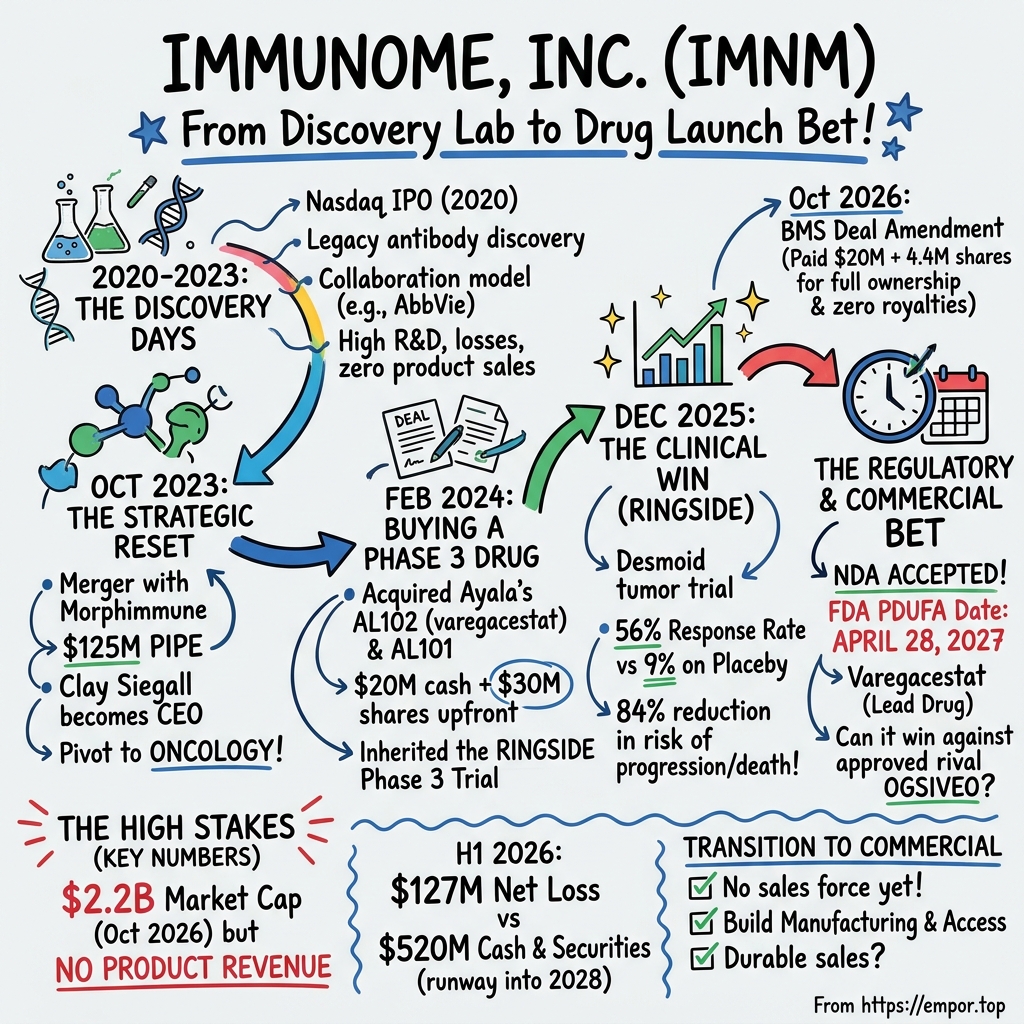
Immunome, Inc.: From Discovery Lab to Drug Launch Bet
I. The Company With No Product Revenue
On October 2, 2026, Immunome signed the fourth amendment to a licence agreement it had not written. The original contract dated from November 2017, when Bristol Myers Squibb licensed two gamma secretase inhibitors to a small biotech called Ayala Pharmaceuticals.1 Ayala was gone by then. The drugs had passed to Immunome, and BMS still held a claim on their future: milestone payments if they succeeded and royalties on every dollar of sales. In October 2026, Immunome paid that claim off.
The price was $20 million in cash and 4,425,487 newly issued Immunome shares.1 In return, BMS handed over the patent rights for varegacestat, the drug Ayala had called AL102, and for its sibling AL101. Immunome's filing put the result plainly: once the consideration was paid, the company had "no milestone, royalty or other payment obligations to BMS."1 For a business that has never sold a single pill, it was an unusually confident thing to do. Immunome spent cash and stock to own one hundred percent of the economics of a drug the FDA had not yet approved.
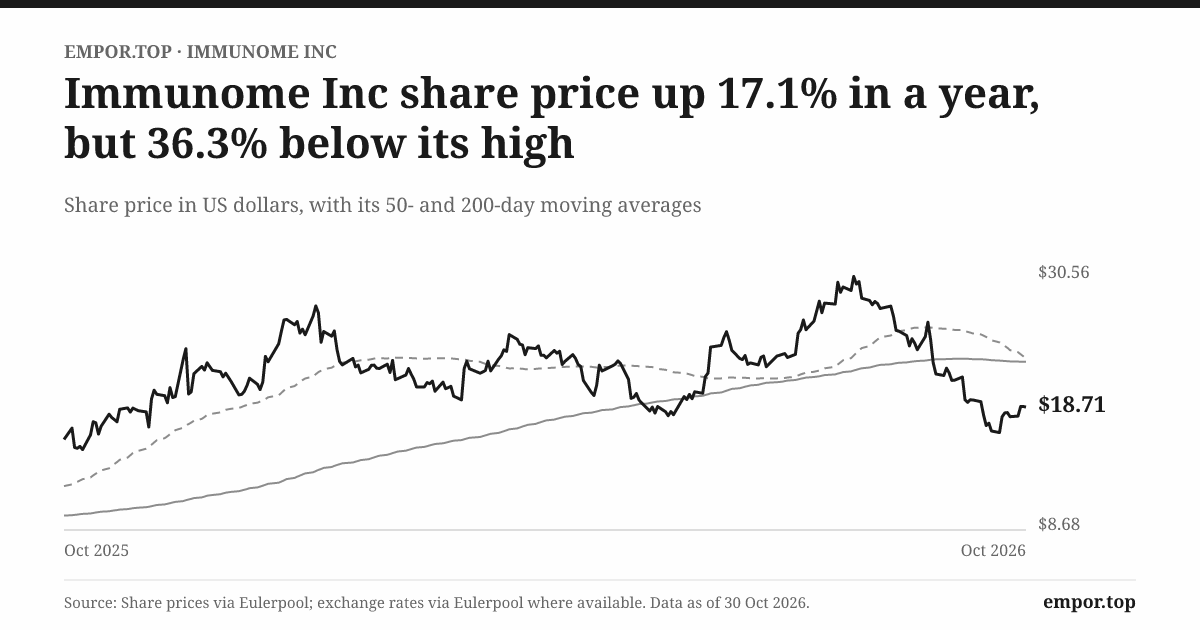
The scale of the bet becomes clear when you set it against the rest of the company. By October 30, 2026, the stock traded around $18.71, giving Immunome a market value of about $2.2 billion.2 Its revenue in the most recent reported quarter was zero. It was also zero in the quarter before that, and the one before that.3
In the first half of 2026, Immunome lost $127 million.3 The money did not go on factories, sales offices or marketing campaigns. It went almost entirely on clinical trials, laboratories and scientists.
That gap between a $2.2 billion valuation and an empty revenue line is the whole story in miniature. Investors are not paying for what Immunome sells. They are paying for what it might sell once a regulator in Silver Spring, Maryland, decides whether varegacestat can reach patients. The FDA accepted Immunome's New Drug Application in July 2026 and set a target action date of April 28, 2027.4 Until then, everything the company owns is a promise.
And yet the promise is unusually concrete for a biotech of this size. In December 2025, varegacestat met its primary endpoint in a Phase 3 trial called RINGSIDE, cutting the risk of tumour progression or death by 84% against placebo in adults with desmoid tumours.5 That is a big effect in a placebo-controlled study. It is the reason the BMS buyout made sense to management: once a drug has strong late-stage data, every future royalty point owed to a licensor becomes expensive.
So three questions hang over the company tonight. The first is how a business that started life discovering antibodies ended up betting its future on a pill it bought from someone else. The second is whether varegacestat can win in a disease where a rival drug, Ogsiveo, has been on the market since November 2023.6 The third is money: whether Immunome can pay for a commercial launch and a wider pipeline before the cash runs short, without handing too much of the company to new shareholders.
There is a temptation, when a biotech posts clean Phase 3 data, to treat the hard part as finished. Immunome's record argues against that. The company has never launched a product, never negotiated with insurers, never run a sales force, and never earned a dollar from selling medicine. Its entire revenue history consists of one research collaboration with AbbVie, which ran its course in July 2025.7 Every capability it now needs, it must build.
Even the October deal carried a small reminder of who holds the cards in this transition. Immunome agreed to file a registration statement by November 16, 2026, so that BMS can resell the shares it received.1 A large pharmaceutical company has no reason to sit on a small position in a pre-revenue biotech, and the terms gave it a clear route out. For existing shareholders, that means the new stock may not stay in friendly hands for long. It is a minor overhang next to the larger questions, but it captures the trade Immunome keeps making: future certainty bought with present dilution.
That is what makes the October deal so revealing. Owning the asset outright is a statement that management believes the value lies ahead. But owning a drug is not the same as selling one. The BMS payment settled the question of who gets the economics. The next question is whether there will be any economics to get, and that question started in a very different company.
 Subscribe on LinkedIn
II. A Public Company Changes Its Business
To understand today's Immunome, you have to meet the company that existed before it, because the name and the stock ticker are almost the only things the two share.
The original Immunome was born in Pennsylvania in 2006 and grew up in Exton, a suburb west of Philadelphia.8 Its scientific idea was elegant. Some people fight off diseases better than others, and their immune systems remember how they did it.
Immunome built a platform to mine memory B cells, the immune system's archive of past battles, from patients who had mounted strong responses, and to turn the antibodies it found into drug candidates.9 The pitch was that the human body had already done the discovery work; Immunome would simply read the answers off the page.
It was a patient, expensive kind of science. By its own account, the company had devoted substantially all of its resources to research and development and had lost money every year since it was founded.10 In 2018 it lost about $8 million; by 2022 the annual loss had grown to about $37 million, and it still had no revenue at all.11 This was a classic discovery-stage biotech: a lab, a platform, a handful of early programs and a perpetual need for new capital.
The pandemic gave it a moment in the light. In 2020, Immunome was developing an antibody cocktail against multiple parts of the SARS-CoV-2 virus, drawn from the memory B cells of what it called "super-responders," and it held a $13.3 million Department of Defense contract to support the work.12 Under chief executive Purnanand Sarma, the company went public that autumn.12
Its shares began trading on Nasdaq on October 2, 2020, priced at $12, the midpoint of the expected range, raising about $39 million in the base offering.13 The underwriters later bought another 487,500 shares under their over-allotment option.10 It was a modest IPO in a year when investors were throwing money at anything with a pandemic angle.
The public listing would prove to be the most durable asset the original company created. Over the next three years the stock collapsed, as it did for a large share of the 2020 biotech class. The largest fall in Immunome's share price over the past five years was about 90%.2
By 2022 the company's cash had fallen to about $20 million, and shareholders' equity had shrunk to roughly $17 million.11 A discovery company with that little money had a year, perhaps less, before it had to raise on punishing terms or find a partner.
It found a partner first. In January 2023, AbbVie signed a collaboration and option agreement, paying a nonrefundable $30 million upfront for Immunome to discover and validate antibodies against tumour targets, with options to take rights to up to ten target-antibody pairs.7
It was a vote of confidence in the platform, and it put the first revenue on Immunome's books: about $14 million in 2023.7 But the revenue was a service fee, recognised as Immunome did the research work. It was not a product, and it was not designed to last.
Then came the reset. In June 2023, Immunome agreed to merge with Morphimmune, a private oncology company built on research by Purdue University chemist Philip Low, who had previously founded Endocyte, a targeted cancer-therapy company Novartis bought in 2018.14
Morphimmune's "Targeted Effector" platform aimed to deliver potent payloads directly to cancer cells. The deal was all stock, and it came wrapped in a $125 million private placement, a PIPE, from a group of specialist investors that included EcoR1 Capital, Redmile Group, Janus Henderson Investors and Enavate Sciences.9
The merger closed on October 2, 2023, three years to the day after Immunome's first trade.9 The new shares tell you who really took control. Legacy Immunome holders ended up with about 28.6% of the combined company, Morphimmune holders about 20.7%, and the new PIPE investors about 50.7%.15
In other words, the people who had just written a cheque for $125 million owned more than half the company. Accounting treated Immunome as the acquirer; economically, it looked more like a recapitalisation with a new management team bolted on.15
That management team had a single, very recognisable face. Clay Siegall became chairman and chief executive of the combined company.9 In biotech, Siegall needed no introduction. He had co-founded Seattle Genetics in 1998 and led it for more than two decades, turning it into one of the defining companies in antibody-drug conjugates, a class of cancer drugs that attach a toxic payload to an antibody so it can be delivered straight to a tumour.16 Seattle Genetics' first approved drug, Adcetris, reached the market in 2011, and three more approvals followed.16 In 2023, Pfizer completed a takeover of the company, by then renamed Seagen, for about $43 billion.17
But Siegall did not arrive at Immunome straight from that triumph. In April 2022 he was arrested after an incident at his home in Washington state on a fourth-degree domestic violence assault charge, which he denied.16 He took a leave of absence, and Seagen's independent directors opened an investigation.
He resigned as chief executive and director in May 2022, before Pfizer's offer; Seagen said the resignation was not driven by findings from the investigation, which was still under way.18 In December 2022, the local prosecutor declined to file charges for evidentiary reasons.19 The findings of Seagen's board investigation were never made public. In March 2023, Siegall resurfaced as chief executive of Morphimmune.20
That history matters to investors in a specific way. It is part of what the board weighed in handing him both the chair and the chief executive role, and it is part of why his record at Immunome deserves to be judged on outcomes rather than reputation. What he brought, unquestionably, was a playbook: buy or license promising molecules, push them through late-stage trials, and build a commercial oncology business around them. Seagen had done exactly that.
For investors reading Immunome's numbers, the merger creates a trap. The company's financial history looks like one continuous line, but it is really two businesses glued together. The revenue it reported in 2023, 2024 and 2025 came from the AbbVie collaboration, the legacy discovery model, and fell from about $14 million to about $7 million as that work wound down.7
It says nothing about the oncology pipeline that now defines the company. Losses, meanwhile, jumped from about $37 million in 2022 to $107 million in 2023, because the new strategy was far more expensive than the old one.7
The public shell, then, was the real prize of the old Immunome. It gave Siegall and his backers a Nasdaq listing, a research platform and an existing shareholder base, and the $125 million PIPE gave them time. What they did with that time is the next chapter. The answer turned out to be a shopping list.
III. Buying a Phase 3 Drug From a Company That Needed to Sell
In the first weeks of 2024, Ayala Pharmaceuticals was running out of road. The company had cut about half its staff during 2023. In the first quarter of 2024 it gave notice to 18 more employees and two officers, after which its chief executive would be its only employee.21
At the end of 2023 it had $4.9 million in cash against $25 million of current liabilities, and its auditors had flagged substantial doubt about its ability to continue as a going concern.21 Yet in its pipeline sat a drug in a Phase 3 trial: AL102, a once-daily oral pill for desmoid tumours.
That combination, a valuable asset inside a company that could no longer afford to finish developing it, is one of the oldest opportunities in biotech. Late-stage trials are expensive, and when the cash runs out, the seller's bargaining power runs out with it. Immunome had just raised fresh capital and had a chief executive whose career was built on late-stage oncology development. On February 6, 2024, it announced it would buy AL102 and its sibling AL101.22
The terms were modest by the standards of late-stage drug deals. Immunome agreed to pay $20 million in cash and $30 million in its own stock at closing, plus up to $37.5 million more if the drug hit development and commercial milestones.22 It was buying substantially all of Ayala's assets.21
The transaction closed on March 25, 2024, after Ayala's stockholders approved it.23 Ayala received 2,175,489 Immunome shares, and in a detail that captures its desperation, it agreed not to dissolve, file for bankruptcy or sell more than half of those shares for six months after closing.21 In May 2024 Ayala filed to deregister and stop reporting to the SEC.24
It is worth being precise about what Immunome actually spent, because headline deal values blur two very different kinds of money. The $50 million upfront was real and immediate: $20 million of cash out the door and $30 million of new shares diluting existing holders.
The $37.5 million was a ceiling on future payments, owed only if the drug succeeded. One of those milestones did come due: Immunome recognised $10 million of acquired research and development expense in 2025 for a varegacestat development milestone.7 The rest remains contingent.
There was also a second layer of obligation hidden inside the asset. Ayala had not invented AL102; it had licensed it from Bristol Myers Squibb. As described in Immunome's filings in 2024, that licence carried up to about $142 million in clinical and regulatory milestones, up to $50 million in commercial milestones per product, and tiered royalties from the high single digits to the low teens as a percentage of sales.23 Those terms may have shifted through intermediate amendments. Either way, in buying the drug from Ayala, Immunome had also bought BMS's continuing claim on it.
What did $50 million buy in scientific terms? AL102 is a gamma secretase inhibitor. A simple way to picture it: inside cells, gamma secretase acts like a pair of molecular scissors, cutting proteins to release signals that tell certain cells to keep growing.
In desmoid tumours, one of the pathways those scissors help switch on, the Notch pathway, appears to keep the tumour cells growing. Block the scissors and the signal never gets through. Bristol Myers had originally developed this class of compounds; Ayala aimed one of them at a rare tumour where the mechanism appeared to matter.
The early data were encouraging. In the Phase 2 portion of RINGSIDE, at the 1.2 milligram once-daily dose, 64% of patients on an intention-to-treat basis had objective responses, and the median best reduction in tumour volume was 88%.22
Those were small, open-label numbers, the kind that often shrink when a drug meets a placebo arm in a blinded trial. But the randomised Phase 3 part of the study was already running. Immunome was not buying an idea. It was buying a trial in progress, with a readout perhaps eighteen months away.
Was the price cheap? The honest answer is that public filings do not provide a clean way to tell. There is no tidy set of comparable transactions, with disclosed terms, for distressed sales of Phase 3 rare-disease assets in 2024. What can be said is narrower.
The upfront cost was small next to the money Immunome would later raise on the back of the asset, and the seller had almost no alternatives. Judged by what followed, the deal looks like a well-timed purchase. Judged at the time, it was a bet that a trial run by someone else would read out positively.
Ayala was not Immunome's only acquisition that season. A month earlier, in January 2024, the company had licensed Zentalis Pharmaceuticals' antibody-drug conjugate platform and its preclinical ROR1-targeted program.25 Immunome paid $15 million in cash and about 2.3 million shares, worth $23.4 million at the time, and took on up to $275 million in milestones and mid-to-high single-digit royalties.2325 In October 2024 it went further, buying the licensed Zentalis assets outright and terminating all of those contingent milestone and royalty obligations.23
The pattern is worth noticing, because it repeats with BMS two years later. Immunome tends to license first, then buy out the licensor's claims once it believes in the asset. That can be shrewd: it trades a stream of future payments, which would grow with success, for a fixed payment today. It can also be expensive in the one currency a pre-revenue company has in abundance, its shares. Each buyout swapped a contingent liability for certain dilution.
The Zentalis program also reveals what Siegall wanted beyond desmoid tumours. ROR1 is a protein found on the surface of several blood cancers and solid tumours but largely absent from healthy adult tissue, which makes it an attractive address for a guided-missile drug. Zentalis had developed the platform but was concentrating its own resources elsewhere, so the assets were available.
For a chief executive whose career was built on antibody-drug conjugates, buying a ready-made ADC engine was a way to rebuild the Seagen playbook without starting from a blank page. It was also a bet that Immunome could fund two very different businesses at once: a late-stage rare-disease launch and an early-stage oncology platform.
The accounting for these deals explains one of the strangest numbers in Immunome's history. In 2024 the company lost $293 million, almost three times its 2023 loss.7 More than half of that, $152.3 million, was acquired in-process research and development, the accounting charge a company takes when it buys an unapproved drug with no alternative future use.7
Under US accounting rules, the cost of buying an experimental drug is not capitalised as an asset; it is written off immediately as a research expense. So the purchase of Ayala's programs and the Zentalis platform showed up as a giant loss, even though much of it was paid in shares rather than cash.
That brings the story back to October 2026, when Immunome bought out BMS's remaining claims on varegacestat for $20 million and roughly 4.4 million shares.1
At around $18.71 a share, those shares were worth roughly $80 million at the end of October, though their value on the day of issue depended on the price then.2 Immunome had paid a fixed price to remove a royalty that would only have hurt if the drug sold well, which is exactly the outcome management is betting on.
The acquisitions, in short, gave Immunome what it lacked: a drug in a pivotal trial. What they could not give it was the result. That result arrived in December 2025, and it decided whether the shopping spree had bought a business or merely a very expensive option.
IV. RINGSIDE Gives Immunome Its First Big Answer
Desmoid tumours are strange enemies. They do not spread through the body the way most cancers do, which is why they are often not classed as malignant. But they grow into the tissue around them, wrapping around nerves, organs and blood vessels, and they can cause relentless pain, disfigurement and loss of function.
They are rare: the US National Cancer Institute puts the worldwide rate at two to four new cases per million people per year.26 For decades, the standard tools were surgery, which often failed because the tumours came back, radiation, and drugs borrowed from other diseases.
That changed in November 2023, when the FDA approved nirogacestat, sold by SpringWorks Therapeutics as Ogsiveo, as the first drug for adults with progressing desmoid tumours.6 Ogsiveo is also a gamma secretase inhibitor, the same molecular scissors-blocker as varegacestat.
In its own Phase 3 trial, DeFi, it cut the risk of progression by about 71% against placebo, and 41% of patients had a confirmed response, versus 8% on placebo.6 So by the time Immunome's drug reached its readout, a credible competitor using the same mechanism already sat in oncologists' prescribing systems.
On December 15, 2025, Immunome reported the RINGSIDE results.5 The trial had randomised 156 adults to varegacestat at 1.2 milligrams once a day or to placebo, and followed them until their tumours progressed. On the primary endpoint, progression-free survival judged by independent radiologists who did not know which patients got which treatment, the hazard ratio was 0.16.5 A hazard ratio is simply the relative risk of the bad event; 0.16 means patients on the drug faced roughly one-sixth the risk of those on placebo at any given time.
The response numbers were just as striking. Some 56% of patients on varegacestat had a confirmed response, meaning their tumours shrank by at least 30% on scans, compared with 9% on placebo.5 On volumetric imaging, the median tumour shrank by 83% on varegacestat and grew by 11% on placebo.5
Siegall called RINGSIDE the largest and most comprehensive clinical trial conducted to date in desmoid tumours.5 Unlike most claims in biotech press releases, that one comes with a verifiable number: 156 patients against Ogsiveo's 142 in DeFi.6
The detailed data, presented at the American Society of Clinical Oncology meeting on May 30, 2026, added the dimension that matters most to patients: how they felt.27 Desmoid tumours hurt, and shrinking a tumour on a scan means little if the patient's pain does not improve.
At week 12, patients on varegacestat reported a fall of more than two points on a pain scale, while those on placebo reported a slight increase, and the gap had already opened by week four.27 In October 2026, at the European Society for Medical Oncology congress in Madrid, Immunome presented 48-week data showing lower symptom burden and better physical function on varegacestat than on placebo.28
Then there is the cost of that benefit, which the press releases mention but which investors should weigh carefully. Diarrhoea affected 82% of patients on varegacestat versus 27% on placebo; fatigue 44% versus 23%; rash 43% versus 12%; nausea 35% versus 26%; and cough 34% versus 5%.27 Most of these events were mild or moderate.
But 80% of patients on the drug needed a dose reduction because of side effects, compared with 9% on placebo, and 20% stopped treatment because of adverse events, against 7% on placebo.27 Among premenopausal women on varegacestat, 20 of 36, or 56%, experienced ovarian toxicity; it resolved in about half, and none discontinued because of it.27
The detailed presentation also filled in the texture behind the headline. The benefit on progression held across tumour location, baseline tumour size, age and whether patients had received earlier drug treatment, which makes it less likely that one favourable subgroup drove the result.27 Among patients who responded, the median time to a response was about eight months, a reminder that these drugs work slowly and that patients must stay on therapy long enough to see the effect.27
Patients on varegacestat stayed on treatment for a median of about 20 months, compared with about 11 months on placebo, largely because placebo patients progressed sooner.27 At ESMO, the company added an exposure-response analysis intended to support the chosen dose, which matters to regulators deciding whether 1.2 milligrams is the right amount of drug.28
These details matter because treatment can last years and, for women of childbearing age, ovarian function is at stake. A drug that works but that many patients must dose down to tolerate is still a drug that works.
But it is a drug whose real-world performance depends on how well doctors manage side effects, and on whether patients can stay on it. Ogsiveo's label lists a similar spectrum of side effects, including diarrhoea, ovarian toxicity, rash and nausea, which suggests these are properties of the mechanism rather than flaws unique to either drug.6
Here the most tempting conclusion in the story needs to be tested. Bulls will put the two trials side by side: a 56% response rate against 41%, a hazard ratio of 0.16 against 0.29. On paper, varegacestat looks better. Siegall made exactly this case in a February 2026 conversation with Guggenheim biotech analyst Michael Schmidt, pointing to once-daily dosing against Ogsiveo's twice-daily regimen, a higher response rate and pain relief.29 Ogsiveo is taken as three tablets twice a day.6
But RINGSIDE did not compare varegacestat with Ogsiveo. It compared varegacestat with placebo. The two trials enrolled different patients, at different times, with different follow-up, and the placebo arms behaved differently. Cross-trial comparisons in oncology have a long history of misleading investors, because a slightly healthier patient population or a longer follow-up can move these numbers substantially.
The fair reading is narrower: varegacestat clearly works, its efficacy figures look at least competitive with the incumbent's, and the once-daily schedule is a genuine convenience. Whether it is better for a given patient is unproven, and no head-to-head trial exists to settle it.
The investment story turned on that December day all the same. Before RINGSIDE, Immunome was a pipeline company with an interesting asset. After it, Immunome was a company with a drug likely to be filed for approval, and within days it was back in the capital markets raising the largest sum in its history.7
The company submitted its New Drug Application in April 2026, and the FDA accepted it in July, setting the April 28, 2027 target date.274 Immunome has also said it plans to file a Marketing Authorization Application in Europe by the end of 2026.4
Look, though, at what RINGSIDE did not change. Immunome reported $6.9 million of revenue in 2025, all of it from the AbbVie collaboration's final months, and none at all in the first half of 2026.73 A successful Phase 3 trial is a scientific verdict, not a commercial one.
It does not tell you how many oncologists will prescribe a second gamma secretase inhibitor, what price insurers will accept, or how many patients will stay on a drug that gives four in five of them reasons to reduce the dose.
So the clinical question has an answer, and it is yes. The competitive question does not, and it will not be settled by another topline release. It will be settled at the FDA, in oncologists' offices and in pharmacy benefit negotiations, and Immunome has never been to any of those places with a product of its own.
V. The Lab Has to Become a Commercial Company
Picture the Immunome of mid-2025. The AbbVie collaboration, the only source of revenue the company had ever known, reached the end of its term in July and stopped producing income.7 The company's laboratories were busy, its clinical teams were waiting for RINGSIDE, and its finance team was booking quarter after quarter of revenue lines reading zero. This was the moment the old Immunome finally disappeared from the financial statements, and with it the last trace of the business model that had kept the lights on.
The AbbVie deal had been a classic discovery-company arrangement. AbbVie paid $30 million upfront, and Immunome recognised it as revenue gradually, matching the payment to the cost of the research work it performed.7 It was a fee for service with option value attached: if Immunome's platform found good antibodies against AbbVie's chosen targets, AbbVie could license them. That is why the revenue fell every year after the merger. It was not a business shrinking. It was a prepayment being used up.
Through 2025, every dollar of revenue Immunome had ever recorded came from AbbVie.7 That kind of concentration would be alarming in a normal company. Here it is better understood as an absence: Immunome never had a customer base, only a collaborator. When the collaboration ended, the company was left with no receivables to speak of, no recurring income and no commercial relationships.7 The company's next customer will be a patient whose oncologist writes a prescription, paid for by an insurer or a government program.
Meanwhile the cost base was going the other way. Research and development spending rose from about $130 million in 2024 to about $177 million in 2025.7 Headcount rose from 118 full-time employees at the end of 2024 to 177 a year later, and 133 of those 177 worked in research and development.117 In the first half of 2026, R&D spending was another $106 million, up almost $29 million from a year earlier, driven by clinical trials, programs heading toward human testing, more staff and share-based pay.3
The numbers say something specific about the organisation Immunome has built. It is overwhelmingly a development company: three of every four employees work in R&D, and every new hire has gone into making medicines rather than selling them. The first signs of the commercial transition are visible only at the margins.
General and administrative expense in the second quarter of 2026 was $18.3 million, almost double the $10.0 million of a year earlier, and the company attributes part of the increase to commercial-readiness spending.303 That is the first visible cost of turning a laboratory into a seller of medicine, and it is still small next to the research budget.
The company's dependence on outsiders runs deeper than its missing sales force. Immunome generally engages its research vendors through cancellable purchase orders, which keeps fixed commitments low but means its trials, its manufacturing and much of its research run through contract organisations it does not control.7 For a development company, that flexibility is a virtue: when a program fails, the spending stops.
For a commercial company, it becomes a risk, because a launch depends on a reliable supply of drug, and a supply problem at a contract manufacturer lands directly on patients who have started therapy. The filings name no major supplier and give no supplier-concentration figures, so investors cannot yet judge how exposed the first launch will be.7
What has the company not said? It has not disclosed the size of its planned sales force, a launch budget, a manufacturing cost per patient or an intended price. On its second-quarter 2026 update, the business commentary centred on the FDA timeline and the pipeline; launch planning received a general mention rather than numbers.30 That silence is not unusual for a company six months before a regulatory decision. But it does mean investors cannot yet judge the economics of the launch, only its timing.
Siegall has, however, sketched the size of the prize. In that February conversation with Guggenheim's analyst, he described an opportunity of around $1 billion if roughly 3,000 patients were treated, with pricing inferred from the incumbent's.29
He also put numbers on the patient pool: about 1,600 new US cases a year, roughly 11,000 US patients seeking therapy each year, and a total population of about 30,000 people living with the disease.29 Those are management's estimates, and they sit above the narrow incidence rate public-health sources cite, partly because desmoid tumours recur and patients cycle through treatment over many years.
The gap between the two framings is worth remembering: a market sized by prevalence and repeated treatment is larger than one sized by new diagnoses, but it is also harder to reach. He framed varegacestat's target as patients starting therapy for the first time, those who do not respond to existing treatment, and the wider pool of people living with the disease, rather than patients already doing well on Ogsiveo.29 That is a sensible framing. It also concedes the obvious: in a disease with an approved drug, patients who are stable on it are unlikely to switch.
The incumbent's record provides the best real-world reference point. Ogsiveo generated $172 million of US net product revenue in 2024, its first full year on the market, and $61.5 million of that came in the fourth quarter alone, so sales were still accelerating as the year ended.31 A rare-disease drug that reaches an annual run rate near a quarter of a billion dollars within about a year of approval shows that oncologists were waiting for an option, and that payers were willing to fund one.
Merck KGaA of Darmstadt, Germany, acquired SpringWorks in 2025, and in the second half of that year it reported €134 million of Ogsiveo sales.32 So the market for a gamma secretase inhibitor in desmoid tumours is demonstrably real and growing. It is also a market where the first mover now has the backing of a large, established pharmaceutical group with a global commercial organisation.
This is the moment to assess Immunome's competitive advantage, and it is narrower than the stock price might suggest. The company's demonstrated edge is clinical: a successful Phase 3 trial, a once-daily dose, and patents it now owns outright following the BMS amendment.1 Those could support a product-specific position.
What the record does not show is any advantage in distribution, pricing, customer relationships or cost. Immunome has no prescribing physicians who know its sales representatives, no contracts with specialty pharmacies, and no evidence of how payers will treat a second drug in the class.
In a rare disease, the customers who matter are few and concentrated: sarcoma specialists at academic cancer centres, and the insurers who pay for very expensive oral cancer drugs. That gives buyers real bargaining power. A payer facing two drugs with the same mechanism, each tested only against placebo, can demand discounts or require patients to try one before the other. Patent protection may keep generics out for years, but it does nothing to stop Merck KGaA from competing on price, access or physician relationships.
Then there is the rest of the pipeline, which the company presents as its long-term engine. Immunome has an antibody-drug conjugate targeting ROR1, IM-1021, in a Phase 1 trial, where it reported objective responses in B-cell lymphoma patients at several dose levels.30 It dosed the first patient with a second ADC, IM-1617, in June 2026, and the first patient with IM-3050, a radioligand therapy targeting FAP, in July 2026.30 Further ADC programs were expected to enter human testing in 2026 and beyond.30
Both technologies are easier to grasp than their names suggest. An ADC is a guided missile: an antibody that seeks out a protein on cancer cells, carrying a toxic warhead it releases on arrival. A radioligand works similarly, but its warhead is a radioactive atom, in this case lutetium-177, that irradiates the tumour from close range.
Siegall knows ADCs better than almost anyone in the industry, and his Seagen record gives the strategy a plausible logic. But the programs are in the earliest stage of human testing, where most drugs fail, and the industry's base rate for drugs entering Phase 1 reaching approval is low. Treating them as future revenue would be premature.
So the commercial question can be framed narrowly and tested. Can one drug, in one rare disease, with one approved competitor, generate prescriptions and sales at a price that justifies what Immunome has spent? The answer will not come from the pipeline count or from conference presentations. It will come from the first quarters of reported product revenue, and the company needs money to reach them.
VI. Cash Buys Time; Equity Pays for the Bet
As of June 30, 2026, Immunome held $520 million in cash, cash equivalents and marketable securities.30 Some $218 million sat in bank deposits, money-market funds and Treasuries; the other $302 million was in short-dated US government bonds.3 It is a large number for a company of this kind, and it is the reason management says its current cash should fund operations into 2028.30 The company is also spending roughly $20 million a month.
To understand Immunome's finances, start with a puzzle. Between 2018 and 2025, the company's reported losses added up to about $710 million. Yet over the same eight years, the cash that operations actually consumed was only about $385 million.7 Where did the other $325 million go? A naive reader might think Immunome's operations were somehow throwing off cash that the income statement missed. The truth is the opposite: most of the gap is accounting for things Immunome paid for with shares, not money.
The clue lies in the acquisitions. In 2024 alone, the company booked $152.3 million of acquired research and development expense, and the cash-flow statement shows $97.7 million of those assets acquired in exchange for stock.7
Those were the Ayala and Zentalis purchases, expensed immediately under accounting rules but paid in part with newly issued shares. Add share-based compensation, $25.7 million in 2025 alone, and the difference largely disappears.7 The real cost was not hidden; it simply showed up in the share count rather than in the bank balance.
The present burn rate is the number that matters most. In the first six months of 2026, Immunome spent $106.3 million on research and development and $31.2 million on general and administrative costs, and used $120.3 million of cash in operations.3 Interest on its cash pile, $10.5 million over the same period, softened the blow.3
That income is real, but it is a by-product of having raised money in advance, not a business; it shrinks as the cash is spent. In 2025, interest income of about $11.7 million covered barely a twentieth of the year's pretax loss.7 It is a cushion, not a strategy, and if interest rates fall it will cover even less.
The direction of travel matters as much as the level. In the first half of 2025, operating spending was meaningfully lower; a year later, research spending alone had risen by almost $29 million and administrative costs had climbed as launch preparation began.3 The company is spending more each quarter, not less, and it has not yet hired the commercial organisation a launch will need. Investors should expect the burn to rise further before product revenue starts to offset it.
Now follow the financing that made all of this possible. After the 2023 PIPE, Immunome raised $230 million in a public offering in 2024 plus another $20 million through an at-the-market program, which lets a company sell shares gradually into the market.7 In January 2025, it raised $172.5 million. In December 2025, days after RINGSIDE read out, it raised about $460.5 million gross, the largest offering in its history, and sold a further $45.9 million of stock through the at-the-market program during the year.7
That is more than $1 billion of equity raised in under two and a half years, on top of the shares issued for Morphimmune, Ayala, Zentalis and now BMS. The result is visible in shareholders' equity, which grew from about $17 million at the end of 2022 to about $634 million at the end of 2025.7 Almost none of that came from profits. All of it came from shareholders.
The December 2025 raise deserves a moment of credit, because it was the right financing at the right moment. A company with fresh Phase 3 data has its maximum bargaining power with investors, and raising then, rather than waiting until cash ran short, protected existing holders from a more dilutive deal later.
Insiders participated: Siegall personally bought $1.0 million of shares in that offering and $1.2 million in the January 2025 offering.33 Buying alongside outside investors is a better signal than option grants, though at those sizes it is a fraction of his annual pay.
The BMS amendment fits the same pattern, adding close to 4% to the share count.12
Shareholders gave up that slice of the company to remove royalties and milestones that would have grown with every dollar of sales. If varegacestat sells well, that is likely to be a good trade. If it struggles, Immunome will have paid in shares for relief from obligations that might never have been very large.
On the liability side, the picture is clean. Immunome reported no outstanding debt at June 30, 2026.3 The only obligations resembling borrowings were operating leases worth about $4.7 million, mostly long-term.3 There is no covenant to breach, no lender to placate and no refinancing wall. EY, the company's auditor, issued an unqualified opinion on the 2025 financial statements; its critical audit matter was the estimation of accrued and prepaid research costs, a judgment-heavy area in any company running large outsourced trials.7
So the credit question for Immunome is not about debt at all. It is about the time cash buys. At the first-half 2026 rate, $520 million covers a little over two years of operating spending, which squares with management's runway guidance into 2028.30
But that rate does not yet include a full commercial launch, and the October BMS payment consumed another $20 million. Commercial launches in oncology typically require a sales force, medical science liaisons, patient-support services, inventory and payer contracting, all before the first meaningful revenue arrives.
The company itself is cautious on this point. In its quarterly filing, it said its resources were expected to fund current operating plans for at least twelve months, and it warned that it may need additional capital to achieve longer-term objectives.3
That is the standard language of a company that expects to return to the market. It is not a warning of distress; it is an honest description of the business model. Immunome funds itself by selling stock, and it will keep doing so until product sales can cover its costs.
The stock's behaviour tells you how investors weigh that risk. Over the past year, Immunome's shares traded between about $15 and $29, and at the end of October they sat about 36% below their high.2 The market has priced in the clinical success and then pulled back as attention turned to the long, costly road between an NDA and a profitable product.
The balance sheet, then, buys time, and a meaningful amount of it. What it cannot do is guarantee that the milestones arrive before the next raise. The question of whether they will depends on the people running the company, and on whether their incentives point in the same direction as the shareholders funding them.
VII. The Team, the Milestones, and the Shareholders
In April 2026, Immunome published its annual proxy statement, the document where a company tells shareholders how much it paid its executives and why. The headline figure for Clay Siegall was $7.68 million of total compensation for 2025, down from $9.23 million the year before.33 The company lost $212.4 million in 2025.7 In biotech, that combination is not unusual; it is the norm. But it deserves unpacking, because the components say more than the total.
Most of Siegall's 2025 package, $6.27 million, came in the form of stock options, valued at the date they were granted.33 Options only pay out if the share price rises above the price at which they were granted, so their reported value is an accounting estimate, not money in Siegall's pocket.
The cash bonus was $661,500, paid at 150% of target.33 The board, in other words, judged that 2025 was a year of over-achievement, a judgment that is easy to understand in a year that delivered a positive Phase 3 readout.
The leadership around Siegall is small and focused. Max Rosett became chief financial officer in May 2024, having served as interim CFO since January of that year; he succeeded Corleen Roche, who had held the role since 2021, before the merger reset the company.34 Rosett has since run the string of offerings that followed, including the raise in the days after RINGSIDE, which makes him one of the most consequential people in the company: in a business funded by equity, the CFO's timing is a large part of the shareholder's return.
Bob Lechleider, the chief medical officer, leads the clinical program, and at ESMO he framed the company's goals for desmoid patients as extending beyond tumour shrinkage to symptom relief and physical function.28 That emphasis is commercially shrewd as well as clinically sound: in a disease where both drugs shrink tumours, how patients feel may decide which one they take.
Ownership tells a different story from pay. In the February 2026 proxy table, Siegall beneficially owned about 3.19% of the company.33 The largest holders were institutions: Fidelity's parent FMR with about 11.5%, T. Rowe Price with about 9.4%, and Redmile, one of the original PIPE investors, with about 5%.33 T. Rowe Price later reported owning about 17.4% as of June 30, 2026.35 That is a large position, and it suggests one of the most experienced growth investors in the market added to its stake after the RINGSIDE data.
It does not amount to control, and no individual or entity controls Immunome.33 The register has also turned over. Immunome Aggregator, which held about 6% in early 2025 and bought $10 million of stock in the January 2025 offering, no longer appeared among the 5% holders a year later.33 The investors who backed the old discovery company have largely given way to mutual funds and specialist healthcare investors who bought into the late-stage story.
That turnover has a governance consequence. There is no founder or parent with a controlling stake to discipline management, and no related party extracting fees or royalties: the company has no controlling parent, and the related-party transactions it discloses involve executives and holders buying shares in public offerings on the same terms as everyone else.33 Accountability therefore rests on the board and on large institutions willing to vote against it.
Governance signals were mostly reassuring, with one exception. The board considered six of its seven directors independent, with a lead independent director balancing Siegall's combined role as chair and chief executive.33 Shareholders approved executive pay at the June 2026 annual meeting by about 90.9 million votes to 1.4 million.36
But one director, Boylan, received 22.2 million withheld votes against 70.2 million in favour, while the other two nominees each received about 92 million votes for.36 Roughly a quarter of the votes cast for that seat amounted to a protest. The company has not explained it, and the reason is not public.
The fairest test of management is not biography. It is promises against outcomes. On the clinical side, the record is strong: Immunome delivered on its RINGSIDE and NDA commitments.5274
The company had guided to an NDA submission in the second quarter of 2026 and filed in April, inside that window.527 For a team that took over a trial run by another company, that is a meaningful piece of execution.
On the capital side, the record is more complicated. Management has financed the strategy almost entirely through equity, using repeated offerings, at-the-market sales and share consideration for asset deals.71 Each raise was defensible on its own. Together, they mean that a shareholder from the 2023 merger now owns a much smaller slice of a much more valuable company. Whether that trade was good depends entirely on what comes next.
Siegall's Seagen history cuts both ways here. Seagen took more than a decade to reach its first approval, and spent years as a money-losing company financed by investors before it became a commercial success. He has done the launch-and-scale journey before. But Seagen's commercial organisation was built over many years with several products, and Immunome is attempting it with one drug in a rare disease. The playbook is relevant; the circumstances are different.
The next credibility test, then, is disclosure. Management reported clinical milestones with precision: hazard ratios, response rates, dates. It has not yet reported commercial preparation with the same specificity: sales-force size, launch spending, pricing assumptions or the expected path of cash burn after approval.
If those numbers arrive with the same clarity in the coming quarters, investors will be able to judge the launch the way they judged the trial. If they do not, the market will be left to guess, and markets tend to guess conservatively.
The evidence is now on the table: strong trial data, an approved rival, no revenue, a funded runway and a management team with a clinical record but no commercial one at this company. It is time to put the bull and bear cases against each other.
VIII. The Case for Immunome—and the Case Against It
Imagine two investors meeting over coffee in late October 2026, both of whom have read every filing. The first is bullish. The second is sceptical. They agree on all the facts, and they still disagree on what the stock is worth. That is the honest state of the debate about Immunome.
The bull begins with RINGSIDE's strong results.5 The FDA has accepted the application and set a date.4
The company owns the drug outright,1 expects its cash to last into 2028,30 and is bringing a once-daily pill into a market where the incumbent has established sales.31
The bear agrees with every word, then points to what is missing. Immunome has no product-selling experience.3 Its incumbent rival has a head start and backing from Merck KGaA.632 R&D costs and cash use are rising.3
It has funded growth through share sales and says it may need more capital.3 The bear's case is not that the drug failed. It is that a successful drug may still not earn back the capital required to sell it.
Michael Porter's five forces give the debate some structure. Rivalry is the clearest force: Ogsiveo is approved and established, and Merck KGaA has the resources to defend it. The threat of new entrants is moderate, because a third gamma secretase inhibitor would need its own Phase 3 trial, but desmoid tumours have shown they can attract investment.
Buyer power is high because a small number of specialist centres and payers decide access. Supplier power matters because Immunome depends on outside manufacturers and clinical service providers. Substitutes, such as surgery, radiation and older drugs, remain part of practice, and for some patients with slow-growing tumours, careful monitoring without treatment is itself an option.
Add those forces together and the industry structure looks like a classic rare-disease duopoly in the making: attractive pricing because the patient population is small and the need is serious, but limited room to differentiate because both products block the same target.
In such markets, the second entrant often wins share by being easier to take rather than more powerful, and varegacestat's once-a-day schedule is exactly that kind of advantage. The risk is that the first entrant's head start, with prescribers already familiar with managing its side effects, proves stickier than convenience.
Hamilton Helmer's seven powers framework asks a harder question: what lasting advantage lets a company earn returns above its cost of capital? Measured that way, Immunome has, at best, one power in partial form: a cornered resource in its patents and data on varegacestat, now fully owned.
It has no demonstrated scale economies, network effects or switching costs, no brand among prescribers, and no process power in commercialisation. Counter-positioning against Merck KGaA is hard to argue when both companies sell the same mechanism. That does not mean Immunome cannot succeed. It means its success will depend on executing better, not on a structural moat.
Run the strongest version of the bull's claim, that varegacestat is the better drug, through the evidence. The efficacy figures look stronger across trials, and once-daily dosing is a real advantage for patients on long-term therapy.296 But the trials were never run against each other. Some 80% of patients on varegacestat needed a dose reduction.27
And the market Immunome must win is the one Ogsiveo opened, with patients already settled on a drug they tolerate. The evidence narrows the claim: varegacestat is a credible, convenient alternative with competitive efficacy. Whether it is the better drug will be decided by prescribing behaviour and persistence on therapy, not by a slide.
A sceptical investor would also look hard at the acquisitions. The Ayala purchase has, so far, produced a positive Phase 3 result and an accepted NDA.224 The Zentalis ADC platform and the wider pipeline have not yet been tested in the same way.
They cost real money, in cash and in stock, and their value will be decided by Phase 1 and Phase 2 data that have only begun to arrive.30 There is no clean set of comparable transactions to say whether Immunome overpaid. There is only the outcome, and for most of the pipeline, the outcome is not yet in.
Valuation offers little help here. With no revenue, the enterprise-value-to-sales ratio cannot be calculated. The stock trades at about 3.9 times book value, which mostly reflects the cash on the balance sheet, and the free-cash-flow yield is about minus 10%, which simply means the company spends a tenth of its market value each year.2
Enterprise value, market value minus net cash, was about $1.6 billion. That is roughly what the market is paying for the drug, the pipeline and the team, on top of the cash. Set against Siegall's own $1 billion opportunity estimate, it implies the market expects a meaningful launch but not an easy one.29
For investors trying to track whether the bull or the bear is winning, three measures matter most. The first is the FDA's decision and the label it grants: approval, the patient population covered, and any warnings or restrictions.
The second is the first commercial uptake: the number of patients starting therapy and the net price actually realised after discounts. The third is cash: quarterly operating cash use, read alongside milestones achieved and the share count. Today, the first reads as pending, the second reads as zero, and the third reads as about $60 million a quarter and rising.3
The investment case, in the end, turns on one word: conversion. Clinical evidence must become regulatory approval. Approval must become prescriptions. Prescriptions must become sales large enough to fund the company before the pipeline consumes the runway. Each step is plausible; none is proven. And the history of how Immunome got here holds lessons that apply well beyond this one company.
IX. Business & Investing Lessons
Follow a single molecule through this story and the lessons write themselves. Bristol Myers Squibb made it; Ayala licensed it, ran a Phase 3 trial and ran out of money. Immunome bought it, finished the trial, filed for approval, and then paid BMS to own it outright.221 The same pill passed through three companies. Only one of them is still in a position to sell it.
The first lesson comes from Ayala's fire sale. Immunome bought a trial that was mostly finished, and in doing so skipped years of development and a great deal of risk. That was a genuine advantage, and it helped turn a discovery-stage company into one with an NDA in under three years.
But a finished trial does not come with prescribers, payers or a pharmacy network. It only brings you to the door of the market. Buying a nearly finished trial buys time, not a market. For founders, the wider point is that late-stage assets are worth most to buyers who already know how to sell, and Immunome is learning that part as it goes.
The second lesson comes from AbbVie. For three years, the AbbVie collaboration made Immunome look like a business with revenue: from $14 million in 2023 to $7 million in 2025, then nothing.7 Investors who mistook that line for a growing franchise would have misread the company completely.
It was a prepayment, recognised as work was done, and it was always going to run out. Collaboration revenue can finance discovery, but it is not a product franchise. The broader lesson for investors is to ask of any biotech revenue line whether a patient or a partner is paying for it, and whether it recurs.
The third lesson comes from the offerings. Each was well timed: after the merger, after the acquisitions, and after the RINGSIDE data.7 That is skilful financing.
But every raise also set a clock, because cash on a pre-revenue balance sheet is only valuable if the company reaches its next value-creating event before the money runs out. Cash is runway only when milestones arrive before the next raise. For shareholders, the measure of financing skill is not how much was raised, but how much value each dollar bought before the next dollar was needed.
The fourth lesson comes from RINGSIDE itself. The trial answered the question every biotech investor asks first: does the drug work? It did, decisively, against placebo.5 But oncologists do not choose between a drug and a placebo. They choose between a drug and another drug, and patients choose whether to keep taking a pill that, for most of them, needed a dose cut.27 A strong placebo-controlled result answers whether a drug works; the market still asks whether doctors and patients choose it.
The fifth lesson comes from the buyouts. Twice, first with Zentalis and then with Bristol Myers Squibb, Immunome paid a fixed price to extinguish royalties and milestones it would otherwise have owed on success.231 The logic is sound when a company believes its own data, because a royalty grows with every dollar of sales while a buyout price does not. But the payment is made in the one currency a pre-revenue company prints on demand, and it is made before anyone knows whether the sales will come. Buying out a royalty is a bet on your own success, paid for in your shareholders' stock. Founders who copy the move should remember that it converts a partner's risk into their own investors' dilution.
There is a final, unifying lesson. Immunome is often described by the breadth of its pipeline: ADCs, radioligands, a Phase 3 asset. But breadth is not proof. The company has spent years and hundreds of millions of dollars building an organisation that can discover and develop drugs. It has not yet shown it can sell one. The measure that matters now is not the number of programs on a slide. It is the first line of product revenue on an income statement.
X. Epilogue
Tonight, Immunome stands at the most consequential point in its twenty-year history. It owns its lead drug outright. It has an FDA decision date on the calendar. It holds about half a billion dollars, less the $20 million it just paid BMS.301 And it has a pipeline of early programs moving into human trials. Every piece of a commercial biotech is present except the one that matters most: a product that patients can buy.
The first moment that will shape the next chapter is April 28, 2027.4 If the FDA approves varegacestat, the label will matter as much as the decision itself: which patients are covered, how side effects such as ovarian toxicity are described, and whether any restrictions limit use.
A clean label would let Immunome compete head-on with Ogsiveo. A narrow or restrictive one would shrink the opportunity before the launch begins. A delay or rejection would return the company to the capital markets in a much weaker position.
There is a quieter possibility too. The FDA could approve varegacestat with a label that looks much like Ogsiveo's, leaving the two drugs to compete on convenience, tolerability and access rather than on any official claim of superiority. That is probably the most realistic outcome to plan around, because the agency approves drugs on the evidence submitted, and RINGSIDE's evidence is a comparison with placebo.
In that world, the commercial contest becomes a test of execution: how quickly Immunome's team reaches the specialist centres that treat most desmoid patients, how well it supports patients through side effects, and how hard it bargains with payers.
Assuming approval, the next moments are commercial. Investors will watch for the launch date, the price, and the first quarter of product revenue. They will watch whether payers place varegacestat on equal terms with Ogsiveo or demand that patients try the incumbent first. And they will watch the number of patients starting therapy, because in a rare disease the first year of uptake often signals the shape of the curve that follows.
Europe offers a second regulatory path. Immunome has said it plans to submit its application to the European Medicines Agency by the end of 2026.4 Filing and approval are separate events, often more than a year apart, and European pricing negotiations country by country can take longer still. The European opportunity is real but distant, and investors should treat it as such.
Then there is the cash clock. With runway guided into 2028 and launch costs still to come, every quarterly report will be a test of whether spending is tracking the plan.30 The share count matters as much as the cash balance: if Immunome needs to raise again, the price at which it does so will reveal how much confidence the market has in the launch.
The pipeline adds a final layer. IM-1021 has shown early responses in lymphoma, and the company expected to report initial data in 2026; IM-1617 and IM-3050 have only just dosed their first patients.30 These programs could become the company's second act. They will earn that role only through clinical evidence, measured response by response, not through the number of programs entering trials.
So the central questions from the start of this story remain open, but each now has a date or a measure attached. Can varegacestat become revenue? The FDA will answer the first half in April. Can the company control its burn? The quarterly reports will answer that. Does the cash last? The share count will say. The date on the FDA calendar can answer the approval question. Only sales can answer whether Immunome has become a drug company.
XI. Outro
Go back to that October morning, when Immunome paid Bristol Myers Squibb to walk away from the future.1
Three years earlier, Immunome was still an antibody-discovery company. The smaller company was paying the larger one to walk away from the future.
That is what makes Immunome's story different from the hundreds of biotech pipelines that never reach this point. It began as an antibody-discovery company. Through a merger, acquisitions and repeated equity raises, it became a company betting everything on one medicine's path to market. Immunome bought the right to its drug's future; now it has to earn that future.
References
-
Amendment to BMS License Agreement — Immunome Form 8-K, 2026-10-05 ↩↩↩↩↩↩↩↩↩↩↩↩↩
-
Quarterly Report on Form 10-Q for Q2 2026 — SEC, 2026-08-11 ↩↩↩↩↩↩↩↩↩↩↩↩↩↩↩↩
-
FDA Accepts Varegacestat NDA; PDUFA Date April 28, 2027 — Immunome, 2026-07-08 ↩↩↩↩↩↩↩↩
-
Positive Topline Results from Phase 3 RINGSIDE — Immunome, 2025-12-15 ↩↩↩↩↩↩↩↩↩↩
-
FDA Approves Nirogacestat for Desmoid Tumors — FDA, 2023-11-27 ↩↩↩↩↩↩↩↩
-
Annual Report on Form 10-K for 2025 — SEC, 2026-03-03 ↩↩↩↩↩↩↩↩↩↩↩↩↩↩↩↩↩↩↩↩↩↩↩↩↩↩↩↩↩↩
-
Immunome and Morphimmune Complete Merger with $125 Million PIPE — Immunome, 2023-10-03 ↩↩↩↩
-
Quarterly Report on Form 10-Q for Q3 2020 — SEC, 2020-11-12 ↩↩
-
Immunome Third Quarter 2020 Results — Immunome Form 8-K Exhibit 99.1, 2020-11-17 ↩↩
-
Preclinical oncology biotech Immunome prices upsized IPO at $12 midpoint — Renaissance Capital, 2020-10-02 ↩
-
Immunome and Morphimmune Announce Merger Agreement — Immunome Form 8-K Exhibit 99.1, 2023-06-29 ↩
-
Form 8-K on Completion of the Morphimmune Merger — SEC, 2023-10-04 ↩↩
-
Seagen CEO Clay Siegall resigns amid domestic abuse investigation — BioPharma Dive, 2022-05-16 ↩↩↩
-
Done and dusted: Pfizer completes $43bn Seagen deal — BioProcess International, 2023-12-14 ↩
-
Ex-Seagen CEO Clay Siegall will not face charges related to April arrest — Everett Herald, 2022-12-30 ↩
-
Former Seagen CEO Siegall pops up at new biotech — pharmaphorum, 2023-03-24 ↩
-
Ayala Pharmaceuticals Annual Report on Form 10-K for 2023 — SEC, 2024 ↩↩↩↩
-
Immunome to Acquire AL102 and AL101 from Ayala Pharmaceuticals — Immunome, 2024-02-06 ↩↩↩↩↩
-
Immunome's Zentalis License and Asset Purchase Details — Immunome Form 10-Q, 2024-11-12 ↩↩↩↩↩
-
Ayala Pharmaceuticals Files Form 15 to Voluntarily Deregister — BioSpace, 2024-05-09 ↩
-
Immunome Licenses ADC Platform and ROR1 Program from Zentalis — Immunome Form 8-K Exhibit 99.1, 2024-01-08 ↩↩
-
Detailed Phase 3 RINGSIDE Data at ASCO — Immunome, 2026-05-30 ↩↩↩↩↩↩↩↩↩↩↩↩↩
-
Additional Varegacestat Clinical Data at ESMO 2026 — Immunome, 2026-10-26 ↩↩↩
-
Immunome CEO Touts Phase 3 Desmoid Win, Near-Term FDA NDA Plan and Early IM-1021 ADC Responses — MarketBeat via Yahoo Finance, 2026-02-13 ↩↩↩↩↩↩
-
Second-Quarter 2026 Results and Business Update — Immunome, 2026-08-11 ↩↩↩↩↩↩↩↩↩↩↩↩↩
-
SpringWorks Therapeutics Preliminary 2024 Results — SpringWorks Form 8-K Exhibit 99.1, 2025-01-13 ↩↩
-
Merck KGaA Annual Report 2025, Healthcare — Merck KGaA, Darmstadt, 2026 ↩↩
-
Definitive Proxy Statement — Immunome, 2026-04-24 ↩↩↩↩↩↩↩↩↩↩
-
Immunome Announces Promotion of Max Rosett to Chief Financial Officer — Immunome, 2024-05-17 ↩
-
Immunome filings and ownership disclosures — Filing Explorer ↩
-
2026 Annual Meeting Voting Results — Immunome Form 8-K, 2026-06-12 ↩↩
 LinkedIn
 WhatsApp
 Reddit
 Hacker News
 Email
 Kindle
 RSS Feed
 Spotify
 Apple Podcasts
 Amazon Music
 Audible
 YouTube