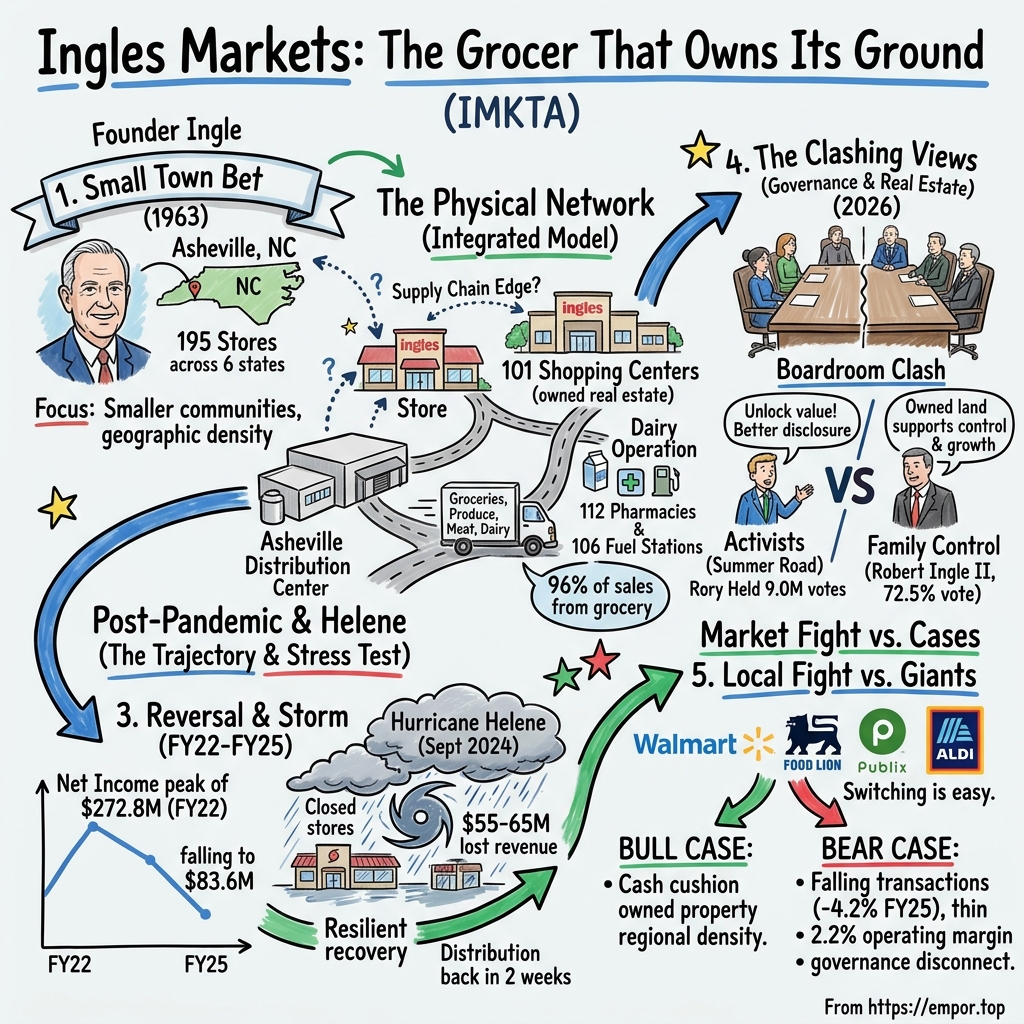
Ingles Markets: The Grocer That Owns Its Ground
I. The Boardroom Fight Behind the Grocery Aisle
On the morning of Thursday, April 30, 2026, the shareholders of a supermarket chain run from the hills outside Asheville, North Carolina, did the one thing the company had spent a month asking them not to do. They elected Rory Held to the board of Ingles Markets.1 Held was not a grocer. He was the chief investment officer of Summer Road, a firm that invests on behalf of the Sackler family, the former owners of the opioid maker Purdue Pharma.1 Ingles had campaigned against him in language rarely seen in a regional grocery proxy fight, calling Summer Road "the family investment office for members of the notorious Sackler family" and warning that his presence on the board could erode the customer loyalty its stores depend on.2 The shareholders heard all of that and voted for him anyway. Held collected about 9.0 million Class A votes; Rebekah Lowe, the management nominee he displaced, collected about 3.6 million.3
"Today's election represents a clear mandate from Class A shareholders that change is needed at Ingles," Held said afterward.1 The board's response was carefully bloodless. It said it appreciated "the engagement and input" of shareholders and did not mention Held or Summer Road by name.1
To understand why a single board seat produced that much heat, it helps to see how Ingles is wired. The company has two classes of stock. Class A trades on Nasdaq under the ticker IMKTA. Class B carries far more voting weight, ten votes a share, and nearly all of it sits with one man.4 Robert Ingle II, the chairman and son of the founder, owned about 22.7% of the company's shares at the 2026 proxy measurement date, but because he held about 96% of the Class B stock, he controlled about 72.5% of the votes.4 That is enough to decide almost everything. What it does not decide is the small slate of directors that Class A holders elect on their own, and that slate is where Summer Road, with roughly 3% of the Class A shares, chose to fight.1
So the vote was a real defeat for management and, at the same time, no threat at all to who runs the company. The family still controls the board. One of the Class A seats now belongs to someone whose stated job is to ask uncomfortable questions. Shareholders also elected Dwight Jacobs, the other company nominee, which meant the outcome was a split decision rather than a sweep.1
What were the uncomfortable questions? Summer Road's case was that Ingles had underperformed both its grocery peers and the broader market, that it had not given investors clear information about its business, and that it had not used its land well, from the store sites it owns to a large bank of undeveloped property.1 It added a pointed observation about tone: Ingles had stopped holding quarterly earnings calls in 2016, so investors had no regular forum to question management.5 In the activist's telling, Ingles was a company sitting on valuable real estate that its outside owners could neither see clearly nor price properly.
Ingles gave as good as it got. It said its total shareholder return had "substantially" exceeded relevant index and peer benchmarks, that its return on invested capital was "well within industry average for 2025 and well above on a longer-term horizon," and that Summer Road's real estate and capital allocation ideas "would be value destructive."2 It argued that its undeveloped land was "strategically important to our long-term growth" and accused the activist of a "total lack of understanding of Ingles' real estate holdings."1 It also said Summer Road had rejected every settlement proposal and insisted only on Held.2
Each side's strongest argument deserves a hearing. The company's best point is that a grocery chain is not a property portfolio with shopping carts attached. If Ingles owns the ground beneath a store, nobody can raise its rent, decline to renew its lease or redevelop the site out from under it, and that control is part of how a regional grocer plans its network over decades. Pull the land out and sell it, and the company would trade a fixed asset for a permanent rent bill. Summer Road's best point is simpler and harder to refute: if management believes the land is worth more inside the grocery business than outside it, it should be able to show shareholders what the land is, what it is worth and what it earns. Without that, minority holders are asked to trust rather than evaluate.
The fight was never a clean referendum on the grocery business, because the Sackler name pulled attention away from the arithmetic. Ingles leaned hard on that association, warning of reputational damage and a possible customer boycott.1 Class A holders evidently decided that the question Held raised mattered more than the name he carried. That tells you something about the mood among the company's outside owners, and the mood had a cause.
At the end of its 2025 fiscal year, Ingles operated 194 supermarkets; by June 2026 it operated 195.67 Its profits had fallen sharply from their pandemic peak, its customers were making fewer trips, and the gap between what the family controlled and what the public owned had never been more visible. Two questions run through the rest of this story. Can a regional grocer keep earning its customers' weekly trips against much larger rivals? And can its owners show minority shareholders how that grocery business, and the ground it stands on, actually create value? Both questions begin in 1963, with a man who decided that the big chains were overlooking the smaller towns.
 Subscribe on LinkedIn
II. The Bet on Small Towns
Robert Ingle grew up in the grocery trade. He was a member of a third-generation grocery family, and he worked in a store his grandfather had started in Asheville, the same mountain city where the company is headquartered today.8 That family store closed in 1956 when Elmer Ingle shut it down.8 For a while the younger Ingle learned the business from the other side of the counter, working from 1961 to 1963 for Colonial Stores, a large chain operating across the Carolinas.8 Then he found the financing to go out on his own. In 1963 he opened Ingles No. 1 on Hendersonville Road in Asheville, a small, crowded store run by Ingle, his wife and a handful of employees.8
The idea that made the company was geographic. The big chains of the era were building in the cities, so Ingle aimed at the smaller towns and rural communities of North and South Carolina that those chains underserved.8 It was a bet that a well-run supermarket could become the default store in a place a national operator did not bother to contest. Once Ingles was the best store in a county seat, the next town over looked like the same opportunity, and expansion followed into Georgia, Tennessee, Alabama and Virginia.8
Two other habits formed early and still shape the company. The first was ownership of land. As Ingles grew, it bought real estate and owned the ground under many of its stores; the company says it owns about two-thirds of the real estate on which it operates.8 The second was a taste for doing things itself. In 1982 it bought a milk processing plant that became Milkco, a wholly owned subsidiary whose output grew from about 5 million gallons a year to more than 60 million.8 It built its own private label, Laura Lynn, named after Robert Ingle's daughter.8 And it supplied its stores from its own distribution center rather than relying on a wholesaler.8 Put those together and you get the shape of the modern company: a chain that wanted to control its sites, its supply and its shelves.
In 1987 Ingles became a publicly traded company on Nasdaq under the symbol IMKTA.8 The listing changed who owned the economics. It did not change who made the decisions, because the dual-class structure kept control with the family. That design was common among founder-led companies of the period, and it has outlasted the founder. Robert Ingle II now serves as chairman and remains the controlling shareholder.4 James Lanning has been chief executive since March 2016, and no chief executive or chief financial officer turnover appears in the company's filings across the past several years.64
That continuity is a feature the company emphasizes and a fact its critics question. The same year Lanning took the top job was the year, by Summer Road's account, that Ingles stopped hosting quarterly earnings calls.5 Whatever the reason, the company that emerged under the current leadership is one that speaks to investors mainly through its filings and press releases. Lanning has not cultivated a public profile as a strategist with a big stage presence; the chairman's influence, meanwhile, shows up less in speeches than in the voting tally. This is a quiet, inward-facing management culture, which is often how good regional operators behave, and also how companies avoid being held to account.
The scale of what that culture built is real. From one Asheville store, Ingles grew to 195 supermarkets across six southeastern states by June 2026.7 Its distribution center sits on the outskirts of Asheville next to Interstate 40 and close to Interstate 26, and the company says it is within 250 miles of its stores.8 That radius is the founding idea turned into logistics. Every store is close enough to the hub to be restocked on a short truck run, and every town in the network adds density to routes that are already paid for.
Here is the tension, though. A tight regional footprint can mean local familiarity, efficient routes and stores that have anchored the same towns for decades. It does not automatically mean that customers are loyal, or that Ingles can charge more than the competitor down the road. In 1963 the overlooked town was the opportunity. In 2026 the overlooked town is no longer overlooked: Walmart, Aldi, Food Lion, Publix and others now operate across the same region with far greater scale.6 The question the founder answered was where to put the stores. The question his successors must answer is why customers keep choosing them, and part of that answer is the machinery behind the store itself.
III. The Distribution Network Behind the Store
Picture a trailer pulling away from the distribution center off Interstate 40 before dawn. It carries dry groceries, produce, meat, dairy and frozen food, loaded to match what a cluster of mountain and Piedmont stores sold the day before. Within a few hours it is backing into a loading dock in a town of a few thousand people. That truck is the most physical expression of Ingles' strategy: the company does not wait for someone else's network to supply it, and that independence was meant to be a cost and service advantage in towns where other chains struggled to make the routes pay.
The first thing to understand is that almost all of the money comes through the front door of the supermarket. Retail grocery generated about 96% of Ingles' fiscal 2025 sales.6 Everything else, milk processing, shopping-center rents and other revenue, is small by comparison. At the end of that fiscal year the chain also ran 112 pharmacies and 106 fuel stations alongside its stores.6 Those are not separate businesses in any meaningful investor sense. They are reasons to make one trip instead of two.
That is the core of the Ingles basket. A shopper comes in for groceries and perishables, picks up household goods and other non-foods, fills a prescription at the pharmacy counter and tops off the tank at the fuel station on the way out. Each additional service raises the odds that the weekly shop happens at Ingles rather than being split among a discount grocer, a drugstore and a gas station. The company calls this its one-stop strategy, and it was central to its argument against Summer Road: the model depends on customer loyalty, Ingles said, and anything that eroded that loyalty would cost sales.2
Those operations supply Ingles' stores, while Milkco also sells milk and other products to outside customers.6 It is tempting to treat each of these as a hidden business worth something on its own, a dairy here, a logistics operation there. The filings do not support that reading. Ingles does not disclose separate profits for distribution, dairy, fuel or pharmacy, so the honest description is that these operations exist to support retail. They may reduce cost, improve freshness and protect supply, but no one outside the company can measure how much.
Fuel adds a particular kind of dependence. Ingles buys about 87% of the fuel it sells under supply contracts that can be modified or terminated if it misses monthly minimum purchases.6 That is a reminder that a fuel station is a traffic tool with its own volume obligations, not a free amenity. When fuel prices swing, they push reported sales around without telling you much about the health of the grocery trip, which is why the company reports comparable grocery sales excluding fuel and why that is the measure worth watching.
Now the economics, which are the economics of a business with very little room for error. In fiscal 2025 Ingles' gross margin was about 23.9%, meaning that for every $100 a customer spent, the company kept about $23.90 after paying for the goods it sold.6 Out of that $23.90 came wages for a workforce of roughly 24,000 associates, more than half of them part-time, plus store operating costs, utilities, repairs, depreciation on stores and trucks, and everything else needed to keep the lights on.4 What was left as operating profit was about $2.20.6 A grocer at that margin lives and dies on small things: how much produce spoils before it sells, how efficiently a shift is scheduled, how well a store manager controls shrink, what suppliers will pay for shelf placement. A headline revenue figure of more than $5 billion sounds formidable. The more important figure is how thin the sliver of profit inside it is.
Which brings us to one of the most important lines in Ingles' accounts, and one of the least discussed. Vendor allowances are payments from suppliers: rebates, promotional funding and other amounts tied to supplier agreements that reduce the cost of the goods Ingles sells. In fiscal 2025 they reduced cost of goods by $151.9 million, up from $128.9 million in fiscal 2023.6 Set that beside the roughly $117 million of operating profit implied by a 2.2% margin on $5.33 billion of sales, and the point jumps out. Supplier funding was larger than the company's entire operating profit for the year. That is common in grocery retail; allowances are a normal part of how the industry divides margin between makers and sellers. It also means that a modest change in supplier terms, or in the volume that triggers them, would move Ingles' earnings far more than its sales line would suggest.
The auditor noticed. It treated the recognition of vendor allowances as a critical audit matter, its term for an area that required especially challenging or subjective judgment.6 That is not a criticism or a sign of error; the auditor issued an unmodified opinion and reported no material weakness.6 But it is a signal to investors about where the judgment in the numbers lives. The allowances also show up on the balance sheet. Receivables, which reached about $106 million at the end of fiscal 2025, consist mainly of vendor allowances, customer charges and pharmacy insurer reimbursements rather than consumer credit, and Ingles does not publish an aging schedule for them.6 For a retailer that collects cash at checkout, the meaningful credit exposure is to suppliers and insurers, not shoppers.
So how good is the machine? The operating case is plausible. Owning the distribution center, the dairy and many of the store sites gives Ingles control over freshness, delivery schedules and costs that a chain buying through a wholesaler would not have. But plausible is not proven. Ingles publishes no comparison of its logistics costs with those of rivals, no customer retention data and no local market share figures. Integration can make a supply chain sturdy, and in 2024 Ingles got a brutal chance to show it. What integration cannot do is guarantee that customers keep coming. The best test of the machine is therefore not the company's description of it but what happened to its profits after the strangest grocery boom in modern memory ended.
IV. When the Pandemic Grocery Boom Went Away
For a few years, running a supermarket felt like printing money. When the pandemic arrived in 2020, restaurants closed, offices emptied and families cooked at home. Grocery stores became the place where Americans spent the money they would otherwise have spent eating out, and they spent it with less attention to price. For a chain like Ingles, with stores spread across smaller towns and suburbs, the effect was immediate.
The numbers show how unusual that era was. In fiscal 2016 Ingles earned about $54 million.9 By fiscal 2020 net income had risen to about $179 million, and by fiscal 2022 it reached $272.8 million, five times the 2016 level.910 Sales grew too, but nowhere near as fast. What happened was operating leverage: a business with high fixed costs and thin margins suddenly had more volume flowing through the same stores, trucks and warehouse, so a larger share of each extra dollar fell to profit. Inflation in 2022 helped as well, since rising prices lifted revenue per basket while customers were still shopping at higher frequency.
Then the tide went out. Net income fell to about $211 million in fiscal 2023, about $106 million in fiscal 2024 and $83.6 million in fiscal 2025.6 Sales, which had peaked at about $5.89 billion in fiscal 2023, slipped to $5.33 billion by fiscal 2025.6 In three years, Ingles gave back more than two-thirds of its peak profit.
The tempting explanation is a single villain, whether inflation fatigue, the storm or competition. The record suggests a more ordinary and more worrying story. Part of the decline was simply the reversal of the pandemic windfall, as restaurant spending returned and grocery trips normalized. Part of it was traffic. In fiscal 2025, comparable grocery transactions excluding fuel fell 4.2%, while the average transaction size rose just 0.1%.6 Put those together and comparable grocery sales fell by about 4%. Fewer people were coming through the doors, and the ones who came were not spending enough more to offset that. For a retailer, that is the most fundamental kind of weakness, because a store's fixed costs do not shrink when its customers do.
Margins tell the same story from the other side. Ingles' operating margin fell from 5.0% in fiscal 2023 to 2.2% in fiscal 2025.6 Gross margin, oddly, improved in fiscal 2025, to 23.9% from 23.0% the year before, helped by higher vendor allowances.6 So the squeeze was not in what Ingles kept on each item sold. It was in the cost of running stores against falling volume: labor, occupancy, repairs and depreciation spread over fewer transactions. A grocer can improve its markup and still see profits shrink if its customers drift away.
There was one more distortion hiding in the profit line, and this one flattered the recent results. Other income, mostly interest earned on the company's large cash balance, was about $12 million in fiscal 2025, roughly 11% of pretax income, compared with about 3% in fiscal 2023.6 Higher interest rates turned Ingles' cash pile into a meaningful contributor to earnings just as the grocery operation was weakening. That interest is real money, but it is not grocery profit, and it would fade if rates fell or the cash were spent.
Then there was the storm. Hurricane Helene struck in late September 2024, at the very end of Ingles' fiscal year, and it damaged stores and inventory across the company's home region. Ingles recorded a $30.4 million inventory impairment and a $4.5 million loss on property and equipment in fiscal 2024.11 The damage mattered, and its after-effects ran into fiscal 2025. But the timeline matters more for the investment case. The earnings decline began in fiscal 2023, a year and a half before Helene made landfall. The storm deepened a slide that was already underway; it did not cause it.
That is why fiscal 2026's rebound needs careful handling. For the first nine months of the fiscal year, through late June 2026, Ingles earned $78.3 million, up from $57.9 million a year earlier, an increase of about 35%.712 Sales were up about 2.1%.7 Read in isolation, that looks like a recovery. Read against the calendar, it is partly a comparison with a storm-hit period: the prior year's first quarter included the immediate aftermath of Helene, with closed stores, disrupted payments and lost inventory. And in the June quarter, comparable grocery sales excluding fuel were down 3.1%.7 Total sales grew, while the same stores sold less. The gap suggests that reopened and new stores, the absence of storm disruption and other non-comparable factors were doing much of the work, rather than a revival of traffic in the existing base.
Here the absence of earnings calls becomes more than a governance complaint. A company that holds calls must answer questions in real time: why comps fell, what is happening to transaction counts, how much of a quarter's profit came from insurance. Ingles explains its results through filings and press releases, which are precise but rarely expansive. Its quarterly releases have generally described results with little discussion of why traffic is falling or what management plans to do about it.12 That leaves the investor in an odd position: able to see that the grocery trip is weakening, but not able to hear management's diagnosis of why.
So was the pandemic peak a lasting step up? The record rejects that idea. The peak was a windfall produced by unusual demand, and the business that remains earns somewhat more than it did in fiscal 2016, about $84 million versus about $54 million, on about 40% more revenue.96 That is a respectable, if unspectacular, decade, roughly 4% to 5% annual growth in sales and profit. It is not a new earnings base of $200 million or more. The fiscal 2026 rebound was real, and it was encouraging; it did not yet show that the old trajectory had returned. To separate the recovery from the storm, you have to go back to the week when Helene turned the Ingles supply chain into a test it never asked to take.
V. Helene Turned the Supply Chain Into a Stress Test
In the last days of September 2024, Hurricane Helene pushed inland from the Gulf Coast and stalled over the southern Appalachians, dumping rain on mountains that had already been soaked. Rivers rose to levels residents had never seen. Roads washed out, bridges failed and power went down across western North Carolina, East Tennessee and the upstate of South Carolina, which is to say, across the heart of Ingles country. Asheville, the company's hometown, was among the hardest-hit places in the storm's path.
For a grocery chain, a disaster like this is two problems at once. The first is that the company itself is a victim: stores flood, inventory spoils when the power fails, employees cannot get to work because their own homes and roads are damaged. The second is that the community suddenly needs the company more than ever. Families without power need water, batteries, non-perishable food and prescriptions. A grocer that cannot reopen loses not just sales but standing in towns where it may be the only full-service store for miles.
The Ingles distribution center, the hub at the center of the whole system, was itself affected by the storm. It returned to full operation within about two weeks.6 That recovery matters. Ingles' self-distribution model concentrates risk in one facility; if the hub had been down for months, every store in the network would have suffered. Two weeks is a creditable outcome for a facility in a disaster zone, and it is the clearest operational evidence that the company's integrated network had resilience built into it rather than just efficiency.
The stores were a harder story. Four were damaged badly enough to close.6 At the end of fiscal 2025, a full year after the storm, three remained closed, with reopening expected during 2026 or 2027.6 By the spring of 2026 the company said it still expected the three to reopen during 2026.2 The duration says something about the scale of the damage. These were not stores waiting for the power to come back; they needed rebuilding.
To understand what Helene did to the numbers, it helps to separate four different things, because the storm touched the financial statements in four different ways. First, there was lost revenue: sales Ingles never made because stores were closed or because customers could not pay, with card networks and banking disrupted across the region. The company estimated that lost revenue at $55 million to $65 million.6 Second, there were impairments: inventory and property that were destroyed or damaged and written off, the $30.4 million and $4.5 million charges booked in fiscal 2024. Third, there were repair and recovery costs, the expense of cleaning, rebuilding and restocking. Fourth, there were insurance receipts, money that flowed back in as the company's claims were paid. Collapsing all four into a single "storm impact" hides the fact that they land in different periods and move earnings in opposite directions.
Insurance is where the comparison becomes slippery. In the June 2026 quarter, Ingles' results included a $5.8 million insurance receipt related to Helene inventory losses.7 That receipt was recorded in a way that lifted gross margin. With it, the quarter's gross margin was 24.3%; without it, the margin would have been about 23.9%, essentially the same as in fiscal 2025.7 In other words, the apparent margin improvement in that quarter was largely the insurer's money. It is legitimate income, and the company is entitled to it. It is also, by its nature, a one-time recovery of value lost almost two years earlier, not evidence that the stores have become more profitable.
The cash flow statement carries the same echo. Operating cash flow for the first nine months of fiscal 2026 rose to $189.2 million from $94.2 million a year earlier.7 Part of that swing reflects the comparison with the prior year, when Ingles was spending heavily to rebuild inventory after the storm. Working capital timing, including inventory and payments to suppliers, can move a grocer's cash flow by tens of millions of dollars from one year to the next, and Helene amplified that movement.7 Over a longer span, Ingles converts profit into cash well, because depreciation on its large store base is a sizable non-cash charge. Across fiscal 2023 to 2025, net income totaled about $400 million while operating cash flow totaled about $683 million.6 In any single year, though, the cash flow is volatile, and the storm years are especially noisy.
What would settle the question of whether Ingles has really recovered? Not the reopening of the three stores by itself. When a closed store reopens, its sales come back onto the books, but that is restoration, not growth; the company is regaining revenue it lost rather than winning new customers. The cleaner evidence is comparable sales in the stores that never closed. If those stores are seeing more transactions, Ingles is winning back trips. If they are seeing fewer, as the June quarter suggested, then the storm has been masking a deeper problem rather than causing it.
Helene, in the end, proved something real and something limited. It showed that the hub-and-spoke network could absorb a catastrophe and come back quickly, which counts in favor of the integrated model. It did not show that customers prefer Ingles when they have a choice, because in the immediate aftermath of a disaster, many of them did not have much of one. The real test happens on an ordinary Tuesday, when the roads are open, the power is on, and every competitor in town is a short drive away.
VI. The Grocery Aisle Is a Local Fight With National-Scale Rivals
Consider a household in a mid-sized town in the Carolina upstate on a Saturday morning. It has a list and a budget and about five options within a fifteen-minute drive. There is the Ingles, with its pharmacy, its fuel station and a parking lot the family has used for years. There is a Walmart Supercenter, where the prices on staples are hard to beat and a lot of non-grocery shopping can happen in the same trip. There is a Food Lion or an Aldi, smaller stores with tighter assortments that win on price for a family willing to give up some choice. And there may be a Publix or a Harris Teeter, where the experience is more polished and the prices a little higher. The family can choose any of them, and next Saturday it can choose differently. That is the fight Ingles is in every week.
Ingles itself names the opponents. Its 2025 annual filing lists Walmart, Food Lion, Publix, Kroger, Aldi, Lidl and Food City among its competitors, along with others.6 It is worth pausing on the scale mismatch. Walmart and Kroger are national operators whose purchasing volume, logistics networks and technology budgets are vastly larger than anything a 195-store chain can match. Aldi and Lidl are subsidiaries of German discount groups that compete through relentless cost discipline, private-label assortments and small-format stores that can be dropped into the same towns Ingles has long served. Food Lion and Publix are powerful regional chains in the Southeast with deep customer bases of their own. Food City is a regional peer that overlaps with Ingles in parts of Tennessee and Virginia. There is no single market share number that captures Ingles' position across its six states, because grocery is won town by town, and Ingles' standing in one county seat says little about its standing in a suburban market a hundred miles away. Ingles does not disclose market share figures.
What the store offers, and what the trip count says
Ingles' claimed advantages are concrete. It has stores in places where it has operated for decades, often on land it owns. It has 131 stores with curbside pickup, letting customers order online and collect their groceries without leaving the car.6 It has pharmacies and fuel stations that broaden the trip. It has a distribution network built for its specific region. And it has private-label products that give it margin and a reason to shop there. On paper, that is the profile of a sturdy local champion.
Now test it against the evidence. If those advantages were holding customers, transaction counts would be stable or rising. Instead, comparable grocery transactions excluding fuel fell 4.2% in fiscal 2025, and in the June 2026 quarter comparable grocery sales excluding fuel were still falling, down 3.1%.67 Basket size barely moved, up 0.1% in fiscal 2025.6 When transactions fall and basket size is flat in an environment where food prices are still rising, it suggests that customers are not trading up at Ingles; they are shopping there less often, or splitting their shopping with someone else. That is the signature of a store losing trips at the margin, and the most likely beneficiaries are the discounters and the national operators who can afford to price staples aggressively.
Ingles has not published a detailed explanation of the traffic decline. Some of it may reflect a broader slowdown in consumer spending in its region, the after-effects of the storm on local incomes, or changes in shopping patterns as inflation made families more price-sensitive. The August 2026 review by Pulse Ratings described grocery comparable sales declining amid cautious consumers, which points in the same direction.13 But a cautious consumer is a reason to shop at a cheaper store. If Ingles' traffic is falling because shoppers are watching their budgets, that is a statement about where Ingles sits in the price hierarchy, and it is not an especially comforting one.
Why a decent markup did not become a decent profit
The margin structure explains the pressure. A 23.9% gross margin in fiscal 2025 is in the range of a conventional supermarket rather than a hard discounter, which typically runs leaner on both price and margin.6 Ingles keeps enough on each item to pay for full-service departments, pharmacies and a broad assortment. But the operating margin was just 2.2%, down from 5.0% in fiscal 2023, so the conventional-supermarket gross margin was not translating into conventional profitability.6 Between those two numbers sit the costs of running stores: labor, occupancy, maintenance, depreciation and technology. When traffic falls, those costs are spread over fewer customers, and the margin shrinks. Ingles cannot easily raise prices to compensate, because a family with five options will notice. And it cannot easily cut costs without degrading the very service that is supposed to justify its prices. That is the squeeze in a sentence: Ingles is positioned between the discounters and the premium chains, and the middle of the grocery market is a difficult place to be when customers are price-sensitive.
What about technology? Ingles' filings do not discuss artificial intelligence, and there is no evidence that AI threatens the physical grocery store in any near-term way; people still need to buy milk somewhere. The more relevant technology question is online ordering and fulfillment. Curbside pickup at 131 stores gives Ingles a credible offer, but it also creates labor costs, since someone must walk the aisles and pick each order. The national chains are investing heavily in automated fulfillment, delivery partnerships and data-driven pricing. The test for Ingles is whether its digital offer improves convenience and labor productivity enough to defend trips and costs, not whether it can match Walmart's technology budget, which it cannot.
So does Ingles have a moat? The evidence presented does not show one. It has a regional operating network, an integrated store proposition and decades of local presence, and those things help it compete. But a moat is something that lets a company earn superior returns despite competition: pricing power, rising share, high customer retention. The record shows falling transactions, a sharply lower operating margin and no disclosed evidence of share gains or retention. Switching costs in grocery are close to zero. The fairest verdict is that Ingles has a competitive position worth defending, not a fortress, and that its customer trip count is the single best measure of whether it is winning the defense. And if the grocery business is not obviously a fortress, then the other asset at the heart of the proxy fight, the ground beneath the stores, matters even more.
VII. The Land Beneath the Grocery Story
Drive through the towns where Ingles operates and you will notice something about many of its stores: they are not tenants in someone else's strip mall. Often the store is the anchor of a shopping center Ingles owns, with smaller shops, restaurants and service businesses leasing space around it. At the end of fiscal 2025, Ingles operated 101 shopping centers alongside its supermarkets.6 It also holds land it has not yet developed, parcels bought for future stores or simply held as part of a long-term view of where its towns will grow.1 That land ownership reflects the founder's early habit of buying store sites; the company says it owns about two-thirds of its operating real estate.8
Why does a grocer want to own land? The strongest reason is control. A store on owned land cannot be priced out by a landlord, and the company can remodel, expand or add a fuel station without asking anyone's permission. In a business where location is one of the few durable advantages, owning the location protects it. A second reason is optionality. Owned shopping centers produce rental income, and undeveloped land gives the company the ability to build where it wants when it wants. A third reason is financial: owned property can be pledged as collateral, and Ingles does pledge property to secure its debt.6
But land has a cost, and the cost is capital. Every dollar tied up in real estate is a dollar not spent on store remodels, technology, wage investment, debt reduction or returns to shareholders. A company that owns its stores carries those assets on its books at historical cost, often far below current market value, which means its reported returns on capital can look different from those of a competitor that leases everything. The question is not whether owning land is good or bad in principle. It is whether this particular land, in this particular company, earns enough as a grocery asset to justify keeping it rather than unlocking its value another way.
That was the heart of Summer Road's campaign: the activist argued that Ingles had not effectively used its land and had not disclosed enough for shareholders to value it.1 Its proxy materials pressed for better disclosure and board oversight and floated the idea that a separation of the real estate could expose value that the market was not recognizing.5 Activists have made versions of this argument at many retailers, the classic playbook being a sale-leaseback or a spin-off into a real estate investment trust. The logic is that property markets may value the land more highly than stock markets value a low-margin grocer, so splitting the two can create value for shareholders on paper.
Ingles' response was blunt. It said Summer Road's real estate suggestions "would be value destructive," that its undeveloped land was strategically important to long-term growth, and that the activist showed a "total lack of understanding" of the company's holdings.21 There is substance behind that position. A sale-leaseback converts an owned asset into an ongoing rent obligation, which raises occupancy costs, reduces operating margin and gives a landlord leverage over the grocer. For a company running at a 2.2% operating margin, a new rent bill on a large share of its stores could consume a meaningful fraction of its profit. And because Ingles pledges property as debt collateral, untangling the real estate from the operating company would not be as simple as writing a check.
The April vote gave the property debate a seat in the boardroom.1 It did not establish that a real estate separation will happen, or that it would benefit shareholders if it did. Held can ask questions, request information and push for disclosure. He cannot force a transaction.
There is one other land-related item worth handling precisely, because it is the kind of thing that attracts suspicion in a controlled company. In fiscal 2024, Ingles exchanged property with a limited liability company owned by Chairman Robert Ingle II.11 The company said it used independent appraisals, the audit committee approved the transaction, and Ingles received $2.3 million in cash.11 That is a tiny amount relative to Ingles' sales, and it was a one-time balance-sheet transaction rather than a recurring stream of payments. It does not suggest self-dealing on any meaningful scale. It does illustrate why the property question matters in a family-controlled company: when the controlling shareholder can transact with the company's land, minority holders have an interest in knowing how that land is valued.
What would settle the property debate? The company could disclose what it owns and what it leases, store by store or at least region by region. It could publish the carrying value of its real estate alongside an estimate of its market value. It could show site-level returns, revealing which stores earn their keep on the land beneath them. It could explain what it intends to do with its undeveloped parcels and when. And it could lay out the economics of a sale-leaseback against continued ownership: what the proceeds would be, what the rent would cost, and how the return on the freed-up capital would compare. None of this is published today. Until it is, both sides of the debate are arguing about a number no outsider can see.
Capital spending is the place where the land question meets the operating question. Ingles spent $210.9 million on capital projects in fiscal 2024 and $114.5 million in fiscal 2025, a cut of nearly half.6 Some of that capital goes into stores and equipment; some goes into land and buildings. If Ingles is spending less, is it because the storm disrupted its project pipeline, because it sees fewer attractive opportunities, or because it has become more cautious about committing capital to a business whose traffic is weakening? The answer bears directly on the land debate, because a company that owns a lot of property but is not investing to grow on it has a harder time arguing that the property is essential to growth.
The fairest verdict is that property clearly supports the retail footprint and the dispute exposed a real information gap. A split or sale-leaseback is a proposal, not proven value creation. The only way to judge it is to compare the proceeds and the ongoing rent with the operating returns the company would give up, and Ingles has not given shareholders the information to make that comparison. That makes the company's broader capital plan the next place to look.
VIII. The Capital Plan: Stores, Dividends and a Nearly Matched Cash Buffer
In June 2026, Ingles opened a new supermarket.7 For a chain of 195 stores, one opening is not a dramatic event, but it is a reminder that the company is still building. Ingles budgeted $120 million to $130 million in capital spending for fiscal 2026, and through the first nine months of the year it had spent $76.4 million.7 That pace was slightly behind the budget, which would have required a heavier final quarter to reach the low end of the range.
Look at the trajectory. After rising sharply in fiscal 2024, capital spending fell nearly in half in fiscal 2025, to about 2.1% of sales from about 3.7% the year before.6 Three explanations are possible, and the company has not clearly said which applies. The first is timing: the storm may have delayed projects, pushing spending into later years. The second is opportunity: Ingles may simply have fewer stores to build or remodel. The third is caution: with traffic falling and profits down sharply, management may be pulling back on investment until the business stabilizes. Each would mean something different for the long-term health of the store base. Underinvestment in a grocery chain shows up slowly, in tired stores, outdated equipment and customers who drift to the brighter store across town, so the reduced spending deserves scrutiny rather than applause.
What does Ingles spend its capital on? The record in recent filings centers on store sites, land, remodels, technology, dividends and debt service.6 There is no major acquisition program. That is worth noting because many grocers have grown through mergers, and Ingles has not. It has grown organically, one store and one remodel at a time. That approach avoids the risk of overpaying for acquisitions, but it also means there is no acquisition record to benchmark against. Capital discipline at Ingles has to be judged by the returns on the stores it builds and the remodels it completes, which the company does not publish.
The pandemic years tell a different story about capital returns. Flush with record profits, Ingles bought back about $67.6 million of stock in fiscal 2020 and $80 million in fiscal 2021.910 Those repurchases happened when the company's earnings multiple was very low, around five times earnings in fiscal 2021, so in hindsight the timing looks reasonable.14 But recent filings through the June 2026 quarter show no comparable buyback program.7 Since then, the main channel for returning cash to shareholders has been the dividend. Ingles has paid quarterly dividends since 1993, currently 16.5 cents a quarter on Class A shares and 15 cents on Class B shares.6 That is a modest payout relative to earnings, and it has been steady rather than growing.
The balance sheet is the company's strongest card. At the end of June 2026, Ingles held $455.1 million in cash against about $500.5 million in borrowings.7 That is close to a net-cash position, unusual for a retailer of its size. The largest piece of debt is the $350 million of senior notes carrying a 4% interest rate, issued in 2021 and due in 2031.10 The company also has a $150 million revolving credit line that matures in 2030 and was undrawn apart from a small letter of credit, and it reported compliance with its debt covenants.7 S&P Global Ratings affirmed Ingles at BB+ with a stable outlook in April 2026, one notch below investment grade.15
That cash buffer is real flexibility, but it is not unlimited. A couple of details are worth noting. The cash was concentrated: at the end of fiscal 2025, about $360 million sat in demand deposits at five banks, above the federally insured limits.6 That is a normal practice for a company of Ingles' size, but it is a concentration risk the company itself discloses. And the cash is earning interest that flatters earnings, a boost that would shrink if rates fell. More fundamentally, the 2031 notes were issued when interest rates were near historic lows. When Ingles refinances them, it is likely to pay more. The cash balance can absorb a lot, but a grocer running at a 2.2% operating margin has limited room to absorb a meaningful rise in interest costs alongside weakening traffic.
What would a skeptical investor make of all this? The company has been prudent: it has not overspent on acquisitions, it has not loaded itself with debt, and it has kept paying dividends through a difficult period. But prudence is not the same as good capital allocation. A company that holds nearly half a billion dollars in cash, which the company says owns two-thirds of its real estate, cut its capital spending nearly in half and has no buyback program is accumulating resources faster than it is deploying them. That might be wise caution, or it might be a sign that management lacks a clear plan for the capital. The company's filings describe what it spends; they do not set out targets for returns on that spending.
Management credibility, in the end, should be judged by store-level returns, by whether capital spending follows through on the budget, by the restoration of the storm-damaged stores and by whether the company explains weak comparable sales rather than simply reporting them. Language about disciplined capital allocation is easy to write. The evidence of discipline is in the returns, and those are not disclosed. That gap between what the company controls and what shareholders can measure is exactly the tension that the bull and bear cases must resolve.
IX. Analysis & Bear vs. Bull Case
In late November 2026, Ingles' Class A shares traded at about 15.7 times trailing earnings.14 Against the company's own history, that is a striking number. In fiscal 2021 the stock traded at about five times earnings; in fiscal 2022 at about 5.7 times; in fiscal 2023 at about 6.8 times.14 Since then, the multiple roughly doubled in fiscal 2024 and has stayed around 15 to 16 times.14 A naive reading would say the stock has become expensive. The more accurate reading is that the multiple rose because earnings fell. The share price did not triple; the denominator collapsed. Investors who paid five times earnings at the pandemic peak were paying for profits that would not last, and the market seems to have known it. Today's higher multiple is paid on earnings that are much smaller, but probably closer to normal.
The price-to-sales ratio tells a steadier story. It was about 0.30 at the snapshot, compared with a range of about 0.24 to 0.27 across fiscal 2021 to 2025.14 By the arithmetic of those multiples, the market values the company at roughly $1.6 billion, against about $5.4 billion of trailing sales. That means investors are paying about 30 cents for every dollar of revenue, a little more than in recent years. Set against peers, Ingles' earnings multiple sat between Village Super Market, at about 11.5 times, and Weis Markets, at about 18.6 times, two other family-influenced regional grocers.1617 Kroger traded at about 40 times trailing earnings and Sprouts at about 9.4 times, but those figures reflect company-specific earnings swings and are not clean benchmarks.1819 The comparison suggests the market is not paying a premium for Ingles' owned real estate, nor applying an extreme discount for its governance. It is pricing a regional grocer with modest growth.
The case for patience, and the case against it
The bull case runs like this. Customers keep making their regular trips, because grocery shopping is habitual and Ingles has been part of these towns for decades. Local density and self-distribution help Ingles compete on cost and freshness in markets the national chains do not dominate. Investment in stores and technology, including curbside pickup, supports productivity. The storm distortions fade, the three closed stores reopen and comparable sales stabilize. The balance sheet, close to net cash, gives the company room to invest or return capital. And the owned real estate provides both operational flexibility and a potential store of value that could one day be realized, whether through disclosure, development or a transaction. On this view, the market is pricing Ingles as a mediocre grocer and ignoring both its land and its resilience.
The bear case is equally coherent. Walmart, Aldi, Food Lion, Publix and other rivals are capturing trips through lower prices or a better experience, and Ingles' falling transaction counts are the proof. Operating margins have more than halved, and the gross margin improvement is supported by vendor allowances whose durability is hard to judge from outside. Interest income is flattering earnings. Capital spending has been cut, raising the risk that the store base ages. Management communicates sparsely, holding no earnings calls, and its capital plan is difficult for minority shareholders to evaluate. The real estate may be valuable, but its value is invisible and may never be realized under a controlling shareholder who sees it as strategic. On this view, the stock is fairly priced or worse, and the governance discount is deserved.
Which case does the evidence favor? Run the business through Michael Porter's five forces and the picture is sobering. Buyer power in the traditional sense is low, because Ingles' customers are millions of individual households and no customer concentration is disclosed. But that fragmentation comes with a catch: each household can switch stores at almost no cost, which gives customers collective power over price even if no single customer has any. Supplier power is hard to assess, because Ingles does not disclose supplier concentration, but the scale of vendor allowances shows how much of the margin depends on supplier relationships, and a 195-store chain negotiates from a weaker position than Walmart or Kroger. The threat of substitutes is moderate and rising: restaurants, meal kits, online grocery and delivery services all compete for the food dollar. The threat of new entrants is real in the form of discounters such as Aldi and Lidl expanding into the Southeast. And rivalry among existing competitors is intense, as the falling trip count shows. Taken together, the five forces describe an industry where returns are structurally thin and competition is fierce, and Ingles does not appear to have escaped that structure.
Hamilton Helmer's seven powers framework asks a sharper question: what lets a company earn returns above its cost of capital over a long period? Scale economies are the most plausible power for Ingles, in the regional sense: dense store clusters and owned distribution reduce cost per store. But the national competitors have far greater scale, so this power is local and partial at best. Network economies, where a product becomes more valuable as more people use it, do not apply to a grocery store. Counter-positioning, where a newcomer adopts a model incumbents cannot copy without damaging themselves, describes the discounters' attack on Ingles better than it describes Ingles' defense. Switching costs are negligible. Branding exists in the sense of local familiarity and the Laura Lynn private label, but there is no evidence that customers pay a premium for the Ingles name; falling traffic suggests the opposite. A cornered resource, an asset no rival can replicate, is the case Summer Road implicitly made for the land, but owned real estate in small towns is not uniquely scarce, and the evidence does not show it confers pricing power. Process power, an embedded operating excellence that rivals cannot easily copy, is possible in Ingles' integrated supply chain, and the swift recovery of the distribution center after Helene is the best evidence for it. But process power should show up in superior margins, and Ingles' 2.2% operating margin does not demonstrate it. The fairest conclusion is that Ingles has, at most, local scale economies and some process advantages, which help it compete but do not amount to a durable moat.
Governance deserves its own stress test. Robert Ingle II holds 72.5% of the votes with 22.7% of the shares.4 His total compensation was about $7.4 million in fiscal 2025, including an annual bonus of about $6.1 million, almost identical to the year before, even as net income fell.4 The chief executive, James Lanning, was paid about $3.1 million.4 A chairman being paid more than twice the chief executive, with a bonus that barely moved while profits fell by more than half, is the kind of fact that invites questions about whether pay is linked to performance. The company's say-on-pay vote passed with about 51.9 million votes in favor and 5.0 million against, but the headline margin largely reflects the family's own Class B votes.3 The more telling figure is the director vote, where Class A holders voted on their own and chose the activist's nominee by a wide margin.3 That is meaningful dissent, even in a company the family controls.
The share register reinforces the point. The largest reported Class A holders include BlackRock, Vanguard and Dimensional, index-oriented investors, alongside Brandes, Gabelli and River Road, value managers whose style is to buy assets they believe the market misprices.4 Those value investors are the natural audience for an argument about hidden real estate, and their presence helps explain why Summer Road's message found a receptive audience. Over time, the family's Class B holdings have also shrunk, from about 6.1 million shares in fiscal 2020 to about 4.5 million in early 2026, as shares were converted into Class A.49 Economic ownership and voting control are drifting further apart.
Three numbers that will decide the story
Three measures will tell investors which case is winning. First, comparable grocery transactions excluding fuel fell in fiscal 2025 and remained weak in the June 2026 quarter.67 The direction is negative; a sustained turn to growth would be the strongest evidence for the bull case. Second, operating margin, read alongside gross margin and vendor allowances, will show whether the business is healing or still relying on supplier support and one-time insurance receipts.6 Third, capital spending, store openings and the reopening of the Helene-damaged stores will show whether investment is tracking the budget and recovery is progressing.72
Valuation, in the end, is a sensitivity rather than a verdict. If investors believe Ingles' normalized earnings are closer to the fiscal 2023 level, the stock looks cheap at today's price. If they believe they are closer to fiscal 2025's level, the stock looks fully priced. The low multiples of the pandemic years were paid on peak earnings and are not a straightforward guide to what normalized earnings deserve. The multiple depends on which earnings base investors believe, and the evidence so far points toward the lower one.
X. Playbook: Business & Investing Lessons
Go back to that truck leaving the distribution center off Interstate 40, and then to the ballot box in April 2026. Between those two images sit six decades of building a regional grocery chain and the moment its outside owners decided to push back. The lessons that follow belong to Ingles, but they reach well beyond it.
The first lesson is that a store network is an advantage only while customers keep choosing it. Ingles spent decades building a regional footprint. And yet in fiscal 2025, comparable transactions fell 4.2%, which means the network was not stopping customers from walking out. In grocery, the switching cost is a different turn at the traffic light. Founders who build physical networks should remember that the network is not the moat; the customer's habit is. And investors who value a retailer for its footprint should value it for the trips that footprint captures, not for the dots on the map.
The second lesson is that integration can steady the supply chain, but it cannot make a weak trip count disappear. The distribution center's recovery after Helene was a genuine accomplishment of self-distribution. Milkco, the private label and the owned logistics give the company control most grocers lack. But that control did not translate into rising traffic or expanding operating margins. Vertical integration is a way to manage costs and risks; it is not a reason for a customer to choose your store. The temptation for any integrated company is to confuse operational resilience with competitive advantage. Ingles shows they are different things.
The third lesson is that a property asset has two jobs: to support the store and to earn a return on capital. Ingles' real estate clearly does the first job. Whether it does the second is the question at the heart of the proxy fight, and the company has not given its shareholders the information to answer it. The lesson for operators who own their real estate is that they should be able to explain, in numbers, why owning beats leasing for their business. The lesson for investors is that a hidden asset is only worth something if it is either earning a return or can be realized. An asset that is neither disclosed nor deployed is a promise without a price.
The fourth lesson is the one Ingles teaches most distinctively: control can make a company patient, and it can also make the minority's patience compulsory. The dual-class structure has let the Ingle family run the company for the long term, without pressure to hit quarterly targets or sell assets at the wrong moment. That is genuine value. But the same structure means that when the business weakens, outside shareholders cannot change course; they can only elect a director or two and sell their shares. Rory Held's election made the minority's voice louder, not its power greater. Founders who choose dual-class structures should recognize that the quiet bargain they strike with outside shareholders depends on performance; when performance falters, control looks less like stewardship and more like insulation.
And a final caution: the pandemic peak was an unusual demand windfall, not a management achievement in itself. Crediting management for the peak would mean blaming management for the decline, and neither is quite fair. What management can be judged on is what it built during the good years and how it responded when they ended. The pandemic-era repurchases look sensible in hindsight. The response to falling traffic is still being written.
XI. Epilogue
Tonight, Ingles stands at an in-between moment. The fiscal year closed in late September 2026, and its full results have not yet been published. Three of the four stores damaged by Helene were awaiting reopening at last report. A new director sits on the board with a mandate from Class A shareholders to press on capital allocation and property transparency. And the chain's comparable sales, the clearest measure of its health, were still falling in the most recent quarter.
The next few moments will decide what kind of story this becomes. The first is the full-year fiscal 2026 report. If it shows comparable grocery transactions stabilizing and operating margin recovering, excluding insurance receipts and storm-related distortions, the bull case gains ground. If it shows continued traffic declines with earnings propped up by interest income, insurance and vendor allowances, the bear case strengthens. The second moment is the reopening of the storm-damaged stores, and how quickly their sales recover. A return to prior sales levels would show that Ingles retained its customers through a year or more of closure. The third moment is the capital plan: whether the company spends its budget, what it spends it on, and whether it begins to explain the returns it expects.
The fourth moment is the boardroom. Will Rory Held's presence produce any change in disclosure, such as a breakdown of owned and leased property, site-level returns, or a plan for undeveloped land? Will the board set measurable targets for store returns and capital allocation? Or will the activist director be outvoted quietly, with the company carrying on much as before? Each outcome would tell investors something different about whether the family's control is compatible with greater accountability.
Further out, the refinancing of the 4% notes due in 2031 will test how much resilience the cash balance really buys. Ingles will likely pay more to borrow, and the full rationale behind its credit rating will matter more than the headline. A grocer with thin margins and falling traffic has less room to absorb higher interest costs than one with rising sales.
What will decide whether this is a recovery or a prolonged plateau is not the land debate in itself. The property question matters only insofar as resolving it improves the operating company or releases value without weakening it. The deciding question is whether everyday grocery traffic returns and whether management makes its capital returns easier to evaluate. The tension that remains is simple to state and hard to resolve: a family that controls the company believes in patience, and a growing share of its outside owners want proof.
XII. Outro
Before dawn tomorrow, another truck will pull out of the distribution center outside Asheville. It will carry bread, milk, produce and meat to stores in towns where Ingles has been part of daily life for decades. Most of the customers who walk into those stores will never think about the land beneath their feet, the voting structure of the company or the proxy fight that unfolded in April. They will think about whether the store has what they need at a price they can live with.
That is what makes Ingles unlike a generic grocery chain. It is both a neighborhood grocer and a controlled public company. The daily work is bread and milk and a reliable local store. The proxy fight brought the question of the network’s value into view. Ingles built its value one grocery trip at a time; now it has to show shareholders what that value is doing.
References
-
Ingles Markets loses proxy fight over board seat — Grocery Dive, 2026-04-30 ↩↩↩↩↩↩↩↩↩↩↩↩↩
-
Ingles Markets issues investor presentation highlighting company's long record of value creation, disciplined strategy and risks posed by Sacklers' Summer Road — Ingles Markets, 2026-04-08 ↩↩↩↩↩↩↩
-
FY2025 Form 10-K — SEC, 2025 ↩↩↩↩↩↩↩↩↩↩↩↩↩↩↩↩↩↩↩↩↩↩↩↩↩↩↩↩↩↩↩↩↩↩↩↩↩↩↩↩
-
Ingles Markets reports results for third quarter and first nine months of fiscal 2026 — Ingles Markets, 2026-08-06 ↩↩
-
Ingles Markets: Credit Rating Review — Pulse Ratings, 2026-08-13 ↩
-
S&P Global Ratings affirms Ingles Markets at BB+ — Cbonds, 2026-04-20 ↩
 LinkedIn
 WhatsApp
 Reddit
 Hacker News
 Email
 Kindle
 RSS Feed
 Spotify
 Apple Podcasts
 Amazon Music
 Audible
 YouTube