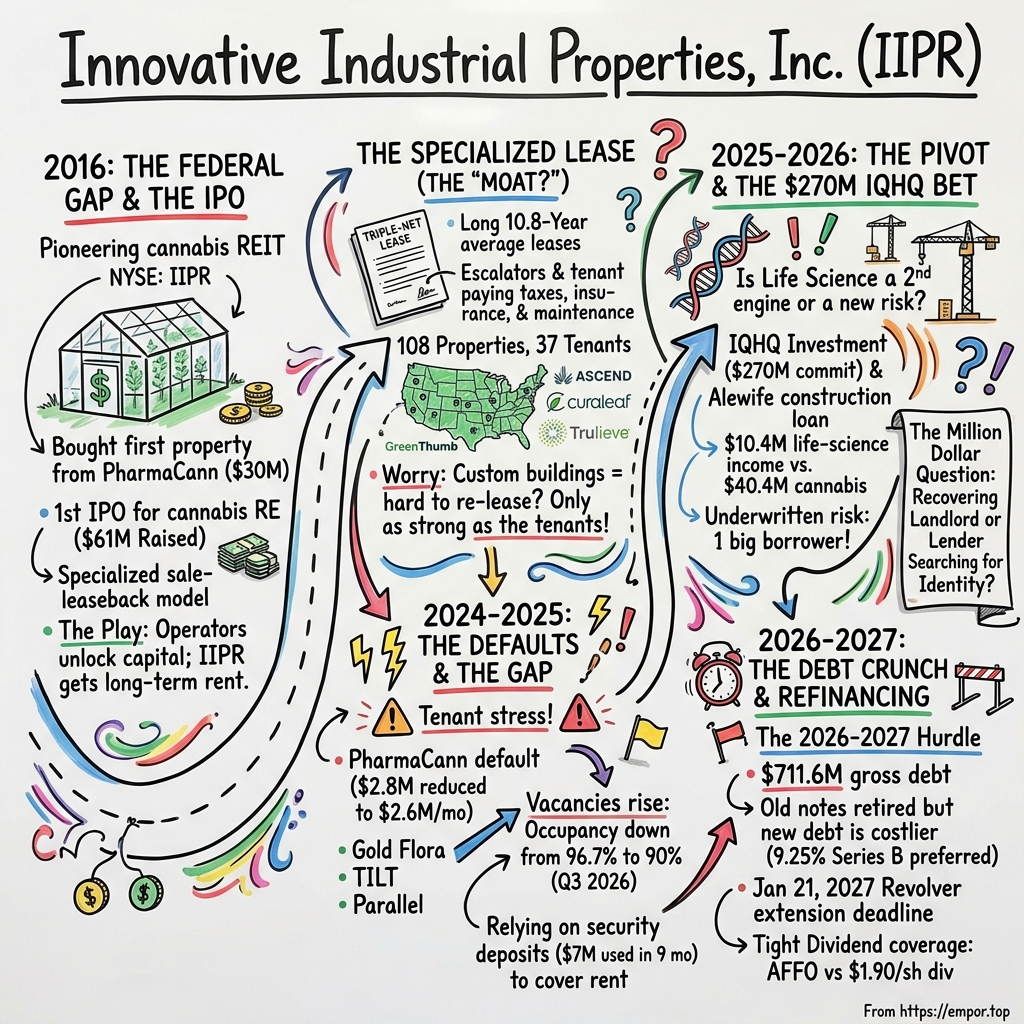
Innovative Industrial Properties: The Rent Check That Became a Loan
I. The Landlord Waiting for Its Tenants to Come Back
The question came early in the call, and it was the one everybody listening wanted answered. On November 3, 2026, Aaron Grey of Alliance Global Partners asked Innovative Industrial Properties when the buildings it had just taken back from PharmaCann, Parallel and The Cannabist Company would start paying rent again.1 Ben Regin, the company's chief investment officer, did not offer a date. He offered a range. Historically, he said, it could be "anywhere from six to 18 months between sourcing a new tenant, lease commencement, license transfer, the regulatory process."1
Six to eighteen months is a long time for a landlord to wait. It is an especially long time for a landlord whose shareholders are being paid a dividend that the market prices at almost 14% a year. And the answer landed in a strange frame, because five weeks earlier the same company had signed up to do something no cannabis landlord had done before. On September 28, 2026, IIPR committed $245 million to a mezzanine construction loan on Alewife Park, a life-science campus in Cambridge, Massachusetts, being developed by IQHQ, and funded about $111 million of it on the day it closed.12
So two timelines now run through one balance sheet. In one, a specialist landlord to state-licensed cannabis operators is changing locks, filing in insolvency courts and walking prospective tenants through license transfers. In the other, the same twenty-odd people in San Diego are underwriting a construction lender's risk on laboratory buildings 3,000 miles away. The company calls the second timeline diversification. Whether it is diversification, or simply a different way of being concentrated, is one of the threads this story follows.
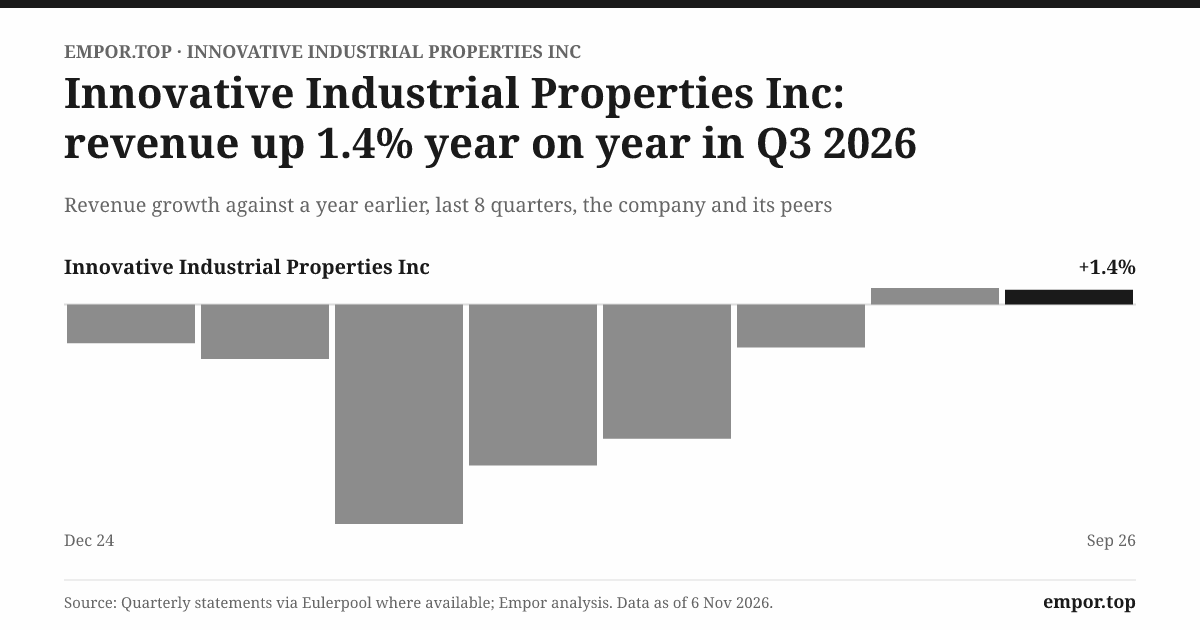
Start with what the third quarter actually showed. At the end of September, IIPR owned 108 properties in 19 states, leased to 37 tenants.2 Its operating portfolio was 90% leased, down from 96.7% at the end of 2025.34 In a single quarter the company terminated 16 leases covering about 1.2 million square feet, re-leasing three of those properties on the spot and signing leases on three others that had sat empty.2 Revenue for the quarter was $64.9 million, up only slightly from a year earlier.5
That flat line hides a messier picture. Part of the quarter's rent did not come from tenants paying their bills at all. IIPR applied $3.8 million of tenants' security deposits to rent during the quarter, and $7.0 million over the first nine months of the year.52 A security deposit is money the landlord already holds; applying it to rent keeps the income statement whole for a while, but it is a one-time cushion, not a stream. On the same call, chief financial officer David Smith told Huntington's Rob Stevenson that the deposits of four of the five defaulted tenants he had been asked about were "fully exhausted."1 The cushion, in other words, is mostly gone.
Meanwhile, the escalators built into IIPR's leases kept nudging rents higher on the buildings that were occupied, and new leases began to fill some of the vacancy. Regin said the company had signed leases on 604,000 square feet across six properties during the quarter, followed by another 270,000-square-foot lease in Pennsylvania after it ended.1 Rent escalations and new leases pushing up; vacancies, terminations and lost tenants pulling down; deposits filling the gap in between. The flat revenue line is the sum of those forces, not the absence of them.
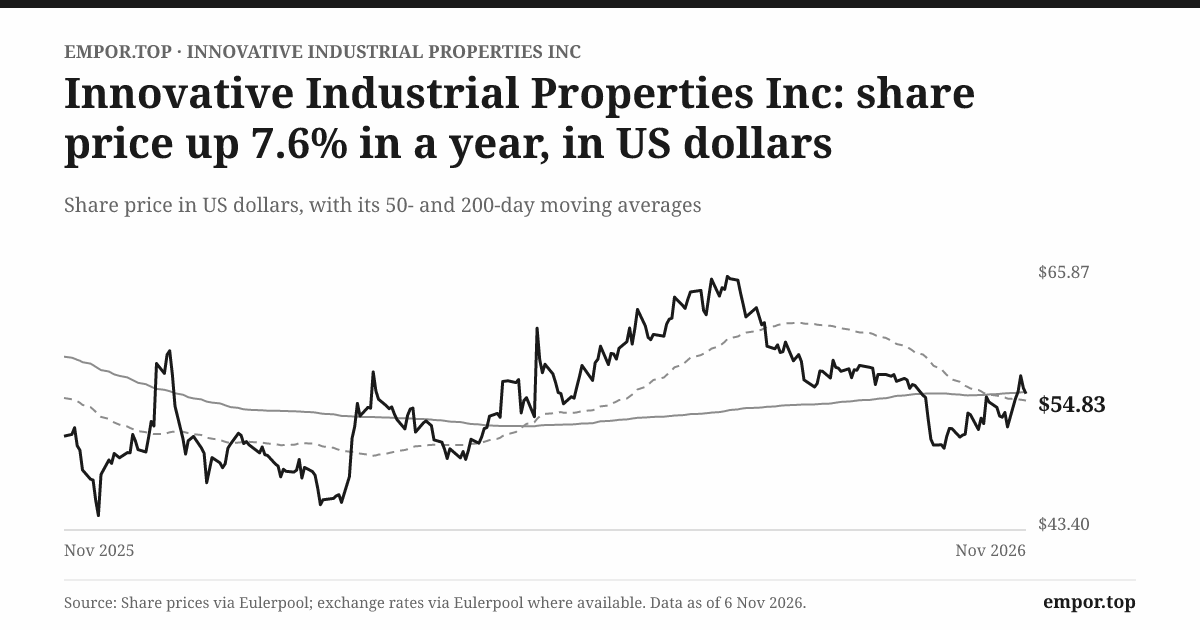
The stakes are visible in the share price. At $54.83 on November 6, 2026, IIPR was valued at about $1.5 billion, roughly 15% below its 52-week high and far below the peak it reached earlier in the decade; at the worst point of the past five years, the stock had lost about 84% of its value.6 The indicated dividend yield was 13.9%.6 A yield that high is not a gift. It is the market telling shareholders that it doubts the dividend, the rent behind it, or both.
This story asks four questions. Can IIPR re-lease the buildings its troubled tenants left behind, and collect rent on them without dipping into deposits? Does its new life-science lending diversify the business, or concentrate risk in one counterparty? Can the balance sheet and the dividend survive a transition that is now being financed at 9% and more? And do management's incentives and record give investors reason to trust its answers? To see why those questions are so sharp, it helps to go back to the moment when a federally illegal industry needed a landlord, and a veteran REIT builder decided to become one.
 Subscribe on LinkedIn
II. A Public REIT Built Around a Federal Financing Gap
In the autumn of 2016, Alan Gold was in a position most real-estate executives spend a career chasing. He had co-founded two New York Stock Exchange REITs, Alexandria Real Estate Equities and BioMed Realty Trust, and had just watched BioMed, which he ran from its 2004 IPO, sell to Blackstone for about $8 billion.78 BioMed had grown under him from 30 buildings to 196, a laboratory-landlord empire built on a simple idea: specialized tenants need specialized buildings, and they will sign long leases to keep them.7
Gold's next move surprised people who knew him only as a life-science landlord. In June 2016 he co-founded Innovative Industrial Properties with Paul Smithers, a lawyer who had spent more than two decades as managing partner of his own San Diego law firm before a short stint as co-founder and chief legal officer of an advanced-materials company.9 Gold became executive chairman; Smithers became president and chief executive.9 Gary Kreitzer, who had co-founded BioMed alongside Gold, also served on IIPR's board.7 The plan was to take the BioMed playbook into an industry no mainstream REIT would touch: medical cannabis.
The logic rested on a gap in the financial system. Cannabis was legal for medical use in a growing number of states, and those states issued a limited number of licenses to grow, process and sell it. But cannabis remained illegal under federal law, so banks were wary of lending to licensed operators, and conventional landlords were reluctant to finance their facilities. Licensed operators had plenty of demand and scarce capital. Much of what capital they did have was locked inside the greenhouses and processing plants they had built to satisfy state regulators. A landlord willing to buy those buildings and lease them back could be paid handsomely for its courage.
The public markets were less sure. IIPR's registration statement, filed in October 2016, proposed selling 8.75 million shares at about $20 each, roughly $175 million, through Ladenburg Thalmann.7 The deal stalled. By late November the company had refiled for a $100 million offering, and then again for $80 million.10 The registration became effective on November 30, 2016, and IIPR listed on the NYSE as the first cannabis-focused company on the Big Board, raising a fraction of what it had first sought.1110 For a company whose whole business would be buying real estate, starting with a sliver of the capital it wanted was a sobering beginning.
The first purchase showed the business model in miniature. Shortly after the offering, IIPR bought a 127,000-square-foot industrial property on roughly 70 acres in Montgomery, New York, from PharmaCann for about $30 million, and leased it straight back to PharmaCann.7 The tenant agreed to base rent of about $320,000 a month, escalating each year at the higher of 4% or three-quarters of inflation, plus supplemental rent of about $105,000 a month for the first five years and a property-management fee on top.7 Base rent alone came to almost 13% of the purchase price in the first year, before the supplemental payments. Few industrial landlords anywhere in America were being paid that much for a warehouse.
That is the sale-leaseback bargain, and it is worth slowing down on, because the rest of the story hangs on it. The operator gets cash today for a building it already owns and keeps operating it, as if it had taken out a mortgage that never needs refinancing. The landlord gets a long-term rent check that rises every year. And because the lease is "triple-net," the tenant also pays the property taxes, the insurance and the maintenance, so the landlord's income is close to pure rent.4 For an operator shut out of bank lending, it was one of the few ways to unlock capital. For IIPR, it was a high-yielding bond with a building attached.
The unresolved risk sat in plain sight. The rent was high because the money was scarce, not because the buildings were unusually valuable to anyone else. A premium price for capital works only as long as the tenant can earn enough to pay it. If the tenant's business falters, the landlord is left with a purpose-built facility whose most natural next user needs a state license, regulatory approval and a business plan that works in the same difficult market. Scarce financing could support attractive yields. It could not make the tenants creditworthy.
For several years, that question seemed academic. Revenue went from nothing in 2016 to about $309 million by 2023, as IIPR used equity, preferred stock and notes to buy and fund facilities across the country.4 Measured from its tiny pre-operating base in 2015, revenue compounded at almost 49% a year over the following decade, a rate that says more about how small the starting point was than about the business IIPR is today.4 The more recent record is the one that matters. Revenue was essentially flat in 2024, fell 14% in 2025 to about $265 million, and over the three years to 2025 shrank by a little over 1% a year.4
So the founding bet produced a large, listed company. The question this story keeps returning to is what kind of company it built: a landlord with a durable advantage, or a financier that profited from a gap in the capital markets for as long as that gap stayed open and its borrowers stayed solvent. To answer that, follow a single lease from the day it is signed to the day the tenant stops paying.
III. The Lease That Made a Niche Look Like a Moat
Picture a cannabis operator in Illinois or Pennsylvania with a fresh state license and a problem. To keep the license, it must build or buy a facility that meets the state's security, climate-control and tracking rules: a sealed cultivation building with heavy power and water infrastructure, vaults, cameras, and space for processing. The building may cost tens of millions of dollars. The operator has customers waiting and a limited number of licenses protecting it from competition. What it lacks is cheap money.
IIPR's answer comes in several forms. Sometimes it buys an existing facility and leases it back. Sometimes it buys a property and funds the tenant's improvements or new construction, adding the cost to the rent base. At September 30, 2026, it had about $6.2 million of such tenant-improvement commitments outstanding.2 Then the clock starts: the tenant moves in, the lease commences, rent begins, and every year the escalator lifts the payment. The leases are triple-net: tenants cover property costs, including structural repairs, and reimburse IIPR for costs it fronts.4 IIPR often collects a property-management fee as well.7
That structure explains why the company runs with almost nobody. At the end of 2025 IIPR had 23 full-time employees, overseeing a balance sheet of about $2.4 billion.4 The tenants run the buildings. IIPR underwrites, finances, documents and, when necessary, enforces.
It also explains why IIPR is not a conventional industrial REIT, even though "industrial" is in its name. An ordinary warehouse can be leased to a parcel carrier one year and a furniture distributor the next. A licensed cannabis facility is a different animal. It is mission-critical to the operator inside it, which is the bull case: a tenant does not lightly walk away from the building that houses its license. But the same specialization narrows the pool of replacement tenants. A new occupant usually needs its own license for that state, often for that location, and regulators must approve the change. Management says regulatory approval can take months.1
The portfolio's headline numbers still look sturdy. At September 30, 2026, the 107 operating properties had a weighted-average remaining lease term of 10.8 years.3 At the end of 2025, that figure was 12.8 years.4 Lease terms naturally shorten as time passes, but a two-year drop in nine months mostly reflects the long leases that were terminated when tenants failed, with shorter or newer replacements taking their place. The long contracts did not disappear because the calendar moved. They disappeared because tenants broke them.
Five tenants, half the rent
The concentration question becomes concrete when the tenants have names. In the third quarter of 2026, five operators each contributed between about 8% and 13% of rental revenue: Ascend Wellness at 13%, Curaleaf and Green Thumb at 10% each, Trulieve at 9% and Holistic Industries at 8%.2 No single tenant dominates. Together, though, those five paid about half the rent. A year earlier, IIPR's ten largest tenants accounted for 75% of the contractual rent it collected in 2025.4 The largest single property, by contrast, was only 5.8% of the real-estate portfolio, so the risk sits in the tenants, not the buildings.3
The tenant list skews toward multi-state operators, the largest and best-capitalized companies in the industry. At the end of 2024, multi-state operators accounted for about 90% of IIPR's annualized base rent and publicly listed operators for about 62%.12 That was meant to be a credit filter. As the next part of this story shows, it was an imperfect one: PharmaCann was a large multi-state operator too.
To understand the bargain from both sides, think of it as two parties who need each other for different reasons. The operators need capital and buildings that satisfy regulators, and in a market where federal illegality keeps banks cautious, they have relatively few places to get both. IIPR needs tenants that can actually pay. The company itself has listed the forces squeezing those tenants: heavy federal, state and local taxes; an illicit market that undercuts licensed sellers; falling wholesale and retail prices for cannabis; limited access to capital; and inflation in operating costs.13 When an operator is healthy, IIPR's scarce capital gives it leverage. When an operator is distressed, the leverage reverses, because the landlord's realistic alternative is a vacant, purpose-built building and a long licensing process.
IIPR is the giant of its niche. NewLake Capital Partners, the closest listed comparison, owned 34 properties leased to 11 tenants at the end of 2025, against IIPR's 108 properties and 37 tenants in September 2026.14 Scale gives IIPR more diversification across tenants and states, more relationships with operators and more data on what happens when tenants fail. It does not by itself prove better underwriting or cheaper capital, and NewLake's smaller, differently financed portfolio is a reference point rather than a yardstick.
There is one more thing scale does not tell investors: whether IIPR paid the right price for what it bought. The company grew mainly through hundreds of individual property purchases and sale-leasebacks rather than a transformative corporate acquisition, and it does not publish a consistent portfolio-wide series of acquisition yields or comparable sales prices for licensed facilities. Without that, claims that it overpaid, or bought cheaply, would be guesses. What can be measured is how the leases have held up.
Seen that way, the case for a moat narrows to something smaller and more defensible. IIPR has specialized knowledge of licensed facilities, deep relationships with operators, a diversified tenant base relative to any single operator, and long contracts with built-in escalators. Those are real advantages in a financing niche. But 90% leased occupancy and nearly eleven years of remaining lease term are measures of contracts on paper. Neither proves that rent is being collected in cash, that renewals will come at the same price, or that empty buildings can be filled quickly. Those proofs arrived only when tenants stopped paying, and the first and most instructive of them came from the very tenant that had supplied IIPR's first property.
IV. When PharmaCann Stopped Paying
In December 2024, PharmaCann missed rent on six of its leases with IIPR.12 Under the cross-default provisions in its leases, that failure pulled the remaining leases into default as well, so the problem quickly covered all eleven properties the operator rented from IIPR.12 PharmaCann was not a fringe tenant. It was the company that had sold IIPR its first building eight years earlier, and the rent at stake across those eleven leases ran to millions of dollars a month.
IIPR had a choice that every landlord to a distressed tenant eventually faces. It could enforce the contract to the letter, evict, and try to re-lease eleven specialized facilities in a weak market. Or it could negotiate, accepting less rent in exchange for keeping a tenant in the buildings. It chose something in between, and on January 30, 2025, it announced the terms.12
First, IIPR applied PharmaCann's security deposits to cover the missed rent for December and January in full, along with certain penalties.12 Second, nine leases in New York, Illinois, Pennsylvania, Ohio and Colorado were amended, cutting their combined base rent from about $2.8 million a month to about $2.6 million, with cash rent resuming on February 1, 2025, and PharmaCann required to post larger deposits.12 Third, two cultivation facilities, in Michigan and Massachusetts, were to be handed to new tenants, with PharmaCann contributing its licenses to make the transition possible; their combined base rent of about $1.3 million a month was abated in full from February.12 If those two properties had not transitioned by August 1, 2025, IIPR would regain full control and PharmaCann would walk away from them.12 In return, PharmaCann's investors put in more equity and PharmaCann issued IIPR a secured, interest-bearing note maturing in 2035, ranking behind its senior lenders.12
The fine print carried the warning. If PharmaCann could not refinance its senior secured debt, which matured on June 30, 2025, the amendments would be void, the leases would snap back to their old terms and the note would be cancelled.12 The settlement, in other words, depended on PharmaCann's other lenders cooperating within five months.
On the earnings call that February, Gold sounded like a landlord who had won. Speaking of other tenants who might falter, he said: "If they default, we will meet them with the same swiftness that we did with PharmaCann."15 Analysts were less relaxed. BTIG's Tom Catherwood pointed out that 2026 was "an outsized year for debt maturities across the cannabis industry."15 Piper Sandler's Alexander Goldfarb asked whether being a multi-state operator was still a useful credit signal after PharmaCann and an earlier default by Kings Garden.15 Smithers answered that the team was "doing deep dives into every single one of our tenants."15 In the fourth quarter of 2024, IIPR had already applied $5.7 million of deposits to rent across five tenants, $4.3 million of it from PharmaCann.1215
The defaults spread
Eight weeks later the swiftness was tested again. On March 28, 2025, IIPR declared three more tenants in default: 4Front Ventures, on four properties that made up 5.7% of contractual rent; Gold Flora, on three properties at 2.9%; and TILT Holdings, on two properties at 2.2%.13 Together they owed about $13 million in rent, fees and taxes.13 The same release declared a default on a $16.1 million loan IIPR had made to the buyer of four California properties formerly leased to Medical Investor Holdings, which meant that even assets the company had sold came back as credit risk.13
The language of that release is worth noticing. It did not lead with the word "default." It announced "a significant tenant replacement and renewal initiative," describing the company as "proactively seeking to refresh a substantial portion of its tenant base with more financially viable long-term tenants."13 There is a real point inside that framing, because a landlord stuck with a non-paying tenant is often better off taking the building back and finding a stronger one. But tenants failing to pay rent is not a strategy that a landlord chooses. It is an event that a landlord responds to.
By the first-quarter call in May 2025, the picture had darkened further. Smithers reported that Gold Flora had entered voluntary receivership in California, that TILT had made only partial payments, and that PharmaCann and 4Front had received new default notices, with IIPR pursuing evictions.16 The PharmaCann settlement announced in January had not held. Smith said the deposits of PharmaCann, 4Front and TILT were exhausted.16 Gold, asked about the path forward, said he was "confident that within a short 18- 36-month period of time, the ship will generally be righted."16
The consequences showed up in the 2025 results. Revenue fell 14% for the year, and IIPR applied $6.6 million of security deposits to rent across seven tenants.4 Then 2026 added two more names. Parallel defaulted on its leases at two large Florida properties, and IIPR took them back in August; Cannabist, which had leased 21 properties and contributed about 8% of rental revenue in 2025, entered insolvency proceedings, and IIPR repossessed seven of its properties in September.172 Regin said on the third-quarter call that the remaining vacancy amounted to a little over 800,000 square feet, about two-thirds of it in the two former Parallel buildings in Florida.1
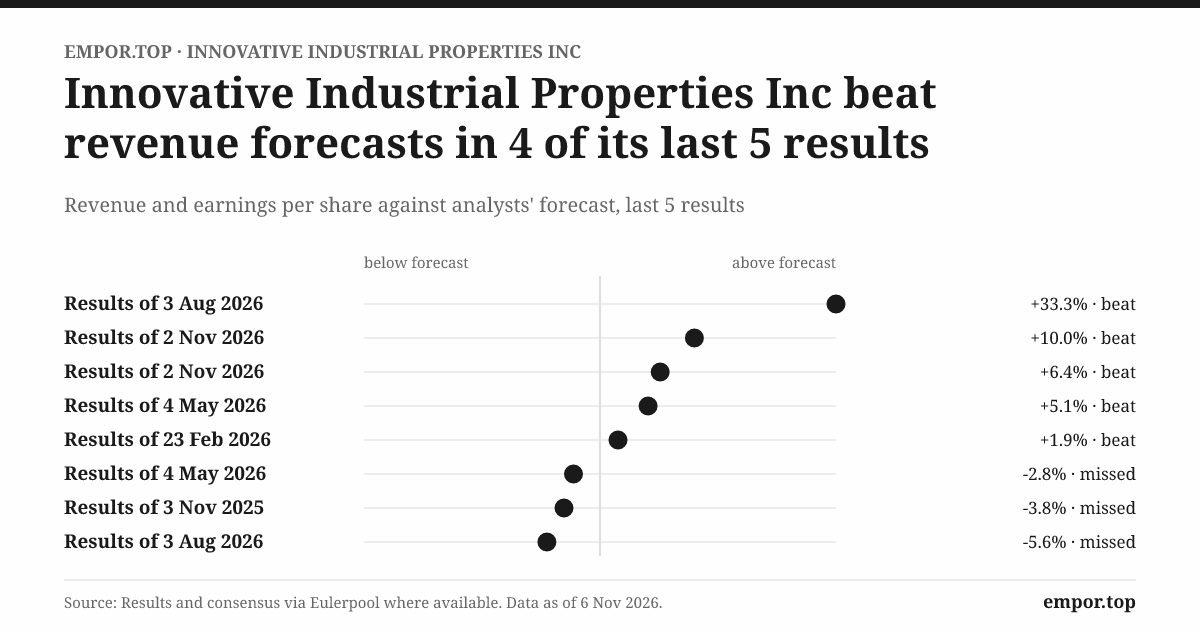
That is why the third quarter's headline needs its context. The $3.8 million of deposits applied in the quarter and the $7.0 million applied over nine months were rent recognized from cash IIPR already held, not new money from operating tenants.52 The quarter also benefited from recoveries of past-due rent from certain defaulted tenants, including 4Front, which Smith said added about 15 cents a share.1 Asked by Roth's Bill Kirk whether the quarter's earnings would stay above the dividend, Smith declined to give guidance and said several of the third-quarter benefits "will be non-recurring."1
Separating the building from the borrower
None of this means the buildings are worthless. A repossessed facility can be leased again, and IIPR has proved it. Management said year-to-date gross leasing in 2026 reached about 1.3 million square feet across 12 properties, roughly 15% of the portfolio.1 It described signed agreements on three Colorado properties, subject to license transfers, and on three former 4Front buildings, while cautioning that there could be "no assurance" those agreements would become executed leases.1 Regin put the all-in cost of re-tenanting, including commissions and improvements, at "well below $10 a foot."1 A former PharmaCann facility in New York has a new tenant.1
What the record shows is that the value of the building and the credit of the tenant are separate things, and IIPR's earlier underwriting treated them as more closely linked than they proved to be. The building retains value as long as a licensed operator wants it. The rent, the timing and the cost of getting there depend on licensing, regulatory approval, the new tenant's capital and the health of the state market.
Even a signed lease is not yet a rent check. New tenants moving into a repossessed facility typically receive an abatement period, months of free or reduced rent while they obtain their license, install equipment and begin growing, which is why Regin measured the wait from lease execution rather than from the day a tenant is found.17 On the August 2026 call, Catherwood pressed exactly this point, asking why nine re-leased properties were not yet paying rent.17 And between eviction and a new lease, the landlord does not simply lock the doors. When IIPR takes possession of a licensed facility, it has used management services agreements to keep the operation running under the existing license while a successor is found, Smithers explained in May 2025.16 That keeps the license alive and the building productive, but it also means IIPR, a company with a couple of dozen employees, is temporarily responsible for overseeing cannabis operations it never intended to run.
The accounting reflects the same uncertainty. Where collection is doubtful, IIPR recognizes rent on a cash basis, booking revenue only as money actually arrives, rather than on the straight-line schedule a landlord would normally use.4 That is the conservative choice, and it means reported revenue tracks cash more closely than at many REITs. It also means that recoveries of past-due rent, and deposits applied to rent, flow straight into the quarter in which they occur, making individual quarters lumpier and harder to read as a trend.
Compare what management said with what followed. In February 2025, the message was swift enforcement and deep diligence. In May 2025, it was a ship righted within 18 to 36 months. In August 2026, Regin described "9- 12+ months from lease execution to get through abatement periods and licensing."17 By November 2026, the range was six to 18 months from sourcing a tenant to commencement.1 The time estimates were candid and, to their credit, specific. But each call opened with a longer list of troubled tenants than the last, and occupancy fell from 96.7% to 90% in the nine months after the company's year-end report.43 The record does not reject the claim that IIPR can re-lease its buildings; it has re-leased many. It does reject the claim that long leases with multi-state operators protect the rent. The forward test is narrower and harder: quarters in which cash rent from paying tenants rises without help from deposits.
While that work went on, IIPR's leaders were building a second source of income that had nothing to do with cannabis, and drawing on Gold's past to do it.
V. The $270 Million Bet on IQHQ
On August 6, 2025, while its cannabis tenants were still filing for receivership and fighting evictions, IIPR announced what Gold called "our first expansion outside of cannabis with this highly accretive transaction."8 The partner was IQHQ, a privately held life-science real-estate company founded in 2019 that described itself as having more than $5 billion in total assets.8 The commitment was up to $270 million.8
It was not a property purchase. IIPR agreed to provide a $100 million credit facility to IQHQ, funded up front, with a three-year term and a one-year extension option, and to buy up to $170 million of IQHQ preferred stock in tranches through mid-2027, along with warrants tied to funding milestones.8 The blended return, the company said, would exceed 14% a year.8 Gold added that the deal paired "strong current income" with the potential to buy life-science buildings from IQHQ directly in the future.8
The terms in IIPR's filings make the structure clear. The credit facility carries a fixed 13.5% rate, of which 12% is paid in cash and 1.5% is "paid in kind," meaning it is added to the amount IQHQ owes rather than paid out.2 The preferred stock, which grew to $200 million after IIPR bought a further $30 million in September 2026, carries a 15% dividend: 10% in cash and 5% paid in kind, with the in-kind portion stepping up at the fourth and fifth anniversaries.21 Paid-in-kind income is like a borrower who pays part of the interest with an IOU. It counts as income for accounting purposes, but it does not arrive as cash until the borrower eventually repays, and a REIT pays its dividends in cash.
Then came the second act. On September 28, 2026, IIPR committed $245 million as part of a lending syndicate to a mezzanine construction loan on Alewife Park, an IQHQ campus in Cambridge.21 A mezzanine loan sits behind the senior construction lender: it gets paid after the senior debt but ahead of the owner's equity, which is why it earns more. The loan pays the greater of 14% or one-month SOFR plus nine percentage points, with an expected yield of about 15.8% including fees, and matures in February 2028, with a one-year extension.21 About $111 million was funded at closing; the remaining $134 million is expected to be drawn through the end of 2027.12 According to management, the 27-acre campus has three buildings totaling 392,000 square feet, 78% leased to Lila Sciences, plus two pad-ready sites for as much as 364,000 square feet more, and about $800 million had been invested before IIPR arrived.1
By the end of September, life-science investments on IIPR's balance sheet had grown to about $417 million, from about $153 million at the end of 2025.2 Counting the full Alewife commitment, total life-science commitments reached about $545 million, and Gold said that, once fully funded, life science would make up about 26% of the company's annualized income.13
What the second engine actually earns
The income is already material. In the third quarter, IQHQ-related interest and dividends came to $10.4 million, out of $14.3 million of total interest and other income.12 The cannabis segment reported $40.4 million of segment net income in the same quarter.2 Those are segment results built on different accounting, so they are not like-for-like margins, but they show the scale: for every four dollars the cannabis business produced at the segment level, the IQHQ book produced roughly one. And Alewife contributed only "a few days of benefit" to the quarter, Smith said, so its effect will be larger from the fourth quarter.1
That contribution is real. It is also lending and preferred equity to one counterparty, not a portfolio of stabilized buildings leased to many tenants. The diversification claim deserves the same test the cannabis leases received: what happens if the borrower struggles?
There, the commercial record at IQHQ is mixed. In early 2025, local coverage described IQHQ's RaDD project, a large waterfront research campus in downtown San Diego, as "still betting" on a downtown life-sciences hub after a sharp downturn in demand for lab space.18 IQHQ did not announce its first life-science tenant there, the J. Craig Venter Institute, until May 2025.19 On the August 2026 call, Regin pointed to a 128,000-square-foot lease to AdvanCell as evidence of progress.17 In November, Gold said IQHQ was benefiting from a recovery in life sciences.1 Those are signs of leasing progress, not proof of value. A 14% to 15% coupon in a world where senior real-estate loans pay far less is not evidence that the collateral is strong. It is the price IQHQ pays because its lenders are taking construction, leasing and refinancing risk.
The Q&A on the third-quarter call made the concentration explicit. Stevenson asked about a further $155 million piece of the Alewife loan. Gold first said IIPR would not acquire it, then clarified that the company has an option, "as part of our agreement," to buy that portion from another lender on the same terms, and called it "a very accretive transaction should it occur," depending on available capital.1 The loan documents allow the facility to grow to $400 million.2 Stevenson calculated that IIPR could be asked to fund as much as $289 million more, and Gold said the board "would certainly consider" further IQHQ opportunities.1 When Catherwood asked why IIPR had added the extra $30 million of preferred stock, Gold called it "an opportunity that we had that we took advantage of."1 No exposure limit for IQHQ was stated.1 Grey heard that IIPR was "exploring" life-science deals beyond IQHQ.1
Gold's other chair
One more fact belongs beside the investment. From December 2018 to December 2024, Alan Gold was IQHQ's executive chairman.9 IIPR announced its IQHQ investment eight months after he left that role. The 2026 proxy credits Gold's "relationships with contacts in the life sciences industry" with leading to the deal, and says the investment was "expected to be highly accretive."9 IIPR reports IQHQ as an investment and lending relationship, not a related-party transaction, and its proxy's related-party section describes only an arrangement involving a private airplane owned by an entity Gold controls.92 The proxy does not describe how the board evaluated Gold's prior role when it approved the IQHQ commitments.9
That does not make the investment unsound. A chairman's knowledge of a counterparty can be an advantage, and the coupons are high. But it changes the question shareholders should ask. Diversification counts when the new risk is genuinely different from the old one. A single private borrower, closely tied to the executive chairman's past, financing construction in a sector recovering from a slump, is different from cannabis. It is not obviously less concentrated. The IQHQ book is financially significant now; its success will be settled only by cash interest received, construction completed, buildings leased and principal repaid.
Paying for that second engine, while repairing the first, required money. And the money had become much more expensive.
VI. The Maturity That Moved the Problem Forward
For most of its life, IIPR's debt was almost an afterthought. At the end of 2024, its only borrowing was $300 million of fixed-rate unsecured notes due in May 2026, and debt amounted to about 11% of gross assets.1215 An independent agency, Egan-Jones, had rated the company BBB+ in 2023, when its operating cash covered debt service many times over.20 That rating predates the defaults and the refinancing, and it is stale.
Then the defaults ate into cash flow just as the maturity drew near. IIPR's 2025 annual report, filed in February 2026, contained a sentence that no REIT wants its shareholders to read: there was substantial doubt about the company's ability to continue as a going concern, because the $291.2 million of notes still outstanding, due in May 2026, could not then be repaid from available liquidity.4 The company had bought back some of the notes at a discount in early 2025, shaving the balance from $300 million.16 But it needed new money, and it needed it within months.
What followed was a burst of financial engineering. Over the spring, IIPR closed about $150 million of secured term loans across five transactions, at rates ranging from about 6.7% to 9%.172 In June it sold $402.5 million of exchangeable notes due in 2029, priced at a 6% coupon with an effective interest rate of about 7.5% after costs, which holders can exchange into shares at about $69.39.217 It drew its revolving credit lines. It sold $44 million of new common stock and $81 million of Series A preferred stock through at-the-market programs.2 And the May notes were repaid in full at maturity.217
So the going-concern problem was solved. But look at what replaced it. At September 30, 2026, gross debt stood at $711.6 million, more than double the $300 million of a little under two years earlier: $402.5 million of exchangeable notes, $121.6 million of term loans and $187.5 million drawn on revolving facilities.2 The main revolver, $87.5 million and fully drawn, was charging 9% at quarter-end, and on October 21 it was extended by only 90 days, from October 23, 2026 to January 21, 2027.21 It carries a minimum debt-service-coverage covenant of 2.0 times, which IIPR met at September 30.2 Smith said the extension gave "additional flexibility to continue to evaluate our financing alternatives."1 That is another way of saying the permanent answer has not yet been found.
Then, in October, IIPR sold about 2.2 million shares of Series B preferred stock at $25 each, raising about $54 million gross, with a 9.25% coupon.12 Gold said the proceeds would fund "all or a portion" of the remaining Alewife commitment.1 There is a straightforward arithmetic case for that trade: borrowing at about 9% to lend at about 14% to 16% leaves a spread. But preferred stock ranks ahead of common stock, has no maturity date, and carries dividends that must be paid whether or not the loan it funds performs.
Buying back stock with expensive money
One part of the sequence will strike a skeptical investor as odd. In the first nine months of 2026, IIPR repurchased 1.47 million of its own common shares for $89 million, while it was selling common stock and preferred stock through its at-the-market programs and borrowing at high rates.2 None of the buybacks occurred in the third quarter, and a new $100 million authorization runs to March 2027.2 With the stock trading below book value, management can argue that buying shares at a discount adds value for remaining holders. But a company that has just escaped a going-concern warning, is paying 9% on its revolver and has issued preferred stock at 9.25% is effectively financing part of its buybacks with expensive capital. Whether that was clever or reckless depends on whether the discount to book proves to be a mispricing or a correct warning about asset values.
None of this means IIPR is heavily indebted by REIT standards. Net debt was about 2.1 times adjusted EBITDA at quarter-end and about 19% of gross assets, still a modest load compared with many property companies.1 The problem is not the quantity of debt. It is the cost, the short fuse on the revolver, the growing layer of preferred stock, and the fact that the company is spending on new investments while its core rent base is still shrinking.
The exchangeable notes add a quieter second deadline. Holders can swap them for shares at about $69.39, well above the November share price.2 If the stock recovers past that level, the notes turn into new shares and dilute existing holders; if it does not, IIPR must repay $402.5 million in cash in June 2029.2 That falls just over a year after the Alewife loan's initial maturity in February 2028, so the company's lending book and its own largest debt obligation come due in roughly the same window.2 The refinancing problem of 2026 was solved by pushing a bigger one into the back half of the decade.
It is also worth noticing that IIPR became a lender well before IQHQ. When it sold properties, it sometimes financed the buyer. The note from the purchaser of four former Medical Investor Holdings properties in California, $16.1 million, went into default in March 2025.13 In May 2026 IIPR sold another property and took back $49 million of seller financing, which was repaid in full on October 2, after the quarter ended.2 It also holds a $22.8 million construction loan, carried with no allowance for credit losses at September 30.2 In all, loans receivable stood at about $72 million at quarter-end, alongside the life-science investments.2 Some of these loans have worked well, and the $49 million repayment returned useful cash just as the revolver deadline approached. But together they show a company whose balance sheet increasingly earns money by extending credit, not just by collecting rent, and whose credit judgments now matter in more than one place.
Does the dividend fit?
The dividend is where these threads meet, and it can be measured several ways that tell different stories. In 2025, IIPR's cash from operations was about $198 million, while it paid about $216 million in dividends.4 Against GAAP net income, the payout was about 190%.4 GAAP earnings understate a REIT's cash generation because they deduct depreciation on buildings, which costs no cash in the year it is recorded; in 2025 IIPR added back about $74 million of depreciation and amortization.4 So the industry uses adjusted funds from operations, or AFFO, which strips out such non-cash items.
On that measure, 2025 AFFO was $7.24 a share, down from $8.98 in 2024, while the dividend ran at $1.90 a quarter, or $7.60 a year.912 The payout was about 106% of AFFO for the year.9 In the third quarter of 2026, AFFO was $1.96 a share against the $1.90 dividend, a payout of 97%.13 That is better, but there is almost no room left. And about 15 cents of the $1.96 came from recovered past-due rent that Smith said would not recur, while deposits applied to rent helped too.1 Strip out the recoveries and the quarter's AFFO falls below the dividend. Add in a full quarter of interest on the Alewife loan, roughly 14% on about $111 million, which works out to something on the order of 14 cents a share, and the gap closes again. The arithmetic shows how fine the margin has become: the dividend now depends on a construction loan's interest replacing one-time collections from failed tenants.
The longer history explains why cash from operations is not the same as free capital. From 2015 through 2025, IIPR's cumulative operating cash flow ran well ahead of its cumulative net income, largely because of those depreciation add-backs.4 But almost all of it went out again, in dividends of about $1.1 billion, property acquisitions and, lately, life-science investments, with equity and debt raised to fill the gap during the growth years.4 That model works when capital is cheap and tenants pay. When capital costs 9% and tenants are failing, every dollar of dividend, debt service and new loan competes for the same thinner stream.
The next two tests are concrete. By January 21, 2027, IIPR needs a durable refinancing of its main revolver, ideally with disclosed leverage and coverage. And over the coming quarters, it needs to show that it can maintain the dividend without another round of high-cost capital. Both tests fall to the same small team that built the company, and that team's own record has become part of the investment case.
VII. Smithers and Gold: The Case for Continuity, the Test of Stewardship
The 2026 proxy statement, filed in April, read in places like a document from two different companies. Its letter to shareholders spoke of capital "deployed" in "a strategic and accretive manner."9 Its compensation tables showed executive chairman Alan Gold receiving about $6.55 million for 2025 and chief executive Paul Smithers about $4.72 million, in a year when revenue fell 14% and AFFO per share fell by about a fifth.94 Both men's base salaries rose 5%.9 And when shareholders voted on executive pay at the June annual meeting, about 10.7 million votes were cast in favor and about 6.0 million against.9
The people at the top have been there from the start. Gold has chaired IIPR since co-founding it in 2016.9 Smithers has run it as chief executive since then; his legal background fits a company whose recent work has involved nine courtroom wins against tenants, a figure the compensation committee cited in his favor.9 David Smith, chief financial officer since March 2023, came from senior finance roles at REITs and Fortress.9 The board had five directors in 2026, three of them independent, with every committee chaired by an independent director; Gary Kreitzer, Gold's longtime co-founder, retired from the board at the 2026 meeting.9 Insiders as a group owned about 2.3% of the stock, including Gold's 1.4%; index-fund giants BlackRock and Vanguard each reported stakes above 15%, though those figures come from filings on different dates.9
Continuity has value in a business built on relationships with operators and regulators. It also concentrates accountability. The same people who underwrote PharmaCann, Parallel and Cannabist are now underwriting IQHQ.
What the pay plan rewards
The compensation plan reveals what the board chose to reward. Half of each executive's 2025 annual cash bonus depended on three formulaic goals, weighted equally.9 The first was AFFO per share: the target was $8.18 and the threshold $7.36, and the actual result of $7.24 missed the threshold entirely, earning nothing.9 The second was the AFFO payout ratio, targeted at 93%; the actual 105.8% also earned nothing.9 The third was investments, with a $75 million target; IIPR invested $275 million, earning the maximum 150% payout on that component, "driven primarily by our investment in IQHQ, which was not anticipated at the time the goals were established."9 The other half rested on individual performance, where the committee judged that both Gold's and Smithers's performance "exceeded" their objectives and paid 105% of target.9 The result was an overall bonus of 78% of target.9
Read that plainly. On the two measures that track what shareholders receive, cash earnings per share and dividend coverage, the executives earned zero. On the measure that tracks how much money they put to work, they earned the maximum, and the deal that delivered it was the IQHQ investment, which Gold's relationships produced, with a company he had chaired until eight months earlier.9 Long-term awards granted in 2025 were restricted stock that vests over time, with no performance conditions.9 Earlier performance shares tied to relative shareholder return in 2021 and 2022 failed to reach their thresholds and were forfeited.9 The plan does not include occupancy, cash rent collection or re-leasing among its metrics.9
The say-on-pay vote put that design in context. Support averaged more than 93% from 2020 through 2023, fell to about 73% in 2024 and 74% in 2025, and dropped to roughly 64% in 2026.9 The proposal passed every time. But more than a third of the votes cast this year opposed it, a sizable minority for a company whose shares are largely held by index funds.
There is also a legal overhang that has been removed. A securities class action filed in 2022 against IIPR and certain officers was dismissed with prejudice in 2024, and an appeals court affirmed the dismissal in October 2025.4 That episode is closed.
The capital-allocation ledger
What remains is the ledger, and it should be read as one account rather than a series of separate decisions. On one side: a company built from a single $30 million building to more than a hundred properties, a dividend raised every year from 2016 through 2024, a capital base with modest leverage, and a quick, specific response to tenant defaults.12 On the other: a tenant book that proved far less durable than its lease terms implied, a dividend maintained at $1.90 a quarter through two years of falling earnings, buybacks partly coinciding with expensive preferred and debt issuance, a going-concern warning, and a pivot into a single-counterparty life-science loan book that the bonus plan rewarded handsomely.
The calls tell a similar story. Before the PharmaCann default, management emphasized the strength of multi-state tenants. After it, the language was swift enforcement. After the 2025 decline, it was 18 to 36 months to right the ship. Around IQHQ, it was "highly accretive." Around the 2026 refinancing, it was flexibility. Each phrase was defensible on the day. Taken together, they show a team that is consistently confident in prepared remarks and more tentative in Q&A, where the six-to-18-month leasing window, the unquantified IQHQ exposure and the refusal to guide on dividend coverage all surfaced. The record supports continuity and competence in enforcement. It does not yet support the larger claim, implicit in the IQHQ pivot, that this team has earned a free hand to redirect capital.
With the people, the balance sheet and the tenants all on the table, the question becomes what the market is paying for, and whether the price leaves room for things to go wrong.
VIII. Analysis & Bear vs. Bull Case
Put three numbers side by side. The stock at $54.83. The dividend at $1.90 a quarter, a 13.9% yield. And January 21, 2027, the date by which the main revolver must be refinanced or extended again.62 Everything else in the investment case is a way of connecting those three.
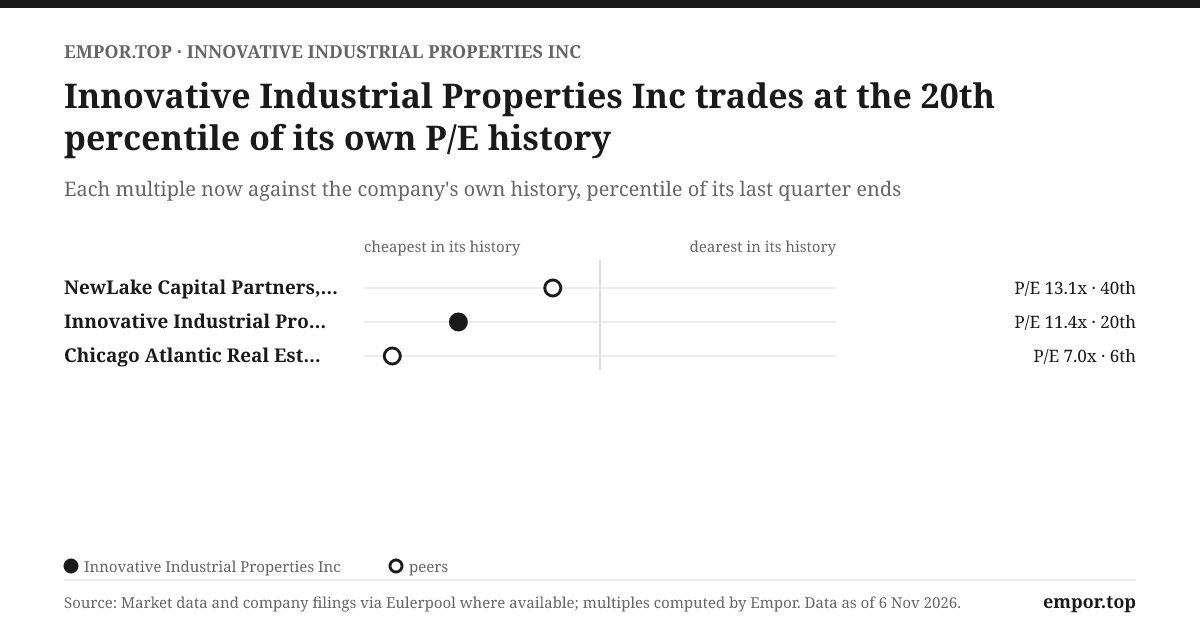
By conventional yardsticks, IIPR looks cheap. It traded at about 11.4 times trailing earnings in early November 2026, against a five-year median of about 13.2 times; at about 0.8 times book value; and at about 8.4 times EV to EBITDA.6 NewLake, the smaller cannabis landlord, traded at roughly 12.9 times earnings, 0.73 times book and 7.1 times EV to EBITDA at about the same time.21 So the two listed cannabis landlords trade at similar, depressed multiples. The market is not singling out IIPR so much as pricing the whole niche as distressed.
Those multiples need care. Price-to-earnings is a blunt tool for a REIT, because GAAP earnings deduct building depreciation that may not reflect any real loss of value. Book value is the depreciated cost of buildings, which is useful only if those buildings could be sold or re-leased near that value. A price below book says the market doubts that, at least for a portion of the portfolio. And peer comparisons mislead if the companies' scale, leverage and tenant quality differ, which they do. A cheaper multiple than its own history tells investors IIPR's earnings are now regarded as riskier than they were. It does not tell them whether that judgment is right.
The bull case
The optimistic reading starts with scarcity. Management said in November that the Drug Enforcement Administration had completed its hearing on moving marijuana to a less restrictive schedule, though the process remains subject to further administrative review, and that Florida approved 22 additional medical licenses.1 New licenses in a state create new tenants for empty buildings. IIPR's leases still average more than a decade remaining, with escalators that lift rent on occupied buildings.3 Re-leasing has been real, at a reported cost well below $10 a square foot, and third-quarter activity was described by analysts on the call as a record.1
The bull also points to the balance sheet's spare capacity. Leverage of about two times EBITDA leaves room to absorb setbacks, and IQHQ already produces about a fifth of the company's segment-level earnings at high yields.12 If the Florida and Cannabist buildings fill, cash rent stops leaning on deposits and the revolver is refinanced on workable terms, the market's 14% yield could look, in hindsight, like an overreaction.
The bear case
The pessimistic reading starts from the same facts and sees fragility. Occupancy has fallen sharply.43 Tenant concentration remains high, and two years of defaults have shown that multi-state operators are not immune to the economics of falling cannabis prices, heavy taxes and an illicit market.213 Deposits that propped up reported rent are largely exhausted.1 Re-leasing takes time, and some pending deals depend on license transfers that regulators have not yet approved.1 Meanwhile, the company's growth engine is now concentrated in a single private borrower, part of whose return arrives as IOUs, while the money to fund it costs 9% or more.2 If AFFO slips below the dividend for long, the yield is not a return but a forecast of a cut.
The forces on the bargain
Walk through the competitive forces and the picture sharpens. Tenants are IIPR's buyers, and their power varies with their health: when an operator has many funding options, it can negotiate rent; when it is distressed, it has less to offer and more incentive to default, which turns the landlord's apparent leverage into recovery risk. The threat of substitutes is the federal-policy question. If rescheduling or banking reform lets operators borrow from ordinary lenders, sale-leasebacks at double-digit yields lose their monopoly on desperate capital, and IIPR's pricing would compress. Rivalry is limited among listed players, since NewLake is much smaller, but private lenders and family offices compete for deals. Supplier power is small, because tenants bear operating costs. New entrants are deterred mainly by federal illegality itself, which means the barrier that protects IIPR is the same barrier its tenants hope will fall.
Hamilton Helmer's seven powers offer a stricter test, and IIPR passes fewer of them than its scale suggests. There are no network effects: one more tenant does not make the platform more valuable to the others. Switching costs exist in a narrow sense, because an operator cannot easily move its license and plant, but the past two years showed that a distressed tenant's real alternative is default, not moving. IIPR has no cornered resource; it does not own the licenses, and the buildings can be replicated. Scale has not delivered a demonstrated cost-of-capital advantage, as 9% revolver rates attest. The most defensible power is a process advantage: years of experience underwriting licensed facilities, navigating state regulators and re-tenanting distressed property. That is valuable, but it is a skill set rather than a barrier, and its proof is occupancy and cash collection, not lease terms.
So the verdict on the moat is a narrowed one. IIPR occupies a real financing niche, created by federal policy and defended by specialized knowledge. The record of 2024 to 2026 rejects the stronger claim that long leases and big tenants made its cash flows dependable. The margin of safety the low multiples appear to offer is thinner than it looks, because tenant losses and the rising cost of capital eat into exactly the cash that would make the multiple cheap.
Imagine a skeptical investor with a large position and a seat at the table. The first demand would be a number: a disclosed ceiling on exposure to IQHQ, together with regular disclosure of how the borrower and the Alewife project are performing, since IIPR's shareholders now carry that credit without seeing its accounts. The second would be a rewrite of the bonus plan, swapping a target for dollars invested, the only formulaic goal executives hit in 2025, for cash rent collected, occupancy and AFFO per share, the measures that set the dividend.9 The third would be a clear rule for buybacks, explaining why repurchasing common stock makes sense in the same year the company issues preferred stock above 9%, or stopping until the revolver is refinanced.21 The fourth would be a standing quarterly figure for cash rent received from tenants, excluding deposits and one-time recoveries, so that investors no longer have to reconstruct it from footnotes. None of those demands requires a change of strategy. Each would make it easier to tell whether the strategy is working.
The skeptic would also press on a quieter trade-off. Every dollar committed to Alewife is a dollar not available to re-tenant cannabis buildings, repay the 9% revolver or support the dividend. Management argues that the loan's yield more than pays for itself.1 The counterargument is that IIPR is adding a new, concentrated credit risk at the very moment its existing credit risks are proving costlier than expected, and that the safest accretive use of capital for a company in this position may simply be reducing expensive debt.
Three measures will tell investors which story is winning. The first is the operating portfolio's leased percentage, which has fallen sharply.34 The second is cash rent collected from tenants, excluding security-deposit applications.51 The third is AFFO per share after interest and preferred dividends, which recently covered the dividend only narrowly and was flattered by one-time recoveries.1 If all three improve together, the recovery is real. If leasing improves while cash collection and AFFO do not, the gains are on paper.
What does all this teach beyond one REIT's next quarter? The lessons are sharper than the usual warnings about high yields, because they come from a specific building and a specific tenant.
IX. Playbook: Business & Investing Lessons
Go back to Montgomery, New York, in late 2016. A newly listed company with a fraction of its planned capital pays $30 million for a 127,000-square-foot facility and hands the keys straight back to the seller, PharmaCann, in exchange for rent that would have made any industrial landlord envious.7 Eight years later, PharmaCann stopped paying. A settlement collapsed within months, deposits were burned, rents were cut, and by August 2026 the Montgomery property was, in Regin's words, "still something we're working through."17 The company's first deal became the case study for everything that followed.
The first lesson is about what scarcity buys. IIPR earned premium rents because it was willing to finance an industry that banks avoided. That was a genuine opportunity, and it built a billion-dollar company. But the premium was payment for taking tenant risk, not a sign that the risk was low. A scarce lender can earn a premium; it cannot lend its way into a tenant's profits. When cannabis prices fell and taxes and illicit competition squeezed operators, the rent that looked like a moat became the cost that broke them. For founders and investors in any capital-starved industry, the lesson is that the price of scarce money measures the borrower's desperation as much as the lender's edge.
The second lesson is about contracts. On paper, IIPR's tenants owed it rent for well over a decade, with annual increases. In practice, PharmaCann renegotiated within weeks of defaulting, and the replacement deals took six to 18 months to produce rent.1 A long lease is a promise with a property attached, not a guarantee of cash. The property part of that promise did hold up, which is why IIPR could re-lease buildings at all. The promise part depended entirely on the tenant's solvency. Investors who value a REIT by its weighted-average lease term are counting promises; the more useful count is cash collected.
The third lesson is about diversification. IIPR's answer to cannabis concentration was a high-yielding position in IQHQ that, once fully funded, management expects to provide about a quarter of income.1 That reduces dependence on cannabis operators. It increases dependence on one private borrower, in one sector, financing construction, with a portion of its return paid in kind, chaired until recently by IIPR's own executive chairman.29 Diversification counts only when the new risk is different, smaller and independently judged. Swapping thirty-seven cannabis tenants' risk for a growing slice of one life-science developer's risk is a change of exposure, and investors should name it as such.
The fourth lesson is about the dividend. A 13.9% yield attracts attention, and IIPR has paid it faithfully. But the dividend exceeded GAAP earnings by almost two to one in 2025, exceeded AFFO that year, and was covered in the third quarter of 2026 only with help from recoveries that management said would not recur.491 At the same time, the company raised preferred stock at 9.25% and borrowed at 9%. A dividend yield is a question before it is a reward. The question here is whether rent and loan interest can cover it after the expensive new capital takes its share first.
Underneath all four is the deeper lesson this company teaches. IIPR proved that specialized capital can build a public company quickly. It also proved that owning the building does not make the business inside it solvent. Its future rests on the discipline of its underwriting and the cost of its capital, the two things scarcity once allowed it to treat lightly.
X. Epilogue
Tonight, IIPR is a company with two clocks running. The first is a calendar. The main revolver, $87.5 million at 9%, comes due on January 21, 2027, after a 90-day extension that management described as room to "evaluate our financing alternatives."21 Before then, investors will want to see a lasting refinancing, with its rate, its covenants and the company's leverage and coverage disclosed. A refinancing at a lower rate and a longer term would remove the most immediate pressure. A second short extension, or a deal that depends on another round of high-coupon preferred stock, would suggest that the capital markets are still charging IIPR as a distressed borrower.
The second clock is the slower one of leases and licenses. About 800,000 square feet of the portfolio sits vacant, roughly two-thirds of it in the two Florida buildings Parallel left behind.1 Pending agreements on three Colorado properties await license transfers; agreements on three former 4Front properties await execution.1 The Cannabist insolvency is not finished, and some of its deposits remain to be applied.1 Each signed lease will start a new six-to-18-month clock toward rent. The next quarterly results will show whether the leased percentage climbs from 90%, and whether rent collected in cash rises as deposit applications fall toward zero.
The third front is IQHQ. About $134 million of the Alewife loan remains to be funded through the end of 2027, and IIPR holds an option to buy a further $155 million on the same terms.21 The markers to watch are straightforward: draws on the loan, cash interest actually received rather than accrued, construction progress and leasing at Alewife, and whether IIPR sets a disclosed limit on how large this single exposure is allowed to become.
What would change the story? Sustained cash collections, a rising lease rate and a cheaper, longer refinancing would support the view that the defaults were a painful cycle and the core is stabilizing. More defaults, rent that keeps leaning on deposits, or another expensive capital raise to fund both the dividend and the IQHQ commitments would point the other way. Federal rescheduling, if it ever completes, would help tenants' finances but could also invite cheaper lenders into IIPR's niche, so even good news for cannabis carries a double edge for its landlord.
One question the filings leave genuinely open is whether life-science income can keep growing without concentrating too much of the company's capital in one borrower. The answer will be found not in a press release about accretion, but in the next few years of interest checks from IQHQ.
XI. Outro
Ten years after its first purchase in Montgomery, IIPR is still working through tenant defaults while carrying debt and laboratory investments.72
It is still a landlord. It is now also a lender. And for both identities, the test is the same piece of paper arriving every month: the rent check, or the interest check, paid in cash by someone whose business is strong enough to pay it. IIPR owns the buildings; its story still depends on who can afford to stay in them.
References
-
Innovative Industrial Properties Q3 2026 Earnings Call Transcript — Stock Analysis, 2026-11-03 ↩↩↩↩↩↩↩↩↩↩↩↩↩↩↩↩↩↩↩↩↩↩↩↩↩↩↩↩↩↩↩↩↩↩↩↩↩↩↩↩↩↩↩↩↩↩↩↩↩↩↩↩
-
Q3 2026 Form 10-Q — Innovative Industrial Properties, 2026-11-03 ↩↩↩↩↩↩↩↩↩↩↩↩↩↩↩↩↩↩↩↩↩↩↩↩↩↩↩↩↩↩↩↩↩↩↩↩↩↩↩↩↩↩↩
-
Q3 2026 Supplemental Financial Information — Innovative Industrial Properties, 2026-11-02 ↩↩↩↩↩↩↩↩↩
-
2025 Form 10-K — Innovative Industrial Properties, 2026-02-24 ↩↩↩↩↩↩↩↩↩↩↩↩↩↩↩↩↩↩↩↩↩↩↩
-
Innovative Industrial Properties Reports Third Quarter 2026 Results — Innovative Industrial Properties, 2026-11-02 ↩↩↩↩
-
Form S-11 Registration Statement — Innovative Industrial Properties, 2016-10-17 ↩↩↩↩↩↩↩↩↩
-
Innovative Industrial Properties Announces Strategic and Diversifying $270 Million Investment in Life Science Real Estate Platform — Innovative Industrial Properties, 2025-08-06 ↩↩↩↩↩↩↩
-
2026 Proxy Statement — Innovative Industrial Properties, 2026-04-22 ↩↩↩↩↩↩↩↩↩↩↩↩↩↩↩↩↩↩↩↩↩↩↩↩↩↩↩↩↩↩↩
-
Investors Hoping to Ride High on Trailblazing Marijuana Company — TIME, 2016-11-30 ↩↩
-
Notice of Effectiveness, Form S-11 — U.S. Securities and Exchange Commission, 2016-11-30 ↩
-
Innovative Industrial Properties Reports Fourth Quarter and Full-Year 2024 Results — Innovative Industrial Properties, 2025-02-19 ↩↩↩↩↩↩↩↩↩↩↩↩↩↩
-
Innovative Industrial Properties Reports Defaults by Tenants — Innovative Industrial Properties, 2025-03-28 ↩↩↩↩↩↩↩
-
NewLake Capital Partners 2025 Form 10-K — NewLake Capital Partners, 2026-03-06 ↩
-
Innovative Industrial Properties Q4 2024 Earnings Call Transcript — Stock Analysis, 2025-02-20 ↩↩↩↩↩↩
-
Innovative Industrial Properties Q1 2025 Earnings Call Transcript — Stock Analysis, 2025-05-08 ↩↩↩↩↩
-
Innovative Industrial Properties Q2 2026 Earnings Call Transcript — Stock Analysis, 2026-08-04 ↩↩↩↩↩↩↩↩↩
-
IQHQ's RaDD Project Is Still Betting on a Downtown Life-Sciences Hub — Axios, 2025-01-16 ↩
-
IQHQ Announces First Life-Science Tenant at Its Downtown Waterfront Campus — Axios, 2025-05-06 ↩
-
Third Quarter 2023 Supplemental Financial Information — Innovative Industrial Properties, 2023-11-01 ↩
-
NewLake Capital Partners Statistics and Valuation Metrics — Stock Analysis, 2026-11-06 ↩
 LinkedIn
 WhatsApp
 Reddit
 Hacker News
 Email
 Kindle
 RSS Feed
 Spotify
 Apple Podcasts
 Amazon Music
 Audible
 YouTube