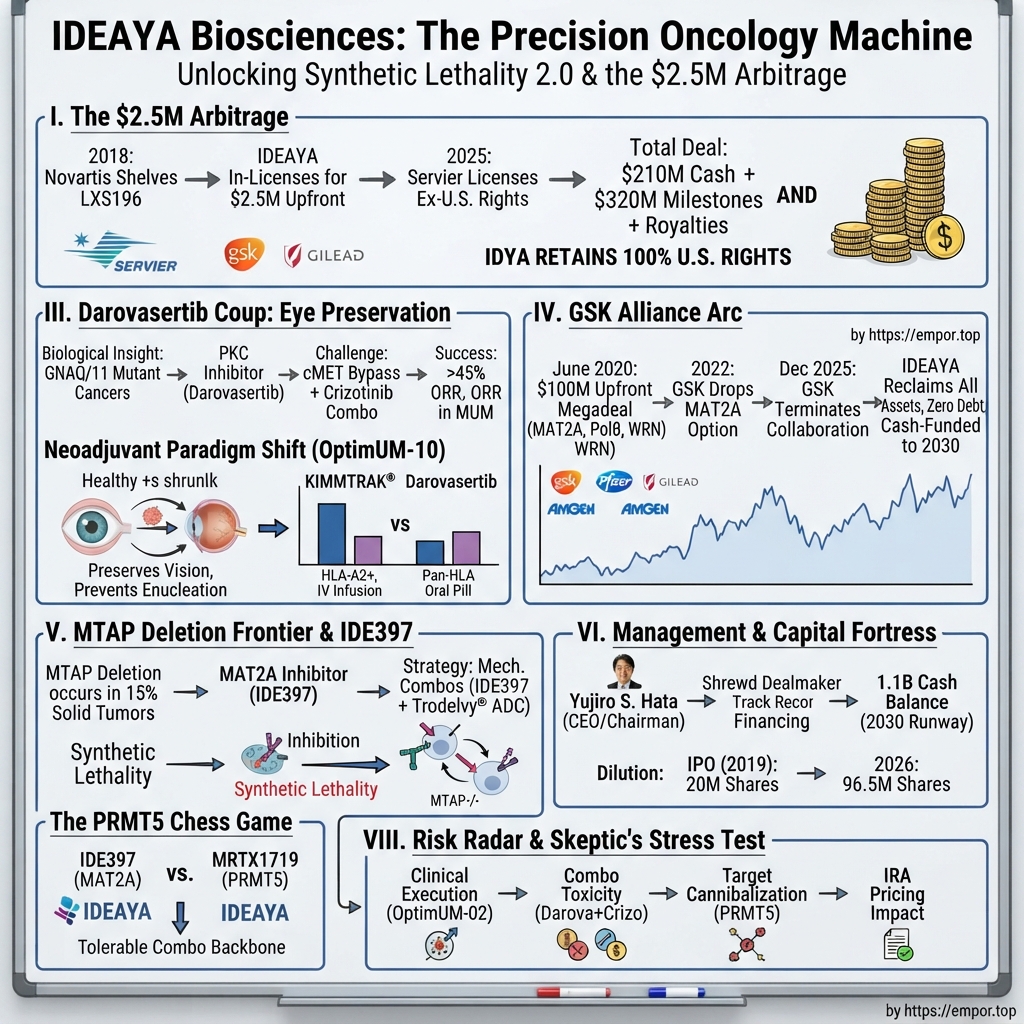
IDEAYA Biosciences: The Precision Oncology Machine and the $2.5M Arbitrage
I. Prologue & The $2.5 Million Arbitrage
In the autumn of 2018, a private biotechnology firm in South San Francisco with fewer than fifty employees and no commercial products wrote a check to Novartis for $2.5 million.
The transaction acquired a discarded clinical asset. Novartis had synthesized the small molecule, designated LXS196, evaluated it in a Phase 1 trial for a rare eye cancer, and observed response rates in the single digits to low teens alongside side effects that included hypotension and gastrointestinal distress. Concluding that the candidate did not justify further clinical development, Novartis shelved the compound. IDEAYA Biosciences, three years old at the time and operating on venture funding, acquired it for the price of a single Bay Area home.12
Seven years later, on September 2, 2025, IDEAYA licensed the international rights to that same molecule — now known as darovasertib — to the French pharmaceutical group Servier. Under the agreement, Servier paid $210 million upfront in cash, committed up to $100 million in regulatory milestones and up to $220 million in commercial milestones, and agreed to double-digit royalties on sales outside the United States. IDEAYA retained full U.S. commercial rights.3 On April 13, 2026, the registrational Phase 2/3 trial co-funded by both companies yielded positive top-line data: a combination of darovasertib and crizotinib reduced the risk of disease progression by 58% compared with investigator's choice of immunotherapy in first-line metastatic uveal melanoma.4
That sequence captures the core arbitrage: a $2.5 million cast-off evolved into the anchor asset of an enterprise valued at $3.8 billion.
The company as it stands today
IDEAYA Biosciences trades on the NASDAQ Global Select Market under the ticker IDYA. As of the close on September 4, 2026, the shares traded at $39.86, giving the company a market capitalization near $3.8 billion against a 52-week trading range of roughly $23 to $43.5 The company concluded the second quarter of 2026 with approximately $1.24 billion in cash, cash equivalents, and marketable securities, carried no commercial debt, and projected that this balance sheet would fund operations into 2030.6
At the same time, IDEAYA has no approved medicines on the market, generates no recurring commercial revenue beyond collaboration inflows, and reported a second-quarter net loss of $112.5 million.6 The current valuation represents an unhedged claim on future clinical and commercial execution.
The thesis this article tests
The narrative IDEAYA presents to public markets centers on synthetic lethality — the therapeutic strategy of destroying a malignant cell by targeting a vulnerability created by an existing cancer mutation. That principle yielded a major commercial class in the 2010s with PARP inhibitors, followed by a decade of clinical disappointments as numerous biotechs raised capital on the concept only to find that monotherapy trials in solid tumors failed to produce meaningful tumor regression.
The central question is not whether the underlying genetics are compelling, but how IDEAYA navigated the pitfalls that derailed earlier synthetic-lethality developers. Three potential explanations emerge. First, the company may excel at acquiring external chemical assets at low cost and re-engineering their clinical strategy. Second, management may be unusually adept at raising growth capital well ahead of operational need. Third — the proposition management emphasizes most heavily to investors — the company may possess a proprietary discovery engine that identifies viable targets overlooked by peers.
A close review of the corporate record supports only two of those three propositions.
The roadmap
This analysis examines the biological reasons single-node targeted therapies often fail and how IDEAYA's scientific leadership reassessed the clinical shortcomings of LXS196. It follows the GlaxoSmithKline collaboration from a $120 million validation pact in 2020 to its complete unwinding in December 2025, evaluating what it means when an anchor pharmaceutical partner terminates every joint asset. It reviews the MTAP-deletion program, where IDEAYA operates not as an unencumbered pioneer but as a smaller entrant competing against Bristol Myers Squibb and Amgen — and where the company has already had to execute one strategic pivot. It assesses a capital structure expanded through a roughly fivefold increase in outstanding shares since the initial public offering. Finally, it identifies the key operational and clinical milestones that will determine whether the business model can endure.
The initial arbitrage generated substantial value. Whether management can systematically replicate that success remains the defining question for investors.
 Subscribe on LinkedIn
II. Precision Oncology's Graveyard & Founding Context
Understanding why a shelved Novartis compound was available for $2.5 million requires examining what the oncology industry believed in 2015 — and what it had just stopped believing.
The rise and stall of synthetic lethality 1.0
Synthetic lethality sounds like a modern corporate neologism, but the concept was borrowed from fruit-fly genetics in the 1940s. The underlying biology is straightforward: two genes, each individually nonessential to cell survival, become jointly indispensable. Inactivate either gene alone, and the cell survives. Inactivate both, and the cell dies.
The therapeutic application in oncology offered an elegant theoretical window. Malignant cells routinely lose genes as collateral damage during tumor evolution. If losing gene A renders a cell acutely dependent on gene B, while normal cells retain gene A, a drug targeting gene B should selectively destroy malignant cells while sparing healthy tissue. The mechanism promised chemotherapy's cytotoxicity combined with a targeted drug's tolerability, anchored by a built-in selection biomarker: clinicians would treat only patients whose tumors had already lost gene A.
Initial clinical validation arrived in BRCA-mutated breast and ovarian cancers. Tumors with mutated BRCA genes cannot repair double-strand DNA breaks through homologous recombination, leaving them dependent on a backup repair enzyme called PARP. Inhibiting PARP causes unresolved DNA damage to accumulate until the malignant cell dies. AstraZeneca's olaparib reached the market on that exact mechanism, establishing commercial proof of concept for the class.
Subsequent efforts to generalize the model faltered. Through the mid-2010s, an influx of DNA-damage-response companies applied the PARP template to other repair nodes, including ATR, ATM, CHK1, WEE1, and DNA-PK. The resulting clinical pattern was consistently disappointing. Because healthy dividing cells also rely on fundamental DNA repair machinery, therapeutic windows proved narrow. Toxicities such as bone marrow suppression recurred across development programs. Objective response rates in unselected or broadly selected solid tumors remained low. Furthermore, patient-selection biomarkers proved difficult to standardize, as homologous recombination deficiency emerged as a continuous, assay-dependent variable rather than a clean genetic on-off switch.
By 2015, the reality of synthetic lethality amounted to a single commercial franchise surrounded by costly clinical setbacks. That skeptical environment formed the backdrop for IDEAYA's founding — a climate that represented either poor market timing or an opportune moment to assemble specialized assets at discounted valuations.
The founding, 2015–2016
Yujiro S. Hata incorporated IDEAYA Biosciences in June 2015, serving as its initial employee and chief executive.7 His background helps explain the company's subsequent operational style — specifically why IDEAYA's defining milestones have stemmed from strategic transactions rather than in-house scientific discoveries.
Rather than rising from the laboratory bench, Hata built his career in corporate development. After studying chemistry at Colorado College and the University of Oxford, he completed an MBA at Wharton, where he won first prize out of 226 entries in the business plan competition.8 From 2010 to 2014, he was Vice President of Corporate Development and Strategy at Onyx Pharmaceuticals, guiding strategy, asset management, and licensing through the approvals of Kyprolis and Stivarga and through Onyx's acquisition by Amgen in October 2013. He subsequently served as Chief Operating Officer of Flexus Biosciences, acquired by Bristol Myers Squibb in April 2015, and continued at the Flexus spinout FLX Bio, later renamed RAPT Therapeutics.8
In short, before founding a drug developer, Hata spent years as the executive evaluating which oncology assets were worth acquiring and at what price. That trajectory produced an executive team skilled at recognizing mispriced compounds and structuring disciplined transactions, rather than an organization primarily focused on de novo molecular discovery.
IDEAYA assembled experienced drug discovery leadership alongside Hata. In May 2016, the company closed a $46 million Series A round and named Jeffrey Hager, Ph.D., as co-founder and Senior Vice President, Head of Biology, and Michael Dillon, Ph.D. — formerly head of global discovery chemistry for oncology and new therapeutic modalities at the Novartis Institutes for BioMedical Research — as Senior Vice President, Head of Drug Discovery.79 The syndicate included 5AM Ventures, Canaan Partners, Celgene, WuXi Healthcare Ventures, the Novartis Institutes for BioMedical Research, and Alexandria Real Estate Equities. Hata concurrently served as an Executive-in-Residence at 5AM from 2015 to 2018 while establishing the company.78
Two features of that capitalization table carried long-term implications. First, Novartis was an equity investor in IDEAYA well before licensing LXS196 in 2018; the transaction emerged from an existing institutional relationship and Dillon's previous discovery leadership at Novartis. Second, the initial board included Terry Rosen, Ph.D., the chief executive of Arcus Biosciences, who has served on IDEAYA's board for a decade and whose presence becomes relevant in subsequent governance evaluations.7
The founding thesis, as stated at the time, was to develop "personalized synthetic lethality medicines targeting DNA damage and repair" alongside immuno-oncology therapies directed at the tumor microenvironment.7 The strategic bet held that strict genetic stratification — treating only patients whose tumors carry a defined loss-of-function lesion — would rescue synthetic lethality from the broad screening failures that compromised the first wave.
Historical falsification check: did the discovery engine deliver?
That founding thesis warrants evaluation against a decade of operational data, as the presence of a repeatable discovery engine underpins a platform-company valuation rather than a single-asset multiple.
The claim. Management asserted that IDEAYA's proprietary discovery platform would generate wholly owned, first-in-class clinical candidates with greater speed and capital efficiency than established pharmaceutical peers.
The disconfirming record. IDEAYA's primary commercial asset did not originate from internal discovery. Darovasertib was an in-licensed compound shelved by Novartis. The company's most advanced asset outside uveal melanoma, the DLL3 antibody-drug conjugate IDE849, was acquired via an exclusive license from Hengrui Pharma in December 2024.10 Its bispecific antibody-drug conjugate, IDE034, came from Biocytogen.[^11] Meanwhile, the three programs that represented internal discoveries and were highlighted as platform validation in 2020 — MAT2A, Pol Theta, and Werner helicase — have all been deprioritized or slated for discontinuation, a development analyzed in sections IV and V.1112
The counterweight. The company's internal research efforts have produced clinical assets. IDE161, a PARG inhibitor, and IDE892, an MTA-cooperative PRMT5 inhibitor engineered with roughly 1,400-fold selectivity for the MTA-bound form of the enzyme, are internal programs now undergoing clinical evaluation.13 IDE892, in particular, represents sophisticated medicinal chemistry. Yet it entered the clinic only in March 2026 — roughly a decade after IDEAYA's founding and years behind rival programs directed at the same target.
Conclusion. A decade of clinical history does not refute the discovery claim outright, but it narrows it substantially. IDEAYA's proven core competency is translational: diagnosing why an experimental compound failed, identifying the underlying resistance mechanism, and designing the combination regimen and patient-selection criteria to overcome it. Sourcing chemical entities, by comparison, has been opportunistic and frequently external. Investors should view the platform discovery thesis as unproven and the translational capability as partially demonstrated. That test is now running in real time: if IDE892 and IDE161 advance to registrational studies on internal clinical data, the platform thesis gains credibility; if IDEAYA's next commercial driver arrives, once again, via an in-licensing wire transfer, it does not.
That dynamic turns the focus to the single licensing transaction that defined the enterprise.
III. The Darovasertib Coup: Turning a Novartis Cast-Off into a Franchise
The clinical reality of uveal melanoma is unusually stark.
Unlike cutaneous melanoma, the malignancy originates inside the eye, within the pigmented vascular layer known as the uvea. Standard treatment for the primary tumor has long relied on two invasive options: plaque brachytherapy, in which a radioactive disc is sutured to the exterior of the eyeball for several days, or enucleation, the complete surgical removal of the eye. While brachytherapy can preserve the physical globe, it frequently damages visual acuity, and enucleation causes irreversible blindness in that eye.
Even after aggressive local therapy, distant metastases eventually emerge in a substantial minority of patients—nearly always seeding the liver.
The biology: one gene, one pathway, no drug
Genetically, uveal melanoma is far less heterogeneous than most solid tumors. The vast majority of cases are driven by activating mutations in GNAQ or GNA11, two genes encoding G-protein alpha subunits. Biologically, these proteins function like molecular switches designed to alternate between active and inactive states. The oncogenic mutation jams the switch in the active position, driving continuous downstream signaling through protein kinase C into the MAPK growth cascade.14
The epidemiological reality is both severe and small-scale. Uveal melanoma is a rare malignancy, with annual incidence estimated at roughly 4,800 cases globally and approximately 2,000 in North America. Between 40% and 50% of patients ultimately develop metastatic disease, and up to 95% of those metastases colonize the liver. Once hepatic lesions appear, historical median overall survival has hovered around six to seven months, with one-year survival rates between 10% and 15%.15 A published meta-analysis cited by IDEAYA in its 2025 clinical presentations established a historical benchmark of roughly 12 months for median overall survival in first-line metastatic disease.16
Those dynamics define the commercial challenge: a well-understood, single-node oncogenic driver coupled with a patient population too small to compete for capital inside the pipeline committees of global pharmaceutical giants.
October 2018: the trade
Novartis had initially synthesized the candidate to address that pathway. LXS196 was designed as an oral, selective PKC inhibitor. In Phase 1 monotherapy trials, however, the compound showed limited clinical activity—producing modest response rates and progression-free survival of only a few months, offset by dose-limiting toxicities. Confronted with a worldwide market of a few thousand patients, Novartis made a conventional portfolio calculation and shelved the asset.
On October 3, 2018, IDEAYA announced an exclusive worldwide license to develop the compound in GNAQ- and GNA11-mutant cancers.1 Filings show the deal structure was conservative: $2.5 million in upfront cash, 263,615 shares of Series B redeemable convertible preferred stock, up to $8.0 million in development and regulatory milestones, up to $20.0 million in commercial milestones, and tiered royalties in the mid-to-high single digits on worldwide net sales.2 Underscoring the disciplined cost structure, IDEAYA paid Novartis a milestone of just $1.0 million in April 2025—meaning that seven years after the transaction, the cumulative cash outlay to secure the asset remained in the single-digit millions.2
While market commentary often frames this transaction as visionary leadership, it was fundamentally an economic arbitrage: IDEAYA acquired an option that Novartis could not justify holding. The molecule was not biologically broken, but the commercial indication was too niche for a multinational pharmaceutical company while offering a transformative anchor for an emerging biotech.
Capitalizing on that option, however, required solving the biological problem that had halted Novartis.
The bypass: why blocking one node is never enough
The failure of LXS196 as a single agent reflected a common vulnerability in targeted oncology: malignant cells rarely rely on a single signaling route, and inhibiting one pathway often prompts the tumor to activate an alternative pathway.
Drawing on academic research in uveal melanoma biology, IDEAYA focused on the microenvironment where the cancer turns fatal. When uveal melanoma spreads to the liver, it enters the human body's primary reservoir of hepatocyte growth factor. This growth factor binds to the cMET receptor on the tumor cell surface, activating both the MAPK and PI3K/AKT pathways—the very growth cascades that PKC inhibition was meant to block. In effect, the hepatic microenvironment provides the tumor with an alternate signaling channel that bypasses the drug entirely.14
Darovasertib monotherapy had stalled not because the inhibitor lacked potency, but because hepatic metastases routinely circumvented it.
The strategic solution was dual inhibition. IDEAYA combined darovasertib with crizotinib, an ALK and cMET inhibitor developed by Pfizer with a well-established safety profile and generic-adjacent pricing. In preclinical studies, the combination demonstrated synergistic tumor suppression at concentrations achievable in humans.14 The approach carried distinct operational advantages: rather than undertaking the risk and delay of discovering or licensing a proprietary cMET inhibitor, IDEAYA repurposed an off-the-shelf, approved generic oncology agent.
The data, in order
Clinical evidence for the combination accumulated across both single-arm and randomized studies.
In the first-line metastatic setting, the Phase 1/2 OptimUM-01 study reported mature data in October 2025. Across 44 treatment-naive patients evaluated at a median follow-up of 25 months, the regimen delivered a median overall survival of 21.1 months, a median progression-free survival of 7.0 months, a confirmed overall response rate of 34%, a median duration of response of 9.0 months, and a disease control rate of 90%—substantially exceeding the historical benchmark of approximately 12 months of median survival.16
The combination faced its definitive test in OptimUM-02, a registrational Phase 2/3 trial. The Phase 2b/3 portion enrolled 313 patients: 210 randomized to darovasertib plus crizotinib and 103 to investigator's choice of therapy, which comprised ipilimumab plus nivolumab in 76% of control patients and pembrolizumab in 24%. Based on a January 23, 2026 data cutoff, median progression-free survival by blinded independent central review reached 6.9 months in the experimental arm versus 3.1 months in the control arm, representing a 58% reduction in the risk of disease progression or death (hazard ratio 0.42; 95% confidence interval 0.30–0.59; p<0.0001). The confirmed overall response rate was 37.1% compared with 5.8%, including five complete responses with the combination and none in the control group. The disease control rate was 73.3% versus 31.1%, and median response duration was 6.8 months. Overall survival data were immature at the cutoff, though early trends favored the combination.417
Those findings warrant both enthusiasm and caution. Positively, the comparator arm was not inactive chemotherapy; it was contemporary checkpoint immunotherapy, the prevailing standard of care, which delivered the poor outcomes consistent with historical literature. Outperforming an active standard-of-care regimen in a randomized study offers a much higher standard of proof than single-arm response metrics. The caveat is that progression-free survival served as the primary endpoint, and radiographic improvements do not always translate into statistically significant survival extensions. Formal validation will hinge on the planned interim overall survival analysis.
The safety profile, updated with the full ASCO 2026 presentation, was manageable but clinically demanding. Grade 3 or 4 treatment-related adverse events occurred in 40.6% of patients receiving the combination compared to 37.0% receiving immunotherapy. The most frequent high-grade toxicities were diarrhea at 10.0%, syncope at 7.1%, and hypotension at 3.8%. However, serious treatment-related adverse events were lower in the combination cohort at 9.2% versus 25.0% on immunotherapy, and treatment discontinuation due to related toxicities stood at 2.5% for darovasertib and 10.0% for crizotinib, compared to 19.0% in the control arm. Median relative dose intensity reached 91.0% for darovasertib but dropped to 77.1% for crizotinib.17
The discrepancy in dose intensity highlights a practical reality: while patients tolerated darovasertib relatively well, they experienced greater difficulty with crizotinib. Tolerability challenges with the combination partner could complicate administration in community oncology practice, whereas the neoadjuvant setting—which uses darovasertib as a single agent—avoids that complication.
From saving lives to saving eyes
The second phase of darovasertib's clinical development expanded the commercial opportunity from an empirical finding: administered prior to surgery, the drug induced meaningful tumor regression directly within the eye.
That shift changed the commercial scope. Metastatic uveal melanoma represents a small, late-line market. Primary uveal melanoma encompasses the entire incident patient population, where the therapeutic alternative is surgical removal or high-dose radiation of the eye.
The Phase 2 OptimUM-09 trial, presented at ESMO in 2025, evaluated 95 primary uveal melanoma patients across two cohorts: 56 facing recommended enucleation and 39 eligible for plaque brachytherapy. Among 94 evaluable patients, 83% achieved ocular tumor reduction and 54% demonstrated at least 20% shrinkage. Within the enucleation cohort, 57.1% of patients who completed primary therapy successfully preserved their eye; among those achieving at least 20% tumor shrinkage, the eye-preservation rate reached 95%. Furthermore, visual acuity improved in approximately 55% of enucleation-eligible and 61% of brachytherapy-eligible patients, with mean gains of 17 and 10 letters, respectively, and 70% of brachytherapy patients experienced a reduction in planned radiation dose to sensitive ocular anatomy. Grade 3 or higher treatment-related adverse events occurred in 16.8% of patients, with 6.3% discontinuing therapy.18
Preserving an eye while restoring or maintaining visual acuity provides an unmistakable clinical and economic benefit. Darovasertib holds FDA Breakthrough Therapy Designation in the neoadjuvant setting for enucleation-eligible patients.18 The confirmatory Phase 3 OptimUM-10 trial is actively enrolling, with completion of enrollment now projected by year-end 2027—delayed from earlier guidance targeting the first half of 2027.12 Concurrently, IDEAYA is running OptimUM-11, a global Phase 3 adjuvant study enrolling approximately 450 primary uveal melanoma patients at high risk of recurrence regardless of HLA status, randomized to twelve months of darovasertib plus crizotinib versus observation, with relapse-free survival as the primary endpoint.12
The competitor across the table
The commercial landscape in uveal melanoma is not entirely vacant. Immunocore gained regulatory approval in 2022 for KIMMTRAK (tebentafusp), a bispecific T-cell engager that became the first therapeutic to demonstrate an overall survival advantage in metastatic uveal melanoma.
KIMMTRAK has established a validated commercial baseline. The drug generated $400.0 million in net product revenue in 2025, reflecting 29% year-over-year growth across approvals in 39 countries, with Immunocore reporting widespread adoption as standard of care and mean U.S. treatment duration reaching 14 months.19 Those figures provide a realistic benchmark for commercial expectations in this niche indication.
Yet KIMMTRAK is constrained by biological and logistical hurdles that IDEAYA has deliberately targeted. KIMMTRAK requires patients to express the HLA-A*02:01 tissue type, which presents the specific melanoma peptide targeted by the construct. Roughly half of uveal melanoma patients lack this allele, leaving them without an approved targeted therapy. In addition, KIMMTRAK is administered as a weekly intravenous infusion carrying a risk of cytokine release syndrome that mandates institutional monitoring.
IDEAYA designed OptimUM-02 to enroll exclusively HLA-A*02:01-negative first-line patients.4 This clinical trial design serves multiple strategic goals: it addresses an unserved segment of the market, avoids a head-to-head confrontation with an established survival-extending drug, and provides regulators with data in a population lacking approved targeted therapies. At the same time, this strategy initially restricts any potential commercial label to roughly half the metastatic population. IDEAYA's broader goal of treating all patients regardless of HLA status remains to be proven in later lines and earlier disease stages. Phase 1/2 OptimUM-01 data in HLA-A2-positive patients, encompassing roughly 85 evaluable patients, are slated for presentation at the European Society for Medical Oncology congress in October 2026.6
Historical falsification check: the standalone drug claim
The claim tested: darovasertib is a potent single agent across GNAQ/GNA11-driven melanoma.
The evidence against it. The Novartis Phase 1 monotherapy experience is the original disconfirmation, and IDEAYA has never overturned it in metastatic disease. Every metastatic dataset the company has generated—from OptimUM-01's 21.1-month median overall survival to OptimUM-02's hazard ratio of 0.42—depends entirely on crizotinib co-administration.164 Furthermore, the safety cost of that dependency is concentrated in the partner drug, with crizotinib discontinuations running four times darovasertib's alongside a lower relative dose intensity of 77.1%.17
Where the claim survives. In the neoadjuvant primary setting, single-agent darovasertib demonstrated clear activity, achieving ocular tumor reduction in 83% of patients.18 The monotherapy thesis remains viable, but only in early localized disease where tumors have not yet migrated to the liver and activated hepatic bypass mechanisms.
Conclusion. The clinical record qualifies the standalone drug claim: darovasertib is an obligate combination therapy in metastatic disease and a viable monotherapy in the primary eye tumor. This dichotomy establishes two distinct commercial profiles—a clinically demanding metastatic combination regimen and a more straightforward neoadjuvant monotherapy. The critical real-world test will be crizotinib tolerability: if community oncologists struggle to maintain patients on the combination, progression-free survival in broader clinical practice may fall short of trial benchmarks.
While IDEAYA has assembled a coherent franchise in uveal melanoma, the fate of the broader pipeline that management promised investors presents a far more complicated record.
IV. The GSK Alliance: Euphoria, Cracks, and the December 2025 Termination
June 2020 marked a uniquely euphoric period for biotechnology. Capital was virtually free, public markets viewed the sector as a singular bright spot, and an emerging biotech with three preclinical programs could command nine-figure commitments from global pharmaceutical giants.
IDEAYA capitalized on that window.
The deal that changed the company's balance sheet
On June 16, 2020—thirteen months after an initial public offering that had raised $57.5 million gross at $10.00 per share—IDEAYA announced a strategic partnership with GlaxoSmithKline covering its three internal synthetic lethality programs: MAT2A, Pol Theta, and Werner helicase.2021
The economics were transformative relative to IDEAYA's scale. GSK paid $100 million in upfront cash and invested $20 million in IDEAYA common stock through a direct private placement. An additional $50 million cash option-exercise fee applied to the MAT2A program. For MAT2A and Werner helicase, IDEAYA secured a 50% U.S. profit share alongside ex-U.S. royalties while agreeing to fund 20% of global development costs following option exercise. On Pol Theta, GSK agreed to fund all research, development, and commercialization, with IDEAYA receiving global royalties. All three programs were preclinical at signing, projected to reach clinical trials within three years.20
Hata framed GSK at the time as "the ideal strategic partner," projecting that the collaboration would enable combination regimens across major solid tumors, including lung, prostate, breast, colorectal, and ovarian cancers.20 The market interpreted the deal as existential validation: an established pharmaceutical manufacturer had underwritten the discovery platform in cash before IDEAYA had dosed a single trial participant. For a company that had entered public markets with less than $60 million, securing $120 million from GSK fundamentally reshaped its balance sheet.
Yet the underlying transaction reflected a classic industry dynamic. GSK was not purchasing proven clinical data; it was acquiring optionality on early-stage biology at a time when its own oncology franchise required pipeline replenishment. The upfront payment functioned as an option premium—and in biopharma, option premiums are routinely paid on exploratory assets that the acquirer ultimately expects to discard.
2022: the first program comes back
The unwinding began quietly. In August 2022, following early Phase 1 dose-escalation data for IDE397, GSK waived its right to exercise the MAT2A option. All worldwide rights returned to IDEAYA, which retained unencumbered ownership of the program.22
Management attributed the decision to GSK's internal portfolio realignment rather than IDE397's clinical profile: GSK had discontinued internal assets that would have served as natural combination partners for a MAT2A inhibitor, making the standalone opportunity less compelling within its pipeline. IDEAYA also argued that regaining full ownership was liberating, allowing the company to combine IDE397 with third-party compounds without partnership governance constraints.22
Both explanations may hold merit. Yet the analytical structure of management's argument is worth noting, as IDEAYA would deploy it again: the partner exited because of internal portfolio considerations, not because of the underlying asset. That rationalization is unfalsifiable from the outside, which is why investors should weigh a corporate partner's revealed actions far more heavily than a licensee's framing.
December 2025: the rest of it
On December 4, 2025, GSK notified IDEAYA of its intent to terminate the broader collaboration. Formal written notice followed on December 9, with the termination taking effect ninety days later, on March 9, 2026. The Werner helicase program (IDE275) and the Pol Theta helicase program (IDE705) reverted to IDEAYA, with GSK responsible for transferring both clinical programs during the transition period. IDEAYA announced that it would evaluate strategic options in 2026 and stated there was no immediate impact on its financial guidance.2324
The public record points to a routine pharmaceutical realignment rather than a sudden dispute: a strategic rotation inside GSK toward internally originated programs, antibody-drug conjugates, immunology, and vaccines, and away from capital-intensive synthetic lethality targets whose solid-tumor monotherapy activity had failed to replicate the PARP inhibitor experience. Rather than finance the next clinical phase, GSK absorbed a nine-figure sunk cost.2324
Then IDEAYA provided its own verdict. In its first-quarter 2026 financial update, the company stated plainly that following the GSK termination, it "plans to discontinue development of IDE275, a small molecule inhibitor of Werner helicase (WRN), and IDE705, a small molecule inhibitor of Pol-Theta helicase (POLQ)," while evaluating external strategic options for the compounds.12
That admission is pivotal. IDEAYA did not take back two partner-funded clinical assets and advance them using its $1.24 billion cash reserves. It accepted the returned programs and shelved them. An organization holding over a billion dollars in capital and carrying no debt chose not to deploy funds into assets it had spent half a decade promoting as first-in-class therapies. The most economical interpretation is that IDEAYA's internal clinical assessment arrived at the same conclusion as GSK's.
Historical falsification check: does big pharma partnership validate a platform?
The claim tested: multi-target collaborations with large pharmaceutical companies demonstrate the durability and commercial viability of a discovery engine.
The disconfirming record, over the full five-and-a-half-year span. GSK walked away from every one of the three programs it optioned. It did so with complete operational access: more than five years reviewing preclinical packages, medicinal chemistry, and early clinical data across all three molecular targets. GSK forfeited its option rights and potential future milestones to exit. Furthermore, IDEAYA's subsequent decision to discontinue two of the three returned assets corroborates rather than contradicts GSK's skepticism.222312
Peer base rate. This pattern is not an anomaly. Across the synthetic lethality sector, major pharmaceutical sponsors have repeatedly trimmed or terminated alliances when early solid-tumor monotherapy activity fell short of the historical PARP benchmark. The base rate of these early-stage partnerships surviving into Phase 3 trials is low, which underscores the risk of treating any single deal signing as scientific validation.
What survives. IDEAYA kept the $120 million upfront and equity capital. It retained the clinical data. It emerged with clean, debt-free asset ownership. In economic terms, the alliance functioned as a non-dilutive $120 million research subsidy—an outcome of immense value for an early-stage biotech that would otherwise have issued equity at 2020 market valuations.
Conclusion. The historical record refutes the claim as formulated. Large-pharma partnership signings are not platform validation; they represent call options on exploratory biology, and in this instance, the buyer let every option expire. What remains validated is narrower, though still commercially consequential: IDEAYA converted a discontinued partnership into substantial cash reserves and unencumbered asset ownership without compromising its balance sheet. The real test now falls on the internally developed programs that GSK never touched—IDE892 and IDE161. If those candidates fail to generate convincing clinical activity, IDEAYA's operational record will reflect three internal programs shelved and every advanced asset in-licensed.
That reality sets the framework for examining what management now positions as its second clinical pillar.
V. The High-Stakes Frontier: MTAP Deletion, IDE397, and the PRMT5 Chess Game
If uveal melanoma represents a niche market IDEAYA might control, MTAP deletion represents a far larger battleground where the company must fight for share. The two opportunities require entirely different analytical frameworks, and conflating them is a frequent misstep in assessing the business.
The prize, and the accident of chromosomal geography
The science behind the MTAP opportunity begins with an accident of chromosomal geography.
Malignant cells frequently delete a tumor suppressor known as CDKN2A, a critical brake on cell division located on chromosome 9p21. Directly adjacent sits a housekeeping gene called MTAP, which recycles a metabolic byproduct. When a tumor deletes CDKN2A, it routinely eliminates MTAP alongside it—not because MTAP impeded the cancer, but because it happened to reside next door, an instance of collateral damage during genomic deletion.
That accident creates a therapeutic vulnerability. Without MTAP, the cell cannot clear a metabolite called MTA, which accumulates intracellularly. MTA selectively binds to PRMT5—an enzyme that methylates proteins and is essential for cellular survival—partially inhibiting its function. Consequently, the malignant cell operates with PRMT5 at reduced capacity, whereas healthy cells with intact MTAP function at full capacity. Inhibiting PRMT5 slightly further selectively destroys the tumor while sparing normal tissue.25
That pathway can also be targeted one step upstream. PRMT5 requires a methyl donor called SAM, synthesized by the enzyme MAT2A. Depleting cellular SAM achieves an analogous vulnerability.25
The commercial attraction lies in the scale. Homozygous MTAP deletion occurs in approximately 10% to 15% of solid tumors—a prevalence confirmed through genomic profiling across more than half a million tumor specimens—with significant representation in non-small cell lung cancer, bladder and urothelial cancer, head and neck cancer, pancreatic cancer, and glioblastoma.26 Compared to a uveal melanoma population measured in the low thousands globally, this represents an opportunity orders of magnitude larger.
That potential also explains why the field is intensely crowded.
IDE397, and the pivot that became a retreat
IDEAYA's initial entry into the space was IDE397, the oral MAT2A inhibitor that GSK optioned in 2020 and returned in 2022. As a monotherapy, the molecule showed modest clinical activity—sufficient to support further investigation, but inadequate to anchor a standalone registrational filing. Management responded with its established playbook, seeking an external combination partner.
The company selected Gilead's TROP-2 antibody-drug conjugate Trodelvy (sacituzumab govitecan). The mechanistic rationale was plausible: MAT2A inhibition weakens a malignant cell's capacity to repair DNA damage, and an antibody-drug conjugate delivering a topoisomerase-1 inhibitor payload inflicts precisely that damage. Preliminary data appeared promising. In MTAP-deleted urothelial cancer, IDEAYA reported an overall response rate of 33% at dose level 1, reflecting confirmed partial responses in three of nine patients, and 57% at dose level 2. The company selected the higher dose to advance, dosed the first patient in an expansion cohort for non-small cell lung cancer, and projected additional clinical updates for the first half of 2026.27
Then, in March 2026, IDEAYA announced that it would "deprioritize clinical activity with Gilead evaluating the combination of IDE397 and Trodelvy and conclude enrollment in the Phase 1/2 trial in MTAP-deleted urothelial and lung cancers."12
That quiet disclosure represented a major strategic retreat. A combination regimen promoted to investors as the primary registrational path for IDE397—backed by a large biopharmaceutical partner and boasting a 57% response rate at the target dose—was unwound within six months of reporting those results. IDEAYA has not disclosed a detailed clinical rationale for concluding the trial. The asset itself was not formally abandoned; instead, management redirected IDE397 into an internal combination with IDEAYA's own PRMT5 inhibitor, initiating a combination cohort in mid-2026 with expansion planned by late 2026 or early 2027, while exploring a potential triplet regimen with Roche's pan-RAS inhibitor.628
Yet IDE397's clinical role has been redefined twice in three years: initially framed as a lead monotherapy, then repurposed as the backbone for an external antibody-drug conjugate alliance, and finally relegated to a supportive pairing for an earlier-stage internal PRMT5 inhibitor. Each shift arrived with an articulate mechanistic justification. For investors, however, the recurring pattern of tactical repositioning matters far more than the rationale accompanying each transition.
The arms race IDEAYA joined late
The competitive dynamics in MTAP deletion contrast sharply with those in uveal melanoma.
The direct therapeutic strategy—MTA-cooperative PRMT5 inhibitors that selectively bind the MTA-associated complex—is led by pharmaceutical incumbents. Bristol Myers Squibb controls MRTX1719 (now designated BMS-986504) through its acquisition of Mirati Therapeutics, while Amgen is advancing AMG 193. These programs are not early-stage followers; they maintain a multi-year head start. Peer-reviewed first-in-human data for AMG 193 in MTAP-deleted solid tumors have already been published, with cross-program activity in this mechanistic class coalescing around an objective response rate of approximately 23%, a median duration of response near 10.5 months, and disease control rates approaching 70% across varied tumor histologies.29
Those outcomes demonstrate genuine biological activity, but they fall short of transformative clinical benefit. In a genetically selected patient population, an objective response rate of 23% confirms therapeutic engagement without establishing an unassailable commercial moat. The defining clinical challenge for the class is whether next-generation inhibitors can sufficiently widen the therapeutic index to allow tolerable combinations with chemotherapy, antibody-drug conjugates, or RAS inhibitors, avoiding the dose-limiting hematologic toxicities that encumbered first-generation PRMT5 candidates.
IDEAYA's entry is IDE892, an internally discovered MTA-cooperative PRMT5 inhibitor engineered with approximately 1,400-fold preclinical selectivity for the MTA-bound state over the SAM-bound enzyme—a chemical design intended to spare healthy tissue.13 The clinical development schedule has moved rapidly: IDEAYA submitted an Investigational New Drug application in September 2025, dosed the first patient in March 2026, launched a combination cohort with IDE397 by mid-2026, and initiated a Part 2 monotherapy expansion in MTAP-deleted non-small cell lung and pancreatic cancers in July 2026, noting that the maximum tolerated dose had not yet been reached.13306 In June 2026, IDEAYA established a clinical collaboration with Roche to evaluate IDE892 alongside Roche's Phase 1 pan-RAS inhibitor, RG6505, in MTAP-deleted, RAS-mutant pancreatic cancer, with both companies retaining commercial rights to their respective compounds and an option to incorporate IDE397 as a triplet regimen.28
For investors, management's emphasis that the maximum tolerated dose has not been reached signals favorable early tolerability and implies that the selectivity engineering is functioning as intended. At this stage, however, tolerability in dose escalation does not establish anti-tumor efficacy, and IDEAYA has not yet reported clinical response data for IDE892.
Stripped of promotional framing, IDEAYA's position in MTAP deletion is straightforward: an emerging biotech trailing two well-capitalized pharmaceutical giants by several years, advancing an unproven though chemically differentiated molecule without clinical efficacy validation. Its strategy assumes that market leadership will ultimately belong not to the most potent monotherapy, but to the compound that combines most safely with partner agents like Roche's pan-RAS inhibitor or its own MAT2A candidate. That approach is a pragmatic clinical compromise, but it represents a high-risk gamble rather than an established competitive advantage.
The ADC pivot nobody put in the plan
Concurrently, the clinical asset that has emerged as IDEAYA's second most valuable program did not originate from synthetic lethality research.
On December 29, 2024, IDEAYA secured an exclusive license for SHR-4849—a DLL3-directed antibody-drug conjugate carrying a topoisomerase-1 inhibitor payload—from Hengrui Pharma for all territories outside Greater China. IDEAYA paid $75 million upfront, committed up to $200 million in development and regulatory milestones, and agreed to commercial milestones that could bring total consideration to $1.045 billion, alongside mid-single to low-double-digit royalties.10 Renamed IDE849, the candidate addresses small cell lung cancer and neuroendocrine carcinomas—aggressive, poorly served malignancies that offer a far larger commercial target than uveal melanoma.
Early clinical findings were sufficiently robust to shift the organization's strategic priorities. Phase 1 results presented at the 2025 World Conference on Lung Cancer evaluated 87 small cell lung cancer patients and 13 individuals with other neuroendocrine carcinomas; median progression-free survival at doses of at least 2.4 mg/kg reached 6.7 months across all lines of therapy and remained unreached among second-line patients.31 Building on that momentum, IDEAYA announced on August 31, 2026, that an FDA Type C meeting had endorsed the design of a Phase 3 registrational trial in extensive-stage small cell lung cancer. The study will randomize approximately 400 patients against investigator's choice of chemotherapy, using objective response rate by blinded independent central review as the primary endpoint to support potential accelerated approval, with dosing scheduled to commence by year-end 2026.32 In April 2026, IDEAYA also entered a clinical collaboration with AstraZeneca to evaluate IDE849 in combination with Imfinzi (durvalumab) in extensive-stage disease.12
The remainder of the pipeline reflects a similar hybrid structure. IDE034, a B7H3/PTK7 bispecific antibody-drug conjugate in-licensed from Biocytogen under a 2024 agreement, received IND clearance in December 2025, with initial Phase 1 data anticipated around the end of 2026 or early 2027; IDE161, an internally discovered PARG inhibitor, is undergoing Phase 1 evaluation in combination with IDE849; and IDE574, a KAT6/7 inhibitor, remains in dose escalation.[^11]336
Viewed as a whole, the composition of the pipeline tells a clear story. A company founded to commercialize internal synthetic lethality discoveries now relies on an in-licensed PKC inhibitor and an in-licensed antibody-drug conjugate as its two most advanced clinical drivers. Meanwhile, its internal synthetic lethality candidates have either been discontinued or remain in early Phase 1 dose escalation. That divergence does not diminish the clinical potential of the assets themselves. It does, however, clarify where the firm's commercial value originated, providing a sobering corrective to valuations that presume a validated discovery platform.
VI. Current Management, Capital Allocation & The $1.1B Balance Sheet
In June 2026, IDEAYA's board enacted a leadership change that signaled a decisive shift in the company's internal balance of power.
Governance: the consolidation
On June 17, 2026, IDEAYA announced that its board of directors had elected Yujiro S. Hata as Chairman, effective June 16. Terry Rosen, Ph.D.—the Arcus Biosciences chief executive who had chaired the board and served as a director since the company's founding financing round—transitioned to Lead Independent Director.347 The company's definitive proxy statement, filed weeks earlier on April 29, 2026, had described Rosen as Board Chair presiding over executive sessions, noting that six of the seven directors were independent.35
Unifying the chairman and chief executive roles in a pre-commercial biotechnology firm is a common practice, but it rarely strengthens independent board oversight. In this instance, the consolidation took effect nine weeks after IDEAYA released positive registrational trial results for darovasertib—the moment of peak founder leverage. The presence of a lead independent director mitigates, but does not eliminate, that concentration of executive power. For investors evaluating a business model fundamentally driven by founder-led transactions, the softening of institutional checks warrants close attention.
Shareholders also registered a measurable, if modest, degree of dissatisfaction regarding executive compensation. At the 2026 annual meeting, the advisory vote on executive pay recorded 64,269,756 votes in favor and 8,349,131 against, alongside 397,608 abstentions—representing roughly 11% of cast ballots voting in opposition.36 While dissent at that level remains well within standard corporate bounds, it falls short of the overwhelming mandate typical for a management team coming off a pivotal clinical success.
The operating team
Hata has led IDEAYA for eleven years, an unusually prolonged continuous tenure for a biotechnology founder-CEO that spans private venture rounds, an initial public offering, the signing and subsequent dissolution of a major pharmaceutical alliance, and a successful registrational trial readout. Around him, executive appointments have shifted steadily toward commercial execution and capital markets expertise: Michael White serves as Chief Scientific Officer, Darrin Beaupre as Chief Medical Officer, and Joshua Bleharski—a healthcare investment banker by training—joined as Chief Financial Officer in 2025.37
Selecting an investment banker as chief financial officer ahead of an anticipated first commercial launch provides a clear signal regarding where leadership anticipates value creation. That appointment aligns with the firm's history and pairs with an established disclosure practice: IDEAYA issues quarterly financial updates via press releases, concentrating management commentary in investor conferences and event-driven data webcasts rather than conducting routine quarterly earnings calls with open analyst question-and-answer sessions. While common among development-stage biotechs, this format limits the recurring public forums where investors can probe management's operating assumptions. As IDEAYA approaches commercial product sales, that lack of direct quarterly interrogation becomes increasingly material.
Capital allocation: the fortress, and what it cost
IDEAYA's financing strategy demonstrates the most consistent operational discipline of its eleven-year history: raising capital aggressively into market and clinical strength.
The chronological sequence details that pattern: $57.5 million in gross proceeds from its May 2019 initial public offering;21 $120 million in cash and equity investment from GlaxoSmithKline in 2020;20 approximately $175 million in an April 2023 follow-on offering at $18.50 per share; roughly $143.7 million in October 2023 at $23.50; approximately $215.9 million generated through at-the-market equity sales during the first seventeen days of January 2024 at a weighted average price near $36.39; roughly $302.4 million in July 2024 at $35.00; $210 million upfront from Servier in September 2025;3 and, several weeks after the OptimUM-02 readout, a June 2026 public offering of 7,222,225 shares alongside pre-funded warrants for 5,555,576 shares that raised $323.4 million net, supplemented by $33.1 million in net proceeds from at-the-market sales.63839
Every equity raise occurred on the heels of positive corporate developments rather than financial distress. As a consequence, IDEAYA closed the second quarter of 2026 with approximately $1.24 billion in cash, cash equivalents, and marketable securities against total assets of $1,309.7 million, zero commercial debt, and projected cash runway extending into 2030—even while funding three Phase 3 uveal melanoma studies and preparing a fourth registrational trial in small cell lung cancer.6
The strategic value of that balance sheet extends directly to commercial negotiating power. Substantial cash reserves allowed IDEAYA to extract $210 million upfront from Servier while surrendering only ex-U.S. rights and retaining the domestic market—a structure available only to a licensor negotiating without balance-sheet urgency. A developer facing a near-term cash cliff would have been compelled to negotiate for global rights on far less favorable terms.
The Servier transaction, assessed
Measured strictly on financial terms, the Servier agreement was an advantageous transaction for an asset that had not yet reported pivotal data at the time of signing: $210 million upfront for rights outside the United States, up to $320 million in downstream milestones, tiered double-digit royalties, and shared clinical development expenses across three Phase 3 trials.3 Servier assumed responsibility for international regulatory submissions, ex-U.S. commercial infrastructure, and a proportionate share of trial expenses. That structure allows IDEAYA to focus its maiden commercial footprint exclusively on U.S. specialty ocular-oncology and melanoma centers—a concentrated network of prescribers that can be targeted effectively with a modest field force.
Two analytical qualifications balance that assessment. First, because the agreement closed prior to the OptimUM-02 clinical readout, IDEAYA monetized international rights at pre-data valuations, forfeiting the ability to demand higher economics after the combination achieved a 58% reduction in the risk of progression. Whether that transaction represented prudent risk mitigation or premature concession depends entirely on counterfactual assumptions. Second, double-digit royalties on international net sales in a rare oncology indication, when benchmarked against KIMMTRAK's $400 million global annual run rate, provide a reliable secondary income stream rather than a transformative revenue base.19 The Servier partnership is therefore best understood as risk transfer and balance-sheet extension rather than an independent corporate valuation driver.
Historical falsification check: has management protected shareholder equity?
The claim tested: disciplined, counter-cyclical financing has protected early shareholders.
The disconfirming record. IDEAYA sold 5,750,000 shares at its May 2019 initial public offering and had roughly 20 million shares outstanding immediately following the transaction.21 By the April 20, 2026 record date, the share count had climbed to 87,860,920 shares, and subsequent to the June 2026 offering and at-the-market activity, outstanding common stock stands near 95 million with an additional 5,555,576 shares underlying pre-funded warrants.3565 That progression represents roughly a fivefold expansion of the share base in seven years. An investor who bought at the IPO and held throughout now owns a substantially smaller fraction of a much larger enterprise. Concurrently, operational spending has accelerated: research and development expenses reached $204.4 million in the first half of 2026 compared with $145.1 million in the prior-year period, driving a six-month net loss of $211.0 million against $149.7 million a year earlier.6
The counterweight, weighed honestly. Dilution is not inherently destructive to shareholder value; the critical test is whether each successive financing was conducted at valuations reflecting genuine operational de-risking since the previous round. On that metric, management's execution has been disciplined: the public offering prices advanced sequentially from $10.00 at the IPO, to $18.50, $23.50, roughly $36.00 through the ATM program, $35.00, and ultimately the June 2026 follow-on offering. Equity was consistently issued into rising share prices following clinical de-risking rather than into falling prices out of operational necessity. Furthermore, the substantial capital inflows from corporate partnerships—$120 million from GSK in 2020 and $210 million from Servier in 2025—were entirely non-dilutive.
Conclusion. The claim survives in a narrowed, qualified form. Management has not minimized dilution, nor has it ever professed a goal of share-count preservation; instead, it has systematically prioritized balance-sheet durability, executing that strategy by raising equity at progressively higher valuations. The realistic assessment is that early IDEAYA shareholders have conceded roughly 80% of their proportional ownership in exchange for the capital necessary to advance a multi-program clinical pipeline, wagering that fully funded pipeline optionality creates more durable wealth than concentrated ownership of an undercapitalized developer. The falsifying event for this strategy would be a significant equity raise executed at a discount to prior rounds—the definitive signature of financing from operational weakness.
With the capital structure and executive governance established, the defining strategic question is whether this model can maintain its edge against competitors advancing rapidly along the same clinical frontiers.
VII. Strategic Moats & 7 Powers / Porter's 5 Forces Analysis
Analytical frameworks are useful only if they are allowed to return an unflattering verdict. Applied rigorously to IDEAYA Biosciences, they yield two distinct conclusions, reflecting a company running two businesses with fundamentally contrasting competitive dynamics.
Hamilton Helmer's 7 Powers
Cornered Resource — moderate, and asset-specific. IDEAYA's strongest defense rests not on its discovery platform, but on darovasertib itself and the clinical dataset assembled around it. Composition-of-matter and combination patents, orphan drug designations, and Breakthrough Therapy Designation in the neoadjuvant setting establish meaningful regulatory and intellectual property barriers.18 Yet more durable than any patent portfolio is the clinical data asset: OptimUM-02 is the first randomized trial to demonstrate a statistically significant progression-free survival benefit in first-line, HLA-A2-negative metastatic uveal melanoma, while OptimUM-09 represents the largest neoadjuvant dataset in primary disease.418 In an indication with roughly 4,800 new cases diagnosed each year worldwide, a prospective competitor would need to enroll a randomized trial against an active standard of care from a patient population that IDEAYA and Immunocore are already absorbing.15 That clinical enrollment scarcity forms a genuine commercial moat. Crucially, however, that protection does not extend into MTAP deletion or small cell lung cancer.
Process Power — weak, and weakening. The proposition that IDEAYA commands a proprietary translational engine—spanning biomarker selection, patient-derived tumor explants, and combination pharmacodynamics—draws some credibility from the cMET bypass insight that rescued darovasertib. Yet the raw material of synthetic lethality target identification has been largely commoditized by public, genome-wide CRISPR screening libraries. More critically, IDEAYA's own operational record challenges the narrative: the three internal programs optioned by GSK have been discontinued or deprioritized, while the pipeline's two most advanced clinical assets were acquired externally.12 Investors should not assign a valuation premium for process power here.
Counter-Positioning — strong in uveal melanoma, absent in MTAP. In uveal melanoma, IDEAYA benefits from genuine counter-positioning. Immunocore cannot easily pivot toward an oral, pan-HLA, outpatient regimen without cannibalizing an established, $400 million infusion franchise engineered around HLA-A*02:01-positive patients, nor can it readily pursue the neoadjuvant eye-preservation setting where the clinical objective is localized tumor shrinkage prior to surgery.19 That dynamic represents classic counter-positioning: an attractive market segment an established incumbent is structurally disincentivized to contest. In MTAP deletion, however, the opposite holds. Bristol Myers Squibb and Amgen command far larger commercial organizations, deeper internal portfolios in lung and gastrointestinal oncology to assemble combinations, and multi-year development leads. Nothing about IDEAYA's position in MTAP discourages rival pursuit; it is a straight development race.
Scale Economies, Network Effects, Switching Costs, and Branding — largely inapplicable for a pre-commercial biotechnology developer. Physician familiarity and institutional ties across specialty ocular oncology centers could evolve into modest switching costs following commercial launch, but that remains a prospective asset rather than an existing defense.
Porter's Five Forces
Bargaining power of buyers — low today, but structurally rising. In a rare oncology indication that offers organ preservation, reimbursement resistance from commercial and public payers is clinically and politically fraught; a therapy capable of sparing an eye is difficult for insurers to deny. The more significant long-term headwind is structural. Under the Inflation Reduction Act, small-molecule therapeutics become eligible for Medicare price negotiation on a faster statutory clock than biologics. While orphan drug exclusions can temporarily shield rare-disease therapies from price negotiations, that exemption is contingent on a drug remaining approved exclusively for a single rare indication. IDEAYA's central commercial thesis, however, hinges on expanding darovasertib's label from metastatic disease into neoadjuvant and adjuvant primary uveal melanoma. Pursuing the full commercial potential of the asset is simultaneously the mechanism that could forfeit its orphan pricing protections—a structural tension that cannot be dissolved by management optimism.
Bargaining power of suppliers — low in operations, high in economics. Small-molecule chemical synthesis is routinely distributed across established contract manufacturing organizations, and the combination partner crizotinib is a widely available off-patent compound. The company's true supplier vulnerability is intellectual rather than physical: IDEAYA does not hold foundational ownership of the chemical matter for either of its two lead clinical assets. It licenses darovasertib from Novartis under royalty obligations and in-licensed IDE849 from Hengrui Pharma subject to up to $200 million in development and regulatory milestones alongside commercial royalties.210 While these represent contractual obligations rather than manufacturing bottlenecks, they impose permanent claims on downstream gross margins.
Threat of new entrants — low in uveal melanoma, high in MTAP deletion and lung cancer. The patient scarcity that shelters IDEAYA in ocular oncology creates a formidable barrier to entry for prospective competitors. In MTAP-deleted tumors and extensive-stage small cell lung cancer, the dynamic reverses: broad patient populations, substantial commercial upside, and well-funded clinical programs invite intense industry participation. The DLL3 target addressed by IDE849, in particular, represents one of the most heavily contested frontiers in thoracic oncology.
Threat of substitutes — high outside ocular oncology. The rapid clinical maturation of antibody-drug conjugates, bispecific T-cell engagers, and next-generation direct PRMT5 inhibitors creates substantial substitution risk. In MTAP deletion, an upstream target like MAT2A risks being circumvented altogether by direct pathway inhibitors or target-agnostic cytotoxic payloads—a vulnerability underscored by IDEAYA's own decision to conclude its combination study pairing IDE397 with Trodelvy.12
Competitive rivalry — a rational duopoly in ocular oncology, a crowded field everywhere else. The commercial market in uveal melanoma is poised to settle into a segmented duopoly: Immunocore's KIMMTRAK commanding HLA-A*02:01-positive metastatic patients, and darovasertib securing the HLA-A2-negative segment alongside the primary neoadjuvant market, with competition confined to the margins in later-line therapy. That structure offers pricing stability and clear patient demarcation. Across the remainder of IDEAYA's pipeline, however, the competitive environment is an open contest against better-resourced pharmaceutical incumbents.
The strategic takeaway for investors is clear: IDEAYA controls one defensible rare-oncology franchise alongside several highly contested clinical options. The fundamental valuation question is how much of the company's $3.8 billion market capitalization rests on those contested options. Benchmarked against KIMMTRAK's $400 million annual run rate, a successful rare-disease franchise alone struggles to justify a multi-billion-dollar enterprise value without substantial, unhedged credit awarded to the unproven remainder of the pipeline.
VIII. Material Risk Radar & The Skeptic's Stress Test
The material risks, in order of how much they matter
Overall survival in OptimUM-02 (high impact). The registrational trial met its progression-free survival endpoint decisively, but overall survival data remained immature at the January 2026 cutoff, showing only an early favorable trend.17 Regulators and treating oncologists regard overall survival as the definitive clinical benchmark in metastatic melanoma, particularly because KIMMTRAK secured regulatory approval on that basis. A neutral or negative interim overall survival readout would not necessarily derail approval given the magnitude of progression-free survival benefit, but it would materially impair the regimen's competitive standing and commercial pricing power. This outcome represents the single largest clinical binary facing the company.
Real-world tolerability of the combination (medium-high impact). While the safety profile observed at specialized academic trial centers appeared manageable, the crizotinib component required substantial dose reductions that compressed median relative dose intensity to 77.1%, alongside a 10.0% treatment-related discontinuation rate for the partner drug.17 Specialized academic medical centers possess the supportive infrastructure to manage such toxicities. Community oncology practices, which will treat a substantial portion of patients, often face greater logistical hurdles. Real-world discontinuation rates and dose intensity across the initial year of commercial availability will provide the true measure of tolerability.
Neoadjuvant adoption behavior (medium-high impact). The projected completion of enrollment for the Phase 3 OptimUM-10 trial has already slipped from the first half of 2027 to year-end 2027.12 Clinical enrollment timelines in this setting reflect cultural practice rather than simple operational logistics. Ocular oncologists have relied on plaque brachytherapy and surgical enucleation for decades. Asking surgeons to defer definitive local intervention while a systemic therapy reduces tumor volume requires clinicians to accept an intentional window of observation in a malignancy with lethal metastatic potential. While the preliminary clinical data are compelling, real-world adoption hinges on changing surgical practice, and delayed trial recruitment offers the first tangible indicator of that institutional inertia.
Competitive obsolescence in MTAP deletion (medium impact). If Bristol Myers Squibb's BMS-986504 or Amgen's AMG 193 demonstrate durable monotherapy activity meaningfully above the roughly 23% historical benchmark for the class alongside favorable hematologic safety profiles, the commercial rationale for IDE892 narrows strictly to whatever tolerability advantage its selectivity confers in combination regimens—and the justification for IDE397 diminishes even further.29
Operational concentration and execution load (medium impact). IDEAYA is concurrently preparing its maiden New Drug Application, managing three Phase 3 trials in uveal melanoma, designing a fourth registrational trial in small cell lung cancer, and overseeing more than half a dozen early-stage clinical programs, while research and development expenditures exceed $100 million per quarter.6 Managing multiple late-stage global programs simultaneously poses severe operational demands on a pre-commercial organization, regardless of available cash balances.
Statutory pricing pressures and orphan exclusivity (medium impact, long-dated). Under the Inflation Reduction Act, small molecules face Medicare drug price negotiation significantly earlier than biologic therapies. The critical vulnerability involves label breadth versus orphan exclusivity: should darovasertib expand beyond metastatic disease into neoadjuvant and adjuvant settings, pursuing broader commercial indications could simultaneously forfeit the single-indication orphan drug exclusion that shields rare-disease medicines from mandatory government price negotiations.
The skeptic's stress test
A rigorous investment evaluation requires testing management's narrative against the most cogent counterarguments.
"Uveal melanoma has a hard commercial ceiling, and the market is capitalizing assets that have not yet delivered definitive data." This argument forms the foundation of the skeptical thesis and withstands analytical scrutiny. The clearest real-world benchmark for the commercial potential of metastatic uveal melanoma is Immunocore's KIMMTRAK, which achieved $400.0 million in 2025 net sales across thirty-nine approved countries after four years of commercial availability.19 IDEAYA's initial regulatory filing will address only the HLA-A2-negative segment of that patient population, with international economics reduced to tiered double-digit royalties under the Servier partnership.3 When evaluated against those revenue parameters, the first-line metastatic indication alone cannot support an enterprise value near $3.8 billion. To justify that valuation, the market is effectively assigning substantial probability weight to neoadjuvant and adjuvant expansions—where Phase 3 data do not yet exist and enrollment schedules have stretched—as well as IDE849 in extensive-stage small cell lung cancer, where registrational dosing has not commenced. Skeptics do not need to assume that darovasertib fails; they need only demonstrate that unproven pipeline expansions are already priced as commercial certainties.
"GSK's withdrawal represented an informed substantive rejection rather than a routine portfolio realignment." IDEAYA has consistently attributed GlaxoSmithKline's sequential exits to external portfolio reprioritizations. Yet GSK possessed more than five years of comprehensive internal access to preclinical packages, medicinal chemistry, and early clinical results across all three collaboration programs, ultimately forfeiting its option rights and milestone potential to walk away entirely.2223 The most telling corroboration came from IDEAYA itself: despite regaining full ownership of two clinical-stage assets at zero cost and holding over a billion dollars in cash, the company chose to discontinue development of both candidates.12 When both licensor and licensee independently decline to fund an asset, attributing the initial departure to partner portfolio rotation is contradicted by management's own capital allocation.
"The strategic rationale for IDE397 has shifted with every new clinical dataset." The historical record shows a recurring pattern: initially introduced as a wholly owned lead monotherapy; subsequently repositioned into a Trodelvy combination following modest standalone efficacy, generating an attention-grabbing 57% response rate at the target dose; then, six months later, deprioritized and withdrawn from that same partnership; and currently reassigned as a supportive partner for IDEAYA's earlier-stage PRMT5 inhibitor and an exploratory triplet with Roche's pan-RAS candidate.271228 While each transition was accompanied by a biologically coherent justification, a therapeutic candidate whose development path is overhauled after each data readout—and whose most promising combination was curtailed without an explanatory clinical briefing—warrants modest option value rather than core pillar status. The absence of detailed public rationale for winding down a combination that management had promoted months earlier represents an important disclosure consideration for investors.
"The corporate model has evolved into an external asset aggregator without an explicit strategic acknowledgement." IDEAYA raised early venture capital, completed its public offering, and secured a nine-figure pharmaceutical partnership on the premise of an internal synthetic lethality discovery engine. Today, its lead commercial asset is an in-licensed PKC inhibitor, its second most advanced clinical program is an in-licensed antibody-drug conjugate, and all three of its foundational synthetic lethality candidates have been discontinued or deprioritized. Management continues to present the enterprise through the conceptual lens of a synthetic lethality pioneer. In operational reality, IDEAYA functions as an astute oncology asset acquirer and clinical architect supported by an exploratory research laboratory. That represents a viable commercial strategy, but it is an entirely different operational profile from the proprietary discovery platform outlined in original investment theses, and public markets price those models on divergent valuation multiples.
The institutional governance vulnerabilities an activist would challenge. An evaluation of corporate governance identifies three distinct points of friction: the June 2026 consolidation of the chairman and chief executive roles at the point of peak founder leverage following the OptimUM-02 readout;34 an advisory vote on executive compensation that saw roughly 11% of voting ballots register opposition;36 and the continued absence of open, quarterly analyst question-and-answer conference calls as the firm approaches commercialization. While none of these elements constitutes corporate malfeasance, together they outline an environment where executive discretion is expanding at the exact operational juncture when commercial execution, three global Phase 3 trials, and an expanding clinical pipeline call for heightened independent oversight and transparency.
IX. Playbook: Durable Business & Investing Lessons
Setting aside daily share price fluctuations, IDEAYA’s eleven-year operating history yields four transferable lessons for healthcare investors and corporate strategists. Each carries a counterintuitive nuance.
Lesson 1: The asymmetry in deprioritized pharmaceutical assets is real, but it is an economic arbitrage rather than a scientific one. Large pharmaceutical developers rarely shelve molecules simply because they fail in the laboratory; they shelve them when an addressable patient population cannot clear internal hurdle rates calibrated for multi-billion-dollar franchises. A rare malignancy with a few thousand annual cases represents a rounding error inside a global pharmaceutical conglomerate, yet it can serve as a transformative foundation for an emerging biotech. The core insight is that the same asset carries fundamentally different values in different corporate hands. The buyer’s advantage derives from a lower opportunity cost of capital—a willingness to build around a focused niche. What made the darovasertib transaction exceptional was that the purchase price—$2.5 million in upfront cash, preferred equity, and up to $28 million in contingent milestones—was dictated by a seller that had effectively written off the compound’s residual value.2 Yet an essential caveat balances this playbook: for every successfully rescued asset, dozens of shelved candidates are abandoned for fatal biological or safety flaws that external buyers cannot reliably distinguish in advance.
Lesson 2: Design for drug resistance before entering the clinic, and recognize that bypass pathways are frequently microenvironmental rather than purely genetic. The cMET insight that revived darovasertib did not emerge from newly identified tumor mutations; it arose from analyzing the metastatic niche—specifically, that the liver’s abundant reservoir of hepatocyte growth factor triggers an alternative signaling bypass.14 Drug discovery programs routinely model malignant cells in isolation while neglecting the surrounding anatomical microenvironment. For investors evaluating targeted oncology developers, the essential diagnostic question is whether management can articulate the biological routes through which a single-agent therapy will fail and incorporate pre-emptive combination regimens into early clinical designs. If an executive team leaves resistance mechanisms to be diagnosed during Phase 2 trials, the asset carries unpriced biological risk.
Lesson 3: Secure balance-sheet runway aggressively into market strength, and recognize that the explicit price is shareholder ownership. IDEAYA’s accumulated cash reserves allowed management to negotiate with Servier from financial strength, conceding only international rights while preserving the lucrative domestic commercial market. That structural leverage proved valuable. However, the cost absorbed by long-term shareholders was tangible and permanent: approximately a fivefold expansion in outstanding shares since the initial public offering.216 The realistic interpretation of this financing strategy is not that equity dilution is harmless, but rather that dilution functions as the premium on an insurance policy against distressed recapitalization. That policy justifies its cost only if management consistently redeploys cash proceeds into assets whose clinical value outpaces the proportional equity surrendered—an investment underwriting judgment that shareholders must recalculate with every successive equity offering rather than assume by default.
Lesson 4: Expanding an indication from late-line metastatic disease into earlier-stage intervention offers the highest potential return in precision oncology—and the slowest execution timeline. Metastatic indications provide rapid clinical proof of concept in concentrated patient cohorts facing poor prognoses. By contrast, neoadjuvant and adjuvant settings encompass broader patient populations and greater commercial value, exemplified by darovasertib’s clinical pivot from treating liver metastases to preserving intact eyes and visual acuity. Yet moving into earlier disease stages demands longer trial durations, more rigorous composite endpoints, and the disruption of entrenched surgical and radiotherapeutic practices. IDEAYA’s extended enrollment timeline in the Phase 3 OptimUM-10 trial illustrates that operational friction.12 For investors, the strategic takeaway is clear: addressable market expansion and multi-year clinical adoption lags must be evaluated as an inseparable package, never as independent variables.
X. Bull vs. Bear Case & What to Watch
The bull case, stated at its strongest
Darovasertib becomes the oral standard of care in HLA-A2-negative first-line metastatic uveal melanoma on the strength of a hazard ratio of 0.42, with a New Drug Application already underway under the FDA's Real-Time Oncology Review program and completion targeted for the second half of 2026.46 The planned interim analysis confirms the early favorable trend in overall survival, converting an approval based on progression-free survival into a durable clinical standard and supporting pan-HLA adoption in subsequent lines of therapy. In primary disease, the Phase 3 neoadjuvant trial replicates OptimUM-09's 57% eye-preservation rate among patients facing recommended enucleation, proving that organ preservation represents the type of clinical benefit that rapidly reshapes surgical practice once trial data are definitive.18 Concurrently, the global adjuvant study, co-funded with Servier, extends treatment duration across the broadest patient segment in primary uveal melanoma.12
Outside ocular oncology, IDE849 validates its Phase 1 clinical signal in extensive-stage small cell lung cancer, initiating a Phase 3 trial by year-end 2026 designed to support accelerated approval while an AstraZeneca combination establishes a viable first-line path.3212 IDE892's selectivity engineering yields a wide-therapeutic-index PRMT5 inhibitor that becomes the partner of choice across MTAP-deleted tumors. Supported by unencumbered U.S. commercial rights to an approvable anchor asset, more than $1.2 billion in cash, zero commercial debt, and multiple registrational programs, IDEAYA emerges as a structurally attractive acquisition candidate for any large pharmaceutical manufacturer seeking to reinforce its solid-tumor pipeline.
The bear case, stated at its strongest
The commercial opportunity in metastatic uveal melanoma remains tightly constrained by underlying epidemiology rather than operational execution. Benchmarked against KIMMTRAK's $400 million run rate after four years on the market, an asset restricted to the HLA-A2-negative subset with international economics reduced to royalties cannot support the company's valuation on its own.193 If the interim overall survival analysis disappoints or proves equivocal, darovasertib remains an agent validated primarily by progression-free survival in a clinical specialty where extended survival is the accepted gold standard. Furthermore, community oncologists may find the crizotinib combination partner more difficult to administer than specialized trial centers did, compressing real-world dose intensity well below the 77% achieved in clinical studies.17
In primary disease, ocular surgeons may prove slower to adopt neoadjuvant systemic therapy than financial models project—with the delayed OptimUM-10 enrollment schedule serving as an early indicator of institutional hesitation—pushing the commercial eye-preservation opportunity years into the future.12 In MTAP deletion, Bristol Myers Squibb and Amgen are poised to convert their multi-year development lead into marketed therapies while IDE892 remains in early dose escalation, leaving IDE397's repeatedly restructured program to face quiet discontinuation. In lung cancer, IDE849 enters an intensely crowded DLL3 competitive field. Meanwhile, research and development expenditures already exceeding $200 million every six months deplete the balance sheet faster than management's 2030 cash runway guidance anticipates, forcing the company to return to equity markets under less favorable conditions.6
The three KPIs that actually matter
Most metrics tracked by public markets are noise. Three operational indicators will determine the trajectory of the business.
1. The OptimUM-02 overall survival interim analysis. Progression-free survival provided the clinical rationale for the New Drug Application, but overall survival will dictate whether darovasertib establishes itself as the undisputed first-line standard of care or a secondary option behind immunotherapy, where KIMMTRAK has already demonstrated a survival advantage. Management has noted that the next overall survival update will arrive at the pre-specified interim analysis.17 This single clinical readout carries far more commercial weight than any other near-term catalyst.
2. Eye-preservation rate in the Phase 3 OptimUM-10 trial — and the pace of patient enrollment. The neoadjuvant setting represents the largest commercial expansion for the darovasertib franchise, anchored by an explicit Phase 2 benchmark: a 57.1% eye-preservation rate in enucleation-recommended patients, rising to 95% among those achieving at least 20% tumor shrinkage.18 Until Phase 3 data mature, trial enrollment pace provides the most reliable observable proxy for surgeons' willingness to defer surgery in favor of systemic therapy. Management's updated guidance targets complete enrollment by year-end 2027; a secondary delay would signal persistent institutional inertia that financial models have largely overlooked.
3. IDE849's confirmed response rate and duration in extensive-stage small cell lung cancer. This program serves as the definitive swing factor for everything outside ocular oncology. The Phase 3 trial design employs objective response rate by blinded independent central review as the primary endpoint to support potential accelerated approval in approximately 400 patients.32 Confirmed response rates and durability from IDEAYA's Phase 1/2 study—slated for the fourth quarter of 2026—paired with Hengrui's larger clinical dataset at ESMO, will resolve whether IDEAYA is a rare-disease company with early-stage options or a diversified, multi-franchise precision oncology developer.6
Track those three. The rest is commentary.
XI. Epilogue: The Next Phase of Synthetic Lethality
The field IDEAYA was founded to industrialize has quietly changed shape underneath it.
Synthetic lethality began as a DNA repair story—PARP and BRCA, damage and repair, the theoretical elegance of a broken backup mechanism. A decade of clinical disappointment across solid tumors pushed the discipline toward less conventional biology: metabolic co-dependencies like the MTAP-PRMT5 axis, where vulnerability stems from the depletion of a methyl donor rather than defective repair machinery, and bypass pathways, where the lethal pairing is not two mutated genes but an oncogenic driver and the microenvironmental escape route the malignancy uses to survive. Darovasertib combined with crizotinib is not synthetic lethality in the textbook genetic sense; it is resistance-informed combination pharmacology—an approach that may ultimately prove the more durable clinical framework.
A second transition is architectural. Precision oncology increasingly pairs small molecules that sensitize malignant cells with antibody-drug conjugates that exploit that induced vulnerability—a targeted compound to lower cellular defenses paired with a cytotoxic payload directed to specific tumor antigens. IDEAYA's pipeline has shifted along that trajectory, evolving from three partner-funded DNA repair enzymes in 2020 to an in-licensed DLL3 antibody-drug conjugate, an in-licensed bispecific construct, and an internal PARG inhibitor evaluated alongside them. That evolution was never unveiled as a coordinated strategic pivot; it materialized one transaction at a time.
That pragmatic opportunism provides the most coherent framework for evaluating the enterprise. Eleven years after establishing operations in South San Francisco, IDEAYA has arrived at a positive registrational trial, an active New Drug Application submission, and $1.24 billion on its balance sheet—yet virtually none of that progress traced the blueprint that secured its founding capital. Its defining transaction was not an in-house discovery, but the recognition that an asset Novartis had effectively marked to zero held immense commercial value for an organization willing to address a focused patient cohort, backed by the translational discipline to identify why single-agent therapy had stalled.
Whether that execution represents a repeatable operating model or an unreplicable arbitrage is the question the next three years will resolve. The mature overall survival data in metastatic uveal melanoma, the pace of surgical adoption in OptimUM-10, and the confirmed response rates for IDE849 in small cell lung cancer will settle that debate with far greater precision than any corporate narrative.
References
-
IDEAYA Licenses Phase 1 Compound LXS196 For The Treatment Of Cancers With GNAQ And GNA11 Mutations — IDEAYA Biosciences, 2018-10-03 ↩↩
-
IDEAYA Biosciences, Inc. Form 10-Q for the quarterly period ended March 31, 2025 — SEC EDGAR, 2025 ↩↩↩↩↩
-
Servier and IDEAYA Biosciences Partner to Bring Darovasertib, a Promising Uveal Melanoma Treatment, to Patients Worldwide — Servier, 2025-09-02 ↩↩↩↩↩
-
IDEAYA Biosciences and Servier Announce Positive Topline Results from Phase 2/3 Registrational Trial (OptimUM-02) of Darovasertib in Combination with Crizotinib in First-line HLA-A*02:01-Negative Metastatic Uveal Melanoma — PR Newswire, 2026-04-13 ↩↩↩↩↩↩
-
IDEAYA Biosciences Inc. Company Profile and Market Data — Reuters, 2026-09-05 ↩↩
-
IDEAYA Biosciences Reports Second Quarter 2026 Financial Results and Provides Business Update — PR Newswire, 2026-08-04 ↩↩↩↩↩↩↩↩↩↩↩↩↩↩↩
-
IDEAYA Biosciences Raises $46 Million Series A and Recruits Leadership and Advisory Board — PR Newswire, 2016-05-03 ↩↩↩↩↩↩
-
Yujiro S. Hata — Director Biography, Enanta Pharmaceuticals ↩↩↩
-
Michael P. Dillon, Ph.D. — Biography, CuraSen Therapeutics ↩
-
IDEAYA Biosciences Enters Exclusive License with Hengrui Pharma for SHR-4849, a Novel Phase 1 DLL3 Topo-I-Payload ADC Targeting SCLC and NET Solid Tumors — PR Newswire, 2024-12-29 ↩↩↩
-
IDEAYA Biosciences, Inc. Form 10-K for the fiscal year ended December 31, 2024 — SEC EDGAR, 2025-02-18 ↩
-
IDEAYA Biosciences Reports First Quarter 2026 Financial Results and Provides Business Update — IDEAYA Biosciences, 2026-05-05 ↩↩↩↩↩↩↩↩↩↩↩↩↩↩↩↩
-
IDEAYA Biosciences Announces IND Submission for IDE892, a Potential Best-In-Class PRMT5 Inhibitor for MTAP-Deletion Solid Tumors — IDEAYA Biosciences, 2025-09-03 ↩↩↩
-
Darovasertib, a novel treatment for metastatic uveal melanoma — Frontiers in Pharmacology, 2023 ↩↩↩↩
-
Global incidence and prevalence in uveal melanoma — PubMed Central, 2024 ↩↩
-
IDEAYA Biosciences Reports Positive Median Overall Survival Data from Phase 2 Trial of the Darovasertib and Crizotinib Combination in First-line Metastatic Uveal Melanoma at the 2025 Society for Melanoma Research Congress — PR Newswire, 2025-10-20 ↩↩↩
-
IDEAYA Biosciences and Servier Provide Complete Data from Phase 2/3 Registrational OptimUM-02 Trial of the Darovasertib Combination in First Line HLA*A2:01 Negative Metastatic Uveal Melanoma in a Late-Breaking Oral Presentation at ASCO — PR Newswire, 2026-06-01 ↩↩↩↩↩↩↩
-
IDEAYA Biosciences Announces Positive Phase 2 Data for Darovasertib in the Neoadjuvant Setting of Primary Uveal Melanoma in a Proffered Paper Oral Presentation at ESMO 2025 — PR Newswire, 2025-10-20 ↩↩↩↩↩↩↩
-
Immunocore reports fourth quarter and full year 2025 financial results and provides a business update — Immunocore Holdings plc via GlobeNewswire, 2026-02-25 ↩↩↩↩↩
-
IDEAYA and GSK Announce a Broad Partnership in Synthetic Lethality, an Emerging Field in Precision Medicine Oncology — PR Newswire, 2020-06-16 ↩↩↩↩
-
IDEAYA Biosciences Announces Closing of Initial Public Offering and Full Exercise of Underwriters' Option to Purchase Additional Shares — PR Newswire, 2019-05-28 ↩↩↩↩
-
GSK turns down one solid tumor collaboration, but Ideaya thinks it's for the best — Fierce Biotech, 2022 ↩↩↩↩
-
GSK Cuts Five-Year-Old Cancer Collaboration With Ideaya — BioSpace, 2025-12 ↩↩↩↩
-
GSK cuts the cord on longtime Ideaya collaboration, letting go of 2 programs — Fierce Biotech, 2025-12 ↩↩
-
MTAP Deletion in Oncogenesis: A Synthetic Lethality Scenario — Cancer Research, American Association for Cancer Research, 2025 ↩↩
-
Genomics of MTAP Loss in >500,000 Solid Tumor Specimens Profiled Using Comprehensive Genomic Profiling Platforms — JCO Precision Oncology, 2026 ↩
-
IDEAYA Biosciences Announces Positive Data From Phase 1/2 Combination Trial of IDE397, a potential first-in-class MAT2A inhibitor, and Trodelvy in MTAP-Deletion Urothelial Cancer — IDEAYA Biosciences, 2025-09-08 ↩↩
-
IDEAYA Biosciences Announces Clinical Collaboration with Roche in MTAP-Deleted RAS-Mutant Pancreatic Cancer — PR Newswire, 2026-06-03 ↩↩↩
-
First-in-human study of AMG 193, an MTA-cooperative PRMT5 inhibitor, in patients with MTAP-deleted solid tumors: results from phase I dose exploration — Annals of Oncology, 2024 ↩↩
-
IDEAYA Biosciences Announces IDE892, a Potential Best-in-Class MTA-Cooperative PRMT5 Inhibitor, Initiates Part 2 Monotherapy Expansion in the Phase 1/2 Study in MTAP-Deleted Pancreatic and Lung Cancers — PR Newswire, 2026-07-27 ↩
-
IDEAYA Biosciences and Hengrui Pharma Present Positive Phase 1 Data for IDE849 (SHR-4849), a Potential First-in-Class DLL3 TOP1 ADC, in Small Cell Lung Cancer at the IASLC 2025 World Conference on Lung Cancer — PR Newswire, 2025-09 ↩
-
IDEAYA Biosciences Announces Successful FDA Type C Meeting for IDE849, DLL3 TOP1 ADC, on Phase 3 Registrational Trial Design for Potential Accelerated and Full Approval in Extensive Stage Small Cell Lung Cancer — PR Newswire, 2026-08-31 ↩↩↩
-
IDE034, a Bispecific ADC Licensed by Biocytogen to IDEAYA, Receives FDA IND Clearance — Business Wire, 2025-12-04 ↩
-
IDEAYA Biosciences Announces Yujiro S. Hata Elected Chairman of its Board of Directors — PR Newswire, 2026-06-17 ↩↩
-
IDEAYA Biosciences, Inc. Definitive Proxy Statement (Schedule 14A) — SEC EDGAR, 2026-04-29 ↩↩
-
IDEAYA Biosciences, Inc. Current Report on Form 8-K reporting 2026 annual meeting voting results — SEC filing summary, 2026 ↩↩
-
IDEAYA Biosciences Announces Appointment of Healthcare Investment Banking Veteran Joshua Bleharski as Chief Financial Officer — PR Newswire, 2025 ↩
-
IDEAYA Announces Closing of Public Offering Including Full Exercise of Underwriters' Option to Purchase Additional Shares — PR Newswire, 2024-07 ↩
-
IDEAYA Announces Pricing of $300 Million Offering of Common Stock and Pre-Funded Warrants — PR Newswire, 2026-06 ↩
 LinkedIn
 WhatsApp
 Reddit
 Hacker News
 Email
Email Kindle
 RSS Feed
 Spotify
 Apple Podcasts
 Amazon Music
 Audible
 YouTube