IDT Corporation: The Phone Company That Is Trying to Become a Payments Platform
I. Four Businesses, One Company—and One Unfinished Turn
At the end of September 2026, IDT Corporation called its fiscal year a record.1 For a company that once lived and died by the price of an international phone minute, the headline numbers looked respectable rather than spectacular: about $1.3 billion of revenue, up a modest 5% on the year before.1 The interesting part was buried a few lines lower. Revenue barely moved, yet gross profit grew about twice as fast, operating income grew about four times as fast, and adjusted EBITDA, management's preferred measure of cash earnings, reached roughly $155 million, up 17%.1 Something inside the company was changing faster than the top line admitted.
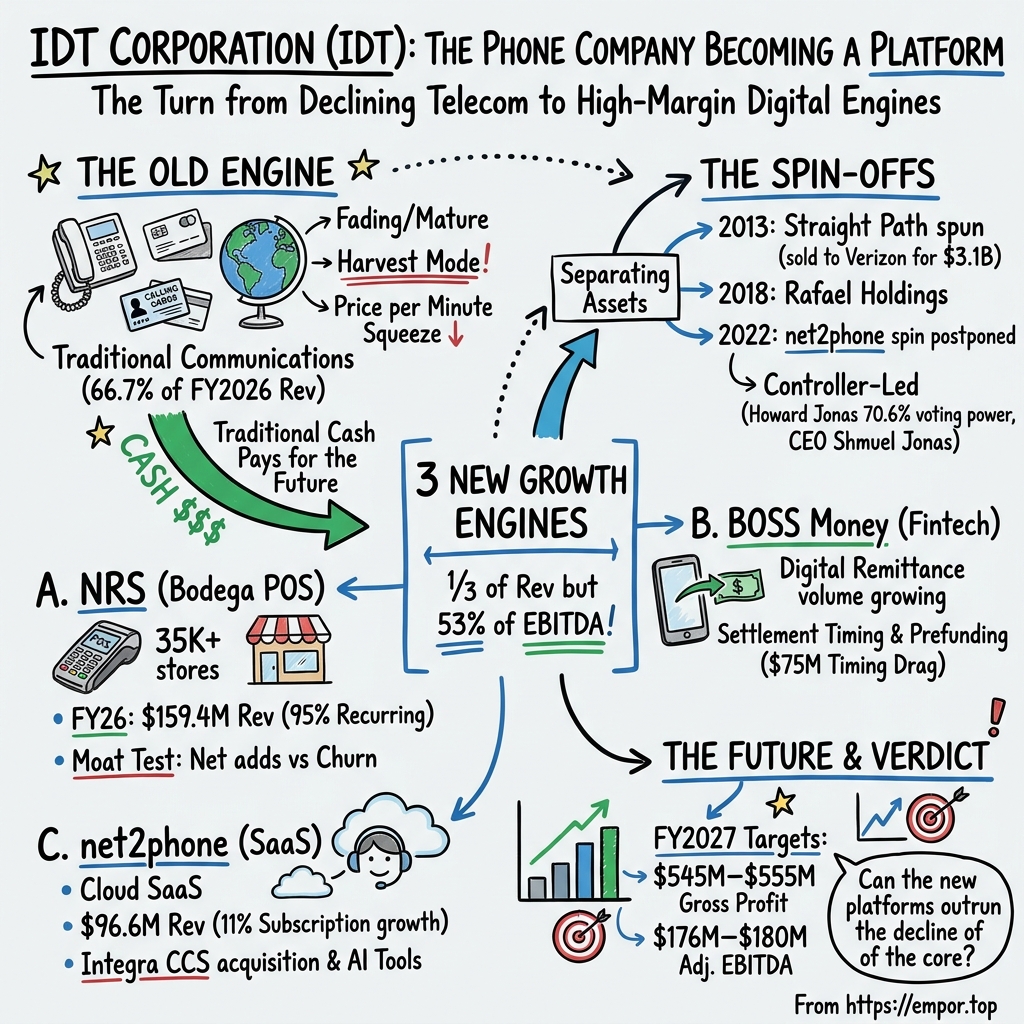
Here is the mismatch that frames this whole story. The business most people still picture when they hear "IDT"—the calling cards, the international minutes, the prepaid top-ups sold at a corner store—sits inside a segment called Traditional Communications. In fiscal 2026 that segment produced about two-thirds of all revenue.1 The other third came from three younger businesses: National Retail Solutions, a point-of-sale network for independent shops; Fintech, built around the BOSS Money remittance service; and net2phone, a cloud phone and contact-center provider. Those three produced only a third of the sales, yet management said they generated 53% of segment adjusted EBITDA before corporate overhead.12 One-third of the revenue, more than half of the profit. A company that still looks like a phone company on the revenue line looks increasingly like something else on the profit line.
That gap is the reason to tell this story now. It is also the reason to be careful telling it. Revenue mix is a fact. Profit mix is a fact. But "the growth businesses are taking over" is a forecast, and forecasts about mix are only as good as the economics underneath. A segment can contribute a rising share of profit because it is genuinely winning, or because the old segment is shrinking, or because costs are being cut in a way that cannot be repeated. The question that runs through every section below is which of those explanations is doing the work at IDT.
Three questions set the stakes. The first is whether the growth businesses can outrun the decline in traditional calling. International calling has been losing ground for two decades to mobile plans with bundled minutes and to free internet calling apps, and IDT's own filings describe parts of the legacy business as mature or in "harvest mode".3 If the old engine fades faster than the new ones scale, the company shrinks even while its mix improves. The second question is whether the new businesses have a durable edge or are simply growing in markets that larger, better-funded competitors can also reach. A point-of-sale terminal in a bodega and a remittance app on a migrant worker's phone are both crowded categories. The third question is the one minority shareholders always ask in a controlled company: does the cash these businesses generate belong to shareholders as well as to the controller?
That last question is not academic at IDT. Howard Jonas founded the company in 1990 and still controls it, holding about 70.6% of the aggregate voting power through a class of shares that carries three votes each.4 His son, Shmuel Jonas, has been chief executive since January 2014.4 Howard Jonas serves as chairman. The company has a long habit of building businesses, then spinning them out to shareholders as separate public companies, and at least one of those separations ended up in the Delaware courts. Any judgment about where IDT's value is created has to include a judgment about how the people who control it have behaved when value was being divided.
So today's IDT is best understood as a portfolio: a mature communications franchise that throws off cash, a point-of-sale network that has become the fastest-growing piece, a remittance business whose growth ties up working capital, and a cloud-communications unit that management once tried to spin off and then kept. It has no debt.3 It returns cash through buybacks and a dividend that started in 2024.3 And it trades, as of mid-November 2026, at a market value of roughly $2 billion, after a share price that rose almost 60% over the previous year.5
The verdict this story will build toward rests on evidence the company publishes rather than the labels it uses for itself: revenue mix, segment profits, customer behavior, how much of the profit turns into cash, and what management has done with that cash. To understand why the mix matters so much, it helps to start where IDT started, with a calling card and the brutal arithmetic of a minute.
 Subscribe on LinkedIn
II. A Calling-Card Company Learns the Price of a Minute
Long-distance calls out of the United States were expensive, especially to the countries where immigrants had family. Howard Jonas, a young New Jersey entrepreneur, saw an arbitrage hiding in that price. The name was the business plan: make calls abroad cheaper than the incumbents did.4 Six years later, in 1996, the company went public, riding the excitement around deregulated telecom and the early internet.6 In 2001 its shares moved to the New York Stock Exchange.6
The model is simple to describe and hard to run well. Think of IDT as a wholesaler of conversations. It buys or leases capacity on telephone networks, routes calls across borders, and pays a fee, called a termination rate, to the carrier that delivers the call at the far end. It then sells those calls twice over: to consumers, through prepaid cards and later through the BOSS Revolution app and retail network, and to other carriers, who hand IDT traffic they would rather not route themselves. The profit is the spread between what IDT pays to complete a minute and what it collects for that minute. Run enough minutes through the system and a small spread becomes a large business.
That "enough minutes" assumption is where the trouble lives. A spread business has no protection if the price falls faster than the cost, and in international voice both were falling, but not always in step. Every new carrier that entered the market, every regulator that opened a foreign telephone monopoly, every technology that made routing cheaper, pushed rates down. Volume could rise and still leave the company worse off.
The cleanest illustration comes from fiscal 2010. That year IDT's wholesale carrier business carried more minutes than the year before, and yet its revenue fell 5.6%.7 The explanation was in the price per minute. In one quarterly comparison that year, the average revenue IDT collected per wholesale minute dropped 12.5%.7 The company was working harder and getting paid less for it. More minutes did not mean more money.
That one year captures the structural squeeze that has shaped IDT ever since. On the consumer side, the prepaid calling card was being undermined by two forces at once. Mobile carriers began bundling international minutes into unlimited plans, and internet calling apps let a worker in Queens call home to Guatemala or Bangladesh for nothing more than the cost of data. On the wholesale side, the traffic that remained was a commodity, bought by carriers on price and switched on short notice. IDT's current filings still describe that exposure plainly: its IDT Global wholesale contracts include minimum traffic commitments but generally run for only one to six months.3 A customer who can leave in a quarter is not a customer who will pay a premium.
What IDT learned in those years was not how to win a price war, because nobody wins a price war in a commodity. It learned how to operate at low margins with enormous volume: how to manage routes, carriers, fraud, billing and a sprawling network of small retailers who sold its cards and top-ups. Those are real skills. They are also skills whose value depends on there being traffic to manage.
Today, the descendants of that business are grouped into Traditional Communications. In fiscal 2026 the segment still produced $865.9 million of revenue, 66.7% of the company total.3 Its flagship consumer brand, BOSS Revolution, sells international calling, and that calling revenue fell 14.6% in fiscal 2026 after a 19.8% decline the year before.3 Management does not pretend otherwise. It calls some of these offerings mature and describes parts of the portfolio as being run in harvest mode, a polite phrase for managing a product for cash rather than growth.3 It identifies free over-the-top calling apps and unlimited plans as the pressures behind the decline.3
The lesson of 2010 has therefore never really expired. Volume alone could not protect the economics then, and declining volume certainly will not protect them now. What the old business did provide, and still provides, is scale, cash, and a network of relationships with carriers and independent retailers. That raises the question every mature-business owner eventually faces. If the old engine can no longer deliver much growth, what should be done with the assets and the cash it produces? IDT's answer, for much of the last fifteen years, was to give some of the most valuable pieces away.
III. The Spin-Offs That Redrew the Company
IDT has never been a company that preserved one tidy strategy. Over the years it built, bought, sold and separated businesses as the portfolio changed. Several of those separations survive as public companies whose names still appear in IDT's own related-party disclosures, including the energy retailer Genie Energy, the mobile content company Zedge, and the real-estate and pharmaceutical holding company Rafael Holdings.3 Each was once inside IDT. Each was distributed to IDT's shareholders as a separate stock. To understand both the appeal and the cost of that habit, one spin-off matters more than the rest.
In May 2013, IDT announced that it had filed to spin off Straight Path Communications.8 The headline asset was unusual: a portfolio of wireless spectrum licenses, chiefly 629 licenses in the 39 GHz band, along with a patent-licensing business.8 In 2013 that spectrum was an oddity. Very high-frequency bands like 39 GHz carry enormous amounts of data but over short distances, and before the 5G era nobody had built a mass-market network to use them. Think of it as owning a superhighway with no on-ramps. Valuable, perhaps, if traffic ever arrived. Hard to value in the meantime.
The spin-off put that asset in shareholders' hands as a separate stock. Then the on-ramps arrived. As carriers began planning 5G networks, millimeter-wave spectrum became one of the scarcest inputs in American telecom. In the spring of 2017, AT&T agreed to buy Straight Path. Verizon came in over the top, and after a short bidding contest, Verizon won.9 The deal was valued at about $3.1 billion, and Verizon completed the acquisition in early 2018.910 An asset IDT had treated as a side holding had turned into one of the more spectacular outcomes in the company's history, and the value accrued to the shareholders who had received and kept Straight Path shares.
That is the version of the story that most people remember: a controller with an eye for overlooked assets, a spin-off that crystallized value, and a bidding war between the two largest American wireless carriers. It is true as far as it goes. The record shows something harder alongside it.
Before Verizon could close, Straight Path had to resolve a liability tied to its licenses. Federal regulators had scrutinized whether the licenses had been properly built out, and Straight Path had reached a settlement with the Federal Communications Commission in early 2017.9 Under the spin-off arrangements, IDT had indemnified Straight Path for certain pre-spin liabilities, so the question of how much IDT owed Straight Path became a live negotiation. That negotiation sat on both sides of the same family. Howard Jonas controlled IDT, and he was also the controlling holder of Straight Path's voting stock.11 The settlement Straight Path reached with IDT over that indemnity became the subject of a shareholder lawsuit in Delaware, which alleged that the controller had steered a valuable claim against IDT into a settlement that favored the company he controlled more heavily.11
The case ran for years. The trial court found that a breach had occurred but awarded only nominal damages, and the plaintiffs appealed.11 On December 3, 2025, the Delaware Supreme Court affirmed the outcome in IDT's and Jonas's favor, ending the litigation.3 IDT won, in the sense that matters on a balance sheet. In the sense that matters to a minority shareholder weighing whether to trust a controller, the case is more ambiguous. It began with a dispute over a transaction in which the controller sat on both sides, and it took a decade of corporate history and a trip to the state's highest court to resolve.
So the honest verdict on Straight Path holds two things at once. The spin-off created and revealed real value; few companies can point to a distributed side asset that later sold for billions. And the related-party fight shows why that value cannot be judged apart from governance. When one person controls both the parent and the spin, every later transaction between them has to be policed by courts and independent directors rather than by ordinary shareholder votes. The value-creation story and the governance story are the same story.
The last large separation came in March 2018, when IDT completed the spin-off of Rafael Holdings, which took the company's real-estate holdings and its interests in early-stage pharmaceutical ventures.12 Shmuel Jonas framed that separation as a way to focus IDT on what it was becoming: a company concentrated on communications and payment services.12 That statement is worth holding onto, because it is the cleanest early description of the strategy the rest of this story tests.
There is an investor lesson in the sequence. Spin-offs can be excellent tools for a conglomerate: they let markets price assets that would otherwise be buried, and they hand the decision to hold or sell back to shareholders. But in a controlled company, they also leave shareholders dependent on the controller's judgment about which assets belong inside the company, which belong outside it, and on what terms the two sides deal with each other afterward. The bar for transparent process is higher, not lower.
After Rafael, the portfolio pruning largely stopped. IDT's attention turned from separating assets to building new ones inside the company. Three of them now carry the growth story, and the first began with a cash register in a corner store.
IV. A Register in the Bodega Becomes IDT's Fastest-Growing Engine
Walk into an independent convenience store in the Bronx, a liquor shop in New Jersey or a family grocery in Houston and look behind the counter. The owner is running a business with thin margins, long hours, and a list of jobs that big retailers hand to whole departments: ringing up sales, tracking inventory, ordering stock, accepting cards, running promotions, keeping the books. The large point-of-sale platforms of the last decade were built mostly for restaurants, cafés and boutiques with a smartphone-native owner and a designer's taste in hardware. The bodega owner was not their first customer. That gap is where National Retail Solutions, NRS, built its business.
NRS sells independent retailers a checkout system: hardware at the counter, software that manages the store, and payment processing for card transactions. These are the same kinds of shops, in the same neighborhoods, that sold IDT's calling cards and mobile top-ups for years, which gave the company a natural map of where its customers were. By July 2026, the NRS network reached about 35,000 stores and roughly 40,400 active terminals.313 Its core verticals are bodegas, convenience stores, liquor stores, small grocers and tobacco shops, a slice of retail that rarely makes the pitch decks of venture-backed payments companies.
The growth has been the clearest evidence in IDT's story that the portfolio shift is real. NRS revenue rose from $103.1 million in fiscal 2024 to $159.4 million in fiscal 2026, about 55% in two years.3 Fiscal 2026 alone added 24%.1 And the quality of that revenue matters as much as the quantity: about $151.9 million of it, or roughly 95%, was recurring.3 For a business that sells to small shopkeepers, that is the difference between selling a cash register once and collecting a monthly bill for as long as the shop stays open.
Three ways to get paid by a corner store
NRS earns money in three distinct ways, and the mix among them explains why its profits have grown faster than its revenue. The first is the software subscription: retailers pay a monthly fee for the terminal and the store-management software, and a premium tier adds more features. The second is payment processing. When a customer taps a card at an NRS terminal, NRS earns a slice of the transaction, with pricing that combines a monthly charge, a percentage of the transaction's value, and a fixed fee per transaction.3 The third is advertising and data. A network of tens of thousands of independent stores, each recording what sells, when and at what price, generates a picture of a retail channel that big consumer brands find hard to see. NRS sells that visibility to advertisers and data buyers.3
The economics of each stream are different, and that is the point. A store that only rents the terminal pays a modest monthly fee. A store that also runs its card payments through NRS generates revenue every time a customer buys a soda. A store whose screen carries a beverage brand's promotion, and whose sales data feeds a brand's analytics, earns NRS more again, at very little extra cost. That is why the numbers that matter most for NRS are not terminals but how many services each store uses.
The financial results show that layering at work. Operating income at NRS reached $39.3 million in fiscal 2026, up 42% on a revenue gain of 24%.31 Its gross margin rose to about 92%.1 Think of what that means: once a store is signed and the terminal is installed, almost all of each additional dollar of software, payment or advertising revenue falls through to gross profit. In the fourth quarter alone, NRS contributed about $14 million of adjusted EBITDA.2 Annualized, that is a business producing more than $50 million of cash earnings, from a unit that most IDT shareholders a decade ago would not have known existed.
There is an outside marker of value too. In 2021, the hedge fund Alta Fox paid $10 million for 2.5% of NRS on a fully diluted basis.3 That price implied a valuation of about $400 million for the whole of NRS at a time when the business was much smaller. It is a private mark from one investor, not a market price, but it was set by a sophisticated buyer putting real money in, and it gives a useful reference point for how outsiders began to think of the unit.
The competitors behind the counter
Now the harder question. NRS operates in one of the most competitive corners of financial technology. Block's Square, Toast, Lightspeed, Fiserv's Clover and NCR all sell point-of-sale systems, payments and software to merchants, and every one of them is larger or broader than NRS. None maps neatly onto its niche. Toast is built around restaurants; Lightspeed leans toward specialty retail and hospitality; Square sells to almost anyone with a phone; Clover rides the distribution of Fiserv's bank partners; NCR has deep roots in larger grocery and convenience chains. IDT does not publish a market-share comparison, and none of those competitors reports a figure for independent bodegas and tobacco shops, so no honest share estimate is available.
The bull case for NRS rests on a specific kind of advantage: niche fit plus a growing network. The software is tailored to the inventory and compliance quirks of convenience and liquor retail. The distribution came from a company that already knew those stores. And the network itself feeds the advertising and data business: the more stores NRS covers, the more valuable its data becomes to brands, and the more it can share that revenue back with retailers or use it to subsidize pricing.
But the evidence for a moat, in the strict sense of something competitors cannot copy, is thinner than the growth suggests. The case for high switching costs would need retention data, and IDT does not disclose cohort retention for NRS. The case for pricing power would need evidence of price increases that stuck, and none is published. The data business is a plausible network effect, but its scale relative to the advertising markets of larger players is unproven. What the record supports is a smaller claim: NRS has found an underserved niche, built a recurring base in it, and learned to sell more to each store.
The company's own filing supplies the disconfirming evidence, and it belongs right here, next to the growth story. In fiscal 2026, management reported that competition had increased, that the pace of new terminal and payment-account additions slowed, and that retailer churn was elevated.32 That is exactly the mechanism that would break a moat claim. If larger providers start offering competitive terms to the same stores, the shops can switch, and some evidently did. Growth in recurring revenue does not prove recurring customers; it proves that additions and upsell outran losses during the year.
Management responded, notably, by changing what it reports. In the fourth quarter of fiscal 2026 it introduced two new measures: the number of retailer locations, rather than only terminals, and average monthly gross profit per location.213 That is a meaningful shift. A terminal count can rise because existing stores add a second register; a location count tells you whether the network of stores is actually growing. Gross profit per location tells you whether each store is becoming more valuable over time, through payments, premium software and advertising. Together, those two numbers are the right test. If locations grow and gross profit per location rises, NRS is winning. If locations stall while gross profit per location rises, NRS is extracting more from a fixed base, which works until churn catches up. If both fall, competition is winning.
The questions an analyst should press on future calls follow directly. How do cohorts of stores signed in a given year retain over time? How many services does a typical store adopt in its first two years? How much of the gross-profit growth comes from payments, which are tied to the retailer's sales, versus software and advertising, which depend on NRS's own product? The disclosures that would answer them are not yet published.
There is also a small acquisition to place in proportion. In fiscal 2026, NRS paid about $4.8 million for a controlling interest in OnCore Digital, a digital advertising brokerage, with IDT issuing about $1.5 million of its own shares as part of the consideration.3 The purchase includes contingent earnout payments tied to milestones that IDT says are not currently probable.3 The logic is clear: a brokerage that sells digital advertising could help NRS monetize its in-store screens and data across a wider set of buyers. The scale is tiny relative to IDT, and without comparable transaction multiples there is no basis to call the price cheap or expensive. It is better read as a signal of where management thinks NRS's next dollar of gross profit will come from.
So the verdict on NRS is concrete on growth and open on durability. The business has recurring revenue, a high gross margin, rising profit, and a credible plan to earn more from each store. What it does not yet have is evidence that its stores stay when someone bigger comes calling. The key number for the next year is net store growth together with gross profit per location, not the terminal count alone. If NRS is the part of IDT that most clearly earns its growth, the next engine is the one where growth comes with a working-capital bill attached.
V. BOSS Money's Growth Meets the Cash-Flow Clock
A nurse's aide in Newark finishes a Friday shift and opens an app on her phone. She sends a few hundred dollars to her mother in Port-au-Prince, tops up her brother's prepaid mobile account in Guatemala, and closes the app. To her, the transaction took thirty seconds. To IDT, it began a chain of obligations that runs across currencies, banks, payout partners and days of settlement, and somewhere along that chain the company has to put up its own money before it gets paid.
Those are the hidden mechanics of BOSS Money, the remittance service at the center of IDT's Fintech segment. When a customer sends money abroad, IDT collects the funds in the United States, while a partner in the destination country, a bank, a cash-pickup agent or a mobile wallet, pays out the recipient. Those partners often want to be funded in advance, so the money is already there when the recipient walks in. IDT therefore prefunds its disbursement partners, and it also carries settlement assets, which are amounts in transit from card processors, retailers and partners that have not yet landed in its accounts. In both cases, cash leaves IDT's control before the transaction is complete.
At the end of July 2026, IDT held $55.0 million of settlement assets and $84.8 million of disbursement prefunding.3 It also reported $138.7 million of restricted cash, money held to safeguard customer funds and for customer use, separately from the unrestricted cash it reports as its own.3 For a company with about $155 million of annual adjusted EBITDA, those are not rounding errors. They are a working-capital machine that grows as the remittance business grows.
The machine showed up clearly in fiscal 2026. Net income rose to $95.1 million from $81.1 million, yet operating cash flow fell to $91.1 million from $127.1 million.3 Profit went up, cash went down. The company's explanation was timing: settlement assets rose by $27.8 million and disbursement prefunding by $47.3 million during the year, as BOSS Money funded pending remittances and its payout partners.3 Together, those two lines absorbed about $75 million of cash that would otherwise have shown up in operating cash flow.
Viewed over three years, the picture is better. From fiscal 2024 through fiscal 2026, IDT's net income totaled about $245 million and its operating cash flow about $296 million.3 Cumulatively, cash generation beat reported profit by roughly $50 million, helped by non-cash charges such as depreciation and $10.5 million of stock compensation in fiscal 2026 alone.3 That is a healthy record. It is also a record that contains a sharp annual wobble, and the wobble is tied directly to the business management is most eager to grow. Remittance growth is not cash-free. Every new corridor and every new payout partner can require more money parked in advance.
There is one more accounting detail worth knowing, because it flatters near-term profit slightly. In fiscal 2026 IDT capitalized $12.0 million of customer-acquisition costs and amortized $5.5 million of previously capitalized amounts.3 In plain terms, some of the money spent winning new customers was recorded as an asset to be expensed over time rather than as an immediate cost. That is permitted and common, but it means a portion of current spending on growth sits on the balance sheet rather than the income statement.
A shrinking calling app and a growing money app
The growth case for BOSS Money is real. Digital BOSS Money revenue, from transactions made through the app rather than at a retail counter, grew 22% in the fourth quarter of fiscal 2026, and the broader Fintech segment grew 14% for the year.21 Digital channels matter because they cut out retailer commissions and attract younger senders who would rather tap a phone than visit a store. If the digital share keeps rising, the segment's margins should benefit.
Set that against the other product sharing the BOSS brand. BOSS Revolution calling, built on international minutes, is shrinking fast.3 The same customer who used to buy calling credit now calls home on WhatsApp for free. IDT's bet is that the relationship survives the product: that the immigrant customer who trusted BOSS for calling will trust BOSS for money transfer. That is a plausible migration path, and the digital growth figures suggest it is working for some customers. But it means one part of the brand is in decline while another is ascending, and the two are counted in different segments.
The competitive field for remittances is crowded and well-funded. Western Union and MoneyGram have physical agent networks that span almost every corridor. Remitly and Wise built digital-first businesses with heavy marketing budgets and, in Wise's case, a reputation for transparent pricing. Behind them sit digital wallets and mobile-money systems that, in some corridors, let senders bypass remittance companies altogether. IDT does not publish a market-share comparison, and the corridors where BOSS Money is strongest, often Latin America and the Caribbean, are ones where every major player competes. The case for BOSS Money is not that it is bigger; it plainly is not. The case is that it reaches a specific community through a brand and a retail network that community already used, at a cost that lets IDT earn a margin.
Currency adds a further twist. International operations produced about a fifth of IDT's revenue in fiscal 2026, down from nearly a quarter two years earlier.3 IDT says local-currency costs offset much of its exposure and does not disclose a hedging program.3 That natural offset usually works: currency moves produced a small gain in each of the last two years. But in fiscal 2024 they produced a $3.8 million loss, a reminder that a business moving money across borders cannot entirely escape the exchange rates in between.3
So the forward indicators for BOSS Money are specific. Watch digital send volume and digital revenue growth. Watch how much of the Fintech segment's profit actually comes from remittances rather than from other payment products. Watch the swings in settlement assets and prefunding. And above all, watch operating cash flow once customer-fund movements are stripped out. A remittance business that grows revenue 14% a year and turns that growth into cash is valuable. One that grows revenue but needs ever more prefunding to do it is a bank-like balance sheet hiding inside a tech-like growth story. The 2026 results show IDT somewhere between those two descriptions, and the next year will show which way it is moving.
If BOSS Money's challenge is turning growth into cash, the third growth engine has a different problem: proving that it can grow at all on a scale that matters.
VI. net2phone Bought a Contact-Center Business, Then Put Off the Spin
In the spring of 2022, IDT had a plan for net2phone, and the plan was to let it go. The company had announced its intention to spin off the cloud-communications business as a separate public company. Then, in May 2022, it postponed the separation, citing market conditions.14 The timing told its own story. Technology valuations had fallen sharply that spring, and a small, subscale cloud-phone company was not going to get a flattering price in a market that was punishing much larger software names.
Just before the postponement, net2phone had made its biggest move in years. It acquired Integra CCS, a contact-center-as-a-service provider, for disclosed consideration of up to $15 million, adding about 7,000 seats to its platform.15 The logic was straightforward. net2phone sold cloud phone systems and unified communications to small and medium-sized businesses, priced per seat, per user, per month. Contact centers are where the same customers handle large volumes of inbound and outbound calls, and they buy more sophisticated software for queuing, routing, recording and analytics. Adding a contact-center product let net2phone sell more to existing customers and compete for a richer segment of business. There is no basis here to judge the price against peer multiples, but at up to $15 million it was a modest bet relative to IDT's resources.
To picture the product, think of a dental group with five offices. Instead of buying telephone lines and a switchboard for each, it pays net2phone a monthly fee for each employee's line. Calls route over the internet, voicemail lands in email, the front desk can transfer a call to any office, and when the group grows, it adds seats rather than wiring. A contact center is the same idea at higher intensity: the group's central scheduling desk handling hundreds of calls an hour, with software that decides who answers next and records the conversations for quality review.
Four years after the postponement, net2phone is a real but modest business. It produced $96.6 million of revenue in fiscal 2026, about 7.4% of IDT's total.3 Subscription revenue, the recurring per-seat fees, was $94.9 million, up 11%.3 That is steady growth for a business that sells into a competitive market: cloud-phone and contact-center software is a field where RingCentral, 8x8, Zoom, Microsoft Teams and a long tail of regional providers compete for the same small-business customers. The structural risk is that phone service for small businesses becomes a feature inside a larger software suite rather than a product of its own.
The question the spin-off postponement leaves behind is what changed. When IDT shelved the separation, it still described net2phone as having growth and acquisition opportunities.14 Since then, management has not revived the spin, and its emphasis has shifted toward portfolio growth inside IDT, cross-segment investment and shareholder returns. That may be the right decision: a small cloud-communications company might struggle as a standalone public stock, and keeping it inside IDT lets it share overhead and capital. But it also means outside investors cannot see the market price a standalone net2phone would command, and the decision to keep it is, like every structural decision at IDT, ultimately the controller's.
Management now talks about net2phone's AI products, an AI Agent that can handle calls and a Coach product that analyzes conversations to help human agents improve.2 These are plausible extensions of a contact-center platform. Every vendor in the category is racing to put AI into the call flow, because a bot that resolves a simple customer request is cheaper than a human, and analytics that improve human agents justify a higher price per seat. But a launch is not a business. IDT has not disclosed AI-related revenue, the number of paying customers using these products, or any change in pricing attributable to them. Technical capability and paid adoption are different milestones, and the company's own history with new ventures, some of which became Straight Path-style successes and many of which did not, argues for waiting until the second milestone shows up in the numbers.
The verdict on net2phone is therefore measured. The subscription base, growing at about 11%, and the acquired contact-center capability support a real, if small, growth business. AI is an option, not yet a profit pool. The tests are seat growth, subscription growth, customer retention and margins after the Integra integration, plus any disclosure of AI revenue or customer use. If those improve, the case for eventually separating net2phone could return. If they stall, net2phone remains a useful but minor contributor to a portfolio that is still, by revenue, dominated by its oldest business.
And that oldest business, for all the talk of growth engines, is still the one paying for them.
VII. The Old Engine Still Pays for the New Ones
There is a strange kind of resilience in a business that everyone agrees is dying. Traditional Communications has been in decline for years. And yet, through fiscal 2026, management reported that the segment's adjusted EBITDA had increased for a second consecutive year.21 A business in harvest mode was still, in its own way, growing the harvest.
To see how, it helps to take the segment apart. Traditional Communications is not one business but several, each with its own meter. IDT Digital Payments handles international mobile top-up, the service that lets a customer in the United States add credit to a prepaid phone abroad; its meter is transaction volume. BOSS Revolution calling sells international minutes to consumers; its meter is minutes and price per minute. IDT Global is the wholesale carrier business, selling and buying voice traffic with other carriers on contracts that typically run only one to six months; its meter is wholesale traffic and carrier rates. IDT Express and a set of smaller offerings make up the rest.3 Together they produced $865.9 million of fiscal 2026 revenue.3
The scale of that number deserves respect. Traditional Communications on its own would be a larger company by revenue than most small-cap telecom businesses. But revenue is not where the value lies in a business that resells other people's networks. The gross margin on wholesale voice is thin, because most of what IDT collects is passed straight through to the carriers that terminate the calls. That is why the segment can generate two-thirds of revenue but less than half of segment adjusted EBITDA, while the three smaller businesses produce the majority.1 Revenue share overstates its role in future value creation; profit share is the better guide.
How did the segment's profit rise while its revenue base was under pressure? Management's answer is cost discipline: reducing network and operating costs, renegotiating carrier arrangements, trimming the expense of running products that are no longer growing, and managing the mix toward higher-margin activity.2 That is a credible explanation, and the rising gross margin across the company is consistent with it. But it carries a built-in limit. Cost reduction can protect profits for a while, but it cannot grow them indefinitely, because at some point there is nothing left to cut. Two consecutive years of rising segment EBITDA show good execution. They do not show that the segment has stopped declining.
The 2010 lesson remains relevant: the segment is still exposed to falling wholesale rates and substitution by free calling apps and bundled plans. Because IDT Global's contracts are short, a sudden loss of carrier volume could show up within a quarter.
These pressures could break the cash engine faster than management expects, particularly a sudden loss of carrier volume. None of them is new. All of them have been at work for years. The question is the pace. A slow, managed decline lets IDT harvest cash for a long time; a fast one forces the growth businesses to carry the company sooner than they may be ready to.
One more structural point matters. Traditional Communications is also where IDT's relationships with independent retailers and carriers live. The retailers who sold calling cards became prospects for NRS terminals. The carrier operations that route voice traffic are part of the infrastructure behind net2phone and BOSS Money's mobile top-up. Harvesting the old business too aggressively could weaken channels the new businesses still use. Managing it for cash while keeping its distribution intact is a more delicate operation than "harvest mode" suggests.
Management's posture is clear: run the segment for cash and efficiency while the higher-margin businesses expand. That raises the question the rest of this story has to answer. If the old franchise is funding the portfolio, what is management doing with the proceeds?
VIII. Shmuel Jonas's Record: Growth, Buybacks, and a Controller's Vote
The proxy statement IDT filed in October 2026 tells a family story in the dry language of corporate governance. It lays out the family control that frames everything else management does.4 The board can be majority independent, as IDT's is, and the votes on director elections can be comfortable, but the final word on the company's direction belongs to one person.4
The mechanics of control are simple. IDT has two classes of common stock. Class A shares carry three votes each; Class B shares, the ones that trade on the New York Stock Exchange, carry one-tenth of a vote.4 Howard Jonas owns all of the roughly 1.57 million Class A shares outstanding, plus about 2.5 million Class B shares.4 That combination gives him control of the company without owning a majority of its economics. His voting control was 69.7% in October 2020 and was above 70% in 2026, so it has been stable even as Class B ownership has moved.164 BlackRock, the largest disclosed outside holder, owned about 6.1% of the Class B shares, which translated into only about 2% of the votes.4
Shmuel Jonas took over as chief executive at a moment when IDT was still a sprawling collection of businesses, and his tenure has been defined by narrowing the company's focus. The Rafael spin-off happened on his watch, framed as a way to concentrate on communications and payments.12 NRS grew from a startup idea into the company's fastest-growing profit engine. BOSS Money moved toward digital. net2phone was readied for separation and then kept. The through-line of his decade is subtraction followed by cultivation: fewer businesses, each expected to grow inside the company rather than be handed off.
What the cash has bought
The capital-allocation record over the last three years has three visible pieces. The first is buybacks. Repurchases of Class B shares rose from $9.1 million in fiscal 2024 to $21.0 million in fiscal 2026, under an authorization from 2016 with about 3.8 million shares remaining at year-end.3 The second is the dividend, which began in 2024 and cost $6.5 million in fiscal 2026.3 The third is reinvestment: capital expenditure of $23.1 million in fiscal 2026 and technology and development spending of $55.7 million, which is the closest IDT comes to disclosing research and development.3 Headcount rose from about 1,256 employees in October 2020 to about 1,971 in September 2026, a sign that the reinvestment is mostly people and product rather than heavy infrastructure.163
Put those together and the shape is sensible. Returns to shareholders totaled about $27.5 million in fiscal 2026, roughly 30% of operating cash flow, while the growth businesses received steady internal investment. Nothing in the record suggests reckless capital deployment in the last three years. The bolder judgment would be that management has been conservative: with $271.9 million of unrestricted cash and investments and no debt, IDT could have returned more or invested more aggressively.3 The modest pace of returns relative to the balance sheet is itself a choice, and in a controlled company, the controller's preferences about liquidity shape that choice.
Compensation reads as moderate for a company of this size, but with a nuance. Shmuel Jonas received total reported compensation of about $1.45 million in fiscal 2026, of which $877,625 was bonus and just $79,420 was stock awards.4 That is a modest package for the chief executive of a company worth around $2 billion, and his pay rose from $1.09 million in fiscal 2024 as net income attributable to IDT climbed from $64.5 million to $86.6 million.4 The larger awards went to his lieutenants. Bill Pereira, the president and chief operating officer, received about $3.61 million, and the chief financial officer, Marcelo Fischer, about $3.16 million, each including option awards valued at about $2.27 million.4 Options of that size dilute shareholders if they are exercised, and they give the operators running the businesses a strong incentive to lift the share price. Whether that is good alignment or excessive dilution depends on whether the operating results keep coming.
The governance discount
The record also contains moments that minority shareholders weigh differently. In 2017, IDT sold about 1.73 million treasury shares to Howard Jonas for about $24.9 million and sought shareholder approval for a fully vested option grant to him.17 A share sale to a controller is not inherently unfair, but it is exactly the kind of transaction in which an independent process matters most. The Straight Path case ended favorably for IDT and Jonas on appeal, but it began with a dispute over a controller-affiliated transaction, and that history is part of how minority shareholders assess every subsequent one.11
Smaller related-party dealings run through the filings. IDT charges or pays modest sums to the controller-affiliated companies Rafael Holdings, Genie Energy and Zedge for shared services, legal work and marketing; the net amounts are tiny relative to revenue.3 IDT pays $18,600 a year in rent for a property jointly owned by Howard and Shmuel Jonas.3 NRS billed CTM Media Group, a company owned by the controller, nothing in fiscal 2026, yet CTM owed NRS about $627,000 at year-end.3 None of these amounts moves the financial needle. The CTM balance, though, is the kind of item an independent director or a diligent shareholder should ask about: a receivable from a controller-owned company with no billings in the year raises the obvious question of when, and whether, it will be collected.
Shareholder votes offer one window into how outsiders feel. At the 2025 annual meeting, the weakest-supported director nominee received about 86.7% of the votes cast, and an increase in the equity-incentive plan received about 85.5%.18 Because the controller's 70% vote is included in those totals, the true level of dissent among outside holders was considerably higher than those percentages suggest. The 2026 proxy seeks approval to add 75,000 shares to the equity plan, and the vote is scheduled for the December 10, 2026 annual meeting; as of mid-November, the outcome is pending.4 The plan will pass, because the controller can carry it alone. The interesting number will be how many outside shareholders vote against.
The verdict on management is therefore split along a clear line. On operating execution and capital returns, the last three years have been good: profit has risen, cash has been returned, the balance sheet is clean, and the growth businesses are getting the investment they need. On governance, the structure has not changed and cannot change without the controller's consent. The family relationship between chairman and chief executive, the unequal voting rights and the Straight Path history mean outside shareholders own a claim on the economics without a meaningful say over decisions. Whether that deserves a discount, and how large, is the question the market answers every day in the share price. The next visible tests are the December vote, the pace of repurchases, the size of future option grants, and whether management delivers its fiscal 2027 guidance.
That guidance is where the strategy stops being a description and becomes a promise.
IX. The Forecast Is a Promise the Mix Must Keep
On the fourth-quarter call in September 2026, management made its central claim in plain terms: the rising contribution from NRS, Fintech and net2phone was the key driver of IDT's future growth.2 Then it put a number on that claim. For fiscal 2027, IDT guided to gross profit of $545 million to $555 million and adjusted EBITDA of $176 million to $180 million.12 Against fiscal 2026's gross profit of $496.8 million and adjusted EBITDA of $154.6 million, that implies roughly 10% growth in gross profit and about 15% in adjusted EBITDA.1 It is a promise that the mix will keep improving, and the rest of this section tests whether the evidence can carry it.
Start with the long view, because it tempers the recent excitement. IDT's fiscal 2026 revenue of $1.298 billion was still about 13% below the $1.496 billion it reported in fiscal 2016.191 Over that decade the company spun off businesses and exited others, so the comparison is not like for like. But the profit picture over the same span is transformed: net income attributable to IDT rose from $23.5 million in fiscal 2016 to $86.6 million in fiscal 2026.191 A smaller company by revenue is a much more profitable one, which is exactly what a mix shift toward higher-margin businesses should produce.
The recent improvement is sharper still. From fiscal 2024 to fiscal 2026, revenue rose from about $1.21 billion to $1.30 billion, an increase of less than 8%.201 Over the same two years gross profit rose from $390.2 million to $496.8 million, and operating income nearly doubled, from $64.8 million to $121.2 million.201 The bridge between those numbers is gross margin, which climbed from about 32% to about 38%.201 Put simply, for every $100 of sales, IDT now keeps about $6 more after paying its carriers, processors and other direct costs than it did two years ago. Because operating expenses grew more slowly than gross profit, most of that extra margin flowed to operating income. That is the mix shift in its most concrete form: more of IDT's revenue comes from businesses like NRS, where gross margins exceed 90%, and less from wholesale voice, where most revenue passes straight through.
Does the guidance require heroics? On its face, no. Gross profit grew 11% in fiscal 2026, and the guide asks for about 10% in fiscal 2027.1 Adjusted EBITDA grew 17% and the guide asks for about 15%.1 The targets are roughly a continuation of the recent trend rather than an acceleration. The risk is not that the numbers look ambitious; it is that they depend on a narrow set of engines, and two of those engines showed strain in fiscal 2026. NRS reported more competition and higher churn. BOSS Money's growth absorbed cash. If either slows, the gap must be filled by cost cuts in Traditional Communications, which have their own limits.
The leading indicators line up neatly with the businesses. For NRS, the numbers are net retailer locations and average monthly gross profit per location, the measures management introduced in the fourth quarter. For Fintech, it is digital BOSS Money revenue growth and, equally, operating cash flow after settlement assets and prefunding. For net2phone, it is subscription revenue growth, which ran at about 11% in fiscal 2026. For Traditional Communications, it is adjusted EBITDA, which has risen two years in a row and needs to decline only slowly for the plan to work.
Who holds the power in IDT's markets
The guidance is a statement about execution, but whether that execution earns lasting returns depends on the structure of the markets IDT plays in. Run the five forces across the portfolio and the picture is mixed.
Rivalry is intense almost everywhere. In point of sale, NRS competes against larger platforms with more capital; in remittances, BOSS Money faces Western Union, MoneyGram, Remitly and Wise; in cloud communications, net2phone faces RingCentral, Zoom, Microsoft and many others; and in voice, IDT Global competes on price in a commodity market. The threat of substitutes is the defining force in Traditional Communications, where free calling apps and unlimited plans have been replacing the product for two decades, and it is a live force in remittances, where digital wallets and mobile money can bypass intermediaries. Buyer power is low at the level of individual customers, because IDT sells to tens of thousands of small shops and millions of consumers; its five largest customers made up only 12.5% of fiscal 2026 revenue, and no single customer reached 10%.3 But buyer power is high collectively, because those small customers can switch easily, as NRS's churn showed. Supplier power is moderate and hard to measure. IDT depends on carriers to terminate calls and on banks and payout partners to complete remittances, and it warns that some functions rely on one or a few suppliers, without quantifying the exposure.3 The threat of new entrants is high in payments and cloud software, where venture-backed startups keep arriving, and low in wholesale voice, where nobody wants to enter a shrinking market.
Now ask Hamilton Helmer's question: which of his seven powers, the durable sources of advantage, does IDT actually possess? Scale economies are real in voice routing and remittance processing, where fixed costs spread over volume, but larger competitors have more of them in remittances and cloud software. Network economies are the most interesting candidate at NRS, where each additional store makes the data and advertising product more valuable to brands, but the evidence that this effect is strong enough to keep stores from leaving is not yet in the numbers. Switching costs exist at NRS and net2phone, because changing a store's register or a company's phone system is a nuisance, yet the fiscal 2026 churn at NRS shows they are not high enough to stop determined competitors. Counter-positioning is a plausible fit for NRS: large platforms built for restaurants and boutiques may find it uneconomic to tailor products and sales efforts to bodegas and tobacco shops. Brand matters in BOSS Money, where trust within immigrant communities is earned over years. Cornered resources and process power are hard to identify.
The honest summary is that IDT's advantages are real but narrow. It has niche positioning and community trust, not a fortress. That is enough to grow profitably while competitors focus elsewhere. It may not be enough if they decide to come for the same customers, and NRS's 2026 churn suggests some already have.
The balance sheet and the price tag
The balance sheet gives management room to absorb mistakes. IDT reported no debt at July 31, 2026 and had not drawn on its $25 million revolving credit facility at year-end, a facility extended after year-end to July 2029.3 It held $271.9 million of unrestricted cash and current investments.1 That figure deserves one caution: it includes debt securities, equity investments and fixed-income funds that carry market risk, so it is not all cash in the bank.3 And the $138.7 million of restricted cash is held for customer use and should not be counted as shareholder liquidity at all.3 The absence of debt eliminates refinancing risk. It does not eliminate the cash-conversion swings that remittance growth can produce.
A few other items belong on the risk ledger. IDT's auditor, Grant Thornton, issued a clean opinion on both the financial statements and internal controls for fiscal 2026 and reported no critical audit matters.3 The company flags a possible sales-tax exposure following the Supreme Court's Wayfair decision, which allowed states to tax remote sellers, but gives no estimate of its size.3 It also had $25.6 million of performance bonds outstanding, a normal feature of a business that holds licenses to move money.3 None of these is large on its own. Together they are a reminder that a fintech business carries regulatory obligations that a phone company does not.
Then there is the price. In mid-November 2026, IDT shares traded at about $83, near the top of a 52-week range that ran from about $46 to about $85.5 The stock had risen nearly 59% over the previous year, giving the company a market value of about $2.06 billion and an enterprise value, after netting out its cash and investments, of about $1.79 billion.5 On trailing earnings, the shares traded at about 24 times; on analysts' forward estimates, at about 20 times.5 Measured against fiscal 2026 adjusted EBITDA, the enterprise value works out to roughly 11.6 times; against the midpoint of the fiscal 2027 guide, roughly 10 times.
What does that price assume? A year earlier, the stock was much cheaper relative to earnings: the share price rose about 59% while attributable net income rose about 14%, so most of the gain came from a higher multiple rather than higher profit.51 The market has re-rated IDT, apparently in recognition of the mix shift. That leaves less room for disappointment than a year ago. There is also a structural complication in any sum-of-the-parts comparison. The natural peers for NRS are point-of-sale and payments companies; for BOSS Money, remittance companies; for net2phone, cloud-communications vendors; and for Traditional Communications, low-margin telecom wholesalers that the market prices at modest multiples. IDT's single valuation blends all of them, and NRS and net2phone also have minority owners who share in their value. A meaningful comparison has to separate the higher-growth businesses from the communications base, and IDT does not disclose the segment-level balance-sheet detail that would make that separation precise.
So the forecast stands on credible ground: the mix is improving, the margin gain is real, the targets extend recent trends rather than reaching beyond them, and there is no debt to complicate a bad year. But the plan rests on NRS and Fintech continuing to grow while the largest segment remains exposed to substitution, and on investors continuing to grant a multiple that already reflects the shift. Fiscal 2027's results will test both. Before looking ahead, it is worth asking what IDT's long path teaches.
X. Business & Investing Lessons
The fiscal 2010 episode offers the first lesson, and it reaches far beyond telecom. Volume is a vanity metric when the price of each unit is falling faster than the cost, and the investor's job is to look past the activity number to the realized economics underneath it. IDT's modern dashboards, terminals, transactions, seats, are all volume metrics too. Each one deserves the same question that 2010 forced on the voice business: what is each unit actually earning, and is that rising or falling? It is no accident that management's newest NRS metric is gross profit per location rather than another count of terminals.
The second lesson comes from the bodega counter. Recurring revenue still has to earn its renewal. NRS's recurring-revenue figure sits alongside its reports of increased competition and churn. For founders building subscription businesses for small merchants, the lesson is that the subscription is the start of the relationship, not the moat. For investors, it is that the percentage of revenue that is recurring tells you how the money arrives, not whether it will keep arriving. Retention and expansion by cohort are the numbers that convert "recurring" into "durable", and IDT does not yet publish them.
The third lesson is the most uncomfortable, and it belongs to Straight Path. A good spin-off can still leave a governance bill. The windfall came with an indemnity dispute between two companies under the same controller, a dispute that lasted until December 2025. The value and the trust question arrived together. For controlled companies, every separation creates a new set of transactions between related parties, and the price of those transactions is paid in investor confidence long after the spin is complete. The best spin-offs pair the separation with processes that would satisfy a skeptical outsider, because sooner or later one will look.
The fourth lesson comes from net2phone, which was nearly a separate public company and now has AI products. A launch is not a business. Technical capability, product announcements and impressive demonstrations are milestones on the way to revenue, not revenue itself. IDT has a long history of starting ventures; some, like Straight Path, became valuable, and many became footnotes. The right way to treat net2phone's AI products is as options whose value will show up in subscription growth, retention and margins, or not at all. Founders hear this as a warning against confusing a product roadmap with a business model; investors should hear it as a reason to price options as options.
The fifth lesson lives in the space between a customer's phone and a recipient's hand in Port-au-Prince. A cash engine is only as useful as its conversion. BOSS Money's growth has shown how a remittance business can consume working capital in a way that growth in software does not. For anyone evaluating a payments business, the right measure of earnings is cash after customer-fund movements, not reported profit.
Step back and these five lessons form one picture. IDT has shown that a company can improve its economics long before the revenue headline shows the change. The margin record shows it has happened. But mix improvement is a necessary condition for a successful transformation, not a sufficient one. The durable version requires customers who stay, cash that converts, and a controller whose capital allocation keeps earning the trust that the structure does not guarantee.
XI. Epilogue
On the evening of November 15, 2026, IDT stands at an unusual crossroads for a company with a 36-year history. It has just reported the best year in its modern record. Its shares sit near their 52-week high. It has no debt, a clean audit, and a forecast that asks for roughly the same rate of improvement it has just delivered. And it is still, by revenue, mostly a phone company in a world that no longer pays for phone calls.
The next moment arrives in less than a month. On December 10, 2026, IDT will hold its annual meeting, where shareholders will vote on adding 75,000 shares to the equity-incentive plan.4 The outcome is not in doubt, because the controller's votes are enough to carry it. The signal is in the margin. A year ago, about 14.5% of votes cast did not support the last plan increase, which, given the controller's stake, implied that a much larger share of outside holders voted against.18 If opposition grows, it tells management that outside shareholders are uneasy about dilution and pay; if it shrinks, it suggests the operating record has bought some goodwill. Afterward, how the new authorization is used, and whether option grants to senior executives remain as large as fiscal 2026's, will be the practical test.
Then come the quarterly reports of fiscal 2027, and with them the four measures that decide whether the portfolio shift is real. The first is NRS: whether net retailer locations grow, whether churn eases from the elevated levels of fiscal 2026, whether payment-account additions recover, and whether gross profit per location keeps rising. If all four move in the right direction, NRS's niche looks defensible. If locations stall while gross profit per location rises, the business is harvesting its base, which is a reasonable outcome but a different one from the growth story the market is pricing.
The second is Fintech's cash conversion. If settlement assets and prefunding stabilize while digital BOSS Money revenue keeps growing, operating cash flow should move back above net income, and the fiscal 2026 dip will look like a timing blip. If prefunding keeps climbing with volume, investors will have to treat the remittance business as one that needs ever more working capital to grow, which lowers the value of each dollar of its reported profit.
The third is net2phone. Subscription growth of about 11% is steady but not transformative. If AI Agent and Coach start producing disclosed revenue or a visible lift in pricing per seat, the case for net2phone as a growth engine strengthens and the case for an eventual spin could return. If not, net2phone remains a solid but secondary business.
The fourth is the gross-profit and adjusted-EBITDA guide itself, alongside Traditional Communications' contribution. Hitting $545 million to $555 million of gross profit and $176 million to $180 million of adjusted EBITDA would extend a three-year run of improving margins.1 Missing it, particularly if the miss came from a faster decline in the legacy segment, would remind investors that the old engine still sets the pace.
Each outcome has a clear meaning against the questions this story began with. If the growth businesses outrun the legacy decline, IDT becomes what management says it is: a portfolio of higher-margin businesses funded, for now, by a fading but cash-rich franchise. If the legacy decline accelerates or NRS's churn worsens, IDT remains a legacy telecom company with promising but still smaller businesses attached. And in either case, the question of whether outside shareholders share fully in the result will be answered not by the vote, which the controller decides, but by the pattern of capital allocation over years.
The tension that remains is simple to state. IDT's newer businesses already earn most of its segment profit. They do not yet earn most of its revenue, and they have not yet proven that their customers stay when competition arrives. The next year will not settle the whole story. It will show which way it is bending.
XII. Outro
Somewhere tonight, a phone call is crossing an ocean, from a kitchen in Queens to a village in the Dominican Republic. Thirty years ago, that call was IDT's future: a cheaper minute, sold on a card, at a corner store. Today it probably costs nothing, routed through an app that IDT does not own.
A few blocks away, behind the counter of that same corner store, a register built by NRS is ringing up a sale, recording what sold, processing the card, and quietly feeding a network designed to earn IDT more per store each year. The old business still dominates revenue; the newer ones lead on profit. The old business is still paying for that shift.
Whether the new businesses can eventually carry the whole story is still the question. IDT is trying to turn the price of a minute into the value of a network.
References
-
FY2026 Results: IDT Corporation Reports Record Fourth Quarter and Fiscal Year 2026 Results — IDT Corporation, 2026-09-28 ↩↩↩↩↩↩↩↩↩↩↩↩↩↩↩↩↩↩↩↩↩↩↩
-
IDT Q4 FY2026 Earnings Call Transcript — Stock Analysis, 2026-09-28 ↩↩↩↩↩↩↩↩↩↩
-
IDT Corporation FY2026 Form 10-K — SEC, 2026-09-29 ↩↩↩↩↩↩↩↩↩↩↩↩↩↩↩↩↩↩↩↩↩↩↩↩↩↩↩↩↩↩↩↩↩↩↩↩↩↩↩↩↩↩↩↩↩↩↩↩↩↩↩
-
IDT Corporation FY2026 Annual Meeting Proxy Statement — SEC, 2026-10-23 ↩↩↩↩↩↩↩↩↩↩↩↩↩↩
-
IDT Corporation Statistics and Valuation — Stock Analysis, 2026-11-14 ↩↩↩↩↩
-
Verizon Beats AT&T to Buy Spectrum Holder Straight Path — Reuters via Yahoo Finance, 2017-05-11 ↩↩↩
-
Straight Path Litigation Appeal, Oral Argument — Delaware Supreme Court, 2025-04-23 ↩↩↩↩
-
IDT Completes Rafael Holdings Spin-Off — SEC, 2018-03-27 ↩↩↩
-
IDT Corporation FY2026 Investor Presentation — IDT Corporation, 2026 ↩↩
-
IDT Corporation Form 10-Q, Integra CCS Acquisition Terms — SEC, 2022-03-03 ↩
-
IDT Corporation 2025 Annual Meeting Results, Form 8-K — SEC, 2025-12-16 ↩↩
-
IDT Corporation Reports Fourth Quarter and Full Year Fiscal 2016 Results — IDT Corporation, 2016-09-28 ↩↩
 LinkedIn
 WhatsApp
 Reddit
 Hacker News
 Email
 Kindle
 RSS Feed
 Spotify
 Apple Podcasts
 Amazon Music
 Audible
 YouTube