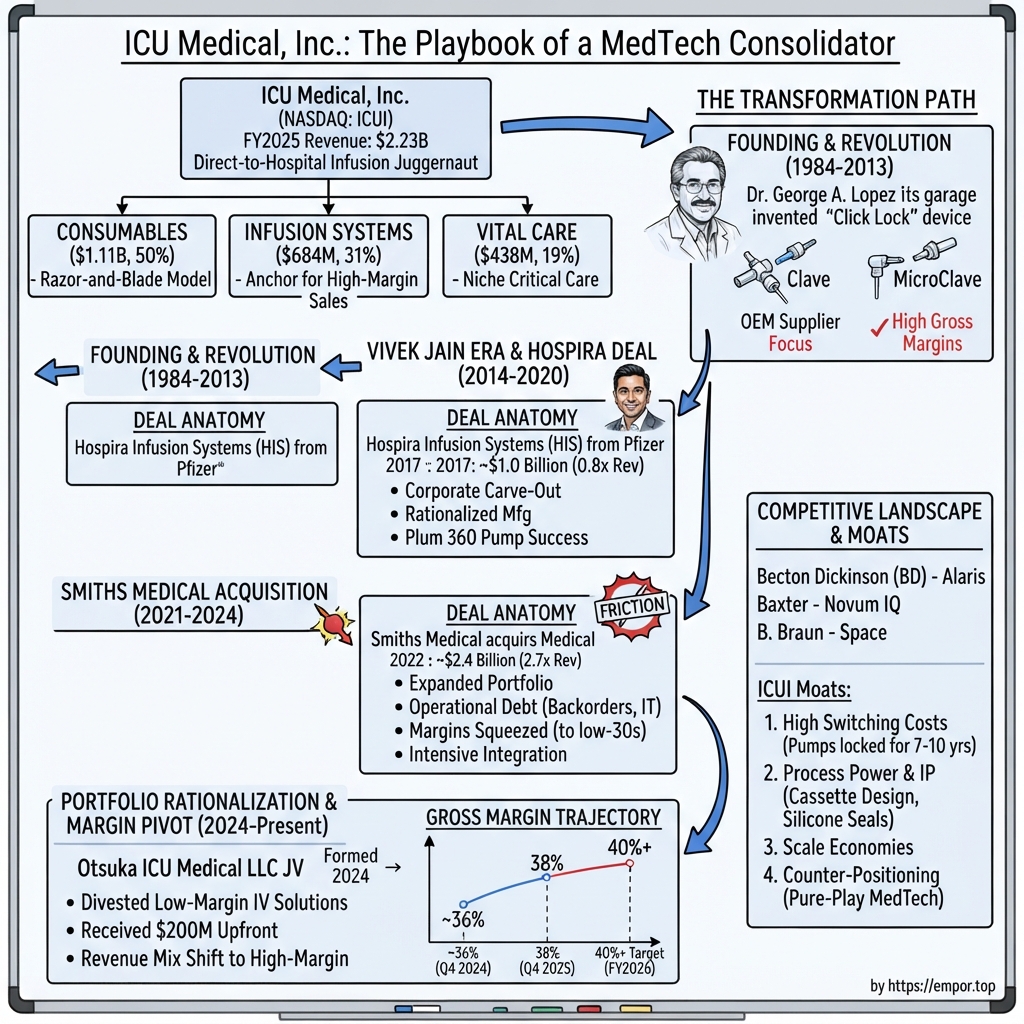
ICU Medical, Inc.: The Playbook of a MedTech Consolidator
I. Introduction & Episode Roadmap (00:00 – 08:30)
A hospital intensive care unit is defined by its lines and monitors: oxygen supply, drainage tubes, monitoring leads, and — entering a vein in the arm, neck, or chest — the intravenous catheter. That IV line is the primary mechanism through which critically ill patients receive fluids, antibiotics, sedatives, chemotherapy, and analgesics. Though among the most routine pieces of hardware in acute care, it remains one of the most critical conduits in hospital medicine.
In the early 1980s, an intravenous connection detached in a Southern California intensive care unit, resulting in a fatal patient outcome. The attending physician, Dr. George Lopez, had to inform the patient's family.1 Rather than pursuing litigation or academic publication, Lopez engineered a locking connector hub designed to prevent accidental disconnection, secured a patent, and established a commercial venture to manufacture it.
Four decades later, that venture has grown into ICU Medical, Inc., traded on the NASDAQ Global Select Market under ticker ICUI, generating $2.23 billion in fiscal 2025 revenue.2 Operating without direct consumer branding, blockbuster pharmaceutical products, or high-profile founder keynotes, the company occupies a specialized position in acute care infrastructure: manufacturing needlefree connectors, intravenous tubing sets, infusion pumps, and safety software that enforces dosing parameters.
The transition from a single-product startup to a $2.2 billion device maker was driven primarily by corporate acquisitions rather than internal research and development. Under Chief Executive Officer Vivek Jain, the company executed two large-scale carve-outs of underperforming divisions from larger corporations, yielding starkly different outcomes: the first deal expanded profitability significantly, while the second created prolonged operational and financial friction.
The core question this episode asks: ICU Medical operated for thirty years as a high-margin component supplier without direct distribution relationships with hospitals. Between 2017 and 2022, the company acquired direct hospital access through two major transactions: first purchasing Pfizer's Hospira Infusion Systems, followed by Smiths Medical from British engineering group Smiths Group plc. The Hospira transaction delivered immediate accounting gains, whereas the Smiths Medical deal led to four years of compressed operating margins, an inherited FDA warning letter, and a leverage peak of $1.7 billion in debt during a rising-rate climate.3 As management asserts that integration costs are subsiding, the central analytical question for investors is whether ICU Medical has emerged as a structurally improved franchise or merely a stabilized one.
Where the business stands today. Fiscal 2025 revenue of $2.23 billion was generated across three operating segments: Consumables ($1.11 billion), Infusion Systems ($684 million), and Vital Care ($438 million).2 Adjusted EBITDA reached $403.8 million, compared to GAAP net income of $0.7 million, or $0.03 per share.4 The substantial spread between GAAP earnings and adjusted EBITDA reflects non-cash amortization, corporate restructuring, and regulatory remediation costs incurred over four consecutive fiscal years.
Management entered 2026 with adjusted EBITDA guidance of $400 million to $430 million, absorbing the revenue reduction associated with contributing its IV Solutions business to a joint venture with Japan's Otsuka Pharmaceutical Factory.5 In its second-quarter earnings report on August 6, 2026, management raised full-year adjusted EBITDA guidance to between $415 million and $435 million, updated adjusted earnings per share guidance to $8.60–$9.00, and maintained an adjusted gross margin target of approximately 41.5%.6 Equity shares traded near $184 in mid-August 2026 within a 52-week range of $113 to $193, representing a equity market capitalization of approximately $4.6 billion.7
The roadmap. This analysis reviews the company's early development and the high-margin connector business; the appointment of Vivek Jain in 2014 and the operational scale change from the Hospira carve-out; the acquisition and four-year integration of Smiths Medical; the strategic rationale behind the Otsuka joint venture; segment-level unit economics; competitive dynamics against Becton Dickinson, Baxter, and B. Braun; strategic positioning evaluated through Hamilton Helmer's 7 Powers and Porter's Five Forces; management execution and compensation alignment; current operational risks; and the core bull and bear investment theses along with key monitoring metrics.
The overarching theme examines corporate asset carve-outs: how corporate orphans should be valued, and what operational capabilities are required to restructure them successfully.
 Subscribe on LinkedIn
II. Founding Story & The Needlefree Revolution (1984–2013) (08:30 – 22:00)
In the early 1980s, American hospitals faced growing concerns over occupational exposure to bloodborne pathogens such as HIV and hepatitis B. At the time, clinicians routinely added medication to an intravenous line by piercing a rubber port with a steel needle dozens of times per shift, rendering needlestick injuries a widespread occupational hazard.
Dr. George Lopez brought a practical clinical perspective to medical device design. After graduating from the University of Colorado School of Medicine in 1973, he practiced as a board-certified internist in intensive care units, observing firsthand the operational vulnerabilities of intravenous connections.1
His initial design, the ClickLock, locked the needle into the IV port to prevent accidental disconnections caused by patient movement or snagged lines while simultaneously shielding the needle to protect healthcare personnel.1 The device addressed both patient safety and clinician exposure to bloodborne pathogens at a time when hospital safety standards were tightening, aligning clinical safety with economic incentives.
From lock to valve. The transition from needle protection to complete elimination led to the development of needlefree connectors. ICU Medical introduced the Clave, a valve featuring a split silicone seal that opens when pressed by a syringe or tubing line and automatically closes upon withdrawal. This design eliminated needles from the connection sequence while allowing staff to disinfect the outer surface prior to medication delivery.
Engineering needlefree valves requires precise manufacturing standards. The silicone seal must actuate reliably under low mechanical force over thousands of uses, maintain a hermetic seal when inactive, and avoid internal dead space where fluid stagnation could harbor bacteria. Fluid dead space in IV connectors is a primary risk factor for catheter-related bloodstream infections, which incur substantial hospital expenses, potential reimbursement penalties, and extended lengths of stay. Consequently, product adoption relies on demonstrating infection reduction to justify capital expenditures. ICU Medical expanded this portfolio with the MicroClave and Neutron product lines. In the first quarter of 2026, the company secured an updated 510(k) clearance for MicroClave and Neutron to include newly published clinical evidence regarding infection control directly on product labeling.8
The business model that built the balance sheet. For its first three decades, ICU Medical operated primarily as an original equipment manufacturer component supplier rather than selling directly to health systems. Major infusion device and IV solution providers—including Abbott Laboratories (whose hospital products division was later spun off as Hospira), Baxter International, and B. Braun—purchased needlefree valves and customized sets in bulk to package alongside their proprietary solution bags and infusion pumps. ICU Medical functioned as an ingredient supplier, leveraging patent protection and steep regulatory barriers to entry.
This indirect supply model generated strong financial returns. In fiscal 2016, the final full year prior to its major corporate carve-outs, ICU Medical generated $379.4 million in revenue with a gross margin of 53%.9 The high margin profile reflected automated injection-molding production at scale, intellectual property protections, and high switching costs for its corporate customers.
The strategic trap. Despite these margins, the company's long-term growth faced structural limitations by 2013 due to three primary vulnerabilities.
First, customer concentration concentrated pricing power in the hands of a few large distributors and pump manufacturers. Contract renewals required negotiating with corporate buyers that possessed substantially greater scale and detailed insights into component manufacturing costs.
Second, the absence of a direct sales force left ICU Medical without direct insight into end-user hospital utilization patterns. Lacking dedicated clinical education teams or direct relationships with hospital procurement officers, the company had limited visibility into customer churn until purchase orders declined.
Third, the company faced disintermediation risk. Infusion pump manufacturers held the overarching hospital capital contracts. Health systems typically acquire infusion pump fleets on five- to seven-year capital replacement cycles, subsequently purchasing dedicated administration sets compatible with those specific pumps. Owning the pump hardware secured the recurring consumables revenue stream, whereas ICU Medical supplied a component attached to another manufacturer's device platform.
This dynamic positioned ICU Medical as a high-margin component vendor vulnerable to channel decisions made by its distribution partners. Following declining health, Dr. Lopez retired as chief executive officer in late 2013, ending his three-decade tenure and prompting the board of directors to reconsider the company's strategic orientation.
III. Enter Vivek Jain: The Operational Playbook & Hospira Mega-Deal (2014–2020) (22:00 – 40:00)
When Dr. George Lopez retired, the board appointed an executive who had never run a public company or designed a medical device. Vivek Jain joined ICU Medical in February 2014 as chairman and chief executive officer. He arrived from CareFusion Corporation, where he had led the Procedural Solutions division after managing its Medical Technologies and Services business. He had previously served as executive vice president for strategy and corporate development at Cardinal Health, directed business development and M&A at Philips Medical Systems, and worked from 1994 to 2006 as an investment banker at J.P. Morgan.2
That background pointed to a deliberate strategic pivot. Rather than recruiting another product visionary, the board selected an operational dealmaker with extensive experience pricing, acquiring, carving out, and integrating healthcare assets. Jain approached ICU Medical's strategic ceiling as an acquisition problem rather than an internal innovation bottleneck.
Over the following decade, Jain maintained an understated public profile marked by technical earnings commentary, an absence of long-dated financial targets, and little promotional rhetoric. On earnings calls, he emphasized operational discipline, noting that the business produces essential items requiring significant clinical training.6 This measured communication style provided a clear benchmark for evaluating execution against reported performance.
The orphan. In 2015, Pfizer acquired Hospira for approximately $17 billion to secure its sterile injectables and biosimilars pipeline. Attached to that transaction was Hospira Infusion Systems—a business encompassing pumps, IV solutions, and administration sets. With heavy fixed assets and low profit margins, the infusion hardware business had no strategic fit within a large-molecule pharmaceutical company.
The division was also operationally impaired. Hospira's pump franchise had endured years of quality problems and market share erosion. Jain later described the asset as a business that had come off a decade of share losses, noting that during its peak challenges, heavy price discounting failed to alter market dynamics.5
With capital-intensive operations non-core to its parent and requiring specialized hardware and quality management, Hospira Infusion Systems fit the classic profile of a corporate orphan—an asset sold primarily to eliminate operational distraction rather than maximize transaction price.
The transaction. ICU Medical completed the acquisition on February 3, 2017, announcing the final terms on February 6.10 Although headline reports cited a $1 billion transaction value, purchase accounting disclosed a lower net consideration.
Final consideration recorded in the fiscal 2017 annual report was $687.9 million: $180.8 million in cash net of working-capital adjustments, a $75.0 million three-year interest-only seller note, $19.0 million in contingent consideration, and 3.2 million newly issued ICU Medical shares valued at $140.75 each. The share consideration carried a market value of $450.4 million, reduced to $413.1 million after an 8.3% discount for lack of marketability.9 Pfizer emerged as ICU Medical's largest shareholder, holding roughly one-sixth of the enlarged company.
Because the fair value of the identifiable net assets acquired—including $417.6 million in inventory and $288.1 million in property, plant, and equipment—exceeded the purchase consideration, ICU Medical recorded a bargain purchase gain of $70.9 million.9 Bargain purchase gains occur when a seller prioritizes transaction speed and divestiture certainty over price. However, while asset values exceeded the purchase price, ongoing enterprise value depended entirely on executing an operational turnaround.
The cost of scale. The transaction fundamentally altered the company's financial profile. Annual revenue expanded from $379.4 million in 2016 to $1.29 billion in 2017, while gross margin compressed from 53% to 33%.9 ICU Medical traded a high-margin component business for a full-line platform roughly three and a half times larger, accepting lower gross margins to secure direct hospital relationships and control the end-customer interface.
What the operator actually did. Management's integration strategy focused on removing redundant corporate overhead, consolidating manufacturing plants, repricing unprofitable contracts, and directing capital into the pump hardware platform.
Rather than harvesting the installed base, ICU Medical reinvested in the Plum platform. The Plum 360 infusion system subsequently earned top marks in provider surveys, receiving Best in KLAS honors in the Smart Pump EMR-Integrated category. By February 2025, the company reported its eighth consecutive year of recognition, having become in 2023 the first pump honored in both EMR-integrated and traditional categories.11 For a business acquired after years of market share losses, sustained customer satisfaction metrics signaled operational stabilization ahead of contract renewals.
By fiscal 2019 and 2020, the combined company generated approximately $1.27 billion in revenue, produced GAAP net income above $85 million, and carried no meaningful debt.12 The Hospira integration established direct hospital distribution and demonstrated management's ability to absorb and restructure a distressed corporate carve-out.
That operational success provided the template—and built the confidence—for the company's next major transaction.
IV. The Smiths Medical Acquisition: Ambition Meets Operational Friction (2021–2024) (40:00 – 58:00)
A specific hazard often follows a successful turnaround: assuming the playbook itself constitutes the skill. Having restructured Hospira Infusion Systems, ICU Medical sought another distressed corporate carve-out in September 2021. It selected a significantly larger target, paid a premium valuation, and entered the transaction during a global supply-chain disruption.
The setup. On September 8, 2021, ICU Medical announced an agreement to acquire Smiths Medical from British engineering group Smiths Group plc for $2.35 billion in cash and stock, alongside assumed liabilities and a contingent earn-out. Headline terms specified $1.85 billion in cash, 2.5 million newly issued ICU Medical shares then valued at approximately $500 million, and up to $100 million in performance-contingent cash. Upon closing, Smiths Group held roughly a 10% equity stake in the combined entity, which generated pro forma annual revenue of about $2.5 billion.13 The transaction closed on January 6, 2022.14
Final purchase accounting pushed total consideration to $2.55 billion. This comprised $1.92 billion in cash, $53.5 million in contingent consideration, and 2.5 million shares valued at $230.39 per share on the closing date ($576.0 million). Net identifiable assets acquired totaled $1.08 billion, generating $1.47 billion in non-tax-deductible goodwill alongside $945 million in identifiable intangibles—primarily $510 million allocated to customer relationships and $400 million to developed technology.3
Comparing the two carve-outs highlights a distinct shift in strategic posture. While Hospira was acquired below the fair value of its hard assets, Smiths Medical was purchased for roughly two and a half times revenue, with over half the purchase price recorded as goodwill. The Hospira transaction operated as an asset arbitrage; the Smiths Medical deal was a high-priced bet on enterprise synergies and product scale.
Why it made sense on paper. The strategic logic addressed a real commercial gap. ICU Medical's infusion pump franchise focused primarily on large-volume pumps—pole-mounted units administering fluids over extended hours. Hospital systems also require dedicated syringe pumps for precise dosing in neonatal and anesthesia environments, as well as ambulatory pumps for outpatient pain management and chemotherapy. Smiths Medical supplied the Medfusion syringe pump portfolio and CADD ambulatory family, alongside Jelco vascular access catheters and Portex airway management lines.
Chief Executive Officer Vivek Jain described the rationale in platform terms, stating the objective was "to have the most modern infusion devices connected to a single software solution across hospital LVP, syringe and ambulatory pumps," utilizing a unified interface that "minimizes training, speeds onboarding, supports interoperability and enables standardization for our enterprise customers."6 For healthcare procurement officers managing thousands of devices across multiple clinical sites, consolidating hardware and safety software under a single vendor presented a compelling operational argument.
What the price failed to discount. Alongside the product lines, ICU Medical acquired years of accumulated operational neglect that were not fully priced in preliminary diligence.
In 2021, prior to the transaction's close, Smiths Medical received an FDA warning letter regarding its Oakdale, Minnesota facility, citing non-compliance with medical device reporting regulations and Quality System Regulation standards.2 ICU Medical finalized the purchase aware that regulatory authorities had formally flagged quality control failures at the target assets.
Subsequent macroeconomic pressure exacerbated these internal operational challenges. Operating performance in 2022 diverged sharply from initial targets, resulting in an approximate $100 million EBITDA shortfall against internal budget expectations. Freight costs, logistics bottlenecks, and adverse foreign exchange movements accounted for over $50 million of the negative variance, while revenue shortfalls at Smiths Medical contributed an additional $30 million. Raw material inflation and spot-market component pricing added over $30 million in cost drag, which was only partially offset by accelerated synergy realization.15
Adjusted gross margin for fiscal 2022 fell to 36%, well below management's initial target of 40%.3 Annual freight and logistics expenditures spiked to $240 million, driven in part by expensive air freight deployed to address legacy Smiths fulfillment backlogs and prevent customer churn.15 Inventory levels expanded by roughly $200 million as management accumulated buffer stock to insulate assembly lines. By the fourth quarter of 2022, quarterly free cash flow dropped to negative $23 million, while net debt reached $1.7 billion against $214 million in cash—coinciding directly with monetary policy tightening and rising interest rates.3
The candor question. Management's disclosure strategy during the integration period provides a critical benchmark for evaluating corporate governance and operational communication.
In earnings calls throughout the downturn, disclosure remained detailed and itemized. Jain outlined the specific cost bridges separating target projections from reported results, distinguishing between permanent structural inflation and transient operational friction. Addressing customer fulfillment backlogs, Jain characterized operational remediation as "halfway there," noting that while backorders had declined more than 65% from their mid-2022 peak, backorder reductions represented a service recovery metric rather than a backlog of deferred revenue.15 Management also disclosed subsequent regulatory interactions, including an unannounced FDA inspection, acknowledging the challenging timing while updating public guidance.
However, detailed reporting did not offset the underlying diligence oversight. Despite extensive carve-out experience and known regulatory warnings at the target company, management underestimated the time and capital required to remediate legacy manufacturing infrastructure. Jain's subsequent characterization—noting "we lost time" and "it cost a little bit more capital"—acknowledged the operational setback, though it simplified a multi-year financial drag.15
The grind. Operational recovery required a prolonged capital effort. ICU Medical had to separate Smiths Medical's IT infrastructure from the parent company under a transition services agreement before migrating operations onto its own ERP system, while simultaneously consolidating manufacturing plants, overhauling quality control systems, and executing field corrective actions mandated by regulatory notices. In fiscal 2022 alone, the company paid $37.6 million in transition service fees to maintain temporary access to legacy administrative systems.3
Financial recovery progressed slowly. GAAP gross margin, which stood at 32.8% in 2023, recovered modestly to 34.6% in 2024.2 GAAP net losses persisted, totaling $74.3 million in 2022, $29.7 million in 2023, and $117.7 million in 2024.12 Furthermore, annual interest expense on the debt-financed acquisition exceeded $100 million from 2023 onward.2
By late 2024, three years post-acquisition, ICU Medical maintained an expanded infusion hardware platform but faced elevated leverage, slow gross margin recovery, and lingering operational drag from non-core business segments. These factors prompted management to re-evaluate capital allocation and explore structural portfolio changes.
V. Portfolio Rationalization: The Otsuka IV Solutions JV & Margin Pivot (2024–Present) (58:00 – 1:12:00)
Consider what an IV solutions business actually is. It manufactures sterile salt water and dextrose in plastic bags, in enormous volume, to pharmaceutical-grade standards, in dedicated plants that cost hundreds of millions of dollars — and then ships it, by weight, across a continent. A litre of saline weighs a kilogram. The product is essential, regulated, chronically short in the United States after hurricanes and plant outages, and priced like a commodity because it is one.
It is, in other words, the exact inverse of a needlefree connector: heavy instead of light, capital-intensive instead of capital-light, freight-exposed instead of freight-immune, and priced by procurement instead of by clinical evidence. Jain had been saying so publicly since at least early 2023, when he told analysts that for IV solutions "the value of the product and its pricing are out of line" and pointedly declined to discuss competitors' predicaments.15
The deal. On November 12, 2024, ICU Medical entered into a purchase agreement with Otsuka Pharmaceutical Factory America, Inc. — a subsidiary of Japan's 大塚ホールディングス Otsuka Holdings Co., Ltd. — to divest a controlling interest in its IV Solutions business.2 The stated logic on both sides was supply-chain resilience: Otsuka Pharmaceutical Factory operates sixteen IV solutions production sites across Asia and wanted North American access for its PVC-free bag technologies, while ICU Medical wanted the assets off its balance sheet without abandoning its customers.16
The mechanics closed in the spring of 2025. ICU Medical formed a new entity, contributed the IV Solutions assets, liabilities, and operations to it, and on May 1, 2025 sold 60% of it to Otsuka Pharmaceutical Factory America, retaining 40% and two of the five board seats.2 The renamed vehicle is Otsuka ICU Medical LLC.
The financial terms, disclosed in the FY2025 annual report, are more nuanced than the headline "$200 million upfront" suggests. Cash proceeds were $211.2 million subject to conventional adjustments. ICU Medical recorded a combined gain of $44.8 million, built from a $45.6 million gain on the disposal of the 60% interest plus a $19.4 million step-up on remeasuring its retained 40% stake to fair value, less a $20.2 million liability recorded because the services ICU Medical agreed to provide the joint venture — commercial, logistics, administrative, and certain component manufacturing, for up to five years — were priced below their fair value.2
That last item deserves attention, because it is the kind of thing that separates a clean exit from a partial one. ICU Medical did not walk away. It agreed to keep selling, warehousing, shipping, and partly manufacturing for the business it had just sold control of, at rates the accountants judged to be under market. The unfavourable contract liability is being released back through the income statement over five years, reducing reported costs. Otsuka holds a call option on ICU Medical's remaining 40%, and ICU Medical holds a put, both exercisable at specified dates beginning five years after closing at values tied to historical financial metrics.2 There is also contingent consideration payable if the joint venture beats plan on 2026 revenue or gross margin, which the company has not recognized.
So the structure is best understood not as a divestiture but as a staged exit with a defined off-ramp — one that removes the manufacturing capital and the commodity margin from ICU Medical's books today while preserving both the customer relationship and an option on the eventual value.
What it did to the numbers. The mechanical effect was large. IV Solutions revenue fell $213.9 million in 2025 as a result of the transaction, and Vital Care as a whole dropped from $690.7 million in 2024 to $437.9 million in 2025.2 Total revenue therefore declined 6.3% year over year even as the two businesses management actually cares about grew.4
Underneath the optical decline, Consumables rose from $1,038.9 million to $1,109.1 million and Infusion Systems from $652.4 million to $684.2 million.2 On the February 2026 call, Jain characterized the organic growth as 6% for consumables and 5% for infusion systems for the full year, on top of 7% each in 2024.5 Consolidated organic growth for 2025 was 5%.
The margin effect was the entire point. GAAP gross margin improved from 34.6% in 2024 to 36.8% in 2025, and adjusted gross margin exited the year at 40.5% in the fourth quarter — against the 36% trough of 2022.25 Roughly $250 million of revenue left the building and gross margin went up. That is the arithmetic of mix, and it is the clearest evidence in the file that management understands the difference between growing revenue and creating value.
The proceeds went to the balance sheet. Of the cash received, $200 million was applied directly to the Term Loan A in the second quarter of 2025. Across the full year the company paid down $303 million of principal, closing 2025 with $1.3 billion of term debt and $308 million of cash, and a net leverage ratio just under 2.5 times.25 On October 31, 2025 it refinanced, replacing the existing Term Loan A and revolver with a new five-year $750 million Term Loan A maturing October 2030 and a $500 million revolving facility, using $190 million of the cheaper Term Loan A proceeds to retire higher-rate Term Loan B debt in a cashless roll.2
A signal worth noticing. Credit rating agencies took time to be convinced, and then moved. At the filing of the FY2025 annual report in February 2026, ICU Medical's issuer and Term Loan B ratings stood at B1 from Moody's with a stable outlook, BB/BB+ from Fitch with a negative outlook, and BB− from S&P with a positive outlook.2 By the second-quarter 2026 filing in August, Moody's had upgraded to Ba3 and Fitch had moved its outlook from negative to stable.17 Rating agencies are slow, backward-looking, and unromantic — which is exactly why an upgrade and an outlook revision inside six months is a more credible endorsement of the deleveraging story than any management slide.
A second-layer note on cash quality. One item in the 2025 disclosures deserves a careful reader's attention. ICU Medical has run a receivables purchase program — effectively selling trade receivables to a bank for early cash. In 2024 it sold $435.4 million of receivables under that facility. In 2025 it sold $10.0 million.2 Winding a program like that down is a headwind to reported operating cash flow, not a tailwind. So the $99.9 million of free cash flow reported for 2025, against $125.4 million in 2024, was generated while the company was simultaneously stepping back from a working-capital financing tool.4 That makes the 2025 cash figure lower in headline and arguably higher in quality than the year-over-year comparison suggests — a distinction that matters given how central free cash flow is to the deleveraging case.
The portfolio was now pointed in the right direction. What it points at is worth understanding in detail.
VI. Core Business Economics & Segment Anatomy (1:12:00 – 1:26:00)
Inside the supply room of a typical American hospital, ICU Medical's business model exists in physical form. On one shelf sit boxes of clear plastic needlefree valves and coiled tubing sets, consumed and discarded by the thousand every week. Parked in the hallway are pole-mounted infusion pumps with expected operational lifespans of seven to ten years. Running on central servers is dose-error reduction software that enforces clinical safety limits for those pumps.
These three product categories constitute the company's operating segments, each governed by distinct economic drivers.
Consumables — $1.11 billion, 50% of revenue. Representing the descendant of the original franchise, Consumables serves as the primary engine of corporate profitability. The segment encompasses the Clave, MicroClave, and Neutron needlefree connector lines, disinfection caps, extension sets, custom IV tubing, safety catheters, oncology products—including closed-system transfer devices that protect pharmacists compounding chemotherapy—and, following the Smiths Medical transaction, vascular access and tracheostomy lines.2
The segment produces the company's highest margins for three reinforcing reasons. First, products are single-use and non-discretionary: hospitals cannot defer purchasing connectors and IV lines during budget constraints without halting patient care. Second, unit costs are low relative to the clinical and financial expense of catheter-related bloodstream infections, limiting buyer pushback during price negotiations. Third, high-volume automated injection molding across facilities in the United States, Costa Rica, Mexico, and the Czech Republic creates unit-cost advantages and substantial capital barriers to entry.2
Segment revenue growth provides the clearest indicator of underlying demand because it remains insulated from multi-year capital replacement cycles. In the fourth quarter of 2025, management reported high single-digit growth across three product families—infusion consumables, oncology, and tracheostomy—while vascular access lagged, requiring operational stabilization and updated product lines to reverse market share losses.5
Product development in consumables relies on steady, incremental refinement. In the first quarter of 2026, ICU Medical received two 510(k) clearances: one for an oncology device bonding Clave connectors to access ports and non-PVC, non-DEHP IV bags, and another for an updated disinfection cap expanding its SwabCap line. Chief Executive Officer Vivek Jain characterized these additions as the routine operational execution required to sustain long-term consumables growth.8 Market leadership in connector markets depends not on disruptive breakthroughs, but on progressively integrating safety enhancements into clinical workflows while updating product labels with clinical infection control data.
Infusion Systems — $684 million, 31% of revenue. This segment encompasses hardware and safety software platforms: the Plum 360 along with the newer Plum Duo and Plum Solo large-volume pumps, Medfusion syringe pumps, CADD ambulatory pumps, proprietary administration tubing sets, and dose-error reduction software—formerly MedNet, now succeeded by the LifeShield platform, which secured FDA clearance for its latest version in the first quarter of 2026.8
The technical differentiation of the Plum platform lies in its pumping mechanism. Most competing large-volume pumps rely on linear peristaltic action, using external rollers to compress flexible tubing to advance fluid. Delivering a secondary medication concurrently requires hanging a second IV bag higher than the primary bag, leaving flow rates dependent on gravity, line pressure, and head height—factors that frequently trigger false air-in-line alarms and increase clinician alarm fatigue.
The Plum system utilizes a rigid cassette containing an internal pumping chamber. Both primary and secondary lines connect directly into the cassette, allowing the pump mechanism—rather than gravity—to control fluid delivery while automatically trapping and venting air. This enables clinicians to administer two compatible medications simultaneously without adjusting bag heights or managing nuisance alarms. This functional design has contributed to the Plum's multi-year recognition in provider satisfaction surveys.
The economic challenge of the Infusion Systems segment historically centered on hardware profitability. Management noted that segment value derives from four streams: dedicated administration sets, software and maintenance services, pull-through of adjacent consumables, and pump hardware sales. Jain acknowledged that the business historically generated insufficient margins on the pump devices themselves.5 To address this, the newer Duo and Solo platforms were launched at higher average selling prices. On the August 2026 earnings call, Jain stated that realization prices were holding because the clinical utility of the devices justified the list pricing, though the financial impact of this pricing strategy will depend on gross margin trajectory in subsequent quarters.6
Strategically, the hardware platform functions as an anchor for recurring revenue. Installing an infusion pump fleet secures dedicated tubing set sales for the seven- to ten-year lifespan of the hardware, while placing clinical support teams inside hospital accounts to support broader consumables adoption.
Vital Care — $438 million, 19% of revenue. Following the joint venture transaction, Vital Care includes Portex airway management and tracheostomy products, hemodynamic monitoring, respiratory and general anesthesia, temperature management, and regional anesthesia lines, alongside the IV solutions manufactured and distributed on behalf of Otsuka ICU Medical LLC.2
Management has characterized Vital Care as less synergistic with the core infusion business and a drag on corporate growth, noting that gross margins across most of the segment trail the company average.5 In response, the company initiated a deliberate SKU rationalization program throughout 2025 and 2026, pruning low- and negative-margin product lines, including exiting a Japanese surgical business that had declined from over $20 million in revenue to under $10 million.8 These structural exits resulted in a 14% organic revenue decline in the segment during the first quarter of 2026 before stabilizing to a 4% organic contraction in the second quarter.86
Consequently, Vital Care operates primarily as a cash-generating portfolio managed for optionality while leadership evaluates potential divestitures. Asked about divestiture timing in August 2026, Jain indicated that finding an acceptable alignment of buyer interest, valuation, and transaction structure remains ongoing.6
The shape of the whole. In its post-restructuring form, ICU Medical operates as roughly half high-margin consumables, one-third hardware and safety software that anchors customer relationships, and one-fifth legacy specialty products managed for cash and divestiture. In fiscal 2025, domestic sales accounted for 61% of total revenue, with Europe, the Middle East, and Africa contributing $411.7 million, Asia-Pacific generating $232.9 million, and remaining international markets representing $230.6 million.2 The company employs approximately 13,000 personnel across more than 35 countries and reports financial results under a single operating segment, with the chief executive officer acting as the chief operating decision maker.2
This single-segment financial structure limits external visibility into individual product-line economics. Disclosed segment data is restricted to top-line revenue and standard direct costs, while manufacturing variances, freight expenses, quality systems overhead, and regulatory remediation costs are aggregated at the corporate level.2 As a result, exact segment-level gross margins remain unquantified, requiring investors to evaluate product profitability through consolidated margin trends and management disclosure.
Evaluating ICU Medical's long-term competitive position requires analyzing how these three business layers perform against established medical device peers and industry dynamics.
VII. Industry Structure & Competitive Dynamics (1:26:00 – 1:40:00)
In March 2020, as the pandemic began, Becton Dickinson issued a voluntary Class I recall on its Alaris infusion system. What followed was one of the longest competitive vacuums in modern medical device history. Alaris was the most widely installed pump platform in American hospitals. For more than three years, BD could not freely ship new units into the United States while working through remediation. Every hospital requiring pumps during that window had to seek alternative suppliers.
That competitive window has now closed. On July 21, 2023, BD received 510(k) clearance for its updated Alaris system, covering new hardware across large-volume, syringe, and patient-controlled-analgesia modules alongside software featuring enhanced cybersecurity and electronic health record (EHR) interoperability, subsequently launching a plan to remediate or replace its entire existing U.S. installed base.18
The field. North American infusion operates as an oligopoly with a small number of scaled participants and virtually no fringe suppliers.
Becton Dickinson remains the largest participant, operating as a diversified medical technology company across specimen collection, medication management, and surgery in addition to infusion. Its scale provides a distinct commercial mechanism: BD can bundle products across broad clinical categories in a manner pure-play device makers cannot match.
Baxter International competes in both solutions and pumps with its Novum IQ and Spectrum IQ platforms and serves, alongside B. Braun, as the primary competitor to the products ICU Medical distributes on behalf of the Otsuka joint venture.2
B. Braun Medical, the U.S. subsidiary of the family-controlled German group, maintains an established presence across pumps, solutions, and consumables in both domestic and international markets.
Beyond these major players, ICU Medical's regulatory filings identify Fresenius Kabi and Moog Medical in infusion systems; AngioDynamics, Teleflex, EquaShield, and Medtronic in consumables; and Edwards Lifesciences, Belmont, and Intersurgical plc in Vital Care.2 The filings explicitly acknowledge the competitive landscape, noting that these competitors "benefit from greater financial, research and development and marketing resources than we have."2
How the buying actually works. Hospital procurement of infusion hardware differs fundamentally from standard enterprise purchasing. Health systems conduct multi-month evaluations involving nursing, pharmacy, biomedical engineering, information technology, and supply chain teams. Procurement requires testing bidirectional integration with electronic health record platforms — primarily Epic or Oracle Health — to ensure physician orders flow to the pump and delivery data routes back to the patient chart. Staff must validate drug libraries and train thousands of clinicians, executing transactions through group purchasing organization (GPO) contracts that govern pricing and access.
Group purchasing organizations aggregate buying power across hundreds of hospital systems. ICU Medical's disclosures indicate that a substantial volume of its U.S. product flow targets GPO member hospitals, warning that competitive dynamics within GPO and integrated delivery network contracting may impair its ability to secure or retain contract positions across its portfolio.2 Disclosures further highlight that several larger competitors "have been successful in obtaining full-line contracts with a significant number of hospitals and group purchasing organizations to supply all of their infusion product requirements."2
Full-line contracting allows diversified suppliers to leverage product breadth to exclude focused competitors. ICU Medical's counter-strategy relies on offering enterprise coverage — providing pumps across multiple clinical formats, consumables, and IV solutions through its joint venture — to respond to full-line RFPs. However, whether that portfolio remains competitive against bidders bundling non-infusion categories, such as specimen collection or surgical products, remains an open structural question.
What the current evidence actually shows. Following Alaris's return to the market, ICU Medical's pump business expanded rather than contracted. Infusion Systems generated 6% organic revenue growth in the first quarter of 2026 and 12% organic growth in the second quarter, with management reporting record pump shipments in both periods.86
Analyst disclosures provide important context for these figures. Addressing whether quarterly performance signaled a broader capital replacement cycle, Chief Executive Officer Vivek Jain clarified in August 2026 that the company had not yet entered its core upgrade cycle, attributing shipments to installations of previously executed competitive wins.6 Jain noted that pull-forward timing rendered the 12% growth rate unnaturally high and unsuitable as a baseline run-rate, adding that broader market dynamics reflected normal replacement patterns rather than a generalized market acceleration.6
Similarly, when addressing competitor market share claims on the May 2026 call, Jain noted the difficulty of making direct comparisons across vendor reporting, observing that stated share gains across competitors often conflict and that reported revenues offer the only reliable baseline.8
The competitive verdict, stated honestly. ICU Medical maintains three structural advantages in acute care infusion. First, its cassette-based pump architecture addresses dual-line administration workflows more effectively than peristaltic alternatives, contributing to top-category rankings in provider surveys for eight consecutive years.11 Second, its connector franchise maintains established clinical data supporting infection prevention.8 Third, upon securing remaining clearances for its syringe and ambulatory platforms, the company will offer a single software management layer across all major pump formats.
Conversely, two structural disadvantages persist. ICU Medical remains smaller than its primary diversified competitors, operating with fewer cross-category bundling capabilities. Furthermore, the business sells into institutional procurement channels that systematically seek to commoditize hardware differentiation to compress unit pricing.
Ultimately, ICU Medical has transitioned from a period of operational disruption and share loss to a position of portfolio stability and product momentum. The long-term durability of that position depends on maintaining execution across its core consumables and hardware platforms as competitive replacement cycles unfold.
VIII. Strategic Moats & 7 Powers Analysis (1:40:00 – 1:52:00)
Hamilton Helmer's framework asks a deliberately narrow question: not "what is this company good at?" but "what condition creates a persistent differential in returns that a competent competitor cannot arbitrage away?" Applied to ICU Medical, the structural reality is that one power is strong, two are moderate, and one commonly claimed on its behalf does not survive scrutiny.
1. Switching costs — the primary power, and it is real. A large health system operating several thousand infusion pumps that decides to change vendors undertakes a multi-year enterprise project: capital expenditure to buy the fleet, biomedical engineering time to configure and validate every device, IT resources to build and test bidirectional integration with the electronic health record, pharmacy effort to rebuild the drug library from scratch, clinical education for every nurse across every shift and site, and a period of operational risk while staff adapt to a new bedside interface.
The evidence that these costs bind is behavioural rather than theoretical. Chief Executive Officer Vivek Jain has described the replacement decision in terms hospital executives recognize, noting that "it's a little bit like the car analogy I always use — the thing depends how many more miles you got available to you," and stating that the company does not "want to squeeze our customers into having to upgrade or get an off capital cycle earlier than they need to."6 A vendor capable of forcing early upgrades would do so; that ICU Medical cannot is proof that the purchasing cadence is governed by the customer's capital budget, which operates on seven- to ten-year replacement cycles.
The corollary is what makes this power valuable rather than merely inconvenient: whoever holds the installed base holds the dedicated administration set annuity, which carries the segment's highest margins. ICU Medical's historical experience demonstrates the cost of losing that base: following the legacy Hospira share losses, Jain noted that the company's installed foundation "had gone backwards, from here was very low," requiring years of operational effort to rebuild.5
2. Cornered resource and process power — moderate, and partly unverifiable from outside. The Plum cassette architecture and needlefree connector seal designs are protected by patents and proprietary manufacturing know-how. However, the company's fiscal 2025 annual report includes a notable qualification: "there is however, no single patent or group of patents that we own that we believe is material in relation to our business as a whole," alongside disclosures warning that patent protections face eventual expiration.2
Evaluating the asset base objectively, the intellectual property consists of a broad portfolio and accumulated process knowledge — such as molding silicone seals to actuate consistently over thousands of cycles or operating validated cleanroom lines at high volume — rather than a single defensible patent. This represents a tangible but slowly eroding advantage, making the continuous cadence of incremental regulatory clearances in consumables essential to preserving market position.
3. Scale economies — moderate, and relative rather than absolute. ICU Medical maintains genuine scale in high-volume molded consumables, with production concentrated across facilities in the United States, Costa Rica, Mexico, and the Czech Republic.2 Within the narrow needlefree connector and administration set category, this manufacturing footprint provides meaningful cost efficiencies. Relative to diversified competitors such as Becton Dickinson or Baxter International, however, ICU Medical remains significantly smaller, a resource disadvantage explicitly acknowledged in its corporate risk factors.2
This geographic footprint also introduces structural exposure. A substantial share of global revenue depends on products manufactured in Costa Rica and Mexico for export to the United States. That concentration created financial headwinds following shifts in U.S. trade policy: ICU Medical recorded $34.3 million in tariff expenses in fiscal 2025 and projected fiscal 2026 tariffs at approximately 2% of revenue, with Jain estimating the incremental annual cost drag at $30 million to $40 million.256 Offshoring production to adjacent low-cost markets provides scale efficiencies only so long as trade barriers remain stable.
4. Counter-positioning — this one does not hold. Industry observers sometimes suggest that ICU Medical benefits from counter-positioning, arguing that a dedicated focus on infusion allows it to commit resources that diversified competitors will not match.
In Helmer's framework, counter-positioning requires that an incumbent be structurally unable to respond without cannibalizing its existing core business. Neither Becton Dickinson nor Baxter faces such a constraint; both invest heavily in infusion platforms at far greater absolute scale. Pure-play focus represents an organizational discipline and capital allocation choice rather than a structural economic moat.
Porter's five forces, tested rather than asserted.
Supplier power — low. Raw materials consist primarily of medical-grade polymers, silicones, and electronic components, which are broadly available. The primary exposure lies in single-source supply dependencies, which the company identifies as an operational risk: a disruption or quality defect at a single-source supplier could materially impair manufacturing schedules.2 Aggregate supplier power remains low, but tail risk is concentrated.
Buyer power — high and rising. Group purchasing organizations, integrated delivery networks, and consolidated health systems exercise substantial pricing leverage in an environment focused on healthcare cost containment. Legislative developments further amplify buyer pressure: the One Big Beautiful Bill Act, passed in July 2025, introduced significant Medicaid funding reductions, which management expects will lower enrollment and covered services, potentially depressing hospital purchasing volume.2 Institutional financial strain transmits directly to vendor pricing.
Threat of substitutes — near zero. No alternative clinical mechanism exists for administering intravenous fluids and medications directly into the bloodstream. Infusion technology represents one of the few medical device categories where substitution risk is negligible.
Threat of new entrants — very low. Launching a competing infusion platform requires navigating formidable regulatory and commercial hurdles: securing FDA clearances, establishing certified quality management systems, engineering cybersecurity protections and electronic health record interoperability, building a field service network, and obtaining GPO contract access. Regulatory scrutiny continues to increase, as demonstrated when the FDA required ICU Medical to submit larger sample sizes across additional set configurations for its own product filings.8 While regulatory standards create strong entry barriers, they impose equal ongoing compliance costs on established incumbents.
Rivalry — high and structurally persistent. Competing in an oligopoly dominated by three scaled suppliers, long capital replacement cycles, and high fixed manufacturing costs ensures intense competition for every hospital contract renewal. Jain summarized the sector's structural vulnerability concisely: "we all live in a glass house. This whole industry has been ripe for challenges."5
Synthesis. ICU Medical's strategic moat is narrower than bullish arguments suggest, yet more durable than bear cases imply. Its core advantage rests on high customer switching costs paired with a gradually eroding process capability, operating within a sector shielded by negligible substitution threat and steep entry barriers. These dynamics are counterbalanced by larger competitors and increasingly consolidated buyers equipped with significant bargaining power. For disciplined management, this structure provides a stable foundation for capital compounding — provided execution remains sound and reporting transparent.
Evaluating how effectively leadership has navigated these dynamics requires examining executive execution and compensation alignment.
IX. Management Credibility & Governance Stress Test (1:52:00 – 2:02:00)
The most revealing document ICU Medical published in 2026 was not an earnings release. It was the proxy statement filed on April 2, 2026 — specifically, the eleven paragraphs detailing how the compensation committee decided that 2025 was a maximum-payout year.
Start with the honest scorecard. Vivek Jain has led the company since February 2014 — twelve years spanning two major acquisitions and one that nearly imperiled the balance sheet. He beneficially owns 279,172 shares, representing about 1.1% of the company, including shares held in a family trust.4 That represents meaningful skin in the game for a professional chief executive, though below founder-scale equity.
His target-setting record remains mixed. The Hospira transaction delivered ahead of expectations, while the Smiths Medical deal fell short. At the time of the Smiths acquisition, management projected that the combined entity would generate $500 million in post-integration EBITDA. Four years later, Chief Financial Officer Brian Bonnell addressed that gap on the February 2026 earnings call. Against the upper bound of 2026 guidance, the shortfall reached $70 million. Bonnell attributed $25 million of the gap to earnings surrendered in the IV Solutions joint venture divestiture and $40 million to $50 million to unexpected tariffs, concluding that "the underlying business performance is now within reach of our original goals at the time of the acquisition, but tariffs do present another hurdle."19
That bridge provides legitimate context, as both items represented genuine external shifts unpredicted in 2021. Structurally, however, the explanation attributes the miss entirely to exogenous factors while absorbing endogenous challenges — four years of remediation spending, an inherited FDA warning letter, and an integration that Bonnell conceded "has been bumpier and taken longer than we expected" — into the assertion of being "within reach."19 For investors, the takeaway is clear: management missed its initial target, provided a specific and verifiable reconciliation, but designed that reconciliation to bypass the operational areas under its direct control.
Narrative consistency across calls. On executive communication, the track record is consistently steady. Across earnings calls from February 2023, February 2026, May 2026, and August 2026, core commitments remained nearly identical: the net leverage target stayed at "2x or less," consumables and infusion systems were consistently framed as "reliable growers with an industry acceptable profit margin," and the description of manufacturing "essential items that require significant clinical training" recurred verbatim.15586 Consumables guidance remained set at mid-single digits for three consecutive years. Furthermore, when management raised 2026 full-year guidance in August, it did so after delivering two quarters of concrete results rather than projecting early optimism in January.
Similarly, management has generally disclosed operational headwinds promptly: reporting an unexpected FDA inspection in 2023, acknowledging regulatory withdrawal of pump submissions in 2026, and detailing deliberate SKU exits that temporarily weighed on Vital Care performance.
Where the story is thinner than the delivery. Discrepancies appear in two key areas.
First, the regulatory path for infusion pump clearances. On the May 2026 call, Jain explained that the FDA requested additional testing data for the Medfusion and CADD submissions, framing the request as a rising regulatory standard across the industry rather than a product defect — noting that "nothing about the additional testing relates to the core product technology" — and highlighting six successful 510(k) clearances over the prior two and a half years.8 By August, he cited "substantial progress" and stated an amended package would be resubmitted to the FDA later in the year, while declining to offer specific dates.6
Regulatory filings provide a more direct account. The second-quarter 2026 report stated that following discussions with the FDA and requests for additional data, "we agreed to withdraw our 510(k) applications for MedFusion and CADD infusion pumps."17 Both accounts reflect the same event, but "withdrawn" and "making substantial progress" carry distinct implications. An investor relying solely on earnings call commentary received a more optimistic impression than one reading the official 10-Q filing — illustrating why regulatory filings must be evaluated alongside management commentary.
Second, the 2025 executive bonus structure, where governance scrutiny is most acute.
The compensation stress test. The 2025 executive incentive plan allocated weightings of 75% to adjusted EBITDA and 25% to free cash flow. Performance targets established threshold, target, and stretch goals of $395 million, $410 million, and $425 million for adjusted EBITDA, and $45 million, $85 million, and $125 million for free cash flow.4
Actual reported performance yielded adjusted EBITDA of $403.8 million — placing between threshold and target — and free cash flow of $99.9 million, landing between target and stretch.
The compensation committee subsequently applied two pre-approved plan adjustments. First, it added back $17.0 million to EBITDA and $7.0 million to free cash flow to account for the joint venture deconsolidation, reasoning that baseline targets were set prior to the deal and that evaluating remaining operations against unadjusted targets would penalize management unfairly. Second, it added back $4.2 million to EBITDA and $18.1 million to free cash flow for tariffs under a pre-established provision allowing up to 50% of incremental tariff costs to be shared between management and shareholders.4
With these adjustments, calculated EBITDA reached $425.0 million and free cash flow reached $125.0 million — hitting the maximum stretch targets precisely to the dollar. Consequently, the committee funded the bonus pool at 150% of target, paying 110% in March 2026 and deferring 40% to the fourth quarter of 2026 for retention.4 The proxy statement noted that the full allowable tariff adjustment was not required to reach the maximum payout ceiling.
Evaluating this outcome involves two perspectives. The governance defense notes that adjustments were defined in advance, that penalizing management for executing a board-approved divestiture would align incentives poorly, and that trade tariff shifts were outside operational control. Conversely, the critical view highlights that adjusted metrics landed exactly at maximum payout caps during a year when GAAP net income fell to $0.7 million, net revenue contracted 6.3%, and the equity share price declined from $155.17 to $142.67 — rendering a maximum bonus payout difficult to reconcile with broader shareholder returns.4 By contrast, long-term performance restricted stock units (RSUs) enforce tighter alignment, cliff-vesting against three-year cumulative adjusted EBITDA and revenue targets.4
Accounting and disclosure judgments worth flagging. ICU Medical recorded no loss contingency regarding the 2025 warning letter, determining that a financial loss was neither probable nor reasonably estimable — a defensible but material accounting position.217 The company also recorded an $8.7 million tax expense in 2025 to establish a valuation allowance against select U.S. federal and state deferred tax assets, citing "the weight of objectively verifiable negative evidence" — an accounting signal that historical taxable income was insufficient to guarantee asset realization.2 Additionally, reporting operations under a single segment, while compliant with standards, offers less granular visibility into line-by-line product margins than a multi-segment reporting structure.
Ownership and board governance. Institutional and index funds dominate the share register: BlackRock held 14.6%, Janus Henderson 9.9%, Vanguard 9.8%, and Fuller & Thaler Asset Management 5.7% as of March 2026.4 The position held by Fuller & Thaler — a behavioral finance manager focused on market overreactions — provides a notable indicator of institutional value positioning following the stock's 2025 price decline.
Board governance structure is shifting toward broader shareholder rights. In the 2026 proxy statement, management proposed adopting simple majority voting rules and establishing a 25% ownership threshold for shareholders to call special meetings, alongside a shareholder-sponsored proposal recommending a 10% threshold.4 Combined ownership among directors and executive officers stood at 2.1% of outstanding shares.4
Verdict, held loosely. ICU Medical is led by an executive team that communicates with technical precision, sets conservative revenue targets, has twice demonstrated the capacity to restructure portfolio assets when market conditions dictate, and discloses regulatory challenges transparently. Simultaneously, it is a management team that miscalculated a major acquisition, attributes performance shortfalls largely to external factors, and presided over executive bonus adjustments that hit maximum payout levels during a year of declining top-line revenue and minimal GAAP profitability. Both observations are grounded in reported facts, and evaluating the franchise requires balancing both dynamics.
The next twelve months will test management's operational execution against emerging commercial and regulatory risks.
X. Current Risk Radar & Material Threats (2:02:00 – 2:12:00)
Every quarter, in a hospital procurement office, a five-year infusion contract comes up for renewal, revealing whether the incumbent's past performance earned customer loyalty. That recurring procurement cycle is the primary mechanism through which most of ICU Medical's operational and commercial risks transmit. Below are the four material threats facing the business, categorized by underlying mechanism rather than generic macroeconomic concerns.
Risk 1: BD's full commercial re-entry. The competitive window created by the market absence of Becton Dickinson's Alaris system has closed. BD is not merely shipping units again; it committed to remediating or replacing every Alaris device in the U.S. market with the cleared version, providing a structural reason to engage every existing customer in new hardware discussions.18
The mechanism of commercial risk to ICU Medical is not price competition in the abstract, but bundling. A hospital renewing an infusion contract with BD can be offered terms across multiple product categories that a pure-play device maker cannot match. ICU Medical's own filings acknowledge that larger competitors have historically secured full-line contracts on this basis.2
The primary mitigant is timing and clinical evidence. ICU Medical's pump growth accelerated after Alaris returned to the market, indicating that competitive wins have been driven by product merit rather than a competitor's absence.86 However, management has cautioned against extrapolating second-quarter growth rates, and the critical test will arrive when ICU Medical begins refreshing its own installed base—a cycle chief executive officer Vivek Jain stated begins in earnest in 2027.5 Those contract renewals will take place with customers who once again have a fully available market alternative.
Risk 2: FDA quality systems and the cybersecurity dimension. Regulatory compliance represents the most immediate operational overhang on the business today.
The 2021 warning letter inherited with Smiths Medical was closed by the FDA on February 5, 2026—a notable operational milestone after four years.2 However, a second warning letter arrived on April 4, 2025, following an inspection of the same Oakdale, Minnesota facility in July and August 2024. The letter cited unapproved modifications made to the Medfusion Model 4000 syringe pump and CADD Solis VIP ambulatory pump that could affect safety or effectiveness, requiring new 510(k) clearances.2 The FDA highlighted concerns that these modifications could alter delivery profiles and alarm functionality—introducing risks of over- or under-infusion, delayed therapy, and false alarms—and noted that certain changes were implemented to address issues from a Class I recall without prior regulatory clearance.20
ICU Medical submitted 510(k) applications in July 2025 but subsequently withdrew them after the agency requested additional testing data.17 As of the second-quarter 2026 filing, the regulatory matter remained unresolved, no financial loss contingency had been accrued, and the company disclosed that "until the matters cited in the 2025 Warning Letter are resolved to the FDA's satisfaction, additional legal or regulatory action may be taken without further notice."17
The broader risk extends beyond compliance costs. Modern infusion devices operate as networked hardware on hospital wireless networks, exchanging medication orders and delivery logs with electronic health record platforms. That connectivity creates a cybersecurity attack surface. A firmware defect or software vulnerability can trigger field corrective actions across thousands of installed units. Furthermore, the FDA's heightened regulatory expectations—requiring expanded sample sizes and testing data—signal rising baseline compliance costs across the industry.8 For ICU Medical specifically, securing 510(k) clearances for its syringe and ambulatory pumps remains the gating requirement for delivering a unified software interface across all pump formats, which formed the central strategic rationale for acquiring Smiths Medical. Regulatory delays defer that software synergy while keeping active enforcement files open.
Risk 3: GPO re-contracting and structural pricing pressure. ICU Medical realized pricing gains over recent years as broader inflation provided commercial cover. That pricing flexibility is diminishing. On the August 2026 earnings call, Jain noted that price realization had moderated compared to prior periods, with top-line growth driven predominantly by unit volume and competitive account wins.6
Underlying institutional cost pressures persist. Hospital operating margins remain constrained, and Medicaid funding reductions enacted in July 2025 are expected to lower total covered lives and healthcare utilization.2 As health systems face revenue constraints, procurement teams seek savings in high-volume, standardized consumables purchased through group purchasing organizations. ICU Medical defends its position through clinical evidence and hardware switching costs. However, those defenses are most effective in infusion pumps, whereas consumables—which are more vulnerable to commoditization—account for half of corporate revenue.
Risk 4: Execution on deleveraging, tariffs, currency, and the joint venture handoff. The corporate balance sheet has strengthened. Net leverage decreased to 2.3 times adjusted EBITDA at the end of the second quarter of 2026, against a target of approximately 2.0 times by year-end, supported by $1.24 billion in total debt, $298 million in cash, and a $50 million debt reduction during the quarter.617 Management noted that reaching the 2.0 times leverage threshold would allow free cash flow to be allocated toward share repurchases.5
However, four operational variables could affect that trajectory. First, import tariffs continue to impose an annual cost drag of $30 million to $40 million. Although the company received $20 million in customs refunds during the second quarter of 2026 related to expired emergency tariff duties, management explicitly excluded potential future refunds from full-year financial guidance.6 Second, foreign exchange movements represent a sustained headwind. Jain quantified the four-year cumulative impact of the Costa Rican colón, Mexican peso, and Japanese yen at approximately $60 million in negative drag, driven by a historically strong colón and peso—where manufacturing costs are incurred—and a weak yen in key export markets.6 This represents a structural cost exposure rather than a transient currency translation effect.
Third, the joint venture structure carries ongoing operational dependencies. ICU Medical continues to provide commercial, administrative, logistics, and manufacturing services to Otsuka ICU Medical LLC under contracts extending up to five years. The retained 40% equity stake generated an equity loss of $1.2 million in fiscal 2025, with management projecting breakeven to a small loss for fiscal 2026.26 Meanwhile, Otsuka announced a $500 million investment to expand U.S. IV solutions production and introduce its PVC-free bag technology, scheduling a groundbreaking ceremony for August 24, 2026, adjacent to existing facilities.6 While this capital commitment enhances supply-chain resilience and product availability for ICU Medical's distribution channel, the eventual valuation of the retained equity stake—and the execution of future put or call options—remains dependent on a joint venture partner's capital deployment timeline.
Collectively, these operational headwinds do not present existential threats to the enterprise, but they define the execution parameters for a business transitioning from restructuring toward financial stabilization.
XI. Playbook: Key Business & Investing Lessons (2:12:00 – 2:22:00)
Strip away the specifics of infusion therapy and four transferable lessons remain — three demonstrated by successful execution, and one by a costly operational miscalculation.
1. The orphan asset arbitrage works, but only for a capability-matched buyer. The Hospira transaction produced a day-one accounting gain because Pfizer prioritized deal certainty and strategic focus over transaction price. Large corporations routinely hold divisions that are operationally demanding yet non-core — creating value opportunities in the gap between a seller's desire to exit and an operator's ability to restructure.
However, this arbitrage is not universally accessible. It requires an acquirer possessing the specific capabilities the seller lacks: operating a validated manufacturing network, managing hospital procurement relationships, and navigating regulatory compliance. A financial buyer paying the same price likely would have captured far less value. Carve-out returns accrue to buyers with matching operational capabilities; the same asset can be mispriced for one owner and hazardous for another.
The strategic trade-off underscores this dynamic: ICU Medical accepted a gross margin reduction from 53% to 33% to execute the acquisition.9 Gross margins fell while enterprise value expanded, as the company traded a high-margin but vulnerable component business for a full-line hospital platform. Evaluating the transaction solely on initial margin compression would have missed the primary driver of long-term value creation.
2. The hidden cost of medical device M&A is quality debt, which rarely reflects on a balance sheet. The operational friction following the Smiths Medical acquisition was foreshadowed by an inherited FDA warning letter prior to closing. Management's miscalculation lay not in recognizing the defect, but in underestimating its multi-year duration and cash drain: four years of remediation, complex ERP transitions, plant consolidations, and peak integration and restructuring cash outlays reaching roughly $100 million annually — a cost trajectory summarized on the February 2026 earnings call and acknowledged by Jain as a "vivid recollection of our shared experience."5
In regulated manufacturing, neglected quality infrastructure functions like deferred physical maintenance. Remediation costs scale not with the immediate defect, but with the years of legacy neglect, requiring historical processes to be re-documented and re-validated. Acquisition diligence that prices immediate audit findings while ignoring systemic quality debt will consistently understate integration expenses.
3. Pruning revenue can expand corporate value — even if markets initially penalize top-line contraction. The Otsuka joint venture removed over $200 million in annual commodity revenue, causing headline top-line declines while raising consolidated gross margin by more than two percentage points.2 The transaction converted a capital-intensive, freight-exposed business into a 40% equity stake alongside $211.2 million in cash dedicated to debt reduction.
The transaction's structure reflects deliberate deal discipline. Rather than executing a simple divestiture, ICU Medical retained board representation, preserved distribution pull-through, negotiated performance-contingent earn-outs for 2026, and secured a put option for a structured future exit.2 Management sought a transaction that expanded gross margins and accelerated revenue growth while remaining roughly earnings-neutral, with Jain noting that "it's easy to give things away, but it's value destructive."5 Asset rationalization creates durable value only when management refuses to accept unfavorable terms merely to shed non-core operations.
4. Installed-base micro-monopolies represent highly durable industrial business models. The rationale behind acquiring infusion hardware rests on installed-base economics. Regulated hardware operating on long replacement cycles, paired with proprietary single-use consumables, creates a predictable, inflation-resistant cash flow stream. Because individual administration sets represent low unit costs vital to clinical care, switching costs remain high once hardware is deployed.
This dynamic yields a counterintuitive strategic principle: hardware margins are secondary to installed-base scale. ICU Medical operated for years with compressed pump margins — as management explicitly acknowledged — because placing hardware secures proprietary consumable sales for the subsequent decade.5 Current efforts to improve hardware margin realization through newer pump platforms represent incremental upside built upon an already functional economic model.
The corresponding vulnerability is equally clear: an installed-base model depends entirely on defending installed scale. Having previously inherited a Hospira franchise eroded by market share losses, ICU Medical demonstrated that a micro-monopoly without new hardware placements risks becoming a contracting annuity.
Which brings the story to the live question of what happens from here.
XII. Bull vs. Bear Case & Key KPIs to Track (2:22:00 – 2:30:00)
By mid-August 2026, the debate surrounding ICU Medical centers on a core question: whether the preceding four years of integration friction represented an expensive detour or a foundational restructuring.
The bull case.
The operational thesis holds that integration is concluding and latent earnings power is finally reaching the income statement. The empirical evidence extends beyond management commentary. Adjusted gross margin climbed from a 36% trough in 2022 to roughly 41% in the first half of 2026, prompting management to raise full-year guidance to approximately 41.5%.36 Both core operating segments posted record revenue quarters in the first half of 2026. Restructuring and integration cash outlays, which peaked near $100 million annually, declined sequentially through the first half of 2026, with management projecting materially lower spending in the second half.6 The 2021 FDA warning letter was closed, enterprise resource planning systems were unified onto a single software platform outside a remaining legacy Smiths Asia-Pacific footprint,5 and two major legacy Smiths manufacturing plants were consolidated, with cost benefits accruing as pre-costed bridge inventory sells through.5
The mix thesis suggests the business is structurally more profitable than in prior periods. Consumables now generate half of total revenue, and management has identified approximately two additional percentage points of potential gross margin expansion from plant and logistics consolidation, incremental pricing, and favorable product mix.6
The capital allocation thesis posits that balance-sheet deleveraging mechanically translates operating improvements into equity value. Net debt decreased to roughly 2.3 times adjusted EBITDA, debt refinancing extended principal maturities to 2029 and 2030 at reduced interest rates, credit rating agencies improved their outlooks, and management indicated that reaching a 2.0 times leverage ratio will unlock share repurchases against a compact equity base of roughly 25 million shares.1725 Chief Executive Officer Vivek Jain framed this priority directly, stating, "ultimately, we want to transfer value from debt to equity."6
The product thesis emphasizes a synchronized new-product cycle unfolding across all three infusion pump formats, with ICU Medical's installed customer base — healthcare providers that maintained contracts through integration delays — offering an unexploited upgrade pool.
The bear case.
The competitive counter-argument contends that recent pump momentum reflects a temporary commercial window rather than a permanent market shift. With Becton Dickinson remediating and replacing its entire Alaris installed base, BD regains direct access to every upcoming hospital contract renewal.18 Management's explicit warning against extrapolating second-quarter growth rates reinforces this caution.6
The pricing objection notes that inflation-driven price gains are moderating while hospital operating budgets tighten under Medicaid funding reductions and group purchasing organizations leverage health system consolidation to compress vendor margins.62
The regulatory objection highlights that 510(k) clearances for Medfusion and CADD pumps — withdrawn following agency requests for additional testing — remain pending, leaving the unified software strategy incomplete, while the 2025 FDA warning letter remains open without accrued loss reserves alongside explicit warnings that additional enforcement actions could occur without notice.17
The structural-cost objection stresses that trade tariffs and foreign exchange headwinds represent persistent operational drags rather than transient pressures. Annual tariff expenses of $30 million to $40 million, combined with a four-year cumulative currency drag of approximately $60 million, reflect structural exposures within a manufacturing footprint centered in Costa Rica and Mexico selling into U.S. dollar and Japanese yen markets.6
The activist objection focuses on corporate governance and reporting transparency. Skeptical investors point out that $1.47 billion in goodwill from the Smiths transaction was never impaired despite four consecutive years of performance trailing initial $500 million EBITDA projections, with official filings recording zero goodwill impairment across 2023, 2024, and 2025.32 Skeptics also question why Vital Care — a segment management acknowledges dilutes overall growth and gross margins — remains in the portfolio five years after deal announcement without a definitive exit timeline.5 Furthermore, executive bonus metrics reached maximum stretch payouts in 2025 despite contracting net revenue,4 while single-segment financial reporting prevents external validation of standalone product-line margins.2
Where the frameworks land. Evaluating ICU Medical through established strategic frameworks reveals a balanced picture. Porter's Five Forces highlights a structurally protected industry burdened by unfavorable buyer power: substitution risk is negligible, regulatory entry barriers are steep, and supplier power is low, but high buyer concentration and persistent three-way oligopolistic rivalry constrain pricing leverage. Hamilton Helmer's 7 Powers identifies one primary moat — customer switching costs rooted in the installed pump base — supported by moderate manufacturing process knowledge and category-level scale, while counter-positioning arguments fail under scrutiny. The resulting enterprise profile suggests a business capable of earning steady returns on capital, rather than an unconstrained compounder.
The three KPIs that matter. Tracking three core financial metrics provides the clearest signal of operational trajectory:
First, adjusted gross margin. This consolidated metric reflects the combined impact of integration synergies, mix expansion toward high-margin consumables, hardware pricing realization, tariffs, and currency movements. Management targeted approximately 41.5% for fiscal 2026, with two additional percentage points of potential expansion identified.6 Stagnation below this baseline would indicate uncaptured synergies or larger operational headwinds than disclosed.
Second, net debt to adjusted EBITDA. This ratio governs balance-sheet deleveraging and triggers capital return, with management designating 2.0 times net leverage as the threshold for resuming share repurchases.5 It also provides an unadjusted test of cash generation, as leverage reduction requires tangible free cash flow rather than accounting adjustments.
Third, Consumables organic revenue growth. Stripping out capital cycle fluctuations, deal noise, and currency shifts, consumables growth offers an unmanipulated measure of underlying demand, reflecting hospital utilization, customer retention, and consumable pull-through. Management guided to mid-single-digit growth for three consecutive fiscal years.5 Sustained deceleration below this range would signal either broader hospital volume contractions or market share erosion within the core connector portfolio.
XIII. Epilogue & Conclusion (2:30:00 – 2:35:00)
There is a symmetry in this story that is easy to miss.
A physician lost a patient because an IV connection detached, and spent the rest of his career building products engineered to hold. Four decades later, the company he founded went through its own version of coming apart: an acquisition that failed to deliver as expected, an integration that consumed four years and hundreds of millions of dollars, an open regulatory file, and a balance sheet carrying $1.7 billion of debt into the sharpest monetary tightening cycle in forty years. The enterprise did not fail. It held — but only because management chose, repeatedly and expensively, to direct capital into quality systems, plant consolidation, and software integration rather than financial engineering.
What ICU Medical has become differs fundamentally from what Dr. Lopez built. It is no longer a specialized component supplier generating 53% gross margins on a single clinical innovation. It has evolved into a $2.2 billion full-line infusion platform employing roughly 13,000 personnel across manufacturing facilities on three continents, operating a leading pump franchise, managing a balance sheet undergoing deleveraging, and holding non-core specialty lines managed for potential exit.2 Whether that represents a superior enterprise depends on how an investor evaluates long-term durability. The legacy business generated higher returns per dollar of sales but controlled little of its customer relationship. The enlarged company operates at lower gross margins but commands direct hospital distribution.
The corporate carve-out strategy in medical device technology presents a clear analytical takeaway: it is neither an automatic value-creation engine nor an inevitable value trap. Instead, it functions as an operational capability arbitrage with severe downside risks when miscalculated. When an acquirer's operational capabilities match a target's specific deficiencies — as with Hospira, where the requirement was manufacturing discipline and contract repricing — the transaction can yield immediate accounting and financial gains. When management assumes its playbook applies universally — as with Smiths Medical, where the primary deficit was legacy quality infrastructure rather than contract pricing — that same approach leads to four years of heavy capital consumption and a substantial goodwill balance to defend.
The final chapter centers on conventional operational execution. ICU Medical must now demonstrate that a portfolio assembled through two decades of corporate acquisitions can deliver mid-single-digit organic growth, maintain industry-standard device margins, generate steady free cash flow, and resolve lingering regulatory compliance files. Management has outlined these operational objectives with detailed specificity and, through mid-2026, has met performance expectations while raising full-year financial guidance twice.
Yet the investment thesis depends on unresolved catalysts. Regulatory clearances for the Medfusion and CADD pump platforms remain pending, leaving the unified safety software platform incomplete. The upcoming upgrade cycle for the company's own installed pump base has not yet begun. Target debt leverage ratios have not been fully achieved. Meanwhile, Becton Dickinson has returned to the market with cleared hardware and an active campaign to remediate or replace its entire domestic installed base.
Four decades after Dr. George Lopez engineered a locking connector to address an acute clinical failure, the business he established is finally positioned to be evaluated on routine operational performance rather than turnaround integration. That transition represents a notable milestone — and sets the baseline for a more demanding operational test.
References
-
CU Alumnus George "Doc" Lopez Receives Honorary Doctorate of Humane Letters — University of Colorado Anschutz Medical Campus ↩↩↩
-
ICU Medical, Inc. Annual Report on Form 10-K for the fiscal year ended December 31, 2025 — U.S. Securities and Exchange Commission, 2026-02-19 ↩↩↩↩↩↩↩↩↩↩↩↩↩↩↩↩↩↩↩↩↩↩↩↩↩↩↩↩↩↩↩↩↩↩↩↩↩↩↩↩↩↩↩↩↩↩↩↩
-
ICU Medical, Inc. Annual Report on Form 10-K for the fiscal year ended December 31, 2022 — U.S. Securities and Exchange Commission, 2023-02-27 ↩↩↩↩↩↩↩
-
ICU Medical, Inc. Definitive Proxy Statement (DEF 14A) — U.S. Securities and Exchange Commission, 2026-04-02 ↩↩↩↩↩↩↩↩↩↩↩↩↩
-
ICU Medical, Inc. (NASDAQ:ICUI) Q4 2025 Earnings Call Transcript — Insider Monkey, 2026-02-19 ↩↩↩↩↩↩↩↩↩↩↩↩↩↩↩↩↩↩↩↩↩↩↩
-
ICU Medical (ICUI) Q2 2026 Earnings Call Transcript — The Motley Fool, 2026-08-06 ↩↩↩↩↩↩↩↩↩↩↩↩↩↩↩↩↩↩↩↩↩↩↩↩↩↩↩↩
-
NASDAQ: ICUI Stock Quote, Financials, and Market Data — NASDAQ ↩
-
ICU Medical (ICUI) Q1 2026 Earnings Transcript — The Motley Fool, 2026-05-07 ↩↩↩↩↩↩↩↩↩↩↩↩↩
-
ICU Medical, Inc. Annual Report on Form 10-K for the fiscal year ended December 31, 2017 — U.S. Securities and Exchange Commission, 2018-03-16 ↩↩↩↩↩
-
ICU Medical Completes the Acquisition of Hospira Infusion Systems from Pfizer (Form 8-K, Exhibit 99.1) — U.S. Securities and Exchange Commission, 2017-02-06 ↩
-
ICU Medical's Plum 360 Infusion System Wins Best in KLAS Honor for Eighth Consecutive Year — ICU Medical, 2025-02-05 ↩↩
-
ICU MEDICAL INC/DE — SEC Filings and Financial Statements, CIK 0000883984 — SEC EDGAR ↩↩
-
ICU Medical, Inc. to acquire Smiths Medical division from Smiths Group plc for $2.35 billion in cash and stock — ICU Medical, 2021-09-08 ↩
-
ICU Medical Completes the Acquisition of Smiths Medical from Smiths Group plc — ICU Medical, 2022-01-06 ↩
-
ICU Medical, Inc. (NASDAQ:ICUI) Q4 2022 Earnings Call Transcript — Yahoo Finance, 2023-02-27 ↩↩↩↩↩↩
-
ICU Medical, Inc. and the Pharmaceutical Factory Division of Otsuka Holdings Co. Ltd. Announce Creation of a Joint Venture to Bolster IV Solutions Manufacturing and Innovation in North America — ICU Medical, 2024-11-12 ↩
-
ICU Medical, Inc. Quarterly Report on Form 10-Q for the quarterly period ended June 30, 2026 — U.S. Securities and Exchange Commission, 2026-08-06 ↩↩↩↩↩↩↩↩
-
BD Receives FDA 510(k) Clearance for Updated BD Alaris Infusion System — Becton, Dickinson and Company, 2023-07-21 ↩↩↩
-
ICU Medical, Inc. Q4 2025 Earnings Call — prepared remarks of CFO Brian Bonnell, Insider Monkey, 2026-02-19 ↩↩
-
ICU Medical receives FDA warning letter over infusion pumps — MedTech Dive, 2025-04 ↩
 LinkedIn
 WhatsApp
 Reddit
 Hacker News
 Email
Email Kindle
 RSS Feed
 Spotify
 Apple Podcasts
 Amazon Music
 Audible
 YouTube