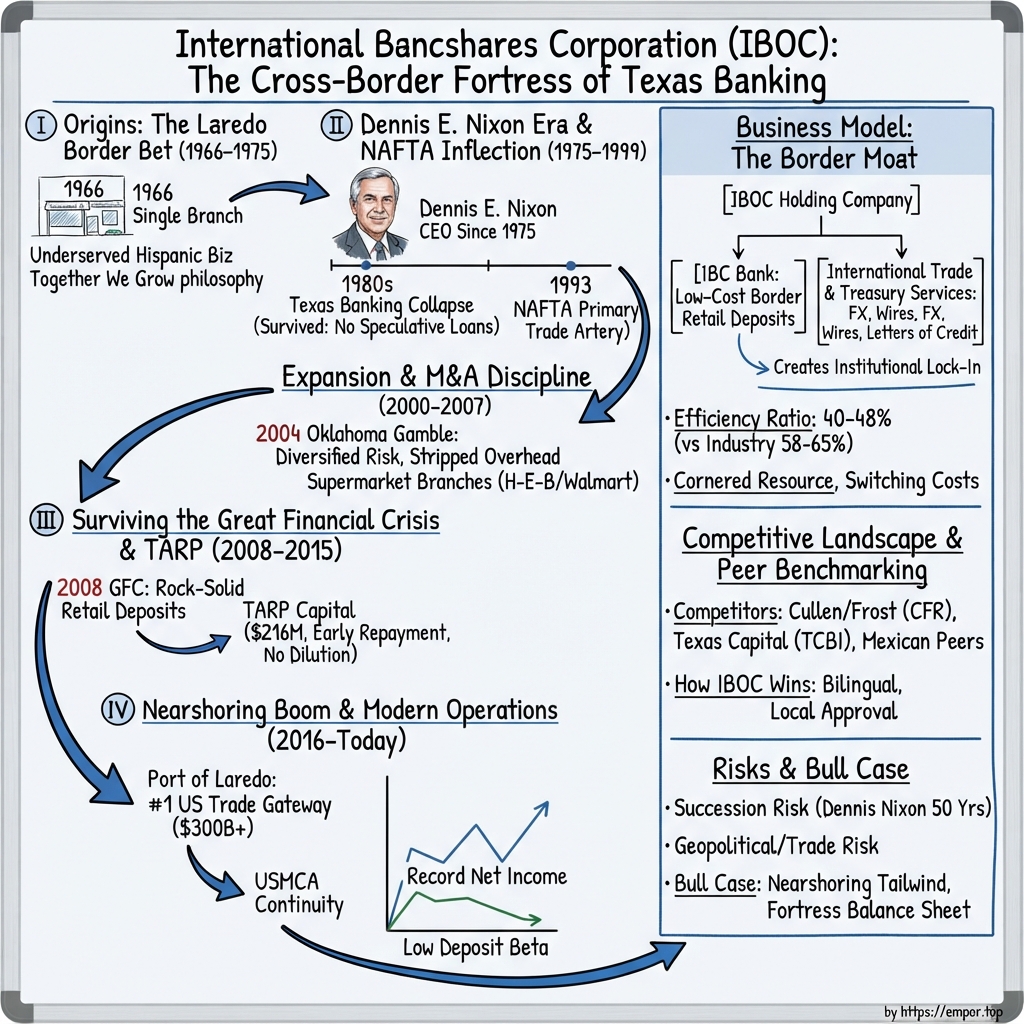
International Bancshares Corporation: The Cross-Border Fortress of Texas Banking
I. Introduction & Episode Roadmap
Drive south on Interstate 35 until the road runs out of America. The last exit before Mexico deposits travelers in Laredo, Texas — a city of warehouses, customs brokerages, drayage yards, and truck queues stretching toward the Rio Grande like a metal river. This is where the North American supply chain physically touches ground, carrying hundreds of billions of dollars in cross-border trade each year, with more than 97% of it tied directly to Mexico.13 Headquartered just minutes away, in an owned building on San Bernardo Avenue that the company occupies in full, sits a $17 billion bank holding company that receives remarkably little attention on Wall Street.13
International Bancshares Corporation is a public company that has out-earned larger regional peers for decades while avoiding traditional Wall Street engagement. It does not hold quarterly earnings calls, nor does it publish investor decks. Its quarterly communication to the market consists solely of a two-page news release followed by an SEC filing; the August 6, 2026 release announcing first-half results contained no dial-in, no webcast, and no supplemental financial package.3 For an institution that has compounded book value for half a century, that posture reflects both a deliberate independence from Wall Street theater and a minimal disclosure policy that invites scrutiny.
The financial metrics highlight why the bank commands attention. In fiscal 2025, the company earned $412.3 million on $16.6 billion of assets — generating a return on assets exceeding 2.4%, roughly double what a well-run American commercial bank produces.2 Non-interest expense consumed about 36 cents of every revenue dollar, an efficiency level rarely matched by commercial peers.2 Meanwhile, its consolidated common equity tier 1 capital ratio stood at 23.36% at year-end 2025, nearly three times the regulatory requirement for a well-capitalized institution.2 Standard financial measures reveal a bank that is simultaneously highly profitable and exceptionally well-capitalized.
That combination breaks standard banking logic. Profitability and capital strength typically exist in tension: commercial banks generate high returns on equity by leveraging their balance sheets, while building thick safety cushions usually dampens overall returns. International Bancshares Corporation escapes this trade-off through extraordinary asset profitability, allowing it to maintain a massive equity cushion while continuing to deliver double-digit returns to equity holders. Crucially, that asset profitability does not stem from exotic lending, a major fee business, or a technological edge. It relies on the low price the bank pays for its deposit funding.
Geography provides the conventional explanation. The company's subsidiary banks operate along the busiest land trade corridor in the Western Hemisphere, where deposits from persons and entities domiciled in Mexico make up what the company describes as "a large and stable portion" of its funding base.2 That cross-border deposit base serves as the bank's core competitive moat. However, viewing the institution simply as a border tollbooth oversimplifies the business model. Commercial trade volume itself is not the primary product; rather, the bank provides dollar-denominated deposit accounts and U.S. banking relationships to businesses and individuals operating across two currencies, legal systems, and regulatory regimes. That franchise is subtle, durable, and sensitive to geopolitical conditions.
This distinction underscores the core risks facing the business. While tariffs or economic downturns that reduce freight traffic through Laredo depress local loan demand, more fundamental shifts pose deeper risks. A political rift that reduces the appeal of a U.S. bank account to Mexican business owners, or a Mexican financial system that gains enough domestic trust to retain those balances at home, would threaten the bank's low-cost deposit foundation. Trade volumes are cyclical; cross-border trust is structural.
Presiding over this operational model is Dennis E. Nixon, who has run the primary subsidiary bank since 1975 and chaired the holding company since 1979.5 At 83 years old as of April 1, 2026, Nixon ranks among the longest-tenured chief executives in American banking, representing significant key-person reliance.5 The company has no named successor and no lead independent director, while the board's youngest member was 73 as of April 2026.5
Governance structures and ownership concentration further explain Wall Street's minimal coverage. Officers and directors beneficially owned 13.09% of the stock as of April 1, 2026, with the founding family's representative holding 9.05% — a concentrated ownership structure that limits the tradable float and renders the company resistant to hostile takeovers.5 Combined with the absence of quarterly conference calls and dedicated investor relations staff, the result is a business that operates independent of public market expectations, raising questions about whether its autonomy represents disciplined governance or limited shareholder accountability.
Four core themes frame this analysis. First, how a Laredo startup built a funding advantage that national banks have never replicated. Second, how an institution that made two decisive acquisitions in the early 2000s then halted expansion, illustrating the boundary between capital discipline and growth restraint. Third, how the 2022–2026 rate cycle transformed an over-liquid balance sheet from an earnings drag into a windfall, and how margins may adjust if interest rates fall. And fourth, whether this franchise can navigate a leadership transition and shifting U.S.–Mexico trade dynamics, particularly as non-accrual loans more than doubled over a six-month period.4
Understanding these dynamics requires starting in the border town where the bank first opened its doors.
 Subscribe on LinkedIn
II. Origins: The Laredo Border Bet (1966–1975)
In September 1966, a new bank opened its doors in Laredo, Texas.6 At the time, Laredo was not yet a major international trade hub, but a regional border town where informal commerce thrived and much of the local economy operated in Spanish across the Rio Grande.
While the bank's initial capitalization and headcount are not disclosed in SEC filings, the market opportunity was clear. Laredo's business community was predominantly Hispanic and family-owned, operating largely outside the criteria of major Texas commercial lenders in Houston and Dallas. A merchant buying inventory in Monterrey, selling in Texas, and balancing peso and dollar exposures rarely presented the standardized financial documentation required by distant loan committees. Where larger regional banks saw underwriting hurdles, the Laredo institution saw its core market.
The bank eventually adopted the motto "We Do More," reflecting the operational realities of its trade corridor.6 In the 1970s, Laredo merchants often lacked accessible local banking options, relying instead on correspondent banks in San Antonio by mail and telephone. By offering extended business hours, primary fluency in Spanish, and rapid local credit decisions, the institution established long-term customer accounts.
This strategy laid the groundwork for the bank's primary competitive advantage: gathering durable, low-cost transaction deposits. Rather than relying on large lending balances, the bank capitalized on cross-border trade operations requiring U.S. dollar checking accounts. Businesses clearing customs, paying U.S. freight carriers, and transferring funds to suppliers maintained working capital in local operating accounts to facilitate daily transactions rather than to chase interest yield.
Treating deposits as operational infrastructure rather than yield-seeking capital has guided the institution's funding strategy for decades. This focus allowed International Bancshares Corporation to build a checking-focused deposit base, keeping its cost of funds consistently below regional peer averages.
This funding model also produced a conservative balance-sheet posture. While many commercial banks seek to maximize returns by maintaining high loan-to-deposit ratios, International Bancshares Corporation consistently collected more deposits than it deployed into loans, placing surplus funds into cash and investment securities. This approach reflected a strategy that prioritized deposit acquisition as a service while restricting lending to markets where the institution possessed direct local credit expertise.
Beyond its deposit strategy, the organization established a decentralized governance framework. Its subsidiary banks appoint local community members to advisory boards that assist with branch operations, product development, and customer introductions — a model the company cites in its annual filings as central to how credit gets underwritten.1 In a cross-border environment, assessing borrower risk relies heavily on local relationships and familiarity with a client's standing across economic cycles, insights that centralized lending committees often lack.
Additionally, the company chose to expand by acquiring or forming separately chartered institutions rather than consolidating into a single bank entity. Today, the enterprise comprises five state-chartered subsidiaries under one holding company.1 While originally intended to preserve local board authority and civic engagement in distinct markets, this multi-charter structure later provided operational flexibility in managing large deposit balances.
Macroeconomic volatility along the border further reinforced the bank's risk management. For two decades prior to the bank's founding, the Mexican peso had been pegged to the U.S. dollar. The devaluations of the mid-1970s and early 1980s demonstrated the dangers of border banking: currency collapses strained Mexican borrowers holding dollar debt and slowed trade traffic, while simultaneously driving capital flight into U.S. dollar accounts. Institutions that lent aggressively across the border suffered heavy losses, whereas those collecting dollar deposits while restricting credit to U.S.-based borrowers gained liquidity.
International Bancshares Corporation adopted the conservative posture and retained it. The modern balance sheet still reflects this deliberate asymmetry: at year-end 2025 the company held $392.8 million of loans classified as international — just 2.4% of total assets — while deposits from Mexico-domiciled customers represented several billion dollars of funding.2 By gathering cross-border deposits while maintaining strict underwriting standards on domestic credit, the bank insulated itself from foreign credit shocks.
By 1975, this operating template was firmly established. That same year, Dennis E. Nixon joined the flagship bank, beginning a leadership tenure that would span more than five decades.
III. The Dennis Nixon Era & The NAFTA Inflection (1975–1999)
Dennis Nixon joined the bank in 1975 and became its chief executive that same year.57 He has led the institution ever since, guiding it through six U.S. presidential administrations, four Mexican peso crises, the collapse of the Texas banking industry in the 1980s, the implementation and eventual replacement of NAFTA, and major shifts in federal interest-rate policy.
Nixon's executive compensation structure illustrates the company's operating philosophy. In fiscal 2025, his total reported compensation was $2.5 million, consisting of a $670,000 base salary, a $1.5 million cash incentive, and approximately $334,000 in other compensation, with no stock awards or option grants.5 That $1.5 million cash incentive matched what he received in both 2023 and 2024.5 Meanwhile, the company's two other named executive officers earned roughly $350,000 each.5 For a financial institution earning over $400 million annually, executive pay remains well below industry averages for peers of comparable profitability — reflecting an operational cost discipline that starts at the executive level. However, this centralized compensation structure also signals governance patterns that carry broader trade-offs.
The culture: expense as a strategy, not a tactic. Nixon's operating strategy focuses heavily on structural expense management. In its 2025 annual report, the company described expense control as "an essential element of our long-term profitability," tracking performance through both the standard efficiency ratio and an "overhead burden ratio" that measures operating expenses against total assets.2 While most commercial banks benchmark expenses strictly against volatile revenue streams, measuring overhead relative to total assets reflects a management approach centered on controlling structural costs across economic cycles.
The 1980s: surviving the Texas banking collapse. Understanding International Bancshares Corporation's positioning requires examining the scale of the 1980s Texas banking crisis. Between 1980 and 1989, 425 Texas commercial banks failed, including nine of the state's ten largest bank holding companies.8 In 1988 alone, 175 Texas banks failed holding $47.3 billion in assets, representing a quarter of the state's total banking assets at the prior year-end.8 From 1987 through 1989, southwestern institutions accounted for 71% of all bank failures across the United States.8 Major institutions such as First RepublicBank, MCorp, and First City failed to survive the downturn.
An FDIC post-mortem analysis highlighted a key lesson regarding balance-sheet risk: nine of those ten largest Texas holding companies entered the 1980s with equity ratios that averaged more than 25% higher than the institutions that survived.8 High capital ratios proved insufficient against severe asset concentration in energy lending and speculative commercial real estate underwritten on expectations of sustained high oil prices.
International Bancshares Corporation survived due to structural features of its balance sheet. Its loan portfolio remained strictly within its local footprint and heavily anchored by real estate collateral. Funding relied on retail transaction deposits rather than volatile wholesale money markets. Crucially, its deposit gathering benefited as Mexican clients sought dollar-denominated accounts during Mexico's domestic currency crisis, providing liquidity to Laredo at a time when Dallas banks faced severe funding drains.
This dynamic established a core attribute of the institution: a funding base that reacts countercyclically to economic distress in Mexico while remaining insulated from U.S. wholesale money markets.
On the lending side, the bank avoided the syndicated loan markets that doomed many regional peers. While major Texas banks grew rapidly by participating in out-of-market energy loans, International Bancshares Corporation restricted its lending to familiar local borrowers. Although this conservative approach capped loan growth during the 1980s boom, it protected the institution from major write-downs during the bust. Consequently, the bank entered the 1990s with an intact balance sheet and an expanded deposit base, positioning it to acquire assets from distressed competitors over the subsequent decade.
NAFTA: from beneficiary to advocate. By the early 1990s, Nixon actively lobbied to expand cross-border commercial infrastructure. He joined Texas business leaders in advocating for congressional approval of the North American Free Trade Agreement (NAFTA), an effort acknowledged in 2008 when the United States-Mexico Chamber of Commerce presented International Bancshares Corporation with its Good Neighbor Award on NAFTA's fifteenth anniversary.7 Nixon also co-founded the Association of South Texas Communities and the Alliance for Security and Trade, and was inducted into the Texas Business Hall of Fame in 2006.7
Nixon's political advocacy helped turn Laredo into a primary trade gateway, expanding the bank's addressable market. At the same time, this strategic alignment created an enduring concentration risk: by tying its growth trajectory directly to cross-border commerce, the institution became increasingly sensitive to shifts in North American trade policy.
Building trade workflow capabilities. Alongside expanding its branch network into McAllen, Brownsville, San Antonio, Houston, and Corpus Christi, the subsidiary banks established specialized international commercial services, including letters of credit, commercial and industrial lending for trade participants, and foreign-exchange processing.1 These trade-finance services created significant operational switching costs for cross-border clients. Customs brokers and logistics firms relying on integrated clearing accounts, wire transfers, and credit lines rarely changed banking partners for minor yield differentials.
By 1999, International Bancshares Corporation had established a low-cost deposit advantage, a conservative credit framework tested by the 1980s crisis, and a strong presence along active trade corridors. However, the institution still lacked scale outside Texas, setting the stage for its next phase of expansion.
IV. Expansion & M&A Discipline: The Oklahoma Gamble (2000–2007)
While International Bancshares Corporation later shifted toward organic growth, its strategy in the early 2000s involved targeted consolidation. On December 31, 2001, the company completed its acquisition of National Bancshares Corporation of Texas in an all-cash transaction structured as a tender offer followed by a cash merger at $24.75 per share.9 NBC Bank was headquartered in Eagle Pass — another key border crossing — with branches extending into Giddings, Luling, Marble Falls, Rockdale, San Antonio, San Marcos, and Taylor. International Bancshares Corporation folded NBC Bank into its Laredo lead charter and moved the three Laredo-based NBC branches to its Commerce Bank subsidiary.9 At the time of the transaction, the company described itself as a $6.3 billion holding company operating 126 banking locations across 40 Texas communities.9
The transaction reflected a strategy of market densification along key trade routes rather than geographic diversification. Adding Eagle Pass to its existing presence in Laredo expanded the institution's coverage across primary border ports of entry while acquiring central Texas locations as secondary assets. In doing so, the acquisition reinforced the bank's core funding advantage rather than introducing a new operational model.
The NBC integration illustrated the company's repeatable acquisition framework. Rather than preserving the acquired brand or operating entity, management absorbed the deposit base, reallocated branches across its multi-charter structure, and eliminated administrative overhead. The multi-bank holding company format — operating five separately chartered subsidiary banks rather than a single consolidated institution — remains unusual among modern regional banks. Management has explicitly cited one major benefit of this structure: maintaining separate charters allows the bank to assist clients in maximizing FDIC deposit insurance coverage across institutions.2 For a banking franchise where uninsured deposits averaged roughly $4.3 billion in 2025, that capability serves as a key retention feature for large commercial accounts.2
The Oklahoma deal. On January 22, 2004, the company announced its largest transaction to date: the acquisition of Local Financial Corporation for approximately $385 million in cash and stock — a transaction that would lift the company's assets from $6.5 billion to roughly $9.4 billion pro forma and expand its branch count from 109 to 161.10 Local Financial shareholders could elect cash or IBC stock valued at $22.00 per share, subject to an election requirement that 75% of shares be exchanged for cash and 25% for stock.10
The acquisition represented a major capital deployment, adding nearly half of the bank's pre-deal asset base in a single transaction. At the announcement, Dennis Nixon framed the transaction as a logical expansion along the trade corridor, stating that it would "dramatically increase our presence along the NAFTA - IH 35 corridor," fitting "with our plans to deploy capital strategically."10 While the acquisition extended the bank's presence northward along Interstate 35, it also served as an effective vehicle for deploying surplus capital into an established deposit franchise.
The transaction provided entry into a second state, a different regulatory environment, and a distinct credit market. Unlike the trade-dependent border region, Oklahoma's loan demand centered on agriculture, energy, and local small businesses — sectors tied to commodity cycles rather than North American trade policy. More than two decades later, the Oklahoma subsidiary continues to operate as a separately chartered bank within the group, maintaining a standalone common equity tier 1 ratio above 20%.2 The purchase-price multiple relative to Local Financial's tangible book value was not disclosed in the announcement, making any specific transaction multiple speculative.
Why the deals stopped. Following the Oklahoma transaction, the company halted major acquisitions. In the 22 years since 2004, International Bancshares Corporation has not completed another major purchase. Because management does not conduct quarterly earnings calls, the leadership team has not publicly detailed this strategic shift. While high bank valuations throughout parts of the 2000s and 2010s encouraged discipline, management also refrained from acquiring distressed institutions during major industry disruptions, such as the 2008–2011 financial crisis or the 2023 regional banking turmoil, despite holding substantial excess capital. SEC filings still describe acquisitions and branch expansion as "a key element of our growth in the past," highlighting a strategy that transitioned from active expansion to capital preservation.1
The branch land-grab. In tandem with its early acquisitions, the bank expanded through an in-store distribution model, placing small branches inside grocery stores and shopping malls with extended hours.1 This low-cost delivery model allowed the institution to gather consumer checking accounts, debit-card interchange fees, and service charges with minimal capital outlay per location compared to standalone facilities. At the peak of this strategy, the branch network spanned hundreds of locations across more than a hundred communities.
Over the past decade and a half, however, that physical distribution network underwent a significant contraction. As of mid-2026, the company operated 165 facilities and 245 ATMs serving 75 communities.3 In September 2011, it operated 275 facilities and 440 ATMs serving 107 communities.12 That represents a 40% reduction in physical points of presence over fifteen years — during which total assets grew from $11.8 billion to $17.0 billion.123
This divergence demonstrates that physical branch density alone does not constitute the institution's primary competitive moat; otherwise, a 40% contraction in locations would have eroded deposit growth. Instead, deposit retention relies on established operational relationships and cash management workflow. The footprint reduction occurred as regulatory changes altered checking account economics, prompting the company to streamline its physical network while maintaining its core funding base.
V. Surviving the Great Financial Crisis & TARP Vindication (2008–2015)
During the financial crisis of 2008, wholesale funding markets that supported many regional banks abruptly froze. International Bancshares Corporation experienced the crisis differently due to its structural reliance on retail funding. Its liabilities were, and remain, overwhelmingly customer deposits gathered from individuals and businesses within its local footprint.2 Because the institution did not rely on volatile capital markets or short-term wholesale credit, it avoided liquidity runs. In its regulatory disclosures, the company describes its liquidity framework directly: subsidiary banks derive funding primarily from deposits of individuals and commercial entities, supplemented by securities sold under repurchase agreements and large certificates of deposit.2
The TARP episode, and why it is more interesting than the usual telling. On December 23, 2008, International Bancshares Corporation received $216 million from the U.S. Treasury under the Troubled Asset Relief Program's Capital Purchase Program.11
While the company eventually exited the program, it retained the federal capital for nearly four years. It began repurchasing the preferred shares in 2012, and by November 2, 2012 — having repurchased 45,000 shares for $45 million — the outstanding balance stood at $131 million, with management announcing plans to retire the remaining shares on or before June 30, 2013.11 Through that November payment, the institution had paid $39.6 million in preferred dividends to the Treasury since 2008.11 Today, the balance sheet carries no preferred stock outstanding.2
This capital repayment process highlighted three distinct financial dynamics. First, the company funded the share repurchases entirely through internal capital generation without issuing common stock or taking on debt, avoiding the equity dilution experienced by many TARP participants.11 Second, the institution maintained capital ratios far above regulatory minimums; returning $45 million altered its capital cushion only marginally, moving its total capital to risk-weighted assets ratio from 24.29% to a pro forma 22.92%.11 Third, the $39.6 million in cumulative dividend payments represented a direct financial cost for carrying capital the bank did not strictly need — effectively serving as an expensive capital insurance policy during a period of broad macroeconomic uncertainty.
Durbin, and the day IBOC closed 55 branches. A more consequential operational disruption occurred on September 22, 2011, when the company announced it would close 55 of its smaller in-store grocery branches, eliminating roughly 500 permanent positions.12 The immediate catalyst was the Durbin Amendment, a provision of the Dodd-Frank Act that capped debit-card interchange fees.
Under the bank's previous operating model, debit interchange revenue directly subsidized low-cost transaction accounts and extended-hour grocery store locations, which served as entry points for gathering consumer deposits. When federal regulations capped interchange fees, the reduced fee income no longer covered the overhead of smaller in-store units.
Dennis Nixon publicly criticized the regulatory change, stating, "Government many times passes regulations that end up hurting the very people they were intended to help," while framing the closures as a choice to protect free checking accounts by reducing physical distribution.12 He added that customer feedback urged the bank to "reduce expenses and close branches instead of eliminating our free checking products and services."12
The response illustrated management's approach to cost structure management. Facing a permanent reduction in fee income, the bank chose not to raise customer service fees or absorb lower profit margins. Instead, it eliminated 20% of its branch network in a single announcement and cut 500 jobs within ninety days, treating its operating expenses as flexible rather than fixed. This decision accelerated a long-term shift toward a leaner physical distribution model, demonstrating that core deposit retention depended more on established transaction workflows than on branch density.
The long squeeze, and what it reveals about the earnings model. The post-crisis period also highlighted the primary vulnerability of the institution's funding advantage: a business model anchored by low-cost deposits generates limited earnings when benchmark interest rates remain near zero. Throughout the mid-2010s, low interest rates compressed net interest margins across the banking industry, while fixed compliance costs associated with post-crisis regulations added further overhead. As a result, the bank's net income did not exceed $216 million in any year through 2018.2
This prolonged low-yield environment underscored how closely the company's profitability is linked to prevailing interest rate cycles. Because the bank maintains a deposit base sensitive to overall rate levels, its earnings power compresses during periods of monetary easing and expands when rates rise. The sharp increase in profitability between 2022 and 2025 reflected this structural dynamic, as higher benchmark interest rates finally unlocked the earning capacity of the bank's long-standing funding model.
VI. The Nearshoring Boom & Modern Operations (2016–Today)
Between 2018 and 2023, global supply chains underwent a structural reorganization as trade friction and pandemic disruptions prompted manufacturers to relocate production closer to North American end markets. This trend toward nearshoring concentrated industrial expansion in Mexico, routing growing volumes of physical freight across the U.S. southern border by commercial truck.
Port Laredo served as a principal gateway for this trade expansion. In 2025, Port Laredo recorded $353.94 billion in international trade — a $14.94 billion or 4.4% increase over the prior year — with more than 97% of that commerce tied directly to Mexico.13 The broader Laredo Customs District handled $481.8 billion in total trade volume.13
While Laredo gained national prominence as a top trade port, ranking variations require contextual analysis. Laredo ranked as the leading U.S. port of entry by trade value in 2023 and 2024 before placing third in 2025. That shift reflected rapid trade growth at major air gateways rather than a decline in border trucking volume: trade value at Chicago O'Hare expanded 31.52% and John F. Kennedy International grew 53.52% in 2025, driven by artificial intelligence hardware imports and gold movements, respectively.14 Laredo reclaimed the monthly top position in April 2026 with $34.16 billion in trade, surpassing O'Hare's $33.92 billion and JFK's $29.10 billion, supported by record monthly exports of $12.45 billion and record imports of $21.70 billion — each up more than 20% year over year.14 Through April 2026, JFK maintained a narrow year-to-date lead at $126.85 billion compared to Laredo's $126.42 billion.14
For bank investors, the underlying composition of freight carries more analytical weight than monthly ranking fluctuations. Laredo's trade volume consists of physical manufactured goods moving across land borders, whereas air-cargo values can be skewed by high-value, low-weight commodities unrelated to the cross-border logistics economy that International Bancshares Corporation funds.
March 2023 and liquidity resilience. The stability of the bank's funding model faced industry-wide testing during the regional banking stress of March 2023. As institutions such as Silicon Valley Bank failed due to reliance on volatile, uninsured deposits and unhedged securities portfolios, commercial bank balance sheets faced rigorous scrutiny. International Bancshares Corporation showed no indications of liquidity distress. Total deposits ended 2023 at $11.82 billion and expanded over subsequent periods, reaching $12.44 billion at year-end 2025.2 The enterprise required no emergency liquidity facilities, issued no dilutive equity, and experienced no deposit flight, confirming the stability of its core customer deposit foundation under broad market stress.
Trade policy shifts and USMCA renegotiations. The trade agreements underpinning border commerce entered a period of active renegotiation in mid-2026. The United States-Mexico-Canada Agreement (USMCA), which replaced NAFTA in 2020 with public support from bank leadership, included a mandatory joint review mechanism.
On July 1, 2026, the USMCA Free Trade Commission convened its initial joint review, where the United States declined to extend the agreement in its existing format. U.S. Trade Representative Ambassador Greer stated: "The United States did not agree to renew the USMCA in its current form. As a result, the USMCA is not renewed."15 Although the agreement remains in effect pending negotiations or formal termination, the U.S. initiated bilateral talks with Mexico, holding a third negotiating round in Mexico City from July 21 to 23, 2026, covering steel and aluminum, automobiles, economic security, labor, agriculture, and electronic payment services.1516
While cross-border freight continues to move under existing rules, the shift from a long-term trade framework to ongoing bilateral negotiations introduces regulatory uncertainty. For a commercial bank whose corporate borrowers finance logistics facilities, vehicle fleets, and cross-border inventory on multi-year terms, sustained policy ambiguity could temper capital deployment along the trade corridor.
Interest-rate dynamics and deposit mix shifts. Alongside trade trends, monetary policy tightening transformed the bank's earning capacity. As the Federal Reserve raised benchmark interest rates starting in 2022, net income expanded from approximately $254 million in 2021 to $300 million in 2022 and $412 million in 2023, maintaining that earnings level with $409 million in 2024 and $412 million in 2025.2
This earnings growth reflected a structural asset-liability mismatch. While yields on interest-earning assets repriced rapidly upward, the bank's funding costs adjusted at a slower pace. In 2025, International Bancshares Corporation earned an average yield of 5.91% on interest-earning assets while paying an average rate of 2.52% on interest-bearing liabilities.2 Applied to $15.0 billion in average earning assets, that spread generated $672 million in net interest income — producing a net interest margin of approximately 4.5%, well above the 3.75% margin reported by regional peer Cullen/Frost Bankers for the second quarter of 2026.221
However, detailed disclosures reveal an internal shift in deposit composition behind this low aggregate funding cost. Average non-interest-bearing demand deposits contracted from $4.80 billion in 2024 to $4.61 billion in 2025, while higher-cost average foreign time deposits — priced at an average rate of 3.42% — grew from $1.52 billion to $1.80 billion.2 While total deposits expanded, customer balances migrated from free operating accounts into interest-bearing time deposits. This deposit mix shift represents a key variable for net interest margins as benchmark interest rates normalize.
First-half 2026 results indicate that the rate expansion cycle has crested. Net income for the first six months of 2026 reached $198.0 million, up 0.5% year over year, but second-quarter net income fell 4.3% to $95.8 million due to increased credit costs.3 With rate-driven margin expansion fully reflected in income statements, future performance will depend primarily on credit quality and expense control.
Artificial intelligence disclosures and operational risks. Management has increasingly highlighted technology initiatives as part of its efficiency strategy. In quarterly press releases during early 2026, chief executive Dennis Nixon cited artificial intelligence initiatives among the tools being implemented to streamline internal processes.173
Regulatory filings present a more cautious assessment. The company's formal risk disclosures highlight potential compliance costs and operational risks associated with adopting AI systems, noting that flaws in implementation could create security vulnerabilities, data inconsistencies, and operational disruptions.4 Because management has disclosed no specific capital allocation, efficiency targets, or operational use cases, public investors cannot determine whether these technological initiatives will yield measurable cost savings or introduce new operational vulnerabilities.
VII. Business Model & Financial Engine: The Border Moat
Behind its cross-border footprint, International Bancshares Corporation operates a straightforward spread-banking model with an atypical balance-sheet structure. At year-end 2025, the company held approximately $12.7 billion in deposits, funded roughly $9.9 billion in loans, held about $5.0 billion in investment securities, and captured the margin between asset yields and funding costs.42 The key to the franchise lies in how those components are configured.
The structure. The holding company operates through five separately chartered subsidiary banks: International Bank of Commerce in Laredo, Commerce Bank in Laredo, International Bank of Commerce in Brownsville, International Bank of Commerce in Zapata, and International Bank of Commerce in Oklahoma.1 Surrounding the core banking operations are six non-banking subsidiaries, including an insurance agency, a liquidating subsidiary, a half-interest in an investment banking unit with a broker-dealer, controlling stakes in five merchant banking entities, and a majority position in a real estate development partnership.2 While these non-banking holdings remain modest in size, they represent an operational departure from core commercial banking; indeed, valuation losses on merchant banking investments served as the main driver behind a 4.1% decline in non-interest income in 2025.2
Where the money is actually made. The earnings engine relies overwhelmingly on traditional interest spreads. In 2025, net interest income reached $672 million compared to $170 million in non-interest income, making spread income responsible for roughly four-fifths of total revenue.2 Within the lending portfolio, credit exposure shows a heavy concentration in real estate. Commercial real estate across three main categories represented approximately 66% of total loans at year-end 2025: construction and land development made up 24.7%, farmland and commercial properties comprised 33.7%, and multifamily housing accounted for 7.2%.2 Commercial and industrial loans represented 18.3% of the portfolio, residential mortgages totaled 11.4%, and consumer lending remained nominal at 0.5%.2
This composition reveals an institution whose loan book functions primarily as a commercial real estate portfolio funded by a border-trade deposit franchise, rather than a specialized trade-finance lender.
The hidden business, properly sized. The institution's international fee activities are specialized but modest relative to total earnings. Product offerings such as letters of credit, trade-related commercial lending, and foreign-exchange processing represent established business lines.1 Fee revenue from deposit account service charges generated $74.3 million in 2025, while general banking service charges, commissions, and fees added $59.0 million.2 Because the company does not disclose standalone foreign-exchange or trade-finance income, public filings offer no way to isolate the exact fee contribution of cross-border operations.
Instead, the cross-border advantage manifests on the liability side of the balance sheet. In 2025, average deposits from foreign customers — predominantly domiciled in Mexico — totaled approximately $3.9 billion, comprising $804 million in non-interest-bearing demand accounts, $1.29 billion in savings and interest-bearing demand balances, and $1.80 billion in time deposits.2 These foreign account balances represented nearly one-third of the company's total average deposit base.2
This deposit base forms the institution's core competitive moat. The primary advantage stems not from financing cross-border trade volume, but from securing low-cost funding from depositors seeking dollar-denominated accounts outside the Mexican banking system. The switching costs protecting this capital are jurisdictional rather than technical.
Expense control, quantified. Structural cost discipline reinforces the revenue model. In 2025, International Bancshares Corporation generated $842 million in combined net interest and non-interest income against $307 million in non-interest expense.2 This produced an efficiency ratio of approximately 36%, outperforming typical U.S. regional bank averages in the mid-to-high 50s. By comparison, Prosperity Bancshares, another efficient Texas regional institution, reported an efficiency ratio of 45.99% excluding non-recurring items in the second quarter of 2026.22
The cost breakdown follows a standard regional banking structure: $153 million in employee compensation, $30 million in occupancy expenses, $23 million in depreciation, and $23 million in software costs.2 The low efficiency ratio reflects top-line revenue strength driven by low deposit funding costs and a physical branch network that has contracted over the preceding fifteen years.
Liquidity and the loan-to-deposit question. Balance-sheet liquidity reflects a conservative allocation. The company's loan-to-deposit ratio stood at approximately 76% at year-end 2025.2 The remaining liquidity is invested primarily in securities: $4.97 billion in available-for-sale debt securities held against an amortized cost of $5.28 billion, alongside a minimal $4.4 million held-to-maturity portfolio.2
This accounting treatment distinguishes the bank's balance-sheet disclosure from peers that designated large bond portfolios as held-to-maturity during the zero-interest-rate era to avoid recognizing unrealized losses. Because International Bancshares Corporation classified nearly its entire securities portfolio as available-for-sale, pre-tax unrealized losses — which narrowed to approximately $315 million at year-end 2025 from about $484 million a year earlier — are already reflected in accumulated other comprehensive income and deducted from reported equity.2 As a result, the reported book value per share of $54.86 at year-end 2025 fully incorporates portfolio mark-to-market adjustments.2
The capital problem. High capitalization creates a structural tension between asset profitability and equity returns. The company generated a return on assets of approximately 2.4% in 2025, but its return on average common equity reached 12.40%, down from 13.66% in 2024.2 This divergence occurs because total equity represents a substantial portion of the balance sheet: shareholders' equity stood at $3.25 billion against $16.58 billion in total assets at year-end 2025, an equity-to-asset ratio of 19.6%.2
This elevated equity cushion provided capital stability during the financial stresses of 2008 and 2023, but it also dilutes return on equity relative to asset performance. Maintaining an equity ratio well above regulatory requirements caps equity returns below what typical commercial leverage would generate from a 2.4% return on assets.
Capital distribution remains conservative relative to earnings generation. The company distributed capital in 2025 through semi-annual dividends of $0.70 per share, which were increased by 4.3% to $0.73 in February 2026 and maintained at that level in August 2026.21920 Relative to 2025 diluted earnings per share of $6.62, the dividend payout ratio stood at approximately 21%.2 Share repurchases have followed a similarly modest pace: the board of directors renewed a $150 million repurchase authorization on February 17, 2026, and cumulative repurchases since the program's 2009 reinstatement reached 13.8 million shares for $420 million as of February 23, 2026 — representing an average annual repurchase pace of roughly $25 million compared to annual net income exceeding $400 million.2
The combination of a 23.36% common equity tier 1 capital ratio, a 21% dividend payout ratio, and modest share repurchases highlights substantial unallocated capital on the balance sheet, creating an important strategic consideration for the company's future capital allocation.
VIII. Competitive Landscape & Peer Benchmarking
Texas banking in 2026 operates as a two-speed market, and International Bancshares Corporation has chosen neither trajectory.
At the top sit national franchises — including JPMorgan Chase, Bank of America, Wells Fargo, and PNC — that dominate metropolitan deposit share while maintaining branches along the border. Their structural challenge in Laredo and the Rio Grande Valley is not a lack of capital or technology, but the nature of cross-border credit decisions. Evaluating a merchant family operating across two countries requires localized judgment, whereas national institutions have spent decades centralizing underwriting processes. A dual-national borrower with assets on both sides of the Rio Grande and financial statements outside standard templates presents a risk profile that centralized models struggle to serve. International Bancshares Corporation addresses this gap through subsidiary banks that pair local branch operations with community advisory boards.1
That relationship advantage remains effective, though it faces pressure in technology. Mid-cap financial institutions must fund digital banking systems, fraud detection tools, and regulatory reporting infrastructure comparable to peers five times their size, while relying on a fraction of the revenue base. International Bancshares Corporation spent $22.6 million on software and software maintenance in 2025, representing a 7.2% increase year over year.2 While modest in absolute terms, this rising cost line reflects fixed technology expenses that scale typically helps absorb. Management has offset these expenditures by maintaining disciplined cost controls across the rest of the operational footprint.
At the other end of the market are fast-growing Texas regional independents, where peer comparisons highlight distinct strategic choices.
Cullen/Frost Bankers represents the closest regional benchmark — a San Antonio-based institution with a century-and-a-half history, a commercial focus, and strong customer retention. In the second quarter of 2026, Frost generated $170.4 million in net income, or $2.70 per diluted share, supported by $42.6 billion in average deposits and $22.6 billion in average loans. These results yielded a 1.30% return on assets, a 15.41% return on common equity, and a 3.75% net interest margin.21 Over the same six-month period, Frost expanded its physical distribution by opening seven financial centers across Dallas, Fort Worth, Austin, and San Antonio.21
Comparing the two institutions reveals a clear trade-off. International Bancshares Corporation generates roughly double Frost's return on assets due to its low funding costs. However, Frost delivers a higher return on equity while actively expanding its branch footprint in major Texas growth markets. While Frost invests capital to expand its geographical reach, International Bancshares Corporation focuses on optimizing its existing franchise.
Prosperity Bancshares offers a sharper contrast in capital deployment. Prosperity completed three bank acquisitions during the first half of 2026 — acquiring American Bank Holding on January 1, Southwest Bancshares on February 1, and Stellar Bancorp on July 1. These transactions expanded total assets to $43.9 billion at June 30, with pro forma assets exceeding $53 billion following the Stellar closing.22 Prosperity earned $168.6 million in second-quarter net income as average assets grew 14.2% year over year.22
This acquisition spree mirrors the consolidation strategy International Bancshares Corporation pursued in 2001 and 2004 before halting major M&A. In an operating environment where scale dictates how efficiently banks absorb compliance and technology overhead, a regional peer consolidating over $15 billion in Texas deposits within six months underscores the divergence between active consolidation and balance-sheet preservation.
Texas Capital Bancshares provides a counter-example that underscores International Bancshares Corporation's funding strength. Dallas-based and corporate-focused, Texas Capital reported $33.9 billion in assets and $28.9 billion in deposits at June 30, 2026, generating $80.6 million in quarterly net income, or $1.83 per diluted share, with a 3.28% net interest margin and a 12.1% common equity tier 1 capital ratio.23 Despite operating with roughly double the asset base of International Bancshares Corporation, Texas Capital generates lower overall net earnings. This gap stems primarily from funding structure: a corporate bank relying on yield-sensitive corporate treasury deposits faces a higher cost of funds than an institution funded by operational transaction accounts.
The Mexican side. Across the border, major Mexican institutions — including Banorte, Banregio, and BBVA México — serve the same commercial client base in pesos. While foreign institutions do not directly replicate International Bancshares Corporation's core offering of U.S. dollar, FDIC-insured accounts, their digital banking capabilities continue to advance. As domestic Mexican banking services mature, the relative advantage of maintaining basic U.S. dollar operating accounts for cross-border transactions could narrow over time.
The fintech question. Specialized payment platforms such as Wise and Remitly have significantly reduced the cost of consumer cross-border money transfers, applying pricing pressure to retail remittance fee income. However, non-bank fintech providers lack the regulatory authority to offer commercial trade financing, warehouse credit lines, letters of credit, or FDIC-insured dollar deposit accounts to foreign-domiciled commercial entities. Consequently, fee compression remains concentrated in retail remittances, while core commercial banking services remain protected by regulatory charters.
The war game. Analyzing potential competitive entry clarifies why the bank's core market has remained durable. If a national institution sought to capture Laredo's commercial market directly, neither capital allocation nor marginal funding costs would represent the primary obstacle. Instead, underwriting execution presents the central barrier. Assessing the creditworthiness of cross-border borrowers requires evaluating assets, business networks, and reputations across international jurisdictions — expertise built through long-standing local presence. Replicating that credit assessment capability requires hiring local expertise and establishing delegated underwriting authority that large institutions rarely maintain.
As a result, entry through acquisition presents the primary strategic threat. However, acquisition attempts face structural barriers: officers and directors control 13.09% of common shares, while long-time chief executive Dennis Nixon has maintained an independent operating strategy.5 This ownership concentration has insulated the border franchise from external acquisition for decades, leaving an eventual leadership transition as the primary catalyst that could alter the bank's independence.
International Bancshares Corporation continues to rely on low-cost deposit funding and structural expense control rather than rapid branch expansion or technological scale. These operational advantages have proven durable over decades of border commercial activity. Nevertheless, ongoing shifts in deposit composition and evolving peer strategies highlight the strategic choices facing the institution as it balances historical funding strength against industry consolidation.
IX. Hamilton Helmer's 7 Powers & Porter's 5 Forces Analysis
Hamilton Helmer's 7 Powers
Cornered Resource — real, but not the one usually named. The instinct is to view the border branch network as the primary cornered resource, but the 40% reduction in physical facilities since 2011 refutes that premise.123 The actual cornered resource is the bank's deep deposit relationship with Mexico-domiciled customers — representing roughly $3.9 billion in average 2025 funding from households and businesses seeking a dollar-denominated safe haven against domestic peso volatility.2 A national money-center bank could open a Laredo branch overnight, but it could not easily replicate six decades of entrenched relationships with families who turned to International Bancshares Corporation during successive Mexican currency crises in 1976, 1982, and 1994, passing those accounts down across generations.
The analytical test remains straightforward: observing whether foreign non-interest-bearing demand deposits stabilize or continue to contract after dropping in 2025.2 While a single year of decline represents short-term fluctuation, a sustained multi-year drop would signal a fundamental thesis break.
Switching Costs — strongest in commercial relationships. For a commercial enterprise whose customs clearing accounts, wire workflows, letters of credit, and credit lines are integrated into a single institution, changing banks represents a major operational disruption rather than a simple administrative decision. By contrast, a retail depositor holding a basic checking account can switch providers with minimal friction. International Bancshares Corporation's switching costs are concentrated in its commercial book, where deposit balances are largest and institutional ties run deepest — though this concentration also means the core deposit foundation is held by fewer accounts than total customer counts imply.
Process Power — the most defensible of the three. Maintaining an efficiency ratio near 36% across shifting rate environments reflects a deliberate operational model rather than coincidental success.2 This process power stems from an accumulated organizational discipline: a multi-charter structure with minimal corporate overhead, executive compensation that pays chief executive Dennis Nixon $2.5 million rather than the multi-million-dollar packages typical of larger regional peers, and a demonstrated willingness to eliminate 55 branches in a single action when regulatory economics shifted.512 In Helmer's framework, process power is notoriously difficult to replicate because it develops over decades of institutional practice.
However, process power developed primarily under a single chief executive across five decades carries key-person reliance. Whether this cost-conscious operating culture is permanently embedded in the organization or dependent on Nixon's leadership remains an open question until a leadership transition tests it.
What the bank does not possess. International Bancshares Corporation lacks scale economies as a mid-cap institution competing in a sector increasingly dominated by regional platforms exceeding $50 billion in assets. It displays no network effects, no structural counter-positioning, and no pricing power derived from brand identity. The institution commands three of the seven competitive powers — a distinct advantage in commercial banking, but one bounded by defined operational limits.
Porter's Five Forces
Threat of new entrants — low. Securing new bank charters remains a capital-intensive and lengthily regulated process. More critically, a new entrant must acquire customer trust and operational relationships rather than mere banking licenses. Decades of national institutions maintaining border branches without displacing International Bancshares Corporation's core market share provide empirical evidence of this entry barrier.
Bargaining power of depositors — low, but rising. Cross-border depositors have historically prioritized dollar stability, specialized trade services, and operational convenience over deposit yield. However, the 2025 deposit mix shift — characterized by a decline in non-interest-bearing demand balances alongside growth in foreign time deposits paying over 3% — offers clear evidence that yield sensitivity is increasing.2 Management explicitly noted "aggressive pricing by competitors" in its filings and confirmed it adjusted deposit rates to preserve balances, reflecting an uptick in depositor bargaining power.2
Bargaining power of funding suppliers — low. The company avoids reliance on brokered certificates of deposit, large-scale Federal Home Loan Bank advances, or wholesale capital markets. Other borrowed funds stood at just $10.3 million at year-end 2025 compared to $12.4 billion in total deposits.2 This self-funded structure insulates the balance sheet from the wholesale liquidity crunches that destabilized Texas lenders in the 1980s and regional institutions in 2023.
Threat of substitutes — moderate and bifurcated. Digital remittance platforms provide viable alternatives for retail cross-border money transfers, placing fee pressure on consumer payment services. However, non-bank technology providers cannot provide commercial credit lines, trade finance facilities, or FDIC-insured operating accounts, leaving core commercial banking relationships largely sheltered from substitution.
Competitive rivalry — moderate, and geographically split. Market competition is subdued in border strongholds such as Laredo, Eagle Pass, Zapata, and the Rio Grande Valley, where the bank maintains dense operational roots. Conversely, competition is intense across major Texas metropolitan centers — including Houston, San Antonio, Austin, and Dallas — where the institution enjoys no distinct structural funding moat against peers such as Cullen/Frost Bankers, Prosperity Bancshares, or money-center banks, and where International Bancshares Corporation has abstained from branch expansion while peers actively add locations.21
The structural picture reveals a well-fortified niche franchise that has chosen not to expand beyond its core territory. While this strategic discipline preserves high asset returns and capital stability, the durability of the business depends entirely on preserving its core cross-border funding advantage against emerging credit and macroeconomic risks.
X. Skeptical Investor Stress Test & Risk Radar
Every long thesis on IBOC eventually collides with the same four objections. They deserve to be taken seriously rather than waved at.
1. Succession and key-man risk. This is the most acute governance issue in the company and it is unusually well-documented in the filings — mostly by omission.
Nixon was 83 as of April 1, 2026, and had served as chief executive of the lead bank since 1975.5 The proxy states that the company has a succession plan for the CEO and for the chief executives of its twelve banking centers, that the plan emphasizes internal development, and that "the Board, with the advice and counsel of Mr. Nixon, will when deemed appropriate by the Board, select a new CEO by choosing one of the banking center CEOs."5 No successor is named. No timetable is given.
Now stack the surrounding facts. The roles of chairman and chief executive are combined; the board notes it has no policy on separating them and believes combining them avoids "confusion about who is the highest-ranking officer."5 There is no designated lead independent director.5 The board does not limit director tenure.5 The eight directors were aged 73, 75, 78, 83, 78, 75, 83, and 77 as of April 2026 — an average approaching 78, with no member under 70.5 The company's founding family remains the largest holder: A.R. Sanchez, Jr., a director since 1995, beneficially owned 9.05% of the stock, with Nixon at 3.59% and all officers and directors together at 13.09%.5
And here is the disclosure gap that should give any investor pause: the 2025 Form 10-K, which runs to dozens of pages of risk factors covering everything from oil prices to environmental liability on foreclosed property, contains no key-person or succession risk factor at all.1 Nixon's name appears in the entire document only in the signature blocks.
Shareholders have noticed something. At the annual meeting on May 18, 2026, Nixon himself drew only 1.03 million votes against — but three long-tenured independent directors drew substantial opposition: 8.45 million against Douglas Howland, 8.39 million against Larry Norton, and 7.21 million against Antonio Sanchez, Jr., against roughly 51 million votes cast.18 That is 14% to 17% dissent concentrated precisely on the directors responsible for audit, compensation, and nomination. Institutional holders are voting against the board's refreshment record, not against the CEO.
The compensation structure compounds the concern in a specific way. The 2025 incentive plan made Nixon the only officer eligible for a Management Incentive Plan payment, contingent on the company achieving either a 0.90% return on average total assets or an 8% return on average shareholders' equity.5 IBOC's actual 2025 results were roughly 2.4% and 12.40%.2 The hurdle was set at approximately a third of the return the bank routinely produces. That is not pay-for-performance; it is a formality. For a company that prides itself on discipline, it is a conspicuous lapse.
2. Border trade and political risk. The USMCA's non-renewal at the July 2026 joint review converted a stable framework into a rolling negotiation.15 The company's own forward-looking risk disclosures now lead with tariffs, listing "the imposition of new or increased international tariffs and the impact of potential retaliatory tariffs," the effect of tariffs on imported goods from Mexico, and "political instability in, and strained geopolitical relations between, the United States and Mexico."24
The transmission mechanism to earnings is not the trade volume itself — IBOC does not earn a toll per truck. It is capital formation. Border warehouse construction, industrial land development, and fleet financing are multi-year commitments, and IBOC's loan book is 24.7% construction and land development.2 If tariff uncertainty causes borrowers to defer projects, loan growth stalls first and credit quality follows. There is also a second-order effect worth naming: a Mexican economic shock is historically good for IBOC's deposits and bad for its loans. The two effects partially offset, which is why this bank has survived every previous version of this stress — but the offset is not free.
3. Commercial real estate — and the number that changed in 2026. This is where the stress test stops being theoretical.
Non-accrual loans stood at $47.2 million at the end of 2023, jumped to $169.1 million in 2024, improved to $140.3 million at the end of 2025 — and then more than doubled to $297.1 million at June 30, 2026.24 The driver was commercial lending: non-accrual commercial loans went from $52.4 million at year-end to $205.4 million in six months.4 Non-accruals now represent roughly 3% of the loan book.
Two accounting judgments deserve flagging. First, of the $297.1 million of non-accrual loans, $205.2 million carried no credit allowance at all — management's assessment being that collateral values are sufficient.4 The specific allowance against individually evaluated loans totaled $25.2 million against $297.1 million of exposure.4 Substantially all doubtful credits are measured using the fair value of collateral method.4 That is a defensible methodology and a heavily judgment-dependent one; if collateral appraisals prove optimistic, provisions follow.
Second, the total allowance for credit losses stood at $170.0 million at June 30, 2026 against those non-accruals — coverage of roughly 57%, down from 113% at the end of 2025.42 Coverage moving that far, that fast, is exactly the pattern regulators examine.
The company's framing of this in its earnings release is worth quoting because it is revealing: "Although the provision for credit losses has increased, no actual losses on those loans have been, or may ever be, realized."3 That is technically accurate. It is also a defensive construction, and the release does not disclose the doubling of non-accrual balances at all — an investor learns that only from the 10-Q filed the same day.43 For a management team whose credibility rests on candor about the balance sheet, this is a meaningful mark against.
Context matters in both directions. IBOC's actual charge-offs remain low: net charge-offs were 0.18% of average loans in 2025 and 0.44% in 2024, when a bankruptcy-related foreclosure drove a commercial charge-down.2 The bank has $3.25 billion of equity against $297 million of non-accruals. This is not a solvency question. It is a question about whether the underwriting culture that survived the 1980s is still operating at the same standard — and one more bad quarter would make it a serious one.
4. Capital efficiency, and the activist case. Here is the argument a concentrated value investor would make. IBOC holds a common equity tier 1 ratio of 23.36% — call it roughly $1.2 billion of capital above even a conservative 15% target.2 It pays out about 21% of earnings in dividends and repurchases roughly $25 million of stock a year against a $150 million authorization.2 Its shares traded at $68.34 on February 23, 2026 against book value of $54.86 — around 1.25 times book, a level at which buybacks are accretive to a bank compounding at a 12% return on equity.2 It has made no acquisition in twenty-two years while a direct competitor consolidated $15 billion of Texas deposits in six months.22
The activist conclusion writes itself: this company is hoarding capital, and the hoarding is why a 2.4% return on assets converts into only a 12.4% return on equity. The counter-argument is that the same hoarding is why IBOC has never had a bad decade, and that in a business where the downside is ruin, insurance is worth paying for. Both are true. What is not defensible is the absence of any articulated capital plan — no stated target capital ratio, no explanation of why 23% is the right number, no discussion of the alternatives considered. In the absence of an earnings call, there is no forum in which anyone can ask.
That is the stress test. What follows is how to monitor it.
XI. Key Performance Indicators & Bull vs. Bear Case
The Critical KPIs to Track
Three primary metrics provide a clear window into whether the core thesis remains sound. Tracking these indicators quarterly offers a far more accurate view of operational performance than relying solely on press release headlines.
1. The deposit mix — specifically, non-interest-bearing demand deposits as a share of total deposits. This remains the fundamental variable driving performance. The company's high profitability, low efficiency ratio, and ability to hold deep balance-sheet liquidity while earning strong returns all stem from a funding base that carries almost no cost. The 2025 financial disclosures showing that average non-interest-bearing demand deposits contracted while higher-cost foreign time deposits expanded marked the initial sign of potential funding friction.2 Because this shift is detailed only in the annual report's average-balance tables, verifying it requires reading the SEC filings directly. If non-interest-bearing deposits continue shrinking as a share of the total funding base, the franchise moat will erode regardless of border trade activity, putting downward pressure on earnings multiples.
2. Non-accrual loans and allowance coverage. Non-accrual loans surged from $140.3 million to $297.1 million in six months, while credit loss allowance coverage fell from 113% to 57%, making asset quality the central swing factor for near-term profitability.24 Key variables to monitor include whether commercial non-accrual balances stabilize, whether the portion evaluated without specific allowances shrinks as collateral is reassessed, and whether net charge-offs increase to align with non-accrual trends. Resolving these credits with minimal loss would confirm management's collateral valuations, whereas a surge in charge-offs would challenge the bank's long-standing underwriting reputation.
3. The efficiency ratio. The company's expense-to-revenue ratio of nearly 36% serves as clear evidence of operational cost discipline.2 However, non-interest expenses rose 4.6% in 2025 and 6.5% in 2024, driven primarily by wage compensation.2 Management has highlighted artificial intelligence initiatives as a potential driver of operational efficiency.3 If the efficiency ratio drifts into the low 40s over coming years, it would signal a weakening of internal cost controls — offering an early indication of operational shifts as leadership eventually transitions.
Myth vs. Reality
Four common assumptions regarding the company require careful evaluation against disclosed results.
Myth: International Bancshares Corporation relies primarily on its border branch network for its competitive advantage. Reality: physical branch locations declined by 40% since 2011 even as total assets expanded by 44%.123 The franchise moat is rooted in long-standing customer deposit relationships rather than physical real estate density.
Myth: Port Laredo holds a permanent position as the leading U.S. port of entry by trade value. Reality: Laredo ranked first in 2023 and 2024 before placing third in 2025, and while it regained the monthly top spot in spring 2026, it trailed John F. Kennedy International Airport on a year-to-date basis through April.14 Cross-border freight flows remain robust, but monthly port rankings fluctuate based on international cargo composition.
Myth: The bank's deposit funding costs remain entirely immune to broader rate shifts. Reality: the average cost of interest-bearing liabilities reached 2.52% in 2025 as customer balances migrated into higher-yielding accounts.2 While funding costs remain low relative to industry averages, deposit sensitivity is real and rising.
Myth: Operating efficiency tracks in line with regional peer averages in the mid-40s. Reality: the efficiency ratio runs near 36%, outperforming typical regional benchmarks — including Prosperity Bancshares' reported 45.99%.222
The Bull Case
The constructive investment case rests on three distinct operational pillars.
The most durable pillar is the core funding franchise. Roughly one-third of average deposits come from foreign customers — predominantly domiciled in Mexico — who seek U.S. dollar stability rather than high interest yields, complemented by a domestic retail base built around zero-cost transaction accounts.2 This structural advantage generated a spread of 5.91% on earning assets against a 2.52% cost of interest-bearing liabilities in 2025, powering a return on assets nearly double the commercial banking average.2 Competitors have failed to replicate this funding moat over six decades of operations.
The second pillar is balance-sheet strength. The company maintains a common equity tier 1 capital ratio of 23.36%, avoids held-to-maturity accounting designations to mask unrealized portfolio markdowns, reflects mark-to-market adjustments directly in reported book value, and operates with minimal wholesale market borrowing.2 In an environment that has repeatedly penalized hidden leverage across regional banking, the institution's balance sheet provides rare transparency and stability.
The third pillar is the structural expansion of cross-border trade. Port Laredo's trade volume expanded 4.4% in 2025 to $353.94 billion, while both monthly imports and exports achieved record levels in April 2026 with year-over-year growth exceeding 20%.1314 The ongoing reallocation of manufacturing capacity closer to North American supply networks positions the bank's core geographic markets at the center of long-term trade activity.
Supported by a semi-annual dividend that was raised to $0.73 per share and backed by a conservative 21% payout ratio, the bull case presents a highly capitalized, low-cost deposit institution trading near book value.192
The Bear Case
The cautionary perspective does not question the historical quality of the institution, but emphasizes that the bank faces three simultaneous operational transitions.
The first transition involves corporate governance and succession. Management remains centralized under an 83-year-old chief executive who has led the primary bank since 1975, operating without a named successor, a lead independent director, a board member under age 70, or a key-person risk disclosure in the annual Form 10-K.51 Disclosed succession plans describe a general process rather than designated leadership. Institutional investors reflected this concern at the May 2026 annual meeting by casting 14% to 17% of votes against long-tenured independent directors on key governance committees.18 An unproven succession model leaves long-term operational continuity unverified.
The second transition relates to credit quality. Non-accrual loans more than doubled over six months to represent approximately 3% of total credit exposure, driven by commercial loans, with $205 million of those non-accruals carrying no specific credit allowance based on collateral valuations, while overall allowance coverage fell by half.4 The company's quarterly press release omitted these non-accrual increases entirely.3 Furthermore, commercial real estate accounts for roughly two-thirds of the loan book — with construction and land development making up a quarter of total loans — at a time when the North American trade framework faces ongoing bilateral renegotiations.215
The third transition is capital accumulation and strategic stagnation. Net income has remained essentially flat near $410 million over three consecutive years, while second-quarter 2026 earnings declined year over year.23 The institution has avoided major acquisitions since 2004, whereas regional competitor Prosperity Bancshares completed three bank transactions within six months and Cullen/Frost Bankers added seven financial centers over half a year.2221 Consequently, return on equity decreased from 16.8% in 2023 to 13.66% in 2024 and 12.40% in 2025, driven not by falling asset profitability, but by retained earnings accumulating on the balance sheet without active redeployment.2
Exacerbating these risks is a restrictive investor disclosure policy. The company holds no quarterly earnings calls, hosts no investor presentations, and offers no public analyst Q&A. Executive commentary in quarterly earnings announcements has remained virtually identical across reporting periods, with the first-quarter 2026 and second-quarter 2026 statements using nearly identical phrasing despite a doubling of non-accrual loans.173 For public market investors, evaluating an institution undergoing credit and governance transitions without direct management access introduces elevated analytical risk.
XII. Epilogue & Playbook Lessons
There is a photograph that does not exist but should: Dennis Nixon in 1975, walking into a small bank in a dusty border town, and Dennis Nixon in 2026, signing an SEC filing as president and chairman of a $17 billion holding company that earns higher returns than institutions twice its size. Fifty-one years, one chair, one city.
The company produced by that tenure is genuinely unusual, and it offers three lessons that extend well beyond banking.
Lesson 1: Own the bottleneck — but understand which bottleneck you own. The seductive version of the story is that International Bancshares Corporation owns Laredo, and Laredo owns North American trade. The more accurate assessment is that the bank owns something more abstract and durable: the primary U.S. dollar banking relationship for individuals and enterprises operating across a currency border. That asset did not depend on maintaining a dense physical network — which has contracted 40% since 2011 — nor does it rely on any single trade agreement.123 It requires only that the peso remain more volatile than the dollar and that core commercial relationships transition across generations. The first condition remains stable; the second represents the open question investors must evaluate.
Lesson 2: Boring discipline compounds, and its costs are invisible. Nine of the ten largest Texas bank holding companies were recapitalized or failed during the 1980s after entering that decade with higher capital ratios than the institutions that survived.8 International Bancshares Corporation survived because management refused out-of-market loan syndications and speculative energy credit. That discipline incurred an unquantifiable opportunity cost in foregone growth during boom periods, but it secured long-term solvency when peers collapsed. The same operational posture drove the 2011 branch closures and sustained a chief executive compensation structure of $2.5 million for managing a business earning $412 million.1252
Yet cost discipline carries structural trade-offs. Over time, an ingrained habit of restraint can become indistinguishable from operational inertia. Twenty-two years without a major acquisition, a 21% dividend payout ratio, $25 million in average annual share repurchases against $400 million in net earnings, and a common equity tier 1 capital ratio approaching three times regulatory requirements reflect extraordinary conservatism, but they also signal a capital allocation strategy that has remained largely static.2
Lesson 3: Cost culture is a superpower until it becomes a succession challenge. An efficiency ratio near 36% sustained across multiple interest-rate cycles represents the institution's most tangible operational advantage, and the element hardest for competitors to replicate.2 However, that cost discipline is closely tied to five decades of executive leadership. The proxy statement's succession framework — indicating the board will select one of twelve banking-center chief executives upon the chairman's counsel when deemed appropriate — outlines a discretionary process rather than a designated succession plan.5
For investors, the resulting picture is a high-performing operating franchise paired with a traditional governance structure, an unoptimized capital base, and a restrictive investor communication policy. The core border franchise remains fortified by six decades of deposit relationships. However, the credit quality shifts observed in the first half of 2026 introduce fresh uncertainty,4 the North American trade framework remains under active bilateral renegotiation,15 and the executive who built the institution reached age 83 in 2026.5
The bank that navigated peso devaluations, the Texas banking collapse, the 2008 financial crisis, and regulatory fee caps now faces a fundamental leadership transition. Whether the operating model established over half a century functions seamlessly under new leadership remains the central long-term question for the enterprise.
References
-
International Bancshares Corporation Form 10-K for fiscal year 2025 — U.S. Securities and Exchange Commission, 2026-02-26 ↩↩↩↩↩↩↩↩↩↩↩
-
International Bancshares Corporation 2025 Annual Report to Shareholders (Exhibit 13 to Form 10-K) — U.S. Securities and Exchange Commission, 2026-02-26 ↩↩↩↩↩↩↩↩↩↩↩↩↩↩↩↩↩↩↩↩↩↩↩↩↩↩↩↩↩↩↩↩↩↩↩↩↩↩↩↩↩↩↩↩↩↩↩↩↩↩↩↩↩↩↩↩↩↩↩↩↩↩↩↩↩↩↩↩↩↩
-
IBC Reports Strong Earnings for the First Six Months of 2026 (Exhibit 99 to Form 8-K) — International Bancshares Corporation, 2026-08-06 ↩↩↩↩↩↩↩↩↩↩↩↩↩↩↩
-
International Bancshares Corporation Form 10-Q for the quarter ended June 30, 2026 — U.S. Securities and Exchange Commission, 2026-08-06 ↩↩↩↩↩↩↩↩↩↩↩↩↩↩
-
International Bancshares Corporation Definitive Proxy Statement (Schedule 14A) — U.S. Securities and Exchange Commission, 2026-04-20 ↩↩↩↩↩↩↩↩↩↩↩↩↩↩↩↩↩↩↩↩↩↩
-
Banking Problems in the Southwest, History of the Eighties: An Examination of the Banking Crises of the 1980s and Early 1990s, Volume I, Chapter 9 — Federal Deposit Insurance Corporation ↩↩↩↩↩
-
International Bancshares Corporation Completes Acquisition of National Bancshares Corporation of Texas (Exhibit 99 to Form 8-K) — International Bancshares Corporation, 2002-01-03 ↩↩↩
-
International Bancshares Corporation Agrees to Acquire Local Financial Corporation (Exhibit 99.1 to Form 8-K) — International Bancshares Corporation, 2004-01-22 ↩↩↩
-
International Bancshares Corporation Announces Completion of Repurchase of $45 Million of TARP Preferred Stock (Exhibit 99 to Form 8-K) — International Bancshares Corporation, 2012-11-02 ↩↩↩↩↩
-
IBC Announces Branch Closings in Response to New Banking Regulations (Exhibit 99 to Form 8-K) — International Bancshares Corporation, 2011-09-22 ↩↩↩↩↩↩↩↩↩↩
-
Port Laredo Records $353.94 Billion in 2025 Trade — PR Newswire, 2026-03-02 ↩↩↩↩
-
Port Laredo Is Nation's Top Trade Gateway For 2nd Straight Month — Forbes, 2026-06-12 ↩↩↩↩↩
-
Ambassador Greer Issues Statement on the USMCA Joint Review — Office of the United States Trade Representative, 2026-07-01 ↩↩↩↩↩
-
United States and Mexico to Convene in Mexico City for Third Bilateral Negotiating Round Related to the Joint Review of the USMCA — Office of the United States Trade Representative, 2026-07 ↩
-
IBC Reports Strong Earnings for the First Quarter of 2026 (Exhibit 99 to Form 8-K) — International Bancshares Corporation, 2026-05-07 ↩↩
-
International Bancshares Corporation Form 8-K reporting 2026 Annual Meeting voting results — U.S. Securities and Exchange Commission, 2026-05-20 ↩↩
-
International Bancshares Corporation Form 8-K announcing increase in cash dividend — U.S. Securities and Exchange Commission, 2026-02-02 ↩↩
-
International Bancshares Corporation Form 8-K announcing cash dividend — U.S. Securities and Exchange Commission, 2026-08-03 ↩
-
Cullen/Frost Reports Second Quarter Results — PR Newswire, 2026-07 ↩↩↩↩↩
-
Prosperity Bancshares, Inc. Reports Second Quarter 2026 Earnings — PR Newswire, 2026-07 ↩↩↩↩↩↩
-
Texas Capital Bancshares, Inc. Announces Second Quarter 2026 Results — StockTitan, 2026-07-22 ↩
 LinkedIn
 WhatsApp
 Reddit
 Hacker News
 Email
Email Kindle
 RSS Feed
 Spotify
 Apple Podcasts
 Amazon Music
 Audible
 YouTube