MarineMax, Inc.: The Boat Dealer That Bought the Marina
I. The $53 Question
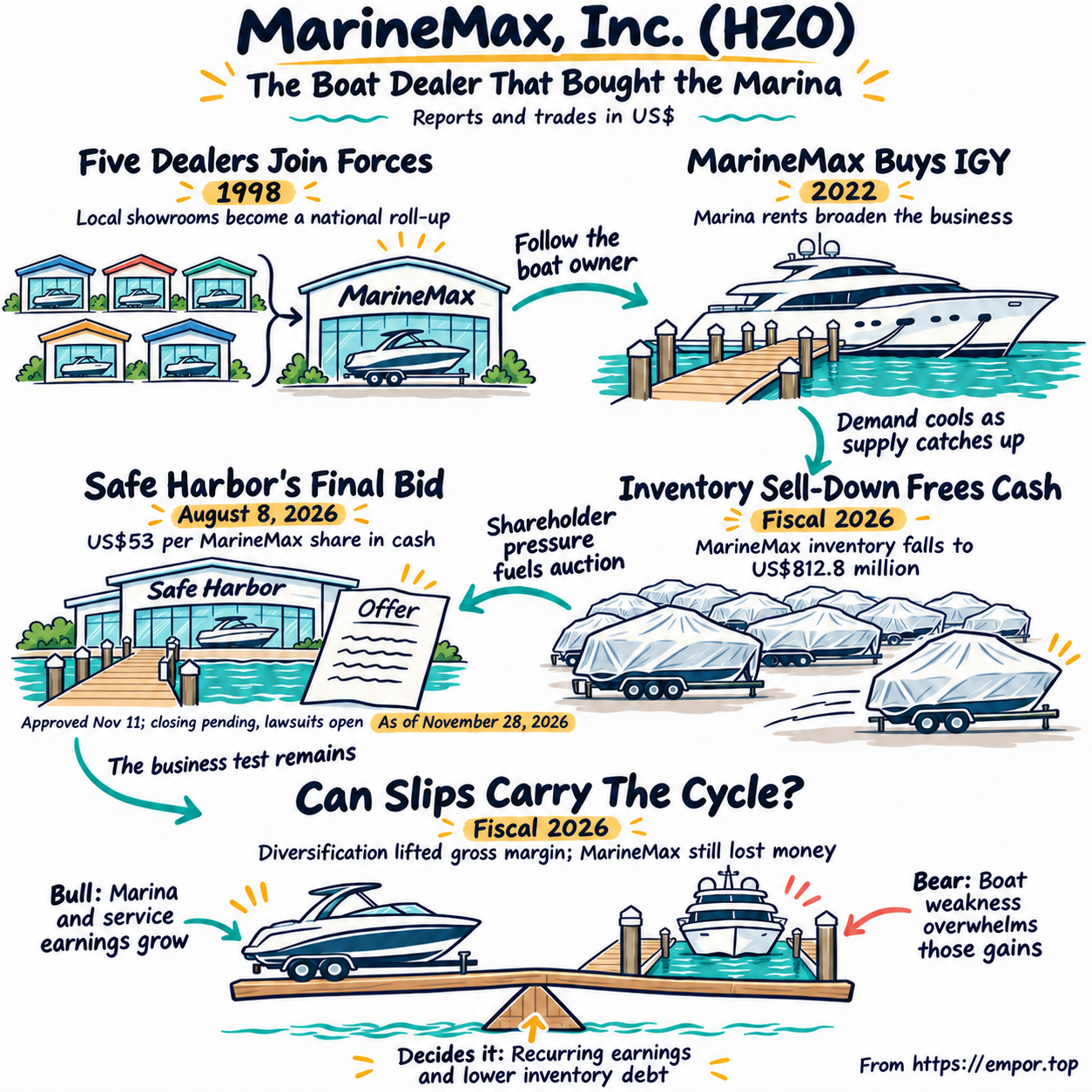
On the weekend of August 8 and 9, 2026, the MarineMax board was deciding what the company was worth. The bids had climbed for months. A marina owner that had opened at $34 a share the previous December had come back with a best-and-final number of $53, in cash.1 On August 9 the board approved a merger agreement with an affiliate of Safe Harbor Marinas, the marina network that Blackstone Infrastructure had agreed to buy for about $5.6 billion the year before.12 The next day MarineMax told the world. The offer put the enterprise value at about $1.5 billion.3 Measured against the $27.03 the stock closed at on January 30, 2026, before the sale process became public, that was a premium of about 96%.1
Look at who is buying whom. MarineMax is, at heart, a retailer. It sells some of the most expensive and least necessary things an American household can buy: sport boats, cruisers, sport-fishing yachts and superyachts. When rates rise or the stock market wobbles, these are among the first purchases buyers put off. Safe Harbor owns docks. A marina slip is a fixed piece of waterfront that cities rarely let anyone build more of, rented out for months or years at a time to people who already own boats. One business lives on the boat cycle. The other lives on the fact that every boat, sold in good years or bad, has to be kept somewhere.
For most of the last decade, MarineMax tried to become a bit more like its buyer. It bought marinas, yacht brokers, charter businesses, finance and insurance operations and even boat builders, on the theory that a customer who buys a $300,000 boat will spend money for years afterward on storage, service, fuel and eventually a bigger boat. The deal with Safe Harbor is the market's verdict on that theory, or at least one buyer's verdict. That raises three questions, and they shape the rest of this story.
The first is how much protection the marina and service revenue actually gave. MarineMax described a company whose earnings were less exposed to boat sales than they used to be. Its own numbers show a company that still got about seven of every ten revenue dollars from selling new and used boats in fiscal 2026.4 The second is whether the acquisitions created value. One of them, a run of boat-manufacturing purchases, ended in a goodwill write-off. The biggest, the 2022 purchase of IGY Marinas, has never been impaired, but it has never been proven cheap either. The third question is the subtlest. Does a $53 cash price reward the strategy, or does it end the test before the results are in?
The ending, as of November 28, 2026, is unusual. On November 11, shareholders voted to approve the merger, with about 16.27 million shares in favor and fewer than 19,000 against.5 But the deal had not closed. Customary conditions remained, and shareholder lawsuits in New York alleged that the merger proxy left out material information. The company disputes those claims.4 MarineMax said it expected to close by the end of the calendar year.1 Meanwhile the business was still reporting losses. Fiscal 2026, which ended on September 30, finished with a net loss of about $8 million attributable to shareholders, on revenue of $2.16 billion.3
So the story has a price tag on it before the story is finished. The price is real: it is cash, and it nearly doubled the stock's value from the January low. It was set by a buyer that understands marinas better than almost anyone in the United States, and it came out of an auction in which a long list of bidders had the chance to pay more. But a price is not a performance record. A buyer like Safe Harbor can value a waterfront network on its own math, with its own cost of capital, its own synergies and its own long holding period. None of that tells a public shareholder whether MarineMax could have earned $53 a share of value on its own.
To see what was being bought, start with how MarineMax was built. It did not begin with a marina or a famous boat. It began with five boat dealers who decided they would be worth more together.
 Subscribe on LinkedIn
II. Five Dealers, Then a Nationwide Roll-Up
In March 1998, a group of independent boat dealers filed to take a new company public.6 None of them had built a famous boat or owned a famous harbor. They had showrooms, service bays, local reputations and, in several cases, long relationships with Brunswick's Sea Ray brand. MarineMax combined five of those dealers into one Florida corporation, later based in Clearwater, and pitched investors on a simple idea. Boat retailing in America was a cottage industry of family businesses. A well-financed consolidator could buy the best of them, put them on common systems and use its size to win better terms from manufacturers and lenders.46
That roll-up logic has defined the company ever since. MarineMax was assembled, not invented. Every few years it added another regional dealer, a new territory, a new brand line. The approach has an important consequence. MarineMax's product, in the sense of the boat itself, mostly belongs to other people. Its edge, if it has one, has to come from distribution: where its stores are, which brands it is allowed to sell, how well it finances and services customers, and how cheaply it can carry inventory.
The modern chapter began in 2018, when Brett McGill became chief executive.7 The pace changed under McGill. The old model was to buy boat dealers. The new one was to buy everything around the boat. MarineMax bought superyacht brokerage and management firms, including Fraser and Northrop & Johnson, which sell, charter and manage some of the largest private vessels afloat.4 It bought boat builders, including Cruisers Yachts and Intrepid Powerboats, which became the product-manufacturing segment.4 It built out a finance and insurance arm. And in 2022 it made the biggest bet of all, the IGY Marinas deal. By fiscal 2026 the company described itself as having more than 120 locations worldwide, including more than 70 dealerships and 65 marina and storage locations.48
The revenue line looks like a growth story. In fiscal 2016, MarineMax had $942 million of revenue.9 That year management credited a 25% jump mostly to comparable-store growth as the industry recovered from the financial crisis.9 By fiscal 2024, revenue had reached a peak of $2.43 billion, more than two and a half times the 2016 level.4 Then it went backwards: $2.31 billion in fiscal 2025 and $2.16 billion in fiscal 2026.3
That peak deserves some suspicion. Revenue more than doubled in eight years, but two very different engines did the work, and neither was steady. One was acquisitions. Every dealer, broker, marina and builder MarineMax bought added revenue that the business had not grown on its own. The other was the pandemic, which sent Americans rushing to buy boats in 2020 and 2021. A company that grows by buying businesses at the same moment its industry has a once-in-a-generation demand surge can look like a compounding machine while being nothing of the sort.
Scale did buy some tangible things. A dealer of MarineMax's size gets manufacturer programs that a small family store may not. Interest assistance from boat builders reduces the cost of carrying inventory, and co-op advertising support reduces marketing spend.4 By September 2026 the company employed 3,316 people: 2,466 in its stores, 493 in manufacturing and 357 in corporate and operational management.4 That is a big organization by the standards of boat retail, where many competitors are run by an owner and a few dozen staff. It can afford specialist finance and insurance desks, a brokerage network and a corporate team that negotiates with lenders and manufacturers as one customer. Yet every one of those advantages comes with a fixed cost, and fixed costs are exactly what hurt when the number of boats sold falls.
Profit makes the point more sharply than revenue. In fiscal 2016, on less than half the revenue, MarineMax earned $22.6 million.9 In fiscal 2026, on $2.16 billion of revenue, it lost money.4 More locations, more brands, more services and more than twice the sales did not produce steadier or higher earnings at the bottom of the cycle. Much of what scale bought was exposure: to more inventory, more debt, more fixed costs and more of the same boating cycle.
This is the distinction that runs through everything that follows. Size in boat retail is real. It gets a dealer into manufacturer meetings, onto lenders' preferred lists and in front of customers in more harbors. But size is not the same thing as a better return on the capital tied up in boats, buildings and acquired goodwill. To see whether MarineMax's size changes the economics, walk into one of its stores.
III. The $341,000 Boat on the Dealer's Lot
Picture a customer walking onto a MarineMax lot in Florida on a spring Saturday. Under the canopy sit gleaming dual-console boats and sport yachts. The salesperson wants to talk about more than the boat. Inside the same company, the buyer can arrange a loan, insure the boat, trade in an old one, sign up for maintenance, find a slip, take lessons, join owner events and, a few years later, list the boat for brokerage and move up to something bigger. That is MarineMax's pitch: not a boat, but an ownership life, all under one corporate roof.
The ticket is large even by boating standards. In fiscal 2026, MarineMax's average selling price on a new boat was about $341,000. The company put the industry average at roughly $93,000, so MarineMax's typical new-boat sale was more than three and a half times the industry norm.4 It does not mainly sell the bass boats and pontoons that fill most of America's lakes. It sells the upper end: Sea Ray, Boston Whaler, Azimut and other premium lines, plus the yachts its brokerage arms handle.4
The money still mostly comes from the sale itself. New and used boat sales, along with motors and trailers, made up 71.2% of fiscal 2026 revenue.4 MarineMax records that revenue when the customer accepts delivery.4 Around each sale sits a cluster of smaller revenue streams. Parts and service, brokerage commissions, finance and insurance fees, storage and charter rentals all add revenue and usually more margin per dollar than the boat. But they are smaller than the pitch implies. Storage and charter rentals were 9.0% of fiscal 2026 revenue, and maintenance and repair 5.3%.4 About 86% of retail-operations revenue was recognized at a single point in time, not earned over months as a subscription would be.4 The ownership-life story is real. The revenue mix shows it is still a story built on top of a boat sale.
Who else is on the water
Boat retail is still a fragmented local business. In most harbor towns, the competition is a family dealer, a used-boat broker or a private seller with a listing online. The only other large public dealer is OneWater Marine, which reported $1.87 billion of revenue for its fiscal 2025 and 95 dealership locations.10 MarineMax's fiscal 2026 revenue of $2.16 billion came from more than 70 dealerships, which is consistent with its higher average ticket.4 The two companies' fiscal years differ, and neither publishes a reliable national market share, so the comparison shows two different strategies rather than one clear winner: OneWater with more stores at more price points, MarineMax with fewer, more expensive transactions and a larger marina and yacht-services business.
What, then, is MarineMax's advantage? The company points to several things. Its premium mix attracts wealthier buyers, who are less dependent on financing and less sensitive to rates. Its "One Price" approach takes the haggling out of the sale. Its breadth of brands lets a customer move up the range without changing dealers. And its stores sit beside service bays, storage and, in some places, marinas, giving it many reasons to stay in touch with a customer after delivery.4 Each of these is plausible. The trouble is that the company does not publish the numbers that would prove them. MarineMax does not disclose customer retention rates, repeat-purchase rates, how much more it gets for the same boat than a rival dealer does, or what it costs to acquire a customer compared with competitors. Customer concentration is not disclosed either, simply because buyers are scattered individuals.4 A shopper can drive to the next dealer, buy a used boat from a stranger, or wait a year.
The people who make the boats
The other side of the bargain matters even more. The real power in this industry sits upstream. Mercury Marine, Yamaha and Volvo supply substantially all the engines on the boats MarineMax sells. Brunswick, which owns Mercury and Sea Ray and Boston Whaler, and Azimut-Benetti are identified as particularly important manufacturers.4 Dealer rights are granted brand by brand and territory by territory. The big agreements with Sea Ray, Boston Whaler and Azimut run for multiple years. Most others are renewed annually.4 MarineMax faces no minimum annual purchase requirement, but falling short of agreed levels can cost it manufacturer incentives or even dealership rights.4
In plain terms, MarineMax rents its most important product from a handful of large suppliers who can, at the margin, give a territory to someone else. Those manufacturers also decide how many boats to build, how to price them and how generously to support dealers with interest assistance and incentives when inventory piles up. That is not a moat. It is a dependency. It is managed well, judging by decades of brand continuity, but it caps how much pricing power a dealer can ever claim.
Consider what this means for a single transaction. When the customer on that Florida lot buys a boat, MarineMax earns a margin on the boat, often a commission on the loan and insurance it arranges, and sometimes a profit on the used boat it takes in trade and resells. Each piece depends on something outside its control: the manufacturer's price and incentives, the lender's appetite, and the used-boat market's willingness to pay what MarineMax estimated for the trade-in. The integrated model lets the dealer collect more pieces of the same sale. It does not change who sets the terms for the most important piece.
So the dealership gives MarineMax scale, a premium customer base and a broad catalog. It does not give it a measurable pricing edge, and it does not escape the cycle. The boat sale is the most cyclical part of the customer relationship, which is why, for years, McGill argued that the rest of the relationship had to carry more of the economics. In August 2022 he made that argument with half a billion dollars.
IV. The $480 Million Bet on IGY
On August 9, 2022, MarineMax announced what Brett McGill called a "transformative" deal.11 It would buy Island Global Yachting, known as IGY Marinas, for $480 million in cash, plus up to $100 million more if the business hit performance targets over the following two years.11 IGY owned or ran 23 marinas across the Americas, the Caribbean and Europe in the kinds of harbors where superyachts spend their seasons, plus a membership program and a yacht-management platform.11 McGill said the deal would make MarineMax "the preeminent leader in the superyacht industry."11
The deal was built to keep IGY's own leaders in charge. Tom Mukamal, IGY's chief executive, and his management team were to continue running the business inside MarineMax, a sign that the buyer was paying for know-how in marina operations it did not have itself.11 Raymond James advised MarineMax and Moelis advised IGY, and the deal was expected to close in the first half of fiscal 2023.11 For a company whose skill had always been selling boats, this was a bet on a different craft: running hospitality-style waterfront properties for owners of vessels worth tens of millions of dollars.
The timing tells you a lot about what management believed. In the summer of 2022, boat dealers were coming off the strongest two years in a generation, and investors were starting to ask what would happen when the boom ended. The IGY acquisition was the answer. MarineMax would buy into a business that earned rent and fees from boats that had already been bought, no matter what happened to next year's boat sales.
The company's case was explicit. The headline said IGY would "more than double" MarineMax's recurring marina revenue and be accretive to earnings in its first full year.11 IGY was projected to bring in more than $100 million of revenue in calendar 2022.11 The release described the business as carrying higher margins than boat retail, though it gave no margin figure.11 Pair the marinas with Fraser and Northrop & Johnson, which broker, charter and manage the yachts that tie up there, and MarineMax would own more of the ecosystem around the world's largest private boats. The pitch was that a superyacht owner who keeps a vessel at an IGY marina is a natural customer for crew placement, charter management, brokerage and eventually a new yacht.
That is management's thesis. It deserves testing, not repeating.
What the price implied
Start with the price. Before the earnout, MarineMax paid at least 4.8 times IGY's projected revenue for the year. Including the earnout and other adjustments, the total recorded consideration came to about $553 million.12 In fiscal 2023, the first year under MarineMax, IGY produced $112.4 million of revenue.12 So the business roughly hit the revenue level management had projected, which is a point in management's favor. But revenue is the wrong ruler for a marina. What matters is the cash it throws off after paying for staff, maintenance, insurance, leases and capital spending. MarineMax never disclosed IGY's standalone EBITDA at the time of the deal or a clean multiple of earnings paid. Nor is there a public marina transaction of similar size, geography and lease structure that would provide a fair benchmark. Waterfront assets in the Caribbean and the Mediterranean do not trade like suburban self-storage.
So the honest verdict on the price is narrower than either side would like. MarineMax paid a lot relative to sales. Whether it overpaid depends on IGY's margins and growth, which the company has not published separately. The deal cannot be called cheap, and it cannot be proven expensive.
Debt on top of the cycle
The financing tells a clearer story. MarineMax paid for IGY with an expanded credit facility, including $400 million of term debt, plus cash on hand.1112 That matters because MarineMax already carried a lot of borrowing of a different kind. Floor-plan debt is the revolving credit dealers use to finance the boats sitting on their lots. It rises and falls with inventory and is repaid as boats are sold, so it is self-liquidating in normal times. Term debt is different: it is long-term money borrowed against the company's whole enterprise, and the interest is owed whether or not boats sell. The IGY deal added that second kind of borrowing just before interest rates rose sharply. MarineMax's exposure to the cost of money went up on two fronts at once, through inventory financing and through acquisition financing.
What happened next to the acquired businesses? Here the record is better for IGY than for MarineMax's other expansion bets. In fiscal 2025, MarineMax wrote off $69.1 million of goodwill, but that charge was assigned to the product-manufacturing segment, the boat builders, not to IGY.12 The fiscal 2026 annual report records no impairment of IGY Marinas.4 On the July 2026 earnings call, the CFO listed marinas, including IGY, among the higher-margin businesses that "performed well."13 By fiscal 2026, MarineMax said it operated 65 marina and storage locations.4
Those facts leave IGY's thesis intact but limited. The marinas have held their accounting value through the worst boat-sales slump since the financial crisis, which suggests the assets are worth roughly what MarineMax paid, at least by its auditors' tests. But "intact" is a modest standard for a deal sold as transformative. Storage and charter rentals still made up less than a tenth of revenue in fiscal 2026.4 IGY made MarineMax a bigger marina company. It did not make MarineMax a marina company.
Which leaves the question that the rest of this story keeps asking: did the recurring businesses grow into a real stabilizer, or did they stay too small to offset what was coming in boat sales? To answer that, go back two years before IGY, to the spring when nobody knew whether anyone would buy a boat again.
V. The Pandemic Boom Became an Inventory Problem
In April 2020, MarineMax looked like a company preparing for disaster. Locations were temporarily closed or restricted under stay-at-home orders. The boating season, the stretch of spring and summer in which dealers make most of their money, was starting under lockdown. MarineMax withdrew its financial guidance and on its fiscal second-quarter call management focused on liquidity, cost control and the uncertainty ahead.1415
Within months, the picture flipped. Americans who could not fly, go to concerts or eat in restaurants found that a boat was one of the few safe ways left to have fun with family. First-time buyers came in. People who had been thinking about a boat for years stopped thinking. The surge reached far beyond Florida: boat sales boomed in places like Minnesota, where registrations and spending jumped during the pandemic.16 By the end of fiscal 2020 in September, MarineMax had reported record results, with revenue of about $1.5 billion despite the spring shutdown.15 Management described demand that kept outrunning supply.15
Here is where the cycle's mechanics take over. In 2021 and 2022, boat builders could not make boats fast enough. Engines were short, parts were late and dealers had empty lots and waiting lists. Empty lots meant dealers could sell nearly everything at full price, with little discounting and little interest cost. That is the most profitable condition a dealer can be in. It also encourages everyone in the chain to assume the demand is permanent. Manufacturers added capacity. Dealers welcomed more inventory, and they had every incentive to: missed sales had been the problem for two years.
The whiplash
Then supply caught up while demand cooled. Interest rates rose sharply from 2022, making boat loans and dealer floor-plan lines more expensive at the same time. Pandemic-era buyers had already bought. Boats arrived on lots faster than customers took them away. A dealer's economics reverse in that situation. Every unsold boat costs interest each month, and the longer it sits, the more likely the dealer will have to discount it to move it. Manufacturers offer incentives to help, but incentives come with targets attached, and missing those targets can cost a dealer money or territory.
By the summer of 2024, this had become the central topic on MarineMax's calls. On its fiscal third-quarter call that July, management discussed elevated inventory across the industry, pressure on new-boat margins and the expected path to normalization as manufacturers cut production.17 The framing was that this was a temporary digestion problem: the market had overbuilt and would clear.
That framing deserves to be checked against what followed. Fiscal 2024 was the peak year for revenue, at $2.43 billion, partly because acquisitions had added sales.4 But revenue fell in fiscal 2025 and again in fiscal 2026, when same-store sales declined 5.5%.3 Industry unit volumes were still expected to fall as late as July 2026.13 On that call, the CFO estimated that underlying boat margins had improved by about 175 to 200 basis points from the prior year, but were still 300 to 350 basis points below their 2017–2019 levels.13 In other words, two years after management first described the inventory problem as something to work through, the core boat business had still not returned to its pre-pandemic profitability. The normalization came, but more slowly and at lower volumes than the 2024 framing implied.
Other forces amplify the cycle. Boat sales are seasonal and weather-dependent, so a wet spring or a hurricane can hit a quarter. Affordability depends on interest rates, since many buyers finance and every dealer finances inventory. And because a few engine makers and boat brands supply most of the product, their production decisions and incentive programs can swing a dealer's margins as much as its own sales effort.
By the July 2026 call, the tone had shifted from waiting out the glut to managing within it. McGill highlighted a certified pre-owned boat program and a partnership between NextBoat and the company's Newcoast Financial Services arm, both aimed at selling more used boats and loans when new-boat demand was soft.13 Asked about the health of the dealer network, he said the worst of the industry's dealer closings was probably behind it.13 The quarter's gross margin of about 35.7% looked strong, but about 110 basis points of the improvement came from a one-time tariff refund, a reminder that headline margins in this period mixed real progress with one-off help.13 Those were reasonable, concrete answers. They were also answers about adapting to a smaller market, not about a return of the old one.
None of this makes the pandemic boom fake. Boating demand did step up, and some new owners stayed. But the boom was a bad baseline. A company that sized its inventory, debt and acquisition ambitions to 2021 demand inherited 2024's glut. The diversification strategy may well have been sensible. The boom years were simply not a reliable guide to what a normal year looked like.
That leaves a practical question that hung over MarineMax going into fiscal 2026. Can it cut inventory without losing sales, manufacturer incentives or access to important brands? The year's cash-flow statement gives a surprisingly loud answer, and it needs careful reading.
VI. $149.9 Million of Cash, but No Profit
When MarineMax closed its books on September 30, 2026, one number stood out. Operating cash flow for the year was $149.9 million.4 For a company that had just reported a net loss, that looks almost paradoxical. How does a business lose money and generate nearly $150 million of cash in the same year?
The three-year sweep makes the reversal vivid. In fiscal 2024, MarineMax earned $38.7 million of net income but its operations consumed $25.7 million of cash. In fiscal 2025 it reported a net loss of $30.8 million but generated $72.8 million of operating cash. In fiscal 2026 it lost $7.5 million on a consolidated basis and produced $149.9 million of operating cash.4 Profit went down while cash went up. The two lines crossed and kept moving apart.
Where the cash came from
The explanation is the boats. In fiscal 2024, MarineMax was still building inventory, and money spent on boats that have not yet sold is cash out the door, whatever the income statement says. In fiscal 2026 the process ran in reverse. Inventory fell by $54.6 million, to $812.8 million.43 Receivables fell by $29.7 million as the company collected what it was owed.4 Customer deposits and accrued liabilities rose.4 Each of those movements converted assets already on the balance sheet into cash. On top of that, the reconciliation from net loss to operating cash added back $50.3 million of depreciation and amortization and $15.2 million of stock compensation, both real costs that do not consume cash in the year they are recorded.4
That last point matters for the quality of the number. Depreciation is the slow recognition that docks, buildings and equipment wear out and have to be replaced. Stock compensation is paid in shares rather than cash, but it still dilutes shareholders. Both make operating cash look better than economic profit.
Floor-plan financing explains why lower inventory matters twice. Because most of the boats are bought with borrowed money, selling down inventory lets the dealer repay the floor plan as well as collect cash. During fiscal 2026, floor-plan borrowings fell from $715.7 million to $613.7 million.4 That is a real improvement: less inventory and less debt carrying it. But it is also a release, not a recurring source of cash. A company can only sell down excess inventory once. When the lots are at the right level and deposits stop rising, the cash flow has to come from earning money on what is sold.
The receivables deserve one more sentence because they are smaller and safer than they look in a cyclical business. Trade receivables were $60.1 million at year-end, normally collected within 30 days, often from the banks and finance companies that fund boat loans rather than from individual buyers. The company called its credit-loss allowance "not material."4 But the annual report gives no aging buckets showing how much is overdue or written off, so the reasonable conclusion is that receivables exposure is modest relative to sales, not that collections are free of risk.4
The cost of the money
Here is the number that matters most. In fiscal 2026, MarineMax generated $51.3 million of operating income. It paid $58.0 million of interest.4 Before taxes, the business lost about $6.8 million, because its operations did not earn enough to cover the cost of borrowing.4 Some of that interest is the floor plan, which is part of the cost of being a dealer. Some is the term debt that paid for acquisitions like IGY. Together, they consumed more than the company earned from operations.
The company was not in distress. It ended the year with $156.4 million of cash.3 It reported compliance with its covenants.4 In June 2026 it signed a new credit agreement with up to $950 million of floor-plan financing, a $150 million revolver and an $85 million delayed-draw mortgage facility, all maturing in June 2031.4 Those are signs that lenders were comfortable with MarineMax's collateral and cash flow. But the agreement also revealed how tightly the floor plan was drawn. At year-end, only $1.3 million of floor-plan capacity remained available, although the revolver and mortgage facility had about $136 million and $54 million of headroom.4 For a company heading into the selling season, when dealers usually build inventory, that is a narrow margin on the line that matters most for buying boats.
Spending tells the same story from another angle. Capital expenditure fell to $36.1 million in fiscal 2026 from about $61 million in each of the two previous years, or from about 2.5% of revenue to about 1.7%.4 Some of the cash generation, in other words, came from investing less. That is a sensible response to a downturn, but it is not a permanent source of cash for a business that owns docks, buildings and service bays that wear out. Over its history, MarineMax has also returned capital by buying back stock rather than raising new equity: cumulative repurchases reached 8.68 million shares for $178.3 million through fiscal 2026, and the board authorized up to $100 million more through March 2028.4 The company has not needed to issue shares to get through the downturn, which is a genuine mark of balance-sheet resilience, even as the debt load kept interest costs high.
So fiscal 2026's cash flow was a genuine liquidity improvement and a sign that management was serious about shrinking inventory. But most of the swing came from working capital, not from recurring earnings. Three measures will show whether the improvement lasts: how fast inventory turns and how old it gets, how much floor-plan availability exists at the peak of the season, and how much operating cash the business produces once inventory and deposits stop providing a one-time boost.
That brings the story to the people who made the bets. If the cash was mostly a release, who had tied it up, and what did the rest of the capital they deployed earn?
VII. The $69 Million Write-Down and the CEO's Scorecard
The write-down arrived in the fiscal third quarter of 2025, the season when dealers expect to be busiest. MarineMax reported a loss of $2.42 a share for the quarter, and most of it came from a single non-cash line: a $69.1 million goodwill impairment in the product-manufacturing segment.1312 Goodwill is the part of an acquisition price that exceeds the value of the assets acquired, the premium paid for future earnings. Writing it off is an accountant's way of admitting that those future earnings no longer justify what was paid. The charge removed the remaining goodwill assigned to the manufacturing reporting unit.12
The manufacturing story was a small but telling piece of McGill's strategy. The logic of buying boat builders such as Cruisers Yachts and Intrepid was to capture the manufacturer's margin on boats MarineMax could also sell through its own stores, and to reduce dependence on outside brands. The logic was understandable. The execution met a market in which builders across the industry were cutting production because dealer lots were full. Even a year after the write-down, the segment was still losing money: it posted $108.6 million of revenue and a $13.7 million operating loss in fiscal 2026.3 Owning the factory, it turned out, meant owning the factory's fixed costs at precisely the moment demand fell.
That record belongs next to the larger claims made for McGill's strategy. Since becoming CEO in 2018, McGill has steered MarineMax toward a broader customer relationship: more brands, superyacht services, finance and insurance, marinas and manufacturing.7 In the fiscal 2026 results release he put the case in one number, pointing out that gross margin had risen from 26.1% in fiscal 2019 to 34.9% in fiscal 2026.3 It is a real achievement, and it supports the idea that MarineMax's mix has shifted toward higher-margin businesses.
But gross margin is the top of the income statement, not the bottom. The same management team said in July 2026 that its core new and used boat margins were still 300 to 350 basis points below their 2017–2019 levels.13 So the higher company-wide gross margin did not come from selling boats more profitably than before the pandemic. It came largely from the mix: marinas, brokerage, service, and finance and insurance, which earn more margin per dollar of revenue. That shift was bought partly with acquisitions, and those acquisitions brought their own operating costs, interest and amortization. Fiscal 2019's lower gross margin came with a profit. Fiscal 2026's higher one came with a loss. A better gross margin that does not survive to net income is evidence the mix changed, not proof that the strategy earned its cost of capital.
Guidance offers a cleaner test of credibility, because it can be checked. In April 2026, in the middle of the auction, MarineMax reported second-quarter revenue of $527.4 million and reaffirmed its full-year guidance.1 In July, management again reaffirmed a fiscal 2026 adjusted EBITDA range of $110 million to $125 million, and said the outcome depended on whether the summer months strengthened.13 The final figure was $112.6 million, inside the range but near its bottom.3 That is a fair record. Management set a wide range, explained what would move the company within it, and landed where its own weaker scenario suggested. It is not the record of a team that overpromised wildly, but neither does it show a business outperforming its plan.
Pay, ownership and the auditor's eye
The pay record is the next exhibit. For fiscal 2025, a year in which MarineMax reported a $30.8 million net loss, McGill's total compensation was $6.27 million, and the company put the ratio of CEO pay to the median employee's pay at about 95 to 1.7 Much of an executive's pay at a company like MarineMax comes in performance-linked stock and annual incentives, so reported compensation includes equity awards whose eventual value depends on the share price. There is no suggestion of misconduct in the pay figures. The question is calibration: an investor would want to see that pay tracks returns on capital and cash conversion, not just revenue growth or adjusted metrics that exclude impairments.
Ownership tells a related story. Directors and executive officers together owned about 3.2% of the shares at the time of the 2026 annual proxy.7 That is enough to give management real money at stake in the share price, and, in a sale, enough to make the transaction personally significant, because merger agreements typically convert unvested equity awards into cash. Aligned incentives and personal stakes in a deal are two sides of the same coin, which is why shareholders cast a separate vote on deal-related pay, a vote that comes up again in the story of the sale.
The accounting record is clean. KPMG issued an unqualified opinion on the fiscal 2026 financial statements and reported that internal controls over financial reporting were effective.4 Its critical audit matter, the area that required the most auditor judgment, was the valuation of used boats taken in trade. Because there is limited public market data for used boats, management has to estimate what a trade-in will fetch, and those estimates flow straight into inventory values and margins.4 It is a sensible area of focus in a downturn, when used-boat prices can fall faster than estimates. No material weakness or emphasis-of-matter paragraph was reported.4
So what does the scorecard say? The manufacturing bet failed on its own terms, and the write-off is concrete evidence that not every expansion held its value. The IGY bet has not failed, but it has not been shown to earn more than it cost. The gross-margin claim is accurate and incomplete. McGill's tenure covers both the acquisition push and the downturn that tested it, so credibility now rests on what the company can show about returns and cash, not on repeating the diversification thesis. The numbers to judge it by are clear: same-store sales, segment operating income, and cash flow after the inventory release runs out.
Shareholders did not wait for those numbers. By late 2025, several of them had decided that the scorecard was already in.
VIII. The Shareholders Asked for a Sale
The decisive fact about the 2026 sale is that it was not MarineMax's first. In July 2023, the board formed a committee to consider a possible transaction. Over that process, 21 counterparties were contacted. One bidder, identified in the proxy only as Party A, offered $44.92 and then $45.50 a share. The talks did not produce a deal, and by January 2024 that bidder declined to update its valuation.1 In the spring of 2024 a second suitor, Party F, offered $40, then $43.20 in a mix of cash and stock, then $40 to $41 in cash. The board rejected those proposals and dissolved its committee in July 2024.1
Those rejected numbers are a standard to measure the board against. Within eighteen months of saying no in the mid-$40s, MarineMax's shares were trading in the high $20s. By January 30, 2026, they closed at $27.03.1 The boat glut and a goodwill write-off had arrived in between. For a shareholder who held through it all, the board's independence in 2023 and 2024 looked expensive until the summer of 2026.
Pressure built quickly. In November 2025, an investment firm nominated three director candidates.1 On December 5, 2025, Safe Harbor Marinas approached with a proposal of $34 a share in cash.1 On December 18, the board authorized hiring Wells Fargo as financial adviser.1 On January 13, 2026, the activist investment firm proposed $35 a share.1 Days later, on January 20, the board formed a transaction committee of independent directors to run a process.1
In early February, the contest went public. Donerail Group, an activist investment firm, announced it had offered to buy MarineMax for $35 a share in an all-cash deal and pushed the board to run a sale.18 Donerail's critique was blunt: the stock had underperformed, the strategy had not delivered, and it argued for a change in leadership.18 On February 17, another shareholder publicly released a letter calling for a strategic review.1
This is the skeptic's case at full strength, and it deserves to be stated as such. MarineMax had spent heavily on acquisitions, written off part of them, carried more debt into a downturn, and posted losses while the CEO's pay remained substantial. Its shares were worth far less than bidders had offered three years earlier. From that vantage point, a sale was a way to stop paying for a strategy whose returns had not shown up, and to put the assets in the hands of an owner with a cheaper cost of capital.
The auction
The process that followed was broad. Wells Fargo reached out to parties beginning in mid-February.1 By late February and March, initial indications arrived from a range of strategic and financial bidders, mostly between the mid-$30s and low $40s a share.1 In April, the committee sent process letters to eight counterparties. Revised bids came back in a range where Safe Harbor, at $38, was one of several contenders and not obviously the winner.1 Over the summer, the bidding narrowed and climbed. Safe Harbor raised its price through the summer and on August 8 delivered a best-and-final offer of $53.1 The board approved the merger agreement on August 9, and the deal was announced the following day.13
The final price was about 56% above Safe Harbor's opening proposal and about 51% above Donerail's public offer. It was also about 16% above the best offer the board had rejected in 2023. The 96% premium is measured from the January low. Measured against the 2023 offer, shareholders who waited were paid modestly for three volatile years. The process converted shareholder pressure into a materially better price than the activist had put on the table, which is what a well-run auction is supposed to do. It also capped any upside public shareholders might have gained from a full boating recovery or a re-rating of the marina business.
The agreement included protections for both sides. MarineMax agreed to pay a $31.65 million termination fee under certain circumstances, such as accepting a superior proposal.1 The closing could not occur before December 7, 2026, without the buyer's consent, and MarineMax said it expected the deal to close by the end of the calendar year, subject to conditions including regulatory clearances.1
The shareholder register helps explain why the vote was never really in doubt. MarineMax had no controlling holder. At the start of 2026, its largest owners were index and institutional managers: BlackRock held about 13.4%, American Century about 11.0%, PPF Group about 8.1% and Dimensional about 6.7%.7 Owners like these rarely fight a cash bid that nearly doubles the January share price. One of them was already easing out: by the merger record date, PPF's reported stake had fallen to about 1.34 million shares from 1.79 million.17 With insiders owning only a few percent and the register dominated by diversified funds, the real check on the price was the auction, not a holdout shareholder.
Two votes, two signals
The special meeting took place virtually on November 11, 2026. The merger itself passed overwhelmingly: about 16.27 million shares in favor and 18,751 against.5 The advisory vote on merger-related executive compensation told a different story. About 13.03 million shares supported it, but nearly 3 million voted against, roughly 19% of the votes cast on that proposal.5 The vote was non-binding, and it passed. But it showed that a large minority of shareholders who were happy to sell the company were unhappy with what executives would collect in the sale. Such votes are commonly opposed on governance grounds, but a fifth of the votes is not a rounding error.
Two loose ends remained at the end of November. The merger still needed to satisfy its closing conditions. And shareholders had filed demand letters and litigation in New York state court alleging that the merger proxy omitted material information, seeking to block or rescind the deal. MarineMax disputes the claims.4 Lawsuits of this kind are common in public-company mergers and often end in supplemental disclosure rather than a blocked deal, but they are an overhang until resolved.
Did the board get the best available price? The case that it did rests on the breadth of the auction, the number of competing bids and the gap between the opening offers and the final one. The case for caution rests on the board's own projections and the banker's valuation analyses in the proxy. The company prepared three-year projections in February 2026, but shared only the first year with bidders.1 Those projections and the fairness analysis, not the premium headline, are where a skeptical investor would test the price. The premium tells you how cheaply the market valued MarineMax in January. It does not tell you what the business is worth over a cycle.
That is the question to take into the analysis: when the fanfare fades, what kind of business did Safe Harbor buy?
IX. Analysis & Bear vs. Bull Case
Imagine the balance sheet as a dock. On one side bobs a new boat, worth $341,000 on the day it is delivered and less every month after, financed with borrowed money until a customer drives it away. On the other side sits a slip on a crowded harbor, which earns rent every month, rarely gets cheaper, and cannot easily be built again next door. MarineMax owns both. The investment question is which one drives the return, and whether the slip can carry the boat through a bad year.
Fiscal 2026 gives a clear reading. Boat sales were 71.2% of revenue, while storage and charter rentals were 9.0%.4 Gross margin rose to 34.9%, the highest in the company's modern history, yet the company still lost money, with $58.0 million of interest expense exceeding operating income.34 The retail-operations segment, which includes the marinas, earned $58.9 million of operating income on $2.16 billion of revenue, a margin under 3%.3 The marinas are inside that number. If they earn the high margins management describes, then the boat retail business was earning very little, or losing money, at the bottom of the cycle.
The slip and the showroom
Start with the industry's structure. Buyer power is dispersed. MarineMax's customers are thousands of individuals, none large enough to dictate terms. But they have options. A buyer can compare dealers in neighboring harbors, buy a used boat from a private seller, or simply wait, because nobody needs a sport yacht. Buyer power shows up less in negotiation than in timing: the customer's ability to walk away for a year is what makes the business cyclical.
Supplier power is concentrated and high. Three engine makers supply substantially all the engines, and a few boat manufacturers, led by Brunswick and Azimut-Benetti, supply the brands that bring customers into the stores.4 Dealer rights can be withdrawn. Manufacturers decide production levels and incentive programs. When the boat market softens, the manufacturer's decision to cut or maintain production lands directly on the dealer's balance sheet.
Rivalry is intense and local. OneWater Marine is a large public competitor, but the main rivals are independent dealers who know their own harbors. The threat of new entrants into boat retail is moderate: opening a dealership requires capital, inventory financing and manufacturer approval, but small dealers enter and exit the market every cycle. The threat of substitutes is the broadest category of all: every other luxury purchase, from vacation homes to travel, competes for the same discretionary dollars. Online search has changed how buyers discover boats, but it cannot replace physical inventory, sea trials, service bays or a slip. In the marina business, the forces look very different. Slips in desirable harbors are scarce, permitting new waterfront is slow, and a boat owner who leaves a marina has to find space somewhere else. That is where MarineMax's best structural position lies.
Hamilton Helmer's 7 Powers framework asks which durable advantages a company has that let it earn more than its cost of capital. Scale economies are partial. MarineMax's size helps with financing, purchasing and marketing, but it does not show up in a measurable cost advantage over OneWater or efficient local dealers, and its operating margin at the bottom of the cycle argues against a decisive edge. Network economies are absent: one more customer does not make the product better for the next. Counter-positioning is weak. The integrated ownership model is something rivals can copy, and OneWater pursues a version of it.
Switching costs are modest in boat retail. A customer can buy the next boat elsewhere. They are higher in marinas, where moving a boat means finding another slip, and in superyacht management, where crew, compliance and maintenance are bundled. Branding belongs mostly to the manufacturers. Sea Ray and Azimut have brand power; MarineMax's name helps less. Process power, the ability to execute in ways competitors cannot easily copy, is not established by the public evidence. The strongest power is a cornered resource: premium waterfront locations and long-standing dealer rights for top brands in key territories. Slips in prime harbors cannot be recreated, and that is precisely what Safe Harbor is buying.
That leaves a verdict. The case that MarineMax has a strong retail moat is not supported by its disclosures. The company does not publish retention, same-brand price premiums or a cost advantage, and its margins at the bottom of the cycle are thin. The case that it owns valuable, hard-to-replicate assets in marinas and selected dealer territories is stronger, but those assets remain a minority of revenue. The record narrows the bull claim from "a less cyclical company" to "a cyclical retailer with a growing, valuable property business attached."
There is also a currency thread that most investors overlook. Fraser, Northrop & Johnson and the international marinas give MarineMax operations outside the United States, and some inventory purchases and sales are denominated in foreign currencies, including yachts bought from European builders such as Azimut.4 The company said it was not using foreign-currency hedges at the end of fiscal 2026, though it might hedge forecast boat and yacht purchases in the future.4 Translation alone reduced goodwill by $2.2 million during the year.4 It is a modest exposure today, but it means a stronger euro can raise the cost of the most expensive boats on MarineMax's lots at the moment a dealer is trying to protect margin.
Why it could win, and what could break it
The bull case goes like this. MarineMax has a premium average ticket, more than 70 dealerships, durable relationships with top manufacturers and 65 marina and storage locations, all giving it multiple touchpoints with wealthy boat owners.4 As inventory normalizes, the core boat margin should recover at least part of the 300 to 350 basis points it lost against 2017–2019.13 Higher-margin services and marinas keep growing, and the group margin holds well above its pre-diversification level. Interest costs fall as the floor plan shrinks. Under this scenario, the cyclical retailer earns a respectable return and the marina network compounds underneath it.
The bear case is that the marina and services businesses remain too small to offset falling boat sales. Same-store sales fell 5.5% in fiscal 2026.3 Inventory was still $812.8 million.3 The floor plan was nearly fully drawn.4 Interest costs and the cost of past acquisitions continued to consume operating income. In this scenario, every downturn forces the company to discount inventory, lean on manufacturer support and absorb losses, while the recurring businesses grow too slowly to change the outcome.
The evidence leans toward a middle reading. The diversification is real and has improved gross margin, but it has not yet produced steady earnings through a downturn, and the recurring businesses are not yet large enough to carry the group.
Three measures capture the business best. The first is same-store sales, which strips out acquisitions and shows whether existing locations are growing. It was down 5.5% in fiscal 2026, though management had expected positive same-store sales in July 2026.313 The second is inventory and floor-plan borrowings through the peak selling season, which show whether MarineMax has right-sized its lots without losing sales or brand access. Inventory stood at $812.8 million and floor-plan debt at $613.7 million at fiscal year-end, both lower than a year earlier.34 The third is the share of revenue and operating profit coming from marinas, storage and services. Storage and charter rentals were 9.0% of revenue in fiscal 2026. MarineMax does not publish a separate operating profit figure for its marinas.4
Valuation offers a final check. The $53 offer valued MarineMax at an enterprise value of about $1.5 billion.3 Against fiscal 2026 adjusted EBITDA of $112.6 million, that is roughly 13 times, a multiple that appears to price the business closer to a property owner than a boat retailer.3 The comparison is rough, because adjusted EBITDA excludes items such as impairments and deal costs, and because the enterprise value is measured without the floor-plan debt that funds inventory. It also says more about the buyer than about the public market. In January 2026, before the process became public, the market valued the shares at about half the eventual deal price.1 The $53 offer is a cash exit value set by a strategic buyer, not evidence of what the standalone business would have been worth.
There is one more gap. MarineMax said it would not provide fiscal 2027 guidance while the acquisition was pending, and it did not hold a conference call for its fourth-quarter results.3 For the first time in years, investors have no management forecast for the coming season. The next owner's operating plan will become the most important evidence about whether the slip can carry the boat.
X. Lessons from a Business Built Around the Slip
Go back to August 2022, the morning the IGY deal hit the wires. MarineMax was telling investors it was buying a different kind of earnings: marina rents and yacht services that would make the company less cyclical, and earnings that would be accretive within a year.11 Four years later, a marina company is buying MarineMax. The circle is almost too neat. Yet the story's lessons are not neat at all, and they belong to this company in particular.
The first lesson is that a better mix can soften a cycle, but it cannot cancel one. MarineMax spent years raising its gross margin, from 26.1% to 34.9%, by building businesses that earn more per dollar than selling boats.3 And still, in fiscal 2026, seven of every ten revenue dollars came from boats, same-store sales fell, and the company lost money.43 A slip earns rent through a recession; a boat dealer with a floor plan does not. Adding the slip changes the shape of the downturn. It does not remove it. For founders and investors in any cyclical business, the measure of diversification is not how much margin it adds in a good year, but how much profit it holds in a bad one.
The second lesson is to buy the customer's next need only if the return comes with it. IGY gave MarineMax premium marinas, superyacht relationships and roughly the revenue it promised.12 What it did not give investors was a clear view of the cash returns on the $553 million it ultimately cost, because MarineMax never published a standalone earnings figure for the business.12 The strategic logic of owning the customer's whole journey can justify almost any acquisition. That is precisely why it needs a financial scorecard. The manufacturing write-off shows what happens when the logic runs ahead of the economics: MarineMax paid for the factory's margin and inherited the factory's losses.123 Owning the next step of the customer's journey is a strategy; earning a return on it is a different, harder thing.
The third lesson is that cash is strongest when it comes from earnings, not from fewer boats on the lot. MarineMax's nearly $150 million of operating cash in fiscal 2026 was real, and it made the company safer.4 It came mostly from selling inventory it had already financed and collecting receivables it was already owed. That kind of cash is a one-time gift from the previous cycle's overbuying. A dealer can shrink its lots once. After that, the cash has to come from selling boats and services at a profit after interest. For investors in retailers and distributors, a cash-flow surge during a downturn should prompt one question first: what happens to the number when working capital stops moving?
The fourth lesson is that scale is an advantage only when it changes the customer's choice. MarineMax is the largest boat and yacht retailer in the United States by its own description, with a premium ticket more than three times the industry's.4 But a shopper can still drive to the next harbor, buy a used boat online or put off the decision for a year. The company's size gets it brand access, financing terms and a national footprint. It does not, on the public evidence, get it customers who pay more for the same boat or who stay longer than they would at a rival. In fragmented, supplier-dominated industries, the consolidator's prize is rarely pricing power; it is the scarce asset that comes with the territory. For MarineMax, that asset turned out to be the waterfront.
XI. The Next Closing Date
Tonight, November 28, 2026, MarineMax is a company caught between two owners. Its shareholders have voted to sell. Its stock trades on the expectation of $53 in cash. Its management has stopped issuing forecasts. And the deal is not yet done.
The next decisive event is closing or termination. The merger agreement prevents closing before December 7 without Safe Harbor's consent, and MarineMax has said it expects to complete the deal by the end of 2026.1 To get there, the remaining conditions have to be satisfied, and the New York litigation, which seeks to enjoin or rescind the merger, has to be resolved or at least prevented from blocking it.4 Most mergers that win shareholder approval this decisively do close. But until the cash changes hands, the deal is a promise.
If it closes, MarineMax disappears as a public company and becomes part of the marina portfolio owned by Safe Harbor and Blackstone Infrastructure.12 The questions then pass to a new owner. How will Safe Harbor invest in MarineMax's 65 marina and storage locations, and how much will it spend expanding them?4 What will it do with the retail business, which brings volatility along with customers? Will it keep the manufacturing segment, which lost money again in fiscal 2026?3 And how will a private owner with a long horizon handle a floor plan that stood at $613.7 million at year-end?4 Those decisions will be made privately, but they will show what a sophisticated marina owner thinks MarineMax's pieces are worth.
The buyer's own history adds context. Blackstone Infrastructure agreed in February 2025 to buy Safe Harbor Marinas for about $5.6 billion, putting one of the largest marina networks in the United States into a long-duration infrastructure fund.2 The entity acquiring MarineMax is SHM Holdco, an affiliate of Safe Harbor and Blackstone Infrastructure.1 Infrastructure investors typically prize assets with steady, inflation-linked rent and long lives, which describes a marina slip far better than a boat showroom. That makes the retail business the most interesting unknown after closing. It brings customers, brokerage relationships and traffic into the marinas. It also brings inventory, floor-plan debt and the boat cycle into a portfolio built to avoid exactly those things. How the new owner balances that trade will reveal, more clearly than any public filing did, how much the dealerships were worth to the marinas and how much the marinas were worth on their own.
If the deal does not close, the public-company questions return at once, and they are the same ones this story has asked. Can MarineMax grow same-store sales again? Can it keep inventory and floor-plan borrowing down through a full season without losing brand support? Can operating income cover interest without help from a working-capital release? Can the marinas and services grow fast enough to matter? A failed deal would also leave the board facing shareholders who had already voted for an exit.
Either way, the test of the business itself remains whether recurring marina and service earnings grow in economic weight while inventory and floor-plan exposure decline. That is what the strategy was supposed to deliver. The sale, if it closes, means public investors will never see the final answer. Safe Harbor is betting it already knows.
There is a reason a marina company was the buyer. A boat is a depreciating asset that is sold once, financed, insured and eventually resold. A slip on the right harbor is a scarce place that earns rent for decades. MarineMax spent a decade trying to own both. Its sale is a reminder of which one is easier to value.
XII. Outro
Back to that weekend in August 2026, when MarineMax's board accepted $53 a share. The buyer was not purchasing a boat dealer in the ordinary sense. It was purchasing a company that had tried, deal by deal, to own more of boating's full journey: the showroom, the loan, the service bay, the brokerage desk, the superyacht crew and, finally, the dock.
Picture a boat leaving a MarineMax lot on delivery day, freshly cleaned, the owner at the helm. That sale happens once. Then the boat comes home to a slip. It will come back to that slip for years, through good seasons and bad, paying rent long after the excitement of the purchase has faded. MarineMax built its business around both moments. The sale to Safe Harbor will decide who owns that relationship next, and whether the slip was the business all along.
References
-
Definitive Merger Proxy Statement — MarineMax, Inc., 2026-10-02 ↩↩↩↩↩↩↩↩↩↩↩↩↩↩↩↩↩↩↩↩↩↩↩↩↩↩↩
-
Blackstone Paying $5.6 Billion to Buy Safe Harbor Marinas — Axios, 2025-02-25 ↩↩↩
-
Fiscal 2026 Fourth Quarter and Full Year Results — MarineMax, Inc., 2026-11-04 ↩↩↩↩↩↩↩↩↩↩↩↩↩↩↩↩↩↩↩↩↩↩↩
-
Form 10-K for Fiscal 2026 — MarineMax, Inc., 2026-11-16 ↩↩↩↩↩↩↩↩↩↩↩↩↩↩↩↩↩↩↩↩↩↩↩↩↩↩↩↩↩↩↩↩↩↩↩↩↩↩↩↩↩↩↩↩↩↩↩↩↩↩↩↩↩↩↩↩↩↩↩↩↩↩
-
Form 8-K: Special Meeting Voting Results — MarineMax, Inc., 2026-11-12 ↩↩↩
-
Definitive Proxy Statement — MarineMax, Inc., 2026-01-21 ↩↩↩↩↩↩
-
MarineMax to Acquire IGY Marinas — MarineMax, Inc., 2022-08-09 ↩↩↩↩↩↩↩↩↩↩↩
-
Form 10-K for Fiscal 2025 — MarineMax, Inc., 2025-11-17 ↩↩↩↩↩↩↩↩↩
-
MarineMax Q3 FY2026 Earnings Call Transcript — Stock Analysis, 2026-07-23 ↩↩↩↩↩↩↩↩↩↩↩
-
MarineMax Q2 FY2020 Earnings Call Transcript — ROIC AI, 2020-04-23 ↩
-
Minnesotans' Love of Boats Remains Afloat Post-Pandemic — Axios, 2023-06-13 ↩
-
MarineMax Q3 FY2024 Earnings Call Transcript — Reportify, 2024-07-25 ↩
-
Donerail Offers to Buy MarineMax in All-Cash Deal — Reuters via Investing.com, 2026-02-03 ↩↩
 LinkedIn
 WhatsApp
 Reddit
 Hacker News
 Email
 Kindle
 RSS Feed
 Spotify
 Apple Podcasts
 Amazon Music
 Audible
 YouTube