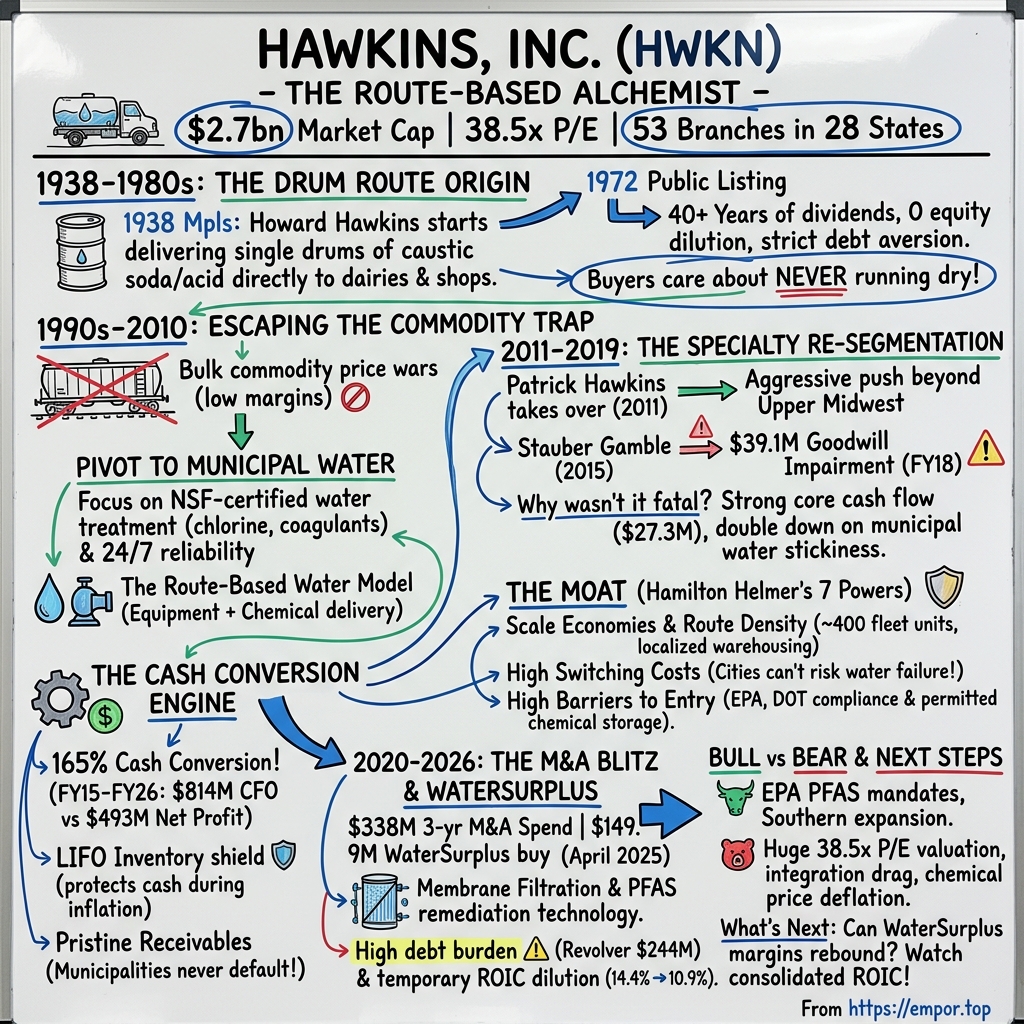
Hawkins, Inc.: The Route-Based Alchemist
I. Chlorine on the Mississippi: The Unseen Utility
The truck arrives before most of the town is awake. It is a plain tanker with a Hawkins logo, pulling into the gravel yard of a municipal water plant somewhere along the upper Mississippi. The driver is also a technician, trained to handle hazardous materials. He connects a hose, and sodium hypochlorite, which is industrial-strength bleach, flows into the plant's feed tanks. Then he walks the pump room, checking that the small metering pumps are dosing the right amount of disinfectant into water that a few thousand people will drink with their morning coffee. Nobody in those kitchens will ever know his name. That is the point. If he does his job, nothing happens.
Hawkins sells that nothing. It runs out of 53 warehouses spread across 28 states, with a fleet of roughly 400 commercial power units, the trade term for tractors and trucks, carrying chlorine, coagulants, acids and alkalis to water plants, food processors and factories.1 It is, on the surface, one of the least glamorous businesses in American public markets: a chemical distributor, founded in Minnesota in 1938, that buys bulk liquids from big producers, blends and repackages them, and drives them to customers.1
Here is the puzzle. Chemical distribution has a reputation as a graveyard for capital. The business is heavy with trucks, tanks and inventory; the products are commodities anyone can buy; and the distributor is squeezed between giant producers on one side and price-conscious buyers on the other. Hawkins itself earned a net margin of about 5% a decade ago, which was respectable for the trade.1 Yet tonight the stock market values Hawkins at about $2.7bn, and the shares trade at roughly 38.5 times trailing earnings.2 That is the kind of multiple investors usually reserve for software companies or specialty franchises with decades of growth ahead, not for a company whose core product is bleach.
The market is making a specific bet. It believes Hawkins is no longer a chemical distributor in any meaningful sense, but a water-infrastructure platform with route density, sticky municipal customers and a long runway of acquisitions. The evidence for that belief is real. Over the decade to March 2026, revenue roughly compounded at 10% a year to about $1.08bn, while net profit compounded at about 16% a year, which means margins widened as the business grew.1 Diluted earnings per share went from 86 cents to $3.91 over the same decade.1
But three questions hang over the price, and they drive the rest of this story. The first is about acquisitions. Hawkins has spent heavily, and with borrowed money, to buy water businesses, including a $150m cash deal for a membrane-filtration company called WaterSurplus in 2025.1 Do those purchases earn what the old branches earned, or are they quietly diluting returns? The second is about where the profits came from. Part of Hawkins' earnings surge coincided with a spike in commodity chemical prices after the pandemic. How much of the improvement is a durable advantage, and how much was a windfall that will fade as prices normalise? The third is about the balance sheet. A company that long prided itself on carrying almost no debt now owes its banks $244m.1 Does that limit what it can do next?
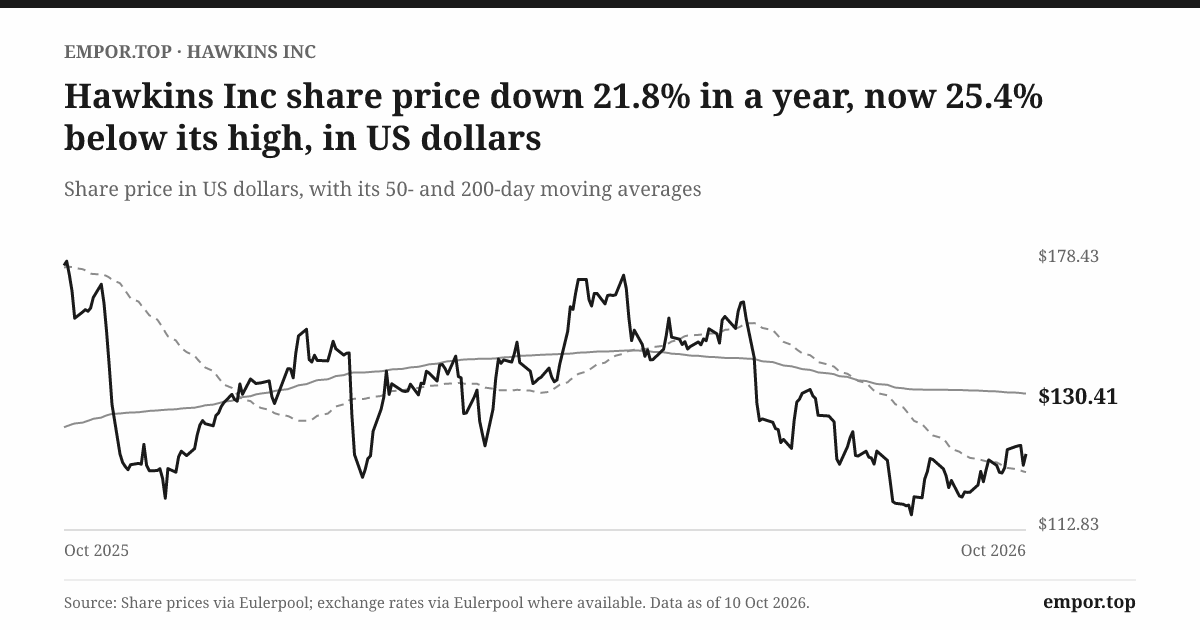
Hawkins stands at a hinge. For most of its life it was a Midwestern family-managed distributor. It now wants to be a national specialty water platform, and it is priced as though it already is one. With a share price about a quarter below its 52-week high, the market has already started to ask whether the transition is going as smoothly as the multiple assumes.2 To understand why investors were willing to pay so much in the first place, the story has to go back to a warehouse in Minneapolis and a founder who decided that what chemical buyers really wanted was not a cheap price but a truck that always showed up.
 Subscribe on LinkedIn
II. Howard Hawkins and the Post-War Drum Route (1938–1980s)
In 1938, with the Depression still lingering over the Upper Midwest, Howard Hawkins started a chemical business in Minneapolis.3 The customers of that era were the small industrial establishments of a growing city: operations that needed acids to clean metal, caustic soda to wash equipment, chemicals for water and food processing. The big chemical makers of the day shipped by the railcar. Most of Howard Hawkins' customers did not want a railcar. They wanted a drum, or a few drums, delivered when they needed them.
That gap became the company's founding insight, and it is worth stating plainly because it still explains the business today. For a buyer of an industrial chemical, the price per pound matters much less than the consequences of running out. A dairy that cannot sanitise its lines stops producing. A plant that cannot treat its water cannot operate. The cost of the chemical is small compared to the cost of not having it. A distributor that can be trusted to deliver the right product, safely, on schedule, every time, can charge a modest premium for that reliability, and the customer will rarely shop around to save a little.
The business built its footprint by doing work the producers did not want to do. It broke bulk shipments into smaller containers, diluted concentrated acids and alkalis to the strengths customers actually used, and blended products to order.1 These are hazardous materials. Diluting sulfuric acid or caustic soda is dangerous if done carelessly, and moving them across city streets brings regulators, insurers and liability. Every one of those frictions was a reason for a small customer to outsource the job to a local specialist, and a reason for the local specialist to own its own warehouse and trucks rather than rely on a common carrier.
The company incorporated in 1955 and went public in 1972.1 That listing happened in a different financial era, long before the SEC's electronic filing system existed, and Hawkins' filing history in that system shows no subsequent registration of a primary equity offering.4 The practical consequence for shareholders is visible in the share count: about 20.75m shares were outstanding in March 2026, against about 20.85m three years earlier, with only small issuance through an employee stock purchase plan offset by buybacks.1 Growth has been financed out of operating cash flow and bank borrowing, not by selling new shares.
That conservatism extended to how the company treated its owners. Hawkins describes a long, unbroken record of paying cash dividends, and in recent years the payout per share has risen steadily, from 63 cents in fiscal 2024 to 75 cents in fiscal 2026.1 Historically the company paid out a large share of its profits; in fiscal 2016 dividends absorbed almost half of net income.1 That pattern says something about the founding culture: a business that saw itself as a steady regional utility for industry, reinvesting in terminals and trucks, avoiding leverage and sending surplus cash back to shareholders.
The record from the founding era is thin in public sources, and the company publishes little about its early decades beyond the dates of founding, incorporation and listing. What matters for an investor today is the operating DNA those decades left behind. Hawkins became a company built around owning the last mile: its own warehouses, its own trucks, its own trained drivers. National rail-based distributors competed on the cost of moving bulk volume long distances. Hawkins competed on being close, being reliable and being able to handle dangerous liquids in small lots.
That model worked well enough for decades. The trouble is that a model built on proximity and reliability does not automatically produce high returns. If the product itself is a commodity, and much of what Hawkins moved was exactly that, then the profit pool is thin and fiercely contested. By the 1990s and 2000s the company faced a question that every regional chemical distributor eventually confronts: in a business where the product is the same everywhere, what exactly are customers paying you for?
III. The Commodity Trap: Bulk Chemicals and the Imperative to Pivot (1990s–2010)
Picture the economics from the inside. A distributor buys liquid caustic soda from a chlor-alkali producer, one of a handful of large manufacturers, and sells it on to an industrial buyer. The distributor's gross profit is the gap between the two prices, minus the cost of storage and freight. When the buyer is purchasing in large volumes, such as whole railcars or tanker loads, that buyer can call several suppliers, including the producer itself, and play them against each other. The distributor's spread compresses toward the cost of moving the product. In that corner of the market, there is very little reason to exist.
That is the commodity trap. The producers set the price of the raw material, and because chlor-alkali production is concentrated, they hold the stronger hand in allocation and pricing. The large buyers shop on price because, for them, the product really is interchangeable. The regional distributor in the middle has neither scale nor differentiation, and its margins swing with commodity cycles it cannot control. Even into the mid-2010s, after years of repositioning, Hawkins' operating margin hovered around 7% to 8%, and its return on invested capital in fiscal 2016 was only about 6%.1 That was a business earning roughly its cost of capital, not a franchise.
The way out was to find customers for whom the service mattered more than the molecule. Municipal water was the obvious candidate. Drinking-water and wastewater plants must dose chemicals precisely: chlorine or hypochlorite to disinfect, coagulants to pull particles out, acids and alkalis to manage pH, other products to control corrosion. Chemicals added to drinking water are expected to meet NSF/ANSI Standard 60, the American certification for drinking-water treatment chemicals, and the plants themselves answer to state and federal regulators.5 A plant that runs out of disinfectant is not simply inconvenienced. It is in violation, and it may have to warn the public not to drink the water.
That changes the buyer's calculation entirely. A small-town water superintendent is not rewarded for saving a few cents a gallon and is in serious trouble if the supply fails. So the superintendent values a supplier who delivers reliably, knows the plant, can service the feed equipment and will show up in an emergency. Hawkins built its water business around exactly that bundle. Its water treatment group supplies the chemicals and also the equipment that doses them, along with technical service from its own staff.5 When a supplier's pumps, tanks and service routines are woven into a plant's daily operation, replacing that supplier means more than changing a purchase order.
The second element was geography. A delivery route is a cost machine: the more stops a truck can make in a day within a short radius, the cheaper each delivery becomes. So the logical strategy was not to sprinkle branches randomly across the country but to build density outward from the Minnesota base, with warehouses serving clusters of customers within a manageable driving range. Over time that network grew into the 53 facilities across 28 states the company operates today.1 Each new branch near existing ones lowers the cost per stop for everyone on the route.
The success of this pivot shows up in the company's sales mix. By fiscal 2026, products that Hawkins manufactured, blended, repackaged, or sold as equipment made up about 61% of sales, while bulk commodity products, the old trap, were down to about 9%.1 Food and health sciences, a different business discussed later, made up most of the rest.1 The low-value middleman trade has become a small residual, and the bulk of revenue now comes from work in which Hawkins adds something a customer cannot easily get elsewhere.
There is an honest caveat, and it should sit right next to the success. The pivot did not take Hawkins out of commodity exposure. It still buys caustic soda, chlorine and acids from large producers, and its own filings say that its sales and margins move with those raw material prices.1 What changed is that Hawkins now sells those commodities inside a service relationship, which gives it more ability to pass costs through and keep its spread. That is a narrower claim than "Hawkins escaped the commodity cycle", and it is the claim the evidence supports. The real test of how far the company had come arrived with a change at the top and an ambitious bet on a very different kind of business.
IV. The Architect's Reign: Patrick Hawkins and the Specialty Re-segmentation (2011–2019)
In 2011, Patrick H. Hawkins became chief executive officer.6 He carried the family name and had spent his career inside the business, so the succession looked, from the outside, like continuity. In practice it marked the start of the most ambitious period in the company's history. Under his leadership Hawkins pushed beyond the Upper Midwest, organised itself around end markets rather than product lines, and began using acquisitions as a growth tool rather than an occasional opportunity.
He is not a celebrity chief executive. He gives few interviews, the company holds a modest public profile, and its investor communication is restrained. What his record reveals most clearly is how he chose to be paid and how he paid his team. Hawkins' executive bonuses are tied to pre-tax income and to the operating profit of the business units, not to revenue.6 That matters in a business where it is easy to grow sales by buying low-margin volume or by riding up commodity prices. A pay plan that rewards profit rather than size pushes managers toward the routes and products that earn money, and away from growth for its own sake.
The first big bet under that regime was a step outside water. On December 23, 2015, Hawkins acquired Stauber Performance Ingredients, a California-based distributor of specialty ingredients for nutrition, food and pharmaceutical customers, for about $157m.7 Stauber was the opposite of the classic Hawkins route business: light on physical assets, built on sourcing and selling ingredients, many of them imported, to makers of dietary supplements and food products. The appeal was clear enough. It gave Hawkins a growth market far from the Rust Belt and a nationwide customer list in a business that did not depend on trucks and tanks. The deal also loaded the balance sheet: borrowings went from zero in fiscal 2015 to about $129m a year later.1
The deal did not work as planned. Within roughly two years, the health and nutrition business was falling short of the projections that had justified the price. In fiscal 2018, Hawkins recorded a goodwill impairment of $39.1m on the Stauber business, which turned the company's reported operating profit into a loss of about $11.8m for the year.8 Goodwill is the premium an acquirer pays above the value of the assets it can identify; writing it down is an accounting admission that the business will not earn what the buyer expected. The filing pinned the shortfall on weaker results in the health and nutrition segment against the original forecasts.8
This is the most important failure in Hawkins' modern record, and it bears directly on the current investment case, because the company is once again paying large premiums for acquisitions. So it deserves a careful weighing. The impairment was large relative to the deal, roughly a quarter of the purchase price. It came from the same management team that runs the company today. And it came from exactly the kind of move a skeptic worries about: an expansion into a business with weaker structural protection than the core.
The other side of the ledger is what happened to cash. A goodwill impairment does not consume cash, because the cash was spent when the deal closed. In the year of the write-down, Hawkins still generated about $27m of cash from operations.1 Debt kept falling, from roughly $129m after the deal to about $69m by fiscal 2020, and the company did not issue shares to repair its balance sheet.1 Stauber was not sold or shut; it remains a subsidiary and grew into part of a food and health sciences business that produced about $321m of sales in fiscal 2026.1 In other words, Hawkins overpaid for a business it kept and worked with, rather than buying something that collapsed.
So the history narrows the claim about Patrick Hawkins' capital allocation rather than rejecting it. It does not support the idea that he never misjudges an acquisition; the Stauber price was too high, and the company had to say so. It does support a smaller and more useful claim: when a deal disappointed, management recognised the loss within a couple of years, kept the cash engine intact, paid down debt and avoided dilution. Shareholders have continued to back that team. At the July 2026 annual meeting, say-on-pay passed with about 97% support and every director won more than 91% of the votes cast.9 Patrick Hawkins personally owns about 348,000 shares, roughly 1.7% of the company, a stake worth about $45m at today's price.6
The strategic lesson Hawkins drew from Stauber appears in where the money went next. The bulk of the following decade's acquisitions targeted water treatment, the business where physical presence and service routines protect the customer relationship.1 Water is a market that imports cannot easily reach, because nobody ships hypochlorite across an ocean to a town of 5,000 people. That was the post-Stauber verdict: lean into the routes. To understand why those routes are worth paying for, the next step is to look inside the machine itself, at how a business full of trucks and tanks manages to throw off so much cash.
V. Inside the Machine: Unit Economics, LIFO Inventory, and the Cash Conversion Engine
Inside a Hawkins terminal, the work looks industrial and mundane. Bulk acid arrives by rail or tanker. Technicians dilute it to customer strength in automated systems, fill totes and drums, and stage the product for route trucks. Somewhere upstairs, an inventory clerk is doing something less visible that matters just as much: valuing that inventory at the cost of the most recent purchases and making sure customer prices keep pace with what replacement material now costs.
Start with the shape of the revenue. In fiscal 2026, Hawkins booked about $1.08bn of sales.1 Roughly $656m came from manufactured, blended and repackaged products and equipment, most of it in water treatment; about $321m came from food and health sciences, spread across nutrition, food, agriculture and pharmaceutical customers; and only about $96m came from bulk commodities.1 The company has reorganised its reporting into three segments: Water Treatment, Food and Health Sciences, and Industrial Solutions.1 Water Treatment, the heart of the investment case, produced about $543m of sales in fiscal 2026, up about 22% on the year, partly thanks to acquisitions.1
The core pricing mechanism is simple to describe. Hawkins does not sign long take-or-pay contracts that lock in prices for years. It prices to the current replacement cost of the chemicals it sells, adjusting customer prices as raw material costs move, and aims to protect the dollars of gross profit it earns on each unit rather than a fixed percentage.1 Think of it like a fuel station that changes its pump prices when wholesale gasoline moves: the station cares about the cents per gallon it keeps, not the headline price. When caustic soda doubles in price, Hawkins' revenue rises but its percentage margin can fall, even if the dollar spread per gallon holds. That is why revenue growth alone is a poor guide to how this business is doing.
Then there is the accounting choice that sits beneath it. Hawkins values about 73% of its inventory using LIFO, last-in, first-out.1 Under LIFO, the cost of goods sold reflects the most recently purchased, and so usually the most expensive, inventory. During inflation, that pushes reported costs up and reported profits down, which also lowers taxable income. The difference between LIFO values and what the inventory would be worth on a first-in, first-out basis builds up in a "LIFO reserve". Hawkins' reserve rose by about $1.6m in fiscal 2026 to roughly $24m, and it rose by another $1.9m in the June 2026 quarter.110
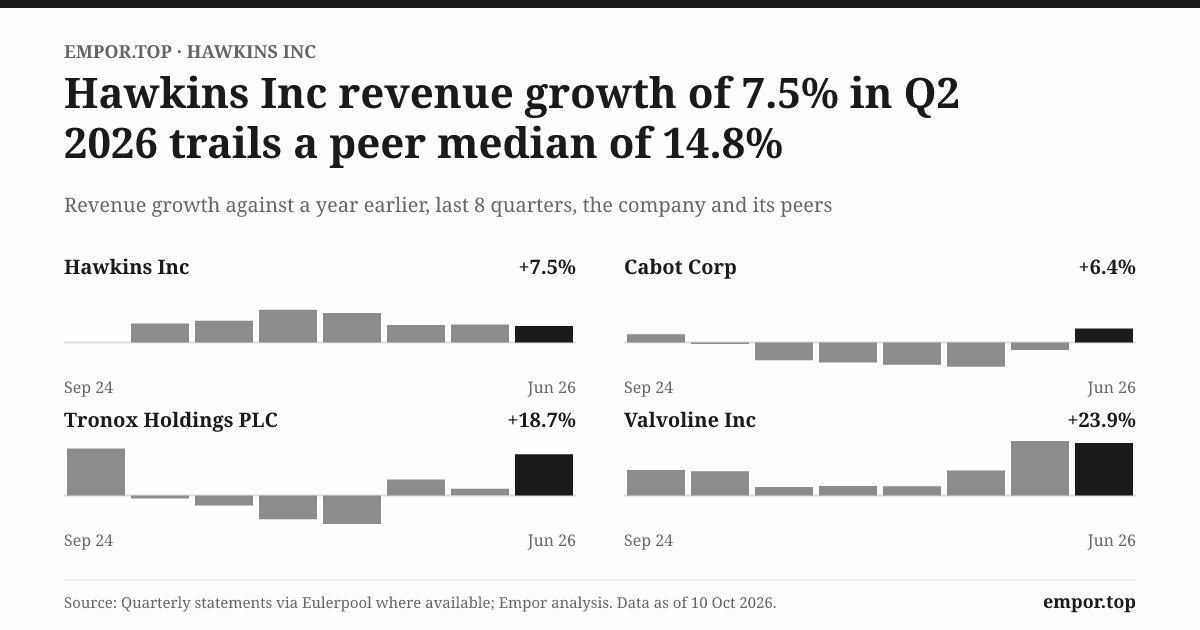
Those numbers explain something investors noticed in the most recent quarter. In the three months to June 2026, sales grew about 7.5% to about $315m, but gross margin slipped to 23.4% from 24.7% a year earlier, which management attributed to higher LIFO expense and freight costs it had not fully recovered.10 Operating profit edged down from about $41m to about $39m.10 The honest reading is that the pass-through mechanism is real but not instant. When costs rise, Hawkins catches up with a lag, and LIFO makes the squeeze show up immediately in reported profit while the cash consequences are softer.
The payoff from all of this is the most striking statistic in Hawkins' accounts. Over the twelve fiscal years to March 2026, the company reported cumulative net profit of about $493m but generated about $814m of cash from operations, or roughly 165% of reported earnings.1 Most of that gap is depreciation and amortisation, the non-cash charges for trucks, tanks and acquired intangibles, which reached about $52.5m in fiscal 2026 alone.1 Some comes from stock compensation, and in fiscal 2026 the company also released about $10m of cash by running down inventory.1 In that year, about $81.5m of net income became about $144m of operating cash flow.1
That conversion deserves a caveat, because an investor should not mistake cash from operations for free money. A route business has to keep replacing its trucks and expanding its terminals. Capital spending rose from about $40m in fiscal 2024 to about $58m in fiscal 2026, and management has guided to about $55m for fiscal 2027.1 After capital spending, the twelve-year free cash flow total was about $461m, which is still close to the cumulative net profit figure and clearly real cash, but not a dramatic multiple of it.1 The more accurate conclusion is that Hawkins' earnings are high quality and genuinely convert into cash; the 165% figure flatters the picture because heavy depreciation is a real economic cost that must be reinvested.
Receivables tell the cleanest part of the story. At the end of fiscal 2026, customers owed Hawkins about $140m, and the company held an allowance for bad debts of only about $0.5m, around 0.4% of the total.1 Actual write-offs were about $76,000 in fiscal 2026 and zero in the two prior years.1 Customers paid in about 47 days on average.1 Municipal water departments, which operate on budgeted appropriations, simply do not tend to default on their chlorine bill. There is no unbilled revenue to speak of, so there is little room for the kind of revenue recognition games that worry analysts in other industries.1
Finally, the treasury. Hawkins keeps almost no cash: about $4m at the end of fiscal 2026 and about $8m at the end of June 2026.110 Any spare operating cash goes to repay its revolving credit line, so the company carries no hoard of idle money and no speculative securities.1 Its small "other income" line comes mostly from investments held for executive deferred compensation, and is offset by matching costs.1 It is a lean, almost austere way of running a balance sheet, and it worked beautifully when debt was low. The question became what happens when the revolver stops being a convenience and becomes the funding source for an acquisition spree.
VI. The M&A Blitz and the WaterSurplus Transformation (2020–2026)
On April 25, 2025, Hawkins signed an amended and restated credit agreement with U.S. Bank National Association, expanding its revolving facility to $400m and pushing its maturity to April 2030.1 The same agreement funded a deal: Hawkins used the borrowing capacity to pay about $149.9m in cash for Surplus Management, Inc., which does business as WaterSurplus.111 For a company that a decade earlier had carried zero borrowings, it was a decisive moment. Hawkins was no longer adding the occasional branch. It was borrowing to buy capability.
The scale of the shift becomes clear over three years. In fiscal 2024 Hawkins spent about $84m in cash on acquisitions; in fiscal 2025, about $87m; and in fiscal 2026, about $167m, for a three-year total of roughly $338m.1 Over those same three years the company generated about $275m of free cash flow and paid about $43m in dividends.1 Put simply, Hawkins spent more on acquisitions than all the free cash its business produced, and borrowed the difference. Headcount grew from about 850 in fiscal 2022 to about 1,200 by March 2026, an increase of roughly 41%, reflecting both acquisitions and organic expansion.1
WaterSurplus is different from the water distributors Hawkins had bought before. It provides engineered water treatment systems, including membrane filtration and reverse osmosis, along with service and replacement parts, for industrial and municipal customers.11 Membrane filtration works like an extremely fine sieve: water is pushed through a material with pores small enough to block dissolved salts, microbes and certain contaminants. Those technologies matter for wastewater reuse and for removing PFAS, the so-called forever chemicals that regulators have pushed utilities to address. Hawkins framed the deal as a way to sell more to its existing water customers and enter adjacent markets.11
The headline price understates what Hawkins committed. Beyond the $149.9m paid upfront, the deal included an earnout, extra payments if WaterSurplus hits future performance targets, which Hawkins valued at about $43m at closing, bringing total estimated consideration to roughly $193m.1 By March 2026, the company carried about $49m of earnout liabilities on its balance sheet, mostly tied to WaterSurplus.1 An earnout is a sensible way to share risk with sellers, but it is also a liability that grows if the business does well, and it depends on assumptions about future results.
Here is where the story needs its sharpest test. If Hawkins' acquisition strategy works, the bought businesses should quickly earn returns comparable to the legacy branches. In its first year under Hawkins ownership, WaterSurplus produced about $34.6m of sales and an operating loss of about $3.9m, weighed down by purchase accounting, including a step-up in the value of acquired inventory and deal fees.1 At the consolidated level, the effect on returns was visible. Return on invested capital fell from about 14.4% in fiscal 2025 to about 10.9% in fiscal 2026, and return on capital employed fell from about 18% to about 13%.1
Some of that fall is mechanical. When a company pays a premium for a business, the invested capital rises immediately while the earnings take time to arrive, and amortisation of acquired intangibles depresses reported profit for years. The inventory step-up and deal costs will not recur. And the segment as a whole kept growing: Water Treatment operating income rose about 14% in fiscal 2026 to about $68m.1 But the arithmetic of that sentence is also the warning. Segment sales grew about 22% while segment operating income grew about 14%, so the margin fell. The acquisitions added revenue faster than they added profit.
The auditor flagged exactly where the judgment lies. Deloitte & Touche issued an unqualified opinion on the fiscal 2026 accounts but identified a critical audit matter: the valuation of about $76m of customer relationships acquired with WaterSurplus.1 That value rests on projections of revenue growth, EBITDA margins and a discount rate. A critical audit matter is not a red flag in itself; it is the auditor telling shareholders where the numbers depend most on management's estimates. Here it points to the asset whose value depends on WaterSurplus delivering the growth and margins Hawkins expected. If those assumptions prove too optimistic, the history of Stauber shows how this company recognises it: an impairment, a few years out.
The debt is the other consequence. Borrowings on the revolver rose from about $108m in fiscal 2024 to $244m by March 2026, and they were still $244m at the end of June 2026.110 Interest expense rose about 149% to roughly $13.5m in fiscal 2026.1 Share buybacks, which had run at about $11m in fiscal 2024 and about $21m in fiscal 2025, stopped entirely in fiscal 2026 while the company digested its purchases.1 The debt carries an interest rate of around 4.4%, partly hedged by a $60m interest rate swap, and it requires no repayments before 2030.1
So did Hawkins overpay? The evidence does not yet allow a clean answer, and that is precisely the point. The deal bought real capability in a growing corner of water treatment, the credit terms are comfortable and the integration costs are partly temporary. But the first year produced a loss, the company's return on capital fell by about a quarter, and the auditor singled out the valuation of the customer base as the biggest judgment in the accounts. The claim that Hawkins' acquisitions earn legacy returns is, for now, unproven. The figure that will settle it is Water Treatment's operating margin as the purchase accounting burns off. Whether those returns can recover depends on something more fundamental: whether the advantages that protected the old branches extend to the new ones.
VII. Competitive Architecture: Moats, Network Density, and Industry Powers
Imagine a procurement meeting at a small municipal utility. A national distributor, one of the global chemical traders, submits a bid that is a little cheaper on the price of chlorine. The incumbent supplier is a local branch whose technician knows the plant's pumps, maintains the feed equipment and has answered emergency calls at odd hours. The board has to decide whether a modest saving is worth the risk of a supplier failure that could force a boil-water notice. Hawkins does not publish its renewal rates, so nobody outside the company can say how often that board chooses to stay. But the logic of that room is the logic of Hawkins' moat, and it is worth testing piece by piece.
The first source of advantage, in the language of Hamilton Helmer's 7 Powers framework, is scale economies, but of a local kind. The relevant scale is not national revenue; it is how many customers a truck can serve within a few hours of a warehouse. Hawkins' 53 facilities and roughly 400 power units give it density in its core regions, which lowers the cost per stop and lets it respond quickly.1 A national competitor with fewer customers in a given county must either drive further or charge more. That advantage is real but regional. Where Hawkins is the new entrant, as in many of the markets it has entered by acquisition, it is the one fighting an incumbent's density.
The second power is switching costs, and it is the strongest. When a supplier's equipment is installed at a plant, its staff service the dosing systems and its products are certified for the purpose, replacing it is a project with real risk. The utility does not save much by switching, because chemicals are a small part of its budget, and it risks a great deal if the new supplier makes a mistake. Hawkins disclosed no material contract cancellations and no customer large enough to account for 10% of revenue in any of the last three years.1 That is consistent with a sticky, fragmented customer base, though it is not direct proof of retention, which the company does not publish.
The third power is process. Handling hazardous chemicals safely across thousands of deliveries requires training, compliance with transport and workplace regulations, and certified products. Those routines are hard to build quickly, and a serious safety incident would damage any supplier's reputation with risk-averse public customers. Process power, however, is the weakest of these claims to treat as unique: national distributors also have rigorous safety systems. It works mainly as a barrier against small, undercapitalised entrants rather than against the industry's giants.
The fourth possible power is a cornered resource: permitted sites for storing hazardous chemicals, rail-served terminals and warehouses that would be hard to replicate because new zoning for such facilities is difficult to win. The plausibility of this is high, but Hawkins does not disclose how hard its permits would be to duplicate, so it is better treated as a likely advantage than a proven one. The company's own environmental record also shows the other side of owning industrial land: it carries a $7.7m liability to remediate legacy PCB contamination at its Rosemount, Minnesota site, a property it bought in fiscal 2012 and did not contaminate.1 Old industrial land comes with old industrial problems.
Porter's five forces sharpen the picture. Supplier power is high. Chlor-alkali and acid production is concentrated among a few large manufacturers, and Hawkins is a price-taker on its base commodities; its filings warn that supply disruptions and price swings can affect its results.1 Buyer power, by contrast, is low: Hawkins' customers are thousands of utilities and processors, none of them large enough to dictate terms.1 The threat of substitutes is limited for the core business, since there is no digital alternative to disinfecting water, though technologies such as ultraviolet treatment and on-site chlorine generation could reduce some chemical volumes over time, a risk the company does not quantify. Barriers to entry are meaningful, because building trucks, terminals, certifications and local relationships takes time and capital. Rivalry among existing players is the force to watch: national distributors and other regional consolidators are also buying water businesses.
The research on Hawkins' moat therefore narrows the bull case rather than confirming it whole. The evidence supports a real advantage where Hawkins has local density and installed relationships with municipal water plants: customers are fragmented, credit losses are negligible and no single buyer can squeeze the company. It does not support the idea that Hawkins is insulated from commodity pricing, since suppliers hold power and the company's reported margins move with raw material costs. Nor does it prove that the moat transfers automatically to new regions or to engineered systems like WaterSurplus, which sell differently, in larger, lumpier projects, with more competition from equipment makers.
That makes the most important number in this part of the story Water Treatment's operating margin. In fiscal 2026 the segment's margin was about 12.5%, down from roughly 14% the year before as acquisitions diluted it.1 If the moat travels with the routes Hawkins buys, that margin should recover as integration proceeds. If it does not, the company is buying revenue rather than power. That distinction is where the lessons of this story begin.
VIII. Playbook: Business & Investing Lessons
Picture the conversation in Hawkins' executive offices in a year like this one. There is cash coming in, a revolver to pay down, a buyback authorisation with room left, and a pipeline of small water distributors in regions where Hawkins wants more density. Every dollar can go to only one place. The way this company has answered that question, again and again over eight decades, is what makes it worth studying, and the answers travel well beyond chemicals.
The first lesson is that the route is the product. Hawkins sells chlorine that any producer could sell; what it really sells is the certainty that the chlorine will be there, in the right concentration, at a water plant that cannot stop. That is why bulk commodities have shrunk to about 9% of its sales while blended and serviced products make up most of the rest.1 For founders, the wider point is that the hardest asset to copy in a commodity business is often not the commodity or the factory but the last mile of trust. When a customer's downside from failure dwarfs the price of the product, the product is nearly free. What the customer pays for is the truck that always comes.
The second lesson is about who absorbs inflation. Hawkins' model depends on passing cost increases through to customers and protecting its dollars of profit per gallon. LIFO accounting makes the reported numbers look worse in inflationary years, but it keeps the books honest about replacement costs and lowers the tax bill. The cost of getting this wrong shows up in the most recent quarter, when unrecovered freight and higher LIFO costs pushed gross margin down more than a full percentage point.10 The lesson for investors is to watch the spread, not the sales line: in a pass-through business, revenue measures commodity prices, and gross profit dollars measure the moat.
The third lesson is about the share count. Since going public in 1972, Hawkins has grown, made dozens of acquisitions and survived a major write-down without selling new shares to the public.14 That is not an accident of luck; it reflects a culture that treats each share as a claim on the routes, not a currency to be spent. The company's ten-year growth in net profit of about 16% a year has flowed almost entirely to per-share earnings, which rose about 4.5 times over the decade.1 For founders, the uncomfortable corollary is that this discipline requires debt to fund growth, and debt brings its own risk, as the WaterSurplus borrowing shows. The lesson is not "never dilute"; it is "make dilution the most expensive option on the table, and grow only as fast as your cash and lenders allow."
The fourth lesson comes from Stauber. When an acquisition misses, the worst response is denial. Hawkins took its $39m impairment within about two years of the deal, kept generating cash and paid down debt, and the Stauber business remained part of a larger food and health sciences platform.81 The write-down did not destroy the company, but it did cost shareholders real money in the form of a premium that never came back. The line to remember: an impairment is a confession, not a cure. Investors should judge acquirers less by whether they ever overpay, because all of them eventually do, and more by how quickly they admit it and whether the next deal reflects the lesson.
Together these lessons point to a pattern that investors often miss. Many great compounders disguise themselves as dull businesses. They do not invent new technology; they take an essential, dangerous or unglamorous task and do it so reliably that customers stop thinking about alternatives. But dullness is not a moat in itself. The moat is the density, the trust and the discipline, and each of those has to be renewed with every acquisition. That is exactly what the market is now debating, at a price that leaves little room for error.
IX. Analysis & Bull vs. Bear Case
Imagine an investment committee laying three companies side by side. Brenntag, the German giant of chemical distribution, trades at a modest multiple of EBITDA that reflects a cyclical, low-margin trade. Balchem, an American maker of specialty nutrition and health ingredients, trades at a premium multiple reflecting proprietary products and steady growth. And Hawkins, the regional distributor of water and industrial chemicals, trades at about 17 times EV to EBITDA and about 38.5 times trailing earnings, closer to the specialty ingredient maker than to the distributor.2 The committee's question is whether Hawkins deserves to be valued like a franchise or like a trader.
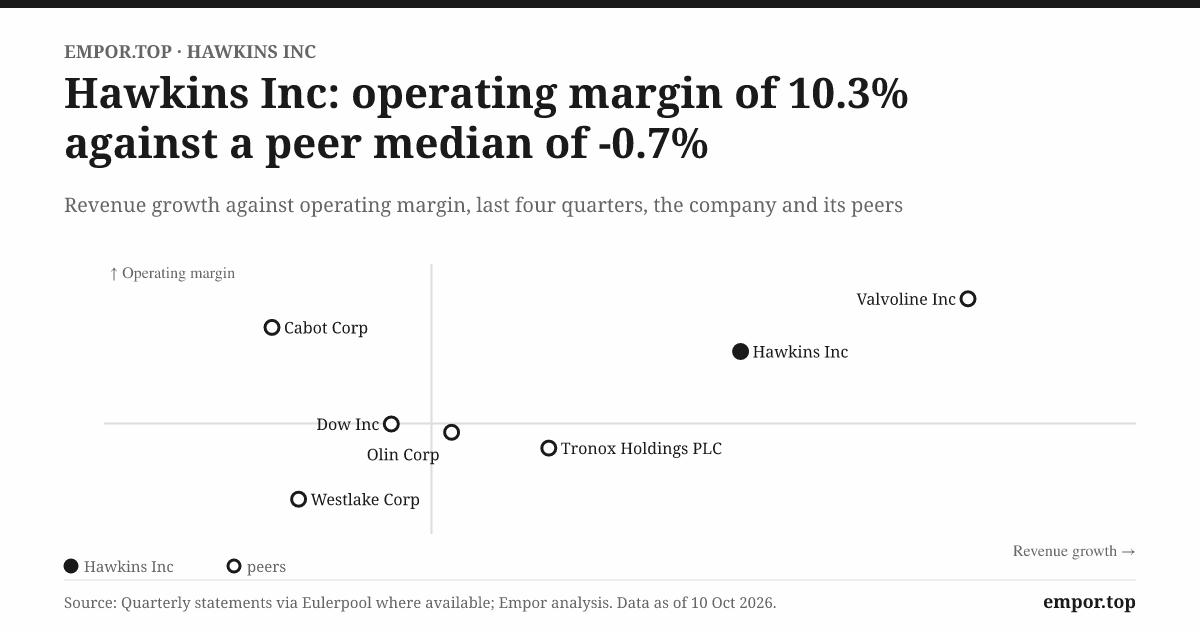
Start with what the market is paying. At about $2.7bn of market value and about $3bn of enterprise value, investors are paying roughly 26 times Hawkins' operating profit and receiving a free cash flow yield of about 3% and a dividend yield of about 0.6%.2 The price-to-earnings-to-growth ratio, a crude measure comparing the multiple to the growth rate, is about 3.6.2 Translate those figures into plain language: an owner buying the whole company today would earn about three cents of free cash for every dollar paid, and would need years of strong growth in that cash to justify the price. Over the last three years net profit grew only about 10% a year and revenue about 5% a year, well below the pace of the preceding five years.1
The bull case begins with water. Regulators have tightened standards for drinking water and wastewater, including limits on PFAS, and utilities across the country face pressure to upgrade treatment. That favours suppliers of treatment chemicals and engineered systems, which is why Hawkins bought WaterSurplus.11 Second, the route-density playbook can be repeated: each small water distributor Hawkins buys in a new region can become the seed of a dense cluster, as the Midwest once was. Third, the balance sheet can heal quickly. Hawkins generated about $86m of free cash flow in fiscal 2026 and about $35m of operating cash in the June 2026 quarter alone.110 Its bank leverage, at roughly 1.4 times EBITDA, sits well below the 3 times ceiling in its loan covenants, and about $156m of the revolver remains undrawn.1 If cash goes to debt repayment, the company could be back to low leverage within a few years, and buybacks have already restarted, with about $7m spent in the June quarter.10
The bear case starts with the price. A stock at nearly 40 times earnings needs the good news to keep coming. Hawkins' share price has already fallen about 25% from its 52-week high, and its largest drop over the past five years was about 37%, a reminder that even a steady business can have a volatile stock.2 If growth disappoints, a return toward the lower multiples at which distributors usually trade would hurt holders badly even if the business itself stays healthy.
The second bear argument is acquisition drag. WaterSurplus lost money in its first year, the company's return on invested capital fell to about 11%, and the $49m of earnout liabilities and the amortisation of acquired intangibles will weigh on reported returns for years.1 A skeptic would ask why a company with a record of overpaying for Stauber should be trusted with a larger deal in a less familiar business, and would note that the auditor's main concern centred on precisely the assumptions that justify WaterSurplus's value.1
The third bear argument is the commodity cycle. Part of Hawkins' strong growth after the pandemic came as commodity chemical prices rose sharply, lifting revenue and gross profit dollars.1 If chlor-alkali prices fall, revenue will shrink and gross profit dollars may soften, even if percentage margins look better. The company's filings explicitly warn that its results move with these raw material costs.1 The fourth is the Rosemount PCB liability, now about $7.7m, which the company expects to spend within twelve months; if regulators widen the area that must be cleaned up, the bill could grow.1 On the scale of a company earning about $121m of operating profit a year, that is a manageable risk rather than a threat to solvency.1
An activist looking at Hawkins would probably not attack governance. Related-party dealings are tiny, mainly a $0.7m annual lease on Stauber's California property from an entity partly owned by director Daniel Stauber, and the employment of three relatives of executives at modest salaries.6 The board is mostly independent, and voting dissent is low.69 The activist's challenge would instead target capital allocation: why spend more than all free cash flow on acquisitions at a time when the company's own shares trade at a premium, and what returns, specifically, management expects to earn on that capital? Hawkins does not publish formal return targets for its acquisitions, which makes that question hard to answer from outside.
Weighed together, the evidence supports a clear verdict, hedged once. The business is very good: high cash conversion, pristine customers, a real local moat and a management team with a demonstrated habit of fixing its mistakes. The stock, by contrast, is priced as if the acquisitions will work, the commodity tailwind will not reverse and growth will reaccelerate, and the record of the last two years does not yet prove any of those things. Investors should treat three numbers as the scorecard. The first is Water Treatment's operating margin, which fell to about 12.5% in fiscal 2026 from about 14% the year before.1 The second is consolidated return on invested capital, which fell to about 11% from about 14%.1 The third is revolver debt, which stood at $244m in June 2026, flat since March.10 If the margin recovers, returns rise and the debt falls, the premium will look justified. If not, the multiple will have to do the adjusting.
X. Epilogue
This winter, in council chambers across the Midwest and South, town boards will approve their budgets for the coming year. Somewhere in those documents is a line for water treatment chemicals, rarely debated and almost always renewed. Hawkins will report its fiscal third and fourth quarter results in the months that follow, and those reports will do more than any budget hearing to decide whether the market's faith in the company is warranted.
The near-term test is simple to state. As WaterSurplus's one-off acquisition costs disappear, Water Treatment's operating income should grow faster than its revenue. If that happens, it will suggest that the moat Hawkins built in Midwestern municipal water extends to engineered systems and new regions. If the segment margin stays stuck near 12%, it will suggest that the company has bought revenue at returns below its historical standard, and the market's premium will be harder to defend.
The second checkpoint is capital allocation. Hawkins has guided to about $55m of capital spending in fiscal 2027 and has about $156m of unused revolver capacity.1 It restarted buybacks in the June quarter, spending about $7m.10 Over the next twelve months investors will learn which way management leans: toward paying down the $244m revolver and rebuilding flexibility, or toward another large acquisition financed by more debt. Either choice can be defended. What matters is whether the next deal is priced with the lessons of Stauber and WaterSurplus in mind.
The governance baseline offers some reassurance. Patrick Hawkins has run the company for fifteen years, owns a stake worth about $45m and is paid largely on profit.6 Shareholders backed the pay plan with about 97% of votes in July 2026.9 That alignment does not guarantee good decisions, but it does mean that the people making them feel the consequences in their own wealth.
So the tension remains unresolved. The company has proved that it can build a remarkable business out of trucks, tanks and bleach. It has not yet proved that it can buy such a business at a price that earns its keep, and the market is paying as though it already has. The next four quarters will start to settle that argument.
XI. Outro
Back on the county highway, the driver closes the valve on the feed tank, signs the delivery ticket and checks the pumps one more time. He climbs into the cab and heads toward the next treatment plant, thirty miles down the road, where another tank is waiting to be filled. Nobody will notice. The water will simply be safe.
That is the whole secret of Hawkins, eighty-eight years after Howard Hawkins began selling chemicals in Minneapolis. The company never invented a breakthrough technology and never needed to sell a new share to the public to grow. It took an essential, hazardous and utterly unglamorous liquid, learned to deliver it safely across a dense web of local routes, and made itself the supplier a city would never think to replace. The open question tonight is not whether that business is good. It is whether the price already assumes that every new route Hawkins buys will become just as unthinkable to replace as the old ones.
References
-
Hawkins, Inc. Form 10-K for the Fiscal Year Ended March 29, 2026 — SEC EDGAR, 2026-05-13 ↩↩↩↩↩↩↩↩↩↩↩↩↩↩↩↩↩↩↩↩↩↩↩↩↩↩↩↩↩↩↩↩↩↩↩↩↩↩↩↩↩↩↩↩↩↩↩↩↩↩↩↩↩↩↩↩↩↩↩↩↩↩↩↩↩↩↩↩↩↩↩↩↩↩↩↩↩↩↩
-
Hawkins, Inc. Company Profile and Financial Overview — Bloomberg, 2026-10-10 ↩↩↩↩↩↩
-
Hawkins, Inc. Investor Relations Overview — Hawkins, Inc., 2026-10-10 ↩
-
Hawkins, Inc. Submissions JSON API (CIK 0000046250) — U.S. Securities and Exchange Commission, 2026-10-10 ↩↩
-
Hawkins, Inc. Water Treatment Products and Capabilities — Hawkins, Inc., 2026-10-10 ↩↩
-
Hawkins, Inc. Definitive Proxy Statement on Form DEF 14A — SEC EDGAR, 2026-06-18 ↩↩↩↩↩↩
-
Hawkins, Inc. Form 10-K for the Fiscal Year Ended March 31, 2024 — SEC EDGAR, 2024-05-15 ↩
-
Hawkins, Inc. Form 10-K for the Fiscal Year Ended April 1, 2018 — SEC EDGAR, 2018-05-23 ↩↩↩
-
Hawkins, Inc. Current Report on Form 8-K (Annual Meeting Voting Results) — SEC EDGAR, 2026-08-03 ↩↩↩
-
Hawkins, Inc. Form 10-Q for the Period Ended June 28, 2026 — SEC EDGAR, 2026-07-29 ↩↩↩↩↩↩↩↩↩↩
-
Hawkins, Inc. Announces Acquisition of WaterSurplus — Hawkins, Inc. Press Release, 2025-04-28 ↩↩↩↩
 LinkedIn
 WhatsApp
 Reddit
 Hacker News
 Email
Email Kindle
 RSS Feed
 Spotify
 Apple Podcasts
 Amazon Music
 Audible
 YouTube