H2O America: The Price of Keeping the Water Running
I. The $2.7 Billion Promise
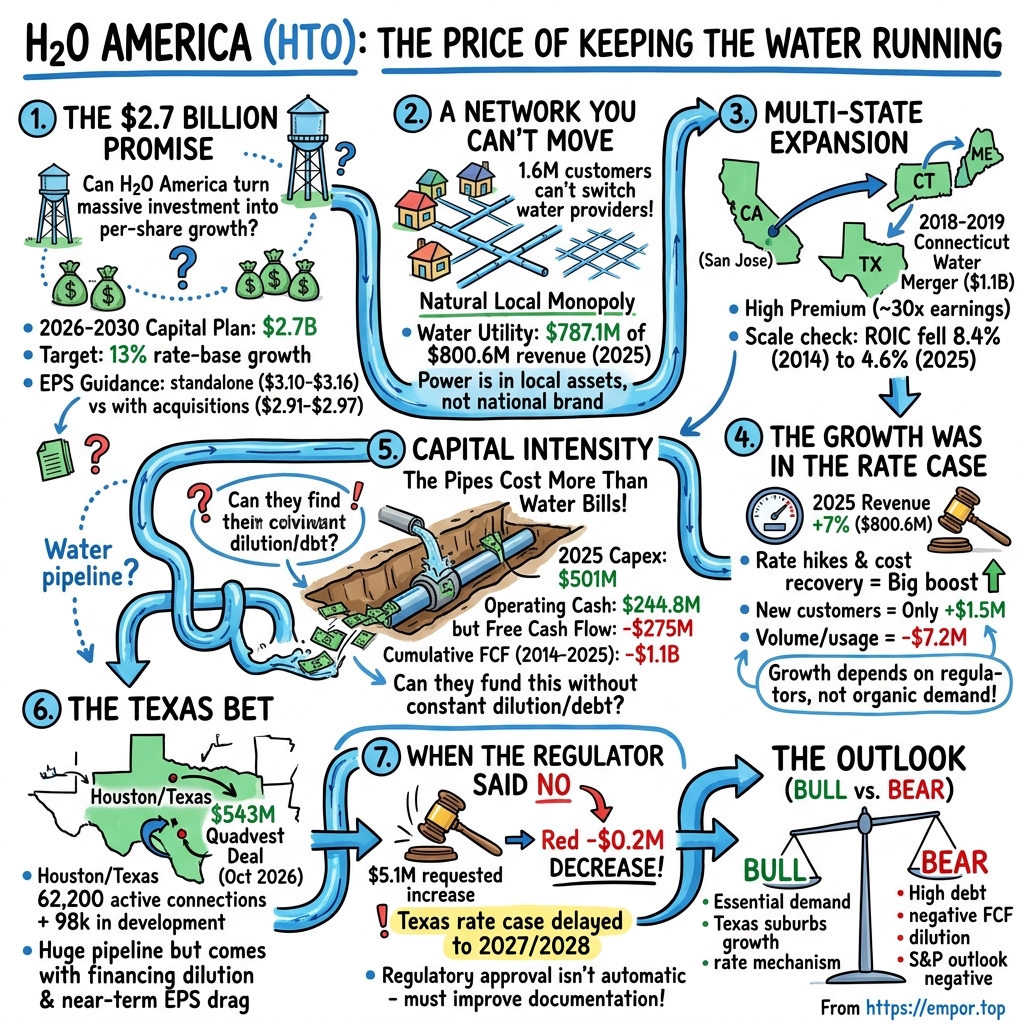
On the first day of October 2026, a water company that began life in San Jose in 1866 became, overnight, a meaningful Texas utility. H2O America closed its purchase of Quadvest, a Houston-area water and sewer operator, paying about $542.7 million in cash for a system that serves fast-growing subdivisions north of the city.[^1]1 It was the largest acquisition in the company's history, the end of a regulatory process that had run for more than a year, and the reason the company had sold hundreds of millions of dollars of new stock in the spring.
The same morning brought a less welcome piece of paper. The Public Utility Commission of Texas adopted an administrative law judge's recommendation on H2O's latest system improvement charge, the mechanism that lets a Texas water utility add completed pipes and pumps to customer bills between full rate cases.2 The company had asked for about $5.1 million of additional annual revenue.3 It walked away with a cut of roughly $240,000 a year instead.2
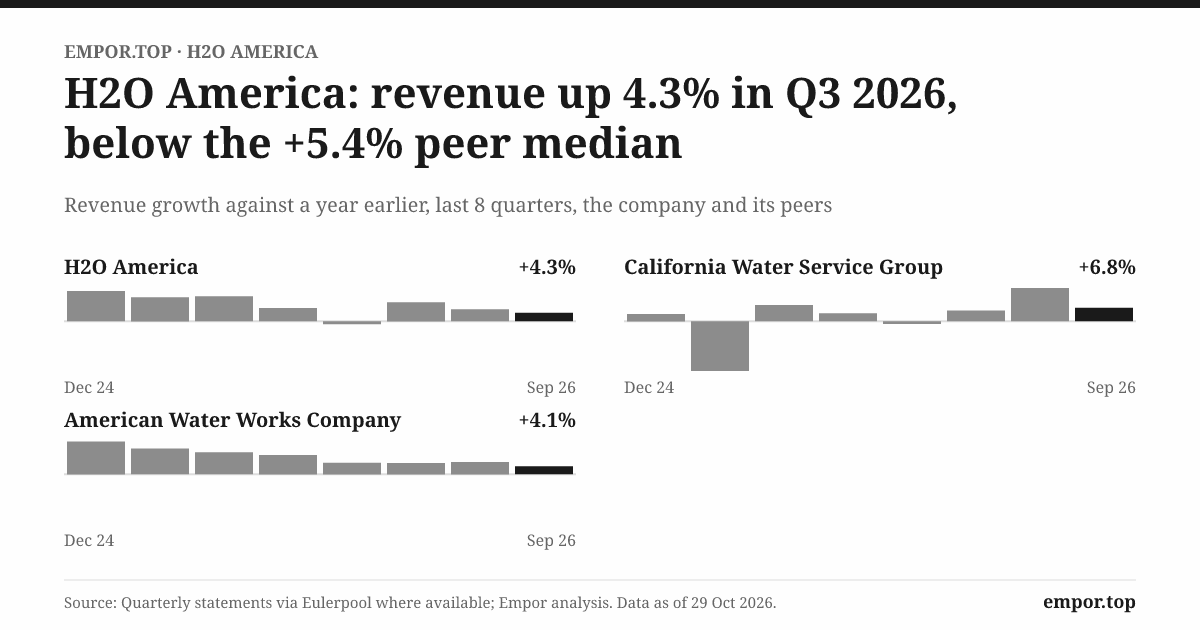
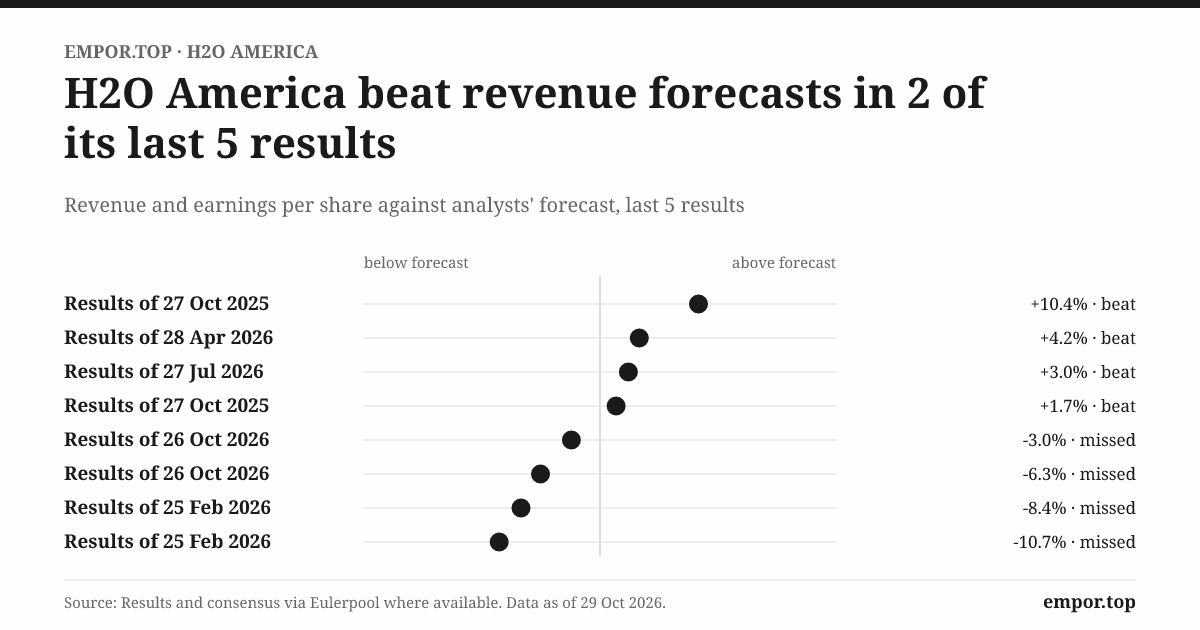
Four weeks later, the third-quarter numbers made the tension visible. Revenue rose about 4% to $250 million.1 Adjusted earnings per share fell to $1.04 from $1.27 a year earlier, because the company now had roughly a fifth more shares outstanding than it did twelve months before.[^1]2 Management narrowed its standalone guidance for 2026 to $3.10 to $3.16 of adjusted earnings per share. Then it gave a second range, the one that actually counts the Texas deals and the stock sold to pay for them: $2.91 to $2.97.2
That gap between two guidance ranges is the cleanest summary of the company today. H2O America has committed to a five-year capital plan of $2.7 billion for 2026 through 2030, about 31% larger than the plan it replaced.3 Combined with Quadvest, management says that spending supports rate-base growth of about 13% a year from an estimated $2.8 billion at the end of 2025.2
Rate base is the pool of invested capital on which regulators allow a utility to earn a return, so growing it at 13% a year is, on paper, a formula for growing earnings at a similar clip. The catch is that every dollar of that growth has to be financed before it is earned, and regulators decide when and whether it is earned at all.
That is the business of a regulated water company in one sentence. It digs up streets, replaces mains laid generations ago, builds treatment plants that remove chemicals nobody measured twenty years ago, and buys smaller systems. Then it goes before a state commission and asks for permission to charge customers for all of it. The commission weighs the evidence, hears from consumer advocates and sets a rate. The utility earns its return only on what the commission recognizes, only from the date new rates take effect, and only if the cost of the money it raised in the meantime does not eat the difference.
H2O America is the name on the stock, not on the water bill. It is a Delaware holding company listed on Nasdaq under the ticker HTO, and the service comes from its subsidiaries: San Jose Water in California, Connecticut Water, Maine Water and Texas Water.4 Until May 2025 the parent was called SJW Group; it had moved its listing from the New York Stock Exchange to Nasdaq six months earlier.4 The rebrand was a declaration that the company no longer thought of itself as a San Jose utility with a few eastern outposts. It wanted to be a national consolidator.
Three questions run through this story. The first is whether a collection of local water networks in four states earns durable returns, or merely durable revenue. The second is whether Texas, and Quadvest in particular, will pay for the equity, the debt and the regulatory delay it required. The third is whether management can deliver growth per share, not just growth in pipes, while the households at the end of those pipes absorb the cost.
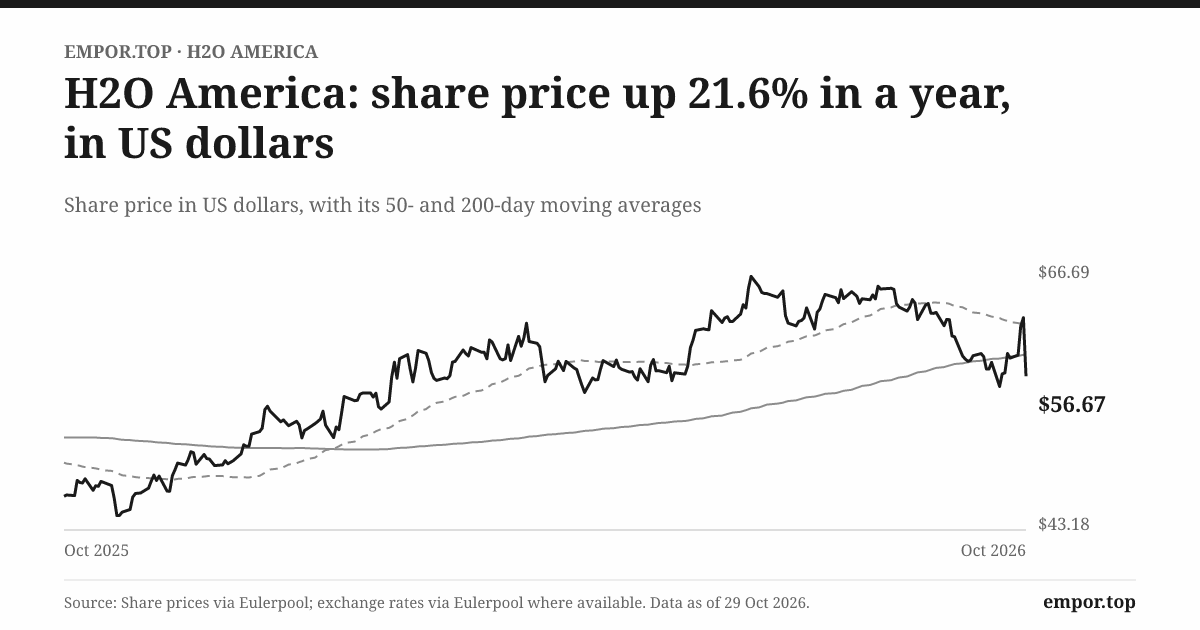
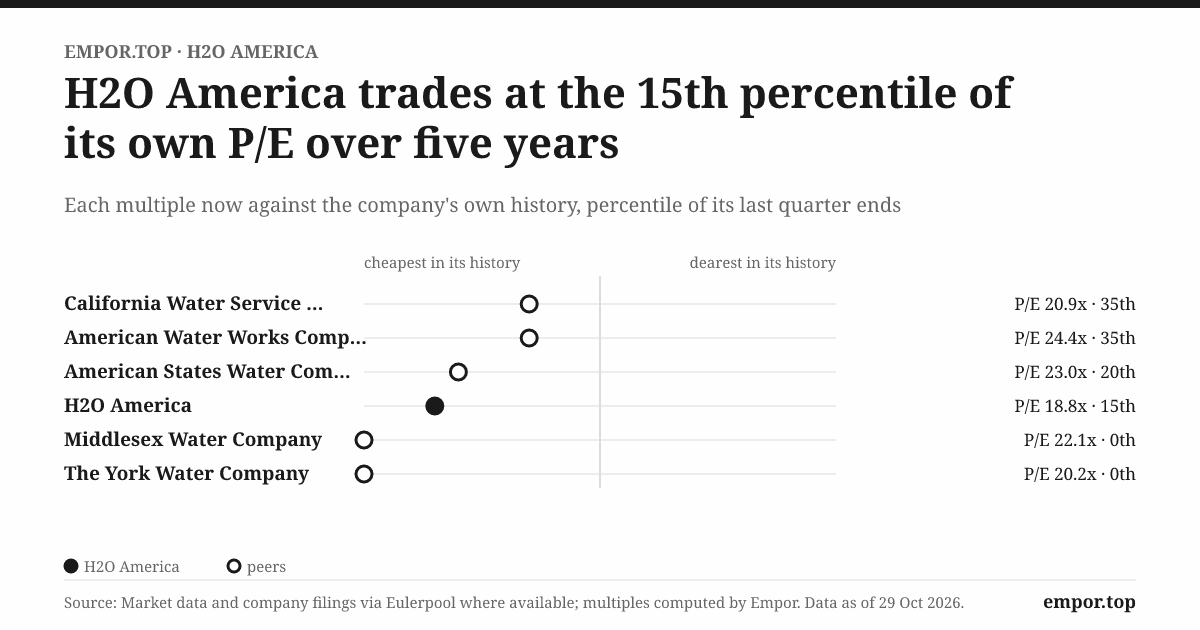
At the share price of $56.67 on October 29, 2026, the market valued the company at about $2 billion, and at about $3.5 billion including its debt.[^6] It priced the stock at about 19 times trailing earnings, well below the roughly 24 times that has been its median over the past five years. Investors, in other words, have already marked down the story. Whether they marked it down far enough depends on something no spreadsheet can settle in advance: how quickly concrete in the ground becomes cash in the bank.
This is a story about the price of reliability, and about who ultimately pays it. It starts where every water utility starts, with a household and a bill.
 Subscribe on LinkedIn
II. A Network You Cannot Pick Up and Move
Open a water bill in Santa Clara County and there are two numbers that matter. One is a fixed service charge that depends on the size of the meter, and it arrives whether the taps run or not. The other is a charge for water actually used, measured in units and billed after delivery, monthly, every other month or quarterly depending on the system.4 Both numbers are set by the California Public Utilities Commission, not by San Jose Water. The company cannot raise them because a competitor raised theirs, because there is no competitor on that street.
That is the first and most important fact about the business. A water utility's product moves through pipes buried under public roads, and those pipes belong to whoever laid them. A household in San Jose cannot switch to a cheaper supplier the way it might switch mobile carriers, because there is no second set of mains running to the house, and nobody is going to build one. Duplicating a city's water network would cost billions and earn nothing, because the incumbent could always undercut the newcomer on the marginal cost of a gallon.
H2O America's revenue tells you how completely the company lives inside that model. In 2025 it reported $800.6 million of revenue.3 Water Utility Services, the regulated business, produced $787.1 million of it; a small bucket the company calls Other Services, which includes non-regulated activities, produced the remaining $13.5 million.4 Nearly ninety-nine cents of every revenue dollar comes from selling water and wastewater service at prices a commission approved.
The company also reports that utility business as a single segment.4 That matters for anyone hoping to judge which state is the best performer. H2O publishes rate base and authorized returns for each jurisdiction, but it does not publish profit by state, so an investor cannot tell from the accounts whether Connecticut earns more on its capital than California, or whether Texas is already pulling its weight.
What H2O does publish is the shape of the footprint. San Jose Water serves about 232,000 connections, roughly a million people across about 140 square miles of Santa Clara County.4 Connecticut Water and Maine Water together serve about 143,000 connections and around 465,000 people in 81 municipalities.4 Texas Water, before Quadvest, served about 30,000 connections and some 90,000 people in the Hill Country between San Antonio and Austin.4 By the end of September 2026 the whole group served about 409,000 water and wastewater connections and more than 1.6 million people.1
Revenue in this world moves with four things. Tariffs come first: the rates set in each rate case. Usage comes second, and usage depends on weather; the company says demand rises in warm, dry months, while drought restrictions or unusually wet seasons can cut it.4 Water costs come third, because San Jose Water buys roughly 40% to 50% of its supply in a normal year from the regional wholesaler Valley Water under a contract that runs to 2051.4 And timing comes fourth, because a rate increase that arrives a year late is a year of investment earning nothing.
That reliance on a single wholesale supplier is quietly one of the biggest pressures on the California bill. On the July 2026 call, management said Valley Water's wholesale charges were rising quickly, and described the options it is studying: a $3 million direct potable reuse pilot, which would purify recycled wastewater to drinking standards, targeting a demonstration in September 2027, and a feasibility study for regional desalination.5
Walters later described these supply projects as a five-to-ten-year effort, and they are not in the company's growth forecast.2 For the household, the arithmetic is unforgiving: when the wholesaler raises its price, the increase flows through to the bill, and none of it earns San Jose Water a return.
Regulators have built shock absorbers into some of this. In Connecticut, a Water Revenue Adjustment mechanism lets the utility true up revenue when sales come in below the level assumed in its rates; the 2026 surcharge filed in February 2026 was 5.7%.4
In California, San Jose Water keeps balancing and memorandum accounts that track under- and over-collections of costs such as purchased water and energy, so that those costs can be recovered or refunded later.4 These mechanisms mean that a wet year does not wreck earnings the way a bad season wrecks a ski resort. They do not eliminate the problem; they defer it, and the deferred amount becomes another thing a commission must approve.
So the moat is real, but it is worth being precise about what it protects. In Michael Porter's language, local pipes make substitution almost impossible and new entry pointless, so the classic competitive forces are weak. The force that is strong is the buyer, and the buyer here is not really the household; it is the state commission acting on the household's behalf, along with the cost of capital that determines whether an allowed return is attractive at all.
In Hamilton Helmer's terms, the strongest power is something like a cornered resource: a physical network in a defined territory, plus the operating know-how to run it. What the record does not support is any claim of brand power or customer lock-in in the commercial sense. The company publishes no retention or price-realization data, because in a regulated monopoly those concepts barely apply.
The deeper competitive question is not who serves a given street but who owns which streets in the first place. Most American water systems are run by municipalities, and those are the real alternative to H2O's model. A town can keep its system public, sell it to an investor-owned utility, or partner with one. The investor-owned companies compete with each other to be the buyer.
On that field H2O is a mid-sized player. American Water Works, the largest listed water utility, serves roughly 15 million people, around nine times H2O's population base.6 California Water Service Group, H2O's long-time California rival, is another listed peer with a bigger home-state footprint. H2O's advantage, such as it is, is not national scale. It is a portfolio of local systems in four states with different regulators, different weather and different growth rates, which spreads regulatory risk but also multiplies the number of commissions that have to say yes.
That is why the next part of the story is not about water at all. It is about how a California company acquired its eastern half, and what it paid for the privilege.
III. The Merger That Made SJW a Four-State Company
For most of its history, San Jose Water was exactly what its name suggested. The utility was first incorporated in California in 1866, when the Santa Clara Valley was orchards and the city was a fraction of its present size; its holding company, SJW Corp., was formed in 1985.4 It added a small Texas business in the Hill Country along the way, but at heart it was a Silicon Valley water company whose fortunes rose and fell with California regulators and California rainfall.
That changed on March 15, 2018, when SJW Group and Connecticut Water Service announced an all-stock combination.7 The terms gave Connecticut Water shareholders 1.1375 SJW shares for each of theirs, worth about $61.86 a share or roughly $750 million in total, an 18% premium.7 Eric Thornburg, SJW's chief executive, called it a merger of equals that would create the third-largest investor-owned water and wastewater utility in the country, and he was emphatic that the logic was growth, not cost-cutting: "this combination is not about synergies," he told analysts.7
Thornburg was a natural messenger for that pitch. He had spent his whole working life in the drinking-water business, more than four decades by the time he retired, and he understood that in this industry a merger is sold as much to regulators and towns as to shareholders.8 The combined company would have about 379,000 connections, more than 1.5 million people served and a rate base of roughly $1.3 billion across California, Connecticut, Maine and Texas.7
It promised local brands, local management, no layoffs as a result of the merger, about $200 million a year of capital investment and no change in customer rates because of the deal.7 Those promises were aimed less at investors than at regulators, because in this industry the commission votes on your merger.
Then the deal turned into a contest. California Water Service Group, the neighbour across the Bay Area, made an unsolicited bid for SJW itself at $68.25 a share in cash and took it directly to shareholders through a tender offer, arguing that its offer was less conditional than the Connecticut merger and above SJW's all-time high.9 SJW's board rejected the approach. Meanwhile, the California commission ordered SJW to seek its approval for the Connecticut transaction, adding a regulatory hurdle to a shareholder fight.9
On August 6, 2018, SJW changed the structure entirely. Instead of shares, it offered Connecticut Water holders $70 a share in cash, a 33% premium to the price before the original announcement and above the stock's all-time high.10 The equity price was about $843 million, and the deal was worth about $1.1 billion including debt.10 J.P. Morgan provided a $975 million bridge loan, and SJW planned to raise $450 million to $550 million of new equity, with the stated aim of keeping a credit rating of at least A-.10 The boards said the cash offer would end "market distractions."10 It also removed the need for SJW shareholders to bless a share issuance while a rival bidder was courting them.
The price was the cost of winning. A stock merger had become a cash acquisition at a much higher premium, and the company that had sold the deal as a partnership was now a buyer paying full value. The deal closed on October 9, 2019.8 Several Connecticut Water directors joined the combined board, including Carol Wallace, who had chaired Connecticut Water and still sits on H2O America's board today.8
What did shareholders get for it? The August 2018 announcement made a specific promise: the transaction would be immediately accretive to 2019 earnings per share and reach high-single-digit accretion by 2021.10 That promise is harder to score than it looks, because the company never published a standalone counterfactual, and consolidated results mix the acquired systems with everything else. But the visible record is sobering. Diluted earnings per share fell from about $2.86 in 2017 to a trough of $0.82 in 2019, then recovered to roughly the 2017 level in 2024 and 2025.4
Per-share earnings took the better part of a decade to return to where they were before the transformation, which is not what "high-single-digit accretion by 2021" sounds like to a shareholder, however much of the shortfall had other causes.
The return record tells the same story at the level of capital. Return on invested capital, which measures after-tax operating profit against all the debt and equity in the business, was about 8.4% in 2014. It fell below 2% in the merger year and has hovered between about 4% and 5% since, finishing 2025 at 4.6%.4
Some of that decline is the arithmetic of buying a regulated business at a premium: the purchase price lands on the balance sheet as goodwill and acquired plant, while regulators continue to set rates on the original cost of the assets. The buyer pays for a rate base it cannot earn a return on in full.
Shareholder returns have not compensated. The company's 2026 proxy shows that $100 invested in the stock at the end of 2020 was worth about $80 at the end of 2025, while the same $100 in the S&P 1000 utilities index grew to about $153.8 Over the 2023 to 2025 performance period, the stock's total return averaged minus 33%, and executives' relative-return share awards vested at just a quarter of target.8
None of this proves the Connecticut deal destroyed value. It brought New England systems with long dividend histories and constructive regulation, and the company that emerged was large enough to contemplate the next acquisition. What the record does is turn "scale creates value" from an assumption into a claim that has to be proved.
H2O America has used a large acquisition to change its geography once before, at a full price, with a promise of per-share accretion that the visible numbers do not confirm. Texas is the second attempt, and before judging it, it helps to understand where the company's growth has actually come from in the years since.
IV. The Growth Was in the Rate Case
Look at H2O America's 2025 results the way a growth investor would and they seem healthy. Revenue rose 7% to $800.6 million, net income rose about 9%, and adjusted earnings per share reached $2.99, near the top of guidance.3 Over the decade from 2015 to 2025, revenue compounded at about 10% a year. That looks like a business on the move.
Now ask where the extra $52 million of 2025 revenue came from. The answer is in the management discussion of the annual report, and it is the single most revealing paragraph in the company's accounts.4 Rate increases, excluding pass-throughs, added about $44 million. Pass-through water costs, which the company passes to customers more or less dollar for dollar, added another $23 million. Lower consumption took away about $7.2 million, and regulatory mechanisms took away about $8 million more. New customers, the thing most people mean when they say a business is growing, contributed $1.5 million.4
That is the reveal. Customer growth explained about 3% of the year's revenue increase. Nearly all the rest came from regulators allowing higher prices, either to earn a return on new investment or to recover higher water costs. And the customers already on the system used less water, not more.
The decade-long figure also needs an asterisk. The 10% compound growth includes the 2019 Connecticut acquisition, which roughly added a third to the revenue base in a single year. Strip that out and the five-year rate, about 7% a year from 2020 to 2025, is a better picture of how the existing business grows when it is not buying anything.
None of this is a scandal. It is how regulated utilities work. A water system in a built-out city like San Jose does not add many new homes, so its revenue grows when it replaces old infrastructure and a commission lets it charge for the replacement. The arrangement is resilient in the sense that people do not stop using water in a recession. It is not automatic. Commissions set rates after months of testimony, customers cut usage in response to weather, conservation messaging and higher bills, and many costs must be incurred and documented before they can be recovered.
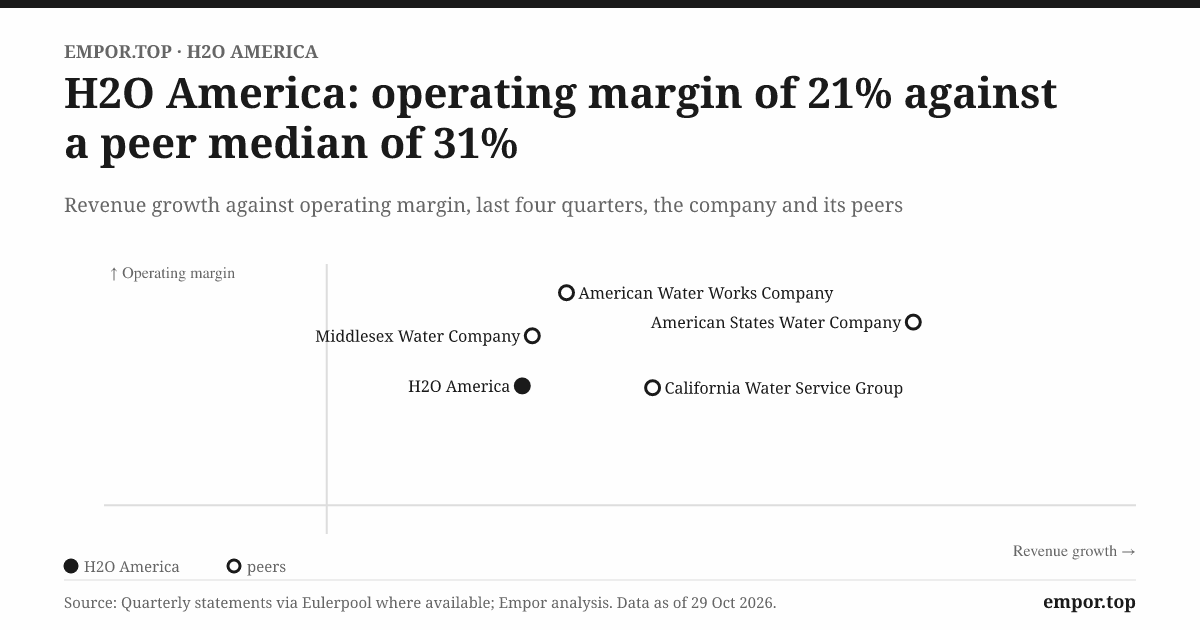
The cost side of 2025 shows the treadmill clearly. Operating expenses rose by about $45 million, almost as fast as revenue.4 Water production costs added about $19 million, driven by higher purchased-water, groundwater and energy charges.4 Administrative and general costs added about $20 million. The company's own explanation of its earnings improvement is that rate increases did the work, partly offset by higher administration, water production and depreciation costs and by lower customer usage. Operating margin ended the year at about 22.6%, almost exactly where it was in 2024.4
That flat margin is the clue to the model. A utility that grows by rate increases does not usually expand its margins, because the commission sets prices to cover costs plus an allowed return. If costs rise faster than expected between rate cases, margins shrink until the next case resets them. If costs rise slower, the utility keeps the difference until the commission notices. The economic engine is not operating leverage; it is the steady addition of capital on which a return is allowed.
The third quarter of 2026 gave a live test. Revenue grew about 4% to $250.2 million.1 The drivers looked familiar: higher rates from general rate cases, surcharges and cost-of-capital adjustments added about $8.7 million, pass-through water costs added about $7.5 million, and lower consumption subtracted about $4.1 million.1 Customer growth added half a million dollars.1
Expenses grew faster than revenue. Total operating expense rose about 8% to $189.7 million, with water production up about $5 million and unallocated corporate costs up by about $4 million.1 Operating profit fell about 6% from the prior year's third quarter, and net income fell about 4%.1 On the earnings call, finance chief Ann Kelly walked through the per-share bridge: revenue added about 25 cents, but water production and other operating costs took back about 29 cents, of which 9 cents was higher depreciation, and the larger share count took another 22 cents.2
The investor's key distinction emerges right there. Over the first nine months of 2026, adjusted net income rose about 8%, a respectable result for a utility.2 But weighted average diluted shares were about 20% higher, which more than wiped out the gain, so adjusted earnings per share fell to $2.30 from $2.53.2 The company grew. The shareholder's slice of it shrank.
That is the central tension of the H2O story. Sales can grow while per-share earnings and cash lag behind, because the thing driving the sales, regulated investment, has to be paid for first. To see why, follow the money into the ground.
V. The Pipes Cost More Than the Water Bills Bring In
In 2025, H2O America invested about $501 million in infrastructure and water supply, a record, up 41% from the year before and above its own guidance of $486 million.3 Picture what that buys in a utility: main replacements on residential streets, new wells and pump stations, a meter in every home that can report usage remotely, storage tanks, treatment upgrades. Then compare it with what the business brought in. The company's capital additions were equal to about 63% of its revenue for the year.
A mature industrial company might reinvest 5% of its sales in capital spending. A software company might reinvest less. H2O reinvests more than half. And it intends to keep going: under its expanded plan, the company expects to spend about $465 million of its own money in 2026 alone, trimmed from $483 million mainly because developers in Texas are paying for more of the new pipe themselves.23
The bargain that justifies this spending is old and simple. A utility replaces aging pipes, expands capacity and meets new water-quality rules. In exchange, the regulator lets the prudent cost of that investment enter the rate base, and sets prices high enough to cover operating costs, depreciation and a return on the rate base. The authorized returns on equity in H2O's jurisdictions in 2025 ranged from 9.3% in Connecticut to about 10.9% in Texas, with California at 9.81%.4
The bargain has two weak points. The first is timing. Investment enters rates only when a commission approves it, and in a traditional rate case that can be a year or more after the asset goes into service. During that gap the utility pays interest and depreciation on an asset that earns nothing. The second is recognition. Regulators can disallow costs they consider imprudent or poorly documented, or approve a lower return than requested.
Management's answer to the timing problem is that about 80% of its planned 2026 to 2030 capital qualifies for "timely" recovery, through mechanisms such as infrastructure surcharges, forward-looking test years and special-purpose filings.2 That figure deserves to be read precisely. It is a forecast about which recovery mechanisms the investment is eligible for, not a promise that every project will be recovered on schedule, and the Texas order in October showed that eligibility for a mechanism and a successful filing are different things.
Now test the outcome. If H2O were earning something close to its authorized returns across its whole capital base, the consolidated return figures should show it. They do not. In 2025, return on capital employed, which measures operating profit against total assets less current liabilities, was 3.7%. Return on invested capital was about 4.6%. Return on equity was about 6.6%.4 Over the twelve months to September 2026, return on capital employed slipped further, to about 3.2%.
These measures are not directly comparable with an authorized return on equity, and it is worth being clear about why. The authorized figure applies to the equity portion of a regulated capital structure. Corporate ROIC is calculated across all capital, after tax, and it includes goodwill from acquisitions, construction work that is not yet earning anything and holding-company costs that regulators do not recognize.
A utility building aggressively will always show lower consolidated returns than its allowed returns, because so much of its capital is in transit. But the gap here is wide and persistent. Return on equity of 6.6% against authorized returns of 9.3% to 10.9% suggests the company has been earning well short of what regulators nominally allow, year after year.
There is one more accounting feature worth understanding, because it flatters earnings during a building boom. When a utility finances construction, it is allowed to capitalize a notional return on the money tied up in projects not yet in service, an item called allowance for funds used during construction, or AFUDC. The equity portion appears as income even though no cash arrives until the asset enters rates.
H2O attributes much of the 2025 improvement in its "other income" line to higher equity AFUDC, alongside pension credits, partly offset by higher interest on its growing debt.4 The practice is standard and regulators sanction it, but it means that the bigger the construction program, the more of reported profit is a promise of future recovery rather than money collected today.
Then there is the cash. On the surface, cash conversion looks superb. Over the twelve years from 2014 to 2025, H2O produced about $1.6 billion of operating cash flow against about $733 million of net profit, more than twice as much cash as accounting earnings.4 In 2025 alone, operating cash flow was $244.8 million.4 That reflects a capital-intensive utility's large noncash depreciation charge, along with regulatory and working-capital timing.
But the same twelve years produced negative free cash flow of about $1.1 billion, because capital spending exceeded operating cash every single year. In 2025 the shortfall was about $275 million: $244.8 million came in from operations and $520 million went out in investing.4 Over the twelve years the company also paid about $400 million of dividends, all of which, in effect, were funded by external capital.
This is not unusual for a growing utility. It is the defining financial fact about H2O, and it means the investment case is inseparable from the financing case. Each year the company must raise new debt, new equity or both simply to pay for its plan and its dividend. In 2025 it sold about 2.4 million shares through its at-the-market program at an average price of about $51.90, raising about $123 million.4 Financing inflows that year totaled about $285 million.4
There is also a new category of spending that nobody asked for. PFAS, the so-called forever chemicals used for decades in nonstick coatings and firefighting foams, have turned up in drinking water across the country, and the Environmental Protection Agency has set maximum contaminant levels for several of them. H2O estimates that complying will require about $400 million of treatment investment.4 In California alone, San Jose Water has asked the state commission to approve a $176 million ion-exchange treatment project at its Williams Station facility.2
That PFAS money is not a growth business. It is a cost of staying in business, imposed by regulation, which the company will try to recover from customers. If regulators allow it into the rate base, it will earn a return like any other investment; if they slow it down or cut it back, it will be another drag on consolidated returns. Either way, households will see it on their bills.
So the financing question becomes impossible to avoid. With free cash flow negative and the capital plan rising, dividends and investment cannot both be sustained from operating cash alone. The company needs the capital markets every year, and in 2025 it decided to ask them for much more than usual, in order to buy its way into one of the fastest-growing regions in America.
VI. The Texas Bet: $543 Million for Houston's Next Suburbs
Drive north from downtown Houston on a weekday morning and the landscape tells you why H2O wanted Quadvest. Pine forest gives way to cleared lots, cleared lots give way to stamped-out subdivisions, and each new street needs water mains, sewer lines and a utility willing to run them. Quadvest has been providing water and sewer service in southeast Texas for nearly fifty years, concentrated around the Houston metro.11 What made it interesting in 2025 was not its history but its pipeline.
H2O announced the deal on July 8, 2025, at a price of about $540 million.[^14] The purchase came in two pieces. The regulated retail business, Quadvest L.P., carried a base price of $483.6 million. A separate wholesale business, which builds and runs systems for developments under long-term contracts, carried a base price of $56.4 million.11 At closing, after adjustments for capital spending, the split was about $480.9 million for the retail business and $61.8 million for wholesale, for total cash consideration of about $542.7 million.1
The structure exploited a feature of Texas law that matters enormously for the economics. Under the state's fair-market-value statute, an acquiring utility can have independent appraisers value a system it buys, and the appraised value becomes the ratemaking rate base, rather than the seller's depreciated original cost.11 The Texas commission appointed three appraisers in August 2025 and received their valuation in December, and the $483.6 million regulated purchase price was set as Quadvest's rate base.111
That changes the calculus that hurt the Connecticut deal. When SJW bought Connecticut Water, it paid a premium that regulators would not recognize in rates. In Texas, the purchase price of the regulated business and its rate base are, by design, the same number. If the system earns its allowed return on that base, the acquisition earns roughly its allowed return on the price paid for the regulated assets. The wholesale piece sits outside that arrangement.
The growth explains why H2O wanted Texas so badly. At the time of the March 2026 offering, Quadvest's retail business had about 38,000 connections across 64 subdivisions, growing about 10% a year from 2020 to 2025, while the wholesale business had about 16,500 connections that had grown at about 82% a year from 2022 to 2025.11
By the end of September 2026, active connections across the business had reached about 62,200, up 14% in nine months after 16% growth in 2025.2 Connections under contract or in development had reached about 98,300, up from 87,000 at the end of 2025, even though about 7,700 had converted into active customers during the year.2
That last fact is the most encouraging piece of evidence in the deal. A backlog that grows while it is being converted into paying customers suggests the developers around Houston are still signing up new subdivisions faster than homes are being finished. Management expects Texas to rise from about 8% of the company's customer base at the end of 2025 to about 26% by 2029.2 In a company whose existing territory in San Jose barely adds customers, that is a different growth engine entirely.
Management was careful to say the pipeline is no guarantee.2 It is also worth naming the risks plainly. Houston's growth depends on interest rates and homebuilding, and when analysts pressed Andrew Walters on that point during the third-quarter call, he acknowledged both as risks while describing local demand as resilient.2 Connections under contract are a developer's plan, not a household's water bill.
The approval itself went more smoothly than the timetable suggested. The company filed its sale-transfer-merger application with the Texas commission in January 2026.11 By July, commission staff had recommended approval without a hearing, and no party asked for one, which left a statutory deadline at the end of August and an antitrust waiting period as the remaining hurdles.5 The closing still slipped from mid-2026 to the first day of the fourth quarter, and that slip had consequences that ran in both directions: it reduced 2026 dilution, and it pushed back the rate case that is supposed to make the deal pay.
What did H2O pay per customer? A crude answer is about $8,700 per active connection, dividing the full consideration by the 62,200 active connections at the end of September. That figure is easy to quote and easy to misuse. It ignores the wholesale business, which serves developments under contract rather than through a retail tariff, and it gives no credit for nearly 100,000 connections in development. It also ignores the fact that regulators have already set rate base equal to the regulated purchase price.
The tempting comparison is the Connecticut deal, priced at about $1.1 billion including debt.10 It is not a clean comparison. One was a mature, slow-growing utility with long dividend histories; the other is a young, fast-growing system with a wholesale arm and a large development pipeline. Without comparable transaction earnings, rate base and connection data for similar Texas deals, the honest verdict is that the evidence supports neither "overpaid" nor "bargain." It supports "strategically plausible, not yet proven attractive."
The cost of getting there is known. In March 2026, H2O sold about 11.5 million shares at $53, of which about 7.5 million were sold under forward agreements that let the company deliver the shares and collect the money later, up to March 2028.11 The overall equity program was upsized to about $700 million, including a $400 million forward.5
The company received about $290 million in March and about $330 million in September when it settled most of the forward shares, leaving about 1.1 million still outstanding.12 At the end of September it sat on about $573 million of cash waiting to pay for Quadvest.1
The prospectus was candid about the cost to shareholders. It said the acquisition would reduce adjusted earnings per share by 10% to 20% in both 2026 and 2027.11 Because the deal closed later than the mid-2026 date originally assumed, 2026 dilution came in nearer 6% at the guidance midpoint.2 Management still expects 10% to 20% dilution against the standalone plan in 2027, and Walters said a full year of Quadvest operations and of higher depreciation would push it toward the higher end of that range.2 The company expects the acquisition to become accretive in 2028, once Texas sets new rates that include Quadvest.2
Alongside Quadvest, H2O is buying a much smaller system: Cibolo Valley's wastewater assets, which serve more than 1,500 connections.3 On the third-quarter call, Bruce Hauk said it was expected to close on November 2.2 It extends the Texas footprint, and it is a modest addition rather than a second growth engine.
So the hard test is clear. More connections must become approved rate base, approved rate base must become earnings, and earnings must grow faster than the share count did. The first half of that chain looks promising. The second half runs through a regulator who, the very day Quadvest closed, delivered a reminder that Texas does not simply sign off on whatever a utility files.
VII. When the Regulator Said No
The system improvement charge was supposed to be the easy part. Texas allows water utilities to add completed infrastructure to rates through a surcharge between full rate cases, a shortcut designed to reduce exactly the regulatory lag that dogs capital-heavy utilities. H2O's Texas subsidiary had used it before: an amended application in 2025 produced about $3.9 million of additional annual revenue.4 The state legislature had just made the process faster, cutting the review period for such applications from 120 days to 60.3
In October 2025, Texas Water filed its third application, asking for about $5.1 million of additional annual revenue.35 By the second-quarter call in July 2026, the trouble was out in the open. An administrative law judge had issued a proposal for decision recommending not an increase but a revenue decrease of about $285,000.5 The disputes centered on project documentation and on how the company accounted for retirements and replacements, the bookkeeping that shows which old assets left service when new ones went in.5
On October 1, 2026, the commission adopted the judge's proposal, and an annual decrease of about $238,000 took effect.2 Hauk told analysts the company was disappointed that its rebuttal evidence had not been given enough weight, and that it had found offsets to protect its earnings guidance.2 About $40 million of assets at stake in the application would now be pursued through the general rate case instead.5
In dollar terms, the outcome is small. A $5.1 million request on a company with $800 million of revenue is not going to make or break the year. As a signal, it is large. The surcharge exists precisely to give utilities fast, low-friction recovery of completed work, and H2O came away with less than nothing. The lesson is not that Texas regulators are hostile; the company itself got a surcharge approved the year before. The lesson is that recovery depends on evidence, and evidence is something a utility either has in the file or does not.
Walters, to his credit, did not blame the regulator. On the July call he said "there were some things that we could have done differently, and that's on us."5 That is a meaningful statement from a chief executive, because it locates the problem inside the company's own processes, which means it is also inside the company's power to fix.
The fix has a timetable. H2O plans a single combined Texas rate case that will fold in the Hill Country system's supply and reliability investments, the assets covered by the unsuccessful surcharge application, and the newly acquired Quadvest and Cibolo Valley rate base.2 It had previously targeted early 2027.
On the October call it said the first half of 2027, with new rates expected in 2028.2 When Wells Fargo's analyst asked about the change, Hauk attributed it to the later closings of the acquisitions and to increased scrutiny of documentation in recent dockets.2 He also noted that the company had not filed a Texas rate case in more than a decade.2
That is not a trivial admission. A rate case is a large, evidence-heavy undertaking, and a company that has not filed one in a jurisdiction for ten years is, in effect, rebuilding a capability at the same time as it absorbs the largest acquisition in its history. The Texas legislature has given utilities new tools, including future and hybrid test years that let rates reflect forecast rather than historical costs.3 Whether H2O uses those tools well will decide when Quadvest's accretion arrives.
Texas is not the only docket. In Connecticut, the company filed in May 2026 for a $28.8 million annual increase to recover about $145 million of infrastructure investment.5 By late October hearings were complete, the company had answered more than 1,300 discovery questions, and a proposed decision was expected in mid-December, with new rates in February 2027.2 When Seaport Research's Angie Storozynski asked why there had been no settlement, Hauk declined to discuss it.2
In Maine, the company is seeking $9.5 million to recover about $36 million of investment, with hearings in January and new rates expected by May 2027.2 The chair of the Maine commission resigned during the process, leaving an acting chair in place, a reminder that the people who decide these cases change too.2 In California, the Williams Station PFAS project faces hearings in late January and a proposed decision in the second quarter of 2027, and San Jose Water plans its next general rate case, covering 2028 through 2030, in January 2027.2
Each of these proceedings is an opportunity to put investment into rates. Each is also a point at which affordability can bite. Commissions do not set rates in a vacuum; they hear from consumer advocates and from customers who already feel their bills rising. H2O plans to propose an affordability tariff in Texas, which does not currently have one, modelled on assistance programs it runs in California, Connecticut and Maine.25 In 2026 the board even replaced the relative shareholder-return metric in executives' long-term pay with a customer-affordability metric that compares average residential water bills with household income in the communities served.8
Walters frames the economics of affordability in a single ratio. Every dollar of operating expense the company avoids, he said, "enables recovery of $7 of the much-needed capital investments."5 The logic is sound: a bill has room for only so much increase, and lower operating costs leave more of that room for a return on capital. It is also a reminder that efficiency does not make infrastructure cheaper. It only frees up space in the customer's budget for the pipes.
PFAS deserves its own careful accounting here, because it cuts in several directions. The company has received about $36 million of settlement money from chemical manufacturers through September 2026, and it books that money as a regulatory liability, not income, because regulators may require it to offset treatment costs or be returned to customers.1 It should not be counted as earnings.
Separately, Connecticut Water has been defending a putative class action since October 2023 alleging contaminants in its water, and the company says it cannot reasonably estimate any loss.41 Connecticut has created what management calls the nation's first PFAS recovery mechanism, a law signed in July 2025, which helps, but it does not guarantee that all remediation capital will flow into rates on the company's timeline.32
The auditors have noticed how much rides on these judgments. Deloitte gave the company clean opinions on its 2025 statements and internal controls, but named rate-regulation accounting, including judgments about the future recovery of regulatory assets, as a critical audit matter.4
So the revised view is this. Rate-base growth of about 13% a year is a credible plan, because the investment needs are real and the mechanisms exist. Earnings growth from that plan remains contingent on orders, documentation and timing, and the Texas surcharge is a concrete example of the plan meeting a regulator who wanted more evidence. That puts the spotlight on the people who must assemble that evidence.
VIII. A New CEO Inherits the Capital Plan
Andrew Walters is not the usual water-utility chief executive. Most of his peers grew up in operations, engineering or regulatory affairs. Walters spent the early part of his career as a dealmaker, running the infrastructure banking team for the Americas at Citigroup and later serving as a managing director in J.P. Morgan's infrastructure private-equity business.8 When he joined the San Jose company in 2014, he brought a banker's instincts into a business built on patience.
Inside the company he became the person who did the deals. He served as chief corporate development officer and integration executive, ran administration at San Jose Water, and held a business-planning role at the Connecticut subsidiary after the merger.8 Then he became chief financial officer and treasurer, responsible for capital allocation and financing. When Eric Thornburg announced his retirement in February 2025, the board unanimously chose Walters to succeed him as chief executive from July 1, 2025, describing a multi-year succession process.8 When Thornburg left the board at the end of January 2026, Walters added the chair's role too.8
That background matters to the investment case, because the strategy he now runs is a financier's strategy. Grow rate base faster than peers, buy systems where state law rewards the buyer, and finance it all with a mix of equity and debt that the rating agencies will tolerate. A former banker who helped integrate Connecticut Water and then financed the company's growth as CFO is well placed to execute that strategy. He is also the person most accountable for whether it works.
Around him is a reshuffled team. Ann Kelly joined the company in November 2024 as chief accounting officer and became CFO in July 2025.8 Bruce Hauk, the chief operating officer, also became president when Thornburg stepped down, and he is now the executive who answers analysts' questions about rate cases.8 Thornburg remains in the story only as the architect of the four-state company Walters inherited.
The pay structure is conventional for the industry. Annual cash incentives are tied to financial, operational and strategic goals; long-term stock awards have been tied to return on equity and relative shareholder returns.8 Walters received total reported compensation of about $2.87 million for 2025, a figure that reflects only half a year as chief executive; the board calculated his annualized pay at about $3.16 million.8 His 2025 annual incentive paid out at about 90% of target.8
Ownership is the more interesting number. Executives must hold stock worth three times base salary for the CEO, and they have five years from appointment to get there.8 At the end of 2025, Walters's holdings were worth about $1.19 million against a guideline of about $2.06 million.8 He is within the policy because the five-year clock is still running, and the company reports that all its named executives were in compliance.8 But a chief executive whose personal stake is less than half a year's total pay has meaningful exposure without the kind of ownership that makes shareholder pain personal.
The long-term awards tell a story of their own. For the three years ending in 2025, the share awards tied to return on equity paid out at about 102% of target, because the company hit the regulated-return goals the board had set.8 The awards tied to shareholder returns against peers paid out at 25% of target.8 Management, in other words, delivered the accounting returns it was asked for while shareholders lost money. That split is the whole debate about this company in miniature, and it is why the board's decision to replace the relative-return metric from 2026 deserves scrutiny.
Shareholders have so far been supportive. At the 2025 annual meeting, about 27 million votes were cast for the say-on-pay proposal against about 1.5 million against.12 Director dissent was concentrated on Thornburg, who drew about 3.3 million votes against.12 Those are governance checks, not signs of a revolt.
The better test of a management team is behavior. In 2025 the company spent more on infrastructure than its revised plan called for, about $501 million against guidance of $486 million.3 It then enlarged the five-year budget by nearly a third, issued equity at the largest scale in its history and accepted openly that earnings per share would be diluted for two years to fund Texas. That is not timid capital allocation. It is a deliberate decision to trade near-term per-share earnings for a larger rate base, and it is the kind of decision that looks brilliant or reckless only in hindsight.
Guidance discipline has been reasonable. The standalone 2026 range held its $3.13 midpoint through the year, and the acquisition-inclusive range makes the dilution explicit rather than burying it.2 In the second-quarter call, management said it expected to stay out of the equity markets, including the at-the-market program, through at least the end of 2027 barring new acquisitions.5 That is a promise investors can check.
There have also been shifts that need explaining, including the Texas rate-case delay and surcharge result. Walters's "that's on us" was a welcome acknowledgment; it does not erase the miss.
On the October call, Walters reiterated the company's long-term target of 6% to 8% annual growth in adjusted earnings per share, and said he expected the 2026 to 2030 growth rate, which will not be smooth, to land at or above the top of that range.2 That is a bold claim from a company whose per-share earnings took the best part of a decade to recover after its last big acquisition, and whose 2027 earnings will be diluted against its standalone plan.
The honest verdict on management is that one year is too short to establish a record. Walters knows the business deeply, has articulated a coherent strategy and has been candid about mistakes. The next Texas rate order, the Connecticut and Maine decisions, and the credit metrics after Quadvest will tell investors far more than the new name or the new logo. That raises the question every investor eventually asks: at today's price, which version of the story is the market betting on?
IX. Analysis & Bull vs. Bear Case
On October 29, 2026, H2O America's stock closed about 13% below its 52-week high of $65.43.[^6] The dividend yielded about 3.1%. Measured by free cash flow, the stock “yielded” minus 21.5%: for every dollar of market value, the company consumed about 21 cents more cash than it generated over the past year.
Those numbers describe a market that has grown more skeptical, and it is worth stating both sides of the argument fully before deciding what the skepticism means.
The bull case starts with the network and the regulatory model that supports investment in it. Texas adds a policy tailwind: a fair-market-value statute that lets an investor-owned buyer earn a return on the price it pays. That advantage comes from legislation, so it can be taken away by legislation, and it is available to every investor-owned rival in the state, not to H2O alone. The bull says the low consolidated returns of the past reflect a decade of acquisition premiums and investment in transit, not a broken model.
The bull then points to the planned accretion from Texas. If the 2027 rate case goes well, 2028 earnings should show the accretion management has promised.
The bull also points to supportive regulatory tools, including California's authorized return, Connecticut's PFAS recovery mechanism and the company's estimate that about 80% of its capital plan qualifies for faster recovery.32 If regulators recognize the planned rate-base growth, the bull says, earnings should grow at the top of management's range.
The bear case starts with the record: low consolidated returns and a stock that lagged the utility index by a wide margin over the past five years.8 It also points to reliance on outside capital, share dilution and the Texas surcharge shortfall.
The bear's sharpest point is about the balance sheet. When H2O announced Quadvest, S&P Global affirmed its A- rating but moved the outlook to negative.13 The agency said the deal would "modestly weaken" consolidated financial measures, and that under its base case, which assumed $100 million to $200 million of debt to fund the purchase, the ratio of funds from operations to debt would drop below the 11% threshold for a downgrade.13
That ratio was 12.0% in 2024.13 By the company's own reckoning it was 11.2% in 2025, just above the line.[^17] S&P also noted that H2O had issued equity every year since 2021 and that Quadvest was its largest acquisition to date, while still describing its market access as solid.13
That is the credit question, and it is subtler than whether a regulated utility can borrow. It certainly can. The question is whether H2O can preserve its rating while funding both the capital plan and a dividend of about $1.76 a share a year.3 The company leaned heavily on equity to pay for Quadvest, which helps; Kelly said the roughly $700 million raised gives flexibility on the timing of the planned debt.2
But it has about $169 million of available credit lines, a $310 million parent maturity in 2029 that management expects to repay partly with new equity, and an enlarged capital plan ahead.21 The San Jose subsidiary carries a stronger rating, A with a stable outlook, because S&P considers it insulated from the parent.413 That insulation protects California bondholders more than it protects H2O's shareholders.
The shareholder register adds one more wrinkle. There is no controlling shareholder; the company is widely held, and the largest reported holder is BlackRock, which disclosed beneficial ownership of about 6.2 million shares, or 14.8%, at the end of September 2026.14 A passive index giant at that scale is a stabilizing presence, not an agitator, but it does mean that a single asset manager's voting policy carries real weight on pay and board questions.
California brings a risk of a different kind. San Jose Water's territory includes wooded hillsides, and in late September 2026 the state enacted SB 1153, which clarifies the limits of water utilities' liability for wildfires and requires certain suppliers to maintain wildfire response procedures.2 For an investor, that matters because wildfire liability has wrecked California electric utilities; legislation that bounds it for water companies removes a tail risk rather than adding one, though it also adds operating obligations.
What would an activist ask? Probably three things. Why should shareholders accept a decade of returns well below authorized levels as the cost of growth, rather than evidence that acquisitions and holding-company costs are absorbing the value? Why did the company remove relative shareholder return from executives' long-term incentives just as the stock had lagged its peers, even if the affordability metric that replaced it has merit? And if the local utility assets are as valuable as the strategy assumes, where exactly is that value appearing: in allowed returns, in per-share earnings, or only in a larger rate base?
The valuation does not settle the debate. At about 19 times earnings, the stock is cheaper than its own history, but that history includes a period of very low interest rates when every regulated utility traded at higher multiples. The discount also does not resolve low returns, persistent negative free cash flow or dilution.
Comparisons with American States Water and California Water Service, which traded in the mid-twenty-times range on a recent screen, look flattering for H2O but were not measured on the same date or the same earnings basis. What the price seems to assume is that the Texas plan works but more slowly, more expensively or more dilutively than management says.
Three measures will tell investors which side is right. The first is approved rate recovery against completed capital additions, a relationship that must improve if returns are to rise.34
The second is diluted earnings per share after the acquisition financing; it stood at about $2.56 over the twelve months to September 2026, down from the 2025 level as shares rose by a fifth. The third is funds from operations to debt after Quadvest and Cibolo Valley close, last reported at 11.2% against the 11% downgrade threshold.[^17]
The upcoming Connecticut and Maine decisions, Texas rate case, California PFAS decision, first year of Quadvest results and next credit review will move those measures. Each is a chance for the company to show that its value lives in its returns and not merely in its rate base. Each is also a chance for the bear case to harden. Before following those events, it is worth pausing on what this company teaches.
X. Playbook: Business & Investing Lessons
Put two numbers side by side and the whole company comes into focus. On one side is $483.6 million: the price of Quadvest's regulated business, accepted by Texas as rate base, so that H2O will earn its allowed return on every dollar it paid.11 On the other is a $5.1 million request for completed Texas infrastructure that became a decrease of about $240,000.32 The same state, in the same year, said a generous yes and a firm no. Everything in the playbook follows from understanding why.
The first lesson is that a pipe in the ground is an investment only when the rate case catches up. H2O spent about half a billion dollars on infrastructure in 2025 and plans $2.7 billion over five years, yet consolidated returns have stayed at around half of authorized levels for a decade. The gap is not mysterious.
Capital spent before rates catch up earns nothing, capital that regulators disallow earns nothing, and capital documented poorly can earn less than nothing. For founders and investors in any regulated business, the lesson is that the asset you build is half the work. The other half is the file you hand the regulator, and the company that treats evidence as an afterthought is the company that loses money on its own construction.
The second lesson is that a growing customer count is not the same as growing value per share. Quadvest is adding connections at a double-digit pace, and its development pipeline grew even as thousands of homes were connected. But H2O issued roughly a fifth more shares to buy it, and adjusted earnings per share fell through 2026 even as adjusted net income rose.
The company has been here before: after Connecticut Water, per-share earnings took most of a decade to recover. Growth is not free when it is paid for in stock, and the only growth that matters to an owner is the growth in the slice of the business that each share represents.
The third lesson is that essential demand protects the need for water, not the owner's return. No household will stop drinking water because the utility issued more shares. That makes revenue durable, but durability of revenue is not the same as durability of profit. A local monopoly sells at a price set by a commission that answers to voters, and that commission weighs affordability alongside the utility's need to earn a return. In 2026, H2O's own board started paying executives partly on whether water bills stay affordable relative to local incomes. The moat keeps competitors out. It also keeps the regulator in.
The fourth lesson is that cash from operations can look strong while a business still needs the capital markets every year. Over twelve years, H2O produced more than twice as much operating cash as net profit. Over the same twelve years it consumed about $1.1 billion more than it generated after capital spending, and paid about $400 million in dividends funded, in effect, by lenders and new shareholders.
A business can be cash-generative in the accounting sense and cash-hungry in the economic sense at the same time. Investors who stop at the first measure will misunderstand the risk, because the real exposure is to the price and availability of new capital.
The broader point is specific to companies like this one. A regulated utility's moat protects the network. It does not eliminate regulatory risk, financing risk or execution risk; in many ways it concentrates them, because the only lever left for creating value is the one that a regulator, a rating agency and a capital market must all agree to pull. The next eighteen months will show whether H2O can pull it.
XI. Epilogue
Tonight, H2O America is a different company from the one that started the year. Quadvest is four weeks into its first season under new ownership, and the Houston subdivisions it serves are still adding homes. In the Hill Country, engineers and regulatory staff are assembling the evidence for the first Texas rate case the company has filed in more than a decade.
In Connecticut, a proposed decision on Connecticut Water's $28.8 million request is about six weeks away. And in San Jose, the company's oldest utility is preparing yet another general rate case, alongside its request to build the PFAS treatment plant at Williams Station.
The Texas case is the moment that matters most. It is due to produce new rates in 2028.2 Investors will want to see whether the filing includes the documentation that the surcharge application lacked, whether the roughly $40 million of assets from that failed request are recovered, and whether the commission accepts the full Quadvest rate base, the Hill Country supply investments and the proposed affordability tariff. A clean outcome would turn the 2028 accretion promise into something tangible. A messy one would push accretion out, deepen the dilution and test the patience of both shareholders and the rating agency.
The second thread is the pipeline. At the end of September, Quadvest's active connections and development pipeline continued to grow.2 If that pipeline keeps replenishing as homes are connected, H2O will have a genuine growth engine of a kind that San Jose and Connecticut cannot provide.
If Houston homebuilding slows with higher mortgage rates, the connection growth that underpins the investment case will slow with it, and the company will have paid for growth it does not receive. Either way, investors should watch whether new connections produce earnings after depreciation, operating costs and financing, not simply larger customer counts.
Cibolo Valley should close quietly and fold into the combined Texas footprint. It deserves attention only as part of the Texas whole, not as a second growth story.
The eastern and western dockets will tell a broader story about regulators' tolerance for rising bills. Connecticut and Maine decisions, due by early and mid-2027, will show whether commissions grant a substantial share of what H2O requested. California's PFAS decision, expected in the second quarter of 2027, will show whether the company can build treatment plants on its own timetable and earn a return on them, and how much the cost of clean water will add to customers' bills.
The credit metrics close the loop. H2O's funds-from-operations-to-debt ratio in 2025 was only just above S&P's downgrade line.[^17] After Quadvest, with its new rate base not yet earning a full return and the planned debt still to come, the ratio could weaken before it improves. A downgrade would raise the cost of every future dollar of debt the capital plan requires.
Finally, there is the promise. Management's long-term adjusted earnings per share growth target will be tested against the actual diluted per-share results after the acquisition period, not against the size of the rate base.2
The chain must hold: customer growth must become approved rate base, approved rate base must become earnings, and earnings must outpace the financing used to build the platform. Every link will be visible in public filings over the next two years.
XII. Outro
Go back to that water bill in Santa Clara County. The fixed charge and the usage charge look the same as they always have, but they now carry more than the cost of the water flowing through the tap. They pay for mains laid decades ago and mains being laid this week, for a meter that reports usage without a reader at the curb, for a treatment plant that will remove chemicals nobody worried about a generation ago, and, indirectly, for the shares and bonds that funded all of it before any customer paid a cent.
That is what H2O America is when the new name, the Texas deal and the growth target are stripped away: a wager that local water systems can be renewed and expanded at a return that customers, regulators and shareholders can all live with. The water is essential. The return on the pipes is still earned one regulatory decision at a time.
References
-
Third Quarter 2026 Form 10-Q — SEC, 2026-10-26 ↩↩↩↩↩↩↩↩↩↩↩↩↩↩↩
-
H2O America Q3 2026 Earnings Call Transcript — Stock Analysis, 2026-10-27 ↩↩↩↩↩↩↩↩↩↩↩↩↩↩↩↩↩↩↩↩↩↩↩↩↩↩↩↩↩↩↩↩↩↩↩↩↩↩↩↩↩↩↩↩↩
-
H2O America Announces 2025 Financial Results and Updated Five-Year Plan (Exhibit 99.1) — SEC, 2026-02 ↩↩↩↩↩↩↩↩↩↩↩↩↩↩↩↩
-
2025 Form 10-K — H2O America, 2026-02-26 ↩↩↩↩↩↩↩↩↩↩↩↩↩↩↩↩↩↩↩↩↩↩↩↩↩↩↩↩↩↩↩↩↩↩
-
H2O America Q2 2026 Earnings Call Transcript — Stock Analysis, 2026-07-28 ↩↩↩↩↩↩↩↩↩↩↩↩
-
Connecticut Water Acquisition Announcement and Investor Call Transcript — SEC, 2018-03-15 ↩↩↩↩↩
-
H2O America 2026 Proxy Statement — H2O America, 2026-04-03 ↩↩↩↩↩↩↩↩↩↩↩↩↩↩↩↩↩↩↩↩↩
-
California Water Responds To SJW's Rejection Of Its Cash Tender Offer — Water Online, 2018-06-15 ↩↩
-
Connecticut Water Acquisition Terms — SEC, 2018-08-06 ↩↩↩↩↩↩
-
Quadvest Acquisition Transaction Filing (Prospectus Supplement) — SEC, 2026-02-27 ↩↩↩↩↩↩↩↩↩
-
2025 Stockholder Meeting Results — H2O America, 2025-05-20 ↩↩
-
S&P Revises H2O America Outlook to Negative After Quadvest Deal — Investing.com, 2025-07-15 ↩↩↩↩↩
-
BlackRock Schedule 13G/A for H2O America — StockTitan, 2026-10-27 ↩
 LinkedIn
 WhatsApp
 Reddit
 Hacker News
 Email
 Kindle
 RSS Feed
 Spotify
 Apple Podcasts
 Amazon Music
 Audible
 YouTube