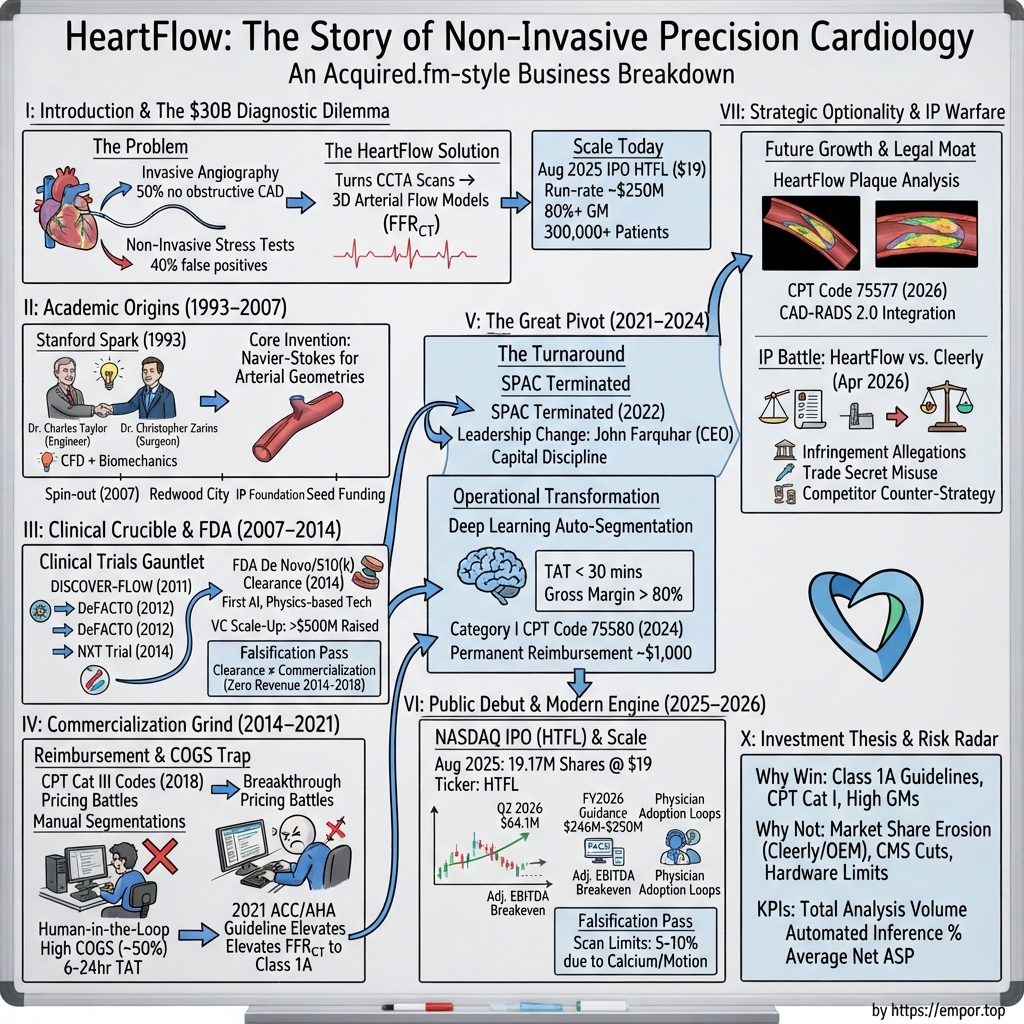
HeartFlow: The Story of Non-Invasive Precision Cardiology
I. Introduction & The Precision Cardiology Revolution
There is a particular kind of silence in a cardiac catheterization lab when the operator finishes threading a wire into a patient's coronary artery, looks at the pressure trace, and realizes the vessel is healthy. The patient arrived with chest pain. A stress test indicated a potential issue. A six-person team prepped, the patient was sedated, an artery in the wrist or groin was punctured, contrast dye was injected, and the result showed no actionable disease. The procedure was safe, expensive, and ultimately unnecessary.
For roughly two decades, this was the central inefficiency of chest-pain medicine. Traditional non-invasive tests—such as treadmill electrocardiograms, stress echocardiography, and nuclear perfusion imaging—measured coronary disease indirectly by observing heart function under stress rather than examining the arteries directly. They were widely available and inexpensive, but imprecise in both directions, generating false alarms that sent healthy patients to the cath lab and false reassurances that sent sick patients home. HeartFlow's PRECISE trial, a randomized study across 65 centers in the United States, Canada, the United Kingdom, and Europe that enrolled 2,103 patients, eventually quantified that gap: a diagnostic pathway combining coronary CT angiography with HeartFlow's analysis was 78% more likely to identify patients who actually required revascularization, while reducing diagnostic-only invasive angiograms by 69%.1
The company that eventually quantified that inefficiency did not begin as a medical device business; it originated as a problem in fluid dynamics.
The hook. HeartFlow's founding insight is that blood is a fluid, arteries are pipes, and the physics of fluid moving through pipes has been formally described since the nineteenth century. If a scanner can produce a sufficiently detailed three-dimensional picture of a patient's coronary arteries—which modern CT technology can accomplish in about ten minutes2—it is possible to simulate blood flow and calculate the pressure drop across a narrowing without inserting a wire. That calculated metric is known as FFR-CT: fractional flow reserve derived from CT scans. Below approximately 0.80, the narrowing restricts downstream blood flow and typically warrants a stent; above that threshold, medical management is generally the better option. These clinical cutoffs emerged from the landmark FAME 1 and FAME 2 trials, which established that deferring intervention on functionally insignificant lesions yielded better patient outcomes than stenting every visible narrowing on an angiogram.1
Think of it as the difference between inspecting a photograph of a kinked garden hose and running water through the hose to measure actual output. Anatomy reveals whether the pipe is narrow; physiology determines whether the restriction matters. HeartFlow's core premise was that physicians could extract physiological insights directly from anatomical images, provided the underlying physics models and computing power were sufficiently advanced.
Where the company stands today. HeartFlow listed on Nasdaq under the ticker HTFL on August 8, 2025, pricing an upsized offering at $19.00 per share—one dollar above the top of its marketed $17 to $18 range—and selling 19,166,667 shares to raise $364.2 million in gross proceeds.34 The stock opened its first trading day at $28.00.3 In the second quarter of 2026, the company reported revenue of $64.1 million, reflecting 48% year-over-year growth, an 83.0% gross margin, and a net loss of $15.7 million, while raising full-year revenue guidance to between $246 million and $250 million.5 To date, HeartFlow's technology has assessed coronary disease in more than 750,000 patients and has been adopted by over 1,800 institutions worldwide.5
While these figures reflect strong commercial momentum, they do not by themselves constitute a complete investment case.
What this story is really about. Four main themes run through HeartFlow's nineteen-year history, each presenting a dual perspective.
The first is the extended distance between a scientific breakthrough and commercial monetization. HeartFlow received FDA clearance in 2014 but did not secure a permanent billing code until 2024. That decade represents the most instructive period in the company's operational development.
The second involves the unit economics of an automated medical platform that still relies on human oversight. HeartFlow's gross margin expanded from 75% to 83% over two years,56 a gain management attributes to software automation. However, regulatory filings indicate the company continues to hire and train production personnel, with full human-out-of-the-loop automation scheduled for 2027.17 The margin expansion is real, but the transition remains incomplete.
The third is capital allocation discipline under adverse market conditions. In 2021, HeartFlow agreed to go public via a SPAC at a $2.4 billion pro forma enterprise value, but the transaction was terminated in February 2022.8 How management navigated the four years between that cancellation and its eventual conventional IPO serves as an essential test of operational resilience.
The fourth concerns competitive moat durability. HeartFlow holds approximately 617 issued patents worldwide.1 In April 2026, it filed a patent infringement lawsuit against its closest venture-backed competitor, Cleerly, in the Eastern District of Texas, alleging violations across six patents.9 While patent litigation can signal legal defense of proprietary technology, it can also reflect intensifying market competition. This dispute coincides with another regulatory matter: a Department of Justice civil investigative demand received in October 2025.1
To understand the trajectory of these challenges, the story begins in a Stanford lecture hall in 1993.
 Subscribe on LinkedIn
II. Academic Origins: Stanford, Biomechanics, & The CFD Breakthrough (1993–2007)
The story began in a university lecture hall in 1993, during a presentation titled "Blood Flow and Your Health" by Christopher Zarins, then Stanford University's newly installed chief of vascular surgery. In the audience sat Charles Taylor, a doctoral candidate in engineering with no medical background, whose research focused on computational fluid dynamics—the branch of applied mathematics aerospace engineers use to model airflow over an aircraft wing. Following the lecture, Taylor approached Zarins to ask whether computational mechanics had a place in vascular research.
Zarins agreed to co-advise him, and Taylor focused his doctoral thesis on simulating arterial blood flow with computers. Taylor joined the Stanford faculty in 1997 and spent the next decade refining the methodology before co-founding HeartFlow in 2007 with Zarins and Nathan Wilson. By the company's account, roughly fifteen years of research on patient-specific computational flow modeling preceded its commercial product.2
Why it took fifteen years. The governing equations—the Navier-Stokes equations describing viscous fluid motion—were formulated in the 1840s. The mathematics itself was not new; rather, every practical requirement for its implementation was absent in 1993.
First, the approach required three-dimensional imaging of coronary arteries detailed enough to reconstruct exact vessel geometry. Coronary arteries measure only a few millimeters across, sit on a heart beating about once a second, and move as the patient breathes. In the early 2000s, clinical CT scanners captured only four to sixteen slices per scan, yielding smeared images of moving cardiac anatomy. Second, the model needed physiologically sound boundary conditions to infer downstream myocardial blood demand—a metric impossible to observe directly on a scan. Third, simulating fluid dynamics across an entire coronary tree at clinical resolution demanded compute capacity far exceeding laptop processing.
The Fogarty Institute's retrospective described the starting point plainly: "no one had ever built a computational flow model from medical imaging before," and the enabling technology—computing power, diagnostic imaging capability—"was not nearly advanced enough at the time."2 HeartFlow became the first resident company at the Mountain View incubator, with Zarins emphasizing that Stanford could host the initial research but not its translation: "we needed a place like Fogarty Innovation to make something clinically useful and commercially available."2
Historical falsification: was the science ever the bottleneck?
Deep-tech founding narratives often imply that scientific invention is the primary hurdle and commercialization follows naturally. HeartFlow's operational timeline contradicts that assumption.
Taylor and Zarins had established a working scientific concept by the late 1990s, yet the company was not incorporated until 2007. The FDA authorized the product in 2014,1 and meaningful commercial deployment began only in 2015.1 The progression from mathematical principles to initial commercial revenue spanned roughly two decades, with technical math causing almost none of the delay.
Instead, progress waited on external infrastructure. Scanner resolution had to increase tenfold. Cloud compute costs had to drop to a level hospitals could afford per simulation. Furthermore, as subsequent chapters illustrate, the American healthcare payment apparatus had to build a reimbursement structure for cloud-hosted analytical software.
This trajectory illustrates a persistent rule in clinical software: software value in medicine is bounded by the quality of the input signal and by the willingness of a third party to pay for the output. Neither variable rests under the software developer's control. Today, HeartFlow reports coronary CTA image acceptance rates exceeding 97%,5 indicating that input quality issues have largely been mitigated. Yet the fundamental constraint remains not the rate of scan rejection, but the overall volume of CT scans ordered and the subset of those scans representing eligible patients. Later chapters will return to that operational arithmetic, which remains a central variable in the company's growth model.
Transitioning from a Stanford computational model to an FDA-cleared diagnostic tool required a capability the founders had not yet developed: conducting large-scale clinical trials.
III. The Clinical Crucible & FDA 510(k) Clearance (2007–2014)
Medical device regulation in the United States rewards a specific kind of rigor. It cares less about the elegance of underlying physics and more about whether calculated outputs match accepted reference standards in patient populations without diagnostic bias.
For HeartFlow, that reference standard was the wire—invasive fractional flow reserve (FFR), measured by threading a pressure sensor directly into a coronary artery during catheterization. To secure regulatory approval, the company had to demonstrate that a pressure metric computed from a non-invasive CT scan could reliably match physiological measurements taken inside a living artery.
The trial sequence. HeartFlow conducted a progressive series of clinical studies of increasing rigor. The decisive milestone was NXT, a prospective, blinded, core-lab-adjudicated trial in which patients with suspected coronary artery disease underwent coronary CT angiography prior to non-emergent invasive angiography. Enrolling 254 patients and evaluating 484 vessels across ten centers in Europe, the United Kingdom, Japan, Korea, and Australia, NXT demonstrated a per-vessel diagnostic accuracy of 86% for HeartFlow's analysis compared to 65% for CT angiography alone (p < 0.001).1
The NXT trial results were published in the Journal of the American College of Cardiology in 2014, and the PRECISE trial was published in JAMA Cardiology in 2023—placing HeartFlow's core clinical data in peer-reviewed journals independently of company influence.1011
The trial's most critical design features were double-blinding and core-lab adjudication. CT image analysts had no knowledge of invasive catheterization results, while independent core laboratories—rather than trial investigators—evaluated image quality and diagnostic outputs. This separation prevented clinical bias from skewing trial data, making NXT, rather than earlier studies such as DISCOVER-FLOW and DeFACTO, the primary basis for regulatory evaluation.
The clearance. On November 26, 2014, the FDA granted de novo authorization for version 1.4 of HeartFlow's FFR-CT Analysis, supported by the NXT trial data. The de novo classification is reserved for novel medical devices lacking a marketed predicate; the agency established special controls to ensure safety and effectiveness, designating the software as a Class II device. A conventional 510(k) clearance for version 2.x followed in January 2015.1
This regulatory distinction carries operational significance. While corporate narratives frequently reference 510(k) clearances, a de novo decision requires the FDA to create an entirely new device category. HeartFlow was not cleared as substantially equivalent to existing technology because no direct predicate existed.
The evidence flywheel. Rather than treating regulatory clearance as an endpoint, HeartFlow continued to fund clinical trials. PACIFIC, an investigator-initiated head-to-head study at a single site in the Netherlands, evaluated HeartFlow's analysis against CT angiography, SPECT, and PET in 208 patients using invasive FFR as the reference standard. HeartFlow recorded the highest area under the receiver operating characteristic curve (AUC) for vessel-specific ischemia at 0.94, outperforming PET at 0.87, CT angiography at 0.83, and SPECT at 0.70.1 Simultaneously, PLATFORM, a 584-patient trial across eleven centers in Europe and the UK, showed that adopting the CT-plus-HeartFlow pathway reduced unnecessary invasive angiograms from 73% to 12% while reducing overall diagnostic costs by 32% at one year.1
By the end of 2025, HeartFlow's platform had been evaluated in more than 200 clinical studies involving over 365,000 patients and cited in more than 600 peer-reviewed publications, with HeartFlow sponsoring 50 of the 200 studies.1 The key operational metric within those figures is the 150 independent studies that HeartFlow did not sponsor. Independent validation converts corporate data into clinical practice guidelines, which govern diagnostic workflows across hospital systems.
Historical falsification: does clearance create a business?
This clinical trajectory highlights the limitations of standard medtech commercialization assumptions. HeartFlow received FDA authorization in late 2014 and launched commercial sales in 2015.1 Yet by 2023, eight years after market launch, annual revenue stood at $87.2 million.1 Financial filings reflect this extended timeline: as of December 31, 2025, the company had accumulated a deficit of $1.1 billion against annual revenues that had never exceeded $176 million in any single year.1
Regulatory clearance provides legal authorization to commercialize, but it does not guarantee payment. U.S. healthcare systems do not adopt diagnostic tools solely because they are cleared by regulators; adoption depends on established reimbursement channels. For nearly a decade following FDA authorization, HeartFlow operated without a permanent, predictable reimbursement mechanism.
The assumption that regulatory clearance automatically drives rapid commercial scaling is directly disproved by HeartFlow's operational history. Spanning from 2014 to 2024, this delay reflects structural market barriers rather than a brief transition period. The central lesson for diagnostic software platforms is clear: in healthcare technology, the binding constraint is the billing code, and adoption is measured by account activations following coverage decisions rather than regulatory milestones. This structural constraint set the stage for the company's subsequent decade.
IV. The Commercialization Grind: CPT Codes, Human-in-the-Loop Bottlenecks, & Venture Scale (2014–2021)
Picture the least glamorous room in the HeartFlow story. It is not a laboratory; it is a conference room in Chicago where the American Medical Association's CPT Editorial Panel meets three times a year to decide what American medicine is permitted to bill for. There are no cameras. The applicants are medical societies, not commercial companies—by design. And the panel's decisions determine, with more force than any FDA committee, which technologies reach clinical practice and which quietly die.
HeartFlow spent seven years working that room.
Step one: getting a code at all. On January 1, 2018, four Category III CPT codes took effect for FFR-CT—0501T for the complete analysis, alongside 0502T, 0503T, and 0504T for the component steps of data preparation and transmission, fluid dynamics computation, and anatomical review and reporting. The application was submitted jointly by the American College of Cardiology, the Society of Cardiovascular Computed Tomography, and the Society for Cardiovascular Angiography and Interventions.12
Notice who applied. Not HeartFlow, but medical societies. That distinction is a structural requirement of the CPT process, meaning a medical technology vendor cannot simply purchase a billing code. It must persuade practicing cardiologists to expend political capital on its behalf. HeartFlow's decade of funding clinical trials was, viewed pragmatically, the necessary price of admission to that room.
Step two, and the trap: Category III is a waiting room, not a destination. A Category III code is explicitly temporary—the AMA's designation for emerging technology. It creates a mechanism to file a claim, but it imposes no obligation on insurers to pay it. Because no relative value units are attached, physician compensation remains undefined. Medicare contractors price such codes at their own discretion or refuse to cover them entirely, while commercial insurers routinely classify Category III services as investigational and deny reimbursement.
The financial consequences were starkly visible on the top line. By 2023—six years after the temporary codes took effect and nine years after FDA clearance—HeartFlow's annual revenue reached $87.2 million.1 For a technology recommended in professional guidelines and validated across dozens of clinical studies, within a country spending more than a fifth of its economy on healthcare, that figure represented a modest footprint. The underlying technology functioned as intended; the reimbursement infrastructure did not.
The other bottleneck: HeartFlow was never a pure software company.
This structural reality is often obscured by "AI diagnostics" narratives. When a hospital uploads a coronary CT scan, the software does not operate entirely autonomously. A human production team performs manual quality control and editing on the scan before the analysis is released to the physician. The company's annual report explicitly describes this architecture as a "human-in-the-loop" process, where human corrections are continuously fed back to train the algorithms.1
That approach represents a defensible design choice for diagnostic software used to guide invasive stenting decisions. However, it creates a cost structure that diverges significantly from traditional software. HeartFlow's cost of revenue consists primarily of personnel expenses for its production team, combined with cloud hosting fees, amortization of internal-use software, and technology licensing royalties.1 Consequently, headcount scales directly with case volume. In 2024, the company recorded a gross margin of 75%.6 While respectable for a technology-enabled service, that margin remains well below typical software benchmarks.
This dynamic raised a fundamental strategic question: was HeartFlow a software business that happened to employ analysts, or an outsourced reading service built around proprietary algorithms? Until that distinction shifted, gross margins remained constrained, limiting operating leverage.
The 2021 guideline moment — and a myth worth correcting.
In November 2021, the American Heart Association and the American College of Cardiology released updated chest pain guidelines that established coronary CT angiography as a primary initial diagnostic tool.13 Investor commentary frequently mischaracterizes this milestone as HeartFlow receiving a "Class 1A" guideline recommendation. It did not, and the clinical nuance is critical.
According to HeartFlow's disclosures, the guidelines assigned coronary CT angiography a Class 1, Level A recommendation for evaluating certain patients with stable or acute chest pain and no prior coronary disease. By contrast, HeartFlow's FFR-CT Analysis received a Class 2a, Level B designation to assist in treatment planning.1 In clinical guidelines, Class 1 indicates a strongly recommended intervention, whereas Class 2a denotes a reasonable option. Level A reflects evidence from multiple randomized trials, while Level B relies on more limited data sets.
The practical implication is that the 2021 guidelines created a powerful tailwind for the underlying scan rather than a mandate for HeartFlow's analysis. HeartFlow benefited directly—because every additional coronary CT scan expands its potential addressable volume—but it grew as a beneficiary of expanding CT utilization rather than a mandatory diagnostic endpoint. That distinction altered its competitive landscape, allowing competing analytical platforms to enter the same clinical workflow. Any investment rationale premised on a guideline-mandated standard of care for HeartFlow specifically relied on a claim the guidelines did not make.
Historical falsification: was this ever a SaaS business?
The market premise that HeartFlow operated as a software-as-a-service business with pure software margins from its inception is contradicted by the financial record. Gross margin stood at 75.1% in 2023 and 75.0% in the fourth quarter of 20246—roughly ten to twenty percentage points below mature vertical software peers—with the difference driven directly by labor expenses. Cost of revenue disclosures consistently reflect significant personnel costs, and the company's 2025 annual report explicitly noted plans to hire additional production personnel to keep pace with growing patient volume.1
During this phase of its development, HeartFlow functioned as a computationally intensive diagnostic service bureau with expanding software capabilities rather than a pure SaaS business. The core operational reality was clear: margin expansion at HeartFlow was not driven by passive operating leverage on fixed software code, but by the gradual automation of human workflows. The key benchmark for tracking this transition remained gross margin performance—specifically whether margins could expand while case volumes outpaced production headcount growth.
By mid-2021, HeartFlow possessed a clinically validated platform, a temporary billing code, a labor-heavy operating structure, and a decade of accumulated losses. To scale further, the company required additional growth capital—and the capital markets of 2021 were uniquely eager to provide it.
V. The Great Pivot: SPAC Collapse, Leadership Change, & The Deep Learning Automation Shift (2021–2024)
In July 2021, at the peak of enthusiasm for special purpose acquisition companies, HeartFlow agreed to merge with Longview Acquisition Corp. II—a blank-check vehicle backed by Larry Robbins's Glenview Capital—at a pro forma enterprise value of $2.4 billion. Longview held $690 million in trust, and the transaction was structured to deliver HeartFlow up to $599 million in gross proceeds.8
For a company generating roughly $100 million in annual revenue, operating with a labor-heavy cost base, and lacking a permanent billing code, that valuation rested substantially on projection rather than performance.
Seven months later, the transaction dissolved. On February 4, 2022, the two companies mutually terminated the business combination agreement, citing "current unfavorable market conditions."8 Longview Acquisition II subsequently liquidated and returned its trust funds to shareholders.
What the cancellation actually revealed. The official explanation—unfavorable market conditions—was both accurate and incomplete. Growth-technology valuations collapsed in early 2022, causing SPAC deals to fall apart across the market. But an inability to execute a transaction at that price is itself informative: it indicates the valuation reflected a temporary market window rather than sustainable business fundamentals, and that public investors with redemption rights concluded the business did not justify the price.
A concrete comparison clarifies HeartFlow's valuation trajectory between 2021 and its eventual public debut. Four years later, when the company went public, it priced shares at $19.00—just above its marketed $17 to $18 range3—on a share count that implied an equity value of approximately $1.6 billion at the offer price, based on the weighted average share counts subsequently disclosed in its results.6 By then, annual revenue had roughly doubled from its 2021 level. The result was a substantially larger business commanding a significantly lower valuation.
This contrast refutes the argument that the 2021 SPAC transaction was fundamentally sound and merely mistimed. The market did not simply defer HeartFlow's initial valuation; it permanently repriced the business, a repricing that persisted despite a doubling of revenue. The evidence leads to a clear conclusion: the SPAC's collapse was a market correction rather than a temporary liquidity disruption, and the company's subsequent execution—not its 2021 projections—provides the true benchmark for evaluating management. The specific financial projections in the 2021 investor presentation are not independently verifiable from primary filings, and any recollection of them should be evaluated accordingly.
Enter John Farquhar.
The leadership transition occurred one month after the SPAC transaction dissolved. On March 1, 2022, John Farquhar became President and Chief Executive Officer. Having joined HeartFlow as Chief Operating Officer in August 2021 and assumed the roles of President and board member on January 1, 2022, Farquhar stepped into the chief executive role via a structured succession. Dr. John H. Stevens, who had led the company as CEO since 2010, transitioned to Vice Chair of the board.14
Farquhar's professional background underscored this strategic pivot. Neither a scientist nor a founder, he brought extensive executive experience from Medtronic, where he served as Vice President and General Manager of the Aortic business alongside leadership roles across the Cardiovascular and Diabetes groups in different regions, holding a BA from Duke and an MBA from Kellogg.14 Board chairman William C. Weldon, a former Johnson & Johnson chief executive, explicitly framed Farquhar's appointment around "operational excellence."14
Corporate boards signal strategic priorities through executive selection. A board seeking scientific breakthroughs hires an inventor; a board focused on commercial distribution and cost control hires a large-cap medtech operator accustomed to managing a P&L. HeartFlow's board chose the operator.
What the operator did.
Farquhar executed three sequential steps that were tightly interdependent.
First, he secured private growth capital during a challenging market cycle. In April 2023, HeartFlow closed a $215 million Series F round led by Bain Capital Life Sciences.15 While raising private capital under tough market conditions was not a celebratory event, it provided the runway required to execute operational reforms.
Second, he targeted the cost structure. HeartFlow's regulatory filings consistently attribute its margin expansion to "improved production team productivity driven by AI efficiency initiatives," partially offset by hiring and training more production staff.6 That distinction is essential: efficiency gains resulted from increasing individual analyst productivity rather than eliminating human oversight. Gross margin expanded from 75.0% in the fourth quarter of 2024 to 79.5% a year later,6 reaching 83.0% by the second quarter of 2026.5 This eight-percentage-point expansion over two years represented sustained operational progress driven by process improvement rather than a step-change in architecture.
Third, and most critically, HeartFlow secured a permanent billing structure. Effective January 1, 2024, FFR-CT transitioned from four temporary Category III codes to a permanent Category I CPT code, 75580. Relative value units were assigned, creating a standardized physician payment for the first time, while CMS increased hospital outpatient reimbursement by approximately 7% for 2024. The code applies across hospital outpatient departments, physician offices, and imaging centers. The petition was submitted jointly by the American College of Cardiology, the American College of Radiology, and the Society of Cardiovascular Computed Tomography, on the basis of rising utilization, accumulated clinical evidence, and guideline inclusion.16
By the end of 2025, HeartFlow had established coverage policies covering approximately 99% of covered lives in the United States for FFR-CT.1
Reading the sequence correctly. While management attributes operational acceleration to the deep learning automation program, the timeline points to reimbursement as the primary catalyst. Revenue expanded 40% in 2024 and 40% again in 2025;6 software automation progressed incrementally over several years, whereas the Category I reimbursement change was a discrete event in January 2024. The data indicates that the Category I code unlocked demand, sales deployment accelerated volume, and margin expansion followed as a consequence of scale rather than its cause.
This distinction is crucial for evaluating HeartFlow's future trajectory. It demonstrates that long-term growth depends on maintaining favorable reimbursement conditions—a key operational variable outside management's direct control—setting up the moment the company finally took the story public.
VI. The Public Debut & Modern Financial Engine: HTFL IPO & Core Business Mechanics (2025–2026)
On the morning of August 8, 2025, HeartFlow's shares opened on Nasdaq at $28.00 — $9 above the $19.00 offer price, a first-trade gain of roughly 47%.3 Deals that open 47% higher are deals that were priced too cheaply, and there is no way to describe that outcome as optimal for the company. But it also told you something about demand: a nineteen-year-old, loss-making diagnostics company had found a genuinely enthusiastic public shareholder base, in a medtech IPO market that had been largely closed since 2021.
The offering closed on August 11 at 19,166,667 shares including the underwriters' full over-allotment exercise, for $364.2 million gross and approximately $332.4 million net after $31.8 million of discounts, commissions and offering costs.41
Where the money went. Not into a war chest for acquisitions. The proceeds retired debt: HeartFlow fully repaid its 2024 Term Loan in August 2025, and both that loan and its 2025 convertible notes were extinguished or converted around the listing. Interest expense, net fell 48% in 2025 to $9.6 million.1 The company ended June 2026 with $246.8 million in cash, equivalents and investments.5
A second-layer note on the 2025 accounts, because it explains an otherwise alarming number. HeartFlow's 2025 net loss was $116.8 million against an operating loss of only $64.1 million.61 The gap is almost entirely non-cash and non-operating: a $43.9 million charge from remeasuring a common stock warrant liability as the share price rose, plus a $6.4 million loss on debt extinguishment.1 The warrant holder net-exercised in full on October 22, 2025, so the fourth quarter of 2025 was the last period in which share-price movements mechanically enlarged the reported loss.6 Investors reading the headline loss line without that context would materially misjudge the cash economics.
How the business actually makes money.
The model is a per-analysis fee, recognized when the analysis is delivered to the physician — what the company calls "pay-per-click." Ordering both an FFR-CT Analysis and a Plaque Analysis from a single scan counts as two revenue cases.1 There is no capital equipment. Hospitals do not buy a box; they send images to the cloud and receive a report. Onboarding is a workflow integration, not an installation.
That distribution model is genuinely differentiated, and it explains the commercial structure the company runs: Territory Sales Managers who open accounts, Territory Account Managers who drive utilization inside accounts by educating referring physicians, and a customer success function that handles onboarding. Notably, HeartFlow's commercial people do not cover cases in the cath lab or the imaging suite — unusual in medtech, where reps often spend their days in procedure rooms.1 The result is a sales force whose time is almost entirely spent selling and educating rather than servicing, which is a real cost advantage per dollar of revenue.
The workflow detail that does the selling. For years the practical objection to FFR-CT was time. A scan uploaded in the morning came back as a report later that day or the next — fine for an outpatient clinic follow-up, useless for a patient sitting in an emergency department waiting on a disposition decision. HeartFlow now states that it delivers final quality-reviewed analyses instantly upon order.5 The mechanism is not that the computation became instantaneous; it is that the pipeline processes the scan when the images arrive, so the analysis is already complete when the physician decides to ask for it. The company absorbs the cost of processing cases that are never ordered in exchange for removing latency from the clinical decision.
That is a genuine commercial insight dressed up as an engineering one. Diagnostic tests are adopted at the speed of the workflow they sit in, not the speed of the science. A cardiologist who has to remember to check for a result tomorrow orders the test less often than one who sees the answer while the patient is still in the room. It also explains why the company can plausibly claim it is becoming embedded in clinical routine rather than merely available to it — and why the applicability ceilings discussed below matter more than any remaining question about speed.
The second quarter of 2026, and what it says.
Revenue of $64.1 million, up 48%, with US revenue up 51% and international up 12%.5 The domestic-international divergence is stark and persistent: international was $4.5 million in the quarter, and its growth has decelerated from 35% in the fourth quarter of 2025 to 12%.65 HeartFlow is, for practical purposes, a United States company with small direct teams in the United Kingdom, Japan and parts of the European Union.1 Reimbursement environments elsewhere have not replicated the American Category I outcome, and nothing in current disclosure suggests they will soon.
Underneath the revenue line, volume was the story: 84,491 revenue cases in the quarter, up 74% year over year.7 Compare that to 48% revenue growth and the arithmetic tells you revenue per case fell meaningfully. Two forces drive that. The first is mix — the share of US revenue cases coming from lower-priced clinic and office-based accounts rose from 22% in 2023 to 28% in 2024 to 32% in 2025, alongside volume rebates in customer contracts.1 The second is definitional: because a Plaque order on the same scan counts as a second case, the fast growth of Plaque mechanically lowers average revenue per case even when nothing has been discounted.
Chief Financial Officer Vikram Verghese addressed pricing directly on the August 13 call when Rick Wise of Stifel pressed on revenue per case, saying FFR-CT volumes came in "significantly above plan" while average selling prices finished "modestly ahead of expectations" on favourable customer mix, and that year-over-year ASP declines should moderate beginning in 2027.7 That is a specific, falsifiable forecast, which is to management's credit. It is also a forecast about the one variable — price realization — that a payer or a large hospital system can change unilaterally.
Gross margin reached 83.0%, from 75.5% a year earlier, attributed to volume leverage, higher Plaque mix, and AI efficiency, partly offset by hiring and training production staff.5 Operating expenses were $71.1 million, or 111% of revenue — still above revenue, which is the plain fact behind the $17.9 million operating loss and $15.7 million net loss.5 Adjusted EBITDA was negative $6.7 million, improved from negative $10.1 million.5
The honest summary: HeartFlow is growing fast, its unit economics have genuinely improved, and it does not yet make money. Management has committed to cash flow profitability by mid-2028, framed as within three years of the IPO.7 That is a testable promise with a date attached, which is more than most pre-profit companies offer.
Historical falsification: is scan rejection the constraint?
The intuitive worry about FFR-CT is that it fails on hard cases — heavily calcified arteries, irregular rhythms, motion artifact — and that this caps the market. HeartFlow's disclosed data pushes back: coronary CTA image acceptance rates exceed 97%, up from above 96% a year earlier.56 This is a company-defined metric without a published methodology, so it deserves the usual scepticism reserved for self-reported operating statistics. But even discounted, it does not support a 5-to-10% structural rejection rate as the binding constraint.
The real constraint is different, and much more interesting, and it comes from the company's own disclosures. FFR-CT is indicated for patients with 40% to 90% stenosis, which HeartFlow estimates at roughly 33% of patients scanned. Plaque Analysis is applicable to approximately 60% of coronary CTA patients — those with 1% to 69% stenosis.17 So at full maturity, an account that runs 100 coronary CTs generates roughly 33 FFR-CT orders and up to 60 Plaque orders, not 100 of either.
That reframes the growth model entirely. Volume growth is not gated by image quality. It is gated by two things: how many coronary CT scans American medicine orders, and how close accounts get to their applicability ceiling. On the same call, management put coronary CT penetration at roughly 11% of the total non-invasive testing market and described the competition as "the standard of care" rather than any named rival.7 That framing is strategically convenient — it directs attention away from Cleerly — but it is also, on the arithmetic, substantially correct. The claim that survives is: HeartFlow's addressable volume is bounded by coronary CT adoption and by fixed applicability percentages, not by technical failure rates. The KPI is revenue cases per account relative to those ceilings — and the company discloses installed-base figures only annually, which is a genuine disclosure limitation for anyone trying to track it.
Which brings us to the product designed to nearly double the number of eligible patients per scan.
VII. Strategic Optionality: Plaque Analysis, CAD-RADS Integration, & The Cleerly IP Warfare
Cardiology has spent a century looking for narrowings. The uncomfortable truth, established across decades of autopsy and imaging research, is that most heart attacks do not come from the tightest narrowing. They come from a plaque that ruptures — often one that was not particularly obstructive at all. A patient can pass a stress test on Tuesday and have a myocardial infarction on Thursday, and nothing about that sequence is a testing failure. It is a framing failure.
Plaque analysis is the attempt to fix the framing: instead of asking "is this artery narrow enough to matter," ask "how much disease does this person actually have, what kind is it, and is it getting worse."
What the product does, in plain terms. Coronary calcium scoring — the widely used screening test — counts only calcified plaque, because calcium is what shows up brightly on a non-contrast CT. But calcified plaque is the stabilized kind. The dangerous material is soft, non-calcified plaque, and calcium scoring is blind to it. HeartFlow's Plaque Analysis quantifies plaque type and volume at every point along the major coronary arteries from the same contrast-enhanced scan already used for FFR-CT. Against intravascular ultrasound — the invasive reference standard, a camera threaded inside the artery — the company's REVEALPLAQUE study reported 95% agreement on total plaque volume.1
The clinical payoff HeartFlow has been trying to demonstrate is not diagnostic accuracy but behaviour change. Its DECIDE registry, initiated in March 2024 and enrolled to approximately 22,000 patients across 30 US sites, has reported that Plaque Analysis changed medical management in over half of patients relative to coronary CT alone.1 At the Society of Cardiovascular Computed Tomography meeting in July 2026, a DECIDE analysis of nearly 12,000 symptomatic patients reclassified half of the patients with a calcium score of zero into a higher risk category by finding non-calcified plaque.7 If that finding holds under peer review, it is commercially significant, because "calcium score of zero" is currently treated by many clinicians as an all-clear.
The reimbursement catalyst. Category I CPT code 75577 took effect January 1, 2026 for AI-enabled plaque analysis. CMS placed it in APC 1511 with a base hospital outpatient payment rate of $950.50.17 Five of the seven Medicare Administrative Contractors had issued final local coverage determinations finding the analysis medically necessary for certain patients in their jurisdictions.1 On the commercial side, Aetna's decision in January 2026 made it the fourth major national insurer to cover the service, taking US covered lives to roughly 75%;18 by the second quarter management put coverage "right around 78%."7
Note the compression. FFR-CT took from 2014 to 2024 to reach a permanent code. Plaque went from AMA code announcement in October 2024 to an effective Category I code in January 2026. HeartFlow built the reimbursement machinery once and is now running the second product through it. That is the most concrete form of "platform" advantage in the whole story — not technology reuse, but regulatory and payer-access reuse.
The commercial evidence so far. Plaque generated $7.8 million of US revenue in the second quarter, which management characterized as roughly a $4 million beat against internal expectations, and full-year Plaque revenue guidance rose to $29 million to $31 million.7 Plaque-activated accounts are guided to approximately 1,250 by year end, against a Plaque installed base of 489 at the end of 2025.76 Farquhar's framing on the call was pointed: FFR-CT took eight years to reach 1,000 accounts; Plaque should reach 1,250 in two.7
That comparison is fair and also flattering, because the two products faced different worlds. FFR-CT had to build the category, the codes, the evidence base and the sales force from nothing. Plaque inherits all four. The right conclusion is not that Plaque is a better product than FFR-CT; it is that HeartFlow's installed base and payer relationships have real distribution value, and this launch is the first clean measurement of it.
The company has been layering product on top: Plaque Staging, launched at SCCT in July 2026, sorts disease burden into four stages and is validated in more than 23,000 patients with up to 16 years of follow-up; PCI Navigator, aimed at interventional cardiologists planning procedures, launched earlier in 2026; and Plaque Tracker, which measures change across serial scans, is targeted for 2027.7 Two honest caveats. PCI Navigator is given away — management confirmed there is no charge and no current plan to pursue reimbursement for it, treating it instead as a wedge to recruit interventional cardiologists as advocates.7 And Plaque Tracker's entire premise depends on reproducibility being tight enough to distinguish real disease progression from measurement noise, which is exactly the claim a competitor would attack.
The quiet fight over reporting standards. Underneath the product launches sits a less visible contest about how plaque gets described in the cardiology report itself. Structured coronary CT reporting has converged on standardized categories, and whichever vendor's outputs map cleanly onto those categories becomes the default input to the report rather than an attachment to it. Farquhar leaned on this in August, citing an American College of Cardiology scientific statement on industry standards for quantitative plaque analysis that treats independently validated accuracy and reproducibility as foundational, and updated Society of Cardiovascular Computed Tomography expert consensus guidance, endorsed by the ACC, emphasizing lesion-specific FFR-CT values in identifying lesions that may warrant intervention.7
Management's implication is that these documents were written around capabilities HeartFlow happens to have. The more neutral reading is that standards bodies write to the state of the evidence, and HeartFlow has generated more of it than anyone else — which produces the same commercial result without requiring anyone to have been captured. Either way, standards drift is a slow-moving competitive variable worth watching: a future consensus statement that emphasized metrics a rival measures better would erode the advantage just as quietly as the current ones built it.
The lawsuit.
On April 13, 2026, HeartFlow filed suit against Cleerly, Inc. in the US District Court for the Eastern District of Texas, asserting infringement of six patents covering anatomic structure segmentation, blood flow estimation from vessel geometry, coronary plaque vulnerability prediction, numerical evaluation of vasculature, correction of artificial deformation in anatomic modelling, and digital image analysis of vessel characteristics. The accused products are Cleerly's Ischemia, Plaque Analysis and Compare. HeartFlow demanded a jury trial and sought a permanent injunction as well as damages.9 The complaint's most aggressive element is not the patent count but the personnel allegation: that Cleerly founder and CEO James K. Min served as a HeartFlow consultant from 2012 to 2017 and used confidential information in developing competing products.9
Cleerly rejected the claims, calling the filing a lawsuit to limit competition and the allegations baseless, with Min stating confidence in "our extensive and well-established intellectual property portfolio and the originality of our technology."9 Cleerly's answer was due July 8, 2026. On the August call, asked directly about the case, Farquhar said the complaint "speaks for itself," expressed high confidence in the legal position, and noted this kind of litigation "typically follows a multi-year path."7 No ruling has been issued and nothing in the public record establishes the merits either way.
Historical falsification: does the patent portfolio block competitors?
HeartFlow's owned and licensed portfolio ran to approximately 617 issued patents globally, including 330 issued US patents, as of December 31, 2025.1 If patents were sufficient, the category would have one participant.
They are not. Cleerly raised a $223 million Series C in July 2022 led by T. Rowe Price and Fidelity, bringing its total raised to $279 million, with participation from Sands Capital, Mirae Asset Capital, Peter Thiel, Breyer Capital and Novartis, among others.19 It built a commercial business and a body of published science. HeartFlow's own annual report names Cleerly, Elucid Bioimaging and Keya Medical Technology as AI competitors and warns explicitly that "recent and future advances in AI may allow other companies to quickly create competing products," potentially "less expensively," while benefiting from the regulatory and reimbursement pathways HeartFlow and others opened.1
That last clause is the crux, and it is HeartFlow's own words. The reimbursement infrastructure the company spent a decade building is not proprietary. CPT code 75577 describes AI-enabled plaque analysis generically, not HeartFlow's version of it — Caristo, for instance, secured Medicare reimbursement for its own plaque product. The code HeartFlow fought for is a road, and roads carry everyone.
So the claim "the patent estate blocks competitors from offering AI-based coronary CT diagnostics" is rejected by the evidence. Competitors exist, are funded, and are selling. The narrower claim that survives is that HeartFlow's patents may impose cost and legal risk on specific competitor architectures, but the company's defensible position rests on evidence volume, payer coverage breadth and installed-base distribution — not on exclusion. The events that would confirm or falsify the narrowed version are concrete: a claim-construction ruling or preliminary injunction in the Eastern District of Texas, an inter partes review petition against the asserted patents, and — more informative than either — whether Plaque activations and utilization keep beating plan while the case proceeds.
VIII. The Helmer 7 Powers & Porter's 5 Forces Analysis
Strip away the clinical vocabulary and HeartFlow is a toll booth on a road that is being widened. The question every framework below is really asking is whether the toll booth can be moved, undercut, or bypassed.
Hamilton Helmer's 7 Powers, applied honestly.
Scale economies — moderate, and often overstated. Data is the genuine asset here: HeartFlow reports a proprietary database of more than 200 million annotated coronary CT angiography images—up from over 160 million a year earlier—built directly from real-world clinical use.56 Larger training sets refine image segmentation, and every completed analysis feeds the feedback loop. Yet the economics of scale differ from traditional software. Cloud computing costs scale roughly linearly, while production labor—the dominant expense—also grows with case volume. Consequently, HeartFlow's scale advantage yields superior model quality rather than a sharply falling cost curve, and model quality is inherently an asset of diminishing returns.
Process power — the strongest of the seven. Nineteen years of refining workflow architecture, achieving HITRUST, SOC 2 Type 2, ISO 13485, and ISO 27001 compliance, and integrating into hospital imaging systems represent institutional know-how that money cannot instantly replicate.5 The operational proof lies in the delivery model: analyses are returned instantly upon order, enabled only because the processing pipeline runs ahead of the physician's explicit request.5 Duplicating that workflow requires a multi-year organizational effort rather than a simple hiring spree.
Switching costs — moderate. These costs are real but modest. The platform requires no capital equipment to strand and no multi-year license to unwind. Customer retention depends instead on clinical habit, familiarity with reporting formats, and the operational friction of onboarding a new vendor into hospital imaging and billing systems. That administrative friction creates stability, but it does not constitute hard lock-in. The absence of proprietary hardware—the company's strongest sales argument—is also why its clients face minimal structural costs to switch providers.
Cornered resource — moderate, and contested. Proprietary clinical datasets like DECIDE, ADVANCE, and PRECISE are exceptionally difficult to replicate; building a 22,000-patient prospective registry across 30 clinical sites requires a level of capital and institutional commitment few rivals can match.1 Furthermore, being selected as the exclusive plaque analysis provider for the NIH-funded, 1,500-patient PREEMPT study indicates that academic researchers view the platform as a reference standard.7 Yet difficult to replicate is not impossible, and Cleerly's venture backing demonstrates that competitors can fund substantial evidence generation of their own.
Network effects — low. Hospitals derive no direct value from other institutions using HeartFlow. The only network-like mechanism is the data flywheel, which functions more accurately as a scale economy.
Counter-positioning — historically strong, now spent. HeartFlow initially acted as the industry challenger whose core proposition was replacing expensive, invasive procedures that incumbents performed. Having harvested that initial positioning advantage, HeartFlow now stands as the established incumbent, facing counter-positioning from cheaper, scanner-native, and startup alternatives.
Brand — moderate. The brand carries significant weight with clinical guideline committees and academic cardiologists. However, it matters little to end patients, who rarely select their diagnostic provider.
Porter's five forces.
Rivalry — high and intensifying. HeartFlow explicitly names Cleerly, Elucid Bioimaging, and Keya Medical Technology in its filings, acknowledging in its annual report that it faces direct competition and price pressure from these firms.1 That acknowledgment of price pressure is particularly telling, as it reflects an operational reality already appearing in corporate disclosures.
Threat of new entrants — the most serious force. HeartFlow's risk disclosures describe a notable structural threat: major imaging equipment manufacturers—Siemens Healthineers, Koninklijke Philips, and Canon Medical Systems—have each previously evaluated workstation-based prototypes for non-invasively deriving CT-based blood flow, and if any were to secure regulatory approval, they could bundle the software directly with hardware sales.1 Equipment manufacturers do not require high software margins to justify the investment; their core objective is selling high-margin scanners. That creates a structurally different competitive threat than a venture-backed software startup.
Buyer power — moderate and rising. Corporate disclosures highlight health system consolidation, warning that expanding healthcare providers "may try to use their market power to negotiate price concessions."1 While no single customer represented more than 10% of revenue in 2023, 2024, or 2025, HeartFlow cautions that purchasing decisions for many facilities are concentrated within a small number of buying groups, making the loss of a major account disproportionately impactful.1 The observed downward trend in average revenue per case indicates that buyer power is already exerting measurable pressure.
Supplier power — low. Cloud hosting infrastructure remains commoditized. The primary supplier dependency is more subtle: HeartFlow relies on CT manufacturers maintaining standardized image export formats, and filings warn that a transition toward proprietary formats would force costly software re-engineering.1 Significantly, the suppliers of these essential inputs are the same equipment manufacturers best positioned to enter the market as direct competitors.
Substitutes — moderate. Invasive FFR wires remain the established reference standard and will continue to be used in complex cases. Traditional nuclear perfusion imaging retains substantial installed volume and entrenched clinical habits. Meanwhile, photon-counting CT—the next generation of scanner technology—presents a dual dynamic: higher-resolution images improve HeartFlow's input quality, but they also lower the technical threshold for competing algorithms, including those running directly on the scanner.
The synthesis. HeartFlow's competitive advantages are genuine, but they belong to the accumulating variety rather than structural fortresses. Process refinement and clinical evidence depth compound over time and cannot be copied overnight. Yet nothing in the company's position prevents a well-funded rival from bidding on the same hospital system next quarter, nor does anything stop a scanner manufacturer from bundling a comparable algorithm at zero incremental cost. HeartFlow operates a solid business, but its position is not an unassailable fortress—a reality its own regulatory filings make clear.
IX. Management Credibility, Capital Allocation, & Skeptical Investor Stress Test
The most reliable way to evaluate a management team is to track what it promises, wait, and compare those commitments against actual results.
HeartFlow has been public for barely a year, leaving a short track record. Within that window, however, its financial guidance has followed a consistent upward path. Management issued initial 2026 guidance alongside fourth-quarter 2025 results in March, projecting revenue between $218 million and $222 million—representing 24% to 26% growth—and a non-GAAP gross margin of 80% to 81%.6 In May, management raised revenue guidance to between $228 million and $232 million while lifting gross margin expectations to roughly 81%.20 In August, it raised targets again, projecting revenue of $246 million to $250 million and a gross margin near 82%.5 That marked two guidance increases in two quarters, with the second raise exceeding the immediate quarterly beat.
CFO Vikram Verghese explicitly outlined this philosophy when analysts questioned conservative second-half guidance, noting that management seeks to set "a high conviction baseline" that "leaves room to outperform."7 That framing reflects a deliberate strategy of managing expectations, creating guidance beats partly by design. Setting conservative targets during a company's first year in public markets is standard corporate practice that mitigates execution risk. The true test of management credibility will occur when the underlying business encounters friction, testing whether corporate disclosures remain transparent during periods of underperformance.
Capital allocation. Post-IPO capital allocation has prioritized debt retirement, commercial expansion, product development, and ongoing clinical trials, with no acquisitions. In 2025, research and development expenses rose 49% to $64.9 million, driven primarily by headcount expansion, while selling, general, and administrative expenses increased 20% to $134.3 million.1 This spending distribution highlights HeartFlow's current operating phase: SG&A spending remains roughly double R&D outlays, reflecting an intensive commercial deployment strategy rather than pure software development.
One capital decision warrants closer examination. In the first quarter of 2026, HeartFlow recorded a $7.5 million non-cash impairment charge on the right-of-use asset for its Mountain View facility after consolidating its footprint and moving its headquarters to San Francisco.20 Recording a lease write-off in a company's second quarter as a public entity highlights past real estate overcommitments, even as management emphasized non-GAAP operating metrics that excluded the charge.
The accounting judgment worth flagging. Beginning in the second quarter of 2026, HeartFlow began excluding expenses described in disclosures as "certain litigation-related expenses associated with our ongoing IP litigation" from non-GAAP SG&A, applying the adjustment retrospectively to prior periods.7 While management cited improved visibility into core operating performance as the rationale, HeartFlow voluntarily initiated the patent litigation against Cleerly. Excluding expenses incurred to protect a core commercial moat from non-GAAP results presents those operational costs as non-recurring items. Although applying retrospective adjustments maintains historical consistency, the modification improved year-over-year non-GAAP operating loss comparisons in the quarter it was introduced.
The stress test: what a short seller would ask.
"What stops Siemens or GE from giving this away with a scanner?" Management addressed this competitive dynamic on its earnings call by framing the primary competition as legacy non-invasive testing rather than rival software vendors, noting that coronary CT has reached only about 11% market penetration and citing HeartFlow's lesion-specific FFR-CT values and prospective clinical validation as core differentiators.7 From a structural standpoint, scanner-native algorithms must secure separate reimbursement coverage and clinical validation, whereas vendor-neutral cloud platforms operate across heterogeneous scanner fleets common in major health systems. Historically, however, integrated software bundled with hardware has displaced standalone paid software in medical imaging, a vulnerability HeartFlow explicitly acknowledges in its regulatory risk disclosures.1
"How expensive and how risky is the Cleerly fight?" Management has characterized the lawsuit as a multi-year legal process.7 Because HeartFlow acts as the plaintiff, an adverse ruling would result in lost legal expenditures and potential patent invalidation rather than an operational injunction against its own products. Backed by $246.8 million in cash and short-term investments, HeartFlow maintains sufficient liquidity to fund prolonged litigation.5 Nevertheless, an unfavorable claim-construction ruling would undermine the legal defense of its technological moat, and management has declined to provide formal cost estimates for the proceedings.
"What about the Department of Justice?" In October 2025, two months following its public listing, HeartFlow and select employees received civil investigative demands from the Department of Justice's Civil Division regarding potential violations of the Anti-Kickback Statute and False Claims Act. The inquiries requested documents, data, and testimony concerning financial and contractual arrangements with healthcare providers, as well as core sales and marketing practices. HeartFlow disclosed that it is fully cooperating, while noting that it cannot predict the duration or final outcome of the inquiry, which could materially affect its business operations, financial condition, or cash flows.1
This regulatory inquiry touches the center of HeartFlow's commercial strategy. The company's expansion relies on a direct sales force driving clinical adoption of analyses billed predominantly through Medicare and commercial insurers via arrangements with ordering physicians and hospitals. An investigation into provider arrangements and marketing activities directly involves these commercial practices. During the August 2026 call, CEO John Farquhar stated that there were no material updates to report, noting that civil investigative demands typically "play out over years, not months" and that management does not view the matter as an operational distraction.7 Although no formal charges or complaints have been filed—and many medtech civil investigative demands resolve without enforcement action—the investigation introduces regulatory uncertainty regarding the sales practices supporting current growth.
"Is the margin story finished?" Gross margin expansion remains an active operational objective. Management's mid-term target of an 85% non-GAAP gross margin relies on its autonomous processing initiative, scheduled for broader deployment in 2027.7 Until that transition occurs, human analysts will remain integrated into the production process, requiring continued recruitment and training to support volume growth. Recent margin gains reflect productivity improvements among human personnel; achieving target margins will require automating those manual workflows entirely.
X. Investment Thesis: The "Why Win / Why Not" Spine, Key KPIs, & Current Risk Radar
Every investment case eventually reduces to a single core hypothesis. For HeartFlow, that thesis asserts that a diagnostic pathway being broadly adopted across American cardiology will route an expanding share of patient volume through the company's software, at stable pricing, until operations reach software-like gross margins. Each component of this thesis is independently falsifiable.
Why it wins from here.
The strongest element of the bull case rests not on technology, but on market positioning. Coronary CT angiography utilization is expanding independently of HeartFlow's commercial push, driven by clinical guideline inclusion and favorable administrative policy. For example, a 2027 CMS proposal described by management on its August 2026 earnings call would increase hospital payment rates for coronary CT scans by nearly 12% while maintaining stable reimbursement for FFR-CT and Plaque Analysis.7 Rather than incurring the cost of primary market creation, HeartFlow can capture incremental volume simply by attaching its analytical tools to scans already being performed.
The second growth driver is product expansion. Plaque Analysis roughly doubles the addressable patient population per scan compared to FFR-CT while carrying higher gross margins. Crucially, it is sold into an installed base where HeartFlow is already credentialed as a vendor with established billing pathways. The speed of the Plaque rollout relative to FFR-CT's decade-long adoption curve, alongside recent guidance increases driven by Plaque outperformance, provides evidence of this platform leverage.
The third factor is balance sheet strength relative to operational cash burn. Adjusted EBITDA losses have contracted while revenue continues to grow at more than 40% annually. With $246.8 million in cash and short-term investments, HeartFlow maintains sufficient liquidity to reach management's target of cash flow profitability by mid-2028 without requiring additional dilutive financing.
Why it may not.
Each of these growth drivers remains vulnerable to external dependencies. If broader coronary CT scan volume decelerates, HeartFlow's top-line growth will slow in tandem. Furthermore, if major CT scanner manufacturers introduce adequate, native on-scanner analysis as a bundled feature, HeartFlow's vendor-neutral cloud distribution model could shift from a competitive advantage to a workflow inconvenience. In addition, if competitors such as Cleerly, Elucid, Caristo, or Keya engage in aggressive price competition in plaque analysis, average revenue per case could decline further, transferring gross margin gains to health system customers.
In addition, diagnostic software faces administrative pricing risks absent in traditional software models. HeartFlow's annual report disclosed that CMS's July 2025 proposed outpatient rule for 2026 included a potential payment reduction of up to 15% for the clinical payment group containing FFR-CT, driven by hospital cost reporting adjustments and code reclassifications rather than clinical evaluation of the technology.1 Unilateral administrative price cuts present a persistent headwind that conventional software valuations rarely account for.
Over a longer horizon, CMS is evaluating a specialized reimbursement framework for hospital-based AI applications. Chief Executive Officer John Farquhar characterized this policy direction as constructive and consistent with long-term agency signaling, while noting that implementation remains a multi-year process targeted for 2029.7 While an outcomes-based reimbursement structure would favor companies with extensive clinical trial data, no formal rules or payment rates have been established.
Where the market has put the company. By late August 2026, HeartFlow traded near $48 per share—more than double its August 2025 initial public offering price—implying an equity valuation above $4 billion and an enterprise value of approximately 15 times the midpoint of 2026 revenue guidance for a business that has yet to record a profitable quarter.5 This premium valuation leaves little margin for execution errors, pricing pressure, or delays in product adoption.
The three KPIs that actually matter.
One: revenue cases. HeartFlow discloses total revenue cases quarterly as its primary operational indicator of market adoption.1 Because this metric counts FFR-CT and Plaque Analysis orders separately, comparing volume growth against revenue growth highlights underlying pricing trends. If case growth significantly outpaces revenue growth, it indicates average selling price compression.
Two: gross margin. Gross margin serves as the direct metric for HeartFlow's automation progress. The key operational question each quarter is whether gross margin expands while production team headcount grows at a slower pace than case volume. Management's mid-term target of an 85% non-GAAP gross margin and its planned 2027 rollout of full human-out-of-the-loop processing set a concrete benchmark; a margin stall in the low 80% range alongside rising headcount would indicate persistent reliance on manual quality control.
Three: revenue per case. Although not reported as a standalone headline metric, revenue per case can be derived from quarterly filings and reflects the net effect of competitive pricing, account mix between clinics and hospitals, and volume-based contract rebates. Management has projected that year-over-year declines in revenue per case will moderate beginning in 2027,7 providing a clear, measurable commitment to evaluate in future earnings disclosures.
The risk radar, restricted to what is material.
Reimbursement volatility represents the primary operational risk for HeartFlow, given its sensitivity to annual CMS rule-making. Legal and regulatory overhang ranks second, comprising the patent infringement litigation against Cleerly—where downside is largely limited to legal expenses and potential patent invalidation—and the Department of Justice's civil investigative demand regarding physician arrangements, which presents broader commercial uncertainty. Technological substitution ranks third, as photon-counting CT technology and scanner-native algorithms could reduce reliance on external cloud analysis over time. Customer concentration sits fourth, as ongoing health system consolidation concentrates purchasing decisions among fewer buying groups.
Finally, execution risk surrounds the planned expansion into asymptomatic patient populations. Management has committed to initiating three randomized controlled trials of 300 to 500 patients each—targeting individuals with coronary calcium, prior stents or heart attacks, and documented plaque—enrolling between the fourth quarter of 2026 and the first quarter of 2027. Management expects to reach these expanded patient groups with reimbursed technology prior to 2030, expanding HeartFlow's estimated U.S. addressable market from $5 billion to approximately $11 billion.7
However, clinical trial execution requires time and significant capital before generating commercial return. Enrolling trials in late 2026 to measure changes in plaque volume and lipid markers does not translate directly into immediate revenue. As HeartFlow's operational history demonstrates, moving from clinical authorization to broad reimbursement required a decade. While asymptomatic screening represents a substantial long-term market opportunity, its financial impact remains distant and should be evaluated with appropriate weight.
XI. Playbook & Epilogue: Business & Investing Lessons from HeartFlow
Nineteen years is long enough for a company to teach lasting operational lessons. Three insights stand out, each extending well beyond cardiology.
Lesson one: in medical technology, the FDA is the easy regulator. HeartFlow received de novo authorization in November 2014 but did not secure a permanent Category I billing code until January 2024. The intervening decade was not spent perfecting the core physics—the technology worked. It was spent accumulating clinical trial data, persuading professional medical societies to petition on its behalf, negotiating with regional Medicare contractors, and contesting commercial payer denials. Anyone evaluating a healthcare software platform should ask four preliminary questions: what code the service bills under, who petitioned for it, what percentage of covered lives it reaches, and what payment rate it commands. Those four variables predict future revenue far more reliably than diagnostic accuracy metrics.
Lesson two: interrogate the cost line of anything categorized as AI. HeartFlow's gross margin remained at 75% for years while external commentary routinely described it as a pure software business. The gap between that figure and SaaS-like gross margins was labor—specifically, a production team performing manual quality control and editing on every scan. Gross margin has since expanded to 83%, with the remaining path toward management's 85% target dependent on an autonomous processing initiative scheduled for 2027. The instructive element lies in the sequence: human oversight came first and is stepping back gradually, with margin gains driven by workforce productivity rather than total automation. When cost of revenue is dominated by headcount, "AI company" reflects strategic ambition rather than financial reality. Gross margin is where investors verify that distinction.
Lesson three: a cancelled deal can prove more informative than a completed one. In 2021, a SPAC transaction offered HeartFlow a $2.4 billion valuation and up to $599 million in proceeds. That merger dissolved in February 2022, making it easy to frame the subsequent four years as a story of corporate redemption featuring new executive leadership, cost structure reforms, permanent billing codes, and a conventional public listing. A more objective reading recognizes that the SPAC collapse was involuntary, driven by broader market conditions rather than an intentional decision to retool operations first. Management's real credit lies in its execution after the setback: securing private capital in a restrictive market, resolving its reimbursement bottlenecks, and expanding gross margins annually. That operational record provides a far more credible basis for evaluating leadership than any prospective presentation deck.
What to watch from here. The broader structural trend is that coronary CT angiography is becoming the initial diagnostic gateway in cardiology rather than a specialized secondary referral. At roughly 11% market penetration among non-invasive cardiac tests, that transition remains in its early stages. The commercial leverage of becoming a diagnostic gateway is substantial: every scan entering the workflow creates a potential order for two HeartFlow analyses. Having helped build the market for that workflow, the company must now demonstrate it can preserve pricing power as scanner manufacturers, venture-backed rivals, and Medicare fee schedules exert downward margin pressure.
The next twelve months will yield several key operational markers. First-year outcomes from the DECIDE registry are anticipated in the fourth quarter of 2026, with management confirming that the primary endpoint will measure changes in LDL levels.7 Final 2027 CMS outpatient and physician fee schedule rules will be published before year-end. Defense arguments in the Cleerly patent litigation will become fully public. The timeline for the 2027 autonomous processing transition will either remain on schedule or slip. Concurrently, the Department of Justice inquiry regarding historical provider arrangements and commercial practices will continue toward resolution.
XII. Outro & Primary References
The nineteen-year story in brief: two Stanford researchers solved a physics problem two decades before the healthcare system was ready to pay for the answer; a decade of clinical evidence secured a permanent billing code; a cancelled SPAC transaction forced an operational reset that produced an operator-led company with improving unit economics; and a second product is now moving through the reimbursement machinery established by the first. Revenue continues to compound at roughly 40% annually, gross margins expanded from 75% to 83% over two years, and the company remains unprofitable on a GAAP basis while targeting cash flow profitability by mid-2028.
The bull case and the bear case share nearly all the same facts and diverge on a single core question: whether a cloud platform sitting between a CT scanner and a cardiologist can preserve its pricing power over time. Every other variable—the clinical evidence base, professional guidelines, CPT codes, installed base, and patent litigation—ultimately serves as secondary context surrounding that central issue.
For investors and industry observers tracking HeartFlow's ongoing trajectory, the essential primary sources remain straightforward: regulatory filings on Form 10-K for structural risk factors and patient applicability ceilings, quarterly earnings releases for revenue case volume and gross margin performance, conference call transcripts for operational disclosures, and annual CMS fee schedules that determine reimbursement rates across the United States.
References
-
Heartflow, Inc. Annual Report on Form 10-K for the fiscal year ended December 31, 2025 — Heartflow, Inc. / SEC, 2026 ↩↩↩↩↩↩↩↩↩↩↩↩↩↩↩↩↩↩↩↩↩↩↩↩↩↩↩↩↩↩↩↩↩↩↩↩↩↩↩↩↩↩↩↩↩↩
-
Fogarty Innovation's First Company, HeartFlow, Continues to Break Ground — Fogarty Innovation ↩↩↩↩
-
The IPO Buzz: Heartflow (HTFL) Prices IPO at $19 – $1 Above Top of Range — IPOScoop, 2025-08-08 ↩↩↩↩
-
Heartflow, Inc. Announces Closing of Upsized Initial Public Offering and Full Exercise of the Underwriters' Option to Purchase Additional Shares — Heartflow Investor Relations, 2025-08-11 ↩↩
-
Heartflow Reports Second Quarter 2026 Financial Results and Raises Full Year 2026 Guidance (Form 8-K, Exhibit 99.1) — Heartflow, Inc. / SEC, 2026-08-13 ↩↩↩↩↩↩↩↩↩↩↩↩↩↩↩↩↩↩↩
-
Heartflow Reports Fourth Quarter and Full Year 2025 Financial Results (Form 8-K, Exhibit 99.1) — Heartflow, Inc. / SEC, 2026-03-18 ↩↩↩↩↩↩↩↩↩↩↩↩↩↩
-
Heartflow, Inc. Second Quarter 2026 Earnings Conference Call, prepared remarks and analyst Q&A — Heartflow Investor Relations, 2026-08-13 ↩↩↩↩↩↩↩↩↩↩↩↩↩↩↩↩↩↩↩↩↩↩↩↩↩↩↩
-
HeartFlow Announces Mutual Termination of SPAC Merger — DealFlow's SPAC News, 2022-02-07 ↩↩↩
-
Heartflow hits Cleerly with patent lawsuit — AuntMinnie, 2026-04 ↩↩↩↩
-
Diagnostic Performance of Noninvasive Fractional Flow Reserve Derived From Coronary Computed Tomography Angiography in Suspected Coronary Artery Disease (NXT Trial) — Journal of the American College of Cardiology, 2014 ↩
-
Randomized Trial of Coronary CT Angiography With Selective FFRct vs Usual Testing in Stable Chest Pain (PRECISE) — JAMA Cardiology, 2023 ↩
-
AMA Issues Category III CPT Codes for HeartFlow's FFRCT Technology — Cardiac Interventions Today, 2017 ↩
-
2021 AHA/ACC/ASE/CHEST/SAEM/SCCT/SCMR Guideline for the Evaluation and Diagnosis of Chest Pain — Circulation / American Heart Association, 2021-11-11 ↩
-
HeartFlow Announces CEO Transition — Diagnostic & Interventional Cardiology (DAIC), 2022-03-01 ↩↩↩
-
Heartflow, Leader in Revolutionizing Precision Heart Care, Closes $215 Million in Series F Funding Led by Bain Capital Life Sciences — Heartflow Investor Relations, 2023-04-06 ↩
-
HeartFlow Announces New Reimbursement Code and Increased Payment for FFRCT — Diagnostic & Interventional Cardiology (DAIC), 2024-01-23 ↩
-
Highlights From the 2026 Hospital OPPS Final Rule — American College of Cardiology, 2025-12-04 ↩
-
Heartflow Plaque Analysis Now Covered by Aetna Insurance Plans Nationwide and for the Majority of Insured Lives in the U.S. — Heartflow Investor Relations, 2026-01-06 ↩
-
Cleerly Closes Series C Funding Round with $223 Million — Cleerly, 2022-07-25 ↩
-
Heartflow Reports First Quarter 2026 Financial Results and Raises Full Year 2026 Guidance (Form 8-K, Exhibit 99.1) — Heartflow, Inc. / SEC, 2026-05-14 ↩↩
 LinkedIn
 WhatsApp
 Reddit
 Hacker News
 Email
Email Kindle
 RSS Feed
 Spotify
 Apple Podcasts
 Amazon Music
 Audible
 YouTube