Hormel Foods Corporation: From Austin Slaughterhouse to Branded Snacking Empire
I. Introduction & Episode Roadmap
On August 27, 2026, a meatpacker founded in a small southern Minnesota town held its third-quarter earnings call with two chief executives on the line. One was Jeff Ettinger, a lawyer by training who had led the company for a decade, retired in 2016, and returned as interim caretaker. The other was John Ghingo, a former Mondelēz brand manager who had previously run Hormel's natural and organic meats business and was scheduled to take over as chief executive in two months.1 The headline results offered an illusion of stability, with adjusted earnings per share edging up to $0.37. But top-line performance told a different story: net sales slipped to $2.96 billion as Retail volume, excluding acquisitions and divestitures, dropped 9%.2 Within three weeks, the stock slid toward $20, hovering near its 52-week low and down more than $6 from its 52-week high.3
The company is Hormel Foods (NYSE: HRL), and it occupies an unusual position in corporate America. It owns some of the most recognizable brands in the American pantry, including SPAM, Skippy, Planters, Hormel Chili, Dinty Moore, Applegate, Jennie-O, and Columbus. Its fiscal 2025 revenue exceeded $12 billion.4 It has raised its dividend for 60 consecutive years, one of the longest dividend-growth streaks in public markets.4 It is also governed unlike almost any other large U.S. consumer packaged goods company: The Hormel Foundation, a public charity based on Main Street in Austin, Minnesota, beneficially owned 46.62% of the common stock as of November 2025.5
That ownership structure shapes every strategic decision the company makes. The Foundation cannot be bought out, and no activist can outvote it. That independence has allowed Hormel to plan in decades rather than quarters, but it has also insulated management from the outside pressures that force conventional public companies to correct operational missteps quickly. The tension between patient stewardship and market discipline defines Hormel's modern dilemma.
The company's recent challenges trace back to a single transaction. In 2021, Hormel paid Kraft Heinz $3.35 billion in cash for Planters, the largest acquisition in its history.6 A company that had spent most of the previous century avoiding leverage took on billions in debt to acquire a snack-nut business tethered to agricultural commodities. What followed was four years of compounding operational friction: severe food inflation, outbreaks of highly pathogenic avian influenza across Minnesota turkey barns, production bottlenecks at the primary Planters facility in Suffolk, Virginia, and consumer trade-down toward private-label alternatives. By fiscal 2025, the company had recorded non-cash impairments on the Planters trade name and on a major Indonesian investment, while replacing its chief executive and losing its chief financial officer.789
The central question is whether Hormel remains a premier branded-protein platform with durable pricing power, an advantaged foodservice operation, and a supply chain capable of self-repair—or whether it has become an insulated Midwestern conglomerate that bought at the peak of the snacking cycle, burdened by volatile input costs and an eroding presence in center-store grocery aisles. The evidence does not cleanly support either caricature.
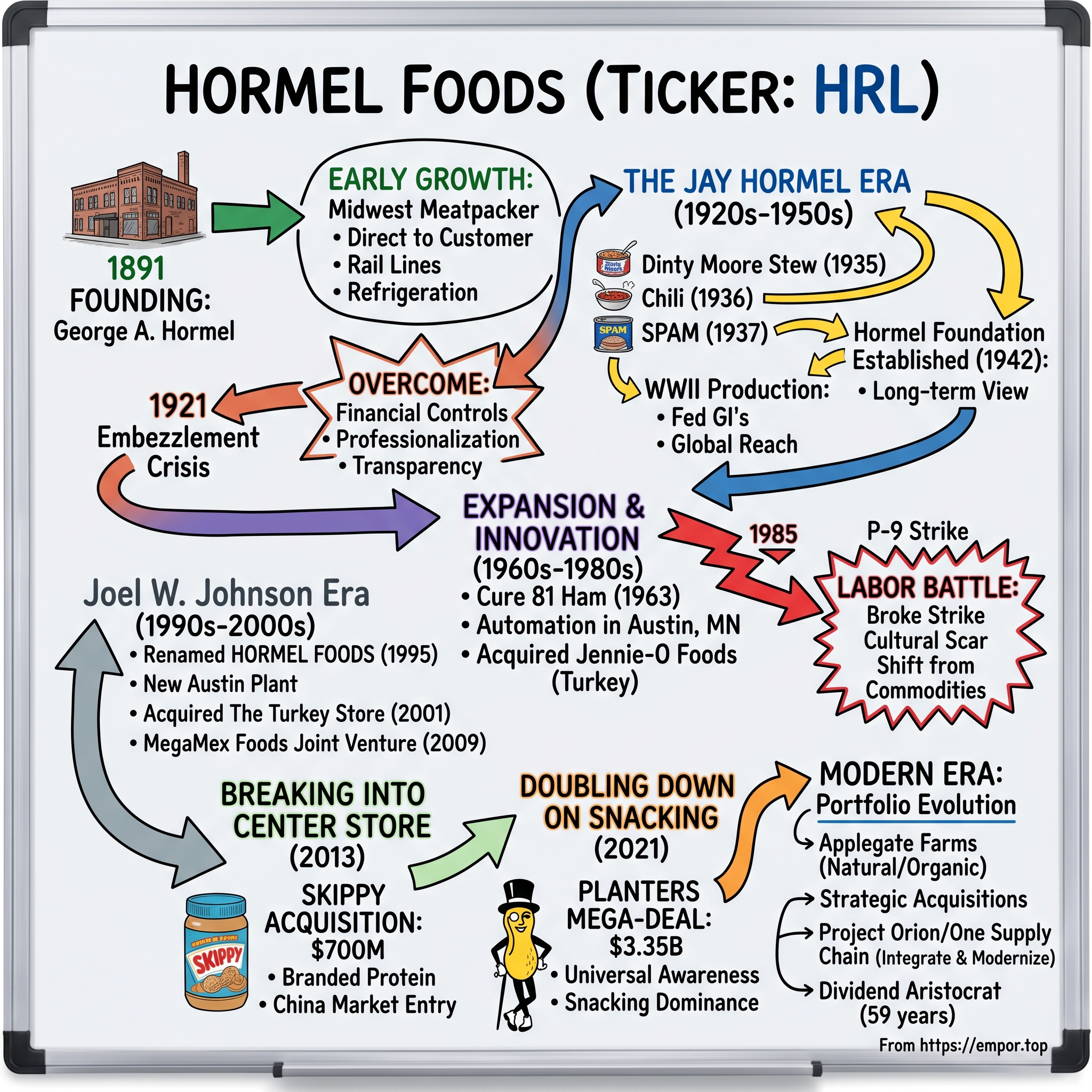
This story unfolds in eight acts. It begins with founder George Hormel, the employee embezzlement that nearly destroyed his young enterprise, and the construction of the Austin packinghouse. It moves through Jay Hormel’s tenure—the invention of canned ham and SPAM, the industrial mobilization of the Second World War, and the creation of the Foundation. It revisits the bitter 1985–1986 Austin strike and Hormel's strategic withdrawal from commodity slaughter. It traces the disciplined acquisition era from 2000 to 2018 before scrutinizing the Planters transaction. Next, it breaks down Hormel’s three reporting segments and their underlying earnings power, examines the operational disruptions that have persisted since 2022, and finishes with a competitive assessment, a management scorecard, bull and bear theses, and the operational metrics that will decide the company's trajectory.
 Subscribe on LinkedIn
II. Origins & Foundation: George A. Hormel and the Packinghouse Blues (1891–1920s)
In Buffalo, New York, during the Panic of 1873, thirteen-year-old George Albert Hormel, the son of German immigrants, left school to help support his family. He drifted west to Chicago and learned the meat trade from the bottom up through butcher-shop work and buying hides and wool. In 1887, while traveling through southern Minnesota as a hide buyer, he spotted an opening in Austin. He borrowed $500 to buy into a local meat market with a partner. Four years later, he dissolved the partnership and set up on his own on the edge of town as Geo. A. Hormel & Co.10
His operating playbook emerged from observing the massive Chicago meatpackers. Unable to match their industrial scale, he focused on quality and differentiation, emphasizing "quality over quantity and innovation over imitation."10 Starting with pork sausage, he reinvested nearly every dollar of profit and incorporated the business in 1901. That same year, he opened a sales branch in Minneapolis, and within a decade he was running national magazine advertising.11 By 1924, the Austin plant processed one million hogs a year.10
That growth masked a severe internal vulnerability that surfaced in July 1921. Jay Hormel, George's son, had returned from military service and began reviewing the company's books. He discovered that the assistant comptroller, Ransom J. "Cy" Thomson, had been embezzling for a decade. The stolen sum totaled $1,187,000, roughly $18 million in 2021 dollars.12 More than $600,000 had vanished in just the prior eight months. Thomson had concealed the deficit by moving money among bank accounts in Boston, Atlanta, and Dallas while funneling cash into Minnesota farms he owned.12 On July 9, 1921, Thomson made a final ledger entry recording the shortages under his own name. He pleaded guilty that September and received two ten-year sentences.12
For a regional packer in 1921, a cash drain of that magnitude could have been fatal. George Hormel appealed to his lenders, secured financing to keep the business solvent, and overhauled operational management. According to Minnesota's state historical encyclopedia, the discovery "prompted company reorganization."10 Corporate lore long traced Hormel's aversion to debt and insistence on tight internal controls to this crisis. While that link reflects retrospective institutional memory rather than a codified charter, the fiscal conservatism lasted for generations—highlighting why the debt-financed Planters transaction a century later marked such a dramatic break from historical practice.
Three dynamics of the founding era still matter. First, Hormel began as a processor competing on proprietary product quality rather than sheer volume, establishing a precedent that every subsequent brand pivot has echoed. Second, the enterprise was built in Austin by an Austin family, establishing geographic and civic ties that later crystallized into permanent foundation ownership. Third, the embezzlement revealed that the firm's greatest hazard was internal. Deficient oversight, rather than industry competition, brought the business to the brink of collapse—an early manifestation of the governance and accountability questions that continue to confront the company.
The son who uncovered that fraud would proceed to reinvent the enterprise, ultimately cementing its national reputation around a can of spiced ham.
III. The Jay Hormel Era: Canned Ham, SPAM, and Corporate Social Invention (1920s–1950s)
Jay Catherwood Hormel presented a sharp contrast to his father. Where George was cautious and devout, Jay was restless, promotional, and eager to experiment. In 1926, the company developed what it calls the world's first canned ham, converting a perishable cut into a shelf-stable product that could survive a sea voyage.11 George retired to California in 1927, leaving Jay as acting president, and in 1928 the company went public.1110
The pantry products of the Depression
The Great Depression rewarded packaged goods that were inexpensive and long-lasting. Between 1935 and 1941, Hormel launched three brands that still generate steady earnings for the company today: Dinty Moore beef stew, Hormel chili, and SPAM.11 SPAM, introduced in 1937, addressed a perennial packinghouse dilemma: pork shoulder was a low-value cut that consistently accumulated in surplus. Jay combined it with ham, salt, water, sugar, and sodium nitrite, then vacuum-sealed the mixture in a can. That formula turned a commodity byproduct into a branded grocery staple requiring no refrigeration. The name arose from an informal contest, and the company has deliberately preserved the mystery around its origins—a playful posture suited to an advertising-led enterprise.
The underlying commercial logic has endured ever since. A commodity protein is transformed into a branded, shelf-stable product that commands grocery shelf space, enjoys high consumer recall, and resists private-label substitution. When modern analysts assess Hormel's value-added portfolio, the operating blueprint begins with this blue-and-yellow can.
War, and a product that reached the Pacific
The Second World War turned SPAM into a global brand. Hormel reported that by 1944, more than 90% of its canned foods were shipped for government use.11 Allied soldiers ate it constantly and ribbed it incessantly, but civilian populations living near American military bases adopted it as well. Across Hawaii, the Philippines, Guam, Okinawa, and later South Korea, SPAM integrated into local cooking rather than serving merely as emergency rations—most famously in South Korea's 부대찌개 (budae-jjigae), or "army base stew." More than eighty years later, that wartime distribution footprint still yields dividends: SPAM remains a pillar of Hormel's international business, and management listed SPAM export sales among its active concerns on the most recent earnings call.13
Jay Hormel recognized that the war had turned SPAM into both a punchline and a household staple, and he capitalized on the exposure. In 1946, the company launched the Hormel Girls, a drum-and-bugle corps of female veterans who toured the country as a traveling marketing troupe.11 The campaign demonstrated an instinct that served Hormel well for decades: applying consumer showmanship to make an inexpensive commodity feel familiar, dependable, and distinct. Viewed through modern brand economics, the Hormel Girls represented early investment in the consumer awareness that still protects SPAM from store-brand competitors.
Paying workers year-round
Jay Hormel's most radical departure from meatpacking convention involved labor rather than products. The slaughter business was fiercely seasonal, tied to the autumn influx of hogs, and packers traditionally hired and fired to mirror the market's swings. In 1938, Hormel introduced a guaranteed annual wage, a joint-earnings plan, and an employee profit-sharing trust.11 Employees received predictable weekly paychecks year-round, while the company gained an experienced, stable workforce. For decades, Austin stood as a national model of industrial cooperation between labor and management—a history that made the bitter breakdown of that pact in the 1980s all the more painful.
The Foundation that keeps Hormel in Austin
In 1941, George and Jay created The Hormel Foundation, and in 1942 the Hormel Institute, a research center in Austin, was established.11 The Foundation's financial design proved far more consequential than its founding date. Hormel family equity was placed into trusts whose remainder interests belong to the Foundation, which votes those shares as trustee. The trusts end 21 years after the death of designated beneficiaries, all of whom had died by August 2021.5 The Foundation became a public charity in 1980, operating under bylaws requiring that a majority of its board represent the nonprofit agencies it supports. Its current board includes the local YMCA chief, the head of the Hormel Institute, a municipal utility manager, and Jeff Ettinger, the interim CEO of Hormel Foods.514
That capital structure grants Austin civic institutions a permanent claim on Hormel's dividend stream while providing the company with a controlling shareholder that cannot be bought out. The mechanism protects management from hostile takeovers and outside activists, but it also makes any reduction to the dividend politically and institutionally fraught. Both dynamics would play decisive roles in Hormel's modern era.
Following the war, Hormel continued rolling out new branded offerings: Little Sizzlers breakfast sausage and Cure 81 ham debuted between 1959 and 1963, a period during which SPAM passed one billion cans produced.11 Company sales crossed $1 billion for the first time in 1976.11 Yet underneath these recognizable consumer brands, Hormel remained primarily an industrial hog slaughterer. The commodity economics of slaughter were about to shift sharply against it.
IV. Meatpacker Blues, The 1985 Strike, and the Value-Added Pivot (1960s–1990s)
On January 20, 1986, Minnesota Governor Rudy Perpich ordered the National Guard into Austin.15 A week earlier, Hormel had reopened its flagship meatpacking plant with roughly 540 replacement workers, many of them migrant laborers, while some 1,500 members of Local P-9 of the United Food and Commercial Workers picketed outside.15 In the town where Jay Hormel had pioneered the guaranteed annual wage, armed soldiers were now stationed at its largest employer. The dispute split families and turned neighbors against each other, a community fracture captured in Barbara Kopple's Academy Award-winning documentary American Dream.15
How it came to this
The confrontation grew out of a structural transformation across the meatpacking industry. During the 1960s and 1970s, low-cost entrants such as IBP built automated, non-union slaughterhouses in rural areas closer to livestock supplies. Older unionized packers operating out of Midwestern cities found themselves losing market share to rivals producing identical cuts of meat at substantially lower operating costs. Hormel sought to defend its margins by slashing labor expenses, imposing a 23% wage cut in Austin that lowered base pay from $10.69 to $8.25 an hour. Local P-9, working alongside outside labor strategist Ray Rogers, rejected the concessions and walked out on August 17, 1985.15
The bitter strike dragged on for more than a year, officially ending in September 1986 after deeply dividing the labor movement. When the national UFCW leadership broke with Local P-9 over its confrontational strategy, the international union placed the local into trusteeship and negotiated a settlement with Hormel. The replacement workers kept their jobs, and only about 20% of the strikers were ever rehired.15 Hormel won the legal and operational dispute, but the victory came at the expense of the civic goodwill Jay Hormel had spent decades fostering. More consequential than the labor victory was the strategic lesson management took from the crisis.
The decision to leave commodity meat
Winning the strike did nothing to make commodity slaughter an attractive business. Packing margins remained razor-thin, hog supplies and prices stayed volatile, and lower-cost competitors maintained structural advantages. Forcing wage cuts on the union merely allowed Hormel to tread water in a commodity segment that generated poor returns on invested capital. Over the ensuing decade, management increasingly directed capital away from primary slaughter and toward branded, processed, value-added packaged foods that commanded pricing power.
That transition began during the strike itself. In 1986, Hormel acquired Jennie-O, a turkey processor based in Willmar, Minnesota, that had been founded by Earl B. Olson in 1949. While the purchase price was not disclosed, Wall Street analysts estimated it at $70 million to $100 million.16 Turkey introduced a leaner alternative protein that appealed to shifting consumer dietary preferences, and Jennie-O grew into one of Hormel's most prominent retail franchises. Yet it was also an asset-heavy live-animal business—an operational exposure that would create severe vulnerabilities forty years later.
A new CEO from Kraft
In 1991, Hormel recruited Joel W. Johnson, who had spent more than three decades at General Foods, as executive vice president of sales and marketing. Johnson rose quickly, becoming president in 1992, chief executive in 1993, and chairman of the board in 1995.17 Bringing in a seasoned packaged-goods marketer rather than promoting an executive from the plant floor signaled a deliberate shift in corporate identity. After listing its shares on the New York Stock Exchange in 1990, the company reinforced that shift in 1993 by shedding "Geo. A. Hormel & Co." to become Hormel Foods Corporation.11 The new corporate identity reflected a modern branded consumer foods manufacturer rather than a legacy slaughterhouse.
Johnson's strategic formula—investing behind core brands, entering international and ethnic food categories, and consolidating scale in turkey—set the company's operating playbook for the next thirty years.17 His largest deal arrived in 2001, when Hormel paid $334.4 million for The Turkey Store Company of Barron, Wisconsin, then the nation's sixth-largest turkey operation, and merged it directly into Jennie-O. It was the largest acquisition in company history at that point.18 The combined Jennie-O Turkey Store operation processed more than 1.2 billion pounds of turkey annually, solidifying Hormel's scale in the poultry aisle.18
Yet that transaction highlighted an unresolved contradiction at the heart of Hormel's portfolio strategy. Management had pledged to steer the enterprise away from volatile commodity cycles, but one of its largest capital commitments dramatically expanded its direct ownership of live birds, feed mills, and commercial grow-out barns. The unbranded commodity side of that turkey business would absorb devastating bird-flu losses in the 2020s, culminating in Hormel selling off its whole-bird operations in 2026 at a pre-tax loss.19 The strategic migration toward value-added food was real, but the company's execution remained conflicted.
With its branded consumer playbook firmly established, robust cash flow, and a clean balance sheet, Hormel turned its attention to external acquisitions.
V. The Protein-to-Pantry Transformation: The M&A Flywheel (2000–2018)
After 2000, Hormel accelerated its acquisition pace, deploying steady packinghouse cash flows to assemble a modern consumer packaged goods portfolio. Each transaction carried a compelling strategic thesis at announcement, but taken together, they offer an unusually clear record of management's underwriting discipline and operational execution. That record is decidedly mixed.
Mexican food through partnership
In 2009, Hormel formed MegaMex Foods, a 50/50 joint venture with Mexico's Herdez Del Fuerte. The venture combined regional brands—including Chi-Chi's, Herdez, La Victoria, Embasa, and Doña María—into a business generating roughly $200 million in initial revenue, overseen by an independent management team in Chino, California.20 For a processor without established footing in Mexican food, the partnership structure shared capital risk with an authentic operator while securing distribution in the fast-growing Hispanic food category. It also established a collaborative template Hormel revisited in 2025 when it sold a 51% controlling stake in Justin's to a private-equity firm.21 Yet joint ventures can also carry valuation risks and friction: in fiscal 2025, Hormel recorded a $2.9 million impairment charge on the Chi-Chi's trade name.7
Skippy: moving into the center store
The acquisition that transformed Hormel's portfolio identity arrived in January 2013, when the company agreed to buy Unilever's global Skippy peanut-butter business for approximately $700 million. Generating about $370 million in annual sales, Skippy held the No. 2 market share in the United States and was the leading peanut-butter brand in China.22 Jeff Ettinger, then chief executive, outlined the rationale directly: Skippy would "grow our branded presence in the center of the store with a non-meat protein product."22
That operating thesis—a shelf-stable protein commanding center-store shelf space rather than the refrigerated perimeter—established the conceptual model Hormel would repeat eight years later with Planters. While Skippy remains widely viewed as a successful transaction and is still ranked among Hormel's core retail priorities, it also revealed the limits of center-store brand equity. Peanut butter is a mature, contested category where J.M. Smucker's Jif and private-label store brands compete aggressively on price. Strong branding also cannot eliminate physical operating vulnerabilities: in the fourth quarter of fiscal 2025, a fire at Skippy's primary processing plant in Little Rock, Arkansas, disrupted production.7 A durable brand does not insulate against facility-level supply shocks.
A burst of acquisitions: CytoSport, Applegate, Justin's, Columbus
Between 2014 and 2017, Hormel launched an acquisition blitz, purchasing four major brands in four years. The subsequent trajectory of each asset provides the clearest available evidence of management's M&A judgment:
- CytoSport (Muscle Milk), 2014: Hormel paid roughly $450 million for the top ready-to-drink protein-shake brand, which brought about $370 million in expected sales.23 Hormel sold the business to PepsiCo in April 2019 for $465 million.24
- Applegate Farms, 2015: Hormel paid about $775 million for the leading brand in natural and organic prepared meats, representing approximately $340 million in expected sales.25
- Justin's, 2016: Hormel acquired the premium nut-butter snacking brand for $286 million.21
- Columbus Manufacturing, 2017: Hormel paid approximately $850 million to private-equity firm Arbor Investments for the premium cured salami and deli-meat processor, which generated about $300 million in sales.26
CytoSport offered the starkest lesson. Hormel paid $450 million and recouped $465 million five years later—roughly breaking even in nominal dollars, but suffering an economic loss after accounting for inflation, the cost of capital, and diverted management attention in a convenience beverage channel Hormel did not understand. Justin's performed worse. Hormel absorbed a $28 million impairment on the Justin's trade name in fiscal 2023.27 In December 2025, the company sold a 51% stake to Forward Consumer Partners for $75.8 million.19 That transaction implied a total equity valuation far below half of the purchase price Hormel had paid nine years earlier.
By contrast, Applegate and Columbus proved far more resilient. Applegate has been one of the few Retail segment brands management consistently singled out for volume growth, including in the third quarter of fiscal 2026.2 John Ghingo led Applegate from 2018 to 2022, an operational performance the board rewarded by appointing him chief executive.1 Columbus gave Hormel an entrenched leadership position in premium charcuterie; in 2017, then-CEO Jim Snee described it as "the catalyst for uniting all our deli businesses into one group."26
What the record shows
Management and outside commentators have often characterized Hormel's M&A strategy as a disciplined, self-funding engine that systematically transitioned the business into the grocery pantry. The historical record suggests a more defined pattern. When Hormel acquired brands adjacent to its established core—such as deli meats, branded proteins, and shelf-stable spreads processed through meatpacking-style manufacturing networks—it generally preserved or expanded their value. But when it strayed into unfamiliar distribution channels, such as sports nutrition or premium boutique snacking, it eroded capital. Factoring in the subsequent write-down on its Indonesian Garudafood investment, Hormel's deal scorecard between 2013 and 2022 split roughly evenly between accretive successes and costly disappointments.
That record carried profound implications for the next transaction. In 2021, Planters would require more capital than all four of those acquisitions combined. On paper, snack nuts appeared closely related to Skippy through their shared peanut base. In reality, the category was far more distant: snack nuts depended heavily on convenience-store impulse sales, and they faced brutal pricing pressure from warehouse-club private labels.
VI. The $3.35 Billion Planters Mega-Deal: Snacking Ambition vs. Center-Store Reality (2021)
When the transaction was announced on February 11, 2021, the market environment appeared uniquely welcoming. The pandemic had filled home pantries and lifted packaged-food valuations, while snacking had emerged as the most popular theme across consumer packaged goods. Kraft Heinz, working to reduce its own elevated debt load, agreed to sell its nuts business—including Planters, NUT-rition, Planters Cheez Balls, and Corn Nuts—to Hormel for $3.35 billion in cash.628
The deal terms
The purchase price was steep by Hormel's historical standards. Against approximately $1.1 billion in sales for calendar 2020,29 the transaction was valued at roughly three times revenue. Hormel stated the deal structure allowed a step-up in the tax basis of the assets worth about $560 million, which brought its net effective price to $2.79 billion.6 Along with the brands, Kraft Heinz transferred three manufacturing plants in Suffolk, Virginia; Fort Smith, Arkansas; and Fresno, California.29 Hormel projected $50 million to $60 million in annual synergies by 2024 and stated the transaction would add to operating margins in fiscal 2022.6 Jim Snee, then chairman and chief executive, framed the deal as a major milestone, saying Planters "adds another $1 billion brand to our portfolio and significantly expands our presence in the growing snacking space."6 The deal closed on June 7, 2021.29
The bull case in 2021
Hormel's investment thesis rested on three pillars. First, snack nuts aligned with consumer migration toward protein and toward low-carb, plant-forward diets. Second, Hormel already purchased large quantities of peanuts for Skippy, suggesting opportunities to combine raw-material purchasing and manufacturing. Third, Planters brought entrenched distribution in convenience stores, a channel where Hormel's grocery-store meat brands had historically struggled.
Kraft Heinz's willingness to sell could be interpreted in two ways: either as a signal that Planters was a mature, commodity-exposed asset that Kraft Heinz could not profitably grow, or as an opportunity created by a highly leveraged seller in urgent need of cash. Hormel embraced the second reading, confident that its operational focus could revitalize the brand.
The balance-sheet effect
For Hormel, the more profound consequence was financial. The company funded the purchase with cash and new senior notes, pushing long-term debt, including current maturities, to about $3.3 billion by the end of fiscal 2023.27 An enterprise whose balance-sheet conservatism traced back to the 1921 embezzlement now carried the kind of leverage it had avoided for generations—arriving just before interest rates surged in 2022. Hormel subsequently prioritized debt reduction, repaying $959 million in fiscal 2024,30 though total long-term debt remained at about $2.9 billion at the end of both fiscal 2024 and fiscal 2025.4 That lingering debt load competed directly with capital investment and the dividend for operating cash throughout this period, as Section X shows.
Testing the deal against what happened
The original underwriting made specific claims, and the company's disclosures over the following four years allow each to be evaluated against reality.
Claim: Planters would add to margins and bring synergies. Hormel did not report Planters profitability as a standalone unit, ruling out a direct accounting check. The broader segment results, however, moved in the wrong direction. Retail segment profit fell from $577.7 million in fiscal 2023 to $562.8 million in fiscal 2024, and adjusted Retail profit fell to $496.0 million in fiscal 2025, even as sales held roughly flat.2731 The ultimate verdict came in fiscal 2025, when Hormel recorded a $59.1 million impairment on the Planters trade name.7 Companies do not write down brands that are meeting or exceeding their acquisition targets.
Claim: Hormel's operating skill would improve Planters. Rather than demonstrating operational efficiency, the acquired supply chain became an active operational headache. At the primary Planters facility in Suffolk, Virginia, production bottlenecks disrupted customer shipments, curtailed planned advertising, and cost Hormel about $0.06 per share in the third quarter of fiscal 2024.32 Quality controls also faltered: in May 2024, Hormel recalled two Planters items—four-ounce honey-roasted peanuts and 8.75-ounce deluxe lightly salted mixed nuts—over potential Listeria contamination after shipments reached Publix and Dollar Tree warehouses across several Southern states.33 While the product recall was limited, it signaled deeper integration friction. An acquirer whose investment case hinges on superior operational execution cannot afford chronic plant-level disruptions.
Claim: the brand would hold up against store brands. The commercial evidence proved mixed. Planters demonstrated real brand equity once supply stabilized: on the fourth-quarter fiscal 2025 earnings call, John Ghingo reported that Planters consumption had grown 12% in dollars over the prior 13 weeks with retail distribution nearly fully recovered, but noted margins remained under pressure as shoppers shifted from higher-priced cashews to cheaper nuts.34 Hormel subsequently exited private-label snack-nut manufacturing altogether. On the third-quarter fiscal 2026 call, management acknowledged that leaving private label and selling the whole-bird commodity turkey business together accounted for about half of the Retail segment's 9% volume decline.13 While shedding commoditized volume was a rational step to protect focus, it confirmed that the private-label production Hormel inherited was not worth keeping.
Conclusion on Planters
Four years of operational data substantially narrow the original thesis. Planters remains a genuine household brand with high consumer recall; when products are reliably on store shelves, shoppers buy them. But the historical record disproves the thesis that justified the $3.35 billion price: that Planters would expand margins and establish an engine for high-growth snacking. What remains is a mature snack-nut franchise tethered to volatile agricultural commodities, acquired with debt at the top of the market, whose trade name has already been written down. Reversing that verdict would require several consecutive years of volume growth and expanding household penetration without aggressive promotional spending, alongside an enduring rebound in Retail segment margins. Neither trend has yet emerged.
Planters sits at the center of the Retail segment, and understanding the full scale of its drag on corporate performance requires evaluating all three of Hormel's operating segments.
VII. Inside Hormel’s Three Segments: Retail, Foodservice, and International
Consider the breakfast rush at a busy diner at 6 a.m. The line cook has a dozen orders waiting, no time to lay out raw pork belly on a flat top, and no space for an oversized grease trap. Opening a cardboard carton of pre-cooked strips, the cook warms them on the griddle in seconds and plates the order. That box—Hormel's Bacon 1 fully cooked bacon—illustrates where the company actually generates its earnings far better than any commercial for SPAM.
In fiscal 2023, Hormel dismantled its legacy operating structure—Refrigerated Foods, Grocery Products, Jennie-O Turkey Store, and International—and reorganized into three customer-focused segments: Retail, Foodservice, and International.35 The restructuring brought the company's underlying unit economics into sharper relief.
Retail: most of the sales, less than half the profit
In fiscal 2025, Retail generated $7.46 billion in net sales, or roughly 62% of Hormel's top line, but delivered just $425.2 million in reported segment profit, or $496.0 million on an adjusted basis.31 That adjusted operating margin stood at approximately 6.7%, down from 7.6% in fiscal 2024 and 7.5% in fiscal 2023.3027 The division houses Hormel's most visible center-store and refrigerated brands: SPAM, Skippy, Hormel chili, Dinty Moore, Planters, Black Label bacon, Natural Choice deli meats, Applegate, Columbus, Jennie-O retail turkey, and the company's equity share in MegaMex.
Retail's primary structural vulnerability is customer concentration. Walmart and its subsidiaries accounted for 15.6% of Hormel's consolidated gross sales in fiscal 2025, while the company's top five retail accounts represented approximately 38%.7 When a single mass merchant controls more than one out of every seven dollars of gross sales—and aggressively develops its own private-label brands—pushing through list-price increases becomes exceptionally difficult. Hormel's volume erosion following its fiscal 2025 pricing actions exposed those limits: after the company raised list prices twice to counter commodity cost inflation,34 retail volume contracted sharply. In the third quarter of fiscal 2026, Retail organic net sales dropped 3% alongside a 9% organic volume contraction, with management attributing the half of the volume decline not tied to divestitures to price elasticity and soft consumer demand.213
Yet performance across the grocery aisle remains uneven. During that same third quarter, management reported mid-to-high single-digit consumption growth for Jennie-O ground turkey and refrigerated entrées, alongside volume gains across Applegate, Planters, SPAM, and Hormel chili.132 The broader retail picture is therefore not one of uniform decline, but of a core stable of healthy priority brands dragged down by commoditized and non-strategic product lines that Hormel is now actively pruning.
That division clarifies management's current portfolio strategy. Rather than attempting to revive every SKU across an expansive retail catalog, executive leadership has narrowed its focus to designated priority brands while selling, partnering, or rationalizing secondary operations. The divestiture of the whole-bird commodity turkey business, the recapitalization of Justin's through a majority stake sale, and the withdrawal from private-label snack nuts all reflect that discipline.1913 While strategically sound, this retrenchment will depress reported retail volumes for several quarters as low-margin volume is intentionally eliminated. For investors, evaluating the turnaround requires distinguishing deliberate portfolio shrinkage from involuntary market share losses—making management's disclosure of the impact of these exits critical in future quarters.
Foodservice: where the profit comes from
Foodservice represents Hormel's most economically attractive operation. In fiscal 2025, the segment generated $3.94 billion in sales—roughly one-third of the corporate total—yet produced $554.6 million in segment profit,31 accounting for nearly half of Hormel's consolidated adjusted earnings. Foodservice delivered an operating margin of approximately 14.1%, more than double that of Retail.
The economic moat here stems from commercial kitchen labor constraints. Confronting persistent staffing shortages and rising wages, restaurant, hotel, school, and hospital kitchens readily pay a premium for prepared proteins that eliminate kitchen prep: fully cooked bacon, pre-sliced deli cuts, Jennie-O turkey breast, and branded pepperoni engineered for commercial pizza chains and institutional lunch programs. Hormel reaches operators primarily through broadline distributors like Sysco, US Foods, and Performance Food Group, supported by a dedicated direct sales team that works inside customer kitchens. The commercial model functions much like an automotive Tier-1 supplier selling pre-assembled modules rather than raw parts: operators pay for eliminated labor, and replacing Hormel requires re-engineering menus and retraining line cooks.
The segment's top-line durability has been consistent. The third quarter of fiscal 2026 marked Foodservice's twelfth consecutive quarter of organic net sales growth, propelled by premium prepared proteins, branded pepperoni, and Jennie-O turkey.2 Management noted that this performance outpaced overall dining traffic, which remained weak.13
Myth vs. reality: The prevailing market narrative frames Foodservice as an engine of continuous margin expansion. Hormel's reported figures tell a different story. Segment profit hovered from $595.7 million in fiscal 2023 to $596.3 million in fiscal 2024 before slipping to $554.6 million in fiscal 2025, even as net sales expanded from $3.64 billion to $3.94 billion.273031 Consequently, segment margin compressed from roughly 16.4% in 2023 to 15.5% in 2024, and down to 14.1% in 2025. In the fourth quarter of fiscal 2025, Foodservice profit declined 13% despite 6% organic sales growth—a quarter that also absorbed the operational fallout from recalling nearly five million pounds of ready-to-eat chicken over potential metal contamination.49 While organic demand remains intact, profit per dollar of revenue has contracted. Foodservice remains Hormel's highest-return business, but the premise that its margins expand uninterrupted is inaccurate; the operational test ahead is whether management can stabilize profitability or whether margin erosion continues.
International: small, and marked down
The International segment generated $709.1 million in sales in fiscal 2025, posting a reported operating loss of $80.4 million against adjusted segment profit of $83.3 million.31 That divergence was driven almost entirely by a single overseas transaction. In December 2022, Hormel acquired an approximate 29% minority stake in Indonesian consumer food company PT Garudafood Putra Putri Jaya from CVC Capital Partners and other shareholders for $410.6 million.3637 At closing, then-CEO Jim Snee hailed Garudafood as "a market leader, with strong and reputable brands."37 Over the next three years, Hormel took successive impairment charges on the asset: a $163.7 million write-down in fiscal 2025 followed by an additional $48.2 million charge in the third quarter of fiscal 2026, reducing the carrying value of its stake to $183.6 million based on prevailing market prices—less than half of its original cash outlay.719
Beyond Indonesia, International encompasses SPAM and Skippy export volumes, manufacturing ventures in China, and a portfolio undergoing retrenchment. Hormel offloaded its Brazilian operations, including the Ceratti deli-meat brand, to Zanchetta Alimentos for $22.1 million in cash in a transaction that closed on July 31, 2026, absorbing a $56.1 million pre-tax loss on the sale.19 Operational friction persisted into the third quarter of fiscal 2026, when International organic volume dropped 11%. Interim CFO Paul Kuehneman attributed the majority of that contraction to an unquantified one-time restructuring of the legal entity managing SPAM export shipments.213 In response to ongoing performance headwinds, management relocated the head of the international division to Singapore.13
International's performance since 2022 offers a sobering case study in capital allocation outside North America: a large minority position in an overseas snack producer marked down by more than half, alongside a value-destroying exit from Brazil.
Taken together, Hormel's three reporting segments reveal an enterprise reliant on a high-margin Foodservice franchise to support a transitioning Retail core and a chastened International division. But the systemic operational challenges that have squeezed margins across all three businesses originated further upstream—in the barns and processing plants.
VIII. The Operational Crucible: Avian Flu, Supply Chain, and "Transform & Modernize" (2022–Present)
Highly pathogenic avian influenza does not spread slowly. A commercial turkey barn in west-central Minnesota can appear healthy one week and suffer catastrophic flock losses the next. When a flock tests positive, federal biosecurity protocols require depopulation—destroying the birds, followed by comprehensive decontamination and extended fallow periods before barns can be restocked.38 From 2022 onward, that cycle repeated relentlessly across the Upper Midwest, striking at the heart of Jennie-O's live-production footprint.
Turkey price swings
For Jennie-O, bird flu inflicted a compounding operational whipsaw. When outbreaks decimated flocks, Hormel faced volume shortfalls while paying surging open-market prices for replacement birds from third-party growers. Conversely, when industry supply rebounded, commodity whole-bird prices plunged, compressing the market value of Hormel's own birds. In its fiscal 2024 annual report, Hormel disclosed that avian influenza had penetrated its turkey supply chain throughout fiscal 2024 and into the first quarter of fiscal 2025, warning that the contagion had curtailed production and would continue to depress output.35 The commercial fallout hit quickly: in the third quarter of fiscal 2024, Retail segment results were dragged down by sharply lower whole-bird volumes and collapsing market prices.32 A year later, during the fourth-quarter fiscal 2025 call, Ghingo reported fresh outbreaks across the Midwest, cautioning that whole-bird costs would remain elevated throughout the coming year.34 By the third quarter of fiscal 2026, operational headwinds had broadened beyond disease, with Ghingo citing summer heat stress and poor feed conversion ratios as further constraints on turkey availability.13
Management responded with a three-phase restructuring. First, it curtailed primary processing capacity: in the second quarter of fiscal 2024, Hormel halted slaughter operations at its Barron, Wisconsin, plant, converting the facility exclusively to value-added production.27 Second, it integrated Jennie-O's standalone agricultural and supply chain infrastructure into Hormel's broader corporate network. Third, it exited commodity live-turkey farming altogether. On April 24, 2026, Hormel completed the sale of its whole-bird commodity business to Willmar-based Life-Science Innovations, divesting the Melrose processing facility, a feed mill in Swanville, transportation assets, and commercial grower contracts. The transaction was valued at $61.2 million—consisting mostly of a $40 million promissory note—and resulted in a $60.8 million pre-tax loss.3919 Crucially, Hormel retained the Jennie-O brand name along with its higher-margin, value-added retail and foodservice portfolio, encompassing ground turkey, deli cuts, burgers, and turkey bacon.39
The divestiture represents the most tangible proof to date that Hormel is executing on its decades-long pledge to shed commodity earnings volatility, forty years after that strategic direction was first articulated. The exit arrived late and crystallized a steep accounting loss, but it decisively severed the enterprise from an operation whose earnings swing wildly on biological disease vectors and weather cycles.
Transform & Modernize: gross savings versus net profit
In October 2023, at an investor day, Hormel unveiled an ambitious multi-year efficiency initiative branded "Transform & Modernize," or T&M.[^40] The program was designed to overhaul enterprise planning, procurement, manufacturing networks, logistics, and portfolio optimization.32 In its fourth-quarter fiscal 2023 earnings release, management established a firm benchmark, projecting that the initiative would generate "$200 million-plus in operating income growth by fiscal 2026."27 The subsequent annual report reinforced that commitment, describing T&M as a foundational initiative designed to drive "meaningful operating profit growth through fiscal 2026."35
At the gross level, the program generated verifiable cost reductions. T&M delivered $75 million in operating income benefits in fiscal 2024.40 For fiscal 2025, leadership targeted an incremental $100 million to $150 million in savings, later confirming that execution fell within that guidance range.4034 Beyond immediate cost-cutting, management highlighted long-term foundational investments across the supply chain, rolling out a standardized Hormel Production System and deploying advanced data analytics to integrate enterprise demand planning.13 The conceptual objective was straightforward: for decades, Hormel's acquired operating units functioned as autonomous silos, each planning from its own regional playbook. Implementing unified systems was meant to harmonize those disparate networks, curbing inventory waste and refining forecast accuracy—though the total capital outlay and cash payback of these implementations have not been separately broken out.
Comparing these gross savings milestones against Hormel's reported earnings reveals a glaring disconnect. In fiscal 2024, consolidated adjusted operating income totaled approximately $1.1 billion.40 In fiscal 2025, rather than expanding, adjusted operating income retreated to $1.019 billion.4 For fiscal 2026, management projected adjusted operating income between $1.06 billion and $1.12 billion.4 In short, after three full years of efficiency programs and well over $175 million in cumulative gross savings claims, Hormel expected fiscal 2026 operating earnings to finish essentially flat with where they stood in 2024. The guidance miss in fiscal 2025 was particularly severe: having entered the year forecasting adjusted earnings per share between $1.58 and $1.72, the company closed at $1.37.404 Leadership attributed the shortfall to unchecked commodity cost inflation, recurring bird-flu outbreaks, and secondary disease pressures across commercial turkey flocks.9
Then came a shift in disclosure. On the fourth-quarter fiscal 2025 earnings call, Ettinger announced: "We do not plan to report T&M savings separately going forward."34 Management explained that cost efficiencies were being absorbed into ongoing business operations—reinvested in brand marketing, utilized to counter input-cost inflation, and deployed to protect baseline margins. While absorbing cost savings into overhead and brand support is standard corporate practice, terminating the reporting metric had an immediate consequence: it effectively ended the ability of external shareholders to audit management's cost-saving claims against bottom-line results.
The historical record leads to a clear conclusion: Transform & Modernize generated genuine gross efficiencies, but those savings failed to translate into net operating profit expansion. Instead, they were consumed by surging input costs, flock depopulations, manufacturing bottlenecks, and promotional spending required to stem customer defections after price hikes. The premise that internal supply-chain modernizations could independently drive consolidated profit growth is unproven by the financial results. What the evidence demonstrates is far more defensive: the efficiency program served as a shock absorber that prevented an operationally turbulent period from deteriorating even further.
Restructuring
In the fourth quarter of fiscal 2025, Hormel initiated a broad corporate restructuring program that incorporated voluntary early retirement buyouts and targeted workforce reductions.7 The headcount reductions eliminated approximately 250 corporate and sales positions, representing roughly 9% of that administrative workforce. Ettinger noted that gross savings from the reduction would equate to two to three times the implementation cost, with an expected payback period of approximately one year, while clarifying that a portion of the annualized savings would be reinvested rather than flowing directly into lower SG&A.34 In the third quarter of fiscal 2026, initial benefits from these overhead cuts began filtering into reported margins: adjusted operating margin expanded 60 basis points to 9.0%, while operating cash flow climbed 54% year-over-year to $241 million.132 Yet the durability of those cost gains remained vulnerable to top-line slippage. Management acknowledged that broader volume declines were depressing fixed-cost plant utilization, warning that lower factory throughput was generating "incremental costs" that threatened manufacturing efficiency.13
Evaluating whether Hormel can sustain these operational improvements and protect its core cash flows requires assessing the durable competitive advantages that underpin its brand portfolio.
IX. The Acquired Playbook: Strategic Analysis & Hamilton Helmer's 7 Powers
Imagine a rival attempting to displace Hormel across three fronts simultaneously: unseating SPAM from a Honolulu supermarket, replacing Hormel's bacon and pepperoni specifications in a Midwestern pizza chain, and taking over a Walmart deli counter. The friction of dislodging all three at once illustrates Hormel’s competitive strength. The ease of picking off any one of them in isolation reveals its vulnerability.
7 Powers, brand by brand
Branding: strong in some places, weak in others. SPAM represents the clearest instance of brand power across the portfolio. Supported by more than eighty years of cultural heritage across the Pacific, store-brand alternatives have never captured meaningful market share. SPAM was among the priority brands management highlighted for volume growth in the third quarter of fiscal 2026, even amid broad consumer demand headwinds.2 Skippy retains measurable brand equity, but it competes in a mature aisle dominated by J.M. Smucker’s Jif and aggressive private-label offerings. Planters carries the highest household name recognition of all, yet that awareness has not conferred pricing power. Shoppers traded down to cheaper nuts when prices rose, and the company wrote down the trade name.347 A brand consumers easily recognize but refuse to pay a premium for possesses far less economic power than its familiarity implies.
Process power: concentrated in Foodservice. Producing pre-cooked bacon that retains texture and moisture through reheating, alongside pepperoni engineered to perform uniformly across commercial pizza ovens, requires proprietary manufacturing expertise developed over decades. The Foodservice segment's twelve consecutive quarters of organic net sales growth despite soft restaurant foot traffic reflect a tangible process advantage.2 However, the segment's compressing operating margin demonstrates that process power alone cannot fully shield earnings from surging input costs.
Cornered resource: the Foundation. The Foundation's 46.62% beneficial ownership stake insulates Hormel from hostile takeovers and activist interventions.5 In Hamilton Helmer’s framework, a cornered resource provides preferential access to an asset that independently lowers operating costs or enhances customer pricing power. The Foundation does neither. It functions instead as a governance shield: granting management the luxury of patient, multi-decade capital allocation, while removing the external activist discipline that compels standard public companies to swiftly address operational underperformance.
Scale economies: moderate. Hormel’s national temperature-controlled supply chain, raw-material purchasing volume, and long-standing relationships with retail deli counters create structural advantages over emerging insurgent brands. Against peer giants such as Tyson, Conagra, and Kraft Heinz, however, Hormel enjoys no scale advantage. Scale acts as an entry barrier against boutique challengers, not a competitive weapon against industry incumbents.
Switching costs: meaningful in Foodservice, negligible in Retail. A foodservice operator that has calibrated kitchen workflows, cook times, and menu margins around Hormel’s pre-cooked bacon or pre-sliced turkey faces real operational disruption and retraining costs if it switches suppliers. By contrast, a supermarket shopper standing in front of the nut or spread display incurs virtually zero switching costs when swapping a name brand for a store brand.
Network effects and counter-positioning: absent. Packaged food generates no two-sided network advantages, and Hormel’s traditional manufacturing and retail distribution model does not counter-position against incumbent competitors.
Porter's Five Forces
Buyer power is high. Grocery customer consolidation grants major retailers considerable leverage. Walmart alone accounts for 15.6% of consolidated gross sales, while the top five retail customers represent approximately 38%.7 Foodservice distribution is similarly concentrated among broadline distributors like Sysco and US Foods.
Supplier power is moderate to high. Cash costs for hogs, live turkeys, feed grains, peanuts, and tree nuts fluctuate with biological disease outbreaks, weather disruptions, and global trade flows. Hormel historically mitigated this exposure through vertical farming integration, but the recent sale of its commodity whole-bird turkey business confirmed a strategic retreat from live agricultural risk.
The threat of substitutes is high in Retail and low in Foodservice. Private-label nuts, peanut butter, and bacon serve as immediate, lower-priced substitutes on grocery shelves. Conversely, labor-saving prepared proteins in commercial kitchens have far fewer direct substitutes, as back-of-house labor shortages make scratch preparation economically unfeasible.
Rivalry is intense. In commodity and prepared meats, Hormel faces well-capitalized competitors including Tyson Foods and WH Group's Smithfield Foods. In center-store grocery aisles, Conagra Brands, Kraft Heinz, J.M. Smucker, and Campbell Soup Company compete aggressively for the same retail shelf allocations.
Barriers to entry are moderate. Establishing USDA-inspected processing infrastructure, nationwide refrigerated logistics, and national retail slotting requires substantial capital. Food-safety recall risks present steep downside hazards. However, these barriers deter startup entrants rather than diversified packaged-food peers, who regularly extend their existing distribution footprints into adjacent categories.
Peer context
Hormel's operating challenges mirror broader pressures across the U.S. packaged-food landscape. After pushing through cumulative post-pandemic price increases, food manufacturers across the sector have weathered volume elasticity, guidance reductions, and painful portfolio pruning. Hormel's portfolio mix, however, sets it apart in three distinct ways. Its unusually high foodservice exposure provides a structural hedge against grocery volume erosion. Its legacy live-animal farming assets exposed it to severe disease and commodity volatility, though the whole-bird divestiture reduces that drag. Finally, its Foundation-led governance structure stands virtually alone among large-cap consumer staples.
Conclusion on competitive position
The operational evidence supports a measured view of Hormel's economic moat. Durable competitive advantages reside in SPAM's unique cultural franchise, in the proprietary formulation and labor-saving utility of the Foodservice prepared-protein business, and in Applegate's presence in natural meats. The remainder of the retail grocery portfolio relies heavily on legacy distribution and consumer shelf habit, exercising limited pricing power. The ultimate test of competitive strength is the capacity to raise price without surrendering volume; the results from fiscal 2025 and 2026 indicate that Hormel's Retail division cannot currently pass that test.
Because the durability of any competitive moat depends on the capital allocation and operational execution of leadership, the inquiry turns next to management's performance.
X. Management Credibility, Capital Allocation & Governance Stress Test
On June 23, 2025, Hormel announced that Jim Snee, who had spent 36 years at the company and served as chief executive since succeeding Ettinger in 2016, would step down.81 The board did not immediately appoint a permanent successor. Instead, it brought back Ettinger as interim chief executive for a designated 15-month term and promoted John Ghingo to president, both effective July 14, 2025.8 Four months later, Chief Financial Officer Jacinth Smiley, who had held the post since November 2021, departed "to pursue other opportunities," and corporate controller Paul Kuehneman stepped in as interim CFO.9 On July 28, 2026, the board formally appointed Ghingo as chief executive, effective October 26, 2026.1 On August 24, 2026, it named Ash Bhumbla, previously chief financial officer of Tyson Foods' chicken segment, as chief financial officer, an appointment that took effect on September 8.41
The leadership turnover was unusual for Hormel. An organization celebrated for orderly, internally cultivated successions experienced an abrupt chief executive departure, an interim leadership bridge, and the exit of its finance chief within roughly four months. While neither the proxy nor the company's press releases stated a reason for Snee's departure, the timing coincided with deteriorating financial performance as fiscal 2025 progressed.
The people
Jim Snee joined Hormel in 1989 and spent his entire career with the enterprise. As chief executive, he spearheaded the Columbus, Planters, and Garudafood transactions.82637 His leadership oversaw sustained Foodservice expansion, but his tenure was also defined by the two largest capital commitments in company history, both of which have since been partially written down.
Jeff Ettinger, an attorney who led Hormel from the mid-2000s until 2016, oversaw the acquisitions of Skippy, CytoSport, and Applegate.221 He returned as interim CEO with an equity package valued at $7.2 million, predominantly in stock options vesting in October 2026 and April 2027.5 Ettinger has also served extensively on The Hormel Foundation's board, serving as its chair until assuming the interim corporate leadership role.5 That dual role illustrates the tight circle of corporate oversight: the same individual has sat on both sides of the company's most decisive governance relationship.
John Ghingo represents an outside pedigree by Hormel's traditional standards: more than 15 years at Mondelēz working across legacy brands including Oreo and Cadbury, operational leadership of plant-based categories at WhiteWave Foods, and tenure as president of Applegate from 2018 to 2022.1 His background is rooted in branded packaged goods marketing rather than packinghouse operations.
Ash Bhumbla brings senior financial experience from Tyson Foods, Perdue Farms, and International Flavors & Fragrances, marking a career grounded in protein processing and food ingredient economics.41 His appointment signals that the board sought a finance chief with deep operational knowledge of commodity protein supply chains.
Promises versus results
Management's record on forward guidance and operational targets has faltered since 2021. Standalone Planters synergy and margin accretion targets cannot be independently verified and are contradicted by subsequent retail margin erosion and trade-name impairments.67 Transform & Modernize fell short of its initial target of delivering more than $200 million in net operating income growth by fiscal 2026.274 Full-year fiscal 2025 performance missed initial guidance by a wide margin, and management trimmed its fiscal 2026 net sales forecast from $12.2–$12.5 billion down to $12.1–$12.2 billion in August 2026, even while raising and narrowing the adjusted EPS target range.42
Other commitments have proven more resilient. Fiscal 2026 adjusted EPS guidance of $1.45 to $1.51 has remained intact.2 Management has also articulated its operational shortfalls with specificity—citing input-cost inflation, avian flu outbreaks, facility bottlenecks, and consumer elasticity—rather than resorting to vague industry headwinds. Furthermore, the interim leadership team took restructuring steps that prior executives deferred: divesting the whole-bird commodity turkey operations, offloading a controlling stake in Justin's, exiting Brazil, and streamlining corporate overhead. On the third-quarter fiscal 2026 earnings call, Ettinger framed his operational priorities around establishing a "realistic" plan, improving execution following segment reorganizations, and pursuing portfolio moves "to reduce volatility."13 The actual capital moves over the past year align with that stated focus.
Acquisitions, ten years on
Major transactions completed since 2014 show an uneven record of capital allocation. CytoSport broke roughly even in nominal terms, representing an economic loss after accounting for inflation and the cost of capital.2324 Justin's was acquired for $286 million, suffered subsequent impairment charges, and had a 51% controlling interest sold off for $75.8 million.212719 Garudafood was acquired for $410.6 million and has been written down to a carrying value of $183.6 million.3619 Planters was purchased for $3.35 billion with debt and has already absorbed a trade-name impairment.67 Conversely, Applegate and Columbus have preserved their portfolio value, underscored by ongoing management focus and the absence of disclosed write-downs. Still, Hormel's annual filing designated $683.3 million of indefinite-lived intangible assets at "heightened risk" of impairment, including the residual trade-name balance for Justin's.7 Further write-downs remain a distinct possibility.
This trajectory does not reflect systematic underwriting discipline. Instead, it reveals a cash-generative enterprise that repeatedly paid full multiples for businesses outside its core competencies, while its most enduring earnings power continued to flow from internally developed operations.
The dividend
Hormel distributed a record $633 million in dividends in fiscal 2025, compared with $845 million in operating cash flow and $311 million in capital expenditures.4 That generated approximately $534 million in free cash flow before dividends, falling roughly $100 million short of the total cash dividend payout. Diluted GAAP earnings of $0.87 per share also trailed the annual dividend distribution of roughly $1.16 per share, though adjusted EPS of $1.37 covered the payout.440 Even so, the board extended the company's dividend-growth streak to 60 consecutive years, raising the payout by 1% to an annualized $1.17 per share.4
The modest size of that bump carries significant signal value: a 1% increase sustains the dividend-growth record while limiting incremental cash commitments. The Foundation's philanthropic spending across Austin relies directly on that dividend stream, and its board includes current and former Hormel executives.5 That alignment generates substantial institutional resistance against any dividend reduction, even in periods when organic free cash flow does not fully support it.
Governance
The Foundation's ownership structure renders Hormel virtually immune to hostile takeovers or activist shareholder intervention. While that insulation provides management with a stable, patient shareholder base capable of long-term planning, it also eliminates the conventional external market discipline that forces rapid course corrections. When capital commitments like Planters and Garudafood failed to hit expectations, outside shareholders lacked the voting power to compel strategic pivots. Accountability emerged only after internal leadership reorganized in 2025.
The incoming executive team brings a more credible operational approach, demonstrated by decisive portfolio pruning and cost rationalization since mid-2025. Yet shrinking an underperforming asset base is distinct from expanding a core franchise. As Ghingo assumes the chief executive role with a restructured balance sheet and pruned portfolio, the next test of management credibility is demonstrating that the remaining brand portfolio can generate sustainable, profitable top-line growth.
XI. The Investment Thesis: Bull vs. Bear Case & Activist Stress Test
Imagine two analysts reviewing the same fiscal 2025 annual report. One sees a company that has pruned volatile commodity operations, streamlined administrative overhead, and preserved a Foodservice franchise that expanded through a broader dining slump. The other sees a business whose operating income has stalled for three straight years, whose dividend payout outstripped free cash flow, and whose marquee snacking acquisition has already absorbed an impairment charge. Both perspectives are grounded in the reported numbers.
The bull case, and what tests it
-
Foodservice sustains top-line momentum. Twelve consecutive quarters of organic net sales growth, an operating margin near 14%, and commercial kitchens eager for labor-saving prepared proteins make this Hormel's most dependable engine.231 The test: segment operating margin contracted in each year from fiscal 2023 through fiscal 2025.273031 The thesis holds for sales volume and revenue, but remains unproven for operating leverage. Confirming evidence would require stabilizing or expanding margins alongside continued organic top-line gains.
-
Portfolio rationalization curbs earnings volatility. Divesting commodity whole-bird turkey assets, recapitalizing Justin's through a majority stake sale, and exiting Brazilian operations eliminate chronic drags on profitability.19 The test: each exit crystallized a pre-tax loss or captured a fraction of invested capital, confirming that shareholder value had already eroded. Future benefits depend entirely on the remaining priority brands executing more consistently.
-
Input-cost relief on the horizon. Management projected that lower hog and pork costs would begin aiding margins in the fourth quarter and extend into fiscal 2027.13 The test: Hormel has repeatedly absorbed sharp commodity whipsaws and possesses limited pricing control over raw inputs. Meanwhile, interim CFO Paul Kuehneman noted that freight costs reached their "highest level since the conflict started."13 Favorable feed and livestock cycles provide cyclical relief, not a durable competitive moat.
-
Balance-sheet flexibility. Hormel closed the third quarter of fiscal 2026 with $840 million in cash against approximately $2.9 billion in long-term debt.24 Incoming CEO John Ghingo signaled that leadership remained open to strategic acquisitions and partnerships.13 The test: given the uneven track record across CytoSport, Justin's, Garudafood, and Planters, balance-sheet capacity to execute further transactions is not inherently reassuring.
-
Compressed valuation. Trading near $20 per share, the stock changes hands at roughly 14 times the midpoint of fiscal 2026 adjusted earnings guidance while yielding nearly 6% on its $1.17 annualized dividend payout.324 The test: depressed valuation multiples are common across packaged-food peers confronting persistent volume elasticity. A low multiple reflects the company's operational friction rather than proof that the headwinds are fleeting.
The bear case, and what tests it
-
Structural contraction in Retail volume. Organic Retail volume contracted 9% in the third quarter of fiscal 2026, driven roughly equally by intentional portfolio pruning and customer price elasticity.13 The test: core priority brands—including SPAM, Applegate, and Jennie-O value-added turkey—have continued generating consumption gains.13 The broad bear narrative may overestimate brand decay by conflating intentional exits from commoditized categories with involuntary share losses among core labels.
-
Planters as a chronic capital drag. The $3.35 billion transaction added debt just ahead of a rising rate environment and required a trade-name impairment. The test: distribution channels have largely normalized, and retail dollar consumption showed double-digit gains following supply recovery.34 The acquisition undeniably destroyed economic value, but whether the brand continues to bleed market share from this stabilized baseline remains an open question.
-
Persistent biological and commodity exposure. The test: while selling the commodity whole-bird business shields Hormel from direct grow-out flock depopulations, the enterprise still procures significant turkey meat for value-added products and remains exposed to volatile hog, feed-grain, and nut markets.39 Agricultural risk has been trimmed, but far from eliminated.
-
Dividend strain against organic cash generation. The test: total dividend distributions exceeded free cash flow in fiscal 2025.4 While operating cash flow improved through the third quarter of fiscal 2026, full-year coverage remains tight. Because The Hormel Foundation's philanthropic commitments rely on that cash stream, management is exceptionally unlikely to reduce the payout, meaning capital expenditures or debt paydown could be constrained instead.
-
Residual legal, operational, and balance-sheet liabilities. Hormel booked a $38 million pre-tax litigation settlement in the third quarter of fiscal 2026.2 It also remains named in federal turkey antitrust class actions dating back to December 2019,19 while carrying $683.3 million in intangible assets flagged at heightened risk of impairment.7 While none of these items threatens solvency, they represent ongoing hazards to reported earnings.
The risk radar: what matters and what does not
Most macroeconomic risks affect Hormel only through a few specific channels.
Consumer strain and trade-down: This represents the most immediate headwind. Ghingo characterized grocery shoppers as "still feeling quite strained with low sentiment" under the cumulative weight of inflation and elevated fuel costs, warning that demand would remain "choppy."13 In a branded portfolio that relies on charging a premium over private-label alternatives, consumer fatigue directly limits pricing power. The offsetting factor is that shelf-stable, convenient staples like SPAM, chili, and prepared entrées often attract consumers trading down from restaurant dining—even as those same households cross-shop against store brands.
Appetite-suppressing medications: The broader adoption of GLP-1 weight-loss drugs poses a secular question for discretionary snacking lines like salted nuts and cheese balls. For protein-rich offerings, the net impact is less straightforward, as clinical guidelines frequently emphasize lean protein intake. Hormel has disclosed no measurable financial impact, and none should be manufactured; it remains a secular trend to track rather than an active drag in the financial statements.
Freight, energy, and supply logistics: Kuehneman's observation that freight rates hit their "highest level since the conflict started" underscores how an extensive refrigerated trucking network remains vulnerable to energy swings.13 Furthermore, international sourcing of spices, nuts, and packaging materials leaves margins susceptible to tariffs and transport bottlenecks, while SPAM and Skippy export volumes require stable shipping corridors into Asia.
Refinancing hurdles: Current maturities of long-term debt reached $505.6 million by the end of the third quarter of fiscal 2026.19 Backed by $840 million in cash, Hormel can address near-term maturities comfortably, but replacing expiring notes in the prevailing interest-rate environment will almost certainly incur higher coupon expense than the low-rate debt issued around the Planters acquisition.2
Food safety and facility execution: Across a 24-month span, Hormel weathered a Planters product recall, severe manufacturing bottlenecks at its Suffolk facility, a plant fire in Little Rock, and a recall of nearly five million pounds of ready-to-eat chicken.333279 While individual incidents were contained, their frequency eroded production throughput, squeezed margins, and damaged customer goodwill—undermining management's core rationale of superior operational execution.
What an activist would argue, and why it would fail
An activist playbook for Hormel would follow a predictable sequence. An outside agitator would argue that the Foodservice business, boasting twelve quarters of steady organic growth and double-digit margins, warrants a significantly higher standalone valuation outside a slow-growing conglomerate. Retail operations would be aggressively stripped down to high-margin priority franchises—SPAM, Applegate, Jennie-O value-added, Columbus, Planters, and Skippy—with secondary lines divested. The annual dividend increase would be frozen until free cash flow robustly covers distributions, further M&A would be halted, and independent directors with consumer turnaround experience would be added to the board.
Yet any activist campaign would collapse at the ballot box. A single shareholder controlling 46.62% of the voting stock—whose trustees include current and former Hormel executives alongside representatives of Austin civic charities dependent on dividend disbursements—will not entertain a breakup that threatens cash distributions.5 That reality acts as an insurmountable defensive wall. Meaningful strategic pressure can originate only from within the Foundation and the boardroom, never from outside proxy contests.
Notably, current leadership has already initiated several planks of that activist blueprint: divesting commodity assets, streamlining overhead, and refocusing resources behind core brands. The single element management has resisted is pausing dividend growth, though its 1% increase in fiscal 2025 signaled a measured approach to capital conservation.4
Overall
The bull thesis rests on Foodservice earnings power, disciplined portfolio pruning, and incoming management restoring operating execution. The bear thesis centers on secular retail volume erosion, commodity vulnerability, and a dividend commitment that strains free cash flow. While the historical data does not fully validate either extreme, it establishes the operational benchmarks that will determine Hormel's trajectory.
XII. Epilogue & "If We Were CEOs"
On October 26, 2026, John Ghingo will take over the company George Hormel started on the edge of Austin 135 years earlier. He will inherit fewer businesses, a lower cost base, a new CFO, and a stock price near a 52-week low.1413
The three measures that matter most
- Foodservice organic sales growth and segment margin. As Hormel's primary profit engine, the division requires both sustained top-line momentum and margin stabilization, demonstrating that ongoing volume growth is not being purchased at the expense of profitability.
- Retail adjusted segment margin. This metric reveals whether the streamlined Retail portfolio possesses genuine pricing power, or whether price elasticity and volume concessions to mass merchants and private-label competitors continue to erode returns.
- Free cash flow compared with dividends. This comparison indicates whether the 60-year dividend streak is supported by underlying cash generation or whether capital distributions are constraining balance-sheet deleveraging and operational reinvestment.
If we were in Ghingo's chair
Focus further on value-added products. The whole-bird divestiture established a clear strategic template. The remainder of the portfolio warrants similar scrutiny: any product line lacking pricing power or sustainable volume growth should be evaluated for sale, partnership, or rationalization. The Justin's structure, where Hormel retained a 49% stake alongside a dedicated operating partner, provides an adaptable model for non-core brands requiring specialized operational focus.42
Make Planters prove itself. With distribution channels largely restored, Planters must demonstrate profitable volume growth in core lines, such as mixed nuts and cashews, without relying on aggressive promotional discounts. If the brand cannot achieve sustainable margin recovery within a defined window, leadership should evaluate whether another owner could extract greater economic value from the franchise.
Protect Foodservice margins before chasing volume. Foodservice expansion should prioritize categories where Hormel's proprietary processing capabilities and labor-saving utility are hardest to replicate, while ensuring contract pricing keeps pace with input-cost inflation. A multi-year streak of organic sales gains loses its value if incremental revenue yields diminishing returns.
Restore transparency to capital allocation. Publishing verifiable benchmarks—covering leverage targets, free-cash-flow conversion ratios, and hurdle rates on invested capital for prospective transactions—would rebuild investor confidence. Concurrently, committing to minimal dividend increases until free cash flow rebuilds an adequate coverage buffer would protect corporate liquidity. Re-establishing auditable disclosures for supply-chain modernizations and enterprise systems would also allow shareholders to track net cost savings against reported operating profit, restoring the accountability that lapsed when separate Transform & Modernize reporting was discontinued.
Build on SPAM's international equity with discipline. SPAM's established consumer following across Asia-Pacific markets remains Hormel's most valuable international asset. The Garudafood write-downs provide a cautionary lesson against deploying capital into passive overseas minority positions, underscoring the benefits of focused export channels, direct brand licensing, and structured commercial partnerships where Hormel retains operational and brand control.
The strategic choices Ghingo implements in his opening quarters will signal whether Hormel intends to evolve into a focused, high-return branded-protein enterprise or remain a sprawling, diversified food conglomerate. The coming reporting cycle will offer the first definitive evidence.
XIII. Recent News & Catalysts
Third quarter of fiscal 2026 (reported August 27, 2026). When Hormel reported its third-quarter results, net sales slipped to $2.96 billion with organic net sales declining 2%, while operating income reached $111 million on a reported basis and $266 million adjusted. That translated into diluted earnings per share of $0.11, compared with an adjusted $0.37.2 The wide spread between GAAP and adjusted results reflected three discrete pre-tax charges: a $56 million loss on the divestiture of the Brazilian business, a $48 million impairment on the Garudafood equity investment in Indonesia, and a $38 million litigation settlement.2 Underlying operational trends diverged along segment lines: Foodservice organic net sales rose 2% as segment profit grew 3%, but Retail organic volume contracted 9% and International organic volume dropped 11%.2 Against that mixed operational backdrop, management narrowed its full-year fiscal 2026 outlook, guiding net sales to between $12.1 billion and $12.2 billion while setting adjusted diluted EPS at $1.45 to $1.51.2
Leadership changes. The planned executive transition culminates in late October 2026. John Ghingo will take over as chief executive on October 26, while Jeff Ettinger will conclude his interim tenure on October 25 and continue serving on the board of directors.1 The finance leadership transitioned earlier in the month, as Ash Bhumbla joined the company as chief financial officer on September 8, 2026.41
Portfolio changes completed in fiscal 2026. Management completed three major divestitures during the fiscal year to streamline operations and curb commodity earnings volatility. Hormel deconsolidated Justin's following the sale of a 51% controlling interest to Forward Consumer Partners on December 15, 2025, completed the sale of its commodity whole-bird turkey operations on April 24, 2026, and closed the sale of its Brazilian business on July 31, 2026.19
Stock performance. Hormel shares closed at $20.44 on September 22, 2026, hovering near the 52-week low of $19.70 and well below the 52-week high of $26.60.3 That depressed valuation reflects persistent market skepticism regarding the raised adjusted EPS guidance against ongoing retail volume contraction.
Coming events. Hormel concludes its fiscal year in late October 2026. The fourth-quarter earnings release—marking Ghingo's debut as chief executive—will introduce full-year fiscal 2027 guidance and disclose the board's annual dividend decision. That reporting cycle will provide the initial test of whether incoming leadership can set targets that hold, and of how the board balances maintaining a 61st consecutive year of dividend growth against free-cash-flow coverage. The operating environment offers little near-term relief; as Paul Kuehneman told analysts, the company is "not envisioning a meaningful improvement" in consumer conditions in the next few quarters.13
References
-
Hormel Foods Names John Ghingo Next Chief Executive Officer — Hormel Foods, 2026-07-28 ↩↩↩↩↩↩↩↩
-
Hormel Foods Reports Third Quarter Fiscal 2026 Results — Hormel Foods, 2026-08-27 ↩↩↩↩↩↩↩↩↩↩↩↩↩↩↩↩↩↩↩↩
-
Hormel Foods Stock Slips Near Its 52-Week Low — Ad-hoc News, 2026-09-22 ↩↩↩↩
-
Hormel Foods Reports Fourth Quarter and Full-Year Fiscal 2025 Results — Hormel Foods, 2025-12-04 ↩↩↩↩↩↩↩↩↩↩↩↩↩↩↩↩
-
Hormel Foods Proxy Statement for the 2026 Annual Meeting — Hormel Foods, 2025-12-16 ↩↩↩↩↩↩↩↩
-
Hormel Foods to Acquire Planters Snacking Portfolio (Form 8-K Exhibit) — U.S. Securities and Exchange Commission, 2021-02-11 ↩↩↩↩↩↩↩
-
Hormel Foods Form 10-K for the Fiscal Year Ended October 26, 2025 — U.S. Securities and Exchange Commission, 2025-12 ↩↩↩↩↩↩↩↩↩↩↩↩↩↩
-
Hormel Foods Announces Elevation of John Ghingo to President; Jeffrey M. Ettinger to Serve as Interim Chief Executive Officer — Hormel Foods, 2025-06-23 ↩↩↩↩
-
Hormel Parts Ways with CFO; Warns of Persistent Inflation Impacts — CFO Dive, 2025-10-30 ↩↩↩↩↩
-
Hormel, George A. (1860–1946) — MNopedia, Minnesota Historical Society ↩↩↩↩↩
-
100th Anniversary of Embezzlement Arrest — Cresco Times Plain Dealer, 2021 ↩↩↩
-
Hormel (HRL) Q3 2026 Earnings Call Transcript — The Motley Fool, 2026-08-27 ↩↩↩↩↩↩↩↩↩↩↩↩↩↩↩↩↩↩↩↩↩
-
Hormel Strike, 1985–1986 — MNopedia, Minnesota Historical Society ↩↩↩↩↩
-
Jennie-O Turkey Store, Inc. — Encyclopedia.com (International Directory of Company Histories) ↩
-
USA: Hormel Foods to Acquire The Turkey Store Company — Just Food, 2001-01-23 ↩↩
-
Hormel Foods Form 10-Q for the Quarter Ended July 26, 2026 — U.S. Securities and Exchange Commission, 2026-09 ↩↩↩↩↩↩↩↩↩↩↩↩
-
Hormel Foods and Herdez Del Fuerte Announce Launch of MegaMex Foods — Hormel Foods, 2009-06-19 ↩
-
Hormel Foods Sells Majority Stake in Justin's Nut Butter — Food Dive, 2025-10-29 ↩↩↩
-
Hormel Foods to Acquire Iconic Skippy Peanut Butter Line — Hormel Foods, 2013-01-03 ↩↩↩
-
Hormel Foods Closes Acquisition of CytoSport, Maker of Muscle Milk Products — Hormel Foods, 2014-08-12 ↩↩
-
Hormel Foods Finalizes the Sale of CytoSport to PepsiCo — Hormel Foods, 2019-04-15 ↩↩
-
Hormel Foods to Acquire Applegate — Hormel Foods, 2015-05-26 ↩
-
Hormel Foods Announces Closing of Acquisition of Columbus Manufacturing Inc. — Hormel Foods, 2017-11-27 ↩↩↩
-
Hormel Foods Reports Fourth Quarter and Fiscal 2023 Results (Form 8-K Exhibit) — U.S. Securities and Exchange Commission, 2023-11 ↩↩↩↩↩↩↩↩↩↩
-
Hormel Foods to Buy Kraft Heinz's Nuts Business for $3.35 Billion — The Wall Street Journal, 2021-02-11 ↩
-
Hormel Finalizes Deal for Planters — Food Business News, 2021-06-07 ↩↩↩
-
Hormel Foods Reports Fourth Quarter and Full-Year Fiscal 2024 Results (segment tables) — Hormel Foods Investor Relations, 2024-12-04 ↩↩↩↩
-
Hormel Foods Reports Fourth Quarter and Full-Year Fiscal 2025 Results (segment tables) — Hormel Foods Investor Relations, 2025-12-04 ↩↩↩↩↩↩↩
-
Hormel Foods Reports Third Quarter Fiscal 2024 Results — Hormel Foods, 2024-09 ↩↩↩↩
-
Hormel Foods Sales, LLC Voluntarily Recalls Two Planters Products Because of Possible Health Risk — U.S. Food and Drug Administration, 2024-05-03 ↩↩
-
Earnings Call Transcript: Hormel Foods Q4 2025 — Investing.com, 2025-12-04 ↩↩↩↩↩↩↩↩
-
Hormel Foods Form 10-K for the Fiscal Year Ended October 27, 2024 — U.S. Securities and Exchange Commission, 2024-12-05 ↩↩↩
-
Hormel Foods Corporation Acquired an Additional 29% Stake in PT Garudafood Putra Putri Jaya Tbk for $410.6 Million — MarketScreener, 2022-12-15 ↩↩
-
Hormel Foods Announces Minority Investment in Garudafood — Hormel Foods, 2022-12-15 ↩↩↩
-
HPAI Detections in Commercial and Backyard Flocks — USDA APHIS, 2024-05-01 ↩
-
Hormel Foods Announces Definitive Agreement to Sell its Whole-Bird Turkey Business to Life-Science Innovations — Hormel Foods, 2026-02-17 ↩↩↩
-
Hormel Foods Reports Fourth Quarter and Full-Year Fiscal 2024 Results — Hormel Foods, 2024-12-04 ↩↩↩↩↩
-
Hormel Foods Announces Appointment of Ash Bhumbla as Chief Financial Officer — Hormel Foods, 2026-08-24 ↩↩↩↩
-
Hormel Foods and Forward Consumer Partners Complete Transaction to Establish Justin's as a Standalone Company — Hormel Foods, 2025-12-15 ↩
 LinkedIn
 WhatsApp
 Reddit
 Hacker News
 Email
Email Kindle
 RSS Feed
 Spotify
 Apple Podcasts
 Amazon Music
 Audible
 YouTube