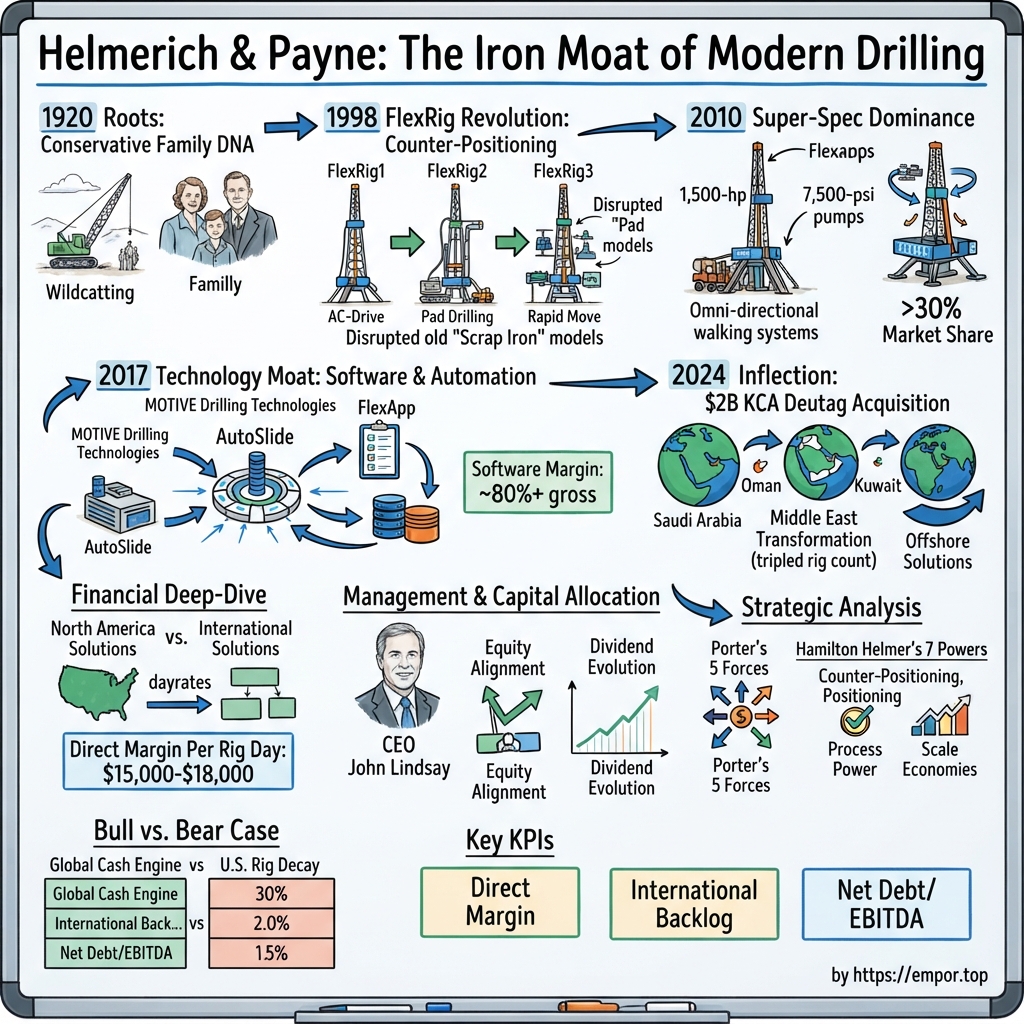
Helmerich & Payne: The Iron Moat of Modern Drilling
I. Introduction & Episode Roadmap
In August 2026, a man from Texas stood in the Saudi desert and got told he had finally become a real oil man.
The man was Raymond John "Trey" Adams III, five months into his tenure as chief executive of Helmerich & Payne, a company founded in Oklahoma in 1920. He recounted the exchange on the company's fiscal third-quarter earnings call with a mixture of amusement and pride: someone in the Kingdom had informed him that because H&P now had a real presence in Saudi Arabia, it was finally a real oil company.6 It was a throwaway line. It was also, in a sense, the whole story — a Tulsa land driller that had spent a century being the best in America at one thing was now trying to prove it could be good at something else entirely, on the other side of the world, while carrying nearly $1.7 billion of net debt it had never carried before.1
That is the tension at the heart of Helmerich & Payne today. On one side sits an operating business of genuine, measurable excellence. As of the end of fiscal 2025, H&P held roughly 24 percent of the total U.S. land drilling market and about 33.7 percent of the U.S. super-spec market — the top tier of rigs capable of drilling long, complex horizontal wells.1 It runs the largest fleet of these rigs in the Western Hemisphere, and in the June 2026 quarter it earned direct margins of $18,669 per rig day in North America, a figure no U.S. land peer publicly matches.2 On the other side sits a balance sheet transformed. In January 2025, H&P closed a roughly $2.0 billion all-cash acquisition of KCA Deutag International Limited, a deal that took a company famous for holding net cash and turned it into a leveraged, four-continent industrial operator with roughly 15,700 employees.18
The strategic question is not whether the drilling business is good. It is. The question is whether buying scale in the Middle East was worth surrendering the financial fortress that made H&P distinctive in the first place — and whether the specific promises management made in July 2024 have survived contact with reality. Some have not. Within six months of closing, Saudi Aramco had suspended 26 of the legacy KCA Deutag rigs H&P had just bought.9 The International Solutions segment absorbed goodwill impairments of $192.2 million during fiscal 2025 and posted operating losses in every quarter since.1210 The stock spent part of the past year below $20 before recovering into the low $40s by late August 2026.22
That is the arc worth understanding. Here is the road:
First, the origin — 1920, two men who met on a rig floor in Texas, and a hundred-year habit of refusing debt that eventually became the company's defining brand. Second, the FlexRig — the late-1990s decision to design and build its own standardised rigs when the entire industry treated drilling iron as interchangeable scrap, and why competitors structurally could not follow. Third, the shale bust and the super-spec arms race, when H&P converted a technology lead into durable market share. Fourth, the software layer: MOTIVE, AutoSlide, FlexRobotics, and the shift from selling days to selling outcomes. Fifth, the KCA Deutag pivot and what it actually bought. Sixth, the segment economics as they stand now, tested against Patterson-UTI and Nabors. Seventh, the management transition — Adams replacing John Lindsay, Todd Scruggs replacing Kevin Vann — and what the guidance record says about credibility. Eighth, the strategic frameworks and the activist stress test. Ninth, the bull and bear cases and the small number of metrics that actually settle the argument.
Start where all of it started: with a pilot and a bacteriologist who could not have known they were building an industrial dynasty.
 Subscribe on LinkedIn
II. Roots & The Conservative Family DNA (1920–1990s)
Two men met on a drilling rig in South Bend, Texas, sometime around 1920. One of them, Walt Helmerich II, was a Chicago-born former Army aviator who had flown in the First World War and had once held a world flight-altitude record — a barnstormer who had drifted into the oil patch and married Cadijah Colcord, the daughter of the Oklahoma oil pioneer Charles F. Colcord. The other, William Payne, was a scientist by training, holding degrees in bacteriology and chemistry, who had spent the war years in the Army Sanitation Corps.4
The pilot and the bacteriologist formed a partnership. They dragged rigs across the South Bend fields, into Kansas, out to New Mexico, and eventually north into Oklahoma. In 1926 they drilled a 2,350-foot wildcat near Braman, Oklahoma, that came in at 5,000 barrels a day, and on the strength of it they formally incorporated as Helmerich & Payne, Inc.4
The Lesson Learned in the Dirt
What matters about the next seventy years is not the well count. It is the disposition.
By 1939, H&P was carrying roughly $1 million of debt and came close to failing outright. It survived by pivoting toward contract drilling — being paid to drill other people's wells rather than betting the balance sheet on its own — while retaining a stake in exploration. A 1936 strike in the Hugoton gas field became the backbone of the company's reserves for the following six decades.4 Payne himself left in 1936 to found his own drilling company in Oklahoma City.4
The near-death experience seems to have imprinted permanently. Walt Helmerich III, a Harvard Business School graduate, became executive vice-president in 1954 and president in 1960, and under him the company built a portfolio that looks eccentric for a driller and made perfect sense as insurance: a chemical business, Natural Gas Odorizing, acquired in 1960 and eventually sold for $24 million in 1996; a 28 percent stake in Atwood Oceanics obtained through a rig trade after offshore misadventures in 1968–69; and, in 1964, the Utica Square shopping centre in Tulsa.4
Hold onto Utica Square. It becomes relevant sixty-two years later.
The payoff arrived in the 1980s. When crude collapsed and the American drilling industry was gutted — leveraged contractors defaulting, fleets sold for scrap, an entire generation of operators wiped out — H&P kept earning money. In 1989 it was reportedly the only drilling company in the world to post a profit, at $22.7 million of net income.4 That was not luck. It was the mechanical consequence of not owing anyone anything when the revenue stopped.
The Business Everyone Assumed Was a Commodity
To understand why the next chapter mattered, understand what contract drilling was before it.
A drilling rig, in the model that prevailed until the late 1990s, was a pile of iron. Contractors bought used equipment cheaply and assembled mismatched components — a drawworks from one supplier, a mast from another, engines of uncertain vintage — into something that could turn a bit. Rigs were mechanically driven or ran on DC motors, meaning the driller controlled the bit with roughly the precision of someone driving a truck by feathering the clutch. Moving a rig between well sites took a week or more of disassembly, trucking and reassembly. Crews worked in genuinely dangerous conditions on rig floors designed decades earlier. And the product was sold on price, by the day.
That is a commodity business with commodity returns, and everyone in it accepted that. Drilling contractors were price-takers whose fortunes rose and fell with the rig count, which rose and fell with the oil price. The industry's collective strategy was to buy iron cheap in the bust and rent it dear in the boom.
H&P's century of financial conservatism produced one asset that turned out to be strategically decisive: the ability to spend serious money on an unproven idea, for years, without a single customer contract to justify it, at a moment when every competitor's balance sheet said no. Owned real estate, owned equity stakes, minimal debt — this was not just defensive. It was optionality, waiting for something worth buying.
In the late 1990s, Hans Helmerich decided he had found it.
III. The FlexRig Revolution: Counter-Positioning & The Modern Moat (1998–2014)
There is a line John Lindsay used years afterward, reflecting on the decision, that captures how genuinely uncomfortable it was at the time: H&P did not have a single customer asking it to build a FlexRig.5
That is the definition of a speculative bet. In January 1998, under Hans Helmerich — grandson of the founder, who had taken over the top job in 1989 and would run the company for roughly a quarter of a century — H&P introduced the first FlexRig.519 Instead of assembling rigs from whatever components the market offered, H&P designed its own, built its own, and standardised them.
What the Machine Actually Did
Strip away the trade jargon and the FlexRig proposition was simple. Three changes, each of which sounded incremental and compounded into something structural.
The first was AC drive. Older rigs used mechanical linkages or DC motors, which gave the driller coarse control over how much weight and rotation went into the bit. AC drive is closer to a modern electric vehicle's motor control: continuous, precise, software-adjustable torque. In drilling terms, that means the bit can be held at exactly the right load through changing rock, which produces straighter holes drilled faster with fewer surprises.
The second was integration. Top drive, pipe handling, controls — designed together, operated from a joystick rather than by roughnecks manhandling pipe on an open floor. That was framed as a safety improvement, and it was, but it also removed a large source of variability: humans doing repetitive physical work at three in the morning in bad weather.
The third — and commercially the most important — was mobility. The FlexRig3, introduced in 2002 as an AC-drive design, was engineered to be taken apart, moved and put back together fast.5 For an operator drilling a programme of wells, rig-move time is dead time it pays for. Cutting a move from a week to a couple of days is worth real money on every well.
Why the Incumbents Could Not Simply Copy It
This is the part that makes the FlexRig a genuine case study rather than a product launch, and it is Hamilton Helmer's counter-positioning almost in its pure textbook form.
Every established land driller in 1998 owned hundreds of legacy mechanical and DC rigs carried on the balance sheet at meaningful book value. To match H&P, a competitor had to do two painful things simultaneously: write down the old fleet, and spend enormous capital on a new one for which no customer had yet agreed to pay a premium. Public markets in the late 1990s and early 2000s — with oil in the $20s for much of that stretch — were not interested in funding either. The rational move for an incumbent was to keep renting the iron it already owned and wait.
H&P did the painful thing to itself. It cannibalised its own legacy fleet, accepted years of weaker reported returns, and built out standardised rigs in its own Tulsa-area facilities. The first two generations produced eighteen rigs — a rounding error against a U.S. land market of well over a thousand.5 It looked, for a while, like an expensive engineering hobby.
The compounding showed up later. H&P's share of the U.S. land drilling market climbed from roughly 3 percent to around 20 percent by the mid-2010s.5 That is the single most important number in the company's history, and it was won not by acquisition but by building a better machine and waiting for customers to notice.
The Manufacturing Advantage Nobody Talks About
Standardisation created a second, quieter moat that is easy to underrate.
When every rig in a fleet is essentially the same rig, the spare part inventory collapses in complexity. A crew trained on one FlexRig can work on any FlexRig. Maintenance procedures are uniform, failure modes are known, and the cost of keeping the fleet running per operating day falls structurally below that of a competitor managing a museum of mismatched equipment. H&P still operates rig assembly and modular component facilities in Galena Park, Texas and the Tulsa area, and it continues to describe this vertical integration as core infrastructure.1
Two decades later, that architecture is still producing an operational edge that shows up in the numbers. In the June 2026 quarter, H&P reactivated ten idle rigs in the Lower 48 and grew per-day margins by more than $1,000 sequentially at the same time — a combination that ordinarily should not happen, because bringing rigs out of storage costs money before it earns any. Management's framing on that call was blunt: H&P added back more rigs at higher margins for lower cost than anyone else in the industry.6 That is a claim, not an audited fact, but the margin arithmetic is consistent with it.
The Customer Proof
The commercial logic that eventually sold FlexRigs was never "our dayrate is competitive." It was the opposite. H&P asked for a premium and argued that total well cost — the number an exploration and production company actually cares about — would fall anyway, because the well would be drilled in fewer days with fewer problems.
The industry-level evidence for that logic is striking. Between the second quarter of 2012 and the fourth quarter of 2019, the U.S. industry went from needing roughly 250 rigs to drill about a thousand wells with 5,000-foot laterals, to needing about 190 rigs to drill the same number of wells with 9,000-foot laterals.5 Fewer rigs, longer and harder wells. Productivity per rig had roughly doubled.
That is a wonderful thing to sell into and a terrifying thing to own. Every efficiency gain H&P delivered destroyed some of the industry's own demand. It is the central paradox of the business, and it would define the decade that followed.
IV. The Shale Bust, Rig Upgrade Arms Race, & Super-Spec Dominance (2014–2021)
In the second half of 2014, West Texas Intermediate fell from above $100 a barrel toward $30. For an industry whose customers set budgets off the strip, this was not a downturn. It was a reset.
What emerged from it changed the physical shape of American drilling. Operators abandoned drilling wells one at a time from separate surface locations and moved to pad drilling: six, eight, twelve horizontal wells launched from a single pad, with the rig physically walking a few dozen feet from one wellhead to the next rather than being torn down and trucked. Laterals stretched from one mile to two and eventually three. The rock did not get easier; the wells got longer, deeper and higher-pressure.
Defining the Standard
Out of this came a piece of vocabulary that now governs the entire competitive landscape: super-spec.
H&P's own definition, as stated in its annual filings, sets four requirements: AC drive; a drawworks of at least 1,500 horsepower; a hookload rating of at least 750,000 pounds; a 7,500-psi mud circulating system; and multiple-well pad capability.1 Translated: enough electrical control to steer precisely, enough lifting power to handle the enormous weight of a three-mile string of pipe, enough pump pressure to circulate drilling fluid through that distance against formation pressure, and the ability to walk across a pad without demobilising.
A rig missing any of these is not a slightly worse rig. For a modern long-lateral programme it is the wrong tool, and it does not get hired at any price. That is what makes super-spec a genuine dividing line rather than a marketing term — it split the U.S. fleet into rigs that could work and rigs that could not.
Upgrading While Others Restructured
H&P's response through the 2015–2020 stretch was to spend into the downturn, converting existing FlexRigs into walking, higher-hookload, higher-pressure machines. As of fiscal 2025, the company had reconfigured 78 FlexRig units into super-spec walking rigs and operated 238 super-spec rigs in total.1 It also declined to chase work below cost, preferring to leave lower-tier rigs idle rather than defend utilisation with pricing that would not cover direct operating expense.
The result was share concentration at the top of the market. By September 2025, H&P's roughly one-third share of U.S. super-spec capacity sat well above its roughly one-quarter share of U.S. land drilling overall — meaning the company is disproportionately represented exactly where the work is hardest and the customers are least price-sensitive.1
That is the mechanism worth internalising. H&P is not the biggest driller because it owns the most iron. It is the most profitable U.S. land driller because it owns the right iron, in a segment that has meaningfully fewer credible suppliers than the headline rig count suggests.
The Uncomfortable Corollary
The strategy carried a cost that management has been consistent about acknowledging, and it is the same paradox from the previous section, now with numbers attached.
In fiscal 2025, H&P's North America Solutions segment generated $2.36 billion of operating revenue and just under $1.04 billion of direct margin across 53,523 revenue days — an average of roughly 147 active rigs.1 Revenue was down 3.4 percent year over year, and the reason given was reduced activity levels, not pricing.1 The company was earning strong per-day economics on a shrinking number of days.
That is the structural bind. Every year that operators drill longer laterals faster, the same production requires fewer rig-days. The efficiency H&P sells is the efficiency that shrinks its addressable market. Management can win share within a declining pool — and has — but share gains within a shrinking pool eventually stop compounding.
By the early 2020s, this arithmetic had become impossible to ignore, and it pushed H&P toward two responses. One was to sell something other than days. The other was to find markets where the rig count was going up rather than down. The first was the technology strategy. The second was KCA Deutag.
V. Digital Rig Operations & Performance Contracts: Technology as a Differentiator
Picture the job that H&P set out to automate. A directional driller is trying to steer a bit two miles underground toward a target zone perhaps thirty feet thick, using a bent motor that only changes direction when the pipe is pushed forward without rotating — an operation called sliding. Sliding is slow and inefficient, so it is done in bursts, and deciding when and how long to slide is a judgment call made continuously by a human reading noisy sensor data. Different people make different calls. The same person makes different calls at 4 a.m. than at noon.
That variability is expensive. It is also, in principle, a software problem.
Buying the Algorithm
On May 22, 2017, H&P announced it would acquire MOTIVE Drilling Technologies for $75 million payable at closing plus up to $25 million in earnout, closing the following month.7 MOTIVE, founded in 2011 and launched inside Hunt Energy Enterprises, had built a Bit Guidance System that applied cognitive computing to directional drilling decisions — weighing the total economic consequence of each steering choice rather than simply pointing at the target. At acquisition, MOTIVE's technology had been proven on more than 200 horizontal wells.7
Two details in that announcement are more revealing than the price. First, John Lindsay explicitly committed that MOTIVE would remain available to all E&P operators and all directional drilling providers regardless of which rig contractor they used.7 H&P bought a technology business and chose not to weaponise it as an exclusive. That is either admirable discipline or a missed opportunity to build switching costs, depending on your view — and honestly, it is some of both. Second, the price was high relative to MOTIVE's revenue at the time, which tells you H&P was buying an option on a capability rather than an earnings stream.
The capability compounded into AutoSlide, H&P's automated sliding system, which executes the steering decisions the algorithm makes without a human continuously in the loop. The proof points management now cites are field results rather than lab claims. In Argentina during the June 2026 quarter, H&P deployed AutoSlide on a well that required zero manual slides, and separately drilled a record well 13 percent faster than the operator's previous best while coming in 15 percent under the operator's budget — under a performance-based contract.6
That last clause is the whole strategy in three words.
From Selling Days to Selling Outcomes
The commercial model matters more than the software.
Traditional contract drilling is a dayrate business: the operator pays a fixed amount per day regardless of what happens. Under that structure, a contractor who drills faster earns less. Performance-based contracts invert the incentive — a base rate plus payments tied to speed, footage or wellbore quality against agreed targets — so the contractor is paid for the outcome it actually delivers.
H&P has moved a majority of its U.S. fleet onto this footing. On the August 2026 call, Mike Lennox, executive vice president for the Western Hemisphere, put it at more than 50 percent of rigs on performance-based contracts, and used that fact to explain something analysts had flagged: quarterly margins are lumpy, because bonus recognition is lumpy.6 The company's own annual filing describes the variable consideration as estimated at the most likely amount and constrained to avoid revenue reversal, and states that across fiscal 2025 the performance-based book produced a positive risk-reward outcome.1
That is a meaningful disclosure and worth reading carefully. It is management's assertion that it is winning its bets on average, backed by an accounting policy that requires constraint. It is not a guarantee that a future quarter cannot go the other way. Investors should treat performance-linked margin as higher-quality-but-higher-variance revenue rather than as a free upgrade.
The Robots Arrive
The current chapter of this story is FlexRobotics, which automates drilling connections and tripping operations on the rig floor using three off-the-shelf robotic arms designed as a retrofit for existing rigs. H&P began validation testing in 2024 on an R&D rig in Tulsa and by early 2026 had deployed the system across three pads for a supermajor customer in the Permian.6
The field evidence so far is genuinely interesting. Lennox said H&P had brought the first robotic rig out with the expectation it would perform at the median of what human crews achieve, and that it had exceeded that from the start — the rig had become that customer's top-performing rig within a fleet in the high twenties.6 By the August 2026 call a second package was operating, with five robotic rigs targeted in the field by February 2027.6
Two caveats belong here. One rig outperforming within one customer's fleet is an anecdote, not a proven productivity curve, and H&P has scheduled a Technology Day in Tulsa for October 8, 2026 at which it says it will provide a deeper look at the system.6 More fundamentally, the company does not separately disclose technology revenue, gross margin, or attach rates. There is no reported line item that lets an outside investor verify what automation contributes. Claims about software economics at H&P are, at present, inferences from consolidated margin rather than observable facts — and that disclosure gap is itself an analytical fact.
What is observable is the aggregate: North American direct margin per day of $18,669 in the June 2026 quarter, against peers who do not report anything comparable at that level.2 Whether the delta comes from the iron, the software, the contracts or the crews cannot be decomposed from outside. It can, however, be compared — which is what Section VII does.
Before that, the deal that changed everything else.
VI. The Pivot of 2024: The $2.0 Billion KCA Deutag Acquisition & Going Global
On the morning of July 25, 2024, H&P did something unusual with its scheduled quarterly earnings call. It moved the call earlier and rewrote the agenda, because the news was no longer the quarter.3
The company had agreed to acquire KCA Deutag International Limited for $1.9725 billion in cash — a business headquartered in Aberdeen with a large Middle East land drilling franchise, an asset-light offshore management operation, and a manufacturing arm.3 For a company whose entire identity was built on not owing money, this was a genuine break with a hundred years of institutional habit.
The Logic, Stated Plainly
Management's case rested on a diagnosis the market largely shared: the U.S. land drilling business was maturing. Efficiency gains meant fewer rigs drilling more footage. E&P consolidation was reducing the number of buyers. Whatever share H&P won at home, the pool was not growing.
The Middle East was different — a market where national oil companies plan on decade horizons, contract for five years at a time, and were signalling production growth. KCA Deutag would take H&P's Middle East rig count from 12 to 88, with 71 of those in Saudi Arabia, Oman and Kuwait, in one transaction.3 The company was explicit that this scale would have been challenging to replicate organically, and framed the deal as acquiring operations and people rather than assets.3
The financial claims were specific and therefore testable. Roughly two-thirds of KCA Deutag's calendar 2023 operating EBITDA came from Middle East land drilling.3 The deal added approximately $5.5 billion of contract backlog.3 Combined last-twelve-months operating EBITDA was around $1.2 billion.3 International land operations would go from about 1 percent of operating EBITDA on a standalone basis to about 19 percent pro forma, and offshore from about 3 percent to about 7 percent.3 Synergies of roughly $25 million run-rate were targeted by 2026, driven by overhead and procurement.3 The transaction was expected to be immediately accretive to free cash flow per share, with double-digit accretion as soon as 2025 and returns exceeding cost of capital by 2026.3
And critically: net debt to operating EBITDA of 1.7x at close, with a commitment to get to at or below 1.0x, the base dividend maintained, and the supplemental dividend suspended for the duration of deleveraging.3
What Was Actually Bought
The transaction closed on January 16, 2025. H&P paid aggregate cash consideration of approximately $2.0 billion: $0.9 billion for the shares and $1.1 billion to simultaneously repay or redeem KCA Deutag's existing debt.18
Three distinct businesses came across. The largest was Middle East land drilling — the rigs in Saudi Arabia, Oman and Kuwait working for national oil companies on multi-year terms. The second was an offshore management contract business covering roughly 29 platform rigs in the North Sea, Angola, Azerbaijan and Canada.3 This is a genuinely different economic model: H&P does not own the platform rigs, it operates and maintains them under contract, which means very little capital employed and a steady fee stream. The third was Kenera, a manufacturing and engineering group including BENTEC with three facilities serving the energy industry.3 H&P has since described BENTEC's engineering depth as complementary to its own rig assembly infrastructure.1
The funding was assembled ahead of closing. In September 2024 H&P privately placed $1.25 billion of senior notes across three tranches — $350 million of 4.65 percent notes due 2027, $350 million of 4.85 percent notes due 2029, and $550 million of 5.50 percent notes due 2034 — alongside a $400 million term loan.1 It also monetised a non-core asset with excellent timing: a $100 million cornerstone investment in ADNOC Drilling was sold in October 2024, 159.7 million shares for approximately $197 million, with proceeds applied to reduce bridge facility commitments.16 Roughly a hundred million dollars of profit, harvested precisely when it was needed. That is the old H&P playbook — quiet assets, held for decades, cashed at the right moment.
And Then the Rigs Stopped
Here is where the story stops being a strategy memo.
On June 10, 2025 — under five months after closing — H&P disclosed that it had received notices of contract suspensions for an additional nine rigs in the legacy KCA Deutag fleet in Saudi Arabia, bringing total suspensions in the country to 26 rigs.9 Lindsay's public framing acknowledged an unexpected softening in the acquired Saudi operations while insisting the long-term position was intact.9
Twenty-six suspended rigs out of a Middle East fleet the deal was built around is not a rounding error. It is the central asset of the transaction being switched off by the customer, at the customer's discretion, within months of purchase — and it is the single most important fact a prospective investor in H&P needs to sit with. Suspension provisions are standard in NOC contracts; that is precisely the point. The backlog that made the deal look de-risked turns out to be contractual in form and discretionary in practice.
The accounting followed. During fiscal 2025 H&P recorded asset impairment charges of $194.0 million, driven principally by a non-cash goodwill impairment of $192.2 million against the International Solutions and BENTEC reporting units, of which $132.7 million sat in International Solutions.1 It also booked $54.7 million of acquisition transaction costs and $12.1 million of restructuring charges.1 Consolidated fiscal 2025 net loss was $165.1 million, or $1.66 per diluted share, against net income of $344.2 million and $3.43 per share in fiscal 2024 — with the effective tax rate distorted to negative 115.8 percent by non-deductible goodwill impairment.1
Writing off goodwill within nine months of closing a transaction is an unambiguous statement that the assets are worth less than what was paid for them. It does not mean the deal will fail. It does mean the price paid was, at minimum, not conservative.
The recovery has been real but partial. By the November 2025 results, H&P had received notification for seven rigs to resume in Saudi Arabia during the first half of calendar 2026.11 By August 2026, five of those seven were drilling, taking the company to 22 rigs operating in the Kingdom, with two suspended rigs in Bahrain also resumed.26 Adams told analysts he had just returned from Saudi Arabia and was encouraged by customer conversations, while pointedly redirecting attention away from rig counts toward a financial target: getting International Solutions to at least $45 million of quarterly direct margin.6
That redirection is worth noting. When a management team stops guiding to the metric it originally sold the deal on, it is usually because that metric is not cooperating.
VII. Segment Breakdown & Core Business Economics
H&P today reports three operating segments, and they could hardly be more different in economic character.
North America Solutions is the engine: $2.36 billion of fiscal 2025 revenue, roughly 63 percent of the consolidated total, generated by 223 marketed rigs of which 144 were contracted at year-end — 73 on fixed-term contracts and 71 working well-to-well.1 International Solutions contributed $802.4 million, about 21 percent, from 137 available rigs with 88 contracted.1 Offshore Solutions delivered $520.4 million, about 14 percent, from an asset base of just seven owned rigs plus the management contract portfolio.1 Total consolidated revenue was $3.75 billion.1
The Anatomy of a Rig Day
The metric H&P manages to, and the one investors should watch, is direct margin per rig day: revenue less direct operating expenses, divided by revenue days. It strips out corporate overhead and depreciation and gets at the question of whether the field operation itself makes money.
In the June 2026 quarter, North America Solutions produced $241 million of direct margin across an average of 142 active rigs — $18,669 per day.2 That was up more than $1,000 sequentially from the March quarter's $17,628, which itself had come down from $18,620 in the September 2025 quarter.21011 Over the full fiscal 2025 year, the segment averaged roughly $19,400 per day.1
What drives that number in either direction? Pricing, obviously. But also crew and field support costs, maintenance and spares, the cost of bringing idle rigs back into service, and — increasingly — the timing of performance bonuses. The June 2026 quarter is instructive precisely because it combined all of these: ten reactivations, which normally depress margin, offset by stronger pricing and bonus recognition strong enough to push the number up anyway.26
Two forward-looking facts sit alongside this. H&P exited the June quarter with 147 rigs running in the Lower 48 and told investors super-spec fleet utilisation was running at about 95 percent, a level management argues supports further market tightening.6 And it stated it retains capacity to reactivate roughly ten more rigs at or below its $1 million maintenance capital threshold, with a theoretical path to 160 operating rigs.6 Reactivation capacity that cheap is a real asset in a tightening market, because it means H&P can capture upside without a capital cycle.
The Peer Test
Comparisons across drillers are imperfect because everyone defines margin differently. But the orders of magnitude are informative.
Patterson-UTI, the closest U.S. land competitor after its 2023 combination with NexTier, reported total revenue of $1.2 billion for the June 2026 quarter and adjusted EBITDA of $232 million, with a net loss attributable to common stockholders of $20 million.20 Its Drilling Services segment produced $374 million of revenue and $114 million of adjusted gross profit — $134 million excluding a charge related to exiting Colombia.20 U.S. contract drilling ran 8,361 operating days on an average of 92 rigs, exiting at 96.20 Pricing on recently awarded term contracts had risen roughly 10 to 15 percent versus the start of the year.20
The comparison is stark on scale within drilling: H&P's North American segment alone generated $241 million of direct margin on 142 average rigs, against Patterson-UTI's entire Drilling Services segment at $114 million on 92 U.S. rigs.220 Definitions differ — H&P's direct margin excludes some costs that Patterson-UTI's adjusted gross profit includes — so this is not an apples-to-apples per-day figure. But the direction is unmistakable, and it is consistent with H&P's super-spec concentration doing real work. Patterson-UTI is also a fundamentally different company now: its Completion Services business, at $754 million of quarterly revenue, is larger than its drilling arm, giving it exposure to pressure pumping economics that H&P has deliberately avoided.20
Nabors Industries offers the other useful contrast. In the same quarter it reported operating revenues of $814.8 million, adjusted EBITDA of $221.7 million and a net loss of $22 million.21 Its Lower 48 fleet averaged 67.8 rigs while its International Drilling segment averaged 93.4 rigs and delivered $131 million of adjusted EBITDA at a daily adjusted gross margin of $17,534.21 Nabors also runs the SANAD joint venture in Saudi Arabia, which had deployed 16 newbuild rigs by mid-2026.21
That last point deserves emphasis, because it complicates the H&P bull case. Nabors currently operates more international rigs than H&P does, has a structural joint-venture position in the Saudi market, and — like H&P — is targeting roughly one turn of net leverage.21 The Middle East is not virgin territory H&P is entering ahead of the pack. It is a market where a scaled competitor got there first with a local partnership structure.
Where the Edge Actually Comes From
Putting the pieces together, H&P's unit-economics advantage rests on three mechanisms that are individually modest and collectively meaningful.
Fleet homogeneity lowers the cost of maintaining, crewing and reactivating rigs — visible in a reactivation capital threshold of about $1 million per rig and in maintenance capital of roughly $250 million a year across a global fleet, a level CFO Todd Scruggs has said the company can sustain for several years.6 Technology integration raises realised revenue per day without a proportional rise in labour cost, though the magnitude is not separately disclosed. And performance-based contracting captures a share of the value created rather than leaving it entirely with the customer.
None of these is a permanent moat. Competitors are upgrading rigs and deploying automation — Nabors deployed its own automated rig floor wrench and its PACE-X Ultra rigs in the same quarter.21 The honest read is that H&P's advantage is real, currently visible in margin, and gradually narrowing at the technology layer while remaining wide at the fleet-standardisation layer.
Which raises the question of who is now steering all of this.
VIII. Management, Governance, & Capital Allocation Record
On February 5, 2026, John Lindsay took his last earnings call as chief executive of Helmerich & Payne and did something CEOs rarely do on a quarterly call: he stopped and reflected.
He had started at H&P thirty-nine years earlier, in 1987, as a drilling engineer.619 He had run Mid-Continent operations, then U.S. land, become executive vice president in 2006, chief operating officer in 2010, president in 2012, and chief executive in March 2014 — the first non-Helmerich to hold the job, succeeding Hans Helmerich, who remained chairman.19 What he said on that final call was characteristically unglamorous: that long-term success depends on discipline and on investing through cycles rather than reacting to them, and that H&P does not chase a perfect quarter.6
It is a fair summary of his record. Over twelve years as CEO he oversaw the super-spec upgrade programme, five technology acquisitions, and the largest transaction in company history.12 He also handed his successor a balance sheet with $2.3 billion of gross debt and an international segment losing money.1
The New Team
The succession was managed unusually deliberately, and the sequencing tells you the board was planning rather than reacting.
Trey Adams was promoted to President effective October 1, 2025, taking responsibility for all revenue-generating business units and becoming only the fifth President in the company's 105-year history.13 He had joined in 2008 and had worked across nearly every part of the business, with a focus on combining drilling operations with technology solutions.13 Hans Helmerich, announcing the promotion, tied it explicitly to the KCA Deutag integration nearing completion and the resulting four-continent footprint.13 Adams was told to divide his time between North America, the U.K. and the Middle East.13
Alongside him the board promoted Mike Lennox to executive vice president for Western Hemisphere land operations and John Bell to the same role for the Eastern Hemisphere — Bell having joined in 1998, pioneered FlexRig operations in the Middle East, and played a central role in the KCA Deutag acquisition and in H&P's entries into Saudi Arabia and Australia.13
On December 11, 2025, the board announced Lindsay would retire as CEO and director following the March 4, 2026 annual meeting, with Adams succeeding him and Lindsay staying on as senior advisor through December 2026.12 Hans Helmerich described it as the next logical step in a succession process underway for several years.12
The finance seat turned over next. On March 16, 2026, H&P announced that Kevin Vann would retire as CFO effective June 30, 2026, with Todd Scruggs — then vice president of corporate finance and treasury — appointed effective July 1.14 Scruggs had come out of energy trading, then WPX Energy where he led treasury and business development involving more than $10 billion of transactions through the Devon Energy merger, then a partnership at Veriten before joining H&P in 2024.14
That is a notable profile for this moment. H&P promoted a balance-sheet and portfolio person into the CFO chair of a company whose defining problem is a balance sheet and a portfolio. Whether the board intended that signal or not, it is the signal.
Capital Allocation: The Record and the Reset
H&P's dividend history is the clearest window into how the company thinks about promises.
For decades it was among the great dividend growth records in American industry. As late as March 2020, Lindsay was publicly citing a long-standing and 48-year increasing dividend while simultaneously warning that the board was reassessing the level of shareholder returns amid the COVID collapse and the oil price war.15 The company honoured the $0.71 per share payment scheduled for June 2020 and then reset the quarterly rate to $0.25, where it has remained.1518 The most recent declaration, on June 3, 2026, kept it at $0.25 per share.18
The reset broke a nearly half-century streak, and it is worth being precise about how to read that. Cutting a dividend to protect a balance sheet during a genuine crisis is defensible capital allocation. Building an investor base on a streak and then breaking it is a credibility event regardless. Both are true.
The current framework, as Scruggs laid it out in August 2026, is explicitly sequenced. The base dividend — roughly $100 million a year — is maintained throughout the deleveraging phase.6 Maintenance capital runs about $250 million annually, sustaining capital for fleet technology upgrades about $50 million, with growth projects assessed against return thresholds plus duration, scalability and the ability to drive technology adoption and performance-based contracts.6 Everything else goes to debt. Only from 2028 onward, once leverage reaches one turn and the 2027 bond is retired, does management contemplate a balanced mix of dividends and buybacks.6
He also committed to specifics: an annualised $40 million reduction in corporate costs by the end of 2027 through streamlining central functions, deploying a standard operating model across regions and harmonising ERP systems; more than $160 million of asset sales targeted for completion by the end of fiscal 2027; a review of working capital and inventory practices; and continued exits from non-core geographies.6 He even flagged that H&P is examining simplifying its reporting and reconsidering its fiscal year end.6
Judging the Record on Behaviour
Here is the fair assessment, weighing what was promised against what happened.
On deleveraging, execution has been ahead of schedule and consistently so. The $400 million term loan was repaid early — $210 million by October 2025 against a prior expectation of $200 million by calendar year-end, $260 million by end-January 2026, and fully retired by the March 2026 quarter, helped by after-tax proceeds from the Utica Square sale exceeding the $100 million target.10116 Net debt stood at roughly $1.66 billion at June 30, 2026.1 The next target is the $350 million bond maturing in 2027.6 Management has repeatedly beaten its own debt-reduction timeline rather than missed it, which is the single strongest credibility datapoint available.
On guidance, the fiscal 2026 record has been solid. Initial guidance issued in November 2025 called for 132 to 148 average North America rigs, 58 to 68 international rigs, and $100 to $115 million of offshore direct margin, with capital expenditure of $280 to $320 million.11 By August 2026 the company had narrowed North America to 140 to 144 rigs, raised offshore to $113 to $117 million, and trimmed capex to $270 to $310 million.2 Delivering at or above the top of an original range through a year that included a Middle East conflict is a genuine execution result.
On the acquisition thesis, the record is weaker and management has been more selective in how it discusses it. The $25 million synergy target has largely disappeared from the narrative, replaced by the larger $40 million corporate cost programme — arguably an expansion, but also a repackaging that makes the original commitment hard to score. The rig-count framing that anchored the deal has given way to a direct-margin run-rate target. And the goodwill written off has not been discussed in the same detail as the debt paid down.
None of this is evasion. It is emphasis, which is what management teams control. Investors should score the deleveraging promise as met and the acquisition promise as unresolved.
Selling Utica Square deserves one final note. The company bought that shopping centre in 1964 and sold it to funds managed by Northwood Investors in April 2026 after more than sixty years of ownership, booking roughly $115 million of gain in the June quarter and using the proceeds to retire debt.172 Hans Helmerich's public comment acknowledged its place in the company's history.17 There is something quietly emblematic about it: the conservative diversification of one era being liquidated to pay for the aggressive expansion of the next.
IX. Primary Evidence: Transcripts & Conference Call Analysis
Read H&P's calls in sequence over two years and a pattern emerges that no single quarter reveals: the story management tells has changed twice, and the analysts have not let either change go unchallenged.
The Three Calls That Matter
The first is July 25, 2024, when the KCA Deutag agreement was unveiled alongside fiscal third-quarter results. The framing was strategic transformation — global leadership in onshore drilling, resilient revenue, earnings visibility, immediate free cash flow accretion.3 Lindsay's language emphasised that H&P had a history of a thoughtful and managed approach to investing in the business and was well versed in commodity volatility — a pre-emptive answer to the obvious objection that this was out of character.3
The second is February 5, 2026, Lindsay's final call. The tone had shifted markedly toward realism about the near term. Adams, then President, told investors that operators were focused on disciplined capital deployment, conserving inventory and prioritising returns over volume, and that oil-related investment would remain soft that year with upside beyond it.6 North America Solutions had exited the quarter with 139 rigs, down 4 percent from the prior quarter's exit rate, with second-quarter guidance of 132 to 138.6 The company reported a net loss of $0.98 per diluted share including roughly $103 million of non-cash impairment and unusual items.6 The gas outlook was described as more robust than oil, driven by LNG and AI-led power demand.6
The third is August 6, 2026, Adams's first full call as CEO and Scruggs's first as CFO — and it reads like a different company. Adams opened by describing the quarter as delivering above the midpoint in all three segments despite ongoing Middle East disruption, and closed by arguing this represented the early innings of a multiyear growth cycle.6
What Analysts Actually Pressed On
The Q&A is where the useful information lives, and three lines of questioning recur.
Derek Podhaizer of Piper Sandler opened the August 2026 call by asking management to walk through the puts and takes for fourth-quarter guidance and how momentum would be sustained into fiscal 2027.6 Scruggs's answer was more revealing than Adams's: he told analysts to think of roughly $250 million per quarter as a good benchmark level of North American profitability and said the company was less focused on the exact rig count than on making the aggregate dollar figure go up each quarter.6 That is a deliberate reframing away from a volume metric the company does not control toward a profit metric it partly does.
Scott Gruber of Citigroup pushed harder on the specifics — how much reactivation costs were weighing on margins, how much of the third quarter came from performance bonuses, and where margins could get to if activity stabilised around 150 rigs.6 The answer, from Lennox, was candid about lumpiness: bonuses fluctuate, reactivation costs are a small component, and there is conservatism built into guidance.6 Adams added the market context — 95 percent super-spec utilisation, private E&Ps driving the additions using hedges, public E&Ps churning through the summer, and a very different budget backdrop for calendar 2027 given crude was in the fifties late in calendar 2025.6
Arun Jayaram of JPMorgan went at the capital framework, asking how H&P could hold roughly $300 million of maintenance-plus-sustaining capital while growing international activity.6 Scruggs's response contained the clearest articulation of the acquisition's underlying logic yet offered: part of the reason for the deal was to build a global platform where growth would not require major capital projects, and moving rigs to Argentina looks operationally similar to recommissioning a rig in North America and then putting it on a boat.6
That is a good answer, and it is falsifiable — which is the highest compliment available. If international growth over the next two years comes with capital intensity materially above maintenance levels, the claim fails.
Saurabh Pant of Bank of America pressed on Saudi Arabia: five of seven suspended rigs back, what about the other two, and what about growth beyond?6 Adams declined to add rigs six and seven to guidance, described the current 22 rigs as a base load, and pivoted to the economics — creating economic viability in the Kingdom and hitting the $45 million quarterly international margin target.6 He did volunteer detail on Jafurah, the Saudi unconventional gas development where H&P runs eight FlexRigs, drawing a parallel to the early Permian where records were broken continually.6
Keith MacKey of RBC asked about Argentina economics on the rigs being exported from the U.S.6 The answer was concrete: rigs deployed to the Vaca Muerta earn margins broadly in line with U.S. levels, with added mobilisation costs for trucking, packing and shipping, and with top drives and well control equipment proactively replaced to align with five-year API requirements and five-year contract terms — the removed equipment being repurposed domestically.6
Reading the Consistency
The narrative has moved from "transformational global platform" through "disciplined survival in a soft market" to "early innings of a multiyear growth cycle" in twenty-four months. Some of that reflects a genuinely changed macro environment: the Middle East conflict pushed the twelve-month strip to around $70 WTI, and management argues customers will use higher planning prices in the coming budget season.6
But investors should note that the most bullish framing arrived from the newest management team, in the quarter with the strongest results, immediately before a technology showcase. That is not a criticism — it is exactly what a new CEO would do with a good quarter. It is simply a reason to weight the operating evidence more heavily than the adjectives.
X. Strategic Frameworks: 7 Powers & Porter's 5 Forces
Strip the narrative away and ask the war-game question: if you had unlimited capital and wanted to take H&P's position, could you?
Hamilton Helmer's 7 Powers, Applied Honestly
Counter-positioning — historically decisive, now largely spent. The FlexRig gambit worked precisely because incumbents faced a business-model conflict in responding. That conflict no longer exists. Super-spec is the industry standard, competitors have upgraded, and the writedown problem has been absorbed across the sector. Whatever counter-positioning remains sits in the integration of software with owned hardware, which is a narrower and more contestable version of the original power.
Process power — the strongest remaining source. Twenty-five years of refining standardised manufacturing, maintenance protocols, crew training and rig-moving procedures across a homogeneous fleet produces a cost position that cannot be bought, only accumulated. The observable evidence is the ability to reactivate rigs at roughly $1 million of capital while expanding margins in the same quarter.6 This is the power an acquirer could not replicate by writing a cheque.
Scale economies — moderate and asymmetric. Roughly a third of U.S. super-spec capacity lets H&P amortise automation R&D and field management across a large base.1 But scale in drilling has limits: rigs work one well at a time, and there is no meaningful fixed-cost leverage in the field beyond overhead. Note also that H&P's fiscal 2025 research and development spend was $34.1 million against $2.36 billion of North American revenue.1 That is a real but modest technology budget, and it caps how far scale economics in software can run.
Switching costs — moderate, unproven at scale. Once an operator's drilling engineering workflow is built around H&P's automation and well-planning tools, changing contractors imposes retraining and predictability costs. But H&P deliberately made MOTIVE available across the industry, and the company does not disclose retention or attach-rate data.7 The claim is plausible; the evidence is not public.
Branding — real within a narrow domain. In tier-one E&P procurement, H&P's safety and reliability record functions as a genuine brand. It does not command a consumer-style premium, but it wins access to bid lists.
Cornered resource and network economies — essentially absent. There is no scarce input H&P uniquely controls and no mechanism by which one customer's use makes the service better for another.
The honest scorecard: one strong power, three moderate, one spent, two absent. That is a good industrial business with a defensible cost position — not a compounding machine with structural pricing power.
Porter's Five Forces
Threat of new entrants: very low. Building a super-spec rig requires substantial capital, and the harder barrier is non-financial — customers will not hire an unproven contractor's crews on a three-mile lateral. Safety record is a licence to operate, and it takes years to establish.
Bargaining power of buyers: high, and rising. This is the force that matters most. H&P's ten largest drilling customers accounted for approximately 54 percent of consolidated operating revenues in fiscal 2025, with the top three at approximately 25.6 percent and the single largest at 12.0 percent, or $451.3 million.1 In offshore, concentration is extreme: the largest customer represented 45.2 percent of segment revenues, at $235.0 million.1 The company's own filings identify customer concentration and industry consolidation as risks.1 Consolidated E&Ps run disciplined procurement and can suspend or decline to renew, as Saudi Aramco demonstrated.
Bargaining power of suppliers: low to moderate. Key components — top drives, mud pumps, prime movers — come from a concentrated supplier base. H&P mitigates this through in-house fabrication and system integration, now augmented by BENTEC's engineering capability.1
Threat of substitutes: low in the medium term, and interestingly ambiguous. Nothing substitutes for a drilling rig in getting hydrocarbons out of shale. The nuance is that adjacent demand is emerging: H&P signed contract awards for geothermal rigs in Germany, Denmark and the Netherlands, added projects in North America, and by August 2026 had roughly six U.S. geothermal rigs with management targeting a double-digit count across the U.S. and Europe at margins described as in line with Lower 48 levels.6 Nabors, meanwhile, has a rig drilling the first commercial superhot geothermal development.21 Substitution here runs partly in H&P's favour — the energy transition needs holes drilled too.
Competitive rivalry: moderate to high. At the super-spec tier the market is concentrated among H&P, Patterson-UTI and Nabors. Below it, tier-two contractors with older iron can price irrationally in downturns, but they cannot take the hardest work. The larger competitive risk is not domestic price war — it is that the Middle East, which H&P entered at scale via acquisition, is already occupied by Nabors' SANAD joint venture and by well-established local and regional players.21
What the Frameworks Say Together
H&P occupies a defensible position in a structurally difficult industry. The barriers protecting it are real but static — accumulated process advantage and a fleet that cannot easily be replicated — while the pressures on it are dynamic: customers consolidating, efficiency shrinking demand, and technology gaps narrowing.
That is a company that can earn good returns for a long time without ever escaping the cycle. Which is exactly what a skeptic would say.
XI. Skeptical Investor Stress Test & Current Risk Radar
Imagine an activist letter landing on H&P's board in late 2026. What would it say?
The Bear's Brief
It would open with the reversal. For a century, H&P's entire investment identity was financial conservatism — the company that stayed solvent when everyone else did not, that held net cash, that funded its own rig builds. In July 2024 it committed $1.97 billion of cash to a single foreign acquisition, funded with $1.25 billion of new senior notes and a $400 million term loan.31 The company that would not take risk with money took the largest financial risk in its history.
It would then note the timing. The deal was struck as U.S. shale efficiency gains were structurally reducing rig demand and as E&P consolidation was shrinking the customer base — the very reasons management gave for needing the deal. Buying diversification because your core market is maturing is defensible; the question is whether you overpay for it because you feel you must.
It would present the evidence that H&P did. Twenty-six rigs suspended in Saudi Arabia within five months of closing.9 A $192.2 million goodwill impairment against International Solutions and BENTEC in the first year of ownership.1 International Solutions posting operating losses of approximately $100 million and $54 million in the March and June 2026 quarters respectively, on direct margins of $11.5 million and $31 million.102 A fiscal 2025 consolidated net loss of $165.1 million against prior-year net income of $344.2 million.1 And a supplemental dividend suspended for the duration of deleveraging — capital that used to go to shareholders now going to bondholders.3
It would close on the disclosure question. H&P sells a technology story but reports no technology segment, no software revenue, no attach rate and no retention data. Investors are asked to accept that automation drives the margin premium without any way to verify it.
The Response, Tested Rather Than Assumed
Management's counter is that the deal bought duration in markets whose customers plan on ten-year horizons, and that contract backlog rose from $1.5 billion at the end of fiscal 2024 to $7.0 billion at the end of fiscal 2025 — with about 22.6 percent expected to be fulfilled in fiscal 2026.1 Offshore backlog alone stood at $3.6 billion including firm and optional periods as of August 2026.2
The backlog is real. Its quality is the open question, and Saudi Arabia supplied the test case: contracted rigs can be suspended at the customer's discretion. A backlog that converts at the buyer's option is a weaker asset than the headline implies.
Where the counter is genuinely strong is deleveraging. H&P has repaid the $400 million term loan ahead of every schedule it set, cut net debt to roughly $1.66 billion, generated $98 million of free cash flow in the June 2026 quarter on $70 million of capital expenditure, and committed to more than $160 million of further asset sales by the end of fiscal 2027.612 The company has done what it said it would do on the balance sheet, repeatedly and early. That matters.
Where the counter is weakest is on whether the acquired business earns its cost of capital. Management said in July 2024 that transaction returns would exceed cost of capital by 2026.3 It is 2026. International Solutions is losing money at the operating line and management's stated goal is a $45 million quarterly direct margin that has not yet been reached.26 The claim is not yet falsified — direct margin has improved sharply from the March quarter — but it is not met either.
The Risk Radar
Middle East geopolitical and operational risk sits at the top, and it is not theoretical. An ongoing regional conflict has driven commodity volatility, disrupted travel routes and created supply chain constraints across H&P's Gulf operations through fiscal 2026, delayed Saudi rig reactivations, and suspended rigs in Iraq and Bahrain for part of the year.1026 Adams described visibility as somewhat limited.6 This is now H&P's largest non-U.S. profit pool and its least controllable variable.
E&P efficiency and consolidation risk is the slow structural threat. The mechanism is arithmetic: longer laterals plus faster drilling equals fewer rig-days for the same production. Management's counter — that harder wells favour high-spec rigs and technology, concentrating demand toward H&P — has evidence behind it in the super-spec share data.1 But winning a larger slice of a shrinking pie has a mathematical ceiling.
Customer concentration compounds both. With a quarter of revenue from three customers and nearly half of offshore revenue from one, a single procurement decision can move a segment.1
Refinancing and cost-of-capital risk is manageable but active. The $350 million 2027 maturity is the near-term item, and Scruggs has said he wants to retire it rather than refinance.6 Beyond that sit $350 million due 2029, $550 million of 2031 notes and $550 million due 2034.1 Interest expense guidance for fiscal 2026 was approximately $100 million — roughly a full quarter's dividend, redirected.2
Integration and execution risk remains live. The company's own filings flag potential failure to integrate KCA Deutag's assets, operations and personnel efficiently, consolidate systems and internal controls, and maintain relationships with customers and vendors.1 Scruggs's August 2026 programme — harmonising ERP systems, deploying a standard operating model across regions, reducing duplication — is an admission that integration is meaningfully incomplete eighteen months after closing.6
Accounting judgment deserves ongoing attention. Goodwill of $182.9 million and net intangible assets of $485.5 million remained on the balance sheet at September 30, 2025 after the impairments.1 Performance-based contract revenue requires management estimation of variable consideration.1 Neither is a red flag. Both are areas where judgment is applied and where a deterioration in the international outlook would show up first.
XII. Bull vs. Bear Case & The 3 Critical KPIs
The Bull Case
The bull case is not that H&P is a growth company. It is that a business generating strong cash flow at the bottom of a cycle, trading at a fraction of its replacement cost, is about to see its two problems — leverage and international losses — resolve simultaneously while its core market tightens.
Start with the market. Super-spec utilisation running at roughly 95 percent, with H&P adding rigs through calendar 2026 and expecting to surpass 150 in the Lower 48 — at least 17 more than at the February 2026 trough — is a genuine tightening signal, and the demand is coming from multiple directions at once.6 Private E&Ps are adding rigs using hedges. The Vaca Muerta is pulling super-spec rigs out of the U.S. market. Geothermal is pulling more. Australia's Beetaloo Basin took a third rig.6 All of these compete for the same scarce asset base, and H&P has only about ten rigs it can reactivate cheaply before hitting a more expensive tranche.6 Scarcity of the marginal rig is what creates pricing power in this industry.
Argentina is the most concrete piece of the growth story. H&P has operated there since 2000, runs nine rigs at roughly 25 percent market share, and has line of sight to fifteen — with margins Lennox described as very much in line with U.S. levels and contracts on five-year terms.6 Management cited Wood Mackenzie forecasts that Vaca Muerta production could grow more than 50 percent between 2026 and 2030, supported by roughly $60 billion of investment.6 This is growth achieved by shipping existing rigs rather than building new ones, which is precisely the capital-light expansion Scruggs described.
Offshore is the underappreciated asset. Three active rigs and thirty management contracts generated $29 million of direct margin in the June 2026 quarter, with full-year guidance raised to $113 to $117 million and a five-year bp renewal in the Caspian and a four-year Norwegian renewal added.2106 It requires minimal capital, generates steady cash, and behaves nothing like the land cycle.
And then the balance sheet unlocks. If leverage reaches one turn and the 2027 bond is retired, management has said flexibility increases significantly from 2028, opening the door to buybacks and supplemental dividends alongside the base payout.6 A company that has been diverting essentially all discretionary cash to debt for three years would suddenly have choices.
The Bear Case
The bear case is that H&P bought a mediocre business at a full price using debt, at the exact moment its excellent business entered structural decline, and that the current upcycle is masking both problems.
U.S. land drilling demand is in secular contraction on a rig-count basis. Fewer rigs drill more footage every year, and no amount of super-spec share protects against a shrinking denominator forever. H&P's North American revenue fell in fiscal 2025 on lower activity, and the segment has spent recent years defending margin rather than growing volume.1
The international asset has not yet demonstrated it can earn its keep. Operating losses persisted through fiscal 2026 even as direct margin recovered, goodwill has already been impaired once, and the largest customer relationship in the region demonstrated within months that it can suspend at will.129 If Middle East activity does not durably recover, H&P owns a large, capital-consuming international footprint acquired with borrowed money.
Leverage constrains everything. At roughly $1.66 billion of net debt against trailing adjusted EBITDA running in the $800 to $900 million annualised range, an oil price shock that pushed WTI meaningfully below $60 would compress cash flow while the interest bill stayed fixed.12 The optionality that defined H&P for a century — the ability to buy when others cannot — has been spent.
And the technology premium is unverifiable and narrowing. Competitors are deploying their own automation. H&P's R&D budget is modest. No disclosure exists to confirm that software rather than fleet quality drives the margin gap.121
The Three KPIs That Actually Settle It
Everything above reduces to three observable numbers. An investor tracking these quarterly will know whether the thesis is working without needing to interpret management's adjectives.
One: North America Solutions direct margin per rig day. This is the company's own primary operational metric and the purest measure of whether the super-spec and technology advantage persists. It has ranged from roughly $17,600 to $18,700 across recent quarters.21011 Watch it in the context of rig count: rising margin per day while rig count rises is the strongest possible signal, because it means pricing power exists even as capacity returns. Margin per day falling while rig count rises would indicate H&P is buying activity with price.
Two: International Solutions quarterly direct margin, against management's stated $45 million run-rate target. This is the scoreboard on the KCA Deutag acquisition, and management has explicitly adopted it as the goal.6 It reached $31 million in the June 2026 quarter, up from $11.5 million in March.210 Reaching and holding $45 million would validate the deal's operating logic; stalling below it would suggest H&P bought scale without economics.
Three: net debt to EBITDA, against the stated target of approximately one turn. This is the credibility metric. Management has committed to it repeatedly and beaten its own schedule so far.63 Reaching one turn is what unlocks the shift from debt repayment to shareholder returns from 2028, and it is the single condition on which the entire post-2027 capital allocation framework depends.
Three numbers. Margin quality, acquisition payoff, balance sheet repair. If all three trend the right way together, the bull case is right. If the first holds while the second and third stall, H&P is a good drilling company carrying a bad acquisition. The evidence will arrive quarter by quarter, and it will not be ambiguous.
XIII. Epilogue & Playbook Lessons
There is a symmetry to Helmerich & Payne's story that is almost too neat.
In 1964, a conservative Tulsa drilling company bought a shopping centre because owning real estate seemed like a sensible way to protect a business exposed to a violent commodity cycle. In 2026, that shopping centre was sold to fund the repayment of debt taken on to buy a Middle Eastern drilling company — because the American drilling market that once needed protecting had matured, and growth had to be purchased elsewhere.4172 Sixty-two years of institutional caution, converted in a single transaction into the financing for institutional ambition.
Three lessons come out of it that generalise well beyond the oil patch.
Cannibalise yourself before the market does it for you. When H&P built the first FlexRig in 1998, it had no customer asking for one and it devalued the fleet it already owned.5 Every rational incentive said wait. The competitors who waited spent the next fifteen years watching H&P's U.S. land share climb from roughly 3 percent toward 20 percent.5 Counter-positioning works precisely because the incumbent's rational response is inaction — but only if you are willing to be the incumbent who acts.
Technology changes what you can charge for, not just what you can build. MOTIVE and AutoSlide mattered less as engineering than as commercial architecture. Once a contractor can measurably prove it drilled a well faster and more accurately, the conversation stops being about dayrate and becomes about outcome — and more than half of H&P's fleet now works under contracts structured that way.6 That shift is what allows an ostensibly commodity business to earn per-day margins its peers do not report matching.
A fortress balance sheet is an option, and options expire when exercised. For a century, H&P's low debt was its most distinctive asset — it was what let the company build FlexRigs speculatively, upgrade fleets during downturns, and stay profitable in 1989 when every competitor was not.4 In 2024 it exercised that option in one transaction. The strategic case for doing so is coherent. But the company that emerges on the other side is a different company: one that must generate cash to service debt rather than deploy cash to seize opportunity, at least until leverage returns to one turn.
Whether that trade proves wise is genuinely undetermined, and anyone claiming otherwise in August 2026 is reasoning ahead of the evidence. The deleveraging is running ahead of schedule. The international business is losing money at the operating line while its margins recover. The core North American franchise is performing at the top of its range in a tightening market. A new chief executive and a new chief financial officer are three to five months into their jobs, running a company whose most important asset — a hundred years of accumulated operating discipline — cannot be measured on any balance sheet, and whose most important liability now can.
The pilot and the bacteriologist who met on a rig floor in Texas would recognise the machinery. They would probably recognise the debate too.
References
-
Helmerich & Payne, Inc. Form 10-K for fiscal year ended September 30, 2025 — SEC, 2025-11-21 ↩↩↩↩↩↩↩↩↩↩↩↩↩↩↩↩↩↩↩↩↩↩↩↩↩↩↩↩↩↩↩↩↩↩↩↩↩↩↩↩↩↩↩↩↩
-
Helmerich & Payne, Inc. Announces Fiscal Third Quarter Results — SEC Form 8-K Exhibit 99.1, 2026-08-05 ↩↩↩↩↩↩↩↩↩↩↩↩↩↩↩↩↩↩↩↩↩↩
-
Helmerich & Payne Announces Agreement to Acquire KCA Deutag — SEC Form 8-K Exhibit 99.1, 2024-07-25 ↩↩↩↩↩↩↩↩↩↩↩↩↩↩↩↩↩↩↩
-
History of Helmerich & Payne, Inc. — FundingUniverse ↩↩↩↩↩↩↩↩
-
FlexRigs: A milestone in the evolution of modern land rig technology, safety — Drilling Contractor ↩↩↩↩↩↩↩↩
-
Helmerich & Payne Earnings Call Transcripts (fiscal Q1 2026, February 5, 2026; fiscal Q3 2026, August 6, 2026) — Seeking Alpha ↩↩↩↩↩↩↩↩↩↩↩↩↩↩↩↩↩↩↩↩↩↩↩↩↩↩↩↩↩↩↩↩↩↩↩↩↩↩↩↩↩↩↩↩↩↩↩↩↩↩↩↩↩↩↩↩↩↩↩
-
Helmerich & Payne, Inc. Announces Acquisition of MOTIVE Drilling Technologies, Inc. — SEC Form 8-K Exhibit 99.1, 2017-05-22 ↩↩↩↩
-
Helmerich & Payne Completes Acquisition of KCA Deutag International Limited — SEC Form 8-K, 2025-01-16 ↩↩
-
H&P Market Update: Additional Saudi Arabia Rig Suspensions — SEC Form 8-K Exhibit 99.1, 2025-06-10 ↩↩↩↩↩
-
Helmerich & Payne, Inc. Announces Fiscal Second Quarter Results — SEC Form 8-K Exhibit 99.1, 2026-05-06 ↩↩↩↩↩↩↩↩
-
Helmerich & Payne, Inc. Announces Fiscal Fourth Quarter and Fiscal 2025 Results and Provides Initial Fiscal Year 2026 Guidance — SEC Form 8-K Exhibit 99.1, 2025-11-17 ↩↩↩↩↩
-
Helmerich & Payne Announces John Lindsay Retirement, Appoints Trey Adams as Next CEO — SEC Form 8-K Exhibit 99.1, 2025-12-11 ↩↩↩
-
Helmerich & Payne, Inc. Announces Promotion of Trey Adams to President — SEC Form 8-K Exhibit 99.1, 2025-09-29 ↩↩↩↩↩
-
Helmerich & Payne Announces Executive Leadership Update — SEC Form 8-K Exhibit 99.1, 2026-03-16 ↩↩
-
Helmerich & Payne Implements Additional Cost Controls and Re-Evaluates Capital Allocation — SEC Form 8-K Exhibit 99.1, 2020-03-23 ↩↩
-
Helmerich & Payne, Inc. Regulation FD Disclosure on ADNOC Drilling Share Sale — SEC Form 8-K, 2024-10-09 ↩
-
H&P Inc. Completes Sale of Utica Square — Helmerich & Payne, Inc., 2026 ↩↩↩
-
Helmerich & Payne, Inc. Declares Quarterly Cash Dividend — SEC Form 8-K, 2026-06-03 ↩↩
-
John Lindsay to succeed Hans Helmerich as H&P CEO in 2014 — Drilling Contractor, 2013-08-21 ↩↩↩
-
Patterson-UTI Energy Reports Financial Results for the Quarter Ended June 30, 2026 — Patterson-UTI Energy, 2026-07-29 ↩↩↩↩↩↩
-
Momentum Accelerates. Cash Flow Improves. Nabors 2Q 2026 Results — SEC Form 8-K Exhibit 99.1, 2026-07-28 ↩↩↩↩↩↩↩↩
-
Reuters Company Profile: Helmerich & Payne Inc (HP.N) — Reuters ↩
 LinkedIn
 WhatsApp
 Reddit
 Hacker News
 Email
Email Kindle
 RSS Feed
 Spotify
 Apple Podcasts
 Amazon Music
 Audible
 YouTube