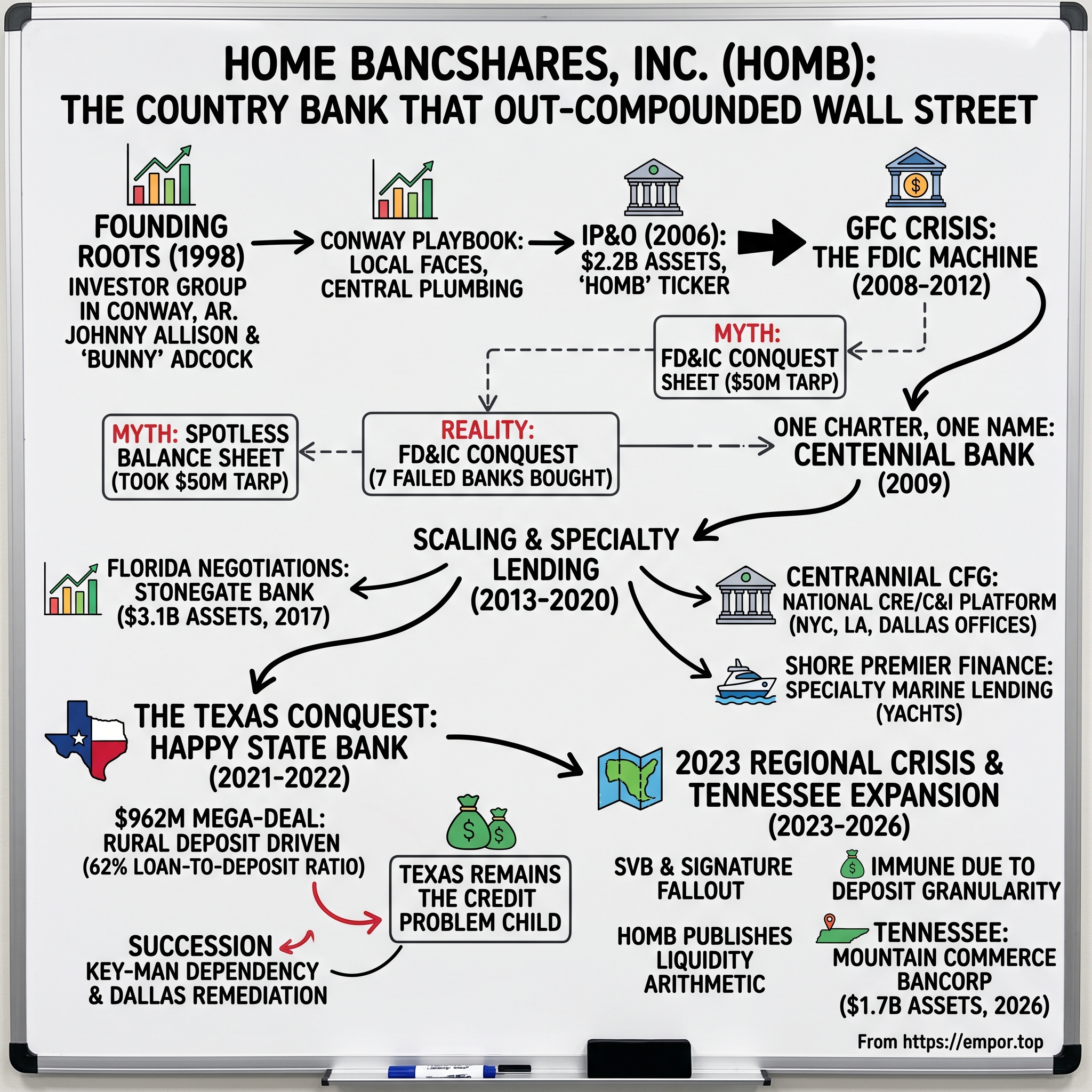
Home BancShares, Inc.: The Country Bank That Out-Compounded Wall Street
I. Introduction & Episode Roadmap
On the afternoon of July 16, 2026, a 79-year-old man from Conway, Arkansas, sat in front of a conference line full of sell-side analysts and finished his prepared remarks the way a trial lawyer finishes a closing argument: "You know, Your Honor, I rest my case."1
The case John W. "Johnny" Allison was resting concerned a quarter that, by the standards of American banking in 2026, looked almost implausible. Home BancShares had just reported record total net revenue of $295.1 million, record adjusted pre-tax pre-provision net revenue of $171.2 million, and adjusted net income of $128.1 million — all while absorbing $12.7 million of merger costs from closing an acquisition in a brand-new state.2 Its adjusted efficiency ratio came in at 40.46%. Its net interest margin held at 4.51%. Its adjusted return on average assets was 2.09%.2
Those numbers deserve translation, because they are the entire story. The efficiency ratio measures what share of a bank's revenue gets consumed by overhead — salaries, branches, technology, compliance. A typical American regional bank runs somewhere in the mid-50s to low 60s. Home BancShares runs around 40, meaning roughly sixty cents of every revenue dollar drops toward pre-tax profit before credit costs, versus perhaps forty cents at a median peer. Net interest margin is the spread between what a bank earns on loans and securities and what it pays for deposits and borrowings; 4.5% is roughly a full percentage point above where most similarly sized banks operate. And return on assets of 2% is, in banking, the number that separates the genuinely excellent from the merely competent — most large regionals aspire to 1.1% to 1.3%.
So the first question this story has to answer is not whether Home BancShares is profitable. It plainly is, and has been for a long time. The question is why, whether the reasons are durable, and what it would take to break them.
Who Home BancShares Actually Is
Home BancShares (NYSE: HOMB) is the Conway, Arkansas-headquartered holding company for a single bank subsidiary, Centennial Bank.3 As of June 30, 2026, it held $24.71 billion in total assets, $17.13 billion in loans and $19.11 billion in deposits, operating branches across Arkansas, Florida, Texas, Tennessee, South Alabama and a single office in New York City.24 It is not a diversified financial conglomerate. It takes deposits in small and mid-sized Sunbelt communities, lends the money out mostly against real estate and small business cash flows, and refuses — loudly, repeatedly, on the record — to chase growth by cutting price or loosening structure.
The Narrative Arc
The arc runs like this. A group of Arkansas investors formed a holding company in 1998 and started buying small community charters.3 It went public in 2006 with roughly $2.2 billion in assets. When the financial crisis destroyed the Florida real estate economy, it bought seven failed banks out of FDIC receivership and turned a distressed state into its second home market.3 It consolidated everything under one charter and one brand.
From there it bought its way into South Florida, into national commercial real estate lending, into yacht finance, into Texas via a $962 million deal for Happy State Bank in 2022, and into Tennessee via a $146 million all-stock deal for Mountain Commerce Bancorp that closed on April 1, 2026.354 Along the way it moved its listing from NASDAQ to the New York Stock Exchange, kept the same ticker, and never moved its headquarters out of a 33,000 square foot building on Harkrider Street in downtown Conway.3
Three themes run underneath all of it. The first is disciplined opportunism: a willingness to hoard capital in good times specifically so that someone else's crisis becomes your entry point. The second is cost structure as strategy rather than as a line item — the argument that when your overhead is fifteen points of revenue lower than a competitor's, you can decline the bad loan they feel compelled to make. The third is demographic tailwind arbitrage: the systematic migration of capital out of slow-growing rural Arkansas and into Florida, Texas and Tennessee.
Each of those deserves to be tested rather than admired. Cost discipline is only a moat if it is structural and not simply the product of a favorable revenue mix. Opportunism only compounds if deals are actually accretive rather than merely large. And a Sunbelt footprint is a tailwind for loan demand but also a concentration of commercial real estate risk in exactly the markets that overbuilt fastest. As of mid-2026, all three of those tensions were live — and one of them, a single $110 million Texas credit, had already put a visible dent in the credit statistics.6
The story starts, as most Arkansas business stories do, with a man who was not originally a banker at all.
 Subscribe on LinkedIn
II. Founding Context & The Conway Banking Roots (1998–2007)
Johnny Allison grew up in Jonesboro, in Arkansas's northeast delta country, and took a business administration degree from Arkansas State University in 1969.7 His first act as an entrepreneur was not finance. He bought mobile home factories.7 That detail matters more than it looks. Manufactured housing in the 1970s was a brutally low-margin, working-capital-hungry, cyclical business where survival was a function of watching unit costs obsessively and never getting caught with inventory when demand turned. It is a reasonable guess that the cost fanaticism that later became Home BancShares' calling card was learned on a factory floor rather than in a bank's asset-liability committee.
Allison moved into banking through board seats and ownership stakes rather than through a training program, eventually chairing First National Bank of Conway. By the mid-1990s he had accumulated capital, relationships across central Arkansas, and a specific view of what community banking got wrong: too many charters, too many redundant back offices, too much overhead per dollar of revenue, and boards too polite to say so.
In 1998, Allison and Robert H. "Bunny" Adcock, Jr. led an investor group that formed Home BancShares as a holding company in Conway.37 The following year they opened their first subsidiary bank, First State Bank, and then began buying: Community Bank, Bank of Mountain View, and eventually a small institution called Centennial Bank.7 By the time the model matured, the company had acquired and integrated 23 banks across four states.3
The Conway Playbook: Local Faces, Central Plumbing
The structure they chose was unusual for its time and is central to understanding everything after. Most acquisitive community bank holding companies of that era ran a federation — each acquired bank kept its own charter, its own board, its own operations staff, its own core processing contract. It preserved local pride and produced terrible economics, because the overhead never consolidated. Home BancShares ran the opposite play: keep local bankers and local loan committees with real decision-making authority, but centralize everything a customer never sees.
That philosophy survives verbatim in current filings. Local directors' loan committees hold approval authority up to $6.0 million of aggregate debt on new secured loans, with individual officer authority scaled by experience from as little as $5,000 up to $3.0 million.3 The bank explicitly describes its model as "experienced bankers and community bank boards who are empowered to make customer-related decisions quickly," paired with a centralized loan review process designed to catch problems early.3 A borrower in Panama City or Amarillo gets a decision from someone who knows the town. The data center, the compliance function and the vendor contracts sit in Conway.
The distinction is worth dwelling on, because "local decision-making" is the single most over-claimed phrase in community banking. Nearly every regional bank's marketing says it. What separates rhetoric from reality is whether the local authority comes with local accountability — whether the officer who booked the loan is the one who has to explain it when it goes bad. Home BancShares' internal culture, as described consistently across two decades of earnings calls, is built on precisely that pairing, and Allison's own framing in 2026 was that "it's extremely important that your entire team, from the top down to the junior lender, must have lending experience. Not only lending experience, but quality lending experience with skin in the game."1
Going Public, Quietly
The company went public in June 2006, listing on the NASDAQ National Market under the symbol HOMB. It was a modest affair by the standards of the era — Stephens Inc. as book-running lead manager, Piper Jaffray and Sandler O'Neill as co-managers, and an over-allotment exercise in late July 2006 that raised roughly $6.3 million in net proceeds on 375,000 additional shares.8 At the time, Home BancShares was a financial holding company with five separate bank subsidiaries: three in central Arkansas, one in Stone County, and — significantly — one already operating in the Florida Keys and southwest Florida.8 Total assets at the end of 2006 were about $2.19 billion.
That Florida toehold, acquired years before anyone thought of Florida as distressed, is the kind of detail that looks like foresight in hindsight and was probably closer to opportunism at the time. But it mattered enormously. When the crisis came, Home BancShares was not a stranger bidding on assets in a state it had never seen. It had operators, licenses and local knowledge already on the ground.
The pre-crisis balance sheet was conservative by the standards of 2006 and 2007 — loan-to-deposit ratios kept in check, no meaningful appetite for the structured mortgage products that were then being marketed to community banks as a yield solution. That conservatism was about to be tested by the worst banking environment in seventy years, and it would prove to be the most valuable asset the company owned.
III. The Great Financial Crisis: The FDIC Acquisition Machine (2008–2012)
Picture the Florida Panhandle in the summer of 2010. Condominium towers in Panama City Beach standing half-empty. Land developers who had bought raw acreage at 2006 prices sitting on collateral worth a third of the loan. And a string of small banks — Wakulla Bank in Crawfordville, Gulf State Community Bank in Carrabelle, Coastal Community Bank in Panama City — whose entire loan books were bets on a single, collapsed thesis.
Every Friday evening, the FDIC would close a handful of them. And on most of those Fridays, somewhere in the bidding process, there was an envelope from Conway, Arkansas.
Home BancShares entered the crisis with roughly $2.58 billion in assets at the end of 2008 and a decision to make. Regional banks broadly faced three options: shrink, raise dilutive capital, or fail. Allison's team chose a fourth, which was to treat other institutions' distress as inventory.
Myth vs. Reality: The Spotless Balance Sheet
Before crediting that decision as pure balance-sheet purity, one nuance belongs in the record, because it complicates the tidiest version of the story. In January 2009, Home BancShares issued 50,000 shares of Fixed Rate Cumulative Perpetual Preferred Stock to the U.S. Treasury under the Capital Purchase Program of the Emergency Economic Stabilization Act — $50.0 million of TARP capital, carrying a 5% dividend rising to 9% after five years.9 The company repurchased all 50,000 shares on July 6, 2011 for approximately $50.4 million including accrued dividends, and bought back the associated Treasury warrant later that month for roughly $1.3 million.10
Taking CPP money was not a sign of weakness — Treasury pushed the program on healthy institutions precisely to remove the stigma, and Home BancShares repaid early and profitably for taxpayers. But the fact sits awkwardly beside the frequently repeated narrative that the company sailed through the crisis on its own capital alone. It went in with $50 million of government preferred stock reinforcing its ratios at exactly the moment it wanted to be aggressive. The honest version is that Home BancShares was strong enough to be a buyer and prudent enough to take cheap capital when it was offered.
What it did with that capacity was remarkable. In 2010 alone, Centennial Bank acquired six failed Florida institutions from the FDIC with loss-share coverage: Old Southern Bank in Orlando, Key West Bank, Coastal Community Bank in Panama City, Bayside Savings Bank in Port Saint Joe, Wakulla Bank in Crawfordville, and Gulf State Community Bank in Carrabelle.1112 Across the full cycle, seven of the 23 banks Home BancShares has acquired came through FDIC-assisted transactions.3
It is worth being precise here, because the folklore around this period tends to inflate. Home BancShares did not buy eighteen failed banks. It bought seven — and integrated eighteen banks in total since 2010, most of them healthy institutions purchased in ordinary negotiated deals.3 The FDIC chapter was decisive, but it was a chapter, not the whole book.
How an FDIC Deal Actually Works
The economics of an FDIC-assisted deal are worth explaining plainly, because they are genuinely strange. A failed bank's assets are marked down brutally before sale — often 20% to 30% below carrying value. The acquirer typically assumes the deposits at or near par and receives the discounted assets, sometimes with a cash payment from the FDIC to bridge the gap. Loss-share agreements then had the FDIC absorbing the large majority of credit losses on covered assets for a defined period. The buyer's real exposure was not credit; it was operational. Could you actually collect on a portfolio of broken construction loans in a town you'd never visited, while simultaneously converting the core system and keeping the depositors from leaving?
That is where the Conway back office mattered. A bank with a federated structure and thin central operations could not absorb six institutions in twelve months. A bank built explicitly to consolidate could. And the loss-share mechanism converted the acquirer's real skill — problem-loan workout — into the primary source of return.
One Charter, One Name
In 2009, the company aligned all of its holdings under a single charter and the Centennial Bank name.37 This was not a marketing exercise. One charter meant one regulator relationship, one set of policies, one core processing contract, one compliance apparatus. The single-charter decision is arguably the most consequential structural choice in the company's history, because it is what allows the efficiency ratio to survive each new acquisition. Every deal since has been an operational bolt-on rather than a new federation member.
The financial transformation was steep. Total assets went from $2.58 billion at the end of 2008 to $3.76 billion at the end of 2010 and $4.24 billion at the end of 2012 — a 64% expansion during a period when the American banking system as a whole was contracting. Shareholders' equity grew from $283 million to $515 million over the same span.
For investors, the lesson of this period is less about heroism than about preparation. The FDIC deals were available to anyone with capital, an operations platform, and regulatory standing. Very few banks had all three in 2010, and the ones that did — Home BancShares and its Little Rock rival Bank OZK among them — captured a disproportionate share of the spoils. The capability was built in the boring years. That is the part that is hard to copy.
By 2012, Home BancShares had a Florida franchise stretching from the Panhandle to the Keys, a proven integration machine, and a management team that had learned something dangerous and useful: that the best returns in banking come from buying, not building.
IV. Scaling the Franchise & Specialty Lending (2013–2020)
The FDIC window closed as quickly as it opened. By 2013 the failed-bank pipeline had dried up, and Home BancShares faced the awkward question that confronts every crisis-era consolidator: what do you do when the discounts disappear?
The answer, over the next seven years, was three-fold — buy healthy Florida banks at negotiated prices, build a national commercial lending platform, and buy a specialty lending niche nobody else wanted.
Stonegate and the "Triple A" Test
The Florida strategy culminated in Stonegate Bank. On March 27, 2017, Home BancShares announced a definitive agreement to acquire the Pompano Beach-based institution, which operated 25 branches with significant presence in Broward and Sarasota counties and held approximately $3.1 billion in assets, $2.5 billion in loans and $2.7 billion in deposits.13 The announced consideration was approximately $749.8 million to shareholders — $50.0 million cash and $699.8 million in Home stock — plus $28.6 million to option holders, for a total of roughly $778.4 million.13 By the time the deal closed on September 26, 2017, share price movement had lifted the total to approximately $820.0 million.14
Allison called it "a game-changer for Home in the Florida market" and described it as "another 'Triple A' transaction... accretive to earnings per share, accretive to book value."13 That "Triple A" framing — accretive to EPS, accretive to tangible book value, and accretive on a third dimension the company has variously described as capital or franchise value — became the company's public M&A discipline test, and it is a genuinely useful lens for investors because it is falsifiable. Most acquisitive banks accept tangible book value dilution and promise an "earn-back period" of three to five years. Home BancShares' stated rule rejects that trade outright.
Whether the rule has actually been honored is a fair question, and the evidence is mixed rather than uniformly flattering. Stonegate was priced at a meaningful premium to tangible book — Florida franchises in 2017 were not cheap — and Home BancShares' own goodwill balance tells the story: it rose from $378.0 million at the end of 2016 to $927.9 million at the end of 2017 and $973.0 million by 2019, before jumping again to $1.398 billion after Happy. Goodwill is the accounting residue of paying above net asset value. A company that genuinely never dilutes tangible book does not accumulate a billion dollars of it. The more accurate characterization is that Home BancShares has been unusually disciplined about the price it pays relative to peers, not that it has paid nothing.
Two Platforms Nobody Expected
Alongside the bank deals, two platform businesses emerged that changed the revenue mix in ways that are easy to underweight.
The first was Centennial Commercial Finance Group, created in 2015 after the company acquired a pool of national commercial real estate loans. Centennial CFG operates a national lending platform focused on commercial real estate plus commercial and industrial credit, run out of the New York City branch office with loan production offices in Los Angeles and Dallas.3 This is not community banking. It is a wholesale, relationship-driven, deal-by-deal business competing against money-center banks and private credit funds — and it is run by Chris Poulton, whose description of the business on the Q2 2026 call was refreshingly unromantic: "It's hard to predict loan growth when your goal isn't loan growth."1
The second was Shore Premier Finance. On July 2, 2018, Home BancShares announced it had acquired SPF, the marine lending division of Union Bank & Trust of Richmond, Virginia, effective as of June 30, 2018. Union received approximately $374.5 million in cash plus 1,250,000 Home shares; SPF carried approximately $384.2 million in total assets including $383.4 million in loans.15 The business provides direct consumer financing on U.S. Coast Guard-registered high-end sail and power boats, plus inventory floor plan lines to marine dealers.15 In 2020 the company bought LH-Finance, the marine lending arm of People's United Bank, and folded it into SPF; in February 2022 it added roughly $242.2 million of yacht loans from LendingClub Bank.3
Yacht lending sounds like a punchline until the underwriting is examined. These are large-balance loans to high-net-worth borrowers against documented, registered, insurable collateral with an active secondary market, at yields well above prime residential mortgage. Allison's stated logic was that the company is "always looking at acquisition opportunities to provide the strongest risk adjusted return for our investors."15 The strategic value is that it is a national-scale, high-yield asset class that a $20 billion bank can dominate because the money-center banks find it too small and the credit unions lack the expertise.
It is also, importantly, a real source of loss when the cycle turns. In the second quarter of 2026, Shore Premier Finance accounted for $1.9 million of Home BancShares' $5.8 million in net charge-offs and carried $11.9 million of non-performing loans — meaningful for a portfolio of its size.2 Specialty lending diversifies revenue; it does not eliminate credit risk, and marine collateral values are correlated with exactly the same consumer wealth conditions that drive the rest of the book.
Through all of this, the efficiency ratio held. That is the genuinely impressive part of the 2013–2020 stretch: total assets roughly quadrupled from $4.2 billion to $16.4 billion, the branch count expanded across four states, and the overhead ratio did not deteriorate. The mechanism was the single charter plus a repeatable integration playbook — and an internal cost campaign the company branded "Build-A-Better-Bank," led by Donna Townsell before she became head of investor relations and a director.16
By 2020, Home BancShares was a $16 billion Sunbelt bank with a national lending arm, a marine niche, and a management team that had run out of obvious things to buy in Florida. Which is when it started looking west.
V. The Texas Conquest: Happy State Bank Mega-Deal (2021–2022)
Texas is to American bank M&A what Manhattan real estate is to global property: the market everyone wants, at prices that usually make the math impossible. Deposit franchises in Dallas–Fort Worth and Austin trade at premiums that reflect a decade of in-migration, and any acquirer paying those premiums accepts years of tangible book value dilution.
Home BancShares found a way around the problem, and the way was geography. It did not buy a Dallas bank. It bought a Panhandle bank that happened to have a Dallas bank inside it.
Happy Bancshares, headquartered in Amarillo, was the parent of Happy State Bank — an institution whose name derives from the tiny town of Happy, Texas, and whose slogan-worthy branding masked a serious agricultural and commercial franchise. As of December 31, 2021, Happy held approximately $6.81 billion in total assets, $3.59 billion in loans and $5.81 billion in deposits across 62 Texas locations.5
Read those three numbers together, because they are the entire rationale for the deal. Happy had $5.81 billion of deposits funding only $3.59 billion of loans — a loan-to-deposit ratio near 62%. In banking terms, Happy was drowning in cheap, sticky, rural core deposits it could not profitably deploy. West Texas farm and ranch communities generate enormous deposit balances relative to local credit demand. Home BancShares, meanwhile, had loan origination capacity in Florida, a national CRE platform, and a marine business — all of which needed funding.
The transaction closed on April 1, 2022. Home issued approximately 42.4 million shares valued at approximately $958.8 million, plus roughly $3.1 million in cash to holders of stock appreciation rights, for total consideration of approximately $961.9 million.5 With completion, the company operated 76 branches in Arkansas, 78 in Florida, 62 in Texas, five in South Alabama and one in New York City.5 Allison called the entry into Texas "the long-awaited entry... at just the right time and with all the right deal attributes."5
The Hardest Deal He Ever Did
Integration was another matter entirely, and the company has been unusually candid about it. On the second-quarter 2026 call, more than four years after closing, Allison volunteered: "I have been involved in over 50 M&A deals. Happy was certainly the most difficult. Even with all the problems associated with the acquisition, we have worked our way through those problems with a good partnership of Happy and Home employees together."1
That is a striking admission from a CEO with a strong incentive to declare victory, and it deserves weight in any assessment of management credibility. The problems were concentrated in the Dallas region, where the credit culture of the acquired institution did not match Conway's standards. Home BancShares eventually installed Mike Cook to lead the Dallas region, and Allison's 2026 framing was that "that region now reflects the credit culture of Home's operating and underwriting standards."1 The word "now" is carrying four years of remediation.
Texas remains the company's problem child in the credit statistics. At June 30, 2026, Texas accounted for $123.9 million of the company's $185.3 million in non-performing loans and $139.5 million of $228.6 million in non-performing assets — roughly two-thirds of the total on both measures.2 That concentration traces directly back to the Happy footprint and to one credit in particular, discussed below.
On brand strategy, the company made a choice worth noting. Rather than immediately painting every Texas branch with the Centennial logo, Home BancShares operated the Texas franchise as "Happy State Bank, a Division of Centennial Bank," preserving customer affinity in more than 40 Texas communities while consolidating everything behind the counter.17 This is the local-brand-central-control principle applied at scale, and it is a genuine insight about deposit stickiness: depositors are loyal to a name and a branch manager, not to a charter.
Did They Overpay? Benchmarking the Deal
Did Home BancShares overpay? The honest answer requires separating two questions. On price, roughly $962 million for a bank with $6.81 billion in assets and a low-cost deposit base was not obviously expensive by 2021 standards, particularly given the deposit surplus. On execution, the four years of Dallas credit remediation and the resulting non-performing loan concentration represent a real, quantifiable cost that no announcement-day accretion model captured. The deal expanded the company's asset base past $22 billion and materially improved its funding profile. It also imported a credit culture that took years to fix. Both statements are true.
The more uncomfortable observation is what happened to growth afterward. Total assets stood at $22.88 billion at December 31, 2022 — and $22.88 billion at December 31, 2025.3 Three full years of essentially zero balance sheet growth. Earnings rose over that span, from $392.9 million in 2023 to $475.4 million in 2025, but the growth came from margin expansion, expense control and share count reduction rather than from the franchise getting bigger.3 For a company whose identity is built on compounding, that flat line is the single most important fact in the recent record.
Which explains a great deal about why, in late 2025, management went looking for another deal.
VI. The 2023 Regional Bank Crisis & Tennessee Expansion (2023–2026)
In the second week of March 2023, the American banking system experienced its fastest deposit run in history. Silicon Valley Bank failed on a Friday. Signature Bank failed on a Sunday. First Republic followed in May. Regional bank equities collapsed indiscriminately as the market tried to identify who else had funded long-duration securities with hot, uninsured, concentrated deposits.
Home BancShares' response was to publish arithmetic.
In the first-quarter 2023 earnings release, the company disclosed $2.74 billion in net available internal liquidity — $2.15 billion of unpledged investment securities, $407.2 million at the Federal Reserve, and $185.9 million in other liquid accounts — plus $4.18 billion in net available external liquidity across the FHLB, the Fed's discount window and the newly created Bank Term Funding Program, for $6.92 billion of total available liquidity.18 Allison's claim was blunt: the company's liquidity "provides more than 100% coverage for all uninsured and uncollateralized depositors," and could have paid every such depositor in full "and still have $1.7 billion remaining."18
Why the Run Never Reached Conway
Why was Home BancShares structurally immune to the failure mode that killed SVB? Three reasons, and they are worth separating because only two of them are strategy.
The first is deposit granularity. SVB's deposits were concentrated among venture-backed startups who all banked with the same handful of firms and could coordinate withdrawal in hours. Home BancShares' deposits come from small businesses, farmers, municipalities and retail households across hundreds of towns. These depositors do not have a group chat.
The second is duration. SVB funded a long-dated held-to-maturity securities portfolio with short-dated deposits, so rising rates destroyed the economic value of its assets while its liabilities repriced immediately. Home BancShares held $1.26 billion of held-to-maturity securities at the end of 2025 against a $22.9 billion balance sheet, with an estimated effective portfolio duration of 4.9 years.3 The securities book is a supporting player, not the main asset.
The third — and this is the part that is circumstance rather than genius — is that a bank with a 4.5% net interest margin has never needed to reach for yield in the bond market. High-margin lending made securities-portfolio risk-taking unnecessary. Banks with 3% margins felt pressure to stretch. That is a consequence of the business model rather than a separate act of foresight, but it is exactly the kind of second-order benefit that makes a high-margin franchise more resilient than its headline metrics suggest.
The crisis was not costless. The FDIC's special assessment to recapitalize the Deposit Insurance Fund after SVB and Signature cost Home BancShares $13.0 million in the fourth quarter of 2023 and another $2.3 million in the second quarter of 2024 — a bill for someone else's risk management.3
Through 2024 and 2025 the company navigated the high-rate environment with margin largely intact, though not without incident. In 2024 it recorded $48.1 million in credit loss expense, of which $33.4 million established a hurricane reserve for loans in FEMA disaster areas hit by Hurricanes Helene and Milton — a reminder that a Florida-heavy franchise carries climate risk that no interest rate model captures.3 By 2025, credit loss expense had fallen to $20.9 million and full-year net income reached a record $475.4 million.3 Management's compensation disclosures put full-year 2025 adjusted return on assets at 2.05%, adjusted return on tangible common equity at 17.44%, adjusted efficiency ratio at 41.29% and the net charge-off ratio at 0.06%.16
Tennessee: The Volunteer State Deal
Then, on December 7, 2025, Home BancShares signed a merger agreement with Mountain Commerce Bancorp of Knoxville, Tennessee.3 The deal closed on April 1, 2026. Home issued approximately 5.4 million shares valued at approximately $146 million, with Mountain Commerce shareholders receiving 0.85 Home shares for each of their own. Mountain Commerce carried approximately $1.77 billion in total assets, $1.49 billion in loans and $1.54 billion in deposits as of December 31, 2025, and brought eight Tennessee branches.4
The strategic logic is transparent: Knoxville, Nashville and the Tri-Cities represent the same demographic setup that made Florida and Texas work, and Mountain Commerce ran a lean, profitable operation. Allison's characterization of the deal on the closing announcement was that its "swift completion... is a testament to the new M&A environment," a reference to a materially faster regulatory approval process than the industry endured from 2021 through 2024.4
The economics have so far run ahead of plan. On the Q2 2026 call, Allison said the merger earnings "came through a little earlier and a little stronger than we anticipated," and framed the test explicitly: "A successful merger is where the two companies should be creating more value together than either company can achieve separately. In our view, the meaning of that is one plus one should equal three, not 1.75."1 Pressed by Raymond James analyst Michael Rose on what specifically was driving the outperformance, Allison's answer was more instinct than analysis — he described watching the daily profit-and-loss statement and thinking "Where'd that come from, and how'd that happen?"1 Chief Financial Officer Brian Davis added a more concrete explanation: purchase accounting accretion rose $2.5 million in the quarter, of which $1.5 million related to Mountain Commerce.1
That distinction matters and is worth flagging clearly. Purchase accounting accretion is the amortization of the discount taken on acquired loans — it is a real economic benefit, but it is finite, front-loaded and accelerates when loans pay off early. It is not the same thing as durable earnings power. Total purchase accounting accretion rose to $3.6 million in Q2 2026 from $1.1 million in Q1, and Davis confirmed roughly $900,000 came from early payoffs.21 A portion of the "stronger than expected" Mountain Commerce contribution is therefore accounting mechanics rather than operating improvement. The actual cost savings — modeled at 20% of Mountain Commerce's expense base, roughly $5.5 million annually — will not arrive until the systems conversion in November 2026.1
The $110 Million Question
Meanwhile, the credit picture deteriorated in a way that was highly specific and highly visible. Non-performing assets to total assets, which had run between 0.55% and 0.60% through 2025, jumped to 0.97% in the first quarter of 2026 and stood at 0.93% at June 30, 2026.2 The cause was a single credit. On the April 2026 call, Allison disclosed that the company had placed a $110 million Texas loan on non-accrual status — a credit "we have been talking about for a year and a half or two years" that had remained current until that quarter, monitored intensely for about eight months, and subject to a short-term forbearance agreement with multiple deadlines.6 He was explicit about the expected outcome: "We are either going to get paid off or we will liquidate the existing collateral. We do not anticipate any additional loss."6
Three months later, that position was unchanged. Allison reported significant movement, no income recognized on the loan during the quarter, and reiterated "we expect no further loss," with the balance still "a little less than $100 million."1 Allowance coverage of non-performing loans improved to 177.19% from 163.43%, and the allowance for credit losses rose to $328.4 million, or 1.92% of total loans.2
For investors, this episode is a live test of management credibility rather than a resolved question. Management has been specific, has repeated the same forecast across two consecutive quarters, and has backed it with a reserve level near the top of the industry. That is the behavior of a team that expects to be held to its words. But the loan is not resolved, the collateral has not been liquidated, and a 1.08% non-performing loan ratio is roughly double where this company has historically run.2 The claim is testable, and the next few quarters will test it.
VII. Deep Dive: Business Segments, Revenue Drivers & Financial Machine
Strip away the geography and Home BancShares is a machine with four inputs and one output. The inputs are cheap deposits, high-yield loans, low overhead and low credit losses. The output, in the second quarter of 2026, was $295.1 million of revenue and $128.1 million of adjusted earnings.2 Understanding the machine means understanding where each input comes from and how fragile it is.
The community banking franchise — Arkansas, Florida and South Alabama — is the deposit engine and the historical core. It generates the granular, low-cost, relationship-based funding that makes everything else possible. In the second quarter of 2026, roughly $1 billion of the company's $1.4 billion in total loan production came from the community bank footprint.1 Florida is also where the growth optionality now sits: Allison described "more going on in the Florida market right now than we've ever had," including a $350 million slate of approvals in a single loan committee meeting and one Miami construction project he called "the best and most fabulous project ever built in Miami, Florida."1 That enthusiasm cuts both ways — large Miami construction exposure is precisely the kind of concentration that looks brilliant in an up-cycle and defines the loss content of a down-cycle.
The Texas franchise contributes commercial, agricultural and middle-market lending plus the low-cost West Texas deposit base that was the original rationale for Happy. It also carries the company's largest credit concentration problem. In June 2026 the company opened a new branch in Rockwall, in the Dallas–Fort Worth metroplex — its first de novo Texas expansion since San Antonio in 2025, and a signal that management now considers the Dallas region rehabilitated enough to grow.13
Centennial CFG operates the national commercial real estate and C&I platform. It originated roughly $800 to $900 million in the first half of 2026 and, notably, was flat in balances during Q2 because production offset anticipated payoffs.1 Poulton's competitive read is worth recording because it is a rare on-the-record description of private credit's behavior: pricing in the market has come down roughly 50 basis points over two years, with periodic bursts of aggression in construction lending where "somebody will step up and get pretty aggressive on price for a few months. They generally do that, and then they fill up, and they go away."1
Shore Premier Finance supplies high-yield marine assets nationally, sourced through loan production offices in Chesapeake, Virginia and Baltimore, Maryland.3
Mountain Commerce Bank is the newest vector, adding Knoxville and Nashville exposure with a lending philosophy that Chief Lending Officer Kevin Hester described as similar enough to Home's own that the combination "has gone very smoothly" with "a shorter learning curve and earlier meaningful contribution."1
Where the Revenue Comes From
On the revenue side, the mix is overwhelmingly spread income. In the second quarter of 2026, net interest income after credit loss expense was $236.4 million against $53.5 million of non-interest income.2 Fee income sources include service charges, trust and wealth management (partly through an alignment with Ameriprise), mortgage banking, loan recovery income and CFG fee income. Management's guidance on the run rate is refreshingly plain: Chief Executive of Centennial Bank Stephen Tipton noted that non-interest income has averaged about $50 million over the trailing five quarters and "that's kind of where we would expect things to be over the long term," after a weak $44 million first quarter that Allison dismissed as an anomaly — "We got no kick, just nothing."1
The Margin, Deconstructed
Now the margin, which is where the real story lives. The reported net interest margin of 4.51% in Q2 2026 included event income; the core margin excluding it was 4.47%.1 Loan yields excluding event income averaged 6.96% and exited the quarter at 6.99%. On the funding side, interest-bearing deposit costs averaged 2.38% and total deposit costs were 1.85%, exiting at 1.84%.1 The spread between a 7% asset yield and a 1.85% blended funding cost is the whole business.
That spread faces a specific, identifiable threat, and management named it. Tipton stated that competition on the deposit side is "probably the biggest threat," with $1.25 billion of certificates of deposit maturing in the second half of 2026 at rates in the mid-3% range, renewing at or below that level so far but vulnerable if competitors force pricing higher.1 On the asset side, new production yields came in around 6.75% in Q2 — below the 6.96% portfolio average — meaning new loans are being booked at a spread-dilutive rate.1 Hester's framing was direct: "we are seeing loan rates from the competitors creep lower and lower, while probabilities for the next Fed interest rate move are up rather than down."1
That last observation carries an underappreciated implication. Home BancShares is asset-sensitive: Tipton disclosed that the asset-liability model shows almost a 6% increase in net interest income in an up-100-basis-point scenario.1 Rising rates help. Falling rates hurt, and Allison described a rate-cutting cycle as the hardest environment his bank faces — "when the rates start down, then people try to jump ahead of a loan rate and go in and cut the rate a point and a half or so."1
Myth vs. Reality: Is the Efficiency Ratio Really a Moat?
The efficiency ratio deserves a skeptical look rather than reflexive admiration. Home BancShares' adjusted 40.46% is genuinely peer-leading, and the company's peer group comparison in its own incentive plan showed 2025 efficiency in the 94th percentile against U.S. banks with $10 billion to $50 billion in assets.16 But the efficiency ratio is a fraction, and Home BancShares wins on both halves of it. Its numerator — non-interest expense of roughly $122.7 million per quarter excluding merger costs — is genuinely lean.1 Its denominator is inflated by a net interest margin a full point above peers. A bank with a 3.5% margin and identical expense discipline would show an efficiency ratio in the high 40s. So the moat is real but compound: it is a cost advantage multiplied by a revenue advantage, and the revenue half is more cyclical than the cost half.
The Fortress, and Its Cost
Capital is the least ambiguous part of the story. At June 30, 2026, common equity tier 1 stood at 16.4%, total risk-based capital at 19.0%, leverage at 14.0%, and tangible common equity to tangible assets at 13.22%.2 Those are extraordinary levels — most large regionals run CET1 in the 10% to 12% range. Book value per share reached $22.68 and tangible book value per share $15.32, the latter growing $0.45 in the quarter for a 12.1% annualized rate.21 The parent company held nearly $450 million in cash.1
That capital position is simultaneously the company's greatest strength and its clearest strategic tension. Capital that sits idle is capital earning less than its cost. Home BancShares' return on equity of 10.55% versus its return on tangible common equity of 15.67% illustrates the drag: the goodwill from past acquisitions and the excess capital together depress the headline equity return.2 Management's answer is that the capital exists precisely to be deployed opportunistically — which only works if the opportunities arrive.
VIII. Current Management, Incentives & Capital Allocation Playbook
There is a moment on nearly every Home BancShares earnings call where the CEO says something no investor relations professional would have written for him. In July 2026, discussing competitors' underwriting, it was: "We're seeing some ridiculous stuff being done by some people in the marketplace... Anybody can get loan growth. Hell, it's nothing to loan growth. You can get all you want. Give it away, change the terms of the structure, and you can load the wagon."1
And then, on the subject of internal pressure to loosen standards: "I got people pushing me to lower our standards and go do that, and they can do that after I'm gone. After I retired, I go in the house. They can do that. They're not going to do it while I'm here."1
John W. Allison, age 79 as of the 2025 annual report, serves as Chairman of the Board and Chief Executive Officer of Home BancShares and Chairman of Centennial Bank.3 The plain-spoken country banker persona is real, and it is also a very effective delivery vehicle for what is actually sophisticated capital allocation thinking. When Allison says he refuses to dilute shareholders, he means something precise about exchange ratios and tangible book value per share, and he applies it in real time. In the second quarter of 2026 he walked away from an acquisition because his own stock had been temporarily depressed by the Texas non-accrual disclosure: "I couldn't get there because I would've diluted myself because they had my stock down to... 170 or something. I said it wouldn't work for me. He said, 'Well, that didn't work for us.'"1
That is a genuinely rare behavior. Most acquisitive CEOs, having publicly promised another deal, would have stretched. Allison let it go and said so on the record, then noted the seller "would be up 25% today" had they accepted.1 Whether that constitutes discipline or stubbornness depends on whether the deal comes back.
The bench around him has been institutionalized more than casual observers assume. Stephen Tipton, 44, serves as Chief Operating Officer of the holding company and Chief Executive Officer of Centennial Bank. Kevin Hester, 62, is President and Chief Lending Officer. Brian Davis, 60, is Chief Financial Officer. Donna Townsell, 55, is Senior Executive Vice President, Director of Investor Relations and a director — and previously ran the "Build-A-Better-Bank" campaign that drove the efficiency ratio down in the first place.316 On the calls, Tipton and Hester handle the technical detail with a fluency that suggests the analytical work is not being done by the chairman alone.
Succession, Family and the Boardroom
Succession, however, remains the loudest unanswered question in the story, and 2026 added a governance wrinkle rather than an answer. In January 2026, John W. Allison II — the chairman's son, a private investor who previously worked at Centennial Bank as a teller and loan assistant — joined the board of directors.16 He is also the nephew of Donna Townsell, herself a director and executive officer.16 Home BancShares now has a board containing the CEO, the CEO's son, and the CEO's sister-in-law's relationship to both. Independent-minded investors are entitled to ask whether that concentration of family representation is a succession signal, a governance concern, or both. The company has not disclosed a formal CEO succession plan.
On alignment, the ownership numbers are meaningful without being extraordinary. As of January 31, 2026, Allison beneficially owned 7,096,935 shares, or 3.57% of the 196,674,178 shares outstanding — including 865,360 shares held by his spouse and 436,000 shares of restricted stock. All 18 directors and executive officers as a group held 12,566,864 shares, roughly 6.4%.16 Co-founder Bunny Adcock held 1,445,267 shares.16 For context, BlackRock and Vanguard together were the only disclosed holders above 5%, at 11.89% and 10.34% respectively.16 Allison's personal stake was worth roughly $220 million at the company's late-July 2026 share price — enough that a 20% drawdown costs him more than a decade of salary and bonus. The alignment is real.
Incentives: The Right Metrics, the Wrong Hurdles
The compensation structure is where a skeptical investor should slow down, because it contains a genuine criticism.
Two-thirds of the chairman and CEO's annual equity-based compensation is subject to predetermined relative performance metrics measured against a peer group over a three-year period, and the cash Executive Incentive Plan uses a blend of absolute and relative measures.16 The metrics themselves are exactly the right ones: return on average assets, return on tangible common equity, efficiency ratio, net charge-off ratio and net interest margin.16 Clawback provisions are in place consistent with NYSE requirements. Shareholders endorsed the program with 94.4% support at the 2025 annual meeting.16
But look at the absolute targets for 2025. Return on average assets: target of at least 1.20%, actual 2.05%. Return on tangible common equity: target of at least 10%, actual 17.44%. Efficiency ratio: target under 47%, actual 41.29%. Net charge-off ratio: target of 1% or less, actual 0.06%.16 Every absolute hurdle was cleared by a wide margin — not because performance was extraordinary relative to expectation, but because the hurdles were set at levels the company has not approached in years. Allison earned 100% of his target bonus, $800,000, plus a $50,000 special cash bonus approved in January 2026 for the record year and the Mountain Commerce negotiation.16
The relative measures partially redeem the design — those required peer-group performance at the 66⅔ percentile or above, and the company delivered at the 91st to 97th percentile.16 An activist would nonetheless argue, fairly, that absolute targets set at roughly half of demonstrated run-rate performance are not incentives; they are formalities. The counter-argument is that the total dollar amounts involved are modest by regional bank standards and that Allison's real incentive is his equity stake, not his bonus. Both points are legitimate. The disclosure is a modest governance flaw in an otherwise well-aligned structure.
The Deployment Hierarchy
The capital allocation hierarchy in practice runs roughly as follows. Organic lending comes first, but only at prices and structures that clear the internal hurdle — which in the current market has meant declining a great deal of volume. Opportunistic M&A comes second, subject to the non-dilution rule. Buybacks come third, and became notably more aggressive in 2026: the company repurchased 500,000 shares in Q1 and 1.5 million shares in Q2 for $40.4 million, at an average price Allison put at roughly $25 to $26 — bought, pointedly, into the weakness caused by his own non-accrual disclosure.1 More than 15 million shares remained available under the existing authorization at June 30.1 The stated goal is explicit: repurchase the shares issued for Mountain Commerce, and by mid-year the company was "already approaching the halfway mark."1 The dividend was $0.21 per share quarterly, up from $0.20 a year earlier.2
Buying back stock issued for an acquisition is an elegant piece of capital management — it converts a nominally all-stock deal into an effectively cash-funded one, retroactively, at whatever price the market offers. It also has a limit. At roughly two times tangible book value, which is approximately where the shares traded in late July 2026, repurchases add far less per-share value than they did at $25. Allison acknowledged the constraint himself when he noted "our stock's back up close to two times tangible book now, that gives us the ability to move up and make somebody happy if they want a better price."1 The high valuation converts buybacks from a value creator into an acquisition currency. That is a reasonable trade, but investors should recognize it as a shift, not a continuation.
IX. Strategic Frameworks: Helmer's 7 Powers & Porter's 5 Forces
Frameworks are only useful if they discriminate. Applied honestly, Hamilton Helmer's 7 Powers gives Home BancShares credit on two dimensions, partial credit on a third, and nothing on the remaining four — which is itself informative.
Hamilton Helmer's 7 Powers Analysis
Process Power is the strongest claim, and it holds up better than most such claims do. Process Power exists when an advantage is embedded in organizational routines that competitors can observe but cannot copy quickly, because copying requires changing how thousands of people behave. Home BancShares' cost structure qualifies. It is not the product of a single clever decision; it is the accumulated residue of the single-charter architecture adopted in 2009, the centralized loan review function, the "Build-A-Better-Bank" campaign, the repeatable acquisition-integration playbook, and a chairman who personally polices expense creep. A competitor can read all of that in the 10-K. Replicating it would require consolidating charters, firing redundant staff, breaking vendor contracts, and surviving the cultural rupture. Most bank boards will not do that. The evidence for the power is that the ratio has survived roughly a sixfold increase in asset size since 2012 without deteriorating.
The honest qualification: as noted, the efficiency advantage is partly a margin advantage in disguise, and margin is cyclical in a way that expense discipline is not.
Cornered Resource is the second claim, and it is real but personal — which is precisely its weakness. Allison's deal-making judgment, his standing as a counterparty the FDIC and state regulators trust, and his willingness to say no are genuinely scarce assets. A cornered resource that walks out the door when one 79-year-old retires is not a durable structural advantage; it is key-man dependency wearing a nicer label. The relevant question is whether the resource has been institutionalized into Tipton, Hester and the credit committee structure. The Happy integration suggests partial success — the problems were identified and remediated by the organization, not by the chairman alone — but this remains unproven at the level of capital allocation, which is the part Allison has never delegated.
Scale Economies get partial credit. A $24.7 billion asset base spreads core processing, compliance and regulatory technology costs across a much larger revenue pool than a $2 billion community bank enjoys — and above the $10 billion threshold, Centennial Bank is subject to CFPB supervision, so it is already paying the fixed cost of large-bank compliance.3 But scale economies in banking exhaust relatively early and then reverse; the largest banks are not the most efficient. Home BancShares sits near the sweet spot: large enough to amortize technology, small enough to avoid the bureaucratic overhead that afflicts $200 billion institutions.
The remaining four powers are absent, and saying so matters. There is no Network Economy — a Centennial deposit account does not become more valuable as other people open one. There is no Switching Costs advantage beyond the ordinary friction of moving a checking account, which is real but modest and steadily eroding as account-opening moves online. There is no Counter-Positioning — Home BancShares does not do anything structurally that a competitor is unwilling to imitate; it simply does the ordinary things better. And there is no meaningful Branding power in the sense of pricing premium: depositors do not accept lower rates because the sign says Centennial.
That last point is worth sitting with. A bank without branding power or switching costs has no pricing power on the liability side. It defends deposit costs through relationships, service and inertia — all of which work until a competitor across the street offers 100 basis points more.
Porter's 5 Forces Analysis
Threat of new entrants: low. De novo bank formation in the United States has been near-dormant for fifteen years. Capital requirements, compliance infrastructure and technology spend make a subscale charter economically unviable. This is the one force unambiguously in the incumbent's favor.
Bargaining power of borrowers: moderate and rising. Prime commercial borrowers in Dallas, Miami and Nashville have many willing lenders, and the evidence from Home BancShares' own management is that borrower power is increasing — competitors offering rates "in the fives, the high fives, the mid fives" alongside looser structure and loan-to-value.1 Home BancShares' counter is speed of local decision-making, which is a genuine service advantage against megabanks but not against other well-run regionals.
Bargaining power of depositors: moderate to high. This is the force that most directly threatens the model. The company's total deposit cost of 1.85% is a competitive weapon, but it exists only because depositors have not fully repriced. The $1.25 billion of CDs maturing in the second half of 2026 is a concrete test of exactly how much power those depositors have chosen to exercise.1
Threat of substitutes: moderate and structurally increasing. Private credit funds now compete directly with Centennial CFG for commercial real estate and C&I paper, and Poulton's account of periodic aggressive pricing bursts confirms the pressure is real, not theoretical.1 Fintech competes for payments and consumer deposits. What substitutes cannot yet replicate is an FDIC-insured deposit relationship attached to a local lender who will answer the phone — but the moat there is narrower than it was a decade ago.
Rivalry: high. The Sunbelt is the most contested banking geography in America. Bank OZK, headquartered thirty miles from Conway in Little Rock, competes on the same national CRE lending turf. Simmons First is an Arkansas neighbor. Prosperity Bancshares dominates Texas. Cadence, Regions and Hancock Whitney compete across the Gulf South. And the money-center banks have branch networks in every metro Home BancShares wants to grow in. Rivalry in this industry expresses itself not through advertising but through underwriting standards, which is why Allison's repeated warnings about competitor structure and terms are the most economically meaningful thing he says on any call.
The synthesis: Home BancShares holds a defensible operating advantage inside a structurally unattractive industry. That is a perfectly good place to be — it simply means the returns come from execution rather than from industry economics, and execution advantages require continuous maintenance.
X. Investment Thesis: Bull vs. Bear Case, Risk Radar & Key KPIs
The Bull Case
The bull case rests on a single, testable proposition: that Home BancShares' 2%-plus return on assets is structural rather than cyclical, and therefore survives the next rate cycle.
The supporting evidence is reasonably strong. The company has delivered adjusted ROA between 2.02% and 2.10% in each of the last five quarters, through rate moves in both directions.2 It ranked in the 97th percentile of $10–50 billion U.S. banks on return on average assets and the 94th on efficiency in 2025, using S&P Global peer data compiled for its own compensation plan — an independent, third-party benchmark rather than a management assertion.16 The cost structure has proven durable across a sixfold increase in size. Capital at 16.4% CET1 provides both a shock absorber and an acquisition warchest, with nearly $450 million of parent-company cash sitting ready.21
The second pillar is optionality. The company sits in Florida, Texas and Tennessee — three of the fastest in-migration states in America — with capacity to lend far beyond current balances. Allison described "billions of dollars worth of opportunities" in the Florida pipeline from long-term customers, with uncertain timing.1 If even a fraction converts, the earning asset base grows without the company having to buy anything.
The third pillar is the M&A option. Management stated plainly on the July call that "it is our intention to do another M&A deal on the heels of Mountain Commerce," and identified a specific target it had bid on and lost.1 With a currency near two times tangible book and $450 million of holding company cash, the company has more acquisition capacity than at any point in its history — and a demonstrated ability to integrate.
There is also a defensive argument buried in the peer comparison that deserves airing. Home BancShares' closest structural analogue is Bank OZK, headquartered thirty miles away in Little Rock, which competes on the same national commercial real estate turf and emerged from the same FDIC-assisted era. The two banks made opposite bets on concentration: OZK built a specialized, highly concentrated construction lending franchise with very large individual credits, while Home BancShares kept its national platform smaller relative to a granular community banking base. Prosperity Bancshares in Texas runs a comparable efficiency discipline with a materially lower-risk loan mix and correspondingly lower margin. Simmons First, the other large Arkansas institution, has historically carried higher expenses. What Home BancShares occupies is the middle position — more margin than Prosperity, less single-name concentration than OZK, less overhead than most of the Gulf South regionals. Investors should recognize that middle position as a deliberate choice rather than a compromise, and should judge it by whether it holds through a credit cycle rather than through a benign one.
The Bear Case and Activist Stress Test
A skeptical investor would organize the attack around four points.
First, the growth has already stopped. Total assets were $22.88 billion at year-end 2022 and $22.88 billion at year-end 2025 — three years of zero balance sheet growth in the fastest-growing region of the country.3 Loans receivable were $15.69 billion at December 2025 versus $15.18 billion in June 2025 and $15.63 billion in March 2026 — essentially flat.2 Earnings grew, but through margin, expenses and share count. The company's own second-quarter organic loan growth was $26 million against a forecast decline of $600 million — a swing management celebrated but which underscores that the underlying trend is payoffs exceeding production.1 Hester conceded that third-quarter payoffs look higher still, with the gap wider than it appeared 90 days earlier.1 A compounding machine that cannot grow its earning assets is, over time, a melting ice cube with excellent margins.
Second, commercial real estate concentration is genuinely large. At December 31, 2025, commercial real estate loans represented 53.2% of gross loans and 194.3% of total stockholders' equity.3 Construction and land development alone stood at $2.78 billion at June 2026, with non-farm/non-residential CRE at $5.92 billion and multifamily at $1.27 billion.2 Multifamily has grown notably — from $620 million in June 2025 to $1.27 billion a year later — a doubling in a property type where national supply has run ahead of absorption in several Sunbelt metros.2 Home BancShares' stated underwriting caps are conservative on paper: generally up to 85% of improved property value, 65% of raw land, 75% of land to be acquired and developed.3 But underwriting standards constrain loss severity, not loss frequency, and the Miami construction enthusiasm Allison expressed in July adds to rather than diversifies this exposure.
Third, the Texas credit is unresolved and the credit statistics have degraded. Non-performing loans at 1.08% of total loans are roughly double the 0.54% to 0.63% range of 2025.2 Net charge-offs of $5.8 million in Q2 were four times the prior quarter's $1.4 million, though Hester noted nearly $3 million represented previously reserved specific allocations.21 Management has forecast no further loss on the $110 million credit for two consecutive quarters. If that forecast proves wrong, the financial damage is manageable against $328.4 million of reserves and $171 million of quarterly pre-provision earnings — but the credibility damage would be substantial, because this is the most specific public commitment management has made.
Fourth, governance and succession. A 79-year-old founder-CEO with no disclosed succession plan, whose son joined the board in January 2026, whose incentive plan sets absolute targets at roughly half of demonstrated performance, and whose personal judgment is explicitly identified by management as the constraint on underwriting standards ("they can do that after I'm gone").116 An activist would argue that the market is being asked to capitalize a 2% ROA in perpetuity on the assumption that one man's discipline is transferable. The company has not made the case that it is.
Second-Layer Diligence
A few items sit below the headline numbers and are worth periodic checking rather than continuous worry.
On ownership, the register is unusually institutional for a bank of this profile: BlackRock and Vanguard held 11.89% and 10.34% respectively as of the most recent disclosures cited in the 2026 proxy, meaning roughly a fifth of the company is held by index vehicles that will not vote against management on anything short of a scandal.16 That combination — a founder with 3.57%, insiders at 6.4%, and index funds above 22% — leaves relatively little of the register in the hands of investors who would actively press on succession or incentive design.16
On accounting, the two judgments that matter most are purchase accounting accretion, which mechanically flatters margin in the years after each acquisition, and the allowance for credit losses under the CECL methodology, where management's discretion over qualitative overlays is wide. The 2024 hurricane reserve of $33.4 million is a useful illustration of how large a single management judgment can be relative to quarterly earnings.3 Reserve coverage at 1.92% of loans is conservative in both directions: it protects against loss, and it gives management the option to release reserves in a weaker quarter. There is no evidence of that having happened, but it belongs on the watch list.
On non-core exposure, the marine business remains a genuine idiosyncrasy — a consumer luxury lending book inside a commercial bank — and the sole New York City branch exists primarily as a booking office for the national lending platform rather than as a retail franchise.3
A fifth, subtler point: Home BancShares' non-GAAP adjustments have grown numerous. The 2025 adjusted figures excluded the FDIC special assessment, BOLI death benefits, marketable securities fair value adjustments, a gain on sale of a building, recoveries on historic losses, special income from equity investments, merger expenses, a gain on retirement of subordinated debt, legal fee reimbursements and legal claims expense.16 Individually each is defensible. Collectively, a nine-item adjustment list is worth watching, particularly when it also determines executive bonus outcomes.
Current Risk Radar
The material risks, in order of proximity:
Deposit repricing in a falling-rate environment. The company is asset-sensitive. If the Fed cuts, loan yields reprice faster than the $1.25 billion of maturing CDs and the broader deposit book, compressing the margin that underwrites everything else.1 This is the single most consequential macro variable.
Commercial real estate credit migration. Not office — Home BancShares' exposure is more construction, multifamily and small-balance commercial — but Sunbelt multifamily and construction carry real revaluation risk if absorption slows.
Execution risk on integration. The Mountain Commerce conversion does not occur until November 2026, deferring the expected $5.5 million of annual savings to late 2026 and 2027.1 Happy demonstrated that Home BancShares' integration machine is not infallible.
Concentration of geographic and climate exposure. Florida represents the largest single market and is exposed to hurricane risk that produced a $33.4 million reserve build in 2024.3
Regulatory and capital change. As an institution above $10 billion, Centennial Bank already carries CFPB supervision and Durbin amendment interchange constraints.3 Any tightening of capital requirements for banks in the $10–50 billion tier would bind less on Home BancShares than most peers given 16.4% CET1 — this is a risk where the company is relatively advantaged.
The Three KPIs That Matter
Everything above reduces to three numbers that an investor should track each quarter.
1. Adjusted efficiency ratio. This is the load-bearing wall of the entire thesis. If it drifts sustainably above the low 40s outside of merger quarters, the cost advantage that justifies the premium valuation is eroding. Management's own stated expense target is a quarterly run rate around $120 million excluding merger costs.1
2. Core net interest margin, excluding purchase accounting accretion and event income. The reported margin flatters itself with acquisition accounting. The core number — 4.47% in Q2 2026 — is the honest measure of whether the spread business is holding.1 Watch it against deposit cost movements as CDs mature.
3. Non-performing assets to total assets, and the resolution of the Texas credit. The historical run rate was 0.55% to 0.60%; the current level is 0.93%.2 A return toward the historical range would validate management's forecast. A further increase, or a loss recognized on the $110 million credit, would call into question both the credit culture and the credibility of management's forward statements.
XI. Business & Investing Playbook Lessons
Efficiency is a weapon, not a virtue. The reason a 40% efficiency ratio matters is not that it looks tidy in a presentation. It is that a bank with fifteen points more of revenue falling to the bottom line can decline the marginal loan its competitor feels obligated to make. Every one of Allison's rants about competitors' "ridiculous" structures is only credible because Home BancShares can afford to say no. Cost advantage buys the right to be patient — and patience, in lending, is the entire risk management system. The corollary for investors is that a low cost structure should be evaluated not by what it adds to margins in good years but by what it allows a company to refuse in frothy ones.
Prepare in the boring years for the interesting ones. The FDIC deals of 2010 were won by a company that had spent the preceding decade building a centralized operating platform for reasons that had nothing to do with bank failures. The capability came first; the opportunity found it. This is the general form of crisis alpha — it is almost never available to those who start preparing when the crisis begins. The corollary is uncomfortable: it requires accepting years of apparently excessive conservatism, during which the stock will underperform peers who are levering up.
Local brand, central control. Preserving "Happy State Bank" on the sign in Amarillo while running the general ledger from Conway is a specific and transferable insight about where customer loyalty actually resides. Depositors are loyal to a name and a person, not a charter. Acquirers who rebrand immediately capture the cost synergies but often bleed the deposits that made the target worth buying — and in banking, the deposits are the asset.
Owner-operator economics change the questions that get asked. When a CEO's personal net worth is 3.57% of the company, the internal debate about a marginally dilutive acquisition is a debate about his own money. That does not guarantee good decisions, but it changes their character. The observable evidence is a CEO who publicly walked away from a deal he wanted because the exchange ratio did not work.1 The limitation, equally observable, is that this discipline has not yet been demonstrated to survive its owner.
Non-dilution is a rule, not an aspiration — and rules should be audited. Home BancShares' "Triple A" test is genuinely more demanding than the earn-back-period framing most acquirers use. But a company with $1.4 billion of goodwill has, at some point, paid above net asset value. The lesson is not that management is dishonest; it is that investors should audit stated capital allocation rules against balance sheet evidence rather than accepting the framing.
XII. Epilogue & Outro
As of late July 2026, Home BancShares was a $24.7 billion bank holding company operating 220 branches across six states, with a market capitalization of roughly $6.2 billion — a little over two times its tangible book value.24 It had just closed its second-largest-ever expansion into a new state, absorbed the accounting noise of doing so, and still produced its highest adjusted quarterly earnings on record.
What comes next is reasonably clear in outline and uncertain in timing. Organically, the company is waiting for Florida's construction pipeline to convert and for Texas and Tennessee to contribute the loan growth that has eluded the consolidated franchise for three years. On the conversion of Mountain Commerce's systems in November 2026, the cost savings arrive. On M&A, management has stated publicly that another deal is intended, and has identified — without naming — a specific institution it bid on and lost when its currency dipped.1 Allison closed the July call with the plainest possible statement of intent: "We hope to be able to tell you about another deal before long."1
And behind all of it sits the question the company has not answered. Allison told analysts in July that he does not "plan on going anytime soon."1 But the entire architecture of the story — the underwriting standards, the refusal to dilute, the willingness to sit on 16% capital while peers lever, the instinct that recognized Florida in 2010 and Amarillo's deposit surplus in 2021 — is attributed, by management itself, to one person's judgment. A bank can institutionalize a cost structure. Whether it can institutionalize a temperament is the open question, and it is the one that will determine whether the next twenty years look like the last twenty.
The broader lesson from Conway is almost aggressively unfashionable. There is no proprietary technology here, no network effect, no platform. There is a single charter, a centralized back office, local loan committees with real authority, an owner who counts the expenses, and a stated willingness to grow more slowly than competitors in exchange for not losing money when the cycle turns. In an industry that has spent four decades finding creative new ways to blow itself up — the S&L crisis, subprime, the 2023 duration mismatch — the most durable edge has repeatedly turned out to be the refusal to be clever.
Whether that edge survives its author is the story's unfinished chapter, and it is being written right now.
References
-
Home BancShares, Inc. Q2 2026 Earnings Call Transcript — Seeking Alpha, 2026-07-16 ↩↩↩↩↩↩↩↩↩↩↩↩↩↩↩↩↩↩↩↩↩↩↩↩↩↩↩↩↩↩↩↩↩↩↩↩↩↩↩↩↩↩↩↩↩↩↩↩↩↩↩↩↩↩
-
Home BancShares, Inc. Second Quarter 2026 Earnings Release (Form 8-K, Exhibit 99.1) — U.S. Securities and Exchange Commission, 2026-07-15 ↩↩↩↩↩↩↩↩↩↩↩↩↩↩↩↩↩↩↩↩↩↩↩↩
-
Home BancShares, Inc. Annual Report on Form 10-K for the Year Ended December 31, 2025 — U.S. Securities and Exchange Commission, 2026-02-27 ↩↩↩↩↩↩↩↩↩↩↩↩↩↩↩↩↩↩↩↩↩↩↩↩↩↩↩↩↩↩↩↩↩
-
Home BancShares, Inc. Announces Completion of the Acquisition of Mountain Commerce Bancorp, Inc. (Form 8-K, Exhibit 99.1) — U.S. Securities and Exchange Commission, 2026-04-01 ↩↩↩↩↩
-
Home BancShares, Inc. Announces Completion of the Acquisition of Happy Bancshares, Inc. (Form 8-K, Exhibit 99.1) — U.S. Securities and Exchange Commission, 2022-04-01 ↩↩↩↩↩
-
Home BancShares (HOMB) Q1 2026 Earnings Call Transcript — The Motley Fool, 2026-04-16 ↩↩↩
-
John W. Allison — Arkansas Business Hall of Fame, Sam M. Walton College of Business, University of Arkansas ↩↩↩↩↩
-
Home BancShares, Inc. Announces Underwriters Exercise Over-Allotment (Form 8-K, Exhibit 99.1) — U.S. Securities and Exchange Commission, 2006-07-27 ↩↩
-
Home BancShares, Inc. Announces Participation in the U.S. Treasury Capital Purchase Program (Form 8-K, Exhibit 99.1) — U.S. Securities and Exchange Commission, 2009 ↩
-
Home BancShares, Inc. Announces Repurchase of Preferred Stock Issued to the U.S. Treasury (Form 8-K, Exhibit 99.1) — U.S. Securities and Exchange Commission, 2011 ↩
-
Home BancShares and Centennial Bank Build Presence in Florida Panhandle With Strategic Acquisition — NBC News, 2010 ↩
-
Two of the Best Banks in America Join Forces in Bank Merger (Form 8-K, Exhibit 99.1) — U.S. Securities and Exchange Commission, 2017-03-27 ↩↩↩
-
Home BancShares, Inc. Announces Completion of the Acquisition of Stonegate Bank — GlobeNewswire, 2017-09-26 ↩
-
Home BancShares, Inc. Announces Acquisition of Loan Portfolio and Creation of Marine Finance Division (Form 8-K, Exhibit 99.1) — U.S. Securities and Exchange Commission, 2018-07-02 ↩↩↩
-
Home BancShares, Inc. Definitive Proxy Statement (Schedule 14A) — U.S. Securities and Exchange Commission, 2026-02-27 ↩↩↩↩↩↩↩↩↩↩↩↩↩↩↩↩↩↩↩↩
-
About Us & Our History — Happy State Bank, a Division of Centennial Bank ↩
-
Home BancShares, Inc. First Quarter 2023 Earnings Release (Form 8-K, Exhibit 99.1) — U.S. Securities and Exchange Commission, 2023-04-20 ↩↩
 LinkedIn
 WhatsApp
 Reddit
 Hacker News
 Email
Email Kindle
 RSS Feed
 Spotify
 Apple Podcasts
 Amazon Music
 Audible
 YouTube