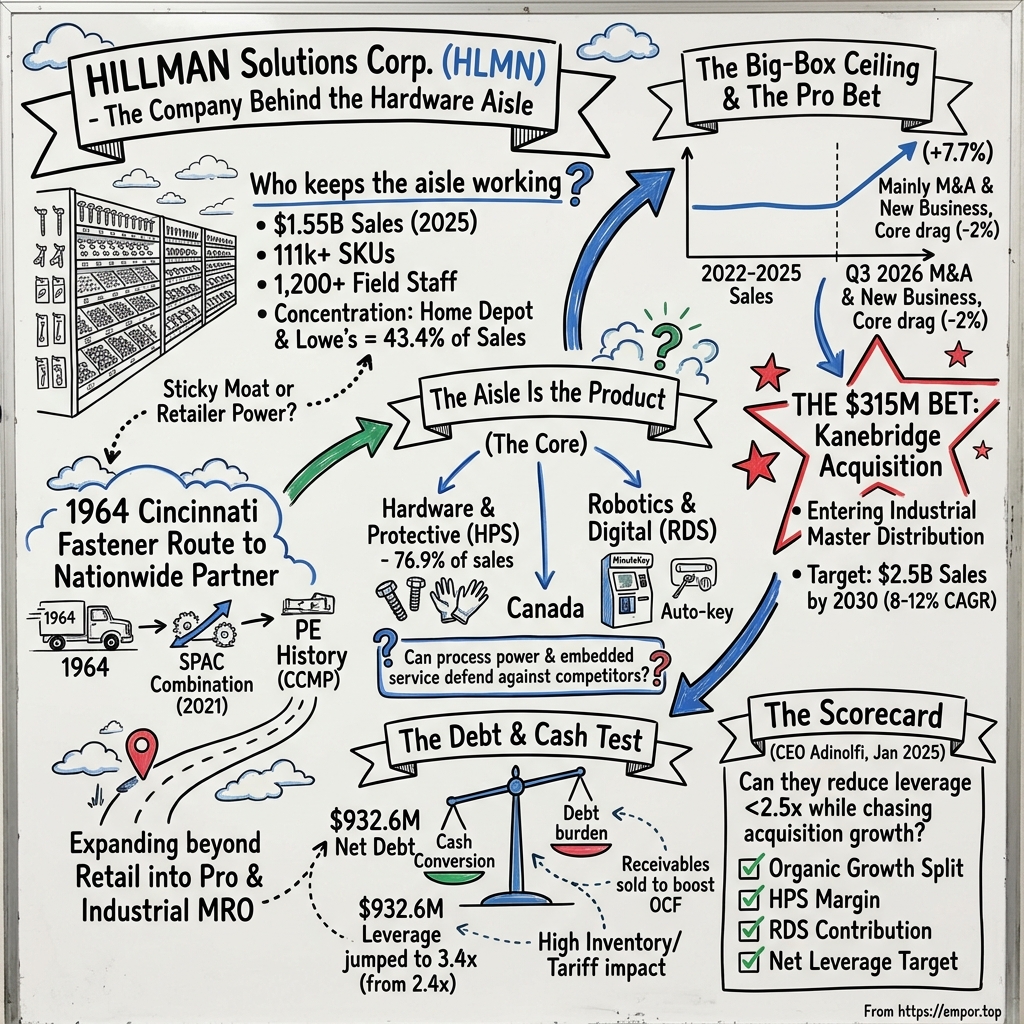
Hillman Solutions Corp.: The Company Behind the Hardware Aisle
I. Who Keeps the Hardware Aisle Working?
Picture a Saturday morning in a big-box home-improvement store. A homeowner walks past the lumber and the riding mowers and turns into the aisle nobody photographs: the long wall of small drawers, hooks and blister packs.
There are wood screws in a dozen lengths, picture-hanging wire, cotter pins, wall anchors, hinge pins, a single stainless-steel hex bolt in exactly the thread pitch that broke on the deck chair. The shopper needs one item that costs less than a cup of coffee. If the drawer is empty, the whole trip has failed.
Most shoppers have never heard of the company that probably filled that drawer. Hillman Solutions Corp. sells the fasteners, hooks, letters, numbers, gloves and other small hardware that line those walls, and at the end of the aisle it often runs the self-service key-cutting kiosk too.1 Behind the products sits a service operation that shoppers rarely see: a field team of more than 1,200 people who visit stores, restock bins, reset displays and keep the machines running.1
The scale is larger than the aisle suggests. In 2025 Hillman reported about $1.55 billion of sales from a catalogue of more than 111,000 stock-keeping units.1 That is not a single-product manufacturer with a famous brand. It is a sourcing, distribution and merchandising platform: it buys an enormous number of small things, mostly from contract suppliers, and delivers them to the right shelf at the right time, with someone on hand to fix the shelf when it goes wrong.
One ratio makes the point better than any slogan. Hillman ended 2025 with 3,986 full- and part-time employees.1 If more than 1,200 of them work in the field, then something like three in every ten people on the payroll spend their days inside other companies' stores.
That is an unusual shape for a distributor. Most of its peers organise around warehouses and trucks. Hillman organises around the shelf itself, and it pays for that choice in wages, travel and management attention every week of the year.
That platform has two very big customers. Home Depot accounted for about 22.5% of Hillman's 2025 sales and Lowe's for about 20.9%, so together the two orange and blue boxes bought about 43 cents of every dollar Hillman sold.1 That single fact frames the whole story. The service model may make Hillman hard to replace, yet the companies it would be hard to replace at are among the most powerful buyers in American retail.
So four questions run through this episode. The first is whether Hillman is winning organically or buying its growth, because the latest quarters mix new programmes, acquisitions and a soft market in ways that need to be pulled apart.
The second is whether the field-service model creates a defensible advantage with retailers that could, in principle, give the drawer to someone else. The third is whether the company converts earnings into cash while tariffs push up what it pays for products and inventory swings from year to year. The fourth is whether it can keep buying businesses and still bring its debt down.
The recovery that makes these questions urgent is real. After two years in which sales drifted lower, Hillman grew again in 2025, and in the third quarter of 2026 it reported record sales of about $457.5 million, up nearly 8% from a year earlier.2 In the same results, though, management trimmed its full-year sales range because the market's volumes had not improved as much as it had assumed.3 Growth and disappointment arrived in the same press release.
Then there is the bigger ambition. In March 2026 Hillman held an investor day and said it planned to reach $2.5 billion of sales by 2030, with a push beyond the retail aisle into professional contractors and industrial maintenance supplies.4 Five months later it agreed to buy Kanebridge, an industrial fastener master distributor, for about $315 million, much of it funded with debt.5
The story that follows moves from the retailer relationship, through the economics behind the aisle, to the Pro and industrial push and the debt that pays for it. Along the way it keeps returning to a question the income statement cannot answer by itself. Home Depot and Lowe's have other suppliers to call. What would make a retailer keep Hillman on the shelf anyway?
To answer that, the story has to start much smaller, with a regional fastener business in Ohio.
 Subscribe on LinkedIn
II. The Fastener Route Became a Retail Service Business
Hillman began in Cincinnati in 1964 as a supplier of fasteners and small hardware to independent hardware stores.6 The founding insight was not glamorous, and it did not need to be. Neighbourhood hardware stores could not afford to stock, count and reorder thousands of slow-moving little parts themselves. A supplier that took the whole category off the owner's hands, kept the bins full and made money on the breadth of the catalogue rather than on any single item had a reason to exist.
That idea, small items and big assortments delivered with service, turned out to be portable. Over the following decades the company moved from fasteners into adjacent categories such as keys, letters and numbers, picture-hanging hardware and other pegboard items, and from independent stores into national chains and home centres.6 Each new category made the same truck stop and the same store visit more valuable. Each larger retailer made the business bigger, and also more dependent on fewer buyers.
Ownership changed repeatedly along the way. Hillman passed through several private-equity owners, a pattern common for steady, cash-generating distributors that can carry debt. The most recent of those owners, CCMP Capital, made a control investment in 2014.1 That deal changed who owned the company and how much it borrowed. It did not create a new business. The aisle, the field team and the customer list continued as before, now inside a more leveraged capital structure.
The decade that followed was a period of steady expansion in nominal terms. Reported sales were about $787 million in 2015 and rose to roughly $838 million by 2017.76 By 2025 they were about $1.55 billion.1 That is close to a doubling in ten years, which sounds like a compounding machine until one remembers how it was built.
The period included acquisitions, changes in ownership and a pandemic-era surge in home projects, so the line from $787 million to $1.55 billion is not a clean record of organic growth. It tells you that Hillman got much larger. It does not tell you how much of that came from selling more to the same stores.
The early part of that decade is revealing precisely because it was quiet. From 2015 to 2017, sales grew by roughly 3% a year, the pace of a mature supplier riding modest growth in home repair and adding the occasional product line.76 Nothing in those years suggested a business that could double on its own.
The doubling came later, and it came with acquisitions, a pandemic spike in do-it-yourself projects and a larger balance sheet. That pattern matters for today's plan, because the investor-day targets ask Hillman to grow far faster than its own quiet years ever did.
Private-equity ownership also left a lasting imprint on the accounts. Each buyout restated the company's assets at the price the new owner paid, creating large balances of goodwill and intangible assets such as customer relationships and trade names.
Those intangibles are amortised year after year, which is one reason Hillman's reported net income has long looked thin beside the cash the business produces. That accounting legacy returns when the story reaches the cash-flow statement, but its origin is here, in the sequence of owners who each paid a full price for the same aisle.
The next turn came in 2021, when Hillman went public by merging with Landcadia Holdings III, a special-purpose acquisition company.8 SPAC deals of that era were sold on investor presentations full of projections, and Hillman's was no exception. The transaction presentation valued the company at roughly $2.6 billion of enterprise value, about 11 times the adjusted EBITDA it projected for 2021.9
That multiple is useful as a starting benchmark, but it does not settle whether public investors got a bargain. Any peer comparison built from the deal materials depends on which industrial and distribution companies one accepts as peers. A cleaner test is to ask what happened afterward.
Sales fell slightly in each of 2023 and 2024, and the company reported net losses in 2022 and 2023 before returning to profit.110 Five years after the listing, the market valued the whole enterprise at about the same dollar figure as the SPAC presentation did, while the debt had grown and the EBITDA had grown with it. That comparison returns later, when the story reaches today's price.
CCMP sold the last of its shares in the second quarter of 2023.1 For the first time in decades, Hillman had no controlling financial sponsor. The company that remained was a public, widely held distributor with a well-defined core: the retail hardware aisle.
That core is where Hillman wants to break out, into Pro distribution and industrial MRO.4 Before judging whether that platform can travel, it is worth understanding what the platform actually is, and that requires going back into the aisle at the moment a Hillman representative walks in.
III. The Aisle Is the Product
It is a weekday morning, before the weekend crowds. A Hillman field representative walks into a home centre with a handheld scanner and a list. The job is unglamorous. Count what is missing from the fastener drawers. Fill the gaps.
Straighten the peg hooks that customers have rearranged. Swap in a new display for a product line the retailer has just added. Check that the key kiosk at the front of the store is cutting cleanly and has blanks loaded. Then move on to the next store.
That visit is the clearest way to understand what Hillman sells. The invoice says screws, anchors and keys. The retailer is also buying something harder to put on an invoice: a category it does not have to manage. Hillman offers the store a single supplier that can keep an awkward, labour-intensive section of the store stocked and tidy.1
The business is organised into three segments, and their sizes matter. Hardware and Protective Solutions, the core fasteners, hardware, gloves and personal-protective products, made up about 76.9% of 2025 sales.1 Robotics and Digital Solutions, the key duplication, engraving and kiosk business, generated about $220 million.1
Canada, a geographic segment selling a similar mix north of the border, accounted for the remainder, less than a tenth of the total. So when people talk about Hillman, they are mostly talking about the first segment. The kiosks are interesting, and they get their own chapter, but the investment case rises or falls on the aisle.
The mechanics of the sale are ordinary for a distributor. Hillman buys and distributes physical products and recognises revenue when control passes to the customer, generally on delivery.1 Its contracts generally do not run beyond one year.1 The company does not disclose a recurring-revenue share or minimum purchase commitments from retailers.
In other words, the relationship is sticky by habit and operational convenience, not by contract. What keeps the sales coming is customer sell-through, the retailer's decisions about shelf space and category assortment, pricing and Hillman's own ability to keep the shelf working.
That last point is a moat claim, and it needs testing. Hillman's case is that a retailer gets more value from a full, well-merchandised section with a service team behind it than from a slightly cheaper supplier that ships cartons to the loading dock and leaves the shelf to store employees.
The argument is easy to believe in the abstract. A store manager who has to staff the fastener aisle with already busy associates bears a real cost, and an empty drawer costs a sale and often a customer trip.
But Hillman is not the only company offering this. In retail fasteners and key-related categories it names competitors such as Midwest Fastener and Hy-Ko, and in fasteners it competes with Fastenal's Elco operation.1 As it moves into Pro and MRO channels, it meets much larger industrial distributors, including Fastenal and W.W. Grainger.1 Hillman does not publish market-share figures that would allow those names to be ranked against it, so its relative scale in each category remains a reasonable inference rather than an established fact.
Testing the moat at the shelf
Michael Porter's five-forces lens makes the tension plain. Buyer power is the dominant force: two retailers take more than two-fifths of sales, and the contracts are short. Supplier power looks moderate, because Hillman sources a huge catalogue of commodity-like items from many manufacturers, although tariffs on imported steel and products have shown that the cost of those goods can move against it.3
The threat of substitutes is real at the product level, since a screw is a screw, but weaker at the service level, where a replacement must also field a store team. New entrants face the challenge of building that team and a catalogue broad enough to take over a whole category. Rivalry is present but fragmented, with specialist suppliers in each niche.
Hamilton Helmer's seven powers sharpen the question further. Hillman shows no network effect; a store's experience does not improve because other stores use Hillman. Nor does it hold a protected resource such as a patent wall or a regulatory licence that shuts out rivals.
The plausible powers are process power, meaning the accumulated know-how of replenishing a vast assortment across thousands of stores efficiently, and a form of switching cost, meaning the disruption a retailer would face in pulling out an entire category and its service team at once. Scale economies may help in sourcing and route density, but the company does not publish data that proves a cost advantage over peers.
Now try to break it. The most direct test of switching costs is retention: how often has Hillman lost a programme at a major retailer, and how often has it won one back? The company does not publish a company-wide customer-retention or lost-programme figure. The concentration figures offer only a partial read.
Home Depot's share of sales was about 23.3% in 2023 and about 22.5% in 2025, while Lowe's moved from about 20.1% to about 20.9%.1 Those shares are stable, which suggests the two relationships have held through a weak cycle, but stable shares are consistent with both a strong moat and a buyer that simply has not yet chosen to move.
Price realisation is the second test, and here the evidence is thin. A supplier with real pricing power passes cost increases through quickly and holds margin when volumes fall. The company says it has raised prices to offset tariffs, and management's full-year adjusted gross margin outlook of about 48% suggests it has protected margin reasonably well.3
Yet management also describes its core performance as a blend of market volume, customer footprint, category management, foreign exchange, mix and price, all netted together.3 When the price effect is folded into a single core number, an outsider cannot measure how much pricing power the company actually has.
The third test is whether every assortment earns its place. In 2023 Hillman recorded a $24.6 million write-down tied primarily to product offerings.1 That charge is a reminder that breadth is not automatically value. Some lines did not earn their keep, and the company had to mark them down. It does not refute the moat, but it narrows it: the advantage belongs to the service system around the categories that sell, not to the catalogue as a whole.
Weighed together, the history leaves the moat intact but unproven. The stable concentration figures through a soft market suggest the relationships are durable. The absence of public data on retention, fill rates, shelf wins and losses, and price realisation means the size of the advantage cannot be measured from outside.
The evidence that would strengthen the claim is clear: disclosed programme retention, price realisation separated from volume, fill-rate data and a concentration trend that stays steady while Hillman grows elsewhere. The evidence that would weaken it would be a major shelf reset at one of the two largest customers or margins that fall faster than volumes.
Whatever the size of the moat, it has to work in a market that has been moving sideways. That is where the recovery story begins to show its limits.
IV. The Big-Box Recovery Has a Ceiling
On November 2, 2026, Hillman reported the largest third-quarter sales in its history.2 A day later, on the earnings call, the same management team explained why it was lowering the midpoint of its full-year sales outlook by about 1.5 percentage points.3 Both statements were true, and the gap between them is the clearest way to understand where Hillman stands.
Start with the longer view. Sales were about $1.49 billion in 2022, the year the pandemic home-improvement boom began to fade.1 They slipped to about $1.48 billion in 2023 and about $1.47 billion in 2024.1 These were not collapses.
They were the slow drift of a business tied to a housing and repair market in which high mortgage rates froze home sales, and with them the weekend projects that follow a move. Then 2025 brought a return to growth, to about $1.55 billion, finally above the 2022 level, with acquisitions and new programmes doing much of the lifting.1
The third quarter of 2026 is the main test of whether that recovery has become self-sustaining. Reported sales of about $457.5 million rose 7.7% from a year earlier.2 Management then broke the increase apart. Roughly five percentage points came from new business wins. Roughly five came from acquisitions. And the core, the underlying business of existing products at existing customers, subtracted about two points.3
That bridge changes the headline. Strip out the acquisitions and the business grew about three percent, all of it from new programmes, while the base it already served shrank. A record quarter, in other words, was a quarter in which Hillman won more shelf than it lost but sold less through the shelf it already had. That is evidence of commercial effort and some competitive success. It is not evidence of a market recovery.
The new-business number is worth unpacking because it is the part management controls. About 3.5 points came from retail, including an expansion of Builders Hardware at one of its top customers, and nearly 1.5 points came from Pro customers.3
The retail wins suggest that the big boxes still give Hillman more of the aisle when they reorganise it. That fits the moat argument. The caveat is that a programme win is a one-time step up. Once a win has been rolled into stores, it stops counting as new business and becomes part of the core, which then rises or falls with the market.
The segments tell a similar story when read in proportion. Hardware and Protective Solutions, the bulk of the company, grew 5.4% in the quarter.2 Robotics and Digital Solutions grew 19.2%, and Canada grew 9.2%.2 The fastest rates belong to the smaller segments.
RDS growth is real and partly reflects the kiosk upgrade programme, but on a base of roughly a seventh of sales its contribution to the company total is far smaller than its growth rate suggests. Canada is smaller still. The decisive figure is the mid-single-digit growth in Hardware and Protective Solutions, a rate that includes acquired revenue and therefore overstates its organic pace.
On the call, prepared remarks and analyst questions revealed different things. In the prepared remarks, Chief Executive Jon Michael Adinolfi described volumes that had improved but were lower than anticipated, which was the reason for narrowing the sales range to about $1.66 billion to $1.68 billion.3 When analysts pressed, the answers became more concrete in some places and less in others.
Asked about the fourth quarter, management said market headwinds would look more like the third quarter than earlier ones, and that new business would add somewhere above 3.5% and up to 5%.3 That is a quantified answer, and it implies that management no longer expects a sequential pickup in market volumes this year.
Analysts also tried to measure Kanebridge's partial-quarter contribution. Lee Jagoda of CJS Securities asked for its revenue and EBITDA, and management declined to break it out, saying only that the business was performing ahead of expectations.3 That qualitative reassurance may prove accurate, but it leaves investors unable to separate acquired revenue from organic revenue within the segment figures, which is exactly the separation the growth question requires.
Other questions probed the quality of the margin rather than the size of the top line. Andrew Carter of Stifel asked about gross margin in the core segment, and the CFO described the third-quarter level as a good number while warning about seasonal swings.3
Matthew Bouley of Barclays asked why selling and administrative costs had risen as a share of sales, and received an answer that pointed to the kiosk business rather than the aisle.3 Taken together, the exchanges suggest a company whose margins were holding but whose volume story depended heavily on what it could add rather than on what it already sold.
That distinction matters because the drivers behave differently over time. Market volume is cyclical: it falls with housing turnover and rises when people move, renovate and repair again. New business is lumpy: it arrives when a retailer resets an aisle, and then it stops arriving.
Acquisitions are purchased: they add revenue at the cost of capital and debt. A company growing mostly through the second and third drivers while the first is negative can report growth for a while, but it needs the first to return before that growth becomes self-sustaining.
Behind all of this sits the structural constraint of serving two dominant retailers. Their decisions about store traffic, inventory levels and aisle resets matter more than any macro forecast.1
A large retailer that trims inventory to protect its own cash flow can reduce Hillman's sales without changing a single shelf assignment. A retailer that resets an aisle and gives a category to a rival could remove a meaningful slice of revenue in a single decision. The wins in Builders Hardware show the upside of that power; the same power could run the other way.
The concentration story also has a quieter side. Ace Hardware's purchasing cooperative represented about 17.1% of Hillman's trade receivables at the end of 2025.1 When the True Value cooperative filed for Chapter 11 in October 2024, Hillman had about $8.8 million of net receivables exposed and took an $8.6 million charge, while saying it expected to keep most of the related sales through the buyer and direct billing to stores.10 The episode showed both sides of the model: the store-level relationships survived the collapse of the intermediary, but the balance sheet still took the hit.
So Hillman is gaining business, and it can show where. The harder question is how much of that becomes repeatable organic growth once each win has been absorbed into the base. Management's answer, delivered on the same call, was to point beyond the retail aisle altogether, toward a new market and a $315 million acquisition to get there.
V. The $315 Million Bet on Pro
On August 3, 2026, Hillman announced that it would acquire Kanebridge, a master distributor of industrial fasteners, describing the deal as the start of an industrial master-distribution presence in the United States.5 A master distributor sits one step back from the shelf.
It holds deep inventory of fasteners and sells them to the distributors who in turn serve contractors, maintenance departments and manufacturers. Kanebridge carries more than 44,000 SKUs.3 For a company whose entire history had been about retail aisles, it was a new kind of customer and a new kind of business.
The purchase price was about $315 million.511 The same day, S&P Global Ratings left Hillman's BB issuer rating in place but put the BB+ rating on its first-lien term loan on CreditWatch negative, citing the expected debt-funded purchase.12 Rating agencies rarely react to a deal of this size unless it moves leverage, and this one did.
The strategic logic is coherent on paper. Hillman wants to sell to specialty distributors, lumber and building-material dealers, and industrial MRO customers, using the sourcing scale, product breadth and field relationships it built for retailers.4 Management's investor-day framing calls this "Win the Pro." The idea is that the same organisation that keeps a home centre's fastener aisle full can supply the professional contractor's counter and, with Kanebridge, the industrial distributor's warehouse.
The investor day attached large addressable-market estimates to that ambition.4 Those estimates are management's framing of the opportunity, not revenue Hillman can count on. Each market it names is already served by entrenched distributors, including Fastenal and Grainger, whose businesses are built on precisely the industrial customer relationships Hillman wants to develop.
A large market is a reason to try, not evidence of a right to win, and without disclosed customer counts, shares or margins in these channels, the opportunity cannot yet be sized as Hillman's own.
What did Hillman pay?
The announcement did not give Kanebridge's revenue or earnings, so at first the price could not be judged. The third-quarter call filled part of that gap. Explaining pro forma leverage, Chief Financial Officer Robert "Rocky" Kraft cited about $29 million of EBITDA that Kanebridge had generated over the previous twelve months.3 Dividing the purchase price by that figure implies roughly 11 times trailing EBITDA.
That number has a neat symmetry. It is about the same multiple at which Hillman itself went public in 2021, based on projected EBITDA, though that valuation is not a Kanebridge comparable.9 It is also above the roughly 9 times at which the market valued Hillman as a whole in early November 2026, a comparison the valuation chapter develops.
If Hillman paid 11 times for a business while its own shares traded near 9, the deal will create value only if Kanebridge grows faster than Hillman's core, earns higher returns, or improves under Hillman's ownership. The trailing EBITDA figure is management-defined and unaudited in the public record, and no synergy figures have been disclosed, so the multiple is an approximation rather than a verdict.
The company's earlier acquisition record offers little guidance at this scale. Hillman has a long history of small bolt-ons, such as the Monkey Hook picture hanger and the Ajustlock line, each immaterial to the group.13 Those deals show a habit of adding categories to the aisle. They do not establish a track record of buying, integrating and earning returns on a separate industrial distribution business worth hundreds of millions of dollars.
Two pieces of the company's own history argue for asking for post-deal evidence. The first is the 2023 product-offering write-down of $24.6 million, already met in the aisle: an investment in assortment that did not earn its expected value.1 The second is the 2022 annual report, which disclosed that the estimated fair value of two reporting units exceeded their carrying value by only a thin margin, so modest changes in assumptions could have forced a goodwill impairment.14
No goodwill impairment followed in 2023 through 2025, which is to the company's credit.1 Neither episode proves that Kanebridge will disappoint. Together they show that acquired value at Hillman has not always behaved as planned, and that a disciplined M&A claim has to be earned with returns rather than asserted.
The targets beside the record
At the investor day, management set out what Pro and acquisitions are supposed to deliver. The plan calls for $2.5 billion of sales in 2030 from a 2025 base of about $1.55 billion, which works out to annual growth of 8% to 12%; adjusted EBITDA growth in the low double digits; net leverage below 2.5 times; and return on invested capital in the high teens.4 Those are targets. Set beside a record of sales that sat below the 2022 level in both 2023 and 2024, they describe an acceleration Hillman has not yet demonstrated organically.
The call gave the most concrete version of how the plan is meant to build. Pro wins should add about 1% to company sales in 2026, about $16 million, and about 2%, more than $33 million, in 2027.3 When David Manthey of Baird pressed on the 2027 build, the CFO laid it out: acquisitions should contribute 3 to 4 points, new business at least 4 points split between Pro and retail, and core price and market a modest headwind.3
That is an honest bridge, because it admits that management does not expect the market to help. It also shows how much of the plan depends on continued acquisitions and on new programmes replacing themselves every year.
The Pro claims are therefore testable, and they should be tested on outcomes. The measures that matter are realised Pro sales against the $16 million and $33 million markers, Pro margins against the retail core, customer retention after the first year, and cash returns on Kanebridge against its roughly $315 million cost. Addressable-market slides will not answer any of those.
The deal also left a mark on the balance sheet. Growth can widen the market Hillman serves, but only cash generation and successful integration can bring leverage back toward the company's own target. That is the next test, and it begins with a puzzle about how a company earning $40 million of net income generates more than twice that in operating cash.
VI. The Growth Blueprint Meets a Debt Test
On the third-quarter call, management did something that sounds contradictory. It narrowed and lowered its sales range because volumes disappointed, and in the same breath held its adjusted EBITDA outlook at about $285 million and its free-cash-flow outlook at $105 million to $115 million.3 Fewer sales, the same profit and the same cash. For a distributor, that combination is possible, but understanding why requires following the money through the cash-flow statement.
The puzzle starts in 2025. Hillman reported net income of about $40.3 million and operating cash flow of about $105.2 million.1 The gap is mostly explained by one large non-cash cost. Depreciation and amortisation added back about $141.1 million, much of it the amortisation of intangible assets created by the company's past buyouts and acquisitions.1
That non-cash charge reduces reported profit without consuming cash today. The cash was spent when the deals were done.
The same statement shows the other side. Inventory absorbed about $79.4 million in 2025.1 Management cited tariffs as one reason for higher inventory costs, since every imported box on the shelf now costs more to buy and carry.1 So 2025 was a year in which a large non-cash charge flattered cash flow relative to profit, while a large inventory build pulled it back down.
A single year can mislead, so the three-year pattern is the better guide. Operating cash flow was about $238.0 million in 2023, about $183.3 million in 2024 and about $105.2 million in 2025.1 Over the same period, net income moved from a loss of about $9.6 million to income of about $17.3 million and then $40.3 million.1 Profit rose while operating cash flow more than halved. The reason is working capital.
In 2023 Hillman released more than $100 million of inventory it had accumulated, which inflated cash that year.1 By 2025 it was rebuilding, partly to absorb tariffs. Anyone who quoted 2023's cash flow as normal would have overstated the business; anyone who quoted 2025's would understate it. The real level likely lies between, and it moves with how much stock the company needs to hold.
There is a second, quieter source of cash that investors should keep in view. Hillman sells some of its receivables without recourse, mainly invoices owed by large customers, to financial institutions, and includes the proceeds in operating cash flow.1
It sold about $286 million to $310 million a year from 2023 to 2025, accepting losses on those sales of about $5.6 million to $6.3 million a year.1 In plain terms, Hillman gets paid early by a bank rather than waiting for the retailer, and pays a small fee for the privilege.
That arrangement is common among suppliers to big retailers, which often impose long payment terms, and it is legitimate. But it matters for interpretation. The programme improves the timing of cash, and as long as it runs at a steady scale, it does not inflate cash flow year after year. If it ever shrank, because a bank pulled back or a customer changed terms, operating cash flow would take a one-time hit as receivables built up on the balance sheet.
The financing is a recurring feature of how Hillman collects from its biggest customers, which ties the cash story back to retailer power. Net receivables were about $168.2 million at the end of September 2026, up from about $114.9 million at the end of 2025, a rise that partly reflects acquired receivables and seasonality.151
Tariffs belong in this story, but only through the mechanism that actually matters. Higher import costs raise the price Hillman pays for products, which it then tries to pass through to retailers; meanwhile, the inventory it holds becomes more expensive to carry.
On the third-quarter call, management said the net tariff effect had been consistent with the first half of the year and that modest tariff refunds had been largely offset by adjustments tied to Section 232 steel tariffs.3 That is a description of a cost that has been absorbed rather than one that has disappeared, and it explains some, not all, of the margin and cash movements.
The new debt and the new clock
At the end of 2025, Hillman owed about $637 million on its term loan and $36 million on its revolver, with net leverage of about 2.4 times adjusted EBITDA.12 Then came the refinancing and Kanebridge.
During 2026 the company replaced its facilities with a $735 million term loan maturing in 2033, a $375 million asset-based revolver maturing in 2031, and a $200 million add-on to the term loan to fund the acquisition.3 The term loan now costs SOFR plus 200 basis points.3 The maturity extension removed any near-term refinancing cliff, which is valuable for a company with a sub-investment-grade rating.
The balance sheet also carries obligations that do not appear in the headline debt figure. Operating lease liabilities, mostly for warehouses and offices, rose from about $63.5 million at the end of 2025 to about $90.3 million by late September 2026, a rise that coincided with the Kanebridge acquisition and management's plans for more distribution-centre capacity.115
Cash on hand was only about $35 million.15 Hillman runs lean on cash and relies on its revolver and receivables programme for liquidity, a sensible setup for a distributor so long as lenders and banks remain willing.
The cost was a larger debt load. By September 26, 2026, gross debt was about $967.7 million and net debt about $932.6 million.2 Reported net leverage rose to about 3.4 times, and about 3.1 times on a pro forma basis that includes a full year of Kanebridge's trailing EBITDA.23 Both numbers matter. The first shows the burden on the earnings Hillman actually reported. The second shows the burden if the acquired earnings are as large and as durable as management says.
Management's path back is explicit. Without further meaningful acquisitions, it expects to end 2027 at roughly 2.5 times leverage, the top of its long-term range.3 That plan depends on free cash flow, which Hillman defines as operating cash flow minus capital expenditures.
Against the 2026 outlook of $105 million to $115 million, the company expects capital spending of $70 million to $75 million, which implies operating cash flow of about $175 million to $190 million.3 That would be a large step up from 2025, achievable only if the inventory build slows and the Kanebridge cash flows arrive as expected.
Hillman has also been buying back stock while it borrows. It repurchased about 1.37 million shares for $12.4 million in 2025 and about 639,000 shares for $5 million in the third quarter of 2026, at an average of $7.75.13 The amounts are small relative to the debt, but they point to a choice an activist would question: every dollar spent on shares is a dollar not used to reduce leverage that the company's own incentive plan rewards it for reducing.
So the practical test for investors is straightforward to state and hard to meet. Over the next year, does Hillman convert growth and integration into cash that brings leverage down, or does each new deal reset the debt clock? The people responsible for answering that question are a management team still early in its tenure.
VII. The CEO's First Full-Year Scorecard
On March 24, 2026, Jon Michael Adinolfi stood in front of investors and presented the first five-year plan of his tenure as chief executive.4 Eight months later, on November 3, he explained why the company was lowering its full-year sales expectations.3 For a CEO who took over on January 1, 2025, those two moments bracket the record by which shareholders can judge him so far.16
Adinolfi is an operator rather than an outsider brought in to transform the company. Before becoming CEO, he led Hillman's U.S. business and served as chief operating officer, so he arrived at the top job already knowing the aisle, the field teams and the customers.16
He succeeded Douglas Cahill, who had run the company through its public listing and remained on the board.16 The finance chair turned over too. Former CFO Scott Ride separated from the company in September 2025, receiving about $649,000 in separation payments plus a prorated bonus and continued option vesting, and Robert Kraft became the chief financial officer.16
The tone Adinolfi has set is that of a sales-driven operator. The investor-day plan was built around winning new programmes, expanding into Pro and adding acquisitions. On the third-quarter call, he described Kanebridge as having closed ahead of schedule and performing ahead of expectations, while declining to give figures.3
When Brian McNamara of Canaccord Genuity asked about valuations in the acquisition market, he gave one of the more candid answers of the call, acknowledging some softening in his expectations of how far sellers' asking prices would come down.3 That is a small but telling admission: a CEO with an acquisition plan was signalling that targets were not getting cheaper.
How the pay plan defines success
The compensation design shows what the board wants him to deliver. Adinolfi's total compensation was about $3.72 million in 2025, compared with about $3.37 million in 2024 under the previous CEO and about $4.35 million in 2023.16 The annual bonus for executives weighted adjusted EBITDA at 60%, leverage at 20% and sales at 20%.16 Beginning in 2025, the performance-based stock units shifted to a return-on-invested-capital measure.16
In practice, that design should push management toward profitable growth without letting debt balloon. The leverage and ROIC components are unusually direct links to the capital-allocation questions this story has raised. If the company pays too much for acquisitions or lets debt climb, the bonus and long-term awards should suffer.
The caveat is that these measures depend on definitions. Adjusted EBITDA excludes items the board decides to treat as non-recurring, and ROIC depends on how invested capital is calculated. A generous adjustment policy can make a demanding scorecard easier to meet. The proxy's reconciliations, rather than the headline weights, are where that discipline is proved.
The ownership picture is that of a widely held company. As of April 2026, the largest holders were institutions, led by BlackRock at about 7.3%, Kayne Anderson Rudnick at about 6.7%, Bank of Montreal at about 5.6%, FMR at about 5.3%, Reinhart Partners at about 5.2% and Jefferies Financial Group at about 5.1%.16
No controlling holder remains after CCMP's exit, which means no single investor sets the agenda. The board has ten members, and its governance framework provides for a lead independent director, a structure designed to keep oversight independent of the CEO.16 That gives management room to execute, and it places the burden of accountability on the board and on voting shareholders.
Those shareholders sent a measured signal at the 2026 annual meeting. Cahill, the former CEO now serving as a director, received about 5.60 million votes against his re-election.17 The advisory vote on executive pay drew about 2.44 million votes against.17 Both passed comfortably. The dissent is worth watching because it was concentrated on the director most associated with the company's previous era, but it is not evidence of a revolt.
The longer record of uneven performance tempers any claim of consistent delivery, though it should not be laid at the feet of a CEO who took over in 2025.114 Those outcomes belong to the longer strategy, much of it under prior management. They are relevant because Adinolfi's plan extends that same strategy, adding categories and buying businesses, at a larger scale.
On guidance, the early evidence is mixed but not damning. The full-year sales midpoint came down by about 1.5 points because management had assumed sequential volume improvement that did not arrive, while profit and cash guidance held.3 Lowering the range at the third quarter, with an explanation, is better discipline than holding it and missing at year-end. It is also a reminder that the plan's market assumptions were too optimistic only seven months after the investor day.
The measurable growth, leverage and return targets are now on the table.34
The open question for a team rewarded on both growth and leverage is whether it can deliver both while it expands through acquisition. Some of the fastest growth, though, is happening in a part of the company that has nothing to do with screws.
VIII. When the Locksmith Became a Growth Option
At the front of many home centres, near the paint counter or the checkout lanes, stands a machine about the size of a vending kiosk. A customer slides in a house key, picks a design, pays with a card and walks away a minute later with a copy.
No locksmith, no wait. That machine, Hillman's MinuteKey, is the most visible product of its Robotics and Digital Solutions segment, which also cuts and engraves keys and pet tags and supplies the key blanks that feed the machines.1
The idea is simple: turn a service that once needed a skilled person behind a counter into a robot the retailer does not have to staff. For the store, the kiosk offers a service with little labour. For Hillman, it adds technology and service revenue to the store relationship it already has, using the same field teams to install and maintain the machines.
The segment is large enough to matter. It generated about $220 million of sales in 2025, roughly a seventh of the company.1 In the third quarter of 2026 its sales grew about 19.2%, and its adjusted EBITDA rose about 13%, with a segment EBITDA margin of about 29.9%.23
Those are richer margins than most hardware distribution earns, which is why the segment draws attention. They also rose more slowly than sales in the quarter, so incremental growth was arriving at a lower margin than the existing business.
Part of the explanation lies in who else gets paid. On the call, the CFO attributed a higher ratio of selling, general and administrative costs to the revenue share that RDS pays its retail customers.3 In other words, the retailer hosting the kiosk takes a cut of what the machine earns. That arrangement is a quiet confirmation of the buyer power theme. Even in Hillman's most technology-driven business, the store owner sets the terms of access to its customers.
The growth story centres on a machine upgrade and a new category. Management said about 4,800 upgraded MinuteKey 3.5 machines were in the field, with more than 1,700 installed during 2026 and deployment at its two largest customers due to be finished in the fourth quarter.3
In the Q&A, Adinolfi called the expansion from home and office keys into auto keys the biggest driver.3 Car keys, with their embedded chips and higher prices, are a much more valuable service than a brass house key, so a successful move into that category could lift revenue per machine.
That is where rollout must be separated from commercialisation. A machine installed in a store is a footprint. It becomes a business only when customers use it often enough to pay back the cost of building, installing and servicing it. Hillman does not disclose machine-level sales, utilisation, profit per kiosk or replacement economics, and it gave no separate figures for auto-key revenue on the call.3 The upgrade count says the hardware is in place. It does not yet say what each machine earns.
The company's own history counsels caution here. In 2022, a $32.9 million litigation adjustment included costs tied to a kiosk-development dispute, and in 2024 Hillman paid $5.0 million to settle claims with a kiosk-development partner.10 Those episodes are not evidence against today's machines. They show that building the robotics platform has been costly and contentious, and that turning technical capability into a profitable, uncontested business has not been smooth. Alongside the 2023 product-offering write-down, they argue against treating strategic promise as a guaranteed return.
It is also worth noticing how little Hillman spends on research for a segment with "robotics" in its name. Company-wide research and development expense was about $1.4 million in 2025, less than a tenth of a percent of sales, down from about $2.6 million in 2023.1 Capital spending was a different matter, at about $70 million in 2025, roughly 4.5% of sales, and management expects $70 million to $75 million in 2026.13
Much of that capital goes into equipment, displays, facilities and machines in the field. In other words, the kiosk business behaves less like a technology developer and more like an equipment owner that places assets in stores and earns a return on them. That makes utilisation and payback the right lenses, and those are precisely the figures the company does not publish.
Management's own outlook keeps the opportunity in proportion. Asked about 2027, the CFO said RDS sales should be above flat and likely grow at a double-digit rate.3 That is a reasonable expectation once a large upgrade cycle finishes, but it also signals that the extraordinary 2026 pace was partly a deployment effect, not a new baseline.
So RDS is a real growth option and a profitable one, but it is a minority of the business. The right test of scale is whether it keeps growing and contributing profit and cash without pulling capital away from the much larger aisle business, which still determines most of Hillman's results.
With that, the pieces are on the table: an aisle with a plausible but unmeasured moat, a recovery driven by wins and deals, a debt-funded Pro bet and a kiosk business with promise. The question is what all of that is worth.
IX. What the Aisle Can and Cannot Promise
At the close of trading on November 6, 2026, Hillman's shares stood at $8.32, giving the company a market capitalisation of about $1.62 billion.18 Over the previous year the stock had traded between about $6.66 and $10.85, a wide range for a business that sells screws.18 Add net debt of about $932.6 million and the enterprise value comes to roughly $2.55 billion.2 Against management's 2026 adjusted EBITDA outlook of about $285 million, that is roughly 9 times.3
That multiple has a history. In 2021, the SPAC presentation valued the enterprise at about $2.6 billion, roughly 11 times projected EBITDA.9 Five years later, the enterprise value is almost identical in dollars, but it buys more EBITDA and carries more debt. Shareholders who held from the listing have absorbed the difference: the business has grown its earnings, and the market has paid less for each dollar of them.
The 9 times figure needs two caveats. It rests on a non-GAAP EBITDA forecast that management defines and adjusts. And it includes only a partial year of Kanebridge earnings against a full load of Kanebridge debt, which makes the business look a little more expensive than it would on a full-year, pro forma basis.
Neither caveat makes the multiple a peer-relative judgement. It is simply what the market currently charges for Hillman's earnings, and it implies investors are pricing a cash-generative platform with modest growth, not the 8% to 12% compounding the investor-day plan describes.
The case for and the case against
The bull case rests on several pieces of evidence. Hillman's scale and field team appear to match few rivals in its retail categories.1 Its two largest customer relationships held steady through the soft stretch, and it won new programmes, including the Builders Hardware expansion, even in a weak market.13
Profit and cash generation recovered.1 The kiosk business is growing at a high margin.3 And the Pro push gives the company a way to grow that does not depend entirely on home-centre foot traffic. A bull would say that a 9 times multiple pays for none of that optionality.
The bear case is just as specific. Retailer concentration remains high, under short contracts.1 The moat remains plausible but unproven.3 Market volumes in the core have been weaker than management expected, and the core shrank in the third quarter.3
Cash conversion remains exposed to working-capital swings and receivables sales.1 Kanebridge has left leverage elevated, and the loan rating is on watch.212 A bear would say that the multiple is cheap for good reason.
The historical record narrows the broad claim that every adjacency Hillman adds will compound: some additions have failed to earn their expected value.114
Yet goodwill held through the weak market.1 The verdict is that the platform can absorb adjacencies, but not all of them pay, and each new one has to prove itself.
Management's claims should be judged on outcomes, not tone. The figures that will settle them are the split between organic and acquired sales, the trend in ROIC against the high-teens target, the gap between adjusted and GAAP earnings, leverage, and whether the company keeps revising guidance early and clearly when demand shifts, as it did in November.
The three numbers that settle it
Three KPIs carry most of the weight. The first is organic sales growth, split between the core and new business and separated from acquired revenue. Its latest reading showed the third-quarter split between a shrinking core and new business growth.3
The second is segment adjusted EBITDA and margin, especially in Hardware and Protective Solutions, which shows whether the service model is translating into pricing and cost control.3 The third is net debt to adjusted EBITDA alongside free cash flow, which shows whether integration is easing the balance-sheet burden.23
Retailer power, tariffs and inventory remain the central operating risks.
Smaller items, such as a California wage-and-hour class action for which the company has accrued a tentative settlement, modest Canadian currency exposure and a tiny related-party sale of excess inventory to Ollie's Bargain Outlet, are worth noting but do not drive the investment case.116
A sceptical activist looking at this picture would ask three pointed questions. The first is about disclosure. A company asking investors to underwrite a five-year plan built on Pro growth and acquisitions could publish more detail on organic growth by segment and Kanebridge's results.3 The second is about capital priorities.
With leverage above its own target, an activist would ask why the company is still buying back shares and still describing an acquisition pipeline, rather than committing all free cash to debt until it reaches 2.5 times. The third is about the plan itself.
The 2027 bridge depends on more acquisitions at prices the CEO has said are not falling much.3 None of those questions implies wrongdoing. They are the questions a board rewarded on leverage and ROIC should be able to answer with numbers.
The valuation does not tell investors whether the moat is real or whether Kanebridge was a good price. It tells them the market is waiting to see. The moat is plausible but unproven, and the return on the acquisition cannot yet be measured from disclosed earnings. That leaves a set of lessons that apply beyond Hillman, about what makes a business that customers barely notice valuable.
X. Playbook: Business & Investing Lessons
Go back to the aisle one more time. The product in the shopper's hand costs a few dollars. But when something goes wrong, a missing fastener, an empty bin, a kiosk showing an error message, the failure is visible immediately and the customer walks out. Hillman's whole business is built in the gap between how cheap the product is and how costly its absence is. That gap is the source of every lesson in its story.
The first lesson comes from the representative with the handheld scanner. Retailers can buy screws from many places. What they cannot easily buy is a team that shows up and keeps a 111,000-item category in order. In a fragmented aisle, the supplier who keeps the shelf working can be harder to replace than the supplier with the lowest invoice.
For founders, the lesson is that service wrapped around a commodity can be a product in its own right. For investors, the lesson is that the value of that service shows up in retention and pricing, so those are the numbers to demand.
The second lesson comes from Hillman's relationships with its two largest customers: a relationship can be sticky and still leave the buyer in charge. The relationships with Home Depot and Lowe's have lasted through a downturn and produced new programmes.
The contracts are short, the retailers take a revenue share on the kiosks in their stores, and a single aisle reset could shift tens of millions of dollars. Embeddedness protects a supplier from being dropped casually. It does not give the supplier the power to set terms.
The third lesson comes from Kanebridge. Hillman's roughly $315 million bet is aimed at a market its investor day describes in very large numbers.53 A bigger market is not a return on capital until the acquired cash flows arrive.
The price is known, the trailing earnings are approximate, and the returns are still to be shown. Acquisitions that broaden a story deserve the same scepticism as a capital project with a long payback: the slide that sells the market is not the evidence that the deal worked.
The fourth lesson comes from the cash-flow statement, which showed how inventory and invoice sales shaped operating cash in 2025.1 Working capital is part of the product.
A distributor that promises availability has to own the inventory to deliver it, and a supplier to giant retailers has to finance their payment terms one way or another. The profit line tells you whether the business is earning money. The working-capital line tells you who is paying for the shelf to be full.
The fifth lesson comes from the robot at the front of the store. The upgraded machines show Hillman has built the footprint.3 A machine in the store is a footprint; customer use and segment profit make it a business. That applies to any company announcing rollouts, installations or deployments.
Count the installs, then ask what each one earns. And notice who else takes a share of the earnings: when the host retailer collects a cut of every key cut on its premises, even a robot inherits the bargaining power of the store it stands in.3
Underneath all five lessons is the distinction that runs through this story. Hillman's service platform may well create value that a spreadsheet cannot easily see. But for investors, the value has to appear somewhere measurable: in retention, organic growth, margins, cash and returns on the capital the company keeps deploying. Where it does, the quiet business behind the aisle is worth more than it looks. Where it does not, it is a distributor with powerful customers and a growing debt bill.
XI. Epilogue
Tonight, Hillman stands at an in-between moment. Kanebridge has closed and is now inside the numbers, but not yet visible in them as a separate business.3 The investor-day plan has been public for about seven months, long enough for the first adjustment to its assumptions. The debt has been refinanced for years to come, and the leverage that came with the deal is the highest the company has carried since it set its current target.
The first moment that will decide the story is the fourth-quarter report, when Hillman shows whether it met its narrowed 2026 sales range of about $1.66 billion to $1.68 billion while delivering about $285 million of adjusted EBITDA and $105 million to $115 million of free cash flow.3
Hitting the cash target would mean operating cash flow far above 2025's level, which would show that the inventory build has eased. Missing it would suggest that tariffs and working capital are still claiming more cash than the plan assumes. Either way, the bridge between core, new business and acquired revenue will matter more than the headline.
The second moment will come over the next several quarters, as Kanebridge accumulates a full year inside Hillman. Investors will want its contribution, its margins, its integration costs and whether it earns the roughly $29 million of EBITDA that management cited.3 If Hillman continues to decline to break the business out, the market will have to judge the acquisition by the aggregate numbers alone, which makes organic growth even harder to see.
The third is the leverage trajectory. Management expects to end 2027 at roughly 2.5 times, provided it makes no further meaningful acquisitions.3 That condition is the crux. The 2027 bridge counts on acquisitions to supply 3 to 4 points of growth.3
If Hillman keeps buying businesses while still above its own leverage target, the debt clock resets; if it waits, it gives up part of the growth plan. Watching which way it chooses will say a great deal about what the board's leverage-weighted incentive plan really rewards.
The fourth concerns the core. Signs of a stronger service advantage would include HPS margins holding while volumes stay soft, more programme wins like Builders Hardware, steady or growing positions at the two largest customers, and any new disclosure on fill rates or retention. A shelf reset at a major retailer would be the strongest contrary signal, because it would test the moat directly.
The fifth is the kiosk business, where the end of the upgrade cycle at the top two customers in the fourth quarter will turn attention from deployments to earnings.3 The questions will be whether auto-key revenue becomes visible, whether RDS keeps growing at a double-digit rate in 2027, and whether its margins stay near the levels of 2026.
There is one more scene to imagine, and it may matter most. At some point a large retailer will reorganise its hardware aisle again, as retailers always do. When that happens, Hillman will either gain more of the wall, keep what it has or lose part of it. Investors will not be in the room.
They will see the outcome a quarter or two later, folded into a core growth figure or an updated customer-concentration percentage. The moat argument that this story has tested will be settled not by an investor-day slide but by that quiet decision in a merchandising meeting.
The credit market will deliver its own verdict along the way. S&P's CreditWatch placement on the term-loan rating is a question that the agency will eventually answer, either by confirming the rating once leverage begins to fall or by lowering it if it does not.12 A downgrade would not change Hillman's business overnight, but it would raise the cost of the next acquisition and narrow the room for error.
Hillman has a credible route to growth through retail programmes, Pro and Kanebridge. The question it has not answered is whether that growth will come from the aisle it already runs or from the acquisitions it keeps funding with debt. The next year of reports will show which.
XII. Outro
Back in that Saturday-morning aisle, the shopper's hand hovers over the wall of small drawers and finds the right bolt on the first try. They will never think about why it was there. Somewhere behind that drawer is a route, a warehouse, a sourcing team, and a field representative who restocked the bin on Tuesday. The products are small. The system that puts them on the shelf is Hillman's real proposition.
That is the paradox the company has to live with. When Hillman does its job well, nobody notices it, not the shopper and sometimes not even the investor. The retailer notices, and so far it has kept Hillman on the shelf. The question now is whether that quiet reliability can grow into durable returns faster than retailer power and acquisition debt can weigh on it. Shoppers will keep finding the bolt. Investors will be watching to see whether finding it keeps earning Hillman more cash.
References
-
2025 Form 10-K — Hillman Solutions Corp., 2026-02-17 ↩↩↩↩↩↩↩↩↩↩↩↩↩↩↩↩↩↩↩↩↩↩↩↩↩↩↩↩↩↩↩↩↩↩↩↩↩↩↩↩↩↩↩↩↩↩↩↩↩↩↩↩
-
Hillman Reports Third Quarter 2026 Results, Updates Full Year Outlook — Hillman Solutions Corp., 2026-11-02 ↩↩↩↩↩↩↩↩↩↩↩↩
-
Hillman Solutions Q3 2026 Earnings Call Transcript — Stock Analysis, 2026-11-03 ↩↩↩↩↩↩↩↩↩↩↩↩↩↩↩↩↩↩↩↩↩↩↩↩↩↩↩↩↩↩↩↩↩↩↩↩↩↩↩↩↩↩↩↩↩↩↩↩↩↩↩↩↩↩↩
-
2026 Investor Day Presentation — Hillman Solutions Corp., 2026-03-24 ↩↩↩↩↩↩↩
-
Hillman to Acquire Kanebridge, Establishes Industrial Master Distribution Presence in U.S. — Hillman Solutions Corp., 2026-08-03 ↩↩↩↩
-
2017 Form 10-K — The Hillman Companies, Inc., 2018-03-21 ↩↩↩↩
-
Landcadia Holdings III and Hillman Business Combination Proxy Statement/Prospectus — SEC, 2021 ↩
-
Business Combination Investor Presentation — Hillman Solutions Corp., 2021-03-03 ↩↩↩
-
Kanebridge Purchase Agreement, Form 8-K — Hillman Solutions Corp., 2026-08-04 ↩
-
Hillman Solutions Corp. Issue Rating Placed on CreditWatch Negative — S&P Global Ratings, 2026-08-03 ↩↩↩
-
2022 Annual Report — Hillman Solutions Corp., 2023-02-27 ↩↩↩
-
2026 Proxy Statement — Hillman Solutions Corp., 2026-04-21 ↩↩↩↩↩↩↩↩↩↩
-
2026 Annual Meeting Results, Form 8-K — Hillman Solutions Corp., 2026-06-05 ↩↩
-
Hillman Solutions Corp. (HLMN) Stock Price and Market Cap — Stock Analysis, 2026-11-06 ↩↩
 LinkedIn
 WhatsApp
 Reddit
 Hacker News
 Email
 Kindle
 RSS Feed
 Spotify
 Apple Podcasts
 Amazon Music
 Audible
 YouTube