Helios Technologies: The Valve Maker Betting on a $1.6 Billion Future
I. The $1.6 Billion Promise
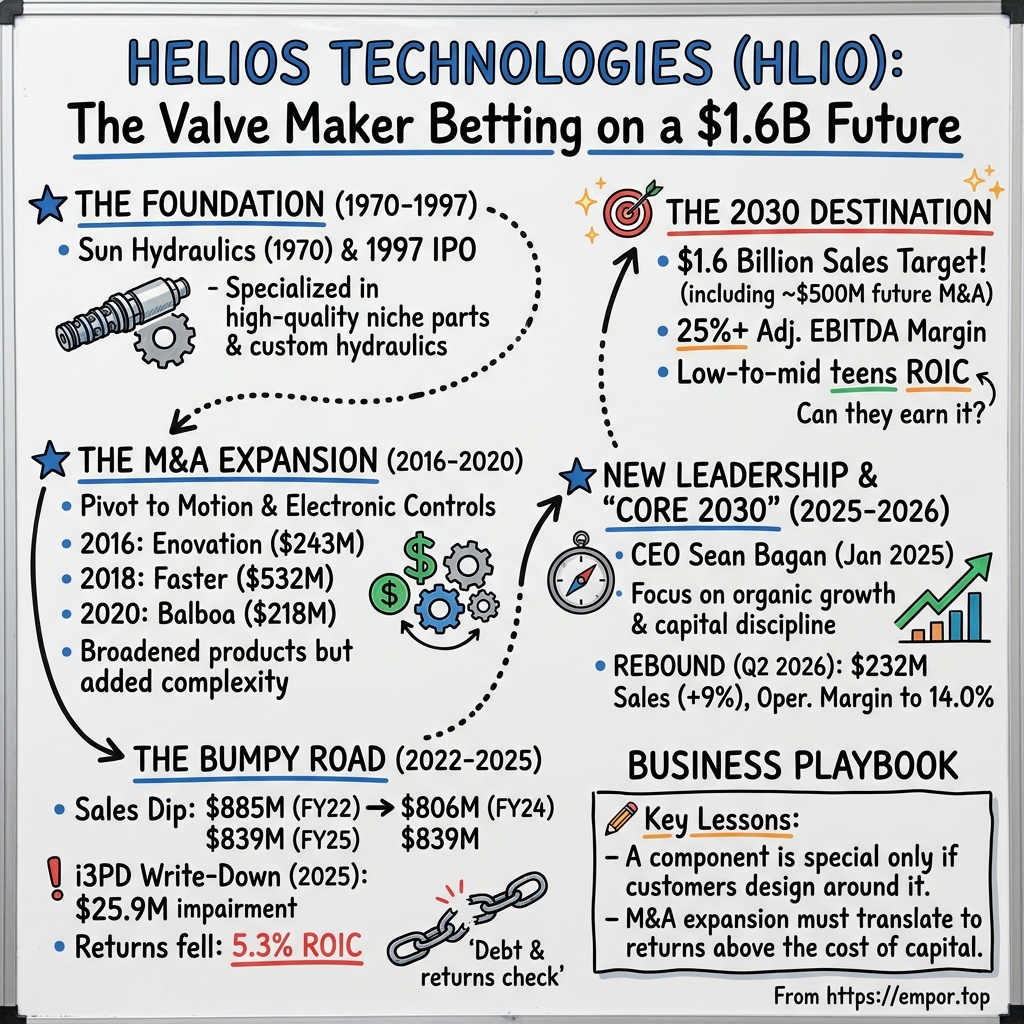
On a Friday morning in March 2026, the investors who flew into Sarasota, Florida, could take a short trip to see where it all started. Helios Technologies had laid on a tour of the original Sun Hydraulics production site for its Investor Day, a reminder that the company now listed on the New York Stock Exchange began as a maker of small metal valves in a Gulf Coast town better known for retirees and spring training.1 Back in the presentation room, Sean Bagan, the former Polaris finance executive who had become chief executive fourteen months earlier, set out the destination. Under a plan he called CORE 2030, Helios would roughly double its sales to $1.6 billion by the end of the decade, lift its adjusted EBITDA margin above 25%, push its adjusted operating margin to 20% and earn a return on invested capital in the low to mid teens.2
It was a bold number, and the setting made it bolder. Five months before the event, Helios had written off $25.9 million of goodwill on i3 Product Development, an engineering-services business it had bought in 2023.3 And when an investor traced the plan back to its starting point, the ground got less firm. Helios sold about $885 million of products in fiscal 2022. Two years later the figure was about $806 million. In fiscal 2025 it climbed back to $839 million, a recovery helped by an extra week in the fiscal calendar and favorable currency moves, and recorded in the same year that the company sold a distribution business in Australia.34 Over those three years sales shrank by almost 2% a year. Measured as after-tax operating profit against the equity and net debt invested in the business, its return on invested capital was about 5.3% in fiscal 2025.3
The $1.6 billion target therefore carries an important footnote. The company expects about $500 million of it to come from acquisitions not yet made.2 So the plan asks investors to believe two things at once: that a business which shrank for three years can grow organically at 5% or more a year, and that a company whose last acquisition ended in a write-down can buy roughly half a billion dollars of new sales on terms that raise returns rather than dilute them.
Four questions carry this story. The first is whether the recent growth is organic and durable, or the product of easy comparisons, a divestiture and currency. The second is whether the acquisitions that turned Sun Hydraulics into Helios created value or mostly bought revenue and complexity. The third is whether the current team, which took charge after an abrupt leadership change in 2024, can raise returns from mid-single digits to something that justifies the capital invested. The fourth is the oldest: whether a specialist component maker has a defensible edge against rivals many times its size.
The company at the center of these questions is easy to describe and hard to see. Helios is a U.S. manufacturer of hydraulic components and electronic controls, organized into two reportable segments, Hydraulics and Electronics, and selling into industrial, mobile machinery, agricultural, recreational, marine, health-and-wellness and other markets in more than 90 countries.3 Its products sit inside machines built by other companies: a valve block on a compact excavator, a quick-release coupling on a tractor, a display on a powersports vehicle, a control panel on a hot tub. The owners of those machines rarely know the name Helios. The engineers who design them often do.
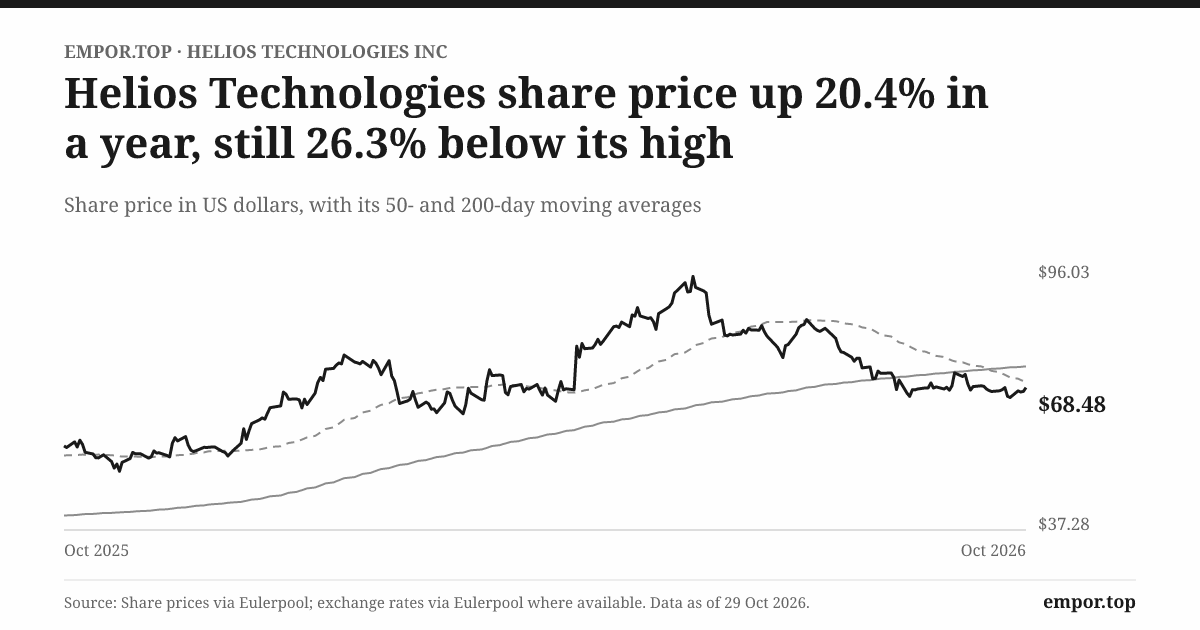
By late October 2026 the stock market had taken a view on the plan, and the view was cautious but expensive. Shares traded around $68, about 26% below their 52-week high, yet the company still carried a market value of roughly $2.2 billion, about 47 times trailing earnings and about 15 times trailing EBITDA.34 Those multiples do not describe a business earning 5% on its capital. They describe a business the market expects to earn much more.
That is the test this story sets. Growth targets and margin targets matter only if Helios can turn them into attractive returns on the money it puts to work. To understand whether it can, the story has to start with the product that made Sun Hydraulics worth scaling in the first place.
 Subscribe on LinkedIn
II. The Cartridge Valve That Made Sun Worth Scaling
Picture an engineer designing a new compact track loader. The machine's arms, bucket and tracks are moved by hydraulic fluid, pushed through hoses and cylinders under enormous pressure. The engineer's real problem is control. Fluid has to go to the right place, at the right pressure, at the right moment, and stop when the operator lets go of the joystick. Get it wrong and a bucket drifts, a boom drops, or a seal blows.
The answer, for many machines, is a screw-in cartridge valve. Think of it as a tap the size of a thumb that threads into a machined block of aluminum or steel, called a manifold. The manifold is drilled with passages, like a miniature road network, and each valve acts as a traffic signal that regulates flow or pressure at one junction. Pack several valves into one manifold and an OEM, the original equipment manufacturer, gets a compact hydraulic brain in place of a tangle of hoses and separate valve bodies. Sun Hydraulics built its business on that idea: cartridge valves, the manifolds they sit in, and integrated packages that combine them.3
Bob Koski founded Sun in Sarasota in 1970, and the company went public in 1997 after filing to list in October 1996.5 Koski's name still turns up in Helios's earnings calls, usually attached to his unusual "horizontal" management style, a flat organization without many of the titles and layers common in industrial companies, and a philanthropic streak that the company still invokes.6 Clyde Nixon, a later chairman and chief executive, is remembered with a business-leadership award in Sarasota County that Helios sponsors.6 The culture mattered because the product demanded it. Cartridge valves are precision parts, and selling them is an engineering conversation as much as a commercial one. The company's own description of its strategy, to develop "high-value, mission-critical, ruggedized solutions" for niche applications, is a modern restatement of what Sun was doing in the 1970s.7
Sun's earliest strategic decision still defines Hydraulics. The company chose to reach most customers through independent distributors, who carry engineering talent of their own and help smaller OEMs design Sun valves into their machines. About 55% of Hydraulics sales came through channel partners in fiscal 2025, with the remaining 45% sold directly to OEMs.3 Electronics, by contrast, is more heavily OEM-led.3 Sun's distributors are not just order-takers. Bagan told analysts in 2026 that the company now measures them and pairs them with its own engineers on targeted accounts, "because it is a very technical sale at times."8
Sun's innovation still happens at the level of the individual valve. At the CONEXPO construction-equipment show in March 2026, it launched a new cartridge valve, the QMEH, with a proprietary built-in position sensor, along with a smaller counterbalance valve aimed at compact machines.9 A sensor inside a valve matters because it lets a machine's electronic controller know exactly what the hydraulics are doing, which is the bridge between Sun's mechanical heritage and the Electronics segment's displays and controllers. When Helios sold its Australian distributor in 2025, it kept the buyer, Questus Group, as Sun's exclusive distributor in the region, a choice that says the company still sees independent distribution, not ownership of the channel, as the right way to sell valves.7
Today the hydraulics heritage is still the larger half of the company. In fiscal 2025, Hydraulics generated about $541 million of sales, roughly 64% of the total, and about $91 million of segment operating income.3 The segment includes the original Sun business, now run as one unit, and Faster, the Italian coupling maker bought in 2018, whose quick-release connectors let a farmer or contractor snap a hydraulic attachment onto a tractor or loader without spilling fluid. Electronics produced about $298 million of sales and only about $10 million of operating income, the latter crushed by the i3PD impairment.3 That segment supplies customized controls, displays, wiring harnesses and software, along with the electronic control systems inside spas and hot tubs through Balboa Water Group.3
Helios says it held about 300 active patents and trademarks as of January 2026, and its investor materials describe more than 300 engineers among roughly 2,300 colleagues.310 Those are signs of a technical franchise. They are not, by themselves, proof of a moat. The more interesting evidence is behavioral. When a valve or display is engineered into a customer's machine, swapping it out means redesign, testing and requalification, which is costly for the OEM and risky for its warranty record. That gives an incumbent supplier an advantage at each model refresh. Helios also says no single customer accounted for 10% or more of its sales in 2025, which limits the damage any one buyer can do.3
The limits of that argument are just as important. Helios does not disclose its market share, its customer-retention rate, the share of bids it wins or loses, or how much price it realizes above cost inflation. Its 2025 tariff experience offers one partial clue: management said it recovered most of the direct tariff cost through pricing and supply changes, essentially passing the cost through rather than earning extra margin on it.11 That shows customers would accept higher prices when the whole industry faced the same cost. It does not show Helios could raise prices against competitors who did not.
Those competitors are formidable. In its annual report Helios names Parker Hannifin, Danfoss and Eaton's former hydraulics business (now part of Danfoss), and Bosch Rexroth together with HydraForce, which Bosch Rexroth bought, as full-line rivals, alongside focused component specialists and lower-cost producers.3 Parker alone reported about $19.9 billion of sales in its fiscal year ended June 2025, almost 24 times Helios's revenue.12 That comparison measures scale, not share in cartridge valves. But scale matters in a specific way. A full-line supplier can offer an OEM pumps, motors, cylinders, valves, hoses, filters and controls on one contract, with one engineering team and one warranty. Helios offers a narrower menu.
The fair verdict on the product is that Sun's application knowledge, its engineering support and its position inside customer designs are credible sources of value, and that Helios has not published the retention or pricing data that would prove how durable they are. The moat is plausible. It is not demonstrated.
That leaves the strategic constraint at the heart of the company. Sun was a niche specialist living among giants, profitable within its niche but small. For most of its history it was content to stay there. In 2016 it decided that being a specialist was no longer enough.
III. The Deals That Changed Sun Hydraulics
At the end of 2015, Sun Hydraulics was a remarkably tidy business. It had about $200 million of annual sales, no borrowings at all, roughly $126 million of cash and short-term investments, and an operating margin above 23%.13 Measured by return on invested capital, it earned more than 30% on the capital invested in the business, a figure flattered by the small asset base of a mature, debt-free valve maker but still the mark of a very good niche franchise.13 The problem was growth. Sales had fallen almost 12% in 2015 as industrial markets weakened, and Sun was a single-technology company in a world where machine controls were becoming electronic.
In 2016 Sun bought Enovation Controls, a maker of electronic displays, controllers and engine-management systems used in recreational vehicles, marine engines, industrial equipment and oil-and-gas machinery. Total consideration was about $243 million, including contingent consideration, part of which was tied to revenue and EBITDA targets the acquired business had to hit after the deal.14 An earnout of that kind is a bet on performance: the buyer pays more only if the business delivers, and the seller keeps an incentive to help it do so. It also tells you that buyer and seller disagreed about what the business was worth, and agreed to let the future settle it.
The strategic logic was clear enough. Hydraulic systems were acquiring electronic brains, and a valve maker that could also supply the display and controller might earn more per machine. The financial consequences were immediate. Sun's balance sheet carried about $140 million of borrowings at the end of 2016, after none the year before, and total assets nearly doubled.13 Return on invested capital fell from above 30% to below 8% in a single year.13 Some of that drop was arithmetic: buying a business at a full price adds goodwill and intangible assets to the capital base before the acquired profits arrive. But the arithmetic was the point. From this moment on, Sun's returns depended on whether acquired businesses could earn their purchase price.
Faster, and the scale of the bet
Two years later Sun made a much bigger move. In 2018 it bought Faster, an Italian maker of quick-release hydraulic couplings founded in the early 1950s, whose products are fixtures on European tractors and construction machines.615 The cash price was about $532 million, more than Sun's entire annual revenue a year earlier. Sun paid for it with the proceeds of a public equity offering and substantial new debt, including $358 million drawn on its credit facility.15 Shareholders' equity nearly doubled that year, from about $273 million to $531 million, which tells you how much new stock was issued, and borrowings rose to about $353 million.13 That same year Sun also bought Custom Fluidpower, an Australian hydraulics distributor and service business. Cash spent on investing activities in 2018 came to about $566 million.13
Faster was a different kind of asset from Enovation. It made a mechanical product with a strong brand in agriculture, sold mainly direct to large OEMs, which gave Sun a direct relationship with tractor makers that its distributor model had never provided. Bagan later cited a 2025 win in which AGCO standardized the hydraulic attachment couplings across its Fendt, Valtra and Massey Ferguson brands on Faster products, chosen, he said, for "performance quality and price."6 He also called Faster's Multi-Faster connector "like the Kleenex" of its category, a brand rivals copy.6 Those are management claims, but they are specific, and they suggest Faster bought Sun a real franchise rather than just revenue.
The public filings do not settle whether the price was right. Helios disclosed the cash price and financing but not a comparable set of transactions or Faster's earnings at the time in a form that allows a clean multiple. The honest conclusion is that Faster was a large, debt-funded commitment, and that the evidence available does not support either a confident claim that it was overpriced or a confident claim that it was a bargain.
In 2019 the company renamed itself Helios Technologies, moving its listing to Nasdaq and then, in 2021, to the New York Stock Exchange.3 The new name was meant to signal a broader industrial-technology platform, not a valve maker.
Balboa and the pandemic boom
In October 2020 Helios agreed to buy Balboa Water Group, the leading supplier of electronic control systems for spas and hot tubs, for $218.5 million.16 The company said the price equated to about 9.3 times Balboa's estimated 2020 adjusted EBITDA.16 That is the cleanest valuation benchmark in the company's deal history, and on its face it looks reasonable for a market leader. But it was measured on 2020 earnings, at the peak of a pandemic boom in which homebound consumers bought hot tubs at an extraordinary rate. A multiple of 9.3 times inflated earnings is a higher multiple of normal ones.
What happened next is the lesson. Bagan later told analysts that Balboa's revenue during the boom year was "about double" its subsequent level, and that the business, after the spike and the bust, returned to roughly where it had been before the pandemic.611 In 2021, with Balboa at full tilt and recreational demand roaring, Helios posted a record year: sales jumped 66% to about $869 million and its adjusted EBITDA margin hit 24.6%.1113 That margin is almost exactly the CORE 2030 target. Helios has been there once, on the back of a demand surge that proved temporary.
The long-run record shows why the deal era is hard to judge from the headline. Sales compounded at about 15.4% a year from fiscal 2015 to fiscal 2025, a growth rate most industrial companies would envy.13 But most of that came in two leaps, 2017 to 2018 and 2021, both driven largely by acquisitions. Over the five years to fiscal 2025 growth slowed to about 9.9% a year, and over the last three years sales shrank by about 1.8% a year.13 Net profit tells a harsher story: it grew less than 4% a year over the decade, while the share count rose to fund the deals.13 A company that multiplied its revenue roughly fourfold ended the decade earning about the same net profit it earned in 2014.13
Helios does not publish a consistent organic growth series across the whole period, so the split between bought growth and earned growth cannot be measured precisely. But the shape is clear enough. Acquisitions added scale. They did not guarantee consistent growth, and they did not lift returns.
They also left a bill. By the end of 2023, after three more acquisitions in 2022 and 2023 that Jeremy Evans, now chief financial officer, later acknowledged did not carry "the same margin profile as the remaining business," Helios owed about $548 million.1311 The question became whether the cash the platform generated could carry the debt used to build it, and what the platform had actually earned.
IV. The Platform's Price Came Due
In May 2023 Helios bought i3 Product Development, a Michigan-area engineering firm that designed products for outside clients on a project-by-project basis and had developed a software platform called Cygnus Reach. Helios paid initial net consideration of about $44 million and issued 370,276 shares as part of the deal.3 The idea was to add software and engineering-services capability to the Electronics segment, so that Helios could sell connected, software-enabled controls.
Two and a half years later, the company wrote off $25.9 million of i3PD's goodwill, about 59% of the initial price.3 The explanation, delivered on the third-quarter 2025 call, was disarmingly direct. Helios had decided to pull i3PD's engineers off third-party work and point them at projects for Helios's own businesses, and to stop trying to sell its software on a stand-alone basis, embedding it in Helios displays instead. Because Helios had not owned the intellectual property from i3PD's client projects, those outside revenues had limited strategic value, and once they were dialed back, the projected profits could not support the goodwill.6 Evans described the move as "not a turnaround play" but a reallocation of talent.6
Then Bagan added a sentence that few chief executives say on an earnings call. The write-down, he said, was "an example of overpaying for an acquisition that was pre-revenue and didn't scale."6
That candor deserves credit, and it also deserves to be taken at its word. The i3PD deal was not a rounding error in strategic terms. It was a recent acquisition, made by the previous management team, in exactly the area the company had identified as its future: software-enabled electronics. Its failure mechanism, as Helios disclosed it, was not a market collapse but a misjudgment of fit and scalability.3 That narrows any claim that acquisitions are a repeatable value-creation engine for Helios. At least one recent deal did not meet its original economic case, and the company's own leaders said so.
The broader capital record needs the same treatment. Over the twelve years from fiscal 2014 to fiscal 2025, Helios generated about $757 million of free cash flow, meaning cash from operations after capital spending.13 It paid about $163 million of that out in dividends, a little over a fifth.13 Yet it ended fiscal 2025 with about $73 million of cash, roughly $21 million less than it held at the end of 2013.13 The rest of the cash, together with the borrowed money and new shares, went into acquisitions and then into repaying the debt those acquisitions required. The business threw off cash every year. The cash did not accumulate, because the strategy kept spending it.
There is a second subtlety in the cash numbers. Over those twelve years, cumulative cash from operations of about $1.0 billion was almost 1.8 times cumulative net profit of about $576 million.13 At first glance that looks like exceptionally high-quality earnings. Part of the gap, though, is a product of the acquisitions themselves. When a company buys businesses, it books intangible assets that it then amortizes, and amortization reduces reported profit without consuming cash. In fiscal 2025 alone, Helios recorded about $29 million of depreciation, about $32 million of amortization and the $25.9 million impairment, all non-cash charges.3 Strong cash conversion therefore says the operating businesses generate real money. It does not say each acquired asset earned back what Helios paid for it. Amortization is the accounting echo of a purchase price, and the purchase price was cash spent long ago.
The returns tell that second story directly. Return on invested capital fell from more than 40% in fiscal 2014, when Sun was a small, debt-free valve company, to the high single digits after Enovation and Faster, briefly back to about 10% in the 2021 boom, and then down to about 5% from 2023 to 2025.13 The starting point was flattered by a tiny capital base, and no company could have kept it while growing fourfold. But the endpoint is the problem. A return of 5% is below what most investors would estimate as the company's cost of capital, which means that on recent evidence the capital poured into the platform was earning less than it cost.
Pruning the portfolio
The current team's first answer was subtraction. In September 2025 Helios sold Custom Fluidpower, the Australian distributor it had bought alongside Faster in 2018, recording a gain of about $21 million and keeping CFP as Sun's exclusive distributor in Australia.6 Bagan framed the sale as returning Sun to "what we are best at": designing and manufacturing manifolds, cartridge valves and integrated packages rather than owning a distribution business.7 CFP was a business generating about $60 million of annual sales, so its sale removed about $14 million from fiscal 2025's reported revenue and will remove more from 2026's.48 Helios also closed a central engineering operation and returned those engineers to its operating businesses.7
The sale matters for how the 2025 recovery should be read. Fiscal 2025 sales rose about 4%, but that figure included roughly $4.4 million of favorable currency, an extra fiscal week, and the partial-year loss of CFP.4 On a pro forma basis excluding CFP, Helios said sales grew about 6%.7 Fiscal 2025 pretax income was also flattered by about $19.6 million of non-operating income, roughly 31% of the total, much of it the CFP gain and a related currency reclassification.3 Net income rose 24% that year, while operating income fell 19% because of the impairment.3 Each line points a different way, which is what happens when a company is both shrinking its portfolio and recovering from a downturn at the same time.
Put the deal history on one page and three benchmarks stand out. Balboa's price was disclosed at about 9.3 times estimated 2020 adjusted EBITDA, a multiple set on peak earnings. Faster cost about $532 million in cash, financed heavily with new debt and new shares. And i3PD's goodwill was written down by more than half within two and a half years. The filings do not provide a set of comparable industry transactions that would let an outsider say whether Faster, or the portfolio as a whole, was bought too expensively against what peers paid. What the record does show is the outcome: the combined platform earned about 5% on its capital in fiscal 2025.
The debt that built the platform
The balance sheet carried the deal era longer than the income statement did. Total borrowings reached about $548 million at the end of 2023, and the company refinanced its credit facility with PNC in June 2024.137 The current agreement caps total net leverage at 3.75 times EBITDA and requires interest coverage of at least three times, and Helios reported that it met both tests at the end of fiscal 2025.3 The cash generation that the platform produced then went to work in reverse. Helios paid down about $82 million of debt in 2025, using operating cash and the CFP proceeds, and ended the year with about $368 million of borrowings, made up of roughly $263 million of term loans and $106 million on its revolving credit line.37 By July 2026 total debt was down to about $332 million, and Helios had prepaid amounts due in 2026, 2027 and part of 2028, leaving most of the principal, about $312 million, due in 2029.17
That is a manageable structure, not a fragile one. Liquidity exceeded total debt by the end of 2025, and there is no refinancing deadline for nearly three years.7 But two features deserve attention. The debt is largely variable-rate, so it costs more when interest rates stay high, which they did through 2025. And fiscal 2025's earnings were flattered by a one-time $5.4 million benefit from an interest-rate swap tied to the 2024 refinancing, which management called out on its fourth-quarter call.7 The swap is a reminder that the year's improvement in net income contained several pieces, a divestiture gain, a swap benefit and an extra week, that will not repeat. Helios also discloses a commitment to buy a building in Europe for about €27 million at the end of a six-year lease, reduced by part of the rent already paid, a modest but real future claim on cash.3
So the inheritance was a company with good businesses, real cash generation, too much debt and too little return. The question the next team faced was whether operating improvement could raise returns without another wave of acquisitions, and the next team arrived in unusual circumstances.
V. A New CEO, a New Scorecard
On July 1, 2024, Helios's board placed its chief executive, Josef Matosevic, on paid leave pending an investigation. Four weeks later it fired him for cause and without severance, after finding he had violated company policy, including through a consensual personal relationship with an employee. The company stressed that the violation "did not involve financial misconduct, or the integrity of the Company's financial systems or controls."18 Matosevic had been the face of the acquisitive Helios. His departure left the company in the hands of its chief financial officer.
That CFO was Sean Bagan, who had joined Helios only in August 2023. Bagan was not a hydraulics engineer. He had spent 23 years at Polaris, the Minnesota maker of off-road vehicles, snowmobiles and boats, working across operational finance, international sales, product segments, acquisitions, treasury and general management, after starting his career at Arthur Andersen.19 Polaris builds exactly the kind of recreational machines into which Enovation sells displays and controls, so Bagan arrived knowing the customer side of Helios's Electronics business. He became interim chief executive in July 2024 while keeping the CFO job, and in January 2025 the board, after a search with an outside firm, named him permanent president and CEO.19
The transition was not tidy. Helios hired Michael Connaway, the chief financial officer of Aviat Networks and a veteran of General Electric, ABB and Honeywell, announcing the appointment in August 2025.20 Connaway joined in October and spoke on his first earnings call in November, when Bagan declared that the company now had "our full leadership team in place."6 He left later that month.21 Jeremy Evans, a former Tech Data finance executive who had joined Helios as controller in January 2024, was promoted to chief financial officer.207 Helios has not described the reasons for Connaway's departure in detail. A CFO who leaves weeks after arriving is not, in itself, evidence of a problem, but in a company that had just lost a CEO for cause, it added to an impression of instability that the new team would have to overcome with results.
What Bagan has done so far
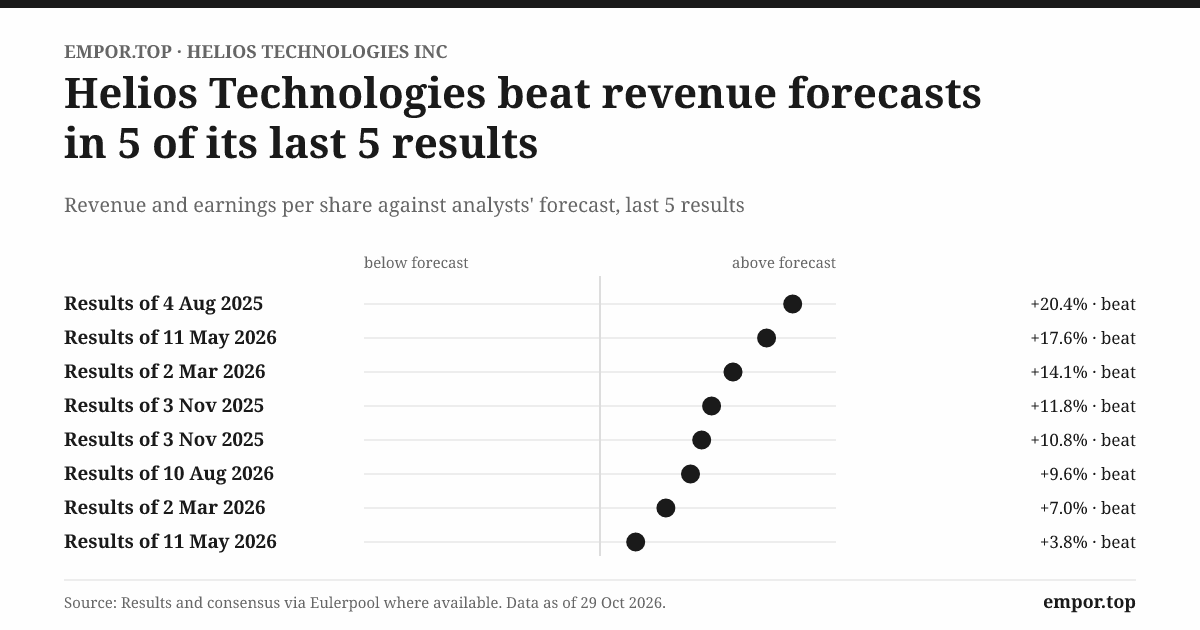
Bagan's record is short, which is why it should be judged by actions rather than adjectives. In roughly two years he sold CFP, recognized the i3PD impairment and explained it plainly, launched the company's first share-repurchase program, a $100 million authorization approved in February 2025, cut leverage sharply, raised the regular dividend for the first time in the company's history, by 33% to $0.12 a quarter in 2026, and introduced CORE 2030.379 His most repeated claim is about predictability: by early 2026 he said the team had met or beaten its forward quarterly guidance for nine consecutive quarters.7
The operating change Bagan prioritized first was selling, not buying. When he took over, Helios had just come through, in his words, "12 quarters of sales decline."6 His diagnosis was that the company had drifted away from its customers. In 2025 Helios changed sales leadership, added what Bagan called "a lot more hunters," and introduced formal discipline around tracking its sales funnel, with the explicit aim of winning more share of wallet from existing customers rather than chasing new markets.11 It promoted Billy Aldridge to run the Electronics segment, and left the two big Hydraulics businesses in the hands of Rick Martich at Sun and Matteo Arduini at Faster.7 It also cut costs: adjusting for the CFP sale, headcount was lower at the start of 2026 than a year earlier, and management said it would lean on overtime rather than hiring as volumes returned.11 None of this is glamorous, and that is the point. The new team's first-year playbook was the opposite of the deal-led strategy it inherited: fewer businesses, less debt, more attention to the customers already on the books.
That claim can be tested against the 2026 guidance trail. In early March, Helios guided full-year sales of $820 million to $860 million. In May, after a strong first quarter, it raised the range to $840 million to $870 million. In August it raised again, to $880 million to $900 million, with adjusted earnings per share lifted from an initial $2.60 to $2.90 to $3.05 to $3.25.798 Two raises in two quarters suggest the opening guide was conservative, which is how a new team rebuilding credibility usually prefers to err. They also show the team explaining its numbers in detail, normalizing for CFP and currency in each quarter and repeatedly warning that the second half of 2026 would face tougher comparisons.98
The Q&A sessions add texture that the prepared remarks lack. When analysts asked in November 2025 whether Helios would think about acquisitions differently from the prior management team, Evans said deals would not be "driven at the corporate level" and had to fit the operating segments and "get the right return."6 In August 2026, Bagan went further: he and Evans had "not done one of those since we've been at Helios and we're thinking about it a lot different than it was done in the past."8 He also said that "the large companies that we bought are starting to really generate nice returns," a claim the company's reported ROIC does not yet support at the consolidated level.8 Prepared remarks have tended toward sports metaphors, March Madness and the Kentucky Derby among them; the analyst exchanges have been more concrete, with management quantifying CFP's quarterly drag, the size of a tariff refund and a $3 million sales pull-forward in the third quarter of 2025.698
One thread of continuity runs through all the turmoil. Helios has paid a cash dividend every quarter since it went public in 1997, 118 consecutive quarters by mid-2026, through the Enovation debt, the Faster financing, the pandemic and the CEO's dismissal.820 That record says the underlying businesses have always generated enough cash to share some of it. It also says the dividend was small enough never to compete seriously with acquisitions; even after the 2026 increase, the yield was under 1% at the October share price.4 In August 2026, with leverage below its 1.5 to 2.5 times target range, management formally reordered its priorities: organic investment first, then sustained returns to shareholders, then strategic acquisitions, with debt reduction no longer the lead item.8 That ordering is sensible on paper. It is also the moment when a company's discipline is easiest to lose, because the balance sheet no longer forces it.
Pay and ownership
The incentive system tells you what a board actually wants. For fiscal 2025, Helios's short-term bonus plan weighted adjusted EBITDA, sales and adjusted free cash flow equally, with personal goals making up the remainder.21 Long-term awards combined time-based restricted stock units with performance-vesting options tied to sales and adjusted earnings per share, modified by Helios's total shareholder return relative to peers.21 Including free cash flow in the annual plan is a healthy signal, because it rewards turning profit into cash. The absence of a return-on-capital measure is the gap. A team paid on sales growth and adjusted earnings could, in principle, hit those goals by buying businesses, even at prices that depress returns. Given that CORE 2030 asks for $500 million of acquired revenue, that is the place where an investor would most want a return hurdle written into pay.
Bagan's total reported compensation was about $3.4 million for fiscal 2025, up from about $1.6 million in 2024 when he was interim CEO for half the year.21 The 2026 proxy listed him as the beneficial owner of 15,934 shares, under 0.1% of the company.21 At the late-October share price that stake is worth around $1 million, modest relative to his annual pay, so his alignment with shareholders rests more on future equity awards than on shares already owned. Shareholders have not objected: the 2026 say-on-pay vote passed with about 27.2 million votes in favor and 0.35 million against, and investors approved adding one million shares to the equity incentive plan.22 Helios has no controlling shareholder; BlackRock, Wellington and Vanguard were the largest holders at about 7.5%, 6.0% and 5.2% respectively in the 2026 proxy.21 The board has an independent chair, Philippe Lemaitre, who had returned to that non-executive role when Bagan was named CEO.1921
Compare the CORE 2030 scorecard with where Helios stood. Organic sales growth of 5% or more a year is a step up from three years of contraction. An adjusted EBITDA margin above 25% compares with about 19% in fiscal 2025 and a single prior peak near 25% in the Balboa boom.711 Return on invested capital in the low to mid teens is roughly two to three times the fiscal 2025 level.213 And $500 million of acquired revenue is, as Evans told analysts in May 2026, "in line with what we have done historically" in volume terms.9 That last sentence cuts both ways. Helios has proven it can buy $500 million of revenue. What it has not proven is that it can buy it at returns above its cost of capital.
Bagan's plan makes the promises measurable, which is more than many industrial turnarounds offer. Its credibility will be decided in the two businesses that actually generate the company's value, and in 2026 both of them started to move.
VI. Two Businesses, One Recovery
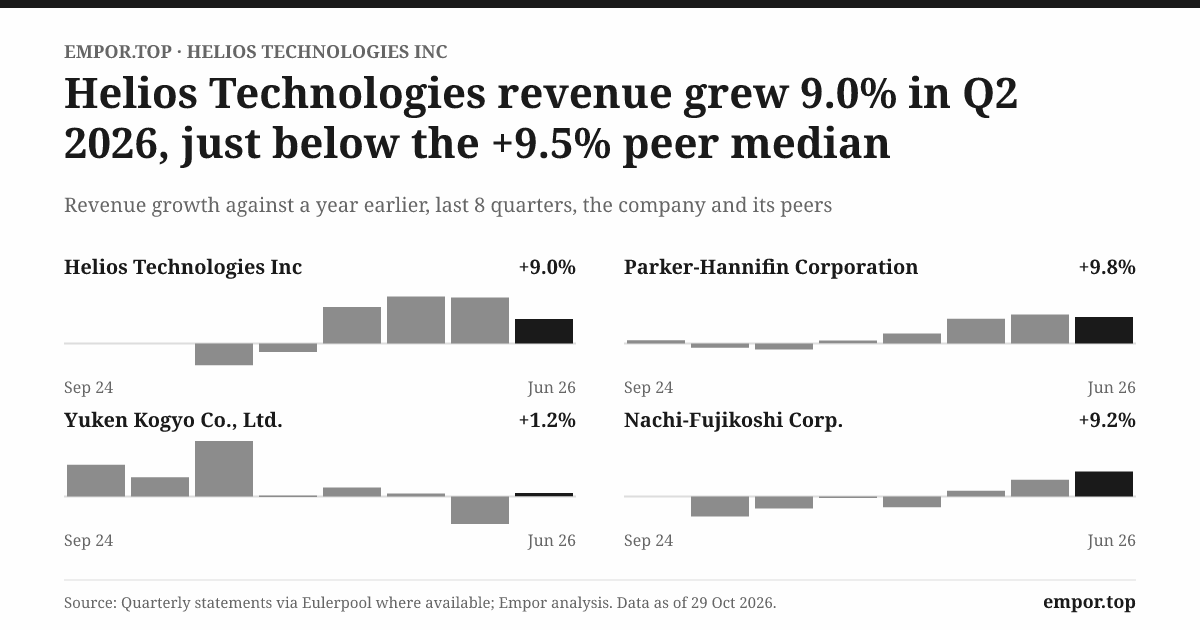
The second quarter of 2026 was the kind investors circle. Helios reported sales of about $232 million, up 9% from a year earlier. Adjusting for the CFP sale and currency, sales rose 16%. Both segments grew, every region grew, and operating margin rose to 14.0% from 10.3% a year earlier.48 Management called it the fourth consecutive quarter of double-digit pro forma sales and adjusted earnings growth, and said orders had grown by double digits year over year for four straight quarters.8 Bagan's description was "turnaround to takeoff."8 The question for an investor is how much of the lift is repeatable demand and how much is the snap-back from a deep trough.
Hydraulics: the cyclical core
Hydraulics deserves the closest look because it is the profit engine. In the second quarter of 2026 the segment sold about $146 million, up 14% on a pro forma basis, and earned an operating margin of about 19.7%, up two percentage points.8 Mobile machinery, especially construction equipment, led the growth. Agriculture improved. Industrial markets were roughly flat once CFP was stripped out. Asia-Pacific grew strongly, with Sun's China business on pace for a record year.8
The nature of that growth matters. Hydraulic components are bought when machines are built, and machines are built when dealers need inventory and contractors and farmers need equipment. That makes Hydraulics cyclical. In early 2026, analysts pressed management on exactly this point, and Bagan agreed that the improvement in agriculture reflected the end of destocking rather than a real recovery in end demand: dealer inventories had fallen to healthier levels, so OEMs were producing again even though retail sales had not recovered.7 A supplier feels that turn early. The same supplier would feel a renewed downturn early too.
Management also argues it is gaining share. It points to falling inventories at Sun's distributors at a time when Sun's own sales were rising, which suggests distributors were selling through stock and reordering.78 It points to lead times that have improved now that operational problems are behind it, after years in which the company admitted it had fallen behind on delivery dates.98 Those are reasonable inferences. They are not measured share data, which Helios does not publish.
The margin gain deserves the same scrutiny as the sales gain. Consolidated gross margin rose almost three points year over year to about 34.6% in the second quarter, the fourth straight quarter of expansion.8 Management attributed most of it to volume, which spreads fixed factory costs over more units, plus mix, productivity work and the removal of lower-margin CFP. About $1 million came from refunds of tariffs collected under emergency trade powers, a one-time benefit that flattered the quarter's incremental margins.8 Cost pressure has not disappeared: Evans cited printed circuit boards, memory chips and aluminum as inputs the company was working to offset, and freight surcharges tied to fuel prices had risen.89 The structural pieces of the margin story are footprint moves that will take time to show up. Helios closed a small Faster plant in Canada and moved the work to Italy, consolidated Faster's North American operations in Toledo, and is shifting more production to low-cost sites in Tijuana, India and China, efforts it had paused when tariffs flared in 2025.8 Bagan said the company could grow sales by roughly half on its existing footprint without major new capacity, which, if true, means that volume growth should keep lifting margins for some time.8 The cleaner reading is that the margin recovery so far is mainly operating leverage on a cyclical upturn, with self-help that is still largely ahead.
Electronics: growth with a scar
Electronics tells a more complicated story. Fiscal 2025 sales rose about 11% to about $298 million, yet segment operating income fell to about $10 million because of the i3PD impairment.3 In the second quarter of 2026 the segment's sales rose 19% to about $86 million, its operating margin expanded nearly five points to about 13%, and operating income nearly doubled to about $11 million.8 Enovation Controls had a record second quarter.8
Look closer and the growth has a concentration that Helios acknowledges without naming. Management has repeatedly credited "a large OEM customer," a recreational vehicle maker taking share in its own market, for much of Enovation's outperformance.798 Recreational marine, a big Electronics market, remained depressed, because many boats and powersports vehicles are financed and interest rates had not fallen much.8 Balboa's health-and-wellness market had stabilized at low single-digit growth after its pandemic boom and bust.9 When an analyst pointed out in August that Electronics' end markets were not growing anywhere near double digits, Bagan credited new customer wins and an aggressive sales effort, and acknowledged that the second half "obviously gets much tougher."8 Helios guided third-quarter Electronics growth of about 5%, a sharp slowdown from the first half.8 The segment's recovery is encouraging. It does not erase the evidence of acquired-asset underperformance that the i3PD write-down left behind.
The mechanics of Helios's revenue explain why visibility is short. Most contracts are standard product sales on "ship and bill" terms, usually fixed-price, short-term and completed within a quarter; revenue is recognized when goods ship or are delivered.3 OEMs share longer-term production forecasts but do not lock orders until close to delivery, and distributor orders are shorter still. Bagan said in August that the order backlog typically covers "just over 1 quarter's worth of sales."8 Helios does not disclose a recurring-revenue share. Replacement parts and long customer programs provide some stability, but the business is fundamentally a product business riding OEM production schedules.
Management has given investors a good deal to be excited about, and an investor's task is to sort the proven from the promised. Helios says its new business wins from 2025 carry about $60 million of projected annual value, phased in over time, after describing them as "well over $50 million" in March.79 It launched what it calls 11 major products in 2025, including a new generation of Enovation displays built on an open programming platform that lets customers do their own engineering.923 In September 2026 it announced a multi-year contract with Indian Motorcycle, a returning customer, alongside the purchase of assets from Radio Sound; it did not quantify the expected revenue.24 Some of the new displays carry advanced, software-driven capabilities, but Helios does not report any material revenue from artificial intelligence, and these are product features rather than a business line.3 All of these are real activities. Only the realized sales and margins that follow will make them evidence.
The most intriguing claim is about data centers. Faster has developed quick-disconnect couplings for liquid cooling systems in data centers, where servers are increasingly cooled by fluid piped directly to the chips. A coupling that leaks in a data center is a disaster, and Bagan argued that leakage performance is exactly where Faster excels, citing the company's own tests against competitors' products.8 He called the market "our single largest opportunity across Helios today" and said it could be larger than the company's existing agriculture and construction coupling markets.8 Helios built a clean room, added capacity at a new facility in Toledo, Ohio, and sent samples to about a dozen prospective customers, typically integrators who build cooling racks for hyperscale data-center operators.8 But the company included no data-center revenue in its 2026 guidance, expected only "a little bit" in 2027 and a gradual ramp thereafter, and acknowledged it was entering late against strong incumbents.8 This is a possible extension of Faster's core technology, not a hidden growth segment. Until orders arrive, it is an option, and options cost money: capital spending was running at about 4.9% of sales in the second quarter, partly to fund it.8
The last test of the recovery is working capital. When a manufacturer grows, it needs more inventory and more receivables, and if it lets either balloon, profits can rise while cash does not. Helios's record here has improved. Its debtor days, the average time customers take to pay, fell from a peak of about 70 in fiscal 2020 to about 50 in fiscal 2025.13 Management said the cash conversion cycle improved by 11 days year over year in the second quarter of 2026.8 Free cash flow was about $31 million in that quarter, a second-quarter record, and net leverage fell to 1.4 times adjusted EBITDA from 2.6 times a year earlier.8
The counter-evidence sits right beside it. Receivables consumed about $27 million of cash in the first half of 2026 as sales rose.17 Inventory still stood at around 115 days in July 2026, meaning Helios holds nearly four months of production costs on its shelves.17 The second quarter also included what management called "an isolated bad debt expense."8 Helios does not publish an ageing schedule of its receivables, so investors cannot see how much is overdue. The credit-loss allowance fell to about $1.4 million at the end of fiscal 2025 from $2.4 million a year earlier, which is favorable but cannot substitute for an ageing table.3
The practical test for the next year is simple to state. If growth keeps arriving without a matching swell in receivables and inventory, the recovery is converting into cash that can fund the plan. If working capital starts absorbing the profit, the recovery is weaker than its headline. And if both businesses keep growing, the case for Helios will turn on a harder question: how well it can defend its position against competitors who can do almost everything it does, and much more.
VII. Analysis & Bear vs. Bull Case
Set two products side by side. On one bench is a Sun cartridge valve, a precision part threaded into a custom manifold that a distributor's engineer helped a mid-sized OEM design. On the other is a full hydraulic system from a global supplier: pump, motor, valves, cylinders, hoses, filtration and electronic controls, engineered as one package and sold on one contract to the world's largest equipment makers. Helios's investment case lives in the space between those two benches. Now cut to the stock screen: at the end of October 2026, Helios traded at about 47 times trailing earnings and about 15 times trailing EBITDA, and about 26% below its 52-week high.4 The price is a judgment about which bench wins.
Why it could win
The bull case begins with specialization. A specialist can be better at one thing than a generalist that must be good at everything. Sun's cartridge valves, Faster's couplings and Enovation's customized displays all solve narrow problems for engineers who care intensely about performance in those narrow problems. Once designed into a machine, a component tends to stay through the model's life, because changing it requires redesign and testing. Sun's distributor network extends its reach into thousands of small and mid-sized OEMs that a giant supplier may not serve as attentively. Faster's direct relationships with tractor makers, and wins such as the AGCO standardization, show a franchise that large customers deliberately choose.6
The recent operating record supports the case. In the second quarter of 2026 both segments grew, margins expanded in both, free cash flow hit a record for the quarter, and net leverage fell to 1.4 times, below the company's own target range.8 Gross margin had expanded year over year for four straight quarters.8 The plan Bagan laid out includes measurable organic growth, margin and return targets, and so far the company is running ahead of its organic growth commitment.8
Why it may not
The bear case begins with the same fact from the other side. Specialists can be bundled out. A global supplier can offer an OEM a complete system with integrated electronics, one warranty and procurement simplicity, and can price individual components aggressively to win the whole package. Specialist rivals and lower-cost producers compete directly for the components Helios sells.3 And Helios gives investors almost none of the evidence that would show how it is faring against them: no market-share trend, no customer retention rate, no record of bids won and lost, no customer concentration beyond saying none exceeded 10% of sales.3
The financial record is also less kind than the latest quarter. Sales contracted from fiscal 2022 to 2025. Recent growth comparisons are shaped by the CFP divestiture, currency and calendar effects. Electronics' operating income was cut by an impairment. And the company's current return on capital is roughly a third to a half of what CORE 2030 promises.313
Seen through Michael Porter's five forces, the industry structure looks moderately favorable for a niche supplier, but not overwhelmingly so. Buyer power is real: Helios sells to OEMs, some of them enormous, and to distributors, and while customized applications moderate their leverage, the company discloses neither retention nor contract terms that would show how much. Rivalry is intense, spanning full-line system suppliers and focused component makers. Substitutes are partly technological, such as alternative valve designs, electro-hydraulic or electric actuation in some machines, and partly economic, in the form of cheaper "good enough" parts. Supplier power showed up in 2025 and 2026 through tariffs and the price of memory chips, which management said had risen four or five times; Helios locked in supply and pushed prices through, which suggests it could manage that pressure, at least this time.79 Barriers to entry are meaningful for precision hydraulics, where manufacturing know-how, qualification and distribution take years to build, but they protect incumbents as a group, not Helios in particular.
Hamilton Helmer's seven powers framework sharpens the point. Helios has a plausible case for switching costs, from products designed into OEM machines, and a weaker case for branding in specific niches such as Faster's couplings, though "the Kleenex of its category" is a management description rather than a measured preference.6 It does not have scale economies; its rivals are far larger. There is no network effect, no cornered resource beyond patents, and no evidence of a process advantage that rivals cannot copy. Sun's original distributor-led model once looked like a form of counter-positioning against vertically integrated giants, but it is not a barrier a rival is unable to replicate. The honest summary is one power, possibly two, each of uncertain strength. That is the profile of a credible niche position, not a wide moat, and it is consistent with the company's own history: when demand fell from 2022 to 2024, Helios's sales fell with it, which is not what durable pricing power looks like.
Several risks sit outside the competitive map but bear directly on these forces. Helios makes and sells in Italy, Germany, South Korea, the U.K., China and India, so currency moves change its reported growth from quarter to quarter; translation adjustments swung by tens of millions of dollars a year between 2023 and 2025, even though actual transaction losses were small.3 Its Electronics products depend on chips whose prices spiked as manufacturers shifted capacity to high-end semiconductors, and the company built inventory to secure supply.79 Tariffs pushed Helios toward an "in the region for the region" manufacturing strategy that reduces exposure but adds complexity.7 And much of its Electronics demand comes from financed consumer purchases, so interest rates act as a brake on boats, powersports vehicles and spas.8 None of these breaks the case. Each makes the earnings path more volatile than a single strong quarter suggests.
A skeptical long-term holder would focus on capital allocation. Helios has repurchased about $24 million of its shares through July 2026, and its remaining authorization is $76 million.178 At 47 times earnings, a buyback is an expensive way to return cash unless management is confident earnings will rise steeply. Yet the same management team proposes $500 million of acquisitions and an expensive data-center option. An investor would want to know how Helios compares the return on a buyback at this price with the return hurdle for an acquisition, and why neither the bonus plan nor the long-term awards contain a return-on-capital measure. They would ask why debt, which carries a variable rate and has most of its principal maturing in 2029, should not be cut further before new deals.7 And they would ask what the company learned from i3PD, Balboa's peak-earnings price and the Faster financing that will change how the next deals are priced.
The valuation leaves little room for error. At about 15 times EBITDA and 2.5 times sales, Helios is priced more like a quality industrial compounder than a cyclical component maker earning 5% on capital.4 Second-quarter peer data placed Helios at about 32 times earnings against about 34 for Parker Hannifin and about 44 for Eaton, but on very different returns and scale, and on dates and methods that differ from the October snapshot.25 The market appears to assume the recovery will continue and that margins and returns will rise substantially toward the 2030 targets.
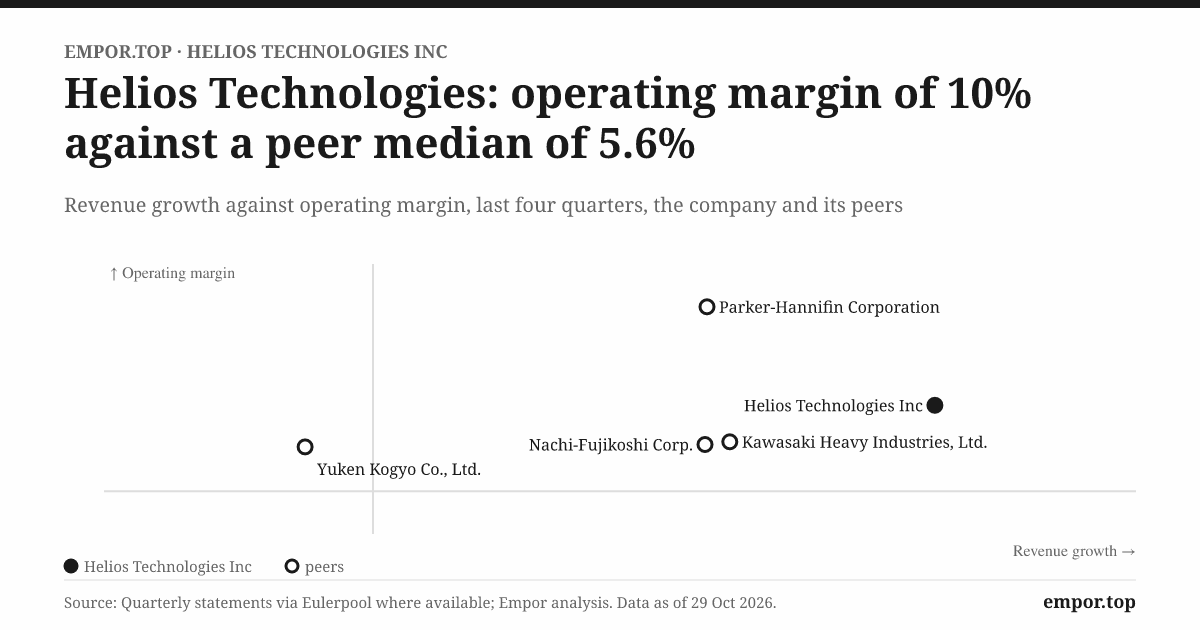
Three indicators will tell whether that assumption is right. The first is organic sales growth by segment, the clearest test of whether demand is real and repeatable; in the second quarter it was 14% for Hydraulics and 19% for Electronics on a pro forma basis, against guidance for a sharp slowdown in the third quarter.8 The second is segment operating margin, about 19.7% in Hydraulics and about 13% in Electronics in the second quarter, both rising.8 The third is return on invested capital, about 5% in fiscal 2025, the measure that will show whether growth and margins are creating value. Debtor days and inventory days are the cash-quality checks that sit underneath all three.
Helios has a credible niche position built on product knowledge and customer integration. The evidence does not establish a wide moat or durable pricing power, and the October valuation embeds a recovery that has begun to appear in quarterly results but not yet in a full-year record of organic growth and stronger returns. The price is asking for proof that has not fully arrived.
VIII. Playbook: Business & Investing Lessons
Go back to that valve threaded into a manifold, and then to the boardroom decisions that wrapped a $2 billion company around it. Helios's story is often told as a debate about acquisitions. It is better told as a story about what makes a specialist valuable, and what happens when a specialist tries to become something else.
The first lesson is that a component becomes special when the customer designs around it. Sun's cartridge valves never had a famous brand among end users. Their value lay in the engineering conversation with the OEM, the distributor who helped draw the manifold, and the inconvenience of redesigning a machine to remove them. That is a real source of advantage, and it is the most defensible thing Helios owns. But it is also invisible on a financial statement. Helios has never published the retention or pricing data that would prove how durable it is, and from 2022 to 2024 its sales fell with its customers' production. For founders, the lesson is that being designed in is a moat only when it shows up in retention and price. For investors, the lesson is to ask for those numbers rather than infer them from patent counts.
The second lesson is that buying a capability is not the same as commercializing it. Helios bought i3PD to accelerate its move into software-enabled electronics. Two and a half years later it had refocused the engineers on internal projects, given up on selling the software on its own and written off more than half the price, with its chief executive calling the deal an example of "overpaying for an acquisition that was pre-revenue and didn't scale."6 The engineers may yet prove valuable inside Helios products. But an acquisition whose payoff depends on reinventing what it does after the purchase is a bet on integration, not on the asset. The test for any capability deal is whether the buyer can name the customers and revenues that will prove it, before it signs.
The third lesson is that sales growth is a weak victory if the capital earns too little. Between 2015 and 2025, Helios's revenue grew more than fourfold, a record that looks like success on any chart of sales.13 Over the same decade its return on invested capital fell from above 30% to about 5%, and its net profit barely moved.13 Faster cost $532 million and much of it was borrowed. Balboa was priced on pandemic-peak earnings. Each deal could be defended on strategy, and together they produced a larger company that earned less per dollar invested. Size is not the scorecard. Return on the money committed is.
The fourth lesson belongs to the plan now on the table: a target is a promise until the cash and returns arrive. CORE 2030 asks for $500 million of acquired revenue, and Helios's CFO has noted that this matches what the company has bought in the past.9 The difference investors are being asked to trust is discipline: deal prices that fit the operating businesses and clear a return hurdle. The proof will not be in the press release that announces the next acquisition. It will be in the segment margins and return on capital three years after it.
IX. Epilogue
Tonight Helios stands at its strongest operating point in years. It has delivered four straight quarters of double-digit pro forma growth, while margins have risen in both segments, net leverage has fallen to its lowest in years and management has raised the full-year outlook, which, if met, would deliver the highest annual sales in the company's history even without the business it sold.8 Its shares, though, sit well below their high, and they still trade at a price that assumes the strength will last.
The next checkpoint is close. Helios is scheduled to report third-quarter 2026 results on November 6, a week after this snapshot.10 The company guided to sales of $215 million to $222 million, about 8% growth at the midpoint on a pro forma basis, with Hydraulics up about 9% and Electronics up about 5%, and an adjusted EBITDA margin slightly below the prior year's.8 Management has spent two calls preparing investors for a slower second half against tougher comparisons. A result at or above the range would extend the team's record of meeting its guidance and support the claim that growth is now driven by wins and products rather than the rebound alone. A miss, especially in Hydraulics, would reopen the question of how cyclical the recovery really is.
Listening to the calls in sequence is the best way to judge the team. In November 2025, management explained the i3PD write-down and, unusually, owned it. In March 2026 it reported the return to full-year growth, set a cautious 2026 guide and promised the CORE 2030 plan. In May and August it raised that guide twice, while flagging tariffs, energy costs, memory-chip prices and tougher comparisons. The message has been consistent. The next step is to show that consistency through a weaker quarter.
The tests to watch are specific. Helios should keep reporting organic, pro forma growth by segment, separating currency, divestiture and calendar effects so that investors can see the underlying trend. It should connect the roughly $60 million of new business wins to realized sales and margins, rather than to a growing pipeline. It should show debtor days and inventory days holding steady or improving as sales rise, so that growth turns into cash. It should explain how it will judge acquisitions against buybacks and debt repayment, now that leverage is below its target range and management has said capital allocation will shift toward organic investment, returns to shareholders and deals.8 And it should show the first data-center orders, because a business it calls its largest opportunity cannot remain an option forever.
Each outcome on November 6 has a clear meaning. Strong Hydraulics growth alongside stable or falling inventory days would suggest that Sun and Faster are winning share in a market that is only beginning to recover, which is the best case for the organic half of CORE 2030. Weak Hydraulics growth with strong Electronics would point back to the concentration in Enovation's recreational customer, and to how much of the segment's surge rests on one OEM's success. A first data-center order would turn the company's largest stated opportunity from samples into revenue, though a single order would say little about margins or scale. And any announcement of an acquisition would move the spotlight from operations to price: what Helios paid, what the target earns, and how quickly it expects the deal to clear the return hurdle it has promised to apply.
A full year of 2026 results, published early next year, will be the first useful test of the central question. If organic growth holds near or above the 5% target, margins keep climbing and return on invested capital moves meaningfully above 5%, the CORE 2030 plan starts to look like a plan rather than an aspiration. If growth fades as comparisons stiffen and the company turns to acquisitions to fill the gap, the old pattern returns: more revenue, more capital, the same returns. The story turns on whether a company built through acquisitions can now earn the returns its strategy promises.
X. Outro
When a compact loader lifts a bucket of gravel on a job site, nobody watching thinks about the valve that let the fluid through. It is a few inches of machined metal, threaded into a block, doing one precise job thousands of times a day. That valve is where Helios began, in Sarasota in 1970.
Around that valve, Helios has wrapped half a century of ambition in a broader platform. The specialist is still in there, doing its quiet work. The question is whether the platform can make that specialty worth more than it was on its own. Helios is betting that the parts customers design around can add up to a platform that earns its price.
References
-
Q4 2025 Earnings Call and Investor Day Invitation — Helios Technologies, 2026-03-03 ↩
-
CORE 2030 Strategy Announcement — Helios Technologies, 2026-03-20 ↩↩↩
-
2025 Form 10-K — SEC, 2026-03-03 ↩↩↩↩↩↩↩↩↩↩↩↩↩↩↩↩↩↩↩↩↩↩↩↩↩↩↩↩↩↩↩↩↩
-
Q4 and FY2025 Results — Helios Technologies, 2026-02-26 ↩↩↩↩↩↩↩↩
-
Q3 2025 Earnings Call — Helios Technologies, 2025-11-04 ↩↩↩↩↩↩↩↩↩↩↩↩↩↩↩↩↩
-
Q4 2025 Earnings Call — Helios Technologies, 2026-03-03 ↩↩↩↩↩↩↩↩↩↩↩↩↩↩↩↩↩↩↩↩↩↩↩
-
Q2 2026 Earnings Call — Helios Technologies, 2026-08-11 ↩↩↩↩↩↩↩↩↩↩↩↩↩↩↩↩↩↩↩↩↩↩↩↩↩↩↩↩↩↩↩↩↩↩↩↩↩↩↩↩↩↩↩↩↩↩
-
Q1 2026 Earnings Call — Helios Technologies, 2026-05-12 ↩↩↩↩↩↩↩↩↩↩↩↩↩↩↩
-
Q4 2025 Earnings Call, Analyst Q&A — Helios Technologies, 2026-03-03 ↩↩↩↩↩↩↩
-
Parker Hannifin FY2025 Results — Parker Hannifin, 2025-08-07 ↩
-
2025 Annual Report — Helios Technologies, 2026-03-03 ↩↩↩↩↩↩↩↩↩↩↩↩↩↩↩↩↩↩↩↩↩↩↩
-
Enovation Controls Acquisition Details — Helios Technologies 2017 Annual Report ↩
-
Faster Acquisition Details — Sun Hydraulics Form 10-Q, 2018 ↩↩
-
Balboa Water Group Acquisition Announcement — Helios Technologies, 2020-10-12 ↩↩
-
Helios Technologies Provides Update on Leadership Transition, Exhibit 99.1 — SEC, 2024-07-29 ↩
-
Helios Technologies Names Sean Bagan President and CEO, Exhibit 99.1 — SEC, 2025-01-06 ↩↩↩
-
Helios Technologies Announces CFO Appointment, Exhibit 99.1 — SEC, 2025-08-28 ↩↩↩
-
2026 Annual Meeting Voting Results, Form 8-K — SEC, 2026-06-15 ↩
-
Investor Day Webcast and Presentation — Helios Technologies, 2026-03-20 ↩
-
Radio Sound Assets and Indian Motorcycle Contract — Helios Technologies, 2026-09-09 ↩
 LinkedIn
 WhatsApp
 Reddit
 Hacker News
 Email
 Kindle
 RSS Feed
 Spotify
 Apple Podcasts
 Amazon Music
 Audible
 YouTube