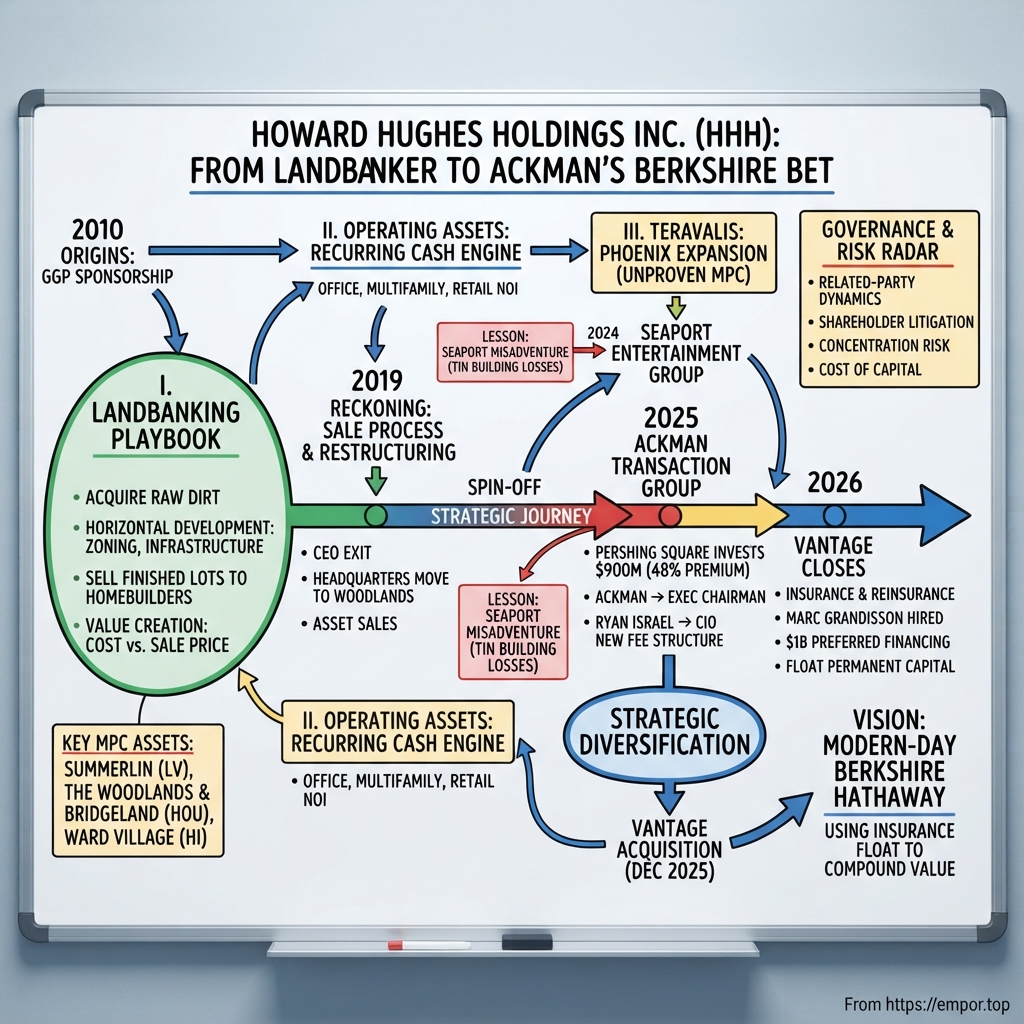
Howard Hughes Holdings: From Landbanker to Ackman's Berkshire Bet
I. Introduction & Episode Roadmap
There is a particular kind of American company that almost nobody talks about at cocktail parties and that almost nobody can replicate. It owns dirt. Not glamorous dirt — not trophy skyscrapers or Class-A towers with famous architects' names attached — but tens of thousands of acres of scrubland, desert, pine forest and floodplain on the outer edges of fast-growing metropolitan areas. It spends decades doing the least photogenic work in capitalism: rezoning, grading, laying sewer trunk lines, negotiating with county commissioners about drainage easements. And then, one parcel at a time, it sells that land to homebuilders at prices that bear almost no relationship to what it paid.
For fifteen years, that was Howard Hughes. A quiet, patient, deeply unfashionable compounding machine built out of the wreckage of the largest real estate bankruptcy in American history, run out of a suburban office park north of Houston, generating the bulk of its profits from three places most investors could not find on a map without help: Summerlin in Las Vegas, Bridgeland and The Woodlands outside Houston, and Ward Village on the edge of Honolulu's harbor.
Then, in 2025 and 2026, the story broke in half.
In May 2025, Bill Ackman's Pershing Square agreed to put $900 million of new capital into the company at a 48% premium to the market price, taking its economic stake to roughly 47%, installing Ackman as Executive Chairman and his chief investment officer as the company's CIO.23 Seven months later, the land company agreed to buy a Bermuda specialty insurer and reinsurer for about $2.1 billion.4 That deal closed on June 4, 2026.[^9] The stated ambition, said out loud and without hedging, was to turn a master-planned-community developer into "a modern-day Berkshire Hathaway" — using insurance float as permanent capital to buy durable-growth businesses.2
So here is the hook for this story. How does a company whose single most economically important activity in 2025 was selling 621 acres of Nevada desert to homebuilders — at an average of roughly $890,000 an acre — end up, eighteen months later, owning a Bermudian reinsurance balance sheet and hiring one of the most respected underwriters in the property-casualty industry to run it?7[^9]
And the harder question underneath it: is the market wrong to be confused, or is the confusion the correct response to a genuinely unresolved situation?
That is what we are here to work out. The roadmap: first, how land banking actually makes money, because the economics are genuinely unusual and almost everything else depends on understanding them. Then the big open bet in exurban Phoenix, the condo business in Honolulu, and the quiet recurring-income engine that holds the whole thing together. Then the mistakes — a 2019 near-sale of the company and a CEO exit, and a downtown Manhattan development that lost money at a rate you have to see written out to believe. Then the Ackman transaction and the litigation it triggered, the insurance acquisition, and finally an honest accounting of what is proven here, what is merely plausible, and what would tell us which.
Let's start where the company itself started: with a bankrupt mall REIT and a hedge fund manager who thought everyone else had the math wrong.
 Subscribe on LinkedIn
II. Origins: A $60 Million Bet That Became a Company
In the spring of 2009, General Growth Properties filed for Chapter 11. It was the largest real estate bankruptcy in United States history, and it was, in a sense, entirely self-inflicted. GGP had spent the 2000s buying malls with short-term, securitized debt on the theory that the commercial mortgage-backed securities market would always be open to roll it. In late 2008, the CMBS market simply stopped existing. The malls were fine. The properties generated cash. The capital structure was the thing that died.
Buried inside that capital structure was something that had nothing to do with malls at all. In 2004, GGP had acquired The Rouse Company — the legendary developer behind Columbia, Maryland and Baltimore's Harborplace — and with it, land assets that Rouse had itself acquired from the estate and successor entities of the original Howard Hughes Corporation, the holding company of the famously reclusive aviator and industrialist. Summerlin, the enormous master-planned community on the western rim of the Las Vegas Valley, was named for Hughes's grandmother. It came into GGP as a rounding error next to the mall portfolio.
Bill Ackman saw the mispricing. Pershing Square accumulated a position in distressed GGP debt and equity for roughly $60 million and, critically, helped arrange debtor-in-possession financing of $375 million — the move that gave Pershing a seat at the table in shaping the reorganization rather than merely riding it.10 The distinction matters. Distressed investing where you are a price-taker is a bet on recovery values. Distressed investing where you fund the DIP and sit on the creditors' committee is a bet on your own ability to determine what the reorganized entity looks like. The GGP trade ultimately returned Pershing something on the order of $1.6 billion — one of the defining home runs of Ackman's career, and one he has never stopped referencing.10
Here is the part that matters for everything that follows. When GGP emerged from bankruptcy in November 2010, it did not emerge as one company. The mall business went forward as the reorganized GGP. Everything that was not a mall — the master-planned communities, the undeveloped acreage, the awkward mixed-use projects that no mall REIT investor wanted to underwrite — was spun out to shareholders as The Howard Hughes Corporation.10
This was a classic orphan spinoff: a grab-bag of assets with no natural buyer, no clean comparable, negative near-term earnings, and enormous embedded book-value-to-market-value gaps. Ackman became chairman of the new entity's board. He stayed on that board, in one capacity or another, for the next fifteen years.
We are going to keep the pre-history brief, because it matters primarily for two reasons rather than for its own sake. First, the land bank that the company still monetizes today — Summerlin, The Woodlands, Bridgeland, Ward Village — arrived in 2010 essentially as-is, carried at legacy basis. The company has been harvesting an inheritance, not building one from scratch. That is a source of enormous economic advantage and, as we will see, a reason the reported earnings and the underlying economics diverge.
Second, Ackman's fifteen-year tenure on that board is the single most important fact for understanding 2025. What happened in May 2025 was not a hostile activist showing up with a 13D and a slide deck. It was the longest-standing director on the board, who had been intimately familiar with every asset for a decade and a half, deciding to convert a governance position into operating control. Whether that history makes the transaction more legitimate or less — because a fifteen-year insider knows exactly what the assets are worth and exactly when the stock is cheap — turns out to be the central question in the litigation that followed.
But before any of that, there is the business itself. And it is genuinely strange.
III. The Land Bank Playbook: How Master-Planned Communities Actually Make Money
Drive west out of the Las Vegas Strip for twenty minutes and the neon gives way to something that looks almost European in its planning discipline: curving parkways, trail systems threaded through arroyos, village centers with grocery anchors, schools sited before the houses around them were built. This is Summerlin. It covers roughly 22,500 acres. It has been under development since 1990. And it is not, in any conventional sense, built by Howard Hughes.
This is the first thing to understand, and it is the thing most people get wrong. Howard Hughes does not build houses. It has never been a homebuilder. It is closer to a manufacturer of finished land.
The factory that produces buildable ground
The production process works like this. The company acquires or inherits raw acreage — entitled for nothing, served by nothing. It then spends years, sometimes decades, converting that raw ground into a legally and physically buildable product. Entitlement comes first: zoning approvals, development agreements with counties and municipalities, environmental clearances, water allocations. Then horizontal development: mass grading, arterial roads, water and sewer trunk lines, storm drainage, dry utilities, parks and trails. Then the amenities that make a community command a premium — schools, retail centers, golf, trail networks.
Only at that point does it sell. The buyers are homebuilders: D.R. Horton, Lennar, Toll Brothers and their regional peers, who purchase finished residential parcels in "takedowns" — contracted tranches of lots, often with escalating pricing and scheduled closings. The company also sells commercial pads to retailers, medical users and employers, and — crucially — sells land to itself, transferring parcels into its own development arm to build apartments, shopping centers and offices.
The value creation is the spread between the cost of raw ground plus horizontal development, and the price a builder will pay for finished lots inside a community with schools, trails and a brand. In 2025, that spread produced what the company reported as a record year: roughly $476 million of segment earnings before taxes in master-planned communities, on 621 residential acres sold at an average of approximately $890,000 per acre.7
Let's translate what that price means, because the number in isolation is meaningless. Nearly $900,000 an acre for residential land is a price a builder will pay only where finished lots are scarce relative to household formation and where the community commands a premium in the resale market. It is not a price you pay for raw desert. It is a price you pay for the right to put houses on ground where a buyer with a mortgage will show up. The pricing is, in effect, the market's own verification of the entitlement work.
Why this is lumpy, and why that matters more than it sounds
Here is the structural characteristic that trips up investors who model this company like an operating business. Land sales are transactions, not subscriptions. A single large superpad sale to a national builder can swing a quarter. A builder that slows its takedown schedule because mortgage rates moved 75 basis points can push revenue from one fiscal year into the next without anything at all changing about the underlying asset.
This means reported quarterly and even annual results in the MPC segment carry a low signal-to-noise ratio. A record year is not necessarily evidence of a step-change in demand; it may be evidence that several large transactions happened to close inside twelve months. Equally, a weak year is not necessarily deterioration. The honest analytical posture is to look at multi-year absorption pace and price realization together, and to treat any single year — including 2025's record — as a data point rather than a trend.
Who else does this, and is it actually a moat?
The competitive set is thin, which is itself informative. The St. Joe Company operates a broadly comparable model in the Florida Panhandle at a similar market capitalization, but concentrated in one region. FivePoint Holdings does coastal California, where the entitlement difficulty is extreme and the asset count is small. Brookfield Residential is large but sits inside a diversified parent. Newland Communities and similar private operators hold meaningful positions without public disclosure. What makes Howard Hughes unusual is not that it does this — it is that it does this across several distinct growth metros simultaneously, so that a Houston slowdown and a Las Vegas acceleration can partially offset.
Is the entitlement pipeline a genuine cornered resource, in Hamilton Helmer's sense — a preferential access to a valuable asset on terms unavailable to others? The honest answer is: substantially yes, with a specific boundary.
The affirmative evidence is not just management assertion. RCLCO's national rankings of top-selling master-planned communities placed Summerlin and Bridgeland at #10 and #11 nationally in 2025 — external, third-party validation that these are among the highest-absorption residential communities in the United States, not merely large.7[^1] That is a real proof point, and it is the kind of evidence that should carry more weight than any narrative: independent observers counting closings.
The mechanism behind the advantage is regulatory and temporal rather than technological. A new entrant cannot assemble 15,000 contiguous, pre-entitled acres adjacent to metropolitan Las Vegas or Houston in any commercially relevant timeframe, because the assembly problem and the entitlement process are each multi-year and each subject to political veto points. The land is finite, the approvals are discretionary, and both compound.
Where the moat is weaker than the story
Now the boundary, stated in the same breath as the claim, because that is where it belongs.
First, homebuilders can multi-source — but only geographically. A builder needs lots where the rooftops and the jobs are. If Summerlin is where the Las Vegas job growth is, a builder cannot substitute land in Pahrump. That constraint is real and it genuinely limits the buyer's bargaining power. But it is not absolute: counties and the federal government (which owns vast acreage around Las Vegas via the Bureau of Land Management) can release competing supply, and when they do, the scarcity premium compresses.
Second, and more importantly, this business has essentially no insulation from the mortgage-rate cycle. The entitlement moat protects against competitors. It provides zero protection against the thing that actually determines demand: whether a household can afford the payment. When rates rise, builders slow takedowns, absorption falls, and the same acre that commanded $890,000 gets bid at something lower or simply does not transact. This is not a hypothetical risk to be filed under boilerplate — it is the primary mechanism by which the segment's earnings fall, and it has nothing to do with competitive position.
The calibrated conclusion: the cornered-resource claim survives its test, but in a narrowed form. Howard Hughes has durable structural advantage in supply — it controls scarce, pre-entitled land that others cannot replicate — and essentially no structural advantage in demand, which is set by interest rates and regional employment. That is a real moat around a cyclical business, not a moat that makes the business non-cyclical. The KPI that tracks whether the supply advantage is holding is price per acre realized alongside acres sold; if acres fall while price holds, that is cyclical demand. If price falls while acres hold, that is competitive supply arriving — a much more serious signal.
Which brings us to the place where the company decided to try to manufacture the next Summerlin from scratch.
IV. Teravalis: The $600 Million Bet on Exurban Phoenix — and What the Historical Base Rate Says
Buckeye, Arizona sits about thirty miles west of downtown Phoenix, out past the Estrella Mountains where the Sonoran Desert gets flat and wide and the air shimmers off the asphalt in July. It is one of the fastest-growing municipalities in America by percentage, which is easy when the base is small. In October 2021 — at the absolute peak of the post-pandemic land market, with mortgage rates near historic lows and homebuilders desperate for lots — Howard Hughes bought roughly 37,000 acres there for approximately $600 million from JDM Partners and El Dorado Holdings.[^1]
The property was called Douglas Ranch. The company renamed it Teravalis. The vision, as articulated, was as large as any land development plan in the country: up to 100,000 homes and something like 300,000 residents, built out over decades.
Let's be precise about what this is and is not. It is not a hidden business or a speculative side bet. It is the explicit answer to the most obvious question an investor should ask about a land bank: what happens when you run out of land? Summerlin and The Woodlands are finite. Every acre sold is an acre gone. Teravalis is the company's attempt to buy the next thirty years of inventory in one transaction.
That makes it the single largest capital deployment in the company's pre-Ackman history, and it deserves the falsification treatment.
Applying the company's own base rate
The most relevant disconfirming evidence for Teravalis is not from a competitor. It is from Howard Hughes itself.
Summerlin began development in 1990 and, thirty-five years later, is still selling land. The Woodlands broke ground in 1974 and took multiple decades to reach the density and commercial maturity it now has. These are the company's two crown jewels, and both required something like twenty to forty years to reach anything resembling economic maturity.
Against that base rate, where does Teravalis stand? Its first village, Floreo, opened only in the 2025–26 window — roughly four years after acquisition.[^1] Four years from close to first village opening is, measured against the company's own history, entirely normal. Arguably fast.
So the honest reading is this: the fact that Teravalis has contributed little to segment earnings five years after a $600 million outlay is not evidence of a stalled project. The company's own commercialization record says that is exactly what this stage looks like. Anyone framing the slow ramp as a failure is applying the wrong clock.
But the same base rate cuts the other way, and this is the part that should temper enthusiasm. If Summerlin took decades, Teravalis will take decades. That means it consumes capital — horizontal development, infrastructure, carrying costs, property taxes on 37,000 acres — for years before it meaningfully contributes. It is a long-duration liability on the cash flow statement before it becomes an asset on the earnings statement. In a higher-rate world, the carrying cost of that duration is materially higher than it was when the deal was underwritten in 2021.
The risks that are specific rather than generic
Two Teravalis-specific risks deserve naming rather than boilerplate.
Water. Arizona groundwater regulation is not a theoretical concern. Development in the Phoenix Active Management Area requires demonstrating an assured 100-year water supply, and state policy on new groundwater-dependent subdivisions in parts of the Phoenix basin has tightened in recent years. For a project contemplating 100,000 homes in the far West Valley, water rights and assured-supply designations are an execution gate, not a disclosure formality. A project of this scale succeeds or fails partly on hydrology and partly on Arizona water politics — neither of which the company controls.
Entitlement pace and infrastructure cost-sharing. A community of this size needs freeway access, water treatment, and a regional employment base to justify the commute. Those depend on municipal and state investment on a timeline the developer influences but does not set.
What would confirm or falsify
The test is straightforward and it is already running. Over the next two to three years, watch lot-sale pace and price per acre at Floreo, and compare them against what Summerlin and Bridgeland produced in their equivalent early-stage years, adjusted for the era. If Floreo absorption tracks or exceeds those early-stage trajectories, the thesis that Howard Hughes can manufacture another Summerlin holds. If absorption materially undershoots while Bridgeland and Summerlin continue to perform, the conclusion is not that land development stopped working — it is that this particular location, thirty miles out in the West Valley, does not have the employment proximity that made the originals work.
Verdict for now: the Teravalis bet is neither confirmed nor refuted. It is unproven and on schedule, which is a genuinely different thing from unproven and late. The claim it supports — that the land-bank model has multi-decade runway — remains intact but undemonstrated at this specific asset.
Three thousand miles west, meanwhile, the company runs a business with almost the opposite risk profile: short cycle, high visibility, and priced in a market where supply is constrained by an ocean.
V. Ward Village & Strategic Developments: The Vertical Condo Business
Ward Village occupies roughly sixty acres between downtown Honolulu and Waikiki, on the Kaka'ako waterfront — land that for decades held warehouses, a swap meet, and low-rise retail. It is arguably the most valuable single piece of real estate Howard Hughes owns, and the business conducted on it looks nothing like the land business.
Here, the company is the developer. It builds condominium towers and sells the units.
A completely different economic engine
The mechanics are worth spelling out because they explain the cash flow pattern. A tower is announced. Buyers put down deposits and sign binding pre-sale contracts, often years before a unit exists — the developer is effectively selling a future apartment on the basis of renderings, a location and a brand. Those pre-sales, once they cross a threshold, unlock construction financing. Construction takes roughly three years. Revenue is not recognized as deposits arrive; it is recognized on closing, when buyers fund the balance and take title.
The consequence: revenue from a Ward Village tower lands in a lump, typically two to four years after the sales activity that produced it. A year with no tower closings looks terrible. A year with two tower closings looks spectacular. Neither says much about the current state of demand. To see current demand, you have to look at pre-sales, not revenue.
And on that measure, the recent evidence is strong. The 2025 launch of two new towers — including an offering branded with Discovery Land Company, a developer known for ultra-high-end private club communities — generated approximately $1.2 billion in sales at launch.12 By November 2025, cumulative pre-sales reached roughly $1.4 billion.[^1]
What that evidence actually proves
Be careful about what to conclude. A billion-plus dollars of contracted demand does not prove the towers will be profitable — construction cost inflation between contract and completion is borne by the developer, and Hawaii is one of the most expensive construction markets in the United States because virtually every input arrives by ship. What it does prove is demand at the price point, in advance, with money committed.
That is unusually good evidence by the standards of this portfolio. In the land business, you learn about demand when a builder exercises or fails to exercise a takedown. In the condo business, you learn about demand years ahead, in dollars, from the actual end buyer. Ward Village is where the "why does this company win" question has its cleanest answer: the supply of oceanfront-adjacent, master-planned, walkable urban development land in Honolulu is effectively fixed, the entitlements took years, and a buyer who wants that specific location has no substitute. Switching costs here are not contractual — they are geographic.
The falsification test is equally clean, though. This is luxury discretionary real estate sold heavily to mainland and international buyers, and it is the most cyclical thing the company does. In a genuine risk-asset drawdown, pre-sales do not slow; they stop, and contracted buyers look for ways out. The company also carries concentration risk here — a small number of very large projects in a single submarket of a single island economy.
There is also a capital-intensity point that is easy to miss. Every tower is a multi-year construction commitment with cost exposure locked in at prices that were negotiated before completion. If construction costs inflate faster than the contracted sale prices — which are fixed at pre-sale — margin compresses, and the developer absorbs it. That is the mechanism by which a fully pre-sold tower can still disappoint.
So: strong evidence of demand, genuine locational advantage, real and unhedged cyclical and cost exposure. The KPI worth watching is not condo revenue — which is an artifact of closing schedules — but pre-sales and contracted backlog at each new tower launch.
Between the lumpy land sales and the lumpier condo closings, an investor could reasonably ask whether anything about this company produces predictable cash. The answer is yes, and it is the segment nobody talks about.
VI. Operating Assets: The Quiet, Growing Cash Engine
Every master-planned community eventually needs the things that make it a place rather than a subdivision: a grocery-anchored shopping center, a medical office building, apartments for people who are not ready to buy, an office campus for the employers whose jobs justify the commute.
Howard Hughes builds and owns those. This is the Operating Assets segment, and it is the closest thing the company has to a conventional REIT.
The strategic logic is elegant and worth pausing on. When the company develops a retail center inside Summerlin, it is not merely acquiring a yield-producing asset. It is increasing the value of the residential land it still owns around that center, because a community with a grocery store and a town center sells lots at higher prices than one without. The operating assets are simultaneously an investment and an amenity — a marketing expense that happens to generate net operating income.
In 2025, that segment produced record NOI of $276.3 million, up about 8% year over year.7 The composition is more interesting than the headline. Office NOI grew roughly 11%, driven by lease-up and the burn-off of free-rent abatement periods in The Woodlands, the Merriweather District in Columbia, Maryland, and Summerlin. Multifamily grew about 7%. Retail grew about 2%.7
Reading the mix
Office growing faster than retail and multifamily in 2025 is counterintuitive given the national office narrative, and it tells you something specific about the asset base. These are not commodity central-business-district towers competing with a hundred identical buildings. They are suburban and master-planned-community office assets in Houston and Las Vegas markets with net in-migration, often purpose-built for tenants who wanted to be in those communities. The growth came substantially from abatement burn-off — meaning leases signed earlier, with free-rent periods, converting to cash-paying — which is a mechanical, visible source of growth rather than a sign of a hot leasing market. That distinction matters: abatement burn-off is a one-time step-up per lease, not a compounding rate.
The 2% retail growth is the softer number and deserves the honest read: it is consistent with a retail portfolio that is essentially fully leased and growing only at contractual escalations. That is stable, not dynamic.
Why this segment matters more than its size suggests
Operating Assets NOI is smaller than MPC earnings before taxes and will be dwarfed in reported scale by the insurance business. But it does something neither of the other two does: it produces cash on a schedule. It is the recurring, contractually-supported floor beneath a company whose other real estate earnings arrive in unpredictable lumps.
For an investor trying to value this company, the operating assets are also the most conventionally valuable piece — a stabilized NOI stream that can be capitalized against comparable transactions, which is exactly the kind of asset that makes a sum-of-the-parts discount-to-NAV argument tractable.
The risk here is ordinary and therefore easy to underrate: this is a levered real estate portfolio. Cap rates move with interest rates. Debt matures and gets refinanced at prevailing costs. A segment that grows NOI 8% while its cost of debt rises more than that is not compounding equity value, whatever the NOI line says. Refinancing and cost of capital are the mechanism to watch, not occupancy.
Which is a reasonable place to introduce the period when the market decided the whole structure was not working — and the board agreed.
VII. The 2019 Reckoning: A Sale Process, a CEO Exit, and a Reset
By mid-2019, the disconnect had become intolerable. Howard Hughes was reporting steady progress on its communities, describing a growing net asset value, and watching its stock trade at what management and most sell-side analysts regarded as a substantial discount to the sum of its parts. The argument that "the market just doesn't understand land banking" had been made for the better part of a decade. At some point, that argument stops being an explanation and starts being an excuse.
In June 2019, the board did something boards rarely do voluntarily: it announced a formal review of strategic alternatives, explicitly including the possible sale of the entire company.11
It is worth sitting with how unusual that is. A board that believes its stock is cheap has two honest options — buy back stock aggressively, or sell the company. What boards actually do, most of the time, is neither: they issue a press release about their confidence in the long-term strategy and change nothing. Putting the whole company on the block is a public admission that the current structure might not be the best owner of these assets.
The October reset
The process did not produce a sale. It produced a restructuring, announced in October 2019.11
Co-founder and chief executive David Weinreb departed, along with President Grant Herlitz. Weinreb had led the company essentially since the spinoff — he was the architect of the post-GGP Howard Hughes, and his exit after nine years was the clearest possible statement that the board held management accountable for the gap between asset value and market value.
Paul Layne, who had run the Central region and The Woodlands operations, became CEO. The corporate headquarters moved from Dallas — where it had been located largely because that was where Weinreb was — to The Woodlands, into the middle of the company's own largest community. The company targeted roughly $50 million of annual overhead reduction and set out to sell approximately $2 billion of non-core assets.11
Read the headquarters move as more than symbolism. A land development company headquartered in a city where it owns nothing is carrying corporate overhead disconnected from operations. Moving into your own asset is both a cost decision and a signal about where the actual work happens.
What this says about governance — weighed, not just noted
This episode is a genuine positive data point on board behavior, and it should be weighted accordingly when assessing the governance questions that arise later in this story.
The affirmative case: the board ran a real process, replaced a founder-CEO, cut overhead, and shrank the asset base rather than defending the status quo. That is a course correction, and it happened without an external activist forcing it — the most engaged large holder was already on the board.
The tempering case: the process came nine years into the discount, not two. And the discount to NAV that motivated the review in 2019 has not been durably closed in the years since — a fact that should discipline how much credit the 2019 actions receive. A restructuring that addressed cost and focus did not solve the valuation problem it was launched to solve. That is important context for 2025, because it explains why a much more radical answer became thinkable.
Layne proved transitional. David O'Reilly, who had been chief financial officer, moved into the CEO role in the turn from 2020 into 2021 and has run the company since — the management regime whose record is the relevant one for judging everything that follows.1
And one asset the 2019 review did not resolve would go on to become the most expensive lesson in the company's history.
VIII. The Seaport Misadventure — and a Clean Exit
Walk down to the East River at the foot of Fulton Street in Lower Manhattan and you arrive at a place that has defeated developers for fifty years. The South Street Seaport has been reimagined as a festival marketplace, a tourist district, a nightlife destination, and a culinary hall. Each version has drawn crowds and, reliably, failed to produce sustainable returns.
Howard Hughes inherited the Seaport from the Rouse legacy and decided to try again — bigger.
The plan was ambitious and, in fairness, coherent on paper. Rebuild Pier 17 as an entertainment and event venue with a rooftop concert space. Convert the historic Tin Building — the old Fulton Fish Market structure — into a food hall in partnership with Jean-Georges Vongerichten, one of the most celebrated restaurateurs in the world. Develop 250 Water Street as a residential and mixed-use project. Create a neighborhood.
The numbers that broke the narrative
The Tin Building is where the theory met the ledger.
Development cost came in around $250 million. In its early years of operation, reported operating losses ran at roughly $100,000 per day. Gross revenue in 2023 was $32.4 million — against an asset that cost a quarter of a billion dollars to build and was burning something on the order of $35 million a year.6
There is no charitable interpretation of that arithmetic. There is no plausible revenue ramp that gets a food hall generating $32 million of gross revenue to breakeven on a $250 million cost basis while losing $100,000 a day. The unit economics were not challenged; they were broken.
And this matters well beyond the Seaport, because it is the single strongest piece of disconfirming evidence against any framing of this management team and board as disciplined capital allocators. It belongs here, next to the claim, rather than in a risk appendix. A company whose entire competitive advantage is patience and locational scarcity in suburban master-planned communities chose to deploy substantial capital into operating a celebrity-chef food hall in one of the most competitive and operationally demanding hospitality markets on earth. That is not an adjacent capability. It is a different business, and the results said so.
The strategic diagnosis is straightforward: this was diworsification. The Seaport was a legacy asset the company felt obliged to make work, and the escalation of commitment — from redevelopment, to operating the food and beverage business itself, to branding it with a marquee chef — is a textbook pattern of a capital allocator solving a sunk-cost problem by spending more.
The exit, weighed fairly
On July 31, 2024, Howard Hughes completed the spinoff of Seaport Entertainment Group to shareholders, distributing one SEG share for every nine HHH shares held, and listing the new company on NYSE American.[^11]
Now, how should this be weighed?
The skeptical read is that a spinoff is not a vindication. Shareholders did not get their capital back; they got shares in a separately capitalized vehicle holding the same problematic assets. The value destroyed in building the Tin Building was destroyed regardless of which ticker it sits under. A spinoff can be a way of removing a bad story from your earnings release without having taken responsibility for it.
The fairer read, and the one the evidence supports, is that this was still a real act of discipline of a specific and underrated kind. The alternative was continuing to fund the Seaport indefinitely inside Howard Hughes, where it would have consumed capital and management attention that belonged in Summerlin and Bridgeland. Management recognized a failed bet, stopped compounding it, and severed it — capitalizing the spinco so it was not an immediate liability handed back. Escalation of commitment is the more common corporate behavior, and by a wide margin. Cutting it loose is rarer.
The calibrated conclusion: the Seaport episode narrows the "disciplined capital allocator" claim substantially. It does not survive intact — a team that deploys $250 million into a food hall has demonstrated that its circle of competence is not as tightly patrolled as the narrative suggests. What survives is a narrower claim: this management recognizes failure and exits rather than escalating. That is worth something, but it is a materially smaller claim than the one usually made on the company's behalf.
There is also a cheap, ongoing way to test whether the exit worked: Seaport Entertainment Group trades publicly. Its post-spinoff results are a free, continuously updating readout on what Howard Hughes shareholders were relieved of.
Hold that narrowed claim in mind, because ten months after the spinoff closed, the same board approved the largest and most consequential transaction in the company's history.
IX. Ackman Takes the Wheel: The $900 Million Deal That Rewired Howard Hughes
Bill Ackman had been trying to do something with Howard Hughes for a long time. Over roughly two years leading into 2025, Pershing Square floated multiple structures for deepening its involvement — proposals that were revised, repriced and reworked as a special committee of the board evaluated them. The public version of the story, told in profiles at the time, was of an investor who had watched a fifteen-year position fail to close its valuation gap and who had concluded that the answer was not a better real estate strategy but a different kind of company entirely.12
On May 5, 2025, the deal landed.
The terms
Pershing Square agreed to invest $900 million for nine million newly issued Howard Hughes shares at $100 each — a 48% premium to the prior close.23 The premium is the first thing that separates this from a conventional control grab: Ackman paid materially above market for newly issued primary stock, putting fresh capital onto the balance sheet rather than buying shares from existing holders.
The stake took Pershing Square's economic ownership to roughly 46.9%, with voting power contractually capped at 40% and beneficial ownership capped at 47%.2 Ackman became Executive Chairman. Ryan Israel, Pershing Square's chief investment officer, became Howard Hughes's Chief Investment Officer — a role that did not previously exist in a land development company and whose creation tells you exactly what the company was about to become.2
And then the economics of the arrangement itself. Pershing Square receives a base fee of $3.75 million per quarter, plus a performance fee tied to growth in Howard Hughes's equity market capitalization above a reference level. Pershing also has the right to nominate three directors so long as it holds at least 17.5% of fully diluted shares.2
The structural question
Strip away the personalities and this is an externally managed holding company wearing the shell of an internally managed real estate operator. That structure has a long and mostly unhappy history in public markets, for a reason that has nothing to do with the manager's talent: a fee on market capitalization is a fee on a number the manager influences through issuance and narrative, and it is paid by all shareholders to one of them.
The performance-fee construction — tied to growth in equity market cap above a reference point — deserves specific scrutiny. A market-cap-based performance fee rewards growth in the aggregate value of the equity, which can be increased by issuing more equity. That is not the same as rewarding growth in value per share. Whether the specific mechanics guard against that is a disclosure question investors should read in the governing documents rather than assume either way.
The litigation
Minority shareholders sued in Delaware Chancery Court, alleging that the board's special committee was pressured into a transaction that handed Ackman operational control without paying a control premium.9
This claim needs to be stated precisely, because it is subtle. Ackman paid a 48% premium to market — but for newly issued shares, into the company. The plaintiffs' theory is that a premium paid for primary stock is not the same as a premium paid to existing shareholders for their control rights. Under the deal, Pershing acquired effective operational control of the enterprise — executive chairmanship, the CIO seat, board nomination rights, and a fee stream — and the argument is that existing holders were diluted and subordinated without being compensated for the transfer of control. Under Delaware law, a controlling-stockholder transaction of this kind attracts heightened scrutiny, and the independence and process integrity of the special committee are the central battleground.
This is not a hypothetical governance concern to be gestured at. It is live litigation over the legitimacy of the transaction that defines the company's current form, and it sits in the same breath as any claim that the new structure "aligns incentives." Alignment and conflict are not opposites here; both are present simultaneously.
The partial mitigant
One piece of the fee critique was addressed. The original structure raised an obvious double-dipping objection: Pershing Square Holdings, the Guernsey-listed closed-end fund, pays Pershing Square management fees on its assets — which include its Howard Hughes stake — while Howard Hughes would now separately pay Pershing Square a management fee. Investors in PSH would effectively be paying twice on the same exposure. PSH subsequently amended its own investment management agreement to reduce fees attributable to its HHH position.2
Weigh that correctly. It is evidence that the fee structure was narrowed in response to criticism, which is a genuine if partial response. It does not address the control-premium dispute at all, and it does not change what Howard Hughes's other shareholders pay.
The net read: this transaction brought real capital at a real premium and a capital allocator with a verifiable record of extraordinary outcomes, including the GGP trade that created this company. It also introduced an external management fee, a conflicted controller, and unresolved litigation into a company that previously had none of the three. Investors do not have to choose between those readings. Both are true, and the second is the one that will be adjudicated.
What Ackman did with the wheel, once he had it, took seven months to reveal.
X. Building an Insurance Engine: The Vantage Acquisition
To understand what happened in December 2025, you have to understand what Ackman has said he is trying to build, and why insurance specifically.
Warren Buffett's central insight at Berkshire Hathaway was not stock picking. It was that an insurance company collects premiums today and pays claims later, and the money sitting in between — the float — is investable capital that, if the underwriting is at least breakeven, costs less than nothing. Float is permanent capital that does not mature, cannot be margin-called, and does not require a shareholder vote. Fairfax Financial in Canada, under Prem Watsa, built a variant of the same machine.
The appeal to an investor who believes he is good at allocating capital and constrained only by the amount of it is obvious.
The deal
In December 2025, Howard Hughes agreed to acquire Vantage Group Holdings, a Bermuda-based specialty insurance and reinsurance company, from private equity owners Carlyle and Hellman & Friedman for approximately $2.1 billion — roughly 1.5 times expected year-end-2025 book value.45
The transaction closed on June 4, 2026.[^9] The financing structure is where the detail matters: company cash plus $1 billion of non-voting exchangeable perpetual preferred stock issued to Pershing Square Holdings, plus a $200 million post-closing capital infusion.[^9] Pershing Square manages Vantage's investment portfolio without charging a fee.[^9]
Parse that financing. Non-voting perpetual preferred is, from the common shareholder's perspective, a reasonable instrument: it does not dilute voting control, it has no maturity date, and the exchangeable feature sets a conversion level. And it was subscribed by Pershing Square Holdings rather than sold into the market — which can be read as conviction, or as a further deepening of the related-party web depending on your priors. Managing the float portfolio for free is a genuine concession and is exactly the kind of term a conflicted controller should be expected to offer.
The credibility hire
Here is the proof point that separates this from a press release.
In July 2026, Howard Hughes installed Marc Grandisson as Vantage's Executive Chairman, with David Gansberg named CEO-designate.[^9] Grandisson previously ran Arch Capital Group as chief executive — Arch being one of the most consistently well-regarded underwriters in the specialty property-casualty world, an organization known specifically for underwriting discipline through soft markets, which is the hardest thing in the business.
This is not a decorative appointment. In insurance, the entire question is whether an organization will walk away from business when pricing is inadequate, and the only real evidence about that is the track record of the people making the decision. Recruiting an Arch alumnus of that seniority is the strongest available signal that the new owners understand the business they bought is an underwriting business first and a float-generation business second.
The skeptical read
That said, this is the largest, fastest and least-tested bet in the company's history, and the honest framing is that it is unproven rather than disqualified.
Consider what is actually being asked of this organization. Insurance underwriting is a discipline of estimating the frequency and severity of events that have not yet happened, pricing them, and setting aside reserves that will not be validated for years. Reserve development — whether the money you set aside proves adequate — is the industry's defining failure mode, and it surfaces slowly and asymmetrically: good news arrives in dribs, bad news arrives all at once. Regulatory capital in Bermuda has its own requirements and its own supervisor. None of this resembles negotiating a development agreement with a county in Texas.
On price: approximately 1.5 times book is a full multiple for a specialty (re)insurer, and at least one market commentator argued Howard Hughes overpaid relative to comparable transactions.4 Whether it was full or fair depends entirely on Vantage's underwriting quality and reserve adequacy, which is precisely what an outside investor cannot yet verify.
And here is the critical point: there is no operating history for this business inside Howard Hughes. Not one full year of combined ratios reported under the current ownership. The insurance thesis is, at this moment, entirely prospective. It rests on the quality of an asset the previous private-equity owners chose to sell, and on the judgment of a team that has run a land company.
The calibrated conclusion: the Berkshire framing is directionally credible — the financing terms were shareholder-friendly in structure, the underwriting hire is the right hire, and the strategic logic of permanent capital is sound. But "credible ambition supported by good hires and sensible financing" is a materially weaker claim than "a working float engine," and the gap between them is measured in combined ratios that have not been reported yet. The confirming or falsifying evidence is specific: Vantage's combined ratio and prior-year reserve development over the next four to eight quarters, and what Pershing Square actually buys with the float.
Which raises the question of who, exactly, is making these decisions, and how they are paid.
XI. Management Playbook: Incentives, Ownership, and the Capital-Allocation Record
Howard Hughes now has an unusual governance architecture: a conventional real estate operating team running the land and building businesses, and a hedge fund's leadership occupying the chairman and chief investment officer seats above them.
The people
David O'Reilly has been chief executive since the 2020–21 transition, having previously served as the company's chief financial officer. He is a real estate finance executive by training and temperament, and his tenure has been defined by three things: the asset rationalization that followed the 2019 review, the Seaport spinoff, and now the role of running the real estate operations of a company whose strategic direction is increasingly set elsewhere. His total 2025 compensation was approximately $7.8 million, weighted heavily toward equity and incentive components.1 That weighting is conventional for a company of this size and is not, by itself, evidence of anything.
Carlos Olea serves as chief financial officer. Bill Ackman is Executive Chairman. Ryan Israel, as CIO, is the person most directly responsible for deploying whatever capital the insurance operation generates — a considerable amount of authority for a role created barely a year ago.
L. Jay Cross, the former President, departed in 2025 with a substantial severance package.1 Senior departures during a control transition are common and not inherently meaningful, but they are worth noting as data: the operating leadership of the company has turned over meaningfully in the period during which its strategic identity changed.
The scorecard, weighed
Rather than listing deployments, it is more useful to grade them against what each says about the allocation process.
The 2019 asset sales and overhead reduction were genuinely good capital allocation, but with the caveat established earlier: they were late, and they did not accomplish the valuation objective that motivated them.
Teravalis is unproven and on schedule, consistent with the company's own historical cadence, and carries a real risk that its specific location lacks the employment proximity of its predecessors.
The Seaport and Tin Building represent a clear, expensive miss, honestly resolved rather than compounded — the episode that most constrains how much discipline can be credited to this organization.
Vantage is the biggest test. What makes it different from everything preceding it is not just size but velocity: agreed in December, closed in June, in an industry the acquirer had never operated in. The 2019–2024 period was characterized by shrinking, focusing and exiting. The 2025–2026 period has been characterized by a premium equity issuance, a $2.1 billion acquisition, and a $1 billion preferred issuance to a related party. That is a discontinuity in behavior, and investors who credited the earlier discipline should be explicit that the current regime is operating on a different playbook.
The related-party dynamic, stated plainly
Pershing Square now occupies multiple positions simultaneously in this structure: largest economic owner, recipient of a management and performance fee, holder of $1 billion of exchangeable perpetual preferred stock, manager of the insurance investment portfolio, and — through the Executive Chairman and the CIO — the operational decision-maker on capital allocation.
Each of those roles is individually defensible. Together they mean that on a meaningful set of future transactions, the party proposing the deal, the party evaluating it, and the party economically benefiting from its financing may substantially overlap.
The right posture is neither cynicism nor trust. It is procedural: read the related-party transaction disclosures in each proxy, track the fee actually paid against the formula, watch how independent directors vote and whether any dissent is disclosed, and watch the level of shareholder support for say-on-pay and director elections. Those are observable, recurring signals. Assuming good faith or bad faith in advance is not analysis.
All of which sets up the question the market has been arguing about since May 2025.
XII. Bull vs. Bear: Compounding Machine or Expensive Distraction?
Let's war-game this properly.
The structural analysis: where the power actually sits
Under Helmer's 7 Powers framework, the land business has one clear power and arguably a second. The clear one is cornered resource: multi-decade entitlement pipelines on contiguous acreage adjacent to growing metros, which cannot be assembled by a new entrant on any commercially relevant timeline. The arguable second is scale economies in a local market — a developer building the schools, trails and town center that make a community desirable spreads those costs across thousands of lots, which a small-parcel competitor cannot match. Brand matters at the margin in Summerlin and Ward Village, but it is downstream of the land position rather than independent of it.
Through Porter's five forces, the picture is more mixed than the moat story suggests. Barriers to new entry are genuinely high. Supplier power is low — grading contractors and civil engineers are commodities. Buyer power is moderate: national homebuilders are large and sophisticated, but constrained geographically, which meaningfully limits their leverage. Substitutes are the real exposure: the substitute for buying a new home in Summerlin is buying an existing home, or renting, or not forming a household — all of which are governed by mortgage rates rather than by anything the company controls. And rivalry is low within any given submarket precisely because the land is cornered.
Now apply the same lens to the insurance business, because this is where the two halves of the company diverge sharply. Specialty (re)insurance has, as an industry, no structural moat at all. Capital is mobile, capacity is fungible, pricing is cyclical, and the only durable advantages are underwriting judgment, cost of capital, and distribution relationships. The cornered resource that protects the land business does not transfer one inch. Vantage must earn its own economics through underwriting discipline, and it will be competing against Arch, RenaissanceRe, and the rest of the Bermuda market, several of which have twenty-year track records of doing exactly that.
This is the most important structural observation in the whole story: Howard Hughes has bolted a no-moat business onto a strong-moat business. That is not automatically bad — Berkshire did the same thing, and the point of float is that it funds ownership of moated assets elsewhere. But it means the combined entity's quality now depends on execution in an arena where the company has no inherited advantage whatsoever.
The bull case
The bull case has three legs, and the first is the strongest.
The real estate base is high quality and demonstrably so. Two communities in the national top eleven by absorption, a record year of land earnings, a record NOI year with visible drivers, and a Honolulu condo platform with over a billion dollars of contracted pre-sales. These are not projections; they are outcomes. And the assets carry legacy basis from a 2010 spinoff, which means depreciation and book value systematically understate economic value — the source of the persistent discount-to-NAV argument.
The second leg is the permanent capital structure. If Vantage underwrites to breakeven or better, the float is genuinely free leverage with no maturity and no covenants, and it funds acquisitions the company could not otherwise make.
The third is the allocator. Ackman's record includes outcomes — the GGP trade chief among them — that very few investors have produced. He has said publicly that he regards the stock as very cheap and has articulated long-run ambitions well above current levels.12 Take that for what it is: a statement of conviction from someone with an enormous personal stake, not evidence.
The bear case, evidenced
The bear case is not a mood; it has specific support.
Reported net income fell 57% in 2025, to $123.9 million from $285.2 million the prior year — during a year in which both the MPC segment and Operating Assets set records.7 That divergence is itself the argument: GAAP net income for this company is a poor proxy for economic performance, which is convenient when it falls and inconvenient for anyone arguing the reported numbers should drive the valuation. An investor cannot have it both ways.
The stock has traded roughly 30% below its 52-week high and well below its 2021 peak.8 Ackman himself has publicly acknowledged investor confusion about the transformation, and asked for time.8 When the controlling shareholder concedes the market does not understand the story, that is a meaningful admission about the difficulty of the sell.
The Vantage acquisition added integration risk, regulatory-capital complexity and a price at least some observers regard as full, with zero operating history under the new owner.
And the Delaware litigation over the control transaction remains unresolved.9
The activist stress test
What would a skeptical investor attack here? The list is not short. Portfolio complexity: a company that now requires an analyst to simultaneously value land, condos, stabilized commercial real estate and a Bermudian reinsurance balance sheet has widened its own valuation discount, not narrowed it — conglomerate discounts exist for a reason. External management economics: a fee paid to the controlling shareholder is a permanent drag that internally managed peers do not carry. Related-party financing: $1 billion of preferred from an affiliate, on terms the affiliate helped set. Disclosure: investors need clean segment-level reporting for the insurance business from day one, including reserve development triangles, to have any ability to judge it. And accountability: the company has now changed strategic direction twice in six years — shrink and focus, then diversify and acquire — which raises the reasonable question of whether the next answer will be a third.
The net read
Here is where the evidence lands.
The real estate engine is well-evidenced and structurally advantaged in supply, cyclically exposed in demand. That part of the story survives its falsification tests with the narrowing already described: a genuine cornered resource, an unproven-but-on-schedule expansion bet in Phoenix, a proven condo platform with real cost and cyclical exposure, and a recurring-income segment whose growth drivers are partly mechanical.
The insurance and holding-company thesis is directionally credible and entirely undemonstrated. The financing terms were structured in a way that protects common shareholders more than they might have been, and the underwriting leadership hire is a serious one. But credible intent, good structure and a good hire are inputs. The output is a combined ratio, and there isn't one yet.
The governance question sits underneath both and will be resolved by a court rather than by the business.
Risk radar: only what is mechanistically live
Four risks are genuinely operative here, and they are worth distinguishing from the generic list.
Cost of capital and refinancing. Elevated rates slow land absorption directly by pricing out homebuyers, compress cap rates on the operating portfolio, and raise the cost of rolling maturing property debt. This is the single highest-sensitivity variable for the legacy business.
Integration and capability risk at Vantage. A real estate-native management team now oversees an underwriting organization. The failure mode would not be dramatic; it would be quiet under-reserving that surfaces in a later accident-year development.
Governance and related-party risk. Discussed above, with the observable signals named.
Concentration. A handful of large land transactions drives MPC results in any given year; a small number of towers drives Ward Village. Both are lumpy by construction.
XIII. What to Watch Next
Most companies deserve a long watch list. This one, because its story is genuinely bifurcated, comes down to a small number of things that actually resolve the open questions.
First: master-planned community land-sale pace and price per acre. Not revenue, not segment profit — acres sold and dollars per acre, tracked together. This is the direct readout on whether 2025's record was the beginning of a step-change or a year in which several large transactions happened to land. The diagnostic value comes from watching the two together: falling acres with stable pricing points to cyclical demand softness; stable acres with falling pricing points to competing land supply eroding the scarcity premium, which is the more structurally serious outcome.
Second: Operating Assets NOI growth, with attention to composition. This is the recurring cash floor beneath the equity. The useful discipline is to separate growth that comes from abatement burn-off and delivery of newly completed assets — mechanical, one-time step-ups — from same-store growth on stabilized properties, which is the real measure of pricing power in these submarkets.
Third: Vantage's underwriting results and float deployment. The combined ratio, and prior-year reserve development, reported with enough granularity to be judged. And separately, what the float actually buys. The entire Berkshire framing rests on two things being simultaneously true: that the insurance operation does not lose money underwriting, and that the capital it generates is deployed into businesses that compound. Either one failing breaks the thesis, and they are independent.
Beyond the KPIs, two dated events matter.
The annual shareholder meeting scheduled for September 30, 2026, at which Ackman and Israel are expected to lay out the strategy directly to investors, is the natural checkpoint for whether the holding-company framing is gaining any traction with the shareholder base or remains the hard sell that management has acknowledged it to be.1 The substance to listen for is not ambition but specificity: what the acquisition criteria are, what returns are being underwritten, and how the company intends to report the insurance business.
And the Delaware Chancery litigation over the 2025 control transaction will eventually produce an outcome — settlement, dismissal, or judgment — that speaks to the legitimacy of the structure the company now operates under.9
XIV. Durable Lessons for Investors
Three things generalize from this story well beyond one company.
Land-banking economics reward decades and punish quarters. The value in a master-planned community accretes through entitlement, infrastructure and amenity creation over periods measured in political cycles, not fiscal ones. The reported earnings from that process arrive in transaction-shaped lumps that bear little relation to when the value was actually created. An investor who models this business as a smooth operating company will be wrong in both directions — too excited by a record year, too discouraged by a quiet one. The corollary is that GAAP net income is close to uninformative here, which is exactly why investors must insist on the underlying operating metrics rather than accepting management's preferred adjusted measure without scrutiny.
The test of a capital allocator is not an unbroken record — it is what happens after the mistake. The Tin Building was a genuine and expensive error, made in a business the company had no advantage in, and the escalation from redevelopment to operating a celebrity food hall was the classic pattern of throwing capital at a sunk cost. What distinguishes this case from the median is that management eventually stopped. Escalation of commitment is the default corporate behavior; cutting a high-profile project loose is the exception. But note the precise shape of the lesson: the exit narrowed the discipline claim rather than restoring it. Good recovery from a bad decision is worth crediting. It is not the same as not making the decision.
When an activist becomes the operator, alignment and conflict arrive together. There is a reflexive assumption in markets that a large owner-operator's interests are automatically aligned with minority holders'. Large ownership does align on the direction of the stock price. It does not eliminate conflict on fee structures, on related-party financings, on who captures control value, or on whose judgment goes unchecked. The structural terms — fee formulas, voting caps, board nomination rights, the independence of the process that approved them — deserve exactly as much analytical attention as the strategy itself, and often get far less because the strategy is more interesting to talk about.
XV. Epilogue & Outro
There is a symmetry to this story that is almost too neat.
It begins with a distressed-debt position of roughly $60 million in a bankrupt mall company, made by an investor who understood that the properties were fine and the capital structure was not. That trade produced one of the great returns of the modern hedge fund era and, almost as a byproduct, produced a company: a collection of land nobody wanted, spun off to shareholders because a reorganized mall REIT had no use for it.
For fifteen years, that company did something genuinely rare in public markets. It was patient. It converted desert and pine forest into communities, sold the results to homebuilders, and built the shopping centers and apartments that made those communities work. It made mistakes — one of them spectacularly, on a pier in Lower Manhattan — and it corrected course, twice, in ways that required a board to hold a founder and then an entire strategy accountable. Through all of it, the stock traded below what almost everyone who examined the assets thought they were worth.
And now the same investor who created the company by accident has taken it over on purpose, and is trying to solve the valuation problem not by explaining the land business better but by changing what kind of company it is.
Which of these two stories turns out to be the right one is not yet knowable, and the honest thing to say is that it will not be knowable for years. But it is knowable what to watch. The land business will keep reporting acres and prices, and those will tell us whether the cornered resource is holding. The Bermuda balance sheet will start reporting combined ratios and reserve development, and those will tell us whether the float engine is real or expensive. And a Delaware court will eventually say something about whether the way this all came about was legitimate.
A land bank compounding quietly in the desert, or the next Berkshire Hathaway, or a real estate company that reached into an industry it did not know and found out why that is hard. The next two years of underwriting results and one court's ruling will do most of the work of deciding.
References
-
DEF 14A Proxy Statement — Howard Hughes Holdings Inc., filed 2026-08-19 ↩↩↩↩
-
Pershing Square to Invest $900 Million to Acquire Nine Million Newly Issued Shares of Howard Hughes Holdings and Transform HHH Into a Diversified Holding Company — GlobeNewswire, 2025-05-05 ↩↩↩↩↩↩↩
-
Bill Ackman's Pershing Square strikes $900 million deal for more control of Howard Hughes — CNBC, 2025-05-05 ↩↩
-
Vantage Group to Be Acquired by Ackman-Backed Howard Hughes Holdings for $2.1B — Insurance Journal, 2025-12-18 ↩↩↩
-
Vantage Group Holdings to be acquired by Howard Hughes Holdings — Carlyle ↩
-
Howard Hughes Holdings Inc. Reports Fourth Quarter and Full Year 2025 Results — GlobeNewswire, 2026-02-19 ↩↩↩↩↩↩
-
Howard Hughes Holding's Earnings Wobble as Ackman Asks For More Time — Commercial Observer, 2026-02 ↩↩
-
Pershing Square faces minority shareholder suit over Howard Hughes deal — Hedgeweek ↩↩↩
-
Ackman Makes Long Bet on Property Reversal With Howard Hughes — Bloomberg, 2010-10-15 ↩↩↩
-
Howard Hughes Corp. Unveils Reorganization, Names New CEO — Commercial Property Executive, 2019 ↩↩↩
-
What does Bill Ackman see in Howard Hughes Holdings? — The Real Deal, 2025-04 ↩↩↩
 LinkedIn
 WhatsApp
 Reddit
 Hacker News
 Email
Email Kindle
 RSS Feed
 Spotify
 Apple Podcasts
 Amazon Music
 Audible
 YouTube