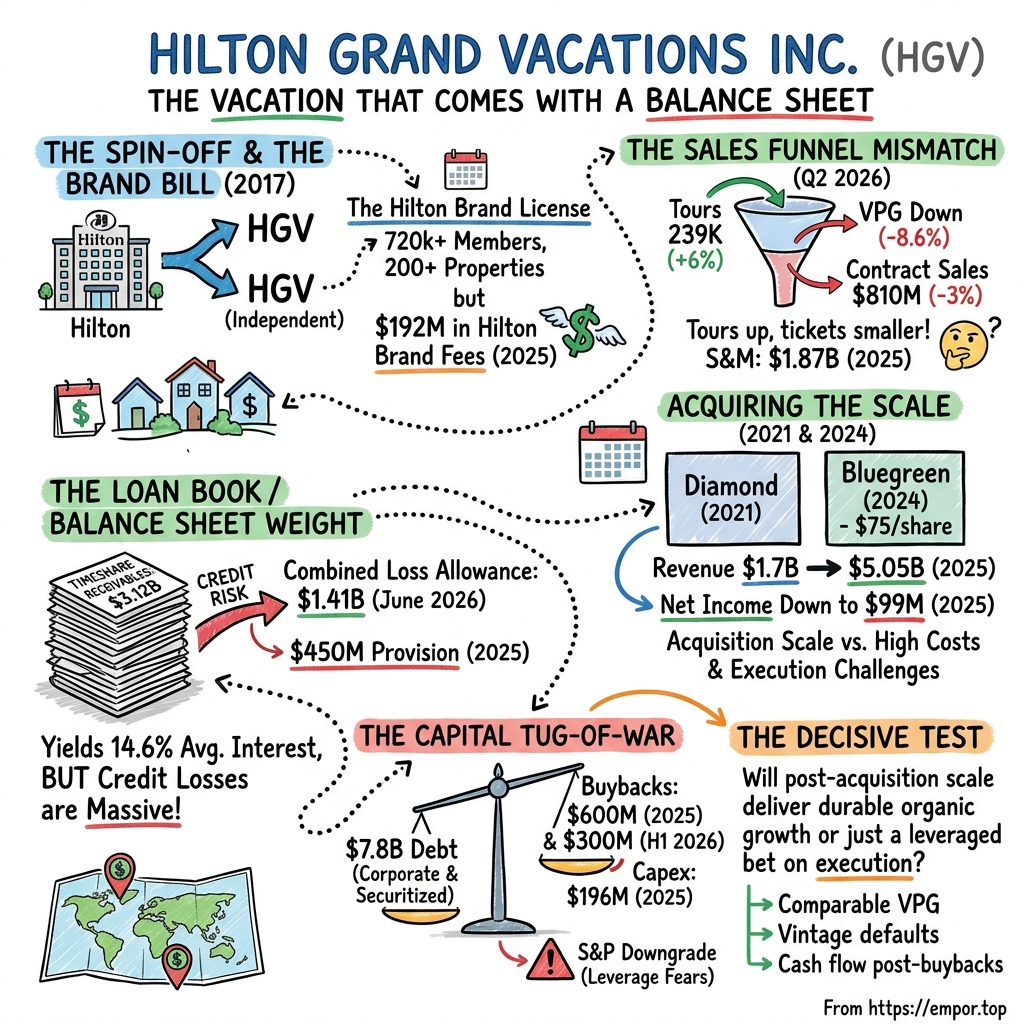
Hilton Grand Vacations Inc.: The Vacation That Comes With a Balance Sheet
The Tours Went Up; the Ticket Got Smaller
Picture a sales center in Orlando in the late spring of 2026. The resort was full, the pool deck was loud, and the morning tour schedule was packed with families who accepted a discounted stay in exchange for ninety minutes with a vacation-ownership counselor. By the measure that most travel businesses worry about first, which is whether people are showing up at all, Hilton Grand Vacations had nothing to apologize for. Across the company, 239,000 guests sat down for a tour in the second quarter of 2026, about 6% more than a year earlier.1 Chief executive Mark Wang told analysts it was the fourth consecutive quarter of consolidated tour growth.2
And yet the money coming out of those rooms shrank. Contract sales, the dollar value of the vacation interests customers signed up to buy, fell about 3% to $810 million.1 The arithmetic that connects those two numbers is the heart of this story. Hilton Grand Vacations, known everywhere by its ticker HGV, measures each tour by its value per guest, or VPG: contract sales divided by the number of tours. In the second quarter that figure dropped 8.6%, from about $3,690 to about $3,370.1 More people walked in. Each of them, on average, signed for less.
Management did not pretend the problem was the weather. On the July 30 call, Wang named three causes. The first was that VPG at Bluegreen, the brand HGV bought in 2024, was moderating faster than expected as the company lapped a spectacular launch period for its HGV Max points program a year earlier. The second was blunter: "sales execution fell short of our expectations," most visibly at a couple of high-volume locations in the back half of the quarter. The third was mix, as more sales came from new buyers and from a trust-based points product, both of which carry smaller average tickets.2 Wang insisted the softness was "not demand related," pointing to healthy occupancy and arrivals that were running ahead of the prior year.2
That explanation matters because it changes the question investors should ask. If demand had cracked, HGV would be a cyclical company waiting for the cycle to turn. If demand is intact and the conversion engine sputtered, HGV is something more interesting and more uncomfortable: a company that spent the last five years buying scale, and is now being tested on whether it can turn that scale into productivity.
Four questions run through everything that follows. Has the enlarged company learned to grow on its own, or did it mostly buy its growth? Do the recurring streams of loan interest and club fees cushion the business when new sales wobble? Does the Hilton name, and the access to Hilton's enormous loyalty base that comes with it, give HGV an edge customers will actually pay for? And can management keep buying back stock while it also invests in resorts and reduces a heavy debt load?
The company that faces those questions is large. At the end of 2025 HGV counted more than 720,000 members across its clubs and over 200 properties in the United States, Europe, Canada, the Caribbean, Mexico and Asia.3 Its 2025 revenue was about $5.05 billion.3 Those figures describe reach, and reach is real. But a footprint of that size was assembled largely through two big acquisitions, and size alone says nothing about whether the purchases earned their cost. Net income in 2025 was $99 million, a profit margin of roughly 2% on that $5 billion of revenue.3
There is a further wrinkle that makes HGV harder to read than most companies. Every sale in that Orlando tour room can create three things at once: a piece of real estate sold, a consumer loan that HGV often holds for years, and an obligation to keep a resort clean, staffed and bookable for as long as the owner wants to use it. The tour may last an afternoon. The economics of what happens there last a decade or more. To understand why HGV looks the way it does, the story has to start with the moment it stopped being a division of a hotel company and became a balance sheet of its own.
 Subscribe on LinkedIn
The Spin-Off Kept the Hilton Name—and the Hilton Bill
On January 3, 2017, Hilton Worldwide completed a piece of corporate surgery it had been planning for most of a year. It split itself into three public companies: the hotel-management and franchising business that kept the Hilton name, a real estate investment trust called Park Hotels & Resorts that held the owned hotels, and Hilton Grand Vacations, the timeshare arm.4 The logic was the logic of the era. Asset-light hotel franchisors were rewarded with rich stock-market multiples; businesses that built condominiums, financed consumer loans and carried inventory were not. Separating them let each be valued on its own terms.
What is easy to misremember is how complete the separation was. HGV's own annual report put it plainly: once the spin-off was done, "neither has any ownership interest in the other."4 The listing was not an initial public offering that raised money. Hilton registered HGV's shares through a Form 10 and distributed them pro rata to its own stockholders.5 A few months later, in May 2017, HGV filed an S-1 prospectus to register up to about 15 million existing shares for resale by selling stockholders, and said it would receive no proceeds from that sale.6 HGV began public life without a capital raise and without a parent.
The first independent year produced revenue of about $1.7 billion and a sizable profit.4 The person running it was no newcomer. Mark Wang had joined Hilton in 1999 as managing director for Hawaii and Asia Pacific, then led HGV's Asian business, and from 2008 until the spin-off ran Hilton Grand Vacations as a wholly owned subsidiary, sitting on Hilton's executive committee and, for a year, running global sales for the hotel division as well.7 Before Hilton he had co-founded three independent timeshare companies, serving as president and chief operating officer of each, and he would later chair the American Resort Development Association, the industry's trade body.7 Few executives in American hospitality know the timeshare sales floor as intimately. That familiarity is an asset, and it also means the company's strategy since 2017 has been, in a very direct way, his strategy.
Independence, however, did not mean letting go of the brand. HGV left Hilton with something more valuable than a building: an exclusive license to use the Hilton Grand Vacations name for timeshare. Its current form, amended and restated in November 2024, runs until December 31, 2116, followed by a 30-year non-exclusive tail period.3 In practical terms the company has the right to call itself Hilton for longer than anyone reading this will be alive.
The bargain has a price. HGV generally pays Hilton 5% of gross revenues from the licensed business, quarterly in arrears, plus specified additional fees.3 It must participate in the Hilton Honors loyalty program, and it buys Honors points to use as sales incentives and owner benefits; those purchases cost $112 million in 2025, up from $53 million in 2023.3 It gets access to Hilton's reservation systems and customer data, which is the real prize, because a guest who already stays at Hiltons is a far cheaper sales lead than a stranger stopped in a shopping mall. In return, HGV accepts operating restrictions. Acquired Diamond and Bluegreen properties that have not been rebranded must be run as separate operations, without Hilton intellectual property or Hilton data, and in connection with the Bluegreen deal HGV agreed to a minimum share of revenue that must come from the Hilton-licensed business to keep exclusivity.3
Follow the license fees over time and the relationship looks less like a legacy and more like a growing line item. HGV recorded about $87 million of license fee expense in 2017.4 By 2023 fees to Hilton were $138 million, then $156 million in 2024 and $192 million in 2025.3 That last figure is about 3.8% of HGV's total reported revenue. Part of the increase reflects acquired properties joining the licensed system on a phase-in schedule with temporarily reduced rates, which means the fee bill should keep climbing as more Diamond and Bluegreen resorts take the Hilton name.3
This is the first tension the investor has to hold. HGV has its own shareholders, its own board and its own debt. Hilton cannot direct its strategy. But HGV's most important marketing asset belongs to someone else, its rent on that asset rises with its revenue, and the rules attached to it shape how acquired businesses can be integrated. The spin-off created an independent company whose commercial identity is still borrowed. Whether that is a bargain depends on what the brand does inside the sales funnel, and the funnel is where the money in this business is actually made.
A Vacation Week Becomes a Loan, a Club—and a Sales Funnel
Start with the guest. Perhaps she received an offer through the Hilton Honors app, or at a kiosk inside a Bass Pro Shops store, or in a call transferred from a hotel reservation line. She pays a modest price for a few nights at a resort in Orlando, Las Vegas or Maui, and agrees to attend a presentation. In the sales room she learns that instead of renting a hotel room every year, she can buy a vacation ownership interest, usually expressed today as an annual allotment of points, and use those points across a network of resorts. If the price feels steep, the counselor can offer financing on the spot.
That one decision fans out into almost every line of HGV's income statement. The sale itself is recorded as sales of vacation ownership interests, which came to about $1.81 billion in 2025.3 If she borrows, HGV earns interest for years; financing revenue was $513 million in 2025.3 Every year after the purchase she pays maintenance fees to a homeowners' association that hires HGV to run the resort, usually under cost-plus agreements that pay HGV a fee of roughly 10% to 15% of the resort's operating costs, and she may pay club dues for the points exchange system on top.3 Resort and club management revenue was $778 million in 2025.3 When owners do not use their time, or when HGV holds unsold inventory, it rents rooms to ordinary travelers, which produced about $746 million of rental and ancillary revenue.3 And when HGV sells on behalf of a third-party developer rather than from its own inventory, it collects commissions and brand fees.3
HGV reports all of this in two segments. Real estate sales and financing is the engine that sells interests and makes loans; it produced about $3.0 billion of segment revenue in 2025. Resort operations and club management, which includes management fees, club dues and the rental business, produced about $1.6 billion.3 The difference between those two segments is the difference between a sales business and an annuity business, and the company's investment case leans heavily on the second half of that sentence.
So how much of HGV truly recurs? The company does not publish a single recurring-revenue share for the whole business, nor a standard contract length. The loan book gives one clue: originated receivables had a weighted-average remaining term of almost nine years at the end of 2025, with an average balance of about $25,000 and a weighted-average interest rate of about 14.7%.3 Management fees recur as long as resorts stay in the system. Club dues recur as long as owners stay in the club. But the largest single revenue line, new interests sold, has to be won again every quarter, one tour at a time.
That is why the unit of account in this industry is the tour. Contract sales equal tours multiplied by VPG, and VPG itself is the product of two things: the close rate, meaning the share of tours that end in a purchase, and the average transaction price. In 2025 HGV ran about 857,000 tours at a VPG of about $3,850, producing roughly $3.3 billion of contract sales, up about 10% from 2024.3 That was a good year. It also shows how sensitive the model is. A small change in close rate or ticket size, multiplied across nearly a million tours, swings hundreds of millions of dollars of sales.
The cost of feeding the funnel is enormous. HGV spent about $1.87 billion on sales and marketing in 2025, which covers marketing packages, discounted stays, tour costs, commissions and wages.3 That is more than the company's reported net sales of vacation interests for the year. The comparison is not quite apples to apples, because some of that spend supports fee-for-service sales and accounting deferrals push some revenue into later years, but the direction is unmistakable. This is a business in which selling is the dominant cost. In the second quarter of 2026 real estate sales and marketing expense ran at about 49% of contract sales.2 Every lost point of VPG lands directly on a cost structure that does not flex easily.
Two more features of the model deserve mention because they explain the numbers that come later. First, accounting. Under the revenue rules HGV adopted in 2018, sales of interests in a resort still under construction are deferred until construction is finished. In 2025 HGV deferred about $368 million of net sales this way, mostly presales at a new Maui project called Ka Haku, which is one reason reported revenue barely grew while contract sales rose about 10%.3 On the July 2026 call, management said another $54 million of net contract sales had been deferred in the quarter.2 Those deferrals will be recognized when the project completes, so GAAP revenue understates recent selling activity, and future revenue will receive a one-time boost. Second, losses. When a sale is financed, HGV books its estimate of future defaults up front as a reduction of revenue. In 2025 that provision deducted about $422 million from the path between contract sales and recognized sales.3 The loan, in other words, is part of the sale from the first day.
What about artificial intelligence, the subject every management team is now asked about? It could matter at the margins of this business: in deciding which hotel guests to target, in scripting and coaching sales conversations, and in servicing hundreds of thousands of owners more cheaply. None of that changes the underlying product, which remains a resort, a loan and a long service obligation. The better question is not whether software disrupts timeshare, but whether it can make each tour cheaper to generate and more likely to close.
Hold on to the cost line. A larger member base is valuable only if tours convert, owners come back and upgrade, and the price of acquiring each new buyer stays supportable. Those three conditions are exactly what HGV's two transformational acquisitions were supposed to improve.
Two Deals Made HGV Much Bigger
On March 10, 2021, with much of the travel industry still shuttered by the pandemic, Mark Wang made the boldest move of his career. HGV announced it would acquire Diamond Resorts, a points-based timeshare operator owned largely by funds managed by Apollo Global Management, in an all-stock transaction.8 The timing was contrarian. HGV's 2020 revenue had collapsed to under $0.9 billion and the company had lost money.9 Diamond's resorts had been empty too. Wang's bet was that consolidation would be cheapest at the bottom, and that HGV's brand and sales machine could do more with Diamond's owners than Diamond could alone.
The terms were designed to look reasonable. HGV would issue about 34.5 million shares, valued at $40.32 each, for an equity value of roughly $1.4 billion; including Diamond's debt, the total deal value was about $3.0 billion.8 HGV promised $125 million of annual cost synergies within 24 months.8 Diamond had earned adjusted EBITDA of about $307 million in 2019, its last normal year.8 Put those together and the multiple depends entirely on whether the synergies arrive. Measured against Diamond's own 2019 earnings, $3.0 billion is close to ten times EBITDA. Add the promised $125 million of savings and it falls to about seven times. That is the source of the attractive multiple quoted at the time, and it is worth remembering that a synergy-adjusted multiple is a forecast, not a price.
The deal was also a leveraged one. On trailing first-quarter 2021 earnings, which were still depressed, HGV's pro forma leverage would be about 6.8 times, and management promised to bring it below three times within 24 months, describing a deal structure that "facilitates financial flexibility and deleveraging."8 Apollo's funds and co-investors would own about 28% of the combined company.8
When the deal closed on August 2, 2021, Wang welcomed "more than 380,000 new owners" and described a combined network of 154 resorts and luxury properties, about 710,000 owners in all.10 Apollo installed two directors, David Sambur and Alex van Hoek, expanding HGV's board from seven to nine.10 The strategic pitch was reach. Diamond brought points-based products, sales centers in markets HGV did not serve and a large owner base whose members could, in theory, be upgraded into Hilton-branded products and sold on the HGV Max program that eventually let owners use points across the combined network.
The integration did not run perfectly. For 2022, management concluded that HGV had not maintained effective internal control over financial reporting because of a material weakness related to Diamond; the following year it reported a separate material weakness in information-technology controls over user access to a revenue and inventory application.3 Both were later remediated, and the auditor gave an unqualified opinion on internal controls for 2025.3 The episode does not prove anything about today's controls. It does show that absorbing a company of Diamond's size stretched the organization, which raises the bar for the next integration rather than lowering it.
That next integration arrived quickly. On November 6, 2023, HGV agreed to buy Bluegreen Vacations Holding Corporation for $75 a share in cash, a deal it valued at about $1.5 billion including net debt.11 Bluegreen was a different animal from Diamond. Based in Boca Raton and run for decades by its chairman and chief executive, Alan Levan, it sold to a more value-oriented, drive-to customer, and much of its lead flow came from an exclusive marketing relationship with Bass Pro Shops and Cabela's stores.1112 HGV signed its own new ten-year exclusive marketing agreement with Bass Pro as part of the deal, giving it kiosks in the outdoor retailer's stores, and gained a member base of more than 200,000.113
The price tag was striking. Bluegreen's merger proxy described the $75 offer as a premium of about 112% over the $35.52 closing price of its Class A shares on November 3, 2023, the last trading day before the announcement.12 A premium that large tends to make headlines, and it raises an obvious suspicion of overpayment. It does not settle the question, though, because a premium to a thinly traded, family-controlled stock is a comparison with a depressed market price, not with the business's cash flows. The fair test is what HGV paid against what Bluegreen earned, and what the combined business has earned since. The deal closed on January 17, 2024, with total consideration of about $1.6 billion including net debt.3
Here the record is sobering. Revenue jumped from about $4.0 billion in 2023 to about $5.1 billion in 2025.3 Net income moved the other way: $313 million in 2023, $60 million in 2024, $99 million in 2025.3 Some of the decline is transitory. Acquisition and integration costs were $237 million in 2024 and $98 million in 2025, and interest expense rose from $178 million to more than $300 million as HGV borrowed to fund the cash deal.3 But the core selling business also became less profitable. The real estate segment's profit margin fell from about 32% in 2023 to about 21% in 2025.3 Bigger did not, at least in these first two years, mean better per dollar of sales.
The most encouraging evidence for Bluegreen came from HGV Max. When HGV introduced the program to Bluegreen owners, sales to those owners soared; Wang later said Bluegreen owner VPGs were up 45% in the second quarter of 2025.2 That was exactly the cross-selling thesis in action: put a richer product in front of an acquired owner base and watch them upgrade. The problem is that a launch is a one-time event. By the second quarter of 2026 those owners had already been offered the product, and the comparison turned brutal. Wang said Bluegreen owner VPGs, even after moderating, were the second highest in the company's history.2 He also acknowledged execution failures at Bluegreen sites, "primarily in Orlando and Myrtle Beach," where leadership was replaced.2
An analyst from Mizuho pressed the obvious point on the call: management knew the comparison would be hard, so what changed? Wang's answer was that the miss was "not a market issue or an integration issue. It really was a leadership issue."2 That framing is plausible. Tour flow at Bluegreen rose 10% and new-buyer transactions there rose 16%, which supports the claim that leads were not the problem.2 But it is worth noticing what the answer concedes. The upgrade surge that made Bluegreen look like a triumph in 2025 was partly a harvest of pent-up demand among existing owners, and harvests do not repeat at the same rate.
So were the deals overpaid? The honest verdict is narrower than either side's headline. Diamond's attractive multiple rested on synergies, and HGV did go on to report rapid cost integration, but the leverage promise of below three times within two years has to be read alongside the debt HGV later took on for Bluegreen and the buybacks that followed. Bluegreen's 112% premium measures the gap with its own share price, not with peer valuations or acquired cash flows. What can be said is that the combined company has not yet delivered the profit that would make either purchase obviously cheap in hindsight. HGV bought a much larger owner base and sales network. Whether it bought a better business depends on whether those owners keep upgrading and paying their loans, and on whether the Hilton brand can do for them what it did for HGV's legacy customers.
The Hilton Brand Is a Doorway, Not a Locked Gate
Imagine an HGV Max member in Chicago planning a February trip. She opens the club's booking system. Her points can buy a week at a Hilton Grand Vacations resort in Hawaii, a former Diamond property in Arizona, a Bluegreen lodge in the Ozarks, or a discount at a Hilton hotel in a city where HGV has no resort at all.3 She can also attend one of HGV's Ultimate Access events, which in the past year hosted more than 137,000 guests at concerts, golf clinics and World Cup matches.2 That bundle is HGV's answer to the question every timeshare buyer eventually asks: why not just book a hotel?
The answer has some weight. HGV can point to its installed base and a license tied to Hilton Honors, a loyalty program Fitch put at roughly 260 million members.313 On the July call, Wang described the Hilton relationship as giving HGV "real deep connection with the customers within Hilton," and claimed the company had leveraged that relationship "better than any brand out there" to become the largest timeshare company in the world.2 On the call, the company said nearly 300,000 members, about 40% of the base, held HGV Max status, up 24% in a year.2
But the competitive arena is crowded with capable rivals. HGV's own annual report names Marriott Vacations Worldwide, Travel + Leisure Co., Disney Vacation Club, Holiday Inn Club Vacations, Westgate Resorts and the Berkley Group as its primary timeshare competitors.3 Marriott Vacations and Travel + Leisure are multi-billion-dollar public companies with their own hotel-brand ties; Disney has perhaps the most emotionally loyal customer base in all of leisure travel. Comparing revenue among them is a rough measure of size rather than a market-share ranking, because each mixes sales, financing, exchange and rental differently. The more important point is that HGV also competes with everything else a family can do with a vacation budget: hotels, cruises, home rentals and travel clubs, which the company itself lists.3
Run the industry through the lens of buyer power and the limits become clear. A prospective owner does not have to buy anything. She can rent the same week at a resort, compare a rival branded club, or buy a used interest on the resale market for a fraction of the developer's price. That last option is the quiet constraint on the whole industry: a product whose secondhand value sits far below its new price relies heavily on the sales presentation, the financing offer and the brand to close the gap. Supplier power, by contrast, is modest; HGV sources inventory from its own development, from recapture of defaulted interests and from third-party developers.3 The real competitive contest is for leads, for sales talent and for repeat purchases, and HGV's annual report says plainly that competition for talent, "in particular for sales and management," is significant.3 An analyst on the July call asked whether staff poaching between timeshare companies had contributed to the Orlando problem; Wang replied that people have moved between companies "for decades."2
What, then, is the edge? The strongest version of the claim is a bundle: a recognized hotel brand that lowers the cost of finding customers, an installed owner base that can be sold upgrades, a points system that lets owners move across a broad network, and a sales and financing operation that can close the deal in a single afternoon. Each part has evidence behind it. The company said tours had grown for four straight quarters and new-buyer tours had risen at a high single-digit rate.2 The Hilton license runs for nearly a century. The Max program's membership is growing.
The weaker part of the claim is the one investors care most about: whether the bundle lets HGV charge more or keep customers longer than rivals. Here the published evidence thins out. HGV does not disclose a long series on owner retention, does not show price realization against peers, and does not reveal how much it costs to acquire each new buyer by channel. The best available proxy is VPG, and VPG fell sharply in the latest quarter. The second-best proxy is the cost of selling, still about half of contract sales.2 A true moat would usually show up as a falling cost of customer acquisition or rising prices. Neither is visible yet.
There is one more piece of evidence, and it cuts both ways. Hilton's fees grew faster than HGV's revenue over the past three years.3 If the brand were a cornered resource that HGV alone could exploit, one would expect the economics to tilt toward the licensee. Instead the licensor collects a steady percentage of gross revenue regardless of whether HGV's profits rise or fall. The brand opens the door to the sales room. It does not guarantee what happens inside.
The fairest conclusion is that HGV's advantage is real but narrower than the marketing suggests. It plausibly lowers the cost of generating leads and gives owners a wider set of places to stay. It has not been shown to create strong switching costs or durable pricing power. The KPI that would confirm the stronger version is sustained VPG growth on a comparable basis without rising sales costs, and that is precisely what the latest quarter failed to show. To understand how much of HGV's growth is genuinely its own, the revenue line needs to be taken apart.
The Revenue Curve Has Two Different Stories
Draw HGV's revenue since the spin-off and it looks like a rocket launch interrupted by a crash. In 2017 the company booked about $1.7 billion.4 Two years later, in 2019, it booked about $1.8 billion.9 Then the pandemic closed resorts and sales centers, and 2020 revenue fell to roughly $0.9 billion, with a net loss of about $201 million.9 From there the line rockets: about $2.3 billion in 2021, rising to roughly $5.0 billion in 2025.9143
A chart like that invites a simple story about a company that tripled in size. The record tells two different stories layered on top of each other, and separating them is the most important analytical step in understanding HGV.
The first story is organic, and it is modest. Between 2017 and 2019, before any large acquisition and before the pandemic, revenue grew by only about $130 million over two years, a low single-digit annual pace.49 Net income in 2019 was about $216 million, lower than in the spin-off year.9 That was the base rate for HGV as a stand-alone Hilton-branded developer: a solid, profitable, slow-growing business. Nothing in the pre-pandemic record suggests a company compounding at double digits on its own.
The second story is about perimeter. Diamond closed in August 2021 and contributed only five months that year; 2022 was its first full year inside HGV.10 Bluegreen closed in January 2024.3 The jump from about $2.3 billion to $3.8 billion between 2021 and 2022, and from about $4.0 billion to $5.0 billion between 2023 and 2024, therefore reflects mostly acquired revenue rather than a newly discovered growth rate. Comparisons with 2020 and 2021 are worse than useless, because they measure recovery from a shutdown.
Once the acquisitions are fully in the base, the organic signal becomes visible again, and it is mixed. Reported revenue grew only about 1% in 2025.3 That understates sales activity, because 2025 contract sales rose about 10% on growing tours and higher VPG, and because large presale deferrals at the Ka Haku project pushed revenue into later periods.3 In the first half of 2026 revenue rose to about $2.64 billion from about $2.41 billion a year earlier.15 Then the second-quarter contract-sales decline arrived, and management lowered its full-year expectations: it now expects VPG to fall by a low-to-mid single-digit percentage for 2026 and contract sales to be flat to slightly down, with third-quarter contract sales down by a mid-single-digit percentage.2
Follow the profit line and the picture darkens. Net income fell from about $352 million in 2022 to $60 million in 2024, then recovered to $99 million in 2025.143 On a per-share basis the decline is softened by buybacks, but the absolute numbers are what matter for judging the acquisitions: the company is roughly a third larger by revenue than it was in 2023 and earns about a third as much. Part of the gap is one-time integration cost and part is higher interest on acquisition debt, but the loan-loss provision has also swollen as Bluegreen's lower-income borrowers joined the book.3 That last element is structural, not transitory.
Management prefers to be measured on a different number. It guides to adjusted EBITDA excluding deferrals, which strips out interest, depreciation, share-based pay, acquisition costs and the timing effects of construction deferrals, and it reiterated a 2026 range of $1.225 billion to $1.265 billion in July.1 That measure has a logic, especially for a business whose revenue recognition swings with construction schedules. It also flatters a company whose economic costs include the interest it pays to finance its loans and the provisions it books for losses. An investor who looks only at adjusted EBITDA sees a resilient business. An investor who looks at net income sees one whose acquisitions have not yet paid.
The second quarter of 2026 is the best credibility test available, because management explained the miss in detail and set out what would fix it. Wang said new leadership, recruiting and training investments in the affected markets were "already making a difference," and that he expected the Orlando and Myrtle Beach centers to return to expected performance by the fourth quarter.2 That is a specific, falsifiable promise, which is to management's credit. The third-quarter guidance, however, already anticipated VPG down in the high single digits, so the repair will not show up immediately.2 The verdict on organic growth is therefore narrower than either bull or bear would like. HGV has proved it can grow tours. It has not yet proved that the enlarged company can grow sales and earnings together, on a comparable basis, for several quarters in a row.
There is a reason the company can keep reporting healthy EBITDA while net income sags, and it lives in the loan book.
The Loan Book Pays Interest—and Sends a Bill Back
When the guest in the Orlando sales room says yes and signs a promissory note, the presentation ends, but HGV's relationship with her has barely begun. HGV is now her lender. It will collect monthly payments for years, at an interest rate set by her down payment, credit profile and loan term, and it will often bundle her loan with thousands of others and sell bonds backed by them to investors.3 If she stops paying, HGV will eventually foreclose, take back her vacation interest and sell it again to someone else.3
The headline economics are attractive. HGV's originated loans carried a weighted-average rate of about 14.7% at the end of 2025, and 14.4% in mid-2026.32 HGV funds much of that book through securitizations and a warehouse facility at far lower rates; its non-recourse debt carried a weighted-average rate of about 5% in mid-2026.1 The spread is large, and the financing segment shows it. In 2025 financing revenue was $513 million and financing profit about $298 million, a margin near 58%.3 In the second quarter of 2026, excluding amortization tied to acquired loans, management put financing margins at 62%.2
The coupon is only the start of the calculation. At the end of 2025 HGV's net timeshare financing receivables were about $3.12 billion, but that was after deducting an allowance for expected losses of about $1.08 billion on originated loans and $155 million on acquired ones.3 During 2025 the company booked roughly $450 million of new provisions across the two portfolios and wrote off about $373 million of loans.3 Put plainly, for every three dollars of net loans on the balance sheet, HGV had set aside more than one dollar for loans it expected would not be repaid. By June 2026 the combined allowance had risen to about $1.41 billion against roughly $5 billion of gross receivables, about 28% of the portfolio.152
Another sign of strain sits in the accrual data. HGV stops accruing interest when a loan is 91 days past due.3 At the end of 2025 it had stopped accruing interest on about $430 million of originated loan principal, up from about $323 million a year earlier.3 That is a third more loans in the penalty box in a single year, during a period of low unemployment.
Management's account of this is careful and partly persuasive. On the July call, President and Chief Financial Officer Dan Mathewes said combined 31-to-90-day delinquencies as a percentage of current balances were down nine basis points from year-end, and that Diamond and Bluegreen delinquencies had improved materially after underwriting changes; Bluegreen down payments were about 800 basis points higher than a year before.2 The second-quarter provision was about 17% of owned contract sales, up roughly four percentage points from the year before, and Truist analyst Patrick Scholes asked about it first.2 Mathewes attributed the increase to more buyers choosing financing and to a mix shift toward trust and new-buyer sales, which are provisioned more heavily, and said it was "not driven by a deterioration in the portfolio itself."2 He expects provisions to stay in the "mid-teens" for the year.2
There is an awkward piece of logic in that answer. A rising share of financed sales is good for future interest income, as Mathewes noted, but it also means more of each sale is a promise to pay rather than cash in hand. A mix toward new buyers is good for long-term member growth, but new buyers are the customers whose payment behavior HGV knows least about. The provision, in other words, is not an accounting nuisance. It is the company's own estimate of how much of today's sales will never turn into cash.
The cash flow statement shows how that estimate moves through the numbers. Across 2023, 2024 and 2025 HGV's net income totaled about $472 million while cash from operations totaled about $921 million.3 That gap looks like a sign of conservative accounting, and in part it is: depreciation and amortization of acquired intangibles, amortization of debt costs and premiums, and share-based pay are all real noncash charges.3 But the single largest add-back in 2025 was the provision for loan losses, about $442 million on the cash flow statement.3 A provision is noncash in the year it is booked. It is cash later, when a borrower stops paying and the expected collections never arrive. Adding it back to measure cash generation is mechanically correct and economically incomplete.
Outside credit analysts are watching the same thing from a different angle. When Fitch reviewed five of HGV's securitization trusts in September 2026, it affirmed every rating with stable outlooks, but noted that three of the 2024 deals were tracking above their initial default assumptions, and raised its lifetime default proxies on those three, in one case to 27%.16 No trust had taken a net loss, partly because HGV had repurchased or substituted defaulted loans.16 That support is a strength while HGV has the liquidity to provide it, and a reminder that the sponsor stands behind its securitizations in practice.
The mitigant HGV cites most often is recovery. When an owner defaults, the company takes back the vacation interest and resells it, often at a low cost of product.3 Wang described this recapture as "a good COP," meaning a low cost of product, and good "for long-term free cash flow, since we don't have to go rebuild inventory."2 That is a genuine feature of timeshare economics. It also has a limit. A recovered interest is worth something only if the sales funnel can resell it, at a time when VPG is falling and the funnel is already under strain.
The conclusion is that financing income is real, recurring and profitable on a gross basis, but the loan book's true return can only be judged after defaults and recoveries by vintage, which HGV does not fully present in a single reconciled view. The numbers to track are the provision rate on owned contract sales, cumulative defaults by origination year and net losses after resale. If the 2025 underwriting changes work, those numbers should improve first at Bluegreen. If they do not, the 14% coupon will turn out to have been a partial illusion. And the loans themselves are funded with debt, which brings the story to the company's other balance sheet.
Buybacks Compete With the Next Vacation—and the Next Debt Payment
In July 2025 HGV's board authorized up to $600 million of share repurchases over two years.15 Management did not take two years. It spent about $600 million buying back roughly 15 million shares in 2025, and another $300 million for about 6 million shares in the first half of 2026.315 By mid-August 2026 only about $61 million remained under the plan, and on August 20 the board approved a fresh $600 million authorization, also over two years, to begin when the old one ran out.17 Mathewes noted in the announcement that HGV had repurchased more than 60 million shares since the program began in 2018.17
That is a remarkable figure in light of the Diamond deal. HGV issued about 34.5 million shares to acquire Diamond in 2021.8 Since 2018 it has bought back nearly twice that number. Shares outstanding stood at about 81 million in February 2026 and about 78 million in October 2026.318 In effect, HGV used Diamond stock to buy the company and then spent cash to retire all of that stock and more. That is a clever way to grow per-share figures. It also means the debt that financed Bluegreen and the buybacks has replaced equity as the cushion under the business.
The size of that cushion is the central fact. At June 30, 2026, HGV carried about $4.9 billion of corporate debt and about $2.9 billion of non-recourse debt, against roughly $272 million of unrestricted cash.152 The two kinds of debt are different. Corporate debt is owed by HGV itself and secured by its assets or ranked as unsecured notes. Non-recourse debt is backed by pools of timeshare loans; if those borrowers default, bondholders generally look to the collateral rather than to HGV. Operating lease liabilities of about $79 million are a separate obligation altogether and should not be mistaken for borrowing.15 But both kinds of debt are essential to the model, because a company that lends to its customers needs a reliable way to refinance those loans, and Fitch lists reliance on the asset-backed bond market as a key constraint on HGV's rating.13
The refinancing news in 2026 was genuinely good. In May HGV upsized and consolidated its timeshare warehouse into a $1 billion facility, with a revolving period running to May 2028 and final maturity in May 2029.19 In July it borrowed a new $850 million term loan maturing in July 2033 to repay the roughly $849 million term loan that had been due in 2028.20 At June 30 it had $463 million available on its revolver and $755 million of capacity in the warehouse.2 Near-term maturity pressure, in other words, eased considerably. What did not change was the total amount owed.
Management's own leverage measure is reassuring: total net leverage of about 3.8 times trailing EBITDA at June 30, unchanged from year-end.1 Rating agencies calculate it differently and see less room. S&P downgraded HGV to BB- with a negative outlook in April 2025, citing expected leverage of 5.5 to 6.0 times, weaker sales, higher sales and marketing costs and continued repurchases.21 Fitch, which affirmed HGV at BB- with a stable outlook in August 2026, was gentler, expecting its measure of leverage to improve to about 4.5 times in 2026 mainly through EBITDA growth rather than debt reduction.13 But Fitch's downgrade trigger is leverage sustained above 4.5 times, so its own base case leaves almost no headroom, and Fitch assumes HGV keeps buying back about $600 million of stock a year.13 The agency said plainly that sizable repurchases are likely to constrain debt reduction.13
The capital allocation record can be laid out in one sentence. In 2025 HGV spent $600 million on buybacks and about $196 million on capital expenditure, while its net income was $99 million.3 Buybacks are being funded from operating cash flow and from the cash released by securitizing loans, not from accounting profit. Management's adjusted free cash flow measure, which counts securitization proceeds, was about $180 million in the second quarter of 2026, and the company expects full-year conversion of EBITDA to adjusted free cash flow in the lower half of its 55% to 65% target range.2 That measure tells investors how much cash management believes is available. It is not the same as realized free cash flow after every loan and inventory dollar is accounted for.
The bull case for this policy is coherent. If HGV's stock trades well below the value of its future cash flows, every share retired increases the remaining owners' claim on those flows, and a smaller share count magnifies any recovery in earnings. With a stock-market value of about $2.8 billion against an enterprise value of about $10.4 billion, small changes in business value move the equity a great deal.18 Management has also attached a condition: it plans to keep repurchasing about $150 million a quarter "subject to the repurchase activity not increasing our net leverage for the full year."2
The skeptical case is that the buybacks have been aggressive just as the business softened. HGV bought about 6 million shares in the first half of 2026 for $300 million, an average of roughly $50 a share.15 On October 23, 2026, the stock closed at about $36.18 Those purchases are currently worth about a quarter less than HGV paid. That does not prove the buybacks were a mistake; a long-term owner should judge them over years. It does show that the stock was not obviously cheap when HGV was buying most heavily, and that the cash could instead have paid down debt carrying interest of more than 5%.1
An activist looking at this would ask a simple question: if management's priority is a stronger balance sheet, why does the repurchase pace stay constant through a quarter in which contract sales missed expectations? The leverage condition is the right instinct, but it is a ceiling on getting worse, not a commitment to getting better. The fair verdict is that refinancing bought time, while the buybacks spend some of it. The capital-return policy will look durable if realized cash flow rises and leverage falls even after repurchases. Until then it is a bet on management's view of HGV's value, made with borrowed money in the background. That bet sits alongside two outside relationships whose influence on HGV has never fully faded.
The Hilton and Apollo Relationships Still Shape the Economics
On May 6, 2026, HGV's shareholders gathered at the Waldorf Astoria Orlando for the annual meeting.7 The ballot listed nine directors. Two of them, David Sambur and Christine Cahill, sat on the board under a stockholders agreement signed when the Diamond deal closed in 2021.7 The proxy statement that set up the meeting showed Apollo's funds holding about 18.2 million shares, or 22.5% of HGV, at the record date, making them by far the largest owner.7 Hilton, whose name is on the door, owns nothing.
Those two relationships are often described as history. They are better understood as live economics.
Hilton's influence runs through the license. Hilton-related fees and points purchases exceeded three times HGV's 2025 net income.33 The license terms are disclosed and fixed, and there is no suggestion they are improper. But no investor can judge HGV's profitability without remembering that a large slice of its gross revenue goes to a company with no stake in its equity.
Apollo's influence runs through ownership, governance and commerce. Apollo received its stake as Diamond's seller and initially held more than 30 million HGV shares; it sold 4 million shares in late 2024 and 8.05 million more in an underwritten offering in 2025, alongside which HGV bought back about 933,000 shares from the underwriters for $40 million at the same price.73 That repurchase was disclosed and priced at market, but it shows how corporate cash and a major holder's exit can meet in the same transaction. Apollo also has commercial ties. HGV paid about $47 million to Arrivia, an Apollo-affiliated provider of loyalty and marketing technology, and about $890,000 to Rackspace, another partly Apollo-owned company, since the start of 2025; the Rackspace agreement was terminated during that year.7 HGV also paid director compensation for the Apollo designees to an Apollo affiliate.7 The proxy discloses these arrangements but offers no benchmarking against third-party alternatives, which is the comparison a minority shareholder would want.
The governance question sharpens when pay is placed beside performance. Mark Wang's reported compensation was about $14.1 million in 2025, including about $7.8 million of stock awards and about $4.5 million of annual incentive pay, almost identical to the $14.0 million he received in 2024.7 In the same two years HGV's net income was $60 million and $99 million.3 The board's case is that incentives are tied to adjusted EBITDA, contract sales and integration goals, measures that were largely met. Shareholders noticed the gap anyway. At the 2025 annual meeting only about 85% of votes cast supported the say-on-pay proposal, and the board concluded that the result did not require substantive changes.7 A year later, in 2026, support recovered sharply, with about 68.2 million votes for and about 0.5 million against, or roughly 99%.22 The swing is worth noting without over-reading: an 85% result signals dissent from a meaningful minority, and the 2026 result suggests most holders were satisfied, but neither vote explains why.
The second-quarter call offered a final test of how management communicates under pressure. The prepared remarks led with tour growth, EBITDA growth and margin expansion before turning to the sales miss.2 The analyst questions went straight to the soft spots: the provision rate, Bluegreen VPG, which part of the sales equation missed, and talent poaching.2 Management's answers were specific about locations and actions, which is encouraging. They were also consistently framed around the idea that nothing structural had changed, and the full-year EBITDA and adjusted free-cash-flow outlook stayed in place even as the sales outlook was cut.2 Holding EBITDA while cutting sales means the plan now leans on cost discipline and a lower provision in the second half. That can work. It also means the guidance has less margin for another miss.
HGV, then, is independent of Hilton's ownership but not of its economics, and independent of Apollo's control but not of its influence. Neither relationship is a scandal. Both are reasons to demand clear disclosure of what HGV pays and what it gets in return. They also sit on top of risks that are more basic than governance: the nature of what HGV sells.
A Long-Lived Resort Obligation Meets a Short-Term Travel Cycle
Every timeshare sale has a strange asymmetry built into it. The customer decides in an afternoon, often on vacation and in a good mood. HGV's long tail of obligations persists for decades. When times are good, that long tail produces management fees and interest. When times turn, the obligations stay put while the sales that pay for the machine can drop quickly.
That is the core risk in this business, and it is cyclical, not technological. Weaker consumer confidence reduces tours, lowers close rates and shrinks the average ticket, all at once. Meanwhile the costs of marketing packages, sales staff, resort operations and debt service continue. HGV's 2020 downturn showed how violent the downside can be.9 Fitch names cyclicality and the possibility of weaker new-owner sales in a prolonged discretionary-spending downturn as key constraints.13 And the loan book adds a second layer, because a downturn that reduces new sales also tends to raise defaults among existing borrowers.
The business also keeps asking for money. Capital expenditure rose from about $97 million in 2023 to about $199 million in 2024 and $196 million in 2025, most of it in the real estate segment.3 Beyond capex, HGV disclosed about $226 million of inventory-related purchase commitments stretching over the next decade.3 It does not report research and development spending, which would be the wrong lens anyway; for this business the relevant investment is in resorts, inventory, sales centers, member programs and technology. The point is not that the spending is excessive. It is that it competes with buybacks and debt reduction for the same cash.
Some of that spending is already visible in new assets and portfolio pruning. HGV closed its acquisition of the Elara joint-venture property at the end of April 2026, which management expects to add about $20 million of EBITDA on a run-rate basis this year and $25 million to $30 million next year.2 At the end of June it disposed of a group of non-core properties, recording a $48 million non-cash loss; the company expects the move to reduce the burden of developer maintenance fees on unsold inventory by $10 million to $12 million a year.2 That burden is real: HGV's rental and ancillary business lost about $10 million in the second quarter, largely because the company pays maintenance fees on inventory it has not sold.2 Cleaning up the portfolio is sensible. It is also a reminder that inventory carries a holding cost that does not show up as an obvious expense until the sales funnel slows.
One specific legal matter deserves attention. In connection with Bluegreen, HGV inherited a dispute over an alleged breach of a purchase and sale agreement for The Manhattan Club in New York. On February 10, 2025, an arbitration panel set out what HGV's subsidiary must do to cure the breach, including purchases of inventory and assuming the management agreement, and HGV said it was in the process of curing it.3 The company warned that liabilities it did not know about at the time of the acquisition could result in substantial costs.3 Beyond that matter, the 2025 annual report describes ordinary-course litigation that management does not expect to be material, and does not identify material unresolved tax demands.3
Currency risk is modest. Most of HGV's operations are in U.S. dollars, and its main foreign exposure is in yen- and Canadian-dollar loans; management estimated that an adverse 10% move in exchange rates would be immaterial.3 Interest-rate risk on variable debt is partly hedged with swaps.3
Two technology risks are worth stating once and in proportion. Cybersecurity and privacy matter because HGV holds personal and financial data on hundreds of thousands of owners and borrowers, and its license gives it access to Hilton customer data under strict conditions.3 Artificial intelligence is more likely to change how efficiently HGV sells than whether people want vacation ownership. The risks that could actually break the investment case are more ordinary: a consumer slowdown, a failure to fix sales execution, rising credit losses and a debt load that leaves little room for all three at once. Those risks are easier to see once the whole business is viewed from the sales room outward, which is where its lessons begin.
The Lessons Hidden in the Sales Presentation
Go back to the guest in the Orlando sales room and follow everything her signature sets in motion. A sale is recorded. A loan is opened. A resort obligation is extended. A member is added to a club that HGV must keep worth belonging to. A slice of the revenue is earmarked for Hilton. Some of the future interest will never be paid, and HGV books that expectation the same day. Few consumer businesses pack so many separate economic bets into one decision, and HGV's history since the spin-off is a series of lessons about what happens when a company multiplies that decision by acquisition.
The first lesson comes from the tour count. Despite four straight quarters of tour growth, HGV watched contract sales fall in the second quarter of 2026 because each tour produced less.1 Two acquisitions made the funnel far wider, and the second quarter of 2026 proved that width is not the same thing as productivity. A bigger funnel is not a better business until each tour earns more than it costs. For founders and acquirers, the wider point is that buying customers is easy to measure on the day of closing and hard to measure afterwards, when the bought customers must be sold to again by people who did not choose them.
The second lesson comes from the loan book. A 14% coupon on consumer loans sounds like a money machine, and on a gross basis the financing business is genuinely profitable.3 Loss reserves and the performance of HGV's 2024 securitizations show why the coupon is only the beginning of the return calculation.1516 Any business that finances its own customers is two businesses, a seller and a lender, and the lender's results arrive years after the seller has been paid its commission.
The third lesson comes from the brand. Hilton's name gives HGV access to travelers who already trust the company, but Hilton also collects a percentage of HGV's gross revenue whether profits rise or fall.3 The brand has not stopped customers from choosing rentals, rival clubs or nothing at all. A brand can open the door, but the customer must keep choosing the vacation. Borrowed prestige is valuable; it is not the same as owned pricing power.
The fourth lesson is about sequencing. HGV issued stock to buy Diamond, borrowed to buy Bluegreen, and then spent heavily to repurchase its own shares while the integration was still being proven.8317 Each step can be defended on its own. Together they converted an equity-funded company into a leveraged one before the acquisitions had demonstrated their returns. Capital allocation is judged by the order of operations as much as by any single decision, and buying back stock is most valuable after the business has shown what it is worth, not before.
The Case Turns on VPG, Credit Losses and Cash After Buybacks
In late July 2026, after admitting that second-quarter sales execution fell short, management did something revealing: it cut its sales outlook and kept its earnings outlook.2 The full-year adjusted EBITDA range of $1.225 billion to $1.265 billion stayed intact, supported by cost discipline, a lower expected provision in the second half and the contribution from Elara.12 Whether that was confidence or optimism is the question the whole investment case now turns on.
The bull case is not hard to state. HGV is, by its own account, the largest timeshare company in the world, with a century-long license to one of the world's most recognized hotel brands, and a set of recurring revenues from management fees, club dues and loan interest that do not depend on any single quarter's sales.23 Its tour flow is growing, its new-buyer transactions are growing, and its Max program is pulling owners deeper into the ecosystem.2 It has pushed out its debt maturities to 2029 and 2033.1920 If the Orlando and Myrtle Beach fixes work and Bluegreen VPG stabilizes once the launch comparison passes, a business with healthy EBITDA margins and a shrinking share count could see per-share earnings rise quickly from a depressed base.
The bear case is just as clear. Most of HGV's growth since 2019 was bought, and the profit attached to that growth is far lower than before the purchases.3 Loan-loss provisions are high and rising, non-accrual loans are climbing, and the securitization data show 2024 vintages defaulting faster than expected.316 Leverage on the rating agencies' measures sits at or near downgrade thresholds while the company continues to buy back stock at about $600 million a year.1321 And the latest quarter showed that the sales engine, which has to carry all of those obligations, can stall even when demand is healthy.
A view through Michael Porter's five forces helps place HGV's position. Rivalry is intense, with branded competitors such as Marriott Vacations, Travel + Leisure and Disney competing for the same affluent travelers and the same sales talent.3 The threat of substitutes is high, because a family can rent a resort, a hotel or a private home without committing to anything. Buyer power is significant not because any customer is large, as HGV has no customer anywhere near 10% of revenue, but because every customer can walk away before signing and the resale market sets an uncomfortable reference price after.3 Supplier power is low, since inventory comes from HGV's own development, recaptured interests and third-party developers. The threat of new entrants is modest, because building resorts, licensing a brand and funding consumer loans at scale take years and capital. The industry's structure rewards incumbents with brands, inventory and financing access, but it gives them little leverage over customers.
Hamilton Helmer's seven powers frame the same question from inside the company. HGV has a claim to scale economies in marketing and in securitization, since a large, steady flow of loans earns better funding terms than a small one, and its access to warehouse lines and the bond market reflects that.19 It has branding, but the brand is licensed rather than owned and paid for out of gross revenue. It has a weak form of switching costs: an owner who has paid for points and is still paying off a loan is unlikely to buy a rival product soon, but that is a cost of having bought, not evidence of satisfaction, and HGV does not publish retention data that would show owners staying by choice. Network economies are modest; a bigger points network gives each member more places to go, which helps, but members do not benefit from each other directly. There is no cornered resource beyond the license, no meaningful counter-positioning against rivals who sell the same product, and some process power in a sales organization Wang calls "one of our greatest competitive advantages."2 That claim was tested in the second quarter, when the process faltered at two of its biggest centers.2 The honest summary is that HGV has a real but narrow advantage in distribution and funding, not a moat that protects price.
Why could HGV win from here? Because it combines three things that rarely sit together: a famous hotel brand, a large installed base of owners who can be sold upgrades, and its own lending machine. If those three reinforce each other, the company's cost of acquiring each customer should fall over time as more of its sales come from owners rather than strangers, and its credit losses should fall as underwriting tightens. Why might it not? Because customers have abundant alternatives, because the larger footprint has not yet produced visible price or retention advantages, and because the license that brings the brand also brings fees and operating restrictions that grow with revenue.
Three numbers will decide which version is true. The first is VPG together with contract sales on a comparable basis, which fell 8.6% and about 3% respectively in the second quarter, and which management expects to fall further in the third quarter before recovering.12 The second is the loan-loss provision as a share of owned contract sales, which rose to about 17% in the second quarter against management's mid-teens target, read alongside delinquencies and vintage defaults.2 The third is realized free cash flow and leverage after buybacks, where company-defined net leverage sat at about 3.8 times and Fitch expects its own measure near 4.5 times for 2026.113 If VPG recovers without the provision rising, and leverage falls while buybacks continue, the bull case will have earned its confidence. If any one of the three moves the wrong way, the others will have less room to compensate.
The stock market's verdict, for now, sits between those outcomes. On October 23, 2026, HGV traded at about 20 times trailing earnings, about 11 times enterprise value to EBITDA and about half of one year's revenue.18 The trailing multiple looks high because 2025 earnings were depressed; on analysts' forward estimates the multiple is under ten times.18 A separate peer comparison, compiled at a different date, showed Marriott Vacations with negative trailing earnings and Travel + Leisure at about 19 times earnings, with both valued at higher multiples of sales than HGV.23 The differing dates and business mixes make that a rough comparison rather than a ranking. What the price appears to assume is that earnings will recover meaningfully from 2025 levels, which is to say that the market is already partly underwriting the fixes management has promised but not yet delivered.
The Next Sales Season Is the Test
Tonight HGV sits between two reporting dates. The second-quarter call, with its admission of execution problems and its promise of a fourth-quarter recovery in Orlando and Myrtle Beach, is three months old. The third-quarter results, which management has already told investors will show contract sales down by a mid-single-digit percentage and VPG down by a high single-digit percentage, have not yet been released.2 A new $600 million buyback authorization is waiting to take over from the nearly exhausted old one.17 The stage is set for a series of verdicts.
The first will come from Bluegreen. By the end of 2026, the comparison with HGV Max's launch period will have rolled off, and Bluegreen's owner VPG will be measured against a normal year rather than a spectacular one. If its sales centers return to expected performance by the fourth quarter, as Wang said they would, the second quarter will look like a stumble.2 If they do not, investors will have to consider that the 2025 surge was the high-water mark of a cross-selling opportunity that has now been largely harvested.
The second verdict will come from the loan book, and it will arrive more slowly. The company expects the provision rate to ease in the second half as loans with larger down payments make up more of the pool.2 The evidence to watch is not a single quarter's provision but the default curves of the 2024 and 2025 vintages, the securitization trusts' cumulative defaults and the losses after foreclosed interests are resold. A weaker consumer environment would test those curves at exactly the moment the company is leaning on them to hold its earnings guidance.
The third verdict concerns the balance sheet. HGV has refinanced its way to longer maturities, and Fitch has given it a stable outlook. But Fitch's own forecast puts leverage at the threshold where it would consider a downgrade, and that forecast assumes continued buybacks of about $600 million a year.13 Management has promised that repurchases will not raise net leverage over the full year.2 The question is whether the company will ever let leverage fall meaningfully, or whether every improvement in cash flow will be returned to shareholders as fast as it arrives.
Put those verdicts together and the story's central tension becomes clear. HGV has bought the scale to be the biggest name in vacation ownership. It has not yet shown that the scale makes each tour more profitable, each loan safer or each dollar of debt easier to carry. The next sales seasons will show whether the platform it assembled is a stronger business or simply a bigger one.
The Vacation Comes With a Balance Sheet
Return one last time to the Orlando sales room in the spring of 2026. A guest walks the resort grounds, sits through the presentation and considers the offer. Across HGV that quarter, the tours kept coming, though each produced less.1 Many of those guests borrowed to buy. Somewhere in the company's accounts, a substantial reserve stands against the chance that some will not pay.15
That is the image that captures HGV better than any revenue total. The company sells the promise of future vacations, and then it carries the loan, the resort and the club that make the promise good. Every successful sale is at once a holiday, a credit decision and a claim on years of service. At Hilton Grand Vacations, the tour ends in an afternoon; the economics last for years.
References
-
Hilton Grand Vacations Reports Second Quarter 2026 Results, Form 8-K Exhibit 99.1 — SEC, 2026-07-30 ↩↩↩↩↩↩↩↩↩↩↩↩
-
Second Quarter 2026 Earnings Call Transcript — Hilton Grand Vacations, 2026-07-30 ↩↩↩↩↩↩↩↩↩↩↩↩↩↩↩↩↩↩↩↩↩↩↩↩↩↩↩↩↩↩↩↩↩↩↩↩↩↩↩↩↩↩↩↩↩↩↩↩↩
-
Hilton Grand Vacations Form 10-K for 2025 — SEC, 2026-02-26 ↩↩↩↩↩↩↩↩↩↩↩↩↩↩↩↩↩↩↩↩↩↩↩↩↩↩↩↩↩↩↩↩↩↩↩↩↩↩↩↩↩↩↩↩↩↩↩↩↩↩↩↩↩↩↩↩↩↩↩↩↩↩↩↩↩↩↩↩↩↩↩↩↩↩↩↩↩
-
Hilton Grand Vacations Form 10-K for 2017 — SEC, 2018-03-01 ↩↩↩↩↩↩
-
Hilton Grand Vacations Form 10 Registration Statement Amendment — SEC, 2016-09-16 ↩
-
Hilton Grand Vacations Form S-1 Resale Prospectus — SEC, 2017-05-25 ↩
-
Hilton Grand Vacations 2026 Proxy Statement — SEC, 2026-03-17 ↩↩↩↩↩↩↩↩↩↩
-
Diamond Resorts Acquisition Investor Presentation — SEC, 2021-03-10 ↩↩↩↩↩↩↩↩
-
Hilton Grand Vacations Form 10-K for 2021 — SEC, 2022 ↩↩↩↩↩↩↩
-
Hilton Grand Vacations Completes Acquisition of Diamond Resorts — Hilton Grand Vacations, 2021-08-02 ↩↩↩
-
Hilton Grand Vacations to Acquire Bluegreen Vacations — Hilton Grand Vacations, 2023-11-06 ↩↩↩
-
Bluegreen Vacations Holding Corporation Definitive Merger Proxy — SEC, 2023-12-11 ↩↩
-
Fitch Affirms Hilton Grand Vacations' IDR at 'BB-'; Outlook Stable — Fitch Ratings via MarketScreener, 2026-08-20 ↩↩↩↩↩↩↩↩↩
-
Hilton Grand Vacations Form 10-Q for the Quarter Ended June 30, 2026 — SEC, 2026-07-30 ↩↩↩↩↩↩↩↩↩
-
Fitch Affirms Five Hilton Grand Vacations Trust Transactions — Fitch Ratings via MarketScreener, 2026-09-28 ↩↩↩↩
-
HGV Announces New Share Repurchase Plan — Hilton Grand Vacations, 2026-08-20 ↩↩↩↩
-
Hilton Grand Vacations Statistics and Valuation — Stock Analysis, 2026-10-23 ↩↩↩↩↩
-
Hilton Grand Vacations Announces Upsized and Consolidated $1 Billion Warehouse Facility — Hilton Grand Vacations, 2026-05-21 ↩↩↩
-
Hilton Grand Vacations Credit Agreement Amendment No. 10, Form 8-K — SEC, 2026-07-17 ↩↩
-
Hilton Grand Vacations Downgraded to 'BB-'; Outlook Negative — S&P Global Ratings, 2025-04-02 ↩↩
-
Hilton Grand Vacations 2026 Annual Meeting Results, Form 8-K — SEC, 2026-05-08 ↩
 LinkedIn
 WhatsApp
 Reddit
 Hacker News
 Email
 Kindle
 RSS Feed
 Spotify
 Apple Podcasts
 Amazon Music
 Audible
 YouTube