Hawaiian Electric Industries: The Utility That Has to Earn Hawaiʻi’s Trust Back
I. The Bill for Keeping the Lights On
On November 6, 2026, Hawaiian Electric Industries put out a quarterly earnings release that looked, at first glance, like modest good news. Net income for the third quarter had risen to about $35 million, from about $31 million a year earlier.1 Read one line further and the picture inverted. Core net income, the number management itself uses to strip out the one-time noise, had fallen to $23 million from about $33 million.1 The headline gain had come almost entirely from the holding company selling and revaluing its leftover shares in American Savings Bank, the lender it used to own outright. The utility, the business that actually keeps lights on across most of Hawaiʻi, had earned less.
And sitting beside those earnings, in the same release, was the line that really mattered. HEI had already prepaid $80 million toward the second installment of the Maui wildfire settlement, which cut the roughly $479 million due by about $82 million once an early-payment discount was applied.1 That is how a utility talks when its most important number is no longer earnings per share. It is a payment schedule.
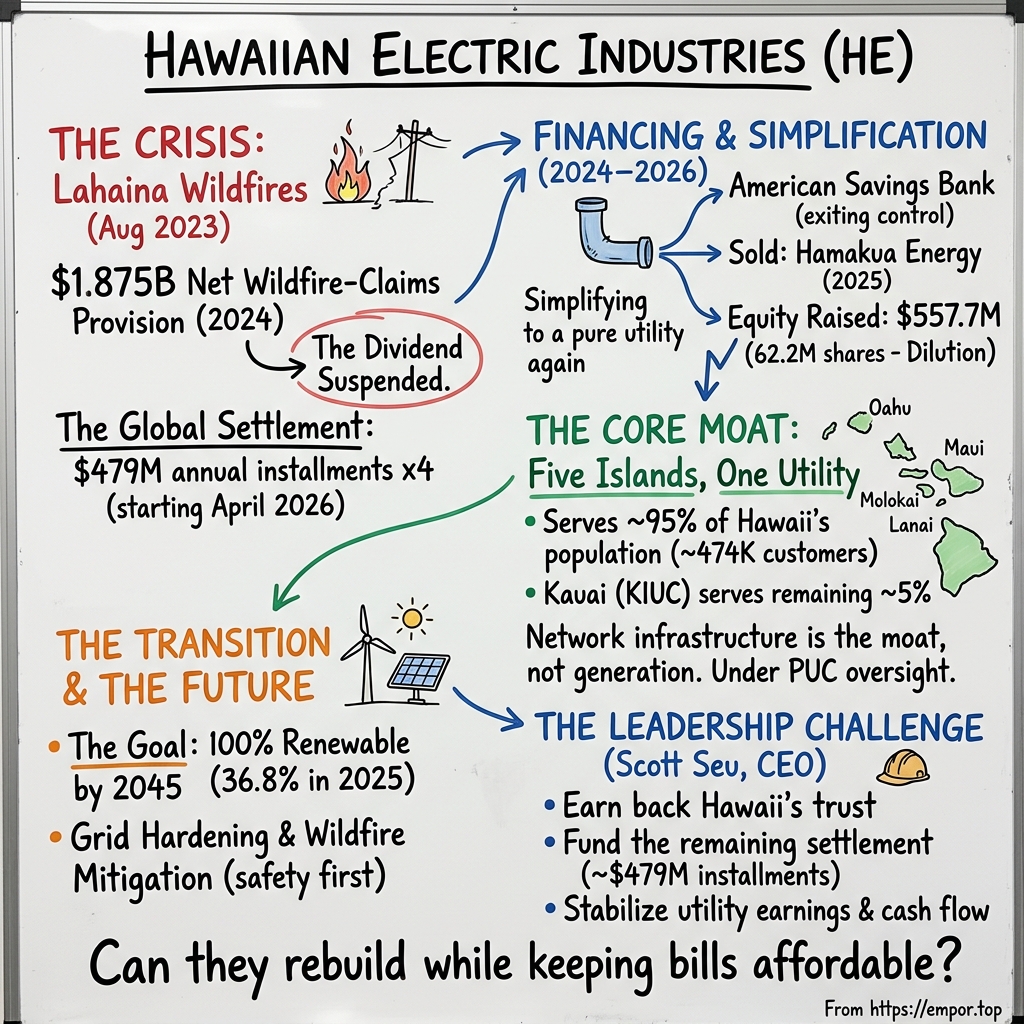
The schedule is easy to state and hard to meet. Under the global settlement of the claims arising from the August 2023 fires, Hawaiian Electric and its parent agreed to pay their share in four annual installments of roughly $479 million each.2 The first went out in April 2026.3 Three more are owed. A company that earned about $123 million of common-stock income in all of 2025 has to find close to half a billion dollars a year, four years running, while still building and repairing the grid that serves about 95% of the people in the state.24
To follow this story without getting lost, it helps to see that there are really three balance sheets in it. The first belongs to HEI, the listed parent, which owes the settlement alongside its utility, raises equity from shareholders, and carries the investment stakes. The second belongs to the regulated utilities, Hawaiian Electric and its island subsidiaries, which earn revenue on rates set by Hawaiʻi's Public Utilities Commission and need constant access to capital to replace poles, wires and power plants. The third is a fading ledger of businesses HEI has sold or is still trying to exit: the bank, now an investment rather than a subsidiary; Hamakua Energy, a power plant on Hawaiʻi Island; and the remnants of Pacific Current, a renewable-energy venture that in the third quarter produced a $51 million impairment on a biomass plant on Kauaʻi.1 Each of these behaves differently, and the danger in reading HEI's results is letting gains in one disguise strain in another.
The third quarter showed exactly that danger. The utility's core earnings fell to about $28 million from about $40 million, because operating costs rose by roughly $20 million, including about $14 million to clean up after August and September storms, and because interest expense rose by about $23 million, most of it a non-cash charge that accretes the discounted settlement liability back toward its face value.1 Higher revenue under the annual rate adjustment helped by about $8 million, but nowhere near enough.1 Meanwhile the holding company booked an $18 million gain on the bank shares it sold into American Savings Bank's initial public offering and a $46 million unrealized gain on the shares it kept.1 GAAP income went up. The engine underneath went down.
It would be easy to dismiss one weak quarter as noise, and storms are genuinely episodic. But the pattern was not new. In the second quarter, too, core net income had fallen by roughly a third from the year before while GAAP income ballooned on a one-time remeasurement of the settlement liability.5 Two quarters in a row, the headline number and the underlying number moved in opposite directions. For an investor, that is a signal to stop reading the first line of the release and start reading the reconciliation, because the reconciliation is where this company's real condition lives. The utility's trailing twelve-month core return on equity had slipped to about 5.2%, from 7.0% a year earlier, a level at which a regulated business is not earning what its capital costs.1
That divergence frames four questions that run through the rest of this story. Can HEI fund the remaining settlement without another large dilution of its shareholders or a liquidity crisis? Is the utility's underlying earnings power recovering, or are reported profits still mostly accounting? Does the slimmed-down group, stripped of its bank and its side ventures, finally make cash flows legible? And can the utility harden its grid against fire, push toward the state's renewable mandate, and keep its credit access, all without pricing out customers in one of the most expensive electricity markets in America?
None of those questions has a clean answer yet. HEI's own quarterly filing says it is still working with advisers to arrange the capital for the remaining settlement payments, and it warns that if financing fails, the company may have to consider strategic alternatives.3 The settlement, in other words, has stopped being a pure legal liability. It has become a financing and execution test for the parent, and the story turns on whether the regulated utility can recover its footing without another major dilution or liquidity event. To see why that test is so delicate, start with what HEI actually owns.
 Subscribe on LinkedIn
II. Five Islands, One Utility Bargain
Picture a household on Oʻahu opening its monthly electric bill. The total is large by mainland standards, and almost nothing in it is set by a market. There is a fixed customer charge for being connected at all. There is an energy charge for every kilowatt-hour consumed. Larger customers pay a demand charge based on their peak usage. And then there are adjustment charges, which pass through the swinging cost of fuel and purchased power and the recovery of approved investments.2 Each component sits in a tariff approved by the Hawaiʻi Public Utilities Commission.26 Payment is due, for most customers, within 30 days.2 The household cannot shop for a different wires company. There is only one on the island.
That is the bargain at the center of Hawaiian Electric. The company holds a regulated franchise to deliver electricity on Oʻahu, Maui, Molokaʻi, Lānaʻi and Hawaiʻi Island, serving about 474,000 customer accounts.4 Oʻahu alone accounts for about 311,000 of those accounts, Hawaiʻi Island about 91,000 and Maui County about 72,000.4 In exchange for that territory, the utility accepts that a state commission decides what it may charge, what investments it may recover, and what return it may earn. The money comes in as regulated, recurring demand rather than as contracts with a fixed term. Nearly all customer revenue is recognized as the electricity is delivered, and even the U.S. Army, a significant customer, pays under a contract whose pricing is recalculated each year on the basis of actual costs.2
The company does not disclose any single customer or supplier accounting for 10% or more of revenue, and it publishes no top-customer concentration table.2 That is what you would expect for a utility selling to hundreds of thousands of households and businesses. The commercial exposures that matter sit elsewhere: on the fuel suppliers who ship oil to the islands, on the independent power producers whose plants feed the grid, and on the regulator who decides how quickly costs flow through to bills.
It helps to separate what Hawaiian Electric does from what it owns. The utility is first a network: transmission lines, distribution feeders, substations, control rooms, and the operators who balance supply and demand second by second. It is also, still, a generator. On Oʻahu its own Kahe and Waiau plants, both oil-fired, supply about 650 and 400 megawatts of firm capacity respectively, while independent producers like the oil-fired Kalaeloa plant and the H-POWER waste-to-energy facility supply most of the rest.4 On Maui, the utility's Māʻalaea plant anchors the system, while a 60-megawatt solar farm paired with storage and a wind farm run by others contribute variable renewable power.4 And increasingly, the customer is a generator too. Hawaiʻi has some of the highest rooftop-solar adoption in the country, and households pairing panels with batteries buy less from the grid while still relying on it as backup.
The franchise and the forces pressing on it
That mix explains both the durability of the moat and its limits. The durable part is the network. Nobody is going to string a second set of wires down the streets of Honolulu, and on islands that cannot import power from a neighbor, someone has to coordinate generation, storage and delivery inside each isolated grid. The territory is near-exclusive, the infrastructure is irreplaceable in the short run, and the coordinating role becomes more valuable, not less, as the system fills with intermittent solar and wind.
The limits are just as real. The regulator, not the market, decides the return on that network. Customers who install solar and batteries reduce their purchases, shifting fixed costs onto those who cannot. The islands' dependence on imported oil makes bills volatile and politically sensitive. And the commission's authority extends to which investments get recovered at all, which means a utility that loses the commission's confidence can find its moat gated by someone else's hand.
Hawaiʻi has also written its ambition into law. The state's statutory goal is for 100% of electricity to come from renewable sources by 2045.2 In 2025, renewable sources accounted for 36.8% of Hawaiian Electric's generation, ranging from about 32% on Oʻahu to about 57% on Hawaiʻi Island, where geothermal helps.4 There were bright moments: on one day in May 2025 Oʻahu's renewable share peaked at nearly 83%.4 The differences between islands are instructive. Hawaiʻi Island has a 38-megawatt geothermal plant run by an independent producer, a source of steady, around-the-clock renewable power that the other islands lack, while Oʻahu, with most of the customers and the least open land, leans hardest on oil.4 Those peaks show the grid can absorb a great deal of variable power on a sunny afternoon. The annual average shows how much of the job remains, and how much of it rests on evenings, cloudy weeks, and firm capacity that is still mostly oil.
The one part of the state Hawaiian Electric does not serve offers a useful contrast. Kauaʻi is served by the Kauaʻi Island Utility Cooperative, a member-owned co-op covering the remaining roughly 5% of the population.2 It is not a peer on equal footing; it serves one island where HEI's utilities serve five and nearly every resident. But it is a reminder that Hawaiʻi has already lived with a different ownership model, one in which customers own the utility and no outside shareholders need a return. That comparison will come back when the question turns to who should bear the risk of the energy transition.
So HEI's core is not a power-generation company competing for retail customers. It is a regulated network with a near-exclusive service territory whose franchise and infrastructure are real advantages. But the allowed return, cost recovery, reliability and public trust all depend on the regulator and the customers, and that dependency was tested a decade ago, when a mainland giant offered to buy the whole thing.
III. The Merger Hawaiʻi Wouldn't Approve
On December 3, 2014, HEI signed an agreement to be acquired by NextEra Energy, the Florida-based company that owned one of America's largest regulated utilities and the world's biggest wind and solar developer.7 The deal was valued at about $4.3 billion.8 For HEI's shareholders it offered a premium and the backing of a balance sheet many times larger than their own. For NextEra it offered a showcase: the most oil-dependent electric system in the United States, on a state mandate to go fully renewable, waiting for a company that knew how to build renewables at scale.
The pitch was straightforward. Hawaiʻi needed to replace oil with renewables and cheaper fuels. That would take enormous capital and engineering talent, and NextEra had both. Bundled into the plan was a second bet: a long-term contract to import liquefied natural gas from a Fortis facility in British Columbia from 2021 through 2040, along with a roughly $1.2 billion plan to convert oil-fired plants to burn gas, centered on an $859 million gas-fired unit at Kahe.8 Gas would be the bridge from oil to renewables. NextEra would be the builder.
There was one condition the whole structure depended on. The merger needed approval from the Hawaiʻi Public Utilities Commission, and the LNG contract itself was conditioned on that approval.7
On July 15, 2016, the commission dismissed the application.9 Its finding was precise, and it is worth getting right rather than compressing into a story of island locals rejecting mainland outsiders. The commission found NextEra fit, willing and able to run the utility.9 What it did not find was that the deal was in the public interest, and it laid out its reasons in five areas.9
The first was the benefit to ratepayers. The applicants had offered $60 million of rate credits and a four-year moratorium on base-rate increases, but the commission found those benefits conditioned on events "some of which were vaguely defined," and it judged the roughly $1 billion statewide benefit estimate to rest on "assumptions and/or unrealistic expectations."9 The second was risk. NextEra had hundreds of affiliates and subsidiaries, and the proposed ring-fencing measures, the legal walls meant to protect a regulated utility from a parent's troubles, "would not adequately insulate" Hawaiian Electric and its customers from a NextEra-related bankruptcy.9 The third was clean energy. NextEra's commitments were framed as "best efforts," without specific near-term actions, and the commission singled out the lack of commitments on distributed energy resources in a state that led the nation in rooftop solar.9 The fourth was local governance: the applicants had not provided governance documents for the new holding companies that would sit above the utility.9 The fifth was competition, since the deal offered no immediate change to the rules for competitive power procurement.9
Read together, those reasons say something more pointed than "local resistance." The regulator was asking who would capture the gains of the energy transition and who would bear its risks. A large, diversified parent with a big development business could easily have found its interests diverging from those of Hawaiian ratepayers, and the commission did not believe the deal's protections or promises were firm enough to prevent it.
NextEra did not try again. On July 18, 2016, the two companies announced that the merger agreement had been terminated.10 NextEra's chief executive, Jim Robo, put it bluntly: "As a result of the PUC's order, we have terminated our merger agreement."10 HEI's chief executive at the time, Connie Lau, said the company remained committed to serving its customers.10 NextEra paid HEI a $90 million termination fee and up to $5 million in expenses.10
The gas plan died with the deal. The utilities terminated the LNG agreement and withdrew the application for its approval, and the $1.2 billion plant-conversion plan was withdrawn too.78 Hawaiʻi would not get its gas bridge. Instead it pushed more directly toward solar, wind, storage and customer-sited systems, with the local utility left to manage that path on its own balance sheet.
What independence did and did not buy
It is tempting to score the episode as a win for HEI: a termination payment of up to $95 million, local ownership preserved, and a regulator that seemed to value the company's independence. That reading goes too far. The fee was compensation for a failed transaction, not evidence that independence created value. And the commission's critique of NextEra's offer did not amount to an endorsement of HEI's own plan. Most of the concerns it raised — vague ratepayer benefits, insulation from risk, credible clean-energy commitments — were questions the standalone company would now have to answer itself.
What independence did preserve was a particular structure: a mid-sized holding company that owned a utility and a bank, with an investment-grade balance sheet but nothing like the depth of a mainland giant behind it. For most of the next seven years that structure seemed adequate. The utility moved forward on renewables, the bank produced steady profits, and the dividend kept coming.
But the merger episode introduced a question that would return with much greater force. Can HEI align a utility's investment plan with the state's goals, the commission's requirements, and customers' tolerance for higher bills, and can it do so while remaining financeable on its own? In 2016, the question was about whether a partner was needed to fund the transition. By 2023 the question would be about whether the company could survive the cost of what it had not done.
IV. The Warnings Before Lahaina
Before dawn on August 8, 2023, winds driven by a hurricane passing far to the south were screaming across West Maui. A power line serving Lahaina, the old royal capital and whaling port on the island's western shore, came down in the gusts. After a visual inspection, the Lahaina-Lahainaluna line was re-energized at 6:01 a.m.; firefighters recorded gusts of about 60 miles an hour at 6:42.11 A fire started near a utility pole off Lahainaluna Road. Firefighters thought they had it under control. In the afternoon, a fire broke out again.12
What happened next is the single worst fact in this story. The fire raced through Lahaina, killing 102 people and causing damage estimated at more than $5.5 billion.11 A town that had been a seat of Hawaiian kings and a nineteenth-century whaling port was largely reduced to ash in an afternoon. For a utility that had served Hawaiʻi for generations, a morning's downed line had become the start of a catastrophe, and the claims that followed were large enough to threaten the company's existence.
It is important to hold that order of things in mind. The financial story that follows — the provisions, the downgrades, the dilution — is real and matters to investors. But it is the aftermath of a catastrophe measured first in lives, homes and a community, not a bad quarter.
Over the following year, investigators reconstructed the morning. In October 2024, the Maui Department of Fire and Public Safety, working with the federal Bureau of Alcohol, Tobacco, Firearms and Explosives, released a cause-and-origin report. It traced the fire's origin to overgrown vegetation at and around utility pole 25 off Lahainaluna Road, where sparks from the energized line fell to the base of the pole, "igniting the unmaintained vegetation below," and it classified the fire as accidental.11 Hawaiian Electric had already acknowledged that its lines appeared to have caused the morning fire, while arguing that those lines had been de-energized for hours before the afternoon flare-up.12 After the cause report, the company said its easements "do not grant the Company the right to trim ground level vegetation."11
Those are the outlines of a fact pattern, not a verdict. Lawsuits and the settlement resolved financial claims; they did not adjudicate every question of ignition, warning, vegetation management or emergency response, and multiple parties, including county and state agencies, faced scrutiny over water, alerts and evacuation. But the facts that are established raise the question that matters most for judging the company: was this a shock no utility could have anticipated, or the exposure of a known weakness?
A risk that was not new
The record makes it hard to argue the first version. The Associated Press reported that a 2020 consultant audit of Hawaiian Electric had found the utility had missed its vegetation-clearance goals for years and that its measurement of tree-trimming needed urgent improvement.13 AP also described a 2018 fire in the same area, during Hurricane Lane, in which utility lines could not be ruled out as a cause.13 The Washington Post reported that in August 2023 the utility had not deployed a public-safety power shutoff, the practice California utilities had adopted after their own catastrophic fires, despite forecasts days earlier that powerful winds would bring dangerous fire conditions.14 And Honolulu Civil Beat reported that a June 2022 request by the utility to spend $190 million on a resilience program, including wildfire work, was still sitting before the commission months after the fire, even though the federal Department of Energy had approved $95 million of matching support for it.15 The same reporting found that the company's earlier annual reports had treated wildfire largely within boilerplate language about catastrophic events.15
Each of those facts can be argued about. The commission's pace was not the company's fault; shutoffs carry their own dangers for people dependent on power; and the line between the company's easement rights and the landowners' responsibilities is a legal question. But taken together, they weaken any claim that wildfire preparedness was a wholly new risk in 2023. The warnings existed. The scale of the response did not match them. That is a judgment about operating discipline, and it is the starting point for evaluating every promise the company has made since.
The financial sequence
The market's verdict came fast. Within weeks of the fire, Maui County sued Hawaiian Electric, and the stock plunged as investors tried to price claims with no obvious ceiling.13 The company suspended its dividend after the second-quarter 2023 payment, removing the steady payout that had made the stock a fixture of income portfolios.2 Credit ratings fell below investment grade, which raised borrowing costs and shut the parent out of the commercial-paper market.316
In 2024 the cost became a number. HEI recorded a net wildfire-claims provision of $1.875 billion, which turned a company that had earned about $146 million from continuing operations in 2023 into one that lost about $1.32 billion attributable to common stock in 2024.2 By September 2026 its cumulative wildfire-related expenses, including settlement estimates, had reached roughly $2.28 billion.3 Then, in September 2024, HEI issued 62.2 million new shares for about $558 million of net proceeds, primarily to fund the expected settlement.2 That raise transferred a large share of the cost onto existing shareholders, whose ownership was diluted at prices far below where the stock had traded before the fire.
There is one more signal worth reading carefully. Deloitte, HEI's auditor, issued an unmodified opinion on the 2025 financial statements and flagged the estimation of wildfire tort claims as a critical audit matter, meaning it involved especially challenging and subjective judgment.2 That tells investors the liability number required hard estimates. It does not tell them whether the utility's operational risk controls before 2023 were adequate. An audit opinion is about whether financial statements are fairly presented, not whether vegetation was trimmed.
Since the fire, Hawaiian Electric has made safety claims that are, at least, specific. In November 2024 it said its investments that year had cut the risk of its equipment starting a destructive fire by about 60%, and that roughly $1 billion of spending would raise that to 80%.17 The commission approved the company's wildfire mitigation plan in December 2025, and in June 2026 granted recovery for about $350 million of related spending.5 On the third-quarter 2026 call, Scott Seu, HEI's chief executive, pointed to fewer pole failures in extreme weather and more aggressive vegetation trimming, and said commercial wildfire insurance premiums per million dollars of coverage had fallen about 52% since the Maui fires.18 The financing of that work has shifted, too. The commission's June 2026 recovery decision covered about $270 million of capital and $80 million of operating costs through a cost-recovery mechanism, but Seu told analysts in August that the company would instead seek to finance the approved spending through securitization, a structure that lets a utility issue highly rated bonds backed by a dedicated charge on customer bills.5 The appeal is a lower financing cost than the parent's speculative-grade credit could command. The cost is another line item that customers will see for years.
The insurance figure is the most interesting of those, because it is a third party pricing risk with its own money. The 60% and 80% figures are modeled estimates, not observed outcomes, and wildfire risk is a low-frequency, high-severity phenomenon in which a few calm years prove almost nothing. The hard question carries forward into every capital plan the utility files: what measurable evidence will show that hardening, vegetation work and shutoff plans are reducing risk, rather than simply raising the next capital budget? Before HEI can show that, it has to pay for what already happened.
V. A Settlement with Four Due Dates
In April 2026, money that had been a line on a balance sheet for more than two years finally left the building. HEI and Hawaiian Electric made the first installment under the global Maui settlement.3 Across the first nine months of the year, settlement payments running through operating cash flow came to about $519 million.3 For the survivors and families of Lahaina, the payments were the long-delayed start of compensation. For HEI, they were the first of four due dates, and the beginning of a test that no earnings report can pass on its own.
The architecture of the settlement matters, because it shapes how much risk is actually left. The global agreement resolved the bulk of the tort claims from the fires, with Hawaiian Electric's share set under the four-installment schedule; the 2025 annual report showed close to $2 billion of settlement payments scheduled between 2026 and 2029.2 Inside that structure sat a $500 million holdback, money set aside to resolve claims from plaintiffs who did not release their claims under the main settlement.3 The class settlement became final after no appeal was filed, though insurer subrogation actions were still working through appeals at the time of the 2025 annual report.2 Separately, a $47.8 million securities class-action settlement was to be funded by directors-and-officers insurance, and a $100 million derivative settlement was intended to be insurance-funded as well.2
The agreement also included an incentive HEI has started to use. Paying early earns a discount, at an annualized rate of about 5.5%, according to Paul Ito, HEI's chief financial officer.18 That is why the company had already prepaid $80 million toward the second installment by early November, cutting the remaining amount due by $82 million.1 For a company whose own borrowing costs are set by speculative-grade ratings, a 5.5% guaranteed return on spare cash is a sensible use of it. But it only helps if the cash exists.
Profit is not the check
Here is the puzzle. In the first nine months of 2026, HEI reported about $189 million of net income for common stock. Over the same period it used about $231 million in operating cash.3 How can a company report a healthy profit while cash flows out of the business?
The clues sit in the reconciliation between the two. Part of the reported profit was never cash: the gains on the bank shares sold into American Savings Bank's public offering and the unrealized gain on the shares HEI kept were accounting entries, not operating receipts.3 Another part was a remeasurement. When the settlement was finalized and its terms fixed, the utility revalued its liability and recorded a benefit of roughly $154 million against its expenses, essentially recognizing that the final obligation was smaller, in present-value terms, than earlier estimates.3 And on the other side, the settlement payments themselves flowed out through operating cash flow, shrinking the tort-claims liability from about $1.97 billion at the end of 2025 to about $1.33 billion by September.3
The reveal is simple. During settlement accounting, reported profit tells investors almost nothing about cash available to pay the next installment. Even 2025, a calmer year, showed the gap working in the opposite direction: HEI generated about $391 million of operating cash against about $123 million of common-stock income, helped by non-cash charges like depreciation and by changes in the wildfire liability.2 The sensible way to read HEI for the next several years is to ignore headline net income and follow two things: the cash the utility generates from operations, and the cash the parent can raise from outside.
On paper, the liquidity looks reassuring. At the end of September, HEI held about $224 million of cash, and its utilities had $850 million of undrawn capacity across their revolving credit facilities and a receivables-backed loan.3 On the third-quarter call, management put total consolidated liquidity at about $1.3 billion.18
But capacity is not the same thing as a funded plan. A revolving credit facility is designed to smooth working capital, not to pay a half-billion-dollar legal obligation every year for three more years. Its usefulness depends on covenants, collateral, maturities and the timing of each installment, and drawing it to pay settlements would simply move the problem from one line of the balance sheet to another. The receivables-backed facility, by design, is tied to customer bills. And the parent no longer has the cheapest form of short-term money: S&P withdrew HEI's short-term rating at the company's request because it lacked access to the commercial-paper market.3
That is why the company's own disclosure is so important. Its third-quarter filing says the financing is still being arranged and warns of strategic alternatives if it fails.3 That phrase, in a filing, is not decoration. It means management is telling investors that the current plan is not yet complete, and that the fallback options include changes to the company itself.
What the plan looks like
On the third-quarter call, Ito sketched the plan in more concrete terms than in prior quarters. After the $80 million prepayment, roughly $400 million remained on the second installment. The company expected a little more than $100 million from selling its remaining bank shares and from insurance proceeds, which would leave about $300 million.18 That balance, he said, would be funded with "debt or convertible debt," with the stated goal of "limiting shareholder dilution while building toward investment-grade credit metrics."18 When an analyst pressed on the choice between the two and the timing, Ito said the plan was unchanged and that the company was "examining both."18
It is worth doing the arithmetic a listener can hold. Take the $479 million installment, subtract the prepayment and its discount, and roughly $400 million remains. Subtract a bit more than $100 million from bank shares and insurance, and about $300 million is left to borrow. Now set that against the utility's own engine. In 2025, a year without settlement payments, HEI's operating cash flow was about $391 million, and capital spending absorbed about $341 million of it.2 In other words, even in a calm year, the regulated business generates only modestly more cash than it reinvests in the grid. There is no hidden reservoir of free cash from which to pay half a billion dollars a year. Each installment has to be financed from outside, from asset sales, or from future rate-funded cash flows that have not yet been approved.
That answer is concrete about amounts and vague about structure, and the structure is where shareholders' interests live. Straight debt adds interest cost and pressure on the credit ratings HEI is trying to rebuild. Convertible debt carries a lower coupon but embeds a future option to turn into shares, which is dilution deferred rather than avoided. And the plan described on the call addresses the second installment; the third and fourth, each around $479 million, still lie ahead in 2028 and 2029.2
The credit markets have moved, and in HEI's favor. As of October 30, 2026, Fitch rated HEI B+ with a positive outlook, Moody's Ba2 with a stable outlook, and S&P BB- with a stable outlook.3 Moody's raised its rating one notch in April, and S&P raised its own one notch in July while revising its view of the utility's business risk to "satisfactory" from "fair."519 S&P tied its upgrade to progress on wildfire mitigation and approved cost recovery, while continuing to cite wildfire exposure and Hawaiʻi's physical risks as constraints.19
Those upgrades matter because they lower the cost of the debt HEI is about to issue. But all three ratings remain below investment grade, which means the parent is still borrowing in the high-yield market, where investors demand higher coupons and tighter terms. Ito has framed the remaining settlement payments, the financing strategy and state legislation known as Act 258 as together offering "a credible path back to investment grade."18 That is management's thesis, and it is plausible. It is not yet demonstrated.
There is also history to respect. The 2024 equity raise already showed that settlement obligations can be passed directly to shareholders.2 Management's promise now is to avoid a repeat. The test is plain. A financing package that covers the remaining installments without another large equity issue would materially strengthen the case that HEI can carry this burden and keep investing. Missed funding milestones, a heavily dilutive convertible, or another equity raise would weaken it. Either way, the money has to come from somewhere, and one source HEI has been tapping is the sale of everything that is not the utility.
VI. Selling the Side Businesses to Become a Utility Again
On March 10, 2025, a subsidiary of HEI sold Hamakua Energy, a 60-megawatt power plant on Hawaiʻi Island, to an experienced plant operator.20 It was a small deal, not material to HEI's financial statements, but it marked a turn. For years Hamakua had been a related-party supplier: the utility bought power from a plant its own parent owned, paying it about $71 million in 2023, $35 million in 2024, and $7 million in the short stretch of 2025 before the sale.2 That kind of arrangement is legal and regulated, but it is exactly the sort of affiliate entanglement that makes a utility holding company harder to read and harder to trust. Selling it simplified the picture.
Later in 2025 HEI sold Pacific Current's solar and battery-storage project companies.2 And at the end of 2024, HEI had already given up control of American Savings Bank, keeping only a 9.9% stake, which turned the bank from a consolidated operating business into an investment.21 In September 2026, the bank completed an initial public offering; HEI sold about 35% of its stake into the deal and kept about 6.4% of the bank's shares.1
The bank's departure deserves a moment, because for decades it was HEI's second leg. A utility holding company that owned a savings bank was always an odd structure, combining two regulated businesses with different regulators, different capital rules and different risks, and it was one reason the group's results were hard to compare with pure utilities. After the fire, the bank also became something else: one of the few assets HEI could sell to raise money without asking the utility's regulator or its customers. Giving up control turned a steady earnings contributor into a pool of capital that is now being drained, share by share, into the settlement. That was a reasonable trade in a crisis. It also means the group gave up the diversification the bank once offered, at precisely the moment its remaining business carried the most concentrated risk in its history.
Taken together, the disposals amount to a strategic simplification. By 2025, Hawaiian Electric contributed about 99% of HEI's revenue.2 The listed company had become, almost entirely, a utility again.
What simplification does and does not prove
That change makes historical comparisons treacherous. In 2015, HEI reported about $2.6 billion of revenue and about $160 million of net income for common stock, but those numbers included a bank.21 In 2025, revenue was about $3.1 billion and common-stock income about $123 million, almost all from the utility.2 Drawing a growth rate between those endpoints compares two different companies, and it would mislead. The cleaner comparison is the recent utility-only record, which shows no acceleration: revenue in 2025 remained below 2023, and the swing from profit to the 2024 loss and back was driven by the wildfire provision, not by any change in the underlying franchise.2
It is also important to separate revenue, profit and value. The utilities drive the operating business. The bank stake creates mark-to-market gains and losses that flow through HEI's income statement, but it is not recurring revenue and will shrink to zero as HEI sells it down. Pacific Current, meanwhile, has been shrinking, and its last chapter has not been a happy one. In the third quarter, HEI recorded a $51 million impairment on Mahipapa, a biomass plant on Kauaʻi.1 According to management, a planned sale fell apart in September, the plant's power-purchase agreement with the Kauaʻi Island Utility Cooperative ended on October 1, and the plant entity filed for Chapter 7 liquidation on November 3.18 Whatever the strategic logic of HEI's old clean-energy venture, its exit has included a write-off.
That is a useful corrective to the idea that HEI's identity as a renewable-energy developer was itself an asset. The investments that HEI made outside the utility — the bank aside — have been sold or written down, not scaled. The clean-energy future of the islands may be real. The proposition that HEI captures it through owning generation projects has not been demonstrated.
Investment continues inside the utility
What the simplification has not done is shrink the utility. Capital expenditures fell from about $443 million in 2023 to about $341 million in 2025 as the company conserved cash after the fire, but they rose to about $399 million in the first nine months of 2026, compared with about $256 million a year earlier.23 Utility headcount was about 2,620 in 2025, roughly where it was in 2023.2 The consolidated workforce fell sharply over the same stretch, but almost entirely because the bank's employees left the group.2 This is a company selling non-core businesses while reinvesting in its grid, not harvesting it.
The cash flows between parent and utility still need watching. HEI charged its utilities about $6.2 million in 2025 for corporate management and administrative services, allocated primarily by employee time.2 The utility paid $10 million quarterly dividends to HEI for the first three quarters of 2025.2 In the first nine months of 2026, HEI advanced about $112 million to affiliates, though the utility had no borrowing outstanding under its intercompany commitment letter at quarter-end.3 None of that is unusual. But a parent that owes a settlement jointly with its utility, and a utility whose customers fund the grid, have interests that can diverge, and the flows between them deserve scrutiny.
That brings in the unfinished business of corporate integration. HEI has folded holding-company functions and employees into the utility, a change management says did not increase consolidated expenses but did move about $6 million of quarterly costs onto the utility's books.181 Any further change to the rules governing transactions between the utility and its affiliates requires the commission's involvement.3 The question is whether simplification can reduce friction and overhead without weakening the oversight that protects customers from the parent's financial needs, and that question lands squarely on the people running both companies.
VII. What Scott Seu Must Prove
Scott Seu became president and chief executive of HEI in 2022, after a career spent largely inside Hawaiian Electric, and Shelee Kimura took the helm of the utility in January of that year.22 Neither of them could have known that within eighteen months they would be running a company facing claims capable of wiping out its equity. Seu has since led HEI through wildfire litigation, the dividend suspension, a large equity raise, the bank's separation and the sale of non-core assets. He is still leading it through a financing plan that is not finished.
The record of those decisions is consequential and, in several respects, correct in direction. Suspending the dividend preserved cash. Raising equity in 2024 put real money against the expected settlement before a deal was finalized. Selling the bank and the side businesses focused the company and freed capital. These are the moves a board and a creditor would want to see. But they are also, in large part, moves forced by the crisis rather than chosen from strength, and they do not erase the evidence from before the fire: the missed vegetation-clearance goals and the shutoff program that was not in place.1314 Those failures sat inside the utility and its operating culture, and the leaders now asking for trust were senior figures in that system before they ran it.
The division of labor matters for how to judge them. Seu runs the parent, which owes the settlement, raises the money and answers to shareholders. Kimura runs the utility, which has to trim the trees, harden the poles, restore power after storms and win the rate case. If the financing works but the utility stumbles operationally, the parent's credibility will not survive; if the utility performs but the financing disappoints, shareholders will pay for it anyway. Kimura's 2025 compensation was about half of Seu's, a reminder that, at least on paper, the board weights the parent's job more heavily even though the operating risk sits in the subsidiary.22 On the recent calls, it has been Seu who delivered the wildfire-mitigation narrative and Ito who carried the financing, which leaves the utility's own operating leadership less visible to investors than its importance would suggest.18
Pay, clawbacks and votes
HEI's compensation design is conventional for a utility holding company. The proxy describes long-term stock awards, performance measures tied to financial and operational outcomes, and stock-ownership requirements for executives.22 Seu's reported total compensation was about $5.4 million in 2023, $6.5 million in 2024, and $4.4 million in 2025; Kimura's 2025 total was about $2.2 million.22 The most telling detail is that Seu's 2024 incentive compensation was later repaid through a wildfire-related clawback process.22 That makes reported pay and realized pay different measures, and it suggests the board was willing to impose some financial accountability at the top. It does not make the fire anyone's fault in particular, and it should not be read as more than it is.
At the June 2026 annual meeting, shareholders approved executive compensation with about 121.3 million votes for and 3.46 million against, with roughly 25.4 million broker non-votes.23 The highest opposition to any director, about 3.96 million votes, was against Peggy Fowler.23 Those numbers show shareholders were not in revolt. They are evidence about voting behavior, not a referendum on the settlement, the safety record or the recovery plan.
There is no controlling shareholder. The proxy shows dispersed institutional ownership, with Horizon Kinetics reporting about 19.4 million shares, roughly 11.2%, as of its January 2026 filing.22 No activist campaign appears to be steering strategy. That leaves the role of the skeptical investor to anyone willing to ask uncomfortable questions, and the obvious ones are not hard to frame. Why hold any of the bank stake rather than monetize it all for the settlement? What exactly is the plan for the last pieces of Pacific Current now that Mahipapa is in liquidation? What terms will protect existing shareholders if the remaining financing is convertible? And when will the company give investors a single, quantified funding schedule for all three remaining installments?
The CFO chair has also turned over. The 2026 proxy listed Scott DeGhetto as HEI's chief financial officer; by the third-quarter filing, Paul Ito was signing in that role.223 Ito has been the public voice of the financing plan on recent calls, which offers some continuity in the message. A CFO change in the middle of an unfinished financing is not by itself a red flag, but it is one more reason to judge the plan by its terms rather than by who presents it.
Two calls, compared
The most useful credibility test is to put consecutive calls side by side. On the second-quarter call in August, Ito said the settlement financing plans were "unchanged from what we communicated last quarter," and that the company intended to manage them "consistent with targeting investment-grade credit metrics."5 The quarter's earnings showed the same split: core net income fell while GAAP income jumped on the settlement remeasurement.5 When an analyst asked about a proposal by the Japanese power company JERA to form a regulated generation utility in Hawaiʻi, Seu answered in procedural terms and did not take a position.5
By November the message had become more specific: Ito laid out a financing plan for the second installment, including debt or convertible debt.18 The earnings release also separated core from GAAP results and explained the decline.1 That is real progress in disclosure discipline. What remains missing is the larger picture: a funding plan for the whole remaining schedule rather than one installment at a time, and an explanation of what happens to core earnings once accretion, storms and integration costs are no longer convenient explanations.
So the verdict on management is mixed and still being written. The corrective steps were consequential and largely sensible. The financing problem is still only partly solved, and disclosure is improving but incremental. Credibility will be earned by delivering a funded schedule and stable utility earnings, not by describing them. Whether those results arrive depends heavily on the strength of the franchise itself.
VIII. The Utility's Edge, and Its Limits
Stand in Hawaiian Electric's Oʻahu control center on a clear afternoon and the job looks almost like air-traffic control. Rooftop panels on hundreds of thousands of roofs push power back into the grid. Utility-scale solar farms ramp up. Batteries charge. Oil-fired units at Kahe and Waiau throttle down but stay ready, because at sunset the solar output falls off a cliff and the evening peak arrives. Independent producers deliver power under contract. And unlike a mainland utility, there is no neighbor to call: each island grid must balance itself, alone, every second of every day.4 On Oʻahu, firm capacity, the generation that can be counted on regardless of weather, totals roughly 1,500 megawatts, and most of it still burns oil, whether in the utility's own plants or in the independent Kalaeloa facility.4 That is the honest picture of the transition: the renewable share climbs, but the system still relies on fossil plants for the hours when the sun and wind do not cooperate.
That isolation is the heart of the edge, and also its limit. The franchise is durable. The question is whether that franchise produces adequate returns, and on that question the evidence is thinner than the franchise suggests.
A franchise pressed from every side
Customers have almost no choice of wires provider, which limits buyer power in the usual sense. But two forces push back hard. The first is the regulator, which acts as a collective buyer on behalf of every customer, setting the allowed return and deciding which costs are recovered. The second is self-generation. Customers who install solar and batteries can reduce their purchases dramatically, and in Hawaiʻi that option is unusually attractive because grid power is so expensive. Supplier power is meaningful too: imported fuel prices flow directly into bills, and independent power producers own a large share of generation under long contracts. Would-be entrants cannot easily build a rival grid, but they can compete in generation, storage and customer-sited systems, and the 2016 merger fight showed that the commission actively wants more competition in procurement.9 Substitutes, in the form of distributed solar and storage, are the most direct threat to sales volume, though not to the need for a network.
Through Hamilton Helmer's lens of durable advantages, HEI's strongest power is a cornered resource: an exclusive, regulated territory and the physical grid that serves it. There is a degree of scale economy in running a single system across five islands, and switching costs for customers are high in the sense that leaving the grid entirely remains rare and costly. What HEI does not obviously have is process power or counter-positioning in clean energy. The sale of Pacific Current's projects, the Mahipapa write-off and the absence of any disclosed research and development spending argue against treating "clean energy" as a separate, proven growth business inside HEI.21 The moat is the regulated grid. Renewable development is not automatically an HEI advantage.
The strongest bull argument is necessity. Whoever owns each solar farm and battery, someone has to coordinate generation and delivery across isolated systems, harden lines against wind and fire, and integrate a growing share of variable power. That work requires capital, and in a regulated system capital that is prudently invested earns a return. The rate rebasing request now before the commission proposes a 5.3% base-rate increase phased over two years, roughly $170 million of revenue, with about $125 million taking effect in 2027.15 Management has said that if the request is approved on its terms, the utility's core return on equity would rise to roughly 7.3% to 7.8% in a partial first year and 8.3% to 8.8% in a full one, with performance incentives able to add up to 150 basis points, about $33 million, or subtract up to 50 basis points, about $11 million.18 That asymmetry is worth noticing. Under Hawaiʻi's performance-based regulation, the utility can earn more by hitting targets on reliability, customer service and clean-energy integration, which gives management a clear financial reason to deliver measurable operating improvements rather than simply to spend. The company has also sought approval to securitize up to $500 million of wildfire safety and resilience investment, which would finance those costs with highly rated bonds repaid through a dedicated charge on bills.118
The bear case is that the risks compound rather than offset. Today, the utility's trailing core return on equity is about 5.2%, down from 7.0% a year earlier, well below what investors typically demand of a utility and below the company's cost of capital at speculative-grade ratings.1 Costs are rising faster than rates. On the August call, Ito sorted the pressure into three buckets: episodic storm costs, discretionary spending such as vegetation management that runs ahead of recovery, and structural increases such as insurance, and said the company was reprioritizing work to cope.5 Only the first of those buckets is clearly temporary, and interest costs sit on top of all three. Every one of the bull case's remedies, whether a rate increase, securitization or a wildfire charge, lands on the same customers who already pay bills inflated by imported fuel, and many of whom live in communities still recovering from the fire. Affordability is not a soft constraint in Hawaiʻi; it is political, and the commission has shown it will say no. The next full rate rebasing, a regulatory affairs executive said on the August call, would come roughly in 2032, which means the 2027 decision sets the economic frame for years.5
There is also the wildfire question itself. The plan's benefits remain unobserved, and the islands' exposure to drought, wind and storm is rising, not falling. A second serious ignition linked to utility equipment, even a far smaller one, would reopen every question this story has asked.
Where the story will be decided
Three measures will decide which case prevails. The first is utility core earnings and operating cash flow: core return on equity sits at about 5.2% and has been falling, and cash from operations was negative over the first nine months of 2026 as settlement payments ran through it.13 The second is settlement financing and credit ratings: three installments of roughly $479 million remain, against ratings that have improved to the BB range but remain speculative grade.3 The third is measurable wildfire mitigation paired with rate recovery: a commission decision on rates in 2027 and on securitization, alongside evidence that risk is actually falling.
As of November 14, 2026, HEI's shares stood near $8.61, which, against roughly 172.6 million shares outstanding, values the equity at about $1.5 billion.242 That is a small number for the owner of a utility that serves 95% of a state. The headline trailing price-to-earnings ratio, around 6.5, looks cheap, but it is not a clean signal: trailing earnings include the settlement remeasurement benefit and gains on the bank stake, both of which flatter profit without repeating. Valued against core earnings, which have been running at about $22 million to $23 million a quarter, the multiple is far less striking. What the price appears to assume is that the settlement will be financed at a meaningful cost to shareholders and that utility returns will recover only slowly. Whether that is too pessimistic depends on decisions not yet made.
IX. Lessons from a Utility Under Oath
In the summer of 2023, an HEI shareholder could have described the investment in a sentence: a monopoly utility on islands nobody could compete for, a bank on the side, and a dividend that arrived every quarter. Within weeks of the fire, the dividend was gone. Within about a year, the shareholder had been diluted by a share sale priced at a fraction of the old stock price, and the company that once seemed the definition of steady had booked a loss of more than $1.3 billion for a single year.2 The speed of that transfer, from a catastrophe on a hillside to the savings of people who had never set foot in Lahaina, is the first thing this story teaches. The lessons below belong to HEI, but they travel.
The first lesson is that a monopoly earns its license every day. Hawaiian Electric's territory is protected by law and by geography, and nobody will build a second grid on Oʻahu. That protection felt absolute until the morning a downed line was re-energized above dry grass. The franchise did not vanish, but its value shifted almost overnight from the network to the regulator's goodwill and the public's tolerance. In 2016, the commission had shown it would reject a deal it judged not to serve Hawaiʻi; in 2026, the same commission decides whether customers fund wildfire hardening, whether storm costs are recovered, and whether the base-rate increase is approved. A regulated franchise is not a deed to a property. It is a lease renewed through performance, and the rent is paid in safety and trust as much as in returns. For investors, the practical consequence is that the moat around a utility should be measured not only in miles of wire but in the regulator's confidence that the operator deserves to keep them.
The second lesson is that accounting profit is not the check you write. For nine months of 2026, HEI reported a healthy profit while cash drained out of the business, because the settlement remeasurement, the bank-stake gains and the accretion of a discounted liability all moved reported income in ways unrelated to the dollars in the account.3 In 2025, the gap ran the other way. An investor who valued HEI on trailing earnings would have been looking at a figure that the company's own bankers could not use to pay a single claimant. When a company is paying down a catastrophe, net income becomes a story about the liability, not the business. The number that matters is the one the settlement administrator receives each spring.
The third lesson is that a capital plan is only credible when the ugly year arrives. Before 2023, HEI's capital plan looked sound: an investment-grade balance sheet, steady utility earnings, a bank throwing off dividends. The plan was not designed for a liability of nearly $2 billion arriving in four installments. When it came, the responses were the ones every distressed company eventually reaches for: stop the dividend, sell equity at a low price, sell non-core assets, borrow at speculative-grade rates. None of those steps was wrong in the circumstances. All of them transferred cost to shareholders who had not priced the risk. The wider lesson for anyone assessing a utility, or any business with a low-probability, high-severity exposure, is to ask what the financing plan looks like in the worst year, not the average one. Three years later HEI is still completing its own answer.
The fourth lesson belongs to the merger that never happened. Independence is a liability you have to fund yourself. When the commission rejected NextEra in 2016, it did so partly because the ring-fencing would not adequately insulate Hawaiian customers from a large parent's risks.9 The irony is that the risk which arrived was not a mainland bankruptcy but a local one, and the local company had no deep-pocketed parent to absorb it. This is not an argument that the merger would have prevented Lahaina; nothing in the record supports that claim. It is an argument that local control carries a price: the community that values a homegrown utility also inherits the narrower balance sheet that comes with it, and when catastrophe strikes, that narrowness is felt by customers, claimants and shareholders alike.
What none of these lessons supports is the idea that the asset sales or the renewable targets have proven value creation on their own. The bank's separation, the Hamakua sale and the Pacific Current exit simplified the company. They did not demonstrate superior returns, and one of them ended in a Chapter 7 filing.18 The 36.8% renewable share is real progress on a long road.4 It is not, by itself, evidence that HEI's shareholders will be paid for walking it. Durable franchises can still fail their most important operating obligation, and when they do, cash access, safety execution and public trust turn out to have been part of the business model all along.
X. Epilogue
Tonight, on November 14, 2026, HEI stands in an unusual position: halfway through a crisis that the market treats as mostly priced, with the hardest work still ahead. The first settlement installment has been paid. The second is partly prepaid, with roughly $400 million left to fund.18 The utility's core earnings are falling, its grid investment is rising, and its credit ratings have climbed back toward, but not into, investment grade.13 The next few months contain a crowded calendar of moments that will decide which way the story bends.
The first moment is the financing itself. Management has said it intends to fund the remaining balance of the second installment with debt or convertible debt after applying proceeds from the remaining bank shares and insurance.18 When that financing arrives, investors will learn three things at once: how much it costs, how much of it can convert into shares, and whether it comes with a credible plan for the third and fourth installments in 2028 and 2029. A package priced at a reasonable spread, with limited dilution and a visible path for the later payments, would be the strongest evidence yet that HEI can carry the settlement without another large equity raise. A deeply discounted convertible, a large new equity issue, or another quarter of silence on the later installments would point the other way. The company's own filings still mention strategic alternatives if financing fails.3 That phrase will either disappear from the risk disclosures or move closer to the center of the story.
The second moment is regulatory. The company has asked the commission to decide on storm-cost deferral by December 15, 2026, and it requested an interim rate decision by December 18, so that new rates could take effect at the start of 2027.185 If the deferral is granted, the company plans to file for recovery of those storm costs in 2027 under a mechanism for exceptional events.18 The commission's inclinations on the next phase of performance-based regulation are expected in early January, and a final decision on the rate rebasing is expected around mid-to-late April 2027.18 Approval close to the request would lift the utility's core return toward the 8% range management has described; a deep cut would leave returns stuck near today's levels, which do not cover the cost of speculative-grade capital.18 The securitization of wildfire investments, if approved, would shift some of the financing burden to cheaper, highly rated bonds.
The third moment is quieter and longer: whether the wildfire mitigation work produces evidence, not just spending. Each fire season without a utility-linked ignition is a small data point. Each storm, like the one in the third quarter that left more than 40% of customer accounts without power at its peak, is a test of hardening and restoration.18 The insurance market's pricing of Hawaiian Electric's wildfire coverage, which management says has fallen by about half since the fires, is a useful external gauge to keep watching.18
And above all of these sits the question of utility-only earnings and operating cash once the noise is stripped away. When the remeasurements end, the bank stake is sold and the accretion runs off, investors will finally see what the regulated business earns on its own, and whether that is enough to fund the grid, service the debt and, someday, restore a dividend. The story remains unresolved. The first payment is complete, but HEI has not yet shown that it can finance every remaining obligation while sustaining the utility that is supposed to pay for them.
XI. Outro
Go back to that household on Oʻahu opening its electric bill. The numbers on it are the price of keeping an island grid running: the oil shipped across the Pacific, the poles replaced after a storm, the solar farms and batteries slowly changing what the islands burn. Somewhere inside those charges, in years to come, will sit the cost of hardening lines against fire and the cost of capital for a company still repairing its credit.
The bill is also a reminder of something no balance sheet records. Hawaiian Electric's right to send that bill rests on the public's belief that the company will keep people safe as well as keep the lights on. HEI is not simply trying to pay for a catastrophe. It is trying to earn back the confidence of the people who have no choice but to depend on it.
References
-
HEI Reports Third Quarter 2026 Results — Hawaiian Electric Industries via SEC, 2026-11-06 ↩↩↩↩↩↩↩↩↩↩↩↩↩↩↩↩↩↩↩↩
-
Hawaiian Electric Industries 2025 Form 10-K — SEC, 2026-02-27 ↩↩↩↩↩↩↩↩↩↩↩↩↩↩↩↩↩↩↩↩↩↩↩↩↩↩↩↩↩↩↩↩↩↩
-
Hawaiian Electric Industries 2026 Third Quarter Form 10-Q — SEC, 2026-11-06 ↩↩↩↩↩↩↩↩↩↩↩↩↩↩↩↩↩↩↩↩↩↩↩↩
-
Hawaiian Electric Q2 2026 Earnings Call Transcript — The Motley Fool, 2026-08-14 ↩↩↩↩↩↩↩↩↩↩↩
-
Hawaiian Electric Industries Form 10-Q for the Quarter Ended March 31, 2017 — SEC, 2017 ↩↩↩
-
Rejected Hawaii Utility Merger Scraps Aging Power Plant Upgrades — Engineering News-Record, 2016-07-27 ↩↩↩
-
PUC Dismissal of NextEra-Hawaiian Electric Merger Application — Hawaiian Electric Industries via SEC, 2016-07-15 ↩↩↩↩↩↩↩↩↩↩
-
NextEra Energy and Hawaiian Electric Industries Announce Termination of Merger Agreement — NextEra Energy, 2016-07-18 ↩↩↩↩
-
PUC Probing Utility's Role in Deadly Lahaina Wildfire — The Garden Island / Honolulu Star-Advertiser, 2024-10-17 ↩↩↩↩
-
An Old Car Tire, Burnt Trees and a Utility Pole May Be Key in Finding How the Maui Wildfire Spread — Associated Press, 2023-09-27 ↩↩
-
Hawaiian Electric Shares Plunge After Utility Is Sued Over Devastating Maui Fires — Associated Press, 2023-08-25 ↩↩↩↩
-
Hawaii Utility Faces Scrutiny for Not Cutting Power to Reduce Fire Risks — Portland Press Herald / The Washington Post, 2023-08-12 ↩↩
-
Utility Regulators Are Still Waiting to Take a Hard Look at Hawaiian Electric — Honolulu Civil Beat, 2023-11-03 ↩↩
-
Financial Performance and Credit Ratings — Hawaiian Electric ↩
-
Hawaiian Electric Claims Gains in Cutting Fire Risk — The Garden Island / Honolulu Star-Advertiser, 2024-11-11 ↩
-
Hawaiian Electric Industries Q3 2026 Earnings Call Transcript — EarningsAPI, 2026-11-06 ↩↩↩↩↩↩↩↩↩↩↩↩↩↩↩↩↩↩↩↩↩↩
-
Research Update: Hawaiian Electric Industries — S&P Global Ratings, 2026-07-22 ↩↩
-
Hawaiian Electric Industries Subsidiary Sells Hawaiʻi Island Power Plant to Experienced Plant Operator — Hawaiian Electric Industries, 2025-03-10 ↩
-
Hawaiian Electric Industries 2015 Form 10-K — SEC, 2016-02-26 ↩
-
2026 Proxy Statement — Hawaiian Electric Industries, 2026 ↩↩↩↩↩↩↩
-
2026 Annual Meeting Results — Hawaiian Electric Industries via SEC, 2026-06-15 ↩↩
 LinkedIn
 WhatsApp
 Reddit
 Hacker News
 Email
 Kindle
 RSS Feed
 Spotify
 Apple Podcasts
 Amazon Music
 Audible
 YouTube