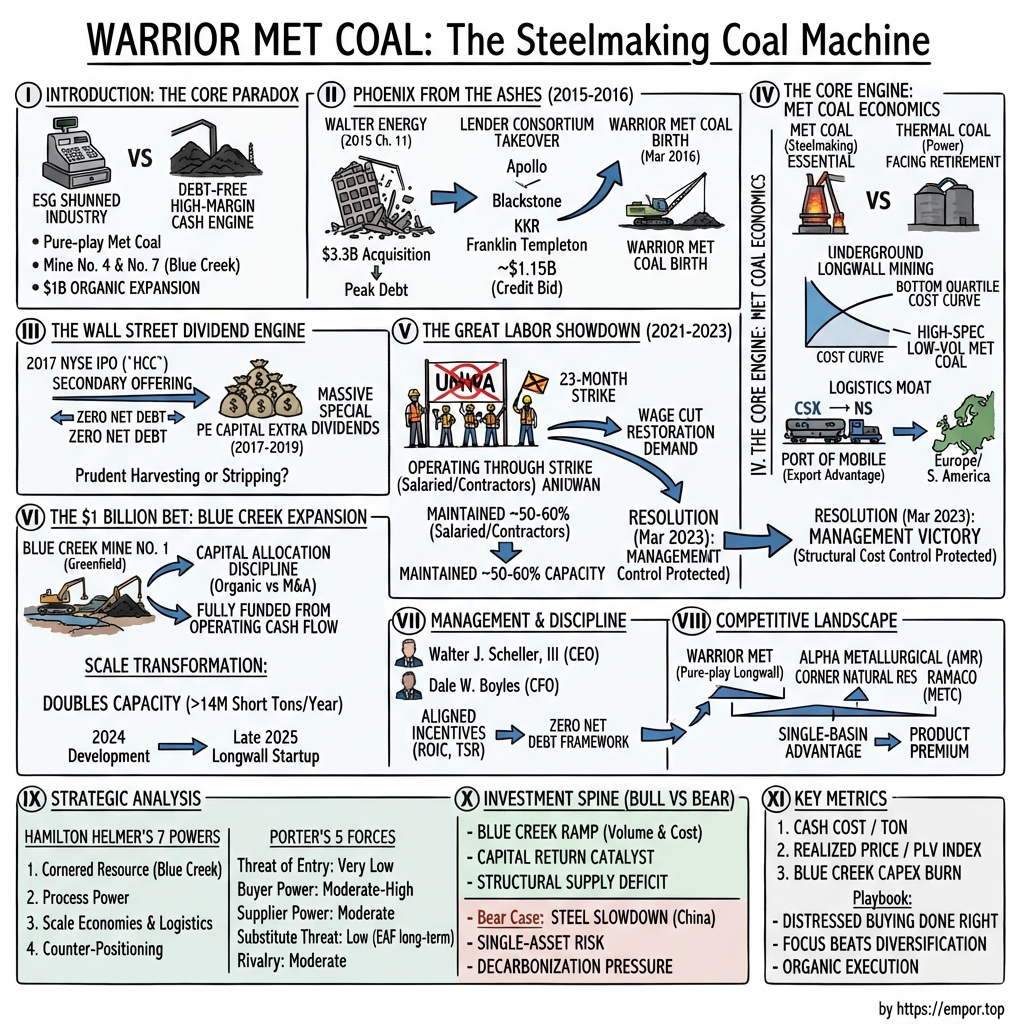
Warrior Met Coal: The Steelmaking Coal Machine
I. Introduction & Episode Roadmap
Drive west out of Birmingham, Alabama on Interstate 20/59, exit at Brookwood, and the landscape yields little indication of major industry. Pine scrub lines a two-lane road near a sign for Highway 216. There is no sprawling corporate campus, glass tower, or logo visible from the highway. The registered headquarters of a company valued at roughly $4.9 billion sits at 16243 Highway 216 in Brookwood—a modest building positioned near the mine portals it exists to serve.1
What occurs beneath that terrain stands out in modern American capital markets. Warrior Met Coal, Inc. (NYSE: HCC) extracts metallurgical coal from Tuscaloosa and Walker Counties, loads it onto CSX and Norfolk Southern railcars, transports it to the Port of Mobile, and ships it to steel producers in India, Japan, Brazil, Poland, and Germany. Roughly 99% of its production is exported.1 The company employs more than 1,485 people, with no thermal coal business, no retail distribution, and no secondary segment diversification.1 For most of the past decade, it has operated as one of the most efficient cash generators listed on the New York Stock Exchange.
The underlying model is more complex than a standard commodity cycle narrative. Warrior was created out of a Chapter 11 bankruptcy restructuring by a consortium of distressed-debt investment funds. When the company completed its initial public offering, it received no primary proceeds.2 Over its first three years as a public entity, Warrior distributed approximately $1.4 billion to shareholders—a cumulative payout exceeding its market capitalization at the IPO—funding a significant share of those distributions through debt rather than operational cash flow alone.34 It subsequently navigated one of the longest labor strikes in modern Alabama history and has operated for more than five years without a ratified contract covering the majority of its workforce.1 During the commodity price surge of 2022 through 2025, management elected not to pursue corporate acquisitions, focusing instead on developing a major greenfield mine.
That project—the Blue Creek mine—defines the company's outlook in August 2026. Its longwall mining system began production in October 2025, eight months ahead of the initial project timeline.5 Final construction outlays concluded in the first quarter of 2026. In the quarter that just closed, Warrior generated $103.4 million in free cash flow, representing its first substantial positive cash generation since capital expenditure on the project began.6 The company has reached the point where its core capital allocation strategy faces operational and financial validation.
This analysis centers on four primary questions:
How does a lender consortium turn a Chapter 11 collapse into a pure-play export business? The answer centers on a Section 363 bankruptcy sale, a legal process that enabled the buyers to acquire core operating assets while leaving historic liabilities behind, laying the foundation for Warrior's structural cost profile.
What actually makes metallurgical coal different from thermal coal, and how durable is that difference? This distinction determines whether Warrior operates a declining asset base or supplies a specialized industrial input with a multi-decade operational horizon.
Did management win the strike, or just outlast it? Beyond the operational outcome, the key issue is what that protracted dispute cost in reputation, political standing, and long-term labor stability.
Was the $1 billion organic bet the right call? Management brought the project online ahead of schedule, but final capital expenditures exceeded original guidance by approximately 50%. Reconciling those two facts provides insight into the company's operational execution and capital discipline.
The story begins where every major corporate restructuring starts: with someone else's catastrophe.
 Subscribe on LinkedIn
II. Phoenix from the Ashes: The Walter Energy Collapse & Private Equity Rebirth (2015–2016)
In the spring of 2011, Walter Energy was briefly a Wall Street favorite. Metallurgical coal prices had spiked past $300 per metric ton after catastrophic flooding in Queensland knocked out a major portion of global supply. With Chinese steel production expanding rapidly, mining executives aggressively pursued hard coking coal assets regardless of price.
At the peak of that cycle, Walter Energy acquired Western Coal Corp. for roughly $3.3 billion, funding the transaction with heavy debt. It proved to be a classic top-of-cycle acquisition—a strategic bet that collapsed under the weight of the market downturn that followed.
What followed was one of the steepest price drops in modern commodity history. Benchmark coking coal plunged from more than $300 per metric ton to under $80. While market prices fell, Walter Energy’s debt remained, alongside mounting legacy obligations: retiree healthcare, pension liabilities, and black lung benefits accumulated over decades of underground mining in Alabama. Confronted with high fixed costs, heavy leverage, and falling revenue, Walter Energy filed for Chapter 11 protection in the U.S. Bankruptcy Court for the Northern District of Alabama on July 15, 2015.7
The credit bid
The restructuring illustrated the unique mechanics of distressed asset purchases under U.S. bankruptcy law. When a company enters Chapter 11, senior secured lenders hold significant leverage as creditors backed by collateral. Under Section 363 of the Bankruptcy Code, lenders can bid for those assets using their existing debt as currency in what is known as a credit bid, acquiring collateral by canceling outstanding debt rather than deploying new capital. Crucially, a Section 363 sale allows buyers to acquire assets free and clear of most historical claims, leaving legacy liabilities with the bankruptcy estate.
On November 5, 2015, Walter Energy entered into a stalking-horse asset purchase agreement with Coal Acquisition LLC—a Delaware entity formed by its senior lender group that was later renamed Warrior Met Coal, LLC. The purchase consideration comprised approximately $5.4 million in cash alongside a credit bid of first-lien claims totaling roughly $1.15 billion.7 The bankruptcy court approved the sale on January 8, 2016, and the transaction closed on March 31, 2016.3
The lender consortium included prominent distressed credit investors, including funds affiliated with Apollo Global Management, Blackstone’s GSO Capital Partners, and KKR. To fund working capital and transaction expenses upon emergence, these first-lien holders injected fresh equity through rights offerings, issuing $200 million in common equity during 2016.3
What they actually bought, and what they left
The primary advantage of the transaction lay not in the purchase price, but in how the asset perimeter was defined.
Warrior acquired Walter Energy's core Alabama operations: Mine No. 4 and Mine No. 7 in Tuscaloosa County, the associated preparation plants, coalbed methane gas assets, rail and barge shipping infrastructure, and an undeveloped reserve block in the Blue Creek seam.1 The buyers excluded the Canadian operations acquired in the Western Coal transaction, the West Virginia mines, and Walter Energy's corporate debt stack. Most importantly, the transaction severed the legacy retiree healthcare and pension liabilities that had burdened the predecessor company.
The outcome was an entity operating the same underlying reserves, longwall equipment, and workforce, but unencumbered by historical liabilities. Within corporate restructuring, this represented a nearly complete reset of the company's cost structure.
The reset was not without consequence for the labor force. Under a five-year collective bargaining agreement ratified by United Mine Workers of America members on February 16, 2016, workers accepted an across-the-board wage reduction of roughly 20% along with substantial cuts to healthcare and retirement benefits.1[^8] The expiration of that five-year contract set the stage for the labor dispute examined in Section V.
The first year was ugly
The immediate post-bankruptcy period remained difficult. Over its nine months of operation in 2016, Warrior generated $369 million in revenue, resulting in a net loss of $111.5 million.8 Operating cash flow for the period stood at negative $49.9 million.3 Metallurgical coal prices had not yet recovered, leaving the lender consortium holding a still-unprofitable asset.
The market turned sharply in the second half of 2016, driven by Chinese supply restrictions and weather-related disruptions in Australia that pushed coking coal prices significantly higher. In 2017, Warrior's revenue tripled to $1.17 billion, while net income reached $455 million.8 The cyclical rebound provided rapid financial recovery for the newly equity-backed entity.
What this means analytically: The central takeaway from the transaction is that long-term value was created primarily by the legal structure rather than market timing. A Section 363 asset sale that permanently removes legacy obligations repositions an operating asset lower on the industry cost curve. While the subsequent commodity price surge provided immediate cash flow, the structural cost reduction was the result of deliberate legal engineering. Investors analyzing Warrior continue to benefit from that cost structure, even as they navigate the strained labor relations created during the same restructuring.
With a highly cash-generative asset established, the sponsor group turned its attention toward an exit strategy—setting up the events of 2017.
III. The Wall Street Dividend Engine: PE Exit & 2017 IPO
On April 12, 2017, Warrior Met Coal, LLC filed a certificate of conversion, transforming from a Delaware limited liability company into a Delaware corporation. Seven days later, on April 19, 2017, its common stock began trading on the New York Stock Exchange under the ticker HCC.3
The structure of the initial public offering reflected its primary purpose as a private equity liquidity event. The offering comprised 16,666,667 shares at $19.00 per share, with all shares sold by existing stockholders. Warrior received no primary proceeds. Net proceeds of $296.9 million—after $19.8 million in underwriting discounts—went entirely to the selling shareholders, while Warrior paid $15.9 million in offering expenses on their behalf.3 Upon closing, the company had 53,442,532 shares outstanding.
The distribution machine
Capital returns to the sponsor group began prior to the public listing. On March 31, 2017—three weeks before the IPO—the board of managers declared a cash distribution of $3.56 per unit, totaling $190 million, paid to holders of the LLC's Class A, B, and C units.3 That distribution was funded entirely from cash on hand.
Following the listing, capital payouts accelerated. In November 2017, Warrior issued senior secured notes, combining approximately $340 million in net debt proceeds with roughly $260 million of cash on hand to fund a special dividend of approximately $600 million, or $11.21 per share.4 In April 2018, the company executed a similar transaction: it issued $125 million of new 8.00% senior secured notes due 2024 and paired those proceeds with $225 million in cash to fund a $350 million special dividend of $6.53 per share, paid on April 20, 2018.4 In April 2019, the board declared an additional special dividend of $4.41 per share, bringing total dividend payments that year to $240.4 million.4
In total, Warrior distributed $796.9 million in dividends in 2017, $360.6 million in 2018, and $240.4 million in 2019. Over three years, the company returned approximately $1.4 billion to shareholders—a cumulative payout exceeding its initial public market capitalization of approximately $1 billion.3
Dividend recap or prudent harvesting?
This distribution phase presents two distinct analytical interpretations depending on whether the payouts are viewed through operational cash flow or capital structure changes.
Under the favorable interpretation, the underlying mining operations generated substantial cash. Operating cash flow reached $434.5 million in 2017, $559.4 million in 2018, and $532.8 million in 2019, while annual capital expenditures remained well below $110 million in each of those years.3 Under this view, Warrior generated cash significantly in excess of its operational requirements while maintaining its mining assets and cost discipline.
Under the critical interpretation, two of the three largest distributions were substantially debt-financed. The November 2017 dividend was more than half funded by new debt, while the April 2018 dividend was one-third debt-financed. These transactions functioned as classic dividend recapitalizations, enabling private equity sponsors to leverage the company's balance sheet and accelerate their exit returns. Although Warrior's cash flow allowed it to absorb the leverage and subsequently reduce its debt, characterization of this period as purely organic cash redistribution ignores the structural role of debt.
Debt covenants also governed the distribution timeline. In March 2019, before declaring that year's special dividend, Warrior was required under its indenture to execute a Restricted Payment Offer to repurchase outstanding notes, which unlocked a $299.4 million basket for shareholder distributions.4 Consequently, the capital return schedule was directly tied to terms negotiated with bondholders.
The exit, and what was left behind
The sponsor consortium reduced its holdings through a series of secondary offerings, largely completing its exit by 2019 and 2020. The resulting corporate profile was unusual for a recent private equity exit: a dispersed institutional shareholder base with no controlling entity, alongside substantial net operating loss (NOL) carryforwards inherited from the Walter Energy bankruptcy.
To protect these tax assets, Warrior implemented restrictive governance provisions. Its certificate of incorporation included Section 382 transfer restrictions to prevent ownership shifts that could limit NOL utilization. In February 2020, the board added an NOL rights agreement—effectively a poison pill triggered by any acquisition of 4.99% or more of outstanding shares—which was amended in 2022 and again in December 2023 to raise the exercise price to $159.00.1 Both the transfer restrictions and the rights agreement ran through April 19, 2026. By that date, federal NOLs had been fully consumed. On the Q2 2026 earnings call, management noted that roughly $900 million in state NOLs remained, but because Warrior pays no Alabama income tax, it is uncertain whether those carryforwards will ever be utilized.9
While designed to preserve tax attributes, the 4.99% threshold and six-year duration also served as a structural takeover defense. In its regulatory filings, the company acknowledged that the provisions "may make our stock less attractive to large institutional holders and limit the price that investors might be willing to pay."1
What this means analytically: The 2017–2019 period established Warrior's market reputation as a high-yield cash distribution vehicle, though that payout history relied on specific, non-recurring financial engineering. Distributions were heavily augmented by debt financing at a cyclical peak on behalf of exiting sponsors. For current investors, that historical distribution rate offers limited predictive value: the shareholder base, balance sheet, and asset profile have undergone fundamental resets, and the company's regular dividend stands at $0.08 per share per quarter.6
With the sponsors fully exited, the narrative shifts from financial engineering to the physical assets that generate operational cash flow: the underlying coal seams.
IV. The Core Engine: Metallurgical Coal Mining, Economics, & Port Logistics
Evaluating Warrior Met Coal requires understanding a distinction fundamental to coal investing: thermal coal is fuel, whereas metallurgical coal is a chemical reagent and structural material.
Thermal coal generates heat to produce steam, spin turbines, and generate electricity. Any competing energy source—natural gas, solar, wind, nuclear, or battery storage—acts as a direct substitute. Every megawatt of renewable capacity added globally compresses demand for thermal coal, giving that industry a visible terminal date.
Metallurgical coal, or coking coal, serves a completely different industrial purpose.
Why blast furnaces need this specific rock
Steelmaking begins with stripping oxygen from iron ore. In a blast furnace, carbon monoxide handles that chemical reduction. The gas is generated from coke—coal baked at roughly 1,000 degrees Celsius in an oxygen-deprived environment to drive off volatile compounds, leaving behind a porous carbon matrix.
Inside the furnace, coke performs three functions simultaneously: it provides the carbon that chemically reduces the ore, burns to supply thermal energy, and physically supports a heavy column of iron ore, limestone, and coke that can reach 30 meters high at temperatures exceeding 1,500 degrees Celsius. If the coke breaks down under extreme pressure and heat, the burden compacts, gas flow halts, and the furnace chokes.
This structural mandate restricts supply. The steel industry evaluates coking coal through Coke Strength after Reaction (CSR), measuring how well the material withstands chemical attack at furnace temperatures. Producing high-CSR coke demands rare geological characteristics—the right coal rank, precise volatile content, and minimal ash, sulfur, and phosphorus. Only a small single-digit percentage of global coal reserves meets these specifications.
Warrior produces two primary metallurgical coal grades. Mine No. 7 yields a premium low-volatility hard coking coal. The Blue Creek mine produces High Vol A, a high-volatility coking coal that commands a price premium due to its fluidity in coal blends. Steelmakers rarely use a single coal type; they craft precise blends, using High Vol A to optimize performance while incorporating lower-cost base coals.
Unlike power plants that can switch rapidly between coal and natural gas, blast furnaces cannot easily change reducing agents. Replacing blast furnace capacity requires alternative technologies, such as electric arc furnaces or hydrogen-based direct reduction—capital replacement cycles measured in decades rather than quarters. This dynamic underpins the long-term durability of coking coal demand, while also defining Warrior's long-dated technology risk.
Longwall economics in plain English
Warrior operates deep underground mines in Alabama's Blue Creek seam using longwall mining, a high-volume extraction technique that dictates the company's cost structure.
In longwall mining, continuous miner machines first carve out large rectangular blocks of coal, called panels, that stretch roughly 1,000 feet wide and several miles long. A longwall mining system is then set up across the face. A rotating shearer moves back and forth, cutting coal from the seam, while hydraulic roof shields temporarily support the overhead rock. As the machine advances through the panel, the shields move forward, allowing the roof behind to collapse safely into the void.
Longwall systems require substantial capital investment to purchase and relocate, but they deliver extraction rates and seam recovery percentages unmatched by traditional room-and-pillar mining. High fixed overhead means longwall economics reward maximum throughput and penalize downtime. Relocating equipment to a new panel—a process known as a longwall move—historically caused multi-week production halts. To mitigate these disruptions, management purchased additional shield sets to enable concurrent setups and achieve near-seamless transitions, noting on the second-quarter 2026 earnings call that the impact of remaining longwall moves for the year would be "minimal, if any."9
The geology also dictates Warrior's coalbed methane operations. Because the Blue Creek seam contains high concentrations of gas, methane must be extracted prior to and during mining for underground safety. Warrior captures and commercializes this gas. However, gas sales do not represent a core growth engine: total non-coal revenue—which includes methane sales, commodity hedging results, and royalties—reached $33.0 million in 2025 compared to $25.2 million in 2024, representing a small fraction of Warrior's $1.31 billion in total revenue.18 Methane capture serves primarily as a safety requirement and modest cost offset rather than an independent commercial business.
The Mobile advantage — real, and narrower than the pitch
Coal moves from Brookwood to the McDuffie Coal Terminal at the Port of Mobile primarily by rail, with barge transport on the Black Warrior River providing a secondary route.1 Shipping from Mobile allows vessels to reach European, Mediterranean, and South American steel mills faster than shipments originating in Queensland, Australia—offering Atlantic Basin customers lower ocean freight costs and shorter transit times.
Recent operating results highlight the trade-offs of this export network. In the second quarter of 2026, Warrior shipped 50% of its volume to Asia and 35% to Europe.6 The company diverted shipments into the Pacific Basin—a market where Australian competitors hold a geographic proximity advantage—to capture favorable pricing differentials. Management noted that it had "temporarily become more profitable to sell into the Pacific Basin despite the higher freight rates."9 However, ocean freight rates to Asia rose roughly $13 per ton, or 37%, above second-quarter 2025 levels, directly compressing realized net prices.9
Single-corridor logistics also introduce operational concentration risk. Warrior relies on a single rail carrier for most shipments, warning in regulatory filings that port disruptions create vessel demurrage expenses and that "there are limited cost-effective alternatives."1 The company maintains long-term throughput agreements with rail operators, barge carriers, and the Alabama State Port Authority that include annual minimum tonnage guarantees—take-or-pay commitments that impose fixed costs even during demand downturns.1 Logistics vulnerabilities surfaced in the second quarter of 2026 when an electrical outage at the Port of Mobile briefly halted ship loading; management characterized the disruption as a brief incident with no lasting operational impact, noting that seasonal weather disruptions are routine at the port.9
Concentration on the customer side, too
Revenue remains concentrated among a small group of global steelmakers. In 2025, a single customer generated $154.2 million, or 11.9%, of total sales revenue, while 97.6% of total trade receivables at year-end were concentrated among Warrior's primary buyer group.1 For the full year 2025, geographic sales broke down as 48% to Asia, 37% to Europe, 14% to South America, and 1% to North American domestic buyers.1
What this means analytically: Warrior operates a high-fixed-cost extraction model delivering a specialized industrial input to a concentrated customer base over a single export channel. Production volume represents the central operational variable: higher throughput dilutes fixed overhead, lowers per-ton cash costs, and satisfies minimum take-or-pay freight contracts. This operating leverage explains why management directed capital and operational focus toward bringing the Blue Creek expansion online.
V. The Great Labor Showdown: The 23-Month UMWA Strike (2021–2023)
At one minute past midnight on April 1, 2021, the collective bargaining agreement that had been ratified in the shadow of the Walter Energy bankruptcy expired.1 Approximately 1,100 members of the United Mine Workers of America walked off the job at Mine No. 4 and Mine No. 7.
The grievance was not abstract, nor was it primarily about the 2021 wage rate. It stemmed from the concessions made in 2016.
Five years earlier, the miners had agreed to roughly a 20% across-the-board wage cut and substantial reductions in healthcare and retirement benefits.[^8] The rationale offered at the time was operational survival: the mines were emerging from bankruptcy, commodity markets were severely depressed, and concessions were the price of keeping the operations alive. The union's position in 2021 was straightforward: the crisis was over, the company had distributed roughly $1.4 billion to shareholders in the interim, and workers sought to restore what had been given up.[^8]
Management's position was equally straightforward, defining Chief Executive Officer Walt Scheller's approach: labor costs must be calibrated against the company's position on the global cost curve rather than temporary coal spot prices. Peak-cycle commodity prices are transient, whereas permanent labor cost increases persist. Granting structural wage increases during a market surge would carry elevated fixed costs into the next cyclical trough.
Both positions were internally coherent, but neither side possessed a mechanism to bridge the divide, initiating a prolonged standoff.
Operating through it
Warrior initially idled Mine No. 4 entirely and scaled back Mine No. 7.1 It deployed salaried staff, contractors, and replacement workers to maintain partial operations. In the first quarter of 2022, it restarted Mine No. 4.1 Production ran well below capacity for an extended period, and the company recorded discrete "business interruption expenses"—incremental safety, security, and negotiation costs—as a separate line item in its income statement.1
Tensions along the picket lines escalated during the dispute. Warrior publicly called for an end to violence on the picket line in October 2021, and an Alabama court issued injunctions limiting picketing activity. The conflict subsequently attracted national labor attention, drawing solidarity rallies well outside Alabama.
The cruellest possible timing
Then Russia invaded Ukraine in early 2022.
The resulting energy and commodity shock delivered an extraordinary financial windfall for metallurgical coal exporters. Warrior's revenue rose from $1.06 billion in 2021 to $1.74 billion in 2022, and net income went from $150.9 million to $641.3 million—the highest in the company's history.8 It generated those record profits while a substantial portion of its unionized workforce was on strike.
From a public relations standpoint, the financial surge intensified external scrutiny, framing an operational dispute as a broader debate over corporate governance and capital allocation.
On February 17, 2022, the Senate Budget Committee—chaired by Senator Bernie Sanders—held a hearing on Wall Street and private equity that used Warrior Met as its central case study.[^11] Braxton Wright, a UMWA Local 2368 member from Brookwood, testified regarding miner concessions. Senators Sanders, Elizabeth Warren, and Tammy Baldwin wrote to Apollo and Blackstone inquiring about their roles in the company.10 The chief executives of BlackRock, Blackstone, Apollo, and Warrior Met were all invited to appear, but all declined.[^11]
The framing offered at that hearing—that miners' concessions had saved the company roughly $1.1 billion while shareholders received over $1.5 billion in dividends—reflected union advocacy rather than audited accounting.[^11] However, the core facts regarding shareholder distributions established in Section III were accurate, leaving the company with limited public defense against the narrative.
The end, and the aftermath that isn't over
On February 16, 2023, UMWA International President Cecil Roberts announced an unconditional offer to return to work.1 After twenty-three months, the union ended the walkout without securing a new contract. The company's confirmation in its filings was characteristically dry: "the labor union representing certain of the Company's hourly employees announced that they were ending the strike and made an unconditional offer to return to work. The Company continues to engage in good faith efforts with the labor union to reach an agreement on a new contract."1
That sentence—"continues to engage in good faith efforts"—has now appeared in Warrior's filings, essentially unchanged, for three consecutive years. As of December 31, 2025, 56.0% of Warrior's employees were represented by the UMWA, and there was still no ratified agreement.1 More than five years after the contract expired, the majority of the workforce operates without one.
Legal and governance fallout continued after the return to work. In June 2023, a National Labor Relations Board administrative law judge found that Warrior had engaged in unfair labor practices by withholding information requested for contract negotiations.
The dispute then migrated to the corporate proxy. In 2024, the UMWA and AFL-CIO ran a solicitation campaign at Warrior's annual meeting, advancing proposals on the poison pill, proxy access, blank-check preferred stock, golden parachutes, and a third-party assessment of the company's respect for workers' rights.11 The last of these drew support from 46% of votes cast at the April 25, 2024 meeting, with both Institutional Shareholder Services and Glass Lewis recommending in favour.11 The board pre-emptively adopted new limits on executive severance and announced support for proxy access.11
What this means analytically: Management achieved its stated economic objective. Warrior's cash cost of sales per short ton was approximately $92.53 in the second quarter of 2026—a structurally competitive figure that a restored 2016 wage package would have made harder to reach.6 The balance sheet and cost profile emerged intact.
However, an investor should carry three analytical considerations forward rather than treating the issue as resolved. First, operating without a collective bargaining agreement is not stability; it represents unresolved operational risk that can re-emerge, particularly as the Blue Creek mine expands and requires additional hiring. Management noted on the Q2 2026 earnings call that the mine is "staffed to run 4 continuous miner units in longwall" but still has open positions.9 Second, a 46% vote against management on a labor-related governance proposal signals persistent shareholder scrutiny rather than routine dissent. Third, the episode demonstrated management's willingness to absorb extraordinary reputational and operational friction to defend its cost structure—a level of discipline that protects margins, but one that can create friction under changing labor market conditions.
While the strike consumed public attention, management directed capital somewhere else entirely.
VI. The $1 Billion Bet: Blue Creek Expansion & The Future Growth Catalyst
In May 2022, with metallurgical coal prices near record levels, the labor strike in its fourteenth month, and U.S. coal producers under intense shareholder pressure to prioritize stock buybacks, Warrior's board approved an unconventional capital allocation path: committing to construct a major new underground mine.
The initial project plan budgeted $650 million to $700 million in capital expenditure over five years, beginning with roughly $45 million in 2022. Development production via continuous miners was targeted for the third quarter of 2024, with longwall operations scheduled to launch in the second quarter of 2026. Management projected nameplate output of 4.8 million short tons per year of premium High Vol A coking coal over its first decade, expanding overall company production capacity by roughly 60%. Based on a long-term price assumption of $150 per metric ton, the company modeled a net present value near $1 billion and an after-tax internal rate of return of approximately 30%.12
Chief Executive Officer Walt Scheller characterized the decision as a central strategic choice, stating that "Blue Creek is truly a world-class asset and our commitment to this new initiative demonstrates our continued, highly focused business strategy as a premium pure-play met coal producer."12
Why greenfield instead of M&A
The strategic rationale for developing a greenfield asset rather than pursuing corporate acquisitions reflected specific market conditions.
In 2022, metallurgical coal assets traded at elevated valuations as Central Appalachian producers generated peak-cycle margins. Acquiring an existing producer would have required paying top-of-cycle multiples for assets with variable geology, uncertain reserve life, and operating cost structures generally higher than Warrior's longwalls.
Blue Creek presented a structural alternative. Warrior had acquired the undeveloped reserve block during the 2016 Walter Energy restructuring and subsequently spent years assembling adjacent mineral and surface rights.1 The property had been extensively explored since 1957 by U.S. Steel and subsequent operators, providing detailed geological data.1 The deposit held an estimated mine life of approximately 40 years utilizing a single longwall system.1
Conversely, greenfield mining developments carry substantial capital allocation risks. Industry precedent shows frequent exposure to cost overruns, permitting delays, geological unexpectedness, and operational ramp-up bottlenecks. Launching construction during an inflationary environment between 2022 and 2024 introduced elevated execution risk.
The budget, honestly stated
The initial cost estimates proved insufficient as project execution progressed.
In June 2023, roughly one year into construction, Warrior announced scope adjustments—primarily transportation and logistics infrastructure designed to reduce operating costs and secure redundant transit routes—that required $120 million to $130 million in additional capital. Concurrently, management cited cumulative inflation of 25% to 35% across operating and capital expenses since late 2021. These factors expanded the rebaselined project budget to between $995 million and $1.075 billion.13
The revised figure represented an approximate 50% increase over the initial capital guidance issued thirteen months prior.
Management subsequently described the project as completing within budget, a claim that holds accurate against the rebaselined guidance. Total capital outlay reached slightly over $1 billion, remaining within the revised forecast range, with the final $66 million expended in the first quarter of 2026.14 Evaluating management's capital discipline requires contextualizing both figures: while execution adhered to the revised 2023 baseline, the initial design underspecified infrastructure requirements by $120 million to $130 million, alongside post-pandemic baseline cost inflation.
What went right
Operational timeline execution and capacity expansion progressed ahead of original expectations.
On February 21, 2025, Warrior raised Blue Creek's projected nameplate capacity by 25%, increasing the target from 4.4 million to 5.4 million metric tons per year through operational refinements and technology integration. Management indicated that higher coal recovery rates and an added fourth continuous miner unit could expand capacity to approximately 6.4 million metric tons annually—raising total company capacity by 88%, from 7.3 million to 13.7 million metric tons per year.1
Longwall extraction commenced in October 2025, eight months ahead of the original schedule. Management reported that the operational ramp was "remarkably smooth, especially for a project of this scale."5 Blue Creek produced 1.3 million short tons in the fourth quarter of 2025 and generated sales of 881,000 short tons that quarter, primarily into Asia.5
During 2025, Warrior expanded its underlying resource base by securing two federal coal leases from the Bureau of Land Management. The leases added 53 million short tons of reserves and unlocked access to additional private mineral acreage.5 Following these transactions, Blue Creek held 89.2 million metric tons of recoverable reserves alongside 54.0 million metric tons of resources exclusive of reserves.1 Associated lease obligations require approximately $9 million annually over four remaining years.5
The project's financing structure remained fully organic. Construction was funded entirely through operational cash flow and existing cash reserves, avoiding debt issuance and share dilution.14 Cash balances declined from $829 million at year-end 2022 to $302 million as of June 30, 2026, while outstanding shares and long-term debt remained constant.36
The commercial test
Commercial integration posed an additional test in 2025. Because High Vol A serves as a blending component, steelmakers must conduct oven trials and technical validations before integrating a new coal specification into supply contracts.
By mid-2026, market adoption showed positive momentum. Warrior increased its full-year 2026 Blue Creek sales volume guidance to between 4.5 million and 5.0 million short tons, with roughly 90% of expected output contracted under terms where customer reception "has surpassed our high expectations."69 Scheller noted that the company had "been able to gain market share, mostly with strategic customers that recognize our differentiated value proposition."9
However, product placement has coincided with broader pricing adjustments. Because Blue Creek output consists of High Vol A coal shipped extensively into the Pacific Basin, its growing contribution lowers Warrior's average realized price per ton relative to benchmark indices, even as higher volume dilutes fixed operational costs. Gross price realization declined to 66% of the Premium Low-Volatile (PLV) index in the second quarter of 2026, down from 80% in the prior-year period.6 Management emphasized that net unit profitability remains the primary performance metric, noting that cash margin per short ton expanded 57% year-over-year to $45.9
What this means analytically: Blue Creek's construction and operational ramp surpassed industry baseline execution performance. However, capital management claims require qualification given the initial 50% budget expansion before rebaselining. Commercial acceptance is established, but long-term validation depends on whether Warrior can maintain blended cash costs per ton in the low $90 range across full commodity cycles while sustaining annual production above 13 million short tons.
VII. Current Management & Capital Allocation Discipline
Chief Executive Officer Walter J. Scheller III has spent fifteen years managing the Brookwood mining operations through two corporate structures, a Chapter 11 bankruptcy, a 23-month labor strike, and a major greenfield expansion.
Scheller's background combines engineering, legal, and executive management training. After earning a mining engineering degree from West Virginia University, he completed a law degree at Duquesne University and an MBA at the University of Pittsburgh. He held operational leadership positions at CONSOL Energy, CNX Gas, and Peabody Energy before joining Walter Energy in June 2010 as President and Chief Operating Officer of Jim Walter Resources. Appointed Chief Executive Officer of Walter Energy in September 2011—shortly after the leveraged Western Coal acquisition—he guided the predecessor through Chapter 11 bankruptcy. When senior lenders acquired the Alabama assets in 2016, they retained Scheller as Chief Executive Officer of Warrior Met Coal.15
That background informs his conservative financial approach. Having managed through a debt-driven corporate collapse, Scheller has maintained a low-leverage balance sheet.
Chief Financial Officer Dale W. Boyles joined the company in January 2017 after serving as Chief Financial Officer at Noranda Aluminum Holding Corporation and as an audit partner at KPMG.15 His accounting background is reflected in the company's financial communications, which provide detailed disclosures covering cost structures, working capital, price realizations, and index mechanics.
Reading the calls
Quarterly earnings calls provide insight into management's disclosure practices and operational priorities.
First, management sets conservative guidance targets. On the February 2026 earnings call, UBS analyst George Eadie questioned whether guidance was overly conservative after Warrior exceeded its original 2025 production forecast by 600,000 tons and beat its mid-point cost guidance by roughly $20 per ton. Boyles responded by acknowledging that "we built into the guidance, just some conservatism... And hope you're wrong on the price assumptions."5 Management subsequently raised the 2026 volume forecast twice.
Second, management maintains strict disclosure boundaries. When an analyst requested mine-by-mine shipment breakdowns on the second-quarter 2026 call, Scheller declined, stating, "No, we don't get into that much detail."9 Asked whether Blue Creek could accelerate its run rate toward 6 million tons, Scheller declined to commit to a specific date, noting only that "it's just a matter of getting the people in line."9
Third, management explicitly distinguishes between verified data and conjecture. Discussing potential price relativities for High Vol A coal on the second-quarter 2026 call, Scheller qualified his remarks by stating, "that's just speculation on my part."9 Disclosing assumptions as speculative offers investors a clear view of management's confidence levels.
Fourth, executive leadership maintained consistent capital allocation priorities during the Blue Creek construction phase. From 2023 through 2025, despite analyst queries regarding share repurchases or special dividends, management prioritized project funding. Warrior repurchased no shares in 2025 and paid $17.8 million in regular quarterly dividends—a small fraction of the $320.3 million allocated to capital expenditures that year.13
Incentives — what they actually measure
The assumption that executive compensation is directly linked to return on invested capital is refuted by regulatory filings. Warrior's 2025 annual incentive program evaluated executive performance across five metrics: Adjusted EBITDA, specific capital expenditure targets, metric tons produced, cash cost of production per metric ton, and safety performance.16
This structure operates as an operational scorecard rather than a capital-allocation benchmark. For a single-commodity mining operator, rewarding low-cost, safe volume production aligns with operational priorities, though it does not explicitly reward capital efficiency.
Capital discipline is incorporated into executive pay primarily through a specialized long-term "Transformational Award" tied to the Blue Creek expansion. This grant weighted on-time project completion at 25%, capital expenditures at 25%, and production volume at 50%, with downward modifiers for environmental and safety compliance and a total shareholder return modifier applied to Scheller's award.16 The project's early longwall start and adherence to the rebaselined capital budget triggered payouts under this framework, aligning executive compensation with the revised project parameters.
Safety performance fell short of target metrics in 2025. Warrior recorded a total reportable incident rate of 1.96 against an internal target of 1.65.16 While disclosed fully, elevated incident rates during an operational expansion represent an area requiring ongoing operational monitoring in deep underground gassy coal mining.
In 2025, Scheller's total compensation reached $7.34 million, compared to a median employee compensation of $127,757—a pay ratio of roughly 57 to 1.16 While moderate relative to broad market indices, the compensation structure remains a focal point for labor and union critics following the 2021–2023 strike. Insider equity ownership among top executives remains limited: as of March 3, 2026, Scheller held 367,793 shares out of nearly 52.8 million shares outstanding, representing an equity stake of well under 1 percent.16
The capital return framework, and what has actually happened
Management's stated capital allocation strategy emphasizes a growing regular quarterly dividend, supplemented by special distributions and share repurchases during cash-surplus periods. Scheller defended this capital return history on the first-quarter 2026 earnings call, noting, "That has done well for our shareholders that have held on to our stock over time."14
Boyles has defined target liquidity parameters as cash balances between $350 million and $400 million, with total liquidity near $500 million.9 As of June 30, 2026, cash stood at $302.3 million and total liquidity reached $452.9 million, remaining below management's stated target range.6 Long-term obligations consist of $350 million in 7.875% senior secured notes due 2028, alongside an asset-backed revolving credit facility.1
This financial position frames the company's capital return profile in mid-2026. Despite consecutive quarters of volume growth and positive free cash flow generation, Warrior has not yet resumed large-scale shareholder distributions. On July 28, 2026, the board declared a regular dividend of $0.08 per share, while share repurchases remained paused.6 Asked on the second-quarter call regarding expanding shareholder returns, Boyles stated, "We're going to have to generate that cash first and see where we go from there."9
What this means analytically: Management has established operational credibility by completing Blue Creek without debt financing while maintaining cost discipline. However, capital allocation strategy faces a crucial test. Following four years of heavy development spending, management must demonstrate whether positive operational cash flow will be systematically returned to shareholders or retained on the balance sheet. A key indicator will be execution on potential share repurchases during commodity pullbacks; as Boyles noted in February 2026, a sharp price decline would represent "a real opportunity for us to take advantage of a buyback."5 Executing counter-cyclical buybacks requires capital discipline that remains to be tested in upcoming quarters.
VIII. Competitive Landscape & Industry Dynamics
A common narrative in metallurgical coal investing frames Warrior Met Coal as the undisputed low-cost American producer operating against higher-cost peers. However, financial performance across the sector in 2025 and early 2026 reveals a more nuanced competitive landscape.
The American field
Alpha Metallurgical Resources (NYSE: AMR) remains the volume leader in the U.S. market, shipping 15.3 million tons in 2025 from its network of Central Appalachian underground and surface mines.17 Its metallurgical segment cost of coal sales averaged $101.43 per ton in the fourth quarter of 2025, with full-year 2026 guidance set at $95 to $101 per ton.17 Alpha has directed the bulk of its free cash flow toward aggressive share repurchases.
Ramaco Resources (NASDAQ: METC) represents a smaller growth operator with non-coal optionality. Ramaco reported a full-year 2025 cash mine cost of $98 per ton sold—a $7 per ton improvement year-over-year—on guided production of 3.9 million to 4.3 million tons.18 The company also holds potential upside from rare-earth element deposits at its Brook Mine in Wyoming, offering a strategic narrative distinct from Warrior's pure-play metallurgical focus.
Core Natural Resources (NYSE: CNR), created through the merger of Arch Resources and CONSOL Energy, provides broad scale across both metallurgical and thermal export markets. That dual exposure provides revenue diversification while diluting its pure-play metallurgical focus.
Evaluating Warrior against this peer group requires careful analysis of reported metrics. Warrior recorded a cash cost of sales of $92.53 per short ton in the second quarter of 2026 and $94.00 per ton in the fourth quarter of 2025.65 While these figures represent a cost advantage of $5 to $8 per ton over Alpha and Ramaco, the gap is modest rather than overwhelming. Furthermore, a portion of Warrior's second-quarter 2026 margin advantage stems from policy rather than geology: management noted that Section 45X tax credits provided a benefit of approximately $3 per ton.9
Because accounting practices and cost definitions differ across mining operators, direct cost rankings carry inherent limitations. Warrior's structural advantage relies less on a dramatically lower spot cash cost today than on the long-term economics of its asset footprint. Operating a single, highly capitalized longwall complex with a 40-year operational horizon in the Blue Creek seam allows Warrior to generate substantial volume from an established footprint. By contrast, Central Appalachian producers face continuous capital outlays to open, develop, and replace smaller mines simply to maintain baseline production. This structural distinction provides Warrior with long-term cost persistence and overhead dilution over multi-year cycles.
The global price setters
Warrior operates as a price taker in a global marketplace governed by international benchmark indices. The primary global benchmark is the Platts Premium Low Vol (PLV) FOB Australia index, driven by Queensland export volumes and dominated by major producers including the BHP Mitsubishi Alliance, Anglo American, Glencore, and Glencore's Elk Valley operations in Canada.
Warrior's realized pricing is tied directly to movements in this index, rendering profitability vulnerable to regional pricing disconnects. In the second quarter of 2026, the PLV benchmark averaged $216 per short ton, representing a 29% increase year-over-year.9 During the same period, the Australian Low Vol HCC second-tier index averaged $170 per ton, maintaining a relative pricing ratio of 79% against PLV. However, the U.S. East Coast High Vol A index—which sets pricing for the majority of Blue Creek's production—declined 7% to $143 per ton, driving its pricing relativity relative to PLV down from 92% to 66%.9 In the first quarter of 2026, that relative pricing ratio briefly hit an all-time low of 62%.14
Management attributed this widening spread to localized supply dynamics. Chief Executive Officer Walt Scheller cited new production volumes entering the Atlantic Basin—including the restart of a mine by Metinvest, the resumption of Arch's Leer South operation, and the commercial ramp of Warrior's own Blue Creek mine—as creating a temporary surplus of High Vol A coal.5 Consequently, Warrior's capacity expansion contributed directly to the pricing discount on its primary growth product. Management expects this price relativity to normalize over time, primarily through a downward adjustment in premium low-vol prices toward High Vol A rather than a substantial price surge in High Vol A.59
Demand: the China problem and the India offset
Macroeconomic demand drivers in mid-2026 reflect diverging trends across major Asian steel-producing nations.
China presents a persistent headwind for global metallurgical coal pricing. Chinese steel exports reached a record 119 million metric tons in 2025, up 7.2% year-over-year, even as domestic crude steel production contracted by 4.4%.5 This dynamic led Chinese mills to export surplus steel into international markets, placing downward pressure on global steel prices, squeezing mill operating margins, and dampening buyer appetite for imported coking coal.
India provides the primary demand offset. Indian pig iron production expanded by more than 6% in 2025 and grew an additional 2.7% during the first half of 2026, contrasting with a 1.9% contraction in global pig iron output over the same period.59 Unlike Western economies transitioning away from blast furnaces, India continues to expand primary steelmaking capacity. Warrior's commercial pivot toward Pacific Basin customers functions as a direct exposure to Indian infrastructure growth.
European markets present mixed demand signals. Management noted that trade protection measures have supported European mill utilization, while emphasizing that regional recovery "remains uneven and is not strong enough to offset weakness in other regions."9
What this means analytically: Warrior maintains a competitive cost position but does not hold an insurmountable operational lead over domestic peers. Its primary differentiation rests on asset quality, reserve scale, and mine longevity. The central medium-term risk stems not from domestic competition, but from product placement: Blue Creek's production expands into a market segment experiencing temporary oversupply—partially induced by Warrior's own volume expansion—where pricing recovery depends on Australian low-vol benchmark declines rather than independent High Vol A price appreciation.
IX. Strategic Analysis: 7 Powers & Porter's 5 Forces
Analytical frameworks provide value only when they discriminate between standard commodity operators and durable competitive franchises. Applied to Warrior Met Coal, most frameworks return a common verdict: the business remains a cyclical commodity operator possessing exceptional real estate. However, evaluating the company through targeted strategic frameworks produces several non-obvious insights.
Hamilton Helmer's 7 Powers
Cornered Resource — strong, and the primary power that clearly applies. Helmer defines a cornered resource as preferential access to a coveted asset that independently enhances business value. The Blue Creek seam fits this criterion. The High Vol A deposit contains roughly 89.2 million metric tons of recoverable reserves and supports a 40-year operational horizon under a single-longwall system. The property was explored continuously after 1957 by U.S. Steel and subsequent operators, assembled over decades of surface and mineral rights acquisitions, and further expanded through federal coal leases secured in 2025.15 Such geological assets cannot be manufactured. In an era when permitting a new underground coal mine in a developed economy requires a decade of regulatory and political navigation, acquiring or duplicating an equivalent asset footprint is virtually impossible.
Process Power — plausible, but weakly supported by empirical evidence. Warrior operates deep, highly gassy longwall mines with strong seam recovery, demonstrating clear operational competence. The Blue Creek longwall began production eight months ahead of schedule with a smooth operational ramp, projected mine capacity expanded by 25% through technology integration, and Mine No. 4 has operated above its nameplate capacity.51 However, counter-evidence requires equal consideration: the company's total reportable safety incident rate missed its 2025 internal target, while cash production costs across primary U.S. peers sit within a modest $5 to $8 per ton range of Warrior's performance.1617 Process power requires an operational advantage that competitors cannot replicate even when fully understood. Warrior demonstrates disciplined execution, but categorizing its operational methods as uncopyable remains an assertion rather than a demonstrated fact.
Scale Economies — operational at the mine level rather than the corporate level. Warrior lacks global production scale compared to international mining conglomerates. Its structural advantage stems from spreading a longwall system's high fixed costs across heavy tonnage within a single footprint, coupled with lean corporate overhead. Selling, general, and administrative expenses totaled $9.8 million in the second quarter of 2026, representing approximately 1.9% of revenue.6 This delivers cost dilution across a concentrated asset footprint rather than corporate-level buying power.
Counter-Positioning — an intriguing thesis that ultimately fails. The counter-positioning argument posits that Warrior's pure-play coking coal strategy cannot be replicated by diversified mining conglomerates without damaging their existing business models or ESG mandates. However, evidence of a valuation penalty driven by institutional exclusion is weaker than market narratives imply. According to Warrior's 2026 proxy statement, BlackRock held a 13.8% equity stake, Vanguard held 11.3%, State Street held 6.5%, and T. Rowe Price Associates held 5.1%—concentrating roughly 37% of outstanding shares among four of the world's largest institutional asset managers.16 Broad institutional exclusion does not explain the valuation multiple. Instead, major producers like BHP and Anglo American reducing coal exposure reflects a supply-side dynamic: capital withdrawal by diversified majors restricts global supply additions, supporting market pricing without constituting a true counter-positioning power.
Switching Costs — modest but meaningful. Integrated steelmakers formulate precise coal blends to maintain required coke strength in blast furnaces. Introducing a new coal grade requires technical trials and blast-furnace validation—a qualification process Warrior undertook for Blue Creek output throughout 2025 and early 2026. Once a specific coal is integrated into a mill's operational blend, replacing it creates technical risk for furnace performance. While distinct from software-style customer lock-in, these technical requirements help explain why Warrior contracted roughly 90% of its expected 2026 sales volume before the year began.6
Branding and Network Economies — absent. International steel producers purchase coking coal strictly based on technical specifications and delivered cost rather than brand equity, and the utility of the product to one buyer is unaffected by adoption among other mills.
Porter's Five Forces
Threat of new entrants — extremely low, representing the primary structural barrier protecting the industry. Developing a new greenfield longwall mine requires approximately $1 billion in capital outlays, up to a decade of permitting processes, access to high-CSR coal reserves, and established rail and port logistics. Warrior's Blue Creek project—situated on reserves acquired out of bankruptcy, adjacent to existing operations, with geological data dating to the 1950s—still required more than $1 billion in cumulative capital and years of construction. A new entrant starting without existing infrastructure faces significantly steeper financial and regulatory hurdles, compounded by restrictive commercial bank financing policies toward coal projects.
Bargaining power of buyers — moderate to high, with increasing buyer leverage during volume expansions. Warrior sells to consolidated global steel producers, including ArcelorMittal, Nippon Steel, Tata Steel, and POSCO. In 2025, a single customer accounted for 11.9% of total company revenue.1 Scarcity of high-CSR coking coal provides a partial offset to customer concentration. However, pricing realization data from 2026 illustrates the boundary of that pricing power: when additional High Vol A supply entered the market, buyers rapidly negotiated lower relative price realization against benchmark indices.
Bargaining power of suppliers — moderate, characterized by equipment concentration and unresolved labor dynamics. Longwall mining machinery is manufactured by a limited group of global equipment vendors possessing notable pricing leverage. Management cited cost inflation across steel roof supports, tungsten drill bits imported from China, and diesel fuel heading into 2026, anticipating an aggregate cost impact of several dollars per ton.914 Regarding labor, Warrior demonstrated during the 2021–2023 strike that it could maintain partial production with replacement personnel and non-union staff, curbing union leverage. However, operating for more than five years without a ratified collective bargaining agreement leaves labor risk suppressed rather than permanently resolved.
Threat of substitutes — low over short-to-medium horizons, but structurally significant over long-term timelines. Electric arc furnaces utilizing recycled steel scrap already account for the majority of U.S. steel production without consuming coking coal, while commercial hydrogen-based direct reduced iron technology presents a long-term alternative to traditional blast furnaces. In its regulatory filings, Warrior acknowledges that should commercial technologies emerge that utilize alternative materials or diminish required coal volumes, "demand and price for our steelmaking coal might fall."1 Transition timelines remain constrained over coming decades by global scrap availability, green hydrogen costs, and the immense capital expense required to replace global blast furnace infrastructure. Nevertheless, underwriting a mine with a 40-year operational life requires navigating a technology transition that could materialize within that operational timeframe.
Competitive rivalry — moderate, manifesting through volume expansion rather than direct price competition. In a market governed by published benchmark indices, producers rarely undercut prices directly. Instead, rivalry manifests through production volume decisions, as illustrated by the regional High Vol A supply expansion that emerged in 2026.
Net assessment: Warrior possesses one primary competitive power in its Cornered Resource at Blue Creek, qualified Process Power, formidable barriers to new entry, and a multi-decade substitution risk. The company operates a high-quality asset within a structurally constrained commodity sector rather than a compounding business franchise—a distinction that dictates how investors evaluate its capital allocation and valuation multiple.
X. Bear vs. Bull Case & The Investment Spine
Why Warrior wins from here
The operational expansion is realized, not projected. Warrior's sales volumes set records for four consecutive quarters, reaching 3.7 million short tons in the second quarter of 2026, up from 2.2 million short tons a year earlier.6 Full-year sales guidance stands at 13 million to 14 million short tons, with Blue Creek expected to supply 5 million short tons, roughly 90% of which is already contracted.6 The expansion expands total nameplate mining capacity by 88%.1 These operational milestones reduce execution risk relative to prior periods.
Margin expansion is matching management's operational thesis. Cash cost per short ton declined 9% year-over-year to $92.53 in the second quarter of 2026, allowing cash margin per ton to rise 57% to $45, even as gross price realization fell from 80% to 66% of the benchmark index.69 The second-quarter results offer initial operational proof that Blue Creek's lower operating cost structure can offset realized price discounts on High Vol A coal.
The capital cycle has shifted from heavy investment to cash generation. Free cash flow reached $103.4 million in the second quarter of 2026, recovering from negative $56.7 million a year earlier as capital expenditures fell from $94.3 million to $18.3 million.6 Ongoing annual capital requirements are projected to stabilize between $130 million and $150 million, including sustaining spend at Blue Creek.9 In a mid-cycle pricing environment, this lower capital intensity leaves significant residual cash.
Supply-side constraints support medium-term pricing durability. Prolonged global underinvestment, complex permitting environments, and strategic exits by diversified mining conglomerates restrict potential supply additions. The High Vol A oversupply observed in 2026 reflects temporary mine restarts and project ramps rather than a permanent structural surplus of premium coking coal.
Legislative policy provides a temporary cash flow tailwind. Metallurgical coal production qualified for the Section 45X advanced manufacturing production credit under the One Big Beautiful Bill Act at 2.5% of production costs, contributing approximately $3 per short ton, or roughly $40 million annually to operational cash flow.13195 Additionally, the legislation capped federal coal lease royalty rates at 7% through 2034, reducing future obligations on Warrior's newly acquired Bureau of Land Management leases.1
Why it may not
The Section 45X tax credit is temporary. The credit applies only to metallurgical coal produced between 2026 and 2029.19 Approximately $3 per short ton of Warrior's current margin advantage relies on federal tax policy rather than structural mining efficiency, introducing policy risk upon its expiration.
Price realizations may remain compressed. Management's baseline outlook assumes that second-tier pricing relativities "will remain at depressed levels relative to the PLV as observed for the past several quarters," warning that this spread "could put pressure on our net selling prices, profitability and free cash flow generation in the second half of the year as compared to the first half."9 Management explicitly noted that historical gross realizations of 80% to 85% relative to the benchmark index are not achievable in 2026.5 Persistent discounts on High Vol A coal leave margin expansion dependent almost entirely on cost containment.
Chinese steel exports create macro headwinds. A record 119 million metric tons of Chinese steel exports in 2025 depressed global mill margins and reduced appetite for imported coking coal, exposing international producers to trade policy responses and output controls from Beijing.5
Logistical bottlenecks expose operations to single-corridor risk. Warrior transports its output over a single rail corridor to one Gulf Coast port facility under take-or-pay throughput agreements that enforce minimum financial commitments during transit disruptions.1 Severe weather or operational outages at the Port of Mobile directly affect quarterly shipment volumes.
Unresolved labor relations create operational friction. Operating for over five years without a collective bargaining agreement for 56.0% of the workforce represents persistent labor risk.1 Expanding production at Blue Creek requires ongoing hiring, a challenge Chief Executive Officer Walt Scheller acknowledged while noting open positions on the second-quarter 2026 call.9
Long-term demand faces technology transition risk. Near-term cash flow strength does not eliminate terminal value risks associated with a 40-year mine asset, as global steelmakers evaluate long-term transitions toward direct reduced iron and electric arc furnace technology.
The activist stress test
A skeptical institutional investor evaluating Warrior's capital allocation and governance record would highlight six core vulnerabilities in a letter to the board:
On capital return execution: Management signaled a free cash flow inflection upon Blue Creek's completion. When free cash flow reached $103.4 million in the second quarter of 2026, the board declared a $0.08 per share regular dividend while share repurchases remained paused.6 With cash balances standing at $302.3 million against management's target range of $350 million to $400 million, shareholders require explicit parameters defining when surplus cash will be distributed.96
On the project budget baseline: Executive disclosures cite Blue Creek's delivery on budget. However, project outlays were measured against a rebaselined June 2023 estimate of $995 million to $1.075 billion, which exceeded the original May 2022 guidance of $650 million to $700 million by approximately 50%.1213 Evaluations under the executive Transformational Award measured capital management performance against that expanded secondary threshold.16
On takeover defenses and tax attributes: The board maintained a 4.99% rights agreement for six years to protect net operating loss carryforwards that have been fully utilized at the federal level and may never yield tax benefits at the state level.19 Company filings conceded that these ownership restrictions could depress equity valuation, raising questions about whether successive extensions were justified solely on tax grounds.
On labor relations: At the 2024 annual meeting, 46% of votes cast supported a shareholder proposal requesting an independent assessment of worker rights, backed by both major proxy advisory firms.11 Over five years after contract expiration, 56.0% of the workforce operates without a collective bargaining agreement.
On counter-cyclical execution: Management identified severe commodity pullbacks as opportunities for counter-cyclical share repurchases.5 Yet when the stock touched a twelve-month low of $54.66,20 Warrior executed zero share repurchases in 2025.1
On operational safety metrics: The company recorded a total reportable incident rate of 1.96 in 2025 against an internal target of 1.65 during an active operational expansion in deep underground mines.16
The valuation frame — and a myth worth correcting
The myth: Environmental, social, and governance (ESG) mandates broadly exclude institutional investors from holding Warrior stock, permanently depressing its valuation multiple.
The reality: Four major institutional asset managers—BlackRock, Vanguard, State Street, and T. Rowe Price—collectively held approximately 37% of outstanding shares as of early 2026.16 Concentrated value managers also hold substantial stakes; Dalal Street, LLC owned roughly 3.4% of the company at the close of the first quarter of 2026, representing nearly 40% of its disclosed U.S. equity portfolio.21 As of August 7, 2026, the stock traded at $91.97—near the upper half of its 52-week range of $54.66 to $110.39—giving the company a market capitalization of approximately $4.86 billion.20
The structural constraint on Warrior's valuation is not institutional exclusion, but asset duration. Commodity producers with finite reserve lives and limited reinvestment opportunities beyond their core asset footprint trade at modest earnings multiples because equity markets discount long-term terminal value. Consequently, investors evaluate Warrior as a cash-distribution vehicle rather than a compounding growth franchise. As Blue Creek transitions into steady-state production, capital allocation discipline and the credibility of shareholder distributions will determine investment performance.
XI. Key Metrics & Playbook Lessons
The three numbers that matter
1. Cash cost of sales per short ton, FOB port. This is the central operating metric. It determines whether Warrior generates cash when benchmark prices sit at $150 per metric ton or only when they reach $220, serving as the direct operational test of the Blue Creek thesis. Full-year 2026 guidance is set between $95 and $105 per short ton.6 In the second quarter of 2026, the metric came in at $92.53 per short ton.6 Two underlying dynamics require attention: investors should deduct the roughly $3 per ton Section 45X tax credit benefit for a baseline comparison, while recognizing that the cost metric moves partly alongside coal prices because rail freight and royalty expenses rise with benchmark indices—meaning a higher per-ton cost during a market rally does not automatically signal operational weakness.95
2. Gross price realization versus the Platts PLV index. This metric measures whether Warrior's product mix commands the pricing premium assumed in original project models. Realization deteriorated from 80% to 66% over the past year, and management explicitly deferred its long-term target of 80% to 85%.65 The trajectory of U.S. East Coast High Vol A pricing relative to the premium low-volatile benchmark remains critical—that single relationship determines whether Blue Creek drives margin expansion or simply volume growth.
3. Free cash flow converted into distributions. The key indicator is conversion efficiency rather than baseline cash generation alone. First-half 2026 free cash flow stood at $11 million, generated entirely during the second quarter.6 The core analytical question is what percentage of second-half cash flow will be returned to shareholders rather than retained on the balance sheet. This represents the primary policy area where management's stated capital allocation strategy remains to be tested.
Playbook lessons
Legal structure can create more durable value than dealmaking. The most consequential milestone in Warrior's history was not an operational turnaround, but a Section 363 credit bid that isolated tier-one mining assets from legacy liabilities. Investors evaluating post-restructuring equities should examine what the buyer acquired and what legacy claims were left behind. Warrior's structural cost profile stems directly from that legal reset—as do its ongoing labor relations, which represent the opposite side of the same transaction.
Focus is a cost strategy, not a marketing position. Warrior's selling, general, and administrative expenses remain below 2% of revenue because the business relies on a single commodity, one geographical basin, a single export corridor, and one strategic focus. Diversified mining operators maintain corporate overhead to manage self-imposed operational complexity. The strategic trade-off is absolute: operating without business segment diversification leaves no operational buffer when single-commodity market cycles turn downward.
Organic development can beat M&A—when you already own the resource. Developing Blue Creek as a greenfield project succeeded over corporate acquisitions because Warrior already owned the mineral rights, possessed seven decades of geological drilling data, and could integrate the mine into existing rail, port, and workforce infrastructure. This does not represent a blanket argument for greenfield development over strategic acquisitions; rather, it demonstrates the value of building where an operator holds clear informational and infrastructure advantages, while acquiring where those advantages are absent.
Believe stated budgets less than stated schedules. Warrior brought Blue Creek online eight months ahead of its original timeline while exceeding its initial capital budget by approximately 50%. That pattern—strong operational engineering combined with cost underestimation in an inflationary environment—is common across capital-intensive resource projects. When management reports project completion within budget, investors must examine whether performance is measured against initial guidance or a subsequent upward revision.
And discipline is only observable through a full cycle. Warrior declined to pursue overpriced corporate acquisitions during the 2022 commodity boom, avoided taking on leverage to accelerate share buybacks, and resisted long-term wage concessions at the top of the market cycle. While those choices protected balance sheet flexibility, the company has operated for most of its public existence in either an asset-construction phase or a private-equity-mandated distribution phase. As a self-directed public entity with a fully operational asset base, leadership has not yet navigated the choice between accumulating cash reserves, scaling shareholder returns, or deploying capital into new initiatives. That decision will unfold over upcoming quarters, defining the company's long-term corporate identity.
References
-
Warrior Met Coal, Inc. Annual Report on Form 10-K for the fiscal year ended December 31, 2025 — U.S. Securities and Exchange Commission, 2026-02-12 ↩↩↩↩↩↩↩↩↩↩↩↩↩↩↩↩↩↩↩↩↩↩↩↩↩↩↩↩↩↩↩↩↩↩↩↩↩↩
-
Warrior Met Coal Announces Closing of Its Initial Public Offering — Warrior Met Coal, 2017-04-19 ↩
-
Warrior Met Coal, Inc. Annual Report on Form 10-K for the fiscal year ended December 31, 2017 — U.S. Securities and Exchange Commission, 2018-02-14 ↩↩↩↩↩↩↩↩↩↩↩
-
Warrior Met Coal, Inc. Annual Report on Form 10-K for the fiscal year ended December 31, 2020 — U.S. Securities and Exchange Commission, 2021-02-24 ↩↩↩↩↩
-
Warrior Met Coal Fourth Quarter and Full Year 2025 Earnings Conference Call Transcript — Seeking Alpha, 2026-02-12 ↩↩↩↩↩↩↩↩↩↩↩↩↩↩↩↩↩↩↩↩
-
Warrior Reports Second Quarter 2026 Results (Form 8-K, Exhibit 99.1) — U.S. Securities and Exchange Commission, 2026-08-05 ↩↩↩↩↩↩↩↩↩↩↩↩↩↩↩↩↩↩↩↩↩↩
-
Walter Energy, Inc. Current Report on Form 8-K regarding the sale of Alabama assets to Warrior Met Coal — U.S. Securities and Exchange Commission, 2016 ↩↩
-
Warrior Met Coal, Inc. SEC Filings and Financial Statements (CIK 0001691303) — U.S. Securities and Exchange Commission ↩↩↩↩
-
Warrior Met Coal Second Quarter 2026 Earnings Conference Call Transcript — Seeking Alpha, 2026-08-05 ↩↩↩↩↩↩↩↩↩↩↩↩↩↩↩↩↩↩↩↩↩↩↩↩↩↩↩↩
-
Warren, Sanders, Baldwin Question Private Equity Firms Apollo and Blackstone on Warrior Met Coal Amid Ongoing Worker Strikes — Office of U.S. Senator Elizabeth Warren ↩
-
UMWA and AFL-CIO Conclude Historic Proxy Contest at Warrior Met Coal, Inc. — United Mine Workers of America, 2024 ↩↩↩↩
-
Warrior to invest $700m in new US met coal mine — Mining Weekly, 2022-05-04 ↩↩↩
-
Warrior Met Coal, Inc. Quarterly Report on Form 10-Q for the quarter ended June 30, 2023 — U.S. Securities and Exchange Commission, 2023 ↩↩↩
-
Warrior Met Coal First Quarter 2026 Earnings Conference Call Transcript — Seeking Alpha, 2026-04-30 ↩↩↩↩↩
-
Warrior Met Coal, Inc. Definitive Proxy Statement on Schedule 14A — U.S. Securities and Exchange Commission, 2022-03-15 ↩↩
-
Warrior Met Coal, Inc. 2026 Definitive Proxy Statement on Schedule 14A — U.S. Securities and Exchange Commission, 2026-03-10 ↩↩↩↩↩↩↩↩↩↩
-
Alpha Announces Financial Results for Fourth Quarter and Full Year 2025 — Alpha Metallurgical Resources, 2026 ↩↩↩
-
Ramaco Resources Reports Fourth Quarter and Full-Year 2025 Results — PR Newswire, 2026 ↩
-
Navigating the One Big Beautiful Bill Act: Metallurgical Coal Added as "Critical Mineral" for Section 45X Tax Credits — Hunton Andrews Kurth LLP, 2025 ↩↩
-
Warrior Met Coal, Inc. (HCC) Company Profile and Market Data — Reuters ↩↩
-
Form 13F institutional holdings filings for Warrior Met Coal, Inc. (CUSIP 93627C101), quarter ended March 31, 2026 — U.S. Securities and Exchange Commission ↩
 LinkedIn
 WhatsApp
 Reddit
 Hacker News
 Email
Email Kindle
 RSS Feed
 Spotify
 Apple Podcasts
 Amazon Music
 Audible
 YouTube